Search Results: "az"

28 October 2022

Shirish Agarwal: Shantaram, The Pyramid, Japan s Hikikomori & Backpack

Shantaram I know I have been quite behind in review of books but then that s life. First up is actually not as much as a shocker but somewhat of a pleasant surprise. So, a bit of background before I share the news. If you have been living under a rock, then about 10-12 years ago a book called Shantaram was released. While the book is said to have been released in 2003/4 I got it in my hand around 2008/09 or somewhere around that. The book is like a good meal, a buffet. To share the synopsis, Lin a 20 something Australian guy gets involved with a girl, she encourages him to get into heroin, he becomes a heroin user. And drugs, especially hard drugs need constant replenishment, it is a chemical thing. So, to fund those cravings, he starts to steal, rising to rob a bank and while getting away shoots a cop who becomes dead. Now either he surrenders or is caught is unclear, but he is tortured in the jail. So one day, he escapes from prison, lands up at home of somebody who owes him a favor, gets some money, gets a fake passport and lands up in Mumbai/Bombay as it was then known. This is from where the actual story starts. And how a 6 foot something Australian guy relying on his street smartness and know how the transformation happens from Lin to Shantaram. Now what I have shared is perhaps just 5% of the synopsis, as shared the real story starts here. Now the good news, last week 4 episodes of Shantaram were screened by Apple TV. Interestingly, I have seen quite a number people turning up to buy or get this book and also sharing it on Goodreads. Now there seems to have been some differences from the book to TV. Now I m relying on 10-12 year back memory but IIRC Khaderbhai, one of the main characters who sort of takes Lin/Shantaram under his wing is an Indian. In the series, he is a western or at least looks western/Middle Eastern to me. Also, they have tried to reproduce 1980s in Mumbai/Bombay but dunno how accurate they were  My impression of that city from couple of visits at that point in time where they were still more tongas (horse-ridden carriages), an occasional two wheelers and not many three wheelers. Although, it was one of the more turbulent times as lot of agitation for worker rights were happening around that time and a lot of industrial action. Later that led to lot of closure of manufacturing in Bombay and it became more commercial. It would be interesting to know whether they shot it in actual India or just made a set somewhere in Australia, where it possibly might have been shot. The chawl of the book needs a bit of arid land and Australia has lots of it. It is also interesting as this was a project that had who s who interested in it for a long time but somehow none of them was able to bring the project to fruition, the project seems to largely have an Australian cast as well as second generations of Indians growing in Australia. To take names, Amitabh Bacchan, Johnny Depp, Russel Crowe each of them wanted to make it into a feature film. In retrospect, it is good it was not into a movie, otherwise they would have to cut a lot of material and that perhaps wouldn t have been sufficient. Making it into a web series made sure they could have it in multiple seasons if people like it. There is a lot between now and 12 episodes to even guess till where it would leave you then. So, if you have not read the book and have some holidays coming up, can recommend it. The writing IIRC is easy and just flows. There is a bit of action but much more nuance in the book while in the web series they are naturally more about action. There is also quite a bit of philosophy between him and Kaderbhai and while the series touches upon it, it doesn t do justice but then again it is being commercially made. Read the book, see the series and share your thoughts on what you think. It is possible that the series might go up or down but am sharing from where I see it, may do another at the end of the season, depending on where they leave it and my impressions. Update A slight update from the last blog post. Seems Rishi Sunak seems would be made PM of UK. With Hunt as chancellor and Rishi Sunak, Austerity 2.0 seems complete. There have been numerous articles which share how austerity gives rises to fascism and vice-versa. History gives lot of lessons about the same. In Germany, when the economy was not good, it was all blamed on the Jews for number of years. This was the reason for rise of Hitler, and while it did go up by a bit, propaganda by him and his loyalists did the rest. And we know and have read about the Holocaust. Today quite a few Germans deny it or deny parts of it but that s how misinformation spreads. Also Hitler is looked now more as an aberration rather than something to do with the German soul. I am not gonna talk more as there is still lots to share and that actually perhaps requires its own blog post to do justice for the same.

The Pyramid by Henning Mankell I had actually wanted to review this book but then the bomb called Shantaram appeared and I had to post it above. I had read two-three books before it, but most of them were about multiple beheadings and serial killers. Enough to put anybody into depression. I do not know if modern crime needs to show crime and desperation of and to such a level. Why I and most loved and continue to love Sherlock Holmes as most stories were not about gross violence but rather a homage to the art of deduction, which pretty much seems to be missing in modern crime thrillers rather than grotesque stuff. In that, like a sort of fresh air I read/am reading the Pyramid by Henning Mankell. The book is about a character made by Monsieur Henning Mankell named Kurt Wallender. I am aware of the series called Wallender but haven t yet seen it. The book starts with Wallender as a beat cop around age 20 and on his first case. He is ambitious, wants to become a detective and has a narrow escape with death. I wouldn t go much into it as it basically gives you an idea of the character and how he thinks and what he does. He is more intuitive by nature and somewhat of a loner. Probably most detectives IRL are, dunno, have no clue. At least in the literary world it makes sense, in real world think there would be much irony for sure. This is speculation on my part, who knows. Back to the book though. The book has 5 stories a sort of prequel one could say but also not entirely true. The first case starts when he is a beat cop in 1969 and he is just a beat cop. It is a kind of a prequel and a kind of an anthology as he covers from the first case to the 1990s where he is ending his career sort of. Before I start sharing about the stories in the book, I found the foreword also quite interesting. It asks questions about the interplay of the role of welfare state and the Swedish democracy. Incidentally did watch couple of videos about a sort of mixed sort of political representation that happens in Sweden. It uses what is known as proportional representation. Ironically, Sweden made a turn to the far right this election season. The book was originally in Swedish and were translated to English by Ebba Segerberg and Laurie Thompson. While all the stories are interesting, would share the last three or at least ask the questions of intrigue. Of course, to answer them you would need to read the book  So the last three stories I found the most intriguing. The first one is titled Man on the Beach. Apparently, a gentleman goes to one of the beaches, a sort of lonely beach, hails a taxi and while returning suddenly dies. The Taxi driver showing good presence of mind takes it to hospital where the gentleman is declared dead on arrival. Unlike in India, he doesn t run away but goes to the cafeteria and waits there for the cops to arrive and take his statement. Now the man is in his early 40s and looks to be fit. Upon searching his pockets he is found to relatively well-off and later it turns out he owns a couple of shops. So then here are the questions ? What was the man doing on a beach, in summer that beach is somewhat popular but other times not so much, so what was he doing there? How did he die, was it a simple heart attack or something more? If he had been drugged or something then when and how? These and more questions can be answered by reading the story Man on the Beach . 2. The death of a photographer Apparently, Kurt lives in a small town where almost all the residents have been served one way or the other by the town photographer. The man was polite and had worked for something like 40 odd years before he is killed/murdered. Apparently, he is murdered late at night. So here come the questions a. The shop doesn t even stock any cameras and his cash box has cash. Further investigation reveals it is approximate to his average takeout for the day. So if it s not for cash, then what is the motive ? b. The body was discovered by his cleaning staff who has worked for almost 20 years, 3 days a week. She has her own set of keys to come and clean the office? Did she give the keys to someone, if yes why? c. Even after investigation, there is no scandal about the man, no other woman or any vices like gambling etc. that could rack up loans. Also, nobody seems to know him and yet take him for granted till he dies. The whole thing appears to be quite strange. Again, the answers lie in the book. 3. The Pyramid Kurt is sleeping one night when the telephone rings. The scene starts with a Piper Cherokee, a single piston aircraft flying low and dropping something somewhere or getting somebody from/on the coast of Sweden. It turns and after a while crashes. Kurt is called to investigate it. Turns out, the plane was supposed to be destroyed. On crash, both the pilot and the passenger are into pieces so only dental records can prove who they are. Same day or a day or two later, two seemingly ordinary somewhat elderly women, spinsters, by all accounts, live above the shop where they sell buttons and all kinds of sewing needs of the town. They seem middle-class. Later the charred bodies of the two sisters are found :(. So here come the questions a.Did the plane drop something or pick something somebody up ? The Cherokee is a small plane so any plane field or something it could have landed up or if a place was somehow marked then could be dropped or picked up without actually landing. b. The firefighter suspects arson started at multiple places with the use of petrol? The question is why would somebody wanna do that? The sisters don t seem to be wealthy and practically everybody has bought stuff from them. They weren t popular but weren t also unpopular. c. Are the two crimes connected or unconnected? If connected, then how? d. Most important question, why the title Pyramid is given to the story. Why does the author share the name Pyramid. Does he mean the same or the original thing? He could have named it triangle. Again, answers to all the above can be found in the book. One thing I also became very aware of during reading the book that it is difficult to understand people s behavior and what they do. And this is without even any criminality involved in. Let s say for e.g. I die in some mysterious circumstances, the possibility of the police finding my actions in last days would be limited and this is when I have hearing loss. And this probably is more to do with how our minds are wired. And most people I know are much more privacy conscious/aware than I am.

Japan s Hikikomori Japan has been a curious country. It was more or less a colonizer and somewhat of a feared power till it dragged the U.S. unnecessarily in World War 2. The result of the two atom bombs and the restitution meant that Japan had to build again from the ground up. It is also in a seismically unstable place as they have frequent earthquakes although the buildings are hardened/balanced to make sure that vibrations don t tear buildings apart. Had seen years ago on Natgeo a documentary that explains all that. Apart from that, Japan was helped by the Americans and there was good kinship between them till the 1980s till it signed the Plaza Accord which enhanced asset price bubbles that eventually burst. Something from which they are smarting even today. Japan has a constitutional monarchy. A somewhat history lesson or why it exists even today can be found here. Asset price bubbles of the 1980s, more than 50 percent of the population on zero hour contracts and the rest tend to suffer from overwork. There is a term called Karoshi that explains all. An Indian pig-pen would be two, two and a half times larger than a typical Japanese home. Most Japanese live in micro-apartments called konbachiku . All of the above stresses meant that lately many young Japanese people have become Hikikomori. Bloomberg featured about the same a couple of years back. I came to know about it as many Indians are given the idea of Japan being a successful country without knowing the ills and issues it faces. Even in that most women get the wrong end of the short stick i.e. even it they manage to find jobs, it would be most back-breaking menial work. The employment statistics of Japan s internal ministry tells its own story.

If you look at the data above, it seems that the between 2002 and 2019, the share of zero hour contracts has increased while regular work has decreased. This also means that those on the bottom of the ladder can no longer afford a home. There is and was a viral video called Lost in Manboo that went viral few years ago. It is a perfect set of storms. Add to that the Fukushima nuclear incident about which I had shared a few years ago. While the workers are blamed but all design decisions are taken by the management. And as was shown in numerous movies, documentaries etc. Interestingly, and somewhat ironically, the line workers knew the correct things to do and correct decisions to take unlike the management. The shut-ins story is almost a decade or two decades old. It is similar story in South Korea but not as depressive as the in Japan. It is somewhat depressive story but needed to be shared. The stories shared in the bloomberg article makes your heart ache

Backpacks In and around 2015, I had bought a Targus backpack, very much similar to the Targus TSB194US-70 Motor 16-inch Backpack. That bag has given me a lot of comfort over the years but now has become frayed the zip sometimes work and sometimes doesn t. Unlike those days there are a bunch of companies now operating in India. There are eight different companies that I came to know about, Aircase, Harrisons Sirius, HP Oddyssey, Mokobara, Artic Hunter, Dell Pro Hybrid, Dell Roller Backpack and lastly the Decathlon Quechua Hiking backpack 32L NH Escape 500 . Now of all the above, two backpacks seem the best, the first one is Harrisons Sirius, with 45L capacity, I don t think I would need another bag at all. The runner-up is the Decathlon Quecha Hiking Backpack 32L. One of the better things in all the bags is that all have hidden pockets for easy taking in and out of passport while having being ant-theft. I do not have to stress how stressful it is to take out the passport and put it back in. Almost all the vendors have made sure that it is not a stress point anymore. The good thing about the Quecha is that they are giving 10 years warranty, the point to be asked is if that is does the warranty cover the zip. Zips are the first thing that goes out in bags.That actually has what happened to my current bag. Decathlon has a store in Wakad, Pune while I have reached out to the gentleman in charge of Harrisons India to see if they have a reseller in Pune. So hopefully, in next one week I should have a backpack that isn t spilling with things all over the place, whichever I m able to figure out.

26 October 2022

Russ Allbery: Review: The Golden Enclaves

Review: The Golden Enclaves, by Naomi Novik
Series: The Scholomance #3
Publisher: Del Rey
Copyright: 2022
ISBN: 0-593-15836-9
Format: Kindle
Pages: 408
The Golden Enclaves is the third and concluding book of the Scholomance trilogy and picks up literally the instant after the end of The Last Graduate. The three books form a coherent and complete story that under absolutely no circumstances should be read out of order. This is an impossible review to write because everything is a spoiler. You're only going to read this book if you've read and liked the first two, and in that case you do not want to know a single detail about this book before you read it. The timing of revelations was absolutely perfect; I repeatedly figured out what was going on at exactly the same time that El did, which rarely happens in a book. (And from talking to friends I am not the only one.) If you're still deciding whether to read the series, or are deciding how to prioritize the third book, here are the things you need to know:
  1. Novik nails the ending. Absolutely knocks it out of the park.
  2. Everything is explained, and the explanation was wholly satisfying.
  3. There is more Liesel, and she's even better in the third book.
  4. El's relationship with her mother still works perfectly.
  5. Holy shit.
You can now stop reading this review here and go read, assured that this is the best work of Novik's career to date and has become my favorite fantasy series of all time, something I do not say lightly. For those who want some elaboration, I'll gush some more about this book, but the above is all you need to know. There are so many things that I loved about this series, but the most impressive to me is how each book broadens the scope of the story while maintaining full continuity with the characters and plot. Novik moves from individuals to small groups to, in this book, systems and social forces without dropping a beat and without ever losing the characters. She could have written a series only about El and her friends and it still would have been amazing, but each book takes a risky leap into a broader perspective and she pulls it off every time. This is also one of the most enjoyable first-person perspectives that I have ever read. (I think only Code Name Verity competes, and that's my favorite novel of all time.) Whether you like this series at all will depend on whether you like El, because you spend the entire series inside her head. I loved every moment of it. Novik not infrequently pauses the action to give the reader a page or four of El's internal monologue, and I not only didn't mind, I thought those were the best parts of the book. El is such a deep character: stubborn, thoughtful, sarcastic, impulsive, but also ethical and self-aware in a grudging sort of way that I found utterly compelling to read. And her friends! The friendship dynamics are so great. We sadly don't see as much of Liu in this book (for very good reasons, but I would gladly read an unnecessary sequel novella that existed just to give Liu more time with her friends), but everyone else is here, and in exchange we get much more of Liesel. There should be an Oscar for best supporting character in a novel just so that Liesel can win it. Why are there not more impatient, no-nonsense project managers in fiction? There are a couple of moments between El and Liesel that are among my favorite character interactions in fiction. This is also a series in which the author understands what the characters did in the previous books and the bonds that experience would form, and lets that influence how they interact with the rest of the world. I won't be more specific to avoid spoilers, but the characters worked so hard and were on edge for so long, and I felt like Novik understood the types of relationships that would create in a far deeper and more complex way than most novels. There are several moments in The Golden Enclaves where I paused in reading to admire how perfect the character reactions were, and how striking the contrast was with people who hadn't been through what they went through. The series as a whole is chosen-one fantasy, and if you'd told me that before I read it, I would have grimaced. But this is more evidence (which I should have learned from the romance genre) that tropes, even ones that have been written many times, do not wear out, no matter what critics will try to tell you. There's always room for a great author to pick up the whole idea, turn it sideways, and say "try looking at it from this angle." This is boarding schools, chosen one, and coming of age, with the snarky first-person voice of urban fantasy, and it respects all of those story shapes, is aware of earlier work, and turns them all into something original, often funny, startlingly insightful, and thoroughly engrossing. I am aware that anything I like this much is probably accidentally aimed at my favorite ideas as a reader and my reaction may be partly idiosyncratic. I am not at all objective, and I'm sure not everyone will like it as much as I did. But wow did I ever like this book and this series. Just the best thing I've read in a very, very long time. Highly, highly recommended. (Start at the beginning!) Rating: 10 out of 10

25 October 2022

Arturo Borrero Gonz lez: Netfilter Workshop 2022 summary

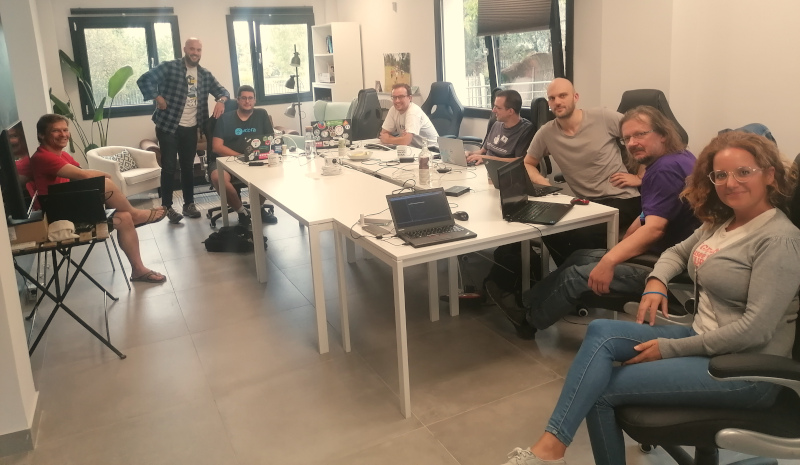
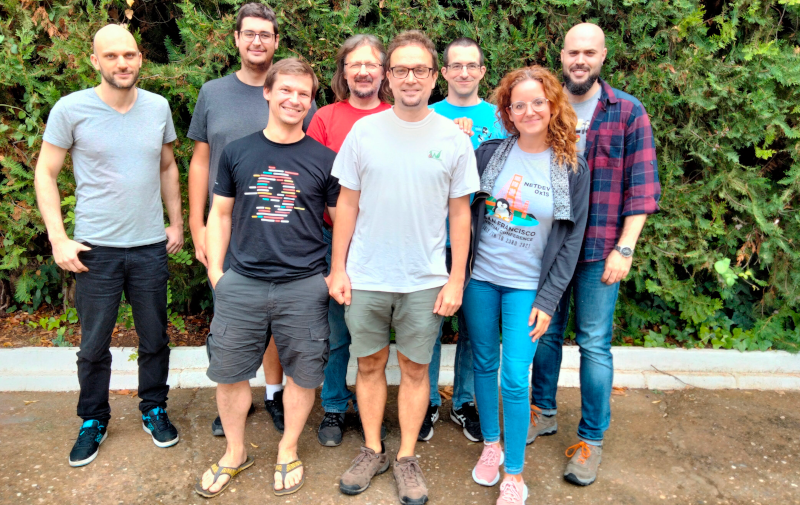
Netfilter logo This is my report from the Netfilter Workshop 2022. The event was held on 2022-10-20/2022-10-21 in Seville, and the venue was the offices of Zevenet. We started on Thursday with Pablo Neira (head of the project) giving a short welcome / opening speech. The previous iteration of this event was in virtual fashion in 2020, two years ago. In the year 2021 we were unable to meet either in person or online. This year, the number of participants was just eight people, and this allowed the setup to be a bit more informal. We had kind of an un-conference style meeting, in which whoever had something prepared just went ahead and opened a topic for debate. In the opening speech, Pablo did a quick recap on the legal problems the Netfilter project had a few years ago, a topic that was settled for good some months ago, in January 2022. There were no news in this front, which was definitely a good thing. Moving into the technical topics, the workshop proper, Pablo started to comment on the recent developments to instrument a way to perform inner matching for tunnel protocols. The current implementation supports VXLAN, IPIP, GRE and GENEVE. Using nftables you can match packet headers that are encapsulated inside these protocols. He mentioned the design and the goals, that was to have a kernel space setup that allows adding more protocols by just patching userspace. In that sense, more tunnel protocols will be supported soon, such as IP6IP, UDP, and ESP. Pablo requested our opinion on whether if nftables should generate the matching dependencies. For example, if a given tunnel is UDP-based, a dependency match should be there otherwise the rule won t work as expected. The agreement was to assist the user in the setup when possible and if not, print clear error messages. By the way, this inner thing is pure stateless packet filtering. Doing inner-conntracking is an open topic that will be worked on in the future. Pablo continued with the next topic: nftables automatic ruleset optimizations. The times of linear ruleset evaluation are over, but some people have a hard time understanding / creating rulesets that leverage maps, sets, and concatenations. This is where the ruleset optimizations kick in: it can transform a given ruleset to be more optimal by using such advanced data structures. This is purely about optimizing the ruleset, not about validating the usefulness of it, which could be another interesting project. There were a couple of problems mentioned, however. The ruleset optimizer can be slow, O(n!) in worst case. And the user needs to use nested syntax. More improvements to come in the future. Next was Stefano Brivio s turn (Red Hat engineer). He had been involved lately in a couple of migrations to nftables, in particular libvirt and KubeVirt. We were pointed to https://libvirt.org/firewall.html, and Stefano walked us through the 3 or 4 different virtual networks that libvirt can create. He evaluated some options to generate efficient rulesets in nftables to instrument such networks, and commented on a couple of ideas: having a null matcher in nftables set expression. Or perhaps having kind of subsets, something similar to a view in a SQL database. The room spent quite a bit of time debating how the nft_lookup API could be extended to support such new search operations. We also discussed if having intermediate facilities such as firewalld could provide the abstraction levels that could make developers more comfortable. Using firewalld also may have the advantage that coordination between different system components writing ruleset to nftables is handled by firewalld itself and developers are freed of the responsibility of doing it right. Next was Fernando F. Mancera (Red Hat engineer). He wanted to improve error reporting when deleting table/chain/rules with nftables. In general, there are some inconsistencies on how tables can be deleted (or flushed). And there seems to be no correct way to make a single table go away with all its content in a single command. The room agreed in that the commands destroy table and delete table should be defined consistently, with the following meanings: This topic diverted into another: how to reload/replace a ruleset but keep stateful information (such as counters). Next was Phil Sutter (Netfilter coreteam member and Red Hat engineer). He was interested in discussing options to make iptables-nft backward compatible. The use case he brought was simple: What happens if a container running iptables 1.8.7 creates a ruleset with features not supported by 1.8.6. A later container running 1.8.6 may fail to operate. Phil s first approach was to attach additional metadata into rules to assist older iptables-nft in decoding and printing the ruleset. But in general, there are no obvious or easy solutions to this problem. Some people are mixing different tooling version, and there is no way all cases can be predicted/covered. iptables-nft already refuses to work in some of the most basic failure scenarios. An other way to approach the issue could be to introduce some kind of support to print raw expressions in iptables-nft, like -m nft xyz. Which feels ugly, but may work. We also explored playing with the semantics of release version numbers. And another idea: store strings in the nft rule userdata area with the equivalent matching information for older iptables-nft. In fact, what Phil may have been looking for is not backwards but forward compatibility. Phil was undecided which path to follow, but perhaps the most common-sense approach is to fall back to a major release version bump (2.x.y) and declaring compatibility breakage with older iptables 1.x.y. That was pretty much it for the first day. We had dinner together and went to sleep for the next day. The room The second day was opened by Florian Westphal (Netfilter coreteam member and Red Hat engineer). Florian has been trying to improve nftables performance in kernels with RETPOLINE mitigations enabled. He commented that several workarounds have been collected over the years to avoid the performance penalty of such mitigations. The basic strategy is to avoid function indirect calls in the kernel. Florian also described how BPF programs work around this more effectively. And actually, Florian tried translating nf_hook_slow() to BPF. Some preliminary benchmarks results were showed, with about 2% performance improvement in MB/s and PPS. The flowtable infrastructure is specially benefited from this approach. The software flowtable infrastructure already offers a 5x performance improvement with regards the classic forwarding path, and the change being researched by Florian would be an addition on top of that. We then moved into discussing the meeting Florian had with Alexei in Zurich. My personal opinion was that Netfilter offers interesting user-facing interfaces and semantics that BPF does not. Whereas BPF may be more performant in certain scenarios. The idea of both things going hand in hand may feel natural for some people. Others also shared my view, but no particular agreement was reached in this topic. Florian will probably continue exploring options on that front. The next topic was opened by Fernando. He wanted to discuss Netfilter involvement in Google Summer of Code and Outreachy. Pablo had some personal stuff going on last year that prevented him from engaging in such projects. After all, GSoC is not fundamental or a priority for Netfilter. Also, Pablo mentioned the lack of support from others in the project for mentoring activities. There was no particular decision made here. Netfilter may be present again in such initiatives in the future, perhaps under the umbrella of other organizations. Again, Fernando proposed the next topic: nftables JSON support. Fernando shared his plan of going over all features and introduce programmatic tests from them. He also mentioned that the nftables wiki was incomplete and couldn t be used as a reference for missing tests. Phil suggested running the nftables python test-suite in JSON mode, which should complain about missing features. The py test suite should cover pretty much all statements and variations on how the nftables expression are invoked. Next, Phil commented on nftables xtables support. This is, supporting legacy xtables extensions in nftables. The most prominent problem was that some translations had some corner cases that resulted in a listed ruleset that couldn t be fed back into the kernel. Also, iptables-to-nftables translations can be sloppy, and the resulting rule won t work in some cases. In general, nft list ruleset nft -f may fail in rulesets created by iptables-nft and there is no trivial way to solve it. Phil also commented on potential iptables-tests.py speed-ups. Running the test suite may take very long time depending on the hardware. Phil will try to re-architect it, so it runs faster. Some alternatives had been explored, including collecting all rules into a single iptables-restore run, instead of hundreds of individual iptables calls. Next topic was about documentation on the nftables wiki. Phil is interested in having all nftables code-flows documented, and presented some improvements in that front. We are trying to organize all developer-oriented docs on a mediawiki portal, but the extension was not active yet. Since I worked at the Wikimedia Foundation, all the room stared at me, so at the end I kind of committed to exploring and enabling the mediawiki portal extension. Note to self: is this perhaps https://www.mediawiki.org/wiki/Portals ? Next presentation was by Pablo. He had a list of assorted topics for quick review and comment. Following this, a new topic was introduced by Stefano. He wanted to talk about nft_set_pipapo, documentation, what to do next, etc. He did a nice explanation of how the pipapo algorithm works for element inserts, lookups, and deletion. The source code is pretty well documented, by the way. He showed performance measurements of different data types being stored in the structure. After some lengthly debate on how to introduce changes without breaking usage for users, he declared some action items: writing more docs, addressing problems with non-atomic set reloads and a potential rework of nft_rbtree. After that, the next topic was kubernetes & netfilter , also by Stefano. Actually, this topic was very similar to what we already discussed regarding libvirt. Developers want to reduce packet matching effort, but also often don t leverage nftables most performant features, like sets, maps or concatenations. Some Red Hat developers are already working on replacing everything with native nftables & firewalld integrations. But some rules generators are very bad. Kubernetes (kube-proxy) is a known case. Developers simply won t learn how to code better ruleset generators. There was a good question floating around: What are people missing on first encounter with nftables? The Netfilter project doesn t have a training or marketing department or something like that. We cannot force-educate developers on how to use nftables in the right way. Perhaps we need to create a set of dedicated guidelines, or best practices, in the wiki for app developers that rely on nftables. Jozsef Kadlecsik (Netfilter coreteam) supported this idea, and suggested going beyond: such documents should be written exclusively from the nftables point of view: stop approaching the docs as a comparison to the old iptables semantics. Related to that last topic, next was Laura Garc a (Zevenet engineer, and venue host). She shared the same information as she presented in the Kubernetes network SIG in August 2020. She walked us through nftlb and kube-nftlb, a proof-of-concept replacement for kube-proxy based on nftlb that can outperform it. For whatever reason, kube-nftlb wasn t adopted by the upstream kubernetes community. She also covered latest changes to nftlb and some missing features, such as integration with nftables egress. nftlb is being extended to be a full proxy service and a more robust overall solution for service abstractions. In a nutshell, nftlb uses a templated ruleset and only adds elements to sets, which is exactly the right usage of the nftables framework. Some other projects should follow its example. The performance numbers are impressive, and from the early days it was clear that it was outperforming classical LVS-DSR by 10x. I used this opportunity to bring a topic that I wanted to discuss. I ve seen some SRE coworkers talking about katran as a replacement for traditional LVS setups. This software is a XDP/BPF based solution for load balancing. I was puzzled about what this software had to offer versus, for example, nftlb or any other nftables-based solutions. I commented on the highlighs of katran, and we discussed the nftables equivalents. nftlb is a simple daemon which does everything using a JSON-enabled REST API. It is already packaged into Debian, ready to use, whereas katran feels more like a collection of steps that you need to run in a certain order to get it working. All the hashing, caching, HA without state sharing, and backend weight selection features of katran are already present in nftlb. To work on a pure L3/ToR datacenter network setting, katran uses IPIP encapsulation. They can t just mangle the MAC address as in traditional DSR because the backend server is on a different L3 domain. It turns out nftables has a nft_tunnel expression that can do this encapsulation for complete feature parity. It is only available in the kernel, but it can be made available easily on the userspace utility too. Also, we discussed some limitations of katran, for example, inability to handle IP fragmentation, IP options, and potentially others not documented anywhere. This seems to be common with XDP/BPF programs, because handling all possible network scenarios would over-complicate the BPF programs, and at that point you are probably better off by using the normal Linux network stack and nftables. In summary, we agreed that nftlb can pretty much offer the same as katran, in a more flexible way. Group photo Finally, after many interesting debates over two days, the workshop ended. We all agreed on the need for extending it to 3 days next time, since 2 days feel too intense and too short for all the topics worth discussing. That s all on my side! I really enjoyed this Netfilter workshop round.

17 October 2022

Jeremy Bicha: Ubuntu bug fix anniversary

I first installed Ubuntu when Ubuntu 6.06 LTS Dapper Drake was released. I was brand new to Linux. This was Ubuntu s first LTS release; the very first release of Ubuntu was only a year and a half before. I was impressed by how usable and useful the system was. It soon became my primary home operating system and I wanted to help make it better. On October 15, 2009, I was helping test the release candidates ISOs for the Ubuntu 9.10 release. Specifically, I tested Edubuntu. Edubuntu has since been discontinued but at the time it was an official Ubuntu flavor preloaded with lots of education apps. One of those education apps was Moodle, an e-learning platform. When testing Moodle, I found that a default installation would make Moodle impossible to use locally. I figured out how to fix this issue. This was really exciting: I finally found an Ubuntu bug I knew how to fix. I filed the bug report. This was very late in the Ubuntu 9.10 release process and Ubuntu was in the Final Freeze state. In Final Freeze, every upload to packages included in the default install need to be individually approved by a member of the Ubuntu Release Team. Also, I didn t have upload rights to Ubuntu. Jordan Mantha (LaserJock), an Edubuntu maintainer, sponsored my bug fix upload. I also forwarded my patch to Debian. While trying to figure out what wasn t working with Moodle, I stumbled across a packaging bug. Edubuntu provided a choice of MySQL or PostgreSQL for the system default database. MySQL was the default, but if PostgreSQL were chosen instead, Moodle wouldn t work. I figured out how to fix this bug too a week later. Jordan sponsored this upload and Steve Langasek from the Release Team approved it so it also was able to be fixed before 9.10 was released. Although the first bug was new to 9.10 because of a behavior change in a low-level dependency, this PostgreSQL bug existed in stable Ubuntu releases. Therefore, I prepared Stable Release Updates for Ubuntu 9.04 and Ubuntu 8.04 LTS. Afterwards Six months later, I was able to attend my first Ubuntu Developer Summit. I was living in Bahrain (in the Middle East) at the time and a trip to Belgium seemed easier to me than if I were living in the United States where I usually live. This was the Ubuntu Developer Summit where planning for Ubuntu 10.10 took place. I like to believe that I helped with the naming since I added Maverick to the wiki page where people contribute suggestions. I did not apply for financial sponsorship to attend and I stayed in a budget hotel on the other side of Brussels. The event venue was on the outskirts of Brussels so there wasn t a direct bus or metro line to get there. I rented a car. I didn t yet have a smartphone and I had a LOT of trouble navigating to and from the site every day. I learned then that it s best to stay close to the conference site since a lot of the event is actually in the unstructured time in the evenings. Fortunately, I managed to arrive in time for Mark Shuttleworth s keynote where the Unity desktop was first announced. This was released in Ubuntu 10.10 in the Ubuntu Netbook Remix and became the default for Ubuntu Desktop in Ubuntu 11.04. Ubuntu s switch to Unity provided me with a huge opportunity. In April 2011, GNOME 3.0 was released. I wanted to try it but it wasn t yet packaged in Ubuntu or Debian. It was suggested that I could help work on packaging the major new version in a PPA. The PPA was convenient because I was able to get permission to upload there easier than being able to upload directly to Ubuntu. My contributions there then enabled me to get upload rights to the Ubuntu Desktop packages later that year. At a later Ubuntu Developer Summit, it was suggested that I start an official Ubuntu flavor for GNOME. So along with Tim Lunn (darkxst), I co-founded Ubuntu GNOME. Years later, Canonical stopped actively developing Unity; instead, Ubuntu GNOME was merged into Ubuntu Desktop. Along the way, I became an Ubuntu Core Developer and a Debian Developer. And in January 2022, I joined Canonical on the Desktop Team. This all still feels amazing to me. It took me a long time to be comfortable calling myself a developer! Conclusion My first Ubuntu bugfix was 13 years ago this week. Because Ubuntu historically uses alphabetical adjective animal release names, 13 years means that we have rolled around to the letter K again! Later today, we begin release candidate ISO testing for Ubuntu 22.10 Kinetic Kudu . I encourage you to help us test the release candidates and report bugs that you find. If you figure out how to fix a bug, we still sponsor bug fixes. If you are an Ubuntu contributor, I highly encourage you to attend an Ubuntu Summit if you can. The first Ubuntu Summit in years will be in 3 weeks in Prague, but the intent is for the Ubuntu Summits to be recurring events again.

16 October 2022

Aigars Mahinovs: Ryzen 7000 amdgpu boot hang

So you decided to build a brand new system using all the latest and coolest tech, so you buy a Ryzen 7000 series Zen 4 CPU, like the Ryzen 7700X that I picked, with a new mother board and DDR5 memory and all that jazz. But for now, you don't yet have a fitting GPU for that system (as the new ones will only come out in November), so you are booting a Debian system using the new build-in video card of the new CPUs (Zen 4 generation has a simple AMD GPU build-in into every CPU now - great stuff for debugging and mostly-headless systems) and you get ... nothing on the screen. Hmm. You boot into the rescue mode and the kernel message stop after:
Oct 16 13:31:25 home kernel: [    4.128328] amdgpu: Ignoring ACPI CRAT on non-APU system
Oct 16 13:31:25 home kernel: [    4.128329] amdgpu: Virtual CRAT table created for CPU
Oct 16 13:31:25 home kernel: [    4.128332] amdgpu: Topology: Add CPU node
That looks bad, right? Well, if you either ssh into the machine or reboot with module_blacklist=amdgpu in the kernel command line you will find in /var/log/kern.log.1 those messages and also the following messages that will clarify the situation a bit:
Oct 16 13:31:25 home kernel: [    4.129352] amdgpu 0000:10:00.0: firmware: failed to load amdgpu/psp_13_0_5_toc.bin (-2)
Oct 16 13:31:25 home kernel: [    4.129354] firmware_class: See https://wiki.debian.org/Firmware for information about missing firmware
Oct 16 13:31:25 home kernel: [    4.129358] amdgpu 0000:10:00.0: firmware: failed to load amdgpu/psp_13_0_5_toc.bin (-2)
Oct 16 13:31:25 home kernel: [    4.129359] amdgpu 0000:10:00.0: Direct firmware load for amdgpu/psp_13_0_5_toc.bin failed with error -2
Oct 16 13:31:25 home kernel: [    4.129360] amdgpu 0000:10:00.0: amdgpu: fail to request/validate toc microcode
Oct 16 13:31:25 home kernel: [    4.129361] [drm:psp_sw_init [amdgpu]] *ERROR* Failed to load psp firmware!
Oct 16 13:31:25 home kernel: [    4.129432] [drm:amdgpu_device_init.cold [amdgpu]] *ERROR* sw_init of IP block <psp> failed -2
Oct 16 13:31:25 home kernel: [    4.129525] amdgpu 0000:10:00.0: amdgpu: amdgpu_device_ip_init failed
Oct 16 13:31:25 home kernel: [    4.129526] amdgpu 0000:10:00.0: amdgpu: Fatal error during GPU init
Oct 16 13:31:25 home kernel: [    4.129527] amdgpu 0000:10:00.0: amdgpu: amdgpu: finishing device.
Oct 16 13:31:25 home kernel: [    4.129633] amdgpu: probe of 0000:10:00.0 failed with error -2
So what you need is to get a new set of Linux Kernel Firmware blobs and upack that in /lib/firmware. The tarball from 2022-10-12 worked well for me. After that you also need to re-create the initramfs with update-initramfs -k all -c to include the new firmware. Having kernel version 5.18 or newer is also required for stable Zen 4 support. It might be that a fresh Mesa version is also of importance, but as I am running sid on this machine I can only say that Mesa 22.2.1 that is in sid works fine.

Vincent Fourmond: Tutorial: analysis of multiwavelength fast kinetics data

The purpose of this post is to demonstrate a first approach to the analysis of multiwavelength kinetic data, like those obtained using stopped-flow data. To practice, we will use data that were acquired during the stopped flow practicals of the MetBio summer school from the FrenchBIC. During the practicals, the student monitored the reaction of myoglobin (in its Fe(III) state) with azide, which yields a fast and strong change in the absorbance spectrum of the protein, which was monitored using a diode array. The data is publicly available on zenodo. Aims of this tutorial The purpose of this tutorial is to teach you to use the free softwareQSoas to run a simple, multiwavelength exponential fit on the data, and to look at the results. This is not a kinetics lecture, so that it will not go in depth about the use of the exponential fit and its meaning. Getting started: loading the file First, make sure you have a working version of QSoas, you can download them (for free) there. Then download the data files from zenodo. We will work only on the data file Azide-1.25mm_001.dat, but of course, the purpose of this tutorial is to enable you to work on all of them. The data files contain the time evolution of the absorbance for all wavelengths, in a matrix format, in which each row correpond to a time point and each column to a wavelength. Start QSoas, and launch the command:
QSoas> load /comments='"'
Then, choose the Azide-1.25mm_001.dat data file. This should bring up a horizontal red line at the bottom of the data display, with X values between about 0 and 2.5. If you zoom on the red line with the mouse wheel, you'll realize it is data. The /comments='"' part is very important since it allows the extraction of the wavelength from the data. We will look at what it means another day. At this stage, you can look at the loaded data using the command:
QSoas> edit
You should have a window looking like this:
The rows each correspond to a data point displayed on the window below. The first column correspond to the X values, the second the Y values, and all the other ones to extra Y columns (they are not displayed by default). What is especially interesting is the first row, which contains a nan as the X value and what is obviously the wavelength for all the Y values. To tell that QSoas should take this line as the wavelength (which will be the perpendicular coordinate, the coordinate of the other direction of the matrix), first close the edit window and run:
QSoas> set-perp /from-row=0
Splitting and fitting Now, we have a single dataset containing a lot of Y columns. We want to fit all of them simultaneously with a (mono) exponential fit. For that, we first need to split the big matrix into a series of X,Y datasets (because fitting only works on the first Y). This is possible by running:
QSoas> expand /style=red-to-blue /flags=kinetics
Your screen should now look like this:
You're looking at the kinetics at all wavelengths at the same time (this may take some time to display on your computer, it is after all a rather large number of data points). The /style=red-to-blue is not strictly necessary, but it gives the red to blue color gradient which makes things easier to look at (and cooler !). The /flags=kinetics is there to attach a label (a flag) to the newly created datasets so we can easily manipulate all of them at the same time. Then it's time to fit, with the following command:
QSoas> mfit-exponential-decay flagged:kinetics
This should bring up a new window. After resizing it, you should have something that looks like this:
The bottom of the fit window is taken by the parameters, each with two checkboxes on the right to set them fixed (i.e. not determined by the fitting mechanism) and/or global (i.e. with a single value for all the datasets, here all the wavelengths). The top shows the current dataset along with the corresponding fit (in green), and, below, the residuals. You can change the dataset by clicking on the horizontal arrows or using Ctrl+PgUp or Ctrl+PgDown (keep holding it to scan fast). See the Z = 728.15 showing that QSoas has recognized that the currently displayed dataset corresponds to the wavelength 728.15. The equation fitted to the data is: $$y(x) = A_\infty + A_1 \times \exp -(x - x_0)/\tau_1$$ In this case, while the \(A_1\) and \(A_\infty\) parameters clearly depend on the wavelength, the time constant of evolution should be independent of wavelength (the process happens at a certain rate regardless of the wavelength we're analyzing), so that the \(\tau_1\) parameter should be common for all the datasets/wavelengths. Just click on the global checkbox at the right of the tau_1 parameter, make sure it is checked, and hit the Fit button... The fit should not take long (less than a minute), and then you end up with the results of the fits: all the parameters. The best way to look at the non global parameters like \(A_1\) and \(A_\infty\) is to use the Show Parameters item from the Parameters menu. Using it and clicking on A_inf too should give you a display like this one:
The A_inf parameter corresponds to the spectum at infinite time (of azide-bound heme), while the A_1 parameter corresponds to the difference spectrum between the initial (azide-free) and final (azide-bound) states. Now, the fit is finished, you can save the parameters if you want to reload them in a later fit by using the Parameters/Save menu item or export them in a form more suitable for plotting using Parameters/Export (although QSoas can also display and the parameters saved using Save). This concludes this first approach to fitting the data. What you can do is How to read the code above All the lines starting by QSoas> in the code areas above are meant to be typed into the QSoas command line (at the bottom of the window), and started by pressing enter at the end. You must remove the QSoas> bit. The other lines (when applicable) show you the response of QSoas, in the terminal just above the command-line. You may want to play with the QSoas tutorial to learn more about how to interact with QSoas. About QSoas QSoas is a powerful open source data analysis program that focuses on flexibility and powerful fitting capacities. It is released under the GNU General Public License. It is described in Fourmond, Anal. Chem., 2016, 88 (10), pp 5050 5052. Current version is 3.1. You can freely (and at no cost) download its source code or precompiled versions for MacOS and Windows there. Alternatively, you can clone from the GitHub repository.
Contact: find my email address there, or contact me on LinkedIn.

14 October 2022

Gunnar Wolf: Learning some Rust with Lars!

A couple of weeks ago, I read a blog post by former Debian Developer Lars Wirzenius offering a free basic (6hr) course on the Rust language to interested free software and open source software programmers. I know Lars offers training courses in programming, and besides knowing him for ~20 years and being proud to consider us to be friends, have worked with him in a couple of projects (i.e. he is upstream for vmdb2, which I maintain in Debian and use for generating the Raspberry Pi Debian images) He is a talented programmer, and a fun guy to be around. I was admitted to the first cohort of students of this course (please note I m not committing him to run free courses ever again! He has said he would consider doing so, specially to offer a different time better suited for people in Asia). I have wanted to learn some Rust for quite some time. About a year ago, I bought a copy of The Rust Programming Language, the canonical book for learning the language, and started reading it But lacked motivation and lost steam halfway through, and without having done even a simple real project beyond the simple book exercises. How has this been? I have enjoyed the course. I must admit I did expect it to be more hands-on from the beginning, but Rust is such a large language and it introduces so many new, surprising concepts. Session two did have two somewhat simple hands-on challenges; by saying they were somewhat simple does not mean we didn t have to sweat to get them to compile and work correctly! I know we will finish this Saturday, and I ll still be a complete newbie to Rust. I know the only real way to wrap my head around a language is to actually have a project that uses it And I have some ideas in mind. However, I don t really feel confident to approach an already existing project and start meddling with it, trying to contribute. What does Rust have that makes it so different? Bufff Variable ownership (borrow checking) and values lifetimes are the most obvious salient idea, but they are relatively simple, as you just cannot forget about them. But understanding (and adopting) idiomatic constructs such as the pervasive use of enums, understanding that errors always have to be catered for by using expect() and Result<T,E> It will take some time to be at ease developing in it, if I ever reach that stage! Oh, FWIW Interested related reading. I am halfway through an interesting article, published in March in the Communications of the ACM magazine, titled Here We Go Again: Why Is It Difficult for Developers to Learn Another Programming Language? , that presents an interesting point we don t always consider: If I m a proficient programmer in the X programming language and want to use the Y programming language, learning it Should be easier for me than for the casual bystander, or not? After all, I already have a background in programming! But it happens that mental constructs we build for a given language might hamper our learning of a very different one. This article presents three interesting research questions:
  1. Does cross-language interference occur?
  2. How do experienced programmers learn new languages?
  3. What do experienced programmers find confusing in new languages?
I m far from reaching the conclusions, but so far, it s been a most interesting read. Anyway, to wrap up Thanks Lars! I am learning (although at a pace that is not magically quick But I am aware of the steep learning curve of the language) quite a bit of a very interesting topic, and I m also enjoying the time I spend in front of my computer on Saturday.

10 October 2022

Ian Jackson: Skipping releases when upgrading Debian systems

Debian does not officially support upgrading from earlier than the previous stable release: you re not supposed to skip releases. Instead, you re supposed to upgrade to each intervening major release in turn. However, skipping intervening releases does, in fact, often work quite well. Apparently, this is surprising to many people, even Debian insiders. I was encouraged to write about it some more. My personal experience I have three conventionally-managed personal server systems (by which I mean systems which aren t reprovisioned by some kind of automation). Of these at least two have been skip upgraded at least once: The one I don t think I ve skip-upgraded (at least, not recently) is my house network manager (and now VM host) which I try to keep to a minimum in terms of functionality and which I keep quite up to date. It was crossgraded from i386 (32-bit) to amd64 (64-bit) fairly recently, which is a thing that Debian isn t sure it supports. The crossgrade was done a hurry and without any planning, prompted by Spectre et al suddenly requiring big changes to Xen. But it went well enough. My home does random stuff server (media server, web cache, printing, DNS, backups etc.), has etckeeper records starting in 2015. I upgraded directly from jessie (Debian 8) to buster (Debian 10). I think it has probably had earlier skip upgrade(s): the oldest file in /etc is from December 1996 and I have been doing occasional skip upgrades as long as I can remember. And of course there s chiark, which is one of the oldest Debian installs in existence. I wrote about the most recent upgrade, where I went directly from jessie i386 ELTS (32-bit Debian 8) to bulleye amd64 (64-bit Debian 11). That was a very extreme case which required significant planning and pre-testing, since the package dependencies were in no way sufficient for the proper ordering. But, I don t normally go to such lengths. Normally, even on chiark, I just edit the sources.list and see what apt proposes to do. I often skip upgrade chiark because I tend to defer risky-looking upgrades partly in the hope of others fixing the bugs while I wait :-), and partly just because change is disruptive and amortising it is very helpful both to me and my users. I have some records of chiark s upgrades from my announcements to users. As well as the recent skip skip up cross grade, direct , I definitely did a skip upgrade of chiark from squeeze (Debian 6) to jessie (Debian 8). It appears that the previous skip upgrade on chiark was rex (Debian 1.2) to hamm (Debian 2.0). I don t think it s usual for me to choose to do a multi-release upgrade the officially supported way, in two (or more) stages, on a server. I have done that on systems with a GUI desktop setup, but even then I usually skip the intermediate reboot(s). When to skip upgrade (and what precautions to take) I m certainly not saying that everyone ought to be doing this routinely. Most users with a Debian install that is older than oldstable probably ought to reinstall it, or do the two-stage upgrade. Skip upgrading almost always runs into some kind of trouble (albeit, usually trouble that isn t particularly hard to fix if you know what you re doing). However, officially supported non-skip upgrades go wrong too. Doing a two-or-more-releases upgrade via the intermediate releases can expose you to significant bugs in the intermediate releases, which were later fixed. Because Debian s users and downstreams are cautious, and Debian itself can be slow, it is common for bugs to appear for one release and then be fixed only in the next. Paradoxically, this seems to be especially true with the kind of big and scary changes where you d naively think the upgrade mechanisms would break if you skipped the release where the change first came in. I would not recommend a skip upgrade to someone who is not a competent Debian administrator, with good familiarity with Debian package management, including use of dpkg directly to fix things up. You should have a mental toolkit of manual bug workaround techniques. I always should make sure that I have rescue media (and in the case of a remote system, full remote access including ability to boot a different image), although I don t often need it. And, when considering a skip upgrade, you should be aware of the major changes that have occurred in Debian. Skip upgrading is more likely to be a good idea with a complex and highly customised system: a fairly vanilla install is not likely to encounter problems during a two-stage update. (And, a vanilla system can be upgraded by reinstalling.) I haven t recently skip upgraded a laptop or workstation. I doubt I would attempt it; modern desktop software seems to take a much harder line about breaking things that are officially unsupported, and generally trying to force everyone into the preferred mold. A request to Debian maintainers I would like to encourage Debian maintainers to defer removing upgrade compatibility machinery until it is actually getting in the way, or has become hazardous, or many years obsolete. Examples of the kinds of things which it would be nice to keep, and which do not usually cause much inconvenience to retain, are dependency declarations (particularly, alternatives), and (many) transitional fragments in maintainer scripts. If you find yourself needing to either delete some compatibility feature, or refactor/reorganise it, I think it is probably best to delete it. If you modify it significantly, the resulting thing (which won t be tested until someone uses it in anger) is quite likely to have bugs which make it go wrong more badly (or, more confusingly) than the breakage that would happen without it. Obviously this is all a judgement call. I m not saying Debian should formally support skip upgrades, to the extent of (further) slowing down important improvements. Nor am I asking for any change to the routine approach to (for example) transitional packages (i.e. the technique for ensuring continuity of installation when a package name changes). We try to make release upgrades work perfectly; but skip upgrades don t have to work perfectly to be valuable. Retaining compatibility code can also make it easier to provide official backports, and it probably helps downstreams with different release schedules. The fact that maintainers do in practice often defer removing compatibility code provides useful flexibility and options to at least some people. So it would be nice if you d at least not go out of your way to break it. Building on older releases I would also like to encourage maintainers to provide source packages in Debian unstable that will still build on older releases, where this isn t too hard and the resulting binaries might be basically functional. Speaking personally, it s not uncommon for me to rebuild packages from unstable and install them on much older releases. This is another thing that is not officially supported, but which often works well. I m not saying to contort your build system, or delay progress. You ll definitely want to depend on a recentish debhelper. But, for example, retaining old build-dependency alternatives is nice. Retaining them doesn t constitute a promise that it works - it just makes life slightly easier for someone who is going off piste. If you know you have users on multiple distros or multiple releases, and wish to fully support them, you can go further, of course. Many of my own packages are directly buildable, or even directly installable, on older releases.

comment count unavailable comments

Joachim Breitner: rec-def: Minesweeper case study

I m on the train back from MuniHac, where I gave a talk about the rec-def library that I have excessively blogged about recently (here, here, here and here). I got quite flattering comments about that talk, so if you want to see if they were sincere, I suggest you watch the recording of Getting recursive definitions off their bottoms (but it s not necessary for the following). After the talk, Franz Thoma approached me and told me a story of how we was once implementing the game Minesweeper in Haskell, and in particular the part of the logic where, after the user has uncovered a field, the game would automatically uncover all fields that are next to a neutral field, i.e. one with zero adjacent bombs. He was using a comonadic data structure, which makes a context-dependent parallel computation such as uncovering one field quite natural, and was hoping that using a suitable fix-point operator, he can elegantly obtain not just the next step, but directly the result of recursively uncovering all these fields. But, much to his disappointment, that did not work out: Due to the recursion inherent in that definition, a knot-tying fixed-point operator will lead to a cyclic definition.
Microsoft Minesweeper Microsoft Minesweeper
He was wondering if the rec-def library could have helped him, and we sat down to find out, and this is the tale of this blog post. I will avoid the comonadic abstractions and program it more naively, though, to not lose too many readers along the way. Maybe read Chris Penner s blog post and Finch s functional pearl Getting a Quick Fix on Comonads if you are curious about that angle.

Minesweeper setup Let s start with defining a suitable data type for the grid of the minesweeper board. I ll use the Array data type, it s Ix-based indexing is quite useful for grids: The library lacks a function to generate an array from a generating function, but it is easy to add: Let s also fix the size of the board, as a pair of lower and upper bounds (this is the format that the Ix type class needs): Now board is simply a grid of boolean values, with True indicating that a bomb is there: It would be nice to be able to see these board in a nicer way. So let us write A function that prints a grid, including a frame, given a function that prints something for each coordinate. Together with a function that prints a bomb (as *), we can print the board: The expression b ! c looks up a the coordinate in the array, and is True when there is a bomb at that coordinate. So here is our board, with two bombs:
ghci> putStrLn $ pBombs board1
######
#    #
#*   #
#*   #
#    #
######
But that s not what we want to show to the user: Every field should have have a number that indicates the number of bombs in the surrounding fields. To that end, we first define a function that takes a coordinate, and returns all adjacent coordinates. This also takes care of the border, using inRange: With that, we can calculate what to display in each cell a bomb, or a number: With a suitable printing function, we can now see the full board: And here it is:
ghci> putStrLn $ pBoard board1
######
#11  #
#*2  #
#*2  #
#11  #
######
Next we have to add masks: We need to keep track of which fields the user already sees. We again use a grid of booleans, and define a function to print a board with the masked fields hidden behind ?:
So this is what the user would see
ghci> putStrLn $ pMasked board1 mask1
######
#11 ?#
#????#
#????#
#????#
######

Uncovering some fields With that setup in place, we now implement the piece of logic we care about: Uncovering all fields that are next to a neutral field. Here is the first attempt: The idea is that we calculate the new mask m1 from the old one m0 by the following logic: A field is visible if it was visible before (m0 ! c), or if any of its neighboring, neutral fields are visible. This works so far: I uncovered the three fields next to the one neutral visible field:
ghci> putStrLn $ pMasked board1 $ solve0 board1 mask1
######
#11  #
#?2  #
#????#
#????#
######
But that s not quite what we want: We want to keep doing that to uncover all fields.

Uncovering all fields So what happens if we change the logic to: A field is visible if it was visible before (m0 ! c), or if any of its neighboring, neutral fields will be visible. In the code, this is just a single character change: Instead of looking at m0 to see if a neighbor is visible, we look at m1: (This is roughly what happened when Franz started to use the kfix comonadic fixed-point operator in his code, I believe.) Does it work? It seems so:
ghci> putStrLn $ pMasked board1 $ solve1 board1 mask1
######
#11  #
#?2  #
#?2  #
#?1  #
######
Amazing, isn t it! Unfortunately, it seems to work by accident. If I start with a different mask: which looks as follows:
ghci> putStrLn $ pMasked board1 mask2
######
#11??#
#????#
#????#
#??? #
######
Then our solve1 function does not work, and just sits there:
ghci> putStrLn $ pMasked board1 $ solve1 board1 mask2
######
#11^CInterrupted.
Why did it work before, but now now? It fails to work because as the code tries to figure out if a field, it needs to know if the next field will be uncovered. But to figure that out, it needs to know if the present field will be uncovered. With the normal boolean connectives ( and or), this does not make progress. It worked with mask1 more or less by accident: None of the fields on in the first column don t have neutral neighbors, so nothing happens there. And for all the fields in the third and forth column, the code will know for sure that they will be uncovered based on their upper neighbors, which come first in the neighbors list, and due to the short-circuting properties of , it doesn t have to look at the later cells, and the vicious cycle is avoided.

rec-def to the rescue This is where rec-def comes in: By using the RBool type in m1 instead of plain Bool, the recursive self-reference is not a problem, and it simply works: Note that I did not change the algorithm, or the self-reference through m1; I just replaced Bool with RBool, with RB. and or with RB.or. And used RB.get at the end to get a normal boolean out. And , here we go:
ghci> putStrLn $ pMasked board1 $ solve2 board1 mask2
######
#11  #
#?2  #
#?2  #
#?1  #
######
That s the end of this repetition of let s look at a tying-the-knot-problem and see how rec-def helps , which always end up a bit anti-climatic because it just works , at least in these cases. Hope you enjoyed it nevertheless.

9 October 2022

Emmanuel Kasper: Markdown CMS or Wiki for smallish website

Following my markdown craze, I am slowly starting to move my Dokuwiki based homesite to Grav, a flat file Markdown CMS. PHP will be always be PHP, but the documentation and usage seem sound (all config is either via an admin panel or editing YAML files) and it has professional support. I intend to use this Debian based Dockerfile and Podman to deploy Grav. Pandoc the talented document converter, hat support for Dokuwiki syntax, Markdown and PHP Markdown extra, so I expected limited hurdles when converting the data.

30 September 2022

Utkarsh Gupta: FOSS Activites in September 2022

Here s my (thirty-sixth) monthly but brief update about the activities I ve done in the F/L/OSS world.

Debian
This was my 45th month of actively contributing to Debian. I became a DM in late March 2019 and a DD on Christmas 19! \o/ There s a bunch of things I do, both, technical and non-technical. Here are the things I did this month:

Debian Uploads
  • rails (2:6.1.6.1+dfsg-2) - Add patch to allow Symbols in YAML columns, fixes #1018934.
  • rails (2:6.1.6.1+dfsg-3) - Add patch to remove active_record.yaml initializers.
  • rails (2:6.1.6.1+dfsg-4) - Add patch to allow Date, Time, ActiveSupport::HashWithIndifferentAccess in YAML columns.
  • ruby-arbre (1.4.0-2) - Add patch to use selector to detect authenticity token input.
  • ruby-net-http-digest-auth (1.4.1-1) - New upstream version, v1.4.1 to fix the FTBFS w/ rails.
  • rails (2:6.1.7+dfsg-1) - New upstream version, v6.1.7+dfsg.
  • redmine (5.0.2-1) - New upstream version, v5.0.2 + fixes for #1017525, #1019607, #1019238, and #1014813.
  • redmine (5.0.2-2) - Add patch to relax pg s version for autopkgtest.
  • ruby-json-jwt (1.14.0-2) - No-change rebuild for unstable to fix #1011682.
  • libexporter-tiny-perl (1.004002-1) - New upstream version, v1.004002.

Other $things:
  • Sponsored php-nikic-fast-route/1.3.0-4~bpo11+1 for William.
  • Being an AM for Arun Kumar, process #1024.
  • Sponsoring stuff for non-DDs.
  • Mentoring for newcomers.
  • Moderation of -project mailing list.

Ubuntu
This was my 20th month of actively contributing to Ubuntu. Now that I joined Canonical to work on Ubuntu full-time, there s a bunch of things I do! \o/ I mostly worked on different things, I guess. I was too lazy to maintain a list of things I worked on so there s no concrete list atm. Maybe I ll get back to this section later or will start to list stuff from the fall, as I was doing before. :D

Debian (E)LTS
Debian Long Term Support (LTS) is a project to extend the lifetime of all Debian stable releases to (at least) 5 years. Debian LTS is not handled by the Debian security team, but by a separate group of volunteers and companies interested in making it a success. And Debian Extended LTS (ELTS) is its sister project, extending support to the Jessie release (+2 years after LTS support). This was my thirty-sixth month as a Debian LTS and twenty-seventh month as a Debian ELTS paid contributor.
I worked for 38.00 hours for LTS and 27.00 hours for ELTS.

LTS CVE Fixes and Announcements:
  • Rolled out announcement for src:flac.
  • Rolled out announcement for src:ruby-rack.
  • Issued DLA 3128-1, fixing CVE-2020-7677, for node-thenify.
    For Debian 10 buster, these problems have been fixed in version 3.3.0-1+deb10u1.
  • Issued DLA 3129-1, fixing CVE-2019-17545 and CVE-2021-45943, for gdal.
    For Debian 10 buster, these problems have been fixed in version 2.4.0+dfsg-1+deb10u1.
  • Looked at src:mbedtls which has about 18 CVEs opened in buster (including no-dsa).
    Also, spoke to the maintainer - they said they d be uncomfortable doing or reviewing the backport (although they initially said they d be happy to help).
  • Fixed src:rails regression via 2:6.1.6.1+dfsg-2, 2:6.1.6.1+dfsg-3, and 2:6.1.6.1+dfsg-4 for sid.
    CVE-2022-32224 broke the entire world. :)
  • Helped Abhijith figure out the regression fix for CVE-2022-32224.
    Also got that verified by the people who reported regression, Raphael, Sven, and Jude. The whole thread is on debian-lts@.

ELTS CVE Fixes and Announcements:
  • Rolled out announcemnet for src:ruby-tzinfo.
  • Rolled out announcemnet for src:grubt.
  • Issued ELA 682-1, fixing CVE-2022-31676, for open-vm-tools.
    For Debian 9 stretch, these problems have been fixed in version 2:10.1.5-5055683-4+deb9u3.
  • Issued ELA 691-1, fixing CVE-2020-21365, for wkhtmltopdf.
    For Debian 8 jessie, these problems have been fixed in version 0.12.1-2+deb8u1.
    For Debian 9 stretch, these problems have been fixed in version 0.12.3.2-3+deb9u1.
  • Issued ELA 692-1, fixing CVE-2022-37452, for exim4.
    For Debian 8 jessie, these problems have been fixed in version 4.84.2-2+deb8u9.
    For Debian 9 stretch, these problems have been fixed in version 4.89-2+deb9u9.
  • Started to look at src:tiff again. Has a lot of open issues. Haven t claimed the package officially yet, though. :)

Other (E)LTS Work:
  • Triaged rails, node-thenify, exim4, wkhtmltopdf, gdal, and mbedtls.
  • Marked CVE-2019-25050/gdal as not-affected for buster.
  • Marked CVE-2022-37451/exim4 as not-affected for stretch and jessie; following buster and bullseye.
  • Helped and assisted new contributors joining Freexian (LTS/ELTS).
  • Answered questions (& discussions) on IRC (#debian-lts and #debian-elts) and Matrix.
  • Participated and helped fellow members with their queries via private mail and chat.
  • General and other discussions on LTS private and public mailing list.
  • Attended the monthly public meeting held on #debian-lts on September 29th.

Until next time.
:wq for today.

25 September 2022

Sergio Talens-Oliag: Kubernetes Static Content Server

This post describes how I ve put together a simple static content server for kubernetes clusters using a Pod with a persistent volume and multiple containers: an sftp server to manage contents, a web server to publish them with optional access control and another one to run scripts which need access to the volume filesystem. The sftp server runs using MySecureShell, the web server is nginx and the script runner uses the webhook tool to publish endpoints to call them (the calls will come from other Pods that run backend servers or are executed from Jobs or CronJobs).

HistoryThe system was developed because we had a NodeJS API with endpoints to upload files and store them on S3 compatible services that were later accessed via HTTPS, but the requirements changed and we needed to be able to publish folders instead of individual files using their original names and apply access restrictions using our API. Thinking about our requirements the use of a regular filesystem to keep the files and folders was a good option, as uploading and serving files is simple. For the upload I decided to use the sftp protocol, mainly because I already had an sftp container image based on mysecureshell prepared; once we settled on that we added sftp support to the API server and configured it to upload the files to our server instead of using S3 buckets. To publish the files we added a nginx container configured to work as a reverse proxy that uses the ngx_http_auth_request_module to validate access to the files (the sub request is configurable, in our deployment we have configured it to call our API to check if the user can access a given URL). Finally we added a third container when we needed to execute some tasks directly on the filesystem (using kubectl exec with the existing containers did not seem a good idea, as that is not supported by CronJobs objects, for example). The solution we found avoiding the NIH Syndrome (i.e. write our own tool) was to use the webhook tool to provide the endpoints to call the scripts; for now we have three:
  • one to get the disc usage of a PATH,
  • one to hardlink all the files that are identical on the filesystem,
  • one to copy files and folders from S3 buckets to our filesystem.

Container definitions

mysecureshellThe mysecureshell container can be used to provide an sftp service with multiple users (although the files are owned by the same UID and GID) using standalone containers (launched with docker or podman) or in an orchestration system like kubernetes, as we are going to do here. The image is generated using the following Dockerfile:
ARG ALPINE_VERSION=3.16.2
FROM alpine:$ALPINE_VERSION as builder
LABEL maintainer="Sergio Talens-Oliag <sto@mixinet.net>"
RUN apk update &&\
 apk add --no-cache alpine-sdk git musl-dev &&\
 git clone https://github.com/sto/mysecureshell.git &&\
 cd mysecureshell &&\
 ./configure --prefix=/usr --sysconfdir=/etc --mandir=/usr/share/man\
 --localstatedir=/var --with-shutfile=/var/lib/misc/sftp.shut --with-debug=2 &&\
 make all && make install &&\
 rm -rf /var/cache/apk/*
FROM alpine:$ALPINE_VERSION
LABEL maintainer="Sergio Talens-Oliag <sto@mixinet.net>"
COPY --from=builder /usr/bin/mysecureshell /usr/bin/mysecureshell
COPY --from=builder /usr/bin/sftp-* /usr/bin/
RUN apk update &&\
 apk add --no-cache openssh shadow pwgen &&\
 sed -i -e "s ^.*\(AuthorizedKeysFile\).*$ \1 /etc/ssh/auth_keys/%u "\
 /etc/ssh/sshd_config &&\
 mkdir /etc/ssh/auth_keys &&\
 cat /dev/null > /etc/motd &&\
 add-shell '/usr/bin/mysecureshell' &&\
 rm -rf /var/cache/apk/*
COPY bin/* /usr/local/bin/
COPY etc/sftp_config /etc/ssh/
COPY entrypoint.sh /
EXPOSE 22
VOLUME /sftp
ENTRYPOINT ["/entrypoint.sh"]
CMD ["server"]
The /etc/sftp_config file is used to configure the mysecureshell server to have all the user homes under /sftp/data, only allow them to see the files under their home directories as if it were at the root of the server and close idle connections after 5m of inactivity:
etc/sftp_config
# Default mysecureshell configuration
<Default>
   # All users will have access their home directory under /sftp/data
   Home /sftp/data/$USER
   # Log to a file inside /sftp/logs/ (only works when the directory exists)
   LogFile /sftp/logs/mysecureshell.log
   # Force users to stay in their home directory
   StayAtHome true
   # Hide Home PATH, it will be shown as /
   VirtualChroot true
   # Hide real file/directory owner (just change displayed permissions)
   DirFakeUser true
   # Hide real file/directory group (just change displayed permissions)
   DirFakeGroup true
   # We do not want users to keep forever their idle connection
   IdleTimeOut 5m
</Default>
# vim: ts=2:sw=2:et
The entrypoint.sh script is the one responsible to prepare the container for the users included on the /secrets/user_pass.txt file (creates the users with their HOME directories under /sftp/data and a /bin/false shell and creates the key files from /secrets/user_keys.txt if available). The script expects a couple of environment variables:
  • SFTP_UID: UID used to run the daemon and for all the files, it has to be different than 0 (all the files managed by this daemon are going to be owned by the same user and group, even if the remote users are different).
  • SFTP_GID: GID used to run the daemon and for all the files, it has to be different than 0.
And can use the SSH_PORT and SSH_PARAMS values if present. It also requires the following files (they can be mounted as secrets in kubernetes):
  • /secrets/host_keys.txt: Text file containing the ssh server keys in mime format; the file is processed using the reformime utility (the one included on busybox) and can be generated using the gen-host-keys script included on the container (it uses ssh-keygen and makemime).
  • /secrets/user_pass.txt: Text file containing lines of the form username:password_in_clear_text (only the users included on this file are available on the sftp server, in fact in our deployment we use only the scs user for everything).
And optionally can use another one:
  • /secrets/user_keys.txt: Text file that contains lines of the form username:public_ssh_ed25519_or_rsa_key; the public keys are installed on the server and can be used to log into the sftp server if the username exists on the user_pass.txt file.
The contents of the entrypoint.sh script are:
entrypoint.sh
#!/bin/sh
set -e
# ---------
# VARIABLES
# ---------
# Expects SSH_UID & SSH_GID on the environment and uses the value of the
# SSH_PORT & SSH_PARAMS variables if present
# SSH_PARAMS
SSH_PARAMS="-D -e -p $ SSH_PORT:=22  $ SSH_PARAMS "
# Fixed values
# DIRECTORIES
HOME_DIR="/sftp/data"
CONF_FILES_DIR="/secrets"
AUTH_KEYS_PATH="/etc/ssh/auth_keys"
# FILES
HOST_KEYS="$CONF_FILES_DIR/host_keys.txt"
USER_KEYS="$CONF_FILES_DIR/user_keys.txt"
USER_PASS="$CONF_FILES_DIR/user_pass.txt"
USER_SHELL_CMD="/usr/bin/mysecureshell"
# TYPES
HOST_KEY_TYPES="dsa ecdsa ed25519 rsa"
# ---------
# FUNCTIONS
# ---------
# Validate HOST_KEYS, USER_PASS, SFTP_UID and SFTP_GID
_check_environment()  
  # Check the ssh server keys ... we don't boot if we don't have them
  if [ ! -f "$HOST_KEYS" ]; then
    cat <<EOF
We need the host keys on the '$HOST_KEYS' file to proceed.
Call the 'gen-host-keys' script to create and export them on a mime file.
EOF
    exit 1
  fi
  # Check that we have users ... if we don't we can't continue
  if [ ! -f "$USER_PASS" ]; then
    cat <<EOF
We need at least the '$USER_PASS' file to provision users.
Call the 'gen-users-tar' script to create a tar file to create an archive that
contains public and private keys for users, a 'user_keys.txt' with the public
keys of the users and a 'user_pass.txt' file with random passwords for them 
(pass the list of usernames to it).
EOF
    exit 1
  fi
  # Check SFTP_UID
  if [ -z "$SFTP_UID" ]; then
    echo "The 'SFTP_UID' can't be empty, pass a 'GID'."
    exit 1
  fi
  if [ "$SFTP_UID" -eq "0" ]; then
    echo "The 'SFTP_UID' can't be 0, use a different 'UID'"
    exit 1
  fi
  # Check SFTP_GID
  if [ -z "$SFTP_GID" ]; then
    echo "The 'SFTP_GID' can't be empty, pass a 'GID'."
    exit 1
  fi
  if [ "$SFTP_GID" -eq "0" ]; then
    echo "The 'SFTP_GID' can't be 0, use a different 'GID'"
    exit 1
  fi
 
# Adjust ssh host keys
_setup_host_keys()  
  opwd="$(pwd)"
  tmpdir="$(mktemp -d)"
  cd "$tmpdir"
  ret="0"
  reformime <"$HOST_KEYS"   ret="1"
  for kt in $HOST_KEY_TYPES; do
    key="ssh_host_$ kt _key"
    pub="ssh_host_$ kt _key.pub"
    if [ ! -f "$key" ]; then
      echo "Missing '$key' file"
      ret="1"
    fi
    if [ ! -f "$pub" ]; then
      echo "Missing '$pub' file"
      ret="1"
    fi
    if [ "$ret" -ne "0" ]; then
      continue
    fi
    cat "$key" >"/etc/ssh/$key"
    chmod 0600 "/etc/ssh/$key"
    chown root:root "/etc/ssh/$key"
    cat "$pub" >"/etc/ssh/$pub"
    chmod 0600 "/etc/ssh/$pub"
    chown root:root "/etc/ssh/$pub"
  done
  cd "$opwd"
  rm -rf "$tmpdir"
  return "$ret"
 
# Create users
_setup_user_pass()  
  opwd="$(pwd)"
  tmpdir="$(mktemp -d)"
  cd "$tmpdir"
  ret="0"
  [ -d "$HOME_DIR" ]   mkdir "$HOME_DIR"
  # Make sure the data dir can be managed by the sftp user
  chown "$SFTP_UID:$SFTP_GID" "$HOME_DIR"
  # Allow the user (and root) to create directories inside the $HOME_DIR, if
  # we don't allow it the directory creation fails on EFS (AWS)
  chmod 0755 "$HOME_DIR"
  # Create users
  echo "sftp:sftp:$SFTP_UID:$SFTP_GID:::/bin/false" >"newusers.txt"
  sed -n "/^[^#]/   s/:/ /p  " "$USER_PASS"   while read -r _u _p; do
    echo "$_u:$_p:$SFTP_UID:$SFTP_GID::$HOME_DIR/$_u:$USER_SHELL_CMD"
  done >>"newusers.txt"
  newusers --badnames newusers.txt
  # Disable write permission on the directory to forbid remote sftp users to
  # remove their own root dir (they have already done it); we adjust that
  # here to avoid issues with EFS (see before)
  chmod 0555 "$HOME_DIR"
  # Clean up the tmpdir
  cd "$opwd"
  rm -rf "$tmpdir"
  return "$ret"
 
# Adjust user keys
_setup_user_keys()  
  if [ -f "$USER_KEYS" ]; then
    sed -n "/^[^#]/   s/:/ /p  " "$USER_KEYS"   while read -r _u _k; do
      echo "$_k" >>"$AUTH_KEYS_PATH/$_u"
    done
  fi
 
# Main function
exec_sshd()  
  _check_environment
  _setup_host_keys
  _setup_user_pass
  _setup_user_keys
  echo "Running: /usr/sbin/sshd $SSH_PARAMS"
  # shellcheck disable=SC2086
  exec /usr/sbin/sshd -D $SSH_PARAMS
 
# ----
# MAIN
# ----
case "$1" in
"server") exec_sshd ;;
*) exec "$@" ;;
esac
# vim: ts=2:sw=2:et
The container also includes a couple of auxiliary scripts, the first one can be used to generate the host_keys.txt file as follows:
$ docker run --rm stodh/mysecureshell gen-host-keys > host_keys.txt
Where the script is as simple as:
bin/gen-host-keys
#!/bin/sh
set -e
# Generate new host keys
ssh-keygen -A >/dev/null
# Replace hostname
sed -i -e 's/@.*$/@mysecureshell/' /etc/ssh/ssh_host_*_key.pub
# Print in mime format (stdout)
makemime /etc/ssh/ssh_host_*
# vim: ts=2:sw=2:et
And there is another script to generate a .tar file that contains auth data for the list of usernames passed to it (the file contains a user_pass.txt file with random passwords for the users, public and private ssh keys for them and the user_keys.txt file that matches the generated keys). To generate a tar file for the user scs we can execute the following:
$ docker run --rm stodh/mysecureshell gen-users-tar scs > /tmp/scs-users.tar
To see the contents and the text inside the user_pass.txt file we can do:
$ tar tvf /tmp/scs-users.tar
-rw-r--r-- root/root        21 2022-09-11 15:55 user_pass.txt
-rw-r--r-- root/root       822 2022-09-11 15:55 user_keys.txt
-rw------- root/root       387 2022-09-11 15:55 id_ed25519-scs
-rw-r--r-- root/root        85 2022-09-11 15:55 id_ed25519-scs.pub
-rw------- root/root      3357 2022-09-11 15:55 id_rsa-scs
-rw------- root/root      3243 2022-09-11 15:55 id_rsa-scs.pem
-rw-r--r-- root/root       729 2022-09-11 15:55 id_rsa-scs.pub
$ tar xfO /tmp/scs-users.tar user_pass.txt
scs:20JertRSX2Eaar4x
The source of the script is:
bin/gen-users-tar
#!/bin/sh
set -e
# ---------
# VARIABLES
# ---------
USER_KEYS_FILE="user_keys.txt"
USER_PASS_FILE="user_pass.txt"
# ---------
# MAIN CODE
# ---------
# Generate user passwords and keys, return 1 if no username is received
if [ "$#" -eq "0" ]; then
  return 1
fi
opwd="$(pwd)"
tmpdir="$(mktemp -d)"
cd "$tmpdir"
for u in "$@"; do
  ssh-keygen -q -a 100 -t ed25519 -f "id_ed25519-$u" -C "$u" -N ""
  ssh-keygen -q -a 100 -b 4096 -t rsa -f "id_rsa-$u" -C "$u" -N ""
  # Legacy RSA private key format
  cp -a "id_rsa-$u" "id_rsa-$u.pem"
  ssh-keygen -q -p -m pem -f "id_rsa-$u.pem" -N "" -P "" >/dev/null
  chmod 0600 "id_rsa-$u.pem"
  echo "$u:$(pwgen -s 16 1)" >>"$USER_PASS_FILE"
  echo "$u:$(cat "id_ed25519-$u.pub")" >>"$USER_KEYS_FILE"
  echo "$u:$(cat "id_rsa-$u.pub")" >>"$USER_KEYS_FILE"
done
tar cf - "$USER_PASS_FILE" "$USER_KEYS_FILE" id_* 2>/dev/null
cd "$opwd"
rm -rf "$tmpdir"
# vim: ts=2:sw=2:et

nginx-scsThe nginx-scs container is generated using the following Dockerfile:
ARG NGINX_VERSION=1.23.1
FROM nginx:$NGINX_VERSION
LABEL maintainer="Sergio Talens-Oliag <sto@mixinet.net>"
RUN rm -f /docker-entrypoint.d/*
COPY docker-entrypoint.d/* /docker-entrypoint.d/
Basically we are removing the existing docker-entrypoint.d scripts from the standard image and adding a new one that configures the web server as we want using a couple of environment variables:
  • AUTH_REQUEST_URI: URL to use for the auth_request, if the variable is not found on the environment auth_request is not used.
  • HTML_ROOT: Base directory of the web server, if not passed the default /usr/share/nginx/html is used.
Note that if we don t pass the variables everything works as if we were using the original nginx image. The contents of the configuration script are:
docker-entrypoint.d/10-update-default-conf.sh
#!/bin/sh
# Replace the default.conf nginx file by our own version.
set -e
if [ -z "$HTML_ROOT" ]; then
  HTML_ROOT="/usr/share/nginx/html"
fi
if [ "$AUTH_REQUEST_URI" ]; then
  cat >/etc/nginx/conf.d/default.conf <<EOF
server  
  listen       80;
  server_name  localhost;
  location /  
    auth_request /.auth;
    root  $HTML_ROOT;
    index index.html index.htm;
   
  location /.auth  
    internal;
    proxy_pass $AUTH_REQUEST_URI;
    proxy_pass_request_body off;
    proxy_set_header Content-Length "";
    proxy_set_header X-Original-URI \$request_uri;
   
  error_page   500 502 503 504  /50x.html;
  location = /50x.html  
    root /usr/share/nginx/html;
   
 
EOF
else
  cat >/etc/nginx/conf.d/default.conf <<EOF
server  
  listen       80;
  server_name  localhost;
  location /  
    root  $HTML_ROOT;
    index index.html index.htm;
   
  error_page   500 502 503 504  /50x.html;
  location = /50x.html  
    root /usr/share/nginx/html;
   
 
EOF
fi
# vim: ts=2:sw=2:et
As we will see later the idea is to use the /sftp/data or /sftp/data/scs folder as the root of the web published by this container and create an Ingress object to provide access to it outside of our kubernetes cluster.

webhook-scsThe webhook-scs container is generated using the following Dockerfile:
ARG ALPINE_VERSION=3.16.2
ARG GOLANG_VERSION=alpine3.16
FROM golang:$GOLANG_VERSION AS builder
LABEL maintainer="Sergio Talens-Oliag <sto@mixinet.net>"
ENV WEBHOOK_VERSION 2.8.0
ENV WEBHOOK_PR 549
ENV S3FS_VERSION v1.91
WORKDIR /go/src/github.com/adnanh/webhook
RUN apk update &&\
 apk add --no-cache -t build-deps curl libc-dev gcc libgcc patch
RUN curl -L --silent -o webhook.tar.gz\
 https://github.com/adnanh/webhook/archive/$ WEBHOOK_VERSION .tar.gz &&\
 tar xzf webhook.tar.gz --strip 1 &&\
 curl -L --silent -o $ WEBHOOK_PR .patch\
 https://patch-diff.githubusercontent.com/raw/adnanh/webhook/pull/$ WEBHOOK_PR .patch &&\
 patch -p1 < $ WEBHOOK_PR .patch &&\
 go get -d && \
 go build -o /usr/local/bin/webhook
WORKDIR /src/s3fs-fuse
RUN apk update &&\
 apk add ca-certificates build-base alpine-sdk libcurl automake autoconf\
 libxml2-dev libressl-dev mailcap fuse-dev curl-dev
RUN curl -L --silent -o s3fs.tar.gz\
 https://github.com/s3fs-fuse/s3fs-fuse/archive/refs/tags/$S3FS_VERSION.tar.gz &&\
 tar xzf s3fs.tar.gz --strip 1 &&\
 ./autogen.sh &&\
 ./configure --prefix=/usr/local &&\
 make -j && \
 make install
FROM alpine:$ALPINE_VERSION
LABEL maintainer="Sergio Talens-Oliag <sto@mixinet.net>"
WORKDIR /webhook
RUN apk update &&\
 apk add --no-cache ca-certificates mailcap fuse libxml2 libcurl libgcc\
 libstdc++ rsync util-linux-misc &&\
 rm -rf /var/cache/apk/*
COPY --from=builder /usr/local/bin/webhook /usr/local/bin/webhook
COPY --from=builder /usr/local/bin/s3fs /usr/local/bin/s3fs
COPY entrypoint.sh /
COPY hooks/* ./hooks/
EXPOSE 9000
ENTRYPOINT ["/entrypoint.sh"]
CMD ["server"]
Again, we use a multi-stage build because in production we wanted to support a functionality that is not already on the official versions (streaming the command output as a response instead of waiting until the execution ends); this time we build the image applying the PATCH included on this pull request against a released version of the source instead of creating a fork. The entrypoint.sh script is used to generate the webhook configuration file for the existing hooks using environment variables (basically the WEBHOOK_WORKDIR and the *_TOKEN variables) and launch the webhook service:
entrypoint.sh
#!/bin/sh
set -e
# ---------
# VARIABLES
# ---------
WEBHOOK_BIN="$ WEBHOOK_BIN:-/webhook/hooks "
WEBHOOK_YML="$ WEBHOOK_YML:-/webhook/scs.yml "
WEBHOOK_OPTS="$ WEBHOOK_OPTS:--verbose "
# ---------
# FUNCTIONS
# ---------
print_du_yml()  
  cat <<EOF
- id: du
  execute-command: '$WEBHOOK_BIN/du.sh'
  command-working-directory: '$WORKDIR'
  response-headers:
  - name: 'Content-Type'
    value: 'application/json'
  http-methods: ['GET']
  include-command-output-in-response: true
  include-command-output-in-response-on-error: true
  pass-arguments-to-command:
  - source: 'url'
    name: 'path'
  pass-environment-to-command:
  - source: 'string'
    envname: 'OUTPUT_FORMAT'
    name: 'json'
EOF
 
print_hardlink_yml()  
  cat <<EOF
- id: hardlink
  execute-command: '$WEBHOOK_BIN/hardlink.sh'
  command-working-directory: '$WORKDIR'
  http-methods: ['GET']
  include-command-output-in-response: true
  include-command-output-in-response-on-error: true
EOF
 
print_s3sync_yml()  
  cat <<EOF
- id: s3sync
  execute-command: '$WEBHOOK_BIN/s3sync.sh'
  command-working-directory: '$WORKDIR'
  http-methods: ['POST']
  include-command-output-in-response: true
  include-command-output-in-response-on-error: true
  pass-environment-to-command:
  - source: 'payload'
    envname: 'AWS_KEY'
    name: 'aws.key'
  - source: 'payload'
    envname: 'AWS_SECRET_KEY'
    name: 'aws.secret_key'
  - source: 'payload'
    envname: 'S3_BUCKET'
    name: 's3.bucket'
  - source: 'payload'
    envname: 'S3_REGION'
    name: 's3.region'
  - source: 'payload'
    envname: 'S3_PATH'
    name: 's3.path'
  - source: 'payload'
    envname: 'SCS_PATH'
    name: 'scs.path'
  stream-command-output: true
EOF
 
print_token_yml()  
  if [ "$1" ]; then
    cat << EOF
  trigger-rule:
    match:
      type: 'value'
      value: '$1'
      parameter:
        source: 'header'
        name: 'X-Webhook-Token'
EOF
  fi
 
exec_webhook()  
  # Validate WORKDIR
  if [ -z "$WEBHOOK_WORKDIR" ]; then
    echo "Must define the WEBHOOK_WORKDIR variable!" >&2
    exit 1
  fi
  WORKDIR="$(realpath "$WEBHOOK_WORKDIR" 2>/dev/null)"   true
  if [ ! -d "$WORKDIR" ]; then
    echo "The WEBHOOK_WORKDIR '$WEBHOOK_WORKDIR' is not a directory!" >&2
    exit 1
  fi
  # Get TOKENS, if the DU_TOKEN or HARDLINK_TOKEN is defined that is used, if
  # not if the COMMON_TOKEN that is used and in other case no token is checked
  # (that is the default)
  DU_TOKEN="$ DU_TOKEN:-$COMMON_TOKEN "
  HARDLINK_TOKEN="$ HARDLINK_TOKEN:-$COMMON_TOKEN "
  S3_TOKEN="$ S3_TOKEN:-$COMMON_TOKEN "
  # Create webhook configuration
    
    print_du_yml
    print_token_yml "$DU_TOKEN"
    echo ""
    print_hardlink_yml
    print_token_yml "$HARDLINK_TOKEN"
    echo ""
    print_s3sync_yml
    print_token_yml "$S3_TOKEN"
   >"$WEBHOOK_YML"
  # Run the webhook command
  # shellcheck disable=SC2086
  exec webhook -hooks "$WEBHOOK_YML" $WEBHOOK_OPTS
 
# ----
# MAIN
# ----
case "$1" in
"server") exec_webhook ;;
*) exec "$@" ;;
esac
The entrypoint.sh script generates the configuration file for the webhook server calling functions that print a yaml section for each hook and optionally adds rules to validate access to them comparing the value of a X-Webhook-Token header against predefined values. The expected token values are taken from environment variables, we can define a token variable for each hook (DU_TOKEN, HARDLINK_TOKEN or S3_TOKEN) and a fallback value (COMMON_TOKEN); if no token variable is defined for a hook no check is done and everybody can call it. The Hook Definition documentation explains the options you can use for each hook, the ones we have right now do the following:
  • du: runs on the $WORKDIR directory, passes as first argument to the script the value of the path query parameter and sets the variable OUTPUT_FORMAT to the fixed value json (we use that to print the output of the script in JSON format instead of text).
  • hardlink: runs on the $WORKDIR directory and takes no parameters.
  • s3sync: runs on the $WORKDIR directory and sets a lot of environment variables from values read from the JSON encoded payload sent by the caller (all the values must be sent by the caller even if they are assigned an empty value, if they are missing the hook fails without calling the script); we also set the stream-command-output value to true to make the script show its output as it is working (we patched the webhook source to be able to use this option).

The du hook scriptThe du hook script code checks if the argument passed is a directory, computes its size using the du command and prints the results in text format or as a JSON dictionary:
hooks/du.sh
#!/bin/sh
set -e
# Script to print disk usage for a PATH inside the scs folder
# ---------
# FUNCTIONS
# ---------
print_error()  
  if [ "$OUTPUT_FORMAT" = "json" ]; then
    echo " \"error\":\"$*\" "
  else
    echo "$*" >&2
  fi
  exit 1
 
usage()  
  if [ "$OUTPUT_FORMAT" = "json" ]; then
    echo " \"error\":\"Pass arguments as '?path=XXX\" "
  else
    echo "Usage: $(basename "$0") PATH" >&2
  fi
  exit 1
 
# ----
# MAIN
# ----
if [ "$#" -eq "0" ]   [ -z "$1" ]; then
  usage
fi
if [ "$1" = "." ]; then
  DU_PATH="./"
else
  DU_PATH="$(find . -name "$1" -mindepth 1 -maxdepth 1)"   true
fi
if [ -z "$DU_PATH" ]   [ ! -d "$DU_PATH/." ]; then
  print_error "The provided PATH ('$1') is not a directory"
fi
# Print disk usage in bytes for the given PATH
OUTPUT="$(du -b -s "$DU_PATH")"
if [ "$OUTPUT_FORMAT" = "json" ]; then
  # Format output as  "path":"PATH","bytes":"BYTES" 
  echo "$OUTPUT"  
    sed -e "s%^\(.*\)\t.*/\(.*\)$% \"path\":\"\2\",\"bytes\":\"\1\" %"  
    tr -d '\n'
else
  # Print du output as is
  echo "$OUTPUT"
fi
# vim: ts=2:sw=2:et:ai:sts=2

The s3sync hook scriptThe s3sync hook script uses the s3fs tool to mount a bucket and synchronise data between a folder inside the bucket and a directory on the filesystem using rsync; all values needed to execute the task are taken from environment variables:
hooks/s3sync.sh
#!/bin/ash
set -euo pipefail
set -o errexit
set -o errtrace
# Functions
finish()  
  ret="$1"
  echo ""
  echo "Script exit code: $ret"
  exit "$ret"
 
# Check variables
if [ -z "$AWS_KEY" ]   [ -z "$AWS_SECRET_KEY" ]   [ -z "$S3_BUCKET" ]  
  [ -z "$S3_PATH" ]   [ -z "$SCS_PATH" ]; then
  [ "$AWS_KEY" ]   echo "Set the AWS_KEY environment variable"
  [ "$AWS_SECRET_KEY" ]   echo "Set the AWS_SECRET_KEY environment variable"
  [ "$S3_BUCKET" ]   echo "Set the S3_BUCKET environment variable"
  [ "$S3_PATH" ]   echo "Set the S3_PATH environment variable"
  [ "$SCS_PATH" ]   echo "Set the SCS_PATH environment variable"
  finish 1
fi
if [ "$S3_REGION" ] && [ "$S3_REGION" != "us-east-1" ]; then
  EP_URL="endpoint=$S3_REGION,url=https://s3.$S3_REGION.amazonaws.com"
else
  EP_URL="endpoint=us-east-1"
fi
# Prepare working directory
WORK_DIR="$(mktemp -p "$HOME" -d)"
MNT_POINT="$WORK_DIR/s3data"
PASSWD_S3FS="$WORK_DIR/.passwd-s3fs"
# Check the moutpoint
if [ ! -d "$MNT_POINT" ]; then
  mkdir -p "$MNT_POINT"
elif mountpoint "$MNT_POINT"; then
  echo "There is already something mounted on '$MNT_POINT', aborting!"
  finish 1
fi
# Create password file
touch "$PASSWD_S3FS"
chmod 0400 "$PASSWD_S3FS"
echo "$AWS_KEY:$AWS_SECRET_KEY" >"$PASSWD_S3FS"
# Mount s3 bucket as a filesystem
s3fs -o dbglevel=info,retries=5 -o "$EP_URL" -o "passwd_file=$PASSWD_S3FS" \
  "$S3_BUCKET" "$MNT_POINT"
echo "Mounted bucket '$S3_BUCKET' on '$MNT_POINT'"
# Remove the password file, just in case
rm -f "$PASSWD_S3FS"
# Check source PATH
ret="0"
SRC_PATH="$MNT_POINT/$S3_PATH"
if [ ! -d "$SRC_PATH" ]; then
  echo "The S3_PATH '$S3_PATH' can't be found!"
  ret=1
fi
# Compute SCS_UID & SCS_GID (by default based on the working directory owner)
SCS_UID="$ SCS_UID:=$(stat -c "%u" "." 2>/dev/null) "   true
SCS_GID="$ SCS_GID:=$(stat -c "%g" "." 2>/dev/null) "   true
# Check destination PATH
DST_PATH="./$SCS_PATH"
if [ "$ret" -eq "0" ] && [ -d "$DST_PATH" ]; then
  mkdir -p "$DST_PATH"   ret="$?"
fi
# Copy using rsync
if [ "$ret" -eq "0" ]; then
  rsync -rlptv --chown="$SCS_UID:$SCS_GID" --delete --stats \
    "$SRC_PATH/" "$DST_PATH/"   ret="$?"
fi
# Unmount the S3 bucket
umount -f "$MNT_POINT"
echo "Called umount for '$MNT_POINT'"
# Remove mount point dir
rmdir "$MNT_POINT"
# Remove WORK_DIR
rmdir "$WORK_DIR"
# We are done
finish "$ret"
# vim: ts=2:sw=2:et:ai:sts=2

Deployment objectsThe system is deployed as a StatefulSet with one replica. Our production deployment is done on AWS and to be able to scale we use EFS for our PersistenVolume; the idea is that the volume has no size limit, its AccessMode can be set to ReadWriteMany and we can mount it from multiple instances of the Pod without issues, even if they are in different availability zones. For development we use k3d and we are also able to scale the StatefulSet for testing because we use a ReadWriteOnce PVC, but it points to a hostPath that is backed up by a folder that is mounted on all the compute nodes, so in reality Pods in different k3d nodes use the same folder on the host.

secrets.yamlThe secrets file contains the files used by the mysecureshell container that can be generated using kubernetes pods as follows (we are only creating the scs user):
$ kubectl run "mysecureshell" --restart='Never' --quiet --rm --stdin \
  --image "stodh/mysecureshell:latest" -- gen-host-keys >"./host_keys.txt"
$ kubectl run "mysecureshell" --restart='Never' --quiet --rm --stdin \
  --image "stodh/mysecureshell:latest" -- gen-users-tar scs >"./users.tar"
Once we have the files we can generate the secrets.yaml file as follows:
$ tar xf ./users.tar user_keys.txt user_pass.txt
$ kubectl --dry-run=client -o yaml create secret generic "scs-secret" \
  --from-file="host_keys.txt=host_keys.txt" \
  --from-file="user_keys.txt=user_keys.txt" \
  --from-file="user_pass.txt=user_pass.txt" > ./secrets.yaml
The resulting secrets.yaml will look like the following file (the base64 would match the content of the files, of course):
secrets.yaml
apiVersion: v1
data:
  host_keys.txt: TWlt...
  user_keys.txt: c2Nz...
  user_pass.txt: c2Nz...
kind: Secret
metadata:
  creationTimestamp: null
  name: scs-secret

pvc.yamlThe persistent volume claim for a simple deployment (one with only one instance of the statefulSet) can be as simple as this:
pvc.yaml
apiVersion: v1
kind: PersistentVolumeClaim
metadata:
  name: scs-pvc
  labels:
    app.kubernetes.io/name: scs
spec:
  accessModes:
  - ReadWriteOnce
  resources:
    requests:
      storage: 8Gi
On this definition we don t set the storageClassName to use the default one.

Volumes in our development environment (k3d)In our development deployment we create the following PersistentVolume as required by the Local Persistence Volume Static Provisioner (note that the /volumes/scs-pv has to be created by hand, in our k3d system we mount the same host directory on the /volumes path of all the nodes and create the scs-pv directory by hand before deploying the persistent volume):
k3d-pv.yaml
apiVersion: v1
kind: PersistentVolume
metadata:
  name: scs-pv
  labels:
    app.kubernetes.io/name: scs
spec:
  capacity:
    storage: 8Gi
  volumeMode: Filesystem
  accessModes:
  - ReadWriteOnce
  persistentVolumeReclaimPolicy: Delete
  claimRef:
    name: scs-pvc
  storageClassName: local-storage
  local:
    path: /volumes/scs-pv
  nodeAffinity:
    required:
      nodeSelectorTerms:
      - matchExpressions:
        - key: node.kubernetes.io/instance-type
          operator: In
          values:
          - k3s
And to make sure that everything works as expected we update the PVC definition to add the right storageClassName:
k3d-pvc.yaml
apiVersion: v1
kind: PersistentVolumeClaim
metadata:
  name: scs-pvc
  labels:
    app.kubernetes.io/name: scs
spec:
  accessModes:
  - ReadWriteOnce
  resources:
    requests:
      storage: 8Gi
  storageClassName: local-storage

Volumes in our production environment (aws)In the production deployment we don t create the PersistentVolume (we are using the aws-efs-csi-driver which supports Dynamic Provisioning) but we add the storageClassName (we set it to the one mapped to the EFS driver, i.e. efs-sc) and set ReadWriteMany as the accessMode:
efs-pvc.yaml
apiVersion: v1
kind: PersistentVolumeClaim
metadata:
  name: scs-pvc
  labels:
    app.kubernetes.io/name: scs
spec:
  accessModes:
  - ReadWriteMany
  resources:
    requests:
      storage: 8Gi
  storageClassName: efs-sc

statefulset.yamlThe definition of the statefulSet is as follows:
statefulset.yaml
apiVersion: apps/v1
kind: StatefulSet
metadata:
  name: scs
  labels:
    app.kubernetes.io/name: scs
spec:
  serviceName: scs
  replicas: 1
  selector:
    matchLabels:
      app: scs
  template:
    metadata:
      labels:
        app: scs
    spec:
      containers:
      - name: nginx
        image: stodh/nginx-scs:latest
        ports:
        - containerPort: 80
          name: http
        env:
        - name: AUTH_REQUEST_URI
          value: ""
        - name: HTML_ROOT
          value: /sftp/data
        volumeMounts:
        - mountPath: /sftp
          name: scs-datadir
      - name: mysecureshell
        image: stodh/mysecureshell:latest
        ports:
        - containerPort: 22
          name: ssh
        securityContext:
          capabilities:
            add:
            - IPC_OWNER
        env:
        - name: SFTP_UID
          value: '2020'
        - name: SFTP_GID
          value: '2020'
        volumeMounts:
        - mountPath: /secrets
          name: scs-file-secrets
          readOnly: true
        - mountPath: /sftp
          name: scs-datadir
      - name: webhook
        image: stodh/webhook-scs:latest
        securityContext:
          privileged: true
        ports:
        - containerPort: 9000
          name: webhook-http
        env:
        - name: WEBHOOK_WORKDIR
          value: /sftp/data/scs
        volumeMounts:
        - name: devfuse
          mountPath: /dev/fuse
        - mountPath: /sftp
          name: scs-datadir
      volumes:
      - name: devfuse
        hostPath:
          path: /dev/fuse
      - name: scs-file-secrets
        secret:
          secretName: scs-secrets
      - name: scs-datadir
        persistentVolumeClaim:
          claimName: scs-pvc
Notes about the containers:
  • nginx: As this is an example the web server is not using an AUTH_REQUEST_URI and uses the /sftp/data directory as the root of the web (to get to the files uploaded for the scs user we will need to use /scs/ as a prefix on the URLs).
  • mysecureshell: We are adding the IPC_OWNER capability to the container to be able to use some of the sftp-* commands inside it, but they are not really needed, so adding the capability is optional.
  • webhook: We are launching this container in privileged mode to be able to use the s3fs-fuse, as it will not work otherwise for now (see this kubernetes issue); if the functionality is not needed the container can be executed with regular privileges; besides, as we are not enabling public access to this service we don t define *_TOKEN variables (if required the values should be read from a Secret object).
Notes about the volumes:
  • the devfuse volume is only needed if we plan to use the s3fs command on the webhook container, if not we can remove the volume definition and its mounts.

service.yamlTo be able to access the different services on the statefulset we publish the relevant ports using the following Service object:
service.yaml
apiVersion: v1
kind: Service
metadata:
  name: scs-svc
  labels:
    app.kubernetes.io/name: scs
spec:
  ports:
  - name: ssh
    port: 22
    protocol: TCP
    targetPort: 22
  - name: http
    port: 80
    protocol: TCP
    targetPort: 80
  - name: webhook-http
    port: 9000
    protocol: TCP
    targetPort: 9000
  selector:
    app: scs

ingress.yamlTo download the scs files from the outside we can add an ingress object like the following (the definition is for testing using the localhost name):
apiVersion: networking.k8s.io/v1
kind: Ingress
metadata:
  name: scs-ingress
  labels:
    app.kubernetes.io/name: scs
spec:
  ingressClassName: nginx
  rules:
  - host: 'localhost'
    http:
      paths:
      - path: /scs
        pathType: Prefix
        backend:
          service:
            name: scs-svc
            port:
              number: 80

DeploymentTo deploy the statefulSet we create a namespace and apply the object definitions shown before:
$ kubectl create namespace scs-demo
namespace/scs-demo created
$ kubectl -n scs-demo apply -f secrets.yaml
secret/scs-secrets created
$ kubectl -n scs-demo apply -f pvc.yaml
persistentvolumeclaim/scs-pvc created
$ kubectl -n scs-demo apply -f statefulset.yaml
statefulset.apps/scs created
$ kubectl -n scs-demo apply -f service.yaml
service/scs-svc created
$ kubectl -n scs-demo apply -f ingress.yaml
ingress.networking.k8s.io/scs-ingress created
Once the objects are deployed we can check that all is working using kubectl:
$ kubectl  -n scs-demo get all,secrets,ingress
NAME        READY   STATUS    RESTARTS   AGE
pod/scs-0   3/3     Running   0          24s
NAME            TYPE       CLUSTER-IP  EXTERNAL-IP  PORT(S)                  AGE
service/scs-svc ClusterIP  10.43.0.47  <none>       22/TCP,80/TCP,9000/TCP   21s

NAME                   READY   AGE
statefulset.apps/scs   1/1     24s
NAME                         TYPE                                  DATA   AGE
secret/default-token-mwcd7   kubernetes.io/service-account-token   3      53s
secret/scs-secrets           Opaque                                3      39s
NAME                                   CLASS  HOSTS      ADDRESS     PORTS   AGE
ingress.networking.k8s.io/scs-ingress  nginx  localhost  172.21.0.5  80      17s
At this point we are ready to use the system.

Usage examples

File uploadsAs previously mentioned in our system the idea is to use the sftp server from other Pods, but to test the system we are going to do a kubectl port-forward and connect to the server using our host client and the password we have generated (it is on the user_pass.txt file, inside the users.tar archive):
$ kubectl -n scs-demo port-forward service/scs-svc 2020:22 &
Forwarding from 127.0.0.1:2020 -> 22
Forwarding from [::1]:2020 -> 22
$ PF_PID=$!
$ sftp -P 2020 scs@127.0.0.1                                                 1
Handling connection for 2020
The authenticity of host '[127.0.0.1]:2020 ([127.0.0.1]:2020)' can't be \
  established.
ED25519 key fingerprint is SHA256:eHNwCnyLcSSuVXXiLKeGraw0FT/4Bb/yjfqTstt+088.
This key is not known by any other names
Are you sure you want to continue connecting (yes/no/[fingerprint])? yes
Warning: Permanently added '[127.0.0.1]:2020' (ED25519) to the list of known \
  hosts.
scs@127.0.0.1's password: **********
Connected to 127.0.0.1.
sftp> ls -la
drwxr-xr-x    2 sftp     sftp         4096 Sep 25 14:47 .
dr-xr-xr-x    3 sftp     sftp         4096 Sep 25 14:36 ..
sftp> !date -R > /tmp/date.txt                                               2
sftp> put /tmp/date.txt .
Uploading /tmp/date.txt to /date.txt
date.txt                                      100%   32    27.8KB/s   00:00
sftp> ls -l
-rw-r--r--    1 sftp     sftp           32 Sep 25 15:21 date.txt
sftp> ln date.txt date.txt.1                                                 3
sftp> ls -l
-rw-r--r--    2 sftp     sftp           32 Sep 25 15:21 date.txt
-rw-r--r--    2 sftp     sftp           32 Sep 25 15:21 date.txt.1
sftp> put /tmp/date.txt date.txt.2                                           4
Uploading /tmp/date.txt to /date.txt.2
date.txt                                      100%   32    27.8KB/s   00:00
sftp> ls -l                                                                  5
-rw-r--r--    2 sftp     sftp           32 Sep 25 15:21 date.txt
-rw-r--r--    2 sftp     sftp           32 Sep 25 15:21 date.txt.1
-rw-r--r--    1 sftp     sftp           32 Sep 25 15:21 date.txt.2
sftp> exit
$ kill "$PF_PID"
[1]  + terminated  kubectl -n scs-demo port-forward service/scs-svc 2020:22
  1. We connect to the sftp service on the forwarded port with the scs user.
  2. We put a file we have created on the host on the directory.
  3. We do a hard link of the uploaded file.
  4. We put a second copy of the file we created locally.
  5. On the file list we can see that the two first files have two hardlinks

File retrievalsIf our ingress is configured right we can download the date.txt file from the URL http://localhost/scs/date.txt:
$ curl -s http://localhost/scs/date.txt
Sun, 25 Sep 2022 17:21:51 +0200

Use of the webhook containerTo finish this post we are going to show how we can call the hooks directly, from a CronJob and from a Job.

Direct script call (du)In our deployment the direct calls are done from other Pods, to simulate it we are going to do a port-forward and call the script with an existing PATH (the root directory) and a bad one:
$ kubectl -n scs-demo port-forward service/scs-svc 9000:9000 >/dev/null &
$ PF_PID=$!
$ JSON="$(curl -s "http://localhost:9000/hooks/du?path=.")"
$ echo $JSON
 "path":"","bytes":"4160" 
$ JSON="$(curl -s "http://localhost:9000/hooks/du?path=foo")"
$ echo $JSON
 "error":"The provided PATH ('foo') is not a directory" 
$ kill $PF_PID
As we only have files on the base directory we print the disk usage of the . PATH and the output is in json format because we export OUTPUT_FORMAT with the value json on the webhook configuration.

Jobs (s3sync)The following job can be used to synchronise the contents of a directory in a S3 bucket with the SCS Filesystem:
job.yaml
apiVersion: batch/v1
kind: Job
metadata:
  name: s3sync
  labels:
    cronjob: 's3sync'
spec:
  template:
    metadata:
      labels:
        cronjob: 's3sync'
    spec:
      containers:
      - name: s3sync-job
        image: alpine:latest
        command: 
        - "wget"
        - "-q"
        - "--header"
        - "Content-Type: application/json"
        - "--post-file"
        - "/secrets/s3sync.json"
        - "-O-"
        - "http://scs-svc:9000/hooks/s3sync"
        volumeMounts:
        - mountPath: /secrets
          name: job-secrets
          readOnly: true
      restartPolicy: Never
      volumes:
      - name: job-secrets
        secret:
          secretName: webhook-job-secrets
The file with parameters for the script must be something like this:
s3sync.json
 
  "aws":  
    "key": "********************",
    "secret_key": "****************************************"
   ,
  "s3":  
    "region": "eu-north-1",
    "bucket": "blogops-test",
    "path": "test"
   ,
  "scs":  
    "path": "test"
   
 
Once we have both files we can run the Job as follows:
$ kubectl -n scs-demo create secret generic webhook-job-secrets \            1
  --from-file="s3sync.json=s3sync.json"
secret/webhook-job-secrets created
$ kubectl -n scs-demo apply -f webhook-job.yaml                              2
job.batch/s3sync created
$ kubectl -n scs-demo get pods -l "cronjob=s3sync"                           3
NAME           READY   STATUS      RESTARTS   AGE
s3sync-zx2cj   0/1     Completed   0          12s
$ kubectl -n scs-demo logs s3sync-zx2cj                                      4
Mounted bucket 's3fs-test' on '/root/tmp.jiOjaF/s3data'
sending incremental file list
created directory ./test
./
kyso.png
Number of files: 2 (reg: 1, dir: 1)
Number of created files: 2 (reg: 1, dir: 1)
Number of deleted files: 0
Number of regular files transferred: 1
Total file size: 15,075 bytes
Total transferred file size: 15,075 bytes
Literal data: 15,075 bytes
Matched data: 0 bytes
File list size: 0
File list generation time: 0.147 seconds
File list transfer time: 0.000 seconds
Total bytes sent: 15,183
Total bytes received: 74
sent 15,183 bytes  received 74 bytes  30,514.00 bytes/sec
total size is 15,075  speedup is 0.99
Called umount for '/root/tmp.jiOjaF/s3data'
Script exit code: 0
$ kubectl -n scs-demo delete -f webhook-job.yaml                             5
job.batch "s3sync" deleted
$ kubectl -n scs-demo delete secrets webhook-job-secrets                     6
secret "webhook-job-secrets" deleted
  1. Here we create the webhook-job-secrets secret that contains the s3sync.json file.
  2. This command runs the job.
  3. Checking the label cronjob=s3sync we get the Pods executed by the job.
  4. Here we print the logs of the completed job.
  5. Once we are finished we remove the Job.
  6. And also the secret.

Final remarksThis post has been longer than I expected, but I believe it can be useful for someone; in any case, next time I ll try to explain something shorter or will split it into multiple entries.

Shirish Agarwal: Rama II, Arthur C. Clarke, Aliens

Rama II This would be more of a short post about the current book I am reading. Now people who have seen Arrival would probably be more at home. People who have also seen Avatar would also be familiar to the theme or concept I am sharing about. Now before I go into detail, it seems that Arthur C. Clarke wanted to use a powerful god or mythological character for the name and that is somehow the RAMA series started. Now the first book in the series explores an extraterrestrial spaceship that earth people see/connect with. The spaceship is going somewhere and is doing an Earth flyby so humans don t have much time to explore the spaceship and it is difficult to figure out how the spaceship worked. The spaceship is around 40 km. long. They don t meet any living Ramans but mostly automated systems and something called biots. As I m still reading it, I can t really say what happens next. Although in Rama or Rama I, the powers that be want to destroy it while in the end last they don t. Whether they could have destroyed it or not would be whole another argument. What people need to realize is that the book is a giant What IF scenario.

Aliens If there were any intelligent life in the Universe, I don t think they will take the pain of visiting Earth. And the reasons are far more mundane than anything else. Look at how we treat each other. One of the largest democracies on Earth, The U.S. has been so divided. While the progressives have made some good policies, the Republicans are into political stunts, consider the political stunt of sending Refugees to Martha s Vineyard. The ex-president also made a statement that he can declassify anything just by thinking about it. Now understand this, a refugee is a legal migrant whose papers would be looked into by the American Govt. and till the time he/she/their application is approved or declined they can work, have a house, or do whatever to support themselves. There is a huge difference between having refugee status and being an undocumented migrant. And it isn t as if the Republicans don t know this, they did it because they thought they will be able to get away with it. Both the above episodes don t throw us in a good light. If we treat others like the above, how can we expect to be treated? And refugees always have a hard time, not just in the U.S, , the UK you name it. The UK just some months ago announced a controversial deal where they will send Refugees to Rwanda while their refugee application is accepted or denied, most of them would be denied. The Indian Government is more of the same. A friend, a casual acquaintance Nishant Shah shared the same issues as I had shared a few weeks back even though he s an NRI. So, it seems we are incapable of helping ourselves as well as helping others. On top of it, we have the temerity of using the word alien for them. Now, just for a moment, imagine you are an intelligent life form. An intelligent life-form that could coax energy from the stars, why would you come to Earth, where the people at large have already destroyed more than half of the atmosphere and still arguing about it with the other half. On top of it, we see a list of authoritarian figures like Putin, Xi Jinping whose whole idea is to hold on to power for as long as they can, damn the consequences. Mr. Modi is no different, he is the dumbest of the lot and that s saying something. Most of the projects made by him are in disarray, Pune Metro, my city giving an example. And this is when Pune was the first applicant to apply for a Metro. Just like the UK, India too has tanked the economy under his guidance. Every time they come closer to target dates, the targets are put far into the future, for e.g. now they have said 2040 for a good economy. And just like in other countries, he has some following even though he has a record of failure in every sector of the economy, education, and defense, the list is endless. There isn t a single accomplishment by him other than screwing with other religions. Most of my countrymen also don t really care or have a bother to see how the economy grows and how exports play a crucial part otherwise they would be more alert. Also, just like the UK, India too gave tax cuts to the wealthy, most people don t understand how economies function and the PM doesn t care. The media too is subservient and because nobody asks the questions, nobody seems to be accountable :(.

Religion There is another aspect that also has been to the fore, just like in medieval times, I see a great fervor for religion happening here, especially since the pandemic and people are much more insecure than ever before. Before, I used to think that insecurity and religious appeal only happen in the uneducated, and I was wrong. I have friends who are highly educated and yet still are blinded by religion. In many such cases or situations, I find their faith to be a sham. If you have faith, then there shouldn t be any room for doubt or insecurity. And if you are not in doubt or insecure, you won t need to talk about your religion. The difference between the two is that a person is satiated himself/herself/themselves with thirst and hunger. That person would be in a relaxed mode while the other person would continue to create drama as there is no peace in their heart. Another fact is none of the major religions, whether it is Christianity, Islam, Buddhism or even Hinduism has allowed for the existence of extraterrestrials. We have already labeled them as aliens even before meeting them & just our imagination. And more often than not, we end up killing them. There are and have been scores of movies that have explored the idea. Independence day, Aliens, Arrival, the list goes on and on. And because our religions have never thought about the idea of ET s and how they will affect us, if ET s do come, all the religions and religious practices would panic and die. That is the possibility why even the 1947 Roswell Incident has been covered up . If the above was not enough, the bombing of Hiroshima and Nagasaki by the Americans would always be a black mark against humanity. From the alien perspective, if you look at the technology that they have vis-a-vis what we have, they will probably think of us as spoilt babies and they wouldn t be wrong. Spoilt babies with nuclear weapons are not exactly a healthy mix

Earth To add to our fragile ego, we didn t even leave earth even though we have made sure we exploit it as much as we can. We even made the anthropocentric or homocentric view that makes man the apex animal and to top it we have this weird idea that extraterrestrials come here or will invade for water. A species that knows how to get energy out of stars but cannot make a little of H2O. The idea belies logic and again has been done to death. Why we as humans are so insecure even though we have been given so much I fail to understand. I have shared on numerous times the Kardeshev Scale on this blog itself. The above are some of the reasons why Arthur C. Clarke s works are so controversial and this is when I haven t even read the whole book. It forces us to ask questions that we normally would never think about. And I have to repeat that when these books were published for the first time, they were new ideas. All the movies, from Stanley Kubrick s 2001: Space Odyssey, Aliens, Arrival, and Avatar, somewhere or the other reference some aspect of this work. It is highly possible that I may read and re-read the book couple of times before beginning the next one. There is also quite a bit of human drama, but then that is to be expected. I have to admit I did have some nice dreams after reading just the first few pages, imagining being given the opportunity to experience an Extraterrestrial spaceship that is beyond our wildest dreams. While the Governments may try to cover up or something, the ones who get to experience that spacecraft would be unimaginable. And if they were able to share the pictures or a Livestream, it would be nothing short of amazing. For those who want to, there is a lot going on with the New James Webb Telescope. I am sure it would give rise to more questions than answers.

22 September 2022

Jonathan Dowland: Nine Inch Nails, Cornwall, June

In June I travelled to see Nine Inch Nails perform two nights at the Eden Project in Cornwall. It'd been eight years since I last saw them live and when they announced the Eden shows, I thought it might be the only chance I'd get to see them for a long time. I committed, and sods law, a week or so later they announced a handful of single-night UK club shows. On the other hand, on previous tours where they'd typically book two club nights in each city, I've attended one night and always felt I should have done both, so this time I was making that happen. Newquay
approach by air approach by air
Towan Beach (I think) Towan Beach (I think)
For personal reasons it's been a difficult year so it was nice to treat myself to a mini holiday. I stayed in Newquay, a seaside town with many similarities to the North East coast, as well as many differences. It's much bigger, and although we have a thriving surfing community in Tynemouth, Newquay have it on another level. They also have a lot more tourism, which is a double-edged sword: in Newquay, besides surfing, there was not a lot to do. There's a lot of tourist tat shops, and bars and cafes (som very nice ones), but no book shops, no record shops, very few of the quaint, unique boutique places we enjoy up here and possibly take for granted. If you want tie-dyed t-shirts though, you're sorted. Nine Inch Nails have a long-established, independently fan-run forum called Echoing The Sound. There is now also an official Discord server. I asked on both whether anyone was around in Newquay and wanted to meet up: not many people were! But I did meet a new friend, James, for a quiet drink. He was due to share a taxi with Sarah, who was flying in but her flight was delayed and she had to figure out another route. Eden Project
the Eden Project the Eden Project
The Eden Project, the venue itself, is a fascinating place. I didn't realise until I'd planned most of my time there that the gig tickets granted you free entry into the Project on the day of the gig as well as the day after. It was quite tricky to get from Newquay to the Eden project, I would have been better off staying in St Austell itself perhaps, so I didn't take advantage of this, but I did have a couple of hours total to explore a little bit at the venue before the gig on each night. Friday 17th (sunny) Once I got to the venue I managed to meet up with several names from ETS and the Discord: James, Sarah (who managed to re-arrange flights), Pete and his wife (sorry I missed your name), Via Tenebrosa (she of crab hat fame), Dave (DaveDiablo), Elliot and his sister and finally James (sheapdean), someone who I've been talking to online for over a decade and finally met in person (and who taped both shows). I also tried to meet up with a friend from the Debian UK community (hi Lief) but I couldn't find him! Support for Friday was Nitzer Ebb, who I wasn't familiar with before. There were two men on stage, one operating instruments, the other singing. It was a tough time to warm up the crowd, the venue was still very empty and it was very bright and sunny, but I enjoyed what I was hearing. They're definitely on my list. I later learned that the band's regular singer (Doug McCarthy) was unable to make it, and so the guy I was watching (Bon Harris) was standing in for full vocal duties. This made the performance (and their subsequent one at Hellfest the week after) all the more impressive.
pic of the band
Via (with crab hat), Sarah, me (behind). pic by kraw Via (with crab hat), Sarah, me (behind). pic by kraw
(Day) and night one, Thursday, was very hot and sunny and the band seemed a little uncomfortable exposed on stage with little cover. Trent commented as such at least once. The setlist was eclectic: and I finally heard some of my white whale songs. Highlights for me were The Perfect Drug, which was unplayed from 1997-2018 and has now become a staple, and the second ever performance of Everything, the first being a few days earlier. Also notable was three cuts in a row from the last LP, Bad Witch, Heresy and Love Is Not Enough. Saturday 18th (rain)
with Elliot, before with Elliot, before
Day/night 2, Friday, was rainy all day. Support was Yves Tumor, who were an interesting clash of styles: a Prince/Bowie-esque inspired lead clashing with a rock-out lead guitarist styling himself similarly to Brian May. I managed to find Sarah, Elliot (new gig best-buddy), Via and James (sheapdean) again. Pete was at this gig too, but opted to take a more relaxed position than the rail this time. I also spent a lot of time talking to a Canadian guy on a press pass (both nights) that I'm ashamed to have forgotten his name. The dank weather had Nine Inch Nails in their element. I think night one had the more interesting setlist, but night two had the best performance, hands down. Highlights for me were mostly a string of heavier songs (in rough order of scarcity, from common to rarely played): wish, burn, letting you, reptile, every day is exactly the same, the line begins to blur, and finally, happiness in slavery, the first UK performance since 1994. This was a crushing set. A girl in front of me was really suffering with the cold and rain after waiting at the venue all day to get a position on the rail. I thought she was going to pass out. A roadie with NIN noticed, and came over and gave her his jacket. He said if she waited to the end of the show and returned his jacket he'd give her a setlist, and true to his word, he did. This was a really nice thing to happen and really gave the impression that the folks who work on these shows are caring people.
Yep I was this close Yep I was this close
A fuckin' rainbow! Photo by "Lazereth of Nazereth"
Afterwards Afterwards
Night two did have some gentler songs and moments to remember: a re-arranged Sanctified (which ended a nineteen-year hiatus in 2013) And All That Could Have Been (recorded 2002, first played 2018), La Mer, during which the rain broke and we were presented with a beautiful pink-hued rainbow. They then segued into Less Than, providing the comic moment of the night when Trent noticed the rainbow mid-song; now a meme that will go down in NIN fan history. Wrap-up This was a blow-out, once in a lifetime trip to go and see a band who are at the top of their career in terms of performance. One problem I've had with NIN gigs in the past is suffering gig flashback to them when I go to other (inferior) gigs afterwards, and I'm pretty sure I will have this problem again. Doing both nights was worth it, the two experiences were very different and each had its own unique moments. The venue was incredible, and Cornwall is (modulo tourist trap stuff) beautiful.

17 September 2022

James Valleroy: How I avoid sysadmin work

The server running this blog is a RockPro64 sitting in my living room. Besides WordPress (the blogging software), I run various other services on it:
  • Bepasty for sharing files,
  • Ikiwiki for taking notes,
  • Quassel for staying connected to IRC chat servers,
  • Radicale for synchronizing my calendar and tasks,
  • Shaarli for sharing bookmarks, and
  • Tiny Tiny RSS for reading other people s blogs.
Most of these are for my personal use, and a few of them have pages for public viewing (linked at the top of this page). Despite running a server, I don t really consider myself to be a system administrator (or sysadmin for short). I generally try to avoid doing system administration work as much as possible. I think this is due to a number of reasons:
  • It is not part of my educational or professional background (which mainly consists of embedded software engineering).
  • I think that I lack the kind of discipline needed to be a sysadmin. For example, taking notes of the commands that you are running, or testing things before you do them on a production server. I m likely to just run commands, and lose track of my notes.
  • And finally a type of laziness. I just don t want to spend a lot of time and effort setting up or maintaining some services.
These reasons might be surprising to some, but they also suggest that an alternative approach:
  • I do have a server running in my home, but I don t consider myself a sysadmin.
  • I have a different kind of discipline than the one I described above.
  • I m willing to spend time and effort to improve things, but I want to do it in a different way than usual.
So my approach is this: if I want to run an additional service, enhance an existing one, or fix a bug, I don t do those changes directly on my server. Instead, I will make (or suggest, or request) the change somewhere upstream of my server:
  • In the various Debian packages of the services I have installed.
  • In FreedomBox configuration and integration of those packages.
  • Or even directly to the upstream software development.
So basically my system administration task turns into a software development task instead. And (in my opinion) there are much better tools available for this: source control systems such as git, test suites and Continuous Integration (CI) pipelines, and code review processes. These make it easier to keep track of and understand the changes, and reduce the possibility of making a catastrophic mistake. Besides this, there is one other major advantage to working upstream: the work is not just benefiting the server running in my home, but many others. Anyone who is using the same software or packages will also get the improvements or bug fixes. And likewise, I get to benefit from the work done by many other contributors. Some final notes about this approach:
  • The software I am running is very standardized, specifically to what is available in Debian and FreedomBox. This limits the number of services available: for example, I could not easily run a Mastodon server with this approach. Also, I am not maintaining any custom configurations for my own services.
  • I am presenting these ideas as they occur to me, and specific to my situation. But there are similar concepts out there, for example Infrastructure as Code .

15 September 2022

Jonathan Dowland: things I'd like to 3D print, revisited

Back in November I wrote up a list of 25 things I would 3D print. Let's revisit the list and see how things have developed. Stuff I won't print
  • Some kind of 45 leaning prong to dry bottles and flasks on
  • A tea tray and coasters
  • Small tins to keep loose-leaf tea in
It was pointed out to me that you can't safely print things to store food in with most materials, as their porous/layered nature facilitates the growth of bacteria. So, I'll rule out those items.
A vinyl record.
The size of the grooves in a vinyl record are smaller than conventional FDM printers can achieve. Things I've printed
a replacement prop arm/foot for my computer keyboard
Someone has modelled the exact part I need, and it worked great: https://www.printables.com/model/59132-lenovo-keyboard-kt-1255
replacement toy bolt replacement toy bolt
replacement bits for an Early Learning Centre Build It Deluxe Set
I was amazed to find that someone has already modelled one of these, too, and it worked beautifully: https://www.printables.com/model/79243-elc-build-it-compatible-bolt
Little kids trinkets. Pacman ghosts
The Pacman ghost family so far The Pacman ghost family so far
So far, I've tried to print useful, functional things, but on a few occasions I've printed a little Pacman ghost when testing printer calibration or similar. I've mostly used these models: https://www.printables.com/model/199425-pac-man-ghost-v2
  • Lego storage/sorters
  • DIY bits-and-bobs sorter/storage (nuts and bolts etc)
I learned about a Slicer setting sometimes called "Vase mode" and found this interesting system of modular drawers that are designed to be printed in Vase mode, so I gave them a go: https://www.printables.com/model/139570-fast-printing-modular-drawer-system-vase-mode I printed one and four drawers for it and gave it to my daughter. It might be used for sorting Lego, or possibly as a chest-of-drawers for a dolls house.
A free-standing inclined vinyl record display stand
https://www.printables.com/model/174711-vinyl-stand-for-kallax
A bracket to install a Gotek drive in my Amiga 500
https://www.thingiverse.com/thing:2745049 Summary From my original list of 25 things to print, I've done 7 of them and determined 4 are not viable. The things in this list I've printed have been off-the-shelf models that other people have constructed. The things I haven't printed are designs I will do myself, which is one reason I haven't printed them yet: building your own designs is the hard part!

14 September 2022

Joachim Breitner: rec-def: Program analysis case study

At this week s International Conference on Functional Programming I showed my rec-def Haskell library to a few people. As this crowd appreciates writing compilers, and example from the realm of program analysis is quite compelling.

To Throw or not to throw Here is our little toy language to analyze: It has variables, lambdas and applications, non-recursive (lazy) let bindings and, so that we have something to analyze, a way to throw and to catch exceptions: Given such an expression, we would like to know whether it might throw an exception. Such an analysis is easy to write: We traverse the syntax tree, remembering in the env which of the variables may throw an exception: The most interesting case is the one for Let, where we extend the environment env with the information about the additional variable env_bind, which is calculated from analyzing the right-hand side e1. So far so good:
ghci> someVal = Lam "y" (Var "y")
ghci> canThrow1 $ Throw
True
ghci> canThrow1 $ Let "x" Throw someVal
False
ghci> canThrow1 $ Let "x" Throw (App (Var "x") someVal)
True

Let it rec To spice things up, let us add a recursive let to the language: How can we support this new constructor in canThrow1? Let use naively follow the pattern used for Let: Calculate the analysis information for the variables in env_bind, extend the environment with that, and pass it down: Note that, crucially, we use env', and not just env, when analyzing the right-hand sides. It has to be that way, as all the variables are in scope in all the right-hand sides. In a strict language, such a mutually recursive definition, where env_bind uses env' which uses env_bind is basically unthinkable. But in a lazy language like Haskell, it might just work. Unfortunately, it works only as long as the recursive bindings are not actually recursive, or if they are recursive, they are not used:
ghci> canThrow1 $ LetRec [("x", Throw)] (Var "x")
True
ghci> canThrow1 $ LetRec [("x", App (Var "y") someVal), ("y", Throw)] (Var "x")
True
ghci> canThrow1 $ LetRec [("x", App (Var "x") someVal), ("y", Throw)] (Var "y")
True
But with genuine recursion, it does not work, and simply goes into a recursive cycle:
ghci> canThrow1 $ LetRec [("x", App (Var "x") someVal), ("y", Throw)] (Var "x")
^CInterrupted.
That is disappointing! Do we really have to toss that code and somehow do an explicit fixed-point calculation here? Obscuring our nice declarative code? And possibly having to repeat work (such as traversing the syntax tree) many times that we should only have to do once?

rec-def to the rescue Not with rec-def! Using RBool from Data.Recursive.Bool instead of Bool, we can write the exact same code, as follows: And it works!
ghci> canThrow2 $ LetRec [("x", App (Var "x") someVal), ("y", Throw)] (Var "x")
False
ghci> canThrow2 $ LetRec [("x", App (Var "x") Throw), ("y", Throw)] (Var "x")
True
I find this much more pleasing than the explicit naive fix-pointing you might do otherwise, where you stabilize the result at each LetRec independently: Not only is all that extra work hidden from the programmer, but now also a single traversal of the syntax tree creates, thanks to the laziness, a graph of RBool values, which are then solved under the hood .

The issue with x=x There is one downside worth mentioning: canThrow2 fails to produce a result in case we hit x=x:
ghci> canThrow2 $ LetRec [("x", Var "x")] (Var "x")
^CInterrupted.
This is, after all the syntax tree has been processed and all the map lookups have been resolved, equivalent to
ghci> let x = x in RB.get (x :: RBool)
^CInterrupted.
which also does not work. The rec-def machinery can only kick in if at least one of its function is used on any such cycle, even if it is just a form of identity (which I ~ought to add to the library~ since have added to the library):
ghci> idR x = RB.false   x
ghci> let x = idR x in getR (x :: R Bool)
False
And indeed, if I insert a call to idR in the line then our analyzer will no longer stumble over these nasty recursive equations:
ghci> canThrow2 $ LetRec [("x", Var "x")] (Var "x")
False
It is a bit disappointing to have to do that, but I do not see a better way yet. I guess the def-rec library expects the programmer to have a similar level of sophistication as other tie-the-know tricks with laziness (where you also have to ensure that your definitions are productive and that the sharing is not accidentally lost).

12 September 2022

Petter Reinholdtsen: Time to translate the Bullseye edition of the Debian Administrator's Handbook

(The picture is of the previous edition.) Almost two years after the previous Norwegian Bokm l translation of the "The Debian Administrator's Handbook" was published, a new edition is finally being prepared. The english text is updated, and it is time to start working on the translations. Around 37 percent of the strings have been updated, one way or another, and the translations starting from a complete Debian Buster edition now need to bring their translation up from 63% to 100%. The complete book is licensed using a Creative Commons license, and has been published in several languages over the years. The translations are done by volunteers to bring Linux in their native tongue. The last time I checked, it complete text was available in English, Norwegian Bokm l, German, Indonesian, Brazil Portuguese and Spanish. In addition, work has been started for Arabic (Morocco), Catalan, Chinese (Simplified), Chinese (Traditional), Croatian, Czech, Danish, Dutch, French, Greek, Italian, Japanese, Korean, Persian, Polish, Romanian, Russian, Swedish, Turkish and Vietnamese. The translation is conducted on the hosted weblate project page. Prospective translators are recommeded to subscribe to the translators mailing list and should also check out the instructions for contributors. I am one of the Norwegian Bokm l translators of this book, and we have just started. Your contribution is most welcome. As usual, if you use Bitcoin and want to show your support of my activities, please send Bitcoin donations to my address 15oWEoG9dUPovwmUL9KWAnYRtNJEkP1u1b.

10 September 2022

Joachim Breitner: rec-def: Behind the scenes

A week ago I wrote about the rec-def Haskell library, which allows you to write more recursive definitions, such as in this small example:
let s1 = RS.insert 23 s2
    s2 = RS.insert 42 s1
in RS.get s1
This will not loop (as it would if you d just used Data.Set), but rather correctly return the set S.fromList [23,42]. See the previous blog post for more examples and discussion of the user-facing side of this. For quick reference, these are the types of the functions involved here: The type of s1 and s2 above is not Set Int, but rather RSet Int, and in this post I ll explain how RSet works internally.

Propagators, in general The conceptual model behind an recursive equation like above is
  • There are a multiple cells that can hold values of an underlying type (here Set)
  • These cells have relations that explain how the values in the cells should relate to each other
  • After registering all the relations, some form of solving happens.
  • If the solving succeeds, we can read off the values from the cells, and they should satisfy the registered relation.
This is sometimes called a propagator network, and is a quite general model that can support different kind of relations (e.g. equalities, inequalities, functions), there can be various solving strategies (iterative fixed-points, algebraic solution, unification, etc.) and information can flow on along the edges (and hyper-edges) possibly in multiple directions. For our purposes, we only care about propagator networks where all relations are functional, so they have a single output cell that is declared to be a function of multiple (possibly zero) input cells, without affecting these input cells. Furthermore, every cell is the output of exactly one such relation.

IO-infested propagator interfaces This suggests that an implementation of such a propagator network could provide an interface with the following three operations:
  • Functions to declare cells
  • Functions to declare relations
  • Functions to read values off cells
This is clearly an imperative interface, so we ll see monads, and we ll simply use IO. So concretely for our small example above, we might expect
There is no need for an explicit solve function: solving can happen when declareInsert or getCell is called as a User I do not care about that. You might be curious about the implementation of newCell, declareInsert and getCell, but I have to disappoint you: This is not the topic of this article. Instead, I want to discuss how to turn this IO-infested interface into the pure interface seen above?

Pure, but too strict Obviously, we have to get rid of the IO somehow, and have to use unsafePerformIO :: IO a -> a somehow. This dangerous function creates a pure-looking value that, when used the first time, will run the IO-action and turn into that action s result. So maybe we can simply write the following: Indeed, the types line up, but if we try to use that code, nothing will happen. Our insert is too strict to be used recursively: It requires the value of c2 (as it is passed to declareInsert, which we assume to be strict in its arguments) before it can return c1, so the recursive example at the top of this post will not make any progress.

Pure, lazy, but forgetful To work around this, maybe it suffices if we do not run declareInsert right away, but just remember that we have to do it eventually? So let s introduce a new data type for RSet a that contains not just the cell (Cell a), but also an action that we still have to run before getting a value: This is better: insert is now lazy in its arguments (for this it is crucial to pattern-match on RSet only inside the todo code, not in the pattern of insert!) This means that our recursive code above does not get stuck right away.

Pure, lazy, but runs in circles But it is still pretty bad: Note that we do not run get s2 in the example above, so that cell s todo, which would declareInsert 42, will never run. This cannot work! We have to (eventually) run the declaration code from all involved cells before we can use getCell! We can try to run the todo action of all the dependencies as part of a cell s todo action: Now we certainly won t forget to run the second cell s todo action, so that is good. But that cell s todo action will run the first cell s todo action, and that again the second cell s, and so on.

Pure, lazy, terminating, but not thread safe This is silly: We only need (and should!) run that code once! So let s keep track of whether we ran it already: Ah, much better: It works! Our call to get c1 will trigger the first cell s todo action, which will mark it as done before calling the second cell s todo action. When that now invokes the first cell s todo action, it is already marked done and we break the cycle, and by the time we reach getCell, all relations have been correctly registered. In a single-threaded world, this would be all good and fine, but we have to worry about multiple threads running get concurrently, on the same or on different cells. In fact, because we use unsafePerformIO, we have to worry about this even when the program is not using threads. And the above code has problems. Imagine a second call to get c1 while the first one has already marked it as done, but has not finished processing all the dependencies yet: It will call getCell before all relations are registered, which is bad.

Recursive do-once IO actions Making this thread-safe seems to be possible, but would clutter both the code and this blog post. So let s hide that problem behind a nice and clean interface. Maybe there will be a separate blog post about its implementation (let me know if you are curious), or you can inspect the code in System.IO.RecThunk module yourself). The interface is simply
data Thunk
thunk :: IO [Thunk] -> IO Thunk
force :: Thunk -> IO ()
and the idea is that thunk act will defer the action act until the thunk is passed to force for the first time, and force will not return until the action has been performed (possibly waiting if another thread is doing that at the moment), and also until the actions of all the thunks returned by act have performed, recursively, without running into cycles. We can use this in our definition of RSet and get to the final, working solution: This snippet captures the essential ideas behind rec-def:
  • Use laziness to allow recursive definition to describe the propagator graph naturally
  • Use a form of explicit thunk to register the propagator graph relations at the right time (not too early/strict, not too late)

And that s all? The actual implementation in rec-def has a few more moving parts. In particular, it tries to support different value types (not just sets), possibly with different implementations, and even mixing them (e.g. in member :: Ord a => a -> RSet a -> RBool), so the generic code is in Data.Propagator.Purify, and supports various propagators underneath. The type RSet is then just a newtype around that, defined in Data.Recursive.Internal to maintain the safety of the abstraction, I went back and forth on a few variants of the design here, including one where there was a generic R type constructor (R (Set a), R Bool etc.), but then monomorphic interface seems simpler.

Does it really work? The big remaining question is certainly: Is this really safe and pure? Does it still behave like Haskell? The answer to these questions certainly depends on the underlying propagator implementation. But it also depends on what we actually mean by safe and pure ? For example, do we expect the Static Argument Transformation be semantics preserving? Or is it allowed to turn undefined values into defined ones (as it does here)? I am unsure myself yet, so I ll defer this discussion to a separate blog post, after I hopefully had good discussions about this here at ICFP 2022 in Ljubljana. If you are around and want to discuss, please hit me up!

3 September 2022

Joachim Breitner: More recursive definitions

Haskell is a pure and lazy programming language, and the laziness allows us to write some algorithms very elegantly, by recursively referring to already calculated values. A typical example is the following definition of the Fibonacci numbers, as an infinite stream:

Elegant graph traversals A maybe more practical example is the following calculation of the transitive closure of a graph: We represent graphs as maps from vertex to their successors vertex, and define the resulting map sets recursively: The set of reachable vertices from a vertex v is v itself, plus those reachable by its successors vs, for which we query sets. And, despite this apparent self-referential recursion, it works!

Cyclic graphs ruin it all These tricks can be very impressive until someone tries to use it on a cyclic graph and the program just hangs until we abort it: At this point we are thrown back to implement a more pedestrian graph traversal, typically keeping explicit track of vertices that we have seen already: I have written that seen/todo recursion idiom so often in the past, I can almost write it blindly And indeed, this code handles cyclic graphs just fine:
ghci> transitive2 $ M.fromList [(1,[2,3]),(2,[1,3]),(3,[])]
fromList [(1,[1,2,3]),(2,[1,2,3]),(3,[3])]
But this is a bit anticlimactic Haskell is supposed to be a declarative language, and transitive1 declares my intent just fine!

We can have it all It seems there actually is a way to write essentially the code in transitive1, and still get the right result in all cases, and I have just published a possible implementation as rec-def. In the module Data.Recursive.Set we find an API that resembles that of Set, with a type RSet a, and in addition to conversion functions from and to sets, we find the two operations that we needed in transitive1: Let s try that: And indeed it works! Magic!
ghci> transitive2 $ M.fromList [(1,[3]),(2,[1,3]),(3,[])]
fromList [(1,[1,3]),(2,[1,2,3]),(3,[3])]
ghci> transitive2 $ M.fromList [(1,[2,3]),(2,[1,3]),(3,[])]
fromList [(1,[1,2,3]),(2,[1,2,3]),(3,[3])]
To show off some more, here are small examples:
ghci> let s = RS.insert 42 s in RS.get s
fromList [42]
ghci> : 
  let s1 = RS.insert 23 s2
      s2 = RS.insert 42 s1
  in RS.get s1
 : 
fromList [23,42]

How is that possible? Is it still Haskell? The internal workings of the RSet a type will be the topic of a future blog post; let me just briefly mention that it uses unsafe features under the hood, and just keeps applying the equations you gave until a fixed-point is reached. Because it starts with the empty set and all operations provided by Data.Recursive.Set are monotonous (e.g. no difference) it will eventually find the least fixed point. Despite the unsafe machinery under the hood, I claim that Data.Recursive.Set is itself nicely safe, and does not destroy Haskell s nice properties like purity, referential transparency and equational reasoning. If you disagree, I d like to hear about it (here, on Twitter, Reddit or Discourse)! There is a brief discussion at the end of the tutorial in Data.Recursive.Example.

More than sets The library also provides Data.Recursive.Bool for recursive equations with booleans (preferring False) and Data.Recursive.DualBool (preferring True), and some operations like member :: Ord a => a -> RSet a -> RBool can actually connect different types. I plan to add other data types (natural numbers, maps, Maybe, with suitable orders) as demand arises and as I come across nice small example use-cases for the documentation (e.g. finding shortest paths in a graph). I believe this idiom is practically useful in a wide range of applications (which of course all have some underlying graph structure but then almost everything in Computer Science is a graph). My original motivation was a program analysis. Imagine you want to find out from where in your program you can run into a division by zero. As long as your program does not have recursion, you can simply keep track of a boolean flag while you traverse the program, keeping track a mapping from function names to whether they can divide by zero all nice and elegant. But once you allow mutually recursive functions, things become tricky. Unless you use RBool! Simply use laziness, pass the analysis result down when analyzing the function s right-hand sides, and it just works!

Next.

Previous.