Shirish Agarwal: Rama II, Arthur C. Clarke, Aliens


 In my previous post I introduced yet another Lisp interpreter. When it was posted there was no support for macros.
Since I've recently returned from a visit to the UK, and caught COVID-19 while I was there, I figured I'd see if my brain was fried by adding macro support.
I know lisp macros are awesome, it's one of those things that everybody is told. Repeatedly. I've used macros in my emacs programming off and on for a good few years, but despite that I'd not really given them too much thought.
If you know anything about lisp you know that it's all about the lists, the parenthesis, and the macros. Here's a simple macro I wrote:
 (define if2 (macro (pred one two)
     (if ~pred (begin ~one ~two))))
if function allows you to write:
(if (= 1 a) (print "a == 1") (print "a != 1"))
if form:
if2 macro instead has three arguments:
 (if2 blah
    (one..)
    (two..))
 (if blah
    (begin
       (one..)
       (two..)))
while function:
 (define while-fun (lambda (predicate body)
    (if2 (predicate)
       (body)
       (while-fun predicate body))))
if test is a neat shortcut.
Of course we need to wrap that up in a macro, for neatness:
(define while (macro (expression body)
                 (list 'while-fun
                       (list 'lambda '() expression)
                       (list 'lambda '() body))))
(let ((a 5))
  (while (> a 0)
     (begin
        (print "(while) loop - iteration %s" a)
        (set! a (- a 1) true))))
(while) loop - iteration 5
(while) loop - iteration 4
(while) loop - iteration 3
(while) loop - iteration 2
(while) loop - iteration 1
 In June I travelled to see Nine Inch Nails perform two nights at the Eden
Project in Cornwall. It'd been eight
years since I last saw them live and when they announced
the Eden shows, I thought it might be the only chance I'd get to see them for a
long time. I committed, and sods law, a week or so later they announced a
handful of single-night UK club shows. On the other hand, on previous tours
where they'd typically book two club nights in each city, I've attended one
night and always felt I should have done both, so this time I was making that
happen.
Newquay
 approach by air
 Towan Beach (I think)
 the Eden Project

 Via (with crab hat), Sarah, me (behind). pic by kraw
 with Elliot, before
 Yep I was this close
 A fuckin' rainbow! Photo by "Lazereth of Nazereth"
 Afterwards
 A week ago I wrote about the
rec-def Haskell library, which allows you to write more recursive definitions, such as in this small example:
let s1 = RS.insert 23 s2
    s2 = RS.insert 42 s1
in RS.get s1Data.Set), but rather correctly return the set S.fromList [23,42]. See the previous blog post for more examples and discussion of the user-facing side of this.
For quick reference, these are the types of the functions involved here:
The type of s1 and s2 above is not Set Int, but rather RSet Int, and in this post I ll explain how RSet works internally.
Set)IO. So concretely for our small example above, we might expect
data Cell a
newCell :: IO (Cell a)
-- declareInsert x c1 c2 declares that the value of c1 ought to be S.insert x c2
declareInsert :: Ord a => a -> Cell a -> Cell a -> IO ()
getCell :: Cell a -> IO (Set a)
declareInsert or getCell is called as a User I do not care about that.
You might be curious about the implementation of newCell, declareInsert and getCell, but I have to disappoint you: This is not the topic of this article. Instead, I want to discuss how to turn this IO-infested interface into the pure interface seen above?
IO somehow, and have to use unsafePerformIO :: IO a -> a somehow. This dangerous function creates a pure-looking value that, when used the first time, will run the IO-action and turn into that action s result.
So maybe we can simply write the following:
type RSet a = Cell a
insert x c2 = unsafePerformIO $ do
  c1 <- newCell
  declareInsert x c1 c2
  return c1
get c = unsafePerformIO $
  getCell c
insert is too strict to be used recursively: It requires the value of c2 (as it is passed to declareInsert, which we assume to be strict in its arguments) before it can return c1, so the recursive example at the top of this post will not make any progress.
declareInsert right away, but just remember that we have to do it eventually? So let s introduce a new data type for RSet a that contains not just the cell (Cell a), but also an action that we still have to run before getting a value:
data RSet a = RSet (Cell a) (IO ())
insert x r2 = unsafePerformIO $ do
  c1 <- newCell
  let todo = do
        let (RSet c2 _) = r2
        declareInsert x c1 c2
  return (RSet c1 todo)
get (RSet c todo) = unsafePerformIO $ do
  todo
  getCell c
insert is now lazy in its arguments (for this it is crucial to pattern-match on RSet only inside the todo code, not in the pattern of insert!) This means that our recursive code above does not get stuck right away.
get s2 in the example above, so that cell s todo, which would declareInsert 42, will never run. This cannot work! We have to (eventually) run the declaration code from all involved cells before we can use getCell!
We can try to run the todo action of all the dependencies as part of a cell s todo action:
data RSet a = RSet (Cell a) (IO ())
insert x r2 = unsafePerformIO $ do
  c1 <- newCell
  let todo = do
        let (RSet c2 todo2) = r2
        declareInsert x c1 c2
        todo2
  return (RSet c1 todo)
get (RSet c todo) = unsafePerformIO $ do
  todo
  getCell c
data RSet a = RSet (Cell a) (IO ()) (IORef Bool)
insert x r2 = unsafePerformIO $ do
  c1 <- newCell
  done <- newIORef False
  let todo = do
        is_done <- readIORef done
        unless is_done $ do
          writeIORef done True
          let (RSet c2 todo2 _) = r2
          declareInsert x c1 c2
          todo2
  return (RSet c1 todo done)
get (RSet c todo _) = unsafePerformIO $ do
  todo
  getCell c
get c1 will trigger the first cell s todo action, which will mark it as done before calling the second cell s todo action. When that now invokes the first cell s todo action, it is already marked done and we break the cycle, and by the time we reach getCell, all relations have been correctly registered.
In a single-threaded world, this would be all good and fine, but we have to worry about multiple threads running get concurrently, on the same or on different cells.
In fact, because we use unsafePerformIO, we have to worry about this even when the program is not using threads.
And the above code has problems. Imagine a second call to get c1 while the first one has already marked it as done, but has not finished processing all the dependencies yet: It will call getCell before all relations are registered, which is bad.
System.IO.RecThunk module yourself). The interface is simply
data Thunk
thunk :: IO [Thunk] -> IO Thunk
force :: Thunk -> IO ()thunk act will defer the action act until the thunk is passed to force for the first time, and force will not return until the action has been performed (possibly waiting if another thread is doing that at the moment), and also until the actions of all the thunks returned by act have performed, recursively, without running into cycles.
We can use this in our definition of RSet and get to the final, working solution:
data RSet a = RSet (Cell a) Thunk
insert x r2 = unsafePerformIO $ do
  c1 <- newCell
  t1 <- thunk $ do
    let (RSet c2 t2) = r2
    declareInsert x c1 c2
    return [t2]
  return (RSet c1 t1)
get (RSet c t) = unsafePerformIO $ do
  force t
getCell crec-def:
rec-def has a few more moving parts.
member :: Ord a => a -> RSet a -> RBool), so the generic code is in Data.Propagator.Purify, and supports various propagators underneath. The type RSet is then just a newtype around that, defined in Data.Recursive.Internal to maintain the safety of the abstraction,
I went back and forth on a few variants of the design here, including one where there was a generic R type constructor (R (Set a), R Bool etc.), but then monomorphic interface seems simpler.
 Welcome to the August 2022 report from the Reproducible Builds project! In these reports we outline the most important things that we have been up to over the past month. As a quick recap, whilst anyone may inspect the source code of free software for malicious flaws, almost all software is distributed to end users as pre-compiled binaries. The motivation behind the reproducible builds effort is to ensure no flaws have been introduced during this compilation process by promising identical results are always generated from a given source, thus allowing multiple third-parties to come to a consensus on whether a build was compromised.
As ever, if you are interested in contributing to the project, please visit our Contribute page on our website.
 The US National Security Agency (NSA), Cybersecurity and Infrastructure Security Agency (CISA) and the Office of the Director of National Intelligence (ODNI) have released a document called Securing the Software Supply Chain: Recommended Practices Guide for Developers (PDF) as part of their Enduring Security Framework (ESF) work.
The document expressly recommends having reproducible builds as part of advanced recommended mitigations, along with hermetic builds. Page 31 (page 35 in the PDF) says:
Reproducible builds provide additional protection and validation against attempts to compromise build systems. They ensure the binary products of each build system match: i.e., they are built from the same source, regardless of variable metadata such as the order of input files, timestamps, locales, and paths. Reproducible builds are those where re-running the build steps with identical input artifacts results in bit-for-bit identical output. Builds that cannot meet this must provide a justification why the build cannot be made reproducible.The full press release is available online.
 On our mailing list this month, Marc Prud hommeaux posted a feature request for diffoscope which additionally outlines a project called The App Fair, an autonomous distribution network of free and open-source macOS and iOS applications, where validated apps are then signed and submitted for publication .
This is the core of a two-decade-old debate among security people, and it s one that the benevolent God faction has consistently had the upper hand in. They re the curated computing advocates who insist that preventing you from choosing an alternative app store or side-loading a program is for your own good because if it s possible for you to override the manufacturer s wishes, then malicious software may impersonate you to do so, or you might be tricked into doing so. [..] This benevolent dictatorship model only works so long as the dictator is both perfectly benevolent and perfectly competent. We know the dictators aren t always benevolent. [ ] But even if you trust a dictator s benevolence, you can t trust in their perfection. Everyone makes mistakes. Benevolent dictator computing works well, but fails badly. Designing a computer that intentionally can t be fully controlled by its owner is a nightmare, because that is a computer that, once compromised, can attack its owner with impunity.
 In Debian this month, the
essential and required package sets became 100% reproducible in Debian bookworm on the amd64 and arm64 architectures. These two subsets of the full Debian archive refer to Debian package priority levels as described in the 2.5 Priorities section of the Debian Policy there is no canonical minimal installation package set in Debian due to its diverse methods of installation.
As it happens, these package sets are not reproducible on the i386 architecture because the ncurses package on that architecture is not yet reproducible, and the sed package currently fails to build from source on armhf too. The full list of reproducible packages within these package sets can be viewed within our QA system, such as on the page of required packages in amd64 and the list of essential packages on arm64, both for Debian bullseye.
podman on Debian bullseye:
$ sudo apt install podman
$ podman run --rm -it debian:bullseye bash
$ SOURCE_DATE_EPOCH=$(date --utc --date=2022-08-29 +%s) mmdebstrap unstable > unstable.tar
$SOURCE_DATE_EPOCH to be not greater than SOURCE_DATE_EPOCH.
/etc/machine-id, /var/cache/ldconfig/aux-cache, /var/log/dpkg.log, /var/log/alternatives.log and /var/log/bootstrap.log, and for cdebootstrap we also need to delete the /var/log/apt/history.log and /var/log/apt/term.log files as well.
/etc/machine-id file in both debootstrap [ ] and cdebootstrap [ ].
randomness_in_browserify_output [ ], haskell_abi_hash_differences [ ], nondeterministic_ids_in_html_output_generated_by_python_sphinx_panels [ ]. Lastly, Mattia Rizzolo removed the deterministic flag from the captures_kernel_variant flag [ ].
 Vagrant Cascadian posted an update of the status of Reproducible Builds in GNU Guix, writing that:
The post itself contains a lot more details, including a brief discussion of tooling. Elsewhere in GNU Guix, however, Vagrant updated a number of packages such asIgnoring the pesky unknown packages, it is more like ~93% reproducibleand ~7% unreproducible... that feels a bit better to me!These numbers wander around over time, mostly due to packages movingback into an "unknown" state while the build farms catch up with eachother... although the above numbers seem to have been pretty consistentover the last few days.
itpp [ ], perl-class-methodmaker [ ], libnet [ ], directfb [ ] and mm-common [ ], as well as updated the version of reprotest to 0.7.21 [ ].
 In openSUSE, Bernhard M. Wiedemann published his usual openSUSE monthly report.
 diffoscope is our in-depth and content-aware diff utility. Not only can it locate and diagnose reproducibility issues, it can provide human-readable diffs from many kinds of binary formats. This month, Chris Lamb prepared and uploaded versions
220 and 221 to Debian, as well as made the following changes:
external_tools.py to reflect changes to xxd and the vim-common package. [ ]xxd package now, not the vim-common package. [ ]at-spi-sharp (build failure when build on a multiprocessor machine).borgbackup (fails to build in 2038, fix)buzztrax (parallelism-related issue)chart-testing (date-related issue)memcached (fails to build in 2038)nim (fails to build in 2038)perl-Time-Moment (fails to build in 2038)python-bson (fails to build in 2038)python-heatclient (fails to build in 2038)python3.8 (fails to build in 2038)reproducible-faketoolss3fs (date-related issue)systemd (date-related issue)wayfire.multipath-tools.node-canvas-confetti.psi (forwarded upstream).sphinx-panels (forwarded upstream).sysfsutils.geeqie. The Reproducible Builds project runs a significant testing framework at tests.reproducible-builds.org, to check packages and other artifacts for reproducibility. This month, Holger Levsen made the following changes:
deb-src lines to enable test builds a Non-maintainer Upload (NMU) campaign targeting 708 sources without .buildinfo files found in Debian unstable, including 475 in bookworm. [ ][ ]linux-image-generic kernel package installed. [ ]SOURCE_DATE_EPOCH for all our new bootstrap jobs. [ ]/bin/sh symlink [ ].
#reproducible-builds on irc.oftc.net.
rb-general@lists.reproducible-builds.org
. The system talks about a back key but what back key I have no clue.

 Mahendra, Akshat, Shirish and Sagar Sukhose (Mangesh s friend) at Bal Gandharva..
 Electric scooter as shared by Akshat seen in Albania
 Somebody making a real-life replica of Wall Street on F.C. Road (Commercial, all glass)
 Ganesh Idol near my house
 Wearing new clothes



 A notorious ex-DD decided
to post garbage on his site in which he links my name to the suicide of
Frans Pop, and mentions that
my GPG key is currently disabled in the Debian keyring, along with some
manufactured screenshots of the Debian NM site that allegedly show I'm
no longer a DD. I'm not going to link to the post -- he deserves to be
ridiculed, not given attention.
Just to set the record straight, however:
Frans Pop was my friend. I never treated him with anything but respect.
I do not know why he chose to take his own life, but I grieved for him
for a long time. It saddens me that Mr. Notorious believes it a good
idea to drag Frans' name through the mud like this, but then, one can
hardly expect anything else from him by this point.
Although his post is mostly garbage, there is one bit of information
that is correct, and that is that my GPG key is currently no longer in
the Debian keyring. Nothing sinister is going on here, however; the
simple fact of the matter is that I misplaced my OpenPGP key
card,
which means there is a (very very slight) chance that a malicious actor
(like, perhaps, Mr. Notorious) would get access to my GPG key and abuse
that to upload packages to Debian. Obviously we can't have that --
certainly not from him -- so for that reason, I asked the Debian keyring
maintainers to please disable my key in the Debian keyring.
I've ordered new cards; as soon as they arrive I'll generate a new key
and perform the necessary steps to get my new key into the Debian
keyring again. Given that shipping key cards to South Africa takes a
while, this has taken longer than I would have initially hoped, but I'm
hoping at this point that by about halfway September this hurdle will
have been taken, meaning, I will be able to exercise my rights as a
Debian Developer again.
As for Mr. Notorious, one can only hope he will get the psychiatric help
he very obviously needs, sooner rather than later, because right now he
appears to be more like a goat yelling in the desert.
Ah well.
CONNECT 2400. Now your computer was bridged to the other; anything going out your serial port was encoded as sound by your modem and decoded at the other end, and vice-versa.
But what, exactly, was the other end?
It might have been another person at their computer. Turn on local echo, and you can see what they did. Maybe you d send files to each other. But in my case, the answer was different: PC Magazine.
71510,1421. CompuServe had forums, and files. Eventually I would use TapCIS to queue up things I wanted to do offline, to minimize phone usage online.
CompuServe eventually added a gateway to the Internet. For the sum of somewhere around $1 a message, you could send or receive an email from someone with an Internet email address! I remember the thrill of one time, as a kid of probably 11 years, sending a message to one of the editors of PC Magazine and getting a kind, if brief, reply back!
But inevitably I had
complete.org, as well. At the time, the process was a bit lengthy and involved downloading a text file form, filling it out in a precise way, sending it to InterNIC, and probably mailing them a check. Well I did that, and in September of 1995, complete.org became mine. I set up sendmail on my local system, as well as INN to handle the limited Usenet newsfeed I requested from the ISP. I even ran Majordomo to host some mailing lists, including some that were surprisingly high-traffic for a few-times-a-day long-distance modem UUCP link!
The modem client programs for FreeBSD were somewhat less advanced than for OS/2, but I believe I wound up using Minicom or Seyon to continue to dial out to BBSs and, I believe, continue to use Learning Link. So all the while I was setting up my local BBS, I continued to have access to the text Internet, consisting of chiefly Gopher for me.
Under Canadian Radio-television and Telecommunications Commission (CRTC) rules in place since 2017, telecom networks are supposed to ensure that cellphones are able to contact 911 even if they do not have service.I could personally confirm that my phone couldn't reach 911 services, because all calls would fail: the problem was that towers were still up, so your phone wouldn't fall back to alternative service providers (which could have resolved the issue). I can only speculate as to why Rogers didn't take cell phone towers out of the network to let phones work properly for 911 service, but it seems like a dangerous game to play. Hilariously, the CRTC itself didn't have a reliable phone service due to the service outage:
Please note that our phone lines are affected by the Rogers network outage. Our website is still available: https://crtc.gc.ca/eng/contact/https://mobile.twitter.com/CRTCeng/status/1545421218534359041 I wonder if they will file a complaint against Rogers themselves about this. I probably should. It seems the federal government is thinking more of the same medicine will fix the problem and has told companies should "help" each other in an emergency. I doubt this will fix anything, and could actually make things worse if the competitors actually interoperate more, as it could cause multi-provider, cascading failures.
He pulls from Ethan Zuckerman s idea of a web that is plural in purpose that just as pool halls, libraries and churches each have different norms, purposes and designs, so too should different places on the internet. To achieve this, Tarnoff wants governments to pass laws that would make the big platforms unprofitable and, in their place, fund small-scale, local experiments in social media design. Instead of having platforms ruled by engagement-maximizing algorithms, Tarnoff imagines public platforms run by local librarians that include content from public media.(Links mine: the Washington Post obviously prefers to not link to the real web, and instead doesn't link to Zuckerman's site all and suggests Amazon for the book, in a cynical example.) And in another example of how the private sector has failed us, there was recently a fluke in the AMBER alert system where the entire province was warned about a loose shooter in Saint-Elz ar except the people in the town, because they have spotty cell phone coverage. In other words, millions of people received a strongly toned, "life-threatening", alert for a city sometimes hours away, except the people most vulnerable to the alert. Not missing a beat, the CAQ party is promising more of the same medicine again and giving more money to telcos to fix the problem, suggesting to spend three billion dollars in private infrastructure.
UnicodeDecodeError) I run Debian on my laptop (obviously); but occasionally, for $DAYJOB, I
have some work to do on Windows. In order to do so, I have had a Windows
10 VM in my libvirt configuration that I can use.
A while ago, Microsoft issued Windows 11. I recently found out that all
the components for running Windows 11 inside a libvirt VM are available,
and so I set out to upgrade my VM from Windows 10 to Windows 11. This
wasn't as easy as I thought, so here's a bit of a writeup of all the
things I ran against, and how I fixed them.
Windows 11 has a number of hardware requirements that aren't necessary
for Windows 10. There are a number of them, but the most important three
are:
swtpm and swtpm-tools packages<devices>
<tpm model='tpm-tis'>
<backend type='emulator' version='2.0'/>
</tpm>
</devices>
i440fx chipset. This one is limited to PCI and IDE, unlike the more
modern q35 chipset (which supports PCIe and SATA, and does not support
IDE nor SATA in IDE mode).
There is a UEFI/Secure Boot-capable BIOS for qemu, but it apparently
requires the q35 chipset,
Fun fact (which I found out the hard way): Windows stores where its boot
partition is somewhere. If you change the hard drive controller from an
IDE one to a SATA one, you will get a BSOD at startup. In order to fix
that, you need a recovery
drive.
To create the virtual USB disk, go to the VM properties, click "Add
hardware", choose "Storage", choose the USB bus, and then under
"Advanced options", select the "Removable" option, so it shows up as a
USB stick in the VM. Note: this takes a while to do (took about an hour
on my system), and your virtual USB drive needs to be 16G or larger (I
used the libvirt default of 20G).
There is no possibility, using the buttons in the virt-manager GUI, to
convert the machine from i440fx to q35. However, that doesn't mean
it's not possible to do so. I found that the easiest way is to use the
direct XML editing capabilities in the virt-manager interface; if you
edit the XML in an editor it will produce error messages if something
doesn't look right and tell you to go and fix it, whereas the
virt-manager GUI will actually fix things itself in some cases (and
will produce helpful error messages if not).
What I did was:
machine attribute of the domain.os.type
element, so that it says pc-q35-7.0.domain.devices.controller element that has pci in
its type attribute and pci-root in its model one, and set the
model attribute to pcie-root instead.domain.devices.disk.target elements, setting their
dev=hdX to dev=sdX, and bus="ide" to bus="sata"domain.devices.controller with
type="usb", and set its model to qemu-xhci. You may also want to
add ports="15" if you didn't have that yet.<controller type="pci" index="1" model="pcie-root-port"/>
<controller type="pci" index="2" model="pcie-root-port"/>
<controller type="pci" index="3" model="pcie-root-port"/>
virt-manager gives you an error when you hit the Apply
button, compare notes against the VM that you're in the process of
creating, and copy/paste things from there to the old VM to make the
errors go away. As long as you don't remove configuration that is
critical for things to start, this shouldn't break matters permanently
(but hey, use your backups if you do break -- you have backups, right?)
OK, cool, so now we have a Windows VM that is... unable to boot.
Remember what I said about Windows storing where the controller is?
Yeah, there you go. Boot from the virtual USB disk that you created
above, and select the "Fix the boot" option in the menu. That will fix
it.
Ha ha, only kidding. Of course it doesn't.
I honestly can't tell you everything that I fiddled with, but I
think the bit that eventually fixed it was where I chose "safe mode",
which caused the system to do a hickup, a regular reboot, and then
suddenly everything was working again. Meh.
Don't throw the virtual USB disk away yet, you'll still need it.
Anyway, once you have it booting again, you will now have a machine that
theoretically supports Secure Boot, but you're still running off an
MBR partition. I found a
procedure
on how to convert things from MBR to GPT that was written almost 10
years ago, but surprisingly it still works, except for the bit where the
procedure suggests you use diskmgmt.msc (for one thing, that was
renamed; and for another, it can't touch the partition table of the
system disk either).
The last step in that procedure says to restart your computer!,
which is fine, except at this point you obviously need to switch over to
the TianoCore firmware, otherwise you're trying to read a UEFI boot
configuration on a system that only supports MBR booting, which
obviously won't work. In order to do that, you need to add a loader
element to the domain.os element of your libvirt configuration:
<loader readonly="yes" type="pflash">/usr/share/OVMF/OVMF_CODE_4M.ms.fd</loader>
virt-manager automatically adds an
nvram element. That's fine, let it.
I figured this out by looking at the documentation for enabling Secure
Boot in a VM on the
Debian wiki, and using the same trick as for how to switch chipsets that
I explained above.
Okay, yay, so now secure boot is enabled, and we can install Windows 11!
All good? Well, almost.
I found that once I enabled secure boot, my display reverted to a
1024x768 screen. This turned out to be because I was using older
unsigned drivers, and since we're using Secure Boot, that's no longer
allowed, which means Windows reverts to the default VGA driver, and that
only supports the 1024x768 resolution. Yeah, I know. The solution is
to download the virtio-win ISO from one of the links in the virtio-win
github project,
connecting it to the VM, going to Device manager, selecting the display
controller, clicking on the "Update driver" button, telling the system
that you have the driver on your computer, browsing to the CD-ROM drive,
clicking the "include subdirectories" option, and then tell Windows to
do its thing. While there, it might be good to do the same thing for
unrecognized devices in the device manager, if any.
So, all I have to do next is to get used to the completely different
user interface of Windows 11. Sigh.
Oh, and to rename the "w10" VM to "w11", or some such. Maybe.

 You can also see it in:
 I arrived in Prizren late on Wednesday. Here s what I did during debcamp (so over 3 days). I hope this post just motivates others to contribute more to Debian.
At least 2 DDs want to upload packages that need a new version of python3-jsonschema (ie: version > 4.x). Unfortunately, version 4 broke a few packages. I therefore uploaded it to Experimental a few months/week, so I could see the result of autopkgtest reading the pseudo excuse page. And it showed a few packages broke. Here s the one used (or part of) OpenStack:

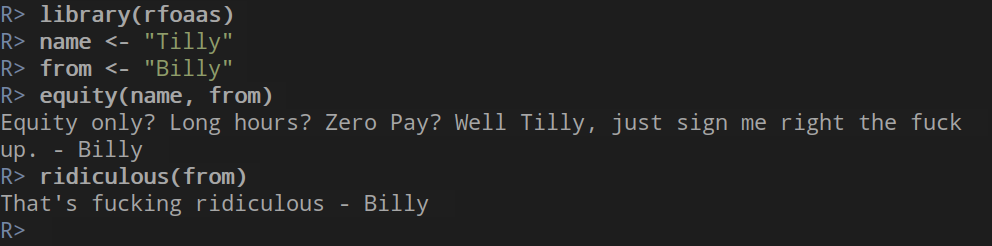 FOAAS by now moved to version 2.3.2 in its repo. This releases 2.3.2 of rfoaas catches up, and brings the first release in about two and a half years.
This 2.3.2 release of FOAAS brings us six new REST access points:
absolutely(), dense(), dumbledore(), lowpoly(), understand(), and yeah(). Along with these new functions, documentation and tests were updated.
My CRANberries service provides a diff to the previous CRAN release. Questions, comments etc should go to the GitHub issue tracker. More background information is on the project page as well as on the github repo
If you like this or other open-source work I do, you can sponsor me at GitHub.
This post by Dirk Eddelbuettel originated on his Thinking inside the box blog. Please report excessive re-aggregation in third-party for-profit settings.
 Welcome to the June 2022 report from the Reproducible Builds project. In these reports, we outline the most important things that we have been up to over the past month. As a quick recap, whilst anyone may inspect the source code of free software for malicious flaws, almost all software is distributed to end users as pre-compiled binaries.
 David Wheeler filed an issue against the Rust programming language to report that builds are not reproducible because full path to the source code is in the panic and debug strings . Luckily, as one of the responses mentions: the
--remap-path-prefix solves this problem and has been used to great effect in build systems that rely on reproducibility (Bazel, Nix) to work at all and that there are efforts to teach cargo about it here .
TheAs their announcement later goes onto state, version-pinning using hash-checking mode can prevent this attack, although this does depend on specific installations using this mode, rather than a prevention that can be applied systematically.ctxhosted project on PyPI was taken over via user account compromise and replaced with a malicious project which contained runtime code which collected the content ofos.environ.items()when instantiating Ctx objects. The captured environment variables were sent as a base64 encoded query parameter to a Heroku application [ ]
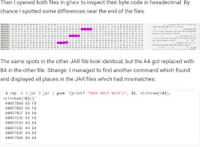 Developer vanitasvitae published an interesting and entertaining blog post detailing the blow-by-blow steps of debugging a reproducibility issue in PGPainless, a library which aims to make using OpenPGP in Java projects as simple as possible .
Whilst their in-depth research into the internals of the
.jar may have been unnecessary given that diffoscope would have identified the, it must be said that there is something to be said with occasionally delving into seemingly low-level details, as well describing any debugging process. Indeed, as vanitasvitae writes:
Yes, this would have spared me from 3h of debugging But I probably would also not have gone onto this little dive into the JAR/ZIP format, so in the end I m not mad.
KBUILD_BUILD_TIMESTAMP) in order to prepare my build with the known to disrupt code layout options disabled .
 Stefano Zacchiroli gave a presentation at GDR S curit Informatique based in part on a paper co-written with Chris Lamb titled Increasing the Integrity of Software Supply Chains. (Tweet)
 In Debian in this month, 28 reviews of Debian packages were added, 35 were updated and 27 were removed this month adding to our knowledge about identified issues. Two issue types were added:
nondeterministic_checksum_generated_by_coq and nondetermistic_js_output_from_webpack.
After Holger Levsen found hundreds of packages in the bookworm distribution that lack .buildinfo files, he uploaded 404 source packages to the archive (with no meaningful source changes). Currently bookworm now shows only 8 packages without .buildinfo files, and those 8 are fixed in unstable and should migrate shortly. By contrast, Debian unstable will always have packages without .buildinfo files, as this is how they come through the NEW queue. However, as these packages were not built on the official build servers (ie. they were uploaded by the maintainer) they will never migrate to Debian testing. In the future, therefore, testing should never have packages without .buildinfo files again.
Roland Clobus posted yet another in-depth status report about his progress making the Debian Live images build reproducibly to our mailing list. In this update, Roland mentions that all major desktops build reproducibly with bullseye, bookworm and sid but also goes on to outline the progress made with automated testing of the generated images using openQA.
 Vagrant Cascadian made a significant number of contributions to GNU Guix:
FORCE_SOURCE_DATE=1 in the environment of all builds in order to fix numerous timestamp issues in documentation generation tools.
maradns package as it appears to embed a random prime number. (Patch)
This paper focuses on one research question: how can [Guix]((https://www.gnu.org/software/guix/) and similar systems allow users to securely update their software? [ ] Our main contribution is a model and tool to authenticate new Git revisions. We further show how, building on Git semantics, we build protections against downgrade attacks and related threats. We explain implementation choices. This work has been deployed in production two years ago, giving us insight on its actual use at scale every day. The Git checkout authentication at its core is applicable beyond the specific use case of Guix, and we think it could benefit to developer teams that use Git.A full PDF of the text is available.
 In the world of openSUSE, SUSE announced at SUSECon that they are preparing to meet SLSA level 4. (SLSA (Supply chain Levels for Software Artifacts) is a new industry-led standardisation effort that aims to protect the integrity of the software supply chain.)
However, at the time of writing, timestamps within RPM archives are not normalised, so bit-for-bit identical reproducible builds are not possible. Some in-toto provenance files published for SUSE s SLE-15-SP4 as one result of the SLSA level 4 effort. Old binaries are not rebuilt, so only new builds (e.g. maintenance updates) have this metadata added.
Lastly, Bernhard M. Wiedemann posted his usual monthly openSUSE reproducible builds status report.
 diffoscope is our in-depth and content-aware diff utility. Not only can it locate and diagnose reproducibility issues, it can provide human-readable diffs from many kinds of binary formats. This month, Chris Lamb prepared and uploaded versions
215, 216 and 217 to Debian unstable. Chris Lamb also made the following changes:
--profile and we were killed via a TERM signal. This should help in situations where diffoscope is terminated due to some sort of timeout. [ ]IndexError exceptions (in addition to ValueError) when parsing .pyc files. (#1012258)argcomplete module. [ ]readelf (ie. binutils), as it appears that this patch level version change resulted in a change of output, not the minor version. [ ]@skip_unless_tool_is_at_least decorator (NB. at_least) over @skip_if_tool_version_is (NB. is) to fix tests under Debian stable. [ ]TERM signal. [ ]build-compare caused a regression for a few days.python-fasttext (CPU-related issue).node-dommatrix.rtpengine.sphinxcontrib-mermaid.yaru-theme.mapproxy (forwarded upstream).libxsmm.yt-dlp (forwarded upstream). The Reproducible Builds project runs a significant testing framework at tests.reproducible-builds.org, to check packages and other artifacts for reproducibility. This month, the following changes were made:
lz4, lzop and xz-utils packages on all nodes in order to detect running kernels. [ ]SOURCE_DATE_EPOCH environment variable [ ]. In addition, Sebastian Crane very-helpfully updated the screenshot of salsa.debian.org s request access button on the How to join the Salsa group. [ ]
#reproducible-builds on irc.oftc.net.
rb-general@lists.reproducible-builds.org
| Series: | Dead Djinn Universe #1 |
| Publisher: | Tordotcom |
| Copyright: | 2021 |
| ISBN: | 1-250-26767-6 |
| Format: | Kindle |
| Pages: | 391 |
Next.
