Search Results: "ads"

13 October 2025

Freexian Collaborators: Monthly report about Debian Long Term Support, September 2025 (by Roberto C. S nchez)


Like each month, have a look at the work funded by Freexian s Debian LTS offering.

Debian LTS contributors In September, 20 contributors have been paid to work on Debian LTS, their reports are available:
  • Abhijith PA did 10.0h (out of 10.0h assigned and 4.0h from previous period), thus carrying over 4.0h to the next month.
  • Andreas Henriksson did 1.0h (out of 0.0h assigned and 20.0h from previous period), thus carrying over 19.0h to the next month.
  • Bastien Roucari s did 20.0h (out of 20.0h assigned).
  • Ben Hutchings did 20.0h (out of 21.0h assigned), thus carrying over 1.0h to the next month.
  • Carlos Henrique Lima Melara did 10.0h (out of 12.0h assigned), thus carrying over 2.0h to the next month.
  • Chris Lamb did 18.0h (out of 18.0h assigned).
  • Daniel Leidert did 21.0h (out of 21.0h assigned).
  • Emilio Pozuelo Monfort did 39.75h (out of 40.0h assigned), thus carrying over 0.25h to the next month.
  • Guilhem Moulin did 15.0h (out of 15.0h assigned).
  • Jochen Sprickerhof did 12.0h (out of 9.25h assigned and 11.75h from previous period), thus carrying over 9.0h to the next month.
  • Lee Garrett did 13.5h (out of 21.0h assigned), thus carrying over 7.5h to the next month.
  • Lucas Kanashiro did 8.0h (out of 20.0h assigned), thus carrying over 12.0h to the next month.
  • Markus Koschany did 15.0h (out of 3.25h assigned and 17.75h from previous period), thus carrying over 6.0h to the next month.
  • Paride Legovini did 6.0h (out of 8.0h assigned), thus carrying over 2.0h to the next month.
  • Roberto C. S nchez did 7.25h (out of 7.75h assigned and 13.25h from previous period), thus carrying over 13.75h to the next month.
  • Santiago Ruano Rinc n did 13.25h (out of 13.5h assigned and 1.5h from previous period), thus carrying over 1.75h to the next month.
  • Sylvain Beucler did 17.0h (out of 7.75h assigned and 13.25h from previous period), thus carrying over 4.0h to the next month.
  • Thorsten Alteholz did 21.0h (out of 21.0h assigned).
  • Tobias Frost did 5.0h (out of 0.0h assigned and 8.0h from previous period), thus carrying over 3.0h to the next month.
  • Utkarsh Gupta did 16.5h (out of 14.25h assigned and 6.75h from previous period), thus carrying over 4.5h to the next month.

Evolution of the situation In September, we released 38 DLAs.
  • Notable security updates:
    • modsecurity-apache prepared by Adrian Bunk, fixes a cross-site scripting vulnerability
    • cups, prepared by Thorsten Alteholz, fixes authentication bypass and denial of service vulnerabilities
    • jetty9, prepared by Adrian Bunk, fixes the MadeYouReset vulnerability (a recent, well-known denial of service vulnerability)
    • python-django, prepared by Chris Lamb, fixes a SQL injection vulnerability
    • firefox-esr and thunderbird, prepared by Emilio Pozuelo Monfort, were updated from the 128.x ESR series to the 140.x ESR series, fixing a number of vulnerabilities as well
  • Notable non-security updates:
    • wireless-regdb prepared by Ben Hutchings, updates information reflecting changes to radio regulations in many countries
There was one package update contributed by a Debian Developer outside of the LTS Team: an update of node-tar-fs, prepared by Xavier Guimard (a member of the Node packaging team). Finally, LTS Team members also contributed updates of the following packages:
  • libxslt (to stable and oldstable), prepared by Guilhem Moulin, to address a regression introduced in a previous security update
  • libphp-adodb (to stable and oldstable), prepared by Abhijith PA
  • cups (to stable and oldstable), prepared by Thorsten Alteholz
  • u-boot (to oldstable), prepared by Daniel Leidert and Jochen Sprickerhof
  • libcommongs-lang3-java (to stable and oldstable), prepared by Daniel Leidert
  • python-internetarchive (to oldstable), prepared by Daniel Leidert
One other notable contribution by a member of the LTS Team is that Sylvain Beucler proposed a fix upstream for CVE-2025-2760 in gimp2. Upstream no longer supports gimp2, but it is still present in Debian LTS, and so proposing this fix upstream is of benefit to other distros which may still be supporting the older gimp2 packages.

Thanks to our sponsors Sponsors that joined recently are in bold.

12 October 2025

Dirk Eddelbuettel: RcppSpdlog 0.0.23 on CRAN: New Upstream

Version 0.0.23 of RcppSpdlog arrived on CRAN today (after a slight delay) and has been uploaded to Debian. RcppSpdlog bundles spdlog, a wonderful header-only C++ logging library with all the bells and whistles you would want that was written by Gabi Melman, and also includes fmt by Victor Zverovich. You can learn more at the nice package documention site. This release updates the code to the version 1.16.0 of spdlog which was released yesterday morning, and includes version 1.12.0 of fmt. We also converted the documentation site to now using mkdocs-material to altdoc (plus local style and production tweaks) rather than directly. I updated the package yesterday morning when spdlog was updated. But the passage was delayed for a day at CRAN as their machines still times out hitting the GPL-2 URL from the README.md badge, leading to a human to manually check the log assert the nothingburgerness of it. This timeout does not happen to me locally using the corresponding URL checker package. I pondered this in a r-package-devel thread and may just have to switch to using the R Project URL for the GPL-2 as this is in fact recurrning. The NEWS entry for this release follows.

Changes in RcppSpdlog version 0.0.23 (2025-10-11)
  • Upgraded to upstream release spdlog 1.16.0 (including fmt 12.0)
  • The mkdocs-material documentation site is now generated via altdoc

Courtesy of my CRANberries, there is also a diffstat report detailing changes. More detailed information is on the RcppSpdlog page, or the package documention site.

This post by Dirk Eddelbuettel originated on his Thinking inside the box blog. If you like this or other open-source work I do, you can sponsor me at GitHub.

10 October 2025

Louis-Philippe V ronneau: Montreal's Debian & Stuff - September 2025

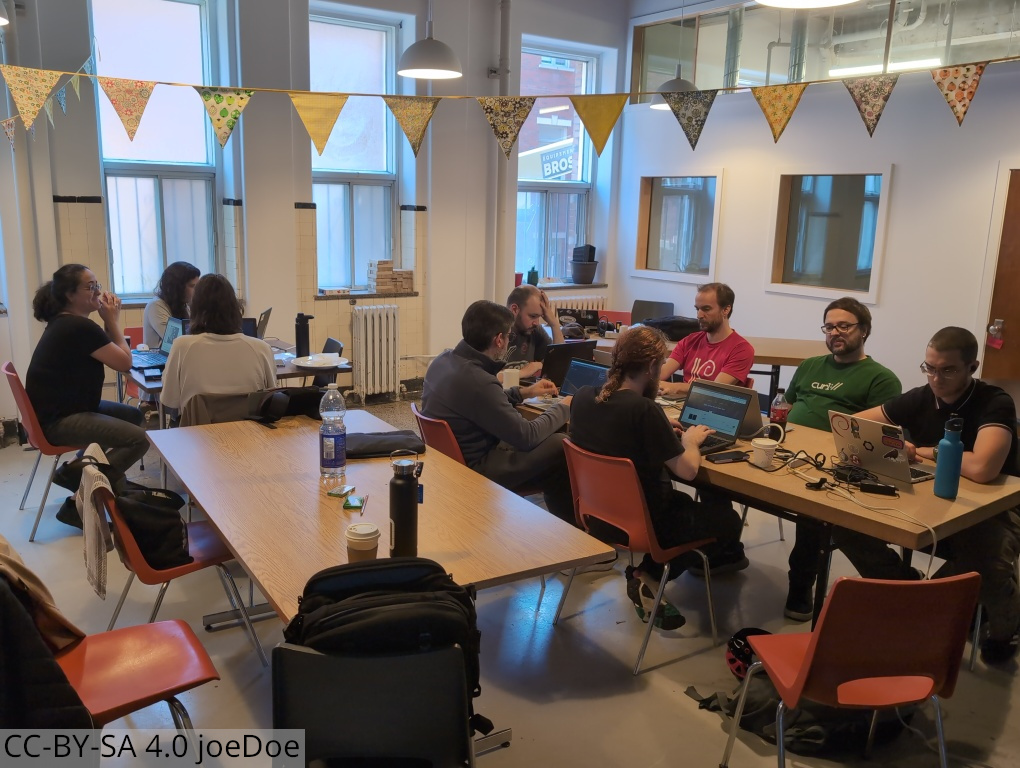
Our Debian User Group met on September 27th for our first meeting since our summer hiatus. As always, it was fun and productive! Here's what we did: pollo: sergiodj: LeLutin: tvaz: viashimo: tassia: Pictures This time again, we were hosted at La Balise (formely ATS ). It's nice to see this community project continuing to improve: the social housing apartments on the top floors should be opening this month! Lots of construction work was also ongoing to make the Espace des Possibles more accessible from the street level. Group photo Some of us ended up grabbing a drink after the event at l'Isle de Garde, a pub right next to the venue, but I didn't take any pictures.
Dirk Eddelbuettel: RcppArmadillo 15 CRAN Transition: Offering Office Hours

armadillo image Armadillo is a powerful and expressive C++ template library for linear algebra and scientific computing. It aims towards a good balance between speed and ease of use, has a syntax deliberately close to Matlab, and is useful for algorithm development directly in C++, or quick conversion of research code into production environments. RcppArmadillo integrates this library with the R environment and language and is widely used by (currently) 1273 other packages on CRAN, downloaded 41.8 million times (per the partial logs from the cloud mirrors of CRAN), and the CSDA paper (preprint / vignette) by Conrad and myself has been cited 651 times according to Google Scholar. Armadillo 15 brought changes. We mentioned these in the 15.0.2-1 and 15.0.2-1 release blog posts: (The second point is a consequence of the first. Prior to C++14, deprecation notes were issue via a macro, and the macro was set up by Conrad in the common way of allowing an override, which we took advantage of in RcppArmadillo effectively shielding downstream package. In C++14 this is now an attribute, and those cannot be suppressed.) We tested this then-upcoming change extensively: Thirteen reverse dependency runs expoloring different settings and leading to the current package setup where an automatic fallback to the last Armadillo 14 release offers fallback for hardwired C++11 use and Armadillo 15 others. Given the 1200+ reverse deoendencies, this took considerable time. All this was also quite extensively discussed with CRAN (especially Kurt Hornik) and documented / controlled via a series of issue tickets starting with overall issue #475 covering the subissues: The sixty pull requests (or emailed patches) followed a suggestion by CRAN to rank-order packages affected by their reverse dependencies sorted in descending package count. Now, while this change from Armadillo 14 to 15 was happening, CRAN also tightened the C++11 requirement for packages and imposed a deadline for changes. In discussion, CRAN also convinced me that a deadline for the deprecation warning, now unmasked, was viable (and is in fairness commensurate with similar, earlier changes triggered by changes in the behaviour of either gcc/g++ or clang/clang++). So we now have two larger deadline campaigns affecting the package (and as always there are some others). These deadlines are coming close: October 17 for the C++11 transition, and October 23 for the deprecation warning. Now, as became clear preparing the sixty pull requests and patches, these changes are often relatively straightforward. For the former, remove the C++11 enforcement and the package will likely build without changes. For the latter, make the often simple (e.g. swith from arma::is_finite to std::isfinite) change. I did not encounter anything much more complicated yet. The number of affected packages approximated by looking at all packages with a reverse dependency on RcppArmadillo and having a deadline can be computed as
suppressMessages(library(data.table))
D <- setDT(tools::CRAN_package_db())
P <- data.table(Package=tools::package_dependencies("RcppArmadillo", reverse=TRUE, db=D)[[1]])
W <- merge(P, D, all.x=TRUE)[is.na(Deadline)==FALSE,c(1:2,38,68)]
W

W[, nrevdep := length(tools::package_dependencies(Package, reverse=TRUE, recursive=TRUE, db=D)[[1]]), by=Package]
W[order(-nrevdep)]
and has been declining steadily from over 350 to now under 200. For that a big and heartfelt Thank You! to all the maintainers who already addressed their package and uploaded updated packages to CRAN. That rocks, and is truly appreciated. Yet the number is still large. And while issues #489 and #491 show a number of pending packages that have merged but not uploaded (yet?) there are also all the other packages I have not been able to look at in detail. While preparing sixty PRs / patches was viable over a period of a good week, I cannot create these for all packages. So with that said, here is a different suggestion for help: All of next week, I will be holding open door open source office hours online two times each day (11:00h to 13:00h Central, 16:00h to 18:00h Central) which can be booked via this booking link for Monday to Friday next week in either fifteen or thirty minutes slots you can book. This should offer Google Meet video conferencing (with jitsi as an alternate, you should be able to control that) which should allow for screen sharing. (I cannot hookup Zoom as my default account has organization settings with a different calendar integration.) If you are reading this and have a package that still needs helps, I hope to see you in the Open Source Office Hours to aid in the RcppArmadillo package updates for your package. Please book a slot!

This post by Dirk Eddelbuettel originated on his Thinking inside the box blog. If you like this or other open-source work I do, you can sponsor me at GitHub.

9 October 2025

Thorsten Alteholz: My Debian Activities in September 2025

Debian LTS This was my hundred-thirty-fifth month that I did some work for the Debian LTS initiative, started by Raphael Hertzog at Freexian. During my allocated time I uploaded or worked on: An upload of spim was not needed, as the corresponding CVE could be marked as ignored. I also started to work on an open-vm-tools and attended the monthly LTS/ELTS meeting. Debian ELTS This month was the eighty-sixth ELTS month. During my allocated time I uploaded or worked on: The CVEs for open-vm-tools could be marked as not-affeceted as the corresponding plugin was not yet available. I also attended the monthly LTS/ELTS meeting. Debian Printing This month I uploaded a new upstream version or a bugfix version of: This work is generously funded by Freexian! Debian Astro This month I uploaded a new upstream version or a bugfix version of: Debian IoT This month I uploaded a new upstream version or a bugfix version of: Debian Mobcom This month I uploaded a new upstream version or a bugfix version of: misc The main topic of this month has been gcc15 and cmake4, so my upload rate was extra high. This month I uploaded a new upstream version or a bugfix version of: I wonder what MBF will happen next, I guess the /var/lock-issue will be a good candidate. On my fight against outdated RFPs, I closed 30 of them in September. Meanwhile only 3397 are still open, so don t hesitate to help closing one or another. FTP master This month I accepted 294 and rejected 28 packages. The overall number of packages that got accepted was 294.

Dirk Eddelbuettel: xptr 1.2.0 on CRAN: New(ly Adopted) Package!

Excited to share that xptr is back on CRAN! The xptr package helps to create, check, modify, use, share, external pointer objects. External pointers are used quite extensively throughout R to manage external resources such as datanbase connection objects and alike, and can be very useful to pass pointers to just about any C / C++ data structure around. While described in Writing R Extensions (notably Section 5.13), they can be a little bare-bones and so this package can be useful. It had been created by Randy Lai and maintained by him during 2017 to 2020, but then fell off CRAN. In work with nanoarrow and its clean and minimal Arrow interface xptr came in handy so I adopted it. Several extensions and updates have been added: (compiled) function registration, continuous integration, tests, refreshed and extended documentation as well as a print format extension useful for PyCapsule objects when passing via reticulate. The package documentation site was switched to altdoc driving the most excellent Material for MkDocs framework (providing my first test case of altdoc replacing my older local scripts; I should post some more about that ). The first NEWS entry follow.

Changes in version 1.2.0 (2025-10-03)
  • New maintainer
  • Compiled functions are now registered, .Call() adjusted
  • README.md and DESCRIPTION edited and update
  • Simple unit tests and continunous integration have been added
  • The package documentation site has been recreated using altdoc
  • All manual pages for functions now contain \value sections

For more, see the package page, the git repo or the documentation site.

This post by Dirk Eddelbuettel originated on his Thinking inside the box blog. If you like this or other open-source work I do, you can sponsor me at GitHub.

8 October 2025

Colin Watson: Free software activity in September 2025

About 90% of my Debian contributions this month were sponsored by Freexian. You can also support my work directly via Liberapay or GitHub Sponsors. Some months I feel like I m pedalling furiously just to keep everything in a roughly working state. This was one of those months. Python team I upgraded these packages to new upstream versions: I had to spend a fair bit of time this month chasing down build/test regressions in various packages due to some other upgrades, particularly to pydantic, python-pytest-asyncio, and rust-pyo3: After some upstream discussion I requested removal of pydantic-compat, since it was more trouble than it was worth to keep it working with the latest pydantic version. I filed dh-python: pybuild-plugin-pyproject doesn t know about headers and added it to Python/PybuildPluginPyproject, and converted some packages to pybuild-plugin-pyproject: I updated dh-python to suppress generated dependencies that would be satisfied by python3 >= 3.11. pkg_resources is deprecated. In most cases replacing it is a relatively simple matter of porting to importlib.resources, but packages that used its old namespace package support need more complicated work to port them to implicit namespace packages. We had quite a few bugs about this on zope.* packages, but fortunately upstream did the hard part of this recently. I went round and cleaned up most of the remaining loose ends, with some help from Alexandre Detiste. Some of these aren t completely done yet as they re awaiting new upstream releases: This work also caused a couple of build regressions, which I fixed: I fixed jupyter-client so that its autopkgtests would work in Debusine. I fixed waitress to build with the nocheck profile. I fixed several other build/test failures: I fixed some other bugs: Code reviews Other bits and pieces I fixed several CMake 4 build failures: I got CI for debbugs passing (!22, !23). I fixed a build failure with GCC 15 in trn4. I filed a release-notes bug about the tzdata reorganization in the trixie cycle. I filed and fixed a git-dpm regression with bash 5.3. I upgraded libfilter-perl to a new upstream version. I optimized some code in ubuntu-dev-tools that made O(1) HTTP requests when it could instead make O(n).

Dirk Eddelbuettel: RPushbullet 0.3.5: Mostly Maintenance

RPpushbullet demo A new version 0.3.5 of the RPushbullet package arrived on CRAN. It marks the first release in 4 1/2 years for this mature and feature-stable package. RPushbullet interfaces the neat Pushbullet service for inter-device messaging, communication, and more. It lets you easily send (programmatic) alerts like the one to the left to your browser, phone, tablet, or all at once. This releases reflects mostly internal maintenance and updates to the documentation site, to continuous integration, to package metadata, and one code robustitication. See below for more details.

Changes in version 0.3.5 (2025-10-08)
  • URL and BugReports fields have been added to DESCRIPTION
  • The pbPost function deals more robustly with the case of multiple target emails
  • The continuous integration and the README badge have been updated
  • The DESCRIPTION file now use Authors@R
  • The (encrypted) unit test configuration has been adjusted to reflect the current set of active devices
  • The mkdocs-material documentation site is now generated via altdoc

Courtesy of my CRANberries, there is a diffstat report relative to previous release. More detailed information is on the repo where comments and suggestions are welcome.

This post by Dirk Eddelbuettel originated on his Thinking inside the box blog. If you like this or other open-source work I do, you can sponsor me at GitHub.

3 October 2025

Dirk Eddelbuettel: #053: Adding llvm Snapshots for R Package Testing

Welcome to post 53 in the R4 series. Continuing with posts #51 from Tuesday and #52 from Wednesday and their stated intent of posting some more here is another quick one. Earlier today I helped another package developer who came to the r-package-devel list asking for help with a build error on the Fedora machine at CRAN running recent / development clang. In such situations, the best first step is often to replicate the issue. As I pointed out on the list, the LLVM team behind clang maintains an apt repo at apt.llvm.org/ making it a good resource to add to Debian-based container such as Rocker r-base or the offical r-base (the two are in fact interchangeable, and I take care of both). A small pothole, however, is that the documentation at the top of apt.llvm.org site is a bit stale and behind two aspects that changed on current Debian systems (i.e. unstable/testing as used for r-base). First, apt now prefers files ending in .sources (in a nicer format) and second, it now really requires a key (which is good practice). As it took me a few minutes to regather how to meet both requirements, I reckoned I might as well script this. Et voil the following script does that:
#!/bin/sh

## Update does not hurt but is not strictly needed
#apt update --quiet --quiet
#apt upgrade --yes

## wget -qO- https://apt.llvm.org/llvm-snapshot.gpg.key   sudo tee /etc/apt/trusted.gpg.d/apt.llvm.org.asc
## or as we are root in container
wget -qO- https://apt.llvm.org/llvm-snapshot.gpg.key > /etc/apt/trusted.gpg.d/apt.llvm.org.asc

cat <<EOF >/etc/apt/sources.list.d/llvm-dev.sources
Types: deb
URIs: http://apt.llvm.org/unstable/
# for clang-21 
#   Suites: llvm-toolchain-21
# for current clang
Suites: llvm-toolchain
Components: main
Signed-By: /etc/apt/trusted.gpg.d/apt.llvm.org.asc
EOF

test -d ~/.R   mkdir ~/.R
cat <<EOF >~/.R/Makevars
CLANGVER=-22
# CLANGLIB=-stdlib=libc++
CXX=clang++\$(CLANGVER) \$(CLANGLIB)
CXX11=clang++\$(CLANGVER) \$(CLANGLIB)
CXX14=clang++\$(CLANGVER) \$(CLANGLIB)
CXX17=clang++\$(CLANGVER) \$(CLANGLIB)
CXX20=clang++\$(CLANGVER) \$(CLANGLIB)
CC=clang\$(CLANGVER)
SHLIB_CXXLD=clang++\$(CLANGVER) \$(CLANGLIB)
EOF

apt update
apt install --yes clang-22
Once the script is run, one can test a package (or set of packages) against clang-22 and clang++-22. This may help R package developers. The script is also generic enough for other development communities who can ignore (or comment-out / delete) the bit about ~/.R/Makevars and deploy the compiler differently. Updating the softlink as apt-preferences does is one way and done in many GitHub Actions recipes. As we only need wget here a basic Debian container should work, possibly with the addition of wget. For R users r-base hits a decent sweet spot.

This post by Dirk Eddelbuettel originated on his Thinking inside the box blog. If you like this or other open-source work I do, you can now sponsor me at GitHub.

Jonathan Dowland: Tron: Ares (soundtrack)

photo of Tron: Ares vinyl record on my turntable, next to packaging
There's a new Nine Inch Nails album! That doesn't happen very often. There's a new Trent Reznor & Atticus Ross soundtrack! That happens all the time! For the first time, they're the same thing. The new one, Tron: Ares, is very deliberately presented as a Nine Inch Nails album, and not a TR&AR soundtrack. But is it neither fish nor fowl? 24 tracks, four with lyrics. Singing is not unheard of on TR&AR soundtracks, but it's rare (A Minute to Breathe from the excellent Before the Flood is another). Instrumentals are not rare on NIN albums, either, but this ratio is very unusual, and has disappointed some fans who were hoping for a more traditional NIN album. What does it mean to label something a NIN album anyway? For me, the lines are now further blurred. One thing for sure is it means a lot of media attention, and this release, as well as the film it's promoting, are all over the media at the moment. Posters, trailers, promotional tie-in items, Disney logos everywhere. The album is hitched to the Disney marketing and promotion machine. It's a bit weird seeing the NIN logo all over the place advertising the movie. On to the music. I love TR&AR soundtracks, and some of my favourite NIN tracks are instrumentals. Despite that, three highlights for me are songs: As Alive As You Need Me To Be, I Know You Can Feel It and closer Shadow Over Me. The other stand-out is Building Better Worlds, a short instrumental and clear nod to Wendy Carlos. My main complaint here applies to some of the more recent soundtracks as well: the tracks are too short. They're scored to scenes in the movie, which makes a lot of sense in that presentation, but less so for independent listening. It's not a problem that their earlier, lauded soundtracks suffered (The Social Network, Before the Flood, Bird Box Extended). Perhaps a future remix album will address that.

Guido G nther: Free Software Activities September 2025

Another short status update of what happened on my side last month. Nothing stands out too much, I enjoyed doing the OSK changes the most as that helped to improve the typing experience further. Also doing a small bit of kernel work again was fun (still need to figure out the 6mq's touch controller repsonsiveness though). See below for details on the above and more: phosh phoc phosh-mobile-settings stevia (formerly phosh-osk-stub) xdg-desktop-portal-phosh pfs libphosh-rs Phrog feedbackd feedbackd-device-themes Debian gnome-settings-daemon git-buildpackage govarnam Sessions twenty-twenty-hugo tuwunnel Linux mutter Phosh debs phosh-site Reviews This is not code by me but reviews I did on other peoples code. The list is (as usual) slightly incomplete. Thanks for the contributions! Help Development If you want to support my work see donations. Comments? Join the Fediverse thread
2 October 2025

Dirk Eddelbuettel: tinythemes 0.0.4 at CRAN: Micro Maintenance

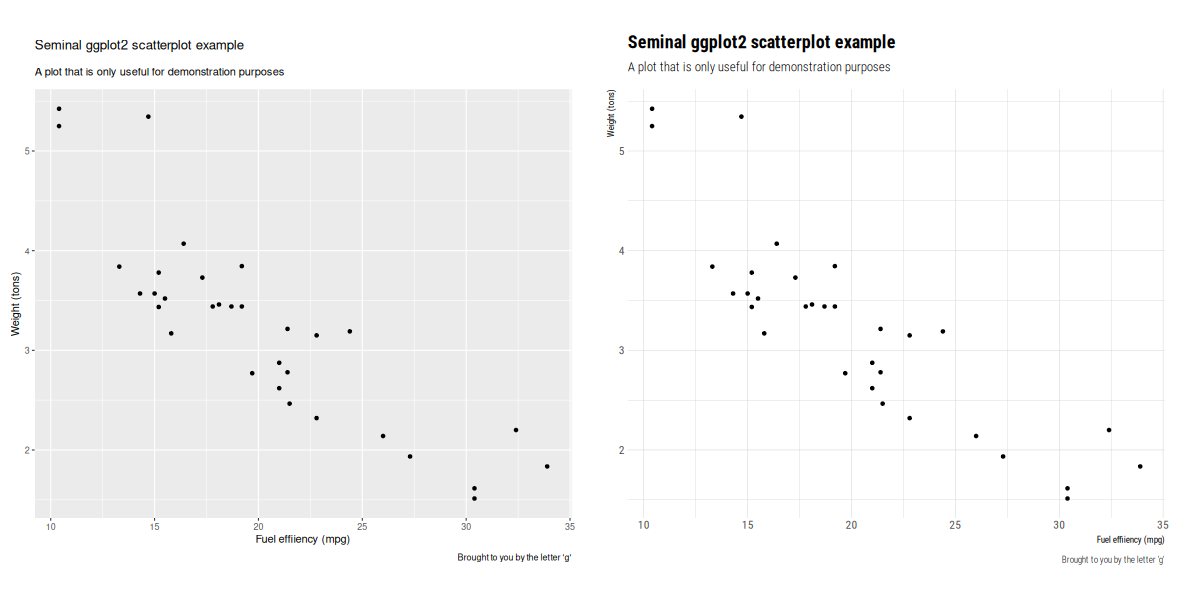
tinythemes demo A tiniest of tiny violins micro maintenance release 0.0.4 of our tinythemes arrived on CRAN today. tinythemes provides the theme_ipsum_rc() function from hrbrthemes by Bob Rudis in a zero (added) dependency way. A simple example is (also available as a demo inside the package) contrasts the default style (on the left) with the one added by this package (on the right): This version adjusts to the fact that hrbrthemes is no longer on CRAN so the help page cannot link to its documentation. No other changes were made. The set of changes since the last release follows.

Changes in tinythemes version 0.0.4 (2025-10-02)
  • No longer \link to now-archived hrbrthemes

Courtesy of my CRANberries, there is a diffstat report relative to previous release. More detailed information is on the repo where comments and suggestions are welcome.

This post by Dirk Eddelbuettel originated on his Thinking inside the box blog. If you like this or other open-source work I do, you can sponsor me at GitHub.

1 October 2025

Dirk Eddelbuettel: #052: Running r-ci with Coverage

Welcome to post 52 in the R4 series. Following up on the post #51 yesterday and its stated intent of posting some more here The r-ci setup (which was introduced in post #32 and updated in post #45) offers portable continuous integration which can take advantage of different backends: Github Actions, Azure Pipelines, GitLab, BitBuckets, and possibly as it only requires a basic Ubuntu shell after which it customizes itself and runs via shell script. Portably. Now, most of us, I suspect still use it with GitHub Actions but it is reassuring to know that one can take it elsewhere should the need or desire arise. One thing many repos did, and which stopped working reliably is coverage analysis. This is made easy by the covr package, and made fast, easy, reliable (as we quip) thanks to r2u. But transmission to codecov stopped working a while back so I had mostly commented it out in my repos, rendering the reports more and more stale. Which is not ideal. A few weeks ago I gave this another look, and it turns that that codecov now requires an API token to upload. Which one can generate in the user -> settings menu on their website under the access tab. Which in turn then needs to be stored in each repo wanting to upload. For Github, this is under settings -> secrets and variables -> actions as a repository secret . I suggest using CODECOV_TOKEN for its name. After that the three-line block in the yaml file can reference it as a secret as in the following snippet, now five lines, taken from one of my ci.yaml files:
      - name: Coverage
        if: $  matrix.os == 'ubuntu-latest'  
        run: ./run.sh coverage
        env:
          CODECOV_TOKEN: $  secrets.CODECOV_TOKEN  
It assigns the secret we stored on the website, references it by prefix secrets. and assigns it to the environment variable CODECOV_TOKEN. After this reports flow as one can see on repositories where I re-enabled this as for example here for RcppArmadillo.

This post by Dirk Eddelbuettel originated on his Thinking inside the box blog. If you like this or other open-source work I do, you can now sponsor me at GitHub.

Ben Hutchings: FOSS activity in September 2025

Last month I attended and spoke at Kangrejos, for which I will post a separate report later. Besides that, here s the usual categorised list of work:

30 September 2025

Junichi Uekawa: Start of fourth quarter of the year.

Start of fourth quarter of the year. The end of year is feeling close!

Jonathan McDowell: Local Voice Assistant Step 5: Remote Satellite

The last (software) piece of sorting out a local voice assistant is tying the openWakeWord piece to a local microphone + speaker, and thus back to Home Assistant. For that we use wyoming-satellite. I ve packaged that up - https://salsa.debian.org/noodles/wyoming-satellite - and then to run I do something like:
$ wyoming-satellite --name 'Living Room Satellite' \
    --uri 'tcp://[::]:10700' \
    --mic-command 'arecord -r 16000 -c 1 -f S16_LE -t raw -D plughw:CARD=CameraB409241,DEV=0' \
    --snd-command 'aplay -D plughw:CARD=UACDemoV10,DEV=0 -r 22050 -c 1 -f S16_LE -t raw' \
    --wake-uri tcp://[::1]:10400/ \
    --debug
That starts us listening for connections from Home Assistant on port 10700, uses the openWakeWord instance on localhost port 10400, uses aplay/arecord to talk to the local microphone and speaker, and gives us some debug output so we can see what s going on. And it turns out we need the debug. This setup is a bit too flaky for it to have ended up in regular use in our household. I ve had some problems with reliable audio setup; you ll note the Python is calling out to other tooling to grab audio, which feels a bit clunky to me and I don t think is the actual problem, but the main audio for this host is hooked up to the TV (it s a media box), so the setup for the voice assistant needs to be entirely separate. That means not plugging into Pipewire or similar, and instead giving direct access to wyoming-satellite. And sometimes having to deal with how to make the mixer happy + non-muted manually. I ve also had some issues with the USB microphone + speaker; I suspect a powered USB hub would help, and that s on my list to try out. When it does work I have sometimes found it necessary to speak more slowly, or enunciate my words more clearly. That s probably something I could improve by switching from the base.en to small.en whisper.cpp model, but I m waiting until I sort out the audio hardware issue before poking more. Finally, the wake word detection is a little bit sensitive sometimes, as I mentioned in the previous post. To be honest I think it s possible to deal with that, if I got the rest of the pieces working smoothly. This has ended up sounding like a more negative post than I meant it to. Part of the issue in a resolution is finding enough free time to poke things (especially as it involves taking over the living room and saying Hey Jarvis a lot), part of it is no doubt my desire to actually hook up the pieces myself and understand what s going on. Stay tuned and see if I ever manage to resolve it all!

Dirk Eddelbuettel: #051: A Neat Little Rcpp Trick

Welcome to post 51 in the R4 series. A while back I realized I should really just post a little more as not all post have to be as deep and introspective as for example the recent-ish two cultures post #49. So this post is a neat little trick I (somewhat belatedly) realized somewhat recently. The context is the ongoing transition from (Rcpp)Armadillo 14.6.3 and earlier to (Rcpp)Armadillo 15.0.2 or later. (I need to write a bit more about that, but that may require a bit more time.) (And there are a total of seven (!!) issue tickets managing the transition with issue #475 being the main parent issue, please see there for more details.) In brief, the newer and current Armadillo no longer allows C++11 (which also means it no longer allowes suppression of deprecation warnings ). It so happens that around a decade ago packages were actively encouraged to move towards C++11 so many either set an explicit SystemRequirements: for it, or set CXX_STD=CXX11 in src/Makevars .win . CRAN has for some time now issued NOTEs asking for this to be removed, and more recently enforced this with actual deadlines. In RcppArmadillo I opted to accomodate old(er) packages (using this by-now anti-pattern) and flip to Armadillo 14.6.3 during a transition period. That is what the package does now: It gives you either Armadillo 14.6.3 in case C++11 was detected (or this legacy version was actively selected via a compile-time #define), or it uses Armadillo 15.0.2 or later. So this means we can have either one of two versions, and may want to know which one we have. Armadillo carries its own version macros, as many libraries or projects do (R of course included). Many many years ago (git blame points to sixteen and twelve for a revision) we added the following helper function to the package (full source here, we show it here without the full roxygen2 comment header)
// [[Rcpp::export]]
Rcpp::IntegerVector armadillo_version(bool single)  

    // These are declared as constexpr in Armadillo which actually does not define them
    // They are also defined as macros in arma_version.hpp so we just use that
    const unsigned int major = ARMA_VERSION_MAJOR;
    const unsigned int minor = ARMA_VERSION_MINOR;
    const unsigned int patch = ARMA_VERSION_PATCH;

    if (single)  
        return Rcpp::wrap(10000 * major + 100 * minor + patch) ;
      else  
        return Rcpp::IntegerVector::create(Rcpp::Named("major") = major,
                                           Rcpp::Named("minor") = minor,
                                           Rcpp::Named("patch") = patch);
     
 
It either returns a (named) vector of the standard major , minor , patch form of the common package versioning pattern, or a single integer which can used more easily in C(++) via preprocessor macros. And this being an Rcpp-using package, we can of course access either easily from R:
> library(RcppArmadillo)
> armadillo_version(FALSE)
major minor patch 
   15     0     2 
> armadillo_version(TRUE)
[1] 150002
>
Perfectly valid and truthful. But cumbersome at the R level. So when preparing for these (Rcpp)Armadillo changes in one of my package, I realized I could alter such a function and set the S3 type to package_version. (Full version of one such variant here)
// [[Rcpp::export]]
Rcpp::List armadilloVersion()  
    // create a vector of major, minor, patch
    auto ver = Rcpp::IntegerVector::create(ARMA_VERSION_MAJOR, ARMA_VERSION_MINOR, ARMA_VERSION_PATCH);
    // and place it in a list (as e.g. packageVersion() in R returns)
    auto lst = Rcpp::List::create(ver);
    // and class it as 'package_version' accessing print() etc methods
    lst.attr("class") = Rcpp::CharacterVector::create("package_version", "numeric_version");
    return lst;
 
Three statements each to and return the value. And now in R we can operate more easily on this (using three dots as I didn t export it from this package):
> RcppDE:::armadilloVersion()
[1]  15.0.2 
> RcppDE:::armadilloVersion() >= "15.0.0"
[1] TRUE
>
An object of class package_version inheriting from numeric_version can directly compare against a (human- but not normally machine-readable) string like 15.0.0 because the simple S3 class defines appropriate operators, as well as print() / format() methods as the first expression shows. It is these little things that make working with R so smooth, and we can easily (three statements !!) do so from Rcpp-based packages too. The underlying object really is merely a list containing a vector:
> unclass(RcppDE:::armadilloVersion())
[[1]]
[1] 15  0  2

> 
but the S3 glue around it makes it behave nicely. So next time you are working with an object you plan to return to R, consider classing it to take advantage of existing infrastructure (if it exists, of course). It s easy enough to do, and may smoothen the experience at the R side.

This post by Dirk Eddelbuettel originated on his Thinking inside the box blog. If you like this or other open-source work I do, you can now sponsor me at GitHub.

Antoine Beaupr : Proper services

During 2025-03-21-another-home-outage, I reflected upon what's a properly ran service and blurted out what turned out to be something important I want to outline more. So here it is, again, on its own for my own future reference.
Typically, I tend to think of a properly functioning service as having four things:
  1. backups
  2. documentation
  3. monitoring
  4. automation
  5. high availability (HA)
Yes, I miscounted. This is why you need high availability. A service doesn't properly exist if it doesn't at least have the first 3 of those. It will be harder to maintain without automation, and inevitably suffer prolonged outages without HA.

The five components of a proper service

Backups Duh. If data is maliciously or accidentally destroyed, you need a copy somewhere. Preferably in a way that malicious Joe can't get to. This is harder than you think.

Documentation I have an entire template for this. Essentially, it boils down to using https://diataxis.fr/ and this "audit" guide. For me, the most important parts are:
  • disaster recovery (includes backups, probably)
  • playbook
  • install/upgrade procedures (see automation)
You probably know this is hard, and this is why you're not doing it. Do it anyways, you'll think it sucks, it will grow out of sync with reality, but you'll be really grateful for whatever scraps you wrote when you're in trouble. Any docs, in other words, is better than no docs, but are no excuse for doing the work correctly.

Monitoring If you don't have monitoring, you'll know it fails too late, and you won't know it recovers. Consider high availability, work hard to reduce noise, and don't have machine wake people up, that's literally torture and is against the Geneva convention. Consider predictive algorithm to prevent failures, like "add storage within 2 weeks before this disk fills up". This is also harder than you think.

Automation Make it easy to redeploy the service elsewhere. Yes, I know you have backups. That is not enough: that typically restores data and while it can also include configuration, you're going to need to change things when you restore, which is what automation (or call it "configuration management" if you will) will do for you anyways. This also means you can do unit tests on your configuration, otherwise you're building legacy. This is probably as hard as you think.

High availability Make it not fail when one part goes down. Eliminate single points of failures. This is easier than you think, except for storage and DNS ("naming things" not "HA DNS", that is easy), which, I guess, means it's harder than you think too.

Assessment In the above 5 items, I currently check two in my lab:
  1. backups
  2. documentation
And barely: I'm not happy about the offsite backups, and my documentation is much better at work than at home (and even there, I have a 15 year backlog to catchup on). I barely have monitoring: Prometheus is scraping parts of the infra, but I don't have any sort of alerting -- by which I don't mean "electrocute myself when something goes wrong", I mean "there's a set of thresholds and conditions that define an outage and I can look at it". Automation is wildly incomplete. My home server is a random collection of old experiments and technologies, ranging from Apache with Perl and CGI scripts to Docker containers running Golang applications. Most of it is not Puppetized (but the ratio is growing). Puppet itself introduces a huge attack vector with kind of catastrophic lateral movement if the Puppet server gets compromised. And, fundamentally, I am not sure I can provide high availability in the lab. I'm just this one guy running my home network, and I'm growing older. I'm thinking more about winding things down than building things now, and that's just really sad, because I feel we're losing (well that escalated quickly).

Side note about Tor The above applies to my personal home lab, not work! At work, of course, it's another (much better) story:
  1. all services have backups
  2. lots of services are well documented, but not all
  3. most services have at least basic monitoring
  4. most services are Puppetized, but not crucial parts (DNS, LDAP, Puppet itself), and there are important chunks of legacy coupling between various services that make the whole system brittle
  5. most websites, DNS and large parts of email are highly available, but key services like the the Forum, GitLab and similar applications are not HA, although most services run under replicated VMs that can trivially survive a total, single-node hardware failure (through Ganeti and DRBD)

Utkarsh Gupta: FOSS Activites in September 2025

Here s my monthly but brief update about the activities I ve done in the F/L/OSS world.

Debian
Whilst I didn t get a chance to do much, here s still a few things that I worked on:

Ubuntu
I joined Canonical to work on Ubuntu full-time back in February 2021. Whilst I can t give a full, detailed list of things I did, here s a quick TL;DR of what I did:
  • Successfully and timely released 25.10 (Questing Quokka) Beta! \o/
  • Continued to hold weekly release syncs, et al.
  • Granted FFe and triaged a bunch of other bugs from both, Release team and Archive Admin POV. :)
  • 360s were fab - I was a peak performer again. Yay!
  • Preparing for the 25.10 Release sprints in London and then the Summit.
  • Roadmap planning for the Release team.

Debian (E)LTS
This month I have worked 16.50 hours on Debian Long Term Support (LTS) and 05.50 hours on its sister Extended LTS project and did the following things:
  • [E/LTS] Frontdesk duty from 22nd September to 28th September.
    • Triaged lemonldap-ng, ghostscript, dovecot, node-ip, webkit2gtk, wpewebkit, libscram-java, keras, openbabel, gegl, tiff, zookeeper, squid, ogre-1.12, mapserver, ruby-rack.
    • Auto-EOL d a few packages.
    • Also circled back on previously opened ticket for supported packages for ELTS.
    • Partially reviewed and added comment on Emilio s MP.
    • Re-visited an old thread (in order to fully close it) about issues being fixed in buster & bookworm but not in bullseye. And brought it up in the LTS meeting, too.
  • [LTS] Partook in some internal discussions about introducing support for handling severity of CVEs, et al.
    • Santiago had asked for an input from people doing FD so spent some time reflecting on his proposal and getting back with thoughts and suggestions.
  • [LTS] Helped Lee with testing gitk and git-gui aspects of his git update.
  • [LTS] Attended the monthly LTS meeting on IRC. Summary here.
    • It was also followed by a 40-minute discussion of technical questions/reviews/discussions - which in my opinion was pretty helpful. :)
  • [LTS] Prepared the LTS update for wordpress, bumping the package from 5.7.11 to 5.7.13.
    • Prepared an update for stable, Craig approved. Was waiting on the Security team s +1 to upload.
    • Now we ve waited enough that we have new CVEs. Oh well.
  • [ELTS] Finally setup debusine for ELTS uploads.
    • Since I use Ubuntu, this required installing debusine* from bookworm-backport but that required Python 3.11.
    • So I had to upgrade from Jammy (22.04) to Noble (24.04) - which was anyway pending.. :)
    • And then followed the docs to configure it. \o/
  • [E/LTS] Started working on new ruby-rack CVE.

Until next time.
:wq for today.

Russ Allbery: Review: Deep Black

Review: Deep Black, by Miles Cameron
Series: Arcana Imperii #2
Publisher: Gollancz
Copyright: 2024
ISBN: 1-3996-1506-8
Format: Kindle
Pages: 509
Deep Black is a far-future science fiction novel and the direct sequel to Artifact Space. You do not want to start here. I regretted not reading the novels closer together and had to refresh my memory of what happened in the first book. The shorter fiction in Beyond the Fringe takes place between the two series novels and leads into some of the events in this book, although reading it is optional. Artifact Space left Marca Nbaro at the farthest point of the voyage of the Greatship Athens, an unexpected heroine and now well-integrated into the crew. On a merchant ship, however, there's always more work to be done after a heroic performance. Deep Black opens with that work: repairs from the events of the first book, the never-ending litany of tasks required to keep the ship running smoothly, and of course the trade with aliens that drew them so far out into the Deep Black. We knew early in the first book that this wouldn't be the simple, if long, trading voyage that most of the crew of the Athens was expecting, but now they have to worry about an unsettling second group of aliens on top of a potential major war between human factions. They don't yet have the cargo they came for, they have to reconstruct their trading post, and they're a very long way from home. Marca also knows, at this point in the story, that this voyage had additional goals from the start. She will slowly gain a more complete picture of those goals during this novel. Artifact Space was built around one of the most satisfying plots in military science fiction (at least to me): a protagonist who benefits immensely from the leveling effect and institutional inclusiveness of the military slowly discovering that, when working at its best, the military can be a true meritocracy. (The merchant marine of the Athens is not military, precisely, since it's modeled on the trading ships of Venice, but it's close enough for the purposes of this plot.) That's not a plot that lasts into a sequel, though, so Cameron had to find a new spine for the second half of the story. He chose first contact (of a sort) and space battle. The space battle parts are fine. I read a ton of children's World War II military fiction when I was a boy, and I always preferred the naval battles to the land battles. This part of Deep Black reminded me of those naval battles, particularly a book whose title escapes me about the Arctic convoys to the Soviet Union. I'm more interested in character than military adventure these days, but every once in a while I enjoy reading about a good space battle. This was not an exemplary specimen of the genre, but it delivered on all the required elements. The first contact part was more original, in part because Cameron chose an interesting medium ground between total incomprehensibility and universal translators. He stuck with the frustrations of communication for considerably longer than most SF authors are willing to write, and it worked for me. This is the first book I've read in a while where superficial alien fluency with the mere words of a human language masks continuing profound mutual incomprehension. The communication difficulties are neither malicious nor a setup for catastrophic misunderstanding, but an intrinsic part of learning about a truly alien species. I liked this, even though it makes for slower and more frustrating progress. It felt more believable than a lot of first contact, and it forced the characters to take risks and act on hunches and then live with the consequences. One of the other things that Cameron does well is maintain the steady rhythm of life on a working ship as a background anchor to the story. I've read a lot of science fiction that shows the day-to-day routine only until something more interesting and plot-focused starts happening and then seems to forget about it entirely. Not here. Marca goes through intense and adrenaline-filled moments requiring risk and fast reactions, and then has to handle promotion write-ups, routine watches, and studying for advancement. Cameron knows that real battles involve long periods of stressful waiting and incorporates them into the book without making them too boring, which requires a lot of writing skill. I prefer the emotional magic of finding a place where one belongs, so I was not as taken with Deep Black as I was with Artifact Space, but that's the inevitable result of plot progression and not really a problem with this book. Marca is absurdly central to the story in ways that have a whiff of "chosen one" dynamics, but if one can suspend one's disbelief about that, the rest of the book is solid. This is, fundamentally, a book about large space battles, so save it when you're in the mood for that sort of story, but it was a satisfying continuation of the series. I will definitely keep reading. Recommended if you enjoyed Artifact Space. If you didn't, Deep Black isn't going to change your mind. Followed by Whalesong, which is not yet released (and is currently in some sort of limbo for pre-orders in the US, which I hope will clear up). Rating: 7 out of 10

Next.

Previous.


