Search Results: "pm"

18 February 2007

Evan Prodromou: 29 Pluvi se CCXV

Impressive amount of snow today -- all the digging I did yesterday when we got home is pretty much moot at this point. Huge swirling snowflake clusters are coming down from the sky and have been since we got up this morning. It's awfully pretty. Amita June and I went out to Loblaw's in the old CPR Angus Shops to replenish our larder, which was pretty empty after our trip to NYC. We had a pretty easy time of it, although I thought I'd be smart and go through the self-service line with my huge cart, which took about 2-3 times longer than just having a professional or two deal with it. By the time we left, Amita was exhausted and she fell asleep in the car on the way home. tags:

Jodi Martin at the Lobby Lounge My friend Jodi Martin is playing at the Lobby Lounge at 4538 av Papineau tonight (Sunday 18th Feb) from 7:30PM to 11PM. Jodi is a South Australian a beautiful voice; she's just an awfully decent person. I'm going to be there, after Amita goes to sleep tonight. Jodi's also got a smouldering new pub photo here. I can't tell if she's gonna kiss you or punch you. I guess that's part of the magic. tags:

wikipatterns.com One of the more interesting people I met at RecentChangesCamp 2007 was Stewart Mader, wiki evangelist for Atlassian and creator of ikiw.org (great domain name). We spent a lot of time talking about using wiki in education. Stewart has just launched wikipatterns.com, a site that uses pattern language to describe wiki usage, wiki adoption, and wiki roles. Patterns and wiki have a long and illustrious history together, of course; Ward Cunningham's original wiki, the Portland Pattern Repository, was created to help software developers share design patterns. Many patterns about wiki were first identified on Ward's wiki itself, and others have been elaborated on MeatballWiki and CommunityWiki, but as far as I know no site dedicated specifically to Wiki patterns has happened before. wikipatterns.com has some that I've never seen identified before, like the Content Alert and Scaffolds. I'm interested to see how wikipatterns.com goes. I think it could be an extremely valuable resource. Currently a lot of the language is aimed towards company wikis, which is probably where a lot of Atlassian people's interest lies, but I'm more interested in creating big Open Content repositories based on the contributions of the entire Internet. It will be interesting to see how wiki patterns scale to fit both kinds of wikis. tags:

16 February 2007

MJ Ray: SPI: eVoting and other links

Elections, for Profit
Basic problems in the e-voting systems of Denver, Colorado, USA
German people: do you care about democracy and your right to vote? Uwe Hermann
I wonder what happened to this petition?
The Open Rights Group : Taking the lid off e-voting
So, given that e-voting is known buggy and considered harmful, what does the UK do? Follows the other sheep into the abyss, looking ahead as little as possible. Here's ORG's explanation of the situation.
Open Voting Foundation @ SPI
Open Voting Foundation sounds like it should be a project to stop the spread of the e-voting problem, but it isn't.
European Commission endorses open source - ZDNet UK
A lengthy EC report (is there any sort besides lengthy?) summarises the benefits of free software. I think one important way that more partner organisations can help SPI-like groups is by helping to inform about this sort of local development.
LWN: The end of the Fedora Foundation
When you see that Red Hat can't/won't start a foundation around its distributions, you realise what an amazing thing SPI is.
2007-02-16
Agenda for this evening's board meeting. I seem to be having difficulty staying connected.

15 February 2007

David Welton: Caching "streamed" content in Rails

In a previous article, I illustrated one way of generating streaming content programatically. The application utilizing it is still slow in sending it, though, because it's got to interact with the database, process the data, and so on. The ideal solution would be to cache it, however, the normal rails cacheing solutions don't work, because the return value is a Proc, and if you try and write that to disk, it just writes the equivalent of proc_object.inspect, which doesn't do me much good. However, I figured out a clever way of running the exact same controller method "standalone", and stashing the results to disk. I placed this file in scripts/cacher:
#!/usr/bin/env ruby
ENV['RAILS_ENV'] = ARGV.first   ENV['RAILS_ENV']   'development'
require File.dirname(__FILE__) + '/../config/boot'
require "# RAILS_ROOT /config/environment"
require 'console_app'
app.get '/mycontroller/big_results_method'
resp = app.controller.response
File.open("# RAILS_ROOT /public/cached_big_results.csv", 'w') do  out 
  resp.body.call resp, out
end
I think it could be improved, because it seems to be running the DB query twice - once during the actual app.get, and once again when the Proc is called. But, in any case, it works, and now I can call it from a cron job.

Jordi Mallach: Tunisia

Last month, Bel n and I managed to secure our trip to Tunisia on the very last moment. So, planning trips on the very last moment isn't nothing new around this place, but we made a big effort to take things to the limit. I can't remember why exactly, but on January 31 we were *so* close to fucking everything up before it started, when we packed our stuff just a pair of hours before having to leave to the train station. My luggage was prepared in a rush, so while I think I took everything I thought I'd need, I didn't really select my clothes too much. The idea was to have our suitcases mostly empty to bring back stuff from the markets: smoking cachimbas, lamps, leather stuff, etc. At that time I didn't know that would end up being a great strategy. Anyway, like 9 minutes before the train's departure we were stuck in Nuevo Centro without a taxi and at that point I really had lost hope about being on time. For some reason, there were no taxis in the area, when it's normally a place where there's tons of them. Suddenly one appeared, we rushed in and I asked the taxi driver to please fly to the station. Happily, we got an incredible green wave around the avenues, he drove us at like 80 Km/h and we even had to wait for a few minutes at the station. In Barcelona, we prepared our small New Year's Eve dinner with my cousin Laia and Marc, and while the plan was to go to sleep pretty early to be in good shape to go to the airport next morning, the bottles of wine and cava emptied quite fast, and around 4:30 we were quite drunk when we decided it was enough. When some annoying sound woke us up next morning, it was really late, so we again rushed out to the empty streets of Barcelona, sneaked into a regional train, without knowing it was the only way to get in time in El Prat airport, and after some initial confusion trying to find the travel's agency desk in the wrong terminal, we managed to check into our flight, being the very last to do so. With all the rush, I couldn't get some clothes from my suitcase transfered into my hand luggage, which I really wanted to do after my nice lost luggage experience during Debconf 5 in Helsinki. Anyway, chances are small that your luggage gets lost, right? But of course, Murphy is always vigilant, and this was a great opportunity to fuck me up. After a short but horrible (due to our really bad hangover) to Tunis/Carthage airport, we were in the long security/passport check. When Bel n picked up her bag and mine didn't appear, I tried to tell myself hey, it'll appear, no worries! . After 15 minutes, the stupid suitcase was nowhere to be found. Apparently, another two pieces of luggage had the same luck, which made us contact a group of four Uruguayans who were missing one of them. Nothing too terrible; it'll surely come on tomorrow's flight. After reclaiming our lost luggage, we went out to the parking where a bus was waiting for us, and on the way there, the six of us nearly fell into the first Tunisian scam, involving a dude selling jasmine flowers at 2 each. The bus took us down to Jasmine Hammamet, the most touristic place in Tunisia. Valencians might have an easy imagining the atrocity of the area by picturing what twice Marina d'Or plus Benidorm including Terra M tica would look like. Kilometres and kilometres of a disgusting Who can build the most horrible giant hotel right next to the beach contest. So it was pretty clear we had to spend as little time as possible in the area. We soon learned about how transport works in Tunisia. The cheapest is to use the public busses and the luagge collective taxis, we soon found out. Our first morning there, our guide Rejeb, working for Iberojet and Solplan touroperators, gave a talk where he advised us against travelling alone, specially around the South, while he offered organised trips around the country for every day of the week. Although we expected this danger! speech, we decided to book the two day trip to the South and Great South of the country, basically because it was the best way to see many places in a short time, even if it meant having limited time in each destination. We wandered around Jasmine Hammamet and discovered Carthage Land, sort of a Disneyland set in the age of Anibal and Carthage's empire, which was inside a newly built medina complex. This was a really bad place to practice the art of haggling, as the place was so desert, merchants really tried hard to get you buy something. Again, we were close to fucking up after our first negotiation, but we finally decided we weren't so interested. Lucky, we later found out the price was outrageous. Sadly, we spent way too much time in that tourist trap, and we found it was too late to go to the real Hammamet town to see a real medina and real stuff, so we had a long walk around the immense beach until sunset. On Wednesday, we did organise a bit with the Uruguayans and some others we had met: Mar a and Santi Kuchi Kuchy , Cristina and Pedro and an Argentinian family, and managed to hire a van driver to drive us all over the North. For quite a good price, we were taken to a few ruin sites in Carthago, now mostly a residential area, and it was really impressive. While the condition of many of the remainings is not optimal, it was exciting to see things which had been built by Phoenicians and Romans 2,000 years ago. I really enjoyed the remainings of the Antonine thermal baths of the city. It had been a huge building right next to the sea; one of the standing columns helps figuring out how big it had been. Right next to this site, the Presidential Palace dominated the whole gulf. Military places are treated zealously in Tunisia, and it is against the law to take pictures of any bit of it, not even a barbwire of the fence. The Palace had a great Tunisian flag waving over it, and many signs advised you against taking pictures in that direction. I couldn't resist.


The ruins of the Roman Antonine Baths After Carthage, we went to Sidi Bou Said, a small touristic town, which had the peculiarity and beauty of having all windows and doors painted in a beautiful light blue colour. Our last stop for the day was in Tunis, where we visited the most amazing medina of the whole week. Unlike the new medina in Jasmine Hammamet, this one was literally packed with people going up and down the maze of very narrow streets. Every few metres you'd come across a new, attractive smell coming from the few salons de th or spice, leather or perfume shops. Here we finally started developing our haggling skills, and managed to get a few items for reasonable amounts.


Streets of Sidi Bou Said Back at our hotel, everyone tried to get a quick dinner and go early to bed, as next morning we were taking a bus for our trip around the South. There was time to call yet another time to the Airport, to find out that one of the luggage pieces had been found. While there was no news about my suitcase, we shared a taxi to the airport to pick the found suitcase, and see if mine was actually there by any chance. Unluckily, it wasn't, so I wouldn't have any clothes for the desert visit. Some people in the group were kind enough to lend me some t-shirts and pants. For my underwear, I actually resorted to using some of Bel n's (no kidding, it was way too sexy :P), while mine dried up after some manual washing. The alarm clock went off at 5:15 or so, and soon after we were ready in the hall with our small bags. When the bus was ready to pick us up, the guide said we weren't allowed in, as we weren't on the list. WTF? We were nearly the first ones to book and pay for it! So he finally let us in, for a short while, until he realised there was no space for everyone, so he demanded that we got off. Of course, we didn't, and a long and very disgusting argument started between the guide, us and a few people who had seen us pay for our trip, and were trying to support us. To make a long story short, we ended up stepping down when I noticed the bus driver calling the police, and after Rejeb, our guide, told us the other bus would be waiting for us at the travel agency if we quickly took a taxi there. We of course knew that was a fantasy to get the bus moving, but dealing with the police at 6:30AM wasn't on my list of activities for the day, so we finally gave up to let the rest of the people get in time to their visits, as they were very tightly scheduled to make everything fit in two days. Nobody was waiting for us at the travel agency, but we were promised our money back, which did happen in the evening; our plans for Thursday and Friday were a bit broken though, and the rest of the morning was spent looking for alternatives. When we had managed to book a new trip in a different agency for Saturday, we took the bus to Nabeul, the capital of the province, well known for their medina specialised in pottery. In Nabeul, we lived a tourist trap which I found to be quite original. Not having walked 3 metres into the city walls, some young dude stops us and tells us that he knows us, as he works in the restaurant of our hotel . I totally didn't remember his face at all, but why not? So he quickly tells us Nabeul has good carpet workshops, and her sister is working in one which is regulated by the Government, and you can only visit two days a week. Coincidentally, Thursday is one of them! So he literally grabs us by the arm and takes us to one of the streets perpendicular to the main market street, and we enter a carpet shop. To the right, his sister probably being like 45 years older, is knitting a nice carpet on the loom. And a few seconds after, we're taken upstairs, where a Teletienda show starts before us. Without being asked if we want to buy a carpet, some other dude starts to unroll carpets and more carpets before us, talking in some very basic Spanish. While we're offered jasmine tea, which is really nice, Ali the brother quickly excuses himself and vanishes, leaving us with the salesman, which continues unrolling more and more before us, now helped by someone else. When 10 minutes later we convince them that we won't buy any carpet, he asks a donative for his young employee, who has unrolled and will now roll back a zillion carpets. Back in the hotel, we have dinner with a pair of Catalans from our flight, and when we tell us about the carpet place, they tell us they went over the same story like one hour before us! On Friday, we got some advice on other places to visit, and decided to go up to Cape Bon and visit Kerkuan, the only important remainings of a Punic city which, when conquered by the Romans, was destroyed to the grounds, but not rebuilt on top (they were busy with Carthage). Romans did an excellent job when destroying cities, and the result is a site which still lets you see perfectly how a small town (around 1,500) looked like 2,000 years ago.


Ruins of a Kerkuan neighbourhood, with their red bathrooms nearly intact To reach Kerkuan we had taken the bus up to Nabeul and then our first luagge to Kelibia, where we took a taxi (after no less than half an hour arguing in French with the taxi driver to settle on a rate for a ride to Kerkuan and then to the tip of the Cape in El Haouaria. Luagges are undoubtedly the best way to travel medium distances for very little money, while getting mixed with locals. During our ride up North, we chatted with a nursing student from Kelibia who was going back to her town for the weekend. She was really open, like most of the people we found in Tunisia, and we ended up exchanging our post addresses; we still need to send her a postcard from Val ncia soonish. This area wasn't so touristic, so the roads, while totally acceptable, weren't as good as the highway from Tunis to Sfax we were used to. We had seen some bits of the local driving skills , but the luagge driver performed some of the most extreme overtakings I've ever seen. These happened every three of four minutes, so after a while I was actually amused about what was going on. We would overtake two lorries on one go when there was absolutely no visibility; if things went too far, people would just slow down to let the overtaker get back into his lane on time, and those coming ahead would just use their headlamps to make them know it was just a bit too close. The taxi driver, annoyed at us, took us to Kerkuan but didn't wait for us; he immediately left, leaving us without any transportation in the middle of nowhere. After a visit at the site, we walked around 2.5 kilometres back to the main road, where we decided it was too late and risky to continue the journey up to El Haouaria, so we waited on the road gutter for a taxi. The first one which stopped was, to our surprise, the same bastard who left us one hour before, who stopped, laughing at us a little. Luckily some other taxi came by in the correct direction, and soon forgot about that man. After a taxi, luagge and bus ride, we were back in Hammamet, and the desert group had already got back from the two day trip. We were asked over and over what happened, what did we do, etc. People who hadn't talked to us before would come over and see; we were really surprised about the warm welcome we had. After dinner, we improvised a customes party, and many people managed to dress up in Tunisian/arabic fashions using bed sheets and so on. We had to wake up at 5AM next morning, but didn't go to bed until 2AM. Nothing could go wrong this time. We had our tickets, we had confirmed we would be going on Sunday the night before, so at 6:15, our new guide came in, and came straight towards me. He said something in German, and after I told him I spoke absolutely no German, he said huh, well you know the bus is full of Germans, and my indications will be in German? . Pretty incredible, but again a fuckup by the agency. My ticket said, clearly: Sahara safari. Bus + 4x4. (ALL). Turns out ALL meant Allemand, not everything included , although we had requested English pretty clearly. This was quite a minor problem though, after having no clothes for a whole week and having been left behind two days before. I think we were really lucky getting that German group, though. We were only 16 people on the minibus, making the stops a lot faster than the normal ones, where 55 persons need to get out and in of the bus. We had our own Routard guide for Tunisia, so we could read about the places we were about to visit before getting ther. Also, I surprisingly knew much of what our guide was talking about, just missing the details he talked about oil production in Tunisia compared to Spain's, among other topics . When the landscape was becoming drier and drier, Bel n and I spotted something dark far away ahead in the completely straight road. As it became bigger, I started thinking it might be the #1 place to visit for me in Tunisia: El Djem's impressive Roman amphitheatre. When we got off the bus, I was totally excited. Before me, the walls of an incredibly well preserved, huge Roman building; in fact, the best Roman ruins in the whole continent. El Djem's amphitheatre was the third biggest of the Roman empire with 35,000 seats, only surpased by Rome's and Capua's. It remained mostly intact until the 17th century, when some of its stones were used to build the city and some of the treasures taken to the Great Mosque of Kairouan, but when it took more damage was during two consequent wars, when the Turks didn't have many problems to blow part of the wall away using cannons to end up a siege of the city.


The Roman amphitheatre of El Djem The underground tunnels are intact, and it's difficult to not have flashes of Gladiator while walking under the arena's trapdoors. Sadly, there was little time to spend there, and we had to continue the journey after just 45 minutes. I would have spent half of the day there. From here, the landscape truly started to get drier and more desertic. The south of Tunisia is a giant olive field, until you reach the Great South, where it's dry enough that the only thing that grows in the land are rocks. Hours later we arrived in Matm ta, the very famous troglodyte village of small holes in the ground. Although I was curious about being there, watching how organised and massive tourism has destroyed these Berber's ways of life dissapointed me greatly. Our guide stopped the bus in one of the pits, which was decorated with white and light blue. In the first room, an old woman was grinding something in a small, stone mill. The dwellers of the few pits still used by their original inhabitants now make a living by letting people into their homes and getting dinar as a payment for taking photographs. What the woman was doing was just a bit of theatre, part of the show. After this first room, we got into the middle of the pit, which had a series of other passages to some rooms, some of which were simply open so we could get in and have a look. I felt a little bit like violating someone's privacy, and wondered how much the house had changed in the last years.


Inside a troglodyte underground house in Matm ta After our visit, we continued up the mountains of Matm ta, and after going by a giant "WELCOME TO MATMATA" sign drawn in white in the middle of a mountain, Hollywood style (!), we stopped for a brief photo-stop (sic). Indeed, the view was quite impressive, and is universally famous as one of the filming spots of Tatoonie scenes in Star Wars: A New Hope. Speaking of famous places, a few minutes later we stopped at the top of one of the hills, were we'd have lunch in the Hotel Sidi Driss, a place of pilgrimage for Star Wars fans, as it was the troglodyte pit which served as the Skywalker's home. The place is full of references to the film saga, and one of the open pits is full of set pieces stuck into the walls. We were served couscous, which wasn't bad, but was cooked and served in the most genuine fast-food fashion. Everyone there gets couscous to eat, apparently, and it's the same in many other touristic places in the area.


Matm ta's lunar landscape From here, our journey headed straight West, in the middle of the rocky desert, until after some time, you could start to see lines of palm tree branches planted here and there, a sign that rocks would soon disappear, being replaced by sand and dunes. As when we were approaching El Djem, at some point a huge, dark spot appeared on the horizon. Douz, probably named after some 12th French batallion which stayed there, is a small town in the very limit of the Sahara desert, built right next to a huge oasis, exclusively dedicated to palm tree plantations, making dates production a big source of income, along with, of course tourism. The travel agencies use Douz as the starting point for several-day trips into the desert, camel rides and stuff like this. Our guide offered us getting a camel and carriage ride in Tozeus for 20 dinar, but Bel n and I declined. He didn't seem to be too happy about it, and had no problem commenting this in German and Arab with the driver (Spanisch and Spanien were clear to me). We learned that the agency (or the guide) makes around 3 Dinar for everyone who contracts the camel rides, after speaking to one native young kid who worked in the camel place. While our German trip mates got dressed in berber fashion, we opted to walk into the desert and play around in the sand on our own. I discovered a few desert insects which were unlike anything I've seen anywhere, and their diminute trails were all over the dunes. Looking West, the view was astonishing, with only thousands of kilometres of yellow dunes ahead us.


The evening sun over the dunes After they came back, we were taken to our hotel, which was really impressive. After leaving our stuff in our room, we headed back to the desert, which was like 300 metres away, to see the sunset over the Great Dune . There's a street which literally serves as the frontier between the rocky ground and the sand desert. From there, you could see many lines of palm tree branches, which are planted by locals in a futile attempt to stop the inexorable advance of the desert. Women in Douz and other towns in the desert limit spend their days sweeping the entrances to their homes, as sand gets in really fast. A small village next to Douz even had to be abandoned and rebuilt in some other place, with the old one being finally devoured by the dunes. When it got dark, we still had some time to kill before dinner, and we discovered a hammam in our hotel. I got in, and saw there was a bored young man inside. He informed us about the prices, and after some short deliberation, we realised we'd spent half of the camel money in some Arab relaxation; while I got a really cool massage, Bel n enjoyed a Turkish bath. I spoke to the guy for a while, and he said not that many people used that hammam. He actually handed the list of services since 2002, which easily fitted in one piece of paper. People don't know what they are missing; he explained that most of the hotel's clients just showed no interest in the baths. I wonder how Fins or Norwegians would react, given their sauna culture. The dinner and breakfast in that hotel was absolutely awesome, and I actually ate too much to have an easy sleep. Next morning we had to be ready at 5:30. That's pushing my limits. The bus started crossing the Chott Jerid when it was still quite dark. The chotts are dry, salt lakes in the middle of the desert, which during some seasons do get some water, sometimes from the underground. The Chott Jerid is the biggest of the three chotts in the area, and the views are fantastic. It's like a giant, totally flat muddy sea which reflects light creating dangerous mirages of oasis-like dark patterns. Before the construction of the recent road that links Douz and Tozeur, crossing the chott was so risky that many people died in the attempt. We had the unique opportunity to see the sun rise over the salty horizon.


Sunrise at the Chott Jerid Again, on our way to Tozeur, we were offered a carriage ride for ten dinar, and again we declined. The guide then asked us if we had no money or what. So in Tozeur we basically wanted to walk around the oasis fields, and ended up talking most of the time with some old man who sold drums and desert roses. On a 4x4, we went up North to Chebika, a really cool town with a small oasis of thermal water, which I guess was around 40 C. The short walk to the wall where the oasis surfaced was packed with children who insistently begged for money or offered necklaces and other items. It was difficult to make them understand you didn't want anything. We then went up the mountain behind Chebika through a road which had its own piece of history. It seems that during WWII, Rommel suffered an Allied siege in Chebika, with a range of mountains behind their backs. The Allies gave him one month to surrender, and he took his time to answer. During that time, he ordered his engineers to design and build a road which would let them escape Chebika through the steep mountains, and they managed. When the ultimatum expired, the Allies apparently found out Chebika had been abandoned by the Germans, including tanks and most of their equipment. So, on the way up, a few kilometres away from the Algerian border, there was another typical visit to the biggest oasis waterfall in Tunisia, which was several metres high.


The oasis at Chebika Our Sahara trip would soon end, and after lunch we headed Northeast on our way to Hammamet. On our way back, we stopped in Kairouan, one of the key Islam pilgrimace spots, with the Great Mosque as the biggest attraction. Unluckily, as we arrived after lunch, we didn't had a chance to see it. Apparently it is really impressive. We haggled a bit for a pair of babouches and a small leather couch in the medina. We came back to our hotel around 7, and found most of the people around the hall. After the obligatory update on how it went, we went to bed as we were exhausted, and of course we had to get up really early to head to the airport. The airport was at that early time of the morning a total chaos, and while people stood in the checkin lines, I tried to find out what was going on with my still lost luggage. I went back to the lost luggage window, which would be closed for 5 more minutes. When they finally opened, they told me once again they had no clue about what was going on with my luggage. I finally understood they had no clue: my tracking number wasn't in their database. I asked them if I could have a look at the unreclaimed luggage storage room. They kindly opened a small door for me, and invited me to go inside and have a look. The view was gross: hundreds of lost bags all over the place. As I was in a bit of a hurry (I actually had to get back to Barcelona), I asked him where to find the bags of one week ago, and he nearly bursted into laugher. Okay, I had to look all over the place, scanning every piece of luggage in an attempt to spot mine. There were bags of absolutely every type in there. In one of the corridors, I sensed a disgusting smell, and figured out some poor guy may have food or something in one of their lost bags, which was rotting in that horrible room. So wrong: soon after I found myself nearly stepping on a puddle of shit, as if someone had literally dumped it right there. Oh my... luckily my search was nearly over and unsuccessful, and I got back to Barcelona with the hope of finding my bag in El Prat. After looking in their two storage rooms I realised I'd probably not see the luggage again, which is a real pain in the ass. A few hours of train later we were back in Val ncia, with a feeling of having spent 3 or 4 weeks in Tunisia, not just 8 days. Really a great place to visit, not only for their cultural treasures, both current and ancient, but for the openness of their people. I hope I'll be back at some point!

13 February 2007

Jurij Smakov: SCALE highlights

I had a chance of visiting the annual South California Linux Expo (SCALE) over the weekend. It was fun, as usual. People at Gentoo booth were emerging something continuously, NetBSD people had their traditional toaster running NetBSD, FreeBSD had some pretty funky crowd, and Debian booth was too small to accomodate all the people :-) . Newbie-friendly FreeSpire had some very enthusiastic folks, showing off their new Click and Run service. They got pretty excited when I mentioned debtags to them. Krugle is a relatively new source code search engine with some nice features. Unfortunately, they were not indexing the Debian’s code repositories, but promised to fix it ASAP (and add support for crawling git repositories as an added bonus). Zenoss presented their impressive open-source monitoring system, and I had a chance to fiddle with the new TrollTech’s Linux-powered GreenPhone. Coming with its own software development kit, this gadget has some serious geek-appeal, however at a price tag of $700 I’m afraid I’ll have to pass for now. And it was exciting to learn that there are still people who feel like writing their own OS pretty much from scratch.
There was one inquiry regarding the Debian’s accessibility features for the visually impaired. Unfortunately, it turned out that the Speakup-enabled kernel flavour we used to have in Sarge is no longer available in Etch. I think that reintroducing it (at least, for i386) should be a release goal for Lenny, I’ll definitely try to see what I can do about it.

11 February 2007

Benjamin Mako Hill: Ambiguous Headlines

I found this headline ambiguous:
Negotiators work on Nth Korea deal to close nuclear facilities
When they say "Nth Korea deal" do they mean "North Korea deal" or "Nth Korea Deal" wherein the latter, N is used a variable to emphasize that there have been so many failed deals that enumeration has become difficult. This is particularly problematic because both interpretations seem entirely appropriate headlines for the story in question.

9 February 2007

Ross Burton: Postr 0.5

Postr 0.5 is out. This has a few fixes: You can follow the development in the Bazaar branch, or get the Postr 0.5 tarball.

Evan Prodromou: 19 Pluvi se CCXV

I had a full day yesterday. I'm not sure how this happened, but for some reason both Montreal Wiki Wednesday and Yulblog First Wednesdays fall on (ta-da!) the same day of each month. So we get a whole lot of Internet social-software craziness all in one intense burst during the day. Wiki Wednesday last night was a good time. We had it up at La bande passante, the informal meeting space that Robin Millette, Marco and roommates have up near Metro Cr mazie. It's a really nice space for a meeting of <20 people in an informal setting. They have lots of space, equipment for presentations, WiFi, a big table and comfy chairs. Hugh McGuire, Anne Goldenberg and Antoine Beaupr , Marc LaPorte, Seb Paquet and Robin Millette were all there (with various bande-passistes passing in and out as needed). I talked about experiences with RecentChangesCamp 2007, especially the "what we should have done" session at the end of the event. It really informs what we're going to do with RoCoCo in May of this year. In particular, we've made a commitment to try to get invitations and sponsorship requests out in February -- about 3 months before the event proper. We hope this is close enough to the event itself that people won't put it off or forget about it, but far enough away that people have time to make plans. Hugh talked about his new project Visible Politics. It's kind of a Wikipedia-meets-They Work for You. It's a wiki project for sharing objective information about the voting records, positions, and affiliations of Canadian federal politicians. It's still in its infancy, but I think the project can lend a really great hand to making public information about civic activities possible. On top of that, Robin demoed a really cool project for measuring activity on parts of a wiki site, Hot Off the Wiki. His demo versions use the BarCamp wiki, but I think the plan is to expand the tool to work for other wiki engines and sites. It's a good idea. I also demoed the MediaWiki OpenID extension, which I think was pretty interesting. I didn't say it at the time, but I mostly did the demo for Marc, who I think could benefit from one of the US$5000 Open Source OpenID bounty. I believe that TikiWiki meets the popularity requirements and the OpenIDEnabled.com libraries should make it easy to implement. Anyways, good Wiki Wednesday all around. I'm looking forward to the next one in March. tags:

YULblog when I tell you to blog After WW, Hugh and I went down to the YULblog event at the Quincaillerie on rue Rachel. We actually stopped in and had a poutine at La Banquise really quickly, which definitely put me in a good mood. When we got to the bar around 8:30 -- in my mind, fashionably late -- the place was already jam-packed. There were easily over 50 bloggers there, and maybe closer to 75. My friend Nicolas Ritoux was already there, sitting down at a table eating papadum with a lot of nice folks. I got a chance to talk to Patrick Tanguay about his upcoming trip to San Francisco, and Niko and I chatted in French about how we never chat in French. I also managed to get a whole stack of Moo Cards from the likes of Hugh and Vanou. All in all a good time, although I left a little early to get some baby quality time in. I really love YULblog; it's a great event that makes me feel connected to the local community. tags:

Personal note Thanks for the blogroll link from the anonymous author of The Love Shack. My guess is that it's Alex Malinovich, but I'm not sure. Anyways, let me know who you are so I can add you to my roll. tags:

8 February 2007

Gustavo Franco: Linspire switches from Debian to Ubuntu^WDebian

Canonical and Linspire announced a technology parternship today. I think it doesn't mean much for Linspire and Freespire success since it's basically a switch from Debian to Debian. Ok, maybe less work to merge bleeding edge stuff into Linspire products but not really mind blowing.

What's really impressive on the deal is the CNR usage in Ubuntu. I believe they're gonna use the CNR regular client for the next release for commercial software, but i bet that in the second semester will push to a integration with the www.cnr.com or a cnr.ubuntu.com. It means a lot to Canonical and Linspire companies and Ubuntu, Linspire and Freespire users. Read more about my view on what could be coming from this CNR on the web thing.

After cnr.com launch, the missing piece will be Red Hat and/or (Open)SuSE come up with a similar service providing a way to upstream developers (maybe through sf.net and similar services) distribute development snapshots or releases not verified (signed if you want) by distributions. It will pave the way to turn the Linux software distribution and installation easier than ever. The shame is that Debian isn't playing a major role on this silent move.

Erich Schubert: Calendaring in a semantic wiki

... is the working title of my diploma thesis. Tomorrow I'll hold the introductory presentation on my topic in the research seminar. This is to explain my project to other members of the working group, so they can give me feedback and suggestions. What I'll be doing: Where I am: Difficulties: Fortunately, we have a rather strong research group here in Munich. There are experts for query and transformation languages (e.g. Xcerpt, SPEX - Querying XML Streams), temporal calculations (Computational Treatment of Temporal Notions, CTTN) and time modeling Calendar and Temporal Type System CaTTS); and I'm also working closely together with the author of IkeWiki and Xcerpt. And of course they're all nice people to work with!

Steinar H. Gunderson: Gngngn

Don't you just hate it when you pick up some software, start using it and immediately crop into three distinct bugs? Today's frustration is brought to you by ESR. Our motto: It's not my design that's broken, it's the equipment. And if you try to add configuration options to adjust better to the equipment, I will refuse your patch.

6 February 2007

Adam Rosi-Kessel: Google Observations

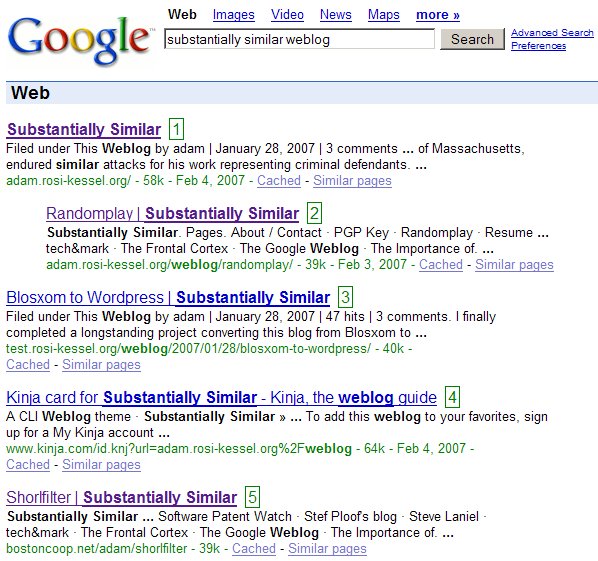
Changes are afoot at Google. A couple of weeks ago Google announced that it is refining its algorithms to minimize the impact of “Google Bombs.” (It’s curious that they made a big announcement rather than just doing it covertly, but perhaps this way they get to control how the news is framed.) Apparently, link text will be weighted less heavily in determining relevance to search terms. Presumably this means the page content will get more weight — ultimately there are only a few parameters that can serve as inputs in PageRank. A couple of weeks ago, I adopted the name Substantially Similar for this blog. I was looking for something clever and suggestive of the focus of this blog, but not overly clever or too narrowly focused. (I leave it to my readers to tell me if it works.) As a test case for Google’s new algorithm, this seems to be proof positive: Substantially Similar Web Search I am fairly certain no one has created a link to me yet with the link text “substantially similar,” yet I’m already the top result. Another change I noticed is the substitution of third-party descriptions of URLs instead of excerpt text. I don’t know if this is a new development or not, but it’s an interesting departure from what I’ve seen before: Google Excerpt Text That last link above is my old law school outline site — and the text “not fancy, but tons of outlines” doesn’t appear anywhere on the page itself. Instead, it is a description of the site from a couple of outline “portal” pages.

5 February 2007

Enrico Zini: pmdraft-commandline

Second generation package manager - First shellish prototype As you know, I'd like to experiment with prototyping some new interface concepts for package managers. I put together a prototype backend and hacked a cmd-based shell interface for it. You should be able to fetch it with:
bzr branch http://people.debian.org/~enrico/2007-01/popcon/
The files involved are pm.py, pmnew and a very little bit of anapop.py. You run it with ./pmnew. The commands are: This can be an example session to try:
tags
search toy
tags
packages
tags
desired 1
packages
info 3
If you: then the list of available packages will be sorted using my recent web interface prototype for popcon-based suggestions. Matt Good and Thomas Viehmann volunteered to have a try at a GUI. This can only be fun.

Jon Dowland: Battery statistics

Recently I've noticed my X40's battery life appears to not be what it once was. I was curious to work out precicely what it is, so I delved into the debian packages to see what I could find. There are two popular "standards" for power management: APM and ACPI. Hardware support for the two standards varies wildly across laptops, which is why we haven't entirely ditched APM and moved to ACPI for everything. The X40 (and thinkpads in general) have great ACPI support, so I use ACPI. Unfortunately most of the packages I've found that look like they might do what I want are for APM only:
battery-stats
...periodically collect statistics...show charge/discharge patterns over time...requires APM...
ibam
...advanced battery monitor for laptops...statistical and adaptive linear methods...requires /proc/apm.
Some other tools sounded great, but also a bit self-defeating:
collectd
...reads various system statistics and updates RRD files... promising so far; the statistics are very fine-grained since the files are updated every 10 seconds. Ack! The heisenberg principle will probably kick in a bit here, if the hard disk is going to spin up every 10 seconds.
It's starting to look like it might be worthwhile porting one of these to ACPI. Ben Hutchings is going to send me some example code he uses to monitor his battery in ion3. Mental note: file patches for the descriptions of those packages which do not make it clear which interface they support.

Bdale Garbee: TAPR Open Hardware License

John Ackermann, N8UR, has authored two new licenses intended to foster collaborative hardware development projects. I've known John for many years through our mutual involvement in TAPR. He invited me to review several early drafts, and did a great job of integrating the feedback that I and his other early reviewers provided. The latest drafts of these licenses are open to public review and comment until March 7th, 2007. I invite readers interested in hardware development and/or the nuances of license texts to review the TAPR Open Hardware License and associated non-commercial variant, and provide feedback through the mechanisms provided.

3 February 2007

Julien Blache: Solutions Linux 2007

I am running through my post-SL TODO list, and I’m down to the item which reads “Write a report”. We’ve had a very good time meeting users, prospective users and fellow DDs, as always. There were 21 people planned to man the booth, which is an all time record so far, and 18 out of those 21 showed up, which is really quite good :-) I’m not going to list everybody here, first because the list has grown quite long now, and because all in all it’s the usual French team that has been at it for the past few years already. We had a couple of firsttimers though, including Pierre Habouzit and Yves-Alexis Perez. Everybody did great, thanks for helping out, guys! Day 0: unpacking sl2007-booth… setting up sl2007-booth… We had less hardware this year than we had the previous years, for a variety of reasons, so the booth setup actually went quite fast. There were no separations between the booths in the .Org Pavilion this year, so we put a bit of thought into that and figured that, oh well, it’d do anyway. Pierre arrived at 7:30pm on the booth with some hardware from Sven and 1500 Debian flyers paid for by Linbox. We went for dinner, then Pierre and I spent the night hacking on the Babelbox scripts to get the damn thing to work with the current debian-installer. At 3:30am, we got to the point where the Babelbox would pretty much work, and couldn’t figure out what was going wrong at that point. Day 1: Fixing the Babelbox, frying a graphics card We ended up fixing the last bit of the Babelbox on the booth in the morning, and preparing the demo system (Pierre’s shuttle) at the same time. It all went fine and we ended up with a dual-head demo system and a beamer-equiped Babelbox in the afternoon after Niv brought a beamer. We used the back of Fr d ric’s Debian banner as the screen for the beamer. We had a nice chat with the Linux+ magazine team in the afternoon, discussing the upcoming Debian release and a dedicated Linux+ issue. We’ll be helping them out tracking the Etch release in the next few weeks until the release. Back at Pierre’s place, we found out that his shuttle apparently wouldn’t boot. Turns out that only the graphics card died, good news. Day 2: Business as usual, Debian France meeting The second day was really business as usual. We saw more people than the previous day, but still there were less visitors than the previous years. The exhibition was smaller than the previous years too, I just hope it’s only a temporary thing and that it’ll be bigger again next year. This also was the “dinosaurs day”, the day all the old-timers pop by and discuss around the Debian booth. This is becoming a tradition or something :-) As Christian wrote already, we met HP people and talked about Linux support from HP on HP hardware. In the evening, we had the first formal Debian France meeting. Julien Cristau and Christian Perrier got elected to the board of directors, replacing C dric Delfosse and Laurent Fousse. The board got reelected, so I’m still the President, Pierre is still the Secretary and Aur lien G r me is still the Treasurer. Thanks to Tarsus for lending us a room for the meeting! Day 3: Packing up Small day… Quite a few visitors in the afternoon, we talked about Debian France a bit more than we did on the previous day, mainly with other people from the .Org Pavilion. Conclusion Overall, a very productive edition this year, we talked about Debian France a lot, about Etch, about quite a few projects involving Debian too. Now we have a lot of work to do to release Etch and develop Debian France to the point were it will actually be really useful for Debian. Hopefully we’ll have things to show in a couple of weeks.

2 February 2007

Julien Blache: pommed on Alioth: mailing-lists

Now that pommed is hosted on Alioth, I’ve created the pommed-devel mailing-list. If you’re interested in pommed’s development, subscribe today ! There’s also a pommed-commits mailing-list for the patch junkies. Send mail to pommed-devel-subscribe@lists.alioth.debian.org and/or pommed-commits-subscribe@lists.alioth.debian.org to subscribe.

Enrico Zini: pmdraft

Second generation package manager I have created many prototypes for advanced package manager features. Erich Schubert also made a tag cloud prototype. Recently, I wrote:
We have lots of interesting, usable metadata; we have algorithms; we have prototypes; we have ideas for lots of cool, implementable features. The question is, are we able to write applications that just combines what is needed from all this treasure to provide the right interface(s) for our base(s) of users?
Most of the back-end code is already implemented in Python, and I'm thinking of putting it together into a working prototype for a new concept of a file manager. This could be even implemented quickly, if someone joins me who is good at: What follows is a sketch description of what I have in mind. The user
Debora is 34, working as a web designer in a small enterprise. She has a laptop running Debian which she uses both for work and at home. She likes Debian for the wide range of software, that allows her to be always able to access the best tools for the job, even in a highly changing environment like the one of web design. At home she enjoys the various tools for photo editing and management, and of course, having a husband and a 6 years old son, the selection of games.
The tasks Looking for new software Use the smart tag search for searching: it allows a Google-like search interface, which afterwards allows categories to be used to semantically refine the results. This last step is conceptually very simple, as it maps to a sequence of "more like this" and "less like this". The search results can be sorted using popcon suggestions, that are very effective at showing software not in the system that many other people use. Looking at what is installed Let's see if this package does what I need Given an installed pacakge, show the contents of its bin/ directories and showing manpages as the details for the bin/ file: thanks to the Debian Policy, executables are all in /(usr/)?s?bin/ and they must have manpages. For packages that are tagged as interface::3d, interface::text-mode or interface::x11, allow to run them directly from the interface. Also show the contents of /usr/share/doc/pkgname and /usr/share/doc/suggested-and-recommended-pkgnames and allow to open documentation with the appropriate software. If there is an html directory which contains an index.html, only show that and not all the other HTML files. Find info documentation and allow to open it into a proper info browser. If there are manpages that don't have a corresponding executable, show them as extra documentation. What was that nice package I installed yesterday? List installed packages sorted by when was the last time they have been installed. Let's get rid of the cruft There are also some "unusefulness" scores one can compute, but I haven't yet been playing with them yet: Task filter Have a look at the popcon suggestion page: there is a "Suggestion type" box. Of course the same idea can be used in a package manager to restrict it to a significant subset of the packages. More filters, as you can imagine, can be easily created. This is how it is implemented:
case "any": $filter = "'!role::shared-lib'"; break;
case "gui": $filter = "'!role::shared-lib && role::program && (interface::x11   interface::3d)'"; break;
case "devel": $filter = "'!role::shared-lib && devel::*'"; break;
case "game": $filter = "'!role::shared-lib && role::program && game::*'"; break;
default: $filter = ""; break;
The same filter can be gived to Debtags:
debtags search '!role::shared-lib'
debtags search '!role::shared-lib && role::program && (interface::x11   interface::3d)'
debtags search '!role::shared-lib && devel::*'
debtags search '!role::shared-lib && role::program && game::*'
Conclusion As I said:
There is so much really cool stuff to be written, just within reach.
So?

1 February 2007

MJ Ray: Environment: Links for 2007-02-01

Milton Country Park
This park near Cambridge is under threat, partly due to council mismanagement.
Climate change prompts Cabinet change in Canada - CNN.com
Carry on flying, says Blair - science will save the planet Special Reports Guardian Unlimited Politics
Weston and Worle News: Recycling Service Branded Rubbish
"A Weston resident has branded the town's recycling service rubbish and joined calls for it to be investigated.Carolyn Jones, who moved to Weston Village from south Gloucestershire 18 months ago,..." I've had to telephone and get Biffa to come back after they missed my collection every time since New Year. What's going on?
Linux Ecology-HOWTO
Nuclear Power?
Cycle Parking Farcility of the Month
CTC - Cyclist who refused to stay in the gutter wins
So you are allowed to cycle on the roads in Telford, despite what the police there think. More coverage:
Cyclist's conviction thrown out : Shropshire Star
BBC NEWS England Shropshire Cyclist wins road blocking appeal
Cycle-lanes - epetition reply
A relevant reminder from Tony Bliar's office that cyclists don't have to use useless cycle lanes.
Trains Swindon - Melksham - Westbury - SLASHED by the DfT and First
Campaign site about the government-enforced cuts to Great Western services in the Wiltshire/Somerset/Bristol area.
EDP24 - Dangerous driver in cyclist death jailed
BBC NEWS England Norfolk Tired motorist jailed over death
High-res plans of the TdF London stages

David Nusinow: Bits From The XSF

This has been a little overdue, but here it is. Lots of less than glamorous stuff has been going on in the XSF, and a few more exciting things are in the pipeline.

Among the less glamorous stuff, our resident release junkie/alpha porter, Steve Langasek, fixed #392500 which was our major RC bug on the alpha arch. Aside from that bug, there's been a whole host of bug triage by our newest team member, Brice Goglin. Brice has taken on the unenviable task of going through the massive list of bugs owned by the XSF. I've been traditionally less than responsible about handling bug reports like I should, and Brice is dealing with the mess I've left behind. Before he started, we were at over 2000 outstanding bugs, and as of this writing we're down to 1646 bugs, which is a huge amount of work. Hopefully this will go a long way towards making our little corner of the BTS usable for mere mortals. Aside from that, there's been an enormous amount of small cleanups and bug fixes by the whole team, most notably Julien Cristau (who's been doing more actual release management than yours truly), Thierry Redding, and Drew Parsons. Perhaps most important among these are miscellaneous last minute driver fixes that will enable a fair number of people to actually run Etch without backports. Michel D nzer has continued to be his usual awesome self, responding to the tough DRI bugs that the rest of us are terrified to approach.

Some of the more exciting stuff from a user perspective has been the various updates and new packaging going on. Thierry has taken on mesa, which is an incredibly daunting task, and he's done and incredible job of it so far. He and Julien cooperated on getting the newest mesa release, 6.5.2, in to experimental. That's a huge step on the way to getting the 7.2 release in to the archive. Thierry has also packaged up the newest compiz and some additional plugins ported from beryl, both of which are waiting in NEW right now for our overworked ftp masters to find time to have a look at them. Speaking of beryl, we also have that more or less complete and packaged. Our second-newest XSF member, Shawn Starr, has taken on beryl, and done a great job of getting the packages ready for experimental. They came back from review with a few minor comments, so he's busy getting those last issues resolved, so beryl should be winging its way over to NEW again for re-review soon. Finally, Josh Triplett and Jamie Sharp, who are both Debian and XCB developers, have put XCB in to experimental for you to test and play with. Expect to hear more about this when the Lenny development cycle starts.

The other huge thing that's been going on, and what I've been devoting most of my time to (aside from reading all the mail from Brice's bug triage), is transitioning the XSF over to git. Thierry has written major chunk of infrastructure to help move us over. I've done most of the conversion locally, and have been putting things up on git.debian.org as I go. As of now, we've got a very large chunk of X in git now, and using svn for those bits is officially closed. I'm hoping to complete the move in the next two weeks or so. If you want the above software that's not yet in the archive (beryl, compiz, compiz-extra, etc) you can clone it from the git repositories and build away. The other major thing that I've been doing is writing up a XSF git policy. This required a lot of input from the team, and we had to come up with a reasonable way of working the archive so that we could easily work with an upstream that was also using git, which as far as I know is a unique situation right now. It's in pretty good shape right now and we're just starting to put it in to real use. I've proposed a talk for Debconf on the XSF roadmap for Lenny, and I'll be sure to talk about our experiences using git if it gets accepted. In addition, we've all been learning the ins and outs of git, which is a whole other post in itself. I think that the XSF will end up being a really good resource for people in Debian who are looking to use git, as we'll have a lot of real world experience with a tool that relatively few people actually seem to know. Since I think git usage will only grow in the future, hopefully this will end up being valuable for Debian as a whole.

Next.

Previous.