Search Results: "ema"

15 July 2010

Jordi Mallach: Hiking through the Pyrenean GR 11

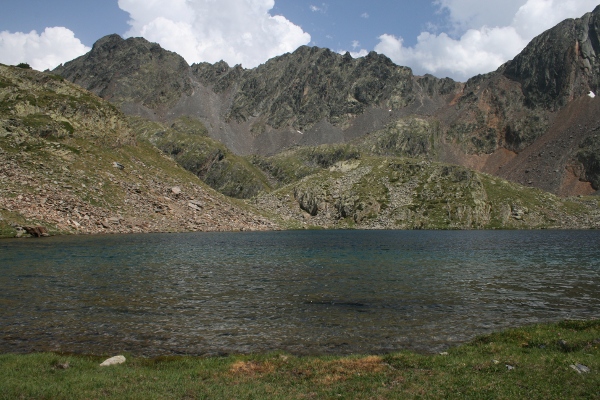
Tomorrow, at this time, I'll probably be unsuccessfully trying to find a comfortable position on a seat of the Bilmanbus to Irun. Very early on Saturday, as soon as we get off the bus, Maria and I will quickly head to Hondarribia's beach in Cape Higer to symbolically wet our feet in the waters of the Cantabrian Sea. We won't have much time to enjoy the cold waters of the ocean, though. Soon after that, we'll have to take a deep breath, look East, and start walking if we want to achieve our utmost objective: take a bath in the beautiful beaches of the Cap de Creus, in the Mediterranean sea. In between, 30 days and 840 kilometres of thick woods, deep valleys, high peaks and cold waters, all of which shape incredible landscapes.


The Portella de Baiau, during our 2008 trip For a whole month, we'll be mostly disconnected from everything else that isn't our knee ache, our blisters, the Sun over our heads or where to get food. It's the first time I leave on a hiking trip as long and tough as this one, and I feel both uncertainty and eagerness. We've been so busy during the last few months that we've been unable to train at all for this, and I'm probably in the worst physical condition in a decade. It's too late to take care of that now, so we'll try to take good care of our legs and spine. In order to get back home in the Mediterranean, we'll have to be fast, some days joining two stages and skipping a few that we know are not that interesting (sections over asphalt, etc.). It's hard to make it in just one month, but we'll try our best. The plan is going to sleep not long after sunset, getting up at dawn, to be able to walk for a decent time before the heat starts being a handicap and just resting at midday, when the Sun is <strongest.> Of course, this means that I'm missing, yet again, this year's edition of DebConf in New York City, which is really sad because I was looking forward hanging around with Mako, Mika, Biella, micah, Clint and the rest of the NYC/ Boston gang, but when the idea of doing a long trip this summer popped up around January, it was clear DebConf seemed unlikely this year. I hope all of you have a lot of fun, and see you in a few weeks!

Enrico Zini: Released cfget 0.15

Released cfget 0.15 I have released version 0.15 of cfget. cfget is a tool to extract values from ini-style config files. A trivial thing, really. It is also simple to install: it is a single python executable and it has no dependencies besides the python standard library. It is trivial and simple, but because of the complex requirements (and sponsorship) of ISAC - CNR it has recently accumulated quite a set of features, and it manages to get a remarkable lot of things done. There are several news since 0.8, worth a rather major announcement: Added --dump=pickle Now all the contents of the configuration files, plus all the contents generated by cfget plugins, can be dumped in pickle format. This provides a quick and dirty way to load all cfget-generated data into a python dict:
data = pickle.loads(
    subprocess.Popen(
        ["cfget", "--dump=pickle"],
        stdout=subprocess.PIPE).communicate()[0])
It sounds like a rather complicated way to read a configuration file, but if you have various plugins that compute nontrivial derived configuration values, that quick&dirty hack could be quite useful. Curly brace expansion Suppose that you have a config file like this:
[general]
mode = show
[show]
command = display
[edit]
command = gimp
And you want to get the command from the section indicated by general/mode. Now you can, very easily: cfget ' general/mode /command' When it notices curly braces, cfget will literally replace them with the result of querying their contents, then parse the expression again. Simple expression support ISAC - CNR are using cfget to configure the run of a rather complicated physical model, and use plugins to derive all sorts of values form the base configuration. This works, but there are times when adding a function to a plugin sounds like overkill: for example, sometimes one needs foo/bar + 1, or just the hour of a timestamp. For those simple cases, I've added support for simple expressions: So to compute a middle point one can now do this:
cfget "round((pos/start + pos/end) / 2)"
It needs a space around arithmetic operators to avoid conflicts with characters used to refer to configuration values, but with the space the expressions look nicer, so the result is that it generally does the right thing. Just as a scary thought, curly braces work with and in expressions:
cfget "values/val round((pos/end - pos/start) / 2)  + 1"
Although if someone ends up having a hairy thing like that, it is worth considering to replace it with a dynamic value computed using a plugin.

Rapha&#235;l Hertzog: Social Micropayment Can Foster Free Software, Discover Flattr

Social Micropayment Flattr LogoA social micropayment system allows you to donate a small amount of money (a few pennies/cents) to thank someone else for a good blog post, piece of music, or for a free software that you enjoy. That s what Flattr is all about. How Flattr works With Flattr, donating is as easy as a single click on a Flattr button that content providers (read free software developers ) embed on their websites. A Flattr button is very similar to a Digg button or other social buttons (you can look at the end of this blog post for a sample). The amount donated per flattr varies from month to month because you define a fixed amount of money to spend each month (minimum 2 ) and it s split evenly between all the things that you appreciated. You can flattr as much as you want, it won t cost you more. Support Free Software with Flattr Free Software lacks a good business model to fund the creation of software, yet someone has to pay the time spent in writing the code. Many projects have tried to ask for donations but the amount collected rarely covers more than the expenses for the website hosting. Flattr makes it so easy to donate that this is possibly about to change. Flattr users have to spend their monthly amount each month, otherwise it gets donated to charity. Thus if it takes off, most Flattr users will grow the habit of doing regular donations to projects that they use and appreciate. Bootstrapping the Process Flattr FLOSS LogoFlattr is a new service, not many projects are using it to accept donations and not many users are participating yet. But it s growing quickly on both sides. In order to help users who want to support Free Software with Flattr, I have started the Flattr Free and Open Source Software project. You can subscribe to a newsletter to receive a monthly reminder with recommendations of Free Software to Flattr. If you have more time, you can also browse public directories listing various Free Software projects using Flattr so that you can manually pick your favorites. To learn more about the Flattr FOSS project, click here. I also invite Free Software developers to setup Flattr on their websites, blogs, and to register those sites so that Flattr users can easily find them. To learn more about this, check out the Earn a Living With Free Software page. Share the News Flattr can change the situation of many small but popular free software projects struggling with a single developer who started it as a hobby and who can t afford to spend more free time on it. But this can only happen if lots of users start using Flattr to support the Free Software that they benefit from. So share the news, tell the friends, join Flattr FOSS and give some Flattr-love every month. Get Your Free Flattr Invite! Flattr is still in beta, but they like Free Software a lot and have offered 30 invites for the launch of Flattr FOSS. You can get yours by subscribing either to my main newsletter or to the Flattr FOSS one. Just reply to the welcome email you get after having subscribed and ask for your invite. Flattr this Share/Bookmark No comment Support my work

Biella Coleman: A User s Guide to Lulzy Media, the Pleasure of Trickery, and the Politics of Spectacle: From the Luddities to Anonymous

One of my favorite conferences is HOPE, which I have missed the last 2 times as I was away from NYC, so I am glad I am around this year. I find it especially valuable when there is some controversy brewing in the air, as there is with Wikileaks, Adrian Lamo, and Manning. I am also giving a talk, description below, with a fabulous postdoctoral researcher, Finn Brunton, who works on spam! But we will be talking about pleasure, trickery, and exploitable media for activists. Our talk is late, like really late: 11:00 PM on Saturday night. At first I was a bit annoyed at the scheduling but then I figured, when will i ever give a talk at 11:00 PM?
Following a brief lecture on Project Chanology, the question will be posed: how can we harness the power of lulzy virality, of pleasure, of trickery, of spectacular trolling for purposes above and beyond sharing the wisdom of Advice Dog? It ll start with a brief look at great activist media in the past, from Guernica and the picture of the whole Earth to projects by the Yes Men - how they spread ideas and helped people get informed, organize, and act. What makes the creation of lulzy memes different? Learn about how to create exploitable forms and rapid variations, and mechanisms for bringing the best stuff forward. Can we make media memes with goals beyond lulz, and teach activists who ve never heard of 4chan to make them too? Part lecture, part workshop, this will feature cameos by Rageguy, Pablo Picasso, V, alt.pave.the.earth, Kathe Kollwitz, Courage Wolf, Stewart Brand, Sarah Palin, Batman, Goya, Philosoraptor, Adolf Hitler, Trollface, Shepard Fairey, Joseph Ducreux, David Cameron, lots of Spartan warriors, and lots and lots of (trollish) cats.

Biella Coleman: A User s Guide to Lulzy Media, the Pleasure of Trickery, and the Politics of Spectacle: From the Luddities to Anonymous

One of my favorite conferences is HOPE, which I have missed the last 2 times as I was away from NYC, so I am glad I am around this year. I find it especially valuable when there is some controversy brewing in the air, as there is with Wikileaks, Adrian Lamo, and Manning. I am also giving a talk, description below, with a fabulous postdoctoral researcher, Finn Brunton, who works on spam! But we will be talking about pleasure, trickery, and exploitable media for activists. Our talk is late, like really late: 11:00 PM on Saturday night. At first I was a bit annoyed at the scheduling but then I figured, when will i ever give a talk at 11:00 PM?
Following a brief lecture on Project Chanology, the question will be posed: how can we harness the power of lulzy virality, of pleasure, of trickery, of spectacular trolling for purposes above and beyond sharing the wisdom of Advice Dog? It ll start with a brief look at great activist media in the past, from Guernica and the picture of the whole Earth to projects by the Yes Men - how they spread ideas and helped people get informed, organize, and act. What makes the creation of lulzy memes different? Learn about how to create exploitable forms and rapid variations, and mechanisms for bringing the best stuff forward. Can we make media memes with goals beyond lulz, and teach activists who ve never heard of 4chan to make them too? Part lecture, part workshop, this will feature cameos by Rageguy, Pablo Picasso, V, alt.pave.the.earth, Kathe Kollwitz, Courage Wolf, Stewart Brand, Sarah Palin, Batman, Goya, Philosoraptor, Adolf Hitler, Trollface, Shepard Fairey, Joseph Ducreux, David Cameron, lots of Spartan warriors, and lots and lots of (trollish) cats.

14 July 2010

Biella Coleman: Annual Review of Anthropology on Digital Media

I don t remember how but I remember when I first stumbled on an Annual Review of Anthropology. Reading the first one was like stumbling accidentally into a pirate chest of gold doubloons. I was simultaneously flabbergasted, elated, and somewhat annoyed. I could not believe how helpful of a resource the articles were, how interesting it was to learn about the state of the field (since each review covers one topic) and what a time saver it was in terms of research. I was annoyed only because no one had really properly clued me into its existence and felt like it was one of the things that every graduate student should know about like before they even entered their program. When I got asked to write one a few years ago, a mix of conflicting emotions welled up. I was honored and horrified at the same time for I knew that it would require some of the heaviest lifting I have ever engaged in, which turned out to be the case. I almost quit twice but managed to turn in the first draft on time, before the deadline (thanks to a scheduled trip to NZ). After a parade of months of reading, drafting, and rethinking, the uncorrected proofs are now online on the ARA wesbite (you need library access to fetch it and the link is tiny and on the right hand corner). The corrected proofs will be there in a few months but all the mistakes at this point are typos, although I would check back to get the final copy for the purposes of citation. There is a lot more I want to say about the piece and the process of writing it but I will leave such ruminations for future posts. For now, it suffices to say that with a piece like this, you become a dart board, as my friend cleverly put it the other night. I am sure I have overlooked folks (I was working within very thrifty parameters, 6000 words, 150 citations though I managed to get a bit more) and I could have pushed everything further than I did, though this again was very hard to do given the constraints. I decided in the end to be as inclusive as I could, which meant sacrificing a few lines of thought, which I hope to pick up in the future. The part I like the most is the last bit, where I conclude by with the help of systems administrators and spam.

Biella Coleman: Annual Review of Anthropology on Digital Media

I don t remember how but I remember when I first stumbled on an Annual Review of Anthropology. Reading the first one was like stumbling accidentally into a pirate chest of gold doubloons. I was simultaneously flabbergasted, elated, and somewhat annoyed. I could not believe how helpful of a resource the articles were, how interesting it was to learn about the state of the field (since each review covers one topic) and what a time saver it was in terms of research. I was annoyed only because no one had really properly clued me into its existence and felt like it was one of the things that every graduate student should know about like before they even entered their program. When I got asked to write one a few years ago, a mix of conflicting emotions welled up. I was honored and horrified at the same time for I knew that it would require some of the heaviest lifting I have ever engaged in, which turned out to be the case. I almost quit twice but managed to turn in the first draft on time, before the deadline (thanks to a scheduled trip to NZ). After a parade of months of reading, drafting, and rethinking, the uncorrected proofs are now online on the ARA wesbite (you need library access to fetch it and the link is tiny and on the right hand corner). The corrected proofs will be there in a few months but all the mistakes at this point are typos, although I would check back to get the final copy for the purposes of citation. There is a lot more I want to say about the piece and the process of writing it but I will leave such ruminations for future posts. For now, it suffices to say that with a piece like this, you become a dart board, as my friend cleverly put it the other night. I am sure I have overlooked folks (I was working within very thrifty parameters, 6000 words, 150 citations though I managed to get a bit more) and I could have pushed everything further than I did, though this again was very hard to do given the constraints. I decided in the end to be as inclusive as I could, which meant sacrificing a few lines of thought, which I hope to pick up in the future. The part I like the most is the last bit, where I conclude by with the help of systems administrators and spam.

Petter Reinholdtsen: Combining PowerDNS and ISC DHCP LDAP objects

For a while now, I have wanted to find a way to change the DNS and DHCP services in Debian Edu to use the same LDAP objects for a given computer, to avoid the possibility of having a inconsistent state for a computer in LDAP (as in DHCP but no DNS entry or the other way around) and make it easier to add computers to LDAP. I've looked at how powerdns and dhcpd is using LDAP, and using this information finally found a solution that seem to work. The old setup required three LDAP objects for a given computer. One forward DNS entry, one reverse DNS entry and one DHCP entry. If we switch powerdns to use its strict LDAP method (ldap-method=strict in pdns-debian-edu.conf), the forward and reverse DNS entries are merged into one while making it impossible to transfer the reverse map to a slave DNS server. If we also replace the object class used to get the DNS related attributes to one allowing these attributes to be combined with the dhcphost object class, we can merge the DNS and DHCP entries into one. I've written such object class in the dnsdomainaux.schema file (need proper OIDs, but that is a minor issue), and tested the setup. It seem to work. With this test setup in place, we can get away with one LDAP object for both DNS and DHCP, and even the LTSP configuration I suggested in an earlier email. The combined LDAP object will look something like this:
  dn: cn=hostname,cn=group1,cn=THINCLIENTS,cn=DHCP Config,dc=skole,dc=skolelinux,dc=no
  cn: hostname
  objectClass: dhcphost
  objectclass: domainrelatedobject
  objectclass: dnsdomainaux
  associateddomain: hostname.intern
  arecord: 10.11.12.13
  dhcphwaddress: ethernet 00:00:00:00:00:00
  dhcpstatements: fixed-address hostname
  ldapconfigsound: Y
The DNS server uses the associateddomain and arecord entries, while the DHCP server uses the dhcphwaddress and dhcpstatements entries before asking DNS to resolve the fixed-adddress. LTSP will use dhcphwaddress or associateddomain and the ldapconfig* attributes. I am not yet sure if I can get the DHCP server to look for its dhcphost in a different location, to allow us to put the objects outside the "DHCP Config" subtree, but hope to figure out a way to do that. If I can't figure out a way to do that, we can still get rid of the hosts subtree and move all its content into the DHCP Config tree (which probably should be renamed to be more related to the new content. I suspect cn=dnsdhcp,ou=services or something like that might be a good place to put it. If you want to help out with implementing this for Debian Edu, please contact us on debian-edu@lists.debian.org.

Mike Hommey: I/O patterns on ELF binary initialization

[ I meant to finish this article much earlier, but i had to leave it in a half-written draft state for quite some time due to other activities ] One particular issue that arises with big binary files is that of I/O patterns. It looks like it is not something under the usual scope for both ld.so and programs/libraries, but it can have a dramatic influence on startup times. My analysis is far from complete, would need to be improved by actually investigating ld.so code further, and so far has been limited to libxul.so built from mozilla-central, with the help of icegrind, on x86-64 linux. As I wrote recently, icegrind allows to track memory accesses within mmap()ed memory ranges. As ld.so does mmap() the program and library binaries, tracking the memory accesses within these mmap()s allows to get a better idea at I/O patterns when an ELF binary is initialized. I only focused on local accesses within a single given binary file (libxul.so) because the case of Firefox loading many files at startup is already being scrutinized, and because most of the non-Firefox files being read at Firefox startup (system and GNOME libraries) are most likely already in the page cache. I also focused on that because it was an interesting case that could be helpful to understand how big (and maybe less big) binaries may be affected by the toolchain (compiler, linker and dynamic linker) and possibly by some coding practices. For the record, what I did to get these results is to use icegrind and elflog, with further additions to the sections file with some output from objdump -h : I added sections that elflog wouldn t give (such as .plt, .hash, .dynsym, etc.), and even down to the entry level for the .rela.dyn section. The latter is particularly interesting because icegrind only outputs the first access for any given section. To see sequential accesses within that section, you need to split it in smaller pieces, which I did for .rela.dyn entries (each one being 24 bytes on x86-64). Uncommenting some parts of the icegrind code was also useful to track where some accesses were made from, code-wise. Now, the interesting data: One of the first accesses is a nullification of a few variables within the .bss section. The .bss section is usually an anonymous piece of memory, that is, a range of mmap()ed memory that is not backed by a file, and filled with zeroes by the kernel (I think it even does that lazily). It is used for e.g. variables that are initialized with zeroes in the code, and obviously, any code accessing these variables would be addressing at some offset of the .bss section. It means the section needs to start in memory at the offset it has been assigned by the linker at build time. This is actually where problems begin. When the .bss section offset as assigned by the linker doesn t align on a page (usually 4KB), the mmap()ed .bss can t be at that location, and really starts on the next page. The remainder is still mmap()ed from the binary file, and ld.so will itself fill that part. As the .bss section doesn t start on a page boundary, any write at this location will trigger the kernel reading the entire page. This means one of the first set of data being read from the file is the end of the section preceding .bss, and the beginning of the following one. Most likely, respectively the .data and .comment sections. While this probably doesn t matter much when the binary file is small, when it is big enough, reading in a non sequential manner will trigger hard disk seeks, and we all know how they can hurt performance. Although thankfully, cheap SSDs should be coming some day, in the meanwhile, we still need to cope with the bad performance. The interesting part is, the .bss section is really empty in the binary file, so its virtual memory address could be anywhere. Why the linker wouldn t align it at a page boundary without having to resort to a linker script is beyond me. The next accesses go back and forth between .dynamic, .gnu.hash, .dynstr, .gnu.version_r, .gnu.version and .dynsym. These are probably all related to symbol version resolution and DT_NEEDED library loading. While most of these sections are at the beginning of the file (not necessarily in the order they are read from), the .dynamic section is much nearer to the end, but way before .data, so that it won t even have been loaded as a by-product of the .bss section loading. After that, the .rela.dyn section is read, and for each relocation entry it contains, the relocations are being applied. Relocations is one of the mechanisms by which position independent code (PIC) is made possible. When a library is loaded in memory, it is not necessarily loaded at the same address every time. The code and data contained in the library thus need to cope with that constraint. Fortunately, while the base address where the library is mmap()ed in memory is not necessary constant, the offsets of the various sections are still as codified in the binary. The library code can thus directly access data at the right offset if it knows the base offset of the library (which is what is done on the x86 ABI), or if it knows where the current instruction is located (which is what is done on the x86-64 ABI). Static data (initialized in e.g. a const or a global variable, or, in C++ case, vtables), on the other hand, may contain pointers to other locations. This is where relocation enters the scene. The .rela.dyn section contains a set of rules describing where in the binary some pointers need to be adjusted depending on the base library offset (or some other information), and how they should be updated. ld.so thus reads all .rela.dyn entries, and applies each relocation, which means that while .rela.dyn is being read sequentially, reads and writes are also performed at various places of the binary, depending on the content of the .rela.dyn entries. This is where this gets ugly for Firefox: there are near 200000 such relocations. On x86-64 an entry is 24 bytes (12 on x86), and each of these is going to read/write a pointer (8 bytes on x86-64, 4 on x86) at some random (though mostly ordered) location. The whole .rela.dyn section not being read ahead, what actually happens is that it is read in small batches, with seeks and reads of other data at various locations in between. In libxul.so case, this spreads over .ctors, .data.rel.ro, .got, and .data. The relocation entries are somehow ordered by address to be rewritten, though they occasionally jump backwards. Some of these relocations also appear to be touching to .gnu.version, .dynsym and .dynstr, because their type involves a symbol resolution. Once .rela.dyn relocation have been dealt with comes .rela.plt s turn. The principle is the same for this section: entries describe what kind of relocation must be done where, and how the result must be calculated. The scope of this section, though, is apparently limited to .got.plt. But before explaining these relocations, I ll explain what happens with the PLT. The PLT (Procedure Linkage Table) is used when calling functions from external libraries. For example, in a Hello World example, the PLT would be used for calls to the puts function. The function making the call would in fact call the corresponding PLT location. The PLT itself, on x86 and x86-64, at least, consists of 3 instructions (I ll skip the gory details, especially for x86, where the caller needs to also set some register before calling the PLT). The first instruction is the only one to be called most of the time: it reads the final destination in the .got.plt section, and jumps there. That final destination, obviously, is not fixed in the library file, since it needs to be resolved by its symbol. This is why the two subsequent instructions exist : originally, the destination stored in the .got.plt section points back to the second instruction ; the first instruction will effectively be a nop (no operation), and the following instructions will be executed. They will jump into code responsible for symbol resolution, update of the .got.plt entry for the next call, and call of the real function. But pointing back to the second instruction is like the pointers in static data we saw above : it s not possible in position independent code. So, the .rela.plt relocations are actually filling the .got.plt section with these pointers back to the PLT. There are a tad more than 3000 such relocations. All these relocations should be going away when prelinking the binaries, but from my several experimentations, it looks like prelinking only avoids relative relocations, and not the others, while it technically could skip all of them. prelink even properly applies all the relocations in the binary, but executing the binary rewrites the same information at startup for all but relative relocations. That could well be a bug in either ld.so not skipping enough relocations or prelink not marking enough relocations to be skipped. I haven t dug deep enough in the code to know how prelinking works exactly. Anyways, prelinking is not a perfect solution, as it also breaks ASLR. Sure, prelink can randomize library locations, but it relies on the user or a cron job doing so at arbitrary times, but that s far from satisfying. An interesting thing to note, though, is that a good part of the relocations prelinking doesn t rid us of in libxul.so (more than 25000) are due to the __cxa_pure_virtual symbol, which is used for, well, pure virtual methods. In other words, virtual methods that don t have an implementation in a given class. The __cxa_pure_virtual function is set as method in the corresponding field(s) of the class VTABLE in the .data.rel.ro section. This function is provided by libstdc++, and as such, is dynamically linked. But this function is just a dummy function, doing nothing. Defining an empty __cxa_pure_virtual function to be included in libxul.so makes these relocations become relative, thus taken care of by prelinking. After all relocations occur, the library initialization itself can begin, and the content of the .init section is executed. That section, indirectly, executes all functions stored in the .ctors section. This includes static initializers, which are unfortunately called backwards, as Taras pointed out already. Each of these static initializers are also accessing various locations in the .data or .bss sections, which may or may not have already been loaded during the relocation phase. The execution of these initializers will also (obviously) read various pieces of the .text section (despite its name, it contains executable sections, i.e. functions code). The initialization of the library ends there, and no access should happen until a function from the library is called. In libxul.so case, XRE_main is first called, then many other functions, but that s another story. All that needs to be remembered about the startup process past this point is that the .text section will be read heavily, as well as the various data, got, plt and dynamic symbol sections, in a very scattered way. While most of these sections may have been retrieved in memory already, as a byproduct of the various initialization processes described above, some may have not, increasing even more the need to seek at all places in the binary file. Now the main problem with all these I/O patterns at startup, is that it seems the only way reorganizing the binary layout may have a visible impact is by considering all the above, and not only a part of it, because only addressing a part of it is very likely to only move part of the problem to a different layer. All in all, making sure the relevant sections of libxul.so are read by the kernel before ld.so enters the game is a good short-term solution to avoid many seeks at startup.

Scott Kitterman: No, it s not a bug in my site

I maintain a Sender Policy Framework (SPF) record testing tool. If you happen to use it and it says your record isn t valid, your first action should not be to email me and ask if it s a bug in the tool. That is all.

13 July 2010

Fathi Boudra: What s going on in Debian Qt world?

Qt 4.7.0 beta 2 and Qt Creator 2.0.0 have been released upstream. There s some
noticeable changes in our Qt packages compared to Qt 4.6.x series:
- legacy Qt Assistant (ADP) is removed
- new Qt declarative module is introduced
- Qt Multimedia and Qt Webkit aren t being built anymore In case your package depends on the deprecated Qt Assistant, it is still being
shipped in a separated Qt Assistant compatibility package called
qt-assistant-compat. Qt Multimedia is now shipped from Qt Mobility API instead of Qt. The module has
been renamed to Qt Mobility MultimediaKit. Qt Mobility delivers a set of APIs
for mobile device functionality. Qt WebKit is shipped standalone, separated from Qt. Hopefully, it will make
Qt WebKit security support easier. There are also a new component in the family: Qt Messaging Framework (QMF).
The Qt Messaging Framework, QMF, consists of a C++ library and daemon server
process that can be used to build email clients, and more generally software
that interacts with email and mail servers. Finally, I have started to ship a snapshot of a new Phonon backend: Phonon VLC,
one backend to rule them all ! All the packages can be found in Debian Experimental repository, except
Qt Simulator, a simulator for Qt applications running on Nokia devices.
This package should land soon in Debian archives. I encourage you to try building your Qt applications against these packages and
please, report any bugs you encounter. Enjoy. http://packages.qa.debian.org/q/qt4-x11.html
http://packages.qa.debian.org/q/qtcreator.html
http://packages.qa.debian.org/q/qt-assistant-compat.html
http://packages.qa.debian.org/q/qtmobility.html
http://packages.qa.debian.org/q/qtwebkit.html
http://packages.qa.debian.org/q/qmf.html
http://packages.qa.debian.org/p/phonon-backend-vlc.html
http://bugs.debian.org/cgi-bin/bugreport.cgi?bug=587759

12 July 2010

Craig Small: Manually calculating process times

Most of the time you can trust the times you see in programs such as ps and top within Linux, but there are those other times where you just want to check what is going on.

First up, if you're using a FreeBSD system and the procps Linux tools, you're out of luck because a lot of the procfs is broken. You're almost guaranteed to get wierd results.

Jiffies and Hertz
The first thing to find is your jiffies. This is the number of clock ticks per second. There are two main ways of doing it.

The first, and more difficult way is to add up the cpu numbers in /proc/stat, divide it by the first number in /proc/uptime and divide it by the number of cpus.

My cpu line in /proc/stat looks like:
cpu 1267430 145826 552700 137029699 905086 8295 17885 0 0

and my /proc/uptime is:
695317.99 1370303.58

I've got 2 cpus on this system so the calculation is:

(1267430 + 145826 + 552700 + 137029699 + 905086 + 8295 + 17885 + 0 + 0 ) / 695317.99 / 2
which equals 100.

The second way is to use getconf, with the command "getconf CLK_TCK" which again on this system gives you 100.

We call this value "Hertz" and is usually 100 or 1024 though for some architectures it is other values.

Start Time
For each process the procfs has the start time, but it is expressed as the number of jiffes since the computer was booted. If we want to know the real "wall clock" time a process is started we have to start with number of seconds since epoch (for example using the time() function) subtract the number of seconds since the computer was booted and add the process start time from procfs.

The seconds since boot is the first value in /proc/uptime:
696141.85 1371857.53

The 22nd item in a procfs PID stat file is the number of jiffes since boot when the process started. We have to divide it by Hertz to calculate the number of seconds.
27139 (bash) S 11942 27139 27139 34821 5200 4202496 5500 25537 0 14 40 16 18 15 20 0 1 0 69446639 23433216 1378 18446744073709551615 4194304 5082140 14073724008 6512 140737240085456 140127945249678 0 65536 3686404 1266761467 0 0 0 17 1 0 0 0 0 0

To get the start time, take the current time, subtract the boot time and add the process start time.
perl -e '$nowstr = localtime(time() - 696141.85 + 69446639 / 100); print $nowstr, "\n";
Mon Jul 12 22:20:07 2010

Unless you are very quick, you will have to take a few seconds off because the time() function will be now, while the values from the proc files will be a few seconds earlier as it takes time for you to cut and paste.


<script defer="defer" src="http://static.zemanta.com/readside/loader.js" type="text/javascript"></script>
1

11 July 2010

Petter Reinholdtsen: Idea for storing LTSP configuration in LDAP

Vagrant mentioned on IRC today that ltsp_config now support sourcing files from /usr/share/ltsp/ltsp_config.d/ on the thin clients, and that this can be used to fetch configuration from LDAP if Debian Edu choose to store configuration there. Armed with this information, I got inspired and wrote a test module to get configuration from LDAP. The idea is to look up the MAC address of the client in LDAP, and look for attributes on the form ltspconfigsetting=value, and use this to export SETTING=value to the LTSP clients. The goal is to be able to store the LTSP configuration attributes in a "computer" LDAP object used by both DNS and DHCP, and thus allowing us to store all information about a computer in one place. This is a untested draft implementation, and I welcome feedback on this approach. A real LDAP schema for the ltspClientAux objectclass need to be written. Comments, suggestions, etc?
# Store in /opt/ltsp/$arch/usr/share/ltsp/ltsp_config.d/ldap-config
#
# Fetch LTSP client settings from LDAP based on MAC address
#
# Uses ethernet address as stored in the dhcpHost objectclass using
# the dhcpHWAddress attribute or ethernet address stored in the
# ieee802Device objectclass with the macAddress attribute.
#
# This module is written to be schema agnostic, and only depend on the
# existence of attribute names.
#
# The LTSP configuration variables are saved directly using a
# ltspConfig prefix and uppercasing the rest of the attribute name.
# To set the SERVER variable, set the ltspConfigServer attribute.
#
# Some LDAP schema should be created with all the relevant
# configuration settings.  Something like this should work:
# 
# objectclass ( 1.1.2.2 NAME 'ltspClientAux'
#     SUP top
#     AUXILIARY
#     MAY ( ltspConfigServer $ ltsConfigSound $ ... )
LDAPSERVER=$(debian-edu-ldapserver)
if [ "$LDAPSERVER" ] ; then
    LDAPBASE=$(debian-edu-ldapserver -b)
    for MAC in $(LANG=C ifconfig  grep -i hwaddr  awk ' print $5 ' sort -u) ; do
	filter="( (dhcpHWAddress=ethernet $MAC)(macAddress=$MAC))"
	ldapsearch -h "$LDAPSERVER" -b "$LDAPBASE" -v -x "$filter"   \
	    grep '^ltspConfig'   while read attr value ; do
	    # Remove prefix and convert to upper case
	    attr=$(echo $attr   sed 's/^ltspConfig//i'   tr a-z A-Z)
	    # bass value on to clients
	    eval "$attr=$value; export $attr"
	done
    done
fi
I'm not sure this shell construction will work, because I suspect the while block might end up in a subshell causing the variables set there to not show up in ltsp-config, but if that is the case I am sure the code can be restructured to make sure the variables are passed on. I expect that can be solved with some testing. :) If you want to help out with implementing this for Debian Edu, please contact us on debian-edu@lists.debian.org. Update 2010-07-17: I am aware of another effort to store LTSP configuration in LDAP that was created around year 2000 by PC Xperience, Inc., 2000. I found its files on a personal home page over at redhat.com.

Enrico Zini: Computing time offsets between EXIF and GPS

Computing time offsets between EXIF and GPS I like the idea of matching photos to GPS traces. In Debian there is gpscorrelate but it's almost unusable to me because of bug #473362 and it has an awkward way of specifying time offsets. Here at SoTM10 someone told me that exiftool gained -geosync and -geotag options. So it's just a matter of creating a little tool that shows a photo and asks you to type the GPS time you see in it. Apparently there are no bindings or GIR files for gtkimageview in Debian, so I'll have to use C. Here is a C prototype:
/*
 * gpsoffset - Compute EXIF time offset from a photo of a gps display
 *
 * Use with exiftool -geosync=... -geotag trace.gpx DIR
 *
 * Copyright (C) 2009--2010  Enrico Zini <enrico@enricozini.org>
 *
 * This program is free software; you can redistribute it and/or modify
 * it under the terms of the GNU General Public License as published by
 * the Free Software Foundation; either version 2 of the License, or
 * (at your option) any later version.
 *
 * This program is distributed in the hope that it will be useful,
 * but WITHOUT ANY WARRANTY; without even the implied warranty of
 * MERCHANTABILITY or FITNESS FOR A PARTICULAR PURPOSE.  See the
 * GNU General Public License for more details.
 *
 * You should have received a copy of the GNU General Public License
 * along with this program; if not, write to the Free Software
 * Foundation, Inc., 59 Temple Place, Suite 330, Boston, MA  02111-1307  USA
 */
#define _XOPEN_SOURCE /* glibc2 needs this */
#include <time.h>
#include <gtkimageview/gtkimageview.h>
#include <libexif/exif-data.h>
#include <stdio.h>
#include <stdlib.h>
static int load_time(const char* fname, struct tm* tm)
 
    ExifData* exif_data = exif_data_new_from_file(fname);
    ExifEntry* exif_time = exif_data_get_entry(exif_data, EXIF_TAG_DATE_TIME);
    if (exif_time == NULL)
     
        fprintf(stderr, "Cannot find EXIF timetamp\n");
        return -1;
     
    char buf[1024];
    exif_entry_get_value(exif_time, buf, 1024);
    //printf("val2: %s\n", exif_entry_get_value(t2, buf, 1024));
    if (strptime(buf, "%Y:%m:%d %H:%M:%S", tm) == NULL)
     
        fprintf(stderr, "Cannot match EXIF timetamp\n");
        return -1;
     
    return 0;
 
static time_t exif_ts;
static GtkWidget* res_lbl;
void date_entry_changed(GtkEditable *editable, gpointer user_data)
 
    const gchar* text = gtk_entry_get_text(GTK_ENTRY(editable));
    struct tm parsed;
    if (strptime(text, "%Y-%m-%d %H:%M:%S", &parsed) == NULL)
     
        gtk_label_set_text(GTK_LABEL(res_lbl), "Please enter a date as YYYY-MM-DD HH:MM:SS");
      else  
        time_t img_ts = mktime(&parsed);
        int c;
        int res;
        if (exif_ts < img_ts)
         
            c = '+';
            res = img_ts - exif_ts;
         
        else
         
            c = '-';
            res = exif_ts - img_ts;
         
        char buf[1024];
        if (res > 3600)
            snprintf(buf, 1024, "Result: %c%ds -geosync=%c%d:%02d:%02d",
                    c, res, c, res / 3600, (res / 60) % 60, res % 60);
        else if (res > 60)
            snprintf(buf, 1024, "Result: %c%ds -geosync=%c%02d:%02d",
                    c, res, c, (res / 60) % 60, res % 60);
        else
            snprintf(buf, 1024, "Result: %c%ds -geosync=%c%d",
                    c, res, c, res);
        gtk_label_set_text(GTK_LABEL(res_lbl), buf);
     
 
int main (int argc, char *argv[])
 
    // Work in UTC to avoid mktime applying DST or timezones
    setenv("TZ", "UTC");
    const char* filename = "/home/enrico/web-eddie/galleries/2010/04-05-Uppermill/P1080932.jpg";
    gtk_init (&argc, &argv);
    struct tm exif_time;
    if (load_time(filename, &exif_time) != 0)
        return 1;
    printf("EXIF time: %s\n", asctime(&exif_time));
    exif_ts = mktime(&exif_time);
    GtkWidget* window = gtk_window_new(GTK_WINDOW_TOPLEVEL);
    GtkWidget* vb = gtk_vbox_new(FALSE, 0);
    GtkWidget* hb = gtk_hbox_new(FALSE, 0);
    GtkWidget* lbl = gtk_label_new("Timestamp:");
    GtkWidget* exif_lbl;
     
        char buf[1024];
        strftime(buf, 1024, "EXIF time: %Y-%m-%d %H:%M:%S", &exif_time);
        exif_lbl = gtk_label_new(buf);
     
    GtkWidget* date_ent = gtk_entry_new();
    res_lbl = gtk_label_new("Result:");
    GtkWidget* view = gtk_image_view_new();
    GdkPixbuf* pixbuf = gdk_pixbuf_new_from_file(filename, NULL);
    gtk_box_pack_start(GTK_BOX(hb), lbl, FALSE, TRUE, 0);
    gtk_box_pack_start(GTK_BOX(hb), date_ent, TRUE, TRUE, 0);
    gtk_signal_connect(GTK_OBJECT(date_ent), "changed", (GCallback)date_entry_changed, NULL);
     
        char buf[1024];
        strftime(buf, 1024, "%Y-%m-%d %H:%M:%S", &exif_time);
        gtk_entry_set_text(GTK_ENTRY(date_ent), buf);
     
    gtk_widget_set_size_request(view, 500, 400);
    gtk_image_view_set_pixbuf(GTK_IMAGE_VIEW(view), pixbuf, TRUE);
    gtk_container_add(GTK_CONTAINER(window), vb);
    gtk_box_pack_start(GTK_BOX(vb), view, TRUE, TRUE, 0);
    gtk_box_pack_start(GTK_BOX(vb), hb, FALSE, TRUE, 0);
    gtk_box_pack_start(GTK_BOX(vb), exif_lbl, FALSE, TRUE, 0);
    gtk_box_pack_start(GTK_BOX(vb), res_lbl, FALSE, TRUE, 0);
    gtk_widget_show_all(window);
    gtk_main ();
    return 0;
 
And here is its simple makefile:
CFLAGS=$(shell pkg-config --cflags gtkimageview libexif)
LDFLAGS=$(shell pkg-config --libs gtkimageview libexif)
gpsoffset: gpsoffset.c
It's a simple prototype but it's a working prototype and seems to do the job for me. I currently cannot find out why after I click on the text box, there seems to be no way to give the focus back to the image viewer so I can control it with keys. There is another nice algorithm to compute time offsets to be implemented: you choose a photo taken from a known place and drag it on that place on a map: you can then look for the nearest point on your GPX trace and compute the time offset from that. I have seen that there are programs for geotagging photos that implement all such algorithms, and have a nice UI, but I haven't seen any in Debian. Are there any such softwares that can be packaged? If not, the interpolation and annotation tasks can now already be performed by exiftool, so it's just a matter of building a good UI, and I would love to see someone picking up the task.

10 July 2010

Jonathan McDowell: SPI 2010 AGM & Board Election

As SPI secretary I announced that nominations for the SPI board were open at the start of the month. The nomination period closes this Tuesday (13th July) with voting opening up on Thursday 15th. This year over half the board is up for election - 5 seats (currently held by Luk Claes, Joshua D. Drake, Bdale Garbee, Joerg Jaspert & Martin Zobel-Helas). So far I've received only 2 nominations, though I'm aware these things are often left to the last minute, so hopefully more will appear in the next few days. All anyone who wants to stand needs to do is drop secretary@spi-inc.org a (preferably PGP signed) email nominating yourself and providing a position statement (which will all be published once the nomination period is over).

Oh, and if you're a contributing SPI member please do remember to vote once voting is open!

9 July 2010

Tim Retout: Toggle fullscreen in Emacs

Today I improved the function I was using to toggle full screen in GNU Emacs.
(defun toggle-fullscreen (&optional f)
  (interactive)
  (let ((current-value (frame-parameter nil 'fullscreen)))
       (set-frame-parameter nil 'fullscreen
                            (if (equal 'fullboth current-value)
                                (if (boundp 'old-fullscreen) old-fullscreen nil)
                                (progn (setq old-fullscreen current-value)
                                       'fullboth)))))
(global-set-key [f11] 'toggle-fullscreen)
The previous function would always restore the frame to "normal" state, even if Emacs was previously maximized. This one makes it behave more like, say, Epiphany or Totem. Apparently using GNOME Keyboard Shortcuts to set this to F11 globally would override custom behaviour from some programs. I've not found any examples of this, though. This would be easily extensible to disable the Emacs toolbar when fullscreen, for instance.

Enrico Zini: Filtering nodes out of OSM files

Filtering nodes out of OSM files I have a pet project here at SoTM10: create a tool for searching nearby POIs while offline. The idea is to have something in my pocket (FreeRunner or N900), which doesn't require an internet connection, and which can point me at the nearest fountains, post offices, atm machines, bars and so on. The first step is to obtain a list of POIs. In theory one can use Xapi but all the known Xapi servers appear to be down at the moment. Another attempt is to obtain it by filtering all nodes with the tags we want out of a planet OSM extract. I downloaded the Spanish one and set to work. First I tried with xmlstarlet, but it ate all the RAM and crashed my laptop, because for some reason, on my laptop the Linux kernels up to 2.6.32 (don't now about later ones) like to swap out ALL running apps to cache I/O operations, which mean that heavy I/O operations swap out the very programs performing them, so the system gets caught in some infinite I/O loop and dies. Or at least this is what I've figured out so far. So, we need SAX. I put together this prototype in Python, which can process a nice 8MB/s of OSM data for quite some time with a constant, low RAM usage:
#!/usr/bin/python
#
# poifilter - extract interesting nodes from OSM XML files
#
# Copyright (C) 2010  Enrico Zini <enrico@enricozini.org>
#
# This program is free software; you can redistribute it and/or modify
# it under the terms of the GNU General Public License as published by
# the Free Software Foundation; either version 2 of the License, or
# (at your option) any later version.
#
# This program is distributed in the hope that it will be useful,
# but WITHOUT ANY WARRANTY; without even the implied warranty of
# MERCHANTABILITY or FITNESS FOR A PARTICULAR PURPOSE.  See the
# GNU General Public License for more details.
#
# You should have received a copy of the GNU General Public License
# along with this program; if not, write to the Free Software
# Foundation, Inc., 59 Temple Place, Suite 330, Boston, MA  02111-1307  USA
#
import xml.sax
import xml.sax.handler
import xml.sax.saxutils
import sys
class XMLSAXFilter(xml.sax.handler.ContentHandler):
    '''
    A SAX filter that is a ContentHandler.

    There is xml.sax.saxutils.XMLFilterBase in the standard library but it is
    undocumented, and most of the examples using it you find online are wrong.
    You can look at its source code, and at that point you find out that it is
    an offensive practical joke.
    '''
    def __init__(self, downstream):
        self.downstream = downstream
    # ContentHandler methods
    def setDocumentLocator(self, locator):
        self.downstream.setDocumentLocator(locator)
    def startDocument(self):
        self.downstream.startDocument()
    def endDocument(self):
        self.downstream.endDocument()
    def startPrefixMapping(self, prefix, uri):
        self.downstream.startPrefixMapping(prefix, uri)
    def endPrefixMapping(self, prefix):
        self.downstream.endPrefixMapping(prefix)
    def startElement(self, name, attrs):
        self.downstream.startElement(name, attrs)
    def endElement(self, name):
        self.downstream.endElement(name)
    def startElementNS(self, name, qname, attrs):
        self.downstream.startElementNS(name, qname, attrs)
    def endElementNS(self, name, qname):
        self.downstream.endElementNS(name, qname)
    def characters(self, content):
        self.downstream.characters(content)
    def ignorableWhitespace(self, chars):
        self.downstream.ignorableWhitespace(chars)
    def processingInstruction(self, target, data):
        self.downstream.processingInstruction(target, data)
    def skippedEntity(self, name):
        self.downstream.skippedEntity(name)
class OSMPOIHandler(XMLSAXFilter):
    '''
    Filter SAX events in a OSM XML file to keep only nodes with names
    '''
    PASSTHROUGH = ["osm", "bound"]
    TAG_WHITELIST = set(["amenity", "shop", "tourism", "place"])
    def startElement(self, name, attrs):
        if name in self.PASSTHROUGH:
            self.downstream.startElement(name, attrs)
        elif name == "node":
            self.attrs = attrs
            self.tags = []
            self.propagate = False
        elif name == "tag":
            if self.tags is not None:
                self.tags.append(attrs)
                if attrs["k"] in self.TAG_WHITELIST:
                    self.propagate = True
        else:
            self.tags = None
            self.attrs = None
    def endElement(self, name):
        if name in self.PASSTHROUGH:
            self.downstream.endElement(name)
        elif name == "node":
            if self.propagate:
                self.downstream.startElement("node", self.attrs)
                for attrs in self.tags:
                    self.downstream.startElement("tag", attrs)
                    self.downstream.endElement("tag")
                self.downstream.endElement("node")
    def ignorableWhitespace(self, chars):
        pass
    def characters(self, content):
        pass
# Simple stdin->stdout XMl filter
parser = xml.sax.make_parser()
handler = OSMPOIHandler(xml.sax.saxutils.XMLGenerator(sys.stdout, "utf-8"))
parser.setContentHandler(handler)
parser.parse(sys.stdin)
Let's run it:
$ bzcat /store/osm/spain.osm.bz2   pv   ./poifilter > pois.osm
[...]
$ ls -l --si pois.osm
-rw-r--r-- 1 enrico enrico 19M Jul 10 23:56 pois.osm
$ xmlstarlet val pois.osm 
pois.osm - valid
Problem 1 solved: now on to the next step: importing the nodes in a database.

Julian Andres Klode: Nokia/Intel/Google/Canonical openness and professionality in MeeGo, Android, Ubuntu

MeeGo (Nokia/Intel): Openness does not seem to be very important for Nokia and Intel. They develop their stuff behind closed doors and then do a large code drop (once dropped, stuff gets developed in the open). In terms of professionality, it does not look much better: If you look at the meego-dev mailing list, you feel like you are in some kind of a kindergarten for open source developers Things like HTML emails and top-posting appear to be completely normal for them, they don t even follow the basic rules for emails and they also appear to ignore any advice on this topic. Oh, and writing a platform in GTK+ while pushing Qt as the supported toolset is not a good idea. Android (Google): The situation with Android appears to be even worse. Google keeps an internal development tree and the only time the public sees changes is when a new release is coming and Google does a new code drop. Such a behavior is not acceptable. Ubuntu (Canonical): Canonical does an outstanding job on openness. Canonical employees develop their software completely in the open, and there are no big code drops. They basically have no competitive advantage and allow you to use their work for your own project before they use it themselves. Canonical employees basically behave like normal free software developers doing stuff in his free time, the only exception being that they are paid for it. Most Canonical employees also know how to behave on mailing lists and do not post HTML emails or do top-posting. There are of course also other people: The design process of the Ubuntu font on the other hand is a disaster, with the font being created using proprietary software running on Windows; for a free software company, that s not acceptable (such persons should probably not be hired at all). Furthermore, the quality of Ubuntu packages is often bad when compared to the quality of a Debian package (especially in terms of API documentation of Canonical-created software); a result of vastly different development cycles and different priorities. On a scale from 0 to 15 (15 being the best), Nokia/Intel receive 5 points ( D in U.S. grades), Google receives 3 points ( F in U.S. grades), and Canonical receives 12 points ( B in U.S. grades). Please note that those grades only apply for the named projects, the companies may behave better or worse in other projects. Final tips for the companies:
Filed under: General, Ubuntu

Alexander Reichle-Schmehl: Release Critical Bug report for Week 27

The unofficial rc bug tracker currently knows about the following bugs:
In Total:501
Affecting Squeeze:401
Squeeze only:95
Remaining to be fixed in Squeeze:306
Of these 306 bugs, the following tags are set:
Pending in Squeeze:16
Patched in Squeeze:49
Duplicates in Squeeze:38
Contrib or non-free in Squeeze:12
Claimed in Squeeze:5
Delayed in Squeeze:6
Can fixed in a security Update:35
Otherwise fixed in Squeeze:33
Ignoring all the above (multiple tags possible), 163 bugs need to be fixed by Debian Contributers to get Debian 6.0 Squeeze released. However, the with the view of the Release Managers, 310 need to be dealt with for the release to happen. Please see my older post for an explanation of the different numbers.

8 July 2010

Biella Coleman: Debian in the World: Buidling an Institution vs Managing a Crowd

So there are times that I think of course anyone remotely interested in Free Software, virtual projects, and similar endeavors knows about Debian and its strange rituals. I am pretty mistaken, actually. Recently I have attended various events where it has been made clear to me that there are hordes of folks interested in the politics of openness, access, and free software who have heard about Debian but don t really know what it takes, socially and politically, to manage such a project. Luckily I had the chance to spread some of the esoteric knowledge during a talk at MIT for the Knight News Challenge winners and I have received many emails, excited and some surprised about the governance structures of Debian. If interested, here is a video of my talk, which is quite short, so I don t go into as much detail as I would like. There is a great audio quote from a Debian developer, taken from this class visit for which there is a podcast and which I recommend as well. If you can t play flash, you can download the a video of the talk here (look at the right hand side of the page for download link). update: Interesting blog post on Why the open source way trumps the crowdsourcing way that explores some of the issues I raise in the panel talk. I don t think it always trumps open source but it is certainly a niche form of production that is useful in some cases but all too often confused with expert peer production in quite unproductive and empirically wrong ways.

Next.

Previous.