148. This version includes the following changes:
[ Daniel Fullmer ]
* Fix a regression in the CBFS comparator due to changes in our_check_output.
[ Chris Lamb ]
* Add a remark in the deb822 handling re. potential security issue in the
.changes, .dsc, .buildinfo comparator.
designer library was
not being built.
The designer library is needed to build designer plugins, which allow loading,
dynamically at runtime, .ui interface files that use custom widgets.
The error the customer got at runtime is:
QFormBuilder was unable to create a custom widget of the class ' '; defaulting to base class 'QWidget'.
The library with the custom widget implementation was correctly linked, and
indeed the same custom widget was used by the application in other parts of its
interface not loaded via .ui files.
It turns out that it is not sufficient, and to load custom widgets
automatically, QUiLoader wants to read
their metadata from plugin libraries containing objects that implement the
QDesignerCustomWidgetInterface
interface.
Sadly, building such a library requires using QT += designer, and the
designer library, that was not being built by Qt5's build system. This looks
very much like a Qt5 bug.
A work around would be to subclass
QUiLoader extending
createWidget to teach it how to create the custom widgets we need.
Unfortunately, the customer has many custom widgets.
The investigation
To find out why designer was not being built, I added -d to the qmake
invocation at the end of qtbase/configure, and trawled through the 3.1G build
output.
The needle in the haystack seems to be here:
DEBUG 1: /home/build/armhf/qt-everywhere-src-5.15.0/qttools/src/designer/src/src.pro:18: SUBDIRS := uiplugin uitools lib components designer plugins DEBUG 1: /home/build/armhf/qt-everywhere-src-5.15.0/qttools/src/designer/src/src.pro:23: calling qtNomakeTools(lib components designer plugins)
qtNomakeTools seems to be intended to disable
building those components if QT_BUILD_PARTS doesn't contain tools. For
cross-building, QT_BUILD_PARTS is libs examples, so designer does not get
built.
However, designer contains the library part needed for
QDesignerCustomWidgetInterface
and that really needs to be built. I assume that part should really be built as
part of libs, not tools.
The fixes/workarounds
I tried removing designer from the qtNomakeTools invocation at
qttools/src/designer/src/src.pro:23, to see if
qttools/src/designer/src/designer/ would get built.
It did get built, but then build failed with designer/src/designer and
designer/src/uitools both claiming the designer plugin.
I tried editing qttools/src/designer/src/uitools/uitools.pro not to claim the
designer plugin when tools is not a build part.
I added the tweaks to the Qt5 build system as debian/patches.
2 hours of build time later...
make check is broken:
make[6]: Leaving directory '/home/build/armhf/qt-everywhere-src-5.15.0/qttools/src/designer/src/uitools' make[5]: *** No rule to make target 'sub-components-check', needed by 'sub-designer-check'. Stop.
make check doesn't do anything in this build, we can simply
override dh_auto_test to skip that step.
Finally, this patch builds a new executable, of an architecture that makes dh_shlibdeps struggle:
dpkg-shlibdeps: error: cannot find library libQt5DesignerComponentssystem.so.5 needed by debian/qtbase5system-armhf-dev/opt/qt5system-armhf/bin/designer (ELF format: 'elf32-little' abi: '0101002800000000'; RPATH: '') dpkg-shlibdeps: error: cannot find library libQt5Designersystem.so.5 needed by debian/qtbase5system-armhf-dev/opt/qt5system-armhf/bin/designer (ELF format: 'elf32-little' abi: '0101002800000000'; RPATH: '')
dh_shlibdeps on the designer executable.
The result is in the qt5custom git repository.
From: Ian Jackson <*****>
To: support@bountysource.com
Subject: Re: Update to our Terms of Service
Date: Wed, 17 Jun 2020 16:26:46 +0100
Bountysource writes ("Update to our Terms of Service"):
> You are receiving this email because we are updating the Bountysource Terms of
> Service, effective 1st July 2020.
>
> What's changing?
> We have added a Time-Out clause to the Bounties section of the agreement:
>
> 2.13 Bounty Time-Out.
> If no Solution is accepted within two years after a Bounty is posted, then the
> Bounty will be withdrawn and the amount posted for the Bounty will be retained
> by Bountysource. For Bounties posted before June 30, 2018, the Backer may
> redeploy their Bounty to a new Issue by contacting support@bountysource.com
> before July 1, 2020. If the Backer does not redeploy their Bounty by the
> deadline, the Bounty will be withdrawn and the amount posted for the Bounty
> will be retained by Bountysource.
>
> You can read the full Terms of Service here
>
> What do I need to do?
> If you agree to the new terms, you don't have to do anything.
>
> If you have a bounty posted prior to June 30, 2018 that is not currently being
> solved, email us at support@bountysource.com to redeploy your bounty. Or, if
> you do not agree with the new terms, please discontinue using Bountysource.
I do not agree to this change to the Terms and Conditions.
Accordingly, I will not post any more bounties on BountySource.
I currently have one outstanding bounty of $200 on
https://www.bountysource.com/issues/86138921-rfe-add-a-frontend-for-the-rust-programming-language
That was posted in December 2019. It is not clear now whether that
bounty will be claimed within your 2-year timeout period.
Since I have not accepted the T&C change, please can you confirm that
(i) My bounty will not be retained by BountySource even if no solution
is accepted by December 2021.
(ii) As a backer, you will permit me to vote on acceptance of that
bounty should a solution be proposed before then.
I suspect that you intend to rely on the term in the previous T&C
giving you unlimited ability to modify the terms and conditions. Of
course such a term is an unfair contract term, because if it were
effective it would give you the power to do whatever you like. So it
is not binding on me.
I look forward to hearing from you by the 8th of July. If I do not
hear from you I will take the matter up with my credit card company.
Thank you for your attention.
Ian.
They will try to say "oh it's all governed by US law" but of
course section 75 of the Consumer Credit Act makes the card
company jointly liable for Bountysource's breach of contract and
a UK court will apply UK consumer protection law even to a
contract which says it is to be governed by US law - because you
can't contract out of consumer protection. So the card company
are on the hook and I can use them
as a lever.
Update - BountySource have changed their mind
From: Bountysource <support@bountysource.com> To: ***** Subject: Re: Update to our Terms of Service Date: Wed, 17 Jun 2020 18:51:11 -0700 Hi Ian The new terms of service has with withdrawn.This is not the end of the matter, I'm sure. They will want to get long-unclaimed bounties off their books (and having the cash sat forever at BountySource is not ideal for backers either). Hopefully they can engage in a dialogue and find a way that is fair, and that doesn't incentivise BountySource to sabotage bounty claims(!) I think that means that whatever it is, BountySource mustn't keep the money. There are established ways of dealing with similar problems (eg ancient charitable trusts; unclaimed bank accounts). I remain wary. That BountySource is now owned by cryptocurrency company is not encouraging. That they would even try what they just did is a really bad sign. Edited 2020-06-17 16:28 for a typo in Bountysource's email address
LWN published today yet another great piece of writing, Loaded terms
in free software. I am sorry, the
content will not be immediately available to anybody following at
home, as LWN is based on a subscription model But a week from now,
the article will be open for anybody to read. Or you can ask me (you
most likely can find my contact addresses, as they are basically
everywhere) for a subscriber link, I will happily provide it.
In consonance with the current mood that started with the killing of
George Floyd
and sparked worldwide revolts against police brutality, racism (mostly
related to police and law enforcement forces, but social as well) and
the like, the debate that already started some months ago in technical
communities has re-sparked:
We have many terms that come with long histories attached to them, and
we are usually oblivious to their obvious meaning. We? Yes, we, the
main users and creators of technology. I never felt using master and
slave to refer to different points of a protocol, bus, clock or
whatever (do refer to the Wikipedia article for a fuller
explanation)
had any negative connotations but then again, those terms have never
tainted my personal family. That is, I understand I speak from a
position of privilege.
A similar although less heated issue goes around the blacklist and
whitelist terms, or other uses that use white to refer to good,
law-abiding citizens, and black to refer to somewhat antisocial uses
(i.e. the white hat and black hat hackers).
For several years, this debate has been sparking and dying off. Some
important changes have been made Particularly, in 2017 the Internet
Software Consortium started recommending Primary and
Secondary,
Python dropped master/slave pairs after a quite thorough and deep
review throughout 2018, GitHub
changed the default branch from master to main earlier this
week. The
Internet Engineering Task Force has a draft (that lapsed and thus
sadly didn t become an RFC, but still, is archived), Terminology,
Power and Oppressive
Language
that lists suggested alternatives:
There are also many other relationships that can be used as metaphors, Eglash s research calls into question the accuracy of the master-slave metaphor. Fortunately, there are ample alternatives for the master-slave relationship. Several options are suggested here and should be chosen based on the pairing that is most clear in context:I ll add that I think we Spanish-speakers are not fully aware of the issue s importance, because the most common translation I have seen for master/slave is maestro/esclavo: Maestro is the word for teacher (although we do keep our slaves in place). But think whether it sounds any worse if you refer to device pairs, or members of a database high-availability cluster, or whatever as Amo and Esclavo. It does sound much worse I cannot add much of value to this debate. I am just happy issues like this are being recognized and dealt with. If the topic interests you, do refer to the LWN article! Some excrepts: I consider the following to be the core of Jonathan Corbet s writeup:
- Primary-secondary
- Leader-follower
- Active-standby
- Primary-replica
- Writer-reader
- Coordinator-worker
- Parent-helper
Recent events, though, have made it clear even to those of us who were happy to not question this view that the story of slavery and the wider racist systems around it is not yet finished. There are many people who are still living in the middle of it, and it is not a nice place to be. We are not so enlightened as we like to think we are. If there is no other lesson from the events of the last few weeks, we should certainly take to heart the point that we need to be listening to the people who have been saying, for many years, that they are still suffering. If there are people who are telling us that terms like slave or blacklist are a hurtful reminder of the inequities that persist in our society, we need to accept that as the truth and act upon it. Etymological discussions on what, say, master really means may be interesting, but they miss the point and are irrelevant to this discussion.Part of a comment by user yokem_55:
Often, it seems to me that the replacement words are much more descriptive and precise than the old language. Allowlist is far more obviously a list of explicitly authorized entities than whitelist . Mainline has a more obvious meaning of a core stream of development than master . The benefit of moving past this language is more than just changing cultural norms, it s better, more precise communication across the board.Another spot-on comment, by user alan:
From my perspective as a Black American male, I think that it s nice to see people willing to see and address racism in various spheres. I am concerned that some of these steps will be more performative than substantial. Terminology changes in software so as to be more welcoming is a nice thing. Ensuring that oppressed minorities have access to the tools and resources to help reduce inequity and ensuring equal protection under the laws is better. We ll get there one day I m sure. The current ask is much simpler, its just to stop randomly killing and terrorizing us. Please and thank you.So Maybe the protests of this year caught special notoriety because the society is reacting after (or during, for many of us) the lockdown. In any case, I hope for their success in changing the planet s culture of oppression.
Language is a tool of power
In school, we read the philologist diary of Victor Klemperer about the
changes in the German language during the Third Reich, LTI - Lingua Tertii Imperii, a book which makes it clear that the use of
language is political, creates realities, and has reverse repercussions on
concepts of an entire society. Language was one of the tools that supported Nazism in
insiduously pervading all parts of society.
Language shapes our concepts of society
Around the same time, a friend of mine proposed to read Egalia's daughters by Gerd Brantenberg, a book
in which gendered words were reversed: so that human becomes
huwim, for example. This book made me take notice of gendered concepts
that often go unnoticed.
Language shapes the way we think and feel
I spent a large part of my adult life in France, which confronted me with
the realization that a language provides its speakers with certain concepts. If
a concept does not exist in a language, people cannot easily feel or imagine
this concept either.
Back then (roughly 20 years ago), even though I was aware of gender inequality, I hated using
gender neutral language because in German and French it felt unnatural, and, or so
I thought, we were all alike. One day, at a party, we played a game that
consisted in guessing people's professions by asking them Yes/No questions.
Turns out that we were unable to guess that the woman we were talking with was
a doctor, because we could simply not imagine this profession for a
young woman. In French, docteur is male and almost nobody would use
the word doctoresse, ou femme docteur.
Unimaginable are also the concepts of words in German that have no
equivalent in French or vice versa:
You never change things by fighting the existing reality. To change something, build a new model that makes the existing model obsolete.A change in language is such a new model: it can make oppression and inequalities visible. Words do not only describe our world, they are a vehicle of ideas, and utopias. Analyzing and criticizing our use of language means paving the way for ideas and concepts of inclusion, equality, and unity. You might be guessing at where am I getting at with this Right: I am in favor of acknowledging past mistakes, and replacing oppressive metaphors in computing. As noted in the IETF draft about Terminology, Power and Oppressive Language, by Niels Ten Oever and Mallory Knodel, the metaphors "master/slave" and "blacklist/whitelist" associate "white with good and black with evil [which] is known as the 'bad is black effect'", all the while being technically inaccurate. I acknowledge that this will take time. There is a lot of work to do.
| Series: | Murderbot Diaries #5 |
| Publisher: | Tor |
| Copyright: | May 2020 |
| ISBN: | 1-250-22984-7 |
| Format: | Kindle |
| Pages: | 351 |
Overse added, "Just remember you're not alone here." I never know what to say to that. I am actually alone in my head, and that's where 90 plus percent of my problems are.Many of the loose ends in the novellas were tied up in the final one, Exit Strategy. The biggest one that wasn't, at least in my opinion, was ART, the research transport who helped Murderbot considerably in Artificial Condition and clearly was more than it appeared to be. That is exactly the loose end that Wells resolves here, to great effect. I liked the dynamic between ART and Murderbot before, but it's so much better with an audience to riff off of (and yet better still when there are two audiences, one who already knew Murderbot and one who already knew ART). I like ART almost as much as Murderbot, and that's saying a lot. The emotional loose end of the whole series has been how Murderbot will decide to interact with other humans. I think that's not quite resolved by the end of the novel, but we and Murderbot have both learned considerably more. The novellas, except for the first, are mostly solo missions even when Murderbot is protecting clients. This is something more complicated; the interpersonal dynamics hearken back to the first novella and then go much deeper, particularly in the story-justified flashbacks. Wells uses Murderbot's irritated avoidance to keep some emotional dynamics underplayed and indirect, letting the reader discover them at opportune moments, and this worked beautifully for me. And Murderbot's dynamic with Amena is just wonderful, mostly because of how smart, matter-of-fact, trusting, and perceptive Amena is. That's one place where the novel length helps: Wells has more room to expand the characterization of characters other than Murderbot, something that's usually limited in the novellas to a character or two. And these characters are great. Murderbot is clearly the center of the story, but the other characters aren't just furniture for it to react to. They have their own story arcs, they're thoughtful, they learn, and it's a delight to watch them slot Murderbot into various roles, change their minds, adjust, and occasionally surprise it in quite touching ways, all through Murderbot's eyes.
Thiago had said he felt like he should apologize and talk to me more about it. Ratthi had said, "I think you should let it go for a while, at least until we get ourselves out of this situation. SecUnit is a very private person, it doesn't like to discuss its feelings." This is why Ratthi is my friend.I have some minor quibbles. The targetSomething naming convention Murderbot comes up with and then is stuck with because it develops too much momentum is entertaining but confusing. A few of the action sequences were just a little on the long side; I find the emotional processing much more interesting. There's also a subplot with a character with memory holes and confusion that I thought dragged on too long, mostly because I found the character intensely irritating for some reason. But these are just quibbles. Network Effect is on par with the best of the novellas that precede it, and that's a high bar indeed. In this series, Wells has merged the long-running science fiction thread of artificial intelligences and the humanity of robots with the sarcastic and introspective first-person narration of urban fantasy, gotten the internal sensation of emotional avoidance note-perfect without making it irritating (that's some deep magic right there), and added in some top-tier negotiation of friendship and relationships without losing the action and excitement of a great action movie. It's a truly impressive feat and the novel is the best installment so far. I will be stunned if Network Effect doesn't make most of the award lists next year. Followed by Fugitive Telemetry, due out in April of 2021. You can believe that I have already preordered it. Rating: 9 out of 10
/etc/modprobe.d/blacklist-memstick.conf, all relevant BT modules were added to the blacklist, all this time.
rrs@lenovo:~$ cat /etc/modprobe.d/blacklist-memstick.conf
blacklist memstick
blacklist rtsx_usb_ms
# And bluetooth too
#blacklist btusb
#blacklist btrtl
#blacklist btbcm
#blacklist btintel
#blacklist bluetooth
21:21
Also to keep in mind is that the driver for my card gives a very misleading kernel message, which is one of the many reasons for this blog post, so that I don t forget it a couple of months later. The missing firmware error message is okay to ignore, as per this upstream comment.
Jun 14 17:17:08 lenovo kernel: usbcore: registered new interface driver btusb
Jun 14 17:17:08 lenovo systemd[1]: Mounted /boot/efi.
Jun 14 17:17:08 lenovo kernel: Bluetooth: hci0: RTL: examining hci_ver=06 hci_rev=000b lmp_ver=06 lmp_subver=8723
Jun 14 17:17:08 lenovo kernel: Bluetooth: hci0: RTL: rom_version status=0 version=1
Jun 14 17:17:08 lenovo kernel: Bluetooth: hci0: RTL: loading rtl_bt/rtl8723b_fw.bin
Jun 14 17:17:08 lenovo kernel: bluetooth hci0: firmware: direct-loading firmware rtl_bt/rtl8723b_fw.bin
Jun 14 17:17:08 lenovo kernel: Bluetooth: hci0: RTL: loading rtl_bt/rtl8723b_config.bin
Jun 14 17:17:08 lenovo kernel: bluetooth hci0: firmware: failed to load rtl_bt/rtl8723b_config.bin (-2)
Jun 14 17:17:08 lenovo kernel: firmware_class: See https://wiki.debian.org/Firmware for information about missing firmware
Jun 14 17:17:08 lenovo kernel: bluetooth hci0: Direct firmware load for rtl_bt/rtl8723b_config.bin failed with error -2
Jun 14 17:17:08 lenovo kernel: Bluetooth: hci0: RTL: cfg_sz -2, total sz 22496
This device s network + bt are on the same chip.
01:00.0 Network controller: Realtek Semiconductor Co., Ltd. RTL8723BE PCIe Wireless Network Adapter
And then, when the btusb module is initialed (along with the misleading driver message), you ll get the following in your USB device listing
Bus 002 Device 005: ID 0bda:b728 Realtek Semiconductor Corp. Bluetooth Radio
rrs@lenovo:~$ systemctl status bluetooth
bluetooth.service - Bluetooth service
Loaded: loaded (/lib/systemd/system/bluetooth.service; enabled; vendor preset: enabled)
Active: active (running) since Mon 2020-06-15 12:54:58 IST; 3s ago
Docs: man:bluetoothd(8)
Main PID: 310197 (bluetoothd)
Status: "Running"
Tasks: 1 (limit: 9424)
Memory: 1.3M
CGroup: /system.slice/bluetooth.service
310197 /usr/lib/bluetooth/bluetoothd
Jun 15 12:54:58 lenovo systemd[1]: Starting Bluetooth service...
Jun 15 12:54:58 lenovo bluetoothd[310197]: Bluetooth daemon 5.50
Jun 15 12:54:58 lenovo systemd[1]: Started Bluetooth service.
Jun 15 12:54:58 lenovo bluetoothd[310197]: Starting SDP server
Jun 15 12:54:58 lenovo bluetoothd[310197]: Bluetooth management interface 1.15 initialized
Jun 15 12:54:58 lenovo bluetoothd[310197]: Sap driver initialization failed.
Jun 15 12:54:58 lenovo bluetoothd[310197]: sap-server: Operation not permitted (1)
12:55
Next, then is to discover and connect to your device
rrs@lenovo:~$ bluetoothctl
Agent registered
[bluetooth]# devices
Device E6:3A:32:A4:31:8F MI Band 2
Device D4:B8:FF:43:AB:47 MI RC
Device 00:1E:3D:10:29:0F BD Remote Control
[CHG] Device 00:1E:3D:10:29:0F Connected: yes
[BD Remote Control]# info 00:1E:3D:10:29:0F
Device 00:1E:3D:10:29:0F (public)
Name: BD Remote Control
Alias: BD Remote Control
Class: 0x0000250c
Paired: no
Trusted: yes
Blocked: no
Connected: yes
LegacyPairing: no
UUID: Human Interface Device... (00001124-0000-1000-8000-00805f9b34fb)
UUID: PnP Information (00001200-0000-1000-8000-00805f9b34fb)
Modalias: usb:v054Cp0306d0100
[bluetooth]#
In case of the Sony BD Remote, there s no need to pair. In fact, trying to pair fails. It prompts for the PIN code, but neither 0000 or 1234 are accepted.
So, the working steps so far are to Trust the device and then Connect the device.
For the sake of future use, I also populated /etc/bluetooth/input.conf based on suggestions on the internet.
Note: The advertised keymappings in this config file do not work.
Note: I m only using it for the power saving measures in instructing the BT connection to sleep after 3 minutes.
rrs@priyasi:/tmp$ cat input.conf
# Configuration file for the input service
# This section contains options which are not specific to any
# particular interface
[General]
# Set idle timeout (in minutes) before the connection will
# be disconnect (defaults to 0 for no timeout)
IdleTimeout=3
# Enable HID protocol handling in userspace input profile
# Defaults to false (HIDP handled in HIDP kernel module)
#UserspaceHID=true
# Limit HID connections to bonded devices
# The HID Profile does not specify that devices must be bonded, however some
# platforms may want to make sure that input connections only come from bonded
# device connections. Several older mice have been known for not supporting
# pairing/encryption.
# Defaults to false to maximize device compatibility.
#ClassicBondedOnly=true
# LE upgrade security
# Enables upgrades of security automatically if required.
# Defaults to true to maximize device compatibility.
#LEAutoSecurity=true
#
#[00:1E:3D:10:29:0F]
[2c:33:7a:8e:d6:30]
[PS3 Remote Map]
# When the 'OverlayBuiltin' option is TRUE (the default), the keymap uses
# the built-in keymap as a starting point. When FALSE, an empty keymap is
# the starting point.
#OverlayBuiltin = TRUE
#buttoncode = keypress # Button label = action with default key mappings
#OverlayBuiltin = FALSE
0x16 = KEY_ESC # EJECT = exit
0x64 = KEY_MINUS # AUDIO = cycle audio tracks
0x65 = KEY_W # ANGLE = cycle zoom mode
0x63 = KEY_T # SUBTITLE = toggle subtitles
0x0f = KEY_DELETE # CLEAR = delete key
0x28 = KEY_F8 # /TIME = toggle through sleep
0x00 = KEY_1 # NUM-1
0x01 = KEY_2 # NUM-2
0x02 = KEY_3 # NUM-3
0x03 = KEY_4 # NUM-4
0x04 = KEY_5 # NUM-5
0x05 = KEY_6 # NUM-6
0x06 = KEY_7 # NUM-7
0x07 = KEY_8 # NUM-8
0x08 = KEY_9 # NUM-9
0x09 = KEY_0 # NUM-0
0x81 = KEY_F2 # RED = red
0x82 = KEY_F3 # GREEN = green
0x80 = KEY_F4 # BLUE = blue
0x83 = KEY_F5 # YELLOW = yellow
0x70 = KEY_I # DISPLAY = show information
0x1a = KEY_S # TOP MENU = show guide
0x40 = KEY_M # POP UP/MENU = menu
0x0e = KEY_ESC # RETURN = back/escape/cancel
0x5c = KEY_R # TRIANGLE/OPTIONS = cycle through recording options
0x5d = KEY_ESC # CIRCLE/BACK = back/escape/cancel
0x5f = KEY_A # SQUARE/VIEW = Adjust Playback timestretch
0x5e = KEY_ENTER # CROSS = select
0x54 = KEY_UP # UP = Up/Skip forward 10 minutes
0x56 = KEY_DOWN # DOWN = Down/Skip back 10 minutes
0x57 = KEY_LEFT # LEFT = Left/Skip back 5 seconds
0x55 = KEY_RIGHT # RIGHT = Right/Skip forward 30 seconds
0x0b = KEY_ENTER # ENTER = select
0x5a = KEY_F10 # L1 = volume down
0x58 = KEY_J # L2 = decrease the play speed
0x51 = KEY_HOME # L3 = commercial skip previous
0x5b = KEY_F11 # R1 = volume up
0x59 = KEY_U # R2 = increase the play speed
0x52 = KEY_END # R3 = commercial skip next
0x43 = KEY_F9 # PS button = mute
0x50 = KEY_M # SELECT = menu (as per PS convention)
0x53 = KEY_ENTER # START = select / Enter (matches terminology in mythwelcome)
0x30 = KEY_PAGEUP # PREV = jump back (default 10 minutes)
0x76 = KEY_J # INSTANT BACK (newer RCs only) = decrease the play speed
0x75 = KEY_U # INSTANT FORWARD (newer RCs only) = increase the play speed
0x31 = KEY_PAGEDOWN # NEXT = jump forward (default 10 minutes)
0x33 = KEY_COMMA # SCAN BACK = decrease scan forward speed / play
0x32 = KEY_P # PLAY = play/pause
0x34 = KEY_DOT # SCAN FORWARD decrease scan backard speed / increase playback speed; 3x, 5, 10, 20, 30, 60, 120, 180
0x60 = KEY_LEFT # FRAMEBACK = Left/Skip back 5 seconds/rewind one frame
0x39 = KEY_P # PAUSE = play/pause
0x38 = KEY_P # STOP = play/pause
0x61 = KEY_RIGHT # FRAMEFORWARD = Right/Skip forward 30 seconds/advance one frame
0xff = KEY_MAX
21:48
I have not spent much time finding out why not all the key presses work. Especially, given that most places on the internet mention these mappings. For me, some of the key scan codes aren t even reported. For keys like L1, L2, L3, R1, R2, R3, Next_Item, Prev_Item, they generate no codes in the kernel.
If anyone has suggestions, ideas or fixes, I d appreciate if you can drop a comment or email me privately.
But given my limited use to get a simple remote ready, to be usable with Kodi, I was apt with only some of the keys working.
btusb.enable_autosuspend=n, but that did not help in this case.
Given that this device is enumberated over the USB Bus, it probably needs this feature applied to the whole USB tree of the device s chain. Something to investigate over the weekend.
Jun 16 20:41:23 lenovo kernel: Bluetooth: hci0: ACL packet for unknown connection handle 7
Jun 16 20:41:43 lenovo kernel: Bluetooth: hci0: ACL packet for unknown connection handle 8
Jun 16 20:41:59 lenovo kernel: Bluetooth: hci0: ACL packet for unknown connection handle 9
Jun 16 20:42:18 lenovo kernel: input: BD Remote Control as /devices/pci0000:00/0000:00:14.0/usb1/1-7/1-7:1.0/bluetooth/hci0/hci0:10/0005:054C:030>
Jun 16 20:42:18 lenovo kernel: sony 0005:054C:0306.0006: input,hidraw1: BLUETOOTH HID v1.00 Gamepad [BD Remote Control] on 2c:33:7a:8e:d6:30
Jun 16 20:51:59 lenovo kernel: input: BD Remote Control as /devices/pci0000:00/0000:00:14.0/usb1/1-7/1-7:1.0/bluetooth/hci0/hci0:11/0005:054C:030>
Jun 16 20:51:59 lenovo kernel: sony 0005:054C:0306.0007: input,hidraw1: BLUETOOTH HID v1.00 Gamepad [BD Remote Control] on 2c:33:7a:8e:d6:30
Jun 16 21:05:55 lenovo rtkit-daemon[1723]: Supervising 3 threads of 1 processes of 1 users.
Jun 16 21:05:55 lenovo rtkit-daemon[1723]: Successfully made thread 32747 of process 1646 owned by '1000' RT at priority 5.
Jun 16 21:05:55 lenovo rtkit-daemon[1723]: Supervising 4 threads of 1 processes of 1 users.
Jun 16 21:05:56 lenovo kernel: Bluetooth: hci0: ACL packet for unknown connection handle 12
Jun 16 21:06:12 lenovo kernel: Bluetooth: hci0: ACL packet for unknown connection handle 1
Jun 16 21:06:34 lenovo kernel: Bluetooth: hci0: ACL packet for unknown connection handle 2
Jun 16 21:06:59 lenovo kernel: input: BD Remote Control as /devices/pci0000:00/0000:00:14.0/usb1/1-7/1-7:1.0/bluetooth/hci0/hci0:3/0005:054C:0306>
Jun 16 21:06:59 lenovo kernel: sony 0005:054C:0306.0008: input,hidraw1: BLUETOOTH HID v1.00 Gamepad [BD Remote Control] on 2c:33:7a:8e:d6:30
rrs@lenovo:~/ps3pair$ kodi-ps3remote localhost 9777
usr/share/pixmaps/kodi//bluetooth.png
Traceback (most recent call last):
File "/usr/bin/kodi-ps3remote", line 220, in <module>
File "/usr/bin/kodi-ps3remote", line 208, in main
xbmc.connect(host, port)
packet = PacketHELO(self.name, self.icon_type, self.icon_file)
File "/usr/lib/python3/dist-packages/kodi/xbmcclient.py", line 285, in __init__
with open(icon_file, 'rb') as f:
11:16 => 1
This one was simple as it was just a broken path.
The second issue with the tool is a leftover from python2 to python3 conversion.
rrs@lenovo:/etc/bluetooth$ kodi-ps3remote localhost
/usr/share/pixmaps/kodi//bluetooth.png
Searching for BD Remote Control
(Hold Start + Enter on remote to make it discoverable)
Redmi (E8:5A:8B:73:57:44) in range
Living Room TV (E4:DB:6D:24:23:E9) in range
Could not find BD Remote Control. Trying again...
Searching for BD Remote Control
(Hold Start + Enter on remote to make it discoverable)
Living Room TV (E4:DB:6D:24:23:E9) in range
Redmi (E8:5A:8B:73:57:44) in range
Could not find BD Remote Control. Trying again...
Searching for BD Remote Control
(Hold Start + Enter on remote to make it discoverable)
BD Remote Control (00:1E:3D:10:29:0F) in range
Found BD Remote Control with address 00:1E:3D:10:29:0F
Attempting to pair with remote
Remote Paired.
Traceback (most recent call last):
File "/usr/bin/kodi-ps3remote", line 221, in <module>
main()
File "/usr/bin/kodi-ps3remote", line 212, in main
if process_keys(remote, xbmc):
File "/usr/bin/kodi-ps3remote", line 164, in process_keys
keycode = data.encode("hex")[10:12]
AttributeError: 'bytes' object has no attribute 'encode'
11:24 => 1
Fixing that too did not give me the desired result on using the BD Remote in the way I want. So eventually, I gave up and used Kodi s Keymap Editor instead.
With the current four-month release cycle, the next Rcpp release is due in July following the 1.0.4 release in March. Just prior to the 1.0.4 release I had asked this:
It would be particularly beneficial if those with unsual build dependencies tested it as we would increase overall coverage beyond what I get from testing against 1800+ CRAN packages. BioConductor would also be welcome.but only on the rcpp-devel list, and only about a good week prior to the release. I remain rather disappointed and disillusioned about what happened after 1.0.4 was released. Two PRs in that release were soon seen to have side effects on more marginal test systems, precisely what added testing could have revealed. An additional issue arose from changes in R s make system, which is harder to anticipate or test. Each and every infelicity was fixed within a day or so, and we always make candidate releases available the current Rcpp as of this writing is 1.0.4.12 meaning twelve microreleases were made since 1.0.4. And those microreleases are always available for normal download and
install.packages use via the Rcpp drat repository accessible to all. So it was truly troubling to see some, especially those with experience in setting up or running testing / ci platforms, pretend to be unable to access, install, and provide these for their own tests, or the tests of their users. It just doesn t pass a basic logic test: it takes a single call to install.packages(), or, even more easily, a single assignment of an auxiliary repo. All told this was a rather sad experience.
So let s try to not repeat this. If you, or maybe users of a build or ci system you maintain, rely on Rcpp, and especially if you do so on systems outside the standard CRAN grid of three OSs and the triplet of previous, current, next releases of R, then please help by testing. I maitain these release as a volunteer, unpaid at that, and I simply cannot expand to more systesm. We take reverse dependency check seriously (and I just run two taking about a day each) but if you insist on building on stranger hardware or much older releases it will be up to you to ensure Rcpp passes. We prep for CRAN, and try our best to pass at CRAN. For nearly a dozen years.
To install the current microrelease from the Rcpp drat repository, just do
That is all there is to it. You could even add the Rcpp drat repository to your repository list.
Rcpp has become successful because so many people help with suggestions, documentation, and code. It is used by (as of today) 1958 CRAN packages, 205 BioConductor packages, and downloaded around a million times per month. So if you can, please help now with some more testing.
If you like this or other open-source work I do, you can now sponsor me at GitHub. For the first year, GitHub will match your contributions.
This post by Dirk Eddelbuettel originated on his Thinking inside the box blog. Please report excessive re-aggregation in third-party for-profit settings.
Could I be any more happier?Well, this time, my project is basically to write a linter (an extension to RuboCop). This tool is mostly to help the Debian Ruby team. And that is the best part, I love working in/for/with the Ruby team!
More details about the project can be found here, on the wiki.git ls-files in the gemspec files. This has been the most problematic thing for us.
Dir or Dir.glob, the best (closest) possible solution
(right now) is to use Rake::FileList which tries to respects the .gitignore file.:wq for today.
tar axf qt-creator-enterprise-src-4.12.2.tar.xz cp -a debian-qtcreator qt-creator-enterprise-src-4.12.2/debian ln -s qt-creator-enterprise-src-4.12.2.tar.xz qt-creator-enterprise-src_4.12.2.orig.tar.xz
cp qt-license.txt ~/.qt-license
apt build-dep to install dependencies manually:
cd qt-creator-enterprise-src-4.12.2
apt build-dep .
.deb metapackage that depends on
the build dependencies:
apt install devscripts mk-build-deps debian-qtcreator/control apt -f install qt-creator-enterprise-src-build-deps_4.12.2-1_all.deb
debian/rules base on the excellent work done by
Debian Qt5 maintainers.
After installing the build dependencies, you can build like this:
cd qt-creator-enterprise-src-4.12.2
debuild -us -uc -rfakeroot
debian/rules you can configure NUMJOBS with the number of available
CPUs in the machine, to have parallel builds.
debian/rules automatically picks qt5custom as the Qt version to use for
the build.
NOTE: Qt Creator 4.12.2 will NOT build if qtbase5custom-armhf-dev is
installed. One needs to make sure to have qtbase5custom-dev installed, but
NOT qtbase5custom-armhf-dev. Despite quite a bit of investigation, I have
been unable to understand why, if both are installed, Qt Creator's build
chooses the wrong one, and fails the build.
Build output
Building sources generates 4 packages:
qtcreator-qt5custom: the programqtcreator-qt5custom-data: program dataqtcreator-qt5custom-doc: documentationqtcreator-qt5custom-dbgsym: debugging symbolsqt5custom and install their content in
/opt/qt5custom.
The packages are coinstallable with the version of Qt Creator packaged in
Debian.
The custom Qt Creator executable is installed in /opt/qt5custom/bin/qtcreator,
which is not in $PATH by default. To run it, you can explitly use
/opt/qt5custom/bin/qtcreator. qtcreator ran without an explicit path, runs
the standard Debian version.
Installing Designer plugins
Designer plugings can be compiled with qt5custom and installed in
/opt/qt5custom/plugins/designer/.
Cross-building with Qt Creator
Once the cross-build Qt5 packages
are installed, one should see it appear in the Qt Creator kit configuration,
where it can be selected and used normally.
If one sets device type to "Generic Linux Device", chooses a compiler for "arm
32bit" and sets Qt Version to "qt5custom-armhf", one can smoothly
cross-compile and execute and debug the built program directly on the device.
Eight members of the Debian Perl team met online between May 15 and May 17 2020, in lieu of a planned physical sprint meeting. Work focussed on preparations for bullseye,
and continued maintenance of the large number of perl modules maintained
by the team.
Whilst an online sprint cannot fully replace an in-person sprint
in terms of focussing attention, the weekend was still very
productive, and progress was made on a range of topics including:
Alien::*, a set of pacakges designed to download source code
This post was originally published in the Wikimedia Tech blog, and
is authored by Arturo Borrero Gonzalez and Brooke Storm.
In the previous post, we shared the context on the recent Kubernetes upgrade that we
introduced in the Toolforge service. Today we would like to dive a bit more in the technical
details.
Custom admission controllers
One of the key components of the Toolforge Kubernetes are our custom admission controllers. We use
them to validate and enforce that the usage of the service is what we intended for. Basically, we
have 2 of them:
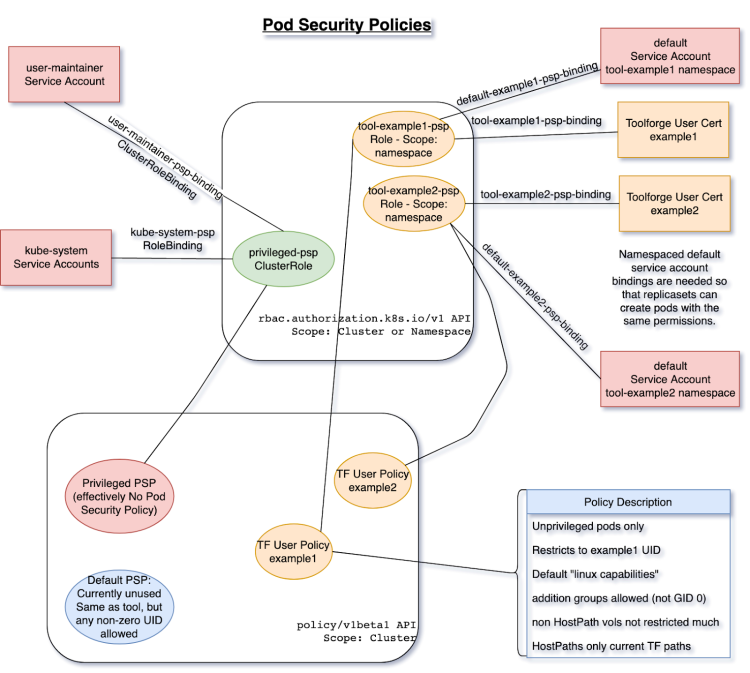
RBAC and PSP for Toolforge, original image in wikitech
I mentioned that we know about each user by means of TLS certificates. This is true, and in fact,
there is a key component in our setup called maintain-kubeusers. This custom piece
of Python software is run as a pod inside the cluster and is responsible for reading our external
user database (LDAP) and generating the required credentials, namespaces, and other configuration
bits for them. With the TLS cert, we basically create a kubeconfig file that is then written into
the homes NFS share, so each Toolforge user has it in their shell home directory.
Networking and Ingress setup
With the basic security controls in place, we can move on to explaining our networking and Ingress
setup. Yes, the Ingress word might be a bit overloaded already, but we refer here to
Ingress as the path that end-users follow from their web browser in their local machine to a
webservice running in the Toolforge cluster.
Some additional context here. Toolforge is not only Kubernetes, but we also have a Son of
GridEngine deployment, a job scheduler that covers some features not available in Kubernetes. The
grid can also run webservices, although we are encouraging users to migrate them to Kubernetes. For
compatibility reasons, we needed to adapt our Ingress setup to accommodate the old web grid.
Deciding the layout of the network and Ingress was definitely something that took us some time to
figure out because there is not a single way to do it right.
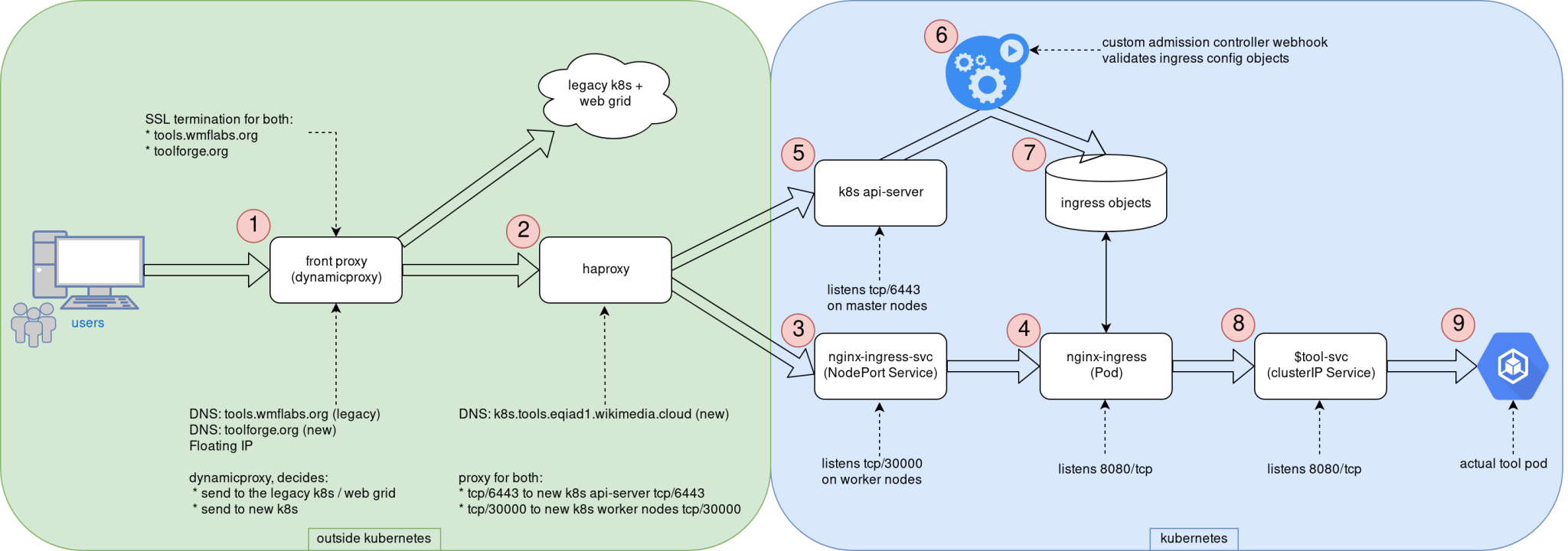
The following diagram can be used to explain the different steps involved in serving a web service
running in the new Toolforge Kubernetes.
Toolforge k8s network topology, original image in Wikitech
The end-user HTTP/HTTPs request first hits our front proxy in (1). Running here is
NGINX with a custom piece of LUA code that is able to decide whether to contact the web grid
or the new Kubernetes cluster. TLS termination happens here as well, for both domains
(toolforge.org and tools.wmflabs.org). Note this proxy is reachable from the internet, as it
uses a public IPv4 address, a floating IP from CloudVPS, the infrastructure service we
provide based on Openstack. Remember that our Kubernetes is directly built in virtual machines a
bare-metal type deployment.
If the request is directed to a webservice running in Kubernetes, the request now reaches
haproxy in (2), which knows the cluster nodes that are available for Ingress. The
original 80/TCP packet is now translated to 30000/TCP; this is the TCP port we use internally for
the Ingress traffic. This haproxy instance provides load-balancing also for the Kubernetes API as
well, using 6443/TCP. It s worth mentioning that unlike the Ingress, the API is only reachable from
within the cluster and not from the internet.
We have a NGINX-Ingress NodePort service listening in 30000/TCP in every Kubernetes worker node in
(3); this helps the request to eventually reach the actual NGINX-Ingress pod in (4), which is
listening in 8080/TCP. You can see in the diagram how in the API server (5) we hook the Ingress
admission controller (6) to validate Kubernetes Ingress configuration objects before allowing them
in for processing by NGINX-Ingress (7).
The NGINX-Ingress process knows which tools webservices are online and how to contact them by means
of an intermediate Service object in (8). This last Service object means the request finally
reaches the actual tool pod in (9). At this point, it is worth noting that our Kubernetes cluster
uses internally kube-proxy and Calico, both using Netfilter components to handle traffic.
tools-webservice
Most user-facing operations are simplified by means of another custom piece of Python code:
tools-webservice. This package provides users with the webservice command line
utility in our shell bastion hosts. Typical usage is to just run webservice start stop status. This
utility creates all the required Kubernetes objects on-demand like Deployment, ReplicaSet, Ingress
and Service to ease deploying web apps in Toolforge. Of course, advanced users can interact
directly with Kubernetes API and create their custom configuration objects. This utility is just a
wrapper, a shortcut.
tool-fourohfour and tool-k8s-status
The last couple of custom components we would like to mention are the tool-fourohfour
and tool-k8s-status web services. These two utilities run inside the cluster as if
they were any other user-created tool. The fourohfour tool allows for a controlled handling of HTTP
404 errors, and it works as the default NGINX-Ingress backend. The k8s-status tool shows plenty of
information about the cluster itself and each tool running in the cluster, including links to the
Server Admin Log, an auto-generated grafana dashboard for metrics, and more.
For metrics, we use an external Prometheus server that contacts the Kubernetes cluster to scrape
metrics. We created a custom metrics namespace in which we deploy all the different
components we use to observe the behavior of the system:
Those of you who watch a lot of Hollywood movies may have noticed a certain trend that has consumed the industry in the last few years. It ...
Video Essay Catalog No. 91 by Kevin B. Lee. Featured on the New York Times and other outlets. Originally published December 13, 2011 on Fandor. https://carpetbagger.blogs.nytimes.com/2011/12/19/staring-in-awe-its-the-spielberg-face/?_r=0
The Korowai cannibals live on top of trees. But is it true?
Bandicoot Cabbagepatch, Bandersnatch Cumberbund, and even Wimbledon Tennismatch: there seem to be endless variations on the name of Benedict Cumberbatch. [...] But how is a normal internet citizen supposed to know, when they hear someone say I just can t stop looking at gifs of Bombadil Rivendell that this person isn t talking about some other actor with a name and a voice and cheekbones? Or in other words, what makes for a reasonable variation of the name Bendandsnap Calldispatch?
The next video in our T^4 series of video lightning talks with tips, tricks, tools, and toys (where we had seen the announcement, shells sessions one, two, and three, as well as byoby sessions one and two) is now up at YouTube. It covers session management for the wonderful byobu tool that is both a text-based window manager and a terminal multiplexer :
The slides are here. This repo at GitHub support the series: use it to open issues for comments, criticism, suggestions, or feedback. If you like this or other open-source work I do, you can now sponsor me at GitHub. For the first year, GitHub will match your contributions.
This post by Dirk Eddelbuettel originated on his Thinking inside the box blog. Please report excessive re-aggregation in third-party for-profit settings.
Another maintenance RVowpalWabbit package update brings us to version 0.0.14. This time CRAN asked us to replace the (long obsoleted C-library) function ftime(). Along the way, we also updated links in the DESCRIPTION file to the (spiffy!!) new vowpalwabbit.org website, updated Travis use and fine-tuned some autoconf code in configure.ac.
There is a newer package rvw based on the excellent GSoC 2018 and beyond work by Ivan Pavlov (mentored by James and myself) so if you are into Vowpal Wabbit from R go check it out. It should go to CRAN eventually once we have better mechanisms to support external libraries.
CRANberries provides a summary of changes to the previous version. More information is on the RVowpalWabbit page. Issues and bugreports should go to the GitHub issue tracker.
If you like this or other open-source work I do, you can now sponsor me at GitHub. For the first year, GitHub will match your contributions.
This post by Dirk Eddelbuettel originated on his Thinking inside the box blog. Please report excessive re-aggregation in third-party for-profit settings.
So last night I had the idea that it might be fun to write a Brainfuck compiler, to convert BF programs into assembly language, where they'd run nice and quickly.
I figured I could allocate a day to do the work, and it would be a pleasant distraction on a Sunday afternoon. As it happened it only took me three hours from start to finish.
There are only a few instructions involved in brainfuck:
>
<
+
-
.
,
[
] command.]
[ command.gcc.nasm, link with ld.++++++++[>++++[>++>+++>+++>+<<<<-]>+>+>->>+[<]<-]>>.>---.+++++++..+++.>>.<-.<.+++.------.--------.>>+.>++.
My C-compiler converted that to the program:
extern int putchar(int);
extern char getchar();
char array[30000];
int idx = 0;
int main (int arc, char *argv[])
array[idx]++;
array[idx]++;
array[idx]++;
array[idx]++;
array[idx]++;
array[idx]++;
array[idx]++;
array[idx]++;
while (array[idx])
idx++;
array[idx]++;
array[idx]++;
array[idx]++;
array[idx]++;
while (array[idx])
idx++;
array[idx]++;
array[idx]++;
idx++;
array[idx]++;
array[idx]++;
array[idx]++;
..
..
The assembly language version is even longer:
global _start
section .text
_start:
mov r8, stack
add byte [r8], 8
label_loop_8:
cmp byte [r8], 0
je close_loop_8
add r8, 1
add byte [r8], 4
label_loop_14:
cmp byte [r8], 0
je close_loop_14
add r8, 1
add byte [r8], 2
add r8, 1
add byte [r8], 3
add r8, 1
add byte [r8], 3
add r8, 1
add byte [r8], 1
sub r8, 4
sub byte [r8], 1
jmp label_loop_14
close_loop_14:
add r8, 1
add byte [r8], 1
..
mov rax, 60
mov rdi, 0
syscall
section .bss
stack: resb 300000
Annoyingly the assembly language version ran slower than the C-version, which I was sneakily compiling with "gcc -O3 .." to ensure it was optimized.
The first thing that I did was to convert it to fold adjacent instructions. Instead of generating separate increment instructions for ">>>" I instead started to generate "add xx, 3". That didn't help as much as I'd hoped, but it was still a big win.
After that I made a minor tweak to the way that loops are handled to compare at the end of the loop as well as the start, and that shaved off a fraction of a second.
As things stand I think I'm "done". It might be nice to convert the generated assembly language to something gcc can handle, to drop the dependency on nasm, but I don't feel a pressing need for that yet.
Was a fun learning experience, and I think I'll come back to optimization later.
Next.