Search Results: "sto"

9 January 2014

Jo Shields: Here Ye, Here Ye

Valve Software s Steam is the number one digital game distribution service, with more than 65 million registered accounts. Steam runs on Windows, Mac OS, and Linux x86/amd64 computers, and provides access to several thousand games, at varying price points an enormous growth from less than a dozen games for Windows only about a decade ago. Valve s latest endeavour has been to bring their storefront into the living room, with a three-pronged attack: a new game controller, a programme of licensed x86 consoles to plug into the family TV, and an OS to run on the Steam Machines to tie it all together. December saw the first public release of their SteamOS which, as it turns out, is basically just a preconfigured desktop Linux. Specifically, it s a Debian Wheezy derivative, comprising a subset of 502 source packages from Wheezy; 8 of Valve s own source packages; and 51 source packages which have been either patched compared to Wheezy, backported from post-Wheezy, or both. For example, the compiler used by default is gcc-4.7 (rather than Wheezy s 4.6) and the libc version postdates Wheezy too. Valve s official instructions and installer release concerned quite a few people who had planned to try SteamOS on an older PC, by mandating a large (500GB) hard disk and a PC with UEFI firmware. Very quickly a number of instructions started appearing from people trying to fix what people felt were real issues specifically provision for BIOS-based computers, and installation from optical media. After being assured that redistribution of derivatives of SteamOS were entirely authorized (and, in fact, encouraged) I decided to produce my own variant, calling upon my own experience with debian-installer modification from past and present jobs, as well as calling upon the skills and experience of the UK Debian community as needed. The end result is Ye Olde SteamOSe. SteamOS on VMware Workstation 10 This weekend saw the third release of Ye Olde SteamOSe, a derivative designed to greatly widen the pool of computers capable of running Valve s OS. And unlike the first two releases, the public response this time has been crazy. Like, totally crazy. Combined score across several subreddits totals about 1700. 7 pages of Google search results. Hundreds of tweets. Mentions in dozens of blogs around the world. Coverage on the Linux Action Show. Unilaterally added to Softpedia s list of distributions. Almost 2000 views of a video installation walkthrough I posted on YouTube. Crazy. Sadly the idea to try and track visitors to the page didn t occur to me until long after the initial rush subsided, but 1000 visitors on Tuesday for a news story which landed on Sunday is still pretty hot in my book. It s also interesting to observe the demographics of site visitors the #1 referrer on Tuesday was Dutch PC site Tweakers.net, and StumbleUpon outranks reddit for referrals. About 66% of visitors interested in installing my Debian Wheezy derivative derivative came using Windows (20% using Linux), which suggests there s a lot of potential Linux users out amongst the Windows gamer masses. So what s the purpose of this self-congratulatory blog post? Just dick-waving? Well, there s an element of that (I m only human), but I think it might be nice to alert the audience on Planet Debian/Ubuntu, many of whom are not big gamers, to the next big thing in embedded Linux except this time a real GNU/X.org/sysVinit distribution, not some NIH thing like Android. So now you know!

Russ Allbery: Review: Honeyed Words

Review: Honeyed Words, by J.A. Pitts
Series: Sarah Beauhall #2
Publisher: Tor
Copyright: July 2011
ISBN: 0-7653-2907-7
Format: Trade paperback
Pages: 412
Honeyed Words is a direct sequel to Black Blade Blues and probably doesn't make sense to read out of order. Sarah, Katie, their friends, and Katie's family are still recovering from the climactic events of Black Blade Blues and licking their wounds, but things are slowly looking up. Sarah is getting more comfortable openly expressing her sexuality, although there are still tensions, and her relationships are improving. The city of Vancouver also seems to be recovering. But major political shifts among the nonhuman races have echoes and ramifications, and after a kidnapped singer and a murdered dwarf, Sarah is pulled back into the turmoil. If you liked the world-building in Black Blade Blues, Honeyed Words is more of the same, but with more variety. Pitts adds elves to dwarves and dragons, shows considerably more of the supernatural world beneath the surface of human cities, and introduces Sarah to some new types of danger. There are a few more glimmers of the history of Sarah's sword and the nature of the gods in this universe, but still nothing conclusive. Pitts broadens the world-building rather than deepening it. But I liked the new characters. Teenage elves with obsessions make for great characters, and the demon who shows up about halfway through is delightful. As with the first book, this is mostly a story of things happening to Sarah while she tries to muddle through as best she can. There isn't much in the way of grand strategy or of seizing control of the plot. She just tries to do the right thing and gets lots of help from lots of friends. But the plot moves right along, and it's mixed with a healthy sense of normality that I find refreshing. She needs work as a blacksmith, she's trying to support a friend without having much money of her own, the living arrangements this forces are a bit of a strain for her own relationships, and her broken relationship with her family continues to lurk. Much urban fantasy is built around the premise of a regular person thrust into a fantasy world, but much of it then discards normal life once the supernatural starts. I think Pitts does a particularly good job of keeping his protagonist's life grounded in the ongoing mundane problems of living. It's also more fun to read about Sarah when she isn't quite as angstful. Over the course of Honeyed Words, she seems to be growing into a person who can accept who she is and feel secure about her place in the world. That's nice to see. The downside to this book is that, while it's full of quite a lot of stuff, not all of it coheres that horribly well. It has a certain "middle book" feel. The major plot resolves, but with some significant lingering consequences and something of a cliff-hanger last chapter. Most of the threads left open by the first book are still open here. There's character growth, and setup for some resolution, but not a lot of actual resolution. I still like this series, though. I like urban fantasy that isn't about vampires and werewolves; berserker blacksmiths and Norse legend has much more appeal, and I want to read more of it. Pitts's writing is a bit clunky and probably won't win many rewards, but it's serviceable and I think improving. If you enjoyed the first book, it's worth looking for this one as well. Followed by Forged in Fire. Rating: 7 out of 10

8 January 2014

Jamie McClelland: New OpenPGP key

After playing around with How secure is my password, I dediced to start changing the handful of passwords I have committed to memory to being very long phrases rather than shorter, concentrated collections of random-seeming characters (another interesting blog post would be to understand the algorythm behind that site but for now I've just taken it at face value). Despite my usual practice of introducing new passphrases by changing my laptop login (which can always be reset if necessary), I went ahead and changed by GPG key instead to a new 50 character phrase. Fifteen minutes passed before I needed access to the key and... I couldn't repeat the passphrase. I tried to be clever. I opened a text file and typed in this passphrase over and over again, ultimately generating 49 unique typo-ridden versions of the passphrase. Then, I wrote a simple script that took each of these versions and generated additional versions by: In the end I had about 350,000 versions of my passphrase. None of them worked. What in the world did I type?? Could I just ask the NSA? In any event, my new OpenPGP key fingerprint is:
1F9C30CB3CFC5DA9987FA035A014C05A607B7535
Please note: I've changed the "real name" part of my User Id from "Jamie McClelland" to "James McClelland" becuase James is on my government issued id. I'll be working on collecting new signatures for the rest of my life. Some interesting information on how this made my life difficult:
Postscript: Thanks to Jordan Uggla, I was directed to passe-partout, a tool that can extract an RSA private key out of memory when ssh-agent is running with the key loaded. Since I am using the Monkeysphere, my OpenPGP key has an authentication-capable subkey, which is fed to an ssh-agent and used to grant me access to remote computers using ssh. After losing my passphrase, I was not able to access that subkey. With the help of pass-partout, and the fact that the subkey was loaded into ssh-agent before I lost the passphrase, I was able to extract the private RSA key from my ssh-agent and save it to a file. Then, I could restart my ssh-agent with my ''new'' authentication-capable OpenPGP subkey, thus allowing me to access servers that have granted me access via my new key and the handful of servers that still only grant me access via my old key.

7 January 2014

Vincent Sanders: Healthy discontent is the prelude to progress

Back in the mists of Internet time (2002) when spirits were brave, the stakes were high, men were real men, women were real women and small furry creatures from Alpha Centauri were real small furry creatures from Alpha Centauri there were few hosting options for a budding open source project.

Despite the meteoric rise of many dot com companies in the early noughties a project either had to go it alone by running everything themselves or pick from a small selection of companies that had not yet worked out how to turn free hosting into money.

One such company, arguably the first, was VA Research with their SourceForge system. Many projects used their platform including a small niche web browser called NetSurf. For years the service was great, there were rough edges but nothing awful.

Netsurf issue tracker in the new SourceForge interface
Over time the NetSurf projects requirements grew beyond what SourceForge could provide and service after service was migrated away eventually all that was left was the bug tracking system. This remained the state of affairs until mid 2013 when SourceForge forced a migration to their new platform which made them unsuitable for the projects use case.

Aside from the issue trackers questionable user interface SourceForge had started aggressively placing advertising throughout their platform. Some of the placements so inadvisable that projects started taking the decision to leave.

While I appreciate that SourceForge had to make money to provide a service they appear to have sown discontent within a large part of their user base without understanding that there are a number of alternatives solutions with a much less onerous funding model.

NetSurf used this as an opportunity to move the remaining issue tracking service to our own infrastructure. Rob Kendrick proceeded to evaluate several solutions and in December 2013 I finally found the time to migrate an XML dump of the old data from SourceForge into MantisBT.

Migrating data from one database into another via incompatible formats took me back to my roots. My early career started with programming tasks moving historical business data from ancient large systems which were about to be scrapped to modern Sparc based systems. Later I would be in a role where financial data needed to be retrieved from obsolete proprietary systems and moved into databases on x86 servers.

My experience in this field was not really stretched as it turns out that modern systems can process a few tens of megabytes in seconds rather than the days for a run in my youth! So some ugly perl scripts and a few hours later I had a nice shiny SQL database filled with NetSurfs bugs and MantisBT instance configured to use them.

NetSurf MantisBT instance showing most recently updated open bugs
Then came the hard bit, triaging all the open bugs, fixing up all the bugs submitted as an anonymous user but with email addresses in, removing duplicates and checking every open bug was still valid took almost two weeks of tedious drudge.

I set up an initial bug workflow within the system that the project developers are still fine tuning to better suit their needs but overall Mantis is proving a very flexible tool. The main deficiencies center around configuration for the projects useage, especially removing unused fields from filters and making the workflow more intuitive..

The resulting system is now getting bug reports submitted again where the sourceforge system had had three in the six months since the forced migration.

The issue tracker is once more a useful tool for the developers allowing us to focus on areas actually causing problems for our users and allowing us to see progress we are making fixing issues.

Overall this was a successful migration and provides a platform the NetSurf project can control where we can offer guarantees to our users about their personal information usage and having a clean rapid interface with no advertisements.

6 January 2014

Russ Allbery: remctl 3.7

remctl is the middleware layer that we use everywhere at Stanford. It's a simple GSS-API-authenticated network service that supports running commands with ACLs. There are client bindings available for a wide variety of programming languages. This release fixes a couple of irritating bugs: the client library leaked memory when remctl_set_ccache was used (which was affecting mod_webkdc from WebAuth), and Net::Remctl::Backend didn't validate argument counts correctly when one of the arguments came from standard input (which affected krb5-sync). I also worked around a bug in RHEL 5's Module::Build, and added sanity checking to Net::Remctl and related classes to ensure that the object argument wasn't undef. Also new in this release are support in the remctld server for systemd startup notification and socket activation, and (via the -Z) flag) support for upstart's expect stop synchronization method. This is mostly a "clearing the decks" release in advance of more significant work. The next release will replace the server event loop with libevent, in preparation for further improvements in how the server can handle persistent worker children. You can get the latest release from the remctl distribution page.

Aurelien Jarno: Debian QEMU images updated

Following the release of Debian Wheezy, I have (finally) updated my set of Debian QEMU images for both Squeeze (6.0.8) and Wheezy (7.3). The following images are now available: Each of these directories contains a GPG signed README.txt file with the md5sums all files, detailed instructions how to run these images and especially the minimum QEMU version to use. The requirements to run the default desktop environment have increased a lot between Squeeze and Wheezy. An accelerated graphics card is now needed to be able to use Gnome (unless you use the fallback mode), which is not something provided by QEMU (actually there is now a QXL para-virtualized video card, but the driver is only in unstable). In addition GDM now needs more than 128MiB to start, while this is the default amount of memory provided for virtual machines. I have therefore decided to switch the default desktop environment on the Wheezy images to Xfce and the display manager to LightDM. Both Gnome and GDM are still installed on the images, and the original default can easily be restored using the following commands: Beside this the new images only contain minor changes. The filesystems have been tweaked to not run fsck after a certain amount of days, and locales-all and openssh-server are now installed in all images. For MIPS and MIPSEL, 64-bit kernels are now also installed and provided, so that it is possible to choose between a 32-bit or a 64-bit kernel (see the README.txt for more details). There is no Debian Wheezy SPARC image available, as QEMU does not fully support SPARC64 yet (it is actually possible to run it, but then the VM crashes often), and Debian Wheezy now only supports 64-bit kernels. I will also invest time to build an S390X image, but so far I haven t been successful on that. The following images are still available at the same location, though they haven t been updated:

Vincent Sanders: NetSurf Developer Workshop Redux

The NetSurf Developers bringing you alternative LOLcat viewing software since 2002Once again the NetSurf developers congregated in Cambridge at the Collabora offices where we were made welcome in a nice environment for the event.

Five developers managed to attend from around the UK Rob Kendrick, Vincent Sanders, Daniel Silverstone, John-Mark Bell and Michael Drake. We also had Chris Young and Fran ois Revol providing some bug fixes remotely.

This was the first time we had all met since the previous event towards the end of 2012 and we took full advantage of this to discuss a pretty extensive agenda in addition to the practical programming tasks.

From Friday lunchtime through to Sunday evening we managed 30 hours of work consisting of over 70 commits to over 100 files.

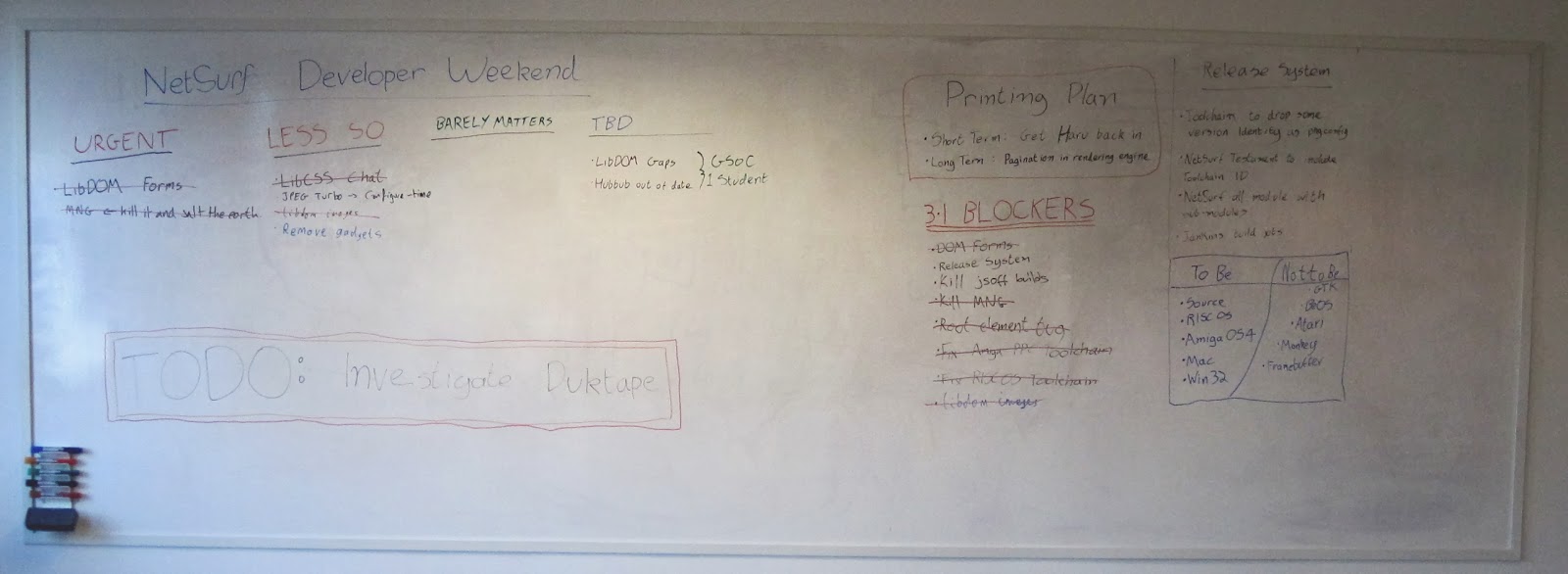
The whiteboard of our notes

Our main focus was working towards a 3.1 release which is scheduled for early April. Along with the source the release will have binary builds for RISC OS, AmigaOS, Windows and Mac OS X (x86 and ppc). Although the NetSurf project will not be directly releasing binaries for the GTK and Framebuffer frontends we will be ensuring the Debian packages are updated which is our prefered method of distribution for those targets.

We analysed the 3.0 release and formulated an improved process for the future. The 3.1 release will be generated automatically by the CI system ensuring constant results and removing the problems we encountered previously.

A set of release blocking issues was derived which we used as a task list during the workshop.The majority of these were completed including:
DOM based forms
Web forms are a feature Netsurf has supported for a long time and their implementation has not kept up with the rest of the browser. This is a long standing problem area which has resulted in numerous strange bugs with form submission. With this change the form system has been reworked to correctly operate directly from the DOM resulting in the squashing of a large number of bugs and a much improved user experience.

DOM based image loading
Up to now image fetching was performed only during the rendering of a page. With this change when the image link is placed into the DOM during the page parse it is scheduled to be fetched, this should give an improved user experience as images should be available earlier in a pages render.

Removal of MNG support
NetSurf has supported MNG since the 1.0 release, indeed the MNG library used to provide the PNG support too though we have long ago transitioned to libPNG. Alas the web has moved on and MNG has been largely forgotten, the libMNG library that performs the image decoding is old and generally unsupported specifically lacking security updates.

The build issues with libMNG (lack of pkg-config, reliance on libcms1 etc.) were causing maintenance issues in code nobody was actually using (there were crash bugs discovered during its removal!). Because of these issues it was decided to join the vast majority of browsers and remove support for this format.
The developers also addressed several issues with toolchain construction and a number of annoying usability bugs.

Plans for how to improve printing support we made. Initially we intend to fix the existing haru based pdf generation using this to print via pdf and in future have correct css styled page paginated printing render output.

The perennial issue of javascript was discussed however, while efforts to improve the existing support are ongoing, our usage of the spidermonkey library continues to raise various challenges including platform support and API changes between versions.

Due to these issues it has been suggested that we might add support for using the duktape JS engine instead, initial results are promising but given the size of the task of implementing an additional javascript engine binding further investigation is necessary before making a commitment.

Amongst the other discussions the group has also agreed that we will once again apply to be a GSoC organisation for a single student with some very focused projects:
  • Improving our HTML5 parser (hubbub)
  • Improving the DOM library implementing missing functionality.
While neither of these projects are as fashionable as some of our previous proposals they are well defined enough that as a group we believe we could offer enough support to the student to make their experience a pleasurable one and get the resulting code reviewed and merged promptly.

This event was very successful with a great deal achieved, the project is much more likely to be in a good shape to release 3.1 by April now and the meeting has given the developers a much welcomed boost.

I would like to extend the groups thanks to Robert McQueen for letting us use the Collabora offices, Dor e Carrier for organising all the administrative things and to Vivek Dasmohapatra for coming out on his Sunday afternoon to let us back in after locking ourselves out.


Julien Danjou: Databases integration testing strategies with Python

The Ceilometer project supports various database backend that can be used as storage. Among them are MongoDB, SQLite MySQL, PostgreSQL, HBase, DB2 All Ceilometer's code is unit tested, but when dealing with external storage services, one cannot be sure that the code is really working. You could be inserting data with an incorrect SQL statement, or in the wrong table. Only having the real database storage running and being used can tell you that.
Over the months, we developed integration testing on top of our unit testing to validate that our storage drivers are able to deal with real world databases. That is not really different from generic integration testing. Integration testing is about plugging all the pieces of your software all together and running. In what I call "database integration testing", the pieces will be both your software and the database system that you are going to rely on. The only difference here is that one of the module is not coming from the application itself but is an external project. The type of database that you use (RDBMS, NoSQL ) does not matter. Taking a step back, what I will describe here could also apply to a lot of other different software modules, even something that would not be a database sytem at all. Writing tests for integration Presumably, your Python application has unit tests. In order to test against a database back-end, you need to write a few specific classes of tests that will use the database subsystem for real. For example:
import unittest
import os
import sqlalchemy

class TestDB(unittest.TestCase):
def setUp(self):
url = os.getenv("DB_TEST_URL")
if not url:
self.skipTest("No database URL set")
self.engine = sqlalchemy.create_engine(url)

This code will try to fetch the database URL to use from an environment variable, and then will rely on SQLAlchemy to create a database connection.
import unittest
import os
import sqlalchemy

import myapp

class TestDB(unittest.TestCase):
def setUp(self):
url = os.getenv("DB_TEST_URL")
if not url:
self.skipTest("No database URL set")
self.engine = sqlalchemy.create_engine(url)

def test_foobar(self):
self.assertTrue(myapp.store_integer(self.engine, 42))

You can then add as many tests as you want using the connection stored in self.engine. If no test database URL is, the tests will be skipped; however that decision is up to you. You may want to have these tests always run and fail if they can't be run. In the setUp() method, you may also need to do more work, like create a database and delete a database.
import unittest
import os
import sqlalchemy

class TestDB(unittest.TestCase):
def setUp(self):
url = os.getenv("DB_TEST_URL")
if not url:
self.skipTest("No database URL set")
self.engine = sqlalchemy.create_engine(url)
self.connection = self.engine.connect()
self.connection.execute("CREATE DATABASE testdb")

def tearDown(self):
self.connection.execute("DROP DATABASE testdb")

This will make sure that the database you need is clean and ready to be used to testing. Launching modules, a.k.a. databases
The main problem we encountered when building integration testing with databases, is to find a way to start them. Most users are used to start them system-wide with some sort of init script, but when running sandboxed tests, that is not really a good option. Browsing the documentation of each storage allowed us to find a way to start them in foreground and control them "interactively" via a shell script. The following is a script that you can use to run Python tests using nose and is heavily inspired by the one we wrote for Ceilometer.
#!/bin/bash
set -e

clean_exit()
local error_code="$?"
kill -9 $(jobs -p) >/dev/null 2>&1 true
rm -rf "PGSQL_DATA"
return $error_code


check_for_cmd ()
if ! which "$1" >/dev/null 2>&1
then
echo "Could not find $1 command" 1>&2
exit 1
fi


wait_for_line ()
while read line
do
echo "$line" grep -q "$1" && break
done < "$2"
# Read the fifo for ever otherwise process would block
cat "$2" >/dev/null &


check_for_cmd mongod

trap "clean_exit" EXIT

# Start PostgreSQL process for tests
PGSQL_DATA= mktemp -d /tmp/PGSQL-XXXXX
PGSQL_PATH= pg_config --bindir
PGSQL_PATH /initdb $ PGSQL_DATA
mkfifo $ PGSQL_DATA /out
$ PGSQL_PATH /postgres -F -k $ PGSQL_DATA -D $ PGSQL_DATA &> $ PGSQL_DATA /out &
# Wait for PostgreSQL to start listening to connections
wait_for_line "database system is ready to accept connections" $ PGSQL_DATA /out
export DB_TEST_URL="postgresql:///?host=$ PGSQL_DATA &dbname=template1"

# Run the tests
nosetests

If you use tox to automatize your test run, you can use this scripts (I call it run-test.sh) in your tox.ini file.
[testenv]
commands = toxinidir /run-tests.sh posargs

Most databases are able to be run in some sort of standalone mode where you can connect to them using a either a Unix domain socket, or a fixed port. Here are the snippet used in Ceilometer to run with MongoDB and MySQL:
# Start MongoDB process for tests
MONGO_DATA=$(mktemp -d /tmp/MONGODB-XXXXX)
MONGO_PORT=29000
mkfifo $ MONGO_DATA /out
mongod --maxConns 32 --nojournal --noprealloc --smallfiles --quiet --noauth --port $ MONGO_PORT --dbpath "$ MONGO_DATA " --bind_ip localhost &>$ MONGO_DATA /out &
# Wait for Mongo to start listening to connections
wait_for_line "waiting for connections on port $ MONGO_PORT " $ MONGO_DATA /out
export DB_TEST_URL="mongodb://localhost:$ MONGO_PORT /testdb"

# Start MySQL process for tests
MYSQL_DATA=$(mktemp -d /tmp/MYSQL-XXXXX)
mkfifo $ MYSQL_DATA /out
mysqld --datadir=$ MYSQL_DATA --pid-file=$ MYSQL_DATA /mysql.pid --socket=$ MYSQL_DATA /mysql.socket --skip-networking --skip-grant-tables &> $ MYSQL_DATA /out &
# Wait for MySQL to start listening to connections
wait_for_line "mysqld: ready for connections." $ MYSQL_DATA /out
export DB_TEST_URL="mysql://root@localhost/testdb?unix_socket=$ MYSQL_DATA /mysql.socket&charset=utf8"

The mechanism is always the same. We create a fifo with mkfifo, and then run the database daemon with the output redirected to that fifo. We then read from it until we find a line stating the the database is ready to be used. At that point, we can continue and start running the tests. You have to read continuously from the fifo, otherwise the process writing to it will block. We redirect the output to /dev/null, but you could also redirect it to a different log file, or not at all. One step further: using parallelism and scenarios The described approach is quite simple, as it only support one database type. When using an abstraction layer, such as SQLAlchemy, it would be a good idea to run all these tests against different RDBMS, such as MySQL and PostgreSQL for example. The snippet above allows to run both RDBMS in parallel, but the classic approach of unit tests does not allow that. Using one scenario for each database backend would be a great idea. To that end, you can use the testscenarios library.
import unittest
import os
import sqlalchemy
import testscenarios

load_tests = testscenarios.load_tests_apply_scenarios

class TestDB(unittest.TestCase):
scenarios = [
('mysql', dict(database_connection=os.getenv("MYSQL_TEST_URL")),
('postgresql', dict(database_connection=os.getenv("PGSQL_TEST_URL")),
]

def setUp(self):
if not self.database_connection:
self.skipTest("No database URL set")
self.engine = sqlalchemy.create_engine(self.database_connection)
self.connection = self.engine.connect()
self.connection.execute("CREATE DATABASE testdb")

def tearDown(self):
self.connection.execute("DROP DATABASE testdb")

$ python -m subunit.run test_scenario   subunit2pyunit
test_scenario.TestDB.test_foobar(mysql)
test_scenario.TestDB.test_foobar(mysql) ... ok
test_scenario.TestDB.test_foobar(postgresql)
test_scenario.TestDB.test_foobar(postgresql) ... ok

---------------------------------------------------------
Ran 2 tests in 0.061s

OK

To speed up tests run, you could also run the test in parallel. It can be intesting as you'll be able to spread the workload among a lot of different CPUs. However, note that it can require a different database for each test or a locking mechanism to be in place. It's likely that your tests won't be able to work altogether at the same time on only one database. (Both usage of scenarios and parallelism in testing will be covered in The Hacker's Guide to Python, in case you wonder.)
The Hacker's Guide to Python
A book I'm writing that will be launched soon, talking about designing Python applications, state of the art, and various Python tips. If you want to be the first to hear about the launch, subscribe now.

5 January 2014

Jonathan Carter: Happy 2014!

So, it s 2014 and I still haven t migrated away from WordPress to using something fancy written in Python. But who cares? Life is great and I ve made good progress in lots of other areas :) I m getting fitter by the day, last year I joined a running club and I now play squash too, which is working so much better than just going to the gym. Also finally making progress with learning how to play guitar, another ancient goal of mine that had slow progress for a while. It helps that I now live on my own and can make noise whenever I want to. I m also going for lessons every Wednesday and have some plans to convert my spare room in to a music room. I ve also gotten into beer brewing. I attended Beerschool via Beerlab, my first batch of American Pale Ale is just about ready for bottling and I ll probably do that next weekend. What else? Well, this year I definitely want to be more focused in my free software contributions than in 2013. I want to get my Debian contributions flowing well again with the aim of becoming a Debian Maintainer. Also planning to go to Debconf in Portland, Oregon in August. Then there s LTSP which is working towards LTSP 6, which will see a huge shift in proper support for local processing and less on thin client support. Not sure how far my involvement will stretch there but I m certainly very interested and will do my best to make the LTSP hackfest later in the year. The next 2-3 months will need the most focus on Edubuntu. The 14.04 LTS release will be a big release and the single-sign-on directory infrastructure that will be released along with it will mark a big milestone for the project. Well, to anyone still reading my blog, have a great 2014!

Jon Dowland: 2013 In Fiction

I read a lot this year - I'll write more about that and reflections on goodreads in another post - but most of the things I read weren't published in 2013. (I should also write a bit about my thoughts on e-readers). However, it seems I have enough to write about 2013's novels to make a round-up post worthwhile, so here we go.

The Cuckoos Calling UK cover
This year, crime author Robert Galbraith published his first novel The Cuckoo's Calling. I'd never have heard of it if Galbraith was not outed as an alias for Joanne "JK" Rowling. Clues that Rowling was working on a detective story exist as early as a Guardian preview article in 2012 for her last novel, The Casual Vacancy. Further hints, for me, that this was no first-time author were the taglines from Ian Rankin and Val McDermid on the cover, writers of a calibre I'd be surprised a new author could attract. However I don't know whether they were on the pre-unveiling cover or not. Rowling was upset be outed, having enjoyed the freedom to write without the baggage of expectation that she is subject to. I hope she's pleased: prior to her unmasking the novel was warmly received by the (admittedly relatively small) number of people who read it. And a very good novel it is too. It starts with a genre clich of a grizzled, meloncholy detective, Mr. Cormoran Strike, in an upstairs office with a neon light flickering through the window, but fleshes the story out both forwards - a client, a mysterious death - and backwards - how did Mr. Strike end up in that upstairs office - living out of it, no less? As is traditional for the genre there's a very clever twist. What I really enjoyed about Cormoran Strike was Galbraith/Rowling moving quickly from Chandler-esque everyman to a well fleshed-out, complex protagonist, intertwining the development of the character with the unfolding of the wider plot. I'm looking forward to the sequel, expected in 2014.
The Shining Girls UK cover
A second surprise favourite this year was Lauren Beukes' time-tripping crime story The Shining Girls. A monsterous murder of women somehow finds a room in Chicago that lets him travel through time (or perhaps the room finds him). He uses this facility to stalk and murder a set of Shining Girls: women who, for one reason or another, literally 'shine' in his perception of them. One such woman survives his first attack and decides to try and find out who attacked her, and why. The crimes are described in a brutal fashion which - from a distance - resemble the sometimes glorified violence for which crime fiction is sometimes criticised, but the focus of the story is very much on the victims: they are fully fleshed out characters and each death is felt by the reader as a genuine tragedy. I discovered Beukes when her earlier novel Zoo City was included in a Humble eBook bundle. On reading The Shining Girls I felt that the novel deserved to be more widely known than I would expect it to be trapped in the ghetto of genre fiction, so I was pleased to discover that the very mainstream Richard and Judy Book Club discovered it. In established author news, Terry Pratchett, having adopted speech recognition for writing (to combat his debilitating Alzheimer's) has seemingly managed to accelerate his rate of production and squeezed out at least two this year: The Long War with Stephen Baxter is the sequel to 2012's The Long Earth which I very much enjoyed, but it really felt like "difficult second novel" to me. Hopefully there'll be a third. Raising Steam, the 40th Discworld novel, was an enjoyable romp around the concept of steam trains, featuring the relatively new Moist von Lipwig who has managed to become one of my favourite Discworld characters. I can't think of much more to say about the novel, really. It's a Discworld novel, probably not the best introduction to the series for a new reader, but will give a reader familiar with the franchise everything they expect, and possibly no more. Iain Banks sadly died this year, shortly after the publication of his last novel, The Quarry. It's sat on my hardback shelf for the time being. I couldn't bring myself to read it in 2013. I did read his last SF offering from the year prior, The Hydrogen Sonata. Sadly, yet coincidentally, both of these books examine the nature of living and dying, The Quarry in particular from the point of view of a terminal cancer sufferer. I have a small backlog of unread Banks fiction which I want to take my time over with. Finally, whilst not really a book, I thoroughly enjoyed the BBC's 2013 adaptation of Neil Gaiman's Neverwhere. Natalie Dormer wrote a piece on the making of the drama which should serve as a good introduction. At the time of writing, most of the programmes have disappeared from iPlayer, but I would be surprised if this wasn't released commercially at some point.

4 January 2014

Andrew Pollock: [life] My daughter, the future Olympic swimmer

I'm not a strong swimmer, and never have been. I was never confident in the water as a child. In my teenage years, I had some skin issues that I was very self-conscious about. Going to a boy's school where I was already bullied, I didn't want to add material, so I avoided swimming. To this day, I can barely swim 50 metres freestyle. To think I once had aspirations of getting into the police, which required a bronze medallion. As as result of my atrocious swimming abilities, it's been very important to me that Zoe be able to swim well. Purely for her own personal safety if nothing more. She's been doing "swim classes" of various sorts since she's been 6 months old. In the US, they were group parent/child water familiarisation classes. When we moved back to Australia and turned three, she was eligible to start doing small-group instructor-led classes with Hampton Swim School. It felt like such an milestone just to no longer have to be in the pool with Zoe. I was initially quite skeptical of Hampton's methods, compared with what I'd observed at the Betty Wright Swim School (which subsequently had to close due to aging facilities). Having seen how well Zoe's swimming has progressed in 3 quarters of classes is just amazing. The last few times I've taken Zoe to a public pool for some non-class swim time, her confidence in the water has been fantastic. I've bought some "sinkies", toys that sink to the bottom, and she'll happily dive down to the bottom to retrieve them (with assistance from me getting down there). Today, to escape the 40 plus degree heat, I took her to the Sleeman Sports Centre, because they have a really cool slide, and the whole thing's indoors. Zoe was confidently swimming between me and the side of the pool in water that was over her head, repeatedly. So to have her go from being fine in the water as long as she was being held, to actively asking me to go further back from the wall, in under a year has been really excellent progress. She's also "diving" in off the side (it's more like a bad belly flop, but she has brilliant form at the start, with her hands over her head). We got to the pool today around 10:30am, and it turned out the slide didn't open until 1pm, so we decided to stick around for lunch and wait until the slide opened. To kill time after lunch, we went to the 50 metre pool, where some other kids were taking turns to jump in off the starting blocks. Fearless Zoe wanted to have a go too. This was seriously deep water. It was really inspiring watching this tiny little girl climb up onto the starting blocks of the 1982 Commonwealth Games 50 metre pool and "dive" into the water, flounder over to me, who was furiously treading water in the middle of the lane, and then flounder over to the side, climb out unassisted and do it all over again. It was a seriously "proud father" moment, while I was trying not to drown myself in the middle of the lane. I wish I'd had someone there with a camera to capture the moment. I have great hopes for the future of her swimming, and I think she's ready to go up a level in her swim class.

Brett Parker: Wow, I do believe Fasthosts have outdone themselves...

So, got a beep this morning from our work monitoring system. One of our customers domain names is hosted with livedns.co.uk (which, as far as I can tell, is part of the Fasthosts franchise)... It appears that Fasthosts have managed to entirely break their DNS:
brettp@laptop:~$ host www.fasthosts.com
;; connection timed out; no servers could be reached
brettp@laptop:~$ whois fasthosts.com   grep -i "Name Server"
   Name Server: NS1.FASTHOSTS.NET.UK
   Name Server: NS2.FASTHOSTS.NET.UK
Name Server: NS1.FASTHOSTS.NET.UK
Name Server: NS2.FASTHOSTS.NET.UK
brettp@laptop:~$ whois fasthosts.net.uk   grep -A 2 "Name servers:"
    Name servers:
        ns1.fasthosts.net.uk      213.171.192.252
        ns2.fasthosts.net.uk      213.171.193.248
brettp@laptop:~$  host -t ns fasthosts.net.uk 213.171.192.252
;; connection timed out; no servers could be reached
brettp@laptop:~$ host -t ns fasthosts.net.uk 213.171.193.248
;; connection timed out; no servers could be reached
brettp@laptop:~$
So, that's fasthosts core nameservers not responding, good start! They also provide livedns.co.uk, so lets have a look at that:
brettp@laptop:~$ whois livedns.co.uk   grep -A 3 "Name servers:"
    Name servers:
        ns1.livedns.co.uk         213.171.192.250
        ns2.livedns.co.uk         213.171.193.250
        ns3.livedns.co.uk         213.171.192.254
brettp@laptop:~$ host -t ns ns1.livedns.co.uk 213.171.192.250
;; connection timed out; no servers could be reached
brettp@laptop:~$ host -t ns ns1.livedns.co.uk 213.171.193.250
;; connection timed out; no servers could be reached
brettp@laptop:~$ host -t ns ns1.livedns.co.uk 213.171.192.254
;; connection timed out; no servers could be reached
So, erm, apparently that's all their DNS servers "Not entirely functioning correctly"! That's quite impressive!

2 January 2014

Luke Faraone: Unstandardized standards are the worst: sendmail

Implementing software to replace legacy systems is always a challenge, especially when you're dealing with a system with as much legacy as sendmail, which was first introduced as delivermail in 1979.ref

Each UNIX vendor, it seems, rewrote or heavily customized sendmail. This has lead to sometimes conflicting implementations.
Case in point: -tNormally, you invoke sendmail(8) with a series of arguments indicating the subject of a message, the recipients, etc. When invoked this way, the command expects a message on standard input, waits for EOF, and then sends your message along.

However, sometimes you don't want to have to fiddle with command-line parameters; you've already written a perfectly fine message with headers.

-t is generally passed to sendmail when you want to build a message envelope from an already-formatted message, with headers, etc. For example, if you had a file foo.txt with a body like this:
From: Luke Faraone 
To: John Smith
Subject: Hello, world!

Hi there.

you could send the message with a simple invocation of cat foo.txt sendmail -t. The system would take care of ensuring a Message-id was appended if appropriate, and queue the message to be sent. However, it is when you do slightly more complex invocations of sendmail that things get ambiguous.

It turns out that implementations differ on what exactly it means when you use -t in combination with naming destination addresses after the arguments to sendmail. exim4's documentation describes the situation in greater detail:
extract_addresses_remove_ argumentsUse: mainType: booleanDefault: true
According to some Sendmail documentation (Sun, IRIX, HP-UX), if any addresses are present on the command line when the -t option is used to build an envelope from a message s To:, Cc: and Bcc: headers, the command line addresses are removed from the recipients list. This is also how Smail behaves. However, other Sendmail documentation (the O Reilly book) states that command line addresses are added to those obtained from the header lines. When extract_addresses_remove_arguments is true (the default), Exim subtracts argument headers. If it is set false, Exim adds rather than removes argument addresses.

Thus, there's basically no mechanism for a program to know which behaviour to expect. God forbid two programs are installed on a system that expect different behaviours!

It appears that the default behaviour of Ruby is the opposite of what exim4 (Debian's default mail client) expects. This has resulted in numerous bug reports. Some replies suggest changing exim4's defaults, while others advocate overriding ActionMailer and friends to use sendmail -i instead, without -t.

That said, its not really clear who's wrong here; at no point does there appear to have been a definitive specification for sendmail, and as such we can hope for defined behaviour by common custom at best, and a sea of incompatibility bugs at worst. Amusingly, POSIX standards have nothing to say on this subject of sendmail at all; it defines that a mailx command must exist, but says that its sending mode may be implementation-specific.

As Matthew Garrett writes, there's not enough gin in the world.

Keith Packard: Present-pixmap-lifetimes-part-deux

Pixmap ID Lifetimes under Present Redirection (Part Deux) I recently wrote about pixmap content and ID lifetimes. I think the pixmap content lifetime stuff was useful, but the pixmap ID stuff was not quite right. I ve just copied the section from the previous post and will update it. PresentRedirect pixmap ID lifetimes (reprise) A compositing manager will want to know the lifetime of the pixmaps delivered in PresentRedirectNotify events to clean up whatever local data it has associated with it. For instance, GL compositing managers will construct textures for each pixmap that need to be destroyed when the pixmap disappears. Present encourages pixmap destruction The PresentPixmap request says:
PresentRegion holds a reference to pixmap until the presentation occurs, so pixmap may be immediately freed after the request executes, even if that is before the presentation occurs.
Breaking this when doing Present redirection seems like a bad idea; it s a very common pattern for existing 2D applications. New pixmap IDs for everyone Because pixmap IDs for present contents are owned by the source application (and may be re-used immediately when freed), Present can t use that ID in the PresentRedirectNotify event. Instead, it must allocate a new ID and send that instead. The server has it s own XID space to use, and so it can allocate one of those and bind it to the same underlying pixmap; the pixmap will not actually be destroyed until both the application XID and the server XID are freed. The compositing manager will receive this new XID, and is responsible for freeing it when it doesn t need it any longer. Of course, if the compositing manager exits, all of the XIDs passed to it will automatically be freed. I considered allocating client-specific XIDs for this purpose; the X server already has a mechanism for allocating internal IDs for various things that are to be destroyed at client shut-down time. Those XIDs have bit 30 set, and are technically invalid XIDs as X specifies that the top three bits of every XID will be zero. However, the cost of using a server ID instead (which is a valid XID) is small, and it s always nice to not intentionally break the X protocol (even as we continue to take advantage of accidental breakages). (Reserving the top three bits of XIDs and insisting that they always be zero was a nod to the common practice of weakly typed languages like Lisp. In these languages, 32-bit object references were typed by using few tag bits (2-3) within the value. Most of these were just pointers to data, but small integers, that fit in the remaining bits (29-30), could be constructed without allocating any memory. By making XIDs only 29 bits, these languages could be assured that all XIDs would be small integers.) Pixmap Destroy Notify The Compositing manager needs to know when the application is done with the pixmap so that it can clean up when it is also done; destroying the extra pixmap ID it was given and freeing any other local resources. When the application sends a FreePixmap request, that XID will become invalid, but of course the pixmap itself won t be freed until the compositing manager sends a FreePixmap request with the extra XID it was given. Because the pixmap ID known by the compositing manager is going to be different from the original application XID, we need an event delivered to the compositing manager with the new XID, which makes this event rather Present specific. We don t need to select for this event; the compositing manager must handle it correctly, so we ll just send it whenever the composting manager has received that custom XID. PresentPixmapDestroyNotify
 
    PresentPixmapDestroyNotify
    type: CARD8         XGE event type (35)
    extension: CARD8        Present extension opcode
    sequence-number: CARD16
    length: CARD32          0
    evtype: CARD16          Present_PixmapDestroyNotify
    eventID: XFIXESEVENTID
    event-window: WINDOW
    pixmap: pixmap
 
This event is delivered to the clients selecting for SubredirectNotify for pixmaps which were delivered in a PresentRedirectNotify event and for which the originating application Pixmap has been destroyed. Note that the pixmap may still be referenced by other objects within the X server, by a pending PresentPixmap request, as a window background, GC tile or stipple or Picture drawable (among others), but this event serves to notify the selecting client that the application is no longer able to access the underlying pixmap with it s original Pixmap ID.

Francois Marier: Running your own XMPP server on Debian or Ubuntu

In order to get closer to my goal of reducing my dependence on centralized services, I decided to setup my own XMPP / Jabber server on a Linode VPS running Debian wheezy. I chose ejabberd since it was recommended by the RTC Quick Start website and here's how I put everything together.

DNS and SSL My personal domain is fmarier.org and so I created the following DNS records:
jabber-gw            CNAME    fmarier.org.
_xmpp-client._tcp    SRV      5 0 5222 jabber-gw.fmarier.org.
_xmpp-server._tcp    SRV      5 0 5269 jabber-gw.fmarier.org.
Then I went to get a free XMPP SSL certificate for jabber-gw.fmarier.org from StartSSL. This is how I generated the CSR (Certificate Signing Request) on a high-entropy machine:
openssl req -new -newkey rsa:2048 -nodes -out ssl.csr -keyout ssl.key -subj "/C=NZ/CN=jabber-gw.fmarier.org"
I downloaded the signed certificate as well as the StartSSL intermediate certificate and combined them this way:
cat ssl.crt ssl.key sub.class1.server.ca.pem > ejabberd.pem

ejabberd installation Installing ejabberd on Debian is pretty simple and I mostly followed the steps on the Ubuntu wiki with an additional customization to solve the Pidgin "Not authorized" connection problems.
  1. Install the package, using "admin" as the username for the administrative user:
    apt-get install ejabberd
    
  2. Set the following in /etc/ejabberd/ejabberd.cfg (don't forget the trailing dots!):
     acl, admin,  user, "admin", "fmarier.org" .
     hosts, ["fmarier.org"] .
     fqdn, "jabber-gw.fmarier.org" .
    
  3. Copy the SSL certificate into the /etc/ejabberd/ directory and set the permissions correctly:
    chown root:ejabberd /etc/ejabberd/ejabberd.pem
    chmod 640 /etc/ejabberd/ejabberd.pem
    
  4. Restart the ejabberd daemon:
    /etc/init.d/ejabberd restart
    
  5. Create a new user account for yourself:
    ejabberdctl register me fmarier.org P@ssw0rd1!
    
  6. Open up the following ports on the server's firewall:
    iptables -A INPUT -p tcp --dport 5222 -j ACCEPT
    iptables -A INPUT -p tcp --dport 5269 -j ACCEPT
    

Client setup On the client side, if you use Pidgin, create a new account with the following settings in the "Basic" tab:
  • Protocol: XMPP
  • Username: me
  • Domain: fmarier.org
  • Password: P@ssw0rd1!
and the following setting in the "Advanced" tab:
  • Connection security: Require encryption
From this, I was able to connect to the server without clicking through any certificate warnings. If you want to make sure that XMPP federation works, add your GMail address as a buddy to the account and send yourself a test message. In this example, the XMPP address I give to my friends is me@fmarier.org.

1 January 2014

Russ Allbery: 2013 Book Reading in Review

What a strange year. 2013 was marked by a whole sequence of entirely unexpected events, including multiple major work upheavals. For large chunks of the year, I had very little time or emotional energy for personal reading goals, and particularly for writing reviews. I declared personal amnesty on most of my intentions halfway through the year, and all the totals will reflect that. On the plus side (although not for reading and reviews), it was a great year for video games. Next year, there will be no specific goals. Between continuing work fallout, a very busy project schedule, my intent to keep playing a lot of video games, and various other personal goals I want to take on, I'm going to take the pressure off of reading. Things will be read and reviews will be written (and I'm going to make more of an effort to write reviews shortly after reading books), but I'm not going to worry about how many. The below statistics are confined to the books I reviewed in 2013. I read six more books that I've not yet reviewed, due to the chaos at the end of the year. Those will be counted in 2014. There were no 10 out of 10 books this year, partly due to the much lower reading totals and partly due to my tendency this year to turn to safe comfort reading, which is reliably good but unlikely to be exceptional. There were, however, several near-misses that were worth calling out. My favorite book of the year was Neal Stephenson's Anathem, which narrowly missed a 10 for me due to some fundamental problems with the plot premise. But this is still an excellent book: the best novel about the practice of science and philosophy that I've ever read. Also deserving mention are K.E. Lane's And Playing the Role of Herself, lovely and intelligent lesbian romance that's likely to appeal even to people who would not normally try that genre, and Guy Gavriel Kay's River of Stars. The latter isn't quite at the level of Kay's earlier Under Heaven, but it's still an excellent work of alternate historical fiction in a memorable setting. A special honorable mention goes to Lisa O'Donnell's The Death of Bees. It requires a lot of warnings for very dark subject matter and a rather abrupt ending, but it's been a long time since I've cared that much about the characters of a book. My favorite non-fiction book of the year was Gary J. Hudson's They Had to Go Out, a meticulously researched account of a tragic Coast Guard mission. The writing is choppy, the editing could have been better, and it's clear that the author is not a professional writer, but it's the sort of detailed non-fiction account that can only be written by someone who's been there and lived through similar experiences. Also worth mentioning is Mark Jason Dominus's Higher Order Perl, which was the best technical book I read all year and which I found quite inspiring for my own programming. The full analysis includes some additional personal reading statistics, probably only of interest to me.

Debian Sysadmin Team: Martin Zobel-Helas: raff.debian.org about to be shut down

We are re-purposing raff.debian.org as a new security mirror to be shipped to South America. The raff.debian.org most of you have used as buildd.debian.org in the past will cease to exist in the near future. raff.debian.org will cease acting as a dns server for the debian.org zone in a few days, therfore we will add two new hosts, senfl.d.o and ravel.d.o. All other services formerly hosted on raff.d.o should have been already moved by now, we just want to encourage those of you who had a login on raff, to backup your home directory if you care of the data stored there, as we will not move that. Current plan is to shut down current raff by end of the year (so in about 7 days).

Debian Sysadmin Team: Martin Zobel-Helas: Dropping security.geo.debian.org zone

While setting up GeoDNS for parts of the debian.org zone, we set up a new subzone security.geo.debian.org. This was mainly due to the fact we didn't want to mess up the existing zone while experimenting with GeoDNS. Now that our GeoDNS setup has been working for more than half a year without any problems, we will drop this zone. We will do that in two phases.

Phase 1 Beginning on July 1st, we will redirect all requests to security.geo.debian.org to a static webpage indicating that this subzone is deprecated and should not be used any more. If you still have security.geo.debian.org in your apt sources.list, updates will fail.

Phase 2 On August 1st, we will stop serving the subzone security.geo.debian.org from our DNS servers.

Conclusion In case you use a security.geo.debian.org entry in your /etc/apt/sources.list, now is the best time to change that entry to security.debian.org. Both zones currently serve the same content.

Vincent Fourmond: Rubyforge is dead, but ctioga2 goes on...

In the light of the frequent recent downtimes of rubyforge, and thanks to the information from @copiousfreetime, I finally decided to move the hosting of ctioga2 away from rubyforge, to sourceforge. Transition went smooth, git is now the only VCS. Code is hosted at sourceforge and mirrored at github.
Work goes on on ctioga2. I've recently implemented a decent support for histograms. It is already much more powerful than the one in the old ctioga, but it is far from being feature-full. Here's a preview.I'm slowly preparing a new release for ctioga2, that would incorporate quite some fixes since the last time, and quite a few nice features in addition to the histograms. Stay tuned !

Russ Allbery: Review: The Female Man

Review: The Female Man, by Joanna Russ
Publisher: Beacon
Copyright: 1975
Printing: 1986
ISBN: 0-8070-6299-5
Format: Trade paperback
Pages: 214
The Female Man is one of the most famous novels of feminist science fiction, written by a giant of the field. Joanna Russ was one of the strongest writers of the first era of explicitly feminist SF and one of the most challenging. Along with Alice Sheldon (James Tiptree, Jr.) and Sheri Tepper, she's probably the best known author whose approach tended towards the directly confrontational. She was also a noted essayist, critic, and reviewer; her book How to Suppress Women's Writing is one of the most famous works of feminist literary criticism. That said, I wasn't sure what to expect from this book. I'd heard that it was about four different women: Jeannine, Joanna, Janet, and Jael. They're parallels of sorts but from far different cultures, alternate worlds displaced in time. I'd also heard that it was full of biting, accurate sarcasm, which is certainly the case. This is a book written from a place of righteous anger combined with keen social observation and a desire to point out how different the world could be. And how toxic male behavior towards women currently is. What it's not, however, is much of a novel, in the sense of having a clear plot that carries the reader through the book. There is a story of sorts, which revolves around the appearance of Janet in Joanna's time. Janet is a native of Whileaway, an alternate future Earth in which there are no men at all and social organization is significantly different. We get a fairly detailed description of her life and of some Whileaway customs over the course of the book. But they're mixed with excerpts from the lives of both Jeannine (from an alternate past in which the Great Depression never ended) and Joanna. If Janet's story is a sort of utopian alternate future, following the basic model of female separatist societies, Jeannine's is the dystopia drawn from our past. She's locked entirely into traditional gender roles and the desire to catch a man and be a wife. I found her the hardest character to read about by far, largely because she locks herself into the worst constraints of that role. She's almost entirely passive, and she's devoted to a man for whom it's difficult to have any respect at all. Janet is interesting in part because she's not particularly exceptional in either ability or intelligence. She just reflects the Whileaway culture, which leads to some sharp conflicts with the norms of Joanna's time. It's a very effective tactic for alienating the reader from current gender roles (or, at least, roles from the 1970s) and showing how absurd they appear with a different set of starting assumptions. Russ makes the point clearly; this is not a book that tends towards the subtle, although it can be a little hard to track the characters' progress through alternate timelines. Towards the end of the book, they meet the fourth character. (This is not really the sort of book that is possible to spoil by summary.) Jael is by far the most aggressive of any of them, the closest that any of them come to the caricature of a "man-hating feminist." One of the strengths of The Female Man is that, by the time the story reaches her, I at least was feeling quite a lot of sympathy towards her aggressively violent approach, after watching Joanna be put down and Jeannine simper ineffectually. However, it's worth nothing that Janet, the representative of the supposed utopia, does not agree with Jael or her methods, and the relationship between their worlds is interestingly complex. None of the four characters are exactly wrong (although Jeannine comes close); none of them are entirely right either. They're all struggling in different ways with how to define femininity. While the quiet and simplicity of Janet's world has definite appeal, it's the sort of utopia that one isn't sure one would actually want. And Jael has some pointed commentary on how wanting such a world is one thing, but the acts required to create it is quite another. I can see why this book is so well-known. Many of the scenes that show gender relations and male behavior are both painful and funny. Reading it forty years after it was written, it's clear that social norms have changed; men do and say things here that they would no longer be able to get away with, that are clearly from another era. But it's also clear that some of the underlying attitudes have not changed, just been cloaked in different language. And Russ's bluntness here is refreshing: this book does not pull its punches, both in openly ridiculing sexist behavior, and in showing how oppressive it is for women. That said, it didn't work as a story for me, in part because the plot is sketchy at best. It's a collection of individual excerpts and commentary, only some of which are shaped like a story. Much of it feels stream of consciousness, and when cut between three different viewpoints, it's also occasionally confusing. There are also a few too-obvious characters: some of the men, particularly in Jael's section, but also Jeannine, who I never liked even after she starts changing her mind about women's roles. I wanted a bit more story and a bit less introspection. I think this is an important book that's worth reading, and sadly it's not as obsolete as one would like. But I don't think it's entirely successful as a novel. Best treated as a piece of literary history. Rating: 6 out of 10

Next.

Previous.