Search Results: "reg"

15 November 2010

Alessio Treglia: Bits from the Debian Multimedia Maintainers

This brief announcement was published in the debian-devel-announce mailing list and I repeat it here for your information.
Hi! Since there has been a lot happening in the Debian Multimedia world during the Squeeze release, so we figured we should give you an update on that. Who are we? In the dark old ages, there were two teams involved in multimedia: the Debian Multimedia and Debian Multimedia Packages teams. Please note that neither of them is related to debian-multimedia.org (which is maintained by Christian Marillat, and is known to break current ffmpeg-based applications like mplayer and vlc in Debian Squeeze.). During late 2008, both teams were merged into one, the Debian Multimedia Maintainers team, to avoid effort fragmentation. Since then, there has been a lot of work done: Consumer Multimedia in Debian Consumer Multimedia is about playing and, well, consuming multimedia. Squeeze will feature: Squeeze will not feature: Producer Multimedia in Debian Producer multimedia is software for producing multimedia. Squeeze will
feature: End user applications: Platforms and technologies: Squeeze will not feature: Debian Multimedia Blend There is also an effort to start a Debian Multimedia Blend to give a better overview about what multimedia applications are available in Debian. There is a short list for a quick overview as well as a long package list separated in sections to give a more detailed overview (including translations, screenshots, popularity of package etc). You are invited to help improving the tasks either directly in SVN or by sending patches to Andreas Tille <tille@debian.org> or debian-multimedia@lists.debian.org (see below). Note that not all of the packages listed in the tasks pages are maintained by the Debian Multimedia team, since they are aimed at producing useful package sets instead of showing only our own packages. For those who want to squash some bugs in multimedia packages there is also the bugs page generated by the Blends tools, or our team bug page. Other activity The team has seen a lot of growth since the merger. Of the current 52 members of the Alioth team, 20 were added during 2009 and 18 in 2010, many of whom are involved in upstream development as well as the debian packaging. The number of packages has also grown, with 112 of the current 205 git repositories in our team area having its first commit during 2010. Where to reach us The Debian Multimedia Maintainers can be reached at pkg-multimedia-maintainers@lists.alioth.debian.org, should you have any questions. We have also decided to repurpose the old debian-multimedia@lists.debian.org address for user and more general discussion. We would like to invite everyone interested in multimedia to join us there. Interested developers/packagers can also join us at the first address. Some of the team members are also in the #debian-multimedia channel on OFTC.

Regards,

Alessio Treglia on behalf of the Debian Multimedia Maintainers

Manoj Srivastava: Manoj: Dear Lazyweb: How do you refresh or recreate your kvm virt periodically?

Dear Lazyweb, how do all y all using virts recreate the build machine setup periodically? I have tried and failed to get qemu-make-debian-root script work for me. Going through and redoing it from netinst ISO is an option but then I need debconf preseeding files, and I was wondering if there are some out there. And then there is the whole Oh, by the way, upgrade from Squeeze to Sid, please step. The less sexy alternative is going to the master copy and running a cron job to safe-upgrade each week, and re-creating any copy-on-write children. Would probably work, but I am betting there are less hackish solutions out there. First, some background. It has been an year since I interviewed for the job I currently hold. And nearly 10 months since I have been really active in Debian (apart from Debconf 10). Partly it was trying to perform well at the new job, partly it was getting permissions to work on Debian from my employer. Now that I think I have an handle on the job, and the process for getting permissions is coming to a positive end, I am looking towards getting my Debian processes and infrastructure back up to snuff. Before the interregnum, I used to have a UML machine setup to do builds. It was generated from scratch weekly using cron, and ran SELinux strict mode, and I used to have an automated ssh based script to build packages, and dump them on my box to test them. I had local git porcelain to do all this and tag releases, in a nice, effortless work flow. Now, the glory days of UML are long gone, and all the cool kids are using KVM. I have set up a kvm box, using a netinst ISO (like the majority of the HOWTO s say). I used madduck s old /etc/networking/interfaces set up to do networking using a public bridge (mostly because how cool his solution was, virsh can talk natively to a bridge for us now) and I have NFS, SELinux, ssh, and my remote build infrastructure all done, so I am ready to hop back into the fray once the lawyers actually ink the agreements. All I have to do is decide on how to refresh my build machines periodically. And I guess I should set up virsh, instead of having a shell alias around kvm. Just haven t gotten around to that.

14 November 2010

Christian Perrier: Where's bubulle: results and answer

So, where was I on this 1978 picture or that 1979 picture? The answer is: first row and 2nd from right on the 1978 picture and 3rd from right on the 1979 one. Yes, that sleeping Gong fan who's recovering from his last joint would actually be me, 18 years old. (and, yes, I've been, and was at that time, a Gong fan and, no, I never ever smoke pot....yes, that is possible...) For this second round, three people found the answer: congrats to Rhonda, St phane Blondon and Gregory Colpart.

Marco d'Itri: Other people's ethics and tastes

In the last years I noticed a growing trend of people pushing for "new" rules about what is appropriate or not for single developers or for the project as a whole. In too many cases even just considering these ideas to be an obvious fact... I prefer to not give specific examples because these would divert the attention from the main topic and would be affected by my own biases. At this point I believe it is useful to remember that all ethical issues which are not explicitly covered by the Social Contract are just the developers' own opinions. It may even be a good idea, but other developers are not and should not be compelled to agree with it no matter how good or important you believe it is. You are entitled to having your own ethics and even ranting about it on Planet Debian, but I am entitled to not caring at all without this making me a worse Debian Developer. Let's try to be grown ups and not be excessively annoyed by other people's choices. This is why I want to convey this simple message to the people who keep preaching about what is proper for me or for Debian: please fuck you. If I want to receive lectures about what is right or wrong then I surely know where I can find a priest. For some reason, now I see fit to mention that I have an Amazon wishlist...

13 November 2010

Gregor Herrmann: RC bugs 2010/43 - 2010/45

if I'm not mistaken, more & more people are trying to hunt down RC bugs nice! here are my contributions during the last weeks: some remarks:

Josselin Mouette: cowbuilder and eatmydata

If you use pbuilder, you probably already use cowbuilder too, in order to save on chroot instantiation time. You also probably use ccache in order to save on compilation time. If you do that, the longest time taken by your build is, by far, the time needed to install the build-dependencies, because dpkg likes to fsync() every file it writes. It s a good thing it does that on your main system, but in a disposable chroot you really, really don t care what happens to it if the system crashes. Thanks to Mike, I discovered eatmydata, and tried it with cowbuilder. If you want to try it out, add this to your pbuilderrc file:
EXTRAPACKAGES="eatmydata"
if [ -z "$LD_PRELOAD" ]; then
  LD_PRELOAD=/usr/lib/libeatmydata/libeatmydata.so
else
  LD_PRELOAD="$LD_PRELOAD":/usr/lib/libeatmydata/libeatmydata.so
fi
export LD_PRELOAD
You will also need to install eatmydata in your chroot, unless you want to regenerate it from scratch. And now you can enjoy your super-fast builds.

12 November 2010

Rog rio Brito: Packaging fonts for a Debian-based system

Seeing now that the situation regarding Free fonts is much better than in the past, I have started packaging some that are of high enough quality so that we can have it available on our systems (be it Debian or any of the good derivatives). In particular, I spent some time during the past few days packaging some that, I think, deserve to be mentioned: Well, that's it for now. Stay tuned for more to come.

11 November 2010

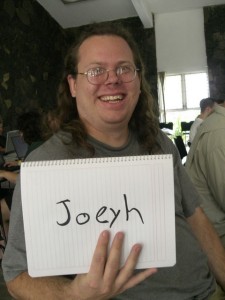
Rapha&#235;l Hertzog: People behind Debian: Joey Hess of debhelper fame


I decided recently to publish interviews from Debian contributors and I picked Joey Hess as my first target. He s one of the few who have heavily influenced Debian by creating software that have become building blocks of the project, like the debian-installer (Joey uses the shorthand d-i to refer to it). My questions are in bold, the rest is by Joey (except for the additional information that I inserted in italics). Who are you? Hello, I m Joey Hess. I m one of the oldtimers in Debian. Actually, I just checked, and there are still up to nineteen active Debian Developers who joined the project before I did, in 1996. I got started fairly young, and am just 34 years old. I spend part of my time working with Lars Wirzenius, another Debian oldtimer, on Branchable. It makes it dead-easy for anyone to make a website that is built from Git, using my Ikiwiki engine to do wiki and blog style things. These days I spend the rest of my time working on free software, when I should really be looking for work to pay the bills. What s your biggest achievement within Debian or Ubuntu? I guess I m mostly known by Debian developers for writing debhelper and perhaps debconf. Probably founding the Debian Installer project has been a bigger impact for users. I m fairly equally proud of all three projects. But while it might sound corny, I am more proud of the accumulation of all the smaller things done in the context of Debian. It s more of a deep connection to the project. All the bugs fixed, and filed, and packages uploaded, and late night discussions, and just being a part of the larger project. What are your plans for Debian Wheezy? Hmm, I stopped thinking of Debian releases by code names back around Slink. :) So, few specific plans for Wheezy. The main thing I would like to help make happen in Debian next is Constantly Usable Testing, and it transcends releases anyway. The only specific plans I have for Wheezy are that there will probably be a new debhelper compat level, and I hope d-i will finally switch to using git. RH: You can learn more about Constantly Usable Testing in my article Can Debian offer a Constantly Usable Testing distribution?. If you could spend all your time on Debian, what would you work on? Getting Debian on all these computers that we carry around in our pockets and can t easily run apt-get on and hack on. Phones that is. It s a bigger problem than just Debian, but I think Debian needs to find a way to be part of the eventual solution. The FreedomBox concept at least hints at a way around the current situation with embedded computers in general. What s the biggest problem of Debian? I believe that the biggest problem is institutional, social and technological inertia. Every specific case of something that frustrates me about Debian today can be traced back to that. You contribute regularly to Debian mailing lists, yet I don t remember any aggressive/frustrated mail of you. How do you manage that? Are you avoiding heated discussions? Rats, sounds like all my wonderful flames of years past have been forgotten! Seriously though, after I noticed thread patterns, I started trying to avoid participating in the bad patterns myself. Now I limit myself to one expression of an opinion, and I don t care who gets the last word. If people can t be convinced, it s time to find another approach to the problem. Also, code talks. Most of the programs you wrote for Debian are in Perl. Do you regret this choice? I love that question! No, no regrets. My only concern is whether the language limits contributors or users. I have not seen Perl significantly limiting the use of anything except for debconf (we had to rewrite it in C for d-i). And I do not notice fewer contributions to my Perl-based code than to other code. I do sometimes regret when someone tells me they had to learn or re-learn Perl to work on something I wrote. But while I m enjoying writing new things in Haskell now, and while I hope it will mean less maintenance burden later, I don t think using Haskell will make it easier for others to contribute to my programs. Anyway, for me the interesting thing about writing a program is the problem it solves and the decisions made doing it. Choice of language is one of the less interesting decisions. Is there someone in Debian that you admire for his contributions? Well, lots. You re tempting me to throw a dart at a map. So arbitrarily, I ll say Anthony Towns. We could all learn something from how he s approached making big, fundamental changes, like introducing Testing, and making Debian Maintainers happen.
Thank you to Joey for the time spent answering my questions. I hope you enjoyed reading his answers as I did. Subscribe to my newsletter and don t miss further interviews. You can also follow along on Identi.ca, Twitter and Facebook. PS: If you want to suggest me someone to interview, leave a comment or mail me.

3 comments Liked this article? Click here. My blog is Flattr-enabled.

Michael Casadevall: On Achieving Goals ...

*blows the dust off his blog*

It's been quite awhile since I last wrote anything in this thing, so I guess its a good time as any, off the tails of UDS-N, to finally sit down and write something down. Since my last blog posting in May, I've been travelling around the world, attending conferences, and trying to represent both Ubuntu and Debian itself, and Canonical in all my travels. I was recently posted to China for a full month where I lived and worked out of an office, made friends with fellow Ubuntu users, and tech enthusiasts, had a wonderful time meeting with people with the Beijing Linux User's Group, and worked hard within my team at Canonical, and the legions of Ubuntu Developers to help make one of the best releases we've ever had.

As I was writing specs and drafting work items, I came to the point that I was reflecting on my own personal goals and growth in life. Two years and change ago, I was a struggling junior at Rochester Institute of Technology, a little less than two years ago, I started working full time with Canonical, and this year, I've gone and traveled to many places I've only dreamed about; Anchorage & Barrow, Alaska; Tampere, Finland; Prague, Czech Republic; and Brussels, Belgium, just to name a few. I packed up and lived in China for a month (an amazing experience, and I look forward to going back and visiting again sometime in the near future). Had you told the me of two years ago what I would be doing now, I'd probably think you were smoking something good.

One thing I've discovered in my life is that if you want to do something, you need to get out there and just ****ing do it. This may seem simple, but I think of the dreams a lot of people have that never seem to come to fruition. When I have an opportunity, I take it; going to Alaska was a dream I harbored for many years, especially entering the arctic circle, and heading to Barrow. That entire trip was booked on roughly four days notice, and the side trip to Barrow was planned the day before it actually happen. I don't regret any of it; it was one of the best things I ever done.

It brings me to what I consider the flux of this blog posting. For those who know me, I've had a goal of visiting every state within the United States. At this time last year, this map looked like this

As of two weeks ago today, this map looked like this:


Now, by the end of the day today, it will look like this:


The point I'm trying to make is if you want to do something, do it the first chance you get, or just don't do it; I say this because you never know when you will be able to do it again.

As for completing a life goal, well, it feels pretty amazing :-). I may write about that in a future blog posting ...

10 November 2010

Lior Kaplan: Linus fixes a sound bug ?

Well, kinda. Just follow the comments on this bug report regarding a sound problem in Fedora 14. A user reported about not being able to get mp3 play smoothly and a few other confirmed the issue with Fedora 14. Tests pointed at the kernel or sound driver. A user (Michael Young) and the Linus him self proved this wrong. and Michael found out it caused by a feature in glibc. From there Linus provided a work around till the glibc guys will fix the issue (and as for now they claim it s not a bug). I m sure the user who opened the bug reported didn t expect this whole chain of events it s quite amazing.
Filed under: Fedora

Erich Schubert: Calendar

If you want to see a really big Google Calendar, check out this calendar. Essentially, it is all the events from over 100 other calendars (all containing swing dancing events) merged into one, resulting in often more than 50 events every day, occasionally over 20 at the same time). The data is approximately the same that can be seen on this map; in fact I'm trying to move the data keeping from a custom database (which has superior filtering capabilities such as synonyms in text search) to just having Google keep the data for me (meaning it will eventually not require me to have an own web server for this). I'm doing some filtering such as removing events that don't have parseable geo information (I'm adding GeoRSS:where elements, in fact), some text to html conversion of the entry contents and filtering out inappropriate events via some regular expressions (e.g. only including "Swing" not "Ballroom" events from a calendar) There are still a couple of things to resolve. I'm not sure that recurrence exceptions are propagated properly to the combined calendar; the updates could work more incrementally, and I have to resolve some timezone issues due to the global nature of the calendar: I need to make sure the timezone information is preserved, since usually it makes more sense to give the events in local (to the event) time. P.S. sorry, the code is too specialized and needs cleanup, I won't share it yet.

8 November 2010

Simon McVittie: Debian activities

Most of my recent Debian work has been the usual pkg-telepathy stuff (mainly in experimental while we're frozen), and hacking on the Quake III engine. Having started working on OpenArena DFSG-freeness as random bug-squashing a year ago, I've accidentally ended up taking over the package. The situation for Debian 6.0 (squeeze) looks something like this: The plan for Quake III in Debian 7.0 (wheezy) has already started in experimental: I haven't been doing as much QA work as the RCBW crowd, but here's some halfway-recent bug squashing in the hope that it motivates others: I also started looking at the series of bugs regarding Flash not compiled from source, but I mostly got distracted by all the webapps having a contrib/ directory containing a million embedded code copies...

7 November 2010

Adnan Hodzic: Ubuntu Developer Summit (UDS-N) Debianized Summary

Last week I was on my first Ubuntu Developer Summit (UDS-N), I wanted to attended this summit for couple of reasons: 1. Developer, I m part of Debian Java, working on Eclipse IDE, and as you re developing Debian, you re automatically developing Ubuntu, no? Nerd 2. DebConf11 main organizer, I really wanted to see how it s all done on corporate level, for instance we re going with hotels instead of student dorms and so on. 3. Migration to Linux infrastructure, make contacts and have some talks on this topic, because after DebConf11 in Bosnia a lot of institution will most probably open doors to open solutions such as Linux. I went to this summit without any expectations or plans, just said I ll play it by ear. This years UDS was held in Orlando, Florida before Orlando I was planning to stay in NYC for couple of days, therefor my whole plan was to get to NYC, then Orlando then head back home Smile I Heart NYC I spent couple of days here with my cousins and friends, as always NYC never fails to surprise me, and I ll always stop by even if it s only for couple of days Wink I wanted to meet up with couple of Debian people as well, but unfortunately my schedule was too tight so Caribe Royale, Orlando Please note that this whole trip was crazy (in a good way) starting from Sarajevo; on my flight from NYC to Orlando I see a guy that s sitting in front of me is wearing Canonical Landscape tshirt, I approach him and it turns he was Jamu Kakar working on Landscape. Since my luggage was late we had conversations from Debian over Ubuntu to Java to everything pretty much. While we were still at the airport, we bump into two more people going to UDS. As we got to hotel, same moment we walked out of cab there he was Jorge Castro, was he there just to smoke a cigarette or whatever doesn t even matter, what matters is that even before walking into hotel building I knew where reception, my tower and bar was, everything I needed to know at that moment High Five! Hotel where everything was held was Caribe Royale and even though I looked at their website I thought there was no way it s all going to be that nice, to my delight it was exact replica. Place is All-Suite Hotel and Convention Center , which meant that both accomodation, venue and everything else was in one place which is Yes 15 minutes later after I checked in, I was at a bar talking to Jim Baker about Java, Jython and Python, exact things I wanted to talk about at that given moment. What I said in these last couple of paragraphs sounds pretty cool eh? Well to me this whole UDS was just like this, everybody was so accessible and open for discussion, from Jono Bacon walking around offering candy to UDS reception staff Michelle, Marianna and others who were always there whether you had a complaint, problem or a praise. I really should stop mentioning names, because I ll forget somebody, and since it s just not fair because I had a feeling everybody was just there for you, whatever it was you needed. Ubuntu Developer Summit (UDS-N) Ubuntu, Debian, DebConf, differences? Even though I said I ll play it by ear, from very beginning I thought I d be complete outsider, being part of Debian and all. Quite contrary, I was everything but outsider, and even more there was plenty of Debian people there, including current DPL Stefano Zacchiroli, Colin Watson, Riku Voipio just to name few. There was also a Debian Healt Check plenary. But overall, there are differences between DebConf and UDS. One of the things is that you can attend UDS remotely I m not sure how much is this doable on DebConf, but then again vast differences are that UDS is filled with BOF s (as we would call it in Debian) meetings of different teams, I attended a lot of these, and most of them end with some kind of conclusion. While each day there was (only?) an hour of lectures on various topics, which on DebConf we would characterize maybe even as speed talks . However, everything was high paced, and it all ended up on You think that s a problem? How do you think we could solve it? . I had a feeling even if I didn t say something out loud that someone would hear me and approach me to discuss it. Everything was straight forward, all in goal to resolve certain issue or a problem, which I absolutely loved. Clap Fun It wasn t all work, even though Orlando doesn t seem to be my kind of city from what I saw, it s way too magical for my taste Party There was a lot of places where you could go to enjoy yourself. Good people at Canonical even offered me free ticket to Disney World, there was a lot of destinations to visit and transpiration was also organized by Canonical. Unfortunately I missed the notorious UDS party on Friday because I had to head home early, but possibly I ll make it next year Razz Even though, hotel was that great and to be honest you didn t have to leave to look for party. My favorite was Universal City Walk, one night I decided to go to see Blue Man Group, best part of it was that I got pulled up on stage by one of the members and was part of one of the acts! ROTFL This is definitely something everyone should see during his life, one moment you re laughing like a lunatic, while other moment you re just having goose bumps from the performance itself. Amazing stuff. After all I wrote here along with the pictures, is there even anything else I need to say? Smile I believe that even if I didn t play it by ear, this whole trip would exceed all my expectations in every possible sense. Because that s really what happened, those three reasons I was going to UDS for? Far more happened than that. All I can say in the end is that I ll move closer to having a part in Ubuntu development, and yea, I ll try to be regular on UDS from now on Smile See you in Budapest? If all these photos weren t enough, you can find official group photo as well as personal set of photos can be found on: UDS-N photos by 2010 Sean Sosik-Hamor





Christian Perrier: Help cleaning spam in Debian mailing lists

Debian mailing lists' standard policy is to allow posts from unsubscribed users. That of course fits our standards for opened development but has the drawback of allowing a lot of spam to reach our mailing lists. This spam also clutters the mailing lists archives. However, 1.5 years ago, listmasters established a well-working system to clean out spam from the mailing lists. It basically works in four steps:
  1. first, spam can be "reported" by anyone meeting it. While you are reading the mailing lists, reporting spam is as simple as bouncing the offending mail to a dedicated address: report-listspam@lists.debian.org. I, for instance, use a mutt macro to set ESC-L as a "report spam" hotkey. Spam can also be reported when browsing the mailing lists archives and clicking on the "Report as spam" button;
  2. when a given mail has been reported as spam more than five times, it is then "nominated" for review;
  3. nominated mails must the be reviewed by volunteers in order to confirm they really are spam. The review algorithm is complex but, in short, when a mail has been confirmed as spam by 3 reviewers without being qualified as "ham" by anyone else, then it is considered spam;
  4. such mails are then removed from the mailing lists archives.
Steps 2 and 4 are performed by a weekly script that runs on Sunday mornings (5:00 UTC, IIRC) How can you help? Process nominated spam We need more reviewers for step 3. At this moment 2 people are doing this on a regular basis (every Sunday with the morning coffee). Some others are working on this in a less frequent way. It seems that 1 or 2 more regulars reviewers would guarantee that we can cope with the nominated spam incoming flow. Only Debian developers can do that step. They should read instructions, ask for a password, then start reviewing. The first 1 or 2 people joining this will have a quite big amount of nominated spam to process, for their first effort. However, as most of these have been classified as spam by at least the two people doing this for months....the amount will slowly decrease. I, for instance, now only spend 5-10 minutes reviewing the nominated mails every week. Report spam Everybody can work on reporting spam. You can start by doing this on mailing lists you read by just bouncing spams to the spam report address; If you want to do more, you can join existing spam cleaning efforts, such as the one running for debian-boot or the one running in debian-l10n-french (the latter probably more for French speakers). Or you can of course start a similar effort for your pet list. To be efficient, this effort needs to gather 5-6 people who will process the mailing lists archives systematically. Let's clean out these archives!

Ritesh Raj Sarraf: Icedove

My recent experience with Mozilla ThuderBird, IceDove. With KDE 4.x, the KDE team took a radical step of ripping apart most of the stuff and rethinking many of the designs. Quite a bold move. Many people appreciated KDE's efforts to start afresh while others moved away from KDE. For some reasons, I decided to stick to KDE. Maybe it was because of the awesome flexibility KDE provided provides to customize the DE to one's personal taste. Or maybe because I was too used to the KDE way of doing things. I stayed with KDE while 4.0 was released and stayed with it up till very recently. I started to lose my patience with the PIM Suite. I know the PIM team is also going to some very radical changes which will bring very innovative stuff later. But, at the moment, the KDE PIM suite is very broken. Broken not in the first impress, but broken when you regularly use it. It leaks memory like anything and keeps doing lots and lots of I/O. I hope some day the KDE team decides that they do need a core team, a core team that could take care of important tasks, making sure that the imporatant tasks are Continuously Usable. It takes time to earn the reputation but it takes a lot lesser time to lose it. Anyways, having been a KDE (PIM) user for long, I had been bearing the PIM torments up until, I recently saw a colleague using IceDove. There was a time when the Mozilla suite was in itself terribly slow. But things seem to have changed a lot. Both, the browser and the PIM suite, have improved a lot lot in terms of functionality and performance. Performance is very important. What good is a feature if its performance is terrible and it hinders the usability. Some of the things that really impressed me were: Indexing: Nepomuk might be good one day but that day is yet to be seen. I patiently wait for that day to come. Well, don't have much choice. Have been patiently waiting for it since KDE 4.0 was released. KDE has great ideas with Nepomuk which is good. But realisticly, what all do you want to see indexed ? There has to be a realistic line drawn. The browsers already have indexing for the history. Amarok, the player, also does indexing. It can tell you when your last favorite song was played. For pictures, I have the awesome KPhotoAlbum that cannot be beaten by anything. But above all, the most important thing to index is your conversation. Those emails that you send daily. And indexing is no good if you can't find the information you need, later. IceDove has filled that place. It does an excellent indexing (in terms of performance) and presents a very user intuitive way to narrowing it down to, when looking for a particular information. Organization: The other great thing about KDE PIM is its ability to break down its applications into small parts and glue them together into a new, well integrated application. Yes, Kontact. It is used to be the best PIM application. Used common libraries to make the suite more efficient than the rest. But all this was used to be. Today, kpart itself might be Kontact's problem. We have different applications glued together that if built with a common design, could have benefited a lot more. Take for example: kmail, knode and akregator. They are all very important parts of the PIM suite. Yet all three are different. The only thing common amonst them is is that they are available from the same Kontact shell. kmail has a different navigation. akregator has very nice aggregated folders but the same cannot be available in knode and kmail. knode, while still okay, has been rotting for some time. So it was time to see how IceDove performed when testing it up against this Use Case. The good thing about IceDove is is that it has one single uniform interface to most of the PIM needs. I can use the same window and the same interface for all my rss feeds, my emails and my leafnode newsgroups. That has a big benefit in itself. I have only 1 integrated interface to look at and only 1 interactive method to learn. There aren't different keystrokes for different applications. All is one in IceDove. And I think one of the main reasons for Mozilla's success is its plugin architecture. It is very difficult to satisfy everyone's needs. In the same way, it is very difficult for one group of developer's to be able to innovate differently. This is where Mozilla rocked. They provided a solid foundation with basic standard interface and let new fresh minds to do the rest of the innovation. Turns out it has worked well. So, with my PIM needs satisfied, I thought KDE was serving as nothing but just a mere shell. So, now was the right time to do the thing I always thought of doing. Switch to GNOME. GNOME looks elegant at first look but that is it. I wanted to take a screenshot of an application to report a bug. I fired up PrntSc key to let the screen capture utility pop-up. It did not have the opiton to select just the application window. Hmmm! Time to return back to KDE and use the Mozilla PIM suite and hope the KDE PIM team learns and does the right thing.

6 November 2010

Russell Coker: Unparliamentary Language and Free Software

I ve just read the Wikipedia page about Unparliamentary Language [1]. I recommend that everyone read it, if only for the amusement value, among other things it links to incidents where elected representatives acted in a way that would be expected of primary school children. The general concept of having rules about Unparliamentary Language is that MPs are permitted to say anything in Parliament without the risk of being sued or prosecuted, but certain things are inappropriate the most common example is directly accusing another MP of lying. One of the main aims of rules against Unparliamentary Language is to prevent attacks on the honor of another member. Having just witnessed a mailing list discussion go widely off track when a free software project was denigrated, it seems to me that we could do with some similar guidelines for mailing list discussions. The aim would be not to just prevent excessive attacks on the honor of other members but to also protect the honor of the free software projects. So for example one might recommend not using a particular program because of design decisions which seem dubious or a bad security history, but saying it s crap would be considered to be inappropriate. Not that rejecting a program based on design decisions or a history of security flaws would be uncontroversial, but at least that gives objective issues to discuss so if there is a debate it will educate some of the lurkers. Note that I m not claiming to be better than other people in this regard, I ve described software as crap on more than a few occasions. But I will try to avoid such things in future. Finally does anyone have a good suggestion for a Free Software equivalent to the term Unparliamentary Language ? It seems that to a large extent the support of certain ideas depends on having a catchy name and I can t think of one.

4 November 2010

Gintautas Miliauskas: Living a monastic life for 10 days

About a month ago, at the end of August, I finished a 10-day Vipassana meditation course. This was probably one of the more extreme activities I have ever participated in, and it's well worth a blog post. I found out about the course in a ridiculously trivial way, by following a link in a Reddit comment (I wonder if I could track down that comment...). The website referenced by the comment contained (almost) no new-agey mumbo-jumbo and looked legit in general. I also appreciated the fact that this was a relatively serious and intensive course, which should be enough to form a reasonably founded opinion on meditation in general. When learning sporadically, in small bits, it is hard to say whether the material itself is no good, or you just do not understand it yet and need to study more; I was quite skeptical towards the practice, but wanted to give it fair trial. I was quite impressed that there was a course available in Lithuania, a few hours by train from where I live. Finally, the course was free (by tradition Vipassana is taught without monetary compensation). I went ahead and signed up for a standard introductory 10-day course. Vipassana (also called insight meditation) is a meditation technique allegedly coming back from Gautama Buddha himself (well, all the traditions like to claim that origin...). It has been experiencing a renaissance, partly due to an organization set up by a meditation teacher S. N. Goenka which has founded meditation centers all over the world. The essence of Vipassana is a method of teaching your mind to act instead of merely reacting to outside stimuli such as pain, anger of other people or hardships. The technique provided is to monitor your sensations, watch them with equanimity and suspend any reaction, and slowly it sinks in that all things are temporary and you can choose what to react to and how. That's the basic idea; I don't want to go deep into exposition of Vipassana as there is plenty of information about that (also at the same time the information is almost useless because you have to experience it to really understand it). Instead, I will sure some of the more personal remarks and experiences. The course took place in an cottage near Kretinga, housing around 50 people. The living conditions were absolutely great, and this would have been a true holiday if not for the regime and the rules. The day would start very early, at 4 AM (ending at around 9:30 PM), and we'd do about 12 hours of meditation in total inbetween, with occasional breaks, but the most gruesome part is that no communication at all was allowed with anyone except the manager of the camp (and the teacher during a specified time). That gets to you after a few days, but still, there are people around you, so it's bearable; on the other side, the senses (touch, smell) become very acute. The food was taken care of by volunteers (students who have finished the course), and I could say it was quite good actually. The goal, of course, was to keep the environment from interfering with meditation, and I think it was done very well. The presentation of the actual technique also did not disappoint. Each day a new step would be introduced, with the whole day to practice before moving on. Looking back, the pacing worked well. Every day in the evening there were lectures on theory. They were somewhat informative, but also sometimes annoyingly primitive and verbose. The little mistakes, holes in logic and slight doses of mumbo-jumbo almost drove me nuts by the middle of the course, until I learned not to react to them. Despite the shortcomings of presentation, the simplicity and lucidity of the practice and lightness of theoretical baggage really appealed to me. The whole organisation in general gave the impression of complete transparency, with no strings attached, no financial interests in play and no agitation for further involvement. While there are many meditation techniques, I am happy that I've gone with Vipassana in particular for one reason: Vipassana meditation uses no artificial tools to help you concentrate, such as mantras, visualisations, counting, etc. Such methods make concentration much easier, but they also create a dependence on the methods themselves. I appreciate the purity of Vipassana in this regard. Not everything in the practice is roses though. First, a particular worldview supported by Vipassana is presented as "scientific" and supposedly "the right way to live", and if even if you don't agree, "the truth" of Vipassana will become obvious to you with time. This is a distinctive mark of ideologies. The thing that makes everything break is the reincarnation, which is generally assumed as true, even if it's not shoved down the student's throat. Every rationalization of a world view has a "white lie" (usually related to the concept of eternity somehow) at the core, and in this context reincarnation is it. Given what we know now about the relationship between the mind and the body, reincarnation is absolutely ridiculous and completely untenable, and that breaks all "moral" reasoning for practicing meditation as opposed to doing something else. I'm not the first to bring up this problem, there's plenty of material about it online. The second slippery idea is that the concept of "negative happiness" is central in Vipassana, that is: happiness is defined as lack of suffering. This point is not that unreasonable actually, from personal experience I could indeed call the state of non-suffering happiness, but there is definitely something missing when compared to the state of mind when I'm truly, positively happy. Whether you consider that something important or not, it's definitely there. Third, Vipassana suggests that it is only you who is at fault when your inner state is disturbed; the world affects you as much as you let it, and in order to find happiness you should learn to control the "interface" rather than the outside world, which will usually not behave as you want. This may be correct, but sometimes it could just be easier to fix the world rather than change yourself, and I have the suspicion that it this is much more frequently the case in the modern world compared to the pre-modern environment. (This is one of the points which break when reincarnation is rejected, as with reincarnation you have the whole eternity to fix yourself.) While the complaints are serious, they do not mean complete rejection of Vipassana but rather integration among the various other techniques available. The actual meditation technique is still great for gaining and maintaining mental composure, reducing anxiety and improving well-being. Now, if I could only get used to meditating regularly... If you have the chance, I highly recommend you try out an introductory 10-day course. There is little to lose and a lot to gain. And if you do go ahead, I have two hints. First, do not even think about leaving the course before it's over. Any hardships are temporary and will be overcome quickly. Second, use the time with the teacher, those interactions were very helpful to me. Also, given the "noble silence", talking to someone once in a while will not hurt.

3 November 2010

Rapha&#235;l Hertzog: Wiki page to share Debian presentations and associated templates

After having created my Debian presentation template, I wanted to share it so that future speakers can reuse my work. Surely there should be a place for this. I quickly found Ubuntu s dedicated wiki page, and for Debian the relevant place was on the website. However looking at that page, it s obvious that the website is not the proper place: the page has not been updated with new talks since 2005. It s just to much burden for any speaker. A wiki page is much more convenient in that regard. Switching to the wiki means we loose translations but that s still better than an outdated translated page on the website. So I went ahead, I created http://wiki.debian.org/Presentations and I filed a bug against www.debian.org to suggest to move the content to the wiki (see #601337) and to leave a link pointing to the new wiki page. So the content of the website needs to be injected into the wiki. This is an easy task for someone that wishes to start contributing to Debian. Thus it s your task. Once completed send a mail to 601337@bugs.debian.org to inform the webmasters that the wiki part of the work has been completed. They just have to drop the old pages and replace them with links to the wiki. PS: If you have given a Debian talk recently, please put your slides online and link to them on the new wiki page.

Flattr this Share/Bookmark 9 comments Support my work

2 November 2010

Francois Marier: RAID1 alternative for SSD drives

I recently added a solid-state drive to my desktop computer to take advantage of the performance boost rumored to come with these drives. For reliability reasons, I've always tried to use software RAID1 to avoid having to reinstall my machine from backups should a hard drive fail. While this strategy is fairly cheap with regular hard drives, it's not really workable with SSD drives which are still an order of magnitude more expensive.

The strategy I settled on is this one:This setup has the benefit of using a very small SSD to speed up the main partition while keeping all important data on the larger mirrored drives.

Resetting the SSDThe first thing I did, given that I purchased a second-hand drive, was to completely erase the drive and mark all sectors as empty using an ATA secure erase. Because SSDs have a tendency to get slower as data is added to them, it is necessary to clear the drive in a way that will let the controller know that every byte is now free to be used again.

There is a lot of advice on the web on how to do this and many tutorials refer to an old piece of software called Secure Erase. There is a much better solution on Linux: issuing the commands directly using hdparm.

Partitioning the SSDOnce the drive is empty, it's time to create partitions on it. I'm not sure how important it is to align the partitions to the SSD erase block size on newer drives, but I decided to follow Ted Ts'o's instructions anyways.

Another thing I did is leave 20% of the drive unpartitioned. I've often read that SSDs are faster the more free space they have so I figured that limiting myself to 80% of the drive should help the drive maintain its peak performance over time. In fact, I've heard that extra unused unpartitionable space is one of the main differences between the value and extreme series of Intel SSDs. I'd love to see an official confirmation of this from Intel of course!

Keeping the RAID1 array in sync with the SSDOnce I added the solid-state drive to my computer and copied my root partition on it, I adjusted my fstab and grub settings to boot from that drive. I also setup the following cron job (running twice daily) to keep a copy of my root partition on the old RAID1 drives (mounted on /mnt):
nice ionice -c3 rsync -aHx --delete --exclude=/proc/* --exclude=/sys/* --exclude=/tmp/* --exclude=/home/* --exclude=/mnt/* --exclude=/lost+found/* --exclude=/data/* /* /mnt/

Tuning the SSDFinally, after reading this excellent LWN article, I decided to tune the SSD drive (/dev/sda) by adjusting three things:


Is there anything else I should be doing to make sure I get the most out of my SSD?

1 November 2010

John Goerzen: Some Amateur Radio Statistics

I ve had a lot of fun with amateur radio since I got licensed in July! Here are some numbers regarding my HF contacts. Not included in this are probably hundreds of more contacts on VHF or UHF, which are more local bands and not typically logged. One of my favorite moments happened recently when I turned on my digital program (fldigi) and happened to tune to 17m. I don t have antennas there and don t usually bother, since there s rarely something I can receive. But I saw two PSK-31 (digital) signals. One of them was a Japenese station calling CQ. I replied, and although we had some noise (perhaps due to my lack of a 17m antenna), made my first contact with Japan! Things like this are part of the fun of amateur radio. Sometimes things that have no business working actually do, and I get a surprise like this.

Next.

Previous.