Search Results: "ina"

8 March 2015

Gregor Herrmann: RC bugs 2015/07-10

finally, some simple RC bugs appeared, & I could contribute a bit towards the jessie release:

7 March 2015

Joey Hess: 7drl 2015 day 1 groundwork

Scroll is a roguelike, with a twist, which I won't reveal until I've finished building it. I'll just say: A playable roguelike pun, set in a filesystem near you. I'm creating Scroll as part of the 7DRL Challange. If all goes well, I'll have a usable roguelike game finished in 7 days. This is my first time developing a roguelike, and my first time writing a game in Haskell, and my first time writing a game to a time limit. Wow!
First, some groundwork. I'm writing Scroll in Haskell, so let's get the core data types and monads and IO squared away. Then I can spend days 2-7 writing entirely pure functional code, in the Haskell happy place. To represent the current level, I'm using a Vector of Vectors of Chars. Actually, MVectors, which can be mutated safely by pure code running inside the ST monad, so it's fast and easy to read or write any particular location on the level.
-- Writes a Char to a position in the world.
writeWorld :: Pos -> Char -> M ()
writeWorld (x, y) c = modWorld $ \yv -> do
    xv <- V.read yv y
    V.write xv x c
showPlayer :: M ()
showPlayer = writeWorld (5,8) '@'
(I wish these Vectors had their size as part of their types. There are vector libraries on hackage that do, but not the standard vector library, which has mutable vectors. As it is, if I try to access outside the bounds of the world, it'll crash at runtime.) Since the game will need some other state, I'm using the state monad. The overall monad stack is type M = StateT S (ST RealWorld). (It could be forall s. StateT S (ST s), but I had some trouble getting that to type check, so I fixed s to RealWorld, which is ok since it'll be run using stToIO. Next, a concept of time, and the main event loop. I decided to use a continutation passing style, so the main loop takes the current continuation, and runs it to get a snapshot of the state to display, and a new continutation. The advantage of using continuations this way is that all the game logic can be handled in the pure code. I should probably be using the Cont monad in my monad stack, but I've not learned it and lack time. For now I'm handling the continuations by hand, which seems ok.
updateWorld :: Step
updateWorld (Just 'Q') = do
        addMessage "Are you sure you want to quit? [yn]"
        next $ \i -> case i of
                Just 'y' -> quit
                _ -> continue
updateWorld input = do
        addMessage ("pressed " ++ show input)
        continue
Finally, I wrote some ncurses display code, which is almost working.
Start time: After midnight last night. Will end by midnight next Friday. Lines of code written today: 368 Craziest type signature today: writeS :: forall a. ((Vec2 a -> ST RealWorld ()) -> M ()) -> Pos -> a -> M ()
By the way, there's a whole LambdaHack library for Haskell, targeted at just this kind of roguelike construction. It looks excellent. I'm not using it for two reasons:
  1. Scroll is going to be unusual in a lot of ways, and LambdaHack probably makes some assumptions that don't fit.
  2. mainSer :: (MonadAtomic m, MonadServerReadRequest m) => [String] -> COps -> (m () -> IO ()) -> (COps -> DebugModeCli -> ((FactionId -> ChanServer ResponseUI RequestUI -> IO ()) -> (FactionId -> ChanServer ResponseAI RequestAI -> IO ()) -> IO ()) -> IO ()) -> IO ()
    That's a lot of stuff to figure out! I only have a week, so it's probably easier to build my own framework, and this gives me an opportunity to learn more generally useful stuff, like how to use mutable Vectors.

Holger Levsen: 20150307-reproducible-video

Video from the reproducible builds talk at FOSDEM 2015 and testing experimental The video from Lunar's and my talk Stretching out for trustworthy reproducible builds (follow this link if you're interested in the slides) given at the recent FOSDEM is finally available for download at both the FOSDEM video archive as well as the Debian video archive. (Update: the Debian video archive has a hires version now, I suspect the FOSDEM archive will follow soon.) To encourage maintainers uploading fixes to experimental and thanks to lots of work from Mattia Rizzolo we are now also testing packages in experimental for reproducibility! And even better: behind the scenes the site is prepared for stretch! Should you have wondered about the decrease in sid since we've been given the talk in early February: this is because we've added some more variations to the second build. Most notably building with a timezone difference of 25h lead to the decrease in the graphs showing the current prospects of reproducible builds... More work and joy to come!

Andrew Pollock: [tech] Honey, I wrote my first Chrome extension!

I love reading Linux Weekly News. It's a great source of high quality Linux and FOSS journalism, and I've been a subscriber for years. One mild annoyance I have with the site is the way articles are cross-linked. All the article URIs are in the format /Article/531114/, which isn't particularly descriptive about that article's content. When faced with an article that links to another article, with perhaps a word of anchor text, it's hard to tell if the new article is worth opening in a tab, is indeed already open in a tab, or has been previously read. (Yes, the "visited link" colour can help to a small degree, but even then, it doesn't tell you which previously read article it is). This is what God the W3C invented the title attribute for. Back in April 2011, I emailed Jonathan Corbet and asked if his content management system could just do this, but it was apparently a bit tricky, and it got filed in the "feature request" bucket. I was sufficiently irritated by this deficiency last Monday, when doing some heavy reading on a topic, and so I decided to take matters into my own hands, and also learn how to write a Chrome Extension into the bargain. I was delighted to have scratched the itch under 24 hours later and developed something that solved my particular problem - lwn4chrome I'm calling it. I'm just finalising an icon for it, and then I'll have a stab at putting it in the Chrome Web Store as a freebie. I might even have a crack at writing a Firefox extension as well for completeness, but I suspect the bulk of LWN's readership is using Chrome or Chromium.

6 March 2015

Rapha&#235;l Hertzog: My Free Software Activities in February 2015

My monthly report covers a large part of what I have been doing in the free software world. I write it for my donators (thanks to them!) but also for the wider Debian community because it can give ideas to newcomers and it s one of the best ways to find volunteers to work with me on projects that matter to me. Debian LTS This month I have been paid to work 14.5 hours on Debian LTS. I worked mostly on CVE triage (41 commits in the security tracker) and organizational issues. One maintainer complained that he had not been kept in the loop for an LTS update of his package. After some discussion, I decided to change the way I did CVE triage so that any time that I add a package to our list of packages needing an update, I also send a mail to the maintainer, thus offering him the opportunity to step in. To make this sustainable, I wrote a small helper script that will generate a mail out of a template. And to kickstart the process I mailed all maintainers of packages that were already listed in our queue of packages to update. To improve the email generated, I requested a JSON export of the security tracker data (see discussions in #761859). In the mean time, Holger worked on this already and after a few iterations we did converge on an output format that will be really useful both for my needs in terms of CVE triage but also for the Package Tracker to be able to display the list of security vulnerabilities affecting each release (see #761730). Last but not least, I don t want to be the only one doing CVE triage for our LTS release so I documented the process in our wiki page. As a side note, I sponsored an e2fsprogs update prepared by Nguyen Cong and I sent the DLA for the embargoed samba update that had been prepared by Ivo de Decker (thanks to both of them!). Tryton Like last month, I invested again a copious amount of time on Tryton, fixing some bugs that were affecting me and improving the French chart of accounts to properly manage purchases and sales within the European Union. Here are some links for more details: Debian I did some work on Distro Tracker, I fixed #777453 (password reset not working because the generated email was using an invalid From email) and #779247 (obsolete build reproducibility action items were not dropped). I also started to work on restructuring the mail handling in distro-tracker (cf #754913) but it s not public yet. While I have no plans to stop contributing to Debian (it s part of my day job!), I reduced my non-work related involvement by officially recognizing that I was no longer properly assuming some of my responsibilities and that I was following too many mailing lists and RSS feeds. The most notable changes are that I removed myself from the maintenance of dpkg, developers-reference, quilt, sql-ledger, and a few perl/python modules. Misc Voting software. Part of the reason why I m reducing my involvement in Debian is that I got more involved in Nouvelle Donne (a French political party) and in particular in the handling of its digital infrastructure (currently running on Ubuntu, doh!). As part of this, I was looking for free software to handle secure votes and elections (and if possible adhering to the principles of liquid democracy). There s no perfect solution and no clear winner. That said I started following the evolution of AgoraVoting because it seems to have a good momentum and has some interesting features (it already supports votes with ranked choices, supports good crypto, has been used for elections involving large numbers of voters in the context of Podemos in Spain). But it still has some ways to go to establish itself as a truly international and community-backed project. GDM bug. Due to my work on Kali, I filed a bug against GDM (this one has been quickly fixed upstream, it s still open in Debian) and another one against accountsservice to request the possibility to define the default graphical session. Dirvish formula for Salt. I contributed another formula to manage backups with dirvish. Thanks See you next month for a new summary of my activities.

One comment Liked this article? Click here. My blog is Flattr-enabled.

Dirk Eddelbuettel: Rcpp 0.11.5

The new release 0.11.5 of Rcpp just reached the CRAN network for GNU R, and a Debian package has also been be uploaded. Rcpp has become the most popular way of enhancing GNU R with C++ code. As of today, 345 packages on CRAN depend on Rcpp for making analyses go faster and further; BioConductor adds another 41 packages, and casual searches on GitHub suggests dozens mores. This release continues the 0.11.* release cycle, adding another large number of small bug fixes, polishes and enhancements. Since the previous release in January, we incorporated a number of pull requests and changes from several contributors. This time, JJ deserves a special mention as he is responsible for a metric ton of the changes listed below, making Rcpp Attributes even more awesome. As always, you can follow the development via the GitHub repo and particularly the Issue tickets and Pull Requests. And any discussions, questions, ... regarding Rcpp are always welcome at the rcpp-devel mailing list. See below for a detailed list of changes extracted from the NEWS file.
Changes in Rcpp version 0.11.5 (2015-03-04)
  • Changes in Rcpp API:
    • An error handler for tinyformat was defined to prevent the assert() macro from spilling.
    • The Rcpp::warning function was added as a wrapper for Rf_warning.
    • The XPtr class was extended with new checked_get and release functions as well as improved behavior (throw an exception rather than crash) when a NULL external pointer is dereferenced.
    • R code is evaluated within an R_toplevelExec block to prevent user interrupts from bypassing C++ destructors on the stack.
    • The Rcpp::Environment constructor can now use a supplied parent environment.
    • The Rcpp::Function constructor can now use a supplied environment or namespace.
    • The attributes_hidden macro from R is used to shield internal functions; the R_ext/Visibility.h header is now included as well.
    • A Rcpp::print function was added as a wrapper around Rf_PrintValue.
  • Changes in Rcpp Attributes:
    • The pkg_types.h file is now included in RcppExports.cpp if it is present in either the inst/include or src.
    • sourceCpp was modified to allow includes of local files (e.g. #include "foo.hpp"). Implementation files (.cc; .cpp) corresponding to local includes are also automatically built if they exist.
    • The generated attributes code was simplified with respect to RNGScope and now uses RObject and its destructor rather than SEXP protect/unprotect.
    • Support addition of the rng parameter in Rcpp::export to suppress the otherwise automatic inclusion of RNGScope in generated code.
    • Attributes code was made more robust and can e.g. no longer recurse.
    • Version 3.2 of the Rtools is now correctly detected as well.
    • Allow 'R' to come immediately after '***' for defining embedded R code chunks in sourceCpp.
    • The attributes vignette has been updated with documentation on new features added over the past several releases.
  • Changes in Rcpp tests:
    • On Travis CI, all build dependencies are installed as binary .deb packages resulting in faster tests.
  • Thanks to CRANberries, you can also look at a diff to the previous release As always, even fuller details are on the Rcpp Changelog page and the Rcpp page which also leads to the downloads page, the browseable doxygen docs and zip files of doxygen output for the standard formats. A local directory has source and documentation too. Questions, comments etc should go to the rcpp-devel mailing list off the R-Forge page.

    This post by Dirk Eddelbuettel originated on his Thinking inside the box blog. Please report excessive re-aggregation in third-party for-profit settings.

    2 March 2015

    Jonathan Dowland: Debian and Docker

    I've been playing around with Debian and Docker a little bit. I found Joey Hess' post about Docker trust interesting reading, in particular this advice:
    I'd recommend only trusting docker images you build yourself. I have some docker images published somewhere that are built with 100% straight debootstrap with no modifications (...) But I'm not going to link to them, because again, you should only trust docker images you built yourself.
    On that advice, I did exactly that. I've pushed the basic scripts I used to build my images to github:jmtd/debian-docker. Suggestions welcome! However, I am planning to share the images I build, at least for my own convenience, on the Docker repository. I'm hoping to publish some PGP-signed sums somewhere so you could verify the binary images on the Docker registry if you so wish. The three images I'm currently maintaining are: (note: I haven't pushed them all yet.) With docker 1.5.x at least, the i386 image works fine on amd64 hosts. I've used it as the basis for running wine and Windows binaries. I might push a wine image if I generalise it enough to be more useful. The Docker folks recommend using Debian as a base image because it's a small size (approx. 163M for my base image, 85.01M for the semi-official one: See Joey's blog for some of the differences) but with a good set of tools. I wondered whether I could leverage the efforts of the Emdebian project to get an even smaller base image. Unfortunately, the Emdebian project discontinued their 'Grip' project midway through last year. A basic Emdebian grip install is a fair bit smaller than the equivalent wheezy image, but once you've applied security updates most of the difference is lost. I suspect that some of Emdebian's minimisation techniques would be useful and applicable for shrinking Docker base images.

    Zlatan Todori : Debian priglavci

    Mom and Debian is an awesome combination. :) Debian pape

    Gergely Nagy: Distributed Version Control from another angle

    I've been using distributed version control systems for a good while, started with TLA back in 2001, when it was still a bunch of shell scripts and was simply called "Arch". I jumped the Git bandwagon quite early too, sometime around May 2005, I believe, though it was only something to test and play with on the side: I didn't migrate my projects over yet. There are many reasons why I preferred these over the systems I used in the past (RCS and CVS; never considered Subversion an option), most of those reasons have been discussed at length over the years, and there's no reason to do so again.The reason for this post, is because I read a blog post about why Git and the other DVCSes fall short. There are a number of things in that article that I find... well, lets just say misinformed. I'll try to explain why.But here's the rub
    I have wanted to have the full history while offline a grand total of maybe about six times. And this is merely going down over time as bandwidth gets ever more readily available. If you work as a field tech, or on a space station, or in a submarine or something, then okay, sure, this is a huge feature for you. But for the rest of us, I am going to assert that this is not the use case you need to optimize for when choosing a VCS.
    I'm neither a field tech, nor do I work on a space station or a submarine. Yet, having the full history available locally has been crucial for my work for at least the past six years. Initially, I worked offline primarily, because my internet connection was incredibly limited (slow, expensive and unreliable), yet, I had a habit of committing small changes often. I needed a full clone to work effectively, and conveniently. Throw-away branches and all that - I needed them local, I didn't have the resources to push them online every time I wanted a merge.But now that I have fast and reliable internet, why do I need the full history on my own computer? I do, because I do much more research than I do development. The vast majority of my work between 2010 and 2012 involved reading histories, cherry picking and so on. About six hours a day, I was reading the past. Having the full history locally is a terrific aid when your job involves digging through it.Between 2013 and 2014, the amount of history reading dropped significantly, but I still worked with long-lived branches a lot, branches where history matters, where having easy and fast access to them is indispensable. I still had to find changes based on content (not commit message, branch, date or anything - content) on a daily basis. Hitting the network for each and every search would have wasted not only tremendous bandwidth and processing power on the server, but also a significant amount of time.If you do more maintenance and research, or follow a good number of branches (or forks), with the intent to merge and cherry-pick actively from them, having all the histories available locally is a huge improvement. I'm happy to pay the price of "wasting" disk space to have this available. I couldn't work otherwise. Without full, local history, the things I did for syslog-ng would not have been possible. No maintenance, none of the features I implemented, none of the fixes I found. Why? Because I rely on the project's history to aid me in learning the whys, not just the hows.Thank you, but - perhaps unlike others - I like to learn from the past, and prefer doing it efficiently.Say goodbye to blobs (or your sanity (and sometimes both))
    You know what kind of external binary asset management system works really well? Subversion. Turns out it works tolerably for source control, too. Maybe you should take a look at it.
    Sure, some systems are better at managing binary assets. Git - and usually DVCSes - are terrible at it. There's nothing stopping anyone from using two systems: one for source, another for data. Mind you, I am extremely happy with git-annex. I disagree with Subversion being tolerable for source control. I'd turn this assertion around instead: You know what kind of system works really well for source code? Git. Turns out it works tolerably as an external binary assest management system, too. Maybe you should take a look at it.But then, I rarely need to work with blobs, so I'm likely not the best person to disagree here.Say goodbye to sane version synchronizationOkay, so this part of the article is ill-titled, I believe. Large repositories and version synchronisation are two different, not necessarily related topic. Granted DVCSes may not be the best fit for large repositories, but neither are centralised version control systems, based on my past experience. I had the misfortune of working with a roughly 3-4Gb (checked out) project, with extensive history, managed with a centralised version control system, without local history. It was terrible (and blame was so slow and expensive that we were told never to use it, because it crashed the server). While the system allowed us to have a reasonable overview over the whole project, but it utterly failed at allowing us to work at the component level. How do I see which version of component X we had in project release A? Or the version of component Y we had two weeks ago? Or what if we have component M, made up from components J and K, and belonging to component Z? Good luck managing that in a single repository.With TLA, we had configs, which were a bit cumbersome to use, but captured most of the essential parts of managing component bundling and hierarchical versioning far better than any other solution I've seen so far. I've yet to find an acceptable solution, but I'm convinced it will not have anything to do with centralised systems. You can't capture the delicate relations there.Say what again, I dare you, I double dare you
    All of the above might be almost tolerable if DVCSes were easier to use than traditional SCMs, but they aren t.
    I'm sorry, but have you tried managing a decently sized project, with a large history, built from multiple components with a traditional SCM? Because that is a colossal pain in the backside.Does Git's UI suck? Yes. But so did CVS's and Subversion's. If you rely on the command-line tools, you're going to feel the pain. That is why you use the IDE integration you surely have, which makes the most common tasks a breeze. That may sound like a git-apology, but remember, we did the same with every other version control system, because smart people prefer integration, and want the computer to work for them.
    And yet, when someone dares to say that Git is harder than other SCMs, they inevitably get yelled at, in what I can only assume is a combination of Stockholm syndrome and groupthink run amok by overdosing on five-hour energy buckets.
    If you feel the need to understand the innards of Git - then yes, it is harder than traditional SCMs. It is distributed, and different than what you're used to. If you do not have prior knowledge though, the difference in learning the internal working of Git and - say - Subversion all that different. And if you do not care how it works down below (and I dare say, a lot of developers should not, and do not care), then there is nothing to learn, apart from your IDE integration, which ain't different from a traditional SCM's.Mind you, I found it both interesting, and beneficial to learn Git's inner workings. Not only because it allowed me to make better use of my VCS, but because it taught me a bunch of things I could make use of elsewhere. I learned nothing from traditional SCMs.Do you hear the people sing, singing the song of angry men
    There is one last major argument that I hear all the time about why DVCSes are superior, which is that they somehow enable more democratic code development.
    The reason Git and other tools make code contribution easier is not GitHub pull requests (although, for drive-by contributions those are pretty useful too). The reason they make contribution easier is because you have your own copy of the full history. You can create your own branches easily, you can work with it as if you were the owner. For one-off contributions, that is no real advantage, I'll give you that. It takes more effort to fork & do a PR on GitHub, than to send a patch, I'll also agree with that.But once you start working with a project for more than a few patches, when you want to work with its history too, once you have long-lived branches, the local copy quickly becomes a great asset. Once you want to submit more than a few changes, you won't have to repeat a all steps. And not only that: since you have the full history, merging upstream changes (or just cherry picking from them), rebasing your work, and many other tasks become simpler.That is what it buys you, that is why it makes contribution easier. GitHub pull requests are an icing over the cake at best (and there are a good number of cases where the icing is completely unnecessary, because it doesn't go well with the cake).In closingIn closing, I'd like to highlight that different projects have different requirements. For example, I understand why Facebook, Google and a number of others use a single, huge repository. I happen to hate that setup, and would find working in such an environment horrible. But luckily, I don't work for those companies, and they don't listen to me, either, so everyone's happy. That does not mean I would go out and tell them they're wrong to use such a centralised, single-repository setup. For their use, in their situation, for their requirements, that may be the better option. For mine, not so much.In the end, what we need to realise is that there is no single tool that will fit all needs. There are tasks where Git is a terrible choice, but that does not make it terrible for all cases. Similarly, there are cases where Subversion is superior (I assume - I didn't have the misfortune of meeting with such a case).Instead of bashing the DVCS world, and assuming the Big Company use cases are all that matter, and that everyone uses the tools the same way, accept that some use it to achieve things you didn't think of, jobs you didn't consider.

    DebConf team: Inviting speakers to DebConf15 (Posted by Ren Mayorga)

    Last year for the DebConf edition that took place in Portland, we had some invited speakers that helped bring a different point of view to the matters discussed during the conference. This year we would like to do this again. If you would like to suggest inviting someone that would not regularly attend DebConf, the DebConf Content Team encourages you to do that now. We will stop accepting new suggestions on 10 March 2015. You can follow the simple procedure described on the Inviting Speakers page in the DebConf s Wiki Please keep in mind that we don t promise to bring to Heidelberg everyone that is suggested. The final list of invited speakers will depend on the speakers availability and our limited budget.

    1 March 2015

    Robert Edmonds: Converting to --upstream-vcs-tag

    Recently, the Google protobuf developers announced a migration of their project's source code from an svn repository to a git repository. Up until this point, the Debian protobuf package repository had only tracked upstream development by embedding upstream release tarballs using gbp import-orig with pristine-tar. It would be nice to smoothly migrate the packaging repository to additionally make use of the --upstream-vcs-tag option to gbp import-orig, the advantages of which have been well described by Russ Allbery. This turned out to be harder than expected, so for reference I documented the steps I took below. Note that this packaging repository uses the default gbp import-orig repository layout, where upstream sources are placed on a branch named upstream, and the Debian branch is named master. Add an upstream remote configured to track the upstream repository's master branch and tags.
    $ git remote add --tags --track master upstream https://github.com/google/protobuf.git
    
    The upstream remote shouldn't be confused with our upstream branch. Note that git-remotes are local to the repository, so the upstream remote should probably be documented in the debian/README.source file. Fetch the upstream branch and tags.
    $ git fetch upstream
    warning: no common commits
    remote: Counting objects: 5210, done.
    remote: Compressing objects: 100% (861/861), done.
    remote: Total 5210 (delta 3869), reused 5194 (delta 3855)
    Receiving objects: 100% (5210/5210), 3.57 MiB   1.43 MiB/s, done.
    Resolving deltas: 100% (3869/3869), done.
    From https://github.com/google/protobuf
     * [new branch]      master     -> upstream/master
     * [new tag]         v2.6.0     -> v2.6.0
    $
    
    We now have a git-remote upstream, a remote-tracking branch upstream/master which corresponds to the master branch that upstream makes releases from, and a release tag v2.6.0. Note that the remote-tracking branch upstream/master shouldn't be confused with our master branch. Up until this point, our upstream branch has been synthetically generated by importing upstream's release tarballs with gbp import-orig. We need to merge this synthetic history with upstream/master. Unfortunately, I couldn't find a way to do this without using a temporary branch.
    $ git checkout -b tmp upstream/master
    Branch tmp set up to track remote branch master from upstream.
    Switched to a new branch 'tmp'
    $ git merge -s ours -m \
      "Merge the original 'upstream' branch with upstream's new master branch" upstream
    Merge made by the 'ours' strategy.
    $ git checkout upstream
    Switched to branch 'upstream'
    Your branch is up-to-date with 'origin/upstream'.
    $ git merge --ff-only tmp
    Updating 7ed940b..9ba221e
    Fast-forward
     CHANGES.txt                                                          49 +-
     COPYING.txt => LICENSE                                                0
     Makefile.am                                                          64 +-
     Makefile.in                                                        1041 --
     README.txt => README.md                                              49 +-
    [...many more lines...]
    $ git branch -D tmp
    Deleted branch tmp (was 5f18f02).
    $
    
    There are now an additional 400 or so commits on our upstream branch, corresponding to the new git repository history published by upstream. Import the 2.6.0 release tarball against the upstream v2.6.0 tag, using the --upstream-vcs-tag option.
    $ git checkout master
    Switched to branch 'master'
    Your branch is up-to-date with 'origin/master'.
    $ gbp import-orig -u 2.6.0 --upstream-vcs-tag=v2.6.0 ~/debian/tarballs/protobuf_2.6.0.orig.tar.gz
    gbp:info: Importing '/home/edmonds/debian/tarballs/protobuf_2.6.0.orig.tar.gz' to branch 'upstream'...
    gbp:info: Source package is protobuf
    gbp:info: Upstream version is 2.6.0
    pristine-tar: committed protobuf_2.6.0.orig.tar.gz.delta to branch pristine-tar
    gbp:info: Merging to 'master'
    gbp:info: Successfully imported version 2.6.0 of /home/edmonds/debian/tarballs/protobuf_2.6.0.orig.tar.gz
    $
    
    The upstream branch now contains a mixture of the original series of release tarball content imported by plain gbp import-orig and the upstream/master branch as published by upstream. Updating the Debian packaging repository when new upstream releases occur only requires a git fetch to pull down upstream's updated git history and release tag and using the --upstream-vcs-tag option when importing the release tarball with gbp import-orig.

    Dirk Eddelbuettel: drat 0.0.2: Improved Support for Lightweight R Repositories

    A few weeks ago we introduced the drat package. Its name stands for drat R Archive Template, and it helps with easy-to-create and easy-to-use repositories for R packages. Two early blog posts describe drat: First Steps Towards Lightweight Repositories, and Publishing a Package. A new version 0.0.2 is now on CRAN. It adds several new features: Courtesy of CRANberries, there is a comparison to the previous release. More detailed information is on the drat page.

    This post by Dirk Eddelbuettel originated on his Thinking inside the box blog. Please report excessive re-aggregation in third-party for-profit settings.

    28 February 2015

    Ben Hutchings: Debian LTS work, February 2015

    This was my third month working on Debian LTS, and the first where I actually uploaded packages. I also worked on userland packages for the first time. In the middle of February I finished and uploaded a security update for the kernel package (linux-2.6 version 2.6.32-48squeeze11, DLA 155-1). I decided not to include the fix for CVE-2014-9419 and the large FPU/MMX/SSE/AVX state management changes it depends on, as they don't seem to be worth the risk. The old patch system used in linux-2.6 in squeeze still frustrates me, but I committed a script in the kernel subversion repository to simplify adding patches to it. This might be useful to any other LTS team members working on it. In the past week I uploaded security updates for cups (version 1.4.4-7+squeeze7, DLA 159-1) and sudo (1.7.4p4-2.squeeze.5, DLA 160-1). My work on the cups package was slowed down by its reliance on dpatch, which thankfully has been replaced in later versions. sudo is a more modern quilt/debhelper package, but upstream has an odd way of building manual pages. In the version used in squeeze the master format is Perl POD, while in wheezy it's mandoc, but in both cases the upstream source includes pre-generated manual pages and doesn't rebuild them by default. debian/rules is supposed to fix this but doesn't (#779363), so I had to regenerate 'by hand' and fold the changes into the respective patches. Finally, I started work on addressing the many remaining security issues in eglibc. Most of the patches applied to wheezy were usable with minimal adjustment, but I didn't have time left to perform any meaningful testing. I intend to upload what I've done to people.debian.org for testing by interested parties and then make an upload early in March (or let someone else on the LTS or glibc team do so). Update: I sent mail about the incomplete eglibc update to the debian-lts list.

    Petter Reinholdtsen: The Citizenfour documentary on the Snowden confirmations to Norway

    Today I was happy to learn that the documentary Citizenfour by Laura Poitras finally will show up in Norway. According to the magazine Montages, a deal has finally been made for Cinema distribution in Norway and the movie will have its premiere soon. This is great news. As part of my involvement with the Norwegian Unix User Group, me and a friend have tried to get the movie to Norway ourselves, but obviously we were too late and Tor Fosse beat us to it. I am happy he did, as the movie will make its way to the public and we do not have to make it happen ourselves. The trailer can be seen on youtube, if you are curious what kind of film this is. The whistle blower Edward Snowden really deserve political asylum here in Norway, but I am afraid he would not be safe.

    Zlatan Todori : Interviews with FLOSS developers: Joey Hess

    Edit: Now translated to Chinese. Thanks zhang wei! There is really hardly a better way to open a series of interviewing with developers behind Free Libre Open Source Software project, then with incredible mind such as Joey Hess. To write his contributions to Free software ecosystem, especially in Debian, would be a book by itself. His impact exceeds even his projects - people literally follow his blog posts to see what he is doing and how is he living. A hacker from cabin. If you really need to have a picture of true hacker, then Joey is the one. As this isn't a book I will just mention few projects that he has been behind - git-annex, ikiwiki, etckeeper, debian installer, parts of dpkg, debhelper, devscripts, taskel. So without further waiting here it is. Picture of Joey Hess me: Who are you? joeyh: I'm Joey -- https://joeyh.name/ me: How did you start programming? joeyh: Atari 130XE which came with BASIC and a boring word processor and not much else. No other friends had one, so the only way to get software was to type in demo programs from manual and then begin to change and write my own. So, the easy way to learn. Also some Logo in school. me: How would you now advise others to start programming? joeyh: Difficult question, it seems much harder to get an intimate understanding of things than when I started, and much harder to be motivated to program when there's so much stuff easily available. Maybe simple bare-metal systems like Arduino coupled with real-world interaction are the answer. I've recently been mentoring my nephew who is learning python and Python the Hard Way has gotten him far impressively fast. me: Setup of your development machine? joeyh: Lenovo laptop de-spywared with Debian unstable, xmonad, xfce, vim. me: Your thoughts on Purism (the open hardware laptop initiative that got recently funded on CrowdSupply)? joeyh: I don't know much about that one, but it seems that consumer level hardware has gotten so low quality, and so closed and untrustworthy that it makes sense to either build alternatives that are open, or pick out, as a community, the stuff we can adapt to our needs and concentrate on it. Several projects are trying, I hope they succeed. me: How do you see future of Debian development? joeyh: Well, I've mostly stopped worrying about it. If you look back at my presentations at the past 2 or 3 DebConfs, you'll find my best thoughts on the matter. me: You retired as Debian developer - do you intend sometime soon to come back and/or do you plan to join some other communities? joeyh: It would be glorious to come back, wouldn't it? But I don't think I will. Can't step in the same river twice, and all. Instead, Debian will probably have to put up with me as an annoying upstream author who doesn't ship tarballs, but does ship debian/ directories, and as a bug reporter who enjoys reporting amusing bugs like -0 NaN. I seem to have more time to spend in other online communities since I left Debian, but in a more diffuse way. Maybe that's just what it's like, to be involved in Free Software but not in the embrace of a big project like Debian. me: Some memorable moments from Debian conferences? joeyh: There are so many! Picnicing on berries and tamales at the Portland farmer's market right outside the venue; rainbows and bonfire in Switzerland after crazy busy days; impromptu pipe organ repair in a weird night venue in Edinburgh; walking through Porto Alegre at night with Ian Murdock and how humble he was about what he'd started; hacking all night in Spain; failing to sleep through midnight sun and incessent partying Finland; hanging out in the hotel lobby in Atlanta where we designed Build-Depends. me: Are you a gamer? Valve Steam games are offered for free to Debian Developers - do you use steam and play Valve games? joeyh: I've played through Half Life and Portal, but nethack has claimed more of my time. I mostly enjoy short, indie games, or games that tell us something new about the medium of games, A recent favorite was A Dark Room. But really, I have more pure fun playing real world Tabletop games with friends, like Carcassanne Discovery and Hive. In March, I am going to try to write a roguelike game in one week, in Haskell, for the Seven Day Roguelike Challenge and I'll be blogging about my progress daily. me: You are nowdays a Haskell hacker (git-annex) - what would you like to say about this language and how does it compare to Python, C, JavaScript, Ruby and Perl? joeyh: Not just git-annex; all my current projects are written in Haskell. I think it's amazing how much we expect programmers to keep in their heads while writing code. Is that buffer going to overflow? Is changing the value of that global variable going to break some other part of the code? Is that input sanitized yet? Did that interface change? Haskell solves some of these outright, but more, it makes you start noticing this kind of pervasive issue, and it provides ways to completely eliminate a class of problems from your code. For example http://joeyh.name/blog/entry/making_propellor_safer_with_GADTs_and_type_families/. The class of bugs I avoided there had never affected my code even once, but it was still worth preventing that whole class of bugs, so I don't have to worry about them ever again. me: Would you suggest Haskell as first language to learn especially for those that have an itch for mathematics? joeyh: I think that can work well. Or it can go other the way -- I had an affinity to mathematics when I was young, but it got knocked out of me in the way that happens to many people, and languages like perl and C don't do much to make you want to learn more about higher-order math. I've been picking up a bit more here and there via Haskell. me: How do you compare your productivity in Haskell compared to your Perl days? joeyh: It's very different; I'm a very different programmer now. I probably would bang out quick hacks more quickly when I was writing Perl. But, they tended to stay quick hacks. Now, I might take a little longer to get there, but the code seems a lot more solid, while also being more malleable to turn into larger or different programs. I'm also a lot more drawn toward writing software libraries. me: Can you describe your philosophy of life (you live in cabin, in forest, using a lot of solar power - many people are intrigued (including myself) what drives you towards that kind of life and how does it impact your overall quality of life and happiness. Looking the todays modern predator capitalistic society, in which you could easily earn more then $10.000 a month, you seem to be an anarchist and very humble human)? joeyh: I want to build worthwhile things that might last. Which is super hard in the world of software, both because it's hard to think far ahead at all, and because most jobs don't emphasize that kind of real value. I've been lucky and bootstrapped up to a point where I've been able to work full time on free software for years, and I'm willing to forgo a lot to continue that. Living in the woods without modern conveniences is great, because it's quiet and you can think as much as you like; the internet is just as close as it is anywhere else (maybe a bit slower); and when you've spent too much time quietly thinking you'll need to go chop wood, or haul water, or jump in the river to cool off, depending on the season. (Humble? Like most programmers, I am internally a flaming tower of ego...)

    Vote on Hacker News

    Dirk Eddelbuettel: RcppEigen 0.3.2.4.0

    A new release of RcppEigen is now on CRAN and in Debian. It synchronizes the Eigen code with the 3.2.4 upstream release, and updates the RcppEigen.package.skeleton() package creation helper to use the kitten() function from pkgKitten for enhanced package creation. The NEWS file entry follows.
    Changes in RcppEigen version 0.3.2.4.0 (2015-02-23)
    • Updated to version 3.2.4 of Eigen
    • Update RcppEigen.package.skeleton() to use pkgKitten if available
    Courtesy of CRANberries, there is also a diffstat report for the most recent release.

    This post by Dirk Eddelbuettel originated on his Thinking inside the box blog. Please report excessive re-aggregation in third-party for-profit settings.

    Gunnar Wolf: Welcome to the world, little ones!

    Welcome to the world, little ones!
    Welcome little babies! Yesterday night, we entered the hospital. Nervous, heavy, and... Well, would we ever be ready? As ready as we could. A couple of hours later, Alan and Elena Wolf Daichman became individuals on their own right. As is often the case in the case of twins, they were brought to this world after a relatively short preparation (34 weeks, that's about 7.5 months). At 1.820 and 1.980Kg, they are considerably smaller than either of the parents... But we will be working on that! Regina is recovering from the operation, the babies are under observation. As far as we were told, they seem to be quite healthy, with just minor issues to work on during neonatal care. We are waiting for our doctors to come today and allow us to spend time with them. And as for us... It's a shocking change to finally see the so long expected babies. We are very very very happy... And the new reality is hard to grasp, to even begin understanding :) PS- Many people have told me that my blog often errors out under load. I expect it to happen today :) So, if you cannot do it here, there are many other ways to contact us. Use them! :)

    27 February 2015

    Enrico Zini: python-api-stability

    Another day in the life of a poor developer
    try:
        # After Python 3.3
        from collections.abc import Iterable
    except ImportError:
        # This has changed in Python 3.3 (why, oh why?), reinforcing the idea that
        # the best Python version ever is still 2.7, simply because upstream has
        # promised that they won't touch it (and break it) for at least 5 more
        # years.
        from collections import Iterable
    import shlex
    if hasattr(shlex, "quote"):
        # New in version 3.3.
        shell_quote = shlex.quote
    else:
        # Available since python 1.6 but deprecated since version 2.7: Prior to Python
        # 2.7, this function was not publicly documented. It is finally exposed
        # publicly in Python 3.3 as the quote function in the shlex module.
        #
        # Except everyone was using it, because it was the only way provided by the
        # python standard library to make a string safe for shell use
        #
        # See http://stackoverflow.com/questions/35817/how-to-escape-os-system-calls-in-python
        import pipes
        shell_quote = pipes.quote
    import shutil
    if hasattr(shutil, "which"):
        # New in version 3.3.
        shell_which = shutil.which
    else:
        # Available since python 1.6:
        # http://stackoverflow.com/questions/377017/test-if-executable-exists-in-python
        from distutils.spawn import find_executable
        shell_which = find_executable
    

    Dirk Eddelbuettel: RcppArmadillo 0.4.650.1.1 (and also 0.4.650.2.0)

    A new Armadillo release 4.650.1 was released by Conrad a few days ago. Armadillo is a powerful and expressive C++ template library for linear algebra aiming towards a good balance between speed and ease of use with a syntax deliberately close to a Matlab. It turned out that this release had one shortcoming with respect to the C++11 RNG initializations in the R use case (where we need to protect the users from the C++98 RNG deemed unsuitable by the CRAN gatekeepers). And this lead to upstream release 4.650.1 which we wrapped into RcppArmadillo 0.4.650.1.1. As before this, was tested against all 107 reverse dependencies of RcppArmadillo on the CRAN repo. This version is now on CRAN, and was just uploaded to Debian. Its changes are summarized below based on the NEWS.Rd file.
    Changes in RcppArmadillo version 0.4.650.1.1 (2015-02-25)
    • Upgraded to Armadillo release Version 4.650.1 ("Intravenous Caffeine Injector")
      • added randg() for generating random values from gamma distributions (C++11 only)
      • added .head_rows() and .tail_rows() to submatrix views
      • added .head_cols() and .tail_cols() to submatrix views
      • expanded eigs_sym() to optionally calculate eigenvalues with smallest/largest algebraic values fixes for handling of sparse matrices
    • Applied small correction to main header file to set up C++11 RNG whether or not the alternate RNG (based on R, our default) is used
    Now, it turns out that another small fix was needed for the corner case of a submatrix within a submatrix, ie V.subvec(1,10).tail(5). I decided not to re-release this to CRAN given the CRAN Repository Policy preference for releases no more than every 1 2 months . But fear not, for we now have drat. I created a drat package repository in the RcppCore account (to not put a larger package into my main drat repository often used via a fork to initialize a drat). So now with these two simple commands
    ## if needed, first install 'drat' via:   install.packages("drat")
    drat:::add("RcppCore")
    update.packages()
    you will get the newest RcppArmadillo via this drat package repository. And course install.packages("RcppArmadillo") would also work, but takes longer to type :) Lastly, courtesy of CRANberries, there is also a diffstat report for the most recent CRAN release. As always, more detailed information is on the RcppArmadillo page. Questions, comments etc should go to the rcpp-devel mailing list off the R-Forge page.

    This post by Dirk Eddelbuettel originated on his Thinking inside the box blog. Please report excessive re-aggregation in third-party for-profit settings.

    26 February 2015

    Daniel Pocock: PostBooks accounting and ERP suite coming to Fedora

    PostBooks has been successful on Debian and Ubuntu for a while now and for all those who asked, it is finally coming to Fedora. The review request has just been submitted and the spec files have also been submitted to xTuple as pull requests so future upstream releases can be used with rpmbuild to create packages. Can you help? A few small things outstanding:
    • Putting a launcher icon in the GNOME menus
    • Packaging the schemas - they are in separate packages on Debian/Ubuntu. Download them here and load the one you want into your PostgreSQL instance using the instructions from the Debian package.
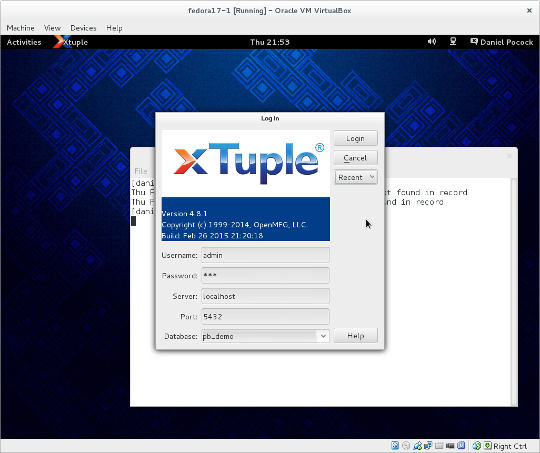
    Community support The xTuple forum is a great place to ask any questions and get to know the community. Screenshot Here is a quick look at the login screen on a Fedora 19 host:

    Next.

    Previous.