Search Results: "don"

6 July 2014

Matthew Palmer: Witness the security of this fully DNSSEC-enabled zone!

After dealing with the client side of the DNSSEC puzzle last week, I thought it behooved me to also go about getting DNSSEC going on the domains I run DNS for. Like the resolver configuration, the server side work is straightforward enough once you know how, but boy howdy are there some landmines to be aware of. One thing that made my job a little less ordinary is that I use and love tinydns. It s an amazingly small and simple authoritative DNS server, strong in the Unix tradition of do one thing and do it well . Unfortunately, DNSSEC is anything but small and simple and so tinydns doesn t support DNSSEC out of the box. However, Peter Conrad has produced a patch for tinydns to do DNSSEC, and that does the trick very nicely. A brief aside about tinydns and DNSSEC, if I may Poor key security is probably the single biggest compromise vector for crypto. So you want to keep your keys secure. A great way to keep keys secure is to not put them on machines that run public-facing network services (like DNS servers). So, you want to keep your keys away from your public DNS servers. A really great way of doing that would be to have all of your DNS records somewhere out of the way, and when they change regenerate the zone file, re-sign it, and push it out to all your DNS servers. That happens to be exactly how tinydns works. I happen to think that tinydns fits very nicely into a DNSSEC-enabled world. Anyway, back to the story. Once I d patched the tinydns source and built updated packages, it was time to start DNSSEC-enabling zones. This breaks down into a few simple steps:
  1. Generate a key for each zone. This will produce a private key (which, as the name suggests, you should keep to yourself), a public key in a DNSKEY DNS record, and a DS DNS record. More on those in a minute. One thing to be wary of, if you re like me and don t want or need separate Key Signing and Zone Signing keys. You must generate a Key Signing key this is a key with a flags value of 257. Doing this wrong will result in all sorts of odd-ball problems. I wanted to just sign zones, so I generated a Zone Signing key, which has a flags value of 256. Big mistake. Also, the DS record is a hash of everything in the DNSKEY record, so don t just think you can change the 256 to a 257 and everything will still work. It won t.
  2. Add the key records to the zone data. For tinydns, this is just a matter of copying the zone records from the generated key into the zone file itself, and adding an extra pseudo record (it s all covered in the tinydnssec howto).
  3. Publish the zone data. Reload your BIND config, run tinydns-sign and tinydns-data then rsync, or do whatever it is PowerDNS people do (kick the database until replication starts working again?).
  4. Test everything. I found the Verisign Labs DNSSEC Debugger to be very helpful. You want ticks everywhere except for where it s looking for DS records for your zone in the higher-level zone. If there are any other freak-outs, you ll want to fix those because broken DNSSEC will take your domain off the Internet in no time.
  5. Tell the world about your DNSSEC keys. This is simply a matter of giving your DS record to your domain registrar, for them to add it to the zone data for your domain s parent. Wherever you d normally go to edit the nameservers or contact details for your domain, you probably want to do to the same place and look for something about DS or Domain Signer records. Copy and paste the details from the DS record in your zone into there, submit, and wait a minute or two for the records to get published.
  6. Test again. Before you pat yourself on the back, make sure you ve got a full board of green ticks in the DNSSEC Debugger. if anything s wrong, you want to rollback immediately, because broken DNSSEC means that anyone using a DNSSEC-enabled resolver just lost the ability to see your domain.
That s it! There s a lot of complicated crypto going on behind the scenes, and DNSSEC seems to revel in the number of acronyms and concepts that it introduces, but the actual execution of DNSSEC-enabling your domains is quite straightforward.

5 July 2014

Mario Lang: I love my MacBookAir with Debian

In short: I love my MacBook Air. It is the best (laptop) hardware I ever owned. I have seen hardware which was much more flaky in the past. I can set the display backlight to zero via software, which saves me a lot of battery life and also offers a bit of anti-spy-acroos-my-shoulder support. WLAN and bluetooth work nicely. And I just love the form-factor and the touch-feeling of the hardware. I even had the bag I use to carry my braille display modified so that the Air just fits in. I can't say how it behaves with X11. Given how flaky accessibility with graphical desktops on Linux is, I have still not made the switch. My MacBookAir is my perfect mobile terminal, I LOVE it. I am sort of surprised about the recent rant of Paul about MacBook Hardware. It is rather funny that we perceive the same technology so radically different. And after reading the second part of his rant I am wondering if I am no longer allowed to consider myself part of the "hardcore F/OSS world", because I don't consider Apple as evil as apparently most others. Why? Well, first of all, I actually like the hardware. Secondly, you have to show me a vendor first that builds usable accessibility into their products, and I mean all their products, without any extra price-tag attached. Once the others start to consider people with disabilities, we can talk about apple-bashing again. But until then, sorry, you don't see the picture as I do. Apple was the first big company on the market to take accessibility seriously. And they are still unbeaten, at least when it comes to bells and whistles included. I can unbox and configure any Apple product sold currently completely without assisstance. With some products, you just need to know a signle keypress (tripple-press the home button for touch devices and Cmd+F5 for Mac OS/X), and with others, during initial bootup, a speech synthesizer even tells you how to enable accessibility in case you need it. And after that is enabled, I can perform the setup of the device completely on my own. I don't need help from anyone else. And after the setup is complete, I can use 95% of the functionality provided by the operating system. And I am blind, part of a very small margin group so to speak. In Debian circles, I have even heard the sentiment that we supposedly have to accept that small margin groups are ignored sometimes. Well, as long as we think that way, as long as we strictly think economically, we will never be able to go there, fully. And we will never be the universal operating system, actually. Sorry to say that, but I think there is some truth to it. So, who is evil? Scratch your own itch doesn't always work to cover everything. How do we motivate contributors to work on things they don't personally need (yet)? How can we ensure that complicated but seldomly used features stay stable and do not fall to dust just because some upstream decides to rewrite an essential subcomponent of the dependency tree? I don't know. All I know is that these issues need to be solved in an universal operating system.

4 July 2014

Paul Tagliamonte: Apple Hardware: Part II

A few interesting things happened after I got a macbook air.

Firstly, I got a lot of shit from my peers and friends about it. This was funny to me, nothing really bothered me about it, but I can see this becoming really tiresome at events like hackathons or conferences.

As a byproduct, there s a strong feeling in the hardcore F/OSS world that Apple hardware is the incarnation of evil.

As a result of both of the above, hardcore F/OSS (and Distro hackers) don t buy apple hardware.

Therefore, GNU/Linux is complete garbage on Apple hardware. Apple s firmware bugs don t help, but we re BAD.

Some might ask why this is a big deal. The fact is, this is one of the most used platforms for Open Source development (note I used that term exactly).

Are we to damn these users to a nonfree OS because we want to maintain our purity?

I had to give back my Air, but I still have a Mac Mini that i ve been using for testing bugs on OSX in code I have. Very soon, my Mac Mini will be used to help fix the common bugs in the install process.

Some things you can do:

Raphaël Hertzog: My Free Software Activity in June 2014

This is my monthly summary of my free software related activities. If you re among the people who made a donation to support my work (168.17 , thanks everybody!), then you can learn how I spent your money. Otherwise it s just an interesting status update on my various projects. Debian LTS After having put in place the infrastructure to allow companies to contribute financially to Debian LTS, I spent quite some time to draft the announce of the launch of Debian LTS (on a suggestion of Moritz M hlenhoff who pointed out to me that there was no such announce yet). I m pretty happy about the result because we managed to mention a commercial offer without generating any pushback from the community. The offer is (in my necessarily biased opinion) clearly in the interest of Debian but still the money doesn t go to Debian so we took extra precautions. When I got in touch with the press officers, I included the Debian leader in the discussion and his feedback has been very helpful to improve the announce. He also officially acked the press release to give some confidence to the press officers that they were doing the right thing. Lucas also pushed me to seek public review of the draft press release, which I did. The discussion was constructive and the draft got further improved. The news got widely relayed, but on the flip side, the part with the call for help got almost no attention from the press. Even Linux Weekly News skipped it! On the Freexian side, we just crossed 10% of a full-time position (funded by 6 companies) and we are in contact with a few other companies in discussion. But we re far from our goal yet so we will have to actively reach out to more companies. Do you know companies who are still running Debian 6 servers ? If yes, please send me the details (name + url + contact info if possible) to deblts@freexian.com so that I can get in touch and invite them to contribute to the project. Distro Tracker In the continuation of the Debian France game, I continued to work together with Joseph Herlant and Christophe Siraut on multiple improvements to distro tracker in order to prepare for its deployment on tracker.debian.org (which I just announced \o/). Debian France Since the Debian France game was over, I shipped the rewards. 5 books have been shipped to: Misc Debian work I orphaned sql-ledger and made a last upload to change the maintainer to Debian QA (with a new upstream version). After having been annoyed a few times by dch breaking my name in the changelog, I filed #750855 which got quickly fixed. I disabled a broken patch in quilt to fix RC bug #751109. I filed #751771 when I discovered an incorrect dependency on ruby-uglifier (while doing packaging work for Kali Linux). I tested newer versions of ruby-libv8 on armel/armhf on request of the upstream author. I had reported him those build failures (github ticket here). Thanks See you next month for a new summary of my activities.

One comment Liked this article? Click here. My blog is Flattr-enabled.

3 July 2014

Hideki Yamane: Open Source Conference 2014 Hokkaido

Oh, time flies... (= I'm lazy)

14th June, I've participated to OSC (Open Source Conference) 2014 Hokkaido in Sapporo, Hokkaido (sorry openSUSE folks, OSC does not mean openSUSE Conference ;) OSC has 10 years history in Japan, so don't blame me...)

Hokkaido is northan island of Japan (it has 4 major islands - Hokkaido, Honshu, Shikoku and Kyushu), takes 1.5 hours from Tokyo (HND-CTS) and debian-mirror.sakura.ne.jp is also there.

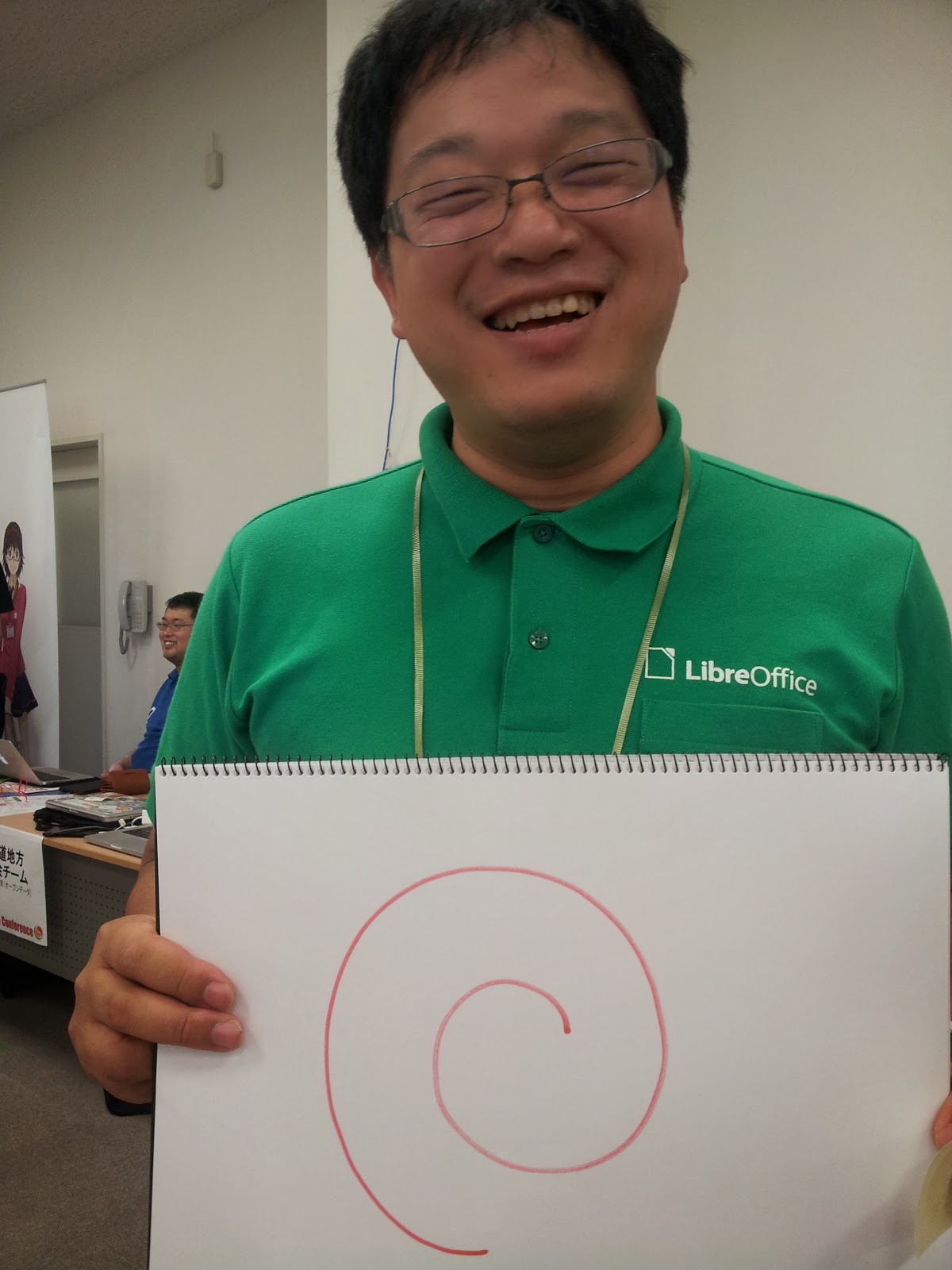
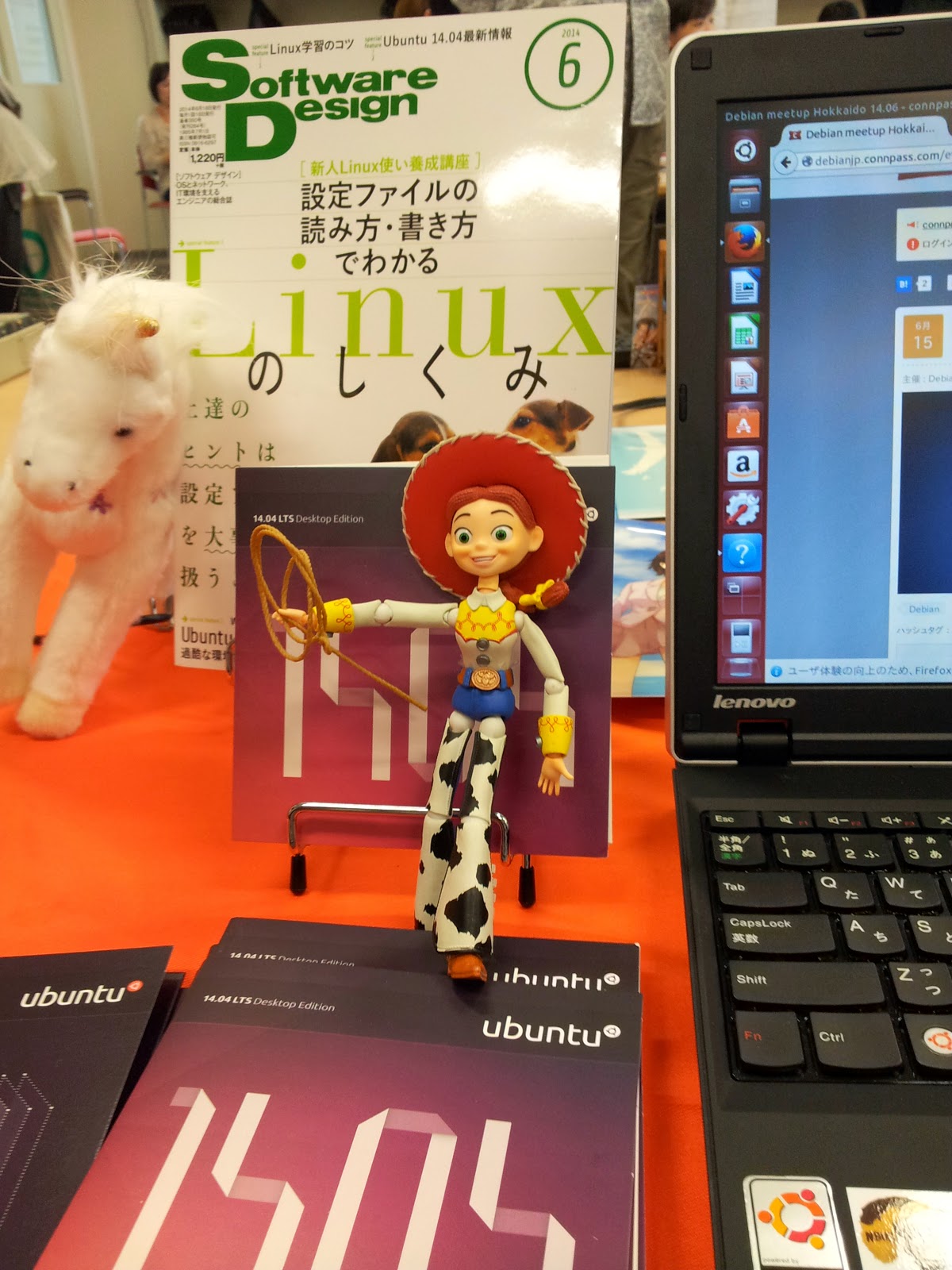
As always, we show the Debian booth with Debian lovers, Squeeze, Woody and Jessie.


And I gave talk about Debian a little,
mostly how it is developed and distribute, and shapes in Jessie at that time (PDF/odf is my page on Debian Wiki as usual).

Does Cowgirl Dream of Red Swirl? from Hideki Yamane


After that, Enjoyed food, beer (sure! :) and chatting in party.


Folks, see you in #osc15do again!

Wouter Verhelst: Docking and Undocking with LVM

I have a number of USB hard disks. Like, I suppose, mostly everyone who reads this blog. Unlike many people who do, however, for whatever reason I decided to create LVM volumes on most of my USB hard disks. The unfortunate result is that these now contain a lot of data with a somewhat less than efficient partitioning system. I don't really care much, but it's somewhat annoying, not in the least because disconnecting an LVM device isn't as easy as it used to be; originally you could just run the lvm2 init script with the stop argument, but that isn't the case anymore today. That is, you can run that, but it won't help you because all that does, effectively, is exit 0. So what do you do instead? This: Voila, your LVM volume group is no longer available, and you've not suffered data loss. Kewl. Note: I don't know what the lvm2 init script used to do. I suspect there's another way which doesn't require the --refresh step. I don't think it matters all that much, though. This works, and is safe. That being said, comments are welcome...

DebConf team: Second set of talks accepted; 3 days left to submit yours (Posted by Ana Guerrero Lopez)

There are only left 3 days to submit your talk. Submit yours before it s too late. From the submissions from the last week, we have accepted a second batch of talks: If your talk is not on the list, it doesn t mean that it is not accepted. The talks team will go through the list of talks again, and will publish the final list of talks towards the end of the month. We ll keep the submission of talks open after the deadline. Talks submitted after the deadline still have the possibility of being scheduled as ad-hoc talks. We ll publish more information about this closer to the conference.

Ian Donnelly: Hello Planet Debian!

Hi Planet Debian! My name is Ian Donnelly. I am going into my Senior Year at Florida State University this fall but for the summer I am working on a Google Summer of Code project with Debian. My mentor is Markus Raab and I am working with the Elektra team to implement a great new feature for Debian! I am spending this summer working on a system to allow automatic conffile merging by utilizing the Elektra Framework. Elektra is designed to provide a universal and secure framework to store configuration parameters in a global, hierarchical key database. For this project, conffiles will be mounted to the Elektra framework as KeySets. I have written code that performs a three-way merge on these KeySets which is much more robust than merging individual lines. A conffile can easily be mounted to the Key database using the kdb mount command, which I detailed in a previous blog post. Elektra has many included plugins which allow all types of conffiles to be mounted to the Key database. With our newest release, we even added an augeas plugin which will provide compatibility for most of the major conffiles. Once a conffile is mounted, any changes to the Elektra KeySet it is contained in will be updated in the actual conffile and visa-versa. So far this summer, I have written code for a three-way merge of Elektra KeySets and we have begun to look at the next step of implementing a automatic merge into dpkg. We are currently working on identifying exactly how the merge should take place and where we need to modify dpkg. The basic idea of what will change is that: Once dpkg has been patched, we will modify some packages and thoroughly test the new merge operation. It is designed to be non-destructive and to not infringe with any of the advantages of the current system. Package maintainers would need to opt in to using this feature to insure that all packages get tested before using it. However, we have designed this system to require minimal modification in order for maintainers to utilize it. This project will benefit Debian by removing a large pain-point with users. For experienced uses, merging changes in conffiles can be a tedious process. For newer users, the current system can be downright confusing. The goal of our project is to make Debian easier to use for everybody while not loosing the features that make it such a powerful platform. Please let us know what you think of the project or if you have any questions. Sincerely,
Ian S. Donnelly

Ian Donnelly: How-To: kdb mount

I would like to go over the kdb mount command. The mount command is used to mount configuration files to the Elektra Key Database. Once a file is mounted, any changes to the file will be reflected in the Elektra Keys and any changes to the keys will be reflected in the configuration file. So how do we use the mount command? kdb mount [filepath] [mountpoint] [plugin] For instance, to mount /etc/hosts to system/hosts (using the hosts plugin):
kdb mount /etc/hosts system/hosts hosts
At this point the hosts file has been mounted. On my system the following key now exist under system/hosts

system/hosts/ian-debian

Which makes sense as the only line in my hosts file is:

127.0.0.1 ian-debian

Now I can edit this configuration file through the Elektra API, the kdb tool, or by editing the file (like always). So if I make a change using kdb such as:

kdb set system/hosts/ian-debian 192.168.0.2

My hosts file will be updated accordingly:

192.168.0.2 ian-debian
So that s how kdb mount works! Update: For the sake of clarity, I just want to add a quick example of how to unmount a configuration file from Elektra. The command is:

kdb umount [backend]

For our above example:

kdb umount system_hosts

Russ Allbery: rra-c-util 5.5

The most significant change in this release is a somewhat embarassing bug fix: the network_read and network_write functions introduced in version 4.2 to support timeouts didn't correctly handle a timeout interrupted by a signal. This is now fixed by restarting the calls on EINTR. Also in this release is a general cleanup for integer overflows during memory allocation. rra-c-util now provides a replacement for reallocarray for systems that don't have it, and calloc and reallocarray are used internally where a size is calculated with multiplication. The util library also now provides a checked xreallocarray function. There are also a few minor fixes: portable/system.h guarantees the inclusion of inttypes.h and limits.h, portable/pam.h will now build with a C++ compiler, the Kerberos Autoconf probes provide a Makefile variable that can be used to suppress warnings from Kerberos headers by forcing them to be system headers, and the util/messages-krb5 test will be skipped when not built with Kerberos support. You can get the latest version from the rra-c-util distribution page.

2 July 2014

Russ Allbery: C TAP Harness 3.1

Most of the changes in this release are based on work by Peter P schl to make the behavior of the C TAP library more consistent with the Perl Test::More functions. ok, okv, and all the is_* functions now return true if the test succeeds and false if it fails, allowing them to be used in conditionals. diag and sysdiag now always return 1, making it easier to insert (possibly temporary) calls into compound statements while debugging test cases. The C TAP library now provides a new breallocarray API that does the same thing as brealloc but takes calloc-style arguments and checks internally for integer overflow. Tests for integer overflow during memory allocation have also been added to several other parts of C TAP Harness, including the runtests harness and other internals of the C TAP library. These probably don't matter a tremendous amount for test code, but best to be safe and consistent everywhere possible. All uses of sprintf have now been replaced with a simpler internal string concatenation function that checks for allocation overflow. The previous usage was probably safe, but this approach is much easier to audit. You can get the latest release from the C TAP Harness distribution page.

Russ Allbery: Review: Lockstep

Review: Lockstep, by Karl Schroeder
Publisher: Tor
Copyright: March 2014
ISBN: 0-7653-3726-6
Format: Hardcover
Pages: 351
Toby McGonigal's family fled an Earth dominated by trillionaires and vicious class conflict, and attempt, instead, a very risky and precarious settlement on a trans-Neptunian object. It's the last unclaimed but marginally habitable space left in the solar system, and securing their claim requires constant bureaucratic hoop-jumping. That's what sent Toby on a solo mission to a distant moon of their home to claim it and solidify their title. But, while in cold sleep, his craft hits a small chunk of rock, and he wakes up near another world: cold, silent, dead... but apparently with lifeless cities. Another trip through suspended animation in a desperate attempt to conserve resources against the distant hope of rescue has him awakening in a society both utterly foreign and yet strangely familiar. Schroeder is one of the better big idea writers in science fiction, but I found Lockstep to be a mixed bag. He does a surprisingly good job with the core conceit of the novel (more on that in a moment), even though it's a tricky one to make believable. Surrounding that, though, are a lot of less convincing bits that I kept having to not think about too hard, such as Toby crossing the path of another trans-Neptunian object after the accident (space is really, really big and really, really empty), or the implications of later revelations about the time scales involved in parts of the plot. Some parts of the world building, even if scientifically plausible, struck me as sloppy; for example, a religion plays a prominent role in the plot, but the nature of that religion was not particularly believable, nor was its interaction with the plot climax. I won't go into details about the religion, since it's a major plot point, but the short version is that religions tend to mature from the concrete to the abstract, not the other way around. That said, the core conceit is both surprising and considerably better-defended in the book than I thought it could be. The world into which Toby awakes is the world of the locksteps: a society that uses suspended animation in a universal and coordinated way to build a functional society on the far outskirts of the solar system. Humans emerge for some short period of time, like a month, and build, trade, interact, and consume. They welcome ships traveling from other trans-Neptunian worlds and prepare for their own journeys. And then they go into suspended animation for an extended period 15 years and 30 years are common choices while robots slowly gather more resources and energy, and repair and replace what's consumed in the month of active life. Ships travel with passengers in suspended animation, allowing the vast distances between these cold worlds to be reached during the sleep period. And, since all members of the lockstep sleep and wake on the same schedule, there is no wrenching desynchronization with the surrounding society during travel. One may spend thirty years in transit, but no time passes for anyone else in the lockstep while you're traveling either. A world can effectively trade with all other worlds within a thirty year travel radius without noticing the elapsed time. This is a technological system that at first doesn't sound like it would work, but Schroeder does a great job defending it and chasing down implications. The lockstep civilization serves as a sort of anchor and time capsule separate from the more frantic pace of the so-called fast worlds. The trans-Neptunian lockstep worlds are remote enough and poor enough to not attract too much unwanted attention, and are thus tolerated by fast societies that may have more available resources. (Although, to be sure, automated robot defenses have to carry a lot of weight here given how helpless the locksteps are during a sleep cycle.) I'm not sure I completely bought the sociology, but it works well enough to carry the weight of the story, and I've never seen a science fiction construction that uses the common technology of suspended animation in quite this way before. Schroeder sets up some nice stabilizing tensions between resources and time, adds some believable political reasons for this fragile society to survive, and uses some of its obvious political vulnerabilities as story drivers. The plot, unfortunately, isn't as good as the big idea, and particularly suffers at the start of the book. Toby is a teenager without much experience (Lockstep is marketed as young adult), and is immediately thrown into a strange and quickly hostile environment. This means that he spends the first half of the book reacting to a blizzard of new information, and the plot tends to revert to a tour of Schroeder's constructed world. Toby is also a bit of a cipher and a bit of an everyman, without many feelings or opinions beyond the obvious feelings that any teenage boy would go through in this situation. That makes the sense of a world tour even stronger. This flaw does not persist through the whole book. Toby does eventually start making decisions and doing things, some of the supporting characters add additional depth, and I found the unwinding of the plot surprisingly satisfying. The nature of time in this world lets Schroeder have both epic sweep and personal connection at the same time, which lets him pull off some neat contrasts between the personal and the political. I also liked Toby's gradual piecing together of what actually happened while he was asleep, both in the construction of society as a whole and in the personal conflicts between people he knew well. Some of the ease of grand manipulation seemed dubious to me, but, in Schroeder's defense, people do develop a reverence for and stories about things that have lasted a very long time, and Schroeder's setup gives him quite a lot to work with in that department. So, a mixed bag. The core concept is thought-provoking and up to Schroeder's usual standards. The surrounding world-building isn't as much, and I think Schroeder reaches for some too-easy explanations and still underplays just how many disruptive things can happen over the span of time that this book covers. The characterization I found weak and unsatisfying for much of the book, but it gets moderately better in the end. There's a bit too much tour, and a bit too much world exploration instead of plot, but it's a fascinating world and I still enjoyed the tour. With stronger characters and a few fewer dubious supporting pillars in the world background, I think this would have been an excellent book. As is, it's an enjoyable novel set firmly in the big idea and deep future end of science fiction, and I'm always happy to see more stories like that. It's not the best that Schroeder has done, but I still recommend it. Rating: 7 out of 10

1 July 2014

Martin Pitt: deb, click, schroot, LXC, QEMU, phone, cloud: One autopkgtest to Rule Them All!

We currently use completely different methods and tools of building test beds and running tests for Debian vs. Click packages, for normal uploads vs. CI airline landings vs. upstream project merge proposal testing, and keep lots of knowledge about Click package test metadata external and not easily accessible/discoverable. Today I released autopkgtest 3.0 (and 3.0.1 with a few minor updates) which is a major milestone in unifying how we run package tests both locally and in production CI. The goals of this are: So, let s dive into the new features! New runner: adt-virt-ssh We want to run tests on real hardware such as a laptop of a particular brand with a particular graphics card, or an Ubuntu phone. We also want to restructure our current CI machinery to run tests on a real OpenStack cloud and gradually get rid of our hand-maintained QA lab with its test machines. While these use cases seem rather different, they both have in common that there is an already existing machine which is pretty much only accessible with ssh. Once you have an ssh connection, they look pretty much the same, you just need different initial setup (like fiddling with adb, calling nova boot, etc.) to prepare them. So the new adt-virt-ssh runner factorizes all the common bits such as communicating with adt-run, auto-detecting sudo availability, doing SSH connection sharing etc., and delegates the target specific bits to a setup script . E. g. we could specify --setup-script ssh-setup-nova or --setup-script ssh-setup-adb which would then get called with open at the appropriate time by adt-run; it calls the nova commands to create a VM, or run a few adb commands to install/start ssh and install the public key. Then autopkgtest does its thing, and eventually calls the script with cleanup again. The actual protocol is a bit more involved (see manpage), but that s the general idea. autopkgtest now ships readymade scripts for these two use cases. So you could e. g. run the libpng tests in a temporary cloud VM:
# if you don't have one, create it with "nova keypair-create"
$ nova keypair-list
[...]
  pitti   9f:31:cf:78:50:4f:42:04:7a:87:d7:2a:75:5e:46:56  
# find a suitable image
$ nova image-list 
[...]
  ca2e362c-62c9-4c0d-82a6-5d6a37fcb251   Ubuntu Server 14.04 LTS (amd64 20140607.1) - Partner Image                           ACTIVE    
$ nova flavor-list 
[...]
  100   standard.xsmall    1024        10     10                 1       1.0           N/A        
# now run the tests: please be patient, this takes a few mins!
$ adt-run libpng --setup-commands="apt-get update" --- ssh -s /usr/share/autopkgtest/ssh-setup/nova -- \
   -f standard.xsmall -i ca2e362c-62c9-4c0d-82a6-5d6a37fcb251 -k pitti
[...]
adt-run [16:23:16]: test build:  - - - - - - - - - - results - - - - - - - - - -
build                PASS
adt-run: @@@@@@@@@@@@@@@@@@@@@@@@@@@@@@@@@@@@@@@@ tests done.
Please see man adt-virt-ssh for details how to use it and how to write setup scripts. There is also a commented /usr/share/autopkgtest/ssh-setup/SKELETON template for writing your own for your use cases. You can also not use any setup script and just specify user and host name as options, but please remember that the ssh runner cannot clean up after itself, so never use this on important machines which you can t reset/reinstall! Test dependency installation without apt/root Ubuntu phones with system images have a read-only file system where you can t install test dependencies with apt. A similar case is using the null runner without root. When apt-get install is not available, autopkgtest now has a reduced fallback mode: it downloads the required test dependencies, unpacks them into a temporary directory, and runs the tests with $PATH, $PYTHONPATH, $GI_TYPELIB_PATH, etc. pointing to the unpacked temp dir. Of course this only works for packages which are relocatable in that way, i. e. libraries, Python modules, or command line tools; it will totally fail for things which look for config files, plugins etc. in hardcoded directory paths. But it s good enough for the purposes of Click package testing such as installing autopilot, libautopilot-qt etc. Click package support autopkgtest now recognizes click source directories and *.click package arguments, and introduces a new test metadata specification syntax in a click package manifest. This is similar in spirit and capabilities to DEP-8 debian/tests/control, except that it s using JSON:
    "x-test":  
        "unit": "tests/unittests",
        "smoke":  
            "path": "tests/smoketest",
            "depends": ["shunit2", "moreutils"],
            "restrictions": ["allow-stderr"]
         ,
        "another":  
            "command": "echo hello > /tmp/world.txt"
         
     
For convenience, there is also some magic to make running autopilot tests particularly simple. E. g. our existing click packages usually specify something like
    "x-test":  
        "autopilot": "ubuntu_calculator_app"
     
which is enough to do what I mean , i. e. implicitly add the autopilot test depends and run autopilot with the specified test module name. You can specify your own dependencies and/or commands, and restrictions etc., of course. So with this, and the previous support for non-apt test dependencies and the ssh runner, we can put all this together to run the tests for e. g. the Ubuntu calculator app on the phone:
$ bzr branch lp:ubuntu-calculator-app
# built straight from that branch; TODO: where is the official" download URL?
$ wget http://people.canonical.com/~pitti/tmp/com.ubuntu.calculator_1.3.283_all.click
$ adt-run ubuntu-calculator-app/ com.ubuntu.calculator_1.3.283_all.click --- \
      ssh -s /usr/share/autopkgtest/ssh-setup/adb
[..]
Traceback (most recent call last):
  File "/tmp/adt-run.KfY5bG/tree/tests/autopilot/ubuntu_calculator_app/tests/test_simple_page.py", line 93, in test_divide_with_infinity_length_result_number
    self._assert_result("0.33333333")
  File "/tmp/adt-run.KfY5bG/tree/tests/autopilot/ubuntu_calculator_app/tests/test_simple_page.py", line 63, in _assert_result
    self.main_view.get_result, Eventually(Equals(expected_result)))
  File "/usr/lib/python3/dist-packages/testtools/testcase.py", line 406, in assertThat
    raise mismatch_error
testtools.matchers._impl.MismatchError: After 10.0 seconds test failed: '0.33333333' != '0.3'
Ran 33 tests in 295.586s
FAILED (failures=1)
Note that the current adb ssh setup script deals with some things like applying the autopilot click AppArmor hooks and disabling screen dimming, but it does not do the first-time setup (connecting to network, doing the gesture intro) and unlocking the screen. These are still on the TODO list, but I need to find out how to do these properly. Help appreciated! Click app tests in schroot/containers But, that s not the only thing you can do! autopkgtest has all these other runners, so why not try and run them in a schroot or container? To emulate the environment of an Ubuntu Touch session I wrote a --setup-commands script:
adt-run --setup-commands /usr/share/autopkgtest/setup-commands/ubuntu-touch-session \
    ubuntu-calculator-app/ com.ubuntu.calculator_1.3.283_all.click --- schroot utopic
This will actually work in the sense of running (and succeeding) the autopilot tests, but it will fail due to a lot of libust[11345/11358]: Error: Error opening shm /lttng-ust-wait... warnings on stderr. I don t know what these mean, just that I also see them on the phone itself occasionally. I also wrote another setup-commands script which emulates read-only apt , so that you can test the unpack only fallback. So you could prepare a container with click and the App framework preinstalled (so that it doesn t always take ages to install them), starting from a standard adt-build-lxc container:
$ sudo lxc-clone -o adt-utopic -n click
$ sudo lxc-start -n click
  # run "sudo apt-get install click ubuntu-sdk-libs ubuntu-app-launch-tools" there
  # then "sudo powerdown"
# current apparmor profile doesn't allow remounting something read-only
$ echo "lxc.aa_profile = unconfined"   sudo tee -a /var/lib/lxc/click/config
Now that container has enough stuff preinstalled to be reasonably fast to set up, and the remaining test dependencies (mostly autopilot) work fine with the unpack/$*_PATH fallback:
$ adt-run --setup-commands /usr/share/autopkgtest/setup-commands/ubuntu-touch-session \
          --setup-commands /usr/share/autopkgtest/setup-commands/ro-apt \
          ubuntu-calculator-app/ com.ubuntu.calculator_1.3.283_all.click \
          --- lxc -es click
This will successfully run all the tests, and provided you have apt-cacher-ng installed, it only takes a few seconds to set up. This might be a nice thing to do on merge proposals, if you don t have an actual phone at hand, or don t want to clutter it up. autopkgtest 3.0.1 will be available in Utopic tomorrow (through autosyncs). If you can t wait to try it out, download it from my people.c.c page . Feedback appreciated!

Russ Allbery: Review: Ancillary Justice

Review: Ancillary Justice, by Ann Leckie
Series: Imperial Radch #1
Publisher: Orbit
Copyright: 2013
ISBN: 0-316-24662-X
Format: Trade paperback
Pages: 416
As Ancillary Justice opens, Breq is on an icy planet trying to track down a person who has gone rather thoroughly to ground. As her search continues, the reader slowly learns the context of that search, which is only the latest step of a long and quixotic exercise in private determination. She was set on her path by events twenty years previous, told in interleaved flashbacks, that have left her greatly diminished and thrust outside of any of the context of her over thousand years of life. Breq was Justice of Toren, a starship and AI that possessed thousands of ancillaries, human bodies slaved to her mind. Now only this one remains, and nothing exists of her former life other than this goal. It's always hard to write a review of a book that I loved this much. I want to find some way to grab the reader and shake them and say "you have to read this!" without giving away any of the delicious details. That's particularly difficult with Ancillary Justice, since one of the delights of this book is the slow unfolding of not only the plot but the background and motivations behind the plot. There is so much beneath the surface of Breq's methodical intent, and discovering all the nuances is utterly delightful. This is also a book that is very deeply concerned with identity, and which does one of the best jobs I've seen in science fiction of showing a non-human first-person protagonist: close enough to human to permit identification and comprehension, but far enough away for delightful sparks of unexpected insight or thought-provoking difference. Breq is a ship, and AIs are central to this story, so the comparison that comes immediately to mind is with Iain M. Banks. Leckie's role for ship AIs is much different than the structure of Banks's Culture, but I think this is still an apt comparison. Like Banks, Leckie is writing large-scale space opera dominated by a meddling empire that follows some familiar human patterns but not others. Banks's Culture takes a less direct approach with its meddling; the Radch has a more Roman attitude towards preventative conquest and citizenship. But both deal with large-scale issues of politics, culture, and conquest. Both also write excellent AIs, but I think Leckie is more successful than Banks at giving her AIs inhuman properties and creating a sense of eerie alienness that sometimes fades almost entirely and sometimes comes sharply to the surface. The first-person perspective helps considerably there. But where Ancillary Justice truly shined for me is in the interpersonal relationships, and in the insight they provided into character and motive. At the start of the book, Breq finds a drug addict dying in the cold and rescues her, bringing her along on her search for lack of a better option. Breq's relationship with Seivarden is complex, difficult for both of them, badly asymmetric at the start, and develops into something brilliant. At the start of the book, Seivarden is easy to dislike, and Breq's tone is refreshingly bracing and forthright. But through the course of the book Seivarden grows into something much more, in a way that I found both believable and incredibly compelling. And Leckie does this without falling into any of the typical relationship patterns, without introducing artificial romance (or, indeed, any romance at all, which is an excellent choice here), and without compromising the personalities of either character. It's masterfully done. One of the most amazing things about this book to me is that it's a first novel. I never would have guessed that from reading it. It's beautifully paced, the characterization is deep and compelling, and Leckie avoids any sign of the typical first-novel problem of stuffing the book with too much Stuff. Ancillary Justice is a capable and confident novel that builds a compelling world and even more compelling characters. I liked it more than I like most of the Culture novels, which is saying quite a lot, but Leckie offers much of the same scope with deeper and more personal characterization and a tighter plot. I haven't yet remarked on one aspect of this book that every other review seems to remark on: its treatment of gender. The Radch do not recognize or care about gender distinctions, and therefore Breq struggles throughout the book with proper gender labeling in much the same way that a native English speaker tends to struggle with grammatical gender when learning a Romance language, except with more social consequences. Leckie has chosen to represent this in the novel by having Breq refer to everyone uniformly as "she." This has its pluses and minuses: it still supports a binary gender concept where a gender-neutral pronoun might not, but given all the negative reaction this book got just for using "she," a gender-neutral pronoun might be a bridge too far for a lot of readers. I thought it created a nice bit of alienation, a way of forcing the reader to look at gender markers from the outside and a way to point out how arbitrary many of them are. It was also interesting to see how surprised I was at various points in the book when it became obvious that some person Breq had been calling "she" in the first-person narration turned out, from story context, to probably be male. That said, I think this part of the book is overblown in reviews. It's often the first thing people mention, but while it was a nice side bit of world-building, I don't think it's that central to the story. I'm particularly baffled by the handful of people who complained about it, since it's not intrusive and it quickly fades into the background apart from occasional necessary shifts of mental image. (It does create the impression of a world containing only women, but I found that a nice change from the more common impression in space opera of a world containing only men.) Ancillary Justice has already won the Nebula and Arthur C. Clarke awards and tied for the BSFA award for best novel, and I'm happy to report that it deserves all of those. I haven't yet read all of the other Hugo nominees, but it's hard to imagine a world in which it won't top my ballot. This is a fantastic novel, by far the best thing I've read so far this year. I'm delighted that it's the first book of a trilogy, since I'm not done with either the world or the characters yet, but it stands well on its own and reaches a satisfying conclusion. I recommend it to everyone, but particularly to anyone who likes Banks, intelligent ships, or who is looking for thoughtful and complex space opera. Followed by Ancillary Sword. Rating: 10 out of 10

Russell Coker: Blog Comments

John Scalzi wrote an insightful post about the utility of blog comments with the way the Internet works nowadays [1]. He starts out focusing on hate comments that could reasonably be described as terrorism (death threats with the aim of preventing people writing about politics meet any reasonable definition of terrorism ). Terrorists on the Internet are a significant problem but it s one that doesn t get much attention as it generally only affects people who aren t straight-acting white men. Blogging About Technology One corner case that John doesn t seem to consider is that of writing about technology. Issues related to programming often aren t related to politics and are often testable so comments will be based on things that have been shown to work rather than stuff people invent or want to believe. I ve received many useful and educational comments on my technical posts with little hostility. Even getting a snarky comment is rare when writing a strictly technical blog post. The comments problem for technology blogging is spam. I ve been using the WordPress plugin Block Spam by Math [2] (which is obsolete but still works) for years. Initially it stopped almost all spam, but now I m getting at least 20 spam comments a day. Extremely Popular Blogs The comments section of a blog is sometimes described as a conversation . When a blog post gets comments from less than 10 people it is possible for them to have something that resembles a conversation with the author that is of benefit to other readers and doesn t take excessive amounts of time for the author. When a blog is very popular and every post gets comments from 50+ people it s not really possible. So a traditional blog comment section seems to work best when the blog is primarily read by a small well connected group of people who sometimes comment and some casual readers who never comment (but sometimes find value in the comments of others). Discussions of blog comment systems usually include a reference to a post written by someone who disabled comments on their blog and found it to be a good thing, it always seems that the person who writes such a post has a large and varied audience who s comments would take a lot of time to moderate. John followed the usual form in this regard by linking to a reasonably popular SF author who would presumably have a lot of fans with good net access. I m not going to criticise anyone for disabling comments when their blog becomes really popular, but any advice that they have to offer about such things won t apply to the vast majority of blogs. Due to the long-tail effect the small blogs would probably comprise the majority of all comments so in terms of the way the blog environment works I don t think it makes much difference when the small minority of very popular blogs disable comments. The vast majority of blogs that I regularly read only have a small number of comments. One thing that should be noted is that getting a lot of readers shouldn t be the only factor for writing a successful blog. For example some of my blog posts about SE Linux are aimed at a small audience of Linux programmers and have an even smaller number of people who are qualified to comment. When I write a post that can only receive comments other than please explain more because I don t understand from a few dozen people that doesn t make it any less important. Sometimes the few dozen people who know a topic well need to work together to educate the few thousand who can implement the ideas for the benefit of millions of users of the software. Disabling Comments on Contentious Posts One interesting method John uses is to disable comments early when posting about contentious issues. It s a general practice when running a blog to disable comments on posts after a certain period of time (3 months to 1 year seem to be common time limits for comments). This means that the moderators can concentrate on recent posts and not be bothered with spam bots hitting ancient posts as the interest in writing legitimate comments on an old post is vanishingly small. John has a practice of disabling comments after a couple of days when the comments start to lose quality. No matter how contentious the issue is I m not likely to get the 400+ comments that John gets. But the idea of closing comments quickly still has some merit for my blog and other blogs with less traffic. Not Accepting Comments While Asleep John has a practice of closing comments while he s asleep to avoid allowing a troll to get 8 hours of viewing for a nasty comment. The most immediate down-side to that is that it inconveniences people who don t want to wait 8 hours to comment and prioritises comments from people in the same time zone, this makes me think of Cory Doctorow s novel Eastern Standard Tribe (which is available for free download and I highly recommend reading it) [3]. It seems that a better solution to that problem would be to have a team of moderators to watch things 24*7 which is what a lot of popular blogs that allow comments do. The WordPress capabilities model doesn t support granting a user no special privileges other than moderating comments [4], as WordPress is the most popular self-hosted blog software this limits the possibilities for people moderating comments on other people s blogs. No variation of this would work for me. I have lots of things that require my ongoing attention and don t want to add my blog to the list. If I have other things to work on for a few days I want to just not bother with my blog. This means that my blog needs to be able to run on autopilot for days at a time however I do monitor my blog closely after publishing a post that is likely to attract nasty comments. One extra problem that I have is that the Android client for WordPress has problems in synchronising comments. Using a Forum for Comments Popular Planet installations such as Planet Debian and Planet Linux Australia syndicate more than a few blogs that have comments disabled. A forum installation for such a Planet would be useful to allow people to comment on all posts and also support bloggers who are thinking of disabling comments. While the use of a forum for blog comments has been proven to work well for Boing Boing forums have their own issues of spam and anti-social behavior. Debian already has a forum [5], if a section of that was devoted to discussing blog posts from Planet Debian then it shouldn t make much of an increase to the work of the forum administrators while providing a benefit to the community. Also if the Debian forum had such a section it would probably attract use from more Debian Developers, I would use that forum if it was a place to comment on blogs that don t have a comment section and I might also comment on other forum discussions. It would be good if there was a forum for discussing Linux in Australia. I m not volunteering to run it but I would help out if someone else wants to be the main sysadmin and I can offer free hosting.

30 June 2014

Lior Kaplan: Removal of (some) PHP related software from Debian

The Debian FTP masters have for quite a while a line in their reject FAQ about the PHP license. Despite that, quite a lot of PHP extensions were uploaded to the archive and accepted. Some are being managed/developed in PHP.net s PECL website, and are done under the umbrella of the PHP Group, which is the group the PHP license is refers to. Over time, we started to see many more extension being developed outside of the PHP group (both technically with sites like github and copyright wise). This is true to certain degree with the PHP.net s PEAR website which has software written in PHP. The issue has been raised again in October 2013 with php-gearman using the PHP license while having different copyright holders (bug #728196). After discussions (ftp masters, release team & Ond ej), it was agreed that the current interpretation is still relevant, and almost all extensions and applications should be either removed or re-licensed by its upstream. This makes the todo list 41 packages long (full list based on Ond ej Sur s bug reports). Any help with contacting upstream projects, explaining the situation and requesting a license change would be welcomed. We also need to monitor new release based on fulfilling these requests. Until such a change happen, with automatic removal of packages from testing, we re going to see packages disappear after mid July. This has a little wider affect due to package dependencies, but for the moment only on testing (Jessie).
Filed under: Debian GNU/Linux, PHP

Russell Coker: Links June 2014

Russ Albery wrote an insightful blog post about trust, computer security, and training programmers [1]. He makes a good case that social problems in our community decrease the availability of skilled people to write and audit security code. The Lawfare blog has an insightful article by Dan Geer about Heartbleed as a Metaphor [2]. He makes some good points about security and design, ways of potentially solving some flaws and problems with the various solutions. Eben Moglen wrote an insightful article for The Guardian about the way that the NSA spying is a direct threat to democracy [3] The TED blog has an interesting interview with Kitra Cahana about her work living with and photographing nomads in the US [4]. I was surprised to learn that there s an active nomad community in the US based on the culture that started in the Great Depression. Apparently people are using Youtube to learn about nomad culture before joining. Dave Johnson wrote an interesting Salon article about why CEOs make 300* as much money as workers [5]. Note that actually contributing to the financial success of the company is not one of the reasons. Maia Szalavitz wrote an interesting Slate article about Autism and Anorexia [6]. Apparently some people on the Autism Spectrum are mis-diagnosed with Anorexia due to food intolerance. Groups of four professors have applied for the job of president and vice-chancellor of the University of Alberta [7]. While it was a joke to apply in that way, 1/4 of the university president s salary is greater than the salary of a professor and the university would get a team of 4 people to do the job so it would really make sense to hire them. Of course the university could just pay a more reasonable salary for the president and hire an extra 3 professors. But the same argument applies for lots of highly paid jobs. Is a CEO who gets paid $10M per annim really going to do a better job than a team of 100 people who are paid $100K? Joel on Software wrote an insightful article explaining why hiring 1/200 applicants doesn t mean you hire the top 0.5% of workers [8]. He suggests that the best employees almost never apply through regular channels so an intern program is the only way to get a chance of hiring the best people. Chaotic Idealism has an interesting article on some of the bogus claims about autism and violence [9]. Salon has an interesting articleby Lindsay Abrams about the way the food industry in the US lobbies for laws to prevent employees from reporting animal cruelty or contamination of the food supply and how drones will now be used for investigative journalism [10]. Jacobin Mag has an interesting article by Geoff Shullenberger about the Voluntariat , the people who volunteer their time to help commercial organisations [11]. I don t object to people voluntarily helping companies, but when they are exploited or when the company also requires voluntary help from the government it becomes a problem. We need some legislation about this. Laura Hudson wrote an insightful article about how Riot Games solved their online abuse problem [12]. There are ideas in this that can apply to all online communities. Matt LeMay wrote an interesting article for Medium titled What (Else) Can Men Do? Grow The Fuck Up [13]. It s a general commentary on the treatment of women in geek communities (and most other places). Foz Meadows wrote an insightful analysis of the attempts of bigots to influence science-fiction [14]. If I had more spare time I d read some of the books by bigoted authors on the Sad Puppy Slate (from a library of course) and see if they lack talent in the same way that Orson Scott Card does. Racialicious has an interesting article by Phenderson Djeli Clark about the horrible racism and bigotry of H.P. Lovecraft [15]. I have only read two HP Lovecraft stories, one was mediocre and the other (The Horroe at Red Hook) was quite poor largely due to his inability to write about non-white people. Grace Wyler wrote an insightful article for Vice magazine about the right-wing terrorists in the US killing cops [16]. Paul Rosenberg wrote an interesting and amusing (for people outside the US) article about the gun crazies in the US [17]. Maybe the gun crazies should have a loaded assault rifles and tequila party to follow up on their gun appreciation day . A US TV show made a 4 minute clip of some of the stupid things that Tony Abbott has done [18]. Tony is almost as stupid as Dubya.

Russ Allbery: Review: The Knowledge

Review: The Knowledge, by Lewis Dartnell
Publisher: Penguin
Copyright: 2014
ISBN: 0-698-15165-8
Format: Kindle
Pages: 328
The cover pitch for The Knowledge is that technological civilization has collapsed. A war, an asteroid, a pandemic, or some other catastrophic event has ended life as we know it. Survivors have recovered enough to stabilize the population, but all the industry and infrastructure that supports the modern world has been crippled and the knowledge lost. What do they need to know to rebuild the world? (The subtitle, How to Rebuild Our World from Scratch, is deceptive. Dartnell spends a lot of time talking about what could be scavenged from the ruins after an event like a pandemic that leaves buildings and tools intact.) This brief description may bring several incorrect ideas to mind, so a few clarifications are in order. First, this is not a book about how to survive an apocalypse, or how to stabilize society afterwards. Dartnell skips over anything related to basic survival or politics, and this book would only be of limited interest to preppers. Rather, it is focused on the key concepts and key processes that underlie much of what makes up our civilization, and how those processes can be bootstrapped and recreated, hopefully much more quickly than the thousands of years they took to develop the first time around. Second, as much as I think Dartnell would have liked it to be, The Knowledge is not an instruction manual. There's just too much involved in modern machinery, metallurgy, chemistry, and other necessary science and engineering. What it is instead is a tour of the most important ideas, basic processes, and approaches that can lead to creation of an industrial economy. This means it's also a tour of the most critical technology and discoveries that we rely on for day-to-day living. Each idea presented here is a bare sketch, and would require extensive research and experimentation to put into practice. The Knowledge is not a scientific encyclopedia. Rather, it's a collection of signposts and suggested directions along with some suggestions about sequencing, with special emphasis on the ideas that were unintuitive or surprising, or which took humans much longer to stumble across than would have been necessary. I will say up front that I am quite dubious about the stated goal of this book. I'm not sure if it would be of significant assistance to people who found themselves in the circumstances that Dartnell postulates, and I'm also not sure it would be as difficult as Dartnell supposes to reconstruct these details from a good library, although the point is well-taken that most modern industrial techniques would be unavailable to a civilization starting from scratch and many historic techniques are no longer practiced and therefore not well-documented. But this book does not have to succeed at its stated goal to be worth reading. The Knowledge provides a fascinating insight into the way our current capabilities developed, other paths that development could have followed, and what building blocks are vital for the industry that we rely on. If you are like me, the first thing The Knowledge will remind you of is Minecraft, particularly with some of the mods (such as TerraFirmaCraft) that add more realistic detail to the technological bootstrapping. It's a treasure trove for anyone who might be working on that sort of mod or game. Dartnell tries to cover as much of the spectrum of technology as possible, from farming through medicine, from basic materials to industrial chemistry, and from electrical power through transportation. Each chapter necessarily covers only the highlights, the most vital technologies and the early priorities, and many of those are relatively vague pointers. But that's enough for a fascinating orientation. It's also full of memorable trivia: the huge variety of uses to which wood can be put, the difficulty in re-establishing production of industrial acids, the shelf life of gasoline, the global seed vault within the Arctic Circle, and the importance of a long-threaded screw for a lathe, just to name a few examples. In short, The Knowledge may or may not be a practical aid in rebuilding the world, but it's a lot of fun to read and full of tidbits that are fun to think about or pass on to others. It's also a great orientation in applied technology. The Knowledge is particularly fascinating if you have any interest in the simplified recreation of technological and industrial processes, such as in Minecraft and similar games. For authors of Minecraft mods who are aiming for realism, it might even be required reading. I'd love to see more mods based heavily on the approaches described in this book. The Knowledge also conveys, better than any book or course I've seen, an intuitive feel for the amazing complexity and ingenuity underlying industrial technology. I pre-ordered a copy of this book as soon as I heard about it, and I was not disappointed. Despite my certainty that I would be one of the early casualties in any general social collapse, I thoroughly enjoyed reading it, and would like to read it again at some point. Recommended, albeit with the caveat that I do not have the background required to verify any of the facts in this book, and am assuming that Dartnell has done his research properly. Rating: 9 out of 10

29 June 2014

Steve Kemp: Slowly releasing bits of code

As previously mentioned I've been working on git-based DNS hosting for a while now. The site was launched for real last Sunday, and since that time I've received enough paying customers to cover all the costs, which is nice. Today the site was "relaunched", by which I mean almost nothing has changed, except the site looks completely different - since the templates/pages/content is all wrapped up in Bootstrap now, rather than my ropy home-made table-based layout. This week coming I'll be slowly making some of the implementation available as free-software, having made a start by publishing CGI::Application::Plugin::AB - a module designed for very simple A/B testing. I don't think there will be too much interest in most of the code, but one piece I'm reasonably happy with is my webhook-receiver. Webhooks are at the core of how my service is implemented: Because the webhook must respond quickly, otherwise github/bitbucket/whatever will believe you've timed out and report an error, you can't do much work on the back-end. Instead I've written a component that listens for incoming HTTP POSTS, parses the body to determine which repository that came from, and then enqueues the data for later processing. A different process will be constantly polling the job-queue (which in my case is Redis, but could be beanstalkd, or similar. Hell even use MySQL if you're a masochist) and actually do the necessary magic. Most of the webhook processor is trivial, but handling different services (github, bitbucket, etc) while pretending they're all the same is hard. So my little toy-service will be released next week and might be useful to others. ObRandom: New pricing unveiled for users of a single zone - which is a case I never imagined I'd need to cover. Yay for A/B testing :)

Craig Small: Sneak peek of top graphs

Jim has been busy as part of the procps-ng team that looks after top. Basically all the changes you find in top from around 2.7 or so are by him. Not satisfied enough with fixing top, making it faster and showing more fields, he has given us CPU and memory graphs. He also thinks I don t have enough colours (or as he would put it colors) on my top output so I ve posted what the new top looks like for me so you can see the graphs and he can see my colours.
top, with colours

top, with colours

I think it is both colourful and useful addition. The colours have been available for a while now and the graphs will appear in the next upstream release of procps-ng.

Next.

Previous.