Search Results: "will"

25 November 2014

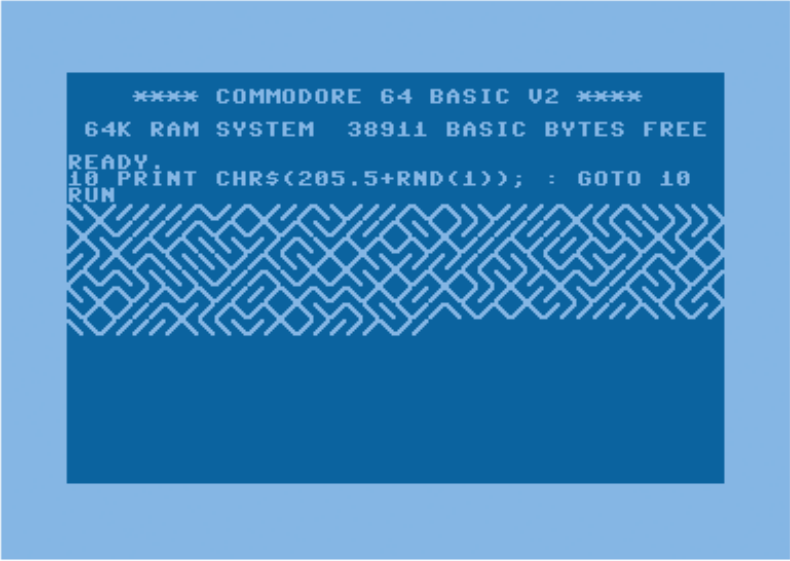
Gunnar Wolf: 10 PRINT CHR$(205.5+RND(1)); : GOTO 10 (also known as #10print )

The line of BASIC code that appears as the subject for this post is the title for a book I just finished reading And enjoyed thoroughly. The book is available online for download under a CC-BY-NC-SA 3.0 License, so you can take a good look at it before (or instead of) buying it. Although it's among the books I will enjoy having on my shelf; the printing is of a very enjoyable good quality. And what is this book about? Well, of course, it analizes that very simple line of code, as it ran on the Commodore 64 thirty years ago. And the analysis is made from every possible angle: What do mazes mean in culture? What have they meant in cultures through history? What about regularity in art (mainly 20th century art)? How would this code look (or how it would be adapted) on contemporary non-C64 computers? And in other languages more popular today? What does randomness mean? And what does random() mean? What is BASIC, and how it came to the C64? What is the C64, and where did it come from? And several other beautiful chapters. The book was collaboratively written by ten different authors, in a Wiki-like fashion. And... Well, what else is there to say? I enjoyed so much reading through long chapters of my childhood, of what attracted me to computers, of my cultural traits and values... I really hope that, in due time, I can be a part of such a beautiful project!

Kenshi Muto: Bug #668001

If the bug title of #668001 was not "debootstrap: cant install systemd instead of sysvinit", but was like "debootstrap ignores everything from the first pipe character to the end of Depends/Pre-Depends line.", it would be treated more carefully ;) My patch posting #20 aims to fix it. Well, I wish this bug will be solved on jessie+1 or backports.

24 November 2014

John Goerzen: My boys love 1986 computing

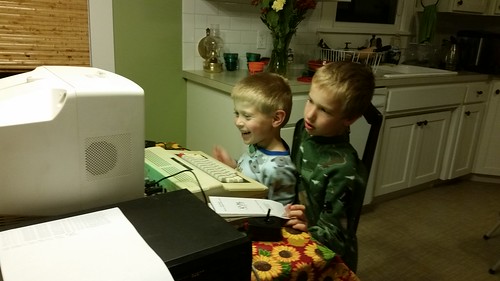
Yesterday, Jacob (age 8) asked to help me put together a 30-year-old computer from parts in my basement. Meanwhile, Oliver (age 5) asked Laura to help him learn cursive. Somehow, this doesn t seem odd for a Saturday at our place. 2014-11-22 18.58.36 Let me tell you how this came about. I ve had a project going on for a while now to load data from old floppies. It s been fun, and had a surprise twist the other day: my parents gave me an old TRS-80 Color Computer II (aka CoCo 2 ). It was, in fact, my first computer, one they got for me when I was in Kindergarten. It is nearly 30 years old. I have been musing lately about the great disservice Apple did the world by making computers easy to learn namely the fact that few people ever bother to learn about them. Who bothers to learn about them when, on the iPhone for instance, the case is sealed shut, the lifespan is 1 or 2 years for many purchasers, and the platform is closed in lots of ways? I had forgotten how finicky computers used to be. But after some days struggling with IDE incompatibilities, booting issues, etc., when I actually managed to get data off a machine that had last booted in 1999, I had quite the sense of accomplishment, which I rarely have lately. I did something that was hard to do in a world where most of the interfaces don t work with equipment that old (even if nominally they are supposed to.) The CoCo is one of those computers normally used with a floppy drive or cassette recorder to store programs. You type DIR, and you feel the clack of the drive heads through the desk. You type CLOAD and you hear the relay click closed to turn on the tape motor. You wiggle cables around until they make contact just right. You power-cycle for the times when the reset button doesn t quite do the job. The details of how it works aren t abstracted away by innumerable layers of controllers, interfaces, operating system modules, etc. It s all right there, literally vibrating your desk. So I thought this could be a great opportunity for Jacob to learn a few more computing concepts, such as the difference between mass storage and RAM, plus a great way to encourage him to practice critical thinking. So we trekked down to the basement and came up with handfulls of parts. We brought up the computer, some joysticks, all sorts of tangled cables. We needed adapters, an old TV. Jacob helped me hook everything up, and then the moment of truth: success! A green BASIC screen! I added more parts, but struck out when I tried to connect the floppy drive. The thing just wouldn t start up right whenever the floppy controller cartridge was installed. I cleaned the cartridge. I took it apart, scrubbed the contacts, even did a re-seat of the chips. No dice. So I fired up my CoCo emulator (xroar), and virtually saved some programs to cassette (a .wav file). I then burned those .wav files to an audio CD, brought up an old CD player from the basement, connected the cassette in plug to the CD player s headphone jack, and presto instant programs. (Well, almost. It takes a couple of minutes to load a program from audio codes.) The picture above is Oliver cackling at one of the very simplest BASIC programs there is: number find. The computer picks a random number between 1 and 2000, and asks the user to guess it, giving a too low or too high clue with each incorrect guess. Oliver delighted in giving invalid input (way too high numbers, or things that weren t numbers at all) and cackled at the sarcastic error messages built into the program. During Jacob s turn, he got very serious about it, and is probably going to be learning about how to calculate halfway points before too long. But imagine my pride when this morning, Jacob found the new CD I had made last night (correcting a couple recordings), found my one-line instruction on just part of how to load a program, and correctly figured out by himself all the steps to do in order (type CLOAD on the CoCo, advance the CD to the proper track, press play on the player, wait for it to load on the CoCo, then type RUN). I ordered a replacement floppy controller off eBay tonight, and paid $5 for a coax adapter that should fix some video quality issues. I rescued some 5.25 floppies from my trash can from another project, so they should have plenty of tools for exploration. It is so much easier for them to learn how a disk drive works, and even what the heck a track is, when you can look at a floppy drive with the cover off and see the heads move. There are other things we can do with more modern equipment Jacob has shown a lot of interest in Arduino projects but I have so far drawn a blank on ways to really let kids discover how a modern PC (let alone a modern phone or tablet) works. Update Nov. 24: Every so often, the world surprises me by deciding to, well, read one of my random blog posts. For the benefit of those of you that don t already know my boys, you might want to know that among their common play activites are turning trees into pretend trains, typing at a manual typewriter, reading, writing their own books, using a cassette recorder, building a PC and learning to use bash or xmonad, making long paper tapes with an adding machine, playing records on a record player, building electric gizmos, and even making mud balls. I am often asked about the role of the computer in the lives, given that my hobby and profession involves computers. The answer: less than that of most of their peers. I look for opportunities for them to learn by doing, discovering, playing, or imagining. I make no presumption that they will develop the passion for computers that I did. What I want is for them to have the curiosity and drive to learn everything there is to know about whatever they do develop a passion for, so they will be great at it.

23 November 2014

Dimitri John Ledkov: Analyzing public OpenPGP keys

OpenPGP Message Format (RFC 4880) well defines key structure and wire formats (openpgp packets). Thus when I looked for public key network (SKS) server setup, I quickly found pointers to dump files in said format for bootstrapping a key server.

I did not feel like experimenting with Python and instead opted for Go and found http://code.google.com/p/go.crypto/openpgp/packet library that has comprehensive support for parsing openpgp low level structures. I've downloaded the SKS dump, verified it's MD5SUM hashes (lolz), and went ahead to process them in Go.

With help from http://github.com/lib/pq and database/sql, I've written a small program to churn through all the dump files, filter for primary RSA keys (not subkeys) and inject them into a database table. The things that I have chosen to inject are fingerprint, N, E. N & E are the modulus of the RSA key pair and the public exponent. Together they form a public part of an RSA keypair. So far, nothing fancy.

Next I've run an SQL query to see how unique things are... and found 92 unique N & E pairs that have from two and up to fifteen duplicates. In total it is 231 unique fingerprints, which use key material with a known duplicate in the public key network. That didn't sound good. And also odd - given that over 940 000 other RSA keys managed to get unique enough entropy to pull out a unique key out of the keyspace haystack (which is humongously huge by the way).

Having the list of the keys, I've fetched them and they do not look like regular keys - their UIDs do not have names & emails, instead they look like something from the monkeysphere. The keys look like they are originally used for TLS and/or SSH authentication, but were converted into OpenPGP format and uploaded into the public key server. This reminded me of the Debian's SSL key generation vulnerability CVE-2008-0166. So these keys might have been generated with bad entropy due to affected tools by that CVE and later converted to OpenPGP.

Looking at the openssl-blacklist package, it should be relatively easy for me to generate all possible RSA key-pairs and I believe all other material that is hashed to generate the fingerprint are also available (RFC 4880#12.2). Thus it should be reasonably possible to generate matching private keys, generate revocation certificates and publish the revocation certificate with pointers to CVE-2008-0166. (Or email it to the people who have signed given monkeysphered keys). When I have a minute I will work on generating openpgp-blacklist type of scripts to address this.

If anyone is interested in the Go source code I've written to process openpgp packets, please drop me a line and I'll publish it on github or something.

Iustin Pop: Debian, Debian

Due to some technical issues, I've been without access to my lists subscription email for a bit more than a week. Once I regained access and proceeded to read the batch of emails, I was - once again - shocked. Shocked at the amount of emails spent on the systemd issue, shocked at the number of people resigning, shocked at the amount of mud thrown. I just hope that the GR results finally will mean silence and getting over the last 3-6 months. For the record: However, some of the more recent emails on -private give me more hope, so I'm looking forward to the next 6 months. I wonder how this will all look in two years? (Side-note: emacs-nox shows me the italic word above as italic in text mode: I never saw that before, and didn't know, that it's possible to have italic fonts in xterm! What is this trickery it seems to be related to the font I use, fun!)

Iustin Pop: Debian, Debian

Due to some technical issues, I've been without access to my lists subscription email for a bit more than a week. Once I regained access and proceeded to read the batch of emails, I was - once again - shocked. Shocked at the amount of emails spent on the systemd issue, shocked at the number of people resigning, shocked at the amount of mud thrown. I just hope that the GR results finally will mean silence and getting over the last 3-6 months. For the record: However, some of the more recent emails on -private give me more hope, so I'm looking forward to the next 6 months. I wonder how this will all look in two years? (Side-note: emacs-nox shows me the italic word above as italic in text mode: I never saw that before, and didn't know, that it's possible to have italic fonts in xterm! What is this trickery it seems to be related to the font I use, fun!)

Matthew Palmer: You stay classy, Uber

You may have heard that Uber has been under a bit of fire lately for its desires to hire private investigators to dig up dirt on journalists who are critical of Uber. From using users ride data for party entertainment, putting the assistance dogs of blind passengers in the trunk, adding a surcharge to reduce the number of dodgy drivers, or even booking rides with competitors and then cancelling, or using the ride to try and convince the driver to change teams, it s pretty clear that Uber is a pretty good example of how companies are inherently sociopathic. However, most of those examples are internal stupidities that happened to be made public. It s a very rare company that doesn t do all sorts of shady things, on the assumption that the world will never find out about them. Uber goes quite a bit further, though, and is so out-of-touch with the world that it blogs about analysing people s sexual activity for amusement. You ll note that if you follow the above link, it sends you to the Wayback Machine, and not Uber s own site. That s because the original page has recently turned into a 404. Why? Probably because someone at Uber realised that bragging about how Uber employees can amuse themselves by perving on your one night stands might not be a great idea. That still leaves the question open of what sort of a corporate culture makes anyone ever think that inspecting user data for amusement would be a good thing, let alone publicising it? It s horrific. Thankfully, despite Uber s fairly transparent attempt at whitewashing ( clearwashing ?), the good ol Wayback Machine helps us to remember what really went on. It would be amusing if Uber tried to pressure the Internet Archive to remove their copies of this blog post (don t bother, Uber; I ve got a Save As button and I m not afraid to use it). In any event, I ve never used Uber (not that I ve got one-night stands to analyse, anyway), and I ll certainly not be patronising them in the future. If you re not keen on companies amusing themselves with your private data, I suggest you might consider doing the same.

22 November 2014

Steve Kemp: Lumail 2.x ?

I've continued to ponder the idea of reimplementing the console mail-client I wrote, lumail, using a more object-based codebase. For one thing having loosely coupled code would allow testing things in isolation, which is clearly a good thing. I've written some proof of concept code which will allow the following Lua to be evaluated:
-- Open the maildir.
users = Maildir.new( "/home/skx/Maildir/.debian.user" )
-- Count the messages.
print( "There are " .. users:count() .. " messages in the maildir " .. users:path() )
--
-- Now we want to get all the messages and output their paths.
--
for k,v in ipairs( users:messages()) do
    --
    -- Here we could do something like:
    --
    --   if ( string.find( v:headers["subject"], "troll", 1, true ) ) then v:delete()  end
    --
    -- Instead play-nice and just show the path.
    print( k .. " -> " .. v:path() )
end
This is all a bit ugly, but I've butchered some code together that works, and tried to solicit feedback from lumail users. I'd write more but I'm tired, and intending to drink whisky and have an early night. Today I mostly replaced pipes in my attic. (Is it "attic", or is it "loft"? I keep alternating!) Fingers crossed this will mean a dry kitchen in the morning.

Craig Small: WordPress 4.0.1 for Debian

WordPress recently released an update that had multiple security patches for their (then) current version 4.0. This release is 4.0.1 and includes important security fixes. The Debian packages got just uploaded, if you are running the Debian packaged wordpress, you should update to 4.0.1+dfsg-1 or later. I am going to look at these patches and see if they can and need to be backported to wordpress 3.6.1. Unfortunately I believe they will be. I m also asking it to be unblocked into Jessie as it is a security fix. There was, at the time of writing, no CVE numbers.

Petter Reinholdtsen: How to stay with sysvinit in Debian Jessie

By now, it is well known that Debian Jessie will not be using sysvinit as its boot system by default. But how can one keep using sysvinit in Jessie? It is fairly easy, and here are a few recipes, courtesy of Erich Schubert and Simon McVittie. If you already are using Wheezy and want to upgrade to Jessie and keep sysvinit as your boot system, create a file /etc/apt/preferences.d/use-sysvinit with this content before you upgrade:
Package: systemd-sysv
Pin: release o=Debian
Pin-Priority: -1
This file content will tell apt and aptitude to not consider installing systemd-sysv as part of any installation and upgrade solution when resolving dependencies, and thus tell it to avoid systemd as a default boot system. The end result should be that the upgraded system keep using sysvinit. If you are installing Jessie for the first time, there is no way to get sysvinit installed by default (debootstrap used by debian-installer have no option for this), but one can tell the installer to switch to sysvinit before the first boot. Either by using a kernel argument to the installer, or by adding a line to the preseed file used. First, the kernel command line argument:
preseed/late_command="in-target apt-get install --purge -y sysvinit-core"
Next, the line to use in a preseed file:
d-i preseed/late_command string in-target apt-get install -y sysvinit-core
One can of course also do this after the first boot by installing the sysvinit-core package. I recommend only using sysvinit if you really need it, as the sysvinit boot sequence in Debian have several hardware specific bugs on Linux caused by the fact that it is unpredictable when hardware devices show up during boot. But on the other hand, the new default boot system still have a few rough edges I hope will be fixed before Jessie is released. Update 2014-11-26: Inspired by a blog post by Torsten Glaser, added --purge to the preseed line.

21 November 2014

Jonathan Wiltshire: On kFreeBSD and FOSDEM

Boy I love rumours. Recently I ve heard two, which I ought to put to rest now everybody s calmed down from recent events. kFreeBSD isn t an official Jessie architecture because <insert systemd-related scare story> Not true. Our sprint at ARM (who kindly hosted and caffeinated us for four days) was timed to coincide with the Cambridge Mini-DebConf 2014. The intention was that this would save on travel costs for those members of the Release Team who wanted to attend the conference, and give us a jolly good excuse to actually meet up. Winners all round. It also had an interesting side-effect. The room we used was across the hall from the lecture theatre being used as hack space and, later, the conference venue, which meant everybody attending during those two days could see us locked away there (and yes, we were in there all day for two days solid, except for lunch times and coffee missions). More than one conference attendee remarked to me in person that it was interesting for them to see us working (although of course they couldn t hear what we were discussing), and hadn t appreciated before that how much time and effort goes into our meetings. Most of our first morning was taken up with the last pieces of architecture qualification, and that was largely the yes/no decision we had to make about kFreeBSD. And you know what? I don t recall us talking about systemd in that context at all. Don t forget kFreeBSD already had a waiver for a reduced scope in Jessie because of the difficulty in porting systemd to it. It s sadly impossible to capture the long and detailed discussion we had into a couple of lines of status information in a bits mail. If bits mails were much longer, people would be put off reading them, and we really really want you to take note of what s in there. The little space we do have needs to be factual and to the point, and not include all the background that led us to a decision. So no, the lack of an official Jessie release of kFreeBSD has very little, if anything, to do with systemd. Jessie will be released during (or even before) FOSDEM Not necessarily true. Debian releases are made when they re ready. That sets us apart from lots of other distributions, and is a large factor in our reputation for stability. We may have a target date in mind for a freeze, because that helps both us and the rest of the project plan accordingly. But we do not have a release date in mind, and will not do so until we get much closer to being ready. (Have you squashed an RC bug today?) I think this rumour originated from the office of the DPL, but it s certainly become more concrete than I think Lucas intended. However, it is true that we ve gone into this freeze with a seriously low bug count, because of lots of other factors. So it may indeed be that we end up in good enough shape to think about releasing near (or even at) FOSDEM. But rest assured, Debian 8 Jessie will be released when it s ready, and even we don t know when that will be yet. (Of course, if we do release before then, you could consider throwing us a party. Plenty of the Release Team, FTP masters and CD team will be at FOSDEM, release or none.)
On kFreeBSD and FOSDEM is a post from: jwiltshire.org.uk Flattr

Gunnar Wolf: Status of the Debian OpenPGP keyring November update

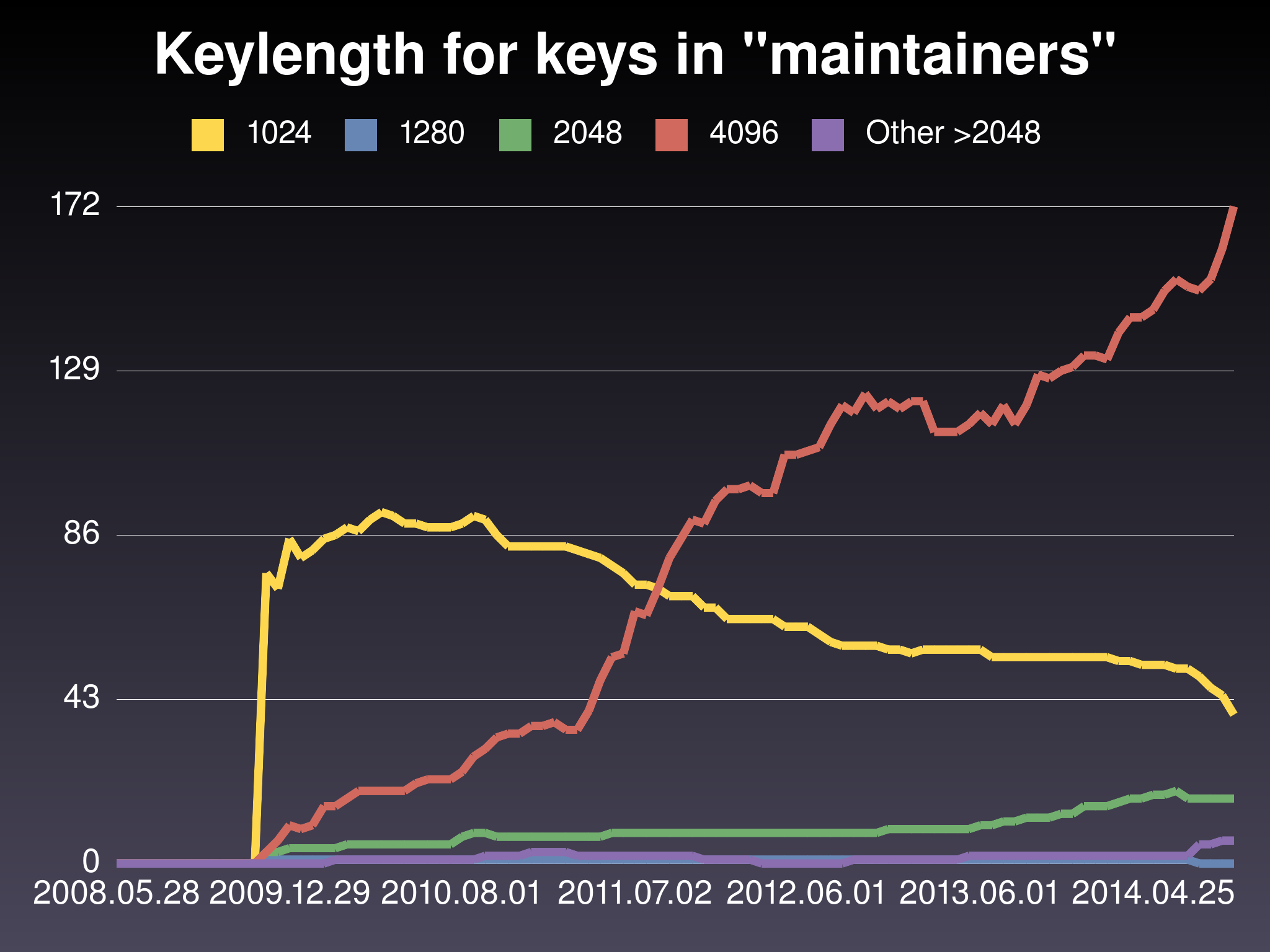
Almost two months ago I posted our keyring status graphs, showing the progress of the transition to >=2048-bit keys for the different active Debian keyrings. So, here are the new figures. First, the Non-uploading keyring: We were already 100% transitioned. You will only notice a numerical increase: That little bump at the right is our dear friend T ssia finally joining as a Debian Developer. Welcome! \o/ As for the Maintainers keyring: We can see a sharp increase in 4096-bit keys. Four 1024-bit DM keys were migrated to 4096R, but we did have eight new DMs coming in To them, also, welcome \o/. Sadly, we had to remove a 1024-bit key, as Peter Miller sadly passed away. So, in a 234-key universe, 12 new 4096R keys is a large bump! Finally, our current-greatest worry If for nothing else, for the size of the beast: The active Debian Developers keyring. We currently have 983 keys in this keyring, so it takes considerably more effort to change it. But we have managed to push it noticeably. This last upload saw a great deal of movement. We received only one new DD (but hey welcome nonetheless! \o/ ). 13 DD keys were retired; as one of the maintainers of the keyring, of course this makes me sad but then again, in most cases it's rather an acknowledgement of fact: Those keys' holders often state they had long not been really involved in the project, and the decision to retire was in fact timely. But the greatest bulk of movement was the key replacements: A massive 62 1024D keys were replaced with stronger ones. And, yes, the graph changed quite abruptly: We still have a bit over one month to go for our cutoff line, where we will retire all 1024D keys. It is important to say we will not retire the affected accounts, mark them as MIA, nor anything like that. If you are a DD and only have a 1024D key, you will still be a DD, but you will be technically unable to do work directly. You can still upload your packages or send announcements to regulated mailing lists via sponsor requests (although you will be unable to vote). Speaking of votes: We have often said that we believe the bulk of the short keys belong to people not really active in the project anymore. Not all of them, sure, but a big proportion. We just had a big, controversial GR vote with one of the highest voter turnouts in Debian's history. I checked the GR's tally sheet, and the results are interesting: Please excuse my ugly bash, but I'm posting this so you can play with similar runs on different votes and points in time using the public keyring Git repository:
  1. $ git checkout 2014.10.10
  2. $ for KEY in $( for i in $( grep '^V:' tally.txt
  3. awk ' print "<" $3 ">" ' )
  4. do
  5. grep $i keyids cut -f 1 -d ' '
  6. done )
  7. do
  8. if [ -f debian-keyring-gpg/$KEY -o -f debian-nonupload-gpg/$KEY ]
  9. then
  10. gpg --keyring /dev/null --keyring debian-keyring-gpg/$KEY \
  11. --keyring debian-nonupload-gpg/$KEY --with-colons \
  12. --list-key $KEY 2>/dev/null \
  13. head -2 tail -1 cut -f 3 -d :
  14. fi
  15. done sort uniq -c
  16. 95 1024
  17. 13 2048
  18. 1 3072
  19. 371 4096
  20. 2 8192
So, as of mid-October: 387 out of the 482 votes (80.3%) were cast by developers with >=2048-bit keys, and 95 (19.7%) were cast by short keys. If we were to run the same vote with the new active keyring, 417 votes would have been cast with >=2048-bit keys (87.2%), and 61 with short keys (12.8%). We would have four less votes, as they retired:
  1. 61 1024
  2. 14 2048
  3. 2 3072
  4. 399 4096
  5. 2 8192
So, lets hear it for November/December. How much can we push down that pesky yellow line? Disclaimer: Any inaccuracy due to bugs in my code is completely my fault!
Julien Danjou: Distributed group management and locking in Python with tooz

With OpenStack embracing the Tooz library more and more over the past year, I think it's a good start to write a bit about it. A bit of history A little more than year ago, with my colleague Yassine Lamgarchal and others at eNovance, we investigated on how to solve a problem often encountered inside OpenStack: synchronization of multiple distributed workers. And while many people in our ecosystem continue to drive development by adding new bells and whistles, we made a point of solving new problems with a generic solution able to address the technical debt at the same time. Yassine wrote the first ideas of what should be the group membership service that was needed for OpenStack, identifying several projects that could make use of this. I've presented this concept during the OpenStack Summit in Hong-Kong during an Oslo session. It turned out that the idea was well-received, and the week following the summit we started the tooz project on StackForge. Goals Tooz is a Python library that provides a coordination API. Its primary goal is to handle groups and membership of these groups in distributed systems. Tooz also provides another useful feature which is distributed locking. This allows distributed nodes to acquire and release locks in order to synchronize themselves (for example to access a shared resource). The architecture If you are familiar with distributed systems, you might be thinking that there are a lot of solutions already available to solve these issues: ZooKeeper, the Raft consensus algorithm or even Redis for example. You'll be thrilled to learn that Tooz is not the result of the NIH syndrome, but is an abstraction layer on top of all these solutions. It uses drivers to provide the real functionalities behind, and does not try to do anything fancy. All the drivers do not have the same amount of functionality of robustness, but depending on your environment, any available driver might be suffice. Like most of OpenStack, we let the deployers/operators/developers chose whichever backend they want to use, informing them of the potential trade-offs they will make. So far, Tooz provides drivers based on: All drivers are distributed across processes. Some can be distributed across the network (ZooKeeper, memcached, redis ) and some are only available on the same host (IPC). Also note that the Tooz API is completely asynchronous, allowing it to be more efficient, and potentially included in an event loop. Features Group membership Tooz provides an API to manage group membership. The basic operations provided are: the creation of a group, the ability to join it, leave it and list its members. It's also possible to be notified as soon as a member joins or leaves a group. Leader election Each group can have a leader elected. Each member can decide if it wants to run for the election. If the leader disappears, another one is elected from the list of current candidates. It's possible to be notified of the election result and to retrieve the leader of a group at any moment. Distributed locking When trying to synchronize several workers in a distributed environment, you may need a way to lock access to some resources. That's what a distributed lock can help you with. Adoption in OpenStack Ceilometer is the first project in OpenStack to use Tooz. It has replaced part of the old alarm distribution system, where RPC was used to detect active alarm evaluator workers. The group membership feature of Tooz was leveraged by Ceilometer to coordinate between alarm evaluator workers. Another new feature part of the Juno release of Ceilometer is the distribution of polling tasks of the central agent among multiple workers. There's again a group membership issue to know which nodes are online and available to receive polling tasks, so Tooz is also being used here. The Oslo team has accepted the adoption of Tooz during this release cycle. That means that it will be maintained by more developers, and will be part of the OpenStack release process. This opens the door to push Tooz further in OpenStack. Our next candidate would be write a service group driver for Nova. The complete documentation for Tooz is available online and has examples for the various features described here, go read it if you're curious and adventurous!

20 November 2014

Neil McGovern: Barbie the Debian Developer

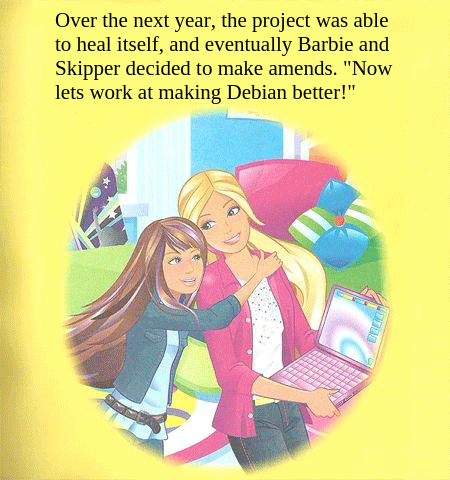
Some people may have seen recently that the Barbie series has a rather sexist book out about Barbie the Computer Engineer. Fortunately, there s a way to improve this by making your own version. Thus, I made a short version about Barbie the Debian Developer and init system packager. (For those who don t know me, this is satirical. Any resemblance to people is purely coincidental.) Edit: added text in alt tags. Also, hai reddit!
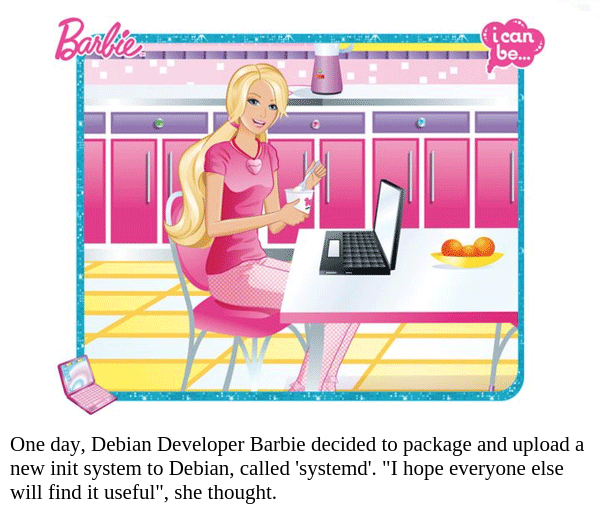
One day, Debian Developer Barbie decided to package and upload a new init system to Debian, called 'systemd'. I hope everyone else will find it useful, she thought.Oh no says Skipper! You'll never take my init system away from me! It's horrendous and Not The Unix Way! Oh dear said Barbie, What have I let myself in to?Skipper was most upset, and decided that this would not do. It's off to the technical committee with this. They'll surely see sense.Oh no! What's this? The internet decided that the Technical Committee needed to also know everyone's individual views! Bad Internet!There was much discussion and consideration. Opinions were reviewed, rows were had, and months passed. Eventually, a decision was agreed upon.Barbie was successful! The will of the Technical Committee was that systemd would be the default! But wait...Skipper still wasn't happy. We need to make sure this never affects me! I'm going to call for a General Resolution!And so, Ms Devotee was called in to look at the various options. She said that the arguments must stop, and we should all accept the result of the general resolution.The numbers turned and the vote was out. We should simply be most excellent to each other said Ms Devotee. I'm not going to tell you what you should or should not do.Over the next year, the project was able to heal itself and eventually Barbie and Skipper decided to make amends. Now let's work at making Debian better!

Gunnar Wolf: UNAM. Viva M xico, viva en paz.

UNAM. Viva M xico, viva en paz.
We have had terrible months in Mexico; I don't know how much has appeared about our country in the international media. The last incidents started on the last days of September, when 43 students at a school for rural teachers were forcefully disappeared (in our Latin American countries, this means they were taken by force and no authority can yet prove whether they are alive or dead; forceful disappearance is one of the saddest and most recognized traits of the brutal military dictatorships South America had in the 1970s) in the Iguala region (Guerrero state, South of the country) and three were killed on site. An Army regiment was stationed few blocks from there and refused to help. And yes, we live in a country where (incredibly) this news by themselves would not seem so unheard of... But in this case, there is ample evidence they were taken by the local police forces, not by a gang of (assumed) wrongdoers. And they were handed over to a very violent gang afterwards. Several weeks later, with far from a thorough investigation, we were told they were killed, burnt and thrown to a river. The Iguala city major ran away, and was later captured, but it's not clear why he was captured at two different places. The Guerrero state governor resigned and a new governor was appointed. But this was not the result of a single person behaving far from what their voters would expect It's a symptom of a broken society where policemen will kill when so ordered, where military personnel will look away when pointed out to the obvious, where the drug dealers have captured vast regions of the country where are stronger than the formal powers. And then, instead of dealing with the issue personally as everybody would expect, the president goes on a commercial mission to China. Oh, to fix some issues with a building company. That coincidentally or not was selling a super-luxury house to his wife. A house that she, several days later, decided to sell because it was tarnishing her family's honor and image. And while the president is in China, the person who dealt with the social pressure and told us about the probable (but not proven!) horrible crime where the "bad guys" for some strange and yet unknown reason (even with tens of them captured already) decided to kill and burn and dissolve and disappear 43 future rural teachers presents his version, and finishes his speech saying that "I'm already tired of this topic". Of course, our University is known for its solidarity with social causes; students in our different schools are the first activists in many protests, and we have had a very tense time as the protests are at home here at the university. This last weekend, supposed policemen entered our main campus with a stupid, unbelievable argument (they were looking for a phone reported as stolen three days earlier), get into an argument with some students, and end up firing shots at the students; one of them was wounded in the leg. And the university is now almost under siege: There are policemen surrounding us. We are working as usual, and will most likely finish the semester with normality, but the intimidation (in a country where seeing a policeman is practically never a good sign) is strong. And... Oh, I could go on a lot. Things feel really desperate and out of place. Today I will join probably tens or hundreds of thousands of Mexicans sick of this simulation, sick of this violence, in a demonstration downtown. What will this achieve? Very little, if anything at all. But we cannot just sit here watching how things go from bad to worse. I do not accept to live in a state of exception. So, this picture is just right: A bit over a month ago, two dear friends from Guadalajara city came, and we had a nice walk in the University. Our national university is not only huge, it's also beautiful and loaded with sights. And being so close to home, it's our favorite place to go with friends to show around. This is a fragment of the beautiful mural in the Central Library. And, yes, the University stands for "Viva M xico". And the university stands for "Peace". And we need it all. Desperately.

Daniel Pocock: Is Amnesty giving spy victims a false sense of security?

Amnesty International is getting a lot of attention with the launch of a new tool to detect government and corporate spying on your computer. I thought I would try it myself. I went to a computer running Microsoft Windows, an operating system that does not publish its source code for public scrutiny. I used the Chrome browser, users often express concern about Chrome sending data back to the vendor about the web sites the users look for. Without even installing the app, I would expect the Amnesty web site to recognise that I was accessing the site from a combination of proprietary software. Instead, I found a different type of warning. Beware of Amnesty? Instead, the only warning I received was from Amnesty's own cookies: Even before I install the app to find out if the government is monitoring me, Amnesty is keen to monitor my behaviour themselves. While cookies are used widely, their presence on a site like Amnesty's only further desensitizes Internet users to the downside risks of tracking technologies. By using cookies, Amnesty is effectivley saying a little bit of tracking is justified for the greater good. Doesn't that sound eerily like the justification we often hear from governments too? Is Amnesty part of the solution or part of the problem? Amnesty is a well known and widely respected name when human rights are mentioned. However, their advice that you can install an app onto a Windows computer or iPhone to detect spyware is like telling people that putting a seatbelt on a motorbike will eliminate the risk of death. It would be much more credible for Amnesty to tell people to start by avoiding cloud services altogether, browse the web with Tor and only use operating systems and software that come with fully published source code under a free license. Only when 100% of the software on your device is genuinely free and open source can independent experts exercise the freedom to study the code and detect and remove backdoors, spyware and security bugs. It reminds me of the advice Kim Kardashian gave after the Fappening, telling people they can continue trusting companies like Facebook and Apple with their private data just as long as they check the privacy settings (reality check: privacy settings in cloud services are about as effective as a band-aid on a broken leg). Write to Amnesty Amnesty became famous for their letter writing campaigns. Maybe now is the time for people to write to Amnesty themselves, thank them for their efforts and encourage them to take more comprehensive action. Feel free to cut and paste some of the following potential ideas into an email to Amnesty:

I understand you may not be able to respond to every email personally but I would like to ask you to make a statement about these matters on your public web site or blog. I understand it is Amnesty's core objective to end grave abuses of human rights. Electronic surveillence, due to its scale and pervasiveness, has become a grave abuse in itself and in a disturbing number of jurisdictions it is an enabler for other types of grave violations of human rights. I'm concerned that your new app Detekt gives people a false sense of security and that your campaign needs to be more comprehensive to truly help people and humanity in the long term. If Amnesty is serious about solving the problems of electronic surveillance by government, corporations and other bad actors, please consider some of the following:
  • Instead of displaying a cookie warning on Amnesty.org, display a warning to users who access the site from a computer running closed-source software and give them a link to download a free and open source web browser like Firefox.
  • Redirect all visitors to your web site to use the HTTPS encrypted version of the site.
  • Using free software such as the GNU/Linux operating system (using one of the Debian, Fedora or Ubuntu systems is one of the more common ways to achieve this) and LibreOffice for all Amnesty's own operations, making a public statement about your use of free software and mentioning this in the closing paragraph of all press releases relating to surveillance topics.
  • Encouraging Amnesty donors, members and supporters to choose similar software especially when engaging in any political activities.
  • Make a public statement that Amnesty will not use cloud services such as SalesForce or Facebook to store, manage or interact with data relating to members, donors or other supporters.
  • Encouraging the public to move away from centralized cloud services such as those provided by their smartphone or social networks and use de-centralized or federated services such as XMPP chat.
Given the immense threat posed by electronic surveillance, I'd also like to call on Amnesty to allocate at least 10% of annual revenue towards software projects releasing free and open source software that offers the public an alternative to the centralized cloud.

While publicity for electronic privacy is great, I hope Amnesty can go a step further and help people use trustworthy software from the ground up.

Jonathan Wiltshire: Getting things into Jessie (#5)

Don t assume another package s unblock is a precedent for yours Sometime we ll use our judgement when granting an unblock to a less-than-straightforward package. Lots of factors go into that, including the regression risk, desirability, impact on other packages (of both acceptance and refusal) and trust. However, a judgement call on one package doesn t automatically mean that the same decision will be made for another. Every single unblock request we get is called on its own merits. Do by all means ask about your package in light of another. There may be cross-over that makes your change desirable as well. Don t take it personally if the judgement call ends up being not what you expected.
Getting things into Jessie (#5) is a post from: jwiltshire.org.uk Flattr

Stefano Zacchiroli: Thoughts on the Init System Coupling GR

on perceived hysteria and silent sanity As you probably already know by now, the results of the Debian init system coupling general resolution (GR) look like this:
Init system coupling GR: results (arrow from A to B means that voters preferred A to B by that margin)
results of the init system coupling GR
Some random thoughts about them: My take home message is that we are experiencing a huge gap between the public perception of the state of Debian (both from within and from without the project) and the actual beliefs of the silent majority of people that make Debian with their work, day after day. In part this is old news. The most "senior" members of the project will remember that the topic of "vocal minorities vs silent majority" was a recurrent one in Debian 10+ years ago, when flames were periodically ravaging the project. Since then Debian has grown a lot though, and we are now part of a much larger and varied ecosystem. We are now at a scale at which there are plenty of FOSS "mass-media" covering daily what happens in Debian, inducing feedback loops with our own perception of ourselves which we do not fully grok yet. This is a new factor in the perception gap. This situation is not intrinsically bad, nor there is blame to assign here: after all influential bloggers, news sites, etc., just do their job. And their attention also testifies of the huge interest that there is around Debian and our choices. But we still need to adapt and learn to take perceived hysteria with a pinch (or two) of salt. It might just be time for our decennial check-up. Time to remind ourselves that our ways of doing things might in fact still be much more sane than sometimes we tend to believe. We went on 10+ years ago, after monumental flames. It looks like we are now ready to move on again, putting The Era of the Great systemd Histeria behind us.

Matthew Palmer: Multi-level prefix delegation is not a myth! I've seen it!

Unless you ve been living under a firewalled rock, you know that IPv6 is coming. There s also a good chance that you ve heard that IPv6 doesn t have NAT. Or, if you pay close attention to the minutiae of IPv6 development, you ve heard that IPv6 does have NAT, but you don t have to (and shouldn t) use it. So let s say we ll skip NAT for IPv6. Fair enough. However, let s say you have this use case:
  1. A bunch of containers that need Internet access
  2. That are running in a VM
  3. On your laptop
  4. Behind your home router!
For IPv4, you d just layer on the NAT, right? While SIP and IPsec might have kittens trying to work through three layers of NAT, for most things it ll Just Work. In the Grand Future of IPv6, without NAT, how the hell do you make that happen? The answer is Prefix Delegation , which allows routers to delegate management of a chunk of address space to downstream routers, and allow those downstream routers to, in turn, delegate pieces of that chunk to downstream routers. In the case of our not-so-hypothetical containers-in-VM-on-laptop-at-home scenario, it would look like this:
  1. My border router (a DNS-323 running Debian) asks my ISP for a delegated prefix, using DHCPv6. The ISP delegates a /561. One /64 out of that is allocated to the network directly attached to the internal interface, and the rest goes into the pool , as /60 blocks (so I ve got 15 of them to delegate, if required).
  2. My laptop gets an address on the LAN between itself and the DNS-323 via stateless auto-addressing ( SLAAC ). It also uses DHCPv6 to request one of the /60 blocks from the DNS-323. The laptop puts one /64 from that block as the address space for the virtual LAN (actually a Linux bridge) that connects the laptop to all my VMs, and puts the other 15 /64 blocks into a pool for delegation.
  3. The VM that will be running the set of containers under test gets an address on the all VMs virtual LAN via SLAAC, and then requests a delegated /64 to use for the all containers virtual LAN (another bridge, this one running on the VM itself) that the containers will each connect to themselves.
Now, almost all of this Just Works. The current releases of ISC DHCP support prefix delegation just fine, and a bit of shell script plumbing between the client and server seals the deal the client needs to rewrite the server s config file to tell it the netblock from which it can delegate. Except for one teensy, tiny problem routing. When the DHCP server delegates a netblock to a particular machine, the routing table needs to get updated so that packets going to that netblock actually get sent to the machine the netblock was delegated to. Without that, traffic destined for the containers (or the VM) won t actually make it to its destination, and a one-way Internet connection isn t a whole lot of use. I cannot understand why this problem hasn t been tripped over before. It s absolutely fundamental to the correct operation of the delegation system. Some people advocate running a dynamic routing protocol, but that s a sledgehammer to crack a nut if ever I saw one. Actually, I know this problem has been tripped over before, by OpenWrt. Their solution, however, was to use a PHP script to scan logfiles and add routes. Suffice it to say, that wasn t an option I was keen on exploring. Instead, I decided to patch ISC DHCP so that the server can run an external script to add the necessary routes, and perhaps modify firewall rules and also to reverse the process when the delegation is released (or expired). If anyone else wants to play around with it, I ve put it up on Github. I don t make any promises that it s the right way to do it, necessarily, but it works, and the script I ve added in contrib/prefix-delegation-routing.rb shows how it can be used to good effect. By the way, if anyone knows how pull requests work over at ISC, drop me a line. From the look of their website, they don t appear to accept (or at least encourage) external contributions. So, that s one small patch for DHCP, one giant leap for my home network.
  1. The standard recommendation is for ISPs to delegate each end-user customer a /48 (giving 65,536 /64 networks); my ISP is being a little conservative in only giving me 256 /64s. It works fine for my purposes, but if you re an ISP getting set for deploying IPv6, make life easy on your customers and give them a /48.

19 November 2014

Thomas Goirand: Rotten tomatoes

There s many ways to interpret the last GR. The way I see it is how Joey hoped Debian was: the outcome of the poll shows that we don t want to do technical decisions by voting. At the beginning of this GR, I was supportive of it, and though it was a good thing to enforce the rule that we care for non-systemd setups. Though I have slowly changed my mind. I still think it was a good idea to see what the community thought after a so long debate. I now think that this final outcome is awesome and couldn t have been better. Science (and computer science) has never been about voting, otherwise the earth would be flat, without drifting continents. So my hope is that the Debian project as a whole, will allow itself to do mistakes, iterative trials, errors, and go back on any technical decision if they don t make sense anymore. When being asked something, it s ok to reply: I don t know , and it should be ok for the Debian project to have this alternative as one of the possible answers. I m convince that refusing to take a drastic choice in this point in time was exactly what we needed to do. And my hope is that Joey comes back after he realizes that we ve all understood and embarrassed his position that science cannot be governed by polls. For Stretch, I m sure there s going to be a lot of new alternatives. Maybe uselessd, eudev and others. Maybe I ll have a bit of time to work on OpenRC Debian integration myself (hum I m dreaming here ). Maybe something else. Let s just wait. We have more than 300 bugs to fix before Jessie can be released. Let s happilly work on that together, and forget about the init systems for a while P.S: Just to be on the safe side: the rotten tomatoes image was not about criticizing the persons who started the poll, who I respect a lot, especially Ian, who I am convinced is trying to do his best for Debian (hug).

Next.

Previous.