Search Results: "sto"

29 January 2014

Daniel Pocock: Lumicall: giving you choice when you dial

One of the distinguishing features of Lumicall, the free and open SIP/VoIP app for Android, is the unique dialing experience. In fact, even regular softphones for the desktop/laptop don't currently offer the same power when you want to make a call. In my previous blog, I looked at the ENUM technology that underpins part of this compelling new user experience. Here we can step back and look at the bigger picture. Choice is important, sneak preview of Sunday's talk at FOSDEM The fundamental reason for the dialing popup is to give the user choice. Choice is important. With that in mind, one of the key revelations that I will discuss during my talk about Lumicall this Sunday at FOSDEM is that I would like to give users the opportunity to use the Lumicall dialer with other VoIP apps, including Jitsi for Android and CSipSimple. To facilitate this, I hope to separate the dialing logic from the app and make it available as a standalone app or library module that can be used in any free communications software. Users expect convenience, Lumicall tries to deliver Have you noticed how many people will pick up their mobile phone to make a call even when they have a regular phone within reach? Have you found yourself calling your friends' mobile numbers even though you have their home and office numbers in your address book too? These mobile network calls are often at least ten times more expensive than landline calls and by definition they are infinitely more expensive than free calls made over the Internet. So why do people behave this way? The answer is simple: convenience. The caller does not want to make multiple efforts to dial, nor does he want to lose one or two minutes speaking to a secretary, colleague or spouse of the person he is trying to call. Dialing from the address book in his own mobile phone and calling the mobile number of the person he wants to speak with is the shortest path to success. It is efficient, it is compelling and it is what users expect. Free software products wanting to make an impact need to carefully align themselves with these user expectations and that is exactly what Lumicall tries to do. Choose your own adventure: dial the digits, use the address book or surf your call history Any of these everyday dialing practices triggers the Lumicall dialer. In this example, the user is trying to call Bob from the address book: While the user may have simply pressed the "call" button, Lumicall alerts them to several ways that they may proceed:
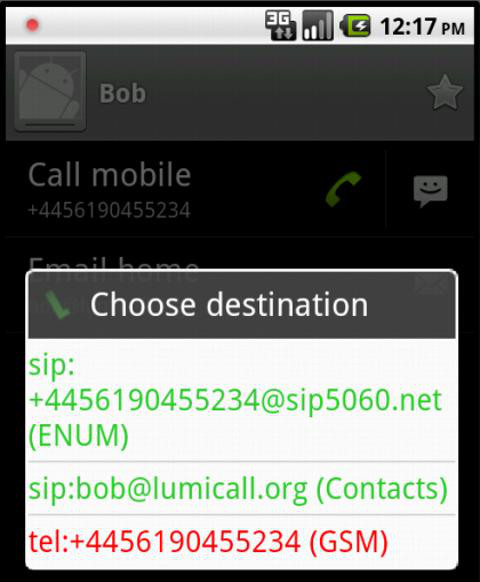
  • The first choice is a SIP address found in the ENUM directory, sip:+4456190455234@sip5060.net. Lumicall will take all the phone numbers associated with Bob in the address book and report any ENUM results associated with them. Here, just a single ENUM result is display.
  • The second choice is a SIP address constructed from Bob's email address. Lumicall found the email address in the address book entry and discovered that Bob's domain, lumicall.org, has a NAPTR record for SIP. Based on this discovery, Lumicall feels there is a good probability the email address is also a SIP address. If multiple email addresses are in the address book, they will all be checked for NAPTR.
  • (Not shown in the picture) if Lumicall has been configured to use a SIP-to-PSTN gateway account, it will display the option to call Bob's number through the gateway in blue
  • Finally, at the bottom of the list, Lumicall offers the option to call Bob's number in the normal manner, through the GSM network. This option is colour-coded in red to emphasize that it is usually the most expensive.

The tip of the iceberg This experience is a big improvement over the experience of the old rotary dial but it could also be taken even further. People don't always respond to their SIP address, especially if they live in a country where mobile data is not yet the norm. These are areas where Lumicall could be improved. For example, we could use SIP presence to make sure that Bob really is online before displaying the SIP option. This would reduce frustration and boost confidence in SIP. We could even go beyond that: Bob could use the SIP presence mechanism to advertise whether or not he is on a slow mobile data network or a fast network like 4G or wifi. You may choose to defer your call to Bob until he enters wifi coverage where the call quality is likely to be better and maybe video will be possible. This latter opportunity also has privacy implications: Bob may only choose to share that live insight into his network coverage with contacts he trusts. Try it at FOSDEM I will spend some time around the real-time lounge at FOSDEM and would be delighted to get feedback from users who are trying Lumicall, FreePhoneBox.net, JSCommunicator, DruCall or the new Debian SIP service.

Emanuele Rocca: Antifeatures and Antibugs

Software Engineering distinguishes between software features and software bugs. It is usually understood that features are positive, expected characteristics of a computer program. Features make users happy by allowing them to do something useful, interesting, or fun. Something good, anyways. Bugs are instead undesirable and annoying. You're sitting there at your computer writing a long email and the software crashes right before your email is sent. Bad stuff. Features are generally implemented by programmers on purpose, whereas bugs are purely unintentional. They are mistakes. You don't make a mistake on purpose. We might at this point be inclined to think that: i) what is good for users is done on purpose by software manufacturers; ii) what is bad for users was not meant to be. It happened by mistake. Here is a handy table to visualize this idea:
On purpose By mistake
Good Feature
Bad Bug
It seems to make a lot of sense. But you might have noticed that two cells of the table are empty. Right! In a great talk titled When Free Software isn't better, Benjamin Mako Hill mentions the concept of antifeatures, and how they relate to Free Software. Antifeatures are features that make the software do something users will hate. Something they will hate so much they would pay to have those features removed, if that's an option. Microsoft Windows 7 is used in the talk to provide some examples of software antifeatures: the Starter Edition does not allow users to change their background image. Also, it limits the amount of usable memory on the computer to 2GBs, regardless of how much memory the system actually has. Two antifeatures engineered to afflict users to the point that they will purchase a more expensive version of the software, if they have the means to do that. I have another nice example. The Spotify music streaming service plays advertisements between songs every now and then. To make sure users are annoyed as much as possible, Spotify automatically pauses an advertisement if it detects that the volume is being lowered. A poor Spotify user even tried to report the bug on The Spotify Community forum, only to find out that what she naively considered as a software error was "intentional behavior". A spectacular antifeature indeed. Whenever a piece of technology does something you most definitely do not want it to do, such as allowing the NSA to take complete control of your Apple iPhone, including turning on its microphone and camera against your will, that's an antifeature.
On purpose By mistake
Good Feature
Bad Antifeature Bug
Both bugs and antifeatures are bad for users. The difference between them is that antifeatures are engineered. Time and money are spent to make sure the goal is reached. A testing methodology is followed. "Are we really sure customers cannot change their wallpaper even if they try very very hard?" Engineering processes, of course, can fail. If the poor devils at Microsoft who implemented those harassments would have made a mistake that allows users to somehow change their wallpaper on Windows Starter... Well, I would call that a glorious antibug.
On purpose By mistake
Good Feature Antibug
Bad Antifeature Bug
There is no place for antifeatures in Free and Open Source Software. Free Software gives users control over what their software does. Imagine Mozilla adding a feature to Firefox that sets your speakers volume to 11 and starts playing a random song from the black metal artist Burzum every time you add a bookmark, unless you pay for Mozilla Firefox Premium Edition. The source code for Firefox is available under a free license. People who are not into Burzum's music would immediately remove this neat antifeature. I have spent many years of my life advocating Free and Open Source Software, perhaps using the wrong arguments. Mako's talk made me think about all this (thanks mate!). All these years I've been preaching about the technical superiority of Free Software, despite evidence of thousands of bugs and usability issues in the very programs I am using, and contributing to develop. Free Software is not better than Proprietary Software per se. Sometimes it is, sometimes it's not. But it gives you control, and freedom. When it annoys you, when it doesn't do what you expect and want, you can be sure it's not on purpose. And we can fix it together.

Petter Reinholdtsen: A fist full of non-anonymous Bitcoins

Bitcoin is a incredible use of peer to peer communication and encryption, allowing direct and immediate money transfer without any central control. It is sometimes claimed to be ideal for illegal activity, which I believe is quite a long way from the truth. At least I would not conduct illegal money transfers using a system where the details of every transaction are kept forever. This point is investigated in USENIX ;login: from December 2013, in the article "A Fistful of Bitcoins - Characterizing Payments Among Men with No Names" by Sarah Meiklejohn, Marjori Pomarole,Grant Jordan, Kirill Levchenko, Damon McCoy, Geoffrey M. Voelker, and Stefan Savage. They analyse the transaction log in the Bitcoin system, using it to find addresses belong to individuals and organisations and follow the flow of money from both Bitcoin theft and trades on Silk Road to where the money end up. This is how they wrap up their article:
"To demonstrate the usefulness of this type of analysis, we turned our attention to criminal activity. In the Bitcoin economy, criminal activity can appear in a number of forms, such as dealing drugs on Silk Road or simply stealing someone else s bitcoins. We followed the flow of bitcoins out of Silk Road (in particular, from one notorious address) and from a number of highly publicized thefts to see whether we could track the bitcoins to known services. Although some of the thieves attempted to use sophisticated mixing techniques (or possibly mix services) to obscure the flow of bitcoins, for the most part tracking the bitcoins was quite straightforward, and we ultimately saw large quantities of bitcoins flow to a variety of exchanges directly from the point of theft (or the withdrawal from Silk Road). As acknowledged above, following stolen bitcoins to the point at which they are deposited into an exchange does not in itself identify the thief; however, it does enable further de-anonymization in the case in which certain agencies can determine (through, for example, subpoena power) the real-world owner of the account into which the stolen bitcoins were deposited. Because such exchanges seem to serve as chokepoints into and out of the Bitcoin economy (i.e., there are few alternative ways to cash out), we conclude that using Bitcoin for money laundering or other illicit purposes does not (at least at present) seem to be particularly attractive."
These researches are not the first to analyse the Bitcoin transaction log. The 2011 paper "An Analysis of Anonymity in the Bitcoin System" by Fergal Reid and Martin Harrigan is summarized like this:
"Anonymity in Bitcoin, a peer-to-peer electronic currency system, is a complicated issue. Within the system, users are identified by public-keys only. An attacker wishing to de-anonymize its users will attempt to construct the one-to-many mapping between users and public-keys and associate information external to the system with the users. Bitcoin tries to prevent this attack by storing the mapping of a user to his or her public-keys on that user's node only and by allowing each user to generate as many public-keys as required. In this chapter we consider the topological structure of two networks derived from Bitcoin's public transaction history. We show that the two networks have a non-trivial topological structure, provide complementary views of the Bitcoin system and have implications for anonymity. We combine these structures with external information and techniques such as context discovery and flow analysis to investigate an alleged theft of Bitcoins, which, at the time of the theft, had a market value of approximately half a million U.S. dollars."
I hope these references can help kill the urban myth that Bitcoin is anonymous. It isn't really a good fit for illegal activites. Use cash if you need to stay anonymous, at least until regular DNA sampling of notes and coins become the norm. :) As usual, if you use Bitcoin and want to show your support of my activities, please send Bitcoin donations to my address 15oWEoG9dUPovwmUL9KWAnYRtNJEkP1u1b.

Enrico Zini: correctness

On political correctness I am reading "Four ways to forgiveness" by Ursula Le Guin. This is how the book begins:
On the planet 0 there has not been a war for five thousand years, she read, and on Gethen there has never been a war. She stopped reading, to rest her eyes and because she was trying to train herself to read slowly, not gobble words down in chunks the way Tikuli gulped his food. There has never been a war : in her mind the words stood clear and bright, surrounded by and sinking into an infinite, dark, soft incredulity. What would that world be, a world without war? It would be the real world Peace was the true life, the life of working and learning and bringing up children to work and learn. War, which devoured work, learning, and children, was the denial of reality. But my people, she thought, know only how to deny. Born in the dark shadow of power misused, we set peace outside our world, a guiding and unattainable light. All we know to do is fight. Any peace one of us can make in our life is only a denial that the war is going on, a shadow of the shadow, a doubled unbelief.
That made me realise that several times I perceived political correctness as "only a denial that the war is going on". Last night I watched this video, which I felt was very relevant to this. Indeed, I have more respect for someone who listens to me and makes a good effort to understand what I said, then rudely disagrees, than for someone who is very politely ignoring everything I am trying to say. This is how I feel like this experience can be distilled into an actionable item:
Replying to an email is probably going to be useless, unless I am willing to make an effort to understand what the other person is trying to say, from their own point of view.

Russ Allbery: rra-c-util 5.2

Another release of my general collection of utility libraries, Autoconf probes, general test cases, and similar things. The major change in this release is the addition of Autoconf probes and portability wrappers for libevent. Now included are Autoconf macros to probe for libevent (mandatory or optional) either via pkg-config or not, following the pattern of other probes in rra-c-util. Also included is a portability wrapper, probes, and some additional glue code that allows programs to be written against the libevent 2.x API and work (mostly) with the libevent 1.4 API, albeit with some missing functionality. This release fixes the systemd unit directory probe to not produce shell errors if pkg-config isn't available on the local system. It also fixes a syntax error when building portable/krb5.h with a C++ compiler. There are multiple improvements to the Kerberos and process TAP add-ons: memory is properly freed in all processes, making exhaustive memory allocation analysis easier; process output is flushed after stopping the process instead of before; the method used to stop processes is cleaner; a memory leak when running via fakeroot has been fixed; and full use is made of the new test_cleanup_register API in C TAP Harness. This release also adds a new message_handlers_reset function that restores all message handlers to their defaults and frees any memory allocated to set different handlers. This again is mostly useful when doing exhaustive memory allocation testing. You can get the latest release from the rra-c-util distribution page.

27 January 2014

Steve Kemp: It is unfortunate that many companies need the same sysadmin jobs carried out

It is unfortunate that I've been exposed to several companies that all need the same kind of problems solving, again and again: A lot of these are solved problems, yet they seem to keep cropping up. I guess the fact I've done some of these things more than once means I'm the local-expert, so that's why I get asked. But still.. There was a time when I thought my Debian Administration site would help solve these kind of problems; that writing documentation would encourage people to do things properly. Certainly it has helped me, and some other people are greatful, but it didn't do enough to help. I'm not sure if the problem is that my documentation is a little ideosyncratic, isn't good enough, or isn't reaching the right kind of people. I suspect a combination of that and scale - You can't walk somebody though the idea of setting up a ten-node database-cluster, they need to suffer, they need to break things, they need to sweat on Christmas Day, at 5AM, as everything goes to hell. Then the next time they'll do it properly. I'd love to take the time to write out recipes in Salt, Ansible, Puppet, Chef, CFengine, Slaughter, whatever, and support them.
Remote. Automated. System management.
Throw in monitoring of metrics, security fixes, and reporting and there's probably a valuable service there. It probably can't happen though, for three main reasons: I did recently write some policies for setting up a two-node Master-Slave MySQL setup, with reporting, monitoring, and custom SMS-based alerts. I guess I'm wondering if I can be cheeky and sell the same work twice. ;)

Richard Hartmann: Public Consultation on the review of the EU copyright rules

You probably didn't know there's a Public Consultation on the review of the EU copyright rules under way as of right now. It states explicitly that "All stakeholders are welcome to contribute to this consultation." This means you. No matter where you live or what you do, this is your chance to potentially influence copyright reform. You have time until 2014-02-05. Don't wait that long, fill the survey out now. Else you will forget. And then lament the fact that legacy industries are upheld with artifical government-sanctioned monopolies. If you find the ~40 A4 pages of text scary, there's a handy guide as to what questions will interest you the most, but I suggest you fill it out on your own. Stop what you're doing, fill this out, and return. Thanks.

Richard Hartmann: You at FOSDEM?

Behind the scenes, all the pieces are falling together to make this FOSDEM the best ever. As every year ;) Part of making things even more awesome is a great effort: To tape ALL the things. As in, literally, every single talk, discussion, and lightning talk; devrooms included. We have the extra equipment, we have the extra storage space, but we don't have all the extra manpower, yet. Why not sign up as a volunteer? There's a self-checkout system where you simply sign up for tasks. Heralding and video-taping are especially simple to do if you plan to attend the respective track/devroom, anyway. If you prefer talking over listening, cloak room and infodesk are available asa well; they are a lot more social and people always tell us it's great fun. Finally, if your schedule is full to the brim, you can help us with build-up and teardown. As an aside, there's a little experiment with IPv6 in the works.

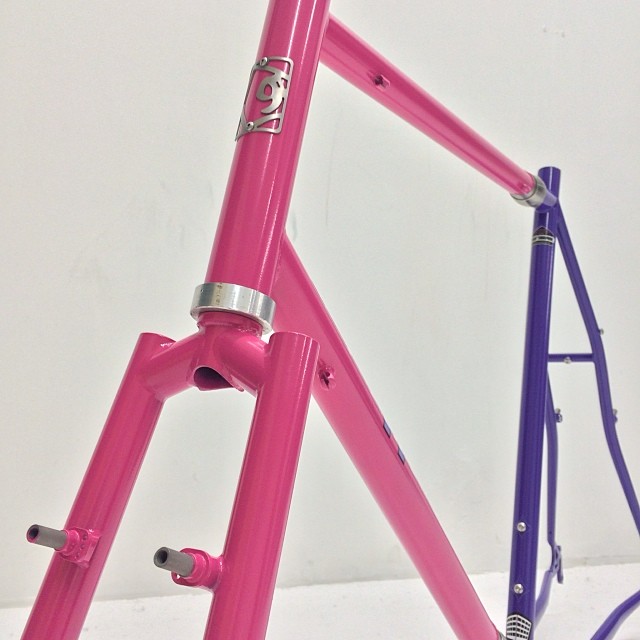
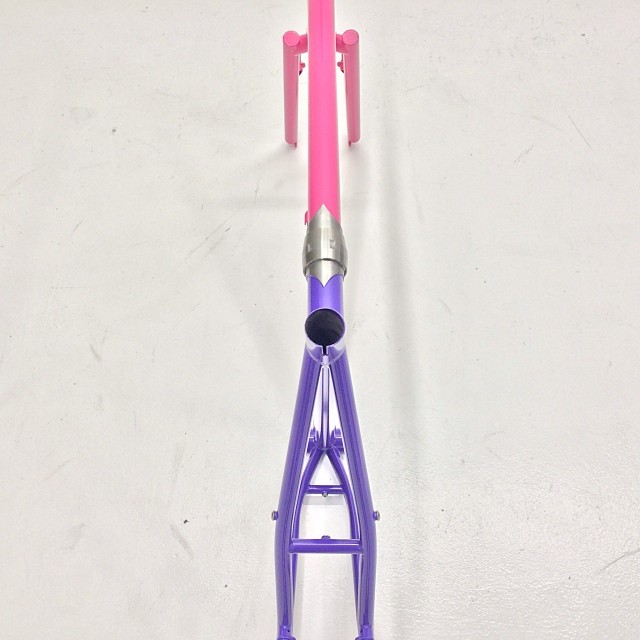
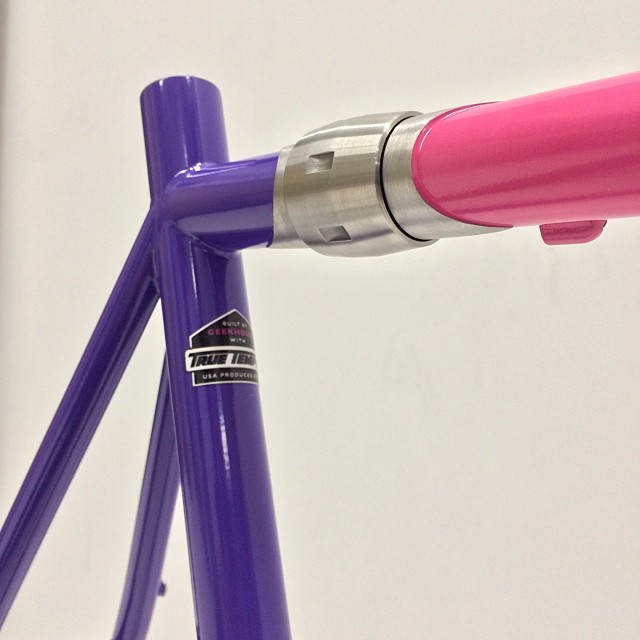
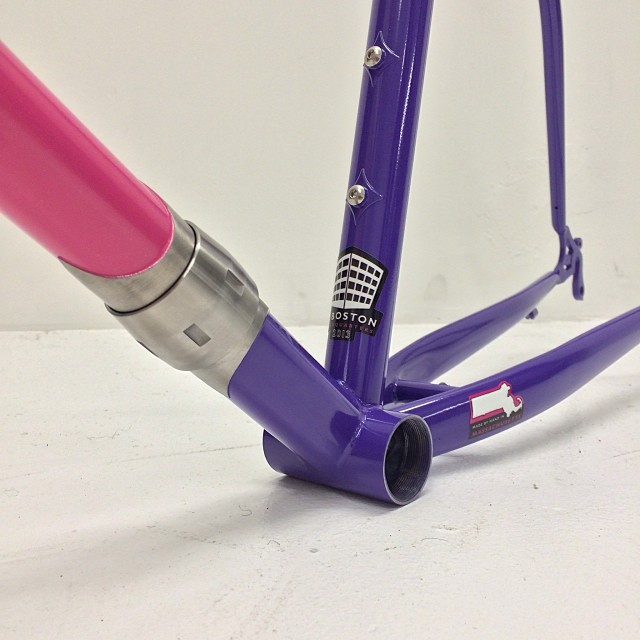
Benjamin Mako Hill: My Geekhouse Bike Frame

In 2011, Mika and I bought in big at the Boston Red Bones party s charity raffle supporting MassBike and NEMBA and came out huge. I won $500 off a custom frame at Geekouse Bikes. For years, Mika and I have been planning to do the Tour d Afrique route (Capetown to Cairo), unsupported, on bike. People that do this type of ride sometimes use an expedition touring frame. I worked with Marty Walsh at Geekhouse to design a bike based on this idea. The concept was a rugged steel touring frame, built for my body and comfortable over long distances, with two quirks:
  1. It s designed for 26 inch mountain bike wheels and mountain bike components to ensure that the bike is repairable with parts from the kinds of cheap mountain bikes that can be found almost everywhere in the world.
  2. It includes S&S torque couplers that let me split the frame in half to travel with the bike as standard luggage.
As our pan-Africa trip kept getting pushed back, so did the need for the bike. Last week, I finally picked up the finished bike from Marty s shop in Boston. It is gorgeous. I absolutely love it. Picture of Geekhouse frame (1)Picture of Geekhouse frame (2)Picture of Geekhouse frame (4) Picture of Geekhouse frame (3) I m looking forward to building up the bicycle over the next couple months and I ll post more pictures when it s finished. I am blown away by Marty s craftsmanship and attention to detail. I am psyched that his donation made this bike possible and that I was able to get the frame while helping cycling in Massachusetts!

26 January 2014

Neil Williams: Home server rack

The uses of this particular rack I ll cover in future entries this is about how I made the rack itself, with help from friends (Steve McIntyre & Andy Simpkins). A common theme is making allowances for using dev kit boards ready-to-rack ARM servers are not here yet. My aim was to have 4, possibly 6 ARM dev kit boards running services from home, so there was no need for a standard 42U rack, a 9U rack is enough. Hence:
Wall Mounted 9U 450mm deep 19 inch rack enclosure glass door To run various other services around the house (firewall, file server etc.), a microserver was also necessary:
HP 704941-421 ProLiant Micro Server (AMD Turion II Neo N54L 2.2GHz, 2GB RAM, 250GB HDD, 2 Core, 7th Generation) I chose to mount that on a bookcase beneath the wall mounted rack as it kept all the cables at the bottom of the rack itself. The microserver needed a second gigabit network card fitted to cope with being a firewall as well, if you do the same, ensure you find a suitable card with a low profile bracket. Some are described as being low profile but do not package the low profile bracket, only a low profile card and a full height bracket.
Intel EXPI9301CTBLK PRO1000 Network Card note the low profile bracket in the pack. The first of the dev kit requirements is the lack of boards which can be racked, so shelves are going to be needed, leading on to something to stop the boards wandering across the shelf when the cables are adjusted velcro pads in my case. Second requirement is that dev kit boards are notorious for not rebooting cleanly. Nothing to do with the image being run, the board just doesn t cut power or doesn t come back after cutting power. Sometimes this is down to early revisions of the board, sometimes the board pulls enough power through the USB serial converter to remain alive, whatever the cause, it won t reboot without user involvement. So a PDU becomes necessary remotely controllable. New units tend to be expensive and/or only suitable for larger racks, I managed to find an older 8 port APC unit, something like: (Don t be surprised if that becomes a dead link search for APC Smart Slot Master Switch Power Distribution Unit). Talking of power, I m looking to use SATA drives with these boards and the boards themselves come with a variety of wall wart plugs or USB cables, so a number of IEC sockets are needed not the usual plugs:
Power cable IEC C14 plug 13A socket 25 cm or, for devices which genuinely need 2A to boot (use the 1A for attached SATA or leave empty):

Black Universal 3.1A 15W 5V Dual USB Rapid Mains Charger Plug Check the power output rating of the USB plugs used to connect to the mains as well many are 1A or less. Keep the right plug for the right board.
Power is going to also be a problem if, like me, you want to run SATA drives off boards which support SATA. The lack of a standard case means that ATX power is awkward, so check out some cheap SATA enclosures to get a SATA connector with USB power. I am using these enclosures (prices seem to have risen since I obtained them):

Startech 2.5 inch eSATA USB External Hard Drive Enclosure for SATA HDD Along with these:
eSATA to SATA Serial External Shielded Cable 1m because the iMx53 boards have SATA connectors but the enclosure exports eSATA. Whilst this might seem awkward, the merit of having both eSATA and simple USB power on one enclosure is not to be under-estimated. (Avoid the stiffer black cables space will get tight inside the rack.) Naturally, a 2.5 inch SATA drive is going to be needed for each enclosure, I m using HDD but SSD is also an option. Also, consider simple 2 or 3 way fused adaptors so that the board and the SATA drive can be powered from a single PDU port, this makes rebooting much simpler if the board needs a power supply with integrated plug instead of over USB. Now to the networking (2 x 8 port was cheaper than 1 x 16):
Netgear GS108 8-port Gigabit Ethernet Unmanaged Switch Don t forget the cat5 cables too you ll want lots of short cables, 1m or shorter inside the rack and a few longer ones going to the microserver and wall socket. I used 8x1m. Naturally, on the floor below your rack you are going to put a UPS, so the PDU power then needs to be converted to draw from the UPS via IEC plugs instead of standard mains. I decided to use a 6 gang extension 1m cable with an IEC plug it was the only bit of wiring I had to do and even those are available ready-made if you want to do it that way. Depending on the board, you may need your own serial to USB converters, you ll certainly need some powered USB hubs. I m using a wall mounted 9U rack, so I also needed a masonry drill and 4 heavy duty masonry M8 bolts. The rack comes with a mounting plate which needs to be bolted to the wall but nothing else is included. This step is much easier with someone else to take the weight of the rack as it is guided into the brackets on the mounting plate the bracket may need a little persuasion to allow for the bolt heads to not get in the way during mounting. Once mounted, the holes in the back of the rack allow for plenty of room, it s just getting to that point. The rack has side panels which latch out easily, providing easy maintenance. The glass door can be easily reversed to open from the opposite side. However, the key in the glass door is largely useless. The expectation is that the units in the rack are attached at the front but the dev boards on shelves are not going to be protected by a key in the front door. The key therefore ends up being little more than a handle for the glass door. OK. If you ve got this far, it s a case of putting things together:
Economy Cage Nut Tool 19 inch racking for cagenut extraction Yes, you really do want one. Fine, do without the premium one, but the economy one will save you a lot of (physical) pain. At this stage, it becomes clear that the normal 19 inch server rack shelves don t leave a lot of room at the back of the rack for the cables and there are a lot of cables. Each board has power, USB serial connection and network. The SATA has power too. The PDU has a power lead and you ll need network switches too. The network switches need power and an uplink cable. I positioned the supports in the rack as far forward as possible and attached the shelves to give enough room for the PDU on the base of the rack, the network switches resting on top and the extension bar (with the heavier, stiffer cables) at the back. (I need to bring my shelves another 1 or 2 positions further forward as there is barely enough room for one cable between the shelf and the back of the rack and that makes moving boards around harder than it needs to be.) The PDU defaults to enabling all ports at startup, so connect to it over telnet and turn off the ports before connecting things and sorting out the network interface to what the rest of the lab needs. (I m using a 10. range and the PDU was originally set to use 192.168.1.) That s about it as far as the hardware setup is concerned. Just time to label up each board, note down which PDU port does which device, which serial to USB converter is on which device on the microserver and check the power my initial problem with one board was traced to the inability of the board to power SATA off the on-board USB port even when using the provided 2A power supply. That meant adding a standard mains adaptor to feed both the SATA power and the board power off the one PDU port there is little point powering off the board but not the SATA, or vice versa. I haven t totalled up the expenditure but the biggest expenses were the microserver and the wall mounted rack but don t underestimate how much it will cost to buy 6 IEC plugs, various USB serial converters and how much you may spend on peripheral items. There is quite a lot of room on the 2 shelves for more boards, what will limit the deployment in this rack is space for the cables, especially power. The shorter the power cables, the easier it will be to maintain the devices in the rack. It might be worth looking at a 12U rack, if only to give plenty of space for cables. Once I ve got the software working, I ll describe what this rack will be doing it s got something to do with Debian, ARM, Linux and tests but you ve probably already guessed that much

Justus Winter: On portability of init systems

There is one thing in the current init system debate that irritates me. It is about the portability of init systems. The new init systems are evaluated by how portable they are. This is one of the arguments that is most often brought against systemd, which is understandable given the polarizing attitude of one of systemd's authors. In this context, the currently used sysvinit is considered portable. But in my book, it is not portable at all. But why can we use sysvinit to boot Debian/ kFreeBSD,Hurd ? Debian/kFreeBSD uses linprocfs for /proc to provide a familiar Linux-like environment for the userspace tools available in Debian (say, pgrep). linprocfs was originally written by the FreeBSD folks to support running Linux binaries using the Linux Binary Compatibility layer. Debian/Hurd uses procfs to provide /poc. This procfs translator is written mainly to provide a Linux-compatible /proc filesystem for the same reason linprocfs is used by Debian/kFreeBSD. So sysvinit works on those system not because it is portable, but because the environment has been made Linux-like enough for sysvinit. We (most likely anyone not using Linux) often do this, because it is the easiest way to run popular software developed (mainly) for Linux. This is often the path of the least resistance, as opposed to getting the upstream project to support the native way of doing things on platform X. During gsoc last year I had to patch our procfs to finally be able to safely shut down Debian/Hurd systems using sysvinit. The problem was, that sysvinit at certain runlevel transitions (like shutting down, or I guess, switching to single user mode), sysvinit assumes that it is okay to stop and kill (almost) all processes on the system (that's what killall5 does). This might be okay on monolithic systems, but on (multiserver) microkernel systems like the Hurd, where your root filesystem and your network driver and stack are running as userspace processes, it is clearly not. I wonder how Linux systems using a FUSE-based root filesystem get away with this. This highlights that not only sysvinit depends on a Linux-specific kernel interface (/proc), but it also hard-codes assumptions about the system architecture. Amusingly, systemd get's this right (ok, I'm not sure if it does, but it could get this right...). systemd organizes processes in cgroups, one for each service it starts and one for each login session or something like that. It can (could?) kill only those processes in it was responsible for, leaving all essential translators (system servers) alone. In fact, even my tiny cgroupfs prototype can keep track of translators that are started by the root filesystem translator.

Daniel Pocock: Beyond init systems: other opportunities for simplification

One thing that everybody agrees on in the debate about Debian's init system replacement is that the manifests used by most of the new schemes are far more concise than traditional init scripts. Simplification need not stop there however. Another opportunity for simplification exists in the creation of users at package installation. Every packaging tool has a different approach and all of them involve multiple lines of boilerplate script code duplicated between hundreds of packages that all need exactly the same thing. What is worse, embedding this logic into the postinst scripts on Debian or %post logic of an RPM makes it far more awkard for a system administrator to audit the user account requirements of packages (when installing many of them in a hurry) or to customise the logic for a whole site without rebuilding the whole packages. Potential improvement How to improve this? Well, packages (on any distribution) could be invited to declare the user and group accounts they depend on. A central configuration parameter in /etc/dpkg/dpkg.cfg or /etc/rpm would then control how the package manager behaves, with several possible options:
  • Create users/groups on demand without prompting
  • Abort installation/configuration of any package if the pre-requisite users do not exist on the system
  • Prompt: at the beginning of any package install, ask the administrator to create the users himself before proceeding, with an option to abort and potentially displaying some convenient LDIF fragments and other samples that the administrator can cut and paste.
Running a command like apt-get --simulate would give a system administrator an immediate view of all users/groups required by the packages they propose to install.

Matthias Klumpp: Next stop: FOSDEM 14

After years of missing this conference, I will finally make it to Brussels this time! I will even have some talks, one about Listaller (in the lightning-talks section) and one about AppStream and Listaller in the Distributions track. The lightning-talk will explain why distributing (some) applications independent from the distribution makes sense, and how Listaller does this. I will also very briefly talk about the concepts behind Listaller and which tools it offers for application developers to create & package cross-distro apps. The AppStream & Listaller talk will be much more detailed. It will cover the rationale for AppStream, what AppData is good for and how AppData files relate to AppStream. I will also reflect the AppData adoption in GNOME/Fedora and why GNOME-Software is the right way to go forward in developing software-centers. It will of course also include our future plans for AppStream. On the Listaller side, I will talk about how Listaller is connected to AppStream and PackageKit and why distributions should ship a way to install cross-distro packaged apps at all. I will explain module-definitions and why they are useful. An overview of the internals of Listaller and it s system integration is also included, as well as how it can be compared to competing installation solutions. If you are at FOSDEM and have questions about AppStream/PackageKit/Listaller/Tanglu/Debian/etc., please ask them! ;-) See you there! FOSDEM

25 January 2014

Ben Hutchings: Looking back on my time at Solarflare, part 1

Friday was my last day at Solarflare Communications, which I joined in 2006 (originally as Level 5 Networks). When I started, Level 5 Networks (L5N) had a 2-port gigabit Ethernet controller called EF1 and a user-level network stack called EtherFabric which ran on Linux. It had nearly completed the Falcon project to develop a 10-gigabit controller (also supporing a 2-port gigabit mode) and was porting EtherFabric to Windows. Later that year, however, L5N merged with Solarflare Communications (SF), which was developing a 10GBASE-T PHY (for 10-gigabit Ethernet over twisted-pair cables). The investors and management saw the opportunity to create an integrated 10GBASE-T LAN-on-motherboard chip that would be attractive to OEMs and so had the potential for mass sales. EtherFabric was put on the back-burner, but regular net drivers for Linux, Windows and other operating systems became more important. In a change from my previous jobs, my initial role at L5N was to maintain and extend the in-house test automation software, Runbench, written in Python. I worked with Dickon Reed who had written most of Runbench up to then. One of my first major tasks was to extend it to cover DUTs running Windows. Aside from changing Runbench itself, I wrote a simple SSH server to be installed on DUTs, using the Twisted.Python framework. (Cygwin's port of OpenSSH wasn't suitable for running a lot of native Windows commands.) I rewrote the test-installation script for the Windows driver itself, converting it to Python (with a C extension to get around the WOW64 nonsense). As Windows does not allow loading a driver just once (like insmod in Linux), except by using the kernel debugger, I added a time check in the driver so the test-installation script can make it fail early when reloaded after a reboot, so that a crasher bug in the probe path would usually be recoverable. In 2007 I persuaded management in Cambridge to loan several older servers to DebConf. I took them there and back by car, and they were used to convert video for live streams and recordings. (This was repeated in 2009.) I was also asked to work on other small development tasks, including some cleanup on the Linux net driver (sfc). In mid-2007, when SF decided it was time to get sfc upstream (in-tree), I joined Steve Hodgson and Robert Stonehouse in working on that. Out-of-tree (separately distributed) drivers for Linux normally need a large number of preprocessor conditions for compatibility with Linux's kernel module API across a range of supported versions. They may also implement some features with a driver-specific interface that should be replaced with a standard interface (possibly including the work to define that standard). They may not comply with the kernel coding style or unwritten conventions for kernel code. All of these problems were present and had to be dealt with. As part of this work, I extended unifdef so that it could be used to remove all of the backward-compatibility and not-for-upstream code without introducing extra blank lines. I could then export the out-of-tree driver from CVS(!) into a kernel source tree automatically and turn it into a patch or patch series that would stand a chance of being acceptable upstream. Our first few attempts got little response, but eventually we newbies got the message that the driver was simply too big for a single submission and that putting patches on a web site because they're too big for the list was not a solution. In the next week, I removed about half of the code (on a git branch), resulting in a relatively lean driver that could be sent to the netdev list. And finally the 9th (I think) submission was accepted. Following this, I continued to work on sfc but was also brought into the Siena project. Siena (SFL9021) was the LAN-on-motherboard chip that had been planned following the merger. It combined a dual-port controller based on Falcon with a 10GBASE-T PHY and a management controller (MC) to support Lights-Out Management (LOM). (Since 10GBASE-T has not taken off, it is now mostly sold as the SFC9020 variant in which the PHY is disabled.) I worked on some of the test framework and test cases for validating the controller design in software simulation and FPGA. In the course of this I learned to read and (somewhat) understand the chip design written in Verilog, but only made a single trivial fix to it. In August 2009, the first Siena ASICs came back from the fab. There were a few ASIC-specific bugs but all of them were quickly worked around in firmware, so it would soon be ready for production. But there was much work still to be done on the driver and firmware. The firmware had until then been running in a smaller block of RAM with no peripherals to manage, while sfc had earlier been modified just enough to configure a sim or FPGA for running a userland test application. sfc now had many special cases scattered around it, and would tell the MC firmware to peek and poke registers that were no longer directly accessible from the host. The software and firmware developers had agreed that, in order to support LOM, the MC would be responsible for managing the ports and all peripherals and drivers would send higher-level requests to the MC. As a bonus, this removed the need for the driver to know the details of each new board, so that it would not be necessary to backport sfc into distribution kernels very often. Over the next few months, the firmware team did an excellent job of defining and implementing those operations, including writing the driver-side functions to invoke them. Meanwhile, Steve and I concentrated on refactoring sfc so most of the Falcon/Siena differences could be abstracted through a few structures with function pointers. The refactoring and new code for Siena were completed and submitted upstream in several large patch series in October and November. In fact, there were so many patches that Solarflare appeared in LWN's table of who wrote Linux 2.6.33 (as did I, thanks also to another patch series adding firmware metadata to many drivers). Sadly we had missed Linux 2.6.32 which was a longterm stable branch and used in many distributions, but I was able to get this version backported into all the major distributions over the next year. (To be continued.)

24 January 2014

Erich Schubert: Definition of Data Science

Everything is "big data" now, and everything is "data science". Because these terms lack a proper, falsifiable definition.
A number of attempts to define them exist, but they usually only consist of a number of "nice to haves" strung together. For Big Data, it's the 3+ V's, and for Data Science, this diagram on Wikipedia is a typical example.
This is not surprising: effectively these term are all marketing, not scientific attempts at definiting a research domain.
Actually, my favorite definition is this, except that it should maybe read pink pony in the middle, instead of unicorn.
Data science has been called "the sexiest job" so often, this has recently led to an integer overflow.
The problem with these definitions is that they are open-ended. They name some examples (like "volume") but they essentially leave it open to call anything "big data" or "data science" that you would like to. This is, of course, a marketers dream buzzword. There is nothing saying that "picking my nose" is not big data science.

If we ever want to get to a usable definition and get rid of all the hype, we should consider a more precise definition; even when this means making it more exclusive (funnily enough, some people already called above open-ended definitions "elitist" ...).
Big data:
  • Must involve distributed computation on multiple servers
  • Must intermix computation and data management
  • Must advance over the state-of-the-art of relational databases, data warehousing and cloud computing in 2005
  • Must enable results that were unavailable with earlier approaches, or that would take substantially longer (runtime or latency)
  • Must be disruptively more data-driven
Data science:
  • Must incorporate domain knowledge (e.g. business, geology, etc.).
  • Must take computational aspects into account (scalability etc.).
  • Must involve scientific techniques such as hypothesis testing and result validation.
  • Results must be falsifiable.
  • Should involve more mathematics and statistics than earlier approaches.
  • Should involve more data management than earlier approaches (indexing, sketching&hashing etc.).
  • Should involve machine learning, AI or knowledge discovery algorithms.
  • Should involve visualization and rapid prototyping for software development.
  • Must satisfy at least one of these shoulds in a disruptive level.
But this is all far from a proper definition. Partially because these fields are so much in flux; but largely because they're just too ill-defined.
There is a lot of overlap, that we should try to flesh out. For example, data science is not just statistics. Because it is much more concerned with how data is organized and how the computations can be made efficiently. Yet often, statistics is much better at integrating domain knowledge. People coming from computation, on the other hand, usually care too little about the domain knowledge and falsifiability of their results - they're happy if they can compute anything.
Last but not least, nobody will be in favor of such a rigid definition and requirements. Because most likely, you will have to strip that "data scientist" label off your business card - and why bite the hand that feeds? Most of what I do certainly would not qualify as data science or big data anymore with an "elitist" definition. While this doesn't lessen my scientific results, it makes them less marketable.
Essentially, this is like a global "gentlemans agreement". Buzz these words while they last, then move on to the next similar "trending topic".

Maybe we should just leave these terms to the marketing folks, and let them bubble them till it bursts. Instead, we should just stick to the established and better defined terms...
Thank you.
Of course, sometimes you will have to play Buzzword Bingo. Nobody is going to stop you. But I will understand that you are doing "playing buzzword bingo", unless you get more precise.
Once you then have results that are so massively better, and really disrupted science, then you can still call it "data science" later on.
You have been seeing, I've been picking on the word "disruptive" a lot. As long as you are doing "business as usual", and focusing on off-the-shelf solution, it will not be disruptive. And it then won't be big data science, or a big data approach that yields major gains. It will be just "business as usual" with different labels, and return results as usual.
Let's face it. We don't just want big data or data science. What everybody is looking for is disruptive results, which will require a radical approach, not a slight modification involving slightly more computers of what you have been doing all along.

Julien Danjou: OpenStack Ceilometer Icehouse-2 milestone released

Yesterday, the second milestone of the Icehouse development branch of Ceilometer has been released and is now available for testing and download. This means the first half of the OpenStack Icehouse development has passed! New features For the Icehouse-1 milestone, we barely had enough time to implement 2 blueprints. We almost did a better job this time, but finally only 2 blueprints were implemented again. This is really far from what we planned initially. The infrastructure slowdown issues and the lower number of reviews is probably the root cause here. Anyway, Ceilometer now offers a REST API to accesses the stored event. The initial work to replace the /v2/meters endpoint with something more RESTy has started with the implementation of /v2/samples. Bug fixes Thirty-one bugs were fixed, though most of them might not interest you so I won't elaborate too much on that. Go read the list if you are curious. Toward Icehouse 3 We now have 29 blueprints targeting the Ceilometer's third Icehouse milestone, with some of them are already started and ready to merge. However, it's likely that we won't make all of them. As usual, the priority should indicate how confident we are that we want and need a feature. Still, it's likely the roadmap will be adjusted in the upcoming weeks. I'll try to make sure we'll get there without too much trouble for the 6th March 2013. Stay tuned!

23 January 2014

John Goerzen: Why and how to run ZFS on Linux

I m writing a bit about ZFS these days, and I thought I d write a bit about why I am using it, why it might or might not be interesting for you, and what you might do about it. ZFS Features and Background ZFS is not just a filesystem in the traditional sense, though you can use it that way. It is an integrated storage stack, which can completely replace the need for LVM, md-raid, and even hardware RAID controllers. This permits quite a bit of flexibility and optimization not present when building a stack involving those components. For instance, if a drive in a RAID fails, it needs only rebuild the parts that have actual data stored on them. Let s look at some of the features of ZFS: Although it is often considered a server filesystem, ZFS has been used in plenty of other situations for some time now, with ports to FreeBSD, Linux, and MacOS. I find it particularly useful: The added level of security in having cheap snapshots available is almost worth it by itself. ZFS drawbacks Compared to other Linux filesystems, there are a few drawbacks of ZFS: Converting to ZFS I have written up an extensive HOWTO on converting an existing system to use ZFS. It covers workarounds for all the boot-time bugs I have encountered as well as documenting all steps needed to make it happen. It works quite well. Additional Hints If setting up zvols to be used by VirtualBox or some such system, you might be interested in managing zvol ownership and permissions with udev.

Keith Packard: Altos1.3.1

AltOS 1.3.1 Bug fixes and improved APRS support Bdale and I are pleased to announce the release of AltOS version 1.3.1. AltOS is the core of the software for all of the Altus Metrum products. It consists of firmware for our cc1111, STM32L151, LPC11U14 and ATtiny85 based electronics and Java-based ground station software. This is a minor release of AltOS, including bug fixes for TeleMega, TeleMetrum v2.0 and AltosUI . AltOS Firmware Antenna down fixed and APRS improved Firmware version 1.3 has a bug in the support for operating the flight computer with the antenna facing downwards; the accelerometer calibration data would be incorrect. Furthermore, the accelerometer self-test routine would be confused if the flight computer were moved in the first second after power on. The firmware now simply re-tries the self-test several times. I went out and bought a real APRS radio, the Yaesu FT1D to replace my venerable VX 7R. With this in hand, I changed our APRS support to use the compressed position format, which takes fewer bytes to send, offers increased resolution and includes altitude data. I took the altitude data out of the comment field and replaced that with battery and igniter voltages. This makes APRS reasonably useful in pad mode to monitor the state of the flight computer before boost. Anyone with a TeleMega should update to the new firmware eventually, although there aren t any critical bug fixes here, unless you re trying to operate the device with the antenna pointing downwards. AltosUI TeleMega support and offline map loading improved. I added all of the new TeleMega sensor data as possible elements in the graph. This lets you see roll rates and horizontal acceleration values for the whole flight. The Fire Igniter dialog now lists all of the TeleMega extra pyro channels so you can play with those on the ground as well. Our offline satellite images are downloaded from Google, but they restrict us to reading 50 images per minute. When we tried to download a 9x9 grid of images to save for later use on the flight line, Google would stop feeding us maps after the first 50. You d have to poke the button a second time to try and fill in the missing images. We fixed this by just limiting how fast we load maps, and now we can reliably load an 11x11 grid of images. Of course, there are also a few minor bug fixes, so it s probably worth updating even if the above issues don t affect you.
22 January 2014

Erich Schubert: The init wars

The init wars have recently caught a lot of media attention (e.g. heise, prolinux, phoronix). However, one detail that is often overlooked: Debian is debating over the default, while all of them are already supported to a large extend, actually. Most likely, at least two of them will be made mandatory to support IMHO.
The discussion seems to be quite heated, with lots of people trying to evangelize for their preferred system. This actually only highlights that we need to support more than one, as Debian has always been about choice. This may mean some extra work for the debian-installer developers, because choosing the init system at install time (instead of switching later) will be much easier. More often than not, when switching from one init system to another you will have to perform a hard reset.
If you want to learn about the options, please go to the formal discussion page, which does a good job at presenting the positions in a neutral way.
Here is my subjective view of the init systems:
  • SysV init is the current default, and thus deserves to be mentioned first. It is slow, because it is based on a huge series of shell scripts. It can often be fragile, but at the same time it is very transparent. For a UNIX system administrator, SysV init is probably the preferred choice. You only reboot your servers every year anyway.
  • upstart seems to be a typical Canonical project. It solves a great deal of problems, but apparently isn't good enough at it for everybody, and they fail at including anyone in their efforts. Other examples of these fails include Unity and Mir, where they also announced the project as-is, instead of trying to get other supporters on board early (AFAICT). The key problem to widespread upstart acceptance seems to be the Canonical Contributor License Agreement that many would-be contributors are unwilling to accept. The only alternative would be to fork upstart completely, to make it independent of Canonical. (Note that upstart nevertheless is GPL, which is why it can be used by Debian just fine. The CLA only makes getting patches and enhancements included in the official version hard.)
  • systemd is the rising star in the init world. It probably has the best set of features, and it has started to incorporate/replace a number of existing projects such as ConsoleKit. I.e. it not only manages services, but also user sessions. It can be loosely tied to the GNOME project which has started to rely on it more and more (much to the unhappyness of Canonical, who used to be a key player for GNOME; note that officially, GNOME chose to not depend on systemd, yet I see this as the only reliable combination to get a complete GNOME system running, and since "systemd can eventually replace gnome-session" I foresee this tie to become closer). As the main drawback, systemd as is will (apparently) only work with the Linux kernel, whereas Debian has to also support kFreeBSD, NetBSD, Hurd and the OpenSolaris kernels (some aren't officially supported by Debian, but by separate projects).
So my take: I believe the only reasonable default is systemd. It has the most active development community and widest set of features. But as it cannot support all architectures, we need mandatory support for an alternative init system, probably SysV. Getting both working reliably will be a pain, in particular since more and more projects (e.g. GNOME) tie themselves closely to systemd, and would then become Linux-only or require major patches.
I have tried only systemd on a number of machines, and unfortunately I cannot report it as "prime time ready" yet. You do have the occasional upgrade problems and incompatibilities, as it is quite invasive. From screensavers activating during movies to double suspends, to being unable to shutdown my system when logged in (systemd would treat the login manager as separate session, and not being the sole user it would not allow me to shut down), I have seen quite a lot of annoyances happen. This is an obvious consequence of the active development on systemd. This means that we should make the decision early, because we will need a lot of time to resolve all these bugs for the release.
There are more disruptions coming on the way. Nobody seems to have talked about kDBUS yet, the integration of an IPC mechanism like DBUS into the Linux kernel. It IMHO has a good chance of making it into the Linux kernel rather soon, and I wouldn't be surprised if it became mandatory for systemd soon after. Which then implies that only a recent kernel (say, mid-2014) version might be fully supported by systemd soon.
I would also like to see less GNOME influence in systemd. I have pretty much given up on the GNOME community, which is moving into a UI direction that I hate: they seem to only care about tablet and mobile phones for dumb users, and slowly turn GNOME into an android UI; selling black background as major UI improvements. I feel that the key GNOME development community does not care about developers and desktop users like me anymore (but dream of being the next Android), and therefore I have abandoned GNOME and switched to XFCE.
I don't give upstart much of a chance. Of course there are some Debian developers already involved in its development (employed by Canonical), so this will cause some frustration. But so far, upstart is largely an Ubuntu-only solution. And just like Mir, I don't see much future in it; instead I foresee Ubuntu going systemd within a few years, because it will want to get all the latest GNOME features. Ubuntu relies on GNOME, and apparently GNOME already has chosen systemd over upstart (even though this is "officially" denied).
Sticking with SysV is obviously the easiest choice, but it does not make a lot of sense to me technically. It's okay for servers, but more and more desktop applications will start to rely on systemd. For legacy reasons, I would however like to retain good SysV support for at least 5-10 more years.

But what is the real problem? After all, this is a long overdue decision.
  • There is too much advocacy and evangelism, from either side. The CTTE isn't really left alone to do a technical decision, but instead the main factors have become of political nature, unfortunately. You have all kinds of companies (such as Spotify) weigh in on the debate, too.
  • The tone has become quite aggressive and emotional, unfortunately. I can already foresee some comments on this blog post "you are a liar, because GNOME is now spelled Gnome!!1!".
  • Media attention. This upcoming decision has been picked up by various Linux media already, increasing the pressure on everybody.
  • Last but not least, the impact will be major. Debian is one of the largest distributions, last but not least used by Ubuntu and Steam, amongst others. Debian preferring one over the other will be a slap in somebodys face, unfortunately.
So how to solve it? Let the CTTE do their discussions, and stop flooding them with mails trying to influence them. There has been so much influencing going on, it may even backfire. I'm confident they will find a reasonable decision, or they'll decide to poll all the DDs. If you want to influence the outcome provide patches to anything that doesn't yet fully support your init system of choice! I'm sure there are hundreds of packages which do neither have upstart nor systemd support yet (as is, I currently have 27 init.d scripts launched by systemd, for example). IMHO, nothing is more convincing than have things just work, and of course, contributing code. We are in open source development, and the one thing that gets you sympathy in the community is to contribute code to someone elses project. For example, contribute full integrated power-management support into XFCE, if you include power management functionality.
As is, I have apparently 7 packages installed with upstart support, and 25 with systemd support. So either, everybody is crazy about systemd, or they have the better record of getting their scripts accepted upstream. (Note that this straw poll is biased - with systemd, the benefits of not using "legacy" init.d script may just be larger).

21 January 2014

John Goerzen: Married!

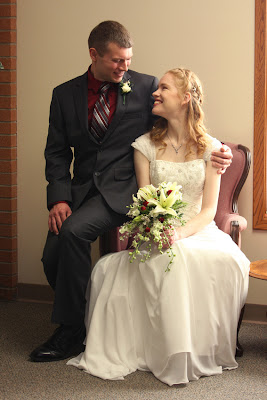
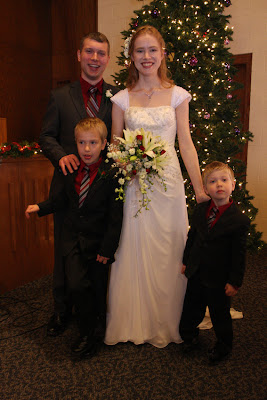
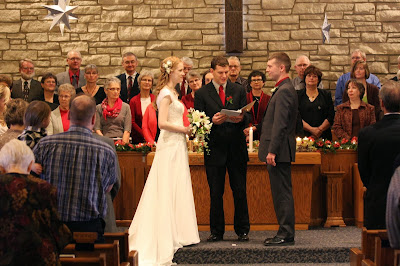
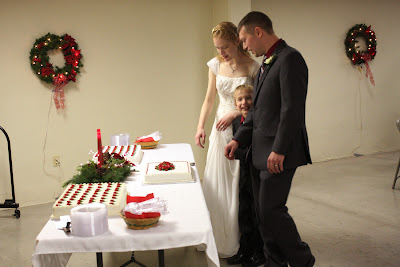
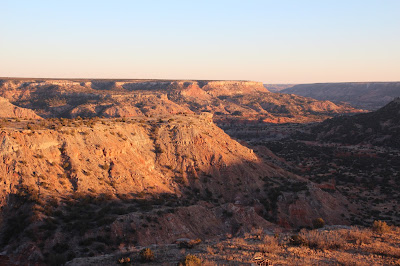
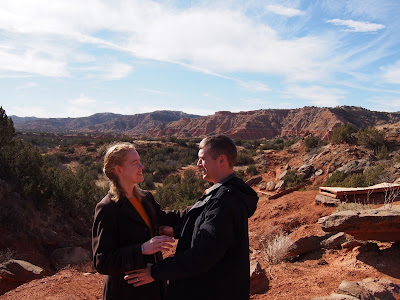
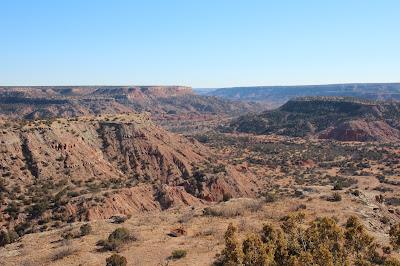
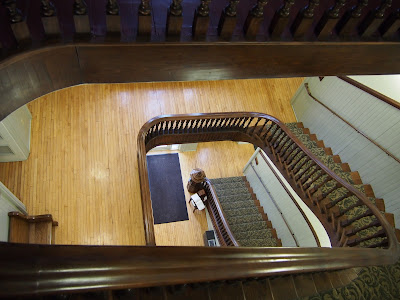
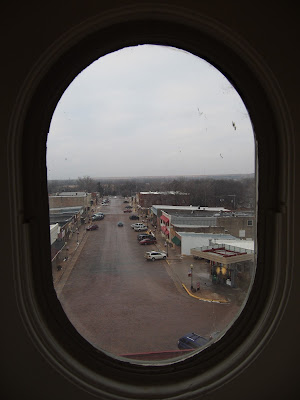
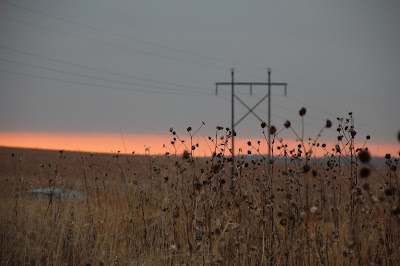
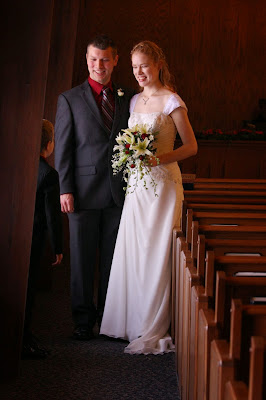
One week before the wedding, to Laura: Mono won t just clear up right away. One week before the wedding, to me: That s going to need stitches. Yes, not long before the wedding, Laura had come down with mononucleosis and I had cut into my finger with a very sharp knife while cutting bread requiring a trip to the emergency room to get stitches. Two days before we got married, instead of moving furniture, I was getting stitches out of my finger. It wasn t the kind of week we had planned. But it was the happiest, most amazing occasion I could have ever imagined. As I wrote last month, I am richly blessed indeed. Our wedding was three days after Christmas. The church was still decorated for Christmas, with the tree in on corner, glittering stars suspended in mid-air on cables from the walls, wreaths and candles in the windows, and it was a joy-filled day. Before the ceremony, we took pictures the only part of the day Jacob and Oliver weren t thrilled with. Nevertheless, we got some fun ones. Laura and I seem to know quite a few pastors between us and not just because Laura is a pastor. My brother officiated with the wedding vows, his wife with scripture and a prayer of blessing, and the church s pastor gave the message. Laura and I wrote in our wedding program, Music has long been a thread running through both our lives. We have enjoyed singing together, playing piano and pennywhistle duets, attending concerts, and even exploring old hymnals. Music is also one of the best ways to have a conversation even a conversation with God. We wrote a page in the program about each of the hymns that were a part of the wedding, and why we picked them. The combined church choirs of my home church and Laura s church sang John Rutter s beautiful arrangement of For the Beauty of the Earth (click here to listen to a different choir). Hearing For the beauty of each hour , For the joy of human love , and Lord of all, to thee we raise this our joyful hymn of praise was perfect for the day. It was with such great happiness that we walked out of the sanctuary, a married couple, to the sound of the congregation singing Joy to the World! Jacob and Oliver were so very excited on our wedding day. They happily explored the church while waiting for things to happen. We had them help us light our unity candle, and they were pleased with that. Jacob loved his suit, which made him look just like me. And they were, of course, delighted with the cake and in the middle of it all. For our honeymoon, we managed to get two weeks of vacation, and spent about half of it at home. We had looked at various options for retreats in the country, but eventually concluded that our house is a retreat in the country, so might as well enjoy it at home. We also went to the Palo Duro Canyon area near Amarillo in the Texas panhandle, staying in a small B&B in Canyon, TX. Palo Duro is the second-largest canyon in North America, and quite colorful year-round. What a beautiful place to go for our honeymoon! By the time we got there, Laura was getting past mono, and we went for hikes in the canyon on two different days hiking a total of 10 miles, including a hike up the side of the canyon. After we got back home, on the last weekday of our honeymoon, we went back to the Flint Hills of Kansas, to some of the same places we had spent our third date. We climbed the windy staircase at the Chase County Courthouse, the oldest courthouse still in use in Kansas. And peered out its famous oval window. We found the last remnant of the old ghost town of Elk, ate at the same restaurant we had that day. It brought back wonderful memories, and it was a good day in itself. Because even though it was a gold, drizzly, overcast day in January, this time, we were married. And this year, Thanksgiving is all year.

Next.

Previous.