Search Results: "az"

4 September 2006

Dann Frazier: Travelling over the Holidays

I travelled quite a bit over the break. First leg was home to New Mexico for Christmas. The night I arrived, YD's band Absolute Uncertainties played a short birthday party set. The rest of the week was spent mostly hanging out with my nieces & nephews. They're pretty fun to hang out with, now that most of them can carry on conversations. Then it was off to Las Vegas. But I didn't stop at that one & instead ventured on to the one in Nevada. I drove to Albuquerque, had lunch with Skye & Casey, then met up with YD to fly to Vegas. After nearly missing the flight to fix a flat on the rental, we were on our way. This was YD's first time on an airplane, and he didn't even throw up on me. That's a true friend. A bunch of us stayed at a friend's house. We spent a lot of time in the hot tub, drank a lot of Coors Light, and ate a lot of Del Taco.

Dann Frazier: Patch Tracking Summary Page

A while back, we started tracking security issues across the various security-supported packages in svn. We're slowly refining the format, but it seems to be working pretty well. In my at-the-parents-for-the-holidays-boredom, I wrote a script to create a summary page. It still needs some smarts about dealing with the linux-2.6 package, and needs a post-commit hook to auto-regenerate. Hopefully I'll have it active by next week.

Dann Frazier: Woody Kernel Security Updates

I've started a wiki to track the status of woody security updates. I think the only problem here is gonna be testing. But, if there's noone around with a woody system to test on, then there's probably not much of a userbase for the updates anyway.

Dann Frazier: Hipster-Wear

I need to start a line of clothing called "Hipster-Wear". Clothing featuring phrases such as

Dann Frazier: New Pornographers, Destroyer & Immaculate Machine

I hadn't heard of Immaculate Machine before, so I downloaded the mp3s they had posted online. They sounded pretty awesome, so I made sure to show up early. Not since the last New Pornographers show have I gotten such good parking at the Gothic (the marquee in the back). Not only that, but some guy with an extra ticket sold it to me for $15 ($17 at the door). The night was starting out right. Just as I walked in and ordered a Gin & Tonic, Immaculate Machines started their set. They were pretty upbeat & rockin; I picked up their new CD. Destroyer played next. I'd listened to a number of tracks available from their site as well. A few of them were pretty good; I really liked the tracks with the horns - but they didn't bring them to the show. I like Dan Bejar's vocals on the New Pornographers albums, but I'm not much of a Destroyer fan. The New Pornographer's set was excellent. They started off with Twin Cinema & Use It - their first two singles off the new album. I always think its cool when bands get their singles out of the way; but that might just be me remembering a Rolling Stone article about the Breeders, and how cool the author thought it was that they started the set with Cannonball. The vocalist/keyboardist (and also Carl Newman's niece, it seems) played the entire set with them, as did the bassist from Destroyer. Dan Bejar came out for a few songs and seemed to be getting a bit a little tipsy near the end. A lot more people showed up than last time I saw the New Pornographers. But that's probably because they were competing with a Flaming Lips/Modest Mouse show the same night.

Fumitoshi Ukai: kazehakase 0.3.1-2 uploaded

Hidetaka Iwai made new package to follow mozilla upgrades to 1.7.12.

Fumitoshi Ukai: kazehakase 0.3.1-1 uploaded

New upstream version of kazehakase has been released on day of Niku (29) and Hidetaka Iwai packaged it. It now be built with GNU TLS so that it depends on libgnutls-dev. But when I built his package in my environment, it failed because of gnutls_session_t was not defined. This is because I had installed libgnutls11-dev that provides libgnutls-dev, so it satisfied build-dependency. However, latest (or actual) libgnutls-dev is development package for libgnutls12 and this is what kazehakase should build-depends on. I wonder kazehakase should build-depends on libgnutls-dev (>= 1.2.6) or build-conflicts libgnutls11-dev. Probably, it wouldn't appear FTBFS bug on buildd, because buildd will try to install libgnutls-dev....

Benjamin Mako Hill: Big News

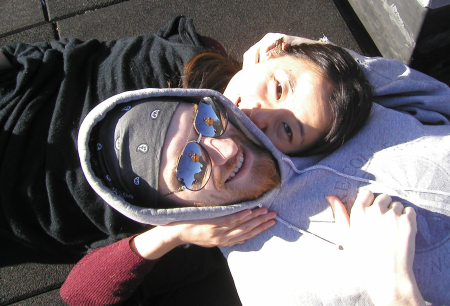
Believe it or not, there is news that is even cooler than the free content and expression definition. The news is that after knowing each other and dating for something like 7 or 8 years -- on and off but mostly on -- Mika and I are going to be getting married. Here's a picture of the two of us at a picnic last weekend:
/copyrighteous/images/mika_mako_boathouse.png
If you read my blog, you've probably seen my frequent links to hers. If you hung out with me in Seattle, Boston, or New York, in the last 3 years or have ever visited The Acetarium, you probably already know her. We've told our families and many of close friends and will going ahead with a wedding and parties in the coming months. At the very least, we'll be having parties in Cambridge (Massachusetts) and in Seattle. Neither of us are particularly traditional and I don't imagine we'll make a very traditional married couple. But we are crazy about each other and in it for the long haul. And that's what counts. The only bad news it that it means that I won't be making Debconf this year -- for the first time in four years. With a little bit of luck I'll be back (perhaps with Mika who attended Debconf 4) next year. If you want to send messages of congratulations. You could make us really happy by sending them in the form of cards or postcards. You can mail those to:
Benjamin Mako Hill and Mika Matsuzaki
The Acetarium
1010 Massachusetts Ave, Apt 54
Cambridge, MA 02138
USA
Stay tuned for information on forthcoming parties and celebrations.

Benjamin Mako Hill: A Done Deed

It's about time for a wrap-up on the recent major event in my life. On May 29th, Mika Matsuzaki and I were married. The festivities kicked off with a parade through Somerville's Davis Square. Andres Salomon kept rhythm on drums and, thanks to my new lab adviser Chris Csikszentmih lyi, we had a couple dozen other wikipedians, hackers, technologists, and biologists keeping tune on kazoos. Like all good Somerville parades, we forgot our parade permit. Which was fine.
/copyrighteous/images/marriage-parade-small.jpg
On the marginally more traditional side, we exchanged vows (written under a mathematical constraint -- Mika's idea) and rings. The marriage was made official by Oxford/Harvard professor of "Cyberlaw" -- who I once worked as teachers' assistant for many years ago -- and Massachusetts Justice of the Peace, Jonathan Zittrain.
/copyrighteous/images/marriage-vows-small.jpg
We ended the day watching the sunset with the serious party-goers from out of town, Debian, and the FSF. Then off to dinner and "happily ever after."
/copyrighteous/images/marriage-sunset-small.jpg
Lots more pictures are linked the Cambridge wedding page on our wedding wiki. If you have pictures, you should link them there or mail them to use and we'll upload them. If you want to send messages of congratulations, please visit that page for mailing instructions (best!) or a wiki page to write them up on. Just yesterday, we received (via Joey Hess) four wonderful pages of tightly packed congratulations messages from the attendees at DebConf. Although it's not a constitutional matter, I'm pretty confident we had more than 3Q developers signing that form which, in a Debian election methods sort of way, really warms my heart. Thank you everyone! It's really too bad we missed DebConf but we're both determined to make next year!

Benjamin Mako Hill: The Real Thing

My friend Seth recently pointed out that the Brazilian Real coins look strikingly similar to the Euro coins. I agree. This was something that I noticed on my last trip to Brazil as well. In fact, they are so similar I had trouble telling which one were the knockoffs or which were Real!

Benjamin Mako Hill: The Official Ubuntu Book

Any Day Now, The Official Ubuntu Book will show up in stores. I have a rubber-banded-together copy of the folded and gathered sheets and the the first batch of books should be bound (or being bound) right now. Those who have pre-ordered it from Amazon or elsewhere should have it in their hands quickly. In addition to my own name on the author page is (future Ubuntu Community Manager) Jono Bacon, Corey Burger, Jonathan Jesse, and Ivan Krsti . Many more members of the Ubuntu community and many editors at Prentice Hall deserve credit as well. I'm proud of the book. I sense that it's more consistent, better organized, and of a higher overall quality than my last book. Even better though, is the fact that the book is released under a Creative Commons Attribution-ShareAlike license. Several chapters are already being shipped by default on the Ubuntu desktop and several translations are underway. You can read more about the book on the publishers site and order it from any number of places online. Books under such licenses are economically risky for publishers so please support the project by buying it if you end up finding the text useful!

Benjamin Mako Hill: Musical Beds

During Wikimania, I was explaining to someone that Aziz Ridouan (Audionautes) was staying at Elizabeth Stark's apartment, that Elizabeth Stark was staying at Jean-Baptiste Soufron's apartment, and that Jean-Baptiste Soufron was staying at my apartment. In fact, all four of us have slept at least one night at both the Acetarium and at Jean-Baptiste's apartment in the last month and a half.

Benjamin Mako Hill: Defining Free Content and Expression

(This is mostly reposted from an Advogato article I just submitted).
About a year ago, I posted an article on Advogato entitled, Towards a Standard of Freedom: Creative Commons and the Free Software Movement. In it, I argued that Creative Commons and the free culture movement were struggling to build a cohesive freedom movement in the way that free and open source software had succeeded in doing by never stopping to define the ground rules of the commons movement. I argued that Free Software built a movement around calls for essential freedoms and against the actions of software producers who failed to live up to this standard. On the other hand, Creative Commons has argued for "some rights reserved" but never explained which rights were unreservable. In the process, they've done the invaluable service of creating a stable of powerful, internationalized licenses. But they failed to build the type social movement that some of us wanted. While this was never their goal, it left some people unsatisfied. In a later version of the essay published in Mute Magazine, I concluded by stating:
Whether in unison or cooperating in separate groups, it is time for those those of us that feel strongly about freedom to discuss, decide, and move forward with our own free information movement built upon a standard of freedom. When we have defined free information in terms of essential freedoms, a subset of Creative Commons works and a subset of Creative Commons licenses will provide tools and texts through which a social movement can be built.
I'm thrilled to say that that day is now within sight. A few weeks ago, Larry Lessig introduced me to Erik M ller, a Wikipedian who had read my article and was planning on launching the same project that I had been planning. It only seemed sensible to collaborate. Today, we have launched a draft of a Free Content and Expression Definition online at freedomdefined.org. The website is a wiki and we welcome feedback, suggestions, and alternative versions of the document. So far, we've have decided to stick closely to the freedoms of free software but are actively interested in updating these to be more relevant for other types of creative works. Of course, anything, even the name, can be changed at this point. To guide us through the project of debating and further refining a definition are four moderators who will ultimately be called upon to resolve disputes and disagreements about what the definition should and will say. These moderators are myself, Erik M ller, Creative Commons General Counsel Mia Garlick, and Wikimedia Foundation Trustee Angela Beesley. You can view the announcement of the definition, please take a look at: To view the definition itself, please visit:

Isaac Jones: How to get involved in Free Software (the bug method)

Are you a software developer? Are you graduating soon? Maybe you should get involved in free software projects! There are any number of reasons people get involved, from altruistic reasons to selfish reasons. Let's approach it from a "selfish" point of view. I assert that involvement in free software projects looks really good on a resume, and is an excellent way to "network". Networking isn't all about schmoozing at job fairs; it's about building a reputation with professionals in your field. There are very few fields where a huge number of professionals are so very accessible. Software developers are very lucky in this sense. Common wisdom seems to indicate that the job market for software developers is very competitive, and it's going to continue to be competitive for a while yet. Any edge you can get over your classmates is going to help. There is plenty of opportunity to contribute, no matter what your skill level. There is documentation to write and there are translations to perform. There are bugs to fix, and packages to create. Of course there are projects that need more "serious" development as well. You don't have to start your own open-source project, and you don't have to learn to hack on the Linux kernel to add something very attractive to your resume. When people ask me how to get involved in free software, I usually recommend that they start out reporting bugs in the open-source software they use frequently. You might install a version of GNU/Linux, or if you want to stick with Windows or MacOS, you should browse around to find out what free software is available. I think you'll be pleasantly surprised. Let's use "Gaim", a multi-protocol IM client, as an example of how this might proceed. Gaim runs on Windows, GNU/Linux variants, and I'd expect MacOS X, and Unix. It's open source and free: http://gaim.sourceforge.net/. Download Gaim and the Gaim source code. Build it for your machine if you want. Notice what language it's written in. Do you know this language? If not, can you understand it (if you know Java, you can probably understand a lot of C, for instance). Try out Gaim, set up your AOL Instant Messenger and your IRC channels. Visit some open source channels. See any problems? Check the bug reports to see if anyone else has seen that problem. If not, report it as a bug (you might want to google for "how to report a bug" first). Now check out the "bug reports" for Gaim. Pick a bug and try to reproduce it. Why are bug reports the first step in improving your resume?
  • Reporting a bug is a half-hour task.
  • Fixing a bug is often (not always) a small, weekend-sized task.
  • Bugs introduce you to the source code on a level where you don't have to understand everything (hopefully).
  • You will build familiarity with debugging tools which are invaluable for a developer.
  • You will start to build a reputation with the authors of the software, and in the free software community.
  • And because developers are always very happy to get bug fixes that they didn't have to work on themselves. Let's take a look at the bug list for Gaim again. Different ways to contribute to fixing a bug:
  • If you can reproduce the bug, you might add more information to the bug report: What steps did take to reproduce it? Is there a unique combination of features you need to be using to cause the bug?
  • If you can't reproduce the bug, maybe it's fixed in the version you're using! Maybe you should add that to the report (better read and understand it very carefully first). Pick another bug, repeat.
  • Depending on your skill level, you might try to fix this bug, or at least isolate where the bug came from. If you manage to fix it, read about the "diff" and "patch" utilities. Send the author a patch, or attach the patch to the bug report. Here is a bug that looks pretty easy, and it doesn't look like the developer is particularly thrilled to spend time on it: "Buddy Pounce does not get removed when user is deleted". I'm going to take a wild stab at how you might fix this bug: most probably, there's a "list" of "pounces" that has a data-structure which contains both the buddy's name, and the pounce action, whatever that is. Find the code where the buddy is deleted from the buddy list (a different list). Add code to search through the "pounces" list to delete that buddy from the pounces list as well. Compile, test, and run diff to create a patch, attach it to the bug report, take a bow. Now add this to your resume. You are now 50% more interesting to me, as someone who reads resumes, than your classmates who have never taken on a project outside of school. You've shown initiative, skill, and maybe even teamwork. Higher levels of commitment If there's a piece of software that you love, that you think is really important, then you might try adding features to that software and joining the development effort. Lots of projects have a page dedicated to information about how to help out. Here is one for the Mozilla project, for instance. If you want to lead a development project, you might adopt one that has been orphaned. Many people recommend against starting your own project off the bat. I've presented you with a method to increase your skill and reputation, and to add something interesting to your resume. Try it out. You might find out why so many software professionals work on free software projects. It's tons of fun! Feel free to send me comments on this document, or to tell me whether this advice has effected you.
  • John Goerzen: Lazy big-O and Haskell Answers

    First, Evan has a host of interesting articles about Haskell, and I found his lazy big-O article particulary interesting.

    Next, Eric Warmenhoven has recently taken up Haskell and posted some Haskell questions on his blog. Eric, here are some answers for you.

    First, regarding shared libraries. While Haskell can be compiled to machine code, and GHC is a popular way to do that, a standard C way of representing information about a library (.h and .so files) is not really rich enough for Haskell. Consider, for instance, that functions may accept arguments of a wide range of types (or even things such as lists of any type). Haskell also performs type checking, and thus must know the type of arguments a function expects, as well as its return type, at compile time. So you do not generally compile Haskell code directly to .so files, but rather use the compiler's module or package support to do that. See Cabal for more information on packages. Through the FFI (Foreign Function Interface), it is possible to both call into C and be called from C with Haskell code, if that's where you want to go. It is actually easier in Haskell than in any other high-level language I've dealt with before.

    Regarding circular module deps -- I've never used them and can't really comment. I can say, though, that the .boot files are internal files created by GHC.

    Regarding practical stuff in tutorials -- I share your complaint there. I have found a few that are better than the others: Yet Another Haskell Tutorial, and Haskell: The Craft of Functional Programming, 2nd ed., by Simon Thompson. Several of us are working intermittently on a project called Haskell V8 -- take a look and darcs send me patches! I would say that Haskell's I/O system is the most powerful I've seen in many ways -- especially with regard to laziness -- and in the upcoming GHC 6.6 release, it will be both lazy *and* blazingly fast. Very nice.

    There isn't much Debian-specific documentation, but there is a draft policy and a mailing list (link to it is in the policy doc).

    Hope this helps!

    Marco d'Itri: I like receiving (some) bug reports

    I suddenly realised that I like receiving bug reports. In a recent bout of structured procrastination I fixed more or less all the bugs I could fix in my packages (except ppp. I don't feel like working on ppp right now, does anybody want to help me?) and now this is a quiet period. Obsessively checking the bugs mailbox for new messages is a clear withdrawal symptom. I am addicted to bugs for a very simple reason: they are a challenge. I stopped working on mutt because it was not interesting anymore to me and then I adopted ppp and packaged udev because I tough that maintaining them would require solving many interesting problems. It's too bad that solving some needs the collaboration of other developers, but this will be the topic of a different rant. But not all bugs are an interesting challenge. Some are just a total waste of my time, which usually is much more valuable than the time of the submitter. I will show some examples. So, if you can follow these simple rules I will probably not flame you to ashes the next time you will report a bug on one of my packages.

    3 September 2006

    David Nusinow: So Much For One Entry A Day

    Too many good responses not to reply now. Both aba and buxy suggest merging the steering committee with the DPL, thus allowing such a committee to be elected democratically. This has its merits, but I'm hesitant for one main reason: Project SCUD was a complete and utter failure from the point of view of many DD's, myself included. There were reasons for it, and I'm sure they're valid, and I'm not blaming anyone, but it does make me distrust that structure for anything useful. The DPL as an office has had the opportunity to create this sort of structure and make it work for a long time now, and it hasn't happened. I'd imagine it's because the DPL is simply bogged down with other things. If the DPL could make this happen, I'd be fine with it, but our past experience suggests that we need a different solution than a non-functional DPL team.

    The current setup, with the 2IC, seems to be working very well, but it's not actively going after issues in this way, even though it has the authority to do so. Indeed, I think if the DPL did start exercising his authority in this way, people would complain and threaten to resign and so forth. While many of us might envy Ubuntu's success, I don't think we really want the DPL to become a dictator.

    The tech-ctte, on the other hand, works very well when things are brought before it, even moreso now that it's been revitalized. Allowing the DPL to delegate the steering committee would allow fresh faces to replace inactive ones each year, which would be a further check on the committee's powers (which I've done my best to limit to the scope of the problem). Also, by acting as a delegate of the DPL, the committee is essentially a focused extension of whatever team the DPL has assembled. By having a group of people who are focused on this specific task, it allows them to get work done without being bogged down by most of the issues that the DPL faces. I admit that this takes some of the glamor out of being DPL, but there's nothing wrong with having the DPL as a member of the steering committee that I can see, provided the committee is large enough. One possibility I've considered is to make the DPL the chair of the steering committee by default, which would give them the same powers as that of the tech-ctte chair.

    As for how the steering committee would work with the release managers, it would, as madduck said, be a fairly close relationship, with some very likely overlap. The RM's are currently loaded up with plenty of work just making the current set of packages and features tight enough to release. Adding the burden of crafting and helping implement a vision isn't something I'd want to force on them. The RM's should be, as they currently are, concerned primarily with getting a high quality release out the door. They would remain the focal point for transitions and RC bug fixes, as well as determining what is actually release critical. The steering committee would give people the power to work towards release goals (hence working closely with the release team) but they don't have the power to say that the release should be held up for any given feature. That power would belong to the release team, the same way it currently does. I'd imagine that any release goals set by the release team would be approved by the steering committee without much effort.

    One final issue. The tech-ctte works out in the open, on public mailing lists and the BTS. Team SCUD, as well as the DPL in general, does not really work out in the open. While I think having some things taken behind closed doors is good, I feel very strongly that the steering committee would have to do its work out in the open in the same manner as the tech-ctte. This is a major reason why I don't want the DPL office to take on this power.

    Raphaël Hertzog: Steering committee or board?

    There’s a new idea floating around: creating a steering committee for Debian. I like the principle but I think we should aim for a broader change in the constitution. I don’t think creating a new separate structure is a good idea, because in my opinion the DPL should be the steering committee. Of course a single individual can’t play that role. And in fact, this is true for almost any task that the DPL currently has to handle. So we need to get rid of the DPL and to replace it with a board. And that board would be the steering committee and would also have the responsibilities that come currently with the DPL hat. Why? First of all, the role of DPL is to provide a vision but most recent leaders have not been able to do that as they tend to get overwhelmed by simple administrative work. If you remove the hope to effectively lead Debian by giving that power to a committee, then you scare everybody that wanted to be DPL because it effectively become an administrative position with no interest. Then, in recent years, the DPL position tended to become a multi-person thingie, first with the DPL team idea and this year with the 2IC (sort of a “DPL assistant”). So it looks like we’re ready to switch to a fully multi-personal leadership: one of an elected board. And last point, since the DPL tends to be active only on internal organizational issues, for most persons he’s only working on “political” stuff and he’s not valued as contributor leading the distribution where it needs to be lead: to the next release. That’s why I suggest that the board should be elected for an entire release with a maximum of 21 months. After each release we elect a new board and it should be in place for 18 months ideally. Tying the term to a release seems like the right approach to me: at the beginning the board is effectively doing most of its work as steering committee (setting/approving release goals) and at the end, during the period where we’re freezing it has more time to concentrate on organizational issues. The questions is now: how is that going to work with the release managers? Will that position become only an administrative work of low-level coordination without any influence on the whole distribution?

    David Moreno Garza: Cat Power!

    Yay!

    Cat Power is coming town. Yay! If you, by any chance, have an spare ticket, I definitively can do slave work to get it :-) Because, just as my magical way to concerts, I simply don’t get tickets on time and then I just have left the tears for missing nice concerts (and also, I prefer concerts where tickets are sold by SmartTicket and not by TicketMaster, which is an evil way to get tickets :P ).

    Martin F. Krafft: Never give up

    Scott, the first thing I want to say in response to your post is that you are not alone. I did not know someone was attacked for wearing an Ubuntu shirt in Helsinki, but I did witness at least one "Fuck Ubuntu" incident, and it seemed that Ubuntu jokes and snaps at the new distro were very common. I find this utterly childish and stupid. I am sorry for everyone who was offended. But please don't blame or condemn everyone in Debian or the whole project for the actions of some of its members or followers. You've already linked to my thoughts on the Ubuntu-Debian situation, so I need not cover any of that anymore. I wouldn't want to either, because believe it or not, this article got me flamed by Ubuntu developers just way too many times, in personal mails as well as in forums. Instead, let's look at the now and then this time. I've heard a few developers express their unhappiness with Debian in the past year, much in the same way that you did. Not always was it related to Ubuntu, but quite often it was. There are newcomers to Debian who shake their head in disbelief how anyone can work in a project such as Debian, and there are the veterans among us who seem to concede that Debian has slipped away from their ideals and it's just not fun anymore. It's not hard for me to understand each of them. I've followed Debian for nearly a decade now and thus tracked how it changed over time. We are one of the largest free software projects, and size never comes without problems. So while the Debian project used to be an association of geeks enjoying their focus on technical excellence, the sheer growth of our project called for many other fields to be managed, and we did not always handle this increase in complexity very gracefully. After all, we are all just geeks who want to have fun, aren't we? As a result, several aspects of our project have been said to "stagnate", and parts (and parties) have diverged. As a volunteer developer, it's not always fun to run up against walls and find that your innovativeness is met with stubborness or simple silence. I say "not always" because I think it's really just a matter of perspective. Over the years, Debian has seriously affected my life, the way I look at things, the way I interact with people, and the way I do stuff. I am eternally grateful for much of that. But the learning process has not stopped. What Debian needs is a stronger grasp of the big picture. In joining all the other developers who are already doing excellent work in that direction, what better learning opportunity could there be to approach large-scale project management, away from academia and the corporate world. For me, this is a very interesting perspective of a fascinating project, one that directly relates to my current research endeavour. I was asked recently how we "control the anarchy", and the first thing I said was that "control" was not the right word. Debian is not about control, it's about the flow. If it's not going your way, you can swim against it, you can pull out, or you can try to find ways to change that flow, bottom-up rather than top-down. I think David's idea of a steering committee is an excellent one, and I'd be happy to dedicate time to such an effort. I wouldn't call it "steering" though, as that seems too active. Rather, I envision a group of people dedicated to keeping track of the big picture (obviously in close contact with the release team) to which developers can turn if they need advice. In the last few years, I've often asked myself why the heck I don't just give up, instead of continuously running up against problems that seemed hopeless. Even now, I sometimes think that I should have just pulled the plug, but my answer has always been no, and it looks like it'll remain that way. Why? Because we've come an incredibly long way, and that by itself provide for a lot of motivation. Mostly, however, I decided to hang in there because I tend to like challenges, even if at first I have no idea how to conquer them. When I then look at what some of the people are doing for the project, I come to realise that there are solutions, even if the road is a long one. You (Scott) strike me as a very innovative person, and not only because the problems you and I are looking at tend to overlap to a large degree. I strongly respect you for your work, and Canonical certainly deserves a tip of the hat for providing you with the environment to do so. Sometimes, I even envy you a little, simply because I haven't been able to get down to coding solutions as much as I would have liked to and you've beaten me to the punch on things like HCT or upstart -- even though my work in that area has been mostly vapourware, so there was no real punch to which you've beaten me... I think you'll know what I mean. Yet, scanning some of your older blog posts, I got the impression that you weren't always happy with the way you have to do things at Canonical. And still, you're enthusiasm for working on your projects is astounding; it wasn't hard to come to that conclusion just a week ago, even though we've only talked briefly in Cambridge. Have you asked yourself why that is? I'll go out on a limb and postulate it's because of your innovativeness, because of your urge to push technology further, to implement cool things, and to break free of the cruft that comes with 13 years of Debian and several decades of standards la POSIX and SysV. Debian is too conservative for you, and all the cruft weighs heavy. Ubuntu, on the other handy, is "fluffy" and not afraid to forge ahead, and you've been an active part of it from day one. As much as I hate to see you "with them" rather than with us, I think you've found your place. And so have I. I'm less about coding than I am about integration, and there's work to do. Debian is a massive project with an amazing track record of achievements to look at. And it has problems. Well, great! Let's attack them. Never give up. Another reason why I've stayed with Debian is because there are people who think alike. Three years ago, I would have been able to give you a long bullet lists of hopeless problems in Debian. If you ask me today, I would have problems arguing their hopelessness, for I've seen plenty of developers taking it up with these problems, and in the meritocratic way. Our release team is doing a fantastic job and I've never felt so positive about the promise we made with the next release. People like J rg, Zobel, Rapha l, the two Alex, Meike, Christoph, and the many others I'll leave out only in the interest of brevity (the list is longer and doesn't only span Germany and France) are doing great work, and that is truly motivating. And I ought to mention explicitly our leader, Anthony, who's been doing an excellent job so far. I hope he can keep it up. Also, take a look at our IRC channels. I would have to be lying if I'd say nothing has changed. And the same applies to mailing lists. We still have a reputation to deal with, but if you stop listening to what people say and actually take a look, I think we've come a long way. I'd even say it's become more fun to work on Debian again! I think we owe a lot of that to Debian Women. I am definitely proud to be a member of this community (with which I mean Debian as a whole, not just Debian Women). I think I could continue this blog post endlessly. Let's not. You (Scott) may not be a fellow DD any longer, but you remain a fellow D, and I hope we'll continue to let our cooperation prosper. Now if only you had told me that "getting upstart installable required changes to twelve different packages, including sysvinit itself" when you approached me with what sounded like a simple sponsorship request... I've started to have a go at the "herculian effort", step by step. Seems like an interesting experiment. NP: Eels / Daisies of the Galaxy (it's really hard to find a better band for a grey Sunday morning) Update: Maybe our reputation isn't all that bad, or Slashdot posts suddenly became all useful. A lot of insightful and interesting posts in the first batch of comments...

    Next.

    Previous.