Search Results: "agi"

13 August 2007

Michael Janssen: Don't you (dun dun dun da dun dun) forget about me

Recently I've been using Remember the Milk to remind me to do stuff. In the past I had used the service briefly on my search for an online GTD tool. I discarded it because it was too hard then to add new lists, which I had planned to use for each project. I also was turned off by it because I wasn't keen on requiring the Internet to work.

A couple of events has recently made this decision change. The first thing that happened was my addition of messaging to my cell phone plan. I did it mainly to interact with Twitter while I was on the road. It's something I never saw myself using before, but now that I am, it is really nifty and I can see why people use it from their phones.

However, with their recent introduction of a Twitter bot, it is now much more useful. The bot lets me add things to my Inbox list from anywhere, unchaining me from the Internet. All I have to do is text 'd rtm whatever' to twitter and it automatically adds a item to my inbox, which is where I keep everything I need to do. I have it setup as a template in my phone, so that I can even avoid typing the 'd rtm ' part. Remember The Milk also has notification settings for phones, so at the beginning of the day it will message me with the things due that day. Having it turned on reminds me to do most things, because I check my phone quite often, even though I don't get any calls.

I've stopped trying to use the lists for separate projects. I now use the Inbox as a main list, not caring how long it gets. I also have separate lists for categories of things that I'd like to do, but I don't care what order or when they get done. For example, I have a list for the pizza places that Diana and I might go to on our pizza place tour of the cities. I also have a list of cheaper and more expensive restaurants that we haven't been to, so when we want to go out to eat somewhere but can't decide where, we can just grab one off of the list. Remember the milk is particularly decent for lists like the two described because you can associate a geographical location with any element on a list, so I can see where the restaurants are instead of having to look them up.

There is one special list that I keep which isn't of the two types above - the projects list. This is the list of projects that I have committed myself to. It has one entry for each project, with a note on each entry explaining the past-tense result of the project. It is used in my weekly review, in order to populate the list if I have for some reason marked off a part of the project and not added a task for the next action in the project. I find that it keeps me honest because I can't mark off something from here until the past-tense description has actually come true.

Generally my workflow now goes like this. I add the task to my Inbox list either from the road or from the web interface. Then it gets moved to a special list if it is of a special class like the "Eating out" or "Pizza Places" lists. If it has more than three or four steps, I will put it on the project list instead and create a new task on the Inbox list that is doable and is the logical next action for the list. When I do something, it gets crossed off the list and then I go on to the next item. I know that if I don't have anything left to do on that day in remember the milk, I can just do random stuff from farther down on the list without a due date.

I've been doing this for a couple weeks now and its working out just fine. I was happy to have everything work out together so that I could use Twitter and Remember the milk, and I am being more productive than any other system that I've tried. This may just be an example of Using What Works. I thought I would share just in case it can help someone else find their workflow to get things done.

Comments: (1) Trackbacks: (0)

Comments
  1. ewtikins: Thank you for this! I will definitely look into it. I have been trying to figure out a way to use online list-making and todo-list facilities without being unable to edit when I'm away from internet for a while, and this sounds like it might just do the trick.
Trackbacks
  1. No Trackbacks

12 August 2007

Daniel Jacobowitz: It s (still) alive!

The gloom from my last entry has more or less lifted. To refresh, my desktop died shortly after a lightning storm; no definite cause and effect relationship, but a strong correlation. I shut it down, and after the next reboot I got scary errors all over the place, starting with this disclaimer:
HARDWARE ERROR. This is *NOT* a software problem!
Please contact your hardware vendor
Now, that may be true, or it may not be. Certainly the disclaimer is sensible, since machine checks are usually caused by failing components. And it persisted for most of a day every time I tried to boot the machine, but there was quickly a new addition: different scary errors on ata1. And it got rapidly worse. On Friday morning, having let the machine cool and relax overnight, I brought it up on a rescue CD and could get at /boot (a separate partition), but not at /etc (from inside my RAID/LVM setup). I went out and bought a new SATA drive and attempted to recover /boot onto it, but I had waited too long; at this point I could still get at the partition table, but not the contents of /boot. Some things to note here. So, after some futzing around I was able to boot the Gentoo rescue CD, partition the new hard drive, mount the remaining disk in degraded mode, reinstall the handy Debian packages of my kernels, have it magically recreate ramdisks, and then reinstall grub. By the way, --no-floppy obviously means something different to grub than it does to me, as most of the reinstalling grub process was still spent waiting for my non-existant fd0 to time out. Then I added the new disk to the array, let it reconstruct for two hours, and rebooted. Lo and behold… no more machine checks! I am a happy camper. Despite the tribulations above I came out remarkably well, since I seem to have lost nothing but my grub menu.lst file. And now I have rdiff-backup configured to back up /boot onto the array in case I ever need to do this again.

Nico Golde: censorship on MSN?

Reading this and the AdiumX wiki it seems like MSN is censoring IM on the server-side.

However trying with ak who is actually using Adium X this seem to be bullshit^WFUD since our little .info test conversation worked flawlessly.

"According to communications director of MSN Sweden, Jessica B rjel, this is being done to protect users against exploits and worms spreading through the MSN Messenger service."

According to what I know about big companies they make official statements, not just some foobar in a private mail. So can someone please enlighten me? :-)

Anyway, stop crying guys, there are better alternatives.

UPDATE: They really censor!
It seems to be no FUD, it seems to be true. But it's not just the .info keyword but the whole URL. So if you send http://test.info/download.php?foo=bar this will be blocked. At least you get an error message in AdiumX, in centericq/im you don't get one :-)
Shame on Microsoft yet another time, especially for this lame approach of muddling security with obscurity, but as said there are better alternatives :-)

Jeff Bailey: Opus and ConCentric

Hah! Usually I don't like to post when I'm travelling so that I don't advertise when a good place to break into my house is. But hey, since we don't actually live anywhere anymore...

Angie, Leif and I are at Opus and ConCentric cooking with Chris Wulff and Sera Star! We're having lots of fun. Everyone's giving Leif all the lovin' he wants, and there's still time for both swimming, worships, and all the cooking that needs to happen. After the chaos that was last year's kitchen, it's not hard to improve on it, but I think we're managing to recreate the type of kitchen environments that got me into hanging out in the kitchen in the first place.

I miss lots of you who are usually here but aren't this year. Hugs&Love to y'all!

Martin-Éric Racine: Fresh out of NEW university: mkelfimage

I maintain the Debian package of mkelfimage, a tool to produce Etherboot images for use with thin client environments such as LTSP, which recently entered the Debian archive. The key difference between mkelfimage and the aging mknbi is that mkelfimage does not reply upon any traditional BIOS call to produce the bootable code in the ELF image, which makes it possible to boot thin clients with LinuxBIOS as their firmware, such as the Linuterm and several other products designed by Artec. mkelfimage accomplishes its BIOS-less operation using a simplified kexec implementation. However, this also means that explicit support for each architecture must be implemented with Assembler code. As it currently stands, the upstream tarball only includes support for i386 and ia64. Since amd64 boots in 32-bit mode, it should also work there, but this is untested. This leaves support for several architectures completely uncovered for. LinuxBIOS developers have taken over the upstream code and they welcome patches towards improving support for other architectures and towards cleaning up the autoconf implementation currently in use.

Dirk Eddelbuettel: The amazing Prof. Ripley (cont'ed)

A little mini-meme got started on August 1 when Ben Bolker posted the following code to the r-devel list (and here I substituted the more standard '-' assignment operator for the less standard though-now permitted '='):
x <- readLines("http://developer.r-project.org/R.svnlog.2007")
rx <- x[grep("^r",x)]
who <- gsub(" ","",sapply(strsplit(rx,"\\ "),"[",2))
twho <- table(who)
twho["ripley"]/sum(twho)
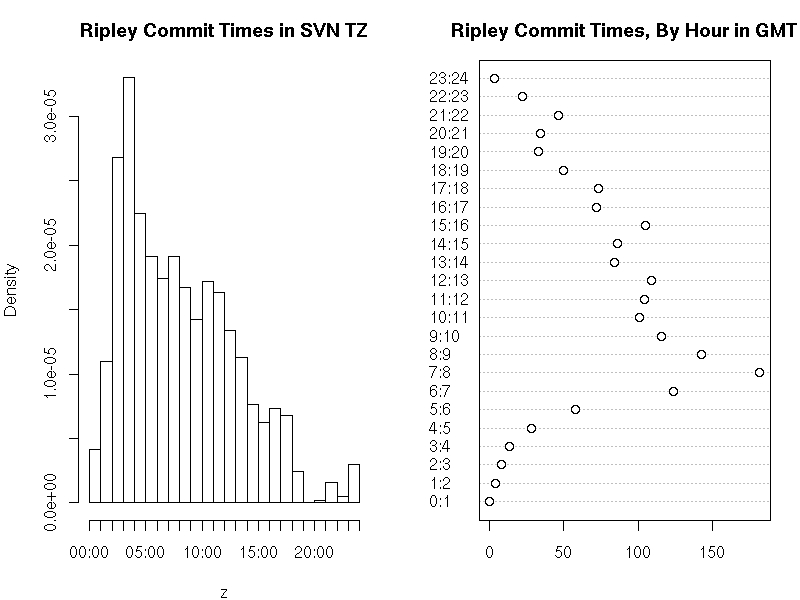
In five lines (that could be shortened to three at the expense of some readibility), the SVN log for R is downloaded directly from the website, the revision authors are extraced and then tabulated by submitter. The relative percentage of Brian Ripley is found to be a staggering 74.8% -- or about three times as much as the other fifteen committers combined. Smokes. [ Oh, and for those who don't know him, he's also got a day job which presumably entails looking after his graduate students at Oxford. Who knows, he may even teach. Kidding aside, he's actually one of the nicest persons you'll ever meet in real life. ] Now yesterday, Simon Jackman who had at first simply repeated Ben's analysis on his own blog followed up with a nice analysis (albeit typeset in a way that rendered the code inoperational, which has now been fixes) that creates both a histogram and a dotplot of commits per hour of the day. Omitting Ben's code which Simon reuses, we have the following for histogram and dotchart:
tod <- unlist(sapply(rx,function(x)strsplit(x,split=" ")[[1]][6]))
tod <- tod[who=="ripley"]
tz <- sub(pattern=".*(-[0-9] 4 ).*",replacement="\\1",x=rx)
tz <- tz[who=="ripley"]
tz <- as.numeric(tz)/100
offset <- 3600*tz
z <- strptime(tod,format="%H:%M:%S")
hist(z,"hours",main="Ripley Commit Times in SVN TZ")
h <- z - offset
h <- format(h,format="%H")
h <- factor(as.numeric(h), levels=0:23)
dotchart(table(h), main="Ripley Commit Times, By Hour in GMT",
         labels=paste(0:23,1:24,sep=":"))
This extracts the commit times, subsets to the ones by Prof. Ripley, extracts the timezones component (as strptime seemingly doesn't do that which is a pain), extracts the tz-less time via strptime into a variable 'z' for which the histogram is drawn. He then corrects the times by the tz offset expressed in seconds, formats is as hour of the day and turns it into a 'factor' (an R data type for qualitative variables which may be ordered as is the case here) and draws a dotplot. This results in the following chart: Simon Jackman's per-hour charts of Brian Ripley's commit patterns Now, nobody has looked at the time series. So we correct this and add the following:
## rather extract both  date and time
dat <- unlist(sapply(rx, function(x)  
  txt <- strsplit(x,split=" ")[[1]]
  paste(txt[5], txt[6])
 ))
## subset on Prof Ripley
dat <- dat[who == "ripley"]
## and convert to POSIXct, correcting by tz as well
datpt <- as.POSIXct(strptime(dat,format="%Y-%m-%d %H:%M:%S")) - offset
## turn into zoo -- we use a constant series of ones as each
## committ is taken as a timestamped event
datzoo <- zoo(1, order.by=datpt)
## and use zoo to aggregate into commits per date
daily <- aggregate(datzoo, as.Date(index(datzoo)), sum)
## now plot as grey bars
plot(daily, col='darkgrey', type='h', lwd=2,
     ylab="Nb of SVN commits, three-week median",
     xlab="R release dates 2.5.0 and 2.5.1 shown in orange",
     main="The amazing Prof. Ripley")
## mark the two R releases of 2007
abline(v=c(as.Date("2007-04-24"),as.Date("2007-06-28")),col='orange',lwd=1.5)
## and do a quick centered rolling median
lines(rollmedian(daily, 21, align="center"), lwd=3)
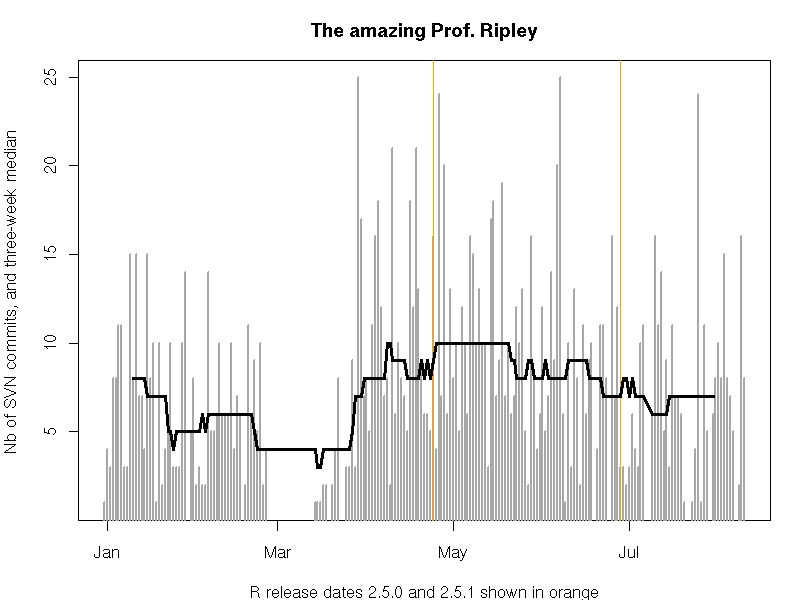
This extracts both date and time, creates a proper R time object (a so-called POSIXct type) from it, fills a zoo ('the' magic class for time series) object with it, uses zoo to aggregate commits per day and plots those in a barchart-alike (I know, I know, ...) plot to which we add the two releases as well as a rolling and centered three-week median (as a real quick hack rather than a proper smooth). Timeseries of Brian Ripley's commit patterns This shows that Prof Ripley averaged about ten commits a day before and after the release of R 2.5.0, and that he has slowed down ever so slightly since then to end up at around a mere seven commits a day. Every day. For the seven-plus months we looked at. So, anyone for analysing his r-help posting frequencies ?

11 August 2007

Cameron Dale: DebTorrent BugFix Release 0.1.3.1

Here's a new release of DebTorrent, containing only bug fixes. This release fixes 2 bugs, one minor, and one serious. The serious bug would probably have caused anyone using a recent (0.7) version of APT to experience hangs with APT saying "waiting for headers". If you had this issue and you're using APT 0.7, please update to this new version. If you had this issue with an older version of APT, please report it as a bug. Agian, if you do find any bugs or have any problems, please submit them to the DebTorrent mailing list, or come and find me (camrdale) on IRC in the #debtorrent channel on OFTC. Here's the changelog:

9 August 2007

Russell Coker: The Principles of Stupidity


  1. We always underestimate the number of stupid people

  2. The probability of a person being stupid is independent of any other characteristic of that person

  3. A stupid person is someone who causes damage to another person, or a group of people, without any advantage accruing to himself (or herself) or even with some resultant self-damage

  4. Non-stupid people always underestimate the damaging power of stupid people. They constantly forget that at any moment, and in any circumstance, associating with stupid people invariably constitutes an expensive mistake.

  5. A stupid person is the most dangerous person in existence

  6. Stupid people don t know they are stupid

The above has been floating around the net for a while. While it makes an interesting read I think that having a boolean criteria of labelling someone as stupid is not necessarily accurate. While there are a small number of people who are stupid, there are many more people who are good at some things and stupid when they act outside their area of expertise. There is a saying “never take investment advice from your dentist” which is apparently due to the incidence of con-artists targetting wealthy people (such as dentists) who sometimes then pass on the bad advice to their customers. One stupid thing that I did a few years ago was to spend more effort in choosing a mobile phone than on choosing a car. I was totally happy with my mobile phone but not totally happy with my car - and the car cost a lot more… Of course the difference between pure stupidity and tactical stupidity (for want of a better term) is that a smart person who is about to do something stupid can generally be persuaded not to do it with a logical argument. If someone had pointed out to me the fact that the amount of time spent on background research for a decision should be in some way proportional to the amount of money involved (maybe proportional to the log of the value) then I would have been convinced. So for rule 4 maybe it would be best to say taking advice from someone in an area where they are stupid is a mistake. For rules 5 and 6, if someone is known to be smart in other areas then tactical stupidity may be overlooked (until it’s too late). Update: Don Marti commented with this link http://www.math.wisc.edu/~miller/old/incomp.txt about incompetent people being unable to judge their own level of incompetence as further evidence for point 6.

8 August 2007

Miriam Ruiz: El rei de la casa

The Proof of the PuddingThis is an updated translation into English of the one-question interview with pjorge (based on Darren Rowse’s one-question interviews idea) in which Javier Candeira (Barrapunto co-founder and editor among many other things, and a good, loved friend of mine) comments about an interesting game of his creation that’s being exhibited in Barcelona and that deals with the fears many parents have towards the Internet and the new enterntainment technologies and videogames. The game code will be released as GPL, even though the game data will have a non-free Creative Commons (with a non-commercial clause). The game has a really interesting approach, and mixes the concept of pinball games with that of graphics generated with “paper dolls” techniques, to try to make people think about the ideas mainstream media are pushing, and the way they try to tell everybody how to raise their kids. You might like it or not, but it will probably won’t leave you indifferent. That’s what art is about, in fact, isn’t it? What is ‘El rei de la casa’? ‘El rei de la casa‘ (an expression that in Catalan and Spanish means “the precious child”) is an exhibition and a videogame. The exhibition deals with the cultural construction of the idea of childhood, and can be visited until September 24 in the Palau de la Virreina in Barcelona. From there. Among other works, in the exhibition there are photos by Loretta Lux and Bego a Egurbide, paintings by Marc Ryden, Kiki Smith and James Reilly… it’s really worth a visit. El rei/la reina de la casa. ( The videogame is a commission from Andr s Hispano and Marc Roig, curators of the exhibition. They wanted to portray Internet and videogame arcades (or cybercafes, which are their modern equivalent) as one of the “new forests”, these places where parents don’t dare allow their children go alone for fear of the dangers (real or imagined) that may lie in ambush. The Internet has entered into the collective imagination, and one of the memetic niches that it has crept into is that of the bogeyman, the scapegoat that bears the brunt of all the evil that happens in society. It is enough to look at the news programmes from right-wing TV stations with their adversative Internet coverage: “it’s good, but…”. All over the media you see headlines like “gang of pedophiles arrested who sold child pornography *on the internet*”. They conveniently skip that pedophiles filmed those poor kids *in a flat*, and that they did it *on a bed* and used *videocameras* just like those used by the reporters now sounding the alarm. But no, what’s bad is *the Internet*.
The other theme that we wanted to touch on with the pinball game is how videogames are presumed to corrupt childhood. When pinball games were introduced, the North American authorities laid down the law: it was an infernal machine that incited gambling and even lust. From the religious right to the secular left, every moral guardian has denounced the supposed harmful effects of videogames on childhood: because of them children and teenagers engage in murder, robbery, truancy, bad school grades and even untidy bedrooms and doubtful personal hygiene. For this reason, the “new forest” of the Internet and videogames had to be a videogame, proving once more that games are cultural vectors, a form of artistic, political or commercial expression like any other. It also had to be a videogame about the a triangle: on one side the children, on the second one the children minders (parents and society at large), and finally the Great Scapegoat: the Internet. After many abandoned and reworked proposals we arrived at the present design for the game: an emulated pinball game presented on a panoramic TV screen, and having two levels: one set in the real world and named after the exhibition, and a second one set in a more or less conventional cyberspace. This second level is called “Prey of the Net”, and portrays the vision of the Internet that a Fox viewer may have: you have Spam, game-playing killers, kids making more money than their parents, S&M gear, dildos… in short, everything that is scary and nothing that is comforting, at least to some.  Presa de la red! (All the illustrations for this pinball, both on the gameplay field and on the scoreboard, are by Mauro Entrialgo. For the scoreboard I asked him to prepare a set of drawings similar to KISS dolls (like the cut-up dolls that kids still played with in the last century). Thanks to these dress-up dolls the scoreboard shows more than the score (which grows randomly anyway); it also portrays the state of the boy or girl protagonist of the game. I say “boy” or “girl” because in the game, just like in real life, you have a 50/50 chance of starting the game of life with either sex. The fist level, ‘El rei de la casa’, portrays the stress that families feel when facing children’s media consumption. The targets trigger lines from the parents: “All day in front of the Idiot Box!” when you hit the tv, or “without a degree, you are nothing” when you hit the school. There are four targets on the right, which can be reached shooting the ball with the left flipper (the one representing the parents): school, museum, church and reading. On the left, and reachable from the right flipper, representing the kids’ id, are the TV, the kid’s peers and the videogame console; at the top of the playing field, towering above it, the internet-enabled computer. As the ball hits the different targets, the scoreboard dresses the kids in a housecoat, a leather jacket, and gives them a mortarboard or a saint’s halo. They are the pride of their parents, kids still not perverted by the Internet. It is cheap symbolism, I confess, two-dimensional sociology, but that was also something we aimed for. After all, pinballs have always been complicated allegories rather than complex ones. In a first design I planned to make computer accessible only under certain conditions, but that is not something that would have work in this exhibition: some people just play and play (which gives me an immense joy), but other people can’t or won’t give it much effort. It’s best to make it easier for everyone, so they can send the ball into the next level even without meaning to. The second level, “Prey of the Net”, is accessed when the player puts the ball through the PC’s screen. Here the character on the scoreboard keeps smiling while the game dresses them in a straightjacket, S&M headgear, or leaves them in their underwear, with their hands full of money, playing cards, bloody knives and sex toys… to their parents’ horror. The player has no fixed goal here, only to make the ball go through the pachinko and the spinning spider. These elements work as an atrocity generator and a rebuke distributor. Parents’ voices scold the player, faced with the horrors of the Internet. But the star is the scoreboard. Mauro rocks. Right now the code and content for downloadable game are done, and the people responsible for the ISO are giving it the final touches. It will be a bootable liveCD with some Debian variant that (hopefully) will run on any PC bought in the last two or three years. We will treat the computer as a games console, which may or may not be symbolic (if you want it symbolic, we can make it symbolic!). The game itself is under the GPL license (the pinball part is based on Henrik Enkvist’s Emilia, which is packaged in Debian), and only the graphic resources will be under a non-commercial Creative Commons license. The music is also under a non-free Creative Commons license because of the status of the original samples, but I recommend you download it and play it because its author is none other than man, the Barrapunto founder and sometimes editor.

Eddy Petri&#537;or: this is the way forward

leveraging existing technologies and obtaining cool things

MJ Ray: Two Answers for All Serious Free Software Contributors

etbe: Two Questions for All Serious Free Software Contributors asks:
"What do you think is the most important single-sentence of advice that you can offer to someone who wants to contribute to the free software community?"
He who does wins, so don't let the bastards grind you down.
"If you had the opportunity to say one sentence to someone who knows about computers and free software (EG they have used both Linux and Windows and done a small amount of programming) to convince them that they should join the free software team, what would it be?"
Imagine every bug you found could be fixed by you if you want, or a friend, or an enemy, or someone you hire, or the original developer, or whoever and that it's your choice who you ask to do it, with no veto from the copyright holder: that's free software. The second sentence is a bit long, but I found it hard to encapsulate the power of that freedom in one. I use the bug example rather than costs or anything, because I think that's what will be most attractive to someone who has done a bit of programming: the right answer to "why can't I fix this trivial bug?"

Neil Williams: Requesting adoption of glipper

RFA: glipper -- A clipboard manager for GNOME #436550.

Glipper is currently my package in Debian at 0.95.1-3 and that version
is written in C and uses a binary data file which has raised one bug
(#436078 - wishlist severity). It currently has no other bugs.

There is now a
new release
that closes this bug, my problem is that
v1.0 is a ground-up rewrite in Python! Essentially, glipper v1.0 is a
completely different package internally. (Previous translations have
also been lost.)

I have no python experience, no python packages and no ability to do
anything if (when) python code goes wrong. I don't want to have to
learn python just for glipper (don't have time).

So - I don't see what I can do except request adoption of glipper, it
just seems so weird to leave a package which is active while I am also
active.

Anyone fancy taking on glipper?

I don't think there's any point retaining the old C package - that code
is already dead upstream.

Currently, there is no RCS for the debian packaging for glipper - I was
using CDBS and the current watch file needs editing to look for a
tar.bz2 instead of the previous tar.gz.

There are two issues with migrating from 0.95.1 to 1.0:
  1. the ~/.glipper directory needs to be removed.

  2. Glipper v1.0 is also now GNOME only, support for other window managers
    has not been implemented in the python version.


John Goerzen: Disasters happen

It's been one of those days.

It started with me forgetting my laptop bag at home. Then I had to work with an attorney on some things. He's a nice guy, and does a good job, but you know, it's not what I'd really like to spend my day doing.

Then in the middle of the afternoon, I hung up the phone and checked my email. About 50 messages from Samba telling me that processes with various PIDs had crashed unexpectedly. Uh-oh. I think we still have some 80ish people using that.

About a minute later, a coworker says, "John, I've been bad." "Is that why I just got 50 emails from Samba?" "No. Well, yes. Well, maybe. I don't know."

It turned out he was working on a restore from tape that, out of necessity, grabbed more data than he needed. He meant to type rm -r ./var but typed rm -r /var instead. Oops. He hit Ctrl-C halfway through, so /var was still there enough to send email but not enough for Samba (or, apparently, NFS) to work.

As he dashed off to pull yesterday's tapes from offsite storage, I prepared the restore and made a plan. We hadn't installed any software since yesterday, so I restored var to a temporary location, took the server down into single-user mode, overwrote the /var that still existed, and rebooted the Xen instance in question. Everything back to normal. Except, that is, for the potentially dozens of users that will require assistance running SCANPST.EXE because their Outlook PST, being the fragile heap of garbage that it is, will have somehow been corrupted by this little incident.

So, what did we learn from this?

7 August 2007

Adrian von Bidder: Fun with virtualisation

Since I seem to be the last person these days who doesn't run his servers inside Xen, Vserver, kvm, lguest or whatever, I decided to finally evaluate Xen. Not having spare hardware and not wanting to really touch my main workhorse, I started with Qemu. Installing etch inside a Qemu (why can't qemu have working tun/tap setup scripts by default?), then xenifying this according to Ganneff's excellent slides, I was stopped while booting into the Xen kernel with a hard freeze in the boot process (Inside Qemu, so no harm done.) Talking to some people in #xen resulted in me disabling kqemu, and a few minutes later I had a working dom0. Debootstrap is slooooooowwww (well, inside a non-accelerated Qemu machine...)! So I decided to use cdebootstrap instead. Sadly, xen-create-image has debootstrap hardcoded, so I had to "ln -sf /usr/bin/cdebootstrap debootstrap". (I decided to do this when debootstrap was still calculating dependencies after several minutes.) After that, creating and booting a domU Just Worked(tm). Having a running Xen environment, I finally wanted to play around with live migration (mostly I was just curious how robust this Qemu + Xen setup is...) So, just clone the qemu disk and boot them both. Whereupon the two qemu machines have the same MAC address, hence networking is not reliable. Change the MAC of the second Xen dom0, curse udev for thinking that now the network interface should be eth1 (persistent device naming is a good thing, generally. I'm not sure there is a sane solution possible that can cover all/most cases. Computers with only one network interface might warrant some special logic ... Oh well.) Having restored the networking setup, enabling the relocation service in the Xen configuration is trivial. After thinking about using plain files on NFS and seeing a Novell tutorial which uses iSCSI, I decided that I should try AoE because it should be much simpler to set up. And by installing the 'vblade' package, it is indeed possible to have an AoE server running within a few minutes (the vbladed command doesn't take the -m option, though.) And the client side is just as simple, just install the aoetools package, and /dev/etherd is automagically created and lists all available devices. That's how SANs should work! (Note: I had the AoE devices in the dom0 and passed them to the domU. A next experiment would obviously be to pass AoE directly to the domU as root devices. Not sure what the implications would be, though.) Ok, after all this, I have two dom0 machines and a domU. Just for fun, I've installed xdaliclock inside the domU and started a live migration. Result: it works stable (modulo some scary kernel messages popping up when booting the domU. I didn't experience any crashes in this light test), xdaliclock stops for a mere 20s (yes, seconds, not milliseconds. Remember, this is two layers of virtualisation without hardware support.) Normal migration (pausing the domU), the migration takes roughly 2 min (both dom0 have 384M RAM assigned in Qemu, the domU has 128M in Xen, the host is a 3GHz P4 with 1G physical ram. There is some swapping going on (I use KDE, so some of the RAM is lost there. I also didn't stop beagle for this experiment.) The full live migration takes about twice as much time. But this said, if you're using Xen inside qemu, timing values are not what you're after... I was, frankly, astonished at how well this worked. Hmmm. I wonder, if I can stack some other virtualisation layer somewhere in there? Just to see how silly it might get.

Wouter Verhelst: Blog slightly fixed

I spent some time fixing some outstanding issues with my blog. The LiveJournal import on my blog had the wrong timestamp. I had some old ruby script that I'd written two years ago when I still believed ruby would someday become my language of choice (it didn't) which converted the livejournal XML exports into something that blosxom would grok, but it didn't work anymore. Apparently ruby's XML library API changed slightly between then and now. Read /usr/share/doc/libxml-ruby/README, updated the script, ran it again, and it worked. So now the blog items are dated on the date they were actually written, rather than 2005-02-17. Since a few weeks, I've been offering a myrss version of my blog feed, which contains a saner version of a link to the item (linking to the path that I wrote it in, rather than some date-based ugly stuff). Liferea choked on it, though, as did the feed validator. Turns out I managed to enter a few minor typos. Fixed those. Apparently the typos weren't of the magnitude that planet would choke on them, but still. So now my blog is slightly improved. Isn't that great. I still wonder why I have this blosxom-writing-php-scripts-with-home-grown-comment-system rather than, say, drupal, but that's for another day. OTOH, drupal doesn't allow me to write a blog entry using a simple svn commit, with magic commit hooks fixing everything. Let's keep things as they are.

Cameron Dale: DebTorrent Release 0.1.3 (in package form!)

Today I have released the next version of DebTorrent. This is the first release to be available in a binary package (.deb) form, and most of the changes are related to the packaging I still consider the program to be alpha quality, though all the functionality for a beta release is there, it just needs to be tested (so tell your friends). I run the program daily and use it for my apt-based updating, so I'm pretty sure it works, but there are definitely bugs. If you do find one please submit it to the DebTorrent mailing list. The installable binary can be found on the Alioth project, or in my personal repository which can be added to your sources.list like so:
deb http://debian.camrdale.org/ unstable main contrib non-free
Once installed, it will start running automatically, and will restart on bootup, so all that is needed is to modify your sources.list files to point them at DebTorrent by prepending localhost:9988 to the mirror name. For example, the entry above for my personal repository would become:
deb http://localhost:9988/debian.camrdale.org/ unstable main contrib non-free
Here's the changelog:

5 August 2007

Miriam Ruiz: Recipe: Internationalizing a C program with gettext

gettext is the GNU internationalization (i18n) library, and it is one of the most important standards in Free Software about i18n of programs. Translators are used to it, and there are really lots of useful tools to work with gettext data, so I’d recommend anyone to avoid trying to invent their own yet-another-gettext-but-not-quite-as-the-real-one. Gettext also works for Windows, so no excuse. It’s really easier than it sounds. Here goes the quite recipe: Add this to the headers of the C module in which you have your main() function:
#ifdef USE_GETTEXT
#include "libintl.h"
#include "locale.h"
#define _(String) gettext (String)
#else
#define _(String) String
#endif
And add this at the beginning of your main() function:
#ifdef USE_GETTEXT
setlocale (LC_MESSAGES, "");
setlocale (LC_CTYPE, "");
setlocale (LC_COLLATE, "");
textdomain ("my-program");
bindtextdomain ("my-program", NULL);
#endif
That’s all for the initialization of gettext, lets go now with its usage from the rest of the modules. In each of them, you’d have to add this to the headers:
#ifdef USE_GETTEXT
#include "libintl.h"
#define _(String) gettext (String)
#else
#define _(String) String
#endif
After all that stuff, you should be able to i18n for whichever texts you want, just write _(”whatever”) instead of whatever:
printf(_("whatever");
Don’t forget to compile your program with -DUSE_GETTEXT if you use the same #defines as I do, or at least to #define USE_GETTEXT somewhere. Now, lets go to the second part, generating the .pot templates, and installing the .mo translation modules in your system:
xgettext -k_ -o my-program.pot *.c *.h --from-code=iso-8859-1
If you prefer, you can create different .pot files for the different parts of your programs instead a really big one to help translators, and then joining all the .po files inside a single one before converting it to .mo with msgcat:
msgcat -o my-program.es.po my-program.part1.es.po my-program.part2.po my-program.part3.es.po
To compile the .po files into .mo, just do:
msgfmt my-program.es.po -o my-program.es.mo
Then, don’t forget to install it in the proper directory of your system:
cp my-program.es.mo /usr/share/locale/es/LC_MESSAGES/my-program.mo
Of course, you can tell your program to look for the .mo file in a different directory, even a relative one, instead. Just read the man pages, this is only a quick recipe on how to do it :) Note: Please, use #include [smaller than]whatever.h[bigger than] instead of #include “whatever.h”, as I have put in my examples. My WordPress weblog seems to be having problems with the those symbols. That’s the magic of HTML.

Christian Perrier: First steps in collab-maint: calife

Today, I made my first steps using the collab-maint repository on Alioth. I accidentally noticed that one of my packages, namely calife (a sudo-like utility which I use since more than 10 years and developed by Ollivier Robert, one of my very very very old friends in the FLOSS world), got a new release at the beginning of July. That was a good occasion to move calife package's maintenance to Alioth and then learn about collab-maint. Thanks to the pretty good documentation, this has been done "en un tournemain" and, that upload had then two benefits: a new calife and my first package in collab-maint. It's now probably time to move there some of my packages, the first being my pet package, geneweb (who has its own project on Alioth, which i certainly overkill). Thanks, again, to Alioth admins for that very efficient work.

Russell Coker: Living in Hotels

I received a private email in response to my post about getting work in another country regarding hotel prices in London. The person who sent me the message had considered London but ended up moving to Japan instead partly due to living expenses (although Japan seems unlikely to be much cheaper). The first issue concerns security of hotels. When living in hotels (for almost a year in London and about 6 months in the Netherlands there were a few occasions (IE one brief occasion every 4+ months) when I left my laptop under my bed at a hotel, but almost all the time I took it with me. At that time I aimed to have a minimal set of luggage, one large suitcase containing clothes, books, etc (things that are generally not worth stealing) and one small case containing my laptop, digital camera, passport, and other small things that are valuable or which would cause excessive inconvenience if I lost them. Also in the small case I would take fragile items. Then when leaving my hotel I would pack most of the items from the small suitcase (pretty much everything apart from the digital camera) into my laptop bag and take it with me. This limited my losses from hotel thieves to a digital camera (no incriminating pictures and I could always buy a better one) and a couple of bottles of liquor. Good hotels have a hotel safe which you can use. But for a cheap (affordable) hotel there is no such option. Hotels in London ARE expensive, but if you are prepared to lower you standard of living they aren’t too expensive. One thing to note about UK hotels is that the idea of having a toilet and shower in every room is a new concept and all the cheaper hotels lack this. It’s a standard feature for a hotel to have a wash-basin in every room, a toilet is optional, and a bath or shower is another option. There are various types of shared bathroom in UK hotels. The better ones vaguely resemble the facilities you might expect to find at a public swimming pool (large spaces, clean tiles everywhere, and a changing area in addition to the toilet and shower cubicles). The worst ones are basically what you might expect to see in a private home but with less cleaning. To get the best deals on small hotels in London you have to find an area where there are many hotels and inspect them. It is quite acceptable to ask for the key to a room so that you can inspect it and determine if you want to rent it. One area where I lived for some time in London is near Victoria Station. Victoria is one of the largest stations in London, it has both a Tube (underground/metro for trains within the city) and a British Rail (for travel to other parts of the country) station. Victoria Station also had facilities for checking in to a flight and having your checked luggage delivered to Gatwick airport via the Gatwick Express. This was really convenient, you can check your luggage and then do some last minute shopping before going to the airport! I’m not sure if they still do this though (comments appreciated). Another good thing about Victoria Station is the large shopping area which included a tourist information centre and a store that sold freshly baked bread. Often in the morning I would buy bread from the section that had the most steam coming from it (which was the most freshly baked) before catching a train. Victoria Station is quite near many of the places you want to visit in London so I could walk to the British Museum and other places that are worth visiting (this depends on how fit you are). But the real reason for staying there is that the were many cheap hotels in the area. I could just walk down a street and know that I could find a room at one of the hotels. One feature of UK hotels is that they almost always include free breakfast as part of the deal (with no option to exclude it). Of course this means that if you are capable of eating a significant breakfast and then skipping lunch then you can save some money. A down-side to cheap hotels is that they almost never have a telephone in your room (just a pay phone in the hall), and if they do have a telephone then it will be wired in. Before wireless net access became common this was a problem as you couldn’t use a modem. More expensive hotels had an extra socket for a modem. In London there is a significant number of people who stay in hotels from Sunday night to Thursday night with their company paying (so they don’t stay in the cheap hotels). This means that most of the good hotels have cheap rooms on the weekend. So while living in London I would often stay at a good hotel on the weekend to get net access (and a few days in a luxury hotel at a cheap rate is a good change from a cheap hotel). Nowadays wireless net access is common so it would be easy to find a free access point anywhere in London and there would be no need for this. But the possibility of getting cheap hotel rooms on the weekend is something to keep in mind. One benefit of this was when I had an employer paying for my hotel bills from Sunday night to Thursday night (as part of a deal to placate my colleagues who complained about working at the other side of London). I spoke to the hotel manager and suggested that having me check out every Friday and have the room empty on the weekend was not good for them and that they should offer me a significant discount to stay 7 days a week - they made me a good deal! At that time I had the lowest cost of living apart from when I lived with my parents while the hotel in which I stayed was quite comfortable (a large comfortable room with toilet and shower and a good hotel breakfast). Moving to the Netherlands was quite easy for me as I was staying in hotels. All I had to do was to pack my suitcase, check out of the hotel, and catch the flight. One significant advantage of living in hotels is that you can easily move to another region or country. This gives the possibility of taking advantage of career opportunities that would not be possible if you owned a house and would be difficult if you rented an apartment. When in the Netherlands I ended up staying in hotels of the Bastion chain (a chain or franchise of business hotels). I stayed in a couple of other hotels first and wasn’t particularly happy but with Bastion hotels I was always happy. I arranged a deal of a small discount in exchange for not getting the breakfast that was normally included (I like to sleep in and the Dutch breakfast didn’t appeal to me). One significant benefit of the Bastion hotels over London hotels was the size. The smallest room had two single beds, a large Dutch-style bathroom, two chairs at a desk that spanned about 3M of a wall (with multiple power sockets and a phone socket), and a good TV. At the time the hotel would play two movies over the TV system every night from video cassette. The videos played on the TV in the restaurant and in the rooms (if you selected the appropriate channel). Once I became known to the staff they would do nice things such as playing the movie I requested (instead of the scheduled one) and pausing the movie when I finished dinner so I didn’t miss anything while walking to my room. Also instead of giving me a free newspaper every day (in Dutch) they gave me some free drinks vouchers every week. Once you become a regular customer at a hotel the staff are always willing to change the deal to make you happy - even when it’s a chain. One of the convenient factors of living in a business hotel is that they are located near business areas. I spent several months living in a Bastion hotel that was about 400M walk from the office where I worked. That was particularly convenient when the network broke at night - I could just walk back to the office to fix it! The deal I had with the Bastion hotels made them about 50% more expensive than the (fairly luxurious) two bedroom apartment that I later moved to. So hotels are expensive and living in them is only an option if your employer pays for it or if you work in an industry where pay is reasonably good. Given that the vast majority of people who read my blog work in the computer industry (and I suspect that they are better paid than average) this should be a viable option.

4 August 2007

Christian Perrier: Setting the screen brightness from a script?

Dear Lazyweb, While hunting the wasted Watts on my laptop, I'm trying to find a way to automagically set the screen brightness on this Dell latitude X1. The laptop of course has screen brightness buttons, which work nicely in X but I really would like to find something similar to /proc/acpi/sony/brightness for Sony laptops or /proc/acpi/toshiba/brightness for toshiba ones. Hints?

Next.

Previous.