Search Results: "nic"

1 September 2012

Lars Wirzenius: Dabbling in diplomacy

For about the past three months I've been conducting a small experiment. When I've seen people misbehave on the Debian development mailing list, I've sent a private e-mail to them suggesting they should avoid some specific behavior, in the hope of getting them to stop. My success has been varied. A few have thanked me, and changed their behavior. A couple have taken offense. Some have ignored me. I've noticed a correlation between how much effort I put into the letter and how successful it. Broadly speaking, if I send anything earlier than the sixth version, it fails. Getting the message exactly right is not easy, for me, and takes quite some effort and time. I'm happy about my successes, but on the whole, I fear my experiment is a failure. It's too much effort to do this in the long term, and it's too chancy. Someone else might be able to do it better, but this is not something I can keep on doing. I think we need some better solution to keep discussions in Debian on track and not have them blow up. We have a systemic problem where contentious issues, such as choice of init system, is quite hard for us to deal with. We're also not very good at dealing with situations where a few individuals are dominating the discussion by being loud, insistent, and unwilling to budge or to give any credence to opposing views. I don't know what to do about that, but we clearly need social and possibly technical tools for this.

Tanguy Ortolo: XMPPloit explained

XMPPloit is an exploit tool for a so-called flaw in the XMPP protocol. It has been published recently under the GPLv3 license, and has received much comment. However, it does not seem anybody took the time to study this attack and explain it. Goals XMPPloit is designed to serve as a transparent man-in-the-middle between an XMPP client and its XMPP server, in order to force the client not to encrypt its communications, so that it is possible to read them and modify them on-the-fly. That allows to force the client to use a clear text authentication mechanism, to display its login and password, and to modify any message it sends or receives.
XMPP logo
Mode of operation If you were expecting a tricky, undetectable attack against the XMPP protocol itself, you will be disappointed. This attack could not be simpler:
  1. In XMPP, the clients opens a connection to the server as plain text. In this case, with the attacker between them.
  2. The server offers the STARTTLS extension. The attacker blocks it, that is, does not transmit this offer to the client, so the connection stays in plain text.
  3. The client authenticate over the plain text connection.
Comments In fact, this is only an exploit against design flaws of some XMPP clients that would not warn the user that they are about to send their credentials on a clear text channel. Actually, the protocol most vulnerable to this type of attack is HTTP. Many websites that identify their users are made available over clear text HTTP, with an automatic redirection to HTTPS. Unless they use HSTS, this redirection can be blocked by an attacker without being noticed by most users. And, contrary to XMPP, not warn the user of an insecure login is not the fact of some broken clients, but of all the available browsers. I repeat: not a single browser will currently tell the user: Hey, you are about to transmit a password in clear, it could be intercepted! . Yes, there are browser that warn their users this way the first time: Hey, you are about to transmit your answers to a form in clear! Do you wish to do that, and do you want me to warn you next time? but this not quite the same, and it is just badly designed and in practice neither useful nor usable so everybody disables that.

31 August 2012

Roland Mas: Integrating FWbuilder with fail2ban and port-knocking

This article documents how I'm currently building my firewalls. It builds on netfilter-based-port-knocking, and tries to integrate several components of a firewall as gracefully as possible. For some context: I'm getting involved with servers where the firewall policy goes beyond a handful of SSH from my home and my other servers rules. There are many different network streams that need to be policed, some of them are common across several (potentially many) servers, and so on. So I'm gradually giving up on my hand-made scripts, and trying out higher-level tools. I settled on FWbuilder, which seems nice. However, it only allows static policies, and I still want to keep dynamic policies such as what fail2ban provides, as well as my own port-knocking system. The problem I had was that fail2ban isn't really made to play nice as part of a complex firewalling setup, my port-knocking system was too tightly integrated within my firewall script, and FWbuilder wasn't too flexible when it came to delegating part of the firewall policy to something external. Fortunately, this was only a perceived problem (or a real problem in my understanding), because it is actually possible to have all three blocks playing nicely together. More context: as usual, I'm focusing on Debian-like systems. More precisely, on those with a Linux kernel; it may be that FreeBSD's firewalling subsystem has a feature comparable to Linux's recent module, but I don't know. Let's start with FWbuilder. This is not the place for a manual, the official documentation is rather complete. I'll assume you have defined most relevant blocks in there: firewall, hosts, IP addresses, services, and so on. You define your static policy with the standard rules. From then on, we want to integrate the external tools for dynamic rules. Step 1: Integrating fail2ban We want fail2ban to have its own playground, so that it doesn't overwrite anything in the standard policy. The trick is to define a new policy rule set named fail2ban. Leave it empty in FWbuilder. So far so good, but fail2ban (the daemon) still operates on the INPUT chain in the firewall, and could therefore still mangle the static rules. Fortunately, starting with fail2ban 0.8.5 (available from Debian Wheezy, or in the backports for Squeeze), you can define what chain to operate on: with a configuration item such as chain = fail2ban, fail2ban (the daemon) will now only add its rules to fail2ban (the firewall chain), and won't be able do damage the other chains. The missing part is to send some of the traffic to it using the standard policy: i defined a rule sending the incoming SSH connections to the fail2ban policy ( branching in FWbuilder jargon). Voil : the static policy delegates part of the decision-making to a sub-policy controlled by the fail2ban daemon. Step 2: Integrating port-knocking This is a bit trickier, but we'll use a similar method. First, the traffic used for port-knocking needs to be directed to the chain that does the listening. Define a policy rule set named portknocking, and leave it empty in FWbuilder. It'll be used by the dynamic rules to track progression of source IP addresses through the port-knocking sequence, so you'll need to send ( branch ) incoming traffic there, probably after the rules allowing incoming connections from known hosts. The dynamic part of this will only concern the refreshing of this listening chain , which we assume will do its work and mark IP addresses with PK_ESTABLISHED once the sequence is completed. What we do with these marked IP addresses will still be defined within the FWbuilder policy. We're going to need some complex rules since we want to filter according to this PK_ESTABLISHED bit and according to destination port, for instance; unfortunately FWbuilder doesn't allow combining filter criteria with and, so we define a new policy rule set called accept_if_pk_ok. This ruleset has two rules: the second is an ACCEPT and should be easy to understand. The first rule needs to ensure the ACCEPT is only reached for connections coming from PK_ESTABLISHED addresses, so it's going to be a bit tricky. (Explanation: the first rule matches packets coming from IP addresses not marked as PK_ESTABLISHED, and returns them to the calling policy. Packets remaining after this rule are those coming from the appropriate addresses, and they go on to the ACCEPT. We could have had the first rule match on IP addresses that are marked, and branch to yet another ruleset with the ACCEPT part, but that would make it harder to read, I feel.) Now let's get back to the main policy and add rules concerning what kind of traffic we want to allow once the port-knocking sequence completed. For instance, we define a rule matching on the SSH service , where the action is to branch to accept_if_pk_ok. When an incoming packet tries to establish a connection to the SSH port, it's passed to the accept_if_pk_ok ruleset. If it comes from the same IP as a recent port-knocking sequence, it goes on to be ACCEPTed. If not, it returns to the main policy. Maybe static rules further on will allow it to go through. Step 3: tying it all together Now that we have all the pieces, the rest is plumbing. With this setup, at boot time, the $hostname.fw script creates the static policy and the extra playgrounds; then the port-knocking script implements the listening for the magic sequence; then fail2ban inserts its own rules. And there we are: three different parts for the firewall policy, all integrating nicely. Mission accomplished! Note: (Mostly copy-and-pasted from the previous article) This article is deliberately short on details and ready-to-run scripts. Firstly because firewall scripts vary wildly so any script would have to be adapted anyway, but mostly because security is best handled with one's brain switched on. Fiddling with a firewall can easily open gaping holes or lock everyone out. So please make sure you understand what goes on before blindly pasting stuff into your own setup. Some bits are left as an exercise to the reader.

Russell Coker: Links August 2012

Google are providing some really good employee benefits including benefits to a life partner of a deceased employee [1]. It s not known if all those benefits are available outside the US, in any case the US is the first world country with the least social security so they need it most there. A recent Australian legal case had a father petitioning the court to have his kids take his family name [2]. According to the news report no good reason was given for renaming the kids, merely tradition. The mother won. GlassDoor.com is a site for reviewing companies [3]. It also has job adverts, it seems that they get people in to read the reviews and then advertise jobs. Sarah Resnick interviewed Jacob Appelbaum (of Tor fame) about privacy issues and published the article as Leave Your Cellphone at Home [4]. It s very interesting and references some resources such as riseup.net that I have to try using. Systemd in Fedora 17 has multi-seat support [5]. They support plugging USB terminals in at run-time to dynamically add new consoles for GNOME sessions. The Coding Horror blog has an amusing and informative post about why people shouldn t learn to code [6]. Related posts:
  1. Links June 2012 This Youtube video is an amusing satire of EULAs and...
  2. Links January 2012 Cops in Tennessee routinely steal cash from citizens [1]. They...
  3. Links August 2008 Michael Janke is writing a series of posts about estimating...

30 August 2012

Erich Schubert: Finding packages for deinstallation

On my netbook, I try to keep the amount of installed software limited. Aptitudes "automatically installed" markers are very helpful here, since they allow you to differentiate between packages that were deliberately installed and packages that were manually marked for installation. I quite often browse through the list of installed packages and recheck those that are not marked as "A".
However, packages that are "suggested" by some other package (but not "required") will be kept even when marked as automatically. This is quite sensible: when you deinstall the package that "suggested" them, they will be removed. So this is nice for having optional software also automatically removed.
However sometimes you need the core package but not this optional functionality. Aptitude can help you there, too. Here's an aptitude filter I used to find some packages for removal:
!?reverse-depends(~i) ~M !?essential
It will display only packages with no direct dependency from another installed package and that are marked as automatically installed (so they must be kept installed because of a weaker dependency.
Some examples of "suggested but not required" packages:
  • Accessibility extensions of Gnome
  • Spelling dictionaries
  • Optional functionality / extensions
Depending on your requirements, you might want to keep some of these and remove others.

Here is also a filter to find packages that you can put on "automatically installed":
~i !~M ?reverse-depends(~i) !?essential
This will catch "installed but not automatically installed packages, that another installed package depends on". Note that you should not blindly put all of these to "automatic" mode. For example "logrotate" depends on "cron anacron fcron". If you have both cron and anacron installed, aptitude will consider anacron to be unnecessary (it is - on a system with 24h uptime). So review this list, and see what happens when you set packages to "A", and reconsider your intentions. If it is a software you want for sure, leave it on manual.

29 August 2012

Russell Coker: Woolworths Maths Fail

picture of discount from $3.99 to $3.00 advertised as 20% off The above is a picture of the chocolate display at Woolworths, an Australian supermarket that was formerly known as Safeway it had the same logo as the US Safeway so there s probably a connection. This is actually a 24.81% discount. It s possible that some people might consider it a legal issue to advertise something as a 25% discount when it s 1 cent short of that (even though we haven t had a coin smaller than 5 cents in Australia since 1991). But then if they wanted to advertise a discount percentage that s a multiple of 5% they could have made the discount price $2.99, presumably whatever factors made them make the original price $3.99 instead of $4.00 would also apply when choosing a discount price. So the question is, do Woolworths have a strict policy of rounding down discount rates to the nearest 5% or do they just employ people who failed maths in high school? Sometimes when discussing education people ask rhetorical questions such as when would someone use calculus in real life , I think that the best answer is people who have studied calculus probably won t write such stupid signs . Sure the claimed discount is technically correct as they don t say no more than 20% off and not misleading in a legal sense (it s OK to claim less than you provide), but it s annoyingly wrong. Well educated people don t do that sort of thing. As an aside, the chocolate in question is Green and Black, that s a premium chocolate line that is Fair Trade, Organic, and very tasty. If you are in Australia then I recommend buying some because $3.00 is a good price. Related posts:
  1. fair trade is the Linux way I have recently purchased a large quantity of fair trade...
  2. LUG Meetings etc Recently I was talking to an employee at Safeway (an...
  3. The Sad State of Shopping in Australia Paul Wayper has written a blog post criticising the main...

28 August 2012

Theppitak Karoonboonyanan: Pango-HarfBuzz Merge and The Effects on Thai Module

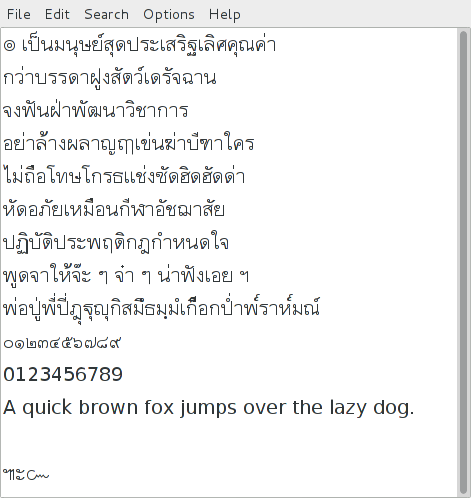
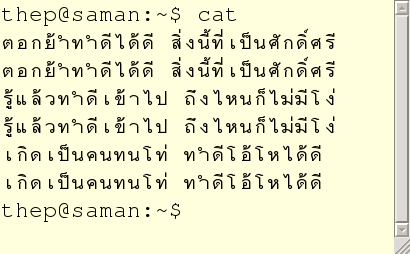
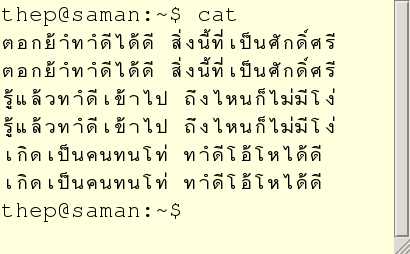
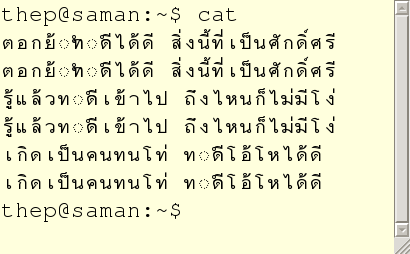
One major change in GNOME 3.6 is Pango s shaper engines replacement with HarfBuzz. Only language engines (for word break analysis, for example) are retained. So, I m checking how this affects Thai/Lao rendering and what to do next. Over all, Behdad has put a good effort to make it right. Most Uniscribe behaviors have been achieved for compatibility. He even cares enough to cover some widespread Thai fonts in which the language tag 'latn' is used instead of 'thai', as seen in Mozilla #719366. Unfortunately, this font set has been declared as standard fonts in official documents. The workaround seems inevitable. Supported Fonts In my experiments with some existing Thai OpenType fonts, the new Pango still renders well without regression. Loma font from fonts-tlwg (glyph positioning with GPOS, rearrangement with GSUB): Loma on new Pango Arundina Sans font from Fonts-SIPA-Arundina (positioning by substitution, only GSUB, no GPOS): Arundina Sans on new Pango But for legacy fonts without OpenType features, it renders badly: Non-OpenType on new Pango In addition, according to Behdad, PUA glyphs in legacy fonts are not supported yet. This means there will be regression on fonts designed for Windows XP or below. But modern fonts designed for Windows 7 should be fine. Changes on Bugs The engine replacement from scratch certainly affects existing bugs. Some become obsolete, some still remain. Here are the summary for Thai/Lao engine, as resolved upstream: Closed bugs: Questionable bugs: Remaining bugs:

27 August 2012

Robert Collins: Why platform specific package systems exist and won t go away

A while back mdz blogged about challenges facing Ubuntu and other Linux distributions. He raises the point that runtime libraries for Python / Ruby etc have a unique set of issues because they tend to have their own packaging systems. Merely a month later he attended Debconf 2010 where a presentation was given on the issues that Java packages have on Dpkg based systems. Since then the conversation seems to have dried up. I ve been reminded of it recently in discussions within Canonical looking at how we deploy web services. Matt suggested some ways forward, including: I think its time we revisit and expand on those points. Nothing much has changed in how Ubuntu or other distributions approach integration with other packaging systems but the world has kept evolving. Internet access is growing ever more ubiquitous, more platforms are building packaging systems clojure, scala, node.js, to name but three, and a substantial and ever growing number of products expect to operate in a hybrid fashion with an evolving web service plus a local client which is kept up to date via package updates. Twitter, Facebook and Google Plus are three such products. Android has demonstrated a large scale app store on top of Linux, with its own custom packaging format. In order to expand them, we need some background context on the use cases that these different packaging systems need to support. Platforms such as antivirus scanners, node.js, Python, Clojure and so forth care a great deal about getting their software out to their users. They care about making it extremely easy to get the latest and greatest versions of their libraries. I say this because the evidence is all around us: every successful development community / product has built a targeted package management system which layers on top of Windows, and Mac OSX, and *nux. The only rational explanation I can come up for this behaviour is that the lower level operating system package management tools don t deliver what they need. E.g. this isn t as shallow as wanting a packaging system written in their own language, which would be easy to write off as parochialism rather than a thoughtful solution to their problems. In general packaging systems provide a language for shipping source or binary form, from one or more repositories, to users machines. They may support replications, and they may support multiple operating systems. They generally end up as graph traversal engines, pulling in dependencies of various sorts you can see the DOAP specification for an attempt at generic modelling of this. One problem that turns up rapidly when dealing with Linux distribution package managers is that the versions upstream packages have, and the versions a package has in e.g. Debian, differ. They differ because at some stage, someone will need to do a new package for the distribution when no upstream change has been made. This might be to apply a local patch, or it might be to correct a defect caused by a broken build server. Whatever the cause, there is a many to one relationship between the package versions that end users see via dpkg / rpm etc, and those that upstream ship. It is a near certainty that once this happens to a library package, that comparing package versions across different distribution packages becomes hard. You cannot reliably infer whether a given package version is sufficient as a dependency or not, when comparing binary packages between Red Hat and Debian. Or Debian and Ubuntu. The result of this is that even when the software (e.g. rpm) is available on multiple distributions (say Ubuntu and RHEL), or even on multiple operating systems (say Ubuntu and Windows), that many packages will /have/ to be targeted specifically to build and execute properly. (Obviously, compilation has to proceed separately for different architectures, its more the depedency metadata that says and build with version X of dependency Y that has to be customised). The result of this is that there is to the best of my knowledge no distribution of binary packages that targets Debian/Ubuntu and RHEL and Suse and Windows and Mac OS X, although there are vibrant communities building distributions of and for each in isolation. Some of the ports systems come close, but they are still focused on delivering to a small number of platforms. There s nothing that gives 99% coverage of users. And that means that to reach all their users, they have to write or adopt a new system. For any platform X, there is a strong pressure to have the platform be maintainable by folk that primarily work with X itself, or with the language that X is written in. Consider Python there is strong pressure to use C, or Python, and nothing else, for any tools that is somewhat parochial, but also just good engineering reducing variables and making the system more likely to be well maintained. The closest system I know of Steam is just now porting to Ubuntu (and perhaps Linux in general), and has reached its massive popularity by focusing entirely on applications for Windows, with Mac OSX a recent addition. Systems like pypi which have multi platform eggs do target the wide range of platforms I listed above, but they do so both narrowly and haphazardly: whether a binary or source package is available for a given platform is up to the maintainer of the package, and the packages themselves are dealing with a very narrow subset of the platforms complexity: Python provides compilation logic, they don t create generic C libraries with stable ABI s for use by other programs, they don t have turing complete scripts for dealing with configuration file management and so forth. Anti virus updaters similarly narrow the problem they deal with, and add constraints on latency- updates of anti virus signatures are time sensitive when a new rapidly spreading threat is detected. A minor point, but it adds to the friction of considering a single packaging tool for all needs is the different use cases of low level package management tools like dpkg or rpm vs the use cases that e.g. pypi has. A primary use case for packages on pypi is for them to be used by people that are not machine administrators. They don t have root, and don t want it. Contrast that with dpkg or rpm where the primary use case (to date) is the installation of system wide libraries and tools. Things like man page installation don t make any sense for non-system-wide package systems, whereas they are a primary feature for e.g. dpkg. In short, the per-platform/language tools are (generally):
  1. Written in languages that are familiar to the consumers of the tools.
  2. Targeted at use on top of existing platforms, by non-privileged users, and where temporary breakage is fine.
  3. Intended to get the software packaged in them onto widely disparate operating systems.
  4. Very narrow they make huge assumptions about how things can fit together, which their specific language/toolchain permits, and don t generalise beyond that.
  5. Don t provide for security updates in any specific form: that is left up to folk that ship individual things within the manager.
operating system package managers:
  1. Are written in languages which are very easy to bootstrap onto an architecture, and to deploy onto bare metal (as part of installation).
  2. Designed for delivering system components, and to avoid be able to upgrade the toolchain itself safely.
  3. Originally built to install onto one operating system, ports to other operating systems are usually fragile and only adopted in niche.
  4. Are hugely broad they install data, scripts, binaries, and need to know about late binding, system caches etc for every binary and runtime format the operating system supports
  5. Make special provision to allow security updates to be installed in a low latency fashion, without requiring anything consuming the package that is updated to change [but usually force-uninstalling anything that is super-tightly coupled to a library version].
Anti virus package managers:
  1. Exist to update daemons that run with system wide escalated privileges, or even file system layer drivers.
  2. Update datasets in realtime.
  3. Without permitting updates that are produced by third parties.
Given that, lets look at the routes Matt suggested Decoupling applications from the core as a strategy makes an assumption that the core and applications are partitionable. If they are not, then applications and the core will share common elements that need to be updated together. Consider, for instance, a Python application. If you run with a system installed Python, and it is built without zlib for some reason, but the Python application requires zlib, you have a problem. A classic example of this problem is facing Ubuntu today, with all the system provided tools moving to Python 3, but vast swathes of Python applications still being unported to Python 3 at all. Currently, the Python packaging system virtualenv/buildout + distribute don t provide a way to install the Python runtime itself, but will happily install their own components for everything up the stack from the runtime. Ubuntu makes extensive use of Python for its own tools, so the system Python has a lot of packages installed which buildout etc cannot ignore this often leads to issues with e.g. buildout, when the bootstrap environment has (say) zope.interfaces, but its then not accessible from the built-out environment that disables the standard sys.path (to achieve more robust separation). If we want to pursue decoupling, whether we build a new package manager or use e.g. virtualenv (or gem or npm or ), we ll need to be aware of this issue and perhaps offer, for an extended time, a dedicated no-frills, no-distro-packages install, to avoid it, and to allow an extended supported period for application authors without committing to a massive, distro sponsored porting effort. While its tempting to say we should install pip/npm/lein/maven and other external package systems, this is actually risky: they often evolve sufficiently fast that Ubuntu will be delivering an old, incompatible version of the tool to users well before Ubuntu goes out of support, or even befor the next release of Ubuntu. Treating data as a service. All the cases I ve seen so far of applications grabbing datasets from the web have depended on web infrastructure for validating the dataset. E.g. SSL certificates, or SSL + content checksums. Basically, small self-rolled distribution systems. I m likely ignorant of details here, and I depend on you, dear reader, to edumacate me. There is potential value in having data repackaged, when our packaging system has behind-firewall support, and the adhoc system that (for instance) a virus scanner system has does not. In this case, I specifically mean the problem of updated a machine which has no internet access, not even via a proxy. The challenge I see it is again the cross platform issue: The vendor will be supporting Ubuntu + Debian + RHEL + Suse, and from their perspective its probably cheaper to roll their own solution than to directly support dpkg + rpm + whatever Apple offer + Windows the skills to roll an adhoc distribution tool are more common than the skills to integrate closely with dpkg or rpm What about creating a set of interfaces for talking to dpkg / rpm / the system packagers on Windows and Mac OSX ? Here I think there is some promise, but it needs as Matt said careful thought. PackageKit isn t sufficient, at least today. There are, I think, two specific cases to cater to:
  1. The anti-virus / fresh data set case.
  2. The egg/gem/npm/ specific case.
For the egg/gem/npm case, we would need to support a pretty large set of common functionality, on Windows/Mac OSX / *nux (because otherwise upstream won t adopt what we create: losing 90% of their users (windows) or 5% (mac) isn t going to be well accepted :) . We d need to support multiple installations (because of mutually incompatible dependencies between applications), and we d need to support multiple language bindings in some fashion some approachable fashion where the upstream will feel capable of fixing and tweaking what we offer. We re going to need to support offline updates, replication, local builds, local repositories, and various signing strategies to match the various tradeoffs made by the upstream tools. For the anti-virus / fresh data case, we d need to support a similar set of operating systems, though I strongly suspect that there would be more tolerance for limited support in that most things in that space either have very platform specific code, or they are just a large-scale form of the egg/gem/npm problem, which also wants easy updates. What next? We should validate this discussion with at least two or three upstreams. Find out whats missing I suspect a lot and whats wrong I hope not much :) . Then we ll be in a position to decide if there is a tractable, widespread solution *possible*. Separately, we should stop fighting with upstreams that have their own packaging systems. They are satisfying different use cases than our core distro packaging systems are designed to solve. We should stop mindlessly repackaging things from e.g. eggs to debs, unless we need that specific thing as part of the transitive runtime or buildtime dependencies for the distribution itself. In particular, if us folk that build system packaging tools adopt and use the upstream application packaging tools, we can learn in a deep way the (real) advantages they have, and become more able to reason about how to unify the various engineering efforts going into them and perhaps even eventually satisfy them using dpkg/rpm on our machines.

25 August 2012

John Goerzen: Voice Keying with bash, sox, and aplay

There are plenty of times where it is nice to have Linux transmit things out a radio. One obvious example is the digital communication modes, where software acts as a sort of modem. A prominent example of this in Debian is fldigi. Sometimes, it is nice to transmit voice instead of a digital signal. This is called voice keying. When operating a contest, for instance, a person might call CQ over and over, with just some brief gaps. Most people that interface a radio with a computer use a sound card interface of some sort. The more modern of these have a simple USB cable that connects to the computer and acts as a USB sound card. So, at a certain level, all that you have to do is play sound out a specific device. But it s not quite so easy, because there is one other wrinkle: you have to engage the radio s transmitter. This is obviously not something that is part of typical sound card APIs. There are all sorts of ways to do it, ranging from dedicated serial or parallel port circuits involving asserting voltage on certain pins, to voice-activated (VOX) circuits. I have used two of these interfaces: the basic Signalink USB and the more powerful RigExpert TI-5. The Signalink USB integrates a VOX circuit and provides cabling to engage the transmitter when VOX is tripped. The TI-5, on the other hand, emulates three USB serial ports, and if you raise RTS on one of them, it will keep the transmitter engaged as long as RTS is high. This is a more accurate and precise approach. VOX-based voice keying with the Signalink USB But let s first look at the Signalink USB case. The problem here is that its VOX circuit is really tuned for digital transmissions, which tend to be either really loud or completely silent. Human speech rises and falls in volume, and it tends to rapidly assert and drop PTT (Push-To-Talk, the name for the control that engages the radio s transmitter) when used with VOX. The solution I hit on was to add a constant, loud tone to the transmitted audio, but one which is outside the range of frequencies that the radio will transmit (which is usually no higher than 3kHz). This can be done using sox and aplay, the ALSA player. Here s my script to call cq with Signalink USB:
#!/bin/bash
# NOTE: use alsamixer and set playback gain to 99
set -e
playcmd ()  
        sox -V0 -m "$1" \
           "  sox -V0 -r 44100 $1 -t wav -c 1 -   synth sine 20000 gain -1" \
            -t wav -   \
           aplay -q  -D default:CARD=CODEC
 
DELAY=$ 1:-1.5 
echo -n "Started at: "
date
STARTTIME= date +%s 
while true; do
        printf "\r"
        echo -n $(( ( date +%s -$STARTTIME) / 60))
        printf "m/$ DELAY s: TRANSMIT"
        playcmd ~/audio/cq/cq.wav
        printf "\r"
        echo -n $(( ( date +%s -$STARTTIME) / 60))
        printf "m/$ DELAY s: off         "
        sleep $DELAY
done
Run this, and it will continuously play your message, with a 1.5s gap in between during which the transmitter is not keyed. The screen will look like this:
Started at: Fri Aug 24 21:17:47 CDT 2012
2m/1.5s: off
The 2m is how long it s been going this time, and the 1.5s shows the configured gap. The sox commands are really two nested ones. The -m causes sox to merge the .wav file in $1 with the 20kHz sine wave being generated, and the entire thing is piped to the ALSA player. Tweaks for RigExpert TI-5 This is actually a much simpler case. We just replace playcmd as follows:
playcmd ()  
        ~/bin/raiserts /dev/ttyUSB1 'aplay -q -D default:CARD=CODEC' < "$1"
 
Where raiserts is a program that simply keeps RTS asserted on the serial port while the given command executes. Here's its source, which I modified a bit from a program I found online:
/* modified from
 * https://www.linuxquestions.org/questions/programming-9/manually-controlling-rts-cts-326590/
 * */
#include <stdio.h>
#include <stdlib.h>
#include <termios.h>
#include <unistd.h>
#include <sys>ioctl.h>
#include <sys< sys="">types.h>
#include <sys>stat.h>
#include <fcntl.h>
static struct termios oldterminfo;
void closeserial(int fd)
 
    tcsetattr(fd, TCSANOW, &oldterminfo);
    if (close(fd) < 0)
        perror("closeserial()");
 
int openserial(char *devicename)
 
    int fd;
    struct termios attr;
    if ((fd = open(devicename, O_RDWR)) == -1)  
        perror("openserial(): open()");
        return 0;
     
    if (tcgetattr(fd, &oldterminfo) == -1)  
        perror("openserial(): tcgetattr()");
        return 0;
     
    attr = oldterminfo;
    attr.c_cflag  = CRTSCTS   CLOCAL;
    attr.c_oflag = 0;
    if (tcflush(fd, TCIOFLUSH) == -1)  
        perror("openserial(): tcflush()");
        return 0;
     
    if (tcsetattr(fd, TCSANOW, &attr) == -1)  
        perror("initserial(): tcsetattr()");
        return 0;
     
    return fd;
 
int setRTS(int fd, int level)
 
    int status;
    if (ioctl(fd, TIOCMGET, &status) == -1)  
        perror("setRTS(): TIOCMGET");
        return 0;
     
    status &= ~TIOCM_DTR;   </sys>* ALWAYS clear DTR */
    if (level)
        status  = TIOCM_RTS;
    else
        status &= ~TIOCM_RTS;
    if (ioctl(fd, TIOCMSET, &status) == -1)  
        perror("setRTS(): TIOCMSET");
        return 0;
     
    return 1;
 
int main(int argc, char *argv[])
 
    int fd, retval;
    char *serialdev;
    if (argc < 3)  
        printf("Syntax: raiserts /dev/ttyname 'command to run while RTS held'\n");
        return 5;
     
    serialdev = argv[1];
    fd = openserial(serialdev);
    if (!fd)  
        fprintf(stderr, "Error while initializing %s.\n", serialdev);
        return 1;
     
    setRTS(fd, 1);
    retval = system(argv[2]);
    setRTS(fd, 0);
    closeserial(fd);
    return retval;
 
This compiles to an executable less than 10K in size. I love it when that happens. So these examples support voice keying both with VOX circuits and with serial-controlled PTT. raiserts.c could be trivially modified to control other serial pins as well, should you have an interface which uses different ones.

24 August 2012

Jonathan Carter: Wheezy Theme Updates


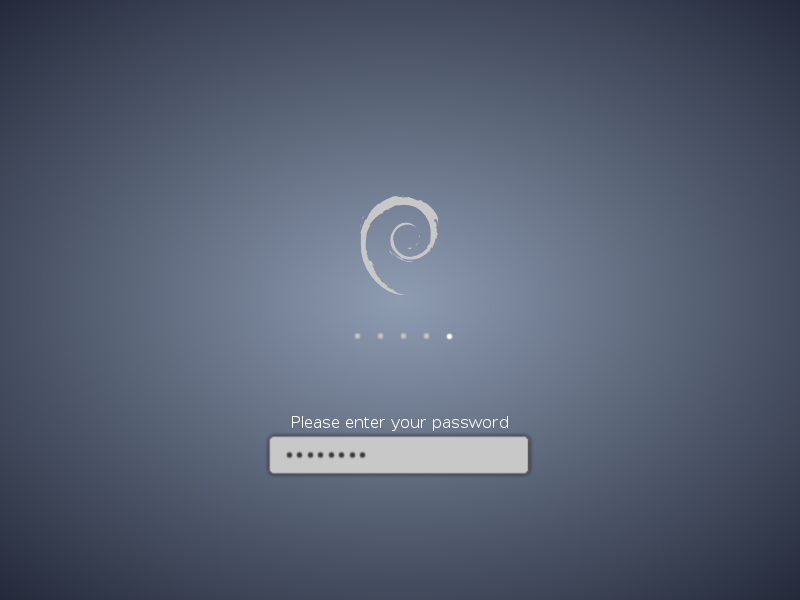
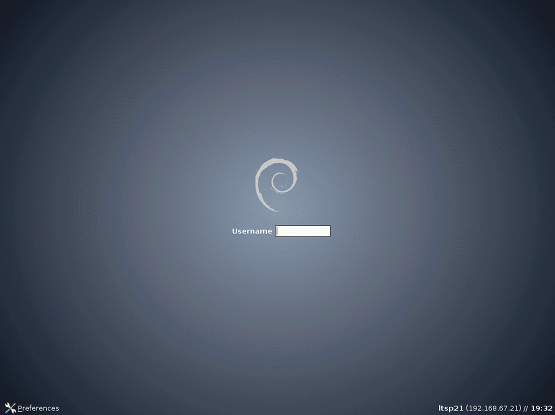
Joy Theme When the Joy theme was picked as the chosen theme for Debian 7.0 (Wheezy), I wanted to do what I could to get as much of it in the archive as possible before the freeze that occurred in June. I ve been working with Paul Tagliamonte and Vagrant Cascadian and I m glad that it resulted in some nice things! The Joy theme is modest and beautiful and I think Debian 7.0 is going to be one of the best looking Debian releases so far. Joy Plymouth Theme Plymouth is the part that provides the boot splash. It also takes care of a few other things, like showing prompts and progress indicators for filesystem checks, password prompts for encrypted devices and more so that the splash doesn t need to exit to show those. It s very scriptable, The installers for the Genesi Efika range of devices even use it for it s front-end. I needed to start with a Plymouth theme where I knew the prompts for all the things that happen during boot was at least more or less implemented, so I started off with one that I know works well, the Edubuntu one. So, fun fact: Debian 7.0 s Plymouth theme is actually based on the Edubuntu one. I had to play with the colours a bit to get it right, Edubuntu has a light background so I had to invert contrast for things like the input box, but I think it came out nicely. Splashy isn t in the archives anymore and it s not widely used anymore, so I cleaned it up from the desktop-base package so that there s less clutter shipped with it. Joy LTSP/LDM Theme This screenshot actually looks a bit uglier than it should because I took it on a VM that doesn t have 24bit colour, but we re looking into what we can do to make it look better on 16bit colour as well. During Debconf in Nigaragua, Vagrant and I worked on getting the LDM theme in shape. I have already done what I thought was most of the work by the time Debconf started, but it turns out there was a lot more to it to do it properly. We managed to get rid of the gtk2-engines-murrine dependency, which in itself is quite tiny, but it s a bit backwards in that it depends on the whole rest of the murrine-themes which brings in too much. We took the time to get the dependencies/recommends/etc right and to make it the default theme in Debian without messing it up for any Debian derivatives. It all came together and now when you install LTSP on Debian, you get the Joy theme by default! I m really glad about that because I didn t get the Spacefun LDM theme done in time for the Squeeze release. Enjoy!

23 August 2012

Gunnar Wolf: Historic airplane found, cash spammed!

Sometimes, very rarely, I am happy that the spam filters in my personal mail server are so far from perfect. Many of us were amazed, some days ago, news broke that Amelia Earhart's plane was found in the Southwestern Pacific. The news is amazing and worthy in itself. But today, I got this mail, proof that Amelia lived through all those years: (all addresses obscured, of course)
Date: Wed, 22 Aug 2012 23:38:59 -0700
From: Amelia Earhart <some-mail@gmail.com>
To: undisclosed-recipients: ;
Subject: Hello
Reply-To: some-other-mail@live.com Hello friend, With due respect to humanity, i am compelled to write to you on a humanitarian ground, however, it has been my wish to execute in life. Please, I am contacting you based on my desire to create a charitable fund in your country with this sum of EURO 3.5 Million which I inherited from my late husband (Dr. Ahrens Earhart). It is my desire to see that this money is invested in any organization of your choice in your country and distributed each year among the charity organizations, the house mother of the child, mosques, churches, schools, support for disadvantaged older men and women or in whatever way you intend helping the less privileged. I took this decision because I was raised out of the house of mother and baby at the moment, i am admitted in a hospital in London were i am taking severe treatment to my cancer illness. Please answer as soon as possible to confirm your agreement with this proposal, so I ll give you all the necessary information that will enable you to have access to this funds my personal accountant will be aware of my arrangements with you. Thank you for your attention and I hope to hear from you soon. Please contact me through my this email- some-other-mail@live.com the nurse helping me will attend to you i have been restricted from touching the computer due to my illness i will direct you through her she is a nice person. Sincerely,
Ms. Amelia Earhart.

Paul Tagliamonte: dpu, debian.js and other random hax

In this choc-filled post, I ve got a few things I d love to share. debian.js First, a quick side-hack called debian.js. It s not entirely a serious project, but it s interesting. Here s some example code (and output from the terminal) Here s some of the client code (but slightly modified for clarity)

debian.on('bug', function(bug)  
    console.log(bug);
 );
which produces the following:
  sender: 'John Johansen <john.johansen@canonical.com>',
  package: 'vidalia',
  id: '<503577E5.2080502@canonical.com>',
  bugno: '682431',
  action: 'followup',
  class: 'bug',
  description: 'Bug#682431: [apparmor] Factorize Qt and GTK themes abstractions?'  
(and later, after I filed for unblock of desktop-base (more on that later))
  sender: 'Paul Tagliamonte <paultag@debian.org>',
  package: 'release.debian.org',
  id: '<20120823011639.GA8561@leliel.localdomain>',
  bugno: '685657',
  action: 'report',
  class: 'bug',
  description: 'Bug#685657: unblock: desktop-base/7.0.3'  
Legit. Anyway, hopefully more hax on this later. I d love to see Debian and Node.js get along better. dpu Nextly, I ve been working on something called dpu , with the (epic) Niels Thykier which will be a replacement for Lintian s test-runner. Progress is good, but not feature-complete yet. The end goal is to allow all projects which deal with the process of generating a debian package to start testing their code. If you have requirements, let me know! desktop-base I ve uploaded version 7.0.3, which features a switch to xz, and slight changes to existing theme elements. Mad props to Eshat Cakar for some slick KDE updates, and to Jo Carter for the Plymouth updates. Props!

22 August 2012

Gunnar Wolf: An industry commits suicide and blames us

[ once again, I am translating somebody else's material In this case, my good Costa Rican friend Carolina Flores. Please excuse my stylistic mistakes My English is far from native as you well know. But this material is worth sharing, and worth investing some tens of minutes doing a quick translation. If you can read Spanish, go read Caro's original entry ] Have you been to a music record store lately? I did so last Saturday, as a mere excercise. I was not planning on buying anything but I wanted to monitor things and confirm my suspicions. What was I suspicious of? First, that I would only find old records. And so it was: The only recent record I found was ...little broken hearts by Norah Jones. the second, that I would only find music for over 50 year old people. so it was: Were I there to look for a present for my father, I would have walked out with 10 good records. Third, that in the store nothing worth commenting would happen. About that last point, I should point out it was around 10 AM and the store had just opened its doors. Lets concede the benefit of doubt. I don't think many of you will remember, but in Barrio La California (where there is now a beauty parlour, almost in front of AM.PM) there was Auco Disco. In Auco Disco there was a guy specialized in rock (Mauricio Alice) and another one specialized in jazz (I don't remember his name). In that record you could always find rare records, but if they were not there, at least you were sure to find somebody to say: "No, we don't have that, but that's an excellent record, it's the best that [insert group here] have ever recorded because just afterwards they switched their guitar player, they had gone a bit south but with that record they are flying. But no, we don't have it; I can recommend you this record by [insert another group] because it has a guitar solo in track six that is amazing". It would happen more or less like that, which means, one would arrive to Auco Disco at 10 AM and leave around 5 PM with three new records, after having listened to a spectacular music selection. What happened to those stores? Were they killed by The Pirate Bay? That's the simplistic answer from the recording industry! The answer is that those stores never got anything from the industry but an invoice. The industry specially in prescindible markets such as ours was limited to hiring artists, taking care of them recording a sellable product, producing the object called record, and that's it. The more commercial radio stations were paid to program those songs as it cannot be casual that "Mosa, mosa" is the summer hit in all of Latin America, can it? but, record stores? Nothing. Lets carry on with that idea: Radio stations are paid to program said music. This idea should not lead us to believe that recording companies are to blame for bad taste. I won't reveal my sources, but I know the success of the "Locura autom tica" song by La Secta was a real example. Nobody paid for it. That song got to the number one because of its own merits(?) (you don't know the effort it took to find that thing, I cannot recommend it to you). Same thing happens with other stations that don't program reggaet n, that try to save the species, and where they play what we do like. But the thing is, everything we like is not available in any record store in this country. Then, even if we wanted to buy a record or give it as a gift to somebody, it is plain impossible. And don't tell me it's the same to present as a gift a link or a CD full of downloaded MP3 as it is to give a record with cover and booklet, wrapped in gift paper. I might be old-school, but the fetish object record still exists, not only because of its cover, but because of its sound. A 3MB MP3 is akin to drinking coffee dripping from a bag that has been used eight times with the same coffee beans. That format is the worst that has ever happened to music, and if we had any bit dignity we would never purchase digital files in Amazon or iTunes safe for MP3 with an acceptable compression level. That, if we could buy them, because not only that is allowed to us. As the musical industry has no interest in resolving ITS problem (that is not our problem, it is those companies') it has not even been resolved how to charge for a MP3 download that includes import fees (well, if downloading from here a MP3 from a USA-based file server can be considered importing goods into Costa Rica!!!) so we don't have to get dizzy entering into the nineties to Titi Online to discover there is nothing by Muse, Andrew Bird, The Killers, Death Cab for Cutie, Paramore, Bj rk... (believe me, I looked them all up, even Norah jones and La Secta. They also were not there). This all leads me to the question, which I present with all due respect (NOT): What the fuck do they expect us to do??? It is outrageous; above all because in the best case they will sell us a watery coffee download that won't allow us to get all the details a vinyl or less compression would give us. In the worst case, post-MP3 groups will end up recording music with no harmonics or hidden sounds, because, what for? Nobody will hear it. They even admit it: "Some musicians and audio engineers say the MP3 format is changing the way studios mix their recordings. They say the MP3 format "flattens" dynamics differences in tone and volume in a song. As a result, a great deal of new music sounds very much alike, and there is nothing as focusing to create a dynamic listening experience. Why working so hard in creating complex sound if nobody can detect it?" (Rolling Stone, The Death of High fidelity, December 26 2007, taken from here). That's why I am not surprised by Adri n's post regarding the sales of old records. The price has nothing to do with it. The causes are related to the fetish object record and what it means or does not mean for people that have never purchased one. Adri n also asks if somebody here keeps buying records. I answered that I would if the stores sold anything I like. I do it even after the nausea I feel while reading "This phonogram is an intellectual work protected in favor of its producer COPYING IT IN WHOLE OR PARTIALLY IS FORBIDDEN " (like that, uppercased, yelling to whoever is only guilty of having bought a record and defending the producer, not the artist). But I am sure that almost nobody buys records because doing so is no longer a gratifying experience; because if buying a record is clicking to wait 15 days for it to reach the mailbox, we prefer clicking on the download link. But there is another reason for people not to buy records anymore. In one of my talks regarding the dictatorship of the all rights reserved, I asked the 30 twenty-something-year-old students if any of them had ever bought a record. One answered he had, because he is an author and performer (cantautor in Spanish) and understands the effort that producing a record entails. The rest of them had never done so. Is it possible that said young people have never listened to real music? Is it possible that, were it not for concerts, what they consider music is a set of washed-out MP3 that are about to fill up 1TB of their computer? Does people no longer buy records because they cannot differentiate one sound from the other? It is not very clear for me where do I want to get to. The recording industry is despicable. An industry that instead of innovating sets its energy on suing adolescents for downloading songs, trying to pass laws restricting our freedoms in Internet, putting up DRMs making us hostages to our devices* and forcing us to listen just the aroma of music, deserves my whole contempt. If we add ot this that said industry won't allow us to legally download their breadcrumbs because it has not understood that Internet does not need a van crossing borders, besides my contempt they deserve my pity and my heartfelt condolence. But the condolence is also for music, real music, that which is not compressed under the shoe using a terrible format. It is also for independent musicians that have not realized that begging for a bit of space to that industry they just add to themselves the "despicable" tag, given they deserve the fruits of their work to enter their bank account. However, there are good things that have come out of this absurdity. Be it for those that have joined projects such as Aut mata (even if it is in MP3) and for dreams come true such as Musopen (that have achieved that the music that's in theory Public Domain becomes so in practice as well). Good for the Electronic Frontier Foundation and the list of lawyers willing to defend people accused of ilegally downloading music in the USA. Good for the Creative Commons licenses that allow free sharing. All those are growing solutions, although none of them allows me to buy the Panamanian Carlos M ndez's record. Thankfully, a friend of mine who knows I will never give a dime to Apple, bought the files for me in iTunes. I thank him deeply, although I would have prefered to go to Auco Disco and have Mauricio tell me that the 2007 EP I have from Carlos is better than the record he did on 2009. * My devices don't have DRM because I use free software. I also use the ogg file format. Image by verbeeldingskr8

Thomas Goirand: MiniUPnP now fully in Debian

IT S FINALLY IN! With this last upload of the MiniUPnP daemon 1.7-3, I ve reached a first milestone: all of the MiniUPnP libraries, daemons and clients are finally in Debian, in a shape which I am not ashamed anymore. What is UPnP for? Back in the days (around Linux 2.0.3x), the only way to share a single Internet connection was to run a Linux box as your gateway. These days are far gone, and nearly every home connection is done through a mini home router, which also often provides a small switch and a WiFi access point. Every computer on the LAN gets its connectivity through the router thanks to NAT, and to be more accurate, masquerading. That works very well for outbound connections (browse the web, send a mail, etc.), but it is then a lot harder that something connects to a server located in the LAN. If you run a permanent server with a fixed LAN IP address, that s fine, you just configure your router to do some port forwarding, so that any inbound connection will be forwarded to the computer of your choice in the LAN. But if one application needs to listen on the public IP address just for a while (for example, IRC using DCC connection), so that something can connect to it, it becomes a way more tricky. That s when UPnP comes into play. UPnP stands for Universal Plug and Play. It s a protocol so that any application on the LAN can open ports on the public IP address of the gateway. Note that an UPnP router is also often referenced as UPnP IGD (Internet Gateway Device). Why using MiniUPnP, don t we have already linux-igd? Before my packaging work, the only UPnP server that was available in Debian was linux-igd, which has a dependency on libupnpX. That library is quite big for what it does (about 500KiB, on top of which you have to install the 200KiB daemon itself), while MiniUPnP is designed to be lightweight (only 158K, with dependencies on iptables, iproute, uuid-runtime and libc6 only). That seems ridiculous, but when you have only 8MiB of flash in your old router, saving few hundreds KiB is really important, and here, we re saving more than 500 KiB, with a full implementation of the UPnP protocol, and the Microsoft NATPmP implemented as well (yes, Microsoft decided that one protocol wasn t enough, and that they should implement their own (sic!)). Who is using MiniUPNP? Probably, you already have the libminiupnpc installed in your SID/wheezy desktop, because the transmission bittorent client which is installed with Gnome by default, depends on it, and minissdpd might be in your desktop too, if you installed the Recommends: packages as well. Which is why these are scoring quite high already in popcon. Previously, transmission was embedding its own version of the MiniUPnP client library, so it s nice to have it as a standalone shared library now. Also, because of its very light weight, and the fact that UPnP is often needed for gaming (both XBOX 360 and PSP need, and can use, the MiniUPnP daemon that runs on your IGD), many ISP who ship a router to their customer, install MiniUPnP in it. For example, at least, the 2nd and 3rd largest Internet access provider in France (Free Telecom and SFR) are shipping MiniUPnPd in their box (one of them using OpenWRT on their router). So probably as well, you are also using MiniUPnP daemon without knowing it. But isn t UPnP unsafe? To this question, I d answer that connecting to Internet is unsafe. It isn t less safe than connecting to Internet on a WiFi hotspot for example. So adding UPnP support on your gateway doesn t make it less safe, especially since MiniUPnP has some features to help with security (like an ACL with IP and port lists, or a secure mode were the router will only open ports to the client requesting it). Also, we are running a distribution where dependencies are easy to check, so it s easy for you to check if a client uses UPnP or not, and decide to trust it (or not). I personally have no issue trusting transmission, x-chat or warzone2010 (more exactly: I don t trust that incoming connectivity will make it less safe for these applications, there are so many other things that could go wrong). MiniUPnP consists of what? MiniUPnP is a set of 4 source packages to handle all of your UPnP needs: - The client library, libminiupnpc (and the corresponding -dev package), with its sidekick miniupnpc client program (you can use it to check the public IP of your gateway, or manually open ports). - The UPnP IGD daemon, miniupnpd, which just reached Debian Experimental. The latest version, 1.7-3, also includes debconf configuration so that you can choose the NIC and IP address to bind on. If you installed previous version, I strongly recommend upgrading to fix previous problems. - The libnatpmp client library (and the -dev package) for implementing the Microsoft protocol as a client (it also has a client package binary for your tests). - The minissdpd daemon to keep memory of all UPnP devices that announced themselves, and speed-up using the UPnP protocol (used by the MiniUPnP client library). A long process to have MiniUPnP in Debian All these 4 pieces of the puzzle were not as easy as it seems to be packaged in Debian. Especially, the IGD daemon, MiniUPnPd, used to depend on some header files that were not packaged in Debian. This was a decision of the iptables maintainers, which even after a long discussion, refused to add the necessary headers because it wasn t supposed to be a kernel API. While this might really be truth, the issue was that there was no public API available in the Linux kernel at all, and other distributions (Fedora, Gentoo, etc.) really did supply these needed files. As a consequence, during a very long time (years literally), shamefully, it was impossible to build the MiniUPnP daemon in Debian, while it was no problem on other distributions. Note that I do not want to start a troll discussion here, I m just stating facts, both parties have very strong and respectable arguments. Anyway, this needed API was finally embedded in MiniUPnPd itself thanks to a contributor to the project, and now it builds on both the Squeeze and the Wheezy (that is Linux 3.2) kernel without any issue. Call for testing Unfortunately, I don t have a Linux box as my Internet gateway. So I did the tests that I could: I installed MiniUPnPd on one computer on my LAN, and checked that I could open ports from another computer. So it seems to work, but I had no way to really test it live , with some real clients. So if you have an Debian SID box as your Internet gateway, feedback would be highly appreciated. What is remaining to do? A transition from libminiupnpc5 to libminiupnpc8 has to happen. Of course, this is too late for Wheezy, so this will happen right after the release. There s not so many reverse dependencies, so it should be ok, but I (yet) have zero experience with transitions. BTW, I had hard time to find out what this transition process was, and maybe some more effort for documenting it would help others (I m thinking about adding some text in the Debian wiki for that). Also, I have called for help on debian-devel, because I m currently the only one maintaining all these 4 source packages, and I m trying to have all my packages checked by others, and team maintained. So if you want to give a hand, or just declare yourself as a backup if I m busy, please raise your hand! Upstream is a friend of mine, and is very reactive to any requests (it very rarely took more than 48 hours to get a reply). Enjoy MiniUPnP and report bugs! Again, feedback would be appreciated. :)
21 August 2012

Alexander Pashaliyski: Google Summer of Code 2012 Clang support for build services in Debian Final Result

In the process of installing and configuring wanna-build, I had lots of problems. Because there was almost no documentation on the subject (and some of the existing was outdated), I had to figure out how everything works by reading the source code and asking people on IRC and mailing lists. I use the most recent version (from git) and since it s not stable, there were some problems and bugs. I fixed several bugs in order to set the system up. I also documented every step so now there s documentation on everything I have done. I uploaded the documentation on installing and configuring wanna-build [0]. I installed and configured reprepro on a local machine in order to use it with wanna-build. In the process I made step-by step setup instructions [1]. I installed and configured sbuild. The lastest version of sbuild contains filters but they don t work. Their purpose is to keep only the necessary variables in the environment, but apparenly the configuration file which should set them is never read. That leaves the filter list empty which causes the environment to be empty. I had to disable them to keep my work going. I installed buildd. I had some problems setting it up there was a bug in the scripts related to parsing the configuration file. I was pointed to a helpful bug report on the topic and with some additional changes I eventually got it working. In the process I had to read some of the source code of buildd. I made a patch that fixes a bug in the manual page of reprepro and got it approved. I contacted the Alioth admin team via the web site, requesting to use their server for my project Clang for build services . I got approved and I created a git repository where I m now uploading my work. The repository that I use to upload changes to sbuild and buildd is [2]. I add the name of the used compiler to the control file and to the name of the deb package. I wrote a function for parsing the debian/rules file looking for hard-coded compiler there. If there is such compiler, which is different from the one chosen as a default, the building proccess exits with a clear error. I made changes to wanna-build, dpkg, sbuild and buildd to fix bugs in them and make it possible to use a compiler different from gcc for the build process.
After my work a build compiler can be set easily. If a package can not be built with that compiler, the build process fails with a clear error. I also modified the pgstatus web interface to display build logs and create reports on user request. I wrote complete documentation about setting up wanna-build, reprepro and buildd ([0] and [1]). This makes a fully functional buildd infrastructure. Now we have a full step by step tutorial. Me and Sylvestre Ledru who was my great mentor, modified the buildd daemon so it will be possible to be run several instances of it for different architectures on a single physical server. I made a lot of changes to pgstatus this is a web interface to the wanna-build database. I had to add some features and fix several problems. In the process I read some of the code of pgstatus and buildd-tools. Now I have a better understanding of how they work. I added a new feature in pgstatus that allows the user to create a full report of the state of all builds. When a designated reports page is opened, a table with the current state of the builds is shown, together with a list of all the reports saved to files for the current distribution and architecture. The reports can be downloaded directly from the
interface. They are stored in JSON format. The log files were not accessible from pgstatus because of lack of implementation and bugs. I created a script that reads emails sent by wanna-build and extracts log files from them. I made changes to wanna-build so that it feeds the database with the necessary information about package history. I updated the wanna-build patch to include these changes. As a result the buildd logs can now be opened from the web interface of pgstatus. I applied a patch that fixes bug [3] so that config_schroot.sh (this script installs and sets the default compiler) starts with the necessary privileges. I added a new feature to sbuild that allows scripts to be run right after the dependencies are installed in the chroot and before the actual package starts building. Now anybody can configure sbuild to run such a script by modifying the appropriate configuration file. By adding the following lines: $external_commands =
chroot-pre-build-commands => [
['/root/purge-gcc.sh'],
],
; The script /root/purge-gcc.sh is run by sbuild in the chroot. This script can be necessary to set everything in the environment so that packages are built exactly as needed. Me and my mentor used this to replace gcc with a script that removes all gcc-specific packages so that we can be sure whether a package uses clang or not. I have a fully functional buildd infrastructure installed on my development system. In order to get it running, I made several patches: dpkg.patch The main patch with a lot of changes related to compiler support for building.
wanna_build.patch Fixes bugs and makes wanna-build feed the database with package history information.
sbuild.patch Fixes bugs and work-arounds the problem that some sbuild scripts are called without reading the configuration file of sbuild. Adds configuration option that allows scripts to be run right after the dependencies are installed in the chroot and before the actual package starts building.
pgstatus.patch Fixes bugs and adds reports page to pgstatus. Me and my mentor contacted the Debian wanna-build team to connect our new service with Debian. We explained what the current state of the project is and what we need from them. I thank my mentor Sylvestre Ledru for his presentation on DebConf 12 ([4], [5]). He showed our project and it was seen that people are interested in it. A nice resume of his talk has been made by Michael Larabel on Phoronix [6]. I tested everything thoroughly to make sure my changes don t break anything. I am happy to say that the project is now finished. ==== [0] http://wiki.debian.org/DebianWannaBuildInfrastructureOnOneServer
[1] http://wiki.debian.org/SetupBuildServiceForWanna-build
[2] http://anonscm.debian.org/gitweb/?p=pkg-llvm/clang-build.git;a=summary
[3] http://bugs.debian.org/cgi-bin/bugreport.cgi?bug=608840
[4] http://sylvestre.ledru.info/blog/media/5/rebuild-debian-presentation-clang-July-10.pdf
[5] http://meetings-archive.debian.net/pub/debian-meetings/2012/debconf12/high/884_Build_Debian_with_another_compiler.ogv
[6] http://www.phoronix.com/scan.php?page=news_item&px=MTEzODQ

Russell Coker: Mirror Displays

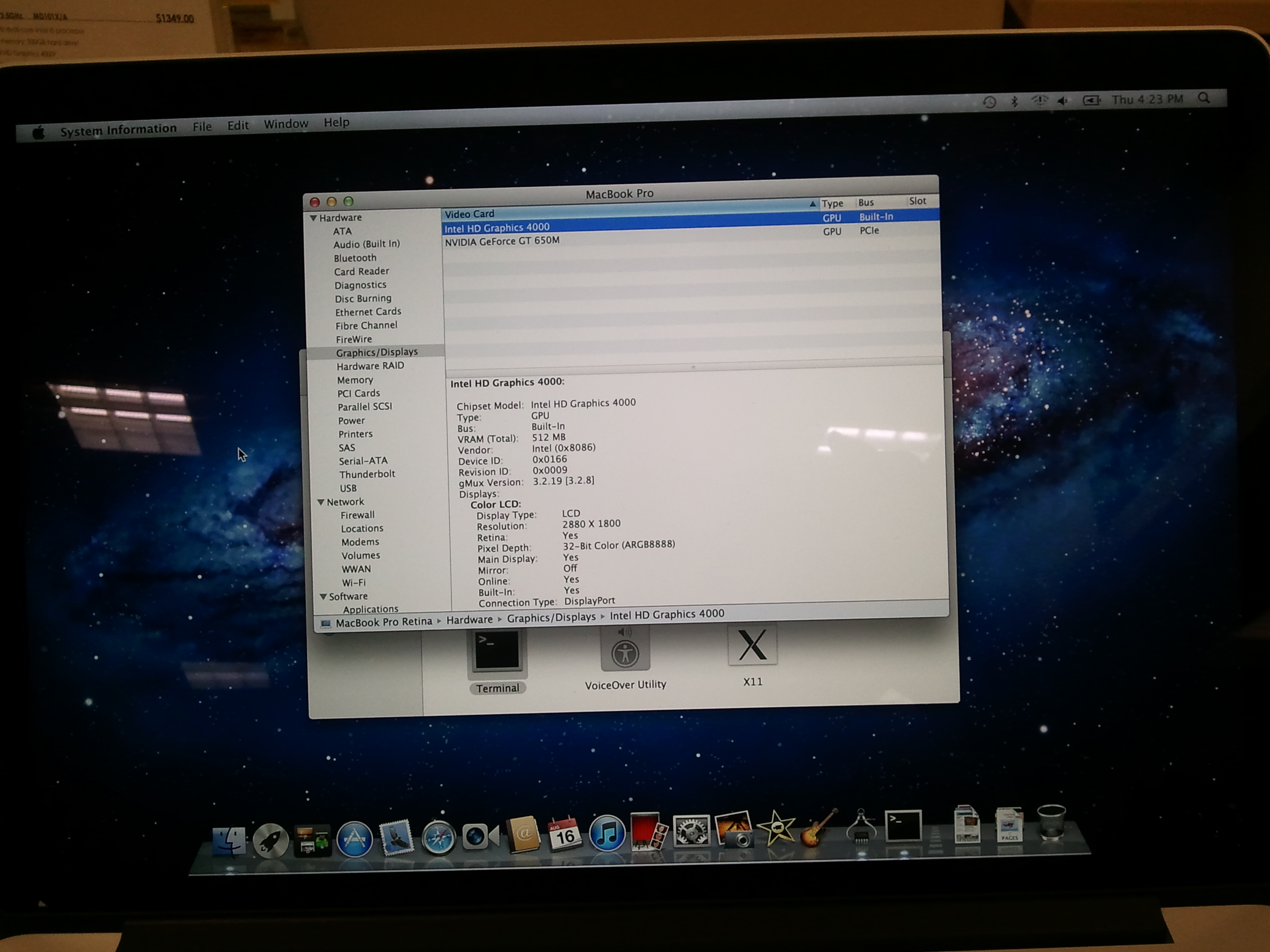
Image of a Macbook Pro with a Retina display showing how badly it reflects When I previously wrote about the Retina display in the new Macbook Pro I was so excited that I forgot to even check whether the display reflects light [1]. A TFT display with a mirrored surface apparently permits more intense color which is generally a good thing. It also makes it easier to clean the surface which is really important for phones and tablets. The down-side of a mirrored surface on a display is that it can reflect whatever else is in the area. This generally isn t a problem in an office as you can usually adjust the angle of the monitor and the background lighting to avoid the worst problems. It s also not a serious problem for a hand-held device as it s usually easy to hold it at an angle such that you don t have light from anything particularly bright reflecting. But my experience of laptop use includes using them anywhere at any time. I ve done a lot of coding on all forms of public transport in all weather conditions. Doing that with a Thinkpad which has a matte surface on it s screen is often difficult but almost always possible. Doing that on a system with a mirrored display really isn t possible. The above photo of a 15 Macbook Pro model MD103X/A was taken at a Myer store which was specifically designed to make the computers look their best. The overall lighting wasn t particularly bright so that the background didn t reflect too much and the individual lights were diffuse to avoid dazzling point reflections. But even so the lights can be clearly seen. Note that the photo was taken with a Samsung Galaxy S, far from the best possible camera. If I was buying a laptop that would only ever be used in the more northern parts of Europe or if I was buying a laptop to use only at home and at the office then I might consider a mirror display. But as I mostly use my laptop in mainland Australia including trips to tropical parts of Australia and I use it in all manner of locations a mirror display isn t going to work for me. This isn t necessarily a bad decision by Apple designers. My observation of Macbook use includes lots of people using them only in offices and homes. Of the serious geeks who describe their laptop as My Precious hardly anyone has a Macbook while Thinkpads seem quite popular in that market segment. I don t think that it s just the matte screen that attracts serious geeks to the Thinkpad, but it does seem like part of a series of design decisions (which include the past tradition of supporting hard drive removal without tools and the option of a second hard drive for RAID-1) that make Thinkpads more suitable for geeks than Macbooks. While the new tradition in Apple design of gluing things together so they can never be repaired, recycled, or even have their battery replaced seems part of a pattern that goes against geek use. Even when Apple products are technically superior in some ways their catering to the less technical buyers makes them unsuitable to people like me. Maybe the ability to use a Macbook as a shaving mirror could be handy, but I d rather grow a beard and use a Thinkpad. Related posts:
  1. The Retina Display Last night I played with an Apple Macbook Pro with...
  2. are Thinkpads meant to run 24*7? My Thinkpad has started to run hot recently. If I...
  3. presentations and background color In response to my last post about using laptops for...

19 August 2012

Andrew Cater: Raspberry Pi - Debian Wheezy rather than Raspbian

I note that the Raspberry Pi folks are recommending the Raspbian fork of Debian for the Pi. This is the hard float port to ARM version 6 undertaken by Mike Thompson and Peter Green (who is also a Debian developer).

That being said, though, they have also released an armel copy that is fully binary compatible with Debian Wheezy for use with software that can't readily be rebuilt e.g. Oracle Java. This is understood to be slower than Raspbian but otherwise contains identical software.

The changes made by the Raspberry Pi folks are fairly minimalist: /opt contains some of the graphics example code which takes advantage of the non-free GPU and the raspi-config script under /usr/bin which allows initial configuration at first boot.

The /etc/apt/get/sources.list refers solely to Debian repositories and the software supplied by the Raspberry Pi project can be readily updated to latest Debian Wheezy. All in all a nice way to have a silent Debian machine in a tiny case.

17 August 2012

Gunnar Wolf: More on hacker conferences and sexual harassment

At the beginning of this year, I blogged about a Mexican security-minded hacker conference scaring away its female audience by advertising in a sexist way. I don't know if it is the need to be l33t or kewl, to show off that hackers are really socially inept, or what... but this seems to carry on. I know many are familiar with the red/yellow card project (and followup) by kdotcdot. I am (rightfully? naively?) proud that at DebConf we have achieved a clean conference environment, without such problems... Yes, I know that, during the last ~year at DebConf11 we discussed an anti-harassment policy (look at the thread, it was quite interesting!), came up with standards of respect And Debian as a whole voted on a GR that ratifies a diversity statement. The fact that we had those very positive discussions, documents and events shows we needed to have them. But, again, this shows that being a hacker does not necessarily mean being a jerk. And I'm very proud to be part of this community. I recently stumbled across a very nice, insightful post by Valerie Aurora on The Ada Initiative: Supporting women in open technology and culture DEFCON: Why conference harassment matters. Take a good read at it. I hope it helps shape other hacker groups in a less-aggressive, more welcoming way. Oh! And before closing: Be sure to at least skim through both Valerie Aurora's and kdotcdot's comments. LOTS of insight in them.

16 August 2012

Lisandro Dami&aacute;n Nicanor P&eacute;rez Meyer: QExtSerialPort in Debian experimental

After some rants about the status of different Qt-based serial port libs, I'm happy to announce that today QExtSerialPort was accepted in Debian experimental (this last link may give a 404 for some time, that's ok).

A great effort was done upstream to put the source in a suitable state for being included in Debian. Thank you all guys!

I packaged a beta version, so I uploaded it to experimental.

In case you are wondering why packaging a lib with (yet) no apps depending on it, the answer is quite simple: there are lots of people already using it in it's home projects (me included). Now those projects have the chance to get into Debian too :-)

As a side note, there is also another nice implementation called QtSerialPort. I have also tested it and works pretty fine too. It aims to become part of Qt as an add-on someday.


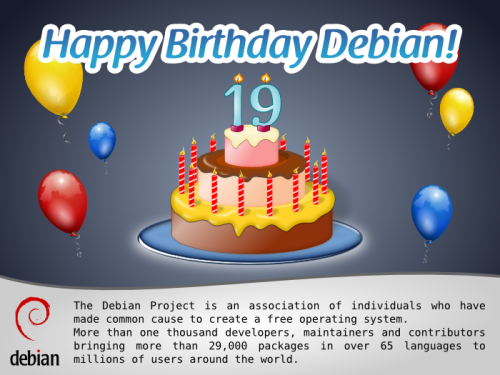
Gunnar Wolf: 19 years of Debian

Happy 19th birthday, Debian! The Debian project is 19 years old now. Following Francesca's invitation (and Rapha l's lead, and using Leandro's image, collaboratively as it always happens here), I will tell a bit of my memories: How I got to Debian. I am a Debian user since ~2000, and a Debian Developer since April 2003. But, just as Rapha l's, my history must go somewhat further back in time. In 1992, I got my first 1200bps modem, and almost immediately became an avid BBS user (what's that? Javier Matuk talks [in Spanish] about BBSes in his newspaper column back in 1994). By mid 1993 I started operating my own BBS, CatarSYS. One of the key points that defined CatarSYS is that my focus was large-scale communication. I started connecting to several BBS networks, allowing messages to be relayed to distant people, mainly in the USA and Spain, and getting some feeds that could be seen as the poor man's Usenet. At some point during the year I kept CatarSYS going, I got connected through a strange set of gateways to pure gold: A UUCP feed! This means, during some months, I operated the first (free, hobbyist) service that offered its users a free Internet mail address in Mexico. Yes, it was completely different to what we are used to today. I tried to connect to my provider at least three times a week, but this meant less than one week turnover time for messages sent to people anywhere in the world! But, back to Debian: Via this UUCP feed, I also got some real Usenet newsgroups Including several on the comp.os category. I remember reading about Linux back then, and learning some commands, but didn't really get hooked into it. I was in Israel from July 1994 to June 1995, doing completely non-computer-related tasks. Came back in 1995, and due to my father being an academic, got dialup internet access at home. WOW, *real* Internet! It didn't take me long to start downloading Linux information and floppy images. One failed after another. But before the end of the year, I found in a bookshop a book (that included a CD-ROM) called "Build your own web server with Linux". WOW again Remember this was still 1995! I bought it, and shortly afterwards, I had a Slackware system (Linux kernel 1.0.9) running. That meant many sleepless nights full of joy and frustration (as getting hardware to work was cloe to impossible). By 1996, I got (within one week) my two first real jobs: A systems administrator at a small ISP and a highschool teacher. At the ISP, I got a spare computer to play with Linux, as of course the Big Server was running with Windows NT 3.51. Poor little machine... By then I was already a part of the Mexican Linux User Group. This group had just printed a batch of Linux CDs RedHat 4.0. This was the first release that really made me happy and allowed me to do good work. Together with a friend I took to work with us, Juan Pablo Romero, we installed over a weekend a full replacement for our buggy NT machine, in much cheaper hardware. Of course, Linux was nowhere near corporate-recognition, and our project remained a project, not touching the Windows machine. Anyway... Several years passed, and I was happy with my RedHat choice. I won't mention the milestones and job changes, as it would get boring and leave the point completely aside. By the year 2000, I was quite more involved with the LUG, as well as with the computer security group in DGSCA-UNAM. I became also an OpenBSD user, and had got so hooked up in free software that I felt the need to collaborate: To be a little part of one of those Big Projects that had given me so much. But which one? I have never been much of a programmer Yes, I can solve my everyday needs and have fun with it, and sometimes a bit beyond that. I enjoy programming. But all of my projects have begun little and stayed little. I wanted to join OpenBSD, as it was a community I really believed in, but given my skillset (and given a flame-prone, aggressive developer community), I lost motivation to do so. By 2000, I had also lost faith in RedHat. I don't have the exact dates, so I might be some months off But after RedHat's IPO, I felt a sharp change. Version 7.0 was really demotivating It tried to offer a polished desktop experience, but was really buggy, unstable, and full of bad decisions. In Mexico, Pepe Neif had taken up the job of making a derivative distribution of RedHat (called LinuxPPP), pressing hundreds of CDs and making a teaching program I was part of several times. Talking with Pepe (who continued to release based on RedHat 6), he told me he was interested in switching over to become a Debian-based distribution, but the job of migrating his installed base made the project stall LinuxPPP reached only version 6.4. But I installed Debian in early 2000, and loved it. I started getting familiar with its social philosophy and foundation documents at the same time I started migrating my servers from RedHat to Debian This must have been by Spring 2000, as I installed Potato while it was frozen but not yet stable. By January 2002 I applied for NM. My process took a long time, as my AM got MIA when he had already approved me (but before sending the AM report), so basically I had to go through AM twice And by April 16, 2003, I got accepted as a DD. Contrary to what is acceptable today, I requested the full process to be done before starting to maintain any packages, as I didn't want to bother people with package sponsorship requests, so my whole process was done evaluating packages I would eventually upload. Since becoming a DD, my main involvement in the project has been in packaging groups (I was a pkg-perl founder and member for many years, and am currently working in the pkg-ruby-extras group). But, as I said, my main strength is not programming So my main involvement in Debian has been more social than technical: I have been a DebConf organizer since 2005, a very interesting, stressing, rewarding and (for some months) time-demanding role, and since 2009 I am part of the keyring maintainence team, which is much easier workload, although carries important ramifications. So, after 19 years of Debian, and after nine years of me being part of it, Debian is clearly my strongest link to the Free Software community, a project I have grown to love and whose way of being I share and enjoy studying and explaining. And it is a technically excellent product, and a great place to start and keep learning both about how every aspect and layer of an operating system works, and how human-to-human interaction works in such a diverse, almost impossible environment happens. Congratulations, Debian!
AttachmentSize
debian-19_500.png149.81 KB

Next.

Previous.