Well, that's all for today. I think so. You can never be sure.
https://www.google.com/calendar/ical/person%40gmail.com/private-12341234123412341234123412341234/basic.ics
After doing that, I noticed that the fan in my laptop was on more often than
usual, and I noticed that akonadi-server and postgres were running very often,
and doing quite a lot of processing.
The evil
I investigated and realised that Google
seems to be doing everything they can to make their ical feeds hard to sync
against efficiently. This is the list of what I have observed Gmail doing to an
unchanged ical feed:
Date: headers in HTTP replies are always nowIf-Modified-Since: is not supportedDTSTAMP of each element is always nowVTIMEZONE entries appear in random orderORGANIZER CN entries randomly change between full name and plus.google.com
user IDATTENDEE entries randomly change between having a CN or not having itTRIGGER entries change spontaneouslyCREATED entries change spontaneously.ics feed has actually changed.
Have a look at the script:
I consider it far from trivial, since it needs to do a partial parsing of the
.ics feed to throw away all the nondeterminism that Google pollutes it with.
The setup
The script needs to be run periodically, and I used it as an opportunity to
try
systemd
user
timers:
$ cat ~/.config/systemd/user/update-ical-feeds.timer
[Unit]
Description=Updates ical feeds every hour
# Only run when on AC power
ConditionACPower=yes
[Timer]
# Run every hour
OnActiveSec=1h
# Run a minute after boot
OnBootSec=1m
Unit=update-ical-feeds.service
$ cat ~/.config/systemd/user/update-ical-feeds.service
[Unit]
Description=Update ICal feeds
[Service]
# Use oneshot to prevent two updates being run in case the previous one
# runs for more time than the timer interval
Type=oneshot
ExecStart=/home/enrico/tmp/calendars/update
$ systemctl --user start update-ical-feeds.timer
$ systemctl --user list-timers
NEXT LEFT LAST PASSED UNIT ACTIVATES
Wed 2015-03-25 22:19:54 CET 59min left Wed 2015-03-25 21:19:54 CET 2s ago update-ical-feeds.timer update-ical-feeds.service
1 timers listed.
Pass --all to see loaded but inactive timers, too.
To reload the configuration after editing: systemctl --user daemon-reload.
Further investigation
I wonder if ConditionACPower needs to be in the .timer or in the
.service, since there is a [Unit] section is in both. Update: I have
been told it can be in the .timer.
I also wonder if there is a way to have the timer trigger only when online.
There is a network-online.target and I do not know if it is applicable. I
also do not know how to ask systemd if all the preconditions are currently met
for a .service/.timer to run.
Finally, I especially wonder if it is worth hoping that Google will ever make
their .ics feeds play nicely with calendar clients.
~ gem update ctioga2The website has also been decently improved, with now a search box for finding images in the gallery
| Author: | David Lochbaum |
| Author: | Edwin Lyman |
| Author: | Susan Q. Stranahan |
| Author: | Union of Concerned Scientists |
| Publisher: | The New Press |
| Copyright: | 2014 |
| ISBN: | 1-59558-927-9 |
| Format: | Kindle |
| Pages: | 320 |
Every year, Debian organizes a DPL election. Around end of March, one waits for the beginning of the DPL campaign. Everyone can ask questions to nominated candidates on debian-vote. This year, and for the first time, I nominated myself as a candidate for the 2015 DPL election. You can read my platform here.Release and Release.gpg files that pass apt's signature
validation on my home connection.
Google publishes Linux software repositories for several of their products,
including Google Chrome, which is available from the following apt source:
deb http://dl.google.com/linux/chrome/deb/ stable main
These repositories are signed with an 8 year old 1024-bit DSA key:
pub 1024D/7FAC5991 2007-03-08
Key fingerprint = 4CCA 1EAF 950C EE4A B839 76DC A040 830F 7FAC 5991
uid Google, Inc. Linux Package Signing Key <linux-packages-keymaster@google.com>
sub 2048g/C07CB649 2007-03-08
Asymmetric 1024-bit keys are not considered strong enough and were, for
instance, aggressively retired from Google's SSL frontends almost two years
ago. Such short keys should not be used to protect the integrity of software
package repositories.
Note that this key has a longer 2048-bit ElGamal subkey, which is not actually
used to produce signatures, but only for encryption. In fact, only a signing key
is needed to sign the files in a secure apt repository, and, for instance, the
archive keys used to sign official debian.org repositories do not contain an
encryption subkey.
Since years, many users have reported an error message like the following when
running apt-get update:
W: GPG error: http://dl.google.com stable Release: The following signatures were
invalid: BADSIG A040830F7FAC5991 Google, Inc. Linux Package Signing Key
<linux-packages-keymaster@google.com>
This error might resolve itself if apt-get update is run again. Apparently,
this is due to "bad pushes" occurring in the Google infrastructure. An example
of this can be seen in the following curl output:
$ curl -v http://dl.google.com/linux/chrome/deb/dists/stable/Release \
http://dl.google.com/linux/chrome/deb/dists/stable/Release.gpg
* Hostname was NOT found in DNS cache
* Trying 74.125.196.136...
* Connected to dl.google.com (74.125.196.136) port 80 (#0)
> GET /linux/chrome/deb/dists/stable/Release HTTP/1.1
> User-Agent: curl/7.38.0
> Host: dl.google.com
> Accept: */*
>
< HTTP/1.1 200 OK
< Accept-Ranges: bytes
< Content-Length: 1347
< Content-Type: application/octet-stream
< Etag: "518b8"
< Expires: Sun, 22 Mar 2015 18:55:19 PDT
< Last-Modified: Fri, 20 Mar 2015 04:22:00 GMT
* Server downloads is not blacklisted
< Server: downloads
< X-Content-Type-Options: nosniff
< X-Frame-Options: SAMEORIGIN
< X-Xss-Protection: 1; mode=block
< Date: Sun, 22 Mar 2015 01:55:19 GMT
< Alternate-Protocol: 80:quic,p=0.5
<
Origin: Google, Inc.
Label: Google
Suite: stable
Codename: stable
Version: 1.0
Date: Thu, 19 Mar 2015 22:55:29 +0000
Architectures: amd64 i386
Components: main
Description: Google chrome-linux repository.
MD5Sum:
53375c7a2d182d85aef6218c179040ed 144 main/binary-i386/Release
c556daf52ac818e4b11b84cb5943f6e0 4076 main/binary-i386/Packages
867ba456bd6537e51bd344df212f4662 960 main/binary-i386/Packages.gz
2b766b2639b57d5282a154cf6a00b172 1176 main/binary-i386/Packages.bz2
89704f9af9e6ccd87c192de11ba4c511 145 main/binary-amd64/Release
fa88101278271922ec9b14b030fd2423 4082 main/binary-amd64/Packages
1ba717117027f36ff4aea9c3ea60de9e 962 main/binary-amd64/Packages.gz
19af18f376c986d317cadb3394c60ac5 1193 main/binary-amd64/Packages.bz2
SHA1:
59414c4175f2cc22e67ba6c30687b00c72a7eafc 144 main/binary-i386/Release
1764c5418478b1077ada54c73eb501165ba79170 4076 main/binary-i386/Packages
db24eafac51d3e63fd41343028fb3243f96cbed6 960 main/binary-i386/Packages.gz
ad8be07425e88b2fdf2f6d143989cde1341a8c51 1176 main/binary-i386/Packages.bz2
153199d8f866350b7853365a4adc95ee687603dd 145 main/binary-amd64/Release
7ce66535b35d5fc267fe23af9947f9d27e88508b 4082 main/binary-amd64/Packages
a72b5e46c3be8ad403df54e4cdcd6e58b2ede65a 962 main/binary-amd64/Packages.gz
dbc7fddd28cc742ef8f0fb8c6e096455e18c35f8 1193 main/binary-amd64/Packages.bz2
* Connection #0 to host dl.google.com left intact
* Found bundle for host dl.google.com: 0x7f24e68d06a0
* Re-using existing connection! (#0) with host dl.google.com
* Connected to dl.google.com (74.125.196.136) port 80 (#0)
> GET /linux/chrome/deb/dists/stable/Release.gpg HTTP/1.1
> User-Agent: curl/7.38.0
> Host: dl.google.com
> Accept: */*
>
< HTTP/1.1 200 OK
< Accept-Ranges: bytes
< Content-Length: 198
< Content-Type: application/octet-stream
< Etag: "518f4"
< Expires: Sun, 22 Mar 2015 18:55:19 PDT
< Last-Modified: Fri, 20 Mar 2015 04:05:00 GMT
* Server downloads is not blacklisted
< Server: downloads
< X-Content-Type-Options: nosniff
< X-Frame-Options: SAMEORIGIN
< X-Xss-Protection: 1; mode=block
< Date: Sun, 22 Mar 2015 01:55:19 GMT
< Alternate-Protocol: 80:quic,p=0.5
<
-----BEGIN PGP SIGNATURE-----
Version: GnuPG v1.4.10 (GNU/Linux)
iEYEABECAAYFAlULm7YACgkQoECDD3+sWZFyxACeNPuK/zQ0v+3Py1n2s09Wk/Ti
DckAni8V/gy++xIinu8OdUXv7c777V9H
=5vT6
-----END PGP SIGNATURE-----
* Connection #0 to host dl.google.com left intact
Note that both the Release and Release.gpg files were fetched with the same
HTTP connection, so the two files must have come from the same web frontend.
(Though, it is possible they were served by different backends.) However, the
detached signature in Release.gpg does not match the content in Release:
gpgv: Signature made Fri 20 Mar 2015 12:01:58 AM EDT using DSA key ID 7FAC5991
gpgv: BAD signature from "Google, Inc. Linux Package Signing Key <linux-packages-keymaster@google.com>"
Performing the same pair of fetches again, the same Release.gpg file is
returned, but the Release file is slightly different:
$ curl -v http://dl.google.com/linux/chrome/deb/dists/stable/Release \
http://dl.google.com/linux/chrome/deb/dists/stable/Release.gpg
* Hostname was NOT found in DNS cache
* Trying 74.125.196.136...
* Connected to dl.google.com (74.125.196.136) port 80 (#0)
> GET /linux/chrome/deb/dists/stable/Release HTTP/1.1
> User-Agent: curl/7.38.0
> Host: dl.google.com
> Accept: */*
>
< HTTP/1.1 200 OK
< Accept-Ranges: bytes
< Content-Length: 1347
< Content-Type: application/octet-stream
< Etag: "518f3"
< Expires: Sun, 22 Mar 2015 18:55:04 PDT
< Last-Modified: Fri, 20 Mar 2015 04:05:00 GMT
* Server downloads is not blacklisted
< Server: downloads
< X-Content-Type-Options: nosniff
< X-Frame-Options: SAMEORIGIN
< X-Xss-Protection: 1; mode=block
< Date: Sun, 22 Mar 2015 01:55:04 GMT
< Alternate-Protocol: 80:quic,p=0.5
<
Origin: Google, Inc.
Label: Google
Suite: stable
Codename: stable
Version: 1.0
Date: Fri, 20 Mar 2015 04:02:02 +0000
Architectures: amd64 i386
Components: main
Description: Google chrome-linux repository.
MD5Sum:
89704f9af9e6ccd87c192de11ba4c511 145 main/binary-amd64/Release
fa88101278271922ec9b14b030fd2423 4082 main/binary-amd64/Packages
1ba717117027f36ff4aea9c3ea60de9e 962 main/binary-amd64/Packages.gz
19af18f376c986d317cadb3394c60ac5 1193 main/binary-amd64/Packages.bz2
53375c7a2d182d85aef6218c179040ed 144 main/binary-i386/Release
c556daf52ac818e4b11b84cb5943f6e0 4076 main/binary-i386/Packages
867ba456bd6537e51bd344df212f4662 960 main/binary-i386/Packages.gz
2b766b2639b57d5282a154cf6a00b172 1176 main/binary-i386/Packages.bz2
SHA1:
153199d8f866350b7853365a4adc95ee687603dd 145 main/binary-amd64/Release
7ce66535b35d5fc267fe23af9947f9d27e88508b 4082 main/binary-amd64/Packages
a72b5e46c3be8ad403df54e4cdcd6e58b2ede65a 962 main/binary-amd64/Packages.gz
dbc7fddd28cc742ef8f0fb8c6e096455e18c35f8 1193 main/binary-amd64/Packages.bz2
59414c4175f2cc22e67ba6c30687b00c72a7eafc 144 main/binary-i386/Release
1764c5418478b1077ada54c73eb501165ba79170 4076 main/binary-i386/Packages
db24eafac51d3e63fd41343028fb3243f96cbed6 960 main/binary-i386/Packages.gz
ad8be07425e88b2fdf2f6d143989cde1341a8c51 1176 main/binary-i386/Packages.bz2
* Connection #0 to host dl.google.com left intact
* Found bundle for host dl.google.com: 0x7ffa33d8b6a0
* Re-using existing connection! (#0) with host dl.google.com
* Connected to dl.google.com (74.125.196.136) port 80 (#0)
> GET /linux/chrome/deb/dists/stable/Release.gpg HTTP/1.1
> User-Agent: curl/7.38.0
> Host: dl.google.com
> Accept: */*
>
< HTTP/1.1 200 OK
< Accept-Ranges: bytes
< Content-Length: 198
< Content-Type: application/octet-stream
< Etag: "518f4"
< Expires: Sun, 22 Mar 2015 18:55:05 PDT
< Last-Modified: Fri, 20 Mar 2015 04:05:00 GMT
* Server downloads is not blacklisted
< Server: downloads
< X-Content-Type-Options: nosniff
< X-Frame-Options: SAMEORIGIN
< X-Xss-Protection: 1; mode=block
< Date: Sun, 22 Mar 2015 01:55:05 GMT
< Alternate-Protocol: 80:quic,p=0.5
<
-----BEGIN PGP SIGNATURE-----
Version: GnuPG v1.4.10 (GNU/Linux)
iEYEABECAAYFAlULm7YACgkQoECDD3+sWZFyxACeNPuK/zQ0v+3Py1n2s09Wk/Ti
DckAni8V/gy++xIinu8OdUXv7c777V9H
=5vT6
-----END PGP SIGNATURE-----
* Connection #0 to host dl.google.com left intact
Note that the Date line in the Release file is different:
@@ -6 +6 @@
-Date: Thu, 19 Mar 2015 22:55:29 +0000
+Date: Fri, 20 Mar 2015 04:02:02 +0000
The file hashes listed in the Release file are in a different order, as well,
though the actual hash values are the same. This Release file does have a
valid signature:
gpgv: Signature made Fri 20 Mar 2015 12:01:58 AM EDT using DSA key ID 7FAC5991
gpgv: Good signature from "Google, Inc. Linux Package Signing Key <linux-packages-keymaster@google.com>"
Note that the Release.gpg files in the good and bad cases are the same, and
the same signature cannot cover two files with different content. Also note that
the same mis-signed content is available via HTTPS, so it is probably not
caused by a MITM attack.
The possibility of skew between the Release and Release.gpg files is
precisely why inline signed Release files were introduced, but Google's
repositories use only the older format with a detached signature.
It would be nice if Google could fix the underlying bug in their infrastructure
that results in mis-signed repositories being published frequently, because it
trains users to ignore cryptographic failures.
.nvidia-settings-rc in my homedir from ages ago was
fun
The downside was that the system was noisier under load; slightly
noisier in some games, to much more noisier in others. This didn't
match my expectations, since the specific version of the card I bought
was not overclocked and had extra large fans, and with only a +25W TDP
it shouldn't have been significantly noisier. Well, that's it, I said,
not all marketing/reviews should be believed.
One interesting thing was that I wasn't clearly able to pin-point what
was generating the additional noise.
PSU upgrade
I was thinking anyway about doing a PSU upgrade as well, since my
current PSU was even older than my videocard, and was at the limit.
Dust
So I bought a PSU as well, and spent about half a day installing
it. Why half a day? Because the new PSU is modular, and the
combination with the case I have means I could redo the cabling inside
my case, significantly.
In the process, I found a lot of accumulated dust which I cleaned. I
also found out that parts of the CPU cooler fins were blocked by dust,
so the fan was not as effective as when new. I also realised that one
case fan was no longer effective in its position, since I have no HDDs
that need cooling (this case is split between MB and HDD/PSU areas),
so I could move it in a place that cools better the various PCIe
devices.
and silence!
After all was said and done, the PC booted up just fine. Everything
seemed correct, the new position of the fan was drawing in cold air
and pushing it over the PCIe cards, so it was time to see if all the
cleanup had any effect on the behaviour under load.
So I start a game, the card gets slightly noisier compared to idle,
and stays there. I go on playing for 10 minutes, which would have
been more than enough to heat the whole system enough that it becomes
noisy, but nothing, just slightly above the normal "PC is on"
noise. Before all the upgrades, my old card was definitely noisier
when playing
I don't know if there is a single, key factor, or if it's a
combination of all of:
Who are you?
I am Laura Arjona, I work as IT assistant at Technic University of Madrid, I am married and I have a son, and I use and promote free (libre) software both at job and at home and with friends. I have a nice time contributing in Debian and other FLOSS projects but I always want to do more than what I manage to actually do (I hope I can improve that, as time goes by... and maybe when I get retired I am the SuperLArjona that you wrote about!).
What parts of FLOSS community are you engaged?
I use Debian, and CyanogenMod + F-Droid in my phone. I coordinate the translation of the Debian website into Spanish, help with FSFE website translation too, and translate some other free software (GNU MediaGoblin, F-Droid, Android apps that I use, web services that we use at work...). I use and promote some free social networks: pump.io, GNU Social, and XMPP. My work/friends environment is mostly Windows/Android so I try to find/promote libre software replacements or interesting applications for them. I give free FLOSS stickers to everybody showing interest for libre software, and a nice Debian sticker if they finally install it in their computers.
Setup of your main machine?
My machine is a humble Compaq Mini 110C laptop (32bits, Atom N270@1.60GHz, 1GB RAM) and I have Debian Jessie (future-stable ATM) with xfce on it. I'm not tied to particular tools, for example I use Mousepad for editing here in my xfce, Kate in my desktop at work, nano in the server. The only "tuning" that I always do is to set a dark background for terminals and text editors, but I don't even switch to a desktop dark theme... (BTW I love Jessie's theme, "Lines"!). I know there are awesome pieces of software out there (hey emacs-org-mode!), but I just don't have fun having to learn them by myself (no LUG near, I'm afraid...).
Some memorable moments from Debian conferences?
I've only been at Barcelona MiniDebConf Women 2014 and it was great. It was memorable that I promoted the keysigning for that MiniDebConf, and came home with lots of signatures and papers to verify and sign... and then I was not remembering my GPG main key passphrase! so I hid under my desk for two months, and then, decided to start again (created a new key and tried to meet some Debian people in Madrid...). So I guess I should go to some (Mini)DebConf again.
You are currently involved in process of becoming non-packaging Debian Developer - what made you take that step?
I began translating in 2011, and since then, I enjoyed contributing in Debian (women, l10n-es, website, publicity). I'm quite regular with the translation work, and applying for DD is a plan to 'force' myself to find chunks of time to contribute more in the other areas too. I also believe that applying I may help other people to also apply or get more involved or become more visible. So here I am.
Although you applied for non-packaging Debian Developer you recognize
that there is still a technical learning curve in Debian even for that - what are the technical aspects a non-Developer should grasp?
Well, I suppose it depends on the area you are contributing. In Publicity you find repositories in git (bits.debian.org), and subversion (Debian Project News). The website uses CVS (www.debian.org)... So you need the basics of 3 different version control systems to commit your changes (or send them to the mailing list and wait somebody to commit them). We use a mail robot to coordinate the translation work, so you need to write the subject with a certain format, and some people complains when somebody send mail in HTML (plain text is preferred). There are some other tools such as IRC and GPG that I began using just for contributing to Debian. Once that you learn them a bit and you learn how Debian works, you understand they are the great tools and you get in love (hey meetbot and KGB! hey i18n.debian.org!), but I wonder how people with no technical background, or even Computer Engineering students nowadays, accostumed to instant messaging in the mobile, fancy web interfaces and so on, look at these tools and just don't even try.
How do you see future of Debian development?
I don't know, Debian is huge... Some areas in which I hope we, as a community, find the way to work more: packaging (or help configuring) web applications or network services, provide LTS support, and keep on improving outreach/diversity.
What are your future plans in Debian, what would you like to work on?
In the Spanish team area, my plan is to go on translating the website, jump more often into translating package descriptions too, and help first-time-contributors to keep themselves involved. In the website and publicity teams, I hope I manage to put some weekly time to help with pending tasks/bugs, and serve as liaison with the other areas in which I'm involved (women, l10n, contributors...). If I become DD, I would like to create/adopt some data sources for contributors.debian.org, or convince people to do it I'm not sure if I will be able to attend DebConf some year; meanwhile, at least, I'll continue trying to help with the blog and promotion (as -publicity-team member).
Why should developers and users join Debian community? What makes Debian a great and happy place?
For using it: the desktop experience has improved very much in the last years, there's a clear separation between free and non-free software so the Debian users always know where are we, and there is wide documentation (in English, at least. Probably in other languages too). For getting involved: I like very much that you can lurk what almost everybody does: just join some mailing lists or IRC channels, the Debian people work in the open. So you know a bit where are you jumping in. Later you learn that everything is easier than what was looking from the outside, because you make friends and with friends everything is better.
README:
Just runrrgat the root of your project.rrgwill parse the code insidelib/, and generate a graph description in the Graphviz format. You can pipe the output to Graphviz directly, or store it in a file and process it to generate an image.
If you call rrgv instead, it will automatically process the graph with Graphviz,
generate a PNG image, and open it.
Let s see some examples. First the classical analysing itself example, the require graph for rrg itself:
Not very interesting, since all of the logic is currently in the main binary and not on library code. But 1) when I do the refactorings I want to, there will be more library code and 2) while writing this I implemented also parsing scripts in bin/.
Now chake which is a slightly larger project:
An even larger (but still not that big) project, gem2deb:
Note that these visualizations may not be accurate representations of the actual source code. In Ruby, nothing stops one from implementing class A::B in lib/x/y.rb, but most reasonable code will make sure that filenames and the classes namespaces actually match.
If you are working on a sane codebase, though, visualizing graphs like this helps understand the general structure of the code and perceive possible improvements. The gem2deb graph gave me some ideas already and I didn t even paid much attention to it yet.
Jo and I just got back from our massive holiday in Australia. We
had an awesome time overall, fitting in lots of stuff
in 4 weeks. Time for a quick write-up and some photos!
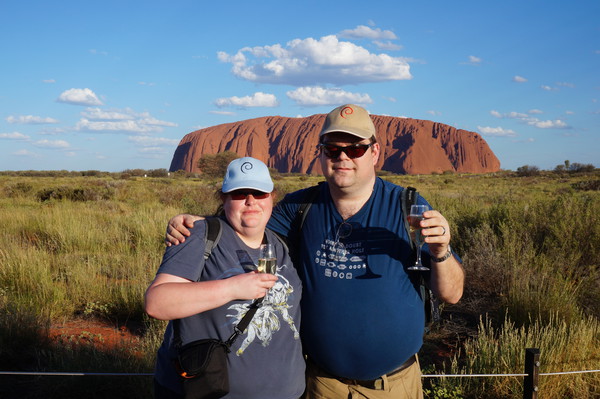
We flew into Sydney, then straight onto Uluru for the obligatory
sunset and sunrise viewings. We didn't climb the Rock, both for
sensitivity reasons and (to be more honest!) it looked way too much
like hard work in 40-plus degree heat.
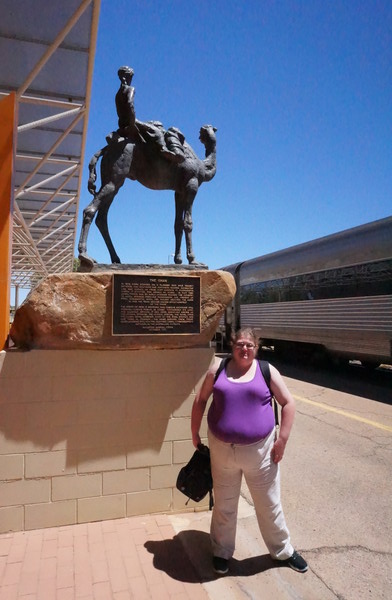
Coach over to Alice Springs, where we had a very quick look around
before taking the Ghan train down to Adelaide. The train was fun for a
day, and we got to see a lot of desert. In Adelaide,
we had a look around the city (lovely colonial feel!) and got a couple
of evenings in fun comedy shows at the Fringe. Great fun!
On to Tasmania, where we did a quick (3 days) run around the island
by car: into Hobart, up the east coast. Stopped in Swansea (a nice
version!) for some heavenly Devonshire teas, then on up to Grindelwald
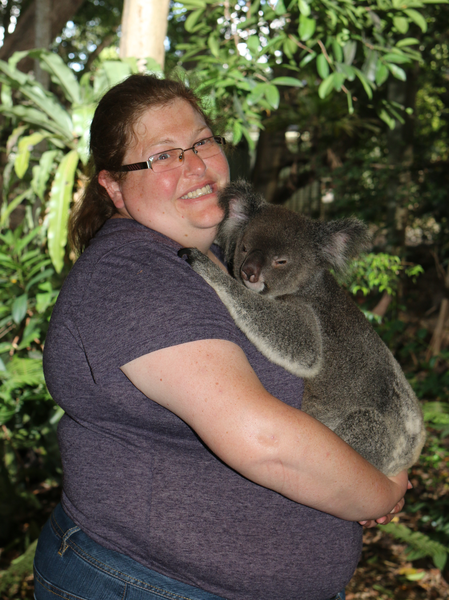
near Launceston. Visited Trowunna Wildlife Park to see (and cuddle!)
lots of local animals, which was amazing - Jo's favourite day of the
holiday. Then on to Queenstown and drive back down to Hobart past some
impossibly beautiful views around Cradle Mountain. Tassie's gorgeous -
like the best bits of Scotland, Wales and Cornwall but with even fewer
people and better weather.
Next, on to Sydney
for Harry
and Cath's wedding. We stayed up in Chatswood. Not knowing
anything about the area beforehand, we were a little surprised to
basically find ourselves back in Hong Kong! We spent most of the
weekend catching up with friends from the wedding group, and the
wedding itself was at Quarantine Station, overlooking the harbour. It
couldn't have been a more perfect location / weather / view for our
friends' big day! We squeezed in a couple of the open-top bus tours of
Sydney on the Sunday, but got caught in the horrendous storm that hit
and ended up sheltering downstairs under cover on the bus. I'm told
Bondi is lovely, but it all looked grey from the bus. :-P
Down to Melbourne on the train (bit of a wasted day, in hindsight),
where we wandered around the city quite a bit. Caught up with an old
friend who lives there for a day, and we did a wine tour up the Yarra
Valley which was fun too.
Up to Port Douglas, where we headed out to the Reef for my
highlight of the holiday: a snorkelling tour with some local marine
experts who showed us the local flora and fauna. We also visited a
local Aboriginal cultural centre, skyrail and scenic railway around
Kuranda village.
Down to Hervey Bay and a 1-day tour of Fraser Island - an amazing
place in combination with quite a thrill-ride experience just being
driven around on the sand tracks. Finally, down to Brisbane where we
wandered around and visited both the Lone Pine Koala Sanctuary (more
cuddles!) and the Gold Coast. Then the long flights home. Whew!
We're knackered now. We knew we could't fit
everything in, but we're glad we travelled all over and got tastes of
almost everything. Now we can work out where we want to spend more
time on our future visit(s). We'll definitely want to head over and
see Perth and some of WA next time, and definitely more time in
Tasmania, Sydney and Adelaide.
FROM jessie:latest
MAINTAINER Noah Meyerhans <frodo@morgul.net>
RUN DEBIAN_FRONTEND=noninteractive apt-get update && apt-get -y install \
asciidoc bash bc binutils bzip2 fastjar flex git-core g++ gcc
util-linux gawk libgtk2.0-dev intltool jikespg zlib1g-dev make \
genisoimage libncurses5-dev libssl-dev patch perl-modules \
python2.7-dev rsync ruby sdcc unzip wget gettext xsltproc \
libboost1.55-dev libxml-parser-perl libusb-dev bin86 bcc sharutils \
subversion
RUN adduser --disabled-password --uid 1000 --gecos "Docker Builder,,," builder
And we generate a docker image based on this Dockerfile per the
docker build documentation. At
this point, we've got a basic image that does what we want. To
initialize the build environment (download package sources, etc), I
might run:
docker run -v ~/src/openwrt:/src/openwrt -u builder -t -i jessie/openwrt
sh -c "cd /src/openwrt/openwrt && scripts/feeds update -a"
Or configure the system:
docker run -v ~/src/openwrt:/src/openwrt -u builder -t -i
jessie/openwrt make -C /src/openwrt/openwrt menuconfig
And finally, build the OpenWRT image itself:
docker run -v ~/src/openwrt:/src/openwrt -u builder -t -i
jessie/openwrt make -C /src/openwrt/openwrt -j3
The -v ~/src/openwrt:/src/openwrt flags tell docker to bind mount my
~/src/openwrt directory (which I'd previously cloned using git) to
/src/openwrt inside the running container. Without this, one might be
tempted to clone the git repo directly into the container at runtime,
but the changes to non-bind-mount filesystems are lost when the
container terminates. This could be suitable for an autobuild
environment, in which the sources are cloned at the start of the build
and any generated artifacts are archived externally at the end, but it
isn't suitable for a dev environment where I might be making and
testing small changes at a relatively high frequency.
The -u builder flags tell docker to run the given commands as the
builder user inside the container. Recall that builder was created
with UID 1000 in the Dockerfile. Since I'm storing the source and
artifacts in a bind-mounted directory, all saved files will be created
with this UID. Since UID 1000 happens to be my UID on my laptop, this
is fine. Any files created by builder inside the container will be
owned by me outside the container. However, this container should not
have to rely on a user with a given UID running it! I'm not sure what
the right way to approach this problem is within Docker. It may be
that someone using my image should create their own derivative image
that creates a user with the appropriate UID (creation of this
derivative image is a cheap operation in Docker). Alternatively,
whatever Docker init system is used could start as root, add a new
user with a specific UID, and execute the build commands as that new
user. Neither of these seems as clean as it could be, though.
In general, Docker seems quite useful for such a build
environment. It's easy to set up, and it makes it very easy to
generate and share a common collection of packages and
configuration. Because images are self-contained, I can reclaim a
bunch of disk space by simple executing "docker rmi".
Since 2009, I am persuing a personal programming project.
As I am not a professional programmer, I have spent quite a lot of that
time exploring options. I have thrown out about three or four prototype
implementations already. My last implementation seems to contain enough
accumulated wisdom to be actually useful. I am far from finished, but the path
I am walking now seems relatively sound.
So, what is this project about? I have set myself a rather ambitious
goal: I am trying to implement a two-way bridge between visual music notation
and braille music code. It is called BMC (Braille Music Compiler).
My problem: I am, as some of you might remember, 100% blind.
So I am trying to write a translator between something I will never
see directly, and its counterpart representation in a tactile encoding
I had to learn from scratch to be able to work on this project.
Braille music code is probably the most cryptic thing I have
ever tried to learn. It basically is a method to represent
a 2-dimensional structure like staff-notation as a
stream of characters encoded in 6-dot braille.
As the goal above states, I am ultimately trying to implement a converter
that works both ways. One of my prototypes already implemented
reading digital staff notation (MusicXML) and transcribing
it to Braille. However, to be able to actually understand all the concepts
involved, I ended up starting from the other end of the spectrum with
my new implementation: parsing braille music code and emitting
digital staff notation (LilyPond and MusicXML). This is a rather unique
feature, since while there is commercial (and very expensive) software out there
to convert MusicXML to braille music code, there is, as far as I know,
no system that allows to input un-annotated braille music code and
have it automatically converted to sighted music notation.
So the current state of things is, that we are able to read certain
braille music code formats, and output either reformatted (to new line-width)
braille music code, LilyPond or MusicXML.
The ultimate goal is to also implement a MusicXML reader, and convert
the data to something that can be output as braille music code.
While the initial description might not sound very hard, there
are a lot of complications arising from how braille music code works,
which make this quite a programming challenge. For one, braille music note and
rest values are ambigious. A braille music note or rest that looks like
a whole can mean a whole or 16th. A braille music note or rest that looks like
a half can mean a half or a 32nd. And so on. So each braille music code value
can have two meanings. The actual value can be caluclated with a recursive
algorithm that I have worked out from scratch over the years. The original
implementation was inspired by Samuel Thibault (thanks!) and has since then
evolved into something that does what we need, while trying to do that very
fast. Most input documents can be processed in almost no time, however,
time signatures with a value > 1 (such as 12/8) tend to make the number of
possible choices exploed quite heavily. I have found so far one piece from
J.S. Bach (BWV988 Variation 3) which takes about 1.5s on my 3GHz AMD (and the
code is already using several CPU cores).
Additionally, braille music code supports a form of "micro"-repetitions
which are not present in visual staff notation which effectively allow certain
musical patterns to be compressed if represented in braille.
Another algorithmically interesting part of BMC that I have started
to taclke just recently is the linebreaking problem. Braille music code has
some peculiar rules when it comes to breaking a measure of
musical material into several lines. I ended up adapting
Donald E. Knuth's algorithm from Breaking Paragraphs into Lines for
fixed-width text. In other words, I am ignoring the stretch/shrink
factors, while making use of different penalty values to find the perfect
solution for the problem of breaking a paragraph of braille music code into
several lines.
One thing that I have learnt from my perivous prototype (which was apparently
useful enough to already acquire some users) is that it is not enough to just
transcribe one format to another. I ultimately want to store meta information
about the braille that is presented to the user such that I can implement
interactive querying and editing features. Braille music code is complicated,
and one of the original motivations to work on software to deal with it was to
ease the learning curve. A user of BMC should be able to ask the system for a
description of a character at a certain position. The user interface (not
implemented yet) should allow to play a certain note interactively, or play the
measure under the cursor, or play the whole document, and if possible, have the
cursor scroll along while playback plays notes. These features are not
implemented in BMC yet, but they have been impleemnted in the previous prototype
and their usefulness is apparent. Also, when viewing a MusicXML document in
braille music code, certain non-structural changes like adding/removing
fingering annotations should be possible while preserving unhandled features of
the original MusicXML document.
This also has been implemented in the previous prototype, and is a goal
for BMC.
I'm using grub version 2.02~beta2-2. I want to make a USB stick that's capable of booting Intel architecture EFI machines, both 64-bit (x86_64) and 32-bit (ia32). I'm starting from a USB stick which is attached to a running debian system as /dev/sdX. I have nothing that i care about on that USB stick, and all data on it will be destroyed by this process. I'm also going to try to make it bootable for traditional Intel BIOS machines, since that seems handy.I'm documenting what I did here, in case it's useful to other people. Set up the USB stick's partition table: parted /dev/sdX -- mktable gpt parted /dev/sdX -- mkpart biosgrub fat32 1MiB 4MiB parted /dev/sdX -- mkpart efi fat32 4MiB -1 parted /dev/sdX -- set 1 bios_grub on parted /dev/sdX -- set 2 esp onAfter this, my 1GiB USB stick looks like:
0 root@foo:~# parted /dev/sdX -- print Model: USB FLASH DRIVE (scsi) Disk /dev/sdX: 1032MB Sector size (logical/physical): 512B/512B Partition Table: gpt Disk Flags: Number Start End Size File system Name Flags 1 1049kB 4194kB 3146kB fat32 biosgrub bios_grub 2 4194kB 1031MB 1027MB efi boot, esp 0 root@foo:~#make a filesystem and mount it temporarily at /mnt:
mkfs -t vfat -n GRUB /dev/sdX2 mount /dev/sdX2 /mntensure we have the binaries needed, and add three grub targets for the different platforms:
apt install grub-efi-ia32-bin grub-efi-amd64-bin grub-pc-bin grub2-common
grub-install --removable --no-nvram --no-uefi-secure-boot \
--efi-directory=/mnt --boot-directory=/mnt \
--target=i386-efi
grub-install --removable --no-nvram --no-uefi-secure-boot \
--efi-directory=/mnt --boot-directory=/mnt \
--target=x86_64-efi
grub-install --removable --boot-directory=/mnt \
--target=i386-pc /dev/sdX
At this point, you should add anything else you want to /mnt here! For example: umount /mnt syncTags: bios, efi, grub, tip
Outreachy
helps people from groups underrepresented in free and open source
software get involved. The current round of internships is open to women (cis
and trans), trans men, genderqueer people, and all participants of the Ascend
Project regardless of gender.
Google Summer of Code
is a global program, sponsored by Google, that offers
post-secondary student developers ages 18 and older stipends to write code
for various open source software projects.
Interns for both programs are granted a $5500 stipend (in three installments)
allowing them to dedicate their summer to working full-time on Debian.
Our amazing team of mentors has listed their project ideas on the Debian
wiki,
and we are now welcoming applicants for both programs.
If you want to apply for an internship with Debian this summer, please fill
out the template for either
Outreachy or
GSoC.
If you re eligible to both
programs, we ll encourage you to apply to both (using the same application),
as Debian only has funds for a single Outreachy intern this round.
Don t wait up! The application period for Outreachy ends March 24th, and the
GSoC application period ends March 27th. We really want applicants to start
contributing to their project before making our selection, so that mentors
can get a feel of how working with their intern will be like for three months.
The small task is a requirement for Outreachy, and we re strongly encouraging
GSoC applicants to abide by that rule too. To contribute in the best
conditions, you shouldn t wait for the last minute to apply :-)
I hope we ll work with a lot of great interns this summer. If you think
you re up for the challenge, it s time to apply! If you have any doubts,
or any question, drop us a line on the soc-coordination mailing
list or
come by on our IRC channel (#debian-soc
on irc.debian.org) and we ll do our best to guide you.
Next.