Search Results: "sf"

21 May 2006

Ian Murdock: Open-source Java and compatibility in the Java world

Sun is worried about compatibility in a world where Java is open source. I can’t say I blame them, and I say this as someone who spends a majority of his time thinking about compatibility in the Linux world, where we’ve managed to hold it together but still have a lot of work to do to match the relative consistency of the Microsoft alternatives (Windows and .NET, among others). After all, a platform is useless if there’s not a single, standard way for developers to target it. Question is: Does open source inherently lead to compatibility problems? Hardly. How many incompatible versions of, say, Apache are there? Or the Ps of the LAMP stack (Perl, PHP, Python)? Or MySQL? GNOME? KDE? BIND? CUPS? The only reason “Linux” and compatibility often come up in the same breath is because the term is used to describe so many different things. Yes, “Linux” has compatibility issues if you’re comparing Red Hat, SUSE, and Debian, but the actual “Linux” used by each of these “Linuxes” (that is, the Linux kernel) have few if any compatibility issues. It’s more the bits around the edges, like slightly different versions of core components with slightly different ABIs or APIs, not to mention the independently developed subsystems for configuration etc., that lead to the compatibility issues. If anything, the fact that the various Linux distributions share so many of the same open source components makes them far more compatible than the various implementations of UNIX ever were. James Gosling, the father of Java, highlights JavaScript as an example of the situation they’re trying to avoid in a recent podcast with Dan Farber. Today, he explains, there are dozens of AJAX toolkits, and the main reason for this is the need to paper over incompatibilities between the various JavaScript implementations. He’s absolutely right. If anything, though, the JavaScript situation is a good example of what might have been if we knew as much about the power of open source in setting standards in the 1990s as we know today. There are numerous JavaScript implementations today because there wasn’t a de facto standard implementation developers could just use when they needed one way back when (like there was with Apache etc. and wasn’t with some of the problematic “Linux” technologies like configuration management). What if there had been an open source JavaScript all along that became a de facto standard like Apache did? Would the AJAX world look any different today? Ironically, then, Java looks a whole lot more fragmented on its current trajectory as the various open source efforts (Apache Harmony, GCJ, GNU Classpath, etc.)—which exist only because the de facto standard implementation isn’t open source—mature and are more tightly integrated into the Linux distributions. So, what lessons does Linux have to offer Sun as it contemplates the future of Java and, more to the point, how to open source it? First of all, far from being a surefire path to turning Java into a veritable tower of babel, open source could actually help promote compatibility in the Java world. For one thing, if Sun’s Java implementation was open source, history shows there would be no need for another implementation. Case in point: Remember the other Harmony project? Secondly, what’s in a name? Absolutely everything. It’s entirely possible to open source Java without diluting the Java brand and the compatibility guarantees that brand promises. Most famously, this strategy has worked very well for Red Hat—Red Hat’s platform is open source, so you can fork it, but you can’t call the result “Red Hat”, which preserves the compatibility guarantee a successful platform requires. It’s not too late, but we’re rapidly approaching a time when it will be. For one thing, the open source implementations are getting better, and once the genie is out of the bottle, it’s damned near impossible to get it back in (see, again, JavaScript). As I said the other day, “open source Java” isn’t so much about licensing as it is about ubiquity, though licensing can get in the way of ubiquity. We’re almost there. Let’s take the final step we need to take to make Linux/Java as well integrated as Windows/.NET.

Simon Law: Debconf 6, Day 4


Boarding the bus
Originally uploaded by sfllaw.
The air has been hot but dry, so it's been quite bearable if you drink enough water. On Wednesday morning, we woke up to the sound of rain. I went to the window and looked through the glass slats to the basketball court outside. There were puddles in the middle of the dry pavement, and it looked like it was raining only in those puddles! The droplets just evaporated as they hit the ground. This was a promising start to the Debconf day trip. A large group of us met at the front of the resort, near the reception, where there was a parking lot full of buses. Silver buses that look like they drove out of the seventies. We milled about before boarding, which took a while, because of the "herding cats" problem. Once we were all aboard, we drove off. I was sitting on the first bus and we puttered along until we got to the highway. We drove past roadside stalls and restaurants until we got to a town. After going through that, we got to open fields and then a series of hills and valleys. The little bus climbed the largest of these hills, like the Little Engine that Could, and we finally pulled into a parking lot. The museum in front of us was a green concrete structure, which contained an exhibit. We stood in front of a model of the area, while our tour guide explained the history of the site. We were going to visit the ruins of an old city, Xochicalco, which was built as a fortification on the top of this hill. Since I was never a docile student, I went around looking at things, taking photographs, and having fun. I found the staff lounge where there were people sitting around chatting. There was also a large pool of stagnant, alg clogged water. Nearby, a dog with fleas was scratching and biting herself. I decided to give her a wide berth.

Vision
Originally uploaded by sfllaw.
The rest of the group started heading up a stone path to the old city, so I ran alongside to catch up. By the time we got to the top, we were greeted by some pyramids. Well, they weren't really friendly pyramids, and more like imposing pyramids. I ignored the tour guide again and started taking photographs. I spotted a Tlachtli court in the valley below, which seemed to be in remarkably good shape. The front gates of the city were built to restrict entry, as is normal for a fortified city. In order to actually enter the city, you have to climb about a hundred narrow steps, which is something pretty difficult to do if you're invaders. According to some of the signs that were placed there, it appeared that the city collapsed due to a revolt, as there were plenty of skeletons found near the gates. And because there was plenty of soot on the stones, which indicated a large fire. At the top, we climbed on some of the pyramids. Or rather, other people walked up some stairs and I climbed up them. Which got me in trouble with the local security guards. I suppose I wasn't very good at being sneaky. I should practise more. We left the site and headed to a large restaurant that was just on the side of the road. It's sort of in the middle of nowhere, with only a motel across the street. The staff was warned that we arrived, but they still looked a little panicked, as we crowded inside and took over their restaurant. They had this buffet table set up, which we queued up to serve ourselves. Since it was a buffet, the food and service wasn't of spectacular quality. However, since we had hundreds of people, the food was consumed really quicky and it was very fresh. So it was the tastiest sponsored meal I've had so far. At the restaurant, they kept some pets. There was a dog, a pair of birds, and some others. One of which was the most adorable lizard, who won everyone's hearts. A crowd gathered around Biella Coleman as she petted him. I think she wanted to take him home.

Photographers
Originally uploaded by sfllaw.
After we stuffed ourselves, we climbed back on the buses and drove to Cuernavaca. It had started raining again, lightly, but we got off the bus just after the sun came out. We were greeted by a marketplace in the center of town and given half-an-hour to look around. Since it seemed pretty touristy, I found Biella and Martin Krafft who had the same sentiments, so we walked around the central part of town and played tourist. We found a juice stand that was selling mixed drinks. Martin decided to get an interesting drink, which apparently had too much banana in it. We then decided to find a public restroom, which we did. It advertised very clean washrooms, for only 5 pesos per person. We had reports that it was spotless. Afterwards, we wandered about and found a Japanese-fan store that sold action figures and anime. We then discovered a tobacconist, which got Martin excited. He attempted to buy a cigar, but the person inside refused to sell it to him. It turns out that this was just a friend minding the store, who refused to engage in any business transactions, by proxy. Martin left, and I was disappointed once more by people's misunderstanding of simple economics. The bus returned us to the reception after a rather long drive and I stumbled into the HackLab. On the veranda, people had gathered to have a liquor BoF. Plenty of foreign liquors showed up, including a bottle of Sortil ge that I brought, and they were consumed rapidly. People had trouble staying awake by now, but I'm unsure if it was because of the alcohol. Maybe it's because it was Wednesday.

19 May 2006

Erich Schubert: No fun for me - I'm not at debconf

But I'd like to be... I'd love to bring that lame old line:
My sock's got your name on it
(Well, if you failed to successfully assassinate someone, it can still be fun to remind him for the next few hours of that fact that he's going to die.) Not to be confused with:
My socket has got your name on it
Becaue we're not talking about coding, and some players have characters in their names (e.g. whitespace) that your programming language will probably not allow for variable names. ;-) Oh, if you want to play that game some time - instead of smacking people with clean socks, you can also just use something like saying "You're dead". Works just as well for virtually killing people. But is probably less fun. I've never been running around for days trying to smack someone with a sock. Do you know what the most evil thing is about this variant of the game? You don't have a chance to stop him from trying to assassinate you again and again... in other game variants, you at least have a chance of defeating him instead. Oh, and maybe Ted Walther misread the game instructions, and the reason he's been smacking people with his toy is that he's trying to assassinate them? Can someone hit him with a cluebat please and explain the rules of the game again?

Josselin Mouette: A great dinner nevertheless

The night started great. Tables arranged in a swirl, happy geeks gathered around a good meal, it was going to be a great formal dinner.

Then came AJ and his megalomania. Well, it was kind of fun at the moment, although I still haven't cooled down after seeing his contribution to the Java in non-free thread. He even compromised himself by showing up hand in hand with Ted Walther.

After that, Ted tried to spoil the dinner, and almost managed to do it. Please people, correct me if I'm wrong as I was a few meters away from the incident and didn't follow everything. It seems the person Ted is calling a "local businesswoman" was a prostitute. As he doesn't want to name people, I'll do it: when learning that, Holger tried to throw Ted out of the building. Unfortunately some people stopped him from doing it. Holger, thanks a lot for having the courage to give this guy what he deserves, and already deserved before the provocation, when most people (including me) just stand still when facing such unbearable behavior.

Of course Ted tried to act as a martyr, as shows his blog entry. Ted, I do hope things won't be "resolved to your satisfaction". And anyway, you won't need to denounce the people who deserve to be awarded instead. Why have you come to Debconf for, anyway? Uploading broken versions of your packages, or writing stupid and provocative blog entries?

Then, the mariachis tried to improve the ambiance but only managed to prevent people from talking to each other. The real fun came from the rain, which fell so hard it entered the building in a magnificent cascade, leaving us eating and walking in a few centimeters of water. Another great moment was the power outage, during which we were lightened by camera flashes.

The food had so much success that I didn't have time to taste more than one dish before everything was wiped out. Still, despite Ted and despite the lack of food, this was a great evening, one of those I won't forget for sure.

I'll upload pictures later, but in the meantime you can have a look at Barry Hawkins' blog.

Ted Walther: Report from Debconf, Day Five


Me and Anthony Towns
A Debian Pope is born. Tonight was Debians formal night. Fabio drove John Sokol, Hilda, and myself to the auditorium where the dinner was being held. Fabio owns the local internet cafe and provides the internet connection to Debconf. Hilda is a local businesswoman, who owns a dental supply company. Very nice people; a real slice of the real Mexico. Hospitable, friendly, and helpful. We arrived just after the buses arrived and people chose their seats. As a formal diner, I had to wear my official costume, the crown and the clue bat. If anyone wants a genuine replica of the clue bat, the price is $50. If you don't buy it for your office, buy it for your kids; the foam is four inches thick and cannot bruise, cut, or hurt anyone. As soon as I entered the auditorium where the dinner was set up, Juan Diaz from Argentina took the crown from my head and raced away. I chased him with the clue bat. Then I saw that his intention was to put the crown on AJ, Debians newly elected project leader. He did it hastily, illegitimately, and backwards. Reaching AJ, I put down my clue bat and told him to hold still. To the cheers and applause of the entire auditorium, I lifted up the crown, and then placed it on AJ's head correctly, in a style befitting a pope crowning an emperor. Immediately after, we hugged and waved to the happy crowd. By the act of crowning, I am now the Debian Pope. This isn't the cushy job it might seem; some members of Debian really hate popes of any sort. Mariachi rain dance. Soon after the crowning, the food and drink started arriving. The mariachi band started playing their trumpets and guitars, starting off with the Mexican national anthem, which is a fun song to sing but I didn't understand a word of it. The newly crowned AJ came along the tables and organized "the wave" like at a football game. We all stood up and sat down as the wave came around, and made the low moaning WHOOOP sound as it came by us. A few minutes after this the food was set on buffet tables, so everyone got into line to get their meals. The meals were simple. Some meat, some rice and bread, and some salad. A nice meal after a week of rich eating. Beer flowed freely, and toward the end some wine was passed around too. The mariachis must have been a signal, because the rainy season started right after they started playing. First the rain bounced off the tin roof so we could hardly hear the band. As dinner went on the clattering of rain got louder, then flashes of lighting showed through the windows. The roof leaked onto many peoples dinner plates and heads, so we all got cozy with each other, finding places out of the rain. At one end of the hall the rain gushed out of the roof so strongly that the entire wall became a waterfall. Finally the lights went out. Cell phones and cigarette lighters quickly waved around, lighting up the place. Strobe lights from digital cameras gave the place a disco atmosphere. Slowly the emergency backup lights came on, then a few minutes later full power was restored. The rain did stop after that, but many people chose to leave shortly after, including yours truly. The Pope is assaulted. Several acts of rudeness and aggression were committed against myself and my guest, a local businessperson. I'm going to wait until tomorrow to see how Debian responds to this inappropriate behavior. If it is resolved to my satisfaction, I'll see no need to name names or post the details in public.

Erich Schubert: Worldcup songs (aka: the four letter f-word: F*FA)

FIFA sucks. It's so much about commerce... Don't buy their stuff. Buy your soccer balls at e.g. Transfair. These were bought at fair prices and not made by exploiting people in third world regions. Check out the 'Wilde Fu ballkerle' design. Very sweet. Much better than this annoying worldcup logo just about everywhere. But back to my original topic. These annoying 'official' worldcup songs. Dear FIFA, how about letting people decide which songs they like? I hate your choice... It makes me think of Titanic! And actually I hope that this happens to FIFA, that they go down like titanic because of some corruption scandal or so. If you want to compare them, check out Voices from the Fifa World Cup at Amazon (with realplayer samples). My current favourite is 1. FC Sommer, played by the Bananafishbones (last.fm), an indie band. They're cool. They do a festival and support new indie bands. If you want to listen to an excerpt, point your browser to the 1. FC Sommer page, there is a realplayer stream available again, klick that audio button. That song has some great wordplays in there, too bad that you can't translate them in all details into english. The refrain is "Der Sommer geh rt dem, der den Weltmeister schafft" which translates to "The summer belongs to who wins the worldcup"; the world play is "Weltmeister schafft" (becomes the world champion) and "Weltmeisterschaft" (Worldcup). And there is also a nice song by Sportfreunde Stiller, who did a whole CD full of soccer songs. So just ignore FIFA and don't buy their branded stuff.

Uwe Hermann: OS Install Experiences - Part 1: Debian stable + unstable [Update]

Debian Open Use Logo
Note: This article is part of my OS Install Experiences series.
OK, so let's start with something simple: Debian. Simple in the sense that there probably won't be too many surprises for me as a Debian developer (or for most readers of Planet Debian). For other people this might be interesting, though, and some facts are probably interesting to one or the other experienced Debian user/developer, too... Hardware A few words on the hardware I'll be installing all these OSes on. It's a cheapo (200 Euros) x86 PC (Intel Celeron, 2 GHz), 80 GB IDE hard drive, 256 MB RAM, ATI Radeon 9200 SE graphics adapter, Realtek PCI ethernet controller, CDROM, USB, and all the other standard stuff. Nothing fancy, really. Install
  1. First, I downloaded a Debian sarge 3.1r2 CD image, burned it on a CD, and booted from that.
  2. An installer menu showed up, where you can press F3 for boot options. I chose "expert26", which will ask me more questions and give me a 2.6 Linux kernel instead of 2.4.
  3. The installer (newt-based, i.e. not graphical) will now start to boot a base Linux system.
  4. Now, you can choose your language (used in the installer), country, region, and keyboard layout.
  5. You'll be asked which additional kernel modules you want to load (default: all), and whether you want PCMCIA support. Also, you can choose which extra installer components should be loaded (LVM, PPP, serial, IrDA, ...).
  6. Your hardware can be automatically detected (my Realtek card was successfully detected, the "8139too" kernel module was then loaded).
  7. The network was successfully auto-configured via DHCP within seconds.
  8. Now you can choose a hostname and domain name for the box. I used "hydra" as hostname (guess why), and "local.domain" as domain name.
Partitioning Now the funny part starts: partitioning the disk. As I will be installing >= 10 OSes, this needs a bit of consideration. I have chosen to create a 10 GB (primary) partition for a Redmond OS I'll be installing later (for games, testing, proprietary software I'm forced to use, and similar things). This will be the first partition and I marked it bootable, as Windows might choke otherwise. For the rest, I reserved 5 GB for each OS — that should do. So the next two (primary) partitions are 5 GB each. I'll leave these empty for now, as I might encounter obscure OSes which must be installed on primary partitions. Let's hope it won't be more than two ;-) As you can only have four primary partitions, I then had to create a logical partition, which will "contain" any further partitions. The next three (secondary) partitions are 1 GB each, intended to be used as swap. One of those I marked as swap in order to use it for Debian. Other Linux installations will be able to reuse this one. The other two are reserved in case I encounter OSes which have another form of swap and cannot use Linux swap partitions... The rest is easy: create twelve 5 GB partitions => lots of space for more OSes. Here's the resulting fdisk output:
Disk /dev/hda: 81.9 GB, 81964302336 bytes
255 heads, 63 sectors/track, 9964 cylinders
Units = cylinders of 16065 * 512 = 8225280 bytes
      Device Boot      Start         End      Blocks   Id  System
   /dev/hda1   *           1        1216     9767488+  83  Linux
   /dev/hda2            1217        1824     4883760   83  Linux
   /dev/hda3            1825        2432     4883760   83  Linux
   /dev/hda4            2433        9964    60500790    5  Extended
   /dev/hda5            2433        2554      979933+  82  Linux swap / Solaris
   /dev/hda6            2555        2676      979933+  83  Linux
   /dev/hda7            2677        2798      979933+  83  Linux
   /dev/hda8            2799        3406     4883728+  83  Linux
   /dev/hda9            3407        4014     4883728+  83  Linux
   /dev/hda10           4015        4622     4883728+  83  Linux
   /dev/hda11           4623        5230     4883728+  83  Linux
   /dev/hda12           5231        5838     4883728+  83  Linux
   /dev/hda13           5839        6446     4883728+  83  Linux
   /dev/hda14           6447        7054     4883728+  83  Linux
   /dev/hda15           7055        7662     4883728+  83  Linux
   /dev/hda16           7663        8270     4883728+  83  Linux
   /dev/hda17           8271        8878     4883728+  83  Linux
   /dev/hda18           8879        9486     4883728+  83  Linux
   /dev/hda19           9487        9964     3839503+  83  Linux
Install, continued
  1. The Debian partitioning tool allowed me to do all of the above via a friendly menu. As it does not modify the partition table until you say "done", I could revert many changes, and play around with different layout ideas until I was satisfied.
  2. Next thing you can choose is the Kernel flavor (386, 686, smp).
  3. You may now configure and install GRUB, the bootloader. I installed it at "(hd0)", the master boot record of the hard disk.
  4. Soon the CD ejects, and you have to reboot.
  5. After a restart (which also shows whether GRUB works fine), you can now choose your timezone, and decide whether you want shadow passwords (say yes!).
  6. Now enter the root password, and decide whether you want to create an additional user account (say yes, and enter a different password here).
  7. You can now configure apt, e.g. tell it which sources you'd like to use (CDROM, FTP, HTTP, ...). You'll be asked whether you want to install software from Debian's "non-free" archive. After choosing a mirror (and proxy settings, if you like), you can (should!) also say yes to the question whether you want security updates...
  8. Finally, you may now choose "tasks" (desktop, web server, file server, ...) your machine should be able to perform; this will influence which packages will be installed. You may choose "manual package selection", of course, if you want more control. I used "desktop".
  9. That's about it. You'll see a few more application-specific questions (configuration of MTA, ssh, fonts, X11, gdm, and others), and after that you'll be left with a GNOME login window.
Security I collected some (partly) security-relevant information after that. Ok, so that's it for Debian stable. Unstable is 99% the same, except that you do a "vi /etc/apt/sources.list; apt-get update; apt-get dist-upgrade". I'll do that later maybe, compare the findings, and report notable differences here, but it shouldn't be too many (I guess). Not today, though, I need some sleep now. Comments, suggestions, flames? Update 2006-05-19: Updated "why is Debian-exim capitalized?" info as per comments, thanks!

Eric Dorland: apt-get install mexican-kittens

So a lot has been going on here at DebConf 6. Yesterday we spent a sun soaked day at Xochicalco. It was hot out, but not unbearable, and it was really interesting. Makes me want to see Mel Gibson's Apocalypto, even though I'll bet it will be crap. We also had a delicious late lunch at a local buffet. I think the key to their deliciousness was serving actual Mexican food, rather than the quasi-Western fare at the hotel. We also had the foreign liquor BoF, which had excellent representation from various countries. I want to go to Puerto Rico for Christmas. The night before [info]sfllaw had the genius idea to get some tuna and feed the kittens running around the hotel complex. They fought tooth and claw for every scrap of the tuna, then proceeded to wrestle and play for our amusement. They were still afraid of us, but not so badly, and it was completely adorable. Pictures are up on [info]sfllaw's Flickr stream. Before a small group of us had dinner at a small Argentinian steak house. It was fantastic, and put me a meat coma for the rest of the night. Earlier in the day I attended an interesting talk by Don Amstrong about the GPLv3. He helped clarify some questions I had on the optional components of the license and how to combine them. Very interesting, and it's nice that Debian is represented on committees helping draft the next draft. Tuesday I attended a couple of very interesting talks by Manoj relating to SELinux. He basically confirmed my suspicion that SELinux is really hard, but nonetheless worthwhile. I'll have to pick up O'Reilly's SELinux book and learn more. It looks likely it will be in the base install in some form or another for etch. Monday night's highlight was a discussion between madduck, [info]sfllaw and I. We talked mostly about why people feel unhappy about Ubuntu and maybe some ways of fixing it. Hopefully this DebConf will help bring the two camps together more than before. I've also been killed in Assassins, after only killing my first victim. I also thank the gods that I brought my old Orinocco wireless card, because the Broadcom drivers for my PowerBook isn't happy with the wireless here. I could of sworn that thing was working at some point. The flaky Internet connectivity is frustrating, but I can tell the volunteers are fighting a hard battle against some tough limitations, so thanks for the hard work! PS: If anyone knows a good way to get the Fn-key with Page Up/Down working on a Aluminum PowerBook, a beverage of your choice is yours.

18 May 2006

Simon Law: Debconf 6, Day 3


Diving board
Originally uploaded by sfllaw.
The Internet connectivity here is not so great, which is why I'm posting journal entries in batch mode. The fact that we have Internet here is fairly impressive, because of all the awesome people who have climbed up on roofs and things. Now, the resort does not supply Internet so people had to figure something out. There's an ISP and Internet caf in town, but no physical link between them. So they've set up two antennas, one on the roof of the ISP, and we've got a wireless link. Then, they've strung switches and access points along the roofs of walkways to cover large parts of the resort with Internet connectivity. Sadly, there's a lot of latency associated with this. I went to talks for most of the day and was wandering around the HackLab at dinner time. I convinced [info]ze_dinosaur, and then Agnieszka and David, to go out to a steakhouse in town. We walked out of the complex and back into Rinc n del Viejo, where we all decided to order beef. My filet mignon was huge and tender and juicy and flavourful. The vegetables on the side were insipid, but the beef was just marvellous. Other people had other steaks, which were equally as tasty. We stuffed ourselves silly and then waddled out of the restaurant. There was some beer shopping done after dinner and I picked up of tuna. My companions thought I was crazy, but I thought it was brilliant.

Yum!
Originally uploaded by sfllaw.
After returning to the HackLab, we discovered that the Internet connectivity was being rejiggered to work better. So people were holding an impromptu dancing BOF, which looked quite fun. I found the wine and cheese BOF nearby and found a bit of room to eat some fancy cheeses. Some of them were very creamy, others very sharp, and still more which were deliciously pungent. Eric and I left for our room, where I put some tuna in a bowl. We then took them out to a walkway where we had some kitten sightings. After a bit of hesitation, some little furballs realized that the bowl was full of delicious food. I managed to get quite close to them and took as many photographs as I could. Their mother sat nearby, guarding them from predators, and keeping a watchful eye on me. There are four kittens in that litter and they are all so adorable. At one point, the orange kitten had his entire body in the bowl, to prevent everyone else from eating. After they had stuffed themselves, they started playing happily. They chased each other around, bounced about, and climbed trees. Then, the two big ones decided to play wrestle all over the grass. We basically suffered from cute overload and spent a long time going, "Awww."

Simon Law: Debconf 6, Day 2


Guacamole y totopos
Originally uploaded by sfllaw.
I woke up early Monday morning, showered and got dressed. You know there are now six people in our hotel room. Simon, Eric, Blars, M ritz, Jimmy, and I have to share one shower which makes the process a bit slow. And this shower is a push-button shower that you have to hold in order to keep the water running. And the water never really gets hot. I was typing on IRC and found Matt Zimmerman on-line. We started chatting and noticed that we were in the same room. I tried looking for someone wearing a grey hat, but couldn't find him until I looked beside me. There he was, having sat down right next to [info]ze_dinosaur. Since Mark Shuttleworth is my boss, I paid attention to his talk, and noticed that bug 35051 popped up during the presentation. You know you've been staring at too many bugs when you know which ones they are in the bug tracking system. I talked to Matt a bit about work, because Debconf is a good time to talk about QA, right? We finished up our discussion, typed a bit on our laptops, and decided that food would be a good idea. We found some people from Intel, who introduced themselves as Mike, Mark, and Denise. I thought that Denise's name sounded familiar and then I realised that she's Denise Cooper, who worked on opening up Sun's source code. I was so happy to finally meet her, since we had talked years ago. We walked towards town to get some better food and picked up Blars. Then we saw [info]xtat, whom I knew only from LiveJournal, and his girlfriend. I invited them to join us and we walked around town for a while. We went to this Argentinian restaurant, called Rinc n del Viejo, that had napkins on the table. I didn't want to get my hopes up, so I expected something plain, but everything was incredibly delicious. We started with some wonderful empanadas, a delicious tomato salad, and guacamole y totopos. Then I ate queso con chorizo. By the time we finished, we were all completely stuffed.

Mural
Originally uploaded by sfllaw.
We picked up some pesos and then decided to walk off this big meal. We went exploring the town and wandered about a bit. We hiked up a hill and found a street full of vibrant colours. I realized that we were in the construction district, with stores selling paint, lumber, sinks, pools, and even hand-painted tiles. A little bit further on, past some clothing stores, we found a very cute hotel that looks like it would be really fun to stay in. We found a daycare with an awesome wall, with little figures dancing about. There was a little kid who was standing inside a florists, drumming on the counter and looking very bored. Another child ducked into a used television shop. After about an hour or so, we were hot and thirsty so we decided to head back. But before we returned to the resort, we stopped at a fruit store and picked up some fruit for breakfast. Boy, oh boy, is that fruit every good. Mangos were fragrant and sweet and juicy. Bananas are just heavenly. The plantains were just wonderful. If only we could get fruit like this in Canada. And I don't even like eating fruit.

Ted Walther: Report from Debconf, Day Four

Day trip. Six busses full of Debian developers, maintainers, and supporters toured the area around Oaxtepec today. We clambered over several Mexican pyramids and a ruined mountain-top city. Walking in the main entrance I immediately felt that it was very familiar. I identified the pool where they purified themselves before entering the complex, and several altars. Some of the things the archaelogists called "altars" looked more like bed platforms. I told the guide maybe they were both; ancient religions were known for their homosexual sex rites. Then we saw the palace of Cortes in the city of Morelos. It is a very swank city, fun to walk around and shop. We got back at 10pm, tired but satisfied. Bought a t-shirt that says "100% GUAPO". The Hispanic contingent at Debconf went wild. They may give me some photos to post soon. Lisp redux. Kevin Mark read my summary of Peter van Eyndes presentation yesterday, and sent in this email:
Hi Ted, you seem to be having fun at Debconf! Saw your post about a book by Peter Seibel. Strangely enough I attended a meeting at lispnyc with him this week. They shot video which hopefully you can see. Checkout http://www.lispnyc.org/home.clp cheers, Kev
Well, thanks Kev! At lunch yesterday, a fellow developer, whose name I forget, told me that OCAML is far superior to Haskell in terms of performance because it is "statically typed at compile time" or something. I thought that was a characteristic of Haskell as well. I mentioned the benchmarks that Haskell is currently winning, and he brushed this aside. Which may be appropriate; optimizing for benchmarks isn't the same as optimizing for the general case. Food. We had lunch yesterday at a restaurant. I hate zucchini, but their zuchini stuffed with quesa (cheese) was delicious. I haven't found birria (shredded goat meat) in the market here yet, but the restaurant had some. At the end of the meal a vendor came into the restaurant with some crisp, deep fried confection called "churros", coiled like a big hose. Its cross section looks like a five point star. For P10 the vendor broke off four pieces, 5 inches long. Knut shared his with me; it was like a donut, only crunchy. John Sokol. John Sokol, part of the original 386BSD team, arrived late Tuesday night. Carrying 80 pounds of luggage, he not only took the Metro, but he walked up the mile longer hill from the resort entrance to the conference. The Metro is nice, but it has a lot of stairs. I was tired after traversing it; I could not have walked up the hill if I tried afterward. He brought a VOIP phone with him, but it gives an error saying his account has been compromised. It is probably looking at his Mexican IP address and blocking it. So John and I have no way of phoning the outside world.

Daniel Burrows: Still Not Dead Yet

If it looks like I've fallen off the 'Net recently, it's because I have. In addition to the usual problem of having relatively little free time since I started working, I've been spending the last month or so moving into a new apartment. Much of my free time has been occupied by either planning what to buy and put in my apartment, shopping for stuff to buy and put in my apartment, hauling stuff home from stores into my apartment, and (in the case of IKEA) assembling the stuff I just bought in my apartment.

On top of that, I haven't hooked up an Internet connection yet. This is partly because I'm dissatisfied with all the available options -- which, in my area, seem to be Verizon and Comcast. Since I'm not interested in cable TV, the cheapest choice is Verizon, and I just finally got them to officially hook my phone line up. This was a more complicated process than you might think; they require you to fax them both sides of your driver's license before they'll activate a phone service (presumably to make the NSA's job a bit easier as they snoop on your traffic). It also looks like I probably can't get DSL service until I receive my first phone bill and get a phone number I can enter into the DSL request form on Verizon's website, so I won't be properly connected for another few weeks.

I think that Kate wants me to get off the computer so she can use the internet, so I'll cut off here. More later, maybe.

Eric Warmenhoven: Cingular sucks.

Lisa has been thinking for a short while that she’d like to get a Motorola RAZR phone. We were AT&T Wireless customers, which now makes us a weird type of Cingular customer where we not only have our AT&T plan, but also special AT&T customer service representatives (which I’ll get to in a bit). So we went into our local Cingular store and she asked about getting the shiny new black RAZR, and they said that it wouldn’t be a problem, they’d just need to upgrade our service, and since we’re on the same plan and the service is changing, I’d need to upgrade my phone as well. AT&T Wireless has a email-to-SMS gateway and gives every phone its own email address, yournumber@mmode.com. Since AT&TWS only charges if you send a message but not if you receive a message, I use it all the time (mostly for stock quotes but also for various other things). So in an average month I probably receive 30-50 emails on my phone, as well as the occasional spam, all of them free. Cingular has the same service, yournumber@cingularme.com. But unlike AT&TWS, Cingular charges you both for sending and receiving messages. (”Text, Instant, and Multimedia messages are charged when sent or received, whether read or unread, solicited or unsolicited.”) So my 30-50 messages a month are going to cost me $3.00-$5.00 a month. Of course, I could always get a package, which will limit those 50 messages to just $3.00. Or I could get a $20 package that lets me receive 2500 messages. That’s not the point. The point is that once that limit is hit, it goes back to $0.10 per message, regardless of the plan. That means that some evil person can send you thousands of messages and you could end up owing hundreds of dollars. The only way to prevent that is to call Cingular and turn off the E-Mail Messaging feature from your service. (You can use the Message Center to “Create block and allow lists to limit e-mail messages received” and “Control what times of day your phone can receive e-mail messages.” Also it looks like you can block email containing some spam attributes. But none of those things guarantee that you’re not going to get a bunch of junk.) I tried calling Cingular to confirm this, and when I entered my phone number, it redirected me to AT&TWS customer service, who confirmed that AT&TWS does not charge for receiving text messages, and confirmed that Cingular does charge for receiving messages, but did not have an answer for how Cingular deals with spam. In fact, they didn’t seem to have a lot of information about the Cingular service at all, other than how to “upgrade” my account to a Cingular account. I had to call Cingular sales, who also didn’t know the answer to how to prevent abuse; but they were able to transfer me to Cingular customer service, who confirmed that yes, I really do have the potential to get screwed if I don’t turn off E-Mail Messaging.

17 May 2006

Matt Brown: Playing With ZoomIn

I signed up for a ZoomIn API Key (not that it seems to be needed atm…) the other week and finally got a chance to have a play this past weekend. My test case was to build a map of all the CRCnet sites and the links between them to use as a plugin in the CRCnet Configuration System. Either as a dynamic status display (colouring links to show traffic loads and status etc) or as a network planning tool to get a feel for the relationship between existing sites and potential new locations. Obviously the lack of topographical information makes the second case far less useful than it could be, but I think even in 2D it would still be a useful tool. Getting the points onto the map was relatively straightforward, but adding any sort of hover event to them was another matter. The GEvent class currently only supports the click event and markers are not added with any other identifying attributes (such as an ID or Name) which could be used to hook an event into them. After a quick squiz at the Terms and Conditions, I grabbed a copy of the API javascript and after unobfuscating it (basically just adding back in line breaks and running in through indent(1)) started to have a squiz at what was happening. The API code is very nice and clean and it wasn’t at all hard to work out what was going on. Mozilla’s Venkman javascript debugger absolutely rocks for this sort of work. It allows you to step through all the scripts on the page line by line and quickly get a feel for the flow of the code. Adding support for the hover (onmouseover) event doesn’t look like it would be too hard, but the T&C didn’t explicitly mention whether I was allowed to actually modify the API code, so I choose to simply create a CRCnetMarker class (see below) that creates GMarker object and then pokes id attributes onto the internal objects of that class before returning it. Then once you’ve called addOverlay you can use the basic DOM functions to hook in an onmouseover event handler on the ID of the marker.
var CRCnetMarker = function (sitename, point, icon)
 
    var marker = new GMarker(point, icon);
    marker.icon.id = "crcnet_container_" + sitename;
    marker.icon.firstChild.id = "crcnet_icon_" + sitename;
    marker.addEventListener = function (eventname, handler)  
         b = document.getElementById(marker.icon.firstChild.id);
         b.addEventListener(eventname, handler, false);
     
     return marker;
 
var marker = new CRCnetMarker(new GPoint(2704685.21,6367057.51), "mph");
map.addOverlay(marker);
marker.addEventListener('mouseover', hoverHandler);
That worked like a charm and I now have nice little info boxes popping up next to each node when you hover over them. I also discovered in the process of implementing this that Prototype and ZoomIn do not play nicely together. It appears to be Prototype’s fault as it messes with the Array type by adding new methods (like each for enumeration) which break the builtin for (i in array) syntax when the array contains non-numeric keys (like each). This has been reported in the prototype bug tracker as breaking Yahoo Maps but the comments don’t seem to offer much hope for Prototype’s behaviour changing anytime soon which is a pity. The next roadblock was a lack of support for drawing lines! This put the kibosh on the whole animated network status idea. Trolling through the source again reveals a GPolyLine class that appears to be semi-implemented, so hopefully support for drawing lines is coming very soon. The only other thing I found slightly annoying was having to supply all the co-ordinates in NZGD49 format. Most of our GPS information for CRCnet is stored in WGS84 format (as that’s what our older GPS unit puts out). NZGD49 has been deprecated in favour of NZGD2000 (which is near enough to identical to WGS84 for normal use) so I’m not really sure why ZoomIn is still using NZGD49. Maybe that’s all TerraLink can supply? Some quick googling turned up the proj library (apt-get install proj in Debian) which provides the cs2cs utility which can convert from WGS84 (aka NZGD2000) to NZGD49 to feed to ZoomIn. The magic peice of information is the transformation parameters which LINZ helpfully provide. Punching those (I chose the 7 parameter version) into cs2cs via a command line like

echo "$lat $long" /usr/bin/cs2cs +proj=latlong +datum=WGS84 +ellps=WGS84 +towgs84=0,0,0 +nodefs +to +proj=nzmg +datum=nzgd49 +ellps=intl +towgs84=59.47,-5.04,187.44,-0.47,0.10,-1.024,-4.5993 awk ' print $1" "$2 '

performs the magic conversion. The conclusion?
Overall I think ZoomIn rocks and it’s really cool to see a small NZ company filling in where Google and friends have failed miserably. The biggest weakness at the moment is definitely the API, which doesn’t really allow you to do much more than add points at this stage. Given that ZoomIn is still relatively young the leanness off the API is understandable. Given the API a few more months to mature and fill out and I think we’ll be able to create some really cool applications on top of the ZoomIn platform. Screenshot:

Simon Law: Debconf 6, Day 1


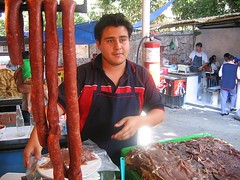
Butcher
Originally uploaded by sfllaw.
Sunday was the first day of actual talks. The night before, [info]ze_dinosaur had arrived and so we hunted for breakfast together. We walked out and found Jesus who was walking towards town. We opted to follow him to the mercado in the town just outside the side gate of the resort. We walked into the market and down some stairs. There are just little stalls where people were selling hats or CDs or pots or clothes. When we walked a bit further, we found a covered area where sweet-smelling smoke swirled everywhere. We sat down on a bench with a thin counter in front of us and someone came back with menus. I ordered a chorizo quesadilla and a glass of horchata. They were very fresh and very, very tasty. I went to the Torre Parlimentaria where the welcome speeches were happening. Mexico has been very warm and sunny, which means dehydration and sunburns. The tower is air-conditioned, so this was a very welcome environment.

Ice cream bar
Originally uploaded by sfllaw.
We sat through a talk where Simon Phipps from Sun announced work he's done with Sun to get more and more software opened. He seems to be very enthusiastic about Free Software, which he mentioned specifically, so I hope he does well with his persuasions within Sun. I no longer remember what I did after this. I think I might have walked around a bit before having the caterred lunch. I've been eating these sponsored meals for a couple of days and they've been rather substandard. Sure, they're edible and doesn't make anyone sick. But it's insipid, because they're trying to put out European style meals, which the kitchen doesn't know how to do. Since I'm travelling, I'm totally going to eat tasty local food, which I won't be able to get in Canada. At lunchtime, I bumped into Filipe whom I met at OLS last year. He introduced me to his Brazillian friends and we discovered that Tiego and Tassia who are studying in Montr al. I promised them that we'd get some Debian get-together in early June, before they leave.

Jesus Climent
Originally uploaded by sfllaw.
It's rather warm right now. The temperature goes about 30 C every day, but the humidity is always close to 30% so it doesn't get very sticky. But it does make such things like ice cream more important. Interestingly enough, lots of American products are for sale in Mexico, but under completely different brand names. After dinner, we went to the HackLab which is a building set up to encourage people to work with their computers. There are plenty of tables and chairs, with extension cords sprawled everywhere. I sat down for a game of Mao, and then got up several hours later. I wandered outside, where people were hanging out on the veranda, so I sat down on the grass in a circle and chatted with people until the early hours of the morning. Debconf, you're so bad for my health.

Ted Walther: Report from Debconf, Day Three, Part II

X Window security. Wandered outside the hack lab to sip a drink and cool down. There I saw Keith Packard and Bdale Garbee. Quickly introduced myself to them both, then asked Keith what his take was on the recent OpenBSD complaints that X11 is insecure by design [1] [2]. Keith said he wasn't going to respond to those complaints, because DRI/DRM already provides what Theo de Raadt says he wants in the way of kernel control over dma and register access on video cards. Many X11 video drivers are not yet converted over to doing things the DRI/DRM way, and so Theo is correct that X11 has huge security holes. But they are not permanent; the future is already arriving. Although DRI/DRM is positioned as a 3d technology, it is intended that even 2d drivers in the future will conform themselves to its API. Keith also said that OpenBSD's representative on the X11 team is easy to work with and cooperates well with the team, so there is hope that if OpenBSD turns its attention to X11 support, everyone will soon benefit from the comprehensive security audit. Although the DRI/DRM design solves the security problems, it is a bitch to implement. Mode switching alone is so finicky and is so tied into both the video hardware and x11 server optimizations, that it has never successfully been implemented in the kernel. Keith said he supported the idea of isolating the mode switching code out into a small, privilege separated userland utility. There were many other things said, which sounded positive, but without the aid of a tape recorder, I can't remember them. Putting packages out of main. Learnt a trick today, courtesy of Phil Hands and Ralph Amissah. If you want to upload a package into a part of the distribution other than main, you alter the Section: field of the debian/control file in your package. Suppose your package fits into the text section, because you use it to process text. Maybe you reimplemented awk. If you put Section: text the package will go into the text portion of the main repository. If your version of awk depends on a library that is in the non-free section, you would put it in the contrib section. So you would put this in your debian/control file: Section: contrib/text and Bob's your uncle. Politics. I find myself doing vastly more politics at this conference than coding, although I am getting some of that done too. When people are deep inside their own worlds, it takes a lot of work to bridge between the worlds. So far it seems like time well invested. Embedded. If anyone needs any embedded work done, Wookey is your guy. Send him an email with a proposal.
  1. 2006-05-11 22:00:04 Re: security bug in x86 hardware (thanks to X WIndows)
  2. 2006-05-13 20:07:35 Re: security bug in x86 hardware (thanks to X WIndows)

16 May 2006

Simon Law: Debconf 6, Day 0


Clouds
Originally uploaded by sfllaw.
I was staying over at [info]dcoombs's place on Friday night, which was very gracious with him. It also meant that I got a ride to the aeroport on Saturday morning, so that I could catch my 8:05 flight. After going through security, I waited for a bit and read a book. Then we boarded and waited on the tarmac for an oil filter change. No kidding. We took off and I soon fell asleep, as I was quite tired. By the time I woke up, we were flying over sunny Mexico. We landed at the aeroport, picked up my baggage, went through customs and ended up in the terminal. It was full of people with signs looking for their loved ones. I made my way past them and followed a sign that looked like it was for taxis. Along the way, I saw an HSBC and poked my head inside. I was slightly disappointed that nobody was speaking Chinese. I bought a flat-rate taxi fare to the Terminal de autobuses in Tasque a. The taxi driver, Bito, loaded my suitcase in the car and we were off. His English was non-existant so we spoke to each other with our hands. The rest of the time, I spent staring out the window.

Taxicab
Originally uploaded by sfllaw.
Mexico City is bright and colourful! Everything has vibrant splashes of colour. There are huge fleets of old Volkswagon Beatles driving around, many of them operating as green taxicabs. We drove past shops and stores and the signs were hand-painted and awesome. When we got to the poorer communities, I started seeing tags on buildings, but then we drove past these huge murals spray-painted on large walls. He let me off at the terminal and I bought a ticket to Oaxtepec. This was done through plenty of pointing and reading off of computer teminals. Then, I went out Gate 3 and walked into a mass of people. Now, I'm used to people queueing up, but this was not a common concept here. I tapped someone on the should and asked how I could get on my bus. Giacomo introduced himself and tried to explain the system. But he eventually just talked to the ticket collector who let me on the same coach. I discovered that he had family who lived in Hamilton and invited him to look me up if he ever visited Montr al. When we got to Oaxtepec, I staggered off the bus and picked up my luggage. Then I got un-carsick by sitting down on something stable. I was standing outside the front gates of the Centro vacacional Oaxtepec IMSS. I considered the long hike up a big hill, and then hired a cab that took me up to the Recepcion building where I got checked in. I dragged my luggage to the room and met Blars there. I picked out a bed amongst the five still available. I had finally arrived.

Ted Walther: Report from Debconf, Day Three

Laundry day. New roommate Thaddeus Black is really on the ball; today is the first laundry day we've had at the conference, and he was prepared for it, and reminded the rest of us when we woke up. I think I'll wait until the Thursday laundry day. To get your laundry done here, you put it in a plastic bag, and mark it somehow. Then the bags go into a pile, and some company hired by the hotel comes and washes them, and returns the bags of clean clothes to you the same or next day. You can even choose between regular drying and sun drying the clothes. Debian. Yesterday someone filed a bug against my expect package; today Alec Berryman sent in a patch that fixed it. Thank you Alec! The fixed package is now uploaded and should be available to everyone tomorrow. Food. Ville Vuorela brought a big bag of candies from Finland for Simon Richter, who shared them with the table here in the hack lab. They were salty and sweet, with mild licorice flavor. They were quite good. My friend Jesus Monroy, a food columnist in the San Francisco Bay Area, had a few comments on my food adventures yesterday, which I will quote here:
Pancita is Spanish for stomach. Most likely you had a type of menudo, or soup dish. This is a very common and popular dish. Usually used for hangovers. Check the chicken vendor's spices when you can. With some hope he did not use MSG. MSG, as you may know, can be toxic in large amounts. It's not unheard of in Mexico, but they don't know that MSG can be toxic. My mother has refused to eat at some friends houses because they use so much the chicken tastes extremely over-salted. MSG toxic effects are lathargy, nausea, headaches, all the way to death (very extreme). Then again too much salt, or just water, can be toxic. As for the church, they have not changed much in 500+ years in Mexico. Most likely what you saw was what was built.
Conference. Today I attended the one presentation that motivated me to attend Debconf; Peter van Eyndes Common Lisp presentation. Common Lisp, of course, is the best programming language ever, in terms of developer time. Haskell is similar, but is designed more for machines to run fast, than for developers to develop fast. The LISP community has almost universally switched to using darcs for their revision control system, which is not only the easiest to use I have ever found, but is also written in Haskell. Nine people attended Peters presentation. He showed us how to drive the Lisp compiler from inside emacs using slime, with its advanced auto-completion features. He demonstrated the common lisp controller which has advanced dramatically in the past five years. It is now simple and intuitive to load libraries into your Lisp program. He showed us how to package lisp libraries using asdf, which has long been an opaque mystery to me. Luca Capello fom Switzeland, the maintainer of the stumpwm window manager was present, and he promised to demonstrate stumpwm later tonight. stumpwm is not yet as advanced as ratpoison, but it could become far more advanced and whiz-bang than ratpoison could ever be. It has potential. I also met Erick Lopez of Mexico, who wants to package cl-wiki, but is looking for a sponsor. As a Lisp developer, he will be an asset to Debian. After the presentation Peter opened the floor, and every question I'd had about Lisp for the past few years was answered very satisfactorily. At the end, Peter showed us a book called Practical Common Lisp, by Peter Seibel, which he praised highly for those who want to use Lisp for "real" things. Such as a streaming MP3 server. I'm sold! But if you are poor (povre), you can read it for free at Gigamonkeys.

Wouter Verhelst: On huge ISPs and multi-level support requests.

Adam They just told you how to get past their front lines: Call their business support on the toll-free phone number she gave you. Here's my take at what happened: Really. Call them. You'll find that you will be talking to someone knowledgeable about what SMTP is, and who is able to put a request with SMTP administrators to fix this issue if that is required. Take it from someone who used to work at one of Belgium's largest ISP's (at least, it was that when I used to work there—they've lost some market share since).

Eric Dorland: DebConf Fun

So I'm halfway through my 2nd full day here at DebConf 6. The trip over was fairly uneventful. Dorval Airport charges a fairly ridiculous amount for WiFi. Cost me $10 to surf for an hour. Such a ripoff. Meet Jimmy in Newark. A bit of a mad rush from the Mexico City airport to the bus station to catch the last bus to Oaxtepec. Mexico city is big (says Captain Obvious). Arrived at the resort after midnight, and was greeted by a nice gift bag and many developers, including one of my roomies for the week, [info]sfllaw. There are wild cats everywhere on the resort! They're adorable, but a little heartbreaking. There's waterpark here too, need to try to find time for that. The swimming pool closes at 6pm, just around the time I'm most keen for a swim. Yesterday, the conference officially began. [info]sfllaw, I and few others (including important spanish speakers), went into town for breakfast. I had a chorizo echilada, very nice and not sick yet. The talk level was fairly light, and [info]sfllaw went to town again to get some beer, limes and water from town. The deposits on the beer bottles were almost the same as the price of the beer! [info]sfllaw theorized that it was to discourage destroying the bottles. The day caught up with me in the evening and I fell asleep and almost missed dinner. Luckily we made it just in time. The conference food has been fairly good, and I can't argue with the price. The net connection seemed to have problems in the evening, I was feeling a mite anti-social and the previous 24 hours had caught up with me, so I totally crashed around 11. Today was some interesting talks, the most interesting being the Ubuntu Annual Report by Mark Shuttleworth. During the QA, a lot of the same objections seemed to be raised (LaunchPad non-freeness, passing back to Debian. The same soft answers were forthcoming. I mostly have no problem with Ubuntu, and think sometimes we're a bit whiny about them. This is free software, we can't compel anyone to do exactly what we want, nor do they owe us. I'm happy to get what help I do from them.

Next.

Previous.