Jon Dowland: Pretty Eight Machine

 P8M CD and stickers

What, haven't you heard about the WikiLovesMonuments photo contest around cultural heritage? Copying from its web page,
Wiki Loves Monuments is an international photo contest around cultural heritage monuments in September. Starting from the Netherlands in 2010 and organized on a European level in 2011, we go global in 2012!I heard about this initiative in Iv n Mart nez's Wikimedia talk at COSIT 2012, held last week in Coatzacoalcos, Veracruz (I intend to write a bit more regarding COSIT later on). I loved the idea, and intend to participate Not because I take great pictures (I don't, and I usually take them using my aging phone, which gives decent results but nothing beyond that), but because I love to move by bike in the city, and it's one of the best ways to roll in front of some of them. But more on me later Back to the topic! WikiLovesMonuments aims to improve on Wikimedia's (the organization behind Wikipedia and several other Free Culture reference projects) coverage of important landmarks all over the world. To do so, they are offering a trip to attend WikiMania 2013 in Hong Kong to the first place winner, and other "photography-related" prizes to the other winners. So, back to me: My motivation to enter the contest is to help Wikimedia. I know my shots won't be top-notch (although they will be the best I can do). I enjoy biking in my city, and often go not too far from many of the listed monuments. I am amazed at the number of monuments still pending in my area (of course, it's not by mistake this is called "La ciudad de los palacios", The city of the palaces) Surely some of the readers of this post will have (or will find easy to take) some photos to add. Of course, I'll try to focus on the missing monuments, but if you are a good photographer, you might want to submit a better version for a monument that's already there. So, some pointers, from what's closest to what's farthest from me:
 I tried to continue netcfg's journey to support IPv6 in debian-installer. Matt Palmer wrote a large patch set many moons ago (kudos!) and Colin Watson polished it and included it into Ubuntu. The reason for it not being merged into Debian first was ifupdown. Version 0.7 finally supports IPv6 and only entered Debian unstable by the end of May. Due to a bunch of changes to netcfg, one reason being a Summer of Code project on it, I had to forward-port those 50 patches and add two bug fixes on top. Hence it's possible that I introduced some breakage, even if the result works well for me (apart from one DHCPv6 oddity that cannot be seen from within KVM). The tree can be found in the people/pkern/ipv6 branch. I was unable to check if Ubuntu has introduced any additional patches on top of the old patch set, as I'm not used enough to bzr.

 Scott Chamberlain blogged about faster creation of
binomial matrices the other day, and even referred to our RcppArmadillo
package as a possible solution (though claiming he didn't get it to work, tst tst -- that is what the
rcpp-devel list is here to help with).
The post also fell short of a good aggregated timing comparison for which we love the
rbenchmark package. So in order to rectify this, and to see
what we can do here with Rcpp, a quick post revisiting the
issue.
As preliminaries, we need to load three packages: inline to
create compiled code on the fly (which, I should mention, is also used together with
Rcpp by the
Stan / RStan MCMC sampler which is creating some buzz this week), the compiler
package included with R to create byte-compiled code and lastly the aforementioned
rbenchmark package to do the timings. We also set row and
column dimension, and set them a little higher than the original example to actually have something measurable:
The first suggestion was the one by Scott himself. We will wrap this one, and all the following ones, in a function so that all approaches are comparable as being in a function of two dimension arguments:library(inline) library(compiler) library(rbenchmark) n <- 500 k <- 100
We also immediatly compute a byte-compiled version (just because we now can) to see if this helps at all with the code. As there are no (explicit !) loops, we do not expect a big pickup. Scott's function works, but sweeps thescott <- function(N, K) mm <- matrix(0, N, K) apply(mm, c(1, 2), function(x) sample(c(0, 1), 1)) scottComp <- cmpfun(scott)
sample() function across all rows and columns which is probably going to be (relatively) expensive.
Next is the first improvement suggested to Scott which came from Ted Hart.
This is quite a bit smarter as it vectorises the approach, generating N times K elements at once which are then reshaped into a matrix. Another suggestion came from David Smith as well as Rafael Maia. We rewrite it slightly to make it a function with two arguments for the desired dimensions:ted <- function(N, K) matrix(rbinom(N * K, 1, 0.5), ncol = K, nrow = N)
This is very clever as it usesdavid <- function(m, n) matrix(sample(0:1, m * n, replace = TRUE), m, n)
sample() over zero and one rather than making (expensive) draws from random
number generator.
Next we have a version from Luis Apiolaza:
It draws from a random uniform and rounds to zero and one, rather than deploying the binomial. Then we have the version using RcppArmadillo hinted at by Scott, but with actual arguments and a correction for row/column dimensions. Thanks to inline we can write the C++ code as an R character string; inline takes care of everything and we end up with C++-based solution directly callable from R:luis <- function(m, n) round(matrix(runif(m * n), m, n))
This works, and is pretty fast. The only problem is that it answers the wrong question as it returns U(0,1) draws and not binomials. We need to truncate or round. So a corrected version isarma <- cxxfunction(signature(ns="integer", ks="integer"), plugin = "RcppArmadillo", body=' int n = Rcpp::as<int>(ns); int k = Rcpp::as<int>(ks); return wrap(arma::randu(n, k)); ')
which uses the the old rounding approximation of adding 1/2 before truncating. With Armadillo in the picture, we do wonder how Rcpp sugar would do. Rcpp sugar, described in one of the eight vignettes of the Rcpp package, is using template meta-programming to provide R-like expressiveness (aka "syntactic sugar") at the C++ level. In particular, it gives access to R's RNG functions using the exact same RNGs as R making the results directly substitutable (whereas Armadillo uses its own RNG).armaFloor <- cxxfunction(signature(ns="integer", ks="integer"), plugin = "RcppArmadillo", body=' int n = Rcpp::as<int>(ns); int k = Rcpp::as<int>(ks); return wrap(arma::floor(arma::randu(n, k) + 0.5)); ')
Heresugar <- cxxfunction(signature(ns="integer", ks="integer"), plugin = "Rcpp", body=' int n = Rcpp::as<int>(ns); int k = Rcpp::as<int>(ks); Rcpp::RNGScope tmp; Rcpp::NumericVector draws = Rcpp::runif(n*k); return Rcpp::NumericMatrix(n, k, draws.begin()); ')
Rcpp::RNGScope deals with setting/resetting the R RNG state. This draws a vector of N time K uniforms
similar to Luis' function -- and just like Luis' R function does so without looping -- and then shapes a matrix of dimension N by K from it.
And it does of course have the same problem as the RcppArmadillo approach
earlier and we can use the same solution:
Now that we have all the pieces in place, we can compare:sugarFloor <- cxxfunction(signature(ns="integer", ks="integer"), plugin = "Rcpp", body=' int n = Rcpp::as<int>(ns); int k = Rcpp::as<int>(ks); Rcpp::RNGScope tmp; Rcpp::NumericVector draws = Rcpp::floor(Rcpp::runif(n*k)+0.5); return Rcpp::NumericMatrix(n, k, draws.begin()); ')
With all the above code example in a small R script we call via littler, we getres <- benchmark(scott(n, k), scottComp(n,k), ted(n, k), david(n, k), luis(n, k), arma(n, k), sugar(n,k), armaFloor(n, k), sugarFloor(n, k), order="relative", replications=100) print(res[,1:4])
We can see several takeaways:edd@max:~/svn/rcpp/pkg$ r /tmp/scott.r Loading required package: methods test replications elapsed relative 7 sugar(n, k) 100 0.072 1.000000 9 sugarFloor(n, k) 100 0.088 1.222222 6 arma(n, k) 100 0.126 1.750000 4 david(n, k) 100 0.136 1.888889 8 armaFloor(n, k) 100 0.138 1.916667 3 ted(n, k) 100 0.384 5.333333 5 luis(n, k) 100 0.410 5.694444 1 scott(n, k) 100 33.045 458.958333 2 scottComp(n, k) 100 33.767 468.986111
sample() idea by David and Rafael is very, very fast too. This proves once again that
well-written R code can be competitive. It also suggest how to make the C++ solution by foregoing (expensive)
RNG draws in favour of samplingrbinom() Rcpp sugar
function, or implementing sample() at the C++ level is, as the saying goes, left as an exercise to the reader.
 In late July, the Awesome Foundations invited me to participate in
an interesting conversation about open brands at their
conference. Awesome is a young collection of organizations
struggling with the idea of if, and how, they want to try to control
who gets call themselves Awesome. I was asked to talk about how the
free software community approaches the issue.
Guidance from free software is surprisingly unclear. I have watched
and participated in struggles over issues of branding in every
successful free software project I've worked in. Many years ago, Greg
Pomerantz and I wrote a draft trademark policy for the Debian
distribution over a couple beers. Over the last year, I've been
working with Debian Project Leader Stefano Zacchiroli and lawyers
at the Software Freedom Law Center to help draft a trademark policy
for the Debian project.
Through that process, I've come up with three principles which I think
lead to more clear discussion about whether a free culture or free
software should register a trademark and, if they do, how they should
think about licensing it. I've listed those principles below in order
of importance.
1. We want people to use our brands. Conversation about trademarks
seem to turn into an exercise in imagining all the horrible ways in
which a brand might be misused. This is silly and wrong. It is worth
being extremely clear on this point: Our problem is not that people
will misuse our brands. Our problem is that not enough people will use
them at all. The most important goal of a trademark policy
should be to make legitimate use possible and easy.
We want people to make t-shirts with our logos. We want people to
write books about our products. We want people to create user groups
and hold conferences. We want people to use, talk about, and promote
our projects both commercially and non-commercially.
Trademarks will limit the diffusion of our brand and, in that way,
will hurt our projects. Sometimes, after carefully considering these
drawbacks, we think the trade-off is worth making. And sometimes it
is. However, projects are generally overly risk averse and, as a
result, almost always err on the side of too much control. I am
confident that free software and free culture projects' desire to
control their brands has done more damage than all brand misuse put
together.
2. We want our projects to be able to evolve. The creation of a
trademark puts legal power to control a brand in the hands of an
individual, firm, or a non-profit. Although it might not seem like
such a big deal, this power is, fundamentally, the ability to
determine what a project is and is not. By doing this, it creates a
single point of failure and a new position of authority and, in that
process, limits projects' ability to shift and grow organically over
time.
I've heard that in US politics, there is no trademark for the terms
Republican or Democrat and that you do not need permission to
create an organization that claims to be part of either party. And
that does not mean that everybody is confused. Through social and
organizational structures, it is clear who is in, who is out, and who
is on the fringes.
More importantly, this structure allows for new branches and groups
outside of the orthodoxy to grow and develop on the margins. Both
parties have been around since the nineteenth century, have swapped
places on the political spectrum on a large number of issues, and have
played host to major internal ideological disagreements. Almost any
organization should aspire to such longevity, internal debate, and
flexibility.
3. We should not confuse our communities. Although they are often
abused, trademarks are fundamentally pro-consumer. The point of
legally protected brands is to help consumers from being
confused as the source of a product or service. Users might
love software from the Debian project, or might hate it, but it's nice
for them to be able to know that they're getting "Debian Quality" when
they download a distribution.
Of course, legally protected trademarks aren't the only way to ensure
this. Domains names, internal policies, and laws against fraud and
misrepresentation all serve this purpose as well. The Open Source
Initiative applied for a trademark on the term open source and
had their application rejected. The lack of a registered trademark
has not kept folks from policing use of the term. Folks try to call
their stuff "open source" when it is not and are kept in line by a
community of folks who know better.
And since lawyers are rarely involved, it is hardly clear that a
registered trademark would help in the vast majority of these these
situations. It is also the case that most free software/culture
organizations lack the money, lawyers, or time, to enforce trademarks
in any case. Keeping your communities of users and developers clear on
what is, and what isn't, your product and your project is deeply
important. But how we choose to do this is something we should
never take for granted.
 I claim that the way we conduct discussions on debian-devel has gone
quickly downhill this year. The discussions around the default init
implementation are particularly sad examples of how Debian debates
technical topics.
I've whined about this before, and people have suggested various
things. Here's a list of things that I think we can conclude do not
work:
 ELKI is a data mining software
project that I have been working on for the last years as part of my PhD
research. It is open source (AGPL-3 licensed) and avilable as both a
Debian package and
Ubuntu package in the official
repositories. So a simple aptitude install elki should get you going
and give you a menu entry for ELKI. These packages come with the scripts
elki to launch the MiniGUI and elki-cli to run from command
line.
The key feature that sets ELKI apart from existing open source tools used in
data mining (e.g. Weka and R) is that it has support for index structures to
speed up algorithms, and a very modular architecture that allows various
combinations of data types, distance functions, index structures and
algorithms. When looking for performance regressions and optimization potential
in ELKI, I recently ran some
benchmarks on a data
set with 110250 images described by 8 dimensional color histograms. This is a
decently sized dataset: it takes long enough (usually in the range of 1-10
minutes) to measure true hotspots. When including Weka and R in the comarison I
was quite surprised: our k-means implementation runs at the same speed as Rs
implementation in C (and around twice that of the more flexible "flexclus"
version). For some of the key agorithms (DBSCAN, OPTICS, LOF) we are an order
of magnitude faster than Weka and R, and adding index support speeds up the
computation by another factor of 5-10x. In the most extreme case - DBSCAN in
Weka vs. DBSCAN with R-tree in ELKI - the speedup was a factor of 330x, or 2
minutes (ELKI) as opposed to 11 hours (Weka).
!?reverse-depends(~i) ~M !?essentialIt will display only packages with no direct dependency from another installed package and that are marked as automatically installed (so they must be kept installed because of a weaker dependency.
~i !~M ?reverse-depends(~i) !?essentialThis will catch "installed but not automatically installed packages, that another installed package depends on". Note that you should not blindly put all of these to "automatic" mode. For example "logrotate" depends on "cron anacron fcron". If you have both cron and anacron installed, aptitude will consider anacron to be unnecessary (it is - on a system with 24h uptime). So review this list, and see what happens when you set packages to "A", and reconsider your intentions. If it is a software you want for sure, leave it on manual.
 Several months ago, I wrote about grep everything and listed grep-like tools which can grep through
compressed files or specific data formats. The blog posting sparked
several magazine articles and talks by Frank Hofmann and me.
Frank recently noticed that we though missed one more or less mighty
tool so far. We missed it, because it s mostly unknown, undocumented
and hidden behind a package name which doesn t suggest a real
recursive grep everything :
deepgrep
deepgrep is part of the Debian package strigi-utils, a package which contains utilities related to the
KDE desktop search Strigi.
deepgrep especially eases the searching through tar
balls, even nested ones, but can also search through zip files and
OpenOffice.org/LibreOffice documents (which are actually zip files).
deepgrep seems to support at least the following archive
and compression formats:
$ deepgrep bar foo.ar
foo.ar/foo.tar/foo.tar.gz/foo.zip/foo.tar.bz2/foo.txt.gz/foo.txt:foobar
foo.ar/foo.tar/foo.tar.gz/foo.zip/foo.tar.bz2/foo.txt.gz/foo.txt:bar
deepgrep though neither seems to support any LZMA based
compression (lzma, xz, lzip, 7z), nor does it support lzop, rzip,
compress (.Z suffix), cab, cpio, xar, or rar.
Further current drawbacks of deepgrep:
deepfind which does
nothing else than to list all files and directories in a given set of
archives or directories:
$ deepfind foo.ar
foo.ar
foo.ar/foo.tar
foo.ar/foo.tar/foo.tar.gz
foo.ar/foo.tar/foo.tar.gz/foo.zip
foo.ar/foo.tar/foo.tar.gz/foo.zip/foo.tar.bz2
foo.ar/foo.tar/foo.tar.gz/foo.zip/foo.tar.bz2/foo.txt.gz
foo.ar/foo.tar/foo.tar.gz/foo.zip/foo.tar.bz2/foo.txt.gz/foo.txt
As with
deepgrep, deepfind does not
implement any common options of it s normal sister tool
find.
Dependencies
The package strigi-utils doesn t pull in the complete Strigi
framework (i.e. no daemon), just a few libraries (libstreams,
libstreamanalyzer, and libclucene). On Wheezy it also pulls in some
audio/video decoding libraries which may make some server
administrators less happy.
Conclusion
Both tools are quite limited to some basic use cases, but can be worth
a fortune if you have to work with nested archives. Nevertheless the claim in the
Debian package description of strigi-utils that they re
enhanced versions of their well known counterparts is IMHO
disproportionate.
Most of the missing features and documentation can be explained by the
primary purpose of these tools: Being backend for desktop searches. I
guess, there wasn t much need for proper commandline usage yet. Until
now. ;-)
42.zip
And yes, I was curious enough to let deepfind have a look
at 42.zip (the one from SecurityFocus, unzip seems not
able to unpack 42.zip from unforgettable.dk due a missing version compatibility)
and since it just traverses the archive sequentially, it has no
problem with that, needing just about 5 MB of RAM and a lot of time:
[ ]
42.zip/lib f.zip/book f.zip/chapter f.zip/doc f.zip/page e.zip
42.zip/lib f.zip/book f.zip/chapter f.zip/doc f.zip/page e.zip/0.dll
42.zip/lib f.zip/book f.zip/chapter f.zip/doc f.zip/page f.zip
42.zip/lib f.zip/book f.zip/chapter f.zip/doc f.zip/page f.zip/0.dll
deepfind 42.zip  11644.12s user 303.89s system 97% cpu 3:24:02.46 total
I though won t try
deepgrep on 42.zip. ;-)
 The above is a picture of the chocolate display at Woolworths, an Australian supermarket that was formerly known as Safeway it had the same logo as the US Safeway so there s probably a connection. This is actually a 24.81% discount. It s possible that some people might consider it a legal issue to advertise something as a 25% discount when it s 1 cent short of that (even though we haven t had a coin smaller than 5 cents in Australia since 1991). But then if they wanted to advertise a discount percentage that s a multiple of 5% they could have made the discount price $2.99, presumably whatever factors made them make the original price $3.99 instead of $4.00 would also apply when choosing a discount price.
So the question is, do Woolworths have a strict policy of rounding down discount rates to the nearest 5% or do they just employ people who failed maths in high school?
Sometimes when discussing education people ask rhetorical questions such as when would someone use calculus in real life , I think that the best answer is people who have studied calculus probably won t write such stupid signs . Sure the claimed discount is technically correct as they don t say no more than 20% off and not misleading in a legal sense (it s OK to claim less than you provide), but it s annoyingly wrong. Well educated people don t do that sort of thing.
As an aside, the chocolate in question is Green and Black, that s a premium chocolate line that is Fair Trade, Organic, and very tasty. If you are in Australia then I recommend buying some because $3.00 is a good price.
Related posts:
'latn' is used instead of 'thai', as seen in Mozilla #719366. Unfortunately, this font set has been declared as standard fonts in official documents. The workaround seems inevitable.
Supported Fonts
In my experiments with some existing Thai OpenType fonts, the new Pango still renders well without regression.
Loma font from fonts-tlwg (glyph positioning with GPOS, rearrangement with GSUB):
 Arundina Sans font from Fonts-SIPA-Arundina (positioning by substitution, only GSUB, no GPOS):
 But for legacy fonts without OpenType features, it renders badly:
 In addition, according to Behdad, PUA glyphs in legacy fonts are not supported yet. This means there will be regression on fonts designed for Windows XP or below. But modern fonts designed for Windows 7 should be fine.
Changes on Bugs
The engine replacement from scratch certainly affects existing bugs. Some become obsolete, some still remain. Here are the summary for Thai/Lao engine, as resolved upstream:
Closed bugs:
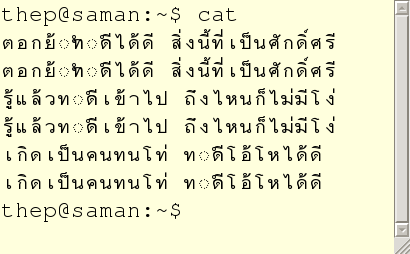 One can easily spot the dotted circle glitches. And here is how I workaround it, which is like how it's rendered on other terminals:
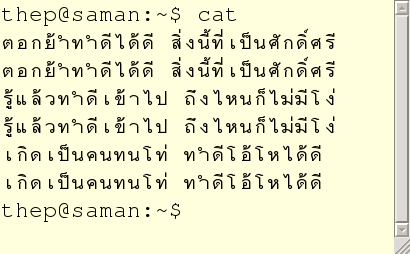 With the HarfBuzz replacement, here is how it renders:
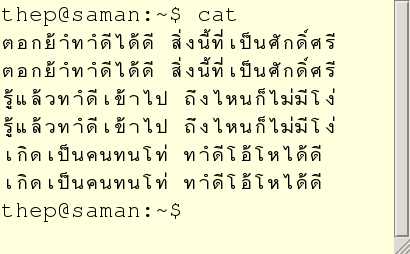 That is, although it s still wrong, it s more tolerable. So, the question for users is: Could they tolerate this until VTE is redesigned for Indic scripts supports?
 Almost a year has passed since my talk at pgconf.eu 2011 in Amsterdam on
Connecting the Debian and PostgreSQL worlds,
and unfortunately little has happened on that front, mostly due to my limited
spare time between family and job.
pgapt.debian.net is up and running, but
got few updates and is lagging behind on PostgreSQL releases.
Luckily, we got the project moving. Dimitri Fontaine
and Magnus Hagander suggested to do a
face-to-face meeting, so we got together at my house for two days last week and
discussed ideas, repository layouts, build scripts, and whatnot to get all of
us aligned for pushing the project ahead. My
employer sponsored my time off work for
that. We almost finished moving the repository to postgresql.org
infrastructure, barring some questions of how to hook the repository into the
existing mirror infrastructure; this should get resolved this week.
The build server running Jenkins is still located on my laptop, but moving this
to a proper host will also happen really soon now. We are using
Mika Prokop's
jenkins-debian-glue scripts for
driving the package build from Jenkins. The big plus point about Jenkins is
that it makes executing jobs on different distributions and architectures in
parallel much easier than a bunch of homemade shell scripts could get us with
reasonable effort.
Here's a list of random points we discussed:
 . We d need to support multiple installations (because of mutually incompatible dependencies between applications), and we d need to support multiple language bindings in some fashion some approachable fashion where the upstream will feel capable of fixing and tweaking what we offer. We re going to need to support offline updates, replication, local builds, local repositories, and various signing strategies to match the various tradeoffs made by the upstream tools.
For the anti-virus / fresh data case, we d need to support a similar set of operating systems, though I strongly suspect that there would be more tolerance for limited support in that most things in that space either have very platform specific code, or they are just a large-scale form of the egg/gem/npm problem, which also wants easy updates.
What next?
We should validate this discussion with at least two or three upstreams. Find out whats missing I suspect a lot and whats wrong I hope not much . Then we ll be in a position to decide if there is a tractable, widespread solution *possible*.
Separately, we should stop fighting with upstreams that have their own packaging systems. They are satisfying different use cases than our core distro packaging systems are designed to solve. We should stop mindlessly repackaging things from e.g. eggs to debs, unless we need that specific thing as part of the transitive runtime or buildtime dependencies for the distribution itself. In particular, if us folk that build system packaging tools adopt and use the upstream application packaging tools, we can learn in a deep way the (real) advantages they have, and become more able to reason about how to unify the various engineering efforts going into them and perhaps even eventually satisfy them using dpkg/rpm on our machines.


#!/bin/bash
# NOTE: use alsamixer and set playback gain to 99
set -e
playcmd ()
        sox -V0 -m "$1" \
           "  sox -V0 -r 44100 $1 -t wav -c 1 -   synth sine 20000 gain -1" \
            -t wav -   \
           aplay -q  -D default:CARD=CODEC

DELAY=$ 1:-1.5
echo -n "Started at: "
date
STARTTIME= date +%s
while true; do
        printf "\r"
        echo -n $(( ( date +%s -$STARTTIME) / 60))
        printf "m/$ DELAY s: TRANSMIT"
        playcmd ~/audio/cq/cq.wav
        printf "\r"
        echo -n $(( ( date +%s -$STARTTIME) / 60))
        printf "m/$ DELAY s: off         "
        sleep $DELAY
done
Run this, and it will continuously play your message, with a 1.5s gap in between during which the transmitter is not keyed.
The screen will look like this:
Started at: Fri Aug 24 21:17:47 CDT 2012
2m/1.5s: off
The 2m is how long it s been going this time, and the 1.5s shows the configured gap. The sox commands are really two nested ones. The -m causes sox to merge the .wav file in $1 with the 20kHz sine wave being generated, and the entire thing is piped to the ALSA player. Tweaks for RigExpert TI-5 This is actually a much simpler case. We just replace playcmd as follows:
playcmd ()
        ~/bin/raiserts /dev/ttyUSB1 'aplay -q -D default:CARD=CODEC' < "$1"
Where raiserts is a program that simply keeps RTS asserted on the serial port while the given command executes. Here's its source, which I modified a bit from a program I found online:
/* modified from
 * https://www.linuxquestions.org/questions/programming-9/manually-controlling-rts-cts-326590/
 * */
#include <stdio.h>
#include <stdlib.h>
#include <termios.h>
#include <unistd.h>
#include <sys>ioctl.h>
#include <sys< sys="">types.h>
#include <sys>stat.h>
#include <fcntl.h>
static struct termios oldterminfo;
void closeserial(int fd)

    tcsetattr(fd, TCSANOW, &oldterminfo);
    if (close(fd) < 0)
        perror("closeserial()");

int openserial(char *devicename)

    int fd;
    struct termios attr;
    if ((fd = open(devicename, O_RDWR)) == -1)
        perror("openserial(): open()");
        return 0;

    if (tcgetattr(fd, &oldterminfo) == -1)
        perror("openserial(): tcgetattr()");
        return 0;

    attr = oldterminfo;
    attr.c_cflag  = CRTSCTS   CLOCAL;
    attr.c_oflag = 0;
    if (tcflush(fd, TCIOFLUSH) == -1)
        perror("openserial(): tcflush()");
        return 0;

    if (tcsetattr(fd, TCSANOW, &attr) == -1)
        perror("initserial(): tcsetattr()");
        return 0;

    return fd;

int setRTS(int fd, int level)

    int status;
    if (ioctl(fd, TIOCMGET, &status) == -1)
        perror("setRTS(): TIOCMGET");
        return 0;

    status &= ~TIOCM_DTR;   </sys>* ALWAYS clear DTR */
    if (level)
        status  = TIOCM_RTS;
    else
        status &= ~TIOCM_RTS;
    if (ioctl(fd, TIOCMSET, &status) == -1)
        perror("setRTS(): TIOCMSET");
        return 0;

    return 1;

int main(int argc, char *argv[])

    int fd, retval;
    char *serialdev;
    if (argc < 3)
        printf("Syntax: raiserts /dev/ttyname 'command to run while RTS held'\n");
        return 5;

    serialdev = argv[1];
    fd = openserial(serialdev);
    if (!fd)
        fprintf(stderr, "Error while initializing %s.\n", serialdev);
        return 1;

    setRTS(fd, 1);
    retval = system(argv[2]);
    setRTS(fd, 0);
    closeserial(fd);
    return retval;
This compiles to an executable less than 10K in size. I love it when that happens.
So these examples support voice keying both with VOX circuits and with serial-controlled PTT. raiserts.c could be trivially modified to control other serial pins as well, should you have an interface which uses different ones.
 Here are a few things to remember about cowbuilder:
- you should have "BUILDRESULTUID=the_user's_id" in ~/.pbuilderrc, and
- you might want to invoke cowbuilder with
'sudo cowbuilder --build the_pack_to_build.dsc --buildresult destination_dir_for_build_results'
sudo cowbuilder --login --bindmounts /path/to/the/dir/you/want
sudo cowbuilder --login --save-after-login
sudo cowbuilder --updateThat's about it.


 Plymouth is the part that provides the boot splash. It also takes care of a few other things, like showing prompts and progress indicators for filesystem checks, password prompts for encrypted devices and more so that the splash doesn t need to exit to show those. It s very scriptable, The installers for the Genesi Efika range of devices even use it for it s front-end.
I needed to start with a Plymouth theme where I knew the prompts for all the things that happen during boot was at least more or less implemented, so I started off with one that I know works well, the Edubuntu one. So, fun fact: Debian 7.0 s Plymouth theme is actually based on the Edubuntu one.
I had to play with the colours a bit to get it right, Edubuntu has a light background so I had to invert contrast for things like the input box, but I think it came out nicely.
Splashy isn t in the archives anymore and it s not widely used anymore, so I cleaned it up from the desktop-base package so that there s less clutter shipped with it.
Joy LTSP/LDM Theme
 This screenshot actually looks a bit uglier than it should because I took it on a VM that doesn t have 24bit colour, but we re looking into what we can do to make it look better on 16bit colour as well.
During Debconf in Nigaragua, Vagrant and I worked on getting the LDM theme in shape. I have already done what I thought was most of the work by the time Debconf started, but it turns out there was a lot more to it to do it properly. We managed to get rid of the gtk2-engines-murrine dependency, which in itself is quite tiny, but it s a bit backwards in that it depends on the whole rest of the murrine-themes which brings in too much. We took the time to get the dependencies/recommends/etc right and to make it the default theme in Debian without messing it up for any Debian derivatives. It all came together and now when you install LTSP on Debian, you get the Joy theme by default! I m really glad about that because I didn t get the Spacefun LDM theme done in time for the Squeeze release. Enjoy!
[ once again, I am translating somebody else's material In this case, my good Costa Rican friend Carolina Flores. Please excuse my stylistic mistakes My English is far from native as you well know. But this material is worth sharing, and worth investing some tens of minutes doing a quick translation. If you can read Spanish, go read Caro's original entry ]
 Have you been to a music record store lately?
I did so last Saturday, as a mere excercise. I was not planning on buying anything but I wanted to monitor things and confirm my suspicions.
What was I suspicious of? First, that I would only find old records. And so it was: The only recent record I found was ...little broken hearts by Norah Jones. the second, that I would only find music for over 50 year old people. so it was: Were I there to look for a present for my father, I would have walked out with 10 good records. Third, that in the store nothing worth commenting would happen. About that last point, I should point out it was around 10 AM and the store had just opened its doors. Lets concede the benefit of doubt.
I don't think many of you will remember, but in Barrio La California (where there is now a beauty parlour, almost in front of AM.PM) there was Auco Disco. In Auco Disco there was a guy specialized in rock (Mauricio Alice) and another one specialized in jazz (I don't remember his name). In that record you could always find rare records, but if they were not there, at least you were sure to find somebody to say: "No, we don't have that, but that's an excellent record, it's the best that [insert group here] have ever recorded because just afterwards they switched their guitar player, they had gone a bit south but with that record they are flying. But no, we don't have it; I can recommend you this record by [insert another group] because it has a guitar solo in track six that is amazing".
It would happen more or less like that, which means, one would arrive to Auco Disco at 10 AM and leave around 5 PM with three new records, after having listened to a spectacular music selection. What happened to those stores? Were they killed by The Pirate Bay? That's the simplistic answer from the recording industry! The answer is that those stores never got anything from the industry but an invoice. The industry specially in prescindible markets such as ours was limited to hiring artists, taking care of them recording a sellable product, producing the object called record, and that's it. The more commercial radio stations were paid to program those songs as it cannot be casual that "Mosa, mosa" is the summer hit in all of Latin America, can it? but, record stores? Nothing.
Lets carry on with that idea: Radio stations are paid to program said music. This idea should not lead us to believe that recording companies are to blame for bad taste. I won't reveal my sources, but I know the success of the "Locura autom tica" song by La Secta was a real example. Nobody paid for it. That song got to the number one because of its own merits(?) (you don't know the effort it took to find that thing, I cannot recommend it to you). Same thing happens with other stations that don't program reggaet n, that try to save the species, and where they play what we do like. But the thing is, everything we like is not available in any record store in this country. Then, even if we wanted to buy a record or give it as a gift to somebody, it is plain impossible. And don't tell me it's the same to present as a gift a link or a CD full of downloaded MP3 as it is to give a record with cover and booklet, wrapped in gift paper.
I might be old-school, but the fetish object record still exists, not only because of its cover, but because of its sound. A 3MB MP3 is akin to drinking coffee dripping from a bag that has been used eight times with the same coffee beans. That format is the worst that has ever happened to music, and if we had any bit dignity we would never purchase digital files in Amazon or iTunes safe for MP3 with an acceptable compression level. That, if we could buy them, because not only that is allowed to us. As the musical industry has no interest in resolving ITS problem (that is not our problem, it is those companies') it has not even been resolved how to charge for a MP3 download that includes import fees (well, if downloading from here a MP3 from a USA-based file server can be considered importing goods into Costa Rica!!!) so we don't have to get dizzy entering into the nineties to Titi Online to discover there is nothing by Muse, Andrew Bird, The Killers, Death Cab for Cutie, Paramore, Bj rk... (believe me, I looked them all up, even Norah jones and La Secta. They also were not there).
This all leads me to the question, which I present with all due respect (NOT): What the fuck do they expect us to do??? It is outrageous; above all because in the best case they will sell us a watery coffee download that won't allow us to get all the details a vinyl or less compression would give us. In the worst case, post-MP3 groups will end up recording music with no harmonics or hidden sounds, because, what for? Nobody will hear it. They even admit it: "Some musicians and audio engineers say the MP3 format is changing the way studios mix their recordings. They say the MP3 format "flattens" dynamics differences in tone and volume in a song. As a result, a great deal of new music sounds very much alike, and there is nothing as focusing to create a dynamic listening experience. Why working so hard in creating complex sound if nobody can detect it?" (Rolling Stone, The Death of High fidelity, December 26 2007, taken from here).
That's why I am not surprised by Adri n's post regarding the sales of old records. The price has nothing to do with it. The causes are related to the fetish object record and what it means or does not mean for people that have never purchased one. Adri n also asks if somebody here keeps buying records. I answered that I would if the stores sold anything I like. I do it even after the nausea I feel while reading "This phonogram is an intellectual work protected in favor of its producer COPYING IT IN WHOLE OR PARTIALLY IS FORBIDDEN " (like that, uppercased, yelling to whoever is only guilty of having bought a record and defending the producer, not the artist). But I am sure that almost nobody buys records because doing so is no longer a gratifying experience; because if buying a record is clicking to wait 15 days for it to reach the mailbox, we prefer clicking on the download link.
But there is another reason for people not to buy records anymore. In one of my talks regarding the dictatorship of the all rights reserved, I asked the 30 twenty-something-year-old students if any of them had ever bought a record. One answered he had, because he is an author and performer (cantautor in Spanish) and understands the effort that producing a record entails. The rest of them had never done so. Is it possible that said young people have never listened to real music? Is it possible that, were it not for concerts, what they consider music is a set of washed-out MP3 that are about to fill up 1TB of their computer? Does people no longer buy records because they cannot differentiate one sound from the other?
It is not very clear for me where do I want to get to. The recording industry is despicable. An industry that instead of innovating sets its energy on suing adolescents for downloading songs, trying to pass laws restricting our freedoms in Internet, putting up DRMs making us hostages to our devices* and forcing us to listen just the aroma of music, deserves my whole contempt. If we add ot this that said industry won't allow us to legally download their breadcrumbs because it has not understood that Internet does not need a van crossing borders, besides my contempt they deserve my pity and my heartfelt condolence.
But the condolence is also for music, real music, that which is not compressed under the shoe using a terrible format. It is also for independent musicians that have not realized that begging for a bit of space to that industry they just add to themselves the "despicable" tag, given they deserve the fruits of their work to enter their bank account.
However, there are good things that have come out of this absurdity. Be it for those that have joined projects such as Aut mata (even if it is in MP3) and for dreams come true such as Musopen (that have achieved that the music that's in theory Public Domain becomes so in practice as well). Good for the Electronic Frontier Foundation and the list of lawyers willing to defend people accused of ilegally downloading music in the USA. Good for the Creative Commons licenses that allow free sharing.
All those are growing solutions, although none of them allows me to buy the Panamanian Carlos M ndez's record. Thankfully, a friend of mine who knows I will never give a dime to Apple, bought the files for me in iTunes. I thank him deeply, although I would have prefered to go to Auco Disco and have Mauricio tell me that the 2007 EP I have from Carlos is better than the record he did on 2009.
* My devices don't have DRM because I use free software. I also use the ogg file format.
Image by verbeeldingskr8
Next.
