Search Results: "nic"

15 September 2012

Eddy Petrișor: Why a lack of skepticism is dangerous...

Some of my Romanian readers might know that for the last two years I've got involved in the skeptical movement to such a degree that I am a co-producer of a bi-weekly podcast on science and skepticism (in Romanian) called Skeptics in Romania . Some might even be regular listeners of the show.

(There isn't much to see now visually on the site, but me and the other people behind the project have some ongoing plans to change that.)

In spite of our modest site, up until now we had some successes, one of them being the publication of an article on us in a known Romanian printed publication and another being the invitation to a live show face to face with Oreste Teodorescu, a well known Romanian mysticist and woo promoter.

During that live show we managed to show a demonstration (video below, in Romanian) of how astrology gives the impression of working, without actually working, and, taking into account we had no prior TV camera experience and that it was a live show, I think we managed an honourable presence.


<iframe allowfullscreen="allowfullscreen" frameborder="0" height="315" src="http://www.youtube.com/embed/y5OG1q8_3Ro" width="420"></iframe>

We also have a series of interviews in English with some really interesting people: Dr. Eugenie Scott, Prof. Christopher French, Prof. Edzard Ernst, Samantha Stein and others. We did these interviews at Denkfest 2011, in Zurich, and we integrated the translated (voice over) interviews in our podcast. The conlusion is that most of our activities revolve around the podcast, so let me tell you more about that.

The podcast has a somewhat fixed structure, it starts with a conversation between ourselves, then we have a segment on the history of science, technology, skepticism and woo, and then we have a segment called The dangers of not being skeptical . In this segment we present cases of people who lost their lives, their health, their money or any combination of the former because they were duped into some scam, science-y sounding non-science, unfounded claim or some other woo.

Having lost recently my brother-in-law to a form of cancer known as Hodgkin lymphoma, I became especially sensitive about miracle-cure claims for cancer, and this section of the show has lately seen its fair share of such cases. Honestly, if there could be a way to prosecute the irresponsible, ignorant and/or cynical people promoting all sorts of quack "therapies", especially for cancer*, I would really like to see it happen. But there isn't, and we're trying the best accessible approach, informing the public.

During my brother-in-law's last two years of his life, he went through lots of chemotherapy and radiotherapy sessions, repeated periods of hospitalisation, and lots of drugs. This is the best of what we currently have for treating and curing most forms of cancer, and too many times this isn't enough. I can't even imagine how stressful and discouraging it must feel when the best of what we have doesn't help.

Here is where the desperation and hopes of patients and their families meet the purely irresponsible cynical or ignorant promoters of woo and quack therapies. Because it takes either an ignorant or a really cynical (I really feel this word isn't enough) person to prey on the suffering of other people to make easy money under the false pretence of offering a cure.

It almost happened to my brother-in-law and his family, because they almost went for some herbal concoction promoted as a cancer cure on some forum, blog or page of a seller of this fake therapy. It was really hard for me to make them understand why using such a product it not advisable, not even in parallel with the medical treatment due its possible counter effect or interactions with the real medical treatment, without them getting the wrong idea that I wasn't trying to help. While trying to be brief and informative not to lose their attention, I told them how "natural" doesn't necessarily mean "good" (uranium, lead and Irukandji's venom are all natural), and how plants are drugs because they all contain chemical substances (and no, "chemical" does not mean "human made" or "artificial") which could interact with the medical treatment.


But most people don't even have the chance of having close by a person with a more science-leaning thought process and a skeptical mind. Those unfortunate people are the most vulnerable people and constitute the biggest chunk of the victims of baseless pseudo-cures or pseudo-treatments.

On our last show, I presented the case of Yvonne Main, a cancer suffering patient who mistook an invasive carcinoma for a cyst, and irdologist Ruth Nelson for a real healthcare giver.

Yvonne Main, died from an invasive carcinoma
after seeking help from a iridologist,
and delaying real medical treament for 18 months


Yvonne, after seeking medical advice from a person that essentially promotes the dead idea of guessing diseases by looking at the eyes**, used natural treatments for about 18 months and, after all this time, her carcinoma grew to a size of 10 to 11 cm, eating through her skull and causing damage which was later attempted to be countered through bone transplant from her ribs.

Ruth Nelson wasn't prosecuted in any way and continues her practice of quackery unharmed.

This is not the only case, nor even one case from a select few where woo and quackery lead to grave consequences for patients. There are many, many more; they're so many that even after splitting them in categories they seem too many per category, especially when you realise these are only the findings of, essentially, a single man:


http://www.whatstheharm.net/


This is part of what I have been doing in the last few years, instead of working on Debian. Is it a good thing? Is it a bad thing? Maybe it's good. I want to know what do you think?


* you will, most likely, never hear such a promoter of non-therapies say that there isn't just one cancer, and that, in fact, cancer is a name for a certain family of diseases which are all called cancer - that's a first sign that you might be dealing with quack
** probably in the line of thought that the eyes are the gates to the soul so they must tell something significant about health

13 September 2012

Keith Packard: Altos1.1

AltOS 1.1 Bug fixes and some nice new features Bdale and I are pleased to announce the release of AltOS version 1.1. AltOS is the core of the software for all of the Altus Metrum products. It consists of cc1111-based micro-controller firmware and Java-based ground station software. We ve spent the last flying season chatting with people flying TeleMetrum and TeleMini boards and they came up with some great ideas to add to the system. AltOS Firmware Features and fixes There are bug fixes in both ground station and flight software, so you should plan on re-flashing both units at some point. However, there aren t any incompatible changes, so you don t have to do it all at once. New features: Bug fixes: AltosUI Easier to use AltosUI has also seen quite a bit of work for the 1.1 release. There aren t any huge new features, but some activities are restructured to make them easier to navigate. And, of course, we ve fixed a bunch of bugs. New features: User interface changes: Bug fixes:
Tim Retout: Inbox zero

My email's been out of control for a while now. I've noticed a correlation between the state of my email and my state of mind - I don't know which way the causation flows, if any. At the weekend (after assembling the shelves), I archived my entire inbox. Again. But I find the hard part with email bankruptcy is preventing the entire cycle recurring. This time, I was more drastic. I deleted all my labels, and all but three of my filters. I removed the Smart Labels, the chat widget, the calendar integration, the Google+ circles (more on that soon). There are no distractions in my inbox any more. I'm forcing myself to process every non-spam email that comes to my address. (Yes, I'm embarassed to say that I use Gmail - it seemed like a good idea at the time, because of the spam filtering. I occasionally notice bugs with ancient emails becoming unarchived or unread, and wonder if Google uses a probabilistic data structure to access all those attributes quickly enough. Can't investigate, though, because it's Gmail. Consider this the first step towards moving away.) So rather than hiding the deluge in the background, I'm unsubscribing from a lot of mailing lists, and informing marketers that I don't want their communications. It turns out that I get a lot less email than I feared - and processing them this way means that high-traffic sources get removed first. My remaining problem is what to do with email from mailing lists like debian-private - I don't really care enough to read everyone's vacation plans, but unsubscribing doesn't seem like the right thing either - there's (obviously) no online archive for this type of mailing list. For the moment, I've added a filter back to hide just vacation messages, but there's a more general problem lurking here.

Gunnar Wolf: Great online course available: Securing Digital Democracy , by J. Alex Halderman

I was pointed at a great online course If you are into e-voting analysis (or, more broadly, into democratic processes' history, evolution and future), I strongly suggest you to take a look at Securing Digital Democracy . Just the name of the teacher should be enough to make it interesting: University of Michigan professor J. Alex Halderman, the guy who has analized/hacked several electronic booths, and one of the clearest, smartest voices to explain what should we require of a voting system and how electronic booths are the worst fit for any purpose. The course is delivered through Coursera; I have found Coursera to be an effective, usable, unobtrusive platform So much I even signed up for another course. I am not so happy with online courses requiring to wait so much between lessons, but after all, it tries to mimic what we see at "regular" (i.e. classroom) teaching settings. And, after all, we autodidacts are still a minority. The course in question started ten days ago, but you can still perfectly join. Each week has two lessons, worth of approximately 40 minutes of video each, and are "graded" through a quiz. Lets see how this evolves.

MJ Ray: Business As Mutual conference, Anglia Ruskin Uni, 12 Sep

image Here s a summary of what happened at this conference. Opening address. Keynote from Nick Hurd MP, @minforcivsoc. Lot less money around. Called canals and rivers trust the biggest social enterprise. Blames lack of large social enterprises on culture, leadership and access to capital. First Big Society Capital investments announced tomorrow. Questions (and responses) about what had changed in commissioning (determination?), something about accountability in health I think but I didn t hear (more public scrutiny), other models besides worker-led (gov is agnostic, but that s just the type of mutuals so far), and capital renewal (gov is challenging the banks with Big Society Bank). This is going to get a bit long, so click through to our site to read what the other the speakers had to say and what that block of flats in the picture has to do with it Still here? Good! Harriet Hounsell from John Lewis Partnership was next. What s the Right level of profit? Structure of the partnership. The registry seems like the member services function and a bit more. Partner suggestions make a real difference. Beliefs have been tested. Recession hit us. Vivian Woodall, the co-operative phone, back to how it started. He knew people working for NGOs with high international phone bills. Bulk buy. Solid steady growth. Paid all tax. Living our cooperative values. Employee council and profit-shared. Adoption of new brand. Questions to both on redundancies (debate openly, try to redeploy, ultimately division of responsibilities: managers manage staff levels, not members), and being rejected as too small to help other social enterprises (ask why? Try local level instead of head office?), plus praise for John Lewis. Then there was coffee, workshops, lunch, workshops and coffee. I don t think I should report all of that, so a quick comment on the venue at Anglia Ruskin Uni Cambridge: is the Lord Ashcroft it s named after the same one who said it was legal to attack Iraq? Anyway Based on the workshops, I don t think our co-op will do SROI accounting any time soon (needs too much people time) and I m little the wiser on leadership. Some people are intrigued by collective management and cooperative working, though. The closing keynote was Wayne Hemingway, formerly of Red or Dead and now of Hemingway Design. He gave a quick history of himself and of those two enterprises and a bit of an entertaining ramble around. He seemed very much from the business end and how to use business to benefit society, but I ve not really looked at his companies before. I probably should do, as they ve a regeneration project in Lynn (pictured: before Wayne). Then it was the closing address, the thanks (yes, thanks to the workers and sponsors) and then time to head for the exit. It s a shame that some people who made good points during the keynotes (coop party!) left quickly instead of staying to chat.

12 September 2012

Joachim Breitner: Haskell Bytes

Last Saturday I have held a talk at the Meta Main-Rhein Chaosdays 2012 in Darmstadt, an event of the local Chaos Computer Club groups and not unsimilar to Karlsruhe s yearly GPN. I was asked to give an talk on a advanced, Haskell related topic, so I took my audience on a guided tour through the memory of a running Haskell program, explained the different types of closures and their layout, and showed how info tables are used to allow the garbage collector to uniformly treat the objects. We also used that knowledge to roughly predict the memory footprint of a program processing a large file using the String data type. Besides showing raw bytes (using my ghc-heap-view package and a small utility function) I included two visualizations: One is the video of a copying garbage collector at work that I blogged about last week, and the other is a nice tool that a student of mine creates for his bachelor thesis: It allows you to visualize the heap structure of a (potentially partially evaluated) value from GHCi and interactively evaluate parts of the structure if you want, even thunks that are hidden behind other thunks, something that you cannot do from Haskell code. The following picture is a screen shot of ghc-vis visualizing the evaluation of the famous two-line primes definition:
ghc-vis at work
The slides of my talk do not cover everything that was included, but the transcript does. It is in German, so as before, if you want me to translate it, then (convince your professor or employer to) invite me to hold the talk again. The ghc-vis tool can be found on Hackage, more information about it is on the author s website.
Flattr this post

11 September 2012

Junichi Uekawa: libexiv2-doc seems to be empty.

libexiv2-doc seems to be empty. Seems like it's missing the whole doc/html directory (doxygen) from install target. Sent a bugreport to BTS but BTS doesn't seem to like my bugreport.

10 September 2012

Craig Sanders: openstack, bridging, netfilter and dnat

I just posted the following question to ServerFault .and then realised there might be people out there in magical internetland who know the answer but never visit any of the SO sites, so i ve posted it here too. Feel free to respond here on on serverfault.
In a recent upgrade (from Openstack Diablo on Ubuntu Lucid to Openstack Essex on Ubuntu Precise), we found that DNS packets were frequently (almost always) dropped on the bridge interface (br100). For our compute-node hosts, that s a Mellanox MT26428 using the mlx4_en driver module.
We ve found two workarounds for this:
1. Use an old lucid kernel (e.g. 2.6.32-41-generic). This causes other problems, in particular the lack of cgroups and the old version of the kvm and kvm_amd modules (we suspect the kvm module version is the source of a bug we re seeing where occasionally a VM will use 100% CPU). We ve been running with this for the last few months, but can t stay here forever.
2. With the newer Ubuntu Precise kernels (3.2.x), we ve found that if we use sysctl to disable netfilter on bridge (see sysctl settings below) that DNS started working perfectly again. We thought this was the solution to our problem until we realised that turning off netfilter on the bridge interface will, of course, mean that the DNAT rule to redirect VM requests for the nova-api-metadata server (i.e. redirect packets destined for 169.254.169.254:80 to compute-node s-IP:8775) will be completely bypassed.
Long-story short: with 3.x kernels, we can have reliable networking and broken metadata service or we can have broken networking and a metadata service that would work fine if there were any VMs to service. We haven t yet found a way to have both.
Anyone seen this problem or anything like it before? got a fix? or a pointer in the right direction?
Our suspicion is that it s specific to the Mellanox driver, but we re not sure of that (we ve tried several different versions of the mlx4_en driver, starting with the version built-in to the 3.2.x kernels all the way up to the latest 1.5.8.3 driver from the mellanox web site. The mlx4_en driver in the 3.5.x kernel from Quantal doesn t work at all)
BTW, our compute nodes have supermicro H8DGT motherboards with built-in mellanox NIC:
02:00.0 InfiniBand: Mellanox Technologies MT26428 [ConnectX VPI PCIe 2.0 5GT/s - IB QDR / 10GigE] (rev b0)
We re not using the other two NICs in the system, only the Mellanox and the IPMI card are connected.
Bridge netfilter sysctl settings:
net.bridge.bridge-nf-call-arptables = 0
net.bridge.bridge-nf-call-iptables = 0
net.bridge.bridge-nf-call-ip6tables = 0
Since discovering this bridge-nf sysctl workaround, we ve found a few pages on the net recommending exactly this (including Openstack s latest network troubleshooting page and a launchpad bug report that linked to this blog-post that has a great description of the problem and the solution) .it s easier to find stuff when you know what to search for :), but we haven t found anything on the DNAT issue that it causes.

Update 2012-09-12: Something I should have mentioned earlier this happens even on machines that don t have any openstack or even libvirt packages installed. Same hardware, same everything, but with not much more than the Ubuntu 12.04 base system installed. On kernel 2.6.32-41-generic, the bridge works as expected. On kernel 3.2.0-29-generic, using the ethernet interface, it works perfectly.
Using a bridge on that same NIC fails unless net.bridge.bridge-nf-call-iptables=0 So, it seems pretty clear that the problem is either in the mellanox driver, the updated kernel s bridging code, netfilter code. or some interaction between them. Interestingly, I have other machines (without a mellanox card) with a bridge interface that don t exhibit this problem. with NICs ranging from cheap r8169 cards to better quality broadcom tg3 Gbit cards in some Sun Fire X2200 M2 servers and intel gb cards in supermicro motherboards. Like our openstack compute nodes, they all use the bridge interfaces as their primary (or sometimes only) interface with an IP address they re configured that way so we can run VMs using libvirt & kvm with real IP addresses rather than NAT. So, that indicates that the problem is specific to the mellanox driver, although the blog post I mentioned above had a similar problem with some broadcom NICs that used the bnx2 driver. openstack, bridging, netfilter and dnat is a post from: Errata

9 September 2012

Erich Schubert: Google Plus replacing blogs not Facebook

When Google launched Google+, a lot of people were very sceptical. Some outright claimed it to be useless. I must admit, it has a number of functions that really rock.
Google Plus is not a Facebook clone. It does not try to mimick Facebook that much. To me, it looks much more like a blog thing. A blog system, where everybody has to have a Google account, and then can comment (plus, you can then restrict access and share only with some people). It also encourages you to share shorter posts. Successful blogs always tried to make their posts "articles". Now the posts themselves are merely comments; but not as crazy short as Twitter (it is not a Twitter clone either), and it does have rich media contents, too.
Those who expect it to replace their Facebook where the interaction is all about personal stuff will be somewhat disappointed. Because it IMHO much less encourages the smalltalk type of interaction.
However, it won a couple of pretty high profile people to share their thoughts and web discoveries with the world. Some of the most active users I follow on Google Plus are: Linus Torvalds and Tim O'Reilly (of the publishing house O'Reilly)
Of course I also have a number of friends that share private stuff on Google Plus. But in my opinion the strength of Google Plus is on sharing publicly. Since Google is the king of search, they can both feed shares of your friends into your regular search results, but there is also a pretty interesting search in Google PLus. The key difference is that with this search, the focus is on what is new. Regular web search is also a lot about searching for old things (where you did not bother to remember the address or bookmark the site - and mind it, today a lot of people even "google for Google" ...) For example I like the plus search for data mining because it occasionally has some interesting links in it. A lot of the stuff is coming in again and again, but using the "j and k" keys, I can quickly scroll through these results to see if there is anything interesting. And there are quite a lot of interesting things I've discovered this way.
Note that this can change anytime. And maybe it is because I'm interested in technology stuff that it works well for me. But say, maybe you are more into HDR photography than me (I think they look unreal, as if someone has done way too much contrast and edge enhancing on the image). But go there, and press "j" a number of times to browse through some HDR shots. That is a pretty neat search function there. And if you come back tomorrow, there will likely be new images!
Facebook tried to clone this functionality. Google+ launched in June 2011, and in September 2011, Facebook added "subscribers". So they realized the need for having "non-friends" that are interested in what you are doing. Yet, I don't know anybody actually using it. And the Public posts search is much less interesting than of Google Plus, and the nice keyboard navigation is also missing.
Don't get me wrong, Facebook still has its uses. When I travel, Facebook is great for me to get into contact with locals to go swing dancing. There are a number of events where people only invite you on Facebook (and that is one of the reasons why I've missed a number of events - because I don't use Facebook that much). But mind it, a lot of the stuff that people share on Facebook is also really boring.
And that will actually be the big challenge for Google: keeping the search results interesting. Once you have millions of people there sharing pictures of lolcats - will it still return good results? Or will just about every search give you more lolcats?
And of course, spam. The SEO crowd is just warming up in exploring the benefits of Google Plus. And there are quite some benefits to be gained from connecting web pages to Google Plus, as this will make your search results stick out somehow, or maybe give them that little extra edge over other results. But just like Facebook at some point was so heavily spammed when every little shop was setting up his Facebook pages, inviting everyone to all the events and so on - this is bound to happen on Google Plus, too. We'll see how Google then reacts, and how quickly and effectively.

Bartosz Fe&#324;ski: Choosing the tablet

Dear lazy web, The electronic devices are much cheaper in US than in Poland and I ve got an opportunity to get one without duty/taxes and all that crap. I wonder if Kindle Fire HD is the right choice for someone outside of US/UK?
We don t have access to all Amazon services but still this tablet specification looks interesting. Any other hints? I m looking for something under 300 bucks, so no fruits please ;)

8 September 2012

Robert Collins: Launchpads page performance report now reusable

Thanks to Corey Goldberg, one of my colleagues @ Canonical, the page performance report can now be used on regular Apache log files, rather than just the zserver trace log files that Launchpad s middle tier generates. We use this report to identify poorly performing pages and get insight into the timing patterns of bad pages. The code lives in the Launchpad dev-utils project instructions for checking it out and configuring it are on the wiki. If you don t have aggregate data for your web application, I highly recommend grabbing PPR and checking it out its very lightweight, and data is extremely useful.

7 September 2012

Rog rio Brito: NOT Trying out AdSense

On the 3rd of September, I applied to Google's AdSense program, as I told in my previous post. Well, that was a short-lived experience. On the 5th of September, I received the following e-mail, which, sincerely, is as uninformative as it could get:
Date: Wed, 05 Sep 2012 16:52:22 -0000
From: adsense-noreply@google.com
To: rbrito@gmail.com
Subject: Google AdSense Support
Hello,
As mentioned in our welcome email, we conduct a second review of your
AdSense application once AdSense code is placed on your site(s). As a
result of this review, we have disapproved your account for the following
violation(s):
Issues:
- Site does not comply with Google policies
---------------------
Further detail:
Site does not comply with Google policies: We're unable to approve your
AdSense application at this time because we feel that your site does not
comply with Google AdSense policies or webmaster quality guidelines. It's
our goal to provide our advertisers sites that offer rich and meaningful
content, receive organic traffic, and allow us to serve well-targeted ads
to users. We believe that currently your site does not fulfill this
criteria. 
For more details, please read the webmaster quality guidelines at
http://www.google.com/support/webmasters/bin/answer.py?answer=35769 and
the AdSense program policies at
http://support.google.com/adsense/bin/answer.py?answer=48182,
https://support.google.com/adsense/bin/topic.py?topic=1271507
(...)
OK, I went on and read all the documentation on program policies etc. I investigate each point here: To cut a long story short, I RTFM and did everything correctly. So, dear lazyweb, what would my options be to fund a tiny bit of my software contributions?

Andrew Pollock: [life] Sarah Pollock, BBus

Sarah is back in Australia attending the graduation ceremony for her Bachelor of Business degree, at the University of Southern Queensland, an Australia University that specialises in distance education. To say I'm immensely proud of her achievement is putting it lightly. Consider for a moment all of the challenges she has had to face in the past 6 years since she started it: Me, I'd fail at "studying remotely". Heck, I've had two stabs at a Bachelor of Information Technology on campus, and what do I have to show for it? No, I'm so very very proud of her for sticking at it, and doing so very well (she twice received the Dean's Award for having a high GPA for the semester). She decided to embark on a business degree after having a really hard time finding meaningful work when we moved to the US. She had been working in business project management for the Australian Federal Government (and really enjoying the work) before we moved, and couldn't find any project management that wasn't high-tech, which wasn't really her thing, and everything wanted a degree. She briefly contracted at VMWare, in a marketing position, and Google, in a Security Vulnerability Management role, but neither of these were really up her alley, so to speak. So she went "bugger it" and enrolled in the degree. Ironically, mid-way through the course, she decided that nursing was more what she wanted to do, so she has also gone out and done short courses in health care. She has been licensed as a Certified Nurse Assistant and also a Phlebotomist, but never worked as either. She's just started an Emergency Medical Technician course at Mission College, and is keen to try and work in that field for a little while before starting on a post-graduate Nursing degree in Australia. Sarah had indicated to me that she'd really love to go back for the on-campus graduation ceremony, since she's barely set foot on campus in the six years she's been studying at the university. I thought that was an excellent idea, so I sprang for a Business Class flight back for just her, and am staying behind to look after Zoe. It's only a flying visit. She departed Wednesday night, returns on Monday. As I write, she's probably at the ceremony right now. Normally it would take 6 years to complete a degree externally, assuming two subjects a semester for 12 semesters. She's obviously had to take a few semesters off here and there because of some of the aforementioned challenges. To still finish the degree in 6 years, she's had to plow through the "summer" break (I say "summer" because it's during the Northern Hemisphere winter) and use the accelerated "summer semester", also known as "semester 3" to do an additional subject. That's meant that summers over here have been her shorter winter break. This summer has been the first summer where she hasn't had to worry about studying, and it's been really wonderful to be a whole family again for an extended period of time, and we've had a jam packed summer as a result. We bought a tent and did a small amount of camping. We've had weekends away with friends. We've been to Raging Waters. We've been to Disneyland (granted that was in between final exams). It's been go go go. So now that summer is almost over, I'm looking forward to the pace slowing down a bit more and things returning to "normal" (well the new "normal" is Sarah doing her EMT class a couple of nights a week until December). She's only just started, but she's really loving the on-campus aspect of it. I'm also looking forward to getting a bit more "me" time. Since Zoe was born, I have sacrificed my personal time to facilitate Sarah's study. I haven't had much time to tinker and I've barely had time for Debian. I'm looking forward to trying to carve out a few hours a week for some of both, plus a bit of reading.

5 September 2012

Jonathan Carter: Shello


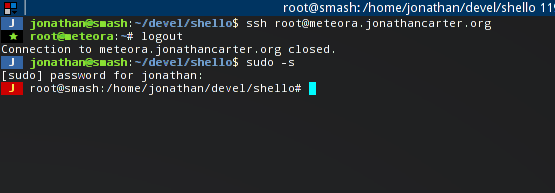
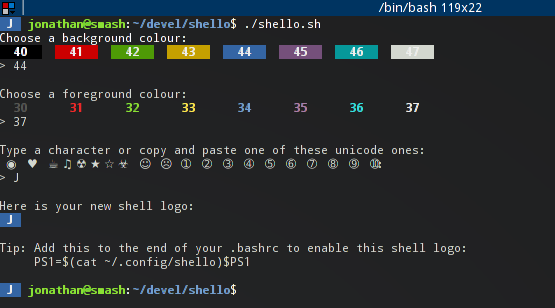
If there s one thing that I ve had missing in my life for way too long, it s hacking on small silly stupid amusing little things. When I was young I used to write dozens of little pointless programs a week and forget about them, only to found them a few months later and be incredibly amused by them. This afternoon I noticed that one of my machines didn t have my default .bashrc loaded, which colourises (or colorizes for Americans or colourizes for Canadians) my shell so that I know on which machine I am so that I don t accidentally do something silly like reboot the wrong host. One problem I ve had with this is that there are limited colours available that makes sense to use for a shell prompt. Right as I was thinking this, I was looking at my Byobu screen sessions and thinking Hmm! I like those logos, maybe I could use them in my shell! . So in just a few minutes I had a little script to help you configure those for your shell. Here is a screenshot of the shell logos in action. On my laptop I use a red background when I have a root shell: This is what the shello script looks like that sets it up: I might get bored by seeing it soon and get rid of it, but at least I had a little fun with it. If you d like to try it out, then you can get the script right here: https://github.com/highvoltage/shello It doesn t do anything like validating input yet, I d also like to add something that creates some kind of a checksum of your hostname and choose a unicode character based on that. Maybe I ll finish it up this weekend, or maybe I ll have new things to write about!
4 September 2012

Gunnar Wolf: Electronic voting in Panama: Slower, more expensive, more uncertainty... Goodbye!

Panama just underwent a nasty e-voting exercise: Electronic-mediated elections were held for the committee of the PRD party. It sounds simple - Even trivial! There were only 4100 authorized voters, it was geographically trivial (all set inside a stadium)... But it blew up in smoke. I won't reiterate all what happened, I'll rather direct you to our project's (the e-voting observatorium) page: News regarding Panama (for those coming from the future, search starting at 2012-08-27 and yes, it's all in Spanish, but there are free-as-in-beer translation services. Many e-vote proponents/sellers/pushers were very eagerly waiting for this election to brag about one more success... So much that they could not just ignore it, and started rationalizing it away. Anyway, while feeding the observatorium, I came across this opinion-article in the Voto Digital website, which makes quite a bit of pro-e-voting noise. I replied to it, and I think my analysis is worth sharing also with you:
So, lets make some simple numbers, rounding the numbers: The PRD vote in Panama was done for a universe of 4100 voters. It took 10 hours (instead of the planned 4), so 410 people were processed every hour. There were 40 voting (electronic) booths, so each processed 10 people per hour. This means, each person spent 6 minutes by the booth. A manual vote in this fashion is highly parallelizable: Each of the voters can be given ballots with anticipation, or many of them cna be allowed in to be given the ballots in situ (depending on the electoral scheme employed). The contention time is the time it takes to each voter to get near the booth and deposit his ballot (either folded or in an envelope) - And it will very rarely be more than a couple of seconds. So, given that using electronic booths parallelism cannot grow (there is a fixed number of machines) and the queues grew wildly, with traditional voting it would have surely fitted in the expected four hours (they were expected, also, based on their past experiences). As for counting, that's the slowest part of manual voting, it's also highly parallelizable: If each of the 40 booths has slightly over 100 ballots, the party personnel can easily count them in under 30 minutes. Capture and aggregation for the 40 partial results would take an extra 10 minutes, even being generous. Manual voting would have saved them around five hours, without demanding additional resources (and being thus much more economical than having to buy 40 specific-purpose computers). And as an additional advantage, the physical and tangible vote proofs would remain, in case they were ever again needed.

Gunnar Wolf: To CURP or not to CURP

To CURP or not to CURP
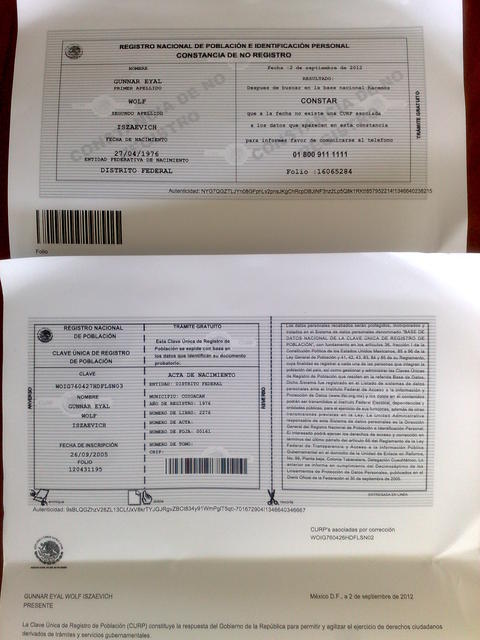
CURP: Clave nica del Registro Poblacional, or Unique Population Registry Code. This is a (hopefully) unique, 18 character long, string identifying each Mexican - I won't get into the technicalities, but serve yourselves. By following such a convoluted scheme, the authorities should have ensured a biunivocal relation between each person and their CURP number. Well, at some point, due to a bureaucratical mishap completely outside my hands (my patron registered me with the wrong birth date, as you can see in the page at the bottom), I got two CURPs - And the procedure to fix it was far from trivial. Last Sunday, I entered the Consulta CURP system to print a copy of the official document. Much to my surprise... It answered that I was not registered! A couple of minutes later, I tried again, and succeeded. But I could not refrain from printing my Certificate of non-registration. I guess their system follows a strong-but-stupid scheme such as:
  1. begin
  2. db = connect_to_database
  3. curp = find_curp_for_person(query)
  4. generate_document(curp)
  5. rescue
  6. generate_non_reg_certificate(query)
So, right, if a user submits a query during the system maintenance window (after all, it was Sunday after 23:00), the system will fail to connect to the database (or whatever), raise an exception, trap it, and... Well, you no longer exist, thanks for playing!

3 September 2012

Lars Wirzenius: New format to replace tar: some notes

During lunch the other day, I discussed the shortcomings of the tar file format with friend and co-worker Daniel. The tar file format has a lot of legacy by now, and it's not quite up to date with the latest developments in file systems, such as extended attributes. This makes tar badly suited for things such as backups and other situations where precise reproduction of the input data matters. There are several variants of the tar file format, and various more or less standard extensions to it. GNU tar, for example, added support for pathnames longer than 100 bytes many years ago, and it is now commonly supported. Other problems in the tar file format: This led us to discuss the possibility of a new file format. We had a bit of fun exploring the solution space for a while. However, almost all use of tar these days is for distributing sets of files, where the filename and basic set of file permissions is enough. In other words, for things such as source code, tar is just fine. The archives are small enough, and the other limitations are rarely a problem, but the pain of switching to a new format would be great. Thus, with some reluctance, we concluded that a new format would be a waste of time. But I thought I'd write this up anyway, in case one of my readers wants to start working on this.

2 September 2012

Junichi Uekawa: Already september.

Already september. End of fun at the beach.

Benjamin Mako Hill: Open Brands

In late July, the Awesome Foundations invited me to participate in an interesting conversation about open brands at their conference. Awesome is a young collection of organizations struggling with the idea of if, and how, they want to try to control who gets call themselves Awesome. I was asked to talk about how the free software community approaches the issue. Guidance from free software is surprisingly unclear. I have watched and participated in struggles over issues of branding in every successful free software project I've worked in. Many years ago, Greg Pomerantz and I wrote a draft trademark policy for the Debian distribution over a couple beers. Over the last year, I've been working with Debian Project Leader Stefano Zacchiroli and lawyers at the Software Freedom Law Center to help draft a trademark policy for the Debian project. Through that process, I've come up with three principles which I think lead to more clear discussion about whether a free culture or free software should register a trademark and, if they do, how they should think about licensing it. I've listed those principles below in order of importance. 1. We want people to use our brands. Conversation about trademarks seem to turn into an exercise in imagining all the horrible ways in which a brand might be misused. This is silly and wrong. It is worth being extremely clear on this point: Our problem is not that people will misuse our brands. Our problem is that not enough people will use them at all. The most important goal of a trademark policy should be to make legitimate use possible and easy. We want people to make t-shirts with our logos. We want people to write books about our products. We want people to create user groups and hold conferences. We want people to use, talk about, and promote our projects both commercially and non-commercially. Trademarks will limit the diffusion of our brand and, in that way, will hurt our projects. Sometimes, after carefully considering these drawbacks, we think the trade-off is worth making. And sometimes it is. However, projects are generally overly risk averse and, as a result, almost always err on the side of too much control. I am confident that free software and free culture projects' desire to control their brands has done more damage than all brand misuse put together. 2. We want our projects to be able to evolve. The creation of a trademark puts legal power to control a brand in the hands of an individual, firm, or a non-profit. Although it might not seem like such a big deal, this power is, fundamentally, the ability to determine what a project is and is not. By doing this, it creates a single point of failure and a new position of authority and, in that process, limits projects' ability to shift and grow organically over time. I've heard that in US politics, there is no trademark for the terms Republican or Democrat and that you do not need permission to create an organization that claims to be part of either party. And that does not mean that everybody is confused. Through social and organizational structures, it is clear who is in, who is out, and who is on the fringes. More importantly, this structure allows for new branches and groups outside of the orthodoxy to grow and develop on the margins. Both parties have been around since the nineteenth century, have swapped places on the political spectrum on a large number of issues, and have played host to major internal ideological disagreements. Almost any organization should aspire to such longevity, internal debate, and flexibility. 3. We should not confuse our communities. Although they are often abused, trademarks are fundamentally pro-consumer. The point of legally protected brands is to help consumers from being confused as the source of a product or service. Users might love software from the Debian project, or might hate it, but it's nice for them to be able to know that they're getting "Debian Quality" when they download a distribution. Of course, legally protected trademarks aren't the only way to ensure this. Domains names, internal policies, and laws against fraud and misrepresentation all serve this purpose as well. The Open Source Initiative applied for a trademark on the term open source and had their application rejected. The lack of a registered trademark has not kept folks from policing use of the term. Folks try to call their stuff "open source" when it is not and are kept in line by a community of folks who know better. And since lawyers are rarely involved, it is hardly clear that a registered trademark would help in the vast majority of these these situations. It is also the case that most free software/culture organizations lack the money, lawyers, or time, to enforce trademarks in any case. Keeping your communities of users and developers clear on what is, and what isn't, your product and your project is deeply important. But how we choose to do this is something we should never take for granted.

Lars Wirzenius: Debian discussion culture: what doesn't work

I claim that the way we conduct discussions on debian-devel has gone quickly downhill this year. The discussions around the default init implementation are particularly sad examples of how Debian debates technical topics. I've whined about this before, and people have suggested various things. Here's a list of things that I think we can conclude do not work: Things that can work: Things that might be worthwhile to try: The current situation, where a few hard-nosed, uncompromising people can prevent any rational discussion about init systems cannot be allowed to continue.

Next.

Previous.