Search Results: "ms"

16 November 2015

Julien Danjou: Profiling Python using cProfile: a concrete case

Writing programs is fun, but making them fast can be a pain. Python programs are no exception to that, but the basic profiling toolchain is actually not that complicated to use. Here, I would like to show you how you can quickly profile and analyze your Python code to find what part of the code you should optimize. What's profiling? Profiling a Python program is doing a dynamic analysis that measures the execution time of the program and everything that compose it. That means measuring the time spent in each of its functions. This will give you data about where your program is spending time, and what area might be worth optimizing. It's a very interesting exercise. Many people focus on local optimizations, such as determining e.g. which of the Python functions range or xrange is going to be faster. It turns out that knowing which one is faster may never be an issue in your program, and that the time gained by one of the functions above might not be worth the time you spend researching that, or arguing about it with your colleague. Trying to blindly optimize a program without measuring where it is actually spending its time is a useless exercise. Following your guts alone is not always sufficient. There are many types of profiling, as there are many things you can measure. In this exercise, we'll focus on CPU utilization profiling, meaning the time spent by each function executing instructions. Obviously, we could do many more kind of profiling and optimizations, such as memory profiling which would measure the memory used by each piece of code something I talk about in The Hacker's Guide to Python. cProfile Since Python 2.5, Python provides a C module called cProfile which has a reasonable overhead and offers a good enough feature set. The basic usage goes down to:
>>> import cProfile
>>> cProfile.run('2 + 2')
2 function calls in 0.000 seconds

Ordered by: standard name

ncalls tottime percall cumtime percall filename:lineno(function)
1 0.000 0.000 0.000 0.000 <string>:1(<module>)
1 0.000 0.000 0.000 0.000 method 'disable' of '_lsprof.Profiler' objects

Though you can also run a script with it, which turns out to be handy:
$ python -m cProfile -s cumtime lwn2pocket.py
72270 function calls (70640 primitive calls) in 4.481 seconds

Ordered by: cumulative time

ncalls tottime percall cumtime percall filename:lineno(function)
1 0.004 0.004 4.481 4.481 lwn2pocket.py:2(<module>)
1 0.001 0.001 4.296 4.296 lwn2pocket.py:51(main)
3 0.000 0.000 4.286 1.429 api.py:17(request)
3 0.000 0.000 4.268 1.423 sessions.py:386(request)
4/3 0.000 0.000 3.816 1.272 sessions.py:539(send)
4 0.000 0.000 2.965 0.741 adapters.py:323(send)
4 0.000 0.000 2.962 0.740 connectionpool.py:421(urlopen)
4 0.000 0.000 2.961 0.740 connectionpool.py:317(_make_request)
2 0.000 0.000 2.675 1.338 api.py:98(post)
30 0.000 0.000 1.621 0.054 ssl.py:727(recv)
30 0.000 0.000 1.621 0.054 ssl.py:610(read)
30 1.621 0.054 1.621 0.054 method 'read' of '_ssl._SSLSocket' objects
1 0.000 0.000 1.611 1.611 api.py:58(get)
4 0.000 0.000 1.572 0.393 httplib.py:1095(getresponse)
4 0.000 0.000 1.572 0.393 httplib.py:446(begin)
60 0.000 0.000 1.571 0.026 socket.py:410(readline)
4 0.000 0.000 1.571 0.393 httplib.py:407(_read_status)
1 0.000 0.000 1.462 1.462 pocket.py:44(wrapped)
1 0.000 0.000 1.462 1.462 pocket.py:152(make_request)
1 0.000 0.000 1.462 1.462 pocket.py:139(_make_request)
1 0.000 0.000 1.459 1.459 pocket.py:134(_post_request)
[ ]

This prints out all the function called, with the time spend in each and the number of times they have been called. Advanced visualization with KCacheGrind While being useful, the output format is very basic and does not make easy to grab knowledge for complete programs. For more advanced visualization, I leverage KCacheGrind. If you did any C programming and profiling these last years, you may have used it as it is primarily designed as front-end for Valgrind generated call-graphs. In order to use, you need to generate a cProfile result file, then convert it to KCacheGrind format. To do that, I use pyprof2calltree.
$ python -m cProfile -o myscript.cprof myscript.py
$ pyprof2calltree -k -i myscript.cprof

And the KCacheGrind window magically appears!
Concrete case: Carbonara optimization I was curious about the performances of Carbonara, the small timeserie library I wrote for Gnocchi. I decided to do some basic profiling to see if there was any obvious optimization to do. In order to profile a program, you need to run it. But running the whole program in profiling mode can generate a lot of data that you don't care about, and adds noise to what you're trying to understand. Since Gnocchi has thousands of unit tests and a few for Carbonara itself, I decided to profile the code used by these unit tests, as it's a good reflection of basic features of the library. Note that this is a good strategy for a curious and naive first-pass profiling. There's no way that you can make sure that the hotspots you will see in the unit tests are the actual hotspots you will encounter in production. Therefore, a profiling in conditions and with a scenario that mimics what's seen in production is often a necessity if you need to push your program optimization further and want to achieve perceivable and valuable gain. I activated cProfile using the method described above, creating a cProfile.Profile object around my tests (I actually started to implement that in testtools). I then run KCacheGrind as described above. Using KCacheGrind, I generated the following figures.
The test I profiled here is called test_fetch and is pretty easy to understand: it puts data in a timeserie object, and then fetch the aggregated result. The above list shows that 88 % of the ticks are spent in set_values (44 ticks over 50). This function is used to insert values into the timeserie, not to fetch the values. That means that it's really slow to insert data, and pretty fast to actually retrieve them. Reading the rest of the list indicates that several functions share the rest of the ticks, update, _first_block_timestamp, _truncate, _resample, etc. Some of the functions in the list are not part of Carbonara, so there's no point in looking to optimize them. The only thing that can be optimized is, sometimes, the number of times they're called.
The call graph gives me a bit more insight about what's going on here. Using my knowledge about how Carbonara works, I don't think that the whole stack on the left for _first_block_timestamp makes much sense. This function is supposed to find the first timestamp for an aggregate, e.g. with a timestamp of 13:34:45 and a period of 5 minutes, the function should return 13:30:00. The way it works currently is by calling the resample function from Pandas on a timeserie with only one element, but that seems to be very slow. Indeed, currently this function represents 25 % of the time spent by set_values (11 ticks on 44). Fortunately, I recently added a small function called _round_timestamp that does exactly what _first_block_timestamp needs that without calling any Pandas function, so no resample. So I ended up rewriting that function this way:
def _first_block_timestamp(self):
- ts = self.ts[-1:].resample(self.block_size)
- return (ts.index[-1] - (self.block_size * self.back_window))
+ rounded = self._round_timestamp(self.ts.index[-1], self.block_size)
+ return rounded - (self.block_size * self.back_window)

And then I re-run the exact same test to compare the output of cProfile.
The list of function seems quite different this time. The number of time spend used by set_values dropped from 88 % to 71 %.
The call stack for set_values shows that pretty well: we can't even see the _first_block_timestamp function as it is so fast that it totally disappeared from the display. It's now being considered insignificant by the profiler. So we just speed up the whole insertion process of values into Carbonara by a nice 25 % in a few minutes. Not that bad for a first naive pass, right?

Norbert Preining: Movies: Monuments Men and Interstellar

Over the rainy weekend we watched two movies: Monuments Men (in Japanese it is called Michelangelo Project!) and Interstellar. Both blockbuster movies from the usual American companies, they are light-years away when it comes to quality. The Monuments Men are boring, without a story, without depth, historically inaccurate, a complete failure. Interstellar, although a long movie, keeps you frozen in the seat while being as scientific as possible and starts your brain working heavily. monuments-men-interstellar My personal verdict: 3 rotten eggs (because Rotten Tomatoes are not stinky enough) for the Monuments Men, and 4 stars for Interstellar. Story First for the plot of the two movies: The Monuments Men is loosely based on a true story about rescuing pieces of art at the end of the second world war, before the Nazis destroy them or the Russian take them away. A group of art experts is sent into Europe and manages to find several hiding places of art taken by the Nazis. Interstellar is set in near future where the conditions on the earth are deteriorating to a degree that human life seems to be soon impossible. Some years before the movie plays a group of astronauts were sent through a wormhole into a different galaxy to search for new inhabitable planets. Now it is time to check out these planets, and try to establish colonies there. Cooper, a retired NASA officer and pilot, now working as farmer, and his daughter are guided by some mysterious way to a secret NASA facility. Cooper is drafted for being a pilot on the reconnaissance mission, and leaves earth and our galaxy through the same wormhole. (Not telling more!) Monuments Men Looking at the cast of Monuments Men (George Clooney, Matt Damon, Bill Murray, John Goodman, Jean Dujardin, Bob Balaban, Hugh Bonneville, and Cate Blanchett) one would expect a great movie but from the very first to the very last scene, it is a slowly meandering shallow flow of sticked together scenes without much coherence. Tension is generated only through unrelated events (stepping onto a landmine, patting a horse), but never developed properly. Dialogs are shallow and boring with one exception: When Frank Stokes (George Clooney) meets the one German and inquires general about the art, predicting his future being hanged. Historically, the movie is as inaccurate as it can be despite Clooney stating that 80 percent of the story is still completely true and accurate, and almost all of the scenes happened . That contrasts starkly with the verdict of Nigel Pollard (Swansea University): There s a kernel of history there, but The Monuments Men plays fast and loose with it in ways that are probably necessary to make the story work as a film, but the viewer ends up with a fairly confused notion of what the organisation was, and what it achieved. The movie leaves a bitter aftertaste, hailing of American heroism paired with the usual stereotypes (French amour, German retarded, Russian ignorance, etc). Together with the half baked dialogues it feels like a permanent coitus interruptus. Interstellar Interstellar cannot serve with a similar cast, but still a few known people (Matthew McConaughey, Anne Hathaway, and Michael Caine!). But I believe this is actually a sign of quality. Well balancing scientific accuracy and the requirements for blockbusters, the movie successfully spans the bridge between complicated science, in particular general gravity, and entertainment. While not going so far to call the move edutainment (like both the old and new Cosmos), it is surprising how much of hard science is packed into this movie. This is mostly thanks to the theoretical physicist Kip Thorne acting as scientific consultant for the movie, but also due to the director Christopher Nolan being serious about it and studying relativity at Caltech. Of course, scientific accuracy has limits nobody knows what happens if one crosses the event horizon of a black hole, and even the existence of wormholes is purely theoretical by now. Still, throughout the movie it follows the two requirements laid out by Kip Thorne: First, that nothing would violate established physical laws. Second, that all the wild speculations would spring from science and not from the fertile mind of a screenwriter. I think the biggest compliment was that, despite the length, despite a long day out (see next blog), despite the rather unfamiliar topic, my wife, who is normally not interested in space movies and that kind, didn t fall asleep throughout the movie, and I had to stop several times to explain details of the theory of gravity and astronomy. So in some sense it was perfect edutainment!

15 November 2015

Manuel A. Fernandez Montecelo: Work on aptitude

Midsummer for me is also known as Noite do Lume Novo (literally New Fire Night ), one of the big calendar events of the year, marking the end of the school year and the beginning of summer. On this day, there are celebrations not very unlike the bonfires in the Guy Fawkes Night in England or Britain [1]. It is a bit different in that it is not a single event for the masses, more of a friends and neighbours thing, and that it lasts for a big chunk of the night (sometimes until morning). Perhaps for some people, or outside bigger towns or cities, Guy Fawkes Night is also celebrated in that way and that's why during the first days of November there are fireworks rocketing and cracking in the neighbourhoods all around. Like many other celebrations around the world involving bonfires, many of them also happening around the summer solstice, it is supposed to be a time of renewal of cycles, purification and keeping the evil spirits away; with rituals to that effect like jumping over the fire when the flames are not high and it is safe enough. So it was fitting that, in the middle of June (almost Midsummer in the northern hemisphere), I learnt that I was about to leave my now-previous job, which is a pretty big signal and precursor for renewal (and it might have something to do with purifying and keeping the evil away as well ;-) ). Whatever... But what does all of this have to do with aptitude or Debian, anyway? For one, it was a question of timing. While looking for a new job (and I am still at it), I had more spare time than usual. DebConf 15 @ Heidelberg was within sight, and for the first time circumstances allowed me to attend this event. It also coincided with the time when I re-gained access to commit to aptitude on the 19th of June. Which means Renewal. End of June was also the time of the announcement of the colossal GCC-5/C++11 ABI transition in Debian, that was scheduled to start on the 1st of August, just before the DebConf. Between 2 and 3 thousand source packages in Debian were affected by this transition, which a few months later is not yet finished (although the most important parts were completed by mid-end September). aptitude itself is written in C++, and depends on several libraries written in C++, like Boost, Xapian and SigC++. All of them had to be compiled with the new C++11 ABI of GCC-5, in unison and in a particular order, for aptitude to continue to work (and for minimal breakage). aptitude and some dependencies did not even compile straight away, so this transition meant that aptitude needed attention just to keep working. Having recently being awarded again with the Aptitude Hat, attending DebConf for the first time and sailing towards the Transition Maelstrom, it was a clear sign that Something Had to Be Done (to avoid the sideways looks and consequent shame at DebConf, if nothing else). Happily (or a bit unhappily for me, but let's pretend...), with the unexpected free time in my hands, I changed the plans that I had before re-gaining the Aptitude Hat (some of them involving Debian, but in other ways maybe I will post about that soon). In July I worked to fix the problems before the transition started, so aptitude would be (mostly) ready, or in the worst case broken only for a few days, while the chain of dependencies was rebuilt. But apart from the changes needed for the new GCC-5, it was decided at the last minute that Boost 1.55 would not be rebuilt with the new ABI, and that the only version with the new ABI would be 1.58 (which caused further breakage in aptitude, was added to experimental only a few days before, and was moved to unstable after the transition had started). Later, in the first days of the transition, aptitude was affected for a few days by breakage in the dependencies, due to not being compiled in sequence according to the transition levels (so with a mix of old and new ABI). With the critical intervention of Axel Beckert (abe / XTaran), things were not so bad as they could have been. He was busy testing and uploading in the critical days when I was enjoying a small holiday on my way to DebConf, with minimal internet access and communicating almost exclusively with him; and he promptly tended the complaints arriving in the Bug Tracking System and asked for rebuilds of the dependencies with the new ABI. He also brought the packaging up to shape, which had decayed a bit in the last few years. Gruesome Challenges But not all was solved yet, more storms were brewing and started to appear in the horizon, in the form of clouds of fire coming from nearby realms. The APT Deities, which had long ago spilled out their secret, inner challenge (just the initial paragraphs), were relentless. Moreover, they were present at Heidelberg in full force, in or close to their home grounds, and they were Marching Decidedly towards Victory: apt BTS Graph, 2015-11-15 In the talk @ DebConf This APT has Super Cow Powers (video available), by David Kalnischkies, they told us about the niceties of apt 1.1 (still in experimental but hopefully coming to unstable soon), and they boasted about getting the lead in our arms race (should I say bugs race?) by a few open bug reports. This act of provocation further escalated the tensions. The fierce competition which had been going on for some time gained new heights. So much so that APT Deities and our team had to sit together in the outdoor areas of the venue and have many a weissbier together, while discussing and fixing bugs. But beneath the calm on the surface, and while pretending to keep good diplomatic relations, I knew that Something Had to Be Done, again. So I could only do one thing jump over the bonfire and Keep the Evil away, be that Keep Evil bugs Away or Keep Evil APT Deities Away from winning the challenge, or both. After returning from DebConf I continued to dedicate time to the project, more than a full time job in some weeks, and this is what happened in the last few months, summarised in another graph, showing the evolution of the BTS for aptitude: aptitude BTS Graph, 2015-11-15 The numbers for apt right now (15th November 2015) are: The numbers for aptitude right now are: The Aftermath As we can see, for the time being I could keep the Evil at bay, both in terms of bugs themselves and re-gaining the lead in the bugs race the Evil APT Deities were thwarted again in their efforts. ... More seriously, as most of you suspected, the graph above is not the whole truth, so I don't want to boast too much. A big part of the reduction in the number of bugs is because of merging duplicates, closing obsolete bugs, applying translations coming from multiple contributors, or simple fixes like typos and useful suggestions needing minor changes. Many of remaining problems are comparatively more difficult or time consuming that the ones addressed so far (except perhaps avoiding the immediate breakage of the transition, that took weeks to solve), and there are many important problems still there, chief among those is aptitude offering very poor solutions to resolve conflicts. Still, even the simplest of the changes takes effort, and triaging hundreds of bugs is not fun at all and mostly a thankless effort althought there is the occasionally kind soul that thanks you for handling a decade-old bug. If being subjected to the rigours of the BTS and reading and solving hundreds of bug reports is not Purification, I don't know what it is. Apart from the triaging, there were 118 bugs closed (or pending) due to changes made in the upstream part or the packaging in the last few months, and there are many changes that are not reflected in bugs closed (like most of the changes needed due to the C++11 ABI transition, bugs and problems fixed that had no report, and general rejuvenation or improvement of some parts of the code). How long this will last, I cannot know. I hope to find a job at some point, which obviously will reduce the time available to work on this. But in the meantime, for all aptitude users: Enjoy the fixes and new features! Notes [1] ^ Some visitors of the recent mini-DebConf @ Cambridge perhaps thought that the fireworks and throngs gathered were in honour of our mighty Universal Operating System, but sadly they were not. They might be, some day. In any case, the reports say that the visitors enjoyed the fireworks.

Lunar: Reproducible builds: week 29 in Stretch cycle

What happened in the reproducible builds effort this week: Toolchain fixes Emmanuel Bourg uploaded eigenbase-resgen/1.3.0.13768-2 which uses of the scm-safe comment style by default to make them deterministic. Mattia Rizzolo started a new thread on debian-devel to ask a wider audience for issues about the -Wdate-time compile time flag. When enabled, GCC and clang print warnings when __DATE__, __TIME__, or __TIMESTAMP__ are used. Having the flag set by default would prompt maintainers to remove these source of unreproducibility from the sources. Packages fixed The following packages have become reproducible due to changes in their build dependencies: bmake, cyrus-imapd-2.4, drobo-utils, eigenbase-farrago, fhist, fstrcmp, git-dpm, intercal, libexplain, libtemplates-parser, mcl, openimageio, pcal, powstatd, ruby-aggregate, ruby-archive-tar-minitar, ruby-bert, ruby-dbd-odbc, ruby-dbd-pg, ruby-extendmatrix, ruby-rack-mobile-detect, ruby-remcached, ruby-stomp, ruby-test-declarative, ruby-wirble, vtprint. The following packages became reproducible after getting fixed: Some uploads fixed some reproducibility issues, but not all of them: Patches submitted which have not made their way to the archive yet: reproducible.debian.net The fifth and sixth armhf build nodes have been set up, resulting in five more builder jobs for armhf. More than 10,000 packages have now been identified as reproducible with the reproducible toolchain on armhf. (Vagrant Cascadian, h01ger) Helmut Grohne and Mattia Rizzolo now have root access on all 12 build nodes used by reproducible.debian.net and jenkins.debian.net. (h01ger) reproducible-builds.org is now linked from all package pages and the reproducible.debian.net dashboard. (h01ger) profitbricks-build5-amd64 and profitbricks-build6-amd64, responsible for running amd64 tests now run 398.26 days in the future. This means that one of the two builds that are being compared will be run on a different minute, hour, day, month, and year. This is not yet the case for armhf. FreeBSD tests are also done with 398.26 days difference. (h01ger) The design of the Arch Linux test page has been greatly improved. (Levente Polyak) diffoscope development Three releases of diffoscope happened this week numbered 39 to 41. It includes support for EPUB files (Reiner Herrmann) and Free Pascal unit files, usually having .ppu as extension (Paul Gevers). The rest of the changes were mostly targetting at making it easier to run diffoscope on other systems. The tlsh, rpm, and debian modules are now all optional. The test suite will properly skip tests that need optional tools or modules when they are not available. As a result, diffosope is now available on PyPI and thanks to the work of Levente Polyak in Arch Linux. Getting these versions in Debian was a bit cumbersome. Version 39 was uploaded with an expired key (according to the keyring on ftp.debian.org which will hopefully be updated soon) which is currently handled by keeping the files in the queue without REJECTing them. This prevented any other Debian Developpers to upload the same version. Version 40 was uploaded as a source-only upload but failed to build from source which had the undesirable side effect of removing the previous version from unstable. The package faild to build from source because it was built passing -I to debbuild. This excluded the ELF object files and static archives used by the test suite from the archive, preventing the test suite to work correctly. Hopefully, in a nearby future it will be possible to implement a sanity check to prevent such mistakes in the future. It has also been identified that ppudump outputs time in the system timezone without considering the TZ environment variable. Zachary Vance and Paul Gevers raised the issue on the appropriate channels. strip-nondeterminism development Chris Lamb released strip-nondeterminism version 0.014-1 which disables stripping Mono binaries as it is too aggressive and the source of the problem is being worked on by Mono upstream. Package reviews 133 reviews have been removed, 115 added and 103 updated this week. Chris West and Chris Lamb reported 57 new FTBFS bugs. Misc. The video of h01ger and Chris Lamb's talk at MiniDebConf Cambridge is now available. h01ger gave a talk at CCC Hamburg on November 13th, which was well received and sparked some interest among Gentoo folks. Slides and video should be available shortly. Frederick Kautz has started to revive Dhiru Kholia's work on testing Fedora packages. Your editor wish to once again thank #debian-reproducible regulars for reviewing these reports weeks after weeks.

Simon McVittie: Discworld Noir in a Windows 98 virtual machine on Linux

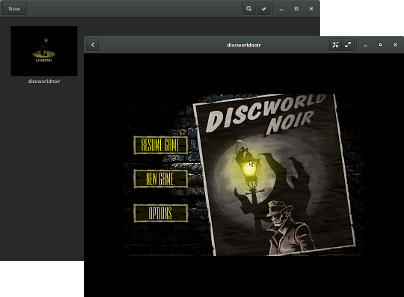
Discworld Noir was a superb adventure game, but is also notoriously unreliable, even in Windows on real hardware; using Wine is just not going to work. After many attempts at bringing it back into working order, I've settled on an approach that seems to work: now that qemu and libvirt have made virtualization and emulation easy, I can run it in a version of Windows that was current at the time of its release. Unfortunately, Windows 98 doesn't virtualize particularly well either, so this still became a relatively extensive yak-shaving exercise. discworldnoir-boxes.jpg These instructions assume that /srv/virt is a suitable place to put disk images, but you can use anywhere you want. The emulated PC After some trial and error, it seems to work if I configure qemu to emulate the following: A modern laptop CPU is an order of magnitude faster than what Discworld Noir needs, so full emulation isn't a problem, despite being inefficient. There is deliberately no networking, because Discworld Noir doesn't need it, and a 17 year old operating system with no privilege separation is very much not safe to use on the modern Internet! Software needed Windows 98 installation It seems to be easiest to do this bit by running qemu-system-i386 manually:
qemu-img create -f qcow2 /srv/virt/discworldnoir.qcow2 30G
qemu-system-i386 -hda /srv/virt/discworldnoir.qcow2 \
    -drive media=cdrom,format=raw,file=/srv/virt/windows98.iso \
    -no-kvm -vga cirrus -m 256 -cpu pentium3 -localtime
Don't start the installation immediately. Instead, boot the installation CD to a DOS prompt with CD-ROM support. From here, run
fdisk
and create a single partition filling the emulated hard disk. When finished, hard-reboot the virtual machine (press Ctrl+C on the qemu-system-i386 process and run it again). The DOS FORMAT.COM utility is on the Windows CD-ROM but not in the root directory or the default %PATH%, so you'll have to run:
d:\win98\format c:
to create the FAT filesystem. You might have to reboot again at this point. The reason for doing this the hard way is that the Windows 98 installer doesn't detect qemu as supporting ACPI. You want ACPI support, so that Windows will issue IDLE instructions from its idle loop, instead of occupying a CPU core with a busy-loop. To get that, boot to a DOS prompt again, and use:
setup /p j /iv
/p j forces ACPI support (Thanks to "Richard S" on the Virtualbox forums for this tip.) /iv is unimportant, but it disables the annoying "billboards" during installation, which advertised once-exciting features like support for dial-up modems and JPEG wallpaper. I used a "Typical" installation; there didn't seem to be much point in tweaking the installed package set when everything is so small by modern standards. Windows 98 has built-in support for the Cirrus VGA card that we're emulating, so after a few reboots, it should be able to run in a semi-modern resolution and colour depth. Discworld Noir apparently prefers a 640 480 16-bit video mode, so right-click on the desktop background, choose Properties and set that up. Audio drivers This is the part that took me the longest to get working. Of the sound cards that qemu can emulate, Windows 98 only supports the SoundBlaster 16 out of the box. Unfortunately, the Soundblaster 16 emulation in qemu is incomplete, and in particular version 2.1 (as shipped in Debian 8) has a tendency to make Windows lock up during boot. I've seen advice in various places to emulate an Eqsonic ES1370 (SoundBlaster AWE 64), but that didn't work for me: one of the drivers I tried caused Windows to lock up at a black screen during boot, and the other didn't detect the emulated hardware. The next-oldest sound card that qemu can emulate is a Realtek AC97, which was often found integrated into motherboards in the late 1990s. This one seems to work, with the "A400" driver bundle linked above. For Windows 98 first edition, you need a driver bundle that includes the old "VXD" drivers, not just the "WDM" drivers supported by Second Edition and newer. The easiest way to get that into qemu seems to be to turn it into a CD image:
genisoimage -o /srv/virt/discworldnoir-drivers.iso WDM_A400.exe
qemu-system-i386 -hda /srv/virt/discworldnoir.qcow2 \
    -drive media=cdrom,format=raw,file=/srv/virt/windows98.iso \
    -drive media=cdrom,format=raw,file=/srv/virt/discworldnoir-drivers.iso \
    -no-kvm -vga cirrus -m 256 -cpu pentium3 -localtime -soundhw ac97
Run the installer from E:, then reboot with the Windows 98 CD inserted, and Windows should install the driver. Installing Discworld Noir Boot up the virtual machine with CD 1 in the emulated drive:
qemu-system-i386 -hda /srv/virt/discworldnoir.qcow2 \
    -drive media=cdrom,format=raw,file=/srv/virt/DWN_ENG_1.iso \
    -no-kvm -vga cirrus -m 256 -cpu pentium3 -localtime -soundhw ac97
You might be thinking "... why not insert all three CDs into D:, E: and F:?" but the installer expects subsequent disks to appear in the same drive where CD 1 was initially, so that won't work. Instead, when prompted for a new CD, switch to the qemu monitor with Ctrl+Alt+2 (note that this is 2, not F2). At the (qemu) prompt, use info block to see a list of emulated drives, then issue a command like
change ide0-cd1 /srv/virt/DWN_ENG_2.iso
to swap the CD. Then switch back to Windows' console with Ctrl+Alt+1 and continue installation. I used a Full installation of Discworld Noir. Transferring the virtual machine to GNOME Boxes Having finished the "control freak" phase of installation, I wanted a slightly more user-friendly way to run this game, so I transferred the virtual machine to be used by libvirtd, which is the backend for both GNOME Boxes and virt-manager:
virsh create discworldnoir.xml
Here is the configuration I used. It's a mixture of automatic configuration from virt-manager, and hand-edited configuration to make it match the qemu-system-i386 command-line. Running the game If all goes well, you should now see a discworldnoir virtual machine in GNOME Boxes, in which you can boot Windows 98 and play the game. Have fun!

14 November 2015

Daniel Pocock: Migrating data from Windows phones

Many of the people who have bought Windows phones seek relief sooner or later. Sometimes this comes about due to peer pressure or the feeling of isolation, in other cases it is the frustration of the user interface or the realization that they can't run cool apps like Lumicall. Frequently, the user has been given the phone as a complimentary upgrade when extending a contract without perceiving the time, effort and potential cost involved in getting their data out of the phone, especially if they never owned a smartphone before. When a Windows phone user does decide to cut their losses, they are usually looking to a friend or colleague with technical expertise to help them out. Personally, I'm not sure that anybody I would regard as an IT expert has ever had a Windows phone though, meaning that many experts are probably also going to be scratching their heads when somebody asks them for help. Therefore, I've put together this brief guide to help deal with these phones more expediently when they are encountered. The Windows phones have really bad support for things like CalDAV and WebDAV so don't get your hopes up about using such methods to backup the data to any arbitrary server. Searching online you can find some hacks that involve creating a Google or iCloud account in the phone and then modifying the advanced settings to send the data to an arbitrary server. These techniques vary a lot between specific versions of the Windows Phone OS and so the techniques I've described below are probably easier. Identify the Windows Live / Hotmail account The user may not remember or realize that a Microsoft account was created when they first obtained the phone. It may have been created for them by the phone, a friend or the salesperson in the phone shop. Look in the settings (Accounts) to find the account ID / email address. If the user hasn't been using this account, they may not recognize it and probably won't know the password for it. It is essential to try and obtain (or reset) the password before going any further, so start with the password recovery process. Microsoft may insist on sending a password reset email to some other email address that the user has previously provided or linked to their phone. Extracting data from the phone In many cases, the easiest way to extract the data is to download it from Microsoft live.com rather than extracting it from the phone. Even if the user doesn't realize it, the data is probably all replicated in live.com and so there is no further loss of privacy by logging in there to extract it. Set up an IMAP mail client An IMAP client will be used to download the user's emails (from the live.com account they may never have used) and SMS. Install Mozilla Thunderbird (IceDove on Debian), GNOME Evolution or a similar program on the user's PC. Configure the IMAP mail client to connect to the live.com account. Some clients, like Thunderbird, will automatically set up all the server details when you enter the live.com account ID. For manual account setup, the details here may help. Email backup If the user was not using the live.com account ID for email correspondence, there may not be a lot of mail in it. There may be some billing receipts or other things that are worth keeping though. Create a new folder (or set of folders) in the user's preferred email account and drag and drop the messages from the live.com Inbox to the new folder(s). SMS backup SMS backup can also be done through live.com. It is slightly more complicated than email backup, but similar.
  • In the live.com Outlook email index page, look for the settings button and click Manage Categories.
  • Enable the Contacts and Photos categories with a tick in each of them.
  • Go back to the main Inbox page and look for the categories section on the bottom left-hand side of the screen, under the folder list. Click the Contacts category.
  • The page may now appear blank. That is normal.
  • On the top right-hand corner of the page, click the Arrange menu and choose Conversation.
  • All the SMS messages should now appear on the screen.
  • Under the mail folders list on the left-hand side of the page, click to create a new folder with a name like SMS.
  • Select all the SMS messages and look for the option to move them to a folder. Send them to the SMS folder you created.
  • Now use the IMAP mail client to locate the SMS folder and copy everything from there to a new folder in the user's preferred mail server or local disk.
Contacts backup On the top left-hand corner of the live.com email page, there is a chooser to select other live.com applications. Select People. You should now see a list of all the user's contacts. Look for the option to export them to Outlook and other programs. This will export them as a CSV file. You can now import the CSV file into another application. GNOME Evolution has an import wizard with an option for Outlook file format. To load the contacts into a WebDAV address book, such as DAViCal, configure the address book in Evolution and then select it as the destination when running the CSV import wizard. WARNING: beware of using the Mozilla Thunderbird address book with contact data from mobile devices and other sources. It can't handle more than two email addresses per contact and this can lead to silent data loss if contacts are not fully saved. Calendar backup Now go to the live.com application chooser again and select the calendar application. Microsoft provides instructions to extract the calendar, summarised here:
  • Look for the Share button at the top somewhere and click it.
  • On the left-hand side of the page, click Get a link
  • On the right-hand side, choose Show event details to ensure you get a full calendar and then click Create underneath it.
  • Look for the link with a webcals prefix. If you are downloading with a tool like wget, change the scheme prefix to https. Fetch the file from this link and save it with an ics extension.
  • Inspect the ics calendar file to make sure it looks like real iCalendar data.
You can now import the ics file into another application. GNOME Evolution has an import wizard with an option for iCalendar file format. To load the calendar entries into a CalDAV server, such as DAViCal, configure the calendar server in Evolution and then select it as the destination when running the import wizard. Backup the user's photos, videos and other data files Hopefully you will be able to do this step without going through live.com. Try enabling the MTP or PTP mode in the phone and attach it to the computer using the USB cable. Hopefully the computer will recognize it in at least one of those modes. Use the computer's file manager or another tool to simply backup the entire directory structure. Reset the phone to factory defaults Once the user has their hands on a real phone, it is likely they will never want to look at that Windows phone again. It is time to erase the Windows phone, there is no going back. Go to the Settings and About and tap the factory reset option. It is important to do this before obliterating the live.com account, otherwise there are scenarios where you could be locked out of the phone and unable to erase it. Erasing may take some time. The phone will reboot and then display an animation of some gears spinning around for a few minutes and then reboot again. Wait for it to completely erase. Permanently close the Microsoft live.com account Keeping track of multiple accounts and other services is tedious and frustrating for most people, especially with services that try to force the user to receive email in different places. You can help eliminate user fatigue by helping them permanently close the live.com account so they never have to worry about it again. Follow the instructions on the Microsoft site. At some point it will suggest certain actions you should take before closing the account, most can be ignored. One thing you should do is remove the link between the live.com account ID and the phone. It is a good idea to do this as otherwise you may have problems erasing the device, if you haven't already done so. Before completely closing the account, also verify that the factory reset of the phone completed successfully. Dispose of the Windows phone safely If you can identify any faults with the phone, the user may be able to return it under the terms of the warranty. Some phone companies may allow the user to exchange it for something more desirable when it fails under warranty. It may be tempting to sell the phone to a complete stranger on eBay or install a custom ROM on it. In practice, neither option may be worth the time and effort involved. You may be tempted to put it beyond use so nobody else will suffer with it, but please try to do so in a way that is respectful of the environment. Putting the data into a new phone Prepare the new phone with a suitable ROM such as Replicant or Cyanogenmod. Install the F-Droid app on the new phone. From F-droid, install the DAVdroid app. DAVdroid will allow you to quickly sync the new phone against any arbitrary CalDAV and WebDAV server to populate it with the user's calendar and contact / address book data. Now is a good time to install other interesting apps like Lumicall, Conversations and K-9 Mail.

Juliana Louback: PaperTrail - Powered by IBM Watson

On the final semester of my MSc program at Columbia SEAS, I was lucky enough to be able to attend a seminar course taught by Alfio Gliozzo entitled Q&A with IBM Watson. A significant part of the course is dedicated to learning how to leverage the services and resources available on the Watson Developer Cloud. This post describes the course project my team developed, the PaperTrail application.

Project Proposal Create an application to assist in the development of future academic papers. Based on a paper s initial proposal, Paper Trail predicts publications to be used as references or acknowledgement of prior art and provides a trend analysis of major topics and methods. The objective is to speed the discovery of relevant papers early in the research process, and allow for early assessment of the depth of prior research concerning the initial proposal.

Meet the Team Wesley Bruning, Software Engineer, MSc. in Computer Science Xavier Gonzalez, Industrial Engineer, MSc. in Data Science Juliana Louback, Software Engineer, MSc. in Computer Science Aaron Zakem, Patent Attorney, MSc. in Computer Science

Prior Art A significant amount of attention has been given to this topic over the past few decades. The table below shows the work the team deemed most relevant due to recency, accuracy and similarity of functionality. priorArt The variation in accuracy displayed is a result of experimentation with different dataset sizes and algorithm variations. More information and details can be found in the prior art report. The main differential of PaperTrail is providing a form of access to the citation prediciton and trend analysis algorithm. With the exception of the project by McNee et al., these algorithmns aren t currently available for general use. The application on researchindex.net is open to use but its objective is to rank publications and authors for given topics.

Algorithm Citation Prediction: PaperTrail builds on the work done by Wolski s team in Fall 2014. This algorithmn builds a reference graph used to define research communities, with an associated vector of topic scores generated by an LDA model. The papers in each research community are then ranked by importance within the community with a custom ranking algorithm. When a target document is given to algorithm as input, the LDA model is used to generate a vector of topics that are present in the document. The communities with the most similar topic vectors are selected and the publications within these communities with highest rank and greatest similarity to the input document are recommended as references. A more detailed description can be found here. Trend Analysis: Initially, the idea was to use the AlchemyData News API to obtain statistics pertaining to the amount of publications on a given topic over time. However, with the exception of buzz-words (i.e. big data ), many more specialized topics appeared very infrequently in news articles, if at all. This isn t entirely surprising given the target audience of PaperTrail. As a work around, we use the Alchemy Language API to extract keywords from the abstracts in the dataset, in addition to relevance scores. The PaperTrail database could then be queried for entry counts for a given year and keyword to provide an indication of publication trends in academia. Note that the Alchemy Language API extracts multiple-word keywords as well as single words.

Data To maintain consistency with Wolski s project, we are using the DBLP data as made available on aminer.org. The DBLP-Citation-network V5 dataset contains 1,572,277 entries; we are limited to the use of entries that contain both abstracts and citations, bringing the dataset size down to 265,865 entries.

Architecture A high-level visualization of the project architecture is displayed below. Before launching PaperTrail, it s necessary to train Wolski s algorithm offline. Currently any documentation with regard to the performance of said algorithm is unavailable; the PaperTrail project will include an evaluation phase and report the findings made. The PaperTrail app and database will be hosted on the Bluemix Platform. ptArchitecture

Status Report Phases completed:
  • Project design
  • Prior art research
  • Data cleansing
  • Development and deployment of an alpha version of the PaperTrail app
Phases under development:
  • Algorithm training and evaluation
  • Keyword extraction
  • MapReduce of publication frequency by year and topic
  • Data visualization component

13 November 2015

Francois Marier: How Tracking Protection works in Firefox

Firefox 42, which was released last week, introduced a new feature in its Private Browsing mode: tracking protection. If you are interested in how this list is put together and then used in Firefox, this post is for you.

Safe Browsing lists There are many possible ways to download URL lists to the browser and check against that list before loading anything. One of those is already implemented as part of our malware and phishing protection. It uses the Safe Browsing v2.2 protocol. In a nutshell, the way that this works is that each URL on the block list is hashed (using SHA-256) and then that list of hashes is downloaded by Firefox and stored into a data structure on disk:
  • ~/.cache/mozilla/firefox/XXXX/safebrowsing/mozstd-track* on Linux
  • ~/Library/Caches/Firefox/Profiles/XXXX/safebrowsing/mozstd-track* on Mac
  • C:\Users\XXXX\AppData\Local\mozilla\firefox\profiles\XXXX\safebrowsing\mozstd-track* on Windows
This sbdbdump script can be used to extract the hashes contained in these files and will output something like this:
$ ~/sbdbdump/dump.py -v .
- Reading sbstore: mozstd-track-digest256
[mozstd-track-digest256] magic 1231AF3B Version 3 NumAddChunk: 1 NumSubChunk: 0 NumAddPrefix: 0 NumSubPrefix: 0 NumAddComplete: 1696 NumSubComplete: 0
[mozstd-track-digest256] AddChunks: 1445465225
[mozstd-track-digest256] SubChunks:
...
[mozstd-track-digest256] addComplete[chunk:1445465225] e48768b0ce59561e5bc141a52061dd45524e75b66cad7d59dd92e4307625bdc5
...
[mozstd-track-digest256] MD5: 81a8becb0903de19351427b24921a772
The name of the blocklist being dumped here (mozstd-track-digest256) is set in the urlclassifier.trackingTable preference which you can find in about:config. The most important part of the output shown above is the addComplete line which contains a hash that we will see again in a later section.

List lookups Once it's time to load a resource, Firefox hashes the URL, as well as a few variations of it, and then looks for it in the local lists. If there's no match, then the load proceeds. If there's a match, then we do an additional check against a pairwise allowlist. The pairwise allowlist (hardcoded in the urlclassifier.trackingWhitelistTable pref) is designed to encode what we call "entity relationships". The list groups related domains together for the purpose of checking whether a load is first or third party (e.g. twitter.com and twimg.com both belong to the same entity). Entries on this list (named mozstd-trackwhite-digest256) look like this:
twitter.com/?resource=twimg.com
which translates to "if you're on the twitter.com site, then don't block resources from twimg.com. If there's a match on the second list, we don't block the load. It's only when we get a match on the first list and not the second one that we go ahead and cancel the network load. If you visit our test page, you will see tracking protection in action with a shield icon in the URL bar. Opening the developer tool console will expose the URL of the resource that was blocked:
The resource at "https://trackertest.org/tracker.js" was blocked because tracking protection is enabled.

Creating the lists The blocklist is created by Disconnect according to their definition of tracking. The Disconnect list is on their Github page, but the copy we use in Firefox is the copy we have in our own repository. Similarly the Disconnect entity list is from here but our copy is in our repository. Should you wish to be notified of any changes to the lists, you can simply subscribe to this Atom feed. To convert this JSON-formatted list into the binary format needed by the Safe Browsing code, we run a custom list generation script whenever the list changes on GitHub. If you run that script locally using the same configuration as our server stack, you can see the conversion from the original list to the binary hashes. Here's a sample entry from the mozstd-track-digest256.log file:
[m] twimg.com >> twimg.com/
[canonicalized] twimg.com/
[hash] e48768b0ce59561e5bc141a52061dd45524e75b66cad7d59dd92e4307625bdc5
and one from mozstd-trackwhite-digest256.log:
[entity] Twitter >> (canonicalized) twitter.com/?resource=twimg.com, hash a8e9e3456f46dbe49551c7da3860f64393d8f9d96f42b5ae86927722467577df
This in combination with the sbdbdump script mentioned earlier, will allow you to audit the contents of the local lists.

Serving the lists The way that the binary lists are served to Firefox is through a custom server component written by Mozilla: shavar. Every hour, Firefox requests updates from shavar.services.mozilla.com. If new data is available, then the whole list is downloaded again. Otherwise, all it receives in return is an empty 204 response. Should you want to play with it and run your own server, follow the installation instructions and then go into about:config to change these preferences to point to your own instance:
browser.trackingprotection.gethashURL
browser.trackingprotection.updateURL
Note that on Firefox 43 and later, these prefs have been renamed to:
browser.safebrowsing.provider.mozilla.gethashURL
browser.safebrowsing.provider.mozilla.updateURL

Learn more If you want to learn more about how tracking protection works in Firefox, you can find all of the technical details on the Mozilla wiki or you can ask questions on our mailing list. Thanks to Tanvi Vyas for reviewing a draft of this post.

Daniel Pocock: How much video RAM for a 4k monitor?

I previously wrote about my experience moving to a 4K monitor. I've been relatively happy with it except for one thing: I found that 1GB video RAM simply isn't sufficient for a stable system. This wasn't immediately obvious as it appeared to work in the beginning, but over time I've observed that it was not sufficient. I'm not using it for gaming or 3D rendering. My typical desktop involves several virtual workspaces with terminal windows, web browsers, a mail client, IRC and Eclipse. Sometimes I use vlc for playing media files. Using the nvidia-settings tool, I observed that the Used Dedicated memory statistic would frequently reach the maximum, 1024MB. On a few occasions, X crashed with errors indicating it was out of memory. After observing these problems, I put another card with 4GB video RAM into the system and I've observed it using between 1024 MB and 1300 MB at any one time. This leaves me feeling that people with only basic expectations for their desktop should aim for at least 2GB video RAM for 4k. That said, I've continued to enjoy many benefits of computing with a 4K monitor. In addition to those mentioned in my previous blog, here are some things that were easier for me with 4K:
  • Using gitk to look through many commits on the master branch of reSIProcate and cherry-pick some things to the resiprocate-1.9 branch. gitk only used half the screen and I was able to use the right hand side of the screen to look at the code in an editor in more detail.
  • Simultaneously monitoring logs from two Android devices running Lumicall and a repro SIP proxy server in three terminal windows arranged side by side, up to 125 lines of text in each.
  • Using WebRTC sites in the Mozilla browser while having a browser console window, source code and SIP proxy logs all open at the same time, none of them overlapping.
You can do much of this with a pair of monitors, but there is something quite nice about doing it all on a single 4K screen.

Daniel Pocock: Building teams around SIP and XMPP in Debian and Fedora

I've recently started a discussion on the Fedora devel mailing list about building a team to collaborate on RTC services (SIP, XMPP, TURN and WebRTC) for the Fedora community. We already started a similar team within Debian. This isn't only for developers or package maintainers and virtually anybody with a keen interest in free software can help. Testing different softphones and putting screenshots on the wiki can help a lot (the Debian wiki already provides some examples). The FedRTC.org site is not intended to be an advertisement for my web design skills and anybody with expertise in design would be very welcome to contribute. Teamwork in this endeavor can provide many benefits:
  • Sharing knowledge about RTC, for use within our communities and also for other communities using the free and open technology
  • Engaging with collaborators who are not involved in packaging teams, for example, the Debian RTC team has also had interest from upstream developers who are not on other Debian or Fedora mailing lists
  • Minimizing the effort required by the system administrators (the DSA team in Debian or Infrastructure team in Fedora) by triaging user problems and planning and testing any proposed changes.
  • Freeing up developer time to work on new features, such as the exciting work I'm doing on telepathy-resiprocate.
There are also many opportunities for project work that go beyond traditional packaging responsibilities. Wouldn't it be interesting to find ways to integrate the publish/subscribe capabilities of SIP and XMPP with the Fedmsg infrastructure? Bringing XMPP to FedoraProject.org We recently launched XMPP for debian.org and it would not be hard to replicate for FedoraProject.org users. Sure, some people are happy running their own XMPP servers. There are just as many people who prefer to focus on development and have something like XMPP provided for them. With the strong emphasis on building a roster/buddy-list, XMPP can also help to facilitate long-term engagement in the community and users may identify more closely with the project. I haven't offered XMPP on the FedRTC.org trial service because it would be inconvenient for people to migrate buddy lists to the FedoraProject.org domain when the service is officially adopted. Collaboration across communities There are various other places where we can share knowledge between teams in different communities and people are invited to participate. The Free-RTC mailing list is a great place to discuss free RTC strategies and initiatives. The XMPP operators mailing list provides a forum to discuss operational issues in the XMPP space, such as keeping out the spammers. Would you like to participate? Please consider joining some of the mailing lists I've mentioned, replying to the thread on the Fedora devel mailing list, volunteering for the Debian RTC team or emailing me personally.

Rapha&#235;l Hertzog: Freexian s report about Debian Long Term Support, October 2015

A Debian LTS logoLike each month, here comes a report about the work of paid contributors to Debian LTS. Individual reports In September, 85.50 work hours have been dispatched among 8 paid contributors. Their reports are available: Evolution of the situation November crossed a new record with 114.5 hours funded. This is mainly thanks to our first Platinum sponsor: TOSHIBA (through Toshiba Software Development Vietnam). They don t know yet if they can sponsor us in the long term (they hope so), but it s still a nice news as we jumped from 50% to 65% of the objective of the equivalent of a full-time position with a single new sponsor. Currently no change is expected for next month as we don t have any other new sponsor in the process of joining us. We still need more support to be able to support all the packages we could not afford to support during the squeeze cycle. We are currently discussing which package we can or cannot support on the LTS list, see the thread Unsupported packages for Wheezy LTS for the current situation. In terms of security updates waiting to be handled, the situation is close to last month: the dla-needed.txt file lists 21 packages awaiting an update (6 more than last month), the list of open vulnerabilities in Squeeze shows about 23 affected packages in total (exactly like last month). Thanks to our sponsors The new sponsors are in bold.

No comment Liked this article? Click here. My blog is Flattr-enabled.

Jaldhar Vyas: New Year Resolutions

Now this could just be the prodigious amounts of sugar and ghee I've been eating the past few days, but I'm bursting with energy for working on Debian so here is a list of things I want to do in the upcoming year. This will happen soon. Sooner if you people will stop filing bugs all the time. The rest of the items are more long term. To keep all of this on track, I shall adopt the practice lately seen on Debian Planet of periodically posting a report of my Debian activities.

11 November 2015

Zlatan Todori : Okay, wow!

Not wow. BUT WOW WOW WOW! This story just blown my mind.
It is no measure of health to be well adjusted to a profoundly sick society - Jiddu Krishnamurti

Kees Cook: evolution of seccomp

I m excited to see other people thinking about userspace-to-kernel attack surface reduction ideas. Theo de Raadt recently published slides describing Pledge. This uses the same ideas that seccomp implements, but with less granularity. While seccomp works at the individual syscall level and in addition to killing processes, it allows for signaling, tracing, and errno spoofing. As de Raadt mentions, Pledge could be implemented with seccomp very easily: libseccomp would just categorize syscalls. I don t really understand the presentation s mention of Optional Security , though. Pledge, like seccomp, is an opt-in feature. Nothing in the kernel refuses to run unpledged programs. I assume his point was that when it gets ubiquitously built into programs (like stack protector), it s effectively not optional (which is alluded to later as comprehensive applicability ~= mandatory mitigation ). Regardless, this sensible (though optional) design gets me back to his slide on seccomp, which seems to have a number of misunderstandings: OpenBSD has some interesting advantages in the syscall filtering department, especially around sockets. Right now, it s hard for Linux syscall filtering to understand why a given socket is being used. Something like SOCK_DNS seems like it could be quite handy. Another nice feature of Pledge is the path whitelist feature. As it s still under development, I hope they expand this to include more things than just paths. Argument inspection is a weak point for seccomp, but under Linux, most of the arguments are ultimately exposed to the LSM layer. Last year I experimented with creating a seccomp LSM for path matching where programs could declare whitelists, similar to standard LSMs. So, yes, Linux could match this API on seccomp . It d just take some extensions to libseccomp to implement pledge(), as I described at the top. With OpenBSD doing a bunch of analysis work on common programs, it d be excellent to see this usable on Linux too. So far on Linux, only a few programs (e.g. Chrome, vsftpd) have bothered to do this using seccomp, and it could be argued that this is ultimately due to how fine grained it is.

2015, Kees Cook. This work is licensed under a Creative Commons Attribution-ShareAlike 3.0 License.
Creative Commons License

Jonathan Dowland: Useful Mac programs

A little over a year ago I wrote about how I'd been using a Mac as my main work machine. I hadn't written anything on the subject since. Here are four useful Mac programs that I can recommend to people. Sizeup, from Irradiated Software. A bit Like Windows' aero snap, but on steroids. I love this. I regularly move windows between two desktops (external and internal display), resize and centre them or put them in one quarter of the screen with just a few presses. The "snapback" feature is also great. X Lossless Decoder (XLD). A handy transcoder that can use QuickTime encoders and so can write out Apple/Quicktime/iTunes-encoded AAC/MP4 files en-mass, translating file meta-data.
LimeChat LimeChat
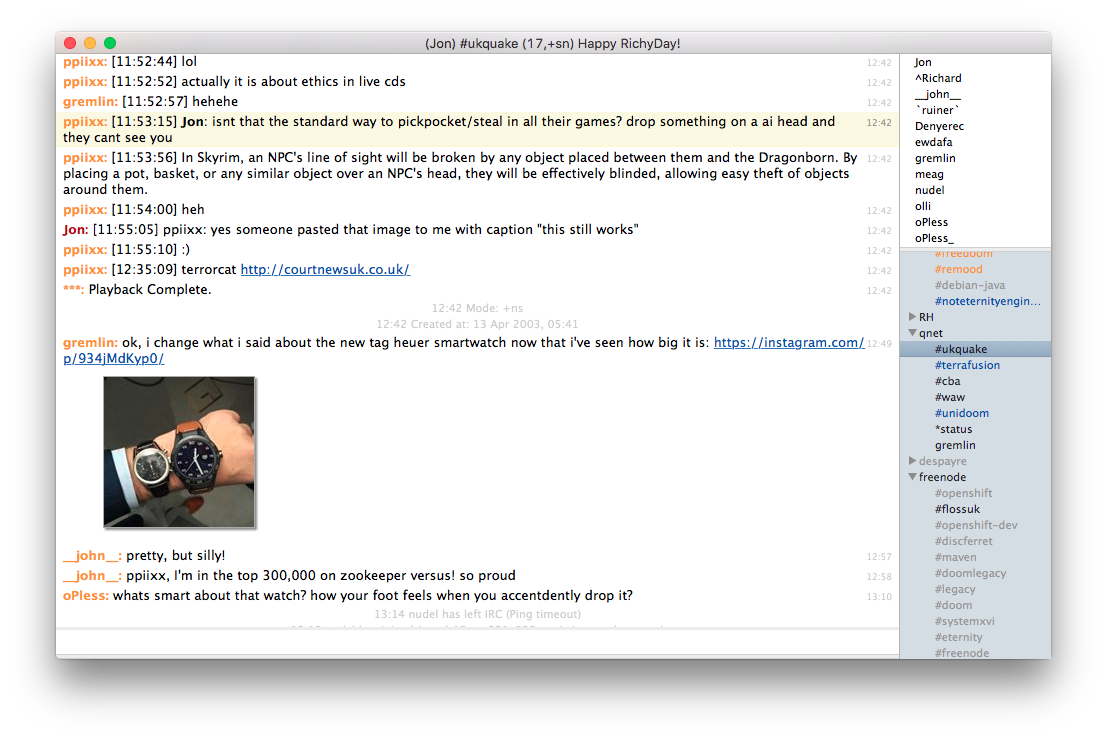
LimeChat, an IRC client. I theme it to look like Colloquy. The net result is pretty clean. I like using a proportional-font for text things, so getting IRC out of a terminal is a win for me. LimeChat automatically fetches and thumbnails URIs to images that people paste in channels, which is either incredibly convenient or a curse, depending on the channel. You can toggle that behaviour but only across the whole client, not on a channel or network basis. Finally, 1Password is an incredibly slick password manager. I use it in a very basic fashion: no mobile client, no syncing to anything outside of my workstation. You could also use LastPass which is similar and has a Linux client. I haven't tried it, but there's a third party tool to read 1Password password stores on Linux written by Ryan Coleman of SDL fame called 1pass.

Ritesh Raj Sarraf: apt-offline 1.7

Hello World, In this part of the world, today is a great day. Today is Diwali - the festival of lights On this day, I am very happy to announce the release of apt-offline, version 1.7. This release brings in a large number of fixes and is a recommended update. Thanks to Bernd Dietzel for uncovering the shell injection bug which could be exploited by carefully crafting the signature file. Since apt-offline could be run as 'root', this one was an important bug. Also thanks to him for the fix. During my tests, I also realized that apt-offline's --install-src-packages implementation had broken over time. --install-src-packages option can be useful to users who would like the offline ability to download a [Debian] source package, along with all its Build Dependencies. For further details on many of the other fixes, please refer to the git repository at the homepage. Packages for Debian (and derivatives) are already in the queue. Wishing You and Your Loved Ones a Very Happy Diwali.

Categories:

Keywords:

Images:

Like:

Mike Gabriel: My FLOSS activities in October 2015

October 2015 has been mainly dedicated to contracted/payed work. Only a few issues I could address during the last month: Arctica Project While having a week off from work, I managed to get Arctica Greeter to build on non-Ubuntu systems. The issue was very simple. The build crashed during the test suite run and it was caused by the XDG_DATA_DIRS variable not being set in my clean build environment. Furthermore, I added various more session type icons to Arctica Greeter (XFCE, LXDE, MATE, OpenBox, TWM, Default X11 Session, etc.) and also rebased the Arctica Greeter code base against all recent commits found in Unity Greeter for Ubuntu 15.10 / upcoming 16.04. Together with Ulrich Sibiller, I continued our work on the new Xinerama implementation for the remote X11 server nxagent (used as x2goagent in X2Go). However, this is unfortunately still work in progress, because various theoretical monitor layout issues became evident that require being handled in the new code before it can get merged into nx-libs's current 3.6.x branch. Also, I managed to do some little work on https://arctica-project.org, the still too rudimentary project homepage. read more

10 November 2015

Daniel Pocock: Aggregating tasks from multiple issue trackers

After my experiments with the iCalendar format at the beginning of 2015, including Bugzilla feeds from Fedora and reSIProcate, aggregating tasks from the Debian Maintainer Dashboard, Github issue lists and even unresolved Nagios alerts, I decided this was fertile ground for a GSoC student. In my initial experiments, I tried using the Mozilla Lightning plugin (Iceowl-extension on Debian/Ubuntu) and GNOME Evolution's task manager. Setting up the different feeds in these clients is not hard, but they have some rough edges. For example, Mozilla Lightning doesn't tell you if a feed is not responding, this can be troublesome if the Nagios server goes down, no alerts are visible, so you assume all is fine. To take things further, Iain Learmonth and I proposed a GSoC project for a student to experiment with the concept. Harsh Daftary from Mumbai, India was selected to work on it. Over the summer, he developed a web application to pull together issue, task and calendar feeds from different sources and render them as a single web page. Harsh presented his work at DebConf15 in Heidelberg, Germany, the video is available here. The source code is in a Github repository. The code is currently running as a service at horizon.debian.net although it is not specific to Debian and is probably helpful for any developer who works with more than one issue tracker.

Norbert Preining: Music check: Google versus Apple Is that all? You can do better, Google!

Ok, I have been an iPhone user since I moved to Japan and got my first smart-phone ever. First a 3s, then a 4s, then a 5s that I dropped into the toilet, so I switched the SIM back into the 4s to have a working phone. Furthermore, I am a heavy music listener and used iTunes Radio for 3 months. Since I am planning to change phones to an Android phone (being fed up with Apple s super-closed environment), I tried out Google Music Plus for about 3 months, too. Here is my verict Google Music is a big pain, far from iTunes in comfort and user friendliness. music-check-google-vs-apple My move to Android is not very much in danger. General description of the service In principle, iTunes Radio and Google Music Subscription do the same things: There are slight differences, that often create confusion, especially with Apple s services: If you are only signed in, you can listen to music stations and can skip some music (limited), but you cannot listen to arbitrary songs from the whole Apple Music library. Then there is another service from Apple, called iTunes Match, that only allows you to upload your music library to the cloud, but other than that again only listening to normal radio stations. Google Music is much simpler, there are only two options: By default it is free to have your music (up to 25000 songs) in the cloud, but if you want to listen to radio stations or any other music in the Google music store, you need a subscription. Prizes and features overview:
Apple Google
No subscription iTunes Match iTunes Radio No subscription With subscription
Prize 0 25$/year 10$/month 0 10$/month
(early access 8$)
Cloud space 0 100000 25000
Extra service Radio stations Radio stations Radio/all music Nothing Radio/all music
Music on the go the application Let us first consider the applications provided to listen to music on your smart phone: Apple Music can of course only be used on Apple devices, and uses the built-in Music application. Start up time is about a few seconds after a cold boot (all on my 4s), and music streaming starts with hardly any delay. Responsiveness is good, and the user interface is clear and easy. Google s application is available on iOS and Android. I have tested the latest version on iOS, but it is a pain in the butt: Managing your library Here iTunes is the way to go, bit of a pain when using Linux, but there are other reasons I have a Windows installation in parallel, so I don t mind to boot now and then into Windows. iTunes gives you very powerful tools to change all kind of data. Google gives you a few options: Use your iTunes library in this case all your playlists and ratings (but see later) are also uploaded. I am not sure what happens if I retag a song in iTunes, or change anything else in there. I guess the song will not be re-uploaded, but who knows for sure. Furthermore, you can edit your library via the web interface, but this is rather poor. Searching your library Over times your library grows and there are hundreds if not thousands of artists. So you want to search them. The natural way would be to scroll to the first letter of the artist you are searching, and then look it up. Well, that works perfectly in both Apple s and Google s application unless you are having artists written in some strange script like Japanese or Korean. iTunes allows you to set a field called something like Artist name for sorting , which allows me to put for example or into the artist field, and into the sort field Tomokawa Kazuki and Kim Doo Soo . This way I find the artists in the correct place. Google on the other hand uses simple Unicode order sorting how could you do that? This is simply plain wrong, and everyone should know that by now. Japanese people will never be able to find anything in their list. And in contrast to Goole Contacts Google Music does not support phonetic name fields (similar to the order sort artist) for artists. What I had to do now is to rename all the artists to include first the phonetic name, followed by the proper name, like in Tomokawa Kazuki ( ) . Something I strongly detest! Radio stations I might have a slightly peculiar music taste, but the radio stations mixed by Google are simply a pain. The reason is easy to explain: I live in Japan, and so what Google does is mixing about 80% of J-Pop into the radio, all those happy yodeling girlies I really dislike (see my Anti J-Pop campaign for alternatives yes, they do exist also in Japan!). iTunes radio is here more relaxed it seems. I appreciate Google s trial to cater to local (dis)taste, but besides voting down each and every song I hear I don t see any other option. And honestly, I cannot go through all this voting down without dying from pain inflicted by J-Pop. Other than this, the two radio stations are probably more or less the same but as I said, due to the local colorit it is hard to compare. Rating Ohhh, what a dire point. So there you have you well curated iTunes library with 5-star ratings. I used the ratings in a way that those songs I like get 1 star, those I even like more get 2 stars, and my absolute favorites got 5 stars. I didn t do any negative ratings. iTunes/iOS Music app allows you to easily adjust rating, and they are synced between devices. All as you would expect. Now for Google they did have a 5-star rating system at some time, but:
Thank you for your feedback. We ve decided to remove the 5-star Rating lab. This decision wasn t made lightly, but Thumbs Up/Down is integral for the future vision for Play Music and will be a central design point for our future releases. Please note that we ll continue to store your ratings that you ve set via the star lab or via iTunes, and we ll translate them to thumbs up/down (1-2 stars = thumbs down, 4-5 stars = thumbs up).
Here we go with the move to a new design they threw away the 5-star system, without any reason but integral for future vision rubbish sales speak. Besides being a very very poor rating system to have only an up and down (good-bad-don t care), the translation from my rating system to the thumbs up-down is just plain wrong. <rant>
Why on earth is the current movement to reduce functionality and rob users of control? Gnome 3 is the prime example of how we stupiditize users by taken any freedom from them in the name of simple design. Google now does the same. I am so sick of getting patronized this way, so Gnome3 was completely banished from my computer and replaced by Cinnamon, which uses the same (good) underlying technique, but takes users seriously!
</rant> Overall verdict As much as I would like to see Google Music a valid alternative to iTunes, by now it makes the impression of a quickly hacked together rotten piece of code that tries to get a share of the market without providing equivalent service. Google is using its market presence and convenience to convert people, not features and quality. I can only hope that this changes in the future. That still leaves me with the question move to Android or remain with iOS

9 November 2015

Ben Armstrong: The passing of Debian Live

Debian Live has passed on. And it has done so in not happy circumstances. (You can search the list archives for more if you are confused.) I have reposted here my response to this one thread because it s all I really want to say, after all of the years of working with the team. I d like to add as a postscript, that while the focus of this article was to remain positive in the face of Daniel s announcement of the closure of his project, that event has left a lot of users confused about the status of live support in Debian going forward. Read my posts here and here addressing that confusion.
On 09/11/15 12:47 PM, Daniel Baumann wrote:
> So long, and thanks for all the fish[7].
>
> Daniel
>
> [7] http://live.debian.net/project/downstream/ Enough bitter words have been said. I don t want to add any more. So: I m proud. Indeed, that long list of downstreams does speak to the impact you ve had in inspiring and equipping people to make their own live images. I m proud to have been a small part of this project. I m thankful. I m thankful that I was able to, through this project, contribute to something for a while that had a positive impact on many people, and made Debian more awesome. I remember the good times. I remember fondly the good times we had in the project s heyday. I certainly found your enthusiasm and vision for the project, Daniel, personally inspiring. It motivated me to contribute. Debconf10 was a highlight among those experiences, but also I had many good times and made many friendships online, too. I m sad. I m sad, because although I made some attempts to liaise between Debian Live and the CD and Installer teams, I don t feel I did an effective job there, and that contributed to the situation we now find ourselves in. If I did you or the project injury in trying to fulfill that role, please forgive me. I m hopeful. I m hopeful that whichever way we all go from here, that the bitterness will not be forever. That we ll heal. That we ll have learned. That we ll move on to accomplish new things, bigger and better things. Thank you, Daniel. Thank you, Debian Live team. Ben
facebooktwittergoogle_plusredditpinterestlinkedinmail

Next.

Previous.