Search Results: "ron"

19 September 2012

Stefano Zacchiroli: bits from the DPL for August 2012

DPL August report, posted on d-d-a a while ago (yep, I forgot to blog it up to now!, sorry for the oldies).
Dear project members, August has been a month with a good deal of vacations for many of us, including yours truly. Therefore the monthly report of DPL activities will be briefer than usual. Which is good, as it'll leave all my readers more time to do NMUs and fix RC bugs! Ongoing discussions Assets Core teams Legal and RC fun Hardware See? It's been quick(er)! Talk to you here next month, with a much lower count of Wheezy RC Bugs on the horizon, hopefully.
Cheers.
PS the boring day-to-day activity log for August 2012 is available at master:/srv/leader/news/bits-from-the-DPL.txt.201208

18 September 2012

Bdale Garbee: Igniter Continuity over Radio

When Keith and I released a new version of AltOS, the open source firmware and software system associated with our Altus Metrum hobby rocket avionics systems last week, we forgot to mention one small but really neat new feature Keith spontaneously added a few months ago. When a rocket is on the rail waiting to launch, we now beep out the igniter continuity status over the radio link instead of just sending periodic audio beeps. This is particularly useful when flying TeleMini, which is just too small to include an on-board beeper. Previously, you had to check the ground station computer to see if the board powered up correctly and was ready to fly. Now all you need is an HT tuned to the right frequency, which is easy to have in your pocket or clipped on your belt while preparing a rocket for flight! Son Robert and I made heavy use of this last weekend flying at the Tripoli Colorado Fall Frenzy 2012 launch, where 4 of our 5 flights were in TeleMini-equipped rockets set up for apogee-only electronic recovery deployment with motor backup. I also found it really handy when setting up YikStik3 on the flight line at Airfest 18. It was hard to hear the altimeter beepers on the two TeleMetrum boards buried deep in the airframe, but they were loud and clear through the HT in my back pocket! Thanks, Keith! So much improvement in flight-line experience from so little code...

Wouter Verhelst: Mel Gorman is my hero

It's taken years to get here, but Mel finally got a series of patches into the kernel, including this one, which should prevent deadlocks of machines doing swap-over-NBD. This means that one of my longest-running wishlist items has finally been attended to. Mel, I owe you a beer. Update: Mel seems to think I don't owe him beer. Obviously he's wrong.

Francois Marier: Advice to newcomers and veterans of the Free and Open Source software communities

A few months ago, a collection of essays called Open Advice was released. It consists of the things that seasoned Free and Open Source developers wish they had known when they got started. The LWN book review is the best way to get a good feel for what it's about, but here are the notes I took while reading it:

Patrick Matth i: Playing with Apache mod_geoip

If you want to add some rules to your Apache based on the clients country, mod_geoip is perfect for it. Installation On Squeeze following is enough: # apt-get install libapache2-mod-geoip geoip-database/squeeze-backports Note that you should use the geoip-database version from squeeze-backports to have got the most up to date database version, I am updating it every month. Configuration You can add the rules to your VirtualHost, Directory, Location directives and also to your apache2.conf ( serverwide ). So you are flexible with where to use it. Blocking countries On some servers I have got more than 90 percent of spam requests only from three countries, so I blocked them with: <DirectoryMatch ^/var/www/.*/html >
SetEnvIf GEOIP_COUNTRY_CODE RU BlockCountry
SetEnvIf GEOIP_COUNTRY_CODE CN BlockCountry
SetEnvIf GEOIP_COUNTRY_CODE UA BlockCountry
Deny from env=BlockCountry
</DirectoryMatch> Allow only specific countries In the other way you also can allow specific countries to have got access to your website, this also may be a good idea for extranets, where you know from where your customers are: <Directory /var/www/my.site.com/html/login >
SetEnvIf GEOIP_COUNTRY_CODE DE AllowCountry
SetEnvIf GEOIP_COUNTRY_CODE CH AllowCountry
Deny from all
Allow from env=AllowCountry
</Directory> Very easy! Rewrite Rules You can also use it for mod_rewrite. Within a project, customers from CN and TW should be redirected to the chinese page: RewriteCond % ENV:GEOIP_COUNTRY_CODE ^(CN TW)$
RewriteRule ^(.*)$ http://some.example.cn/site.php [L] mod_geoip with proxy frontends Normaly mod_geoip works behinds load balancers and proxy servers, since it also take care of the HTTP_X_FORWARDED_FOR header. But with haproxy it looks problematic, since it does not add the HTTP_X_FORWARDED_FOR header to KeepAlive d requests :( Disabling KeepAlive is a bad idea on this cluster, so we decided to also use php5-geoip in our application, so everything is working nice now.. What mod_geoip is NOT is mod_geoip helps you to block/allow specific countries, but it does not protect you from them.
Also keep in mind that the database is only ~ 99,8% accurate, so you may have got false positives/negatives. If you only allow german users, a german IP could be listed as russian.
This is much more problematic with mobile/satellite connections and surely you can also not access your page, if you are on vacation in another country. ;)

17 September 2012

Petter Reinholdtsen: Debian Edu interview: Giorgio Pioda

After a long break in my row of interviews with people in the Debian Edu and Skolelinux community, I finally found time to wrap up another. This time it is Giorgio Pioda, which showed up on the mailing list at the start of this year, asking questions and inspiring us to improve the first time administrators experience with Skolelinux. :) The interview was conduced in May, but I only found time to publish it now. Who are you, and how do you spend your days? I have a PhD in chemistry but since several years I work as teacher in secondary (15-18 year old students) and tertiary (a kind of "light" university) schools. Five years ago I started to manage a Learning Management Service server and slowly I got more and more involved with IT. 3 years ago the graduating schools moved completely to Linux and I got the head of the IT for this. The experience collected in chemistry labs computers (for example NMR analysis of protein folding) and in the IT-courses during university where sufficient to start. Self training is anyway very important I live in the Italian speaking part of Switzerland, and the SPSE school (secondary) is a very special sport school for young people who try to became sport pro (for all sports, we have dozens of disciplines represented) and we are recognised by the Olympic Swiss Organisation. How did you get in contact with the Skolelinux/Debian Edu project? Looking for Linux / Primary Domain Controller (PDC) I found it already several years ago. But since the system was still not Kerberized and since our schools relies strongly on laptops I didn't use it. I plan to introduce it in the next future, probably for the next school year, since the squeeze release solved this security hole. What do you see as the advantages of Skolelinux/Debian Edu? Many. First of all there is a strong and living community that is very generous for help and hints. Chat help is crucial, together with the mailing list. Second. With Skolelinux you get an already well engineered platform and you don't have to start to build up your PDC and your clients from GNU/scratch; I've already done this once and I can tell it, it is hard. Third, since Skolelinux is a standard platform, it is way easier to educate other IT people and even if the head IT is sick another one could pick up the task without too much hassle. What do you see as the disadvantages of Skolelinux/Debian Edu? The only real problem I see is that it is a little too less flexible at client level. Debian stable is rocky and desirable, but there are many reasons that force for another choice. For example the need of new drivers for new PC, or the need for a specific OS for some devices that have specific software packages for another specific distribution (I have such a case for whiteboards that have only Ubuntu packages). Thus, I prepared compatibility packages educlient and eduroaming, hoping not to use them ;-) Which free software do you use daily? I have a Debian Stable PDC at school (Kerberos, NIS, NFS) with mixed Debian and Ubuntu clients. If you think that this triad combination is exotic... well I discovered right yesterday that Perceus has the same... For myself I run Debian wheezy/sid, but this combination is good only I you have enough competence to fix stuff for yourself, if something breaks. Daily I use texmacs, gnumeric, a little bit of R statistics, kmplot, and less frequently OpenOffice.org. Which strategy do you believe is the right one to use to get schools to use free software? I think that the only real argument that school managers "hear" is cost reduction. They don't give too much weight on quality, stability, just because they are normally not open to change. Students adapts very quickly to GNU/Linux (and for them being able to switch between different OS is a plus value); teachers and managers don't. We decided to move to Linux because students at our school have own laptop and we have the responsibility to keep the laptop ready to use; we were really unsatisfied with Microsoft since every Monday we had 20 machine to fix for viral infections... With Linux this has been reduced to zero, since people installs almost only from official repositories. I think that our special needs brought us to Linux. Those who don't have such needs will hardly move to Linux.

16 September 2012

Russell Coker: Servers in the Office

I just had a conversation with someone who thinks that their office should have no servers. The office in question has four servers, an Internet gateway/firewall system, the old file server (and also Xen server), the new file server, and the VOIP server. The Internet gateway system could possibly be replaced by a suitably smart ADSL modem type device, but that would reduce the control over the network and wouldn t provide much of a benefit. The VOIP server has to be a separate system for low latency IMHO. In theory you could use a Xen DomU for running Asterisk or you could run Asterisk on the Dom0 of the file/Xen server. But that just makes things difficult. A VOIP server needs to be reliable and is something that you typically don t want to touch once it s working, in this case the Asterisk server has been a few more years without upgrades than the Xen server. An Asterisk system could be replaced by a dedicated telephony device which some people might consider to be removing a server, but really a dedicated VOIP server device is just as much of a server as a P4 running Asterisk but with greater expense. A major advantage of a P4 running Asterisk is that you can easily replace the system at no cost if there is a hardware problem. Having two file servers is excessive for a relatively small office. But running two servers is the common practice when one server is being replaced. The alternative is to just immediately cut things over which has the potential for a lot of people to arrive at work on Monday and find multiple things not working as desired. Having two file servers is a temporary problem. File Servers The first real problem when trying to remove servers from an office is the file server. ADSL links with Annex M can theoretically upload data at 3Mb/s which means almost 400KB/s. So if you have an office with a theoretically perfect ADSL2+ Annex M installation then you could save a 4MB file to a file server on the Internet in not much more than 10 seconds if no-one else is using the Internet connection. Note that 4MB isn t THAT big by today s standards, the organisation in question has many files which are considerably bigger than that. Large files include TIFF and RAW files used for high quality image processing, MS-Office documents, and data files for most accounting programs. Saving a 65MB quick-books file in 3 minutes (assuming that your Annex M connection is perfect and no-one else is using the Internet) would have to suck. Then there s the issue of reading files, video files (which are often used for training and promotion) are generally larger than 100MB which would be more than 30 seconds of download time at ADSL2+ speed but if someone sends an email to everyone in the office saying please watch this video then the average time to load it would be a lot more. Through quickly examining my collection of Youtube downloads I found a video which averaged 590KB/s, if an office using a theoretically perfect ADSL2+ connection giving 24Mb/s (3MB/s) download speed had such a file on a remote file server then a maximum of five people could view it at one time if no-one else in the office was using the Internet. Now when the NBN is connected (which won t happen in areas like the Melbourne CBD for at least another 3 years) it will be possible to get speeds like 100Mb/s download and 25Mb/s upload. That would allow up to 20 people to view videos at once and a 65MB quick-books file could be saved in a mere 22 seconds if everyone else was idle. Of course that relies on the size of data files remaining the same for another 3 years which seems unlikely, currently no Youtube videos use resolutions higher than 1920*1080 (so they don t take full advantage of a $400 Dell monitor) and there s always potential for storing more financial data. I expect that by the time we all have 100Mb/25Mb speeds on the NBN it will be as useful to us as 24Mb/3Mb ADSL2+ Annex M speeds are today (great for home use but limited for an office full of people). There are of course various ways of caching data, but all of them involve something which would be considered to be a server and I expect that all of them are more difficult to install and manage than just having a local file server. Of course instead of crunching the numbers for ADSL speeds etc you could just think for a moment about the way that 100baseT networking to the desktop has been replaced by Gigabit networking. When people expect each workstation to have 1000Mb/s send and receive speed it seems quite obvious that one ADSL connection shared by an entire office isn t going to work well if all the work that is done depends on it. Management could dictate that there is to be no server in the office, but if that was to happen then the users would create file shares on their workstations so you would end up with ad-hoc servers which aren t correctly managed or backed up. That wouldn t be an improvement and technically wouldn t achieve the goal of not having servers. Home Networking Without Servers It is becoming increasingly common to have various servers in a home network. Due to a lack of space and power and the low requirements a home file server will usually be a workstation with some big disks, but there are cheap NAS devices which some people are installing at home. I don t recommend the cheap NAS devices, I m merely noting that they are being used. Home entertainment is also something that can benefit from a server. A MythTV system for recording TV and playing music has more features than a dedicated PVR box. But even the most basic PVR ($169 for a 1TB device in Aldi now) is still a fairly complex computer which would probably conflict with any aim to have a house free of servers. The home network design of having a workstation run as a file and print server can work reasonably well as long as the desktop tasks aren t particularly demanding (IE no games) and the system doesn t change much (IE don t track Debian/Testing or otherwise have new versions of software). But this is really something that only works if you only have a few workstations. Running an office without servers seems rather silly as it seems that none of my friends are able to have a home without a server. Running Internet Services Hypothetically speaking if one was to run an office without servers then that would require running all the servers in question on the Internet somewhere. For some things this can work better than a local server, for example most of my clients who insist on running a mail server in their office would probably get a better result if they had a mail server running on Linode or Hetzner or one of the Hosted Exchange offerings if they want a Windows mail sever. But for a file server if you were to get around the issue of bandwidth required to access the files in normal use there s the issue of managing a server (which is going to take more effort and expense than for a server on the LAN). Then there s the issue of backups. In my previous post about Hard Drives for Backup [1] I considered some of the issues related to backing data up over the Internet. The big problem however is a complete restore, if you have even a few dozen gigs of data that you want to transfer to a remote server in a hurry it can be a difficult problem. If you have hundreds of gigs then it becomes a very difficult problem. I m sure that I could find a Melbourne based Data Center (DC) that gives the option of bringing a USB attached SATA disk for a restore but even that case would give a significant delay when compared to backing things up on a LAN. If a server on the office LAN breaks in the afternoon my client can make arrangements to let me work in their office in the evening to fix it, but sometimes DCs don t allow 24*7 access and sometimes when they do allow access there are organisational problems that make it impossible when you want it (EG the people at the client company who are authorised become unavailable). The Growth of Servers Generally it s a really bad idea to build a server that has exactly the hardware you need. The smart thing to do is to install more of every resource (disk, RAM, CPU, etc) than is needed and to allow expansion when possible (EG have some RAM slots and drive bays free). No matter how well you know your environment and it s users you can get surprised by the way that requirements change. Buying a slightly bigger server at the start costs hardly any money but upgrading a server will cost a lot. Once you have a server that s somewhat over-specced you will always find other things to run on it. Many things could be run elsewhere at some cost, but if you have unused hardware then you may as well use it. Xen and other virtualisation systems are really good in this regard as they allow you to add more services without making upgrades difficult. This means that it s quite common to have a server that is purchased for one task but which ends up being used for many tasks. Anyone who would aspire to an office without servers would probably regard adding extra features in such a manner to be a problem. But really if you want to allow the workers to do their jobs then it s best to be able to add new services as needed without going through a budget approval process for each one. Conclusion There probably are some offices where no-one does any serious file access and everyone s work is based around a web browser or some client software that is suited to storing data on the Internet. But for an office where the workers use traditional Office software such as MS-Office or Libre-Office a file server is necessary. Some sort of telephony server is necessary no matter how you do things. If you have a traditional telephone system then you might try not to call the PABX a server , but really that s what it is. Then when the traditional phone service becomes too expensive you have to consider whether to use Asterisk or a proprietary system, in either case it s really a server. In almost every case the issue isn t whether to have a server in the office, but how many servers to have and how to manage them. Related posts:
  1. Planning Servers for Failure Sometimes computers fail. If you run enough computers then you...
  2. a good security design for an office One issue that is rarely considered is how to...
  3. Efficiency of Cooling Servers One thing I had wondered was why home air-conditioning systems...

15 September 2012

Eddy Petri&#537;or: Why a lack of skepticism is dangerous...

Some of my Romanian readers might know that for the last two years I've got involved in the skeptical movement to such a degree that I am a co-producer of a bi-weekly podcast on science and skepticism (in Romanian) called Skeptics in Romania . Some might even be regular listeners of the show.

(There isn't much to see now visually on the site, but me and the other people behind the project have some ongoing plans to change that.)

In spite of our modest site, up until now we had some successes, one of them being the publication of an article on us in a known Romanian printed publication and another being the invitation to a live show face to face with Oreste Teodorescu, a well known Romanian mysticist and woo promoter.

During that live show we managed to show a demonstration (video below, in Romanian) of how astrology gives the impression of working, without actually working, and, taking into account we had no prior TV camera experience and that it was a live show, I think we managed an honourable presence.


<iframe allowfullscreen="allowfullscreen" frameborder="0" height="315" src="http://www.youtube.com/embed/y5OG1q8_3Ro" width="420"></iframe>

We also have a series of interviews in English with some really interesting people: Dr. Eugenie Scott, Prof. Christopher French, Prof. Edzard Ernst, Samantha Stein and others. We did these interviews at Denkfest 2011, in Zurich, and we integrated the translated (voice over) interviews in our podcast. The conlusion is that most of our activities revolve around the podcast, so let me tell you more about that.

The podcast has a somewhat fixed structure, it starts with a conversation between ourselves, then we have a segment on the history of science, technology, skepticism and woo, and then we have a segment called The dangers of not being skeptical . In this segment we present cases of people who lost their lives, their health, their money or any combination of the former because they were duped into some scam, science-y sounding non-science, unfounded claim or some other woo.

Having lost recently my brother-in-law to a form of cancer known as Hodgkin lymphoma, I became especially sensitive about miracle-cure claims for cancer, and this section of the show has lately seen its fair share of such cases. Honestly, if there could be a way to prosecute the irresponsible, ignorant and/or cynical people promoting all sorts of quack "therapies", especially for cancer*, I would really like to see it happen. But there isn't, and we're trying the best accessible approach, informing the public.

During my brother-in-law's last two years of his life, he went through lots of chemotherapy and radiotherapy sessions, repeated periods of hospitalisation, and lots of drugs. This is the best of what we currently have for treating and curing most forms of cancer, and too many times this isn't enough. I can't even imagine how stressful and discouraging it must feel when the best of what we have doesn't help.

Here is where the desperation and hopes of patients and their families meet the purely irresponsible cynical or ignorant promoters of woo and quack therapies. Because it takes either an ignorant or a really cynical (I really feel this word isn't enough) person to prey on the suffering of other people to make easy money under the false pretence of offering a cure.

It almost happened to my brother-in-law and his family, because they almost went for some herbal concoction promoted as a cancer cure on some forum, blog or page of a seller of this fake therapy. It was really hard for me to make them understand why using such a product it not advisable, not even in parallel with the medical treatment due its possible counter effect or interactions with the real medical treatment, without them getting the wrong idea that I wasn't trying to help. While trying to be brief and informative not to lose their attention, I told them how "natural" doesn't necessarily mean "good" (uranium, lead and Irukandji's venom are all natural), and how plants are drugs because they all contain chemical substances (and no, "chemical" does not mean "human made" or "artificial") which could interact with the medical treatment.


But most people don't even have the chance of having close by a person with a more science-leaning thought process and a skeptical mind. Those unfortunate people are the most vulnerable people and constitute the biggest chunk of the victims of baseless pseudo-cures or pseudo-treatments.

On our last show, I presented the case of Yvonne Main, a cancer suffering patient who mistook an invasive carcinoma for a cyst, and irdologist Ruth Nelson for a real healthcare giver.

Yvonne Main, died from an invasive carcinoma
after seeking help from a iridologist,
and delaying real medical treament for 18 months


Yvonne, after seeking medical advice from a person that essentially promotes the dead idea of guessing diseases by looking at the eyes**, used natural treatments for about 18 months and, after all this time, her carcinoma grew to a size of 10 to 11 cm, eating through her skull and causing damage which was later attempted to be countered through bone transplant from her ribs.

Ruth Nelson wasn't prosecuted in any way and continues her practice of quackery unharmed.

This is not the only case, nor even one case from a select few where woo and quackery lead to grave consequences for patients. There are many, many more; they're so many that even after splitting them in categories they seem too many per category, especially when you realise these are only the findings of, essentially, a single man:


http://www.whatstheharm.net/


This is part of what I have been doing in the last few years, instead of working on Debian. Is it a good thing? Is it a bad thing? Maybe it's good. I want to know what do you think?


* you will, most likely, never hear such a promoter of non-therapies say that there isn't just one cancer, and that, in fact, cancer is a name for a certain family of diseases which are all called cancer - that's a first sign that you might be dealing with quack
** probably in the line of thought that the eyes are the gates to the soul so they must tell something significant about health

14 September 2012

Vipin Nair: Naive Parallel Factorial in Erlang

I have been toying around with Erlang since quiet some time and finally made something that could be considered the de facto Hello World of Erlang. Unlike most of the other programming languages where concurrency is an added feature, Erlang was built around the concept of concurrent programming. If you love functional programming and can get over the weird Erlang syntax, learning Erlang will not be very difficult and is definitely worth the effort. I have been reading Joe Armstrong s Programming Erlang: Software for a Concurrent World and will definitely recommend it to anyone starting out with Erlang. I am yet to dive into OTP, but so far, so good. :) I have taken the naive recursive factorial algorithm and parallelized it to take advantage of multiple cores available on average system these days. Lets assume that we need to distribute the task of calculating N factorial over K processes. To do that, I have divided the set of integer 1 N to K subsets, say S , S , ., Sk, such that S S Sk = 1 N and S S Sk = Where, S = [ 1, K+1, 2K+1, , (x )*K+1 ];
x : (x )*K + 1 <= N and (x +1)*K + 1 > N and x S = [ 2, K+2, 2K+2, , (x )*K+2 ];
x : (x )*K + 2 <= N and (x +1)*K + 1 > N and x

Sk = [ K, K+K, 2K+K, , (xk)*K+2 ];
xk : (xk)*K + 2 <= N and (xk+1)*K + 1 > N and xk Product of all the elements in each of the sets in calculated in a separate thread and all these calculations, theoretically, can be done in parallel. These sub-products are then multiplied together to get the final factorial. *Update*: The algorithm described above works but is not the best way to find the factorial of a number and after some time on Google, I am convinced that Luschny s is the resource on the internet if you are looking for something faster and has a factorial somewhere in it. I am an Erlang beginner, and this could be very well a sub-optimal implementation. Comment and let me know, what you think of it and if you enjoyed reading this, you should follow me on twitter.
Start the Erlang shell
$ erl
Compile the code
1> c(factorial).
Call the calculate function
2> factorial:calculate(10000).

<script src="https://gist.github.com/3715155.js"> </script>

13 September 2012

Gunnar Wolf: Great online course available: Securing Digital Democracy , by J. Alex Halderman

I was pointed at a great online course If you are into e-voting analysis (or, more broadly, into democratic processes' history, evolution and future), I strongly suggest you to take a look at Securing Digital Democracy . Just the name of the teacher should be enough to make it interesting: University of Michigan professor J. Alex Halderman, the guy who has analized/hacked several electronic booths, and one of the clearest, smartest voices to explain what should we require of a voting system and how electronic booths are the worst fit for any purpose. The course is delivered through Coursera; I have found Coursera to be an effective, usable, unobtrusive platform So much I even signed up for another course. I am not so happy with online courses requiring to wait so much between lessons, but after all, it tries to mimic what we see at "regular" (i.e. classroom) teaching settings. And, after all, we autodidacts are still a minority. The course in question started ten days ago, but you can still perfectly join. Each week has two lessons, worth of approximately 40 minutes of video each, and are "graded" through a quiz. Lets see how this evolves.

12 September 2012

Martin F. Krafft: A black day for democracy

Today was a black day for democracy in Germany. The German constitutional court ruled in favour of the European Stability Mechanism. In combination with last week s announcement by the European Central Bank to purchase government bonds without limits (breaking the No-Bail-Out clause at the core of their mandate more obviously and irreversably than ever before), the German people have lost a good deal of democracy today. Why? you may ask because from now on, fiscal and financial policy will be made in Brussels, by people enjoying full immunity, but who are not elected democratically by the European people, let alone the Germans, and they will freely decide over who has to pay and be liable for whom. I am talking about people like Klaus Regling, who was already involved the very first time the Maastricht Criteria were violated. He is now at the front of the largest and most powerful financial weapon ever conceived. With immunity. And people like Mario Draghi, whom I would possibly call the most corrupt person I know. His announcement to save the Euro at whatever cost accidentally came only a day before his motherland Italy had to go to the market for more money and was able to place a bond at such ridiculously low interest rates that anyone who s kept up to speed with Italy s development had to rightfully ask how that was possible. While in the past, for whatever reason, the European people have let the ECB get by saying that they are not bailing out countries when they buy bonds on the secondary market (wtf!), they have finally dropped that restriction (the law). And as of today, the ESM is ready to go, along with the fiscal pact. Germany is now liable for more than quarter of all of the Eurozone s past and future debts. And no citizen will be able to have any more influence in this, or reverse it. Budget, fiscal policy and currency control are forever gone. Not that parliamentarian democracies were ever direct. Yet, in the past, one could at least vote for those people whose promises one was inclined to believe the most. You can still do that in the future, but those people won t be able to influence fiscal or financial policy anymore. There is no way back. The ESM and its employees enjoy full immunity, and the ESM is forever-binding. There is no exit clause. Thanks to the ECB s law breaking and the ESM, which I consider highly unconstitutional, at least in Germany, Eurozone-countries may refinance their debts at interest rates that are in no way related to their ability to pay back loans. All other countries foremost Germany are henceforth liable for others debts. The fundamental rule of the EU that no country would have to stand up for another country, is gone with the wind. Within an hour, the markets reacted. Germany, which previously had to pay negative interest (a sign of stability) saw interests on its bond shoot up. And Spain, Portugal, Greece and others who couldn t previously refinance their old debts, are now getting fresh money cheaper than ever. Spain s president Rajoy today didn t even bother beating around the bush anymore, he s now going to apply for fresh money but won t bother with any saving schemes or other restructurings. Monti in Italy has suggested the same. Wouldn t you take money if you were offered it for free, without the need to pay it back? This is more than inflation, in my opinion. What is currently happening in Europe is active depreciation of individual wealth. Our heads of state are actively working against the people. The Euro has lost all credibility and everyone knows it. It is only a question of time until it will tremble and fall. Meanwhile, the market celebrates and continues their gambles while they still can, on the backs of our currency and our wealth. Most affected are the people who have savings in Euros, whose life insurances are decreasing in worth and who cannot afford to diversify into other asset classes or currencies. On the other hand, those who let their money do the work are being saved. Whoever previously invested into bonds of struggling states, hoping to reap massive interest gains, is now proven right. Brussels has eliminated the risk factor. What kind of message does this send??? Hands up if you thought that our politicians are even interested in closing the rapidly widening gap between rich and poor. Really? That s naive. The Eurozone is corrupt, and our currency has never been as virtual as today. Nobody can say whether saving the Euro at all cost is the right thing and noone knows whether what s currently happening is just bad. I would have wished that our politicians had taken the crisis as an incentive to fix the system in the interest of the people and with a long-term focus: But on the contrary! Europe s policiticans are making it crystal clear that the foundation upon which it was built, the laws and rules, the promises and guarantees, no longer apply. The people were not asked. The promises once made were broken. Our politicians have ruled over our heads. More debts are being made, and more debts to pay off debts, and so on. It s long gotten out of control, now the process is institutionalised. I feel sorry for our kids. I find it irresponsible what is being done to them (in addition to the way we rape the environment). I also feel deeply with the people in the struggling countries who are being screwed by the crisis and are not at fault. What our politicians are doing is unfortunately not going to help long term. The problems are just postponed, and with every day, the inevitable crash will be more painful. I am sorry. Today is a black day for democracy. We have lost souvereignity. We have lost control over our currency. We have lost our budget rights. And I have lost my faith in the last instance of the German government that I trusted. As of today, I know that the German constitutional court is nothing more than a puppet in the hands of the politicians (who are themselves puppets of Brussels and the banks). The limit they imposed (Germany s liability must not increase beyond 190 billion Euros without the federal parliament s consent) is worthless. Soon the politicians will explain to us why it s inevitable that we must raise this limit. Not that the people could prevent it, but still I had hoped for a fundamental ruling. They should not have touched numbers. The EU had a no-bailout-clause from day one. It was conditional from the start. If one of the fundamental principles of a contract is broken, the contract becomes invalid. Not only did I expect the court to rule against socialised debt, I would have wished them to go a step further. The German national bank gave up control over the currency to the ECB only because the ECB incorporated the principles of the German national bank. Once the ECB overturned those principles, Germany should have reclaimed their souvereignity. But noone else in Europe would have wanted that. Merkel became a puppet herself. I am grateful that our daughter has dual citizenship. NP: Porcupine Tree: Live at Atlanta 2010

11 September 2012

Jon Dowland: Archiving

Last year, via jwz, I watched the video "Archive Team: A distributed Preservation of Service Attack" from Defcon 19. I learned about the Archive Team and the work of Jason Scott. More recently I learned about the archive.org Shareware CD Archive. In the fledgling days of the Internet, shareware (and cover-mount) CD-ROMs were a popular way for files to be distributed. They therefore archive an interesting age in the history of modern Internet culture. Inspired by the above, I dug out some of my old shareware Doom CDs, ripped them, scanned their covers (where I had them) and uploaded them to archive.org. Here they are: They are all part of the growing Doom Level CD Collection. In most cases, the CDs are a super set of files that exist in the /idgames archive. I'm fairly sure there is some stuff on these CDs that never made out of BBSes or the AOL and CompuServe walled gardens onto the wider Internet, with the exception of these shovelware collections. A follow-on project would be to cross-reference their indexes with the /idgames archive and upload whats missing (that can be done so, legally.) Finally, I also had a single, solitary PC ZONE covermount CD that I held on to because it was a Quake (and Duke Nukem 3D) add-on special: From an archive-perspective, Quake has not fared as well as Doom did. The Internet was young when Doom was popular, the World Wide Web was not the all-encompassing thing it has become and by accident rather than design nearly all Doom add-ons ended up being uploaded to a single FTP server: The Walnut Creek CDROM FTP Server, to a sub-folder /idgames. This single archive was mirrored wide and has lived on past the death of Walnut Creek. Today, it is small enough for casual enthusiasts to mirror, and has been kept alive by volunteer admins. The most popular front-end is now http://www.doomworld.com/idgames/. The WWW had grown up by the time Quake came along. There is an /idgames2, but it was never as popular as /idgames was for Doom. The Quake modding community was centered around a series of commercial websites such as Planet Quake, later part of the Gamespy network. Sadly the vast majority of web pages on the old Planet Quake site and similar sites have died completely from bit-rot. Large chunks of the history of the Quake community are therefore lost to a sort-of technological dark age.

10 September 2012

Vincent Sanders: I thought San Diego must be Heaven on earth...It seemed to me the best spot for building a city I ever saw.

I think perhaps Alonzo Horton overstated the case but San Diego was a perfectly pleasant place to spend a week. Recently I was fortunate and attended the Linux Plumbers conference (and bits of Kernel Summit) and as on previous occasions there were some interesting sessions and some less helpful diversions.

Melodie went along with me, our first trip away together without the kids in a long time. We did the tourist thing for a few days including the USS Midway aircraft carrier tour (recommended) and the harbour boat tour (also recommended).

The conference was co-located with several other events and there seemed to be a lot of people around not connected with KS or LPC. For me the hallway track was, as usual, much more rewarding and I got to catch up with several old friends and make some new acquaintances. A lot of my colleagues were about attending the Gstreamer and Linuxcon conferences so there was the obligatory work evening event (which was pizza and beer, just done brilliantly).

A track that did stand out for me was the Clang / LLVM presentations. They gave an excellent overview of their progress towards making the Kernel compile with their tools, such innovation appears to be making both projects stronger.

One thing that occurred to me was the blandness of KS and LPC this time, usually there are at least some loud disagreements but I failed to attend even one session where there was more than small differences which were quickly resolved.

Perhaps such conferences, like the majority of people attending them, are becoming middle aged and a little complacent. An observation like that does make me wonder where the next change will come from and what it will look like. Just as open source software (including Linux) has disrupted the proprietary software industry in the last decade what will come along and disrupt us? Or is open source the end of the line and we will just continue to evolve?


9 September 2012

Erich Schubert: Google Plus replacing blogs not Facebook

When Google launched Google+, a lot of people were very sceptical. Some outright claimed it to be useless. I must admit, it has a number of functions that really rock.
Google Plus is not a Facebook clone. It does not try to mimick Facebook that much. To me, it looks much more like a blog thing. A blog system, where everybody has to have a Google account, and then can comment (plus, you can then restrict access and share only with some people). It also encourages you to share shorter posts. Successful blogs always tried to make their posts "articles". Now the posts themselves are merely comments; but not as crazy short as Twitter (it is not a Twitter clone either), and it does have rich media contents, too.
Those who expect it to replace their Facebook where the interaction is all about personal stuff will be somewhat disappointed. Because it IMHO much less encourages the smalltalk type of interaction.
However, it won a couple of pretty high profile people to share their thoughts and web discoveries with the world. Some of the most active users I follow on Google Plus are: Linus Torvalds and Tim O'Reilly (of the publishing house O'Reilly)
Of course I also have a number of friends that share private stuff on Google Plus. But in my opinion the strength of Google Plus is on sharing publicly. Since Google is the king of search, they can both feed shares of your friends into your regular search results, but there is also a pretty interesting search in Google PLus. The key difference is that with this search, the focus is on what is new. Regular web search is also a lot about searching for old things (where you did not bother to remember the address or bookmark the site - and mind it, today a lot of people even "google for Google" ...) For example I like the plus search for data mining because it occasionally has some interesting links in it. A lot of the stuff is coming in again and again, but using the "j and k" keys, I can quickly scroll through these results to see if there is anything interesting. And there are quite a lot of interesting things I've discovered this way.
Note that this can change anytime. And maybe it is because I'm interested in technology stuff that it works well for me. But say, maybe you are more into HDR photography than me (I think they look unreal, as if someone has done way too much contrast and edge enhancing on the image). But go there, and press "j" a number of times to browse through some HDR shots. That is a pretty neat search function there. And if you come back tomorrow, there will likely be new images!
Facebook tried to clone this functionality. Google+ launched in June 2011, and in September 2011, Facebook added "subscribers". So they realized the need for having "non-friends" that are interested in what you are doing. Yet, I don't know anybody actually using it. And the Public posts search is much less interesting than of Google Plus, and the nice keyboard navigation is also missing.
Don't get me wrong, Facebook still has its uses. When I travel, Facebook is great for me to get into contact with locals to go swing dancing. There are a number of events where people only invite you on Facebook (and that is one of the reasons why I've missed a number of events - because I don't use Facebook that much). But mind it, a lot of the stuff that people share on Facebook is also really boring.
And that will actually be the big challenge for Google: keeping the search results interesting. Once you have millions of people there sharing pictures of lolcats - will it still return good results? Or will just about every search give you more lolcats?
And of course, spam. The SEO crowd is just warming up in exploring the benefits of Google Plus. And there are quite some benefits to be gained from connecting web pages to Google Plus, as this will make your search results stick out somehow, or maybe give them that little extra edge over other results. But just like Facebook at some point was so heavily spammed when every little shop was setting up his Facebook pages, inviting everyone to all the events and so on - this is bound to happen on Google Plus, too. We'll see how Google then reacts, and how quickly and effectively.

Bartosz Fe&#324;ski: Choosing the tablet

Dear lazy web, The electronic devices are much cheaper in US than in Poland and I ve got an opportunity to get one without duty/taxes and all that crap. I wonder if Kindle Fire HD is the right choice for someone outside of US/UK?
We don t have access to all Amazon services but still this tablet specification looks interesting. Any other hints? I m looking for something under 300 bucks, so no fruits please ;)

7 September 2012

Andrew Pollock: [life] Sarah Pollock, BBus

Sarah is back in Australia attending the graduation ceremony for her Bachelor of Business degree, at the University of Southern Queensland, an Australia University that specialises in distance education. To say I'm immensely proud of her achievement is putting it lightly. Consider for a moment all of the challenges she has had to face in the past 6 years since she started it: Me, I'd fail at "studying remotely". Heck, I've had two stabs at a Bachelor of Information Technology on campus, and what do I have to show for it? No, I'm so very very proud of her for sticking at it, and doing so very well (she twice received the Dean's Award for having a high GPA for the semester). She decided to embark on a business degree after having a really hard time finding meaningful work when we moved to the US. She had been working in business project management for the Australian Federal Government (and really enjoying the work) before we moved, and couldn't find any project management that wasn't high-tech, which wasn't really her thing, and everything wanted a degree. She briefly contracted at VMWare, in a marketing position, and Google, in a Security Vulnerability Management role, but neither of these were really up her alley, so to speak. So she went "bugger it" and enrolled in the degree. Ironically, mid-way through the course, she decided that nursing was more what she wanted to do, so she has also gone out and done short courses in health care. She has been licensed as a Certified Nurse Assistant and also a Phlebotomist, but never worked as either. She's just started an Emergency Medical Technician course at Mission College, and is keen to try and work in that field for a little while before starting on a post-graduate Nursing degree in Australia. Sarah had indicated to me that she'd really love to go back for the on-campus graduation ceremony, since she's barely set foot on campus in the six years she's been studying at the university. I thought that was an excellent idea, so I sprang for a Business Class flight back for just her, and am staying behind to look after Zoe. It's only a flying visit. She departed Wednesday night, returns on Monday. As I write, she's probably at the ceremony right now. Normally it would take 6 years to complete a degree externally, assuming two subjects a semester for 12 semesters. She's obviously had to take a few semesters off here and there because of some of the aforementioned challenges. To still finish the degree in 6 years, she's had to plow through the "summer" break (I say "summer" because it's during the Northern Hemisphere winter) and use the accelerated "summer semester", also known as "semester 3" to do an additional subject. That's meant that summers over here have been her shorter winter break. This summer has been the first summer where she hasn't had to worry about studying, and it's been really wonderful to be a whole family again for an extended period of time, and we've had a jam packed summer as a result. We bought a tent and did a small amount of camping. We've had weekends away with friends. We've been to Raging Waters. We've been to Disneyland (granted that was in between final exams). It's been go go go. So now that summer is almost over, I'm looking forward to the pace slowing down a bit more and things returning to "normal" (well the new "normal" is Sarah doing her EMT class a couple of nights a week until December). She's only just started, but she's really loving the on-campus aspect of it. I'm also looking forward to getting a bit more "me" time. Since Zoe was born, I have sacrificed my personal time to facilitate Sarah's study. I haven't had much time to tinker and I've barely had time for Debian. I'm looking forward to trying to carve out a few hours a week for some of both, plus a bit of reading.

5 September 2012

Jonathan Carter: Shello


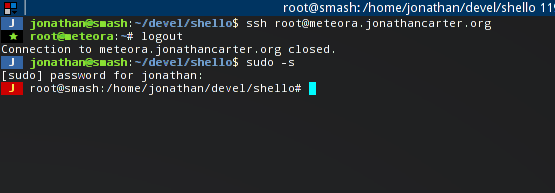
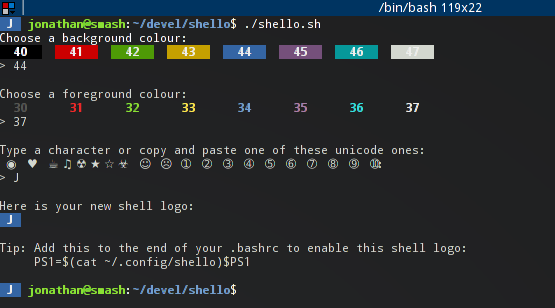
If there s one thing that I ve had missing in my life for way too long, it s hacking on small silly stupid amusing little things. When I was young I used to write dozens of little pointless programs a week and forget about them, only to found them a few months later and be incredibly amused by them. This afternoon I noticed that one of my machines didn t have my default .bashrc loaded, which colourises (or colorizes for Americans or colourizes for Canadians) my shell so that I know on which machine I am so that I don t accidentally do something silly like reboot the wrong host. One problem I ve had with this is that there are limited colours available that makes sense to use for a shell prompt. Right as I was thinking this, I was looking at my Byobu screen sessions and thinking Hmm! I like those logos, maybe I could use them in my shell! . So in just a few minutes I had a little script to help you configure those for your shell. Here is a screenshot of the shell logos in action. On my laptop I use a red background when I have a root shell: This is what the shello script looks like that sets it up: I might get bored by seeing it soon and get rid of it, but at least I had a little fun with it. If you d like to try it out, then you can get the script right here: https://github.com/highvoltage/shello It doesn t do anything like validating input yet, I d also like to add something that creates some kind of a checksum of your hostname and choose a unicode character based on that. Maybe I ll finish it up this weekend, or maybe I ll have new things to write about!
Tanguy Ortolo: Datalove USB drives to reform European copyright

La Quadrature du Net is a European advocacy group that has been created to defend our rights and freedoms on the Internet against the continuous political threats driven by major corporations, such as the recent ACTA. After the recent citizen victories against these monsters, it is time to take the initiative and advocate for a reform of the copyright system which has become inappropriate with the omnipresence of copy-based systems.A USB stick, etched with a heart smiley <3 To this end, la Quadrature will give each Member of the European Parliament a customized USB drive, preloaded with a set of elements for a copyright reform, and with an anthology of free cultural works. To fund that campaign, la Quadrature is asking for everyone's help, by the means of an Ulule campaign (Ulule is a crowd-funding platform similar to Kickstarter). This initiative is noteworthy by at least two aspects: If, like me, you are tired of the continuous attacks from the major corporations of mass entertainment, in addition to not helping them by buying their crap, you can now participate in this first counter-attack. This will probably not end the war, so I hope there will be more offensive actions from the citizen group!

Russ Allbery: Reacting to excitement

I've been slowly noticing, over a number of years now, a place where I don't react to other people the way that I want to. I've been stumbling over defensive reactions that I didn't realize I had. These are a few rules of thumb that I'm formulating for myself to try to improve that, and I thought it might help to write them down. And maybe they'll be meaningful for someone else.
  1. Things people are excited about are probably exciting. If I don't find them exciting, that's probably because I don't know enough about them to understand why they're exciting. Or perhaps I have a different mindset, and therefore the exciting parts don't connect with me. Both of those are okay! There are way more things to learn about than I will ever possibly have time to learn, and I don't have to get excited about everything other people are excited about. But, equally, just because I'm not excited doesn't mean that the thing is not exciting.
  2. My misplaced sense of obligation should not be someone else's buzzkill. This requires a bit of unpacking, since I only intermittantly realize that I'm doing this. But (partly for cultural reasons, partly due to natural inclinations) I've always felt a strong sense of obligation to "keep up" with things. To know a lot about a lot of topics. And one of the things I've realized is that my brain occasionally twists an interest in knowing lots about the world into a sense of obligation to "stay current" and know something about everything important, at least within my vague field of expertise. And usually that part of my brain has a very expansive notion of field of expertise; all of software development, for example, which is, when I pull it out into the light, ridiculously broad. This then sparks one of the standard failure modes of human cognition. I have an unrealistic expectation of myself. I fail to meet that expectation. This makes me feel guilty and stressed. At that point, my brain starts trying to find targets for me to displace negative feelings onto, and that generally ends up being the next person who is excited about something new that I don't know anything about but feel like I should. This is all very interesting psychologically, in the abstract. However, the concrete result is that I sometimes get all snarky and negative about something that someone else is excited about because it happens to be the moment I hit overload, or because I didn't want to hear about another thing that I feel like I should know more about. And that, in turn, can be either confrontational or discouraging to someone who is legitimately excited (and may rarely get the chance to be excited). And that's not the person I want to be.
  3. It's okay not to have an opinion. Seriously, it's okay. The world is full of stuff, far more stuff than any one person can know anything about. It's okay not to go read about everything people say is exciting. It's okay not to know about something new. It's okay to focus on the things I'm already doing. Really. What's not okay is to make up an opinion about something I know nothing about just so that I can feel better about myself by having an opinion. Particularly since that opinion formed under those circumstances tends to be negative, despite the fact that I have no actual basis for having any opinion at all. I need to practice just quietly not having an opinion. No one else needs to know about my lack of opinion.
  4. Before bristling at imposition, be sure someone is actually imposing. I frequently leap to the conclusion that, when someone raises a topic, they want me to do something about it. It's a gut emotional reaction, I think in part because the emotional part of my brain likes to make everything about me. Intellectually, if I can engage that part of my brain, it's often obvious that it's not about me, or that they're not asking me to do anything. Often, when someone brings something up, they just want to tell someone else about it, or make me aware of it. If I've listened to, or read, all the sentences and understood then, then congratulations! I've done everything that I needed to do and was expected to do and need not feel any further obligation. Even if something further needs to be done, it doesn't necessarily need to be done by me. I'm very protective of my time and available resources because I almost always feel overwhelmed by all the things that I want to work on. This does not entitle me to snap at random people who are being excited around me on the grounds that they're trying to put more obligations on me. They're probably not. If it becomes clear that they really want me to do something I don't have time to do, I can politely decline, but if I just shut up and listen for longer, usually that's not the case at all.
(Please note that this is not prompted by any current discussion happening anywhere, and paticularly not by anything in Debian. Insofar as it was prompted by anything, it was by a throwaway comment in an unrelated private discussion. It's just something that gelled enough to write down while I was walking home from work.)

4 September 2012

Gunnar Wolf: Electronic voting in Panama: Slower, more expensive, more uncertainty... Goodbye!

Panama just underwent a nasty e-voting exercise: Electronic-mediated elections were held for the committee of the PRD party. It sounds simple - Even trivial! There were only 4100 authorized voters, it was geographically trivial (all set inside a stadium)... But it blew up in smoke. I won't reiterate all what happened, I'll rather direct you to our project's (the e-voting observatorium) page: News regarding Panama (for those coming from the future, search starting at 2012-08-27 and yes, it's all in Spanish, but there are free-as-in-beer translation services. Many e-vote proponents/sellers/pushers were very eagerly waiting for this election to brag about one more success... So much that they could not just ignore it, and started rationalizing it away. Anyway, while feeding the observatorium, I came across this opinion-article in the Voto Digital website, which makes quite a bit of pro-e-voting noise. I replied to it, and I think my analysis is worth sharing also with you:
So, lets make some simple numbers, rounding the numbers: The PRD vote in Panama was done for a universe of 4100 voters. It took 10 hours (instead of the planned 4), so 410 people were processed every hour. There were 40 voting (electronic) booths, so each processed 10 people per hour. This means, each person spent 6 minutes by the booth. A manual vote in this fashion is highly parallelizable: Each of the voters can be given ballots with anticipation, or many of them cna be allowed in to be given the ballots in situ (depending on the electoral scheme employed). The contention time is the time it takes to each voter to get near the booth and deposit his ballot (either folded or in an envelope) - And it will very rarely be more than a couple of seconds. So, given that using electronic booths parallelism cannot grow (there is a fixed number of machines) and the queues grew wildly, with traditional voting it would have surely fitted in the expected four hours (they were expected, also, based on their past experiences). As for counting, that's the slowest part of manual voting, it's also highly parallelizable: If each of the 40 booths has slightly over 100 ballots, the party personnel can easily count them in under 30 minutes. Capture and aggregation for the 40 partial results would take an extra 10 minutes, even being generous. Manual voting would have saved them around five hours, without demanding additional resources (and being thus much more economical than having to buy 40 specific-purpose computers). And as an additional advantage, the physical and tangible vote proofs would remain, in case they were ever again needed.

Next.

Previous.