Jonathan Carter: LLXC: My little python3-lxc based project

My foray into the world of LXC and RLXC A few months ago, I started trying out LXC (Linux Containers). Before that I used to use OpenVZ, which is an older and more mature contextualization implementation. I was pleased with how well LXC worked and started replacing my personal OpenVZ hosts with LXC. It worked great, but it had a few quirks. While LXC itself works well, the user scripts that ship with it has some space for improvement. The lxc-list command lists anything that s a directory in /var/lib/lxc, so if you have a lost+found directory, it will list it as a container (This has since been fixed upstream). Also, in some cases it would list containers twice or not at all. I was a bit annoyed with that, since OpenVZ s vzlist tool prints out a nice table of your containers along with their IP addresses and other information. Since it s very trivial to implement what I want in a shell script, I went ahead and did just that and called it RLXC. I also missed the vzctl exec <containername> command to execute commands in containers and vzctl enter <containername> to gain a shell inside the container, so I added some more functionality to it so that I could configure ssh keys for these containers and use rlxc enter and rlxc exec like I used to do with the OpenVZ tools, but by using SSH. I also realised that there are others too who wanted similar improvements in the LXC scripts and decided to continue improving RLXC and making it public. Enter LLXC I spoke to St phane about my ideas at the time and he introduced me to python3-lxc that he introduced on his blog yesterday. It provides Python bindings for liblxc, so I took the advantage of that and mostly re-implemented RLXC in Python and called it LLXC. The name doesn t particularly mean anything, I m open to suggestions for what to call it, if anyone cares. Here are some screenshots that explains some of it better than I could do in words:
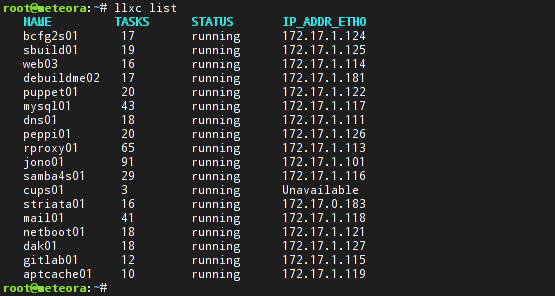
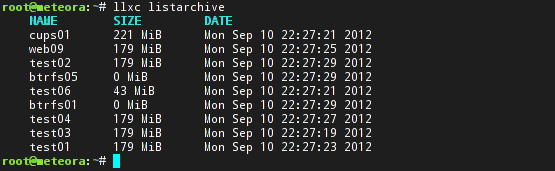
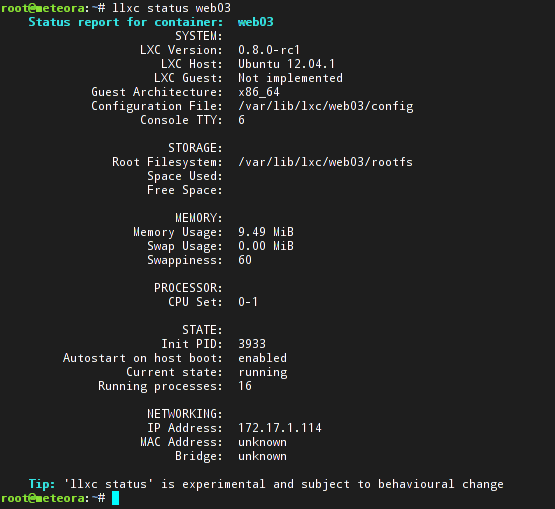
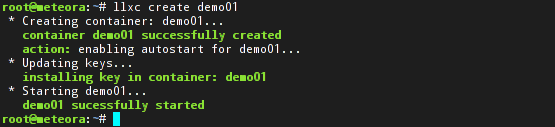
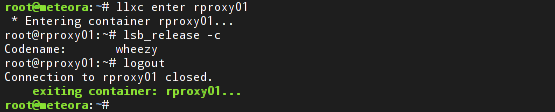

 How to get it
As St phane mentioned in the python3-lxc blog entry, the API hasn t yet been finalized and llxc itself is in an early state and many changes are planned, so it s definitely not meant for production use yet, but since we believe in release early, release often in the free software community, here goes
Currently, llxc.py itself is *very* Ubuntu specific and its only been tested on Ubuntu 12.04, but that will be fixed once more of its kinks have been ironed out. Some people are also working on getting python3-lxc on other distributions, which will help a lot.
The llxc.py script itself is hosted on Github: https://github.com/highvoltage/llxc
For python3-lxc and friends, you need to enable St phane s experimental PPA: https://launchpad.net/~stgraber/+archive/experimental
You will then need to install the following packages: lxc, python3-lxc, python3-crypto, lvm, btrfs-tools
To generate the ssh keys used for ssh interaction between the containers, you need to run llxc gensshkeys . The enter and exec commands also rely on your containers being in dns or in your /etc/hosts file, at least for now, which you may have to configure manually.
The Future
There is a lot that I m planning to add, mostly to scratch my own itches. These include:
- Awareness of other hosts, so that the list command can show you all containers in the awareness . You d also be able to clone, move, etc containers between hosts.
- Easily modify container configuration
- Hooks everywhere, and at least one hook for configuring a configuration management system such as salt, bcfg2, puppet or chef.
- More checks and tips everywhere. Is the host running low on memory? Disk space? Perhaps list available resources on variable hosts and make some suggestions based on that.
- There a not-very-descriptive ROADMAP file in the distribution, check that for more details.

 Thoughts about DRI.Next
On the way to the X Developer s Conference in Nuremberg, Eric and I
chatted about how the DRI2 extension wasn t really doing what we
wanted. We came up with some fairly rough ideas and even held an
 Just about three years ago, I created the
 I'm just back from having spent a week in Helsinki. Despite some minor irritations (the light-switches were always too damn low) it was a lovely trip.
There is a lot to be said for a place, and a culture, where shrugging and grunting counts as communication.
Now I'm back, catching up on things, and mostly plotting and planning how to handle my backups going forward.
Filesystem backups I generally take using backup2l, creating
local incremental backup archives then shipping them offsite using
rsync. For my personal stuff I have a bunch of space on a
number of hosts and I just use rsync to literally copy my
~/Images, ~/Videos, etc..
In the near future I'm going to have access to a backup server which will run rsync, and pretty much nothing else. I want to decide how to archive my content to that - securely.
The biggest issue is that my images (.CR2 + .JPG) will want to be encrypted remotely, but not locally. So I guess if I re-encrypt transient copies and rsync them I'll end up having to send "full" changes each time I rsync. Clearly that will waste bandwidth.
So my alternatives are to use incrementals, as I do elsewhere, then GPG-encrypt the tar files that are produced - simple to do with backup2l - and us rsync. That seems like the best plan, but requires that I have more space available locally since :
 So, yay! Title says it all!
On Saturday September 22, Regina and I got married in my parents' house, in Cuernavaca, Morelos.
 We had a very very nice little party with our family and a small group of friends Of course, due to the nature of our life, we could not forego inviting our family and friends in Argentina, as well as those in other parts of the world, so we set up a simple video stream so that our friends could follow along And they did, with much greater success than what I expected!
So, besides those people present with us in Cuernavaca, we had people tuning in (at least to the degree I could get from the log files) from Argentina (Buenos Aires, Paran , Formosa), Austria, Canada, France, Germany, Hungary, Italy, Macedonia, Mexico, Poland, Spain, Sweden and the United States.
 This next Saturday (September 29) we will have a second party, to which our friends in Mexico are invited, at home. And for the people from far away,,
 I should have posted this a few days ago, better late than never they
say...
On Saturday, 8/9/12, a
 The IPv6 patch set for

 Remember when Linus Torvalds lambasted NVidia for not supporting their Optimus technology in their Linux drivers for half a decade and counting? Well, I went out and bought an AMD/ATi video card as mu upgrade. And you know what? Its Linux drivers are far, far worse than NVidia.


 When
 I just released
 Last July, I had the pleasure to be at
 Over the past few days, I decided to purge Gnash and LightSpark from my laptop to see whether my Internet experience would be affected in any dramatic way. Amazingly, a number of sites seem to offer video content encoded in Theora (VP3) or WebM (VP8). Sadly, a handful of popular sites such as Vimeo insist upon using the H.264 (MPEG-4) CODEC, which cannot be safely supported on Free Software because of unclear licensing issues that might impose an ulterior usage fee onto the end-users.

 Ever wondered how you can update your website (in our case a static website with a bunch of HTML and PHP files) by committing to a Git repository hosted on a different server? if the answer to the previous question is yes, then you are in the right place.
The scenario:
- Website hosted on server A.