Search Results: "tar"

11 March 2015

Joey Hess: 7drl 2015 day 5 type directed spell system development

I want my 7drl game Scroll to have lots of interesting spells. So, as I'm designing its spell system, I've been looking at the types, and considering the whole universe of possible spells that fit within the constraints of the types. My first throught was that a spell would be a function from World -> World. That allows any kind of spell that manipulates the game map. Like, for instance a "whiteout" that projects a stream of whitespace from the player's mouth. Since Scroll has a state monad, I quickly generalized that; making spell actions a state monad M (), which lets spells reuse other monadic actions, and affect the whole game state, including the player. Now I could write a spell like "teleport", or "grow". But it quickly became apparent this was too limiting: While spells could change the World map, the player, and even change the list of supported spells, they had no way to prompting for input. I tried a few types of the Event -> M () variety, but they were all too limiting. Finally, I settled on this type for spell actions: M NextStep -> M NextStep. And then I spent 3 hours exploring the universe of spells that type allows! To understand them, it helps to see what a NextStep is:
type Step = Event -> M NextStep
data NextStep = NextStep View (Maybe Step)
Since NextStep is a continuation, spells take the original continuation, and can not only modify the game state, but can return an altered continuation. Such as one that prompts for input before performing the spell, and then calls the original continuation to get on with the game. That let me write "new", a most interesting spell, that lets the player add a new way to cast an existing spell. Spells are cast using ingredients, and so this prompts for a new ingredient to cast a spell. (I hope that "new farming" will be one mode of play to possibly win Scroll.) And, it lets me write spells that fail in game-ending ways. (Ie, "genocide @"). A spell can cause the game to end by returning a continuation that has Nothing as its next step. Even better, I could write spells that return a continuation that contains a forked background task, using the 66 line contiuation based threading system I built in day 3. This allows writing lots of fun spells that have an effect that lasts for a while. Things like letting the player quickly digest letters they eat, or slow down the speed of events. And then I thought of "dream". This spell stores the input continuation and game state, and returns a modified continuation that lets the game continue until it ends, and then restores from the point it saved. So, the player dreams they're playing, and wakes back up where they cast the spell. A wild spell, which can have different variants, like precognitive dreams where the same random numbers are used as will be used upon awaking, or dreams where knowledge carries back over to the real world in different ways. (Supports Inception too..) Look how easy it was to implement dreaming, in this game that didn't have any notion of "save" or "restore"!
runDream :: M NextStep -> M NextStep -> (S -> S) -> M NextStep
runDream sleepcont wakecont wakeupstate = go =<< sleepcont
   where
         go (NextStep v ms) = return $ NextStep v $ Just $
        maybe wake (go <=<) ms
         wake _evt = do
                 modify wakeupstate
                 wakecont
I imagine that, if I were not using Haskell, I'd have just made the spell be an action, that can do IO in arbitrary ways. Such a spell system can of course do everything I described above and more. But, I think that using a general IO action is so broad that it hides the interesting possibilities like "dream". By starting with a limited type for spells, and exploring toward more featureful types, I was able to think about the range of possibilities of spells that each type allowed, be inspired with interesting ideas, and implement them quickly. Just what I need when writing a roguelike in just 7 days!
Fun comment thread on reddit

Tiago Bortoletto Vaz: Freeing myself from flickr

A flickr standard account gives you a free as in facebook service (I really wanted to reuse it!!!). I don't know about the pro account, but I don't believe it will give you much respect. Anyway, I realized that my photo albums in flickr are still online. And I'm currently unable to access my photos locally. I needed to download all them, then I decided to give flickrbackup a try. I started coding it a few years ago because at that time there was no free tools available for that. And then I abandoned it, too bad I feel. But for my surprise it worked without issues! And that's all I needed in my Debian box:
$ apt-get install flickrbackup $ mkdir myflickr $ flickrbackup -o myflickr/
(this will open a default browser for authentication and will automatically get the API key, then I just need an ENTER to start getting all my albums) I'm not sure whether there're other free tools (as in freedom) for that, but before paying for a license or trusting an online service for downloading your sets please give flickrbackup a chance :) I'll probably set a piwigo instance in a vps. But I fear php. So, suggestions on web galleries are very welcome.

10 March 2015

Joey Hess: 7drl 2015 day 4 coding through exhaustion

Slow start today; I was pretty exhausted after yesterday and last night's work. Somehow though, I got past the burn and made major progress today. All the complex movement of both the player and the scroll is finished now, and all that remains is to write interesting spells, and a system for learning spells, and to balance out the game difficulty.
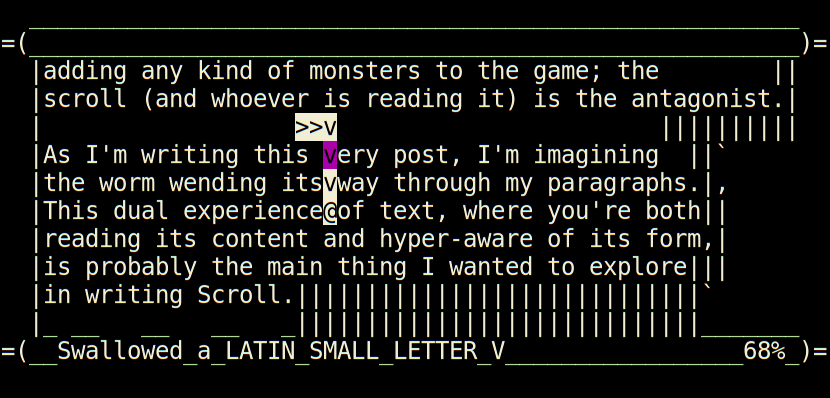
I haven't quite said what Scroll is about yet, let's fix that: In Scroll, you're a bookworm that's stuck on a scroll. You have to dodge between words and use spells to make your way down the page as the scroll is read. Go too slow and you'll get wound up in the scroll and crushed. The character is multiple chars in size (size is the worm's only stat), and the worm interacts with the scroll in lots of ways, like swallowing letters, or diving through a hole to the other side of the scroll. While it can swallow some letters, if it gets too full, it can't move forward anymore, so letters are mostly consumed to be used as spell components. I think that I will manage to get away without adding any kind of monsters to the game; the scroll (and whoever is reading it) is the antagonist. As I'm writing this very post, I'm imagining the worm wending its way through my paragraphs. This dual experience of text, where you're both reading its content and hyper-aware of its form, is probably the main thing I wanted to explore in writing Scroll. As to the text that fills the scroll, it's broadly procedurally generated, in what I hope are unusual and repeatedly surprising (and amusing) ways. I'm not showing any screenshots of the real text, because I don't want to give that surprise away. But, the other thing about Scroll is that it's scroll, a completely usable (if rather difficult..) Unix pager!

Holger Levsen: 20150310-lts-february-2015

My LTS February In February I didn't get much LTS work done, as other projects grabbed my attention. I started working on #761859 but that took a lot more time than initially thought, as the database design has been bended several times to make it fit for some new usecases. For example, "end-of-life" information is saved in the urgency field, making this one of several reasons why a bug can have different urgencies in different releases (despite that a CVE always only has one urgency). There are more oddities in the code base which was written with the (now long gone) assumption to be a tracker for security issues in testing. Constantly adding more requirements and use cases didn't really help to make it more maintainable. I'm glad that at least since yesterday https://security-tracker.debian.org/tracker/data/json provides valid JSON, though probably still a bit of finetuning is needed before I'll consider the output stable and close the bug. In related news I've filed #780201: "new codename needed for oldstable (due to squeeze-lts) when stable becomes oldstable" today as else the security tracker will cease to work for squeeze LTS once we release jessie. And that would spoil that day a bit...

9 March 2015

Joey Hess: 7drl 2015 day 3 movement at last

Got the player moving in the map! And, got the map to be deadly in its own special way.
        HeadCrush -> do
                showMessage "You die."
                endThread
Even winning the game is implemented. The game has a beginning, a middle, and an end. I left the player movement mostly unconstrained, today, while I was working on things to do with the end of the game, since that makes it easier to play through and test them. Tomorrow, I will turn on fully constrained movement (an easy change), implement inventory (which is very connected to movement constraints in Scroll), and hope to start on the spell system too.
At this point, Scroll is 622 lines of code, including content. Of which, I notice, fully 119 are types and type classes. Only 4 days left! Eep! I'm very glad that scroll's central antagonist is already written. I don't plan to add other creatures, which will save some time.
Last night as I was drifting off to sleep, it came to me a way to implement my own threading system for my roguelike. Since time in a roguelike happens in discrete ticks, as the player takes each action, normal OS threads are not suitable. And in my case, I'm doing everything in pure code anyway and certianly cannot fork off a thread for some background job. But, since I'm using continuation passing style, I can just write my own fork, that takes two continuations and combines them, causing both to be run on each tick, and recursing to handle combining the resulting continuations. It was really quite simple to implement. Typechecked on the first try even!
fork :: M NextStep -> M NextStep -> M NextStep
fork job rest = do
        jn <- job
        rn <- rest
        runthread jn rn
  where
        runthread (NextStep _ (Just contjob)) (NextStep v (Just contr)) =
                return $ NextStep v $ Just $ \i -> do
                        jn <- contjob i
                        rn <- contr i
                        runthread jn rn
        runthread (NextStep _ Nothing) (NextStep v (Just contr)) =
                return $ NextStep v (Just contr)
        runthread _ (NextStep v Nothing) =
                return $ NextStep v Nothing
endThread :: M NextStep
endThread = nextStep Nothing
background :: M NextStep -> M NextStep
background job = fork job continue
demo :: M NextStep
demo = do
    showMessage "foo"
    background $ next $ const $
        clearMessage >> endThread
That has some warts, but it's good enough for my purposes, and pretty awesome for a threading system in 66 LOC.

Ulrike Uhlig: Final report from the Outreach Program round 9

Between december 9th 2014 and march 9th 2015 I ve been working as an intern for Debian on Improving AppArmor support in Debian. Progress Before the internship started, I had no clue about AppArmor at all. Reading the Wikipedia page and the AppArmor wiki did barely enlighten me. At least, until I got my hands dirty and installed and activated it. I was able to do this only because there was already some basic documentation on the Debian wiki on how to get AppArmor running on a Debian system. When the internship started I felt a little bit lost. I started to read the documentation and to play around with some AppArmor profiles. But the error messages I saw and the profiles I opened for reading overwhelmed me. What did all these lines mean? Then one mentor briefed me about the current status of AppArmor in Debian. I took many notes and tried to bring some order into the information I was being given. These notes became the first page of the documentation and my first blog post.
Surprise: suddenly I was in the middle of knowing what we were talking about and how the next few weeks would look like. To start with, I have set up a test environment and continued to test some of the profiles which came with the packages I had installed, namely apparmor-profiles-extra which provided me with a profile for Pidgin. I was very much interested in securing this several thousand lines long C-code application on my machine! As a Pidgin user, I noticed immediately that one of my favourite features pidgin blinklight threw an error in the logs. I tried to fix it on my test VM and eventually made it work. Now knowing that such fixes should first be done upstream, i cloned the corresponding upstream repository and sent my first patch. It was not easy at first to switch to another VCS than Git, although I had been using Bazaar and Subversion years ago. Shortly afterwards, I saw my patch showing up on the upstream mailing list, and some days later it got merged. That was a huge encouragement. I was now able to write more documentation on how to contribute upstream. In order to organize the documentation, we ve set up some User Stories. I did not know about this tool before and had quite a hard time to grasp all the details but it proved to be very useful as some pages started to become long and confusing. Writing the documentation took up a lot of time, but before being able to write anything down, I needed to work everything out! This way I incidentally learned how to interact with many parts of Debian s infrastructure: While playing around with the tools provided to inspect AppArmor status on the system, I even accidentally found a little bug in one of the upstream tools. It got fixed very quickly after I mentioned it on the AppArmor team s mailing list. Organization Although I was uncomfortable with this in the beginning, we organized public meetings every two weeks on IRC. These meetings were also attended by MeetBot who took care of taking notes and leaving a trace of our discussions.
Based on the meetings, I maintained a progress page and todo list on the Debian wiki, which helped us to know which tasks were planned for the next two weeks. Before each meeting I sent a status update to the mailing list, so the mentors could catch up with my work. During the meetings I was not only asked to provide feedback on progress but also on mentoring itself. It proved to be very useful to be able to say where I was stuck and if the mentoring process worked out well enough (it did!).
Furthermore, I got regular, detailed and pedantic (thanks for trying to push me to perfection!) feedback on the team s mailing list. The mentors had introduced me on the upstream IRC channel in the beginning, so most of the people who are active there knew about my existence, something which also proved to be handy! Future The internship time is over, but some work remains to be done. As a new member of the AppArmor Packaging team, I am committed to make it happen: Thanks I feel much more confident after these three months, technically but also personally. Thank you: Holger Levsen and intrigeri for mentoring and encouraging me on this journey and to upstream contributors Christian Boltz, Steve Beattie (and everybody else I might forget here) for providing help and feedback. The Debian community (OPW organizers, sponsors, Alioth maintainers, planet.debian.org maintainers although my posts don t show up anymore :( -and others) has been very friendly and welcoming and I am very happy to be part of it.

Axel Beckert: Do we need a zsh-static package in Debian?

Dear Planet Debian, the Debian Zsh Packaging Team (consisting of Michael Prokop, Frank Terbeck, Richard Hartmann and myself) wonders if there s still a reason to build and ship a zsh-static package in Debian. There are multiple reasons: So we ask you, the Planet Debian reader:

Do you need Debian s zsh-static package? If so, please send an e-mail to us Debian Zsh Maintainers <pkg-zsh-devel@lists.alioth.debian.org> and state that you use zsh-static, and, if you want, please also state why or how you re using it. Thanks in advance! Mika, Frank, RichiH and Axel

Axel Beckert: Do we need a zsh-static package in Debian?

Dear Planet Debian, the Debian Zsh Packaging Team (consisting of Michael Prokop, Frank Terbeck, Richard Hartmann and myself) wonders if there s still a reason to build and ship a zsh-static package in Debian. There are multiple reasons: So we ask you, the Planet Debian reader:

Do you need Debian s zsh-static package? If so, please send an e-mail to us Debian Zsh Maintainers <pkg-zsh-devel@lists.alioth.debian.org> and state that you use zsh-static, and, if you want, please also state why or how you re using it. Thanks in advance! Mika, Frank, RichiH and Axel

NOKUBI Takatsugu: Travatar, an OpenSource statistical machine translation system

Graham Neubig published Travater , an OpenSource statistical machine translation system and the demosite (http://ahclab.naist.jp/travatar/translator/). Graham said It makes good result likely Google Translation. Unfortunately, it seems to be crwoded, so I can t get correct result (output IO Error dialog). Anyway, it is a good new for Japanese processing scene.

8 March 2015

Joey Hess: 7drl 2015 day 2 level generation and game concept

Much as I want to get my @ displayed and moving around screen, last night and today have focused on level generation instead. Scroll has kinda strange level generation method, compared to how I suppose most roguelikes do it. There are only 3 calls to rand in all of Scroll. Just a 3 random parameters, but that's enough to ensure a different level each time.
-- Random level generation function.
level :: Bool -> StdGen -> [String]
level randomize r = concat
        [ final (length tutorial + extra) $ concat $ rand mariner1body
        , concat $ rand mariner1end
        , concatMap rand kubla
        ]
  where
    -- here be spoilers
You could say there are two influences in Scroll's level generation method: Nick Montfort and Samuel Taylor Coleridge.
I have thought some about Scroll before starting the 7drl week, but my idea for the game was missing some key concepts. There was nothing to keep the player engaged in moving forward, an unclear victory condition, no clue how to generate appropriate random levels, a large potential for getting stuck, and no way to lose the game. This is all a problem for a roguelike. But, I had an idea finally last night, about a single unified thing that all of that stuff falls out from. And it's right there in the name of the game! Now that I understand Scroll better, I wrote the tutorial level. It's a very meta tutorial level that sets the scene well and serves more purposes than are at first apparent. I count a total of 6 things that this "tutorial level" will let the user do. And interestingly, while the tutorial level is static, it interacts with the rest of the game in a way that will make it be experienced differently every time through.
The strangest line of code I wrote today is:
import GPL
Somehow, I have never before, in all my time programming, written a line like that one.
Finally, after 7 hours of nonstop coding, I got ncurses to display the generated game world, scrolling around in the display viewport. No @ yet; that will need to wait for tonight or tomorrow!

Carl Chenet: Verify your backups or lose them all

Follow me on Identi.ca or Twitter or Diaspora*diaspora-banner As a good sysadmin, you thought you had backups for your server but you didn t verify them before the major migration you attempted? When you need them, they re empty or full of useless files. And now it s too late
nobackup

Wen you discover that you don t have usable backups lesjoiesdusysadmin.fr

You won t guess how often this situation occurs. Backup Checker is a command line software developed in Python 3.4 on GitHub (stars appreciated :) ) allowing users to verify the integrity of archives (tar, gz, bz2, lzma, zip, tree of files) and the state of the files inside an archive in order to find corruptions or intentional of accidental changes of states or removal of files inside an archive. github-logo Install Backup Checker from PyPI The easiest way to install Backup Checker is from PyPi using the following command:
$ pip3.4 install backupchecker
Debian Wheezy and Squeeze packages for Backup Checker Backup Checker Debian packages are now available for your stable servers Wheezy and Squeeze in the MyTux Debian repositories. Debian Squeeze Just copy/paste the following command on your server to add the MyTux Debian Squeeze repository and install Backup Checker:
apt-key adv --keyserver pgp.mit.edu --recv-keys 2B24481A \
&& echo "deb http://debian.mytux.fr squeeze main" > /etc/apt/sources.list.d/mytux.list \
&& apt-get update \
&& apt-get install backupchecker
debian-squeeze-toy Debian Wheezy Just copy/paste the following command on your server to add the MyTux Debian Wheezy repository and install Backup Checker:
apt-key adv --keyserver pgp.mit.edu --recv-keys 2B24481A \
 && echo "deb http://debian.mytux.fr wheezy main" > /etc/apt/sources.list.d/mytux.list \
 && apt-get update \
 && apt-get install backupchecker
wheezy Using Backup Checker 2 steps are needed to secure your backups. First you need to generate the configuration files of your backups, using the following command: $ backupchecker -G /backups/backup-08032015.tar.gz This generates 2 files /backups/backup-08032015.conf and /backups/backup-08032015.list you need to store in order to verify this archive later (the -O option lets you define a custom location to store the files). Second step is to verify your backup. It is as simple as: $ backupchecker -c /etc/backupchecker/backup-08032015.conf -l /var/log/backupchecker.log Then check if warnings have been sent to /var/log/backupchecker.log. Really simple isn t it? Scripting this command, your backups are now verified and secured. If any modification occurs, it will be detected and pinpointed. What do you thing about it? As usual, any feedback is welcome, through bug reports, emails of the author or comments on this blog. Several companies now use Backup Checker to secure their backups. Let us know if we can help you.

Gregor Herrmann: RC bugs 2015/07-10

finally, some simple RC bugs appeared, & I could contribute a bit towards the jessie release:

Hideki Yamane: community booth @ "developers summit 2015" in Tokyo (19th&20th Feb)

I'm back to Developers Summit at (Meguro Gajoen), Tokyo. I was an attendee 2 years ago, and I'm at community booth this year :)

We were at booth "Debian JP Project" (Japanese local Debian community) and other distro people (Ubuntu Japanese Team, openSUSE, VineLinux)


Its conference mostly focuses "development style" in companies, not FLOSS -Keyword: Agile (Scrum), DevOps, using cloud infrastructure, IoT, etc. So, we're a bit stranger but enjoyed chat with some people.

7 March 2015

Joey Hess: 7drl 2015 day 1 groundwork

Scroll is a roguelike, with a twist, which I won't reveal until I've finished building it. I'll just say: A playable roguelike pun, set in a filesystem near you. I'm creating Scroll as part of the 7DRL Challange. If all goes well, I'll have a usable roguelike game finished in 7 days. This is my first time developing a roguelike, and my first time writing a game in Haskell, and my first time writing a game to a time limit. Wow!
First, some groundwork. I'm writing Scroll in Haskell, so let's get the core data types and monads and IO squared away. Then I can spend days 2-7 writing entirely pure functional code, in the Haskell happy place. To represent the current level, I'm using a Vector of Vectors of Chars. Actually, MVectors, which can be mutated safely by pure code running inside the ST monad, so it's fast and easy to read or write any particular location on the level.
-- Writes a Char to a position in the world.
writeWorld :: Pos -> Char -> M ()
writeWorld (x, y) c = modWorld $ \yv -> do
    xv <- V.read yv y
    V.write xv x c
showPlayer :: M ()
showPlayer = writeWorld (5,8) '@'
(I wish these Vectors had their size as part of their types. There are vector libraries on hackage that do, but not the standard vector library, which has mutable vectors. As it is, if I try to access outside the bounds of the world, it'll crash at runtime.) Since the game will need some other state, I'm using the state monad. The overall monad stack is type M = StateT S (ST RealWorld). (It could be forall s. StateT S (ST s), but I had some trouble getting that to type check, so I fixed s to RealWorld, which is ok since it'll be run using stToIO. Next, a concept of time, and the main event loop. I decided to use a continutation passing style, so the main loop takes the current continuation, and runs it to get a snapshot of the state to display, and a new continutation. The advantage of using continuations this way is that all the game logic can be handled in the pure code. I should probably be using the Cont monad in my monad stack, but I've not learned it and lack time. For now I'm handling the continuations by hand, which seems ok.
updateWorld :: Step
updateWorld (Just 'Q') = do
        addMessage "Are you sure you want to quit? [yn]"
        next $ \i -> case i of
                Just 'y' -> quit
                _ -> continue
updateWorld input = do
        addMessage ("pressed " ++ show input)
        continue
Finally, I wrote some ncurses display code, which is almost working.
Start time: After midnight last night. Will end by midnight next Friday. Lines of code written today: 368 Craziest type signature today: writeS :: forall a. ((Vec2 a -> ST RealWorld ()) -> M ()) -> Pos -> a -> M ()
By the way, there's a whole LambdaHack library for Haskell, targeted at just this kind of roguelike construction. It looks excellent. I'm not using it for two reasons:
  1. Scroll is going to be unusual in a lot of ways, and LambdaHack probably makes some assumptions that don't fit.
  2. mainSer :: (MonadAtomic m, MonadServerReadRequest m) => [String] -> COps -> (m () -> IO ()) -> (COps -> DebugModeCli -> ((FactionId -> ChanServer ResponseUI RequestUI -> IO ()) -> (FactionId -> ChanServer ResponseAI RequestAI -> IO ()) -> IO ()) -> IO ()) -> IO ()
    That's a lot of stuff to figure out! I only have a week, so it's probably easier to build my own framework, and this gives me an opportunity to learn more generally useful stuff, like how to use mutable Vectors.

6 March 2015

Eddy Petri&#537;or: Occasional Rsnapshot v1.3.1

I was writing in the previous post about Occasional Rsnapshot and how I ended up writing it.

Just before releasing v1.2.1 I realized it would make sense Semantic Versioning which, in just a few words means:
Given a version number MAJOR.MINOR.PATCH, increment the:
MAJOR version when you make incompatible API changes,
MINOR version when you add functionality in a backwards-compatible manner, and
PATCH version when you make backwards-compatible bug fixes.
I just released Occasional Rsnapshot v1.3.1 which mainly fixed issue 4:
When deciding to do a backup for interval INT, there should be a check that the oldest snapshot in INT-1 interval is older than the threshold for the INT interval. Otherwise the INT interval will be populated with backups more frequent than desired and it is possible older backups in INT interval to completely lost.
The condition should be:
ts(oldest(INT-1)) - ts(newest(INT)) >= threshold(INT)
For example:
  • if weekly.0 is from 15th of February and daily.6 is from 17th of February, weekly should not be triggered, but
  • if weekly.0 is from 15th of February and daily.6 is from 23rd of February, weekly shall be triggered
This extra check should probably added in can_backup_interval.
It was a small bug, but it might have lead to losing important older backups because newer and more frequent backups would be pushed from hourly, interval by interval up to the yearly interval, in spite of the fact that the distance between backups wouldn't have been respecting the upper interval minimum distance in time.

There was also a small syntax bugfix, but functionally nothing has changed because bash was doing the right thing even with that small error.

If you have started using Occasional Rsnapshot, you definitely want now Occasional Rsnapshot v1.3.1. If you haven't started and you don't have backups, please start doing backups, and while you're at it, you might want to try Occasional Rsnapshot (with Rsnapshot).

Rapha&#235;l Hertzog: My Free Software Activities in February 2015

My monthly report covers a large part of what I have been doing in the free software world. I write it for my donators (thanks to them!) but also for the wider Debian community because it can give ideas to newcomers and it s one of the best ways to find volunteers to work with me on projects that matter to me. Debian LTS This month I have been paid to work 14.5 hours on Debian LTS. I worked mostly on CVE triage (41 commits in the security tracker) and organizational issues. One maintainer complained that he had not been kept in the loop for an LTS update of his package. After some discussion, I decided to change the way I did CVE triage so that any time that I add a package to our list of packages needing an update, I also send a mail to the maintainer, thus offering him the opportunity to step in. To make this sustainable, I wrote a small helper script that will generate a mail out of a template. And to kickstart the process I mailed all maintainers of packages that were already listed in our queue of packages to update. To improve the email generated, I requested a JSON export of the security tracker data (see discussions in #761859). In the mean time, Holger worked on this already and after a few iterations we did converge on an output format that will be really useful both for my needs in terms of CVE triage but also for the Package Tracker to be able to display the list of security vulnerabilities affecting each release (see #761730). Last but not least, I don t want to be the only one doing CVE triage for our LTS release so I documented the process in our wiki page. As a side note, I sponsored an e2fsprogs update prepared by Nguyen Cong and I sent the DLA for the embargoed samba update that had been prepared by Ivo de Decker (thanks to both of them!). Tryton Like last month, I invested again a copious amount of time on Tryton, fixing some bugs that were affecting me and improving the French chart of accounts to properly manage purchases and sales within the European Union. Here are some links for more details: Debian I did some work on Distro Tracker, I fixed #777453 (password reset not working because the generated email was using an invalid From email) and #779247 (obsolete build reproducibility action items were not dropped). I also started to work on restructuring the mail handling in distro-tracker (cf #754913) but it s not public yet. While I have no plans to stop contributing to Debian (it s part of my day job!), I reduced my non-work related involvement by officially recognizing that I was no longer properly assuming some of my responsibilities and that I was following too many mailing lists and RSS feeds. The most notable changes are that I removed myself from the maintenance of dpkg, developers-reference, quilt, sql-ledger, and a few perl/python modules. Misc Voting software. Part of the reason why I m reducing my involvement in Debian is that I got more involved in Nouvelle Donne (a French political party) and in particular in the handling of its digital infrastructure (currently running on Ubuntu, doh!). As part of this, I was looking for free software to handle secure votes and elections (and if possible adhering to the principles of liquid democracy). There s no perfect solution and no clear winner. That said I started following the evolution of AgoraVoting because it seems to have a good momentum and has some interesting features (it already supports votes with ranked choices, supports good crypto, has been used for elections involving large numbers of voters in the context of Podemos in Spain). But it still has some ways to go to establish itself as a truly international and community-backed project. GDM bug. Due to my work on Kali, I filed a bug against GDM (this one has been quickly fixed upstream, it s still open in Debian) and another one against accountsservice to request the possibility to define the default graphical session. Dirvish formula for Salt. I contributed another formula to manage backups with dirvish. Thanks See you next month for a new summary of my activities.

One comment Liked this article? Click here. My blog is Flattr-enabled.

DebConf team: Valessio Brito wins DebConf15 logo contest (Posted by Penny Leach)

In May, the DebConf15 Team held a competition to design the logo for DebConf15, which will take place in Heidelberg, Germany. We received many great entries, and after a week-long voting period, this logo by Valessio Brito was selected:
DebConf15 logo (by Valessio Brito)
The lion depicted is the Kurpf lzer L we , which makes up Heidelberg s coat of arms. Valessio is Brazilian, graduated in Communication and Advertising, and specialised in Free Software Development. He is currently a consultant to UI Design of the Secretariat-General of the Presidency of the Republic, living in Brasilia, Brazil. He has been a Debian user since 2000, contributing to local communities, Inkscape and the Debian project. Valessio has a tattoo of the red spiral! His personal website is valessiobrito.com.br (pt_BR). He invites you to visit www.DebianArt.org to discover the work of other artists and designs that contribute to the Debian project. Thanks very much Valessio for your great contribution!

Steve Kemp: Free hosting, and key-signing

Over the past week I've mailed many of the people who had signed my previous GPG key and who had checked my ID as part of that process. My intention was to ask "Hey you trusted me before, would you sign my new key?". So far no replies. I may have to be more dedicated and do the local-thing with people. In other news Bytemark, who have previously donated a blade server, sponsored Debconf, and done other similar things, have now started offering free hosting to Debian-developers. There is a list of such offers here: I think that concludes this months blog-posting quota. Although who knows? I turn 39 in a couple of days, and that might allow me to make a new one.

5 March 2015

Ian Wienand: On VMware and GPL

I do not believe any of the current reporting around the announced case has accurately described the issue; which I see as a much more subtle question of GPL use across API layers. Of course I don't know what the real issue is, because the case is sealed and I have no inside knowledge. I do have some knowledge of the vmkernel, however, and what I read does not match with what I know. An overview of ESXi is shown below overview of vmkernel and vmkapi There is no question that ESXi uses a lot of Linux kernel code and drivers. The question as I see it is more around the interface. The vmkernel provides a well-described API known as vmkapi. You can write drivers directly to this API; indeed some do. You can download a SDK. A lot of Linux code has been extracted into vmkLinux; this is a shim between Linux drivers and the vmkapi interface. The intent here is to provide an environment where almost unmodified Linux drivers can interface to the proprietary vmkernel. This means vendors don't have to write two drivers, they can re-use their Linux ones. Of course, large parts of various Linux sub-systems' API are embedded in here. But the intent is that this code is modified to communicate to the vmkernel via the exposed vmkapi layer. It is conceivable that you could write a vmkWindows or vmkOpenBSD and essentially provide a shim-wrapper for drivers from other operating systems too. vmkLinux and all the drivers are GPL, and released as such. I do not think there could be any argument there. But they interface to vmkapi which, as stated, is an available API but part of the proprietary kernel. So, as I see it, this is a much more subtle question than "did VMware copy-paste a bunch of Linux code into their kernel". It goes to where the GPL crosses API boundaries and what is considered a derived work. If nothing else, this enforcement increasing clarity around that point would be good for everyone I think.

Ulrike Uhlig: So, how usable is AppArmor in Debian?

The short answer is: using AppArmor in Debian is fairly straight forward. Installing and activating it though is not yet a very user friendly experience. One needs to install the apparmor package, then activate it in the kernel by editing a line in the GRUB bootloader and then reboot. The procedure is explained in detail here.
We are working on fixing Debian Bug #702030 which aims at making the installation process easier for normal users by activating the module automatically as soon as one installs the apparmor package. Once you have set this up though, you re good to go. Profiles for confining processes and programs should then be activated automatically. One can verify this through the sudo aa-status command which should output something like this:
apparmor module is loaded.
30 profiles are loaded.
30 profiles are in enforce mode.
 /usr/bin/evince
 /usr/bin/evince-previewer
 /usr/bin/evince-previewer//sanitized_helper
 /usr/bin/evince-thumbnailer
 /usr/bin/evince-thumbnailer//sanitized_helper
 /usr/bin/evince//sanitized_helper
 /usr/bin/irssi
 /usr/bin/pidgin
 /usr/bin/pidgin//launchpad_integration
 /usr/bin/pidgin//sanitized_helper
 /usr/bin/tlsdate
 /usr/bin/tlsdate-helper
 /usr/bin/torbrowser-launcher
 /usr/bin/totem
 /usr/bin/totem-audio-preview
 /usr/bin/totem-video-thumbnailer
 /usr/lib/cups/backend/cups-pdf
 /usr/lib/libvirt/virt-aa-helper
 /usr/sbin/apt-cacher-ng
 /usr/sbin/cups-browsed
 /usr/sbin/cupsd
 /usr/sbin/cupsd//third_party
 /usr/sbin/libvirtd
 /usr/sbin/ntpd
 /usr/sbin/tcpdump
 /usr/sbin/tlsdated
 gst_plugin_scanner
 system_tor
0 profiles are in complain mode.
8 processes have profiles defined.
8 processes are in enforce mode.
 /usr/bin/pidgin
 /usr/bin/torbrowser-launcher
 /usr/sbin/cups-browsed 
 /usr/sbin/cupsd
 /usr/sbin/libvirtd
 system_tor
0 processes are in complain mode.
0 processes are unconfined but have a profile defined.
As of today there are only a dozen packages which ship their own profile in Debian: bind9, clamav, cups-browsed & cups-daemon, libvirt-daemon-system, mysql-5.5, lightdm, obfsproxy, sssd, tlsdate, tor, torbrowser-launcher, vidalia. In order to confine other applications, like evince, irssi, ntpd, pidgin, totem or tcpdump, one can install the apparmor-profiles-extra package. All those profiles work very well in a Debian Wheezy environment or higher, from my own experience. (Only the torbrowser-launcher profile needs to be fixed in wheezy-backports, but works well in Jessie or higher I m working on it.) If you want to confine other applications and found a profile which you want to use on your system, you can copy that profile into /etc/apparmor.d/ and then run
aa-enforce /etc/apparmor.d/myprofile
And that s pretty much it!

Next.

Previous.