Search Results: "sto"

7 March 2014

Steve Kemp: Time to get back to my roots: Perl

Today I wrote a perl Test::RemoteServer module:
#!/usr/bin/perl -w -I.
use strict;
use warnings;
use Test::More tests => 4;
use Test::RemoteServer;
#
#  Ping Tests
#
ping_ok( "192.168.0.1",       "Website host is up: IPv4" );
ping6_ok( "www.steve.org.uk", "Website host is up: IPv6" );
#
#  Socket tests
#
socket_open( "ipv4.steve.org.uk", "2222", "OpenSSH is running" );
socket_closed( "ipv4.steve.org.uk", "22", "OpenSSH is not available on :22" );
I can see a lot of value in defining tests that are carried out against remote hosts - even if they're more basic than the kind of comprehensive testing you'd get via Custodian, Nagios, etc. Being able to run "make test" and remotely probe services is cool. Unfortunately I suspect the new-hotness is to couple the testing with your Chef, Puppet, CFengine, Slaughter, Ansible, etc, policies. That way you have two things: Coming to CPAN in the near future anyway, I can throw it up on Github in advance if there is any interest..

Keith Packard: glamor-hacking

Brief Glamor Hacks Eric Anholt started writing Glamor a few years ago. The goal was to provide credible 2D acceleration based solely on the OpenGL API, in particular, to implement the X drawing primitives, both core and Render extension, without any GPU-specific code. When he started, the thinking was that fixed-function devices were still relevant, so that original code didn t insist upon modern OpenGL features like GLSL shaders. That made the code less efficient and hard to write. Glamor used to be a side-project within the X world; seen as something that really wasn t very useful; something that any credible 2D driver would replace with custom highly-optimized GPU-specific code. Eric and I both hoped that Glamor would turn into something credible and that we d be able to eliminate all of the horror-show GPU-specific code in every driver for drawing X text, rectangles and composited images. That hadn t happened though, until now. Fast forward to the last six months. Eric has spent a bunch of time cleaning up Glamor internals, and in fact he s had it merged into the core X server for version 1.16 which will be coming up this July. Within the Glamor code base, he s been cleaning some internal structures up and making life more tolerable for Glamor developers. Using libepoxy A big part of the cleanup was a transition all of the extension function calls to use his other new project, libepoxy, which provides a sane, consistent and performant API to OpenGL extensions for Linux, Mac OS and Windows. That library is awesome, and you should use it for everything you do with OpenGL because not using it is like pounding nails into your head. Or eating non-tasty pie. Using VBOs in Glamor One thing he recently cleaned up was how to deal with VBOs during X operations. VBOs are absolutely essential to modern OpenGL applications; they re really the only way to efficiently pass vertex data from application to the GPU. And, every other mechanism is deprecated by the ARB as not a part of the blessed core context . Glamor provides a simple way of getting some VBO space, dumping data into it, and then using it through two wrapping calls which you use along with glVertexAttribPointer as follows:
pointer = glamor_get_vbo_space(screen, size, &offset);
glVertexAttribPointer(attribute_location, count, type,
              GL_FALSE, stride, offset);
memcpy(pointer, data, size);
glamor_put_vbo_space(screen);
glamor_get_vbo_space allocates the specified amount of VBO space and returns a pointer to that along with an offset , which is suitable to pass to glVertexAttribPointer. You dump your data into the returned pointer, call glamor_put_vbo_space and you re all done. Actually Drawing Stuff At the same time, Eric has been optimizing some of the existing rendering code. But, all of it is still frankly terrible. Our dream of credible 2D graphics through OpenGL just wasn t being realized at all. On Monday, I decided that I should go play in Glamor for a few days, both to hack up some simple rendering paths and to familiarize myself with the insides of Glamor as I m getting asked to review piles of patches for it, and not understanding a code base is a great way to help introduce serious bugs during review. I started with the core text operations. Not because they re particularly relevant these days as most applications draw text with the Render extension to provide better looking results, but instead because they re often one of the hardest things to do efficiently with a heavy weight GPU interface, and OpenGL can be amazingly heavy weight if you let it. Eric spent a bunch of time optimizing the existing text code to try and make it faster, but at the bottom, it actually draws each lit pixel as a tiny GL_POINT object by sending a separate x/y vertex value to the GPU (using the above VBO interface). This code walks the array of bits in the font and checking each one to see if it is lit, then checking if the lit pixel is within the clip region and only then adding the coordinates of the lit pixel to the VBO. The amazing thing is that even with all of this CPU and GPU work, the venerable 6x13 font is drawn at an astonishing 3.2 million glyphs per second. Of course, pure software draws text at 9.3 million glyphs per second. I suspected that a more efficient implementation might be able to draw text a bit faster, so I decided to just start from scratch with a new GL-based core X text drawing function. The plan was pretty simple:
  1. Dump all glyphs in the font into a texture. Store them in 1bpp format to minimize memory consumption.
  2. Place raw (integer) glyph coordinates into the VBO. Place four coordinates for each and draw a GL_QUAD for each glyph.
  3. Transform the glyph coordinates into the usual GL range (-1..1) in the vertex shader.
  4. Fetch a suitable byte from the glyph texture, extract a single bit and then either draw a solid color or discard the fragment.
This makes the X server code surprisingly simple; it computes integer coordinates for the glyph destination and glyph image source and writes those to the VBO. When all of the glyphs are in the VBO, it just calls glDrawArrays(GL_QUADS, 0, 4 * count). The results were encouraging :
1: fb-text.perf
2: glamor-text.perf
3: keith-text.perf
       1                 2                           3                 Operation
------------   -------------------------   -------------------------   -------------------------
   9300000.0      3160000.0 (     0.340)     18000000.0 (     1.935)   Char in 80-char line (6x13) 
   8700000.0      2850000.0 (     0.328)     16500000.0 (     1.897)   Char in 70-char line (8x13) 
   6560000.0      2380000.0 (     0.363)     11900000.0 (     1.814)   Char in 60-char line (9x15) 
   2150000.0       700000.0 (     0.326)      7710000.0 (     3.586)   Char16 in 40-char line (k14) 
    894000.0       283000.0 (     0.317)      4500000.0 (     5.034)   Char16 in 23-char line (k24) 
   9170000.0      4400000.0 (     0.480)     17300000.0 (     1.887)   Char in 80-char line (TR 10) 
   3080000.0      1090000.0 (     0.354)      7810000.0 (     2.536)   Char in 30-char line (TR 24) 
   6690000.0      2640000.0 (     0.395)      5180000.0 (     0.774)   Char in 20/40/20 line (6x13, TR 10) 
   1160000.0       351000.0 (     0.303)      2080000.0 (     1.793)   Char16 in 7/14/7 line (k14, k24) 
   8310000.0      2880000.0 (     0.347)     15600000.0 (     1.877)   Char in 80-char image line (6x13) 
   7510000.0      2550000.0 (     0.340)     12900000.0 (     1.718)   Char in 70-char image line (8x13) 
   5650000.0      2090000.0 (     0.370)     11400000.0 (     2.018)   Char in 60-char image line (9x15) 
   2000000.0       670000.0 (     0.335)      7780000.0 (     3.890)   Char16 in 40-char image line (k14) 
    823000.0       270000.0 (     0.328)      4470000.0 (     5.431)   Char16 in 23-char image line (k24) 
   8500000.0      3710000.0 (     0.436)      8250000.0 (     0.971)   Char in 80-char image line (TR 10) 
   2620000.0       983000.0 (     0.375)      3650000.0 (     1.393)   Char in 30-char image line (TR 24)
This is our old friend x11perfcomp, but slightly adjusted for a modern reality where you really do end up drawing billions of objects (hence the wider columns). This table lists the performance for drawing a range of different fonts in both poly text and image text variants. The first column is for Xephyr using software (fb) rendering, the second is for the existing Glamor GL_POINT based code and the third is the latest GL_QUAD based code. As you can see, drawing points for every lit pixel in a glyph is surprisingly fast, but only about 1/3 the speed of software for essentially any size glyph. By minimizing the use of the CPU and pushing piles of work into the GPU, we manage to increase the speed of most of the operations, with larger glyphs improving significantly more than smaller glyphs. Now, you ask how much code this involved. And, I can truthfully say that it was a very small amount to write:
 Makefile.am             2 
 glamor.c                5 
 glamor_core.c           8 
 glamor_font.c         181 ++++++++++++++++++++
 glamor_font.h          50 +++++
 glamor_priv.h          26 ++
 glamor_text.c         472 +++++++++++++++++++++++++++++++++++++++++++++++++++++
 glamor_transform.c      2 
 8 files changed, 741 insertions(+), 5 deletions(-)
Let s Start At The Very Beginning The results of optimizing text encouraged me to start at the top of x11perf and see what progress I could make. In particular, looking at the current Glamor code, I noticed that it did all of the vertex transformation with the CPU. That makes no sense at all for any GPU built in the last decade; they ve got massive numbers of transistors dedicated to performing precisely this kind of operation. So, I decided to see what I could do with PolyPoint. PolyPoint is absolutely brutal on any GPU; you have to pass it two coordinates for each pixel, and so the very best you can do is send it 32 bits, or precisely the same amount of data needed to actually draw a pixel on the frame buffer. With this in mind, one expects that about the best you can do compared with software is tie. Of course, the CPU version is actually computing an address and clipping, but those are all easily buried in the cost of actually storing a pixel. In any case, the results of this little exercise are pretty close to a tie the CPU draws 190,000,000 dots per second and the GPU draws 189,000,000 dots per second. Looking at the vertex and fragment shaders generated by the compiler, it s clear that there s room for improvement. The fragment shader is simply pulling the constant pixel color from a uniform and assigning it to the fragment color in this the simplest of all possible shaders:
uniform vec4 color;
void main()
 
       gl_FragColor = color;
 ;
This generates five instructions:
Native code for point fragment shader 7 (SIMD8 dispatch):
   START B0
   FB write target 0
0x00000000: mov(8)          g113<1>F        g2<0,1,0>F                        align1 WE_normal 1Q  ;
0x00000010: mov(8)          g114<1>F        g2.1<0,1,0>F                      align1 WE_normal 1Q  ;
0x00000020: mov(8)          g115<1>F        g2.2<0,1,0>F                      align1 WE_normal 1Q  ;
0x00000030: mov(8)          g116<1>F        g2.3<0,1,0>F                      align1 WE_normal 1Q  ;
0x00000040: sendc(8)        null            g113<8,8,1>F
                render ( RT write, 0, 4, 12) mlen 4 rlen 0        align1 WE_normal 1Q EOT  ;
   END B0
As this pattern is actually pretty common, it turns out there s a single instruction that can replace all four of the moves. That should actually make a significant difference in the run time of this shader, and this shader runs once for every single pixel. The vertex shader has some similar optimization opportunities, but it only runs once for every 8 pixels with the SIMD format flipped around, the vertex shader can compute 8 vertices in parallel, so it ends up executing 8 times less often. It s got some redundant moves, which could be optimized by improving the copy propagation analysis code in the compiler. Of course, improving the compiler to make these cases run faster will probably make a lot of other applications run faster too, so it s probably worth doing at some point. Again, the amount of code necessary to add this path was tiny:
 Makefile.am             1 
 glamor.c                2 
 glamor_polyops.c      116 ++++++++++++++++++++++++++++++++++++++++++++++++++--
 glamor_priv.h           8 +++
 glamor_transform.c    118 +++++++++++++++++++++++++++++++++++++++++++++++++++++
 glamor_transform.h     51 ++++++++++++++++++++++
 6 files changed, 292 insertions(+), 4 deletions(-)
Discussion of Results These two cases, text and points, are probably the hardest operations to accelerate with a GPU and yet a small amount of OpenGL code was able to meet or beat software easily. The advantage of this work over traditional GPU 2D acceleration implementations should be pretty clear this same code should work well on any GPU which offers a reasonable OpenGL implementation. That means everyone shares the benefits of this code, and everyone can contribute to making 2D operations faster. All of these measurements were actually done using Xephyr, which offers a testing environment unlike any I ve ever had build and test hardware acceleration code within a nested X server, debugging it in a windowed environment on a single machine. Here s how I m running it:
$ ./Xephyr  -glamor :1 -schedMax 2000 -screen 1024x768 -retro
The one bit of magic here is the -schedMax 2000 flag, which causes Xephyr to update the screen less often when applications are very busy and serves to reduce the overhead of screen updates while running x11perf. Future Work Having managed to accelerate 17 of the 392 operations in x11perf, it s pretty clear that I could spend a bunch of time just stepping through each of the remaining ones and working on them. Before doing that, we want to try and work out some general principles about how to handle core X fill styles. Moving all of the stipple and tile computation to the GPU will help reduce the amount of code necessary to fill rectangles and spans, along with improving performance, assuming the above exercise generalizes to other primitives. Getting and Testing the Code Most of the changes here are from Eric s glamor-server branch:
git://people.freedesktop.org/~anholt/xserver glamor-server
The two patches shown above, along with a pair of simple clean up patches that I ve written this week are available here:
git://people.freedesktop.org/~keithp/xserver glamor-server
Of course, as this now uses libepoxy, you ll need to fetch, build and install that before trying to compile this X server. Because you can try all of this out in Xephyr, it s easy to download and build this X server and then run it right on top of your current driver stack inside of X. I d really like to hear from people with Radeon or nVidia hardware to know whether the code works, and how it compares with fb on the same machine, which you get when you elide the -glamor argument from the example Xephyr command line above.

6 March 2014

Steve Kemp: So I bought some new hardware, for audio purposes.

This week I received a logitech squeezebox radio, which is basically an expensive toy that allows you to listen to either "internet radio", or music streamed from your own PC via a portable device that accesses the network wirelessly. The main goal of this purchase was to allow us to listen to media stored on a local computer in the bedroom, or living-room. The hardware scans your network looking for a media server, so the first step is to install that: The media-server has a couple of open ports; one for streaming the media, and one for a user-browsable HTML interface. Interestingly the radio-device shows up in the web-interface, so you can mess around with the currently loaded playlist from your office, while your wife is casually listening to music in the bedroom. (I'm not sure if that's a feature or not yet ;) Although I didn't find any alternative server-implementations I did find a software-client which you can use to play music from the central server - slimp3slave - and again you can push playlists, media, etc, to this. My impressions are pretty positive; the device was too expensive, certainly I wouldn't buy two, but it is functional. The user-interface is decent, and the software being available and open is a big win. Downsides? No remote-control for the player, because paying an additional 70 is never going to happen, but otherwise I can't think of anything. (Shame the squeezebox product line seems to have been cancelled (?)) Procmail Alternatives?
Although I did start hacking a C & Lua alternative, it looks like there are enough implementations out there that I don't feel so strongly any more. I'm working in a different way to most people, rather than sort mails at delivery time I'm going to write a trivial daemon that will just watch ~/Maildir/.Incoming, and move mails out of there. That means that no errors will cause mail to be lost at SMTP/delivery time. I'm going to base my work on Email::Filter since it offers 90% of the primitives I want. The only missing thing is the ability to filter mails via external commands which has now been reported as a bug/omission.

Ian Wienand: Skipping pages with django.core.paginator

Here's a little snippet for compressing the length of long Django pagination by just showing context around the currently selected page. What I wanted was the first few and last few pages always selectable with some context pages around the currently selected page; e.g. Example of skip markers in paginator If that's what you're looking for, some variation on below may be of use. In this approach, you build up a list of pages similar to the paginator object page_range but with only the relevant pages and the skip-markers identified.

from django.core.paginator import Paginator
import unittest
class Pages:
    def __init__(self, objects, count):
        self.pages = Paginator(objects, count)
    def pages_to_show(self, page):
        # pages_wanted stores the pages we want to see, e.g.
        #  - first and second page always
        #  - two pages before selected page
        #  - the selected page
        #  - two pages after selected page
        #  - last two pages always
        #
        # Turning the pages into a set removes duplicates for edge
        # cases where the "context pages" (before and after the
        # selected) overlap with the "always show" pages.
        pages_wanted = set([1,2,
                            page-2, page-1,
                            page,
                            page+1, page+2,
                            self.pages.num_pages-1, self.pages.num_pages])
        # The intersection with the page_range trims off the invalid
        # pages outside the total number of pages we actually have.
        # Note that includes invalid negative and >page_range "context
        # pages" which we added above.
        pages_to_show = set(self.pages.page_range).intersection(pages_wanted)
        pages_to_show = sorted(pages_to_show)
        # skip_pages will keep a list of page numbers from
        # pages_to_show that should have a skip-marker inserted
        # after them.  For flexibility this is done by looking for
        # anywhere in the list that doesn't increment by 1 over the
        # last entry.
        skip_pages = [ x[1] for x in zip(pages_to_show[:-1],
                                         pages_to_show[1:])
                       if (x[1] - x[0] != 1) ]
        # Each page in skip_pages should be follwed by a skip-marker
        # sentinel (e.g. -1).
        for i in skip_pages:
            pages_to_show.insert(pages_to_show.index(i), -1)
        return pages_to_show
class TestPages(unittest.TestCase):
    def runTest(self):
        objects = [x for x in range(0,1000)]
        p = Pages(objects, 10)
        self.assertEqual(p.pages_to_show(0),
                         [1, 2, -1, 99, 100])
        self.assertEqual(p.pages_to_show(1),
                         [1,2,3,-1,99,100])
        self.assertEqual(p.pages_to_show(2),
                         [1,2,3,4,-1,99,100])
        self.assertEqual(p.pages_to_show(3),
                         [1,2,3,4,5,-1,99,100])
        self.assertEqual(p.pages_to_show(4),
                         [1,2,3,4,5,6,-1,99,100])
        self.assertEqual(p.pages_to_show(5),
                         [1,2,3,4,5,6,7,-1,99,100])
        self.assertEqual(p.pages_to_show(6),
                         [1,2,-1,4,5,6,7,8,-1,99,100])
        self.assertEqual(p.pages_to_show(7),
                         [1,2,-1,5,6,7,8,9,-1,99,100])
        self.assertEqual(p.pages_to_show(50),
                         [1,2,-1,48,49,50,51,52,-1,99,100])
        self.assertEqual(p.pages_to_show(93),
                         [1,2,-1,91,92,93,94,95,-1,99,100])
        self.assertEqual(p.pages_to_show(94),
                         [1,2,-1,92,93,94,95,96,-1,99,100])
        self.assertEqual(p.pages_to_show(95),
                         [1,2,-1,93,94,95,96,97,-1,99,100])
        self.assertEqual(p.pages_to_show(96),
                         [1,2,-1,94,95,96,97,98,99,100])
        self.assertEqual(p.pages_to_show(97),
                         [1,2,-1,95,96,97,98,99,100])
        self.assertEqual(p.pages_to_show(98),
                         [1,2,-1,96,97,98,99,100])
        self.assertEqual(p.pages_to_show(99),
                         [1,2,-1,97,98,99,100])
        self.assertEqual(p.pages_to_show(100),
                         [1,2,-1,98,99,100])
if __name__ == '__main__':
    unittest.main()
Then somehow pass through the pages_to_show to your view (below I added it to the paginator object passed) and use a template along the lines of
<ul class="pagination">
 % if pages.has_previous % 
  <li><a href="foo.html?page=  pages.previous_page_number  ">&laquo;</a></li>
 % else % 
  <li class="disabled"><a href="#">&laquo;</a></li>
 % endif % 
 % for page in pages.pages_to_show % 
   % if page == -1 % 
  <li class="disabled"><a href="#">&hellip;</a></li>
   % elif page == pages.number % 
  <li class="active"><a href="#">  page_num  </a></li>
   % else % 
  <li><a href="foo.html?page=  page_num  "> page_num </a>
   % endif % 
 % endfor % 
 % if pages.has_next % 
  <li><a href="foo.html?page=  pages.next_page_number  ">&raquo;</a></li>
 % else % 
  <li class="disabled"><a href="#">&raquo;</a></li>
 % endif % 
</ul>

Andrew Pollock: [life] Day 37, Playgroup, bubble tea, and Android phones

Today was Playgroup. We had a pretty early start to the day, and Zoe wanted porridge for breakfast, so we made that together in the Thermomix, and she got dressed while it cooked. After a bit of TV, we biked over. I got to witness semi-firsthand my first mother-to-mother altercation. I said hi to a mother I'd met a previous week, and asked her how she was, and got "Pissed off" as the response. Apparently a reasonably large boy (I'd put him at about the 4 mark) had been in the face of her daughter, and distressed her daughter a bit, so she'd apparently politely told the boy to back off, and then been revved by the mother of the boy for talking to her son. The boy continued hanging around her daughter, and she left Playgroup not long after telling me all about it. I worked out later on that the mother of the boy was one of the women who helped run the Playgroup. Fun times. He was a bit out of control. He full on screamed at me at the end of Playgroup for no reason. His mother did make him apologise to me for that, without me requesting it. There were some dress ups (mostly skirts) today, so Zoe had a fabulous time cavorting around on the stage in a big pink lacy skirt, doing "ballet". She dragged me up on stage with her, and we danced around for a bit. It was quite fun. She was very helpful at pack up time, and was bringing a lot of equipment back to the storage room at the back of the hall. I was helping load stuff into the large crate in the storage room. After parachute time, I lost sight of her briefly, and after a quick search, deduced that she must have gotten herself locked in the storage room. Sure enough, that's where she was. She was only missing for as long as it took me to notice and search in all the other possible places, so she wasn't particularly distressed. Poor thing. After Playgroup, we biked back home, and I had another photo I wanted to print out, so we drove over to Officeworks and had a sausage sizzle after we got the photo printed out, and then drove back home. Zoe had a pretty good bedtime last night, so I decided to try skipping her nap today. I wanted to get the 5-8 player extension pack for Settlers of Catan, which Mind Games in the Myer Centre had, so we hopped on a bus to the city. When we've been on longer public transport rides, Zoe's asked me if she can play games on my phone. This of course keeps her amused, but leaves me with nothing to amuse myself (I need to remember to bring a book). I have this cupboard full of old Android phones, so I decided to blow the dust off my old Nexus S and make it a dedicated games phone for her when we're on public transport. This worked pretty well today. She also decided to bring her handbag, which was convenient. I think she was pretty excited at the idea of her "own phone", even if it lacked a SIM card. After we'd bought the extension pack, I thought we could do something slightly more fun than just traipse into the city and traipse back out again. I've been meaning to introduce her to bubble tea for a while, so took this opportunity to track some down in the Myer Centre. We settled on some honeydew milk tea. She liked the honeydew, but after a couple of mouth fulls, was over the tapioca balls. She was a good sport and gave them a good college try though. It was fun watching her play around with the phone on the way home, and just fumbling her way around the user interface. She found the alarm setting UI, and was having a great old time creating alarms. (I'm glad I cleared them all out when we got home, there was at least one set for 4am). She had fun exploring all the ring tones. Towards the end of the journey home she figured out the camera, and was having a fabulous time taking snaps out the bus window. She still needs to work on keeping her hands and fingers away from the lens. She watched some TV while I made dinner and then I joined her on the couch for a cuddle while I flicked through my copy of 50 Dangerous Things (you should let your children do) and 365 Science Experiments. My cousin Renata came around for dinner with us tonight. Zoe didn't have a particularly great dinner, but she did go to bed nice and easily. I'm not sure how she'll sleep tonight. I've gone back to having a light-weight doona on her, as it's possible last night's wake up was temperature-related.

5 March 2014

Andrew Pollock: [life] Day 36, Kindergarten, cleaning and pee pee accidents in hardware stores

Today was my "clean the house" day. I made a start, then went for my chiropractic assessment and adjustment. I now only need to see him fortnightly, which is nice. I knocked out most of the cleaning, and then went for a massage and had some lunch. The next thing I knew it was about time to pick up Zoe. I biked to Kindergarten, and she was asleep again. She woke up reasonably easily, but was grumpy not long after that. She was very uncooperative, and didn't want to go home on the bike, and wouldn't let me put sunscreen on her. After a bit of work, I managed to extract from her that she didn't like my "sweaty hands" from riding the bike there, so I washed my hands and then she let me sunscreen her up. I'll try doing pick ups in the car next week I think. We got home, and I needed to get some more kitty litter, so we went out to Pet Barn. Zoe had a great time checking out all the fish, and also playing with aquarium decor. It got me thinking that maybe an aquarium might be a good birthday present for her, if not this year, maybe next year. It turns out that fish aren't particularly expensive, so they'd make for easy presents for people. After that, we popped across to Bunnings, because I needed a couple of things. While we were there, Zoe announced she wanted to go to the toilet, so we started trekking off to where I thought the toilets were. Turned out I was wrong, and they were at the opposite end of the building, so we had to trek all the way back again. Zoe got all the way into the ladies bathroom and failed to make it onto the toilet in time, so that concluded our visit to Bunnings. We got home and she got changed, and I started making dinner. While dinner was cooking, Zoe watched a bit of TV, and then I decided to try making some lunch box pies, essentially a piece of buttered bread jammed into a muffin tray with some creamed corn and bacon in the bottom and beaten egg on top, thrown in the oven. Zoe helped sample the bacon and cracked the eggs for me, while I buttered bread and cut the crusts off and jammed slices into muffin trays. Bedtime was remarkably uneventful for a change.

4 March 2014

Mario Lang: Personal mail server

I used to use Fetchmail and Gnus with its mail splitting capabilites and nnml backend to handle my private mail setup for many years. This worked pretty fine since I am used to accessing my home server through SSH. I have Gnus running inside of a GNU screen session. So I can check mail from remote by using a SSH terminal. This works fine as long as I have a good SSH terminal on a desktop or laptop computer. However, it does not work very well on tablets or smaller mobile devices. Additionally, mail splitting has become a performance burden over the years. I do not want to wait for Gnus to sort incoming mail into different folders while checking for new mail. That is something which should have been done in the background already, and thats what we are going to cover with the setup described below. So I had to change my simple setup to accomodate for the new trends in mobile computing. The obvious core of such a setup is an IMAP server which receives and stores your mail such that different clients can access it. So the time of my Gnus nnml storage are definitely over. Mail is no longer stored in and by my mail client.
Dovecot While there are several IMAP server solutions out there, I find Dovecot fits my needs quite nicely. I've decided to store my mail in Maildir format in ~/Maildir. I prefer storing data like that in the home directory to avoid having to backup separate files from /var/. Maildir also features some index files which should help performance in the long run. Incoming mail will solely be delivered by fetchmail and should be checked for spam. While I can probably configure Exim to run SpamAssassin on mails before delivering them to Dovecot, there is a much more elegant solution: the dovecot local delivery agent (LDA). /usr/lib/dovecot/deliver takes mail from standard input and performs Sieve filtering and updates the mail indexes. We will call this executable more or less directly from fetchmail. Incoming mail from mailing lists will be sorted into different folders using Sieve. Dovecot needs to be told to enable the sieve plugin and to create new folders on demand. /etc/dovecot/local.conf:
disable_plaintext_auth = yes
mail_location = maildir:~/Maildir
lda_mailbox_autocreate = yes
lda_mailbox_autosubscribe = yes
protocol lda  
  mail_plugins = sieve
 
Sieve scripts are actually quite intuitive once you have a template to start from. ~/.dovecot.sieve:
require "fileinto";
if exists "X-Spam-Flag"  
  # Store spam tagged by SpamAssassin into dedicated Spam folder
  if header :contains "X-Spam-Flag" "YES"  
    fileinto "Spam";
   
  elsif exists "X-Cron-Env"  
  # Store mails from Cron daemon in dedicated folder
  fileinto "cron";
  elsif exists "List-Id"  
  # File list-mail into dedicated folders, matching on List-Id
  if header :contains "List-Id" "boost-users.lists.boost.org"  
    fileinto "boost-users";
    elsif header :contains "List-Id" "brltty.mielke.cc"  
    fileinto "brltty";
    elsif header :contains "List-Id" "debian-accessibility.lists.debian.org"  
    fileinto "debian-accessibility";
    elsif header :contains "List-Id" "debian-devel-announce.lists.debian.org"  
    fileinto "debian-devel-announce";
    elsif header :contains "List-Id" "debian-devel.lists.debian.org"  
    fileinto "debian-devel";
    elsif header :contains "List-Id" "spirit-general.lists.sourceforge.net"  
    fileinto "spirit-general";
   
  # ...
 
SpamAssassin Since I want automatic classification of spam messages, I use SpamAssassin. Just install spamassasin and enable spamd in /etc/default/spamassassin:
ENABLE=1
We will use spamc in the Fetchmail configuration.
Fetchmail My ~/.fetchmailrc is a straightforward list of some mailboxes to fetch mail from. I use the mda directive to skip the MTA and send mail through SpamAssassin and deliver it to Dovecot via its LDA mechanism. ~/.fetchmailrc:
set daemon 1200 # Poll at 10 minute intervals
poll blind.guru protocol IMAP: ssl;
# ... add more sources here ...
mda "/usr/bin/spamc -u %T -e /usr/lib/dovecot/deliver -d %T"
To avoid spreading access information in too many configuration files I am using the ability of Fetchmail to use netrc to retrieve account passwords. ~/.netrc:
machine blind.guru login mlang password <hidden>
Gnus I am using Gnus to read mail, newsgroups and RSS feeds since many years now. It would be quite a mouthful to explain all the customizations I am using by now. But there is one very important bit in the context of this article: How to access the IMAP server? In my setup, Emacs and therefore Gnus is running on the same machine as the IMAP server. So I can avoid authentication at all. This configuration will avoid unnecessary password prompts or caching. In ~/.emacs or ~/.gnus:
(setq gnus-secondary-select-methods '((nnimap "localhost"
                                       (nnimap-stream shell)))
      nnimap-shell-program "/usr/lib/dovecot/imap")
With this you should be able to subscribe to your IMAP folders from within Gnus with ease. Sorting incoming mails into folders is now performed by the IMAP server through Sieve scripts. Instead of changing Gnus' configuration I now edit ~/.dovecot.sieve when I subscribe to a new mailing list. If you add a new Sieve rule for a mailing list and the associated folder does not exist yet, Dovecot will autocreate it, very convenient.
Mobile devices Now all that is left is a way for your mobile devices to read and eventually send mail. This is very much dependant on your network setup, so I am not going to go into any detail here. If you are accessing your mail setup from a tablet in your local network you might get away without tinkering with your router configuration. If you want to read/send mail on the go you need some way to get to your external IP. Either it is stable enough or you need some dynamic DNS service. You will definitely want to forward IMAP and maybe SMTP ports from your router to your home server. If you don't have an existing SMTP server for your mobile device that accepts your outgoing mails you can also set one up yourself and deliver outgoing mails from your mobile device to the world with Exim or qmail. I am personally using Exim since I am going with the default MTA for Debian. Configuring Exim to take mail from iOS devices was as simple as enabling an appropriate authentication method and adding an account to /etc/exim4/passwd. I have to admit though that I don't particularily like Exim's configuration files. That is why I ended up using dovecot's LDA in the first place.

3 March 2014

Richard Hartmann: Facial recognition

Dear crazyweb, while there seem to be good GUI tools to enable facial recognition with FLOSS, they all fall short of my requirements. And while there seem to be a lot of research projects with open code, they seem to be lacking in the "usable in real life" department. It seems as if there should be something to scratch that itch, but I couldn't find it... Thus, my wishlist for facial recognition software I will gladly follow up with a workflow blog post assuming I end up with useful feedback.

Gunnar Wolf: Pushing keyring updates. Let us bury your old 1024D key!

I have just pushed our pseudo-monthly batch of keyring updates to Debian. I am happy to inform you that, while the situation described in Clint Adams' interesting assessment of the state of the Debian keyring (and the quite constructive conversation that followed) still holds, and we still have way too many weak (1024D) keys in the Debian keyring, we got a noticeable effect as a result of said thread: 20 key upgrade requests in somewhat over a one week period! (mostly from DDs, with two from DMs IIRC). So, for any DD or DM reading this and not following the debian-project list where this thread took place: As keyring maintainers, we no longer consider 1024D keys to be trustable. We are not yet mass-removing them, because we don't want to hamper the project's work, but we definitively will start being more aggressively deprecating their use. 1024D keys should be seen as brute-force vulnerable nowadays. Please do migrate away from them into stronger keys (4096R recommended) as soon as possible. If you have a key with not-so-many active DD signatures (with not-so-many 2) waiting to get it more signed, stop waiting and request the key replacement. If you do not yet have a 4096R key, create a new one as soon as possible and get some signatures on it. Once 2 DDs have signed it, please request us to replace your old key. If you cannot get to meet two DDs in person, please talk to us and we will find out what to do.

Daniel Pocock: Automatically building Java projects

Another of the GSoC project areas I have offered to mentor involves automatically and recursively building Java projects. Why is this important? Recently, I decided to start using travis-ci to automatically build some of my Java projects. One of the projects, JMXetric, depends on another, gmetric4j. When travis-ci builds JMXetric, it needs to look in Maven repositories to find gmetric4j (and also remotetea / oncrpc.jar and junit). The alternative to fetching things from repositories is to stop using Maven and ship the binary JARs of dependencies in the JMXetric repository itself, which is not desirable for various reasons. Therefore, I submitted gmetric4j into the Maven Central repository by using the Sonatype Nexus service. One discovery I made in this process disturbed me: Sonatype allows me to sign and upload my binary JAR, they don't build it from source themselves, so users of the JAR have no way to know that it really is built from the source I publish in Github. In fact, as anybody who works with Java knows, there is no shortage of Java projects out there that have a mix of binary dependencies in their source tree, sometimes without any easy way to find the dependency sources. HermesJMS is one popular example that is crippled by the inclusion of some JARs that are binary-only. No silver bullet, but there is hope Although there are now tens of thousands of JAR libraries out there in repositories and projects that depend on them (and their transitive dependencies and build tools and such), there is some hope:
  • Many JARs provide a -source JAR including source. This doesn't include all of the build artifacts of a true source package or source tarball, it just provides a subset of the source for use with a debugger.
  • Many Maven pom.xml files now include metadata about where the source is located - example
With that in mind, I'm hopeful that a system could be developed to scrape some of these data sources to find some source code and properly build some subset of the thousands of JARs available in the Maven Central Repository. But why bother if you can't completely succeed? One recent post on maven-users suggested that because nobody would ever be able to build 100% of JARs from source, the project is already doomed to failure. Personally, I feel it is quite the opposite: by failing to build 100% of JARs from source, the project will help to pinpoint those hierarchies of JARs that are not really free software and increase pressure on their publishers to adhere to the standards that people reasonably expect for source distribution or provide a red flag to help dependant projects stop using them. On top of that, the confirmation of true free-software status for many other JARs will make it safer for people to rely on them, package them and distribute them in various ways. Dumping a gazillion new Java packages into Debian Just to clear up one point: being able to automatically build JARs from source (or a chain of dependencies involving hundreds of them) doesn't mean they will be automatically uploaded to the official Debian archive by a Debian Developer (DD). Having this view of the source will make it easier for a DD to look at a set of JARs and decide if they are suitable for packaging, but there would still be some manual oversight involved. The tool would simply take out some of the tedious manual steps (where possible) and give the DD the ability to spot traps (JARs without real source hidden in the dependency hierarchy) much more quickly. How would it work? The project - whether completed under GSoC or by other means - would probably be broken down into a few discrete components. Furthermore, it would utilize some existing tools where possible. All of this makes it easier for a student to focus on and complete some subset of the work even if the whole thing is quite daunting. Here are some of the ideas for the architecture of the solution and the different components to be used or developed:
  • The data set:
    • A database schema, tracking each binary artifact, the source repository location (e.g. Git or SVN URL), source tarball location, source JAR availability and dependency relationships (including versions)
    • A local Maven repository - only containing JARs that we have built locally from some source
    • A set of Git repositories to mirror the upstream repositories of projects that need to be tweaked.
  • Tool set:
    • A web interface or command line tool would be necessary for a user to kick-start the process by specifying some artifact they want to build
    • There would need to be a script that tries to work out all the possible ways to get the source for an artifact (e.g. by looking for a Git URL in the pom.xml from the Maven Central repository). This script would be able to do other things, like identifying the existence of -source JARs which may or may not be sufficient to build the artifact.
    • A script would need to be created for testing the artifact's source tarball or repository for binary artifacts (e.g. copies of junit.jar). Whenever such things were found, the script would mirror the repository into our local git and create a branch with binaries removed. A record of the binaries would be added to the local database so we can symlink them from a trusted source when building.
    • A script would need to be created for testing whether the project includes a recognised build system (such as build.xml for ant or pom.xml for Maven). For projects without such artifacts, the script would need to generate a template build.xml and store it in a local clone of the repository
    • Jenkins would be used to build the JARs. A script would need to be created to build the Jenkins job config file for the artifact, pointing Jenkins to the upstream Git or the local Git repository depending upon the situation.
    • If the project is a Maven or Ivy project, then there are likely to be attempts to find dependencies during the build process. Running under Jenkins, these tools would be configured in such a way that they only look to the local repository and use dependencies that we have already built. If the build fails during dependency resolution, this is where the recursive process would kick off: the attempt to find each missing dependency would be logged to a queue, and the requests in this queue would each be handled by restarting the whole process again at the beginning. Each of these requests would also be logged to the database.
    • Sometimes, the system would be unable to proceed (e.g. because there are no clues about source locations in a given pom.xml). A user interface would need to be constructed to show a list of artifacts with exceptions and allow the user to manually locate the source and supply the URLs. The system would then continue iterating with this new data.
  • Reporting: we already know that for some JARs, we will simply fail to make any progress and we are not going to lose any sleep over that. The important thing is to provide accurate reports to help people make decisions that may involve working around those JARs in future:
    • For what percentage of projects could we determine the license from the pom.xml? Reports on licensing: can we spot any license mismatch in the dependency hierarchy?
    • Tools: which build tools in the chain of dependencies don't provide any source code? Are they optional tools (such as code quality analysis) that we can skip in the build process (e.g. by producing a mock version of the tool or plugin)?
    • Which non-free/sourceless JARs are most widely depended upon by other projects in the free Java eco-system? Can we make a list of the top 10 or 20?
    • Abandonware: can we detect JARs that haven't been updated for an extended period of time, with no activity in the source repository? For these projects in particular, it is a really good idea to make backups of the source repositories (or mirrors of their web sites and source download directories) in case they disappear altogether.

Andrew Pollock: [life] Day 34, Kindergarten, recovery, carpentry

I was pretty knackered today. I should have done some Debian stuff, but I just didn't have it in me, and I had a backlog of household stuff to get done. Zoe woke up at 4am, and I didn't have the energy to try and get her to go back to sleep in her bed, so I just let her sleep in my bed. We both slept in until 7am, which was nice. As a result, we didn't have as much time to have a slow start, and Zoe was a bit grumpy and uncooperative as a result. I think there was at least one meltdown before breakfast. It conveniently rained around the time we were ready to leave, so we drove to Kindergarten. Drop off was super smooth. She pretty much waved me off as soon as we got there. I picked up a couple of packages from the post office on the way home, and then started hanging out the washing before I had to go back to see the podiatrist to get my orthotics fitted in my new running shoes. I finished hanging out the washing and putting away stuff from the Coochie trip and Melbourne trip and had some lunch. After lunch I started work on making a little step for Zoe so she can turn the light off in her bedroom. I had enough material left over from the clothes lines I made for her to make a really dodgy little "stool". It rained again around pick up time, so I drove to Kindergarten again, and picked up Zoe. She'd just woken up from a nap before I got there and was in a good mood. Megan's Dad was picking up Megan on foot, and they were going to have a coffee at the local coffee shop, so we joined them. After that, we went to the post office to check my post office box. I had a cheque that needed to be banked, so we went to the bank and the supermarket, and by then it was pretty much time for Sarah to pick up Zoe from me. I did a bit more carpentry before I lost the light, and went to yoga.

2 March 2014

Paul Tagliamonte: Crazy experimental idea: Take sundays off

I ve slowly come to the conclusion that I should likely not work as much as I do. Looking back over my GitHub graphs, and feeling my own internal pressure to do more work is getting to the point of insanity. I can t remember the last time I took a whole day off. As a result, I m going to make a new rule for myself, and put it in a semi-public place to help with peer-pressure enforcing this. I m not going to use my computer (except in vary rare and urgent circumstances) on Sundays, from here on out. The exact rules are still up in the air (Is the Phone OK? Tablet?) Let s see how this goes! I ll start next week (or just stop doing things today)

Daniel Pocock: Google Summer of Code opportunities in JavaScript, HTML5, jQuery and WebRTC

WebRTC is one of the highlights of HTML5. The latest stable releases of Google Chrome (including the free Chromium browser) and Firefox include support for this technology and although the specifications are still being finalized, this is the time when developers can start preparing the first generation of web-apps that will define the future of this technology. The JSCommunicator project aims to make it easy to integrate WebRTC into existing web applications. It provides a high-level API on top of the popular JsSIP SIP stack for JavaScript. The JSCommunicator API provides basic dialing and call control features, allowing you to focus on the application level rather than the SIP level. The configuration file suggests many possible ways it can be deployed and customized without any coding at all. The popular DruCall module for the Drupal CMS provides a practical demonstration of how JSCommunicator can be embedded in other products, multiplying the power of WebRTC for millions of other web developers, bloggers, online shops and other sites. This part of the DruCall source code provides a practical demonstration of how JSCommunicator integrates with PHP and this demonstrates how we extract the parameters from PHP in the JavaScript and convert them to the JSCommunicator configuration object. Practical deployments of WebRTC today The student selected for this GSoC project will focus on two practical, real-world deployments of JSCommunicator: It is particularly important to think about ways to make this technology useful for the Debian Developer community in the pursuit of Debian's work. Not just for Debian A communication product is not much use if there is nobody to talk to. The optimal outcome of this project may involve helping two or three additional free software communities to build portals similar to https://rtc.debian.org so that they can interact with Debian and each other using Federated SIP. As Metcalfe's Law explains, this outcome would be a win-win situation for everybody. Metcalfe's Law - Network effect Mentors needed too The more diverse the mentoring community, the more positive outcomes we can achieve with this project. If you would like to be part of a mentoring team for this project, please email me and subscribe to the Debian SOC co-ordination email list. There is no strict requirement for all mentors in the team to be full Debian Developers and emerging technology like this clearly needs people with strengths in a range of different areas. Get started now For general ideas about getting selected for Google Summer of Code, please see the comments at the bottom of my earlier blog post about Ganglia projects For this project in WebRTC in particular, please:
  • Review the project brief on the Debian wiki
  • Discuss your ideas on the JsSIP Google group
  • Send an email to introduce yourself on the Debian SOC co-ordination email list and give a link to your post on the JsSIP list
  • You must complete a coding test. Please see the open bug list for JSCommunicator, complete one of these tasks and submit a pull request on Github. Please send an email to the JsSIP Google group to discuss your pull request.
  • Explain what features you would create during the summer
  • Explain which other tools or libraries you would like to use
  • Give examples of previous work you have done with HTML and JavaScript
  • Explain how your participation will benefit Debian, free software and the wider world. Give some practical examples.
  • If you are interested in other JavaScript and jQuery opportunities for GSoC 2014, please also read more about the web components in the Ganglia project - if you apply for both Debian and Ganglia, you only have to complete one coding test as part of your application.

1 March 2014

Michael Prokop: Jenkins on-demand slave selection through labels

Problem description: One of my customers had a problem with their Selenium tests in the Jenkins continuous integration system. While Perl s Test::WebDriver still worked just fine the Selenium tests using Ruby s selenium-webdriver suddenly reported failures. The problem was caused by Debian wheezy s upgrade of the Iceweasel web browser. Debian originally shipped Iceweasel version 17.0.10esr-1~deb7u1 in wheezy, but during a security-update version 24.3.0esr-1~deb7u1 was brought in through the wheezy-security channel. Because the selenium tests are used in an automated fashion in a quite large and long-running build pipeline we immediately rolled back to Iceweasel version 17.0.10esr-1~deb7u1 so everything can continue as expected. Of course we wanted to get the new Iceweasel version up and running, but we didn t want to break the existing workflow while working on it. This is where on-demand slave selection through labels comes in. Basics: As soon as you re using Jenkins slaves you can instruct Jenkins to run a specific project on a particular (slave) node. By attaching labels to your slaves you can also use a label instead of a specific node name, providing more flexibility and scalability (to e.g. avoid problems if a specific node is down or you want to scale to more systems). Then Jenkins decides which of the nodes providing the according label should be considered for job execution. In the following screenshot a job uses the selenium label to restrict its execution to the slaves providing selenium and currently there are two nodes available providing this label: TIP 1: Visiting $JENKINS_SERVER/label/$label/ provides a list of slaves that provide that given $label (as well as list of projects that use $label in their configuration), like:
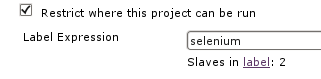
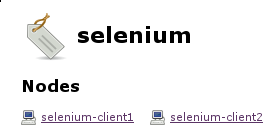
TIP 2: Execute the following script on $JENKINS_SERVER/script to get a list of available labels of your Jenkins system:
import hudson.model.*
labels = Hudson.instance.getLabels()
labels.each  label -> println label.name  
Solution: In the according customer setup we re using the swarm plugin (with automated Debian deployment through Grml s netscript boot option, grml-debootstrap + Puppet) to automatically connect our Jenkins slaves to Jenkins master without any manual intervention. The swarm plugin allows you to define the labels through the -labels command line option. By using the NodeLabel Parameter plugin we can configure additional parameters in Jenkins jobs: node and label . The label parameter allows us to execute the jobs on the nodes providing the requested label: This is what we can use to gradually upgrade from the old Iceweasel version to the new one by keeping a given set of slaves at the old Iceweasel version while we re upgrading other nodes to the new Iceweasel version (same for the selenium-server version which we want to also control). We can include the version number of the Iceweasel and selenium-server packages inside the labels we announce through the swarm slaves, with something like:
if [ -r /etc/init.d/selenium-server ] ; then
  FLAGS="selenium"
  ICEWEASEL_VERSION="$(dpkg-query --show --showformat='$ Version ' iceweasel)"
  if [ -n "$ICEWEASEL_VERSION" ] ; then
    ICEWEASEL_FLAG="iceweasel-$ ICEWEASEL_VERSION%%.* "
    EXTRA_FLAGS="$EXTRA_FLAGS $ICEWEASEL_FLAG"
  fi
  SELENIUM_VERSION="$(dpkg-query --show --showformat='$ Version ' selenium-server)"
  if [ -n "$SELENIUM_VERSION" ] ; then
    SELENIUM_FLAG="selenium-$ SELENIUM_VERSION%-* "
    EXTRA_FLAGS="$EXTRA_FLAGS $SELENIUM_FLAG"
  fi
fi
Then by using -labels $FLAGS EXTRA_FLAGS in the swarm invocation script we end up with labels like selenium iceweasel-24 selenium-2.40.0 for the slaves providing the Iceweasel v24 and selenium v2.40.0 Debian packages and selenium iceweasel-17 selenium-2.40.0 for the slaves providing Iceweasel v17 and selenium v2.40.0. This is perfect for our needs, because instead of using the selenium label (which is still there) we can configure the selenium jobs that should continue to work as usual to default to the slaves with the iceweasel-17 label now. The development related jobs though can use label iceweasel-24 and fail as often as needed without interrupting the build pipeline used for production. To illustrate this here we have slave selenium-client2 providing Iceweasel v17 with selenium-server v2.40. When triggering the production selenium job it will get executed on selenium-client2, because that s the slave providing the requested labels: Whereas the development selenium job can point to the slaves providing Iceweasel v24, so it will be executed on slave selenium-client1 here: This setup allowed us to work on the selenium Ruby tests while not conflicting with any production build pipeline. By the time I m writing about this setup we ve already finished the migration to support Iceweasel v24 and the infrastructure is ready for further Iceweasel and selenium-server upgrades.

Russ Allbery: Review: Air Apparent

Review: Air Apparent, by Mark Monmonier
Publisher: University of Chicago
Copyright: 1999
Printing: 2000
ISBN: 0-226-53423-5
Format: Trade paperback
Pages: 232
Subtitled "how meteorologists learned to map, predict, and dramatize the weather," Air Apparent is a history of weather maps. Mapping the weather is a surprisingly new field, dating only from the early 19th century when a combination of scientific understanding and the ability to combine scattered observations made it practical. They're also a particularly tricky problem since weather is inherently three-dimensional, and even to the present day nearly all of our maps are two-dimensional. Monmonier starts with the earliest observational maps and the attempts to use them for prediction and tracks developments up to the late 1990s, with TV weathermen and (simple) interactive web data viewers. I got a copy of this book after Paul Krugman mentioned it. I don't know a lot about weather forecasting or weather maps, but I remembered finding the science of weather fronts and maps of them fascinating in high school, and I hoped I'd get the same feeling from this. Unfortunately, I probably need to stop reading Monmonier's books; they always sound interesting, but I don't enjoy reading them. One thing that's important to know is that this is not a history of meteorology. One can't hold that against the book, of course, because it never claimed to be. But it has just enough of a history of meteorology mixed into its history of map-making to make at least this reader wish he were reading that other book. I like maps, I really do, but I was hoping for either a book that melded a history of the science of weather forecasting with the maps that were used in that science, or a book that dove deep into the effective and ineffective ways to make weather maps (ideally, Edward R. Tufte for maps). This is neither; it's little more or less than a detailed history of the making of weather maps. Each time it gets close to a clear explanation of the underlying meteorology, it finds a map to examine and skips the rest of the explanation. I kept almost understanding the underlying science, but not enough to really understand the goals of the map makers, or why one presentation was better than another, or how those presentations were used to make forecasts or track weather data. I think I would have found this book more interesting in conjunction with a full history of meteorology, but I suspect that a history of meteorology would include enough about the maps to render this book largely redundant for the casual reader. The other problem I had with this book is that it's very dry. Monmonier is clearly trying, and clearly cares a lot about his topic, but the book has no flow. I kept getting lost in the barrage of names, arguments over technique, and struggles for government funding. It's hard to put a finger on why the book didn't grab me; the closest I can come is that it's a book stuffed full of facts. Monmonier did exhaustive historical research on weather map making, saved numerous quotes from original documents, and laid it all out chronologically. That's fine if you just want the information, but I was looking to be entertained in the process, and that didn't happen. I think the problems get worse in the second half of the book, when weather satellites and computers enter the picture and the laborious, manual map-making fall out, although maybe I was just exhausted with the book by then. The early history of weather maps at least has the benefit of showing the logistical struggles behind creating an effective weather service: insufficient observation points, slow communication methods, and the need for skilled map-makers to turn measurements into visual representations. Once computers and satellite photography enter the picture, the science matters even more, and I think the reader needs a better understanding of the underlying science to make sense of the results. Air Apparent has a tendency to provide a brief introduction to the type of data, a detailed chronological history, and then a discussion of the ways of presenting and representing that data, without ever getting the reader to care about the data itself or see how it ties into forecasting. Part of the problem, I suspect, is that the history of meteorology seems to be full of sensible, careful people who largely did sensible, careful things with the data they had available at the time. This is great for the advancement of science, and not so helpful at making a history engrossing. I wish I could say that I was glad I read this book for the information, if not the presentation, but unfortunately I didn't retain much. I needed some sort of structure or frame on which to hang all of the specifics, some sense of story or controversy or at least scientific understanding, and I didn't get it. It took me a couple of months to finish this book because I kept setting it down to read other things, and I only finished it out of a combination of stubbornness and knowledge that other people liked it. If the topic sounds interesting, well, this book exists, and it's gotten several good reviews. But I'm afraid I can't recommend it. Rating: 4 out of 10

Vasudev Kamath: Gzipped response for CSS/JS with Apache and mod_uwsgi

So it may sound normal to receive compressed response for CSS/JS file from Apache2 but what I faced is completely different behavior, here I saw not just body of response but also header are getting compressed and send to browser and browser was unable to interpret the response there by leading page rendered without CSS and JS. That was long story short, so let me explain in detail the case and what I found out. I have hosted SILPA on my VPS using uWSGI. I had used till date using libapache2-mod-proxy-uwsgi plugin for which uWSGI should be using network socket and in Apache2 config I need ProxyPass directive pointing to uwsgi://host:port and everything used to work out of box. There is a drawback for using network socket in uWSGI that is limited amount of ports (65535) and possible clash with other services if we use wrong port number, additionally network sockets will be slower compared to the file socket so yesterday I thought of changing it to file socket and removed socket directive in the ini file for uWSGI application container for SILPA and here is where all problems started. My updated configuration can be seen in our documentation page that is if you are interested to look my configuration file :-).
Problem Reporting We got selected to Gsoc again this year and we have lot of students jumping in our channel #silpa on irc.freenode.net and yesterday night some students reported they are facing 500 internal server error and subsequently others mentioned there is no theme being rendered. I checked and found everything was fine for me only to notice that my browser was using cached content, and when I clear cache there I go everything vanished, no theme no css no javascript just plain html!!!.
Investigation So I thought I should investigate this and fired up firebug on my iceweasel to observe the network traffic. And below is what I observed in firebug network console!. No response headers So you can see no response header in the above image but there is a response and below how is response content visible on firebug. gzipped response Still weird part was when using wget/curl directly to get the CSS I was getting correct reply and the file, which is puzzling. So I went ahead opened the CSS url directly using browser and saved the resulting file. When I used file command on it, output suggested the saved file in gzip compressed!. I went ahead uncompressed it and opened the file and inside it I found response header and the response body! So what just happened? Did apache some how manage to compress entire respone not just response body? The more puzzling question was why did it work when I was using mod_proxy_uwsgi and failed when I switched to mod_uwsgi. I had no clue at this point why this behavior is coming up.
Possible Solution I was still not sure how to resolve this, and started searching in the network but nothing was coming up in search result which can explain me this. And finally I stumbled on a link which is totally unrelated but I saw the word mod_deflate in the content and wandered on my system to see if its enabled. Yes mod_deflate was enabled I just opened the conf file and saw following.
<IfModule mod_deflate.c>
       # these are known to be safe with MSIE 6
       AddOutputFilterByType DEFLATE text/html text/plain text/xml
       # everything else may cause problems with MSIE 6
       AddOutputFilterByType DEFLATE text/css
       AddOutputFilterByType DEFLATE application/x-javascript application/javascript application/ecmascript
       AddOutputFilterByType DEFLATE application/rss+xml
</IfModule>
Interesting so it suggests to compress css, javascript files etc. So I thought possibly its compressing the result of mod_uwsgi, yeah possibly so why not try disabling mod_deflate and check if it works well and good if not I'm not gonna loose anything. So I disabled mod_deflate and voila! Everything is working fine!
What might be the reason for this behavior? Well I'm not exactly sure but here is my assumption. The whole behavior depends on internal implementation of mod_uwsgi and mod_proxy_uwsgi module. To confirm this I switched back to use mod_proxy_uwsgi module and enabled mod_deflate and observed request response in Firebug network console and below is what I observed. Response with mod_proxy_uwsgi So response is still gziped but this time only response body was gziped and Content-Encoding field was set properly which makes browser to properly uncompress the response body and use it. So it seems like there is a difference between mod_uwsgi and mod_proxy_uwsgi implementation. mod_uwsgi was sending the response along with response headers which was compressed by mod_deflate there by rendering browser helpless to interpret the response. But mod_proxy_uwsgi seems to be only sending the response content without response body and this content was later compressed by mod_deflate and proper response headers were set by apache before sending it to browser. So now whose fault is this? Is it the bug in mod_uwsgi or, mod_deflate not being able to exclude response headers from compression? I've no clue! If you have a clue and you want to share it with me, please consider writing to me over email. My details are available in Contacts

28 February 2014

Daniel Pocock: Google Summer of Code opportunities in data science and machine learning with Ganglia

As mentioned in my blog on Monday, the Ganglia Project is proud to be part of Google Summer of Code in 2014 The Ganglia team are offering various types of projects and different parts of Ganglia would welcome students with different skills, for example:
Component Skills
gmond agent C
gmond modules C or Python
JMXetric Java
gmetad and rrdtool for storing time series data C
Ganglia web interface JavaScript and jQuery
Ganglia integration (e.g. ganglia-nagios-bridge) Python
Big data right under your nose I have had many queries from students about how to get into data science. Very few students will be lucky enough to get an internship where they can study time-series from the financial markets and experiment making their own trading algorithms. On the other hand, network performance data is everywhere. It is real-time. It is surprisingly similar in some ways to processing financial data and it provides excellent opportunities for students to practice data science skills and make a meaningful contribution to solving real problems. Finding public Ganglia data with Google Many large organizations, including universities, governments and corporations are using Ganglia to gather metrics from all the hosts in their networks. Some of them even expose this data to the public. Here are two Google searches you can use to find them:
Courtesy of Universit Montpellier 2, France Some sites may even expose their data as an XML feed, you can try and extract it by connecting to the Ganglia server on one of these ports
Port Comments
8649 gmond: sends an XML snapshot to anybody who connects
8651 gmetad: sends an XML snapshot to anybody who connects
8651 gmetad: works a little bit like HTTP, returns a subset of the XML snapshot when you make a GET request
You can discover a Ganglia environment in your campus by looking for a gmond process on your machine and the gmond.conf file, often in /etc/gmond.conf or /etc/ganglia/gmond.conf. That file may contain a clue about the name of the host where Ganglia data is aggregated:
udp_send_channel  
  host = ganglia-reports.example.edu
  port = 8649
  ttl = 1
 
This tells you that the host ganglia-reports.example.edu is collecting the data - you could try the URL http://ganglia-reports.example.edu/ganglia/ in a web browser or try connecting to one of the TCP ports 8649, 8651 or 8652 on that host. Here is an example with netcat:
$ nc ganglia-reports.example.edu 8649   grep ^.H
It will return a list of all hosts that Ganglia knows about. Once you have a data feed, you can then configure a gmetad process on your own system to poll the remote system and generate local RRDs for you to study. Install your own Ganglia It is very easy to get your own Ganglia setup. On a Debian or Ubuntu system, just do:
# apt-get update
# apt-get install ganglia-monitor ganglia-webfrontend
On Fedora and RPM-based systems (such as CentOS or RHEL with EPEL) you can do:
# yum install ganglia-gmond ganglia-web
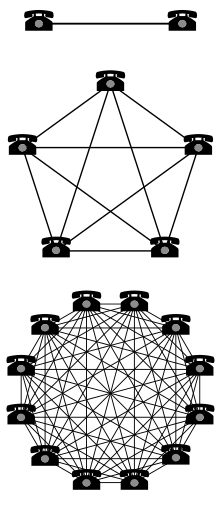
Everything should be autoconfigured. You can then browse to http://localhost/ganglia to see the charts. If you have several hosts with the gmond agent (just the ganglia-monitor.deb or ganglia-gmond.rpm) on the same LAN, they will automatically find each other using multicast and you will see an aggregated report on the machine with the web server. The data is real-time It is important to keep in mind that the data is real-time. This means you can often detect problems in real-time. If this blog appears on slashdot, for example, then that image from Universit Montpellier 2 will be hit many times. The image actually shows the network load on the web server producing the image, so you will see the slashdot effect graphically in the image itself. Processing real-time data is often the most advanced step in any data science exercise. Initially, you may simply log a few days of data to RRD files to start studying a static data set with your tool of choice, whether it is the R project, Weka or Hadoop Once you have a a hypothesis (for example, an algorithm that understands the normal characteristics of each metric) you may then take each new real-time value from the gmetad XML and test it with the algorithm. The algorithm would then raise an alert if any metric on any host deviates from its normal behavior. Mixing in other sources of data Depending upon the computing environment in your campus or organization, you may also be able to get other data sources, such as a list of people logged in to different machines at different times and the processes that each user starts and stops. This might help to make more accurate predictions about when network or computing resources will be under stress. For example, if users bob, alice and eve all appear on the same host, your algorithm might conclude that the load average will reach an excessive level within 15 minutes and send those three users a suggestion to each try other machines. Making a successful application for GSoC 2014 Here are some tips
  • For all organizations/projects
  • For Ganglia and the data science project in particular
    • Join the ganglia-general mailing list and send an email to introduce yourself
    • Try Ganglia on your own Linux system. Use the packages, it is really easy. Send an email to the list with any questions.
    • Explore the source code in github - ask us questions about it. For the data science project, you may also need to look at RRDtool source code and documentation about making a plugin for R (using C)
    • You don't have to do it our way: if you prefer to work with another tool instead of R, please tell us your idea
    • Write some skeleton code or make a diagram to explain what you want to do. While you do this, do you think of any new questions or problems? Make a list of them.
    • We want to give every student a small coding task as a test. Please tell us which language you prefer (e.g. C, Java, Python) so we can give you a suitable test. If you are really keen, follow the link to bugs I reported in Debian, look for one that is easy and try to write a small patch for it - helping fix bugs that annoy your mentor is likely to be a good way to get on the short-list for selection.

Russell Coker: Links February 2014

The Economist has an interesting and informative article about the lack of reproducability of scientific papers and the implications for scientific research [1]. Regina Dugan gave an interesting TED talk about some of the amazing DARPA projects [2]. Chris Anderson interviewed Elon Musk about the Tesla cars, SpaceX, and his new venture Solar City [3]. Elon has a lot of great ideas for improving humanity while also making money. Smart Planet has an interesting article about Bhutan s switch to electric vehicles [4]. Paul Piff gave an insightful and well researched TED talk about the ways that money makes people mean [5]. Maryn McKenna wrote an interesting article for Wired about what happens when the current anti-biotics stop working [6]. Unfortunately she lists increasing food prices as a consequence, really the unreasonably low price of meat is due to the misuse of anti-biotics that is causing this problem. Linda Walther Tirado wrote an interesting article about being poor titled Why I Make Terrible Decisions, or, Poverty Thoughts [7]. It gives a real insight into the situation of people who are trapped in poverty. When someone who is as obviously intelligent as Linda feels that it s impossible to escape poverty there is a real problem in the system. While Australia doesn t suck nearly as badly as the US in this regard (higher minimum wage and better health care) we still need to improve things, I know people in Australia who s experience bears some similarity to Linda s. Maxwell Neely-Cohen wrote an interesting article about peer pressure [8]. Some of the conclusions are dubious, but the ideas on the way the Internet changes peer relationships in high school are interesting. An English pediatrician wrote an article for The Daily Beast about why he won t accept anti-vac clients [9]. There are some decent people in the Liberal Party, Liberal MP Warren Entsch attacks Cory Bernardi on gay obsession [10]. AFAIK we haven t yet had a gay sex scandal involving a homophobic Australian politician

Michael Prokop: State of the art Debian/wheezy deployments with GRUB and LVM/SW-RAID/Crypto

Moving from Lilo to GRUB, using LVM as default, etc throughout the last years it was time to evaluate how well LVM works without a separate boot partition, possibly also on top of Software RAID. Big disks are asking for partitioning with GPT, just UEFI isn t my default yet, so I m still defaulting to Legacy BIOS for Debian/wheezy (I expect this to change for Debian/jessie and according hardware approaching at my customers). So what we have and want in this demonstration setup: System used for installation:
root@grml ~ # grml-version
grml64-full 2013.09 Release Codename Hefeknuddler [2013-09-27]
Partition setup:
root@grml ~ # parted /dev/sda
GNU Parted 2.3
Using /dev/sda
Welcome to GNU Parted! Type 'help' to view a list of commands.
(parted) mklabel gpt
(parted) mkpart primary 2048s 4095s
(parted) set 1 bios_grub on
(parted) name 1 "BIOS Boot Partition"
(parted) mkpart primary 4096s 100%
(parted) set 2 raid on
(parted) name 2 "SW-RAID / Linux"
(parted) quit
Information: You may need to update /etc/fstab.
Clone partition layout from sda to all the other disks:
root@grml ~ # for f in  b,c,d  ; sgdisk -R=/dev/sd$f /dev/sda
The operation has completed successfully.
Make sure each disk has its unique UUID:
root@grml ~ # for f in  b,c,d  ; sgdisk -G /dev/sd$f
The operation has completed successfully.
SW-RAID setup:
root@grml ~ # mdadm --create /dev/md0 --verbose --level=raid5 --raid-devices=4 /dev/sd a,b,c,d 2
mdadm: layout defaults to left-symmetric
mdadm: chunk size defaults to 512K
mdadm: size set to 1465004544K
mdadm: Defaulting to version 1.2 metadata
mdadm: array /dev/md0 started.
root@grml ~ #
SW-RAID speedup (system dependent, YMMV):
root@grml ~ # cat /sys/block/md0/md/stripe_cache_size
256
root@grml ~ # echo 16384 > /sys/block/md0/md/stripe_cache_size # 16MB
root@grml ~ # blockdev --getra /dev/md0
6144
root@grml ~ # blockdev --setra 65536 /dev/md0 # 32 MB
root@grml ~ # sysctl dev.raid.speed_limit_max
dev.raid.speed_limit_max = 200000
root@grml ~ # sysctl -w dev.raid.speed_limit_max=9999999999
dev.raid.speed_limit_max = 9999999999
root@grml ~ # sysctl dev.raid.speed_limit_min
dev.raid.speed_limit_min = 1000
root@grml ~ # sysctl -w dev.raid.speed_limit_min=100000
dev.raid.speed_limit_min = 100000
LVM setup:
root@grml ~ # pvcreate /dev/md0
  Physical volume "/dev/md0" successfully created
root@grml ~ # vgcreate homesrv /dev/md0
  Volume group "homesrv" successfully created
root@grml ~ # lvcreate -n rootfs -L4G homesrv
  Logical volume "rootfs" created
root@grml ~ # lvcreate -n bootfs -L1G homesrv
  Logical volume "bootfs" created
Check partition setup + alignment:
root@grml ~ # parted -s /dev/sda print
Model: ATA WDC WD15EADS-00P (scsi)
Disk /dev/sda: 1500GB
Sector size (logical/physical): 512B/512B
Partition Table: gpt
Number  Start   End     Size    File system  Name                 Flags
 1      1049kB  2097kB  1049kB               BIOS Boot Partition  bios_grub
 2      2097kB  1500GB  1500GB               SW-RAID / Linux      raid
root@grml ~ # parted -s /dev/sda unit s print
Model: ATA WDC WD15EADS-00P (scsi)
Disk /dev/sda: 2930277168s
Sector size (logical/physical): 512B/512B
Partition Table: gpt
Number  Start  End          Size         File system  Name                 Flags
 1      2048s  4095s        2048s                     BIOS Boot Partition  bios_grub
 2      4096s  2930276351s  2930272256s               SW-RAID / Linux      raid
root@grml ~ # gdisk -l /dev/sda
GPT fdisk (gdisk) version 0.8.5
Partition table scan:
  MBR: protective
  BSD: not present
  APM: not present
  GPT: present
Found valid GPT with protective MBR; using GPT.
Disk /dev/sda: 2930277168 sectors, 1.4 TiB
Logical sector size: 512 bytes
Disk identifier (GUID): 212E463A-A4E3-428B-B7E5-8D5785141564
Partition table holds up to 128 entries
First usable sector is 34, last usable sector is 2930277134
Partitions will be aligned on 2048-sector boundaries
Total free space is 2797 sectors (1.4 MiB)
Number  Start (sector)    End (sector)  Size       Code  Name
   1            2048            4095   1024.0 KiB  EF02  BIOS Boot Partition
   2            4096      2930276351   1.4 TiB     FD00  SW-RAID / Linux
root@grml ~ # mdadm -E /dev/sda2
/dev/sda3:
          Magic : a92b4efc
        Version : 1.2
    Feature Map : 0x0
     Array UUID : 7ed3b741:0774d529:d5a71c1f:cf942f0a
           Name : grml:0  (local to host grml)
  Creation Time : Fri Jan 31 15:26:12 2014
     Raid Level : raid5
   Raid Devices : 4
 Avail Dev Size : 2928060416 (1396.21 GiB 1499.17 GB)
     Array Size : 4392089088 (4188.62 GiB 4497.50 GB)
  Used Dev Size : 2928059392 (1396.21 GiB 1499.17 GB)
    Data Offset : 262144 sectors
   Super Offset : 8 sectors
          State : clean
    Device UUID : c1e4213b:81822fd1:260df456:2c9926fb
    Update Time : Mon Feb  3 09:41:48 2014
       Checksum : b8af8f6 - correct
         Events : 72
         Layout : left-symmetric
     chunk size : 512k
   Device Role : Active device 0
   Array State : AAAA ('A' == active, '.' == missing)
root@grml ~ # pvs -o +pe_start
  PV         VG      Fmt  Attr PSize PFree 1st PE
  /dev/md0   homesrv lvm2 a--  4.09t 4.09t   1.50m
root@grml ~ # pvs --units s -o +pe_start
  PV         VG      Fmt  Attr PSize       PFree       1st PE
  /dev/md0   homesrv lvm2 a--  8784175104S 8773689344S   3072S
root@grml ~ # pvs -o +pe_start
  PV         VG      Fmt  Attr PSize PFree 1st PE
  /dev/md0   homesrv lvm2 a--  4.09t 4.09t   1.50m
root@grml ~ # pvs --units s -o +pe_start
  PV         VG      Fmt  Attr PSize       PFree       1st PE
  /dev/md0   homesrv lvm2 a--  8784175104S 8773689344S   3072S
root@grml ~ # vgs -o +pe_start
  VG      #PV #LV #SN Attr   VSize VFree 1st PE
  homesrv   1   2   0 wz--n- 4.09t 4.09t   1.50m
root@grml ~ # vgs --units s -o +pe_start
  VG      #PV #LV #SN Attr   VSize       VFree       1st PE
  homesrv   1   2   0 wz--n- 8784175104S 8773689344S   3072S
Cryptsetup:
root@grml ~ # echo cryptsetup >> /etc/debootstrap/packages
root@grml ~ # cryptsetup luksFormat -c aes-xts-plain64 -s 256 /dev/mapper/homesrv-rootfs
WARNING!
========
This will overwrite data on /dev/mapper/homesrv-rootfs irrevocably.
Are you sure? (Type uppercase yes): YES
Enter passphrase:
Verify passphrase:
root@grml ~ # cryptsetup luksOpen /dev/mapper/homesrv-rootfs cryptorootfs
Enter passphrase for /dev/mapper/homesrv-rootfs:
Filesystems:
root@grml ~ # mkfs.ext4 /dev/mapper/cryptorootfs
mke2fs 1.42.8 (20-Jun-2013)
Filesystem label=
OS type: Linux
Block size=4096 (log=2)
Fragment size=4096 (log=2)
Stride=128 blocks, Stripe width=384 blocks
262144 inodes, 1048192 blocks
52409 blocks (5.00%) reserved for the super user
First data block=0
Maximum filesystem blocks=1073741824
32 block groups
32768 blocks per group, 32768 fragments per group
8192 inodes per group
Superblock backups stored on blocks:
        32768, 98304, 163840, 229376, 294912, 819200, 884736
Allocating group tables: done
Writing inode tables: done
Creating journal (16384 blocks): done
Writing superblocks and filesystem accounting information: done
root@grml ~ # mkfs.ext4 /dev/mapper/homesrv-bootfs
mke2fs 1.42.8 (20-Jun-2013)
Filesystem label=
OS type: Linux
Block size=4096 (log=2)
Fragment size=4096 (log=2)
Stride=128 blocks, Stripe width=384 blocks
65536 inodes, 262144 blocks
13107 blocks (5.00%) reserved for the super user
First data block=0
Maximum filesystem blocks=268435456
8 block groups
32768 blocks per group, 32768 fragments per group
8192 inodes per group
Superblock backups stored on blocks:
        32768, 98304, 163840, 229376
Allocating group tables: done
Writing inode tables: done
Creating journal (8192 blocks): done
Writing superblocks and filesystem accounting information: done
Install Debian/wheezy:
root@grml ~ # mount /dev/mapper/cryptorootfs /media
root@grml ~ # mkdir /media/boot
root@grml ~ # mount /dev/mapper/homesrv-bootfs /media/boot
root@grml ~ # grml-debootstrap --target /media --password YOUR_PASSWORD --hostname YOUR_HOSTNAME
 * grml-debootstrap [0.57] - Please recheck configuration before execution:
   Target:          /media
   Install grub:    no
   Using release:   wheezy
   Using hostname:  YOUR_HOSTNAME
   Using mirror:    http://http.debian.net/debian
   Using arch:      amd64
   Important! Continuing will delete all data from /media!
 * Is this ok for you? [y/N] y
[...]
Enable grml-rescueboot (to have easy access to rescue ISO via GRUB):
root@grml ~ # mkdir /media/boot/grml
root@grml ~ # wget -O /media/boot/grml/grml64-full_$(date +%Y.%m.%d).iso http://daily.grml.org/grml64-full_testing/latest/grml64-full_testing_latest.iso
root@grml ~ # grml-chroot /media apt-get -y install grml-rescueboot
[NOTE: We're installing a daily ISO for grml-rescueboot here because the 2013.09 Grml release doesn't work for this LVM/SW-RAID setup while newer ISOs are working fine already. The upcoming Grml stable release is supposed to work just fine, so you will be able to choose http://download.grml.org/grml64-full_2014.XX.iso by then. :)] Install GRUB on all disks and adjust crypttab, fstab + initramfs:
root@grml ~ # grml-chroot /media /bin/bash
(grml)root@grml:/# for f in  a,b,c,d  ; do grub-install /dev/sd$f ; done
(grml)root@grml:/# update-grub
(grml)root@grml:/# echo "cryptorootfs /dev/mapper/homesrv-rootfs none luks" > /etc/crypttab
(grml)root@grml:/# echo "/dev/mapper/cryptorootfs / auto defaults,errors=remount-ro 0   1" > /etc/fstab
(grml)root@grml:/# echo "/dev/mapper/homesrv-bootfs /boot auto defaults 0 0" >> /etc/fstab
(grml)root@grml:/# update-initramfs -k all -u
(grml)root@grml:/# exit
Clean unmounted/removal for reboot:
root@grml ~ # umount /media/boot
root@grml ~ # umount /media/
root@grml ~ # cryptsetup luksClose cryptorootfs
root@grml ~ # dmsetup remove homesrv-bootfs
root@grml ~ # dmsetup remove homesrv-rootfs
NOTE: On a previous hardware installation I had to install GRUB 2.00-22 from Debian/unstable to get GRUB working.
Some metadata from different mdadm and LVM experiments seems to have been left and confused GRUB 1.99-27+deb7u2 from Debian/wheezy (I wasn t able to reproduce this issue in my VM demo/test setup).
Just in cause you might experience the following error message, try GRUB >=2.00-22:
  # grub-install --recheck /dev/sda
  error: unknown LVM metadata header.
  error: unknown LVM metadata header.
  /usr/sbin/grub-probe: error: cannot find a GRUB drive for /dev/mapper/cryptorootfs.  Check your device.map.
  Auto-detection of a filesystem of /dev/mapper/cryptorootfs failed.
  Try with --recheck.
  If the problem persists please report this together with the output of "/usr/sbin/grub-probe --device-map="/boot/grub/device.map"
  --target=fs -v /boot/grub" to <bug-grub@gnu.org>

Andrew Pollock: [life] Day 31, Coochiemudlo Island to Melbourne in one day

Wow, today was pretty crazy in terms of the travel we managed to pack into one day. This morning, Zoe woke up at about 5:30am and jumped into bed with me for a snuggle and another half hour nap. After that we got up. Zoe had been eyeing off the egg cups in the house, and so I'd wanted to do soft-boiled eggs for breakfast. So we doused ourselves in mosquito repellent and raided the chicken coop. I don't think I've ever cooked soft-boiled eggs in my entire adult life, and today wasn't an exception. They came out hard-boiled. Zoe still ate them anyway, she just couldn't do the toast soldier thing. I need to buy some egg cups for home and we can try again. I hear the Thermomix can do boiled eggs. After breakfast and a shower, I got stuck into packing up and cleaning the house, and Zoe watched TV. At 8am she turned off the TV and declared she wanted to play in the yard. It was nice to see that she wanted to do something more than just veg out in front of the TV, without prompting. I had us all packed up by about 8:30am and we were only 5 minutes from where the barge docked, so we drove over to the other end of the island to take a look at the place at high tide. It was quite different from the two days before in the afternoon at low tide. The stick that we'd walked out to was barely above the waterline. Then we drove back to wait in the queue for the barge. The barge journey back was uneventful and we made it back home by 10am, which was about the time I was expecting, and rendezvoused with my girlfriend, and did a fast unpack and repack. We then headed to the airport, arriving comfortably with enough time to check our luggage and get some lunch to take onto the plane. Zoe was great for the flight down. She watched Brave on the in-flight WiFi entertainment on my phone, and got to fit the whole movie in before we landed, but this meant she skipped a nap. By the time we got to Melbourne Airport, she was in the post-tired manic state, but we weren't in any particular rush, so we had a very roundabout trip to baggage claim, and then after we'd acquired some Myki cards, caught a taxi to our accommodation in South Melbourne. After we'd unpacked and settled in, and I'd gotten some supplies from the local convenience store, we caught a tram into Bourke Street to go to Chinatown for dinner, after checking out the view from the observation deck on the 28th floor. We found a great dumpling place, and Zoe really enjoyed the pork dumpling and noodle soup that I ordered for her. She kept alternating between eating the noodles with her training chopsticks and the broth with one of the big spoons. She was getting really over-tired and over-stimulated by this point, so it was quite a bit of cat-herding to get to Chinatown, and more so getting back to a tram to come back. We got home, Zoe had a quick shower and went to bed without a peep. Her room is nice and dark, so I'm hoping that she'll have a bit of a sleep in tomorrow. (Wishful thinking). I'm really quite pleased with how smoothly today's travel went. Everything went off without a hitch.

Next.

Previous.