A tweet of a friend pointed me at the removal of dovecot from Debian/testing, which surprised me a bit. Investigating the situation it seems that Dovecot in Debian is lagging a bit behind in releases, and hasn t seen responses to some RC bugs. This sounds critical to me as dovecot is a core part of many mail setups, so I prepared updated packages.

Based on the latest released version of Dovecot, 2.3.10, I have made a package starting from the current Debian packaging and adjusted to the newer upstream. The package builds on Debian Buster (10), Testing, and Unstable on i386 and x64 archs. The packages are available on OBS, as usual:
For Unstable:
/etc/apt/trusted.gpg.d/obs-npreining.asc.
These packages are provided without any warranty. Enjoy.


| Publisher: | Penguin |
| Copyright: | 2020 |
| ISBN: | 0-525-56022-X |
| Format: | Kindle |
| Pages: | 249 |
A maintenance release of our (still small) ttdo package just arrived on CRAN. As introduced last fall, the ttdo package extends the most excellent (and very minimal / zero depends) unit testing package tinytest by Mark van der Loo with the very clever and well-done diffobj package by Brodie Gaslam to give us test results with visual diffs:
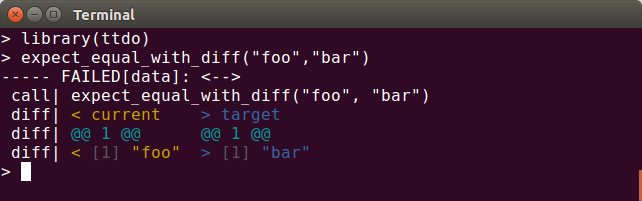
tinytest has an extension mechanism we use, and as tinytest was just upgraded to version 1.2.0 changing, among other nice extensions, one interface by allowing for a new error class argument, we had to rebuild as well in order to document the new argument.
The release was actually prepared three days ago when tinytest itself was updated, but we waited for the binaries at CRAN to be updated and rebuilt to take advantage of the fully automated submission and test process at CRAN.
The NEWS entry follow.
CRANberries provides the usual summary of changes to the previous version. Please use the GitHub repo and its issues for any questions. If you like this or other open-source work I do, you can now sponsor me at GitHub. For the first year, GitHub will match your contributions.Changes in ttdo version 0.0.5 (2020-05-06)
- Rebuilt under tinytest 1.2.0 to add support for
classargument in error-code test predicates
This post by Dirk Eddelbuettel originated on his Thinking inside the box blog. Please report excessive re-aggregation in third-party for-profit settings.
sip:657837644.522827@192.168.169.170Now if only jami would reduce its memory usage, I could even recommend this setup to others. :) As usual, if you use Bitcoin and want to show your support of my activities, please send Bitcoin donations to my address 15oWEoG9dUPovwmUL9KWAnYRtNJEkP1u1b.
We had to cancel R/Finance 2020 due to what is happening all around us. But I plan to present the one-hour workshop I often give in the tutorial session preceding the first day but this time online!
To keep it simple, we will stick with the same day, and possibly the same time: Friday morning at 8:00am! So that makes Friday, June 5, at 08:00h Central time.
This YouTube! link should then provide the stream, I reckon there may also be a recording afterwards.
The talk / demo / presentation will be about an hour long, and material should be similar to the previous ones (of the same length) still available at the talks page (which also has longer talks all the way to the two-day workshops).
If you like this or other open-source work I do, you can now sponsor me at GitHub. For the first year, GitHub will match your contributions.
This post by Dirk Eddelbuettel originated on his Thinking inside the box blog. Please report excessive re-aggregation in third-party for-profit settings.
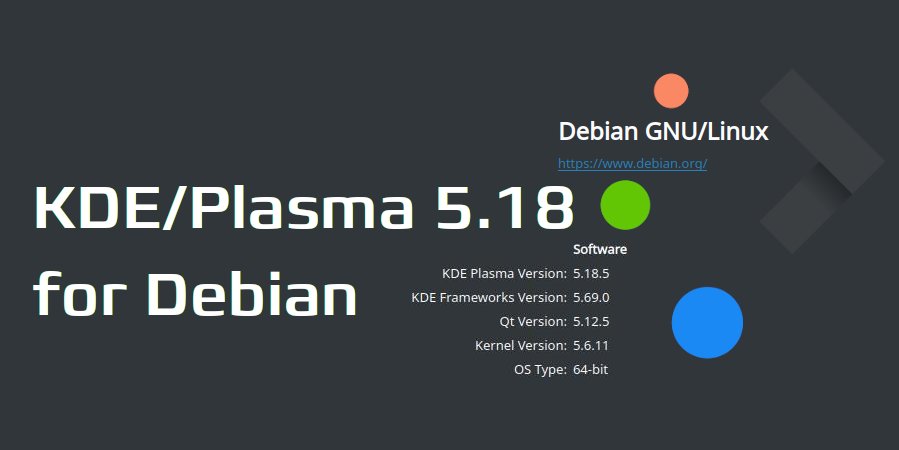
After the KDE Apps update 20.04, now the recently released Plasma 5.18.5 is ready for Debian.
Furthermore, since the most recent version of the KDE frameworks have been uploaded to Debian/experimental, I have adapted the packages to make upgrades to the versions in experimental and hopefully soon in unstable smooth. I am also working with the Debian KDE Qt Team to update KDE Apps and Plasma in Debian proper. Stay tuned.
For now, here is what you need: Use the following APT sources in /etc/apt/sources.list.d/obs-npreining-kde.list:

For Unstable:
/etc/apt/trusted.gpg.d/obs-npreining.asc.
Enjoy.
Welcome to the April 2020 report from the Reproducible Builds project. In our regular reports we outline the most important things that we and the rest of the community have been up to over the past month.
What are reproducible builds? One of the original promises of open source software is that distributed peer review and transparency of process results in enhanced end-user security. But whilst anyone may inspect the source code of free and open source software for malicious flaws, almost all software today is distributed as pre-compiled binaries. This allows nefarious third-parties to compromise systems by injecting malicious code into seemingly secure software during the various compilation and distribution processes.
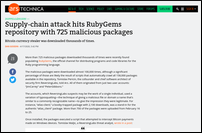
It was discovered that more than 725 malicious packages were downloaded thousands of times from RubyGems, the official channel for distributing code for the Ruby programming language. Attackers used a variation of typosquatting and replaced hyphens and underscores (for example, uploading a malevolent atlas-client in place of atlas_client) that executed a script that intercepted Bitcoin payments. (Ars Technica report)
Bernhard M. Wiedemann launched ismypackagereproducibleyet.org, a service that takes a package name as input and displays whether the package is reproducible in a number of distributions. For example, it can quickly show the status of Perl as being reproducible on openSUSE but not in Debian. Bernhard also improved the documentation of his unreproducible package to add some example patches for hash issues. [ ].
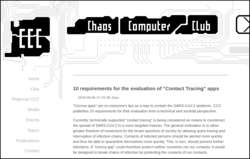
There was a post on Chaos Computer Club s website listing Ten requirements for the evaluation of Contact Tracing apps in relation to the SARS-CoV-2 epidemic. In particular:
4. Transparency and verifiability: The complete source code for the app and infrastructure must be freely available without access restrictions to allow audits by all interested parties. Reproducible build techniques must be used to ensure that users can verify that the app they download has been built from the audited source code.Elsewhere, Nicolas Boulenguez wrote a patch for the Ada programming language component of the GCC compiler to skip
-f.*-prefix-map options when writing Ada Library Information files. Amongst other properties, these .ali files embed the compiler flags used at the time of the build which results in the absolute build path being recorded via -ffile-prefix-map, -fdebug-prefix-map, etc.
In the Arch Linux project, kpcyrd reported that they held their first rebuilder workshop . The session was held on IRC and participants were provided a document with instructions on how to install and use Arch s repro tool. The meeting resulted in multiple people with no prior experience of Reproducible Builds validate their first package. Later in the month he also announced that it was now possible to run independent rebuilders under Arch in a hands-off, everything just works solution to distributed package verification.
Mathias Lang submitted a pull request against dmd, the canonical compiler for the D programming languageto add support for our SOURCE_DATE_EPOCH environment variable as well the other C preprocessor tokens such __DATE__, __TIME__ and __TIMESTAMP__ which was subsequently merged. SOURCE_DATE_EPOCH defines a distribution-agnostic standard for build toolchains to consume and emit timestamps in situations where they are deemed to be necessary. [ ]
The Telegram instant-messaging platform announced that they had updated to version 5.1.1 continuing their claim that they are reproducible according to their full instructions and therefore verifying that its original source code is exactly the same code that is used to build the versions available on the Apple App Store and Google Play distribution platforms respectfully.
Lastly, Herv Boutemy reported that 97% of the current development versions of various Maven packages appear to have a reproducible build. [ ]
In Debian this month, 89 reviews of Debian packages were added, 21 were updated and 33 were removed this month adding to our knowledge about identified issues. Many issue types were noticed, categorised and updated by Chris Lamb, including:
captures_build_path_in_hd5_database_filescargo_installs_crates2_jsonnondeterministic_devhelp_documentation_generated_by_gtk_docros_dynamic_reconfigure_captures_build_pathdebrebuild, a tool for rebuilding a Debian package given a .buildinfo file, proposing to add --standalone or --one-shot-mode functionality.
In openSUSE, Bernhard M. Wiedemann made the following changes:
blender (sort C readdir call, rejected upstream)guile/guix (parallelism race condition)mingw32-filesystem/mingw32-binutils (sort readdir, filesystem, toolchain)mingw64-filesystem/mingw64-binutils (sort readdir, filesystem, toolchain)musescore (non-deterministic .zip files)OBS (FTBFS in rebuild)perl-Image-Sane (report hung build on a single core VM)ruby2.7 (date, already upstream)vtk (drop unreproducible .pyc file)
In Arch Linux, a rebuilder instance has been setup at reproducible.archlinux.org that is rebuilding Arch s [core] repository directly. The first rebuild has led to approximately 90% packages reproducible contrasting with 94% on the Reproducible Build s project own ArchLinux status page on tests.reproducible-builds.org that continiously builds packages and does not verify Arch Linux packages. More information may be found on the corresponding wiki page and the underlying decisions were explained on our mailing list.
Chris Lamb made the following changes to diffoscope, the Reproducible Builds project s in-depth and content-aware diff utility that can locate and diagnose reproducibility issues (including preparing and uploading versions 139, 140, 141, 142 and 143 to Debian which were subsequently uploaded to the backports repository):
.dex files can also serve as APK containers so restrict the narrower identification of .dex files to files ending with this extension and widen the identification of APK files to when file(1) discovers a Dalvik file. (#28).p7c and .p7b certificates. (#94)zipinfo(1) warnings. (#97)pdftotext as a requirement to run the PDF test_metadata text. (#99)python3-h5py in debian/tests/control.in to ensure that we have this module installed during a test run to generate the fixtures in these tests. [ ]./setup.py test --pytest-args arguments. [ ]zipinfo directly instead of piping input via /dev/stdin in order to ensure portability to the BSD operating system [ ]. In addition, Ben Hutchings documented how --exclude arguments are matched against filenames [ ] and Jelle van der Waa updated the LLVM test fixture difference for LLVM version 10 [ ] as well as adding a reference to the name of the h5dump tool in Arch Linux [ ].
Lastly, Mattia Rizzolo also fixed in incorrect build dependency [ ] and Vagrant Cascadian enabled diffoscope to locate the openssl and h5dump packages on GNU Guix [ ][ ], and updated diffoscope in GNU Guix to version 141 [ ] and 143 [ ].
*.sym files as Java archives. (#15).zip filename filtering and exclude two patterns of files generated by Maven projects in fork mode. (#13)0.5.9-1 to Debian unstable. Vagrant Cascadian subsequently refreshed disorderfs in GNU Guix to version 0.5.9 [ ].
elixir (parallelism)gnutls (build failure)moonjit/bcc (compile-time CPU-detection)openstack (backport of patch to drop unreproducible sphinx .pickle files)x3270 (merged, update date patch)dh-cargo.gmap.gpick.herbstluftwm.libcamera.libctl.minetest-mod-xdecor.netgen-lvs.nickle.nmrpflash.node-mqtt.sprai.yaz.xxhash.acoular (report unknown non-determinism)cri-o (report a date issue)gnutls (report certtool being unable to extend certificates beyond 2049)gnutls (report copyright year variation)libxslt (report a bug about non-deterministic output from data corruption)python-astropy (report a future build failure in 2021)
This month, Chris Lamb made a large number of changes to our website and documentation in the following categories:
rb-general mailing list is probably a first step for contributors to take. [ ]jekyll-redirect-from over manual redirect pages [ ][ ] and add a redirect from /docs/buildinfo/ to /docs/recording/. (#23)/news/ namespace [ ] and improve formatting of archived news links [ ].
We operate a large and many-featured Jenkins-based testing framework that powers tests.reproducible-builds.org that, amongst many other tasks, tracks the status of our reproducibility efforts as well as identifies any regressions that have been introduced.
disorderfs-debug prefix in log output when we change non-disorderfs things in the file and, as it happens, do not run disorderfs at all. [ ]<a> HTML elements under <li> ones, which was causing a comma/bullet spacing issue. [ ]jekyll-redirect-from as it now needed by the reproducible-builds.org website. [ ]arm64 architecture, etc.. [ ][ ]debrebuild to version from the latest version of devscripts. [ ][ ]sbuild. [ ][ ][ ][ ][ ].buildinfo file and attempt to build and compare the result. [ ][ ][ ][ ]disorderfs package did not pass its GPG verification which was also fixed by Chris Lamb.
Hans-Christoph Steiner of the Guardian Project asked whether there would be interest in making our website translatable which resulted in a WIP merge request being filed against the website and a discussion on how to track translation updates.
#reproducible-builds on irc.oftc.net.
rb-general@lists.reproducible-builds.org
This month s report was written by Bernhard M. Wiedemann, Chris Lamb, Daniel Shahaf, Holger Levsen, Jelle van der Waa, kpcyrd, Mattia Rizzolo and Vagrant Cascadian. It was subsequently reviewed by a bunch of Reproducible Builds folks on IRC and the mailing list.
At Red Hat we've just shipped Universal Base Image (UBI) build
images for OpenJDK. Download them with your favourite container manager,
e.g.:
podman pull registry.access.redhat.com/ubi8/openjdk-8
podman pull registry.access.redhat.com/ubi8/openjdk-11
UBI, announced a year
ago,
is an initiative where you can obtain, share and build upon official Red Hat
container images without needing a Red Hat subscription. Unlike something like
CentOS, they aren't modified in any way (e.g. to remove branding), they're
exactly the same base images that Red Hat products are built upon, composed
entirely of Open Source software. Your precise rights are covered in the
EULA.
I work on the Red Hat OpenJDK container images, which are designed primarily
for use with OpenShift. We've been based upon the RHEL base images since
inception. Although our containers are
open source (of course),
we haven't been able to distribute the binary images more widely than to
Red Hat customers, until now.
These are based upon the "minimal" flavour base image and add an OpenJDK runtime
and development packages (either JDK8 or JDK11, as per the image name) as
well as Maven and OpenShift integration scripts that allow the image to be
used with Source To Image.
If you give these a try, please let us know what you think! Comment here,
on twitter, or file Issues or Pull Requests in
the GitHub project.
This is the ninth part in a series of blog posts. The previous post was Amiga floppy recovery project scope. The whole series is available here: Amiga.It's been a while since I've reported on my Amiga floppy recovery project. With my bulky Philips CRT attached I slowly ground through the process of importing all my floppy disks, which is now done. The majority of disks were imported without errors. Commercial disks were the most likely to fail to import. Possibly I'd have more success with them if I used a different copying technique than X-COPY's default, but my focus was not on the commercial disks. I have not yet restored the use of my LCD TV with the Amiga. I was waiting to hear back from Amiga Kit about an agreed return, but despite their web store claiming they're still open for business, I haven't been able to get any response to my emails to them since mid-February. I've given up, written off that order and bought an RGB/SCART adaptor elsewhere instead. Meanwhile my bulky CRT has returned to the loft. The next step is pretty boring: time to check over my spreadsheet of disks, the imported copies of them, make sure everything is accounted for and decide whether to make further attempts for any that failed or write them off. For commercial disks it's almost certainly less effort to track down someone else's rip than to try mine again. After that I can return to moving the Gotek floppy adaptor inside the Amiga case, as described in the last entry, and start playing.
echo "Outer print 1111" > /dev/stderr perl -E 'say STDERR ("1111 1111 1111 1111 1111 1111 1111 1111\n")' echo "Outer print 2222" > /dev/stderr perl -E 'say STDERR ("2222 2222 2222 2222 2222 2222 2222 2222\n")'
dothing.sh. This works just fine. Now let's say I want to log
the output to a file. Naturally I do this:
./dothing.sh 2> /tmp/log
$ bash dothing.sh 2> /tmp/log && cat /tmp/log Outer print 2222 2222 2222 2222 2222 2222 2222 2222 2222 $ bash dothing.sh 2> /tmp/log && xxd /tmp/log 0000000: 4f75 7465 7220 7072 696e 7420 3232 3232 Outer print 2222 0000010: 0a00 0000 0000 0000 0000 0000 0000 0000 ................ 0000020: 0000 0000 0000 0000 0032 3232 3220 3232 .........2222 22 0000030: 3232 2032 3232 3220 3232 3232 2032 3232 22 2222 2222 222 0000040: 3220 3232 3232 2032 3232 3220 3232 3232 2 2222 2222 2222 0000050: 0a0a ..The
1111 prints are gone, and we now have a block of binary 0 bytes in there
for some reason. I had been assuming that writes to stderr block until they're
finished. So I can, without thinking about it, mix writing to fd 2 and opening,
and then writing to /dev/stderr. Apparently the right way to do this is to
write to fd 2 in the script directly, instead of opening /dev/stderr:
echo "Outer print 1111" >&2 perl -E 'say STDERR ("1111 1111 1111 1111 1111 1111 1111 1111\n")' echo "Outer print 2222" >&2 perl -E 'say STDERR ("2222 2222 2222 2222 2222 2222 2222 2222\n")'
Update So I poked at it for a bit more, and it turns out that the obvious scapegoat (buffering) is actually not the issue. The problem is this:
$ ls -l /dev/stderr(:A) -rw-r--r-- 1 dima dima 36 May 4 17:02 /tmp/log
:A is the zsh syntax for recursive link-following. /dev/stderr is
thus ultimately a link to /tmp/log. So the file on disk /tmp/log is
being opened for writing and written-to twice at the same time
2>/tmp/log redirection
>/dev/stderr redirection
The apt.postgresql.org repository has been extended
to cover the arm64 architecture.
We had occasionally received user request to add "arm" in the past, but it was
never really clear which kind of "arm" made sense to target for PostgreSQL. In
terms of Debian architectures, there's (at least) armel, armhf, and arm64.
Furthermore, Raspberry Pis are very popular (and indeed what most users seemed
to were asking about), but the raspbian "armhf" port is incompatible with the
Debian "armhf" port.
Now that most hardware has moved to 64-bit, it was becoming clear that "arm64"
was the way to go. Amit Khandekar made it happen that
HUAWEI Cloud Services
donated a arm64 build host with enough resources to build the arm64 packages
at the same speed as the existing amd64, i386, and ppc64el architectures.
A few days later, all the build jobs were done, including passing all
test-suites. Very few arm-specific issues were encountered which makes me
confident that arm64 is a solid architecture to run PostgreSQL on.
We are targeting Debian buster (stable), bullseye (testing), and sid
(unstable), and Ubuntu bionic (18.04) and focal (20.04). To use the arm64
archive, just add the normal sources.list entry:
deb https://apt.postgresql.org/pub/repos/apt buster-pgdg mainUbuntu focal At the same time, I've added the next Ubuntu LTS release to apt.postgresql.org: focal (20.04). It ships amd64, arm64, and ppc64el binaries.
deb https://apt.postgresql.org/pub/repos/apt focal-pgdg mainOld PostgreSQL versions Many PostgreSQL extensions are still supporting older server versions that are EOL. For testing these extension, server packages need to be available. I've built packages for PostgreSQL 9.2+ on all Debian distributions, and all Ubuntu LTS distributions. 9.1 will follow shortly. This means people can move to newer base distributions in their .travis.yml, .gitlab-ci.yml, and other CI files.
| Series: | Seraphina #1 |
| Publisher: | Ember |
| Copyright: | 2012 |
| ISBN: | 0-375-89658-9 |
| Format: | Kindle |
| Pages: | 360 |
The way developers somehow think DevOps is (or should be) an abbreviation of "Developers doing/replacing Operations" is terrifying to me.I'm also in the same boat as the author, in that I recommend and target Debian Stable + Backports (and some vendor/community repos when required).
However hard you work on documentation, it won't work for your software - unless you do it the right way.
I'm going to preach the wonders of Python dataclasses, but for reasons of interested to those who have already gone down the delightful rabbit-hole of typed Python. So let me start with a quick plug for mypy if you haven't heard about it.
Subscribe in a reader Subscribe by Email
Database of 15500 abandonware games free. One of the most complete video games museum. Take a trip down Memory Lane now! Warning: whole weekends can be lost.
Next.