Search Results: "nic"

9 October 2012

David Welton: Fast, Light and Asynchronous

I am a big fan of Ruby on Rails: it does a lot of things, and it does most of them pretty well. When starting a new web project, it's the first thing I would reach for: most of the time, your problem is going to be figuring out a good product/market fit, or whipping up some internal tool without wasting a lot of programmer time. Once you've got a firm grasp of the problem, then maybe you can consider optimizing. Who cares if you do something that no one wants really really fast? However, Ruby on Rails is not beautiful in terms of being particularly fast or lightweight. No complaints from me: most of the time, I'm happy to have something that does so much for me, leaving me to work on the actual problem at hand. Once in a while, though, you do need fast and relatively lightweight, and that space has been getting more interesting over the past few years, at least in terms of the web. First of all, technologies like "Comet", utilizing web sockets or some other always-on connection are becoming more common, where a socket with the server remains open in order to quickly exchange data from the server to the client - and back. That seems to be a poor fit for something like Rails, where it can tie up a lot of resources if one isn't careful. And while computing costs continue to decline, no one minds getting more for less in terms of what their server can do. Furthermore, with frameworks like Backbone.js, pushing more and more code to the client, the server can afford to be a bit simpler and do less, so it may as well be snappy to boot. Java has long been fairly popular for "heavy lifting" types of applications, partially because it does end up being reasonably fast. But it's not something I've ever had much fun using and is usually kind of wordy, and makes you feel like you need a crew of people in Palo Alto, one in Bangalore, and one in Stockholm just to churn out all the code. And it certainly is no lightweight in terms of memory either. So... while it can certainly do pretty much anything you need, I don't see it as being the strongest player when someone needs "real time web" code, and needs it to be reasonably light weight. Ruby, outside of standard Rails stuff like Passenger, seems to offer some interesting possibilities for this kind of work, like Reel but they don't seem to have the traction other solutions do. Python is in a similar situation: the Twisted framework has been around for a while, and while it has some success stories, never seems to have really 'caught fire'. Neither of these languages was built for "concurrency" from the ground up, and that seems to have, to date, inhibited people from using them extensively for this kind of job. My gut feeling is that the need for speed and "concurrency" (or at least handling a lot of concurrent users) will drive adoption of languages heretofore not so popular on the server. Let's have a look at them. Erlang: This is by no means a new language, having been developed in Ericsson in the late 1980ies; and it implements several interesting concepts. First and foremost, concurrency is handled in the form of many small "processes", which are not actually Unix processes at all, but processes internal to the Erlang VM. The Erlang system contains a scheduler that allocates resources to all of these processes, so even if one of them dies or behaves badly, it's not a problem: the system as a whole can continue to function well. The way Erlang is built, the scheduler is preemptive: the internal "processes" don't need to yield to let other processes run. Beyond the scheduler and simple processes, Erlang gives you the tools to create elaborate trees of supervisors and workers that are quite robust to failures in any one portion of the system, as well as giving you the tools to set up a system to run on multiple, distributed computers. This kind of thinking is necessary when you write applications, such as phone switches, where downtime is really, really not ok. Erlang processes comunicate almost exclusively via message passing, meaning that state is not shared. Altogether, this makes for a fast, rock solid system that can easily handle thousands of concurrent connections without breaking a sweat. The computing world being what it is though, Erlang is likely to be more of a Lisp or Smalltalk: it's a trailblazer that did many things years before their time in other languages, but I don't see it as ever quite catching on amongst 'the masses'. It has a wonky syntax, it's a functional programming language, and because it is used in environments where too much experimentation is not good, it does not have a lot of room to break with its own past and innovate in terms of the language itself: it's slow to change and improve, even where the need to is clearly perceived. Node.js: is the opposite, in some ways: being based on Javascript, it draws on a huge number of potential programmers - orders of magnitude more than Erlang. And thanks to design decisions enforcing the use of asynchronous code and callbacks for anything that could block, it deals quite well with concurrent connections, even if the language and libraries don't really give you much in terms of "true" concurrency. This is a simple model that works pretty well, even if, theoretically, all it would take is one "while (1)" loop in a callback to block the entire system. In practice, this doesn't seem to be a big problem, though. More of a problem is writing maintainable code, when everything is a callback. Keeping the network of callbacks straight can be a bit of a chore, and is probably not an optimal model in terms of programmer productivity. That said, people seem to do make due with it, although Node is young enough that we haven't seem projects that are 5 or 6 years old and maintained by people who didn't write them. One of the advantages of being such a popular language is that lots of people have a strong interest in seeing Javascript being very, very performant. That need begat the V8 Javascript engine, from Google, which they were kind enough to release as free software. So one of the advantages that Node has is that the underlying implementation is extremely fast for a dynamic language. For many people who know Javascript, picking up Node.js is also an easy choice, even though people used to browser side programming with Javascript will have to adjust their way of thinking to succesfully tackle server projects. Go language: this is an interesting one, written by some luminaries who work at Google. It can best be described as something akin to C with some updated features, such as garbage collection, that make it more suitable for working on large projects, where things like memory leaks are going to make life very frustrating. It has the feel of a "real language, for real programmers" in that it doesn't stray far too far from what people are used to - it's not going to cause the "what the hell is this?!" reactions that Erlang might in more close-minded circles. Between the big company backing it, and the approachable syntax and concepts, Go looks like it has a good shot at the mainstream. Where it gets interesting is their concurrency model, which is apparently based on something called "communicating sequential processes" which, superficially at least, looks like it has some things in common with Erlang's "actor model" of concurrency. Under the hood, Go apparently hives off its "goroutines" to different OS level threads, but does not have a preemptive scheduler like Erlang: http://code.google.com/p/go/issues/detail?id=543 - although according to this, they may change that in the future. I'm not enough of a computer science guy to comment much on the details of CSP vs Actors, but both seem like valid models with strengths compared to trying to keep threads straight, which always seems to be a source of problems for programmers. Conclusions So, what's actually going to happen? I see Node.js as the clear front runner. It takes a worse-is-better approach that seems to work well enough as people get started. If they encounter difficulties later, they can always rewrite in something else, if needs be, but by "luring people in", Node.js has gathered a large group of users who continue, in turn, to churn out more code for use with the system, making it more attractive to new users. Programming languages are not winner-take-all markets though, so perhaps there is room for a few more languages to have decent followings in this space. Hopefully the competition will lead to ever better tools for those of us utilizing them! What do you think?

Stefano Zacchiroli: bits from the DPL for September 2012

Just posted to d-d-a, bits from the DPL for Septemer 2012.
Heya,
here is the periodic report of DPL activities, this time related to September 2012 (posted here with some delay, as I've been traveling oversea on behalf of Debian for the past few days). Help needed: Google Code-In The Google Code-In (GCI) initiative is about to start again. We don't have a great track record of participating into it, and that's a pity. The initiative revolves around small tasks that other Free Software projects have come to call "easy hacks", showing how effective they're in attracting new volunteers. To participate, we need both mentors and admins. If you're interested see Ana's call for help and please volunteer on the soc-coordination list. Related to this, you've probably seen the report of our participation in GSoC 2012. I'd like to thank all students, mentors, and admins for a very well organized edition. Logo relicensing & other assets The DFSG-relicensing of the Debian logo, which I've mentioned in recent updates, has now happened. The so called Debian "Open Use" logo, in both variants (with and without "Debian") is now dually licensed under LGPL3+ / CC-BY-SA 3.0. The change has been made effective with a resolution of the SPI Board of Directors. Note that the so called "official" logo, which we seem to use very little, is still released under the terms of a non-free license. Discussion is ongoing on -project to stop promoting it. If you're using it or if you've arguments in favor of against that, please participate in the discussion. I've got from SFLC an updated draft of the new proposed trademark policy, implementing most of the changes requested during related August discussions on -project. I'll post it for review there shortly. The Japanese Trademark Office (JPO) has sent us the final confirmation that trademark transfer request (from individuals Debian contributors in the area to SPI) has happened. We've paid the needed fee of 457 CHF to conclude the transaction. We finally settled a domain transfer agreement with the current owner of the debian.eu. Technically, the domain will be transferred to FFIS in the coming weeks. Core teams (non-)news Quite some core teams are in the process of changing their formations these weeks, but most are still pending proper delegation (or equivalent). So here are just a few "teasers": I hope to finalize all the pending tasks above this month. Future events I've spent quite some time to plan my participation in events I'll be attending during October on behalf of Debian, such as the ACM Reflections conference in Urbana-Champaign (at the time of writing, this has already happened), the Ubuntu Developer Summit in Copenhagen, and the LinuxDay event in Turin. Cheers.
PS the day-to-day activity log for September 2012 is available at the usual place master:/srv/leader/news/bits-from-the-DPL.txt.201209

8 October 2012

Luke Faraone: Where I've gone off to

For those of you back at my university, you may have noticed I'm not there this semester.

Google's 2012 FEP team

I spent this past summer at Google, Inc, developing internal tools for the AdSense team, specifically Google Programmable Ads. Being at Google was great; I loved my team and my intern cohort, the rest of the interns in the Freshman Engineering Practicum.

I'm not currently at Google; my internship ended at the beginning of August. Although it was a blast, all good things must come to an end.

I'm not at Mason, either. I was super excited to return to university, and was just about to buy my books and get ready to move in when I got an email from a former coworker at Ksplice, a startup Oracle acquired while I interned there last year. He was starting a new company which would focus on business communications. I'd be working with a bunch of my former coworkers, and based on what I had heard of the company's plans I was confident in their ability to make an awesome product.

Needless to say, when they decided to offer me a position working there full time, I jumped on it.

From an academic point of view, Mason didn't really have much of a mechanism to support this. Co-ops are uncommon there, and not really supported for more than one semester; a full year away had never been done, according to our career services. My department was fully supportive, however, so we managed to find a way to make it work. This involved filling out some oddly-named forms, such as Special Registration for Graduation Request, which the registrar asserted was the right form, trust us on this one.

Myself and Obey Arthur Liu
at a SIPB hackathon
But that's all neither here nor there. I'm now up in Cambridge, MA, working with awesome people (including but not limited to tabbott, wdaher, jesstess, and keegan), and exploring the city. I'm hanging out with MIT SIPB, helping with the maintenance of Sugar Labs' servers in E15 and spending more time working on various open source projects.

To my friends at Mason: I miss you all. I know regardless of how the next year+ turns out, it'll be one one hell of a ride.

Rudy Godoy: MySQL data enconding conversion latin1 utf8

I was about to post a different story but things turned out differently, for good. Now I ll post tips that may save the day in the event of encoding issues when dealing with MySQL table data. Hopefully you find it useful. Say you have a MySQL table that has collation set to latin1 but you have utf8-encoded data stored. This happened when importing a dump, or because of Murphy s law. When querying the data from your application or from mysql s tools you get awful results for non-ascii characters such tildes. Changing the table s collation definition will only work for new columns and records. Altering the collation for the said column would make things worse. So what to do? Fortunately MySQL offers a nice way to save the day. You can use a transition conversion and then set the table encoding back to utf8, so it pairs accordingly with the encoding type for the data it has stored. ALTER TABLE table_name CHANGE column_name column_name BLOB; Issuing the previous command will make the table change it s type to BLOB. Why? Because by doing it the stored data is kept untouched. This is important. If you use the CONVERT or MODIFY commands the data will be converted by MySQL. We don t want that since the data is already in the encoding type we want. You can note that column_name is repeated twice, this is because the CHANGE command copies the data and we want the resulting column to have the same name. Now, we have to put the data back on the encoding we want, so everything is under control again. This is done by issuing the following command. ALTER TABLE table_name CHANGE column_name column_name COLUMN_TYPE CHARACTER SET utf8; COLUMN_TYPE depends on the content s column type. For instance, for a TEXT column it should be. ALTER TABLE table_name CHANGE column_name column_name TEXT CHARACTER SET utf8; It works for VARCHAR, LONGTEXT and other data types that are used to store characters.

Jonathan McDowell: KVM + usbmon + Wireshark == win

(This is something I did a few months ago, and I really should have noted down all the details then so I covered everything. However hopefully these notes will remind me enough next time.) When I first wanted to reverse engineer a USB device that only had Windows drivers the "easy" option was to take a Windows machine, install usbsnoop on it and capture the traffic as a bunch of verbose text files. It was a cumbersome procedure. Recently I wanted to do a firmware upgrade of a ZTE 3G modem dongle, partly to provider unlock it and partly to try and enable some voice functionality. I was also hoping to sniff the traffic to see how to drive the voice side of things. These days I don't have a dedicated Windows box, but I do have a Windows 7 KVM virtual machine. I hadn't yet used the USB support in this, but I thought I'd see what it was capable of. Firstly I had to explicitly enable USB2 - the device wasn't happy with the default USB1 only stack that KVM enabled. That involved passing -usb -device usb-ehci,id=ehci to KVM. I also told KVM to grab all the ZTE devices with -device usb-host,bus=ehci.0,vendorid=0x19d2. I dropped a udev rules file into /etc/udev/rules.d to ensure any device nodes created belonged to my normal user. This gave me a Windows setup that could see the USB dongle and install the appropriate drivers. It was also happy to do the firmware update (along with various device resets on the way as it changed USB ID - this is why I needed the udev rule, to ensure every time the device re-appeared it would be seen by the KVM instance without manual intervention). After that was complete I investigated usbmon. modprobe usbmon created the appropriate /dev/usbmon<n> files and I chowned the appropriate bus to my normal user. Once this was done I was able to start Wireshark which rather nicely has full USB decoding support. Firing up the custom app in the Windows KVM guest I could see the traffic going back and forth to each of the device endpoints and work out what was going on. All of this was much more flexible than using a standalone Windows box. Once I figured out that I needed to explicitly enable USB2 I was quite pleased with how simple USB access under KVM was. I also used lvm to create a snapshot of the Windows guest so at the end I could roll back all of the drivers I'd installed for the dongle. And being able to use Wireshark instead of trawling through dense text files helped a lot in seeing the command stream.

7 October 2012

Junichi Uekawa: parsers.

parsers. From a reader (Hi Diggory) I received a mail that biscuit might be interesting. The syntax is using templates extensively. Not sure if it's something I would touch because it doesn't look very well maintained, and I suspect code would go through significant simplification adapting to c++11.

Sune Vuorela: Playing with webstuff

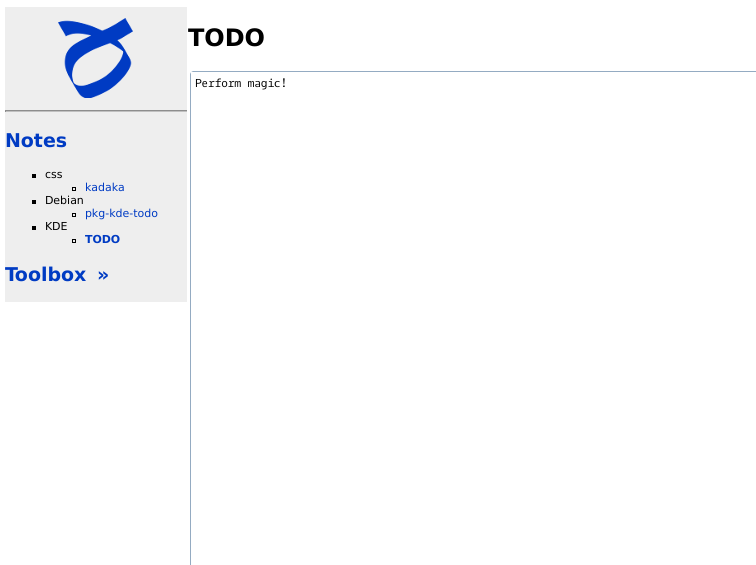
So, the other day, I wrote a blog post asking people to make sure their private hacks become published somehow. So in the sprit of that, I should also publish my recent hacks. I have been toying around as a web dude and created two nice pieces of oldschool webby software. So. Time to introductions: Dodoma is a simple online note taking application. I have created a boring homepage for it on http://sune.vuorela.dk/dodoma and I have a screenshot here:
Screenshot of webapp Kadaka is a simple rss reader showing the five newest items from various rss feeds. Has special support for youtube channels.
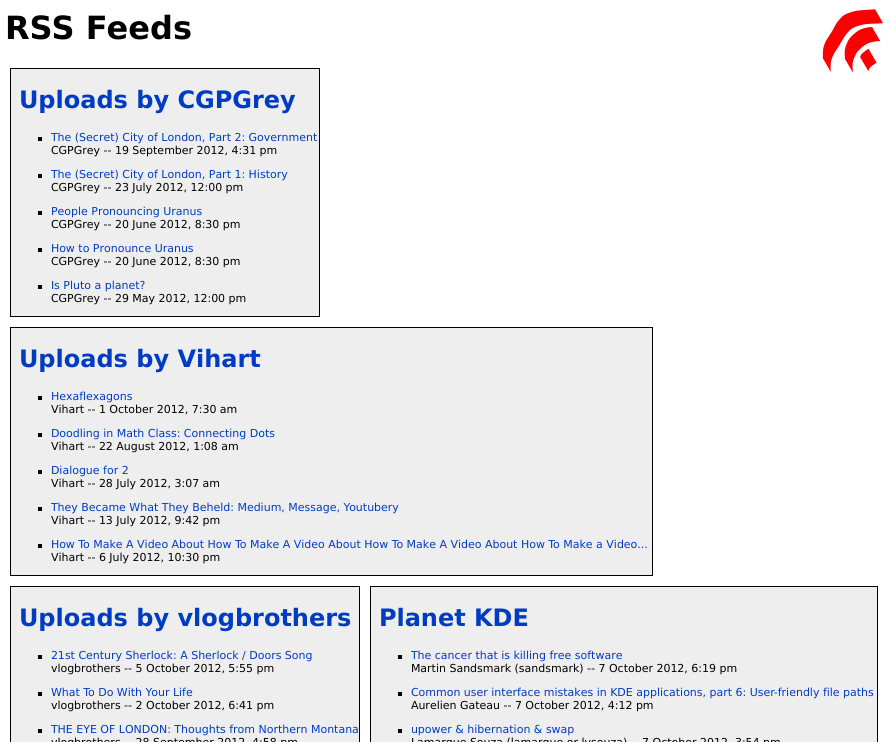
I have created a boring homepage for it on http://sune.vuorela.dk/kadaka and I have a screenshot here:
Screenshot of kadaka Have fun with those two apps. Patches always welcome. Some of you might wonder where does he get those crazy names from . Well. One of them I found on a map. Thats actually a way I name quite many of my projects. Even those that don t even leave my harddrive. And the other one actually also is on a map, but I saw it on a frequently used bus in Tallin, Estonia. And. I am considering naming my next fancy projects after some of the cool words found on the join the game member page. If you want to be part of that, feel free to Join the game!

6 October 2012

Matthew Garrett: The importance of trustworthy power structures

Direct harassment and overt sexism are certainly a significant part of why the gender ratios in the Linux community[1] are so skewed, but they're not the whole story. Part of feeling comfortable with a community is the knowledge that those in positions of power can be relied upon to engage in appropriate action when undesirable situations arise - no matter how compelling your code of conduct, no matter how detailed your diversity policy, if someone contravenes them and nothing happens, those documents are worthless and your community is unwelcoming. You can't rely on enforcement unless the community can trust its leadership.

Setting a good example in terms of behaviour is obviously vital, but it's not sufficient. Leaders who engage in sexist behaviour or who harass community members are clearly untrustworthy and undermine any attempts the rest of the community may be making. Failing to step in when they see examples of unacceptable behaviour is as bad. But less obvious is that it's possible to destroy that community trust without clearly contravening those community standards.

An example of this is Todd Akin, a candidate for the upcoming US Senate elections. In August he justified his support for making abortion illegal even in cases of rape, on the basis that women can't become pregnant through being victims of "legitimate rape". Of course, this had little to do with his fiscal or wider social policies, positions that are more directly relevant to most of his potential constituents, and in an election year that's primarily about the economy and healthcare it might be expected that a single issue would have little effect on the election standings. Instead, there was a huge uproar and a previously safe victory has now turned into a real chance of a loss.

Why? A significant part of it is because many people now have difficulty believing that they can trust him to represent them. If he understands women so little that he's willing to make entirely spurious justifications for his positions, how could any woman trust him to consider any other problems they may face? If he's willing to use fake science to back himself up, how could anyone trust him to consider any issue involving science? Through a single statement to a journalist he demonstrated to many that he was unsuited to be their representative in government. Many people who would otherwise have voted for him simply don't feel that they can rely on him to be there for them. Whether he wins his election or not, that distrust is going to remain and it's going to compromise his ability to work with his constituents.

It's the same in technical communities. If a member of a project's technical leadership frequently and loudly expresses their disdain for Python coders, anyone advocating for increased use of Python in that project is unlikely to feel that they can get unbiased opinions from that leader. If the project as a whole is uninterested in adopting Python then that's probably for the best, but if the rest of the project is open to using Python then there's a problem. People working with Python are less likely to join the project, and perhaps the project will lose out as a result.

But it's worth remembering that technical communities are still communities. If a member of a project's technical leadership vociferously argues that slavery benefited minority groups in the long run, members of those minority groups are going to feel that they're not going to be well represented by that leader. If they blog about how homosexuality is a lifestyle choice then homosexuals are unlikely to flock to the project. Likewise, if they downplay the prevalence or impact of rape, women are going to feel marginalised and find something better to do with their time.

It's impossible to separate these things. No matter how technically competent a community leader is, no matter how much code review they perform or how much mentorship they provide, if they're expressing unacceptable social opinions then they're diminishing the community. People I know and respect have left technical communities simply because people in positions of responsibility have engaged in this kind of behaviour without it causing them any problems.

We shouldn't be willing to give people a pass simply because they aren't actually groping anyone or because they're not members of the KKK. Those who drive people away from the community on the basis of race, gender or sexual orientation deserve vocal condemnation, and if they're unwilling to change their behaviour then the community should instead act to drive them away.

We're pretty bad at that in the Linux world at the moment. Too many people have behaved in this way and are left with positions of power or responsibility. There's no easy solution to the problem, but the Ada Initiative is continuing to work to improve awareness and work with communities to reduce the alienation that results from this kind of behaviour. If you want this to be anything other than a straight white male dominated community, you should give them money.

[1] (and computing in general, though to a lesser extent)

comment count unavailable comments

Christian Perrier: [life] Running update

It's been some time since I didn't write in this blog about my running activities. So let's make an update for my international friends. If you don't care about running, you can move to the next post in your feed reader..:-) After a quite busy running activity during DebConf 12 in Nicaragua, as well as during the touristic trip we did afterwards, I went back to my "regular" schedule. Main objectives in September-December are roughly the following: During August, I broke my monthly distance record by running nearly 300km in one month, even achieving 100km in only 5 days, around 24th. That was one of my goals: improve my overall resistance to run repetitions, which is one of the keys for ultra-running. These were achieved with many runs to/back work, with up to 13km in the morning and the same in the evening. Yes, running 26km at about 11km/h (and with some ups and downs in the woods to make it even worse) on a day where one has a normal work activity is quite a challenge. September has been more focused on marathon preparation. This time, no complicated plan with interval running as the month was also a very busy work month, where fitting training sessions during the day would be hard. So, I made an easy plan : run a half-marathon every Sunday and run part of my work-home commute every day (So, 3km run to the train station, 30mn train ride, then 4km run to my work place, then shower....and the same back after work). Out of the 5 half-marathons I ran during these 5 Sundays, two of them were official ones. On the first one, I finally managed to break my personal best on half, with 1h37'14". Only a 14 seconds improvement, but that one is certainly one of my best among personal bests....even better than 3h38'45" on marathon.. All other half-marathons were run at marathon speed, so targeting 5'06"/km, which will be my planned pace on October 21st. The one I ran on Sept. 16th, which was the other official race I ran was finally done quite significantly faster than this. First of all, because I had hard times to run "only" at 5'06"/km because of other runners emulation. And also, because I ran the last 3 kilometers up to nearly 14km/h (so, down to 4'15"/km), just for fun, because I could do it..:-) With all this preparation, I think that I now manage to very well manage my marathon speed. I'll probably do a final test tomorrow by trying to keep running at this speed for 3 rounds of my favourite "Maurepas Marathon" circuit, which is just exactly 1/4 of a marathon. More "funnily", I also did something I never did before during this really crazy month : simply said, I came back from work by running. All the way long. Through woods, forests, along some lakes and finally in the country. 42 kilometers (yes, a marathon). After a work day. Starting at 5:45pm and arriving home after 4h50 minutes. With 2 hours of heavy rain. With 2.5 hours running in the dark (with my headlamp of course). All alone. That was a crazy bet to do....but really great fun achieving this : the GPS trace is here. Really something I have to do again..:-) So, well, now I'm more or less prepared and having fun is just a matter for time..:-). I'll keep you guys posted with those and, guess what? I'm already picking my target races for next year..:-)

4 October 2012

Rapha&#235;l Hertzog: My Debian Activities in September 2012

This is my monthly summary of my Debian related activities. If you re among the people who made a donation to support my work (1086.48 , thanks everybody!), then you can learn how I spent your money. Otherwise it s just an interesting status update on my various projects. Dpkg I am subscribed to Launchpad s dpkg bug tracker and I was getting annoyed with the amount of noise I got under the form of bug reports that look like package foo failed to install/upgrade: package foo is already installed and configured . Those reports are a combination of a bug in APT and of random other failures (often hardware related like corrupted .deb files, or I/O errors, but sometimes also real problems in other packages) but they always end up assigned on dpkg (because dpkg is outputting an error message complaining about APT s decision to configure something that doesn t have to be configured). I simply don t have the time required to manually process and inspect all those reports, so I decided to filter them at the apport level with a new Ubuntu bug pattern that indicates that those reports are a duplicate of LP#541595. Thanks to this, the dpkg bug count quickly went down from 130 to about 80. Packaging I sponsored a new upstream version of ledgersmb. I quickly updated WordPress to version 3.4.2 since it contains security relevant fixes. I also pushed a small update of nautilus-dropbox fixing #686863 because upstream renamed the binary package that they hand out on their website from nautilus-dropbox to dropbox. Their dropbox package only conflicts with old versions of nautilus-dropbox and not with the version that Debian is shipping and thus I had to add a Conflicts on our side to forbid co-installation of both packages. Testing wheezy s installation I bought a new laptop (Lenovo Thinkpad X230) and used this as an excuse to test Wheezy s installation process. It worked mostly fine except for two things:
  1. First I noticed that it would not accept my passphrase for my encrypted partition during early boot this turned out to be already reported as #619711 but was no longer getting any attention from the package maintainer. After some IRC discussion with Julien Cristau, we prodded Michael Prokop who had apparently already offered to take care of this issue. I tested his updated package and the result got quickly uploaded.
  2. I had weird networking problems that turned out to be related to the lack of the loopback network (i.e. on localhost). This was the result of a broken /etc/network/interfaces: it had been incorrectly modified by NetworkManager. I reported this in #688355. This issue affects people with IPv6 enabled networks.
Debian France There s a resurgence of activity in Debian France. Sylvestre Ledru is leading the organization of a mini-debconf in Paris on November 24-25th. And Tanguy Ortolo is now taking care of some merchandising (Polo shirts, to change from the usual T-Shirt). I might give a talk during this mini-debconf, possibly about multi-arch. Misc It s been a few months that I noticed a 2 second lag of gnome-shell everytime that smuxi (my IRC client) sent a notification. It s very annoying, you have the impression that the entire machine freezes. So I contacted Mirco Bauer on #smuxi and we investigated a bit. It turns out that smuxi is using an old version of the notification protocol where the picture is sent as a bytestream leading to huge dbus messages. This is clearly sub-optimal so smuxi will be fixed to be able to send the path of the picture instead of the picture itself. On the other hand, it s really a bug of gnome-shell that it freezes during the time it takes to handle the bigger-than-usual dbus message. So I also filed a bug on GNOME Shell (Bugzilla #683829) to get this fixed. Librement: funding free software work I started a new project with the goal of helping free software developers to fund their free software work. It s still mostly vaporware for now but I have a public code repository, a nice logo and lots of ideas. If the topic is of interest to you, and you d like to be involved, feel free to get in touch. Otherwise stay tuned. Thanks See you next month for a new summary of my activities.

4 comments Liked this article? Click here. My blog is Flattr-enabled.

3 October 2012

Stefano Zacchiroli: put some Debian salt in the Ubuntu charity marathon

Fellow geeks of the Canonical community team will be doing something pretty weird this week. They're fund-raising for charity, for causes ranging from environment to autism, from homeless support to kids education, from poverty fight to water supplies. But that's not weird. What's weird is that the fund-raising will culminate in a 24-hour work marathon stream live, which will kick off tomorrow (Thursday) at 10:00 UTC. As I like charity, and as I like contributing to Free Software, I gladly accepted to rely here a challenge to the Debian community by one of the marathon "horsemen", Michael Hall: Raising the stakes, Nick Skaggs has decided to propose a similar challenge: Wanna take the challenge? And how about the other 4 horsemen? No challenges to the Debian community? Feel free to leave a comment and I'll raise the stakes even more, updating the list above. Update 4/10/2012, 13:35 +0200: Daniel Holbach added his own challenge to the Debian community:

2 October 2012

Andrea Veri: An interview with Allan Day

A few days ago I had the great pleasure to interview Allan Day, GNOME designer and enthusiastic contributor. Me: Hello Allan, mind presenting yourself? Allan: I m a designer working on the GNOME Project. I ve been involved for quite a few years now. Last year I was lucky to be hired by Red Hat to work in their Desktop Team. Me: Can you tell us something more about GNOME 4? Can we alias it GNOME OS? Allan: GNOME 4 isn t something that is being seriously considered right now, at least as far as I m aware. Those of us in the GNOME Project are thinking about the future though, and have been setting some big goals for the next few years. Who knows, maybe those things will lead to a big new version? It s probably too soon to tell though. Me: Which new features will be introduced in the incoming GNOME 3.6, and what about GNOME 3.8? Allan: 3.6 is already out, so you can read the release notes if you want to find out about it. I was really happy with it, and the last release had quite a lot of new features. My personal favourites where the input sources work, the Lock Screen and the work we need on notifications and the Message Tray. Oh, and I m really pleased with the new Clocks application that we released a preview of. Members of the community are still proposing features for 3.8, so it s a little early to say what we will be working on for the next six months. I think I d be happy if we can continue to polish the core user experience, and hopefully get some more new applications off the ground. Me: GNOME Fallback is due to be completely dropped, are you in favor of that choice and why? Allan: I think that s mostly a technical discussion, and I m not a developer. Also, GNOME needs to have an open discussion about that question as a community which is something we might be doing at this year s Boston
Summit. What I would say is that it is important for us to deliver high quality user experiences, so if fallback mode isn t good enough, or if it is holding back the primary GNOME 3 UX, then we obviously need to think about what needs to happen. Me: Ubuntu has recently released the first two Alphas of the Ubuntu GNOME Remix, do you think this will strengthen the cooperation between GNOME and Canonical as in the past? Allan: As far as I understand it, the GNOME Remix is a community effort, and isn t coming from Canonical itself. That said, we always want to see more involvement in GNOME by Canonical and Ubuntu. Me: Do you see anything in the current GNOME 3 that would require an improvement? and can you add a few words about the brand new login screen recently introduced? Allan: GNOME 3 is getting better all the time, and I m particularly pleased with the latest version. That said, there is plenty of work still to do. I think the big area for us right now is to filling the missing blanks in our application story, so we have a suite of consistent core applications. That will enable people to access content more easily, and will serve as a springboard for other new GNOME applications. What to say about the Lock Screen?! Well, it was originally conceived as something that is like a screensaver, but is really really useful (rather than just looking pretty). We wanted something that looks cool when the machine is locked, but we also wanted to add plenty of features on top, like having media playback controls and built-in notifications. The idea is to make some things possible without having to enter a password, like pausing your music or checking to see if you have received any emails. Me: Many have argued new contributors most of the times aren t redirected correctly to their area of interest, thus they lose interest in contributing and leave. Do you feel anything could be improved in how GNOME welcomes new contributors? Allan: That s a good observation. I agree that one of the hardest things about contributing to open source projects is finding the right place to start. In GNOME we are working to help with this, such as through new mentoring schemes, but there is certainly more that we could do. One thing would be to run more online events, like bug days. Another thing is advertising good tasks for newcomers; we do some of that, but we could be better at it. Me: Anything else you would like to add? Allan: Just that anyone is always welcome in GNOME! That s what we re about really creating opportunities for people, having fun and making great technologies.

Andrea Veri: An interview with Allan Day

A few days ago I had the great pleasure to interview Allan Day, GNOME designer and enthusiastic contributor. Me: Hello Allan, mind presenting yourself? Allan: I m a designer working on the GNOME Project. I ve been involved for quite a few years now. Last year I was lucky to be hired by Red Hat to work in their Desktop Team. Me: Can you tell us something more about GNOME 4? Can we alias it GNOME OS? Allan: GNOME 4 isn t something that is being seriously considered right now, at least as far as I m aware. Those of us in the GNOME Project are thinking about the future though, and have been setting some big goals for the next few years. Who knows, maybe those things will lead to a big new version? It s probably too soon to tell though. Me: Which new features will be introduced in the incoming GNOME 3.6, and what about GNOME 3.8? Allan: 3.6 is already out, so you can read the release notes if you want to find out about it. I was really happy with it, and the last release had quite a lot of new features. My personal favourites where the input sources work, the Lock Screen and the work we need on notifications and the Message Tray. Oh, and I m really pleased with the new Clocks application that we released a preview of. Members of the community are still proposing features for 3.8, so it s a little early to say what we will be working on for the next six months. I think I d be happy if we can continue to polish the core user experience, and hopefully get some more new applications off the ground. Me: GNOME Fallback is due to be completely dropped, are you in favor of that choice and why? Allan: I think that s mostly a technical discussion, and I m not a developer. Also, GNOME needs to have an open discussion about that question as a community which is something we might be doing at this year s Boston

Summit. What I would say is that it is important for us to deliver high quality user experiences, so if fallback mode isn t good enough, or if it is holding back the primary GNOME 3 UX, then we obviously need to think about what needs to happen. Me: Ubuntu has recently released the first two Alphas of the Ubuntu GNOME Remix, do you think this will strengthen the cooperation between GNOME and Canonical as in the past? Allan: As far as I understand it, the GNOME Remix is a community effort, and isn t coming from Canonical itself. That said, we always want to see more involvement in GNOME by Canonical and Ubuntu. Me: Do you see anything in the current GNOME 3 that would require an improvement? and can you add a few words about the brand new login screen recently introduced? Allan: GNOME 3 is getting better all the time, and I m particularly pleased with the latest version. That said, there is plenty of work still to do. I think the big area for us right now is to filling the missing blanks in our application story, so we have a suite of consistent core applications. That will enable people to access content more easily, and will serve as a springboard for other new GNOME applications. What to say about the Lock Screen?! Well, it was originally conceived as something that is like a screensaver, but is really really useful (rather than just looking pretty). We wanted something that looks cool when the machine is locked, but we also wanted to add plenty of features on top, like having media playback controls and built-in notifications. The idea is to make some things possible without having to enter a password, like pausing your music or checking to see if you have received any emails. Me: Many have argued new contributors most of the times aren t redirected correctly to their area of interest, thus they lose interest in contributing and leave. Do you feel anything could be improved in how GNOME welcomes new contributors? Allan: That s a good observation. I agree that one of the hardest things about contributing to open source projects is finding the right place to start. In GNOME we are working to help with this, such as through new mentoring schemes, but there is certainly more that we could do. One thing would be to run more online events, like bug days. Another thing is advertising good tasks for newcomers; we do some of that, but we could be better at it. Me: Anything else you would like to add? Allan: Just that anyone is always welcome in GNOME! That s what we re about really creating opportunities for people, having fun and making great technologies.

Russell Coker: Asperger Syndrome Disability vs Over Pathologising

Is Asperger Syndrome a Disability? Some people tell me that I m disabled. Usually it s an unstated implication such as referring to Asperger Syndrome as a disability with the assumption that I ll agree. One time I had someone assume that I had never had a paid job because they knew I m an Aspie, maybe I should boast more about my career successes. One interesting take on this is represented by Maco s bost about Disablism/Ablism where she says Vocab note: A person has an impairment. Society s treatment of that impairment is what disables the person [1]. The same concept is presented by BRAINHE in their Social Model of Disability document [2]. The Wikipedia page on Ableism says The ableist worldview holds that disability is an error, a mistake, or a failing, rather than a simple consequence of human diversity, akin to race, ethnicity, sexual orientation or gender [3]. This is fairly close to the position that Neurodiversity [4] advocates take on Autism. Jaarsma P and Welin S wrote an interesting paper titled Autism as a Natural Human Variation: Reflections on the Claims of the Neurodiversity Movement [5] which considers these issues in depth and comes to the conclusion that High Functioning Autism (for which Asperger Syndrome is generally regarded as a synonym) is a difference while Low Functioning Autism is a disability. I think that generally we should accept the opinion of the person in question. Someone who is unable to communicate or is too young to make an informed decision could have their disability status determined by carers. But anyone who is capable of making an informed decision and communicating it should have their opinion respected. I am not going to argue with any of the people who claim that they are disabled due to an Autism Spectrum Disorder. But I don t think that I am disabled and I think that people shouldn t argue with me about this. Over Pathologising Lynne Soraya wrote an interesting article for Psychology Today about one aspect of the supposed over-diagnosis [6]. She responds to Paul Steinberg, a psychiatrist who made a number of claims about Asperger Syndrome which lack evidence. Paul s main idea seems to be that anyone who has social problems but who seems to be successful regardless shouldn t have an Autism Spectrum diagnosis and he claims that such people should be regarded as having a social disability instead. His main idea seems to be that having a diagnosis is a bad thing, but his idea of having a social disability diagnosis instead doesn t seem so great. In many other discussions I ve seen people claim that a large number of diagnosis of anything is a problem. Their idea seems to be that the vast majority of the population shouldn t have a diagnosis for anything and that whenever a significant number of people are diagnosed with a psychological condition (and 1% of the population seems to be a significant number) then it s a problem. I don t think that having a large portion of the population diagnosed is necessarily a problem, I think that it would be OK if the majority of the population was diagnosed with something. The issue is not whether people are diagnosed but what happens after the diagnosis. When a child is diagnosed their parents can help them deal with whatever the issues are this may or may not require further involvement with psychologists or special schools. For the milder cases (of Autism, ADHD, and other conditions) merely knowing what areas will cause difficulty and teaching kids how to deal with them will be enough to solve many problems. When someone is diagnosed as a child but doesn t have obvious symptoms as an adult that is more likely to be an indication that they were taught good coping mechanisms and protected from bad situations as a child not that the diagnosis was wrong. There are some serious issues with special schools and psychiatric drugs, but diagnosis doesn t necessarily imply mistreatment and avoiding a diagnosis is not the correct way to avoid such mistreatment. When someone is diagnosed as an adult they have to learn to deal with it. The general lack of psychologists (waiting times as long as 6 months are common) and the fact that most psychologists won t do any good for someone on the Autism Spectrum is a real problem. But merely knowing the source of your problems is a major step towards alleviating or solving them. One of the arguments that is commonly used against so-called over-diagnosis is that adults don t show apparent symptoms. The issue here is that with some effort and planning adults on the spectrum can act like NTs. Acting like an NT doesn t imply being an NT, it usually requires a lot of ongoing effort that could be applied to other things if society didn t expect us to act like NTs all the time. Conclusion I wish people would stop telling me that I m either disabled or too high functioning to be on the Autism Spectrum. I will never think like an NT and I don t want to, so I ll always be an Aspie. By most objective measures I m at least as successful as the general population in all things that require social skills, so unless something like always losing at Poker is considered a disability I don t think that it s reasonable to consider me to be disabled. It would be nice if I could lock the people who claim that Autism is always a disability in a room with the people who think it s over-diagnosed and let them debate it, no matter which side lost the debate the result would be good! Update: I removed a broken link to a Youtube video, I published this post from a 3G connection and didn t test that the Youtube link still worked. For some reason the author had marked it private since the last time I visited it. Related posts:
  1. Autism vs Asperger Syndrome Diagnostic Changes for Autism Spectrum Disorders Currently Asperger Syndrome (AS)...
  2. Is Asperger Syndrome a Good Thing? A meme that keeps going around is that Asperger Syndrome...
  3. Autism Awareness and the Free Software Community It s Autism Awareness Month April is Autism Awareness month, there...

1 October 2012

Junichi Uekawa: Playing with boost spirit.

Playing with boost spirit. I've been playing with C++ parser generator for a while, parsing Debian control files and Packages files. It's interesting because grammers are easier to handle this way, and rather than handcrafted parsers that I don't feel like looking at it ever again, it's something prettier.

Andrew Pollock: [opinion] On helicopter parenting and strangers in day care facilities

It appears that a recent incident at a different campus of the "preschool" (I call it day care) that Zoe goes to has gotten the attention of the Free-Range Kids blog. Firstly, I need to say that on the parenting spectrum, I definitely self-identify closer to the free-range end than the helicopter end. I'm not sure that I'd let an 8 year old ride the New York subway on their own, but Zoe's not 8 yet, so I really can't say. Sarah and I received the same email that is reprinted on the blog, on Friday night, and we were both (very) mildly alarmed at the situation, but not particularly concerned, mostly because it wasn't the facility that Zoe goes to. I'm not sure I'd be that much more concerned if it was, to be honest. I did like the statistics that the parent quoted in response. I thought that that put things into perspective, but didn't really take abductions by estranged parents into consideration. My one reaction to reading the email was, "why did they wait until after the incident to escalate it?" but then, from my own experiences in dropping off or picking up Zoe, I could totally understand not all the staff knowing on sight all the parents or guardians that do pickups and drop offs. This does lead to one asking how they know who to buzz in, but that's another can of worms. Anyway, I read the 50 or so varyingly indignant comments on the Free Range Kids blog, and since they were talking about the company that I give a not inconsequential amount of money to, I feel the need to write a response. The whole episode raises the question: who was this person and what were they doing there? Some of the commentators hypothesize that they were casing the joint for a future incident, or just giving themselves an impromptu tour before placing their child there (Zoe and I toured before we signed up, but that was an official, prearranged thing). It really is unfortunate that the staff didn't challenge this person, but as I said, they probably all had to review the video surveillance footage together to ascertain that none of them knew who the person was. I consider this a bit of a deficiency itself, but I don't really expect them to all have photographic memory, especially if one parent mostly does drop off and pick up. The other (expensive) option would be to issue each authorized person with an electronically revocable proximity card, so they can let themselves in, but I feel that that's taking things to the extreme. They staff all carry portable radios. If they don't have a discreet "code" they can call when one of them sees a person they don't know, I'm sure they will have after this incident. I personally found the majority of the comments on the Free Range Kids blog to be on the extreme overreaction side of things. As much as I'm a believer in Free Range parenting, I think the day care provider has mostly reacted appropriately. Do I agree with their "locked facility" policy? It's my first experience with a commercial day care facility, so I don't have anything to compare it with. As I said earlier, I can totally understand where they're coming from in terms of limiting their liability. Previously, Zoe was in a "home day care" facility, without any locks, and I for one wasn't constantly worrying about someone wandering into that provider's home and abducting my daughter, so I guess the whole "locked facility" thing is on the more extreme end of the scale for me in the first place, but like I said, I'm uncalibrated for commercial day care centres. I'd certainly like to see the primary school environment that Zoe goes to not be such a locked down affair.

Vasudev Kamath: Weekly Log - 01102012

Well this weeks log comes bit late as my week got extended till today ;-). I had working day at office on Saturday and Sunday due to 2nd Quarter end and instead today is declared as compensatory holiday and tomorrow any how is Gandhi Jayanti. So here it goes. Debian Related Most of my work this week was done for Debian-IN team Well most of this weeks work involved KGB ;-) Personal Works Misc Played Cricket after very long time (Guess after 10 long years). Well it was not official match or anything it was just another Gully Cricket. After the match it came to mind that I need regular physical workout :-P. Well that's it Cya till next week :-)

Jonas Smedegaard: How I (don't) use Facebook

Dear Facebook friend, I like you and I want to chat with you, just not on Facebook! My Facebook account is there to reach you where you are, but I do not hang out there. Please join me at Free and Open spaces instead - via email, IRC or Jabber

Good old email If you cannot be bothered with change, then simply email me! My email address is dr@jones.dk like always :-)

Simple webchat If you are in a hurry and do not use Jabber yet, then try use my Simple Groupchat. Use guest login if you are not a user at jones.dk.

Proper Jabber Jabber is similar to email: You need 1) an account somewhere, 2) some client application setup to use that account, and 3) the address of those you want to connect.
  1. Register an account at e.g. Indonesian http://jabin.org/ or some other server.
  2. Install a Jabber client program :
    • on Windows try install Gajim from http://gajim.org/.
    • on smartphone try app from https://imo.im/.
    • on Ubuntu try use the Me menu in top right corner.
    • on Debian try install Pidgin: aptitude install pidgin.
  3. Invite me as your friend/buddy: my Jabber ID is jonas@jones.dk
  4. Tell your friends to do the same! :-D

Geeky IRC Many computer geeks hang out on IRC. I find it ugly and clumsy to use, but most of my techie friends are there, so I recommend going there to discuss technical matters. On OFTC my nickname is jonas, and I often hang out at the chatroom #debian-devel (plus a few others).

Why not Facebook? Facebook is a closed system: all activities happen at one central place. Email, Jabber and IRC are open protocols, exchanging between many Free systems (and some non-free ones as well).
Imagine having an overprotecting mother, who allow you only to meet your friends at one spot in town - where she can look after you. You maybe have no secrets from your mom, but probably still appreciate the option of being alone - to have some privacy.
Facebook is that one spot in town. Jabber is "let's go meet somewhere". Regards, Jonas

Cyril Brulebois: d-i hacking recipe #2: Adding a wireless module

Problem #2: How to add a wireless module to a d-i image? Slightly longer version: As reported in #686605, a whole wireless module family is missing from the linux kernel udebs, meaning they re missing from the d-i images. Please note the hypothesis here is that the regular linux kernel images contain the relevant modules, only the udebs don t. Recipe #2: Craft a local udeb!
  1. The following assumes one is interested in adding a wireless module, but that can be adapted to other module families. The relevant udeb base name is nic-wireless-modules.
  2. When it comes to linux kernel modules, picking the right ones is important, so one has to consider the ABI. Right now, the current ABI in testing is 3.2.0-3-amd64. The complete udeb name is therefore nic-wireless-modules-3.2.0-3-amd64-di.
  3. If you re running a kernel with the same ABI, all good, relevant modules should be available under /lib/modules/$(uname -r), which is what will be assumed below. Otherwise, one would have to download a proper linux-image-$ABI package, and extract it into a temporary directory to grab the wanted module(s).
  4. Determine the relevant module and its dependencies. As an example, I ll pick a Realtek module: rtl8192cu.ko. If it s loaded, one can use the following to detect its dependencies:
    $ lsmod grep rtl8192cu
    rtl8192cu              78863  0
    rtlwifi                81350  1 rtl8192cu
    rtl8192c_common        52602  1 rtl8192cu
    mac80211              192768  4 iwlwifi,rtl8192c_common,rtlwifi,rtl8192cu
    cfg80211              137140  3 mac80211,iwlwifi,rtlwifi
    usbcore               128498  7 ehci_hcd,usbhid,uvcvideo,rtlwifi,rtl8192cu
    
    But it isn t even needed to load the module to get those dependencies:
    $ /sbin/modinfo /lib/modules/3.2.0-3-amd64/kernel/drivers/net/wireless/rtlwifi/rtl8192cu/rtl8192cu.ko grep ^depends
    depends:        rtlwifi,mac80211,rtl8192c-common,usbcore
    
    Compared to what the d-i image contains, only rtlwifi and rtl8192c-common are missing.
  5. Fetch the udeb using http://packages.debian.org/ or browsing your favourite mirror if you know the paths by heart.
  6. Extract the udeb into a temporary data/ directory, along with its meta data:
    dpkg -x nic-wireless-modules-3.2.0-3-amd64-di_3.2.23-1_amd64.udeb data
    dpkg --control nic-wireless-modules-3.2.0-3-amd64-di_3.2.23-1_amd64.udeb data/DEBIAN
    
  7. Copy the 3 modules under the relevant subdirectory under data/.
  8. Update the version in data/DEBIAN/control, for example by adding the +local1 suffix.
  9. Build a new binary package, using fakeroot to avoid owner/group noise in the diff:
    fakeroot dpkg -b data nic-wireless-modules-3.2.0-3-amd64-di_3.2.23-1+local1_amd64.udeb
    
  10. Use debdiff to check the results:
    $ debdiff nic-wireless-modules-3.2.0-3-amd64-di_3.2.23-1*_amd64.udeb
    Files in second .deb but not in first
    -------------------------------------
    -rw-r--r--  root/root   /lib/modules/3.2.0-3-amd64/kernel/drivers/net/wireless/rtlwifi/rtl8192cu/rtl8192c-common.ko
    -rw-r--r--  root/root   /lib/modules/3.2.0-3-amd64/kernel/drivers/net/wireless/rtlwifi/rtl8192cu/rtl8192cu.ko
    -rw-r--r--  root/root   /lib/modules/3.2.0-3-amd64/kernel/drivers/net/wireless/rtlwifi/rtlwifi.ko
    Control files: lines which differ (wdiff format)
    ------------------------------------------------
    Version: [-3.2.23-1-]  +3.2.23-1+local1+ 
    
  11. Put the resulting udeb under localudebs/ in your d-i build tree, and rebuild your image as usual. Almost-tada!
Why almost ? Because a firmware is needed, so one can go back to the 7th step, extract the proper file (lib/firmware/rtlwifi/rtl8192cufw.bin) from the non-free firmware-realtek package, and add it under data/lib/firmware/realtek/. Rebuild the udeb, rebuild the d-i image. Then: tada!

30 September 2012

Russell Coker: Links September 2012

Scott Adams has an interesting idea for political debates he calls Fact Bubbler [1]. It sounds implausible the first time you read it, but then so did Wikipedia. Arstechnica has an interesting article on software defined radio [2]. This could change many things. The Nieder Family has another update on the way patents threaten their daughter s ability to communicate [3]. Also Apple is making things worse by taking pre-emptive strikes against iPhone apps which are involved in legal disputes never use an iPhone (or other proprietary system) for anything important if you have a choice. In more positive news crowd-funded gene sequencing has found an explanation for Maya Nieder s developmental delays [4]. This will revolutionise medicine! Steven Cherry of IEEE Spectrum has an interesting interview with Peter Cappelli about the difficulties that computer and engineering companies have in hiring talented people [5]. The Guardian has an interesting article about the non-profit investigative reporting organisation ProPublica [6]. See the ProPublica.org site for some quality news reports [7]. Michael O.Church wrote an interesting and insightful article about the fate of a Just a Programmer in a startup funded by Venture Capitalists [8]. It doesn t sound good at all. EyeNetra is developing a smart-phone based system for testing eyes [9]. It s apparently possible to manufacture glasses for $0.75 so the cost and difficulty of performing eye tests is the main factor that prevents poor people in developing countries from getting glasses. So a cheap portable eye testing system is going to help many people get the glasses they need. Bryan Gardiner wrote an interesting article for Wired about the Gorilla glass that is used in most mobile phones and tablets [10]. Maco wrote an interesting article about crochet and reverse-engineering along with a Python program to print a crochet pattern [11]. I wonder whether anyone has tried to make a crochet robot, something like a 3D printer but which crochet s things rather than printing them. Holding the wool would be a real challenge, it s not nearly as easy as printing on something that s stuck down and incapable of movement.
  1. [1] http://dilbert.com/blog/entry/fact_bubbler/
  2. [2] http://arstechnica.com/tech-policy/2012/07/how-software-defined-radio-could-revolutionize-wireless/
  3. [3] http://niederfamily.blogspot.com.au/2012/06/silencing-of-maya.html
  4. [4] http://blog.ted.com/2012/07/17/newly-discovered-gene-may-explain-4-year-olds-rare-disease-thanks-to-ted-fellow-jimmy-lin/
  5. [5] http://spectrum.ieee.org/podcast/at-work/tech-careers/why-bad-jobsor-no-jobshappen-to-good-workers
  6. [6] http://www.guardian.co.uk/technology/2012/jul/02/propublica-investigative-reporting
  7. [7] http://www.propublica.org/
  8. [8] http://michaelochurch.wordpress.com/2012/07/08/dont-waste-your-time-in-crappy-startup-jobs/
  9. [9] http://eyenetra.com/
  10. [10] http://www.wired.com/wiredscience/2012/09/ff-corning-gorilla-glass/all/
  11. [11] http://ubuntulinuxtipstricks.blogspot.com.au/2010/10/algorithms-reverse-engineering-and.html
Related posts:
  1. Links April 2012 Karen Tse gave an interesting TED talk about how to...
  2. Links May 2012 Vijay Kumar gave an interesting TED talk about autonomous UAVs...
  3. Links July 2012 The New York Times has an interesting article about hacker...

Next.

Previous.