Search Results: "sto"

18 March 2014

Vincent Bernat: EDNS client subnet support for BIND

To provide geolocation-aware answers with BIND, a common solution is to use a patch adding GeoIP support. A client can be directed to the closest (and hopefully fastest) web server:
view "FRANCE"  
     match-clients   geoip_cityDB_country_FR;  ;
     zone "example.com" in  
         type master;
         file "france.example.com.dns";
      ;
 ;
view "GERMANY"  
     match-clients   geoip_cityDB_country_DE;  ;
     zone "example.com" in  
         type master;
         file "germany.example.com.dns";
      ;
 ;
/* [...] */
view "DEFAULT"  
    zone "example.com" in  
        type master;
        file "example.com.dns";
     ;
 ;
However, an end user does not usually talk directly to authoritative servers. They proxy the query to a third-party recursor server which will query the authoritative server on their behalf. The recursor also caches the answer to be able to serve it directly to other clients. On most cases, we can still rely on the recursor GeoIP location to forward the client to the closest web server because it is located in the client s ISP network, as shown on the following schema: Query for www.example.com through an ISP recursor
  1. Juan is located in China and wants to know the IP address of www.example.com. She queries her ISP resolver.
  2. The resolver asks the authoritative server for the answer.
  3. Because the IP address of the resolver is located in China, the authoritative server decides to answer with the IP address of the web server located in Japan which is the closest one.
  4. Juan can now enjoy short round-trips with the web server.
However, this is not the case when using a public recursor as provided by Google or OpenDNS. In this case, the IP address of the end client and the source IP address of the recursor may not share the same locality. For example, in the following schema, the authoritative server now thinks it is in relation with an European customer and answers with the IP address of the web server located in Europe: Query for www.example.com through an open recursor Moreover, caching makes the problem worse. To solve this problem, a new EDNS extension to expose the client subnet has been proposed. When using this extension, the recursor will provide the client subnet to the authoritative server for it to build an optimized reply. The subnet is vague enough to respect client s privacy but precise enough to be able to locate it. A patched version of dig allows one to make queries with this new extension:
$ geoiplookup 138.231.136.0
GeoIP Country Edition: FR, France
$ ./bin/dig/dig @dns-02.dailymotion.com www.dailymotion.com \
>     +client=138.231.136.0/24
; <<>> DiG 9.8.1-P1-geoip-1.3 <<>> @dns-02.dailymotion.com www.dailymotion.com +client=138.231.136.0/24
; (1 server found)
;; global options: +cmd
;; Got answer:
;; ->>HEADER<<- opcode: QUERY, status: NOERROR, id: 23312
;; flags: qr aa rd; QUERY: 1, ANSWER: 2, AUTHORITY: 0, ADDITIONAL: 1
;; WARNING: recursion requested but not available
;; OPT PSEUDOSECTION:
; EDNS: version: 0, flags:; udp: 4096
; CLIENT-SUBNET: 138.231.136.0/24/24
;; QUESTION SECTION:
;www.dailymotion.com.           IN      A
;; ANSWER SECTION:
www.dailymotion.com.    600     IN      A       195.8.215.136
www.dailymotion.com.    600     IN      A       195.8.215.137
;; Query time: 20 msec
;; SERVER: 188.65.127.2#53(188.65.127.2)
;; WHEN: Sun Oct 20 15:44:47 2013
;; MSG SIZE  rcvd: 91
$ geoiplookup 195.8.215.136
GeoIP Country Edition: FR, France
In the above example, a client located in France gets a reply with two IP addresses located in France. If we now are an US client, we will get IP addresses located in the US:
$ geoiplookup 170.149.100.0
GeoIP Country Edition: US, United States
$ ./bin/dig/dig @dns-02.dailymotion.com www.dailymotion.com \
>     +client=170.149.100.0/24
; <<>> DiG 9.8.1-P1-geoip-1.3 <<>> @dns-02.dailymotion.com www.dailymotion.com +client=170.149.100.0/24
; (1 server found)
;; global options: +cmd
;; Got answer:
;; ->>HEADER<<- opcode: QUERY, status: NOERROR, id: 23187
;; flags: qr aa rd; QUERY: 1, ANSWER: 2, AUTHORITY: 0, ADDITIONAL: 1
;; WARNING: recursion requested but not available
;; OPT PSEUDOSECTION:
; EDNS: version: 0, flags:; udp: 4096
; CLIENT-SUBNET: 170.149.100.0/24/24
;; QUESTION SECTION:
;www.dailymotion.com.           IN      A
;; ANSWER SECTION:
www.dailymotion.com.    600     IN      A       188.65.120.135
www.dailymotion.com.    600     IN      A       188.65.120.136
;; Query time: 18 msec
;; SERVER: 188.65.127.2#53(188.65.127.2)
;; WHEN: Sun Oct 20 15:47:22 2013
;; MSG SIZE  rcvd: 91
$ geoiplookup 188.65.120.135
GeoIP Country Edition: US, United States
The recursor is expected to cache the two different answers and only serve them if the client matches the appropriate subnet (the one confirmed in the answer from the authoritative server). With this new extension, the authoritative server knows that Juan is located in China and answers with the appropriate IP address: Query for www.example.com through an open recursor with client subnet Not many authoritative servers support this extension (PowerDNS and gdnsd, as far as I know). At Dailymotion, we have built a patch for BIND. It only works when BIND is configured as an authoritative server and it doesn t expose no configuration knobs. Feel free to use it (at your own risk). Once installed, you need to register yourself to OpenDNS and to Google to receive queries with the extension enabled.

17 March 2014

Andrew Pollock: [life] Day 48, Pupil free day, shoes, shoes and more shoes, ice skating, cut-throat shaving

Zoe's Kindergarten had a Pupil Free Day today. I think there's only that impacts the days Zoe attends Kindergarten for the whole year. I'd wanted to make the most of the fact that her friend Mackensie wasn't in Kindergarten on a Monday either, and have a play date with her at Southbank, but her little sister was having sleep issues, and her mother wanted her to nap at home today, so we had to scratch those plans. Given the forecast maximum temperature was going to be over 30 C today, I thought ice skating would be a great way to escape the heat, but the rink didn't have their open session until 1pm, so we had to do something in the morning to kill time. I decided we should go shoe shopping. Before we went to Westfield Carindale, we went to Officeworks to print out some more photos. Zoe really enjoys helping me with the self-serve printing kiosk, and is happy amusing herself at the kid's colouring table otherwise. I wanted some unusual size prints, so it involved one of the staff doing some additional faffing around with Photoshop for me. I'm rather amazed they'll spend the staff time doing that, when I only spend a couple of dollars on prints. After that, we headed out to Carindale. Zoe's in that limbo between size 3 and 4 at the moment. I bought her some new size 4 Autumn/Winter clothes the other weekend, and after that, went through her wardrobe and did a big cull of all her size 2 stuff and any size 3 stuff that didn't fit terribly well. That just left shoes and jumpers to sort out, so we concentrated on them today. First things first, we grabbed some morning tea at Muffin Break. They did a nice babyccino in a little china espresso cup, so Zoe enjoyed that, and we split a muffin between us. Zoe took a fancy to some ballerina pumps she saw at Cotton On Kids. We bought a few pairs of socks and a pair of size 10 pumps, and she wanted to wear them from that point on, so we wore them to the shoe shop. Almost as soon as we walked out of the store, she ran into heel problems on one foot, so after a few rounds of taking a couple of steps and needing to refit the heel of one shoe, I convinced her to go barefoot the remainder of the way. At Shoes and Sox she got properly measured for some light up closed-toe shoes. Zoe absolutely loved them, and wanted to wear them from that point on. Next we went to Target, and got a couple of jumpers. The kid's entertainment area was both a blessing and a curse. It was great for keeping her occupied when I needed to dash off and get some socks for myself for ice skating, but it was a negotiation challenge to get her away from it when it was time to leave. Toy Story 3 conveniently finished at just the right time. We dropped into Pumpkin Patch to get some boots. Despicable Me was playing there. Zoe is absolutely hooked on it at the moment. I managed to prime her to leave at the end of a scene though. She did score a couple of stickers while we were sitting there chilling out watching the movie though, so that was nice. I love Pumpkin Patch, but my God, it is expensive. I could have dropped $50 on a dress I really liked there, but I managed to resist. We decided to go back to Cotton On Kids to exchange the ballerina pumps. They didn't have any more of the style she'd chosen in her size, so we switched from gold glittery ones to red ones, which she wore out of the store. Cotton On Kids was also showing Despicable Me, so Zoe was very pleased. Shoes are horrendously expensive in Australia. The Sketchers and the boots set me back $60 each. The pumps were a bit more reasonably priced. I think they were about $20. I hope her feet don't grow too fast. After that shopping extravaganza it was lunchtime, and we split a spinach pide and had a quick fool around in the outdoor kid's play area and by then it was already after 1pm, so it was time to head to the ice skating rink. We got to the rink by about 1:45pm, and I changed Zoe into something a bit warmer. She was so excited, because we've talked about going ice skating on and off for a while, but it's just not something we've gotten around to doing yet, because neither of the two rinks are particularly convenient to home, and they have slightly odd hours. The rink had these slightly shorter than waist-height penguins that you could rent for little kids, so I rented one of them and Zoe pushed it around the rink, and got progressively better on her skates as time passed. We could also turn the penguin around and she could stand on the "feet" and I could push the penguin around by its head, which was fun for her, because we could get more speed up. By the end of the session, she was confident enough to have a few stints without the penguin, and stayed up pretty well. She was pretty buzzed afterwards. Going during the week was great, because there were maybe 20 people on the ice, tops, so it was nice and quiet. Zoe wasn't much of a hazard to anyone. She loved watching a couple of guys speed skate, and a lady do some figure skating. I'd booked myself a cut-throat razor shave at The Emporium Barber as a bit of a splurge, for 4:30pm, so we headed over there next. We got there a bit early, so I had a coffee, and Zoe had a juice while we waited. Then we discovered this dance apparel place a couple of doors down, that also had lots of fairy dresses and dress up dresses and whatnot. I asked on the off chance if they had ballet shoes, and of course they did, so we grabbed a pair of them while we were there, which was most serendipitous. Zoe has a trial dance class on Friday. She wants to do ballet or something of that ilk as her activity next term. Zoe was really good while I had my shave, and kept herself amused with my phone, and then we headed home, where Sarah was waiting to pick up Zoe. So it was really a rather non-stop, but nicely paced day. I'm looking forward to capping it off with a yoga class.

16 March 2014

Benjamin Mako Hill: Community Data Science Workshops in Seattle

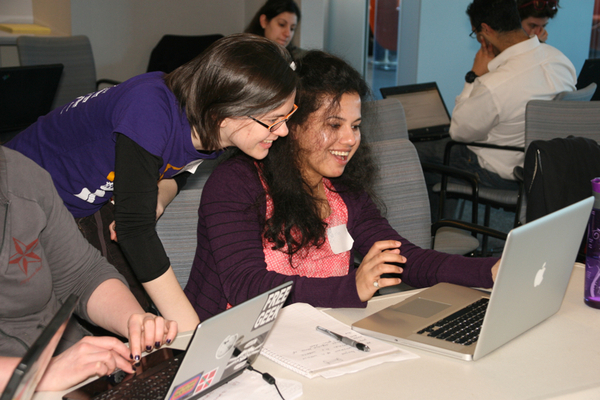
Photo from the Boston Python Workshop   a similar workshop run in Boston that has inspired and provided a template for the CDSW.

Photo from the Boston Python Workshop a similar workshop run in Boston that has inspired and provided a template for the CDSW.

On three Saturdays in April and May, I will be helping run three day-long project-based workshops at the University of Washington in Seattle. The workshops are for anyone interested in learning how to use programming and data science tools to ask and answer questions about online communities like Wikipedia, Twitter, free and open source software, and civic media. The workshops are for people with no previous programming experience and the goal is to bring together researchers as well as participants and leaders in online communities. The workshops will all be free of charge and open to the public given availability of space. Our goal is that, after the three workshops, participants will be able to use data to produce numbers, hypothesis tests, tables, and graphical visualizations to answer questions like: If you are interested in participating, fill out our registration form here. The deadline to register is Wednesday March 26th. We will let participants know if we have room for them by Saturday March 29th. Space is limited and will depend on how many mentors we can recruit for the sessions. If you already have experience with Python, please consider helping out at the sessions as a mentor. Being a mentor will involve working with participants and talking them through the challenges they encounter in programming. No special preparation is required. If you re interested, send me an email.

Russell Coker: BTRFS Status March 2014

I m currently using BTRFS on most systems that I can access easily. It s not nearly reliable enough that I want to install it on a server in another country or an embedded device that s only accessible via 3G, but for systems where I can access the console it s not doing too badly. Balancing and Space Allocation # btrfs filesystem df /
Data, single: total=103.97GiB, used=85.91GiB
System, DUP: total=32.00MiB, used=20.00KiB
Metadata, DUP: total=1.78GiB, used=1.31GiB
# df -h /
Filesystem Size Used Avail Use% Mounted on
/dev/disk/by-uuid/ac696117-473c-4945-a71e-917e09c6503c 108G 89G 19G 84% /
Currently there are still situations where it can run out of space and deadlock on freeing space. The above shows the output of the btrfs df command and the regular df command, I have about 106G of disk space used by data and metadata in BTRFS while df shows that the entire filesystem (IE the block device) is 108G. So if I use another 2G of data or metadata then the system is at risk of deadlocking. To avoid that happening I have to run btrfs balance start / to start a balance which defragments the space use and frees some blocks. Currently there is a bug in BTRFS (present in all Debian/Unstable kernels) which prevents a balance operation from completing when systemd is used in a default configuration (there s something about the way systemd accesses it s journal files that triggers a BTRFS bug). This is really inconvenient, particularly given that there s probably a strong correlation between people who use experimental filesystems and people who use experimental init programs. When you get to the stage of the filesystem being deadlocked you can sometimes recover by removing snapshots and sometimes by adding a new device to the filesystem (even a USB flash drive will do). But I once had a filesystem get into a state where there wasn t enough space to balance, add a device, or remove a snapshot so I had to do a backup/format/restore. Quota Groups Last time I asked the developers (a few weeks ago) they told me that quota groups aren t ready to use. They also said that they know about enough bugs that there s no benefit in testing that feature. Even people who want to report bugs in BTRFS shouldn t use quotas. Kernel Panics with Kmail I ve had three systems develop filesystem corruption on files related to Kmail (the email program from KDE). I suspect that Kmail is triggering a bug in BTRFS. On all three systems the filesystem developed corruption that persisted across a reboot. One of the three systems was fixed by deleting the file for the Outbox, the others are waiting for kernel 3.14 which is supposed to fix the bug that causes kernel panics when accessing the corrupted files in question. I don t know whether kernel 3.14 will fix the bug that caused the corruption in the first place. Conclusion As I don t use quotas BTRFS is working well for me on systems that have plenty of storage space and don t run Kmail. There are some systems running systemd where I plan to upgrade the kernel before all the filesystem space is allocated. One of my systems is currently running SysVinit so I can balance the filesystem. Apart from these issues BTRFS is working reasonably well for me. I haven t yet had it s filesystem checksums correct corrupted data from disk in any situation other than tests (I have had ZFS correct such an error, so hardware I use does benefit from this). I have restored data from BTRFS snapshots on many occasions, so that feature has been a major benefit for me. When I had a system with faulty RAM the internal checks in BTRFS alerted me to the problem and I didn t lose any data, the filesystem became read-only and I was able to copy everything off even though it was too corrupted for writes.

Gunnar Wolf: Trying to get Blender to run in the CuBox-i (armhf): Help debugging Python!

As I posted some weeks ago, I have been playing with my CuBox-i4Pro, a gorgeous little ARM machine by SolidRun, built around an iMX6 system-on-a-chip. My first stabs at using it resulted in my previous post on how to get a base, almost-clean Debian distribution to run (Almost? Yes, the kernel requires some patches not yet accepted upstream, so I'm still running with a patched 3.0.35-8 kernel). After writing this step by step instructions, I followed them and built images ready to dd to a SD card and start running (available at my people.debian.org space. Now, what to do with this little machine? My version is by no means a limited box: 4 ARM cores, 2GB RAM make a quite decent box. In my case, this little machine will most likely be a home storage server with little innovation. However, the little guy is a power server, at only 3W consumption. I wanted to test its capabilities to do some number crunching and aid some of my friends The obvious candidate is building a Blender render farm. Right, the machines might be quite underpowered, but they are cheap (and look gorgeous!), so at least it's worth playing a bit! Just as a data point, running on an old hard disk (and not on my very slow SD card), the little machine was able to compile the Blender sources into a Debian package in 89m13.537s, that is, 5353 seconds. According to the Debian build logs (yes, for a different version, I tried with the version in Wheezy and in a clean Wheezy system), the time it took to build on some other architectures' build daemons was 1886s on i386, 1098s on PowerPC, 2003s on AMD64, 11513s on MIPS and 27721 on ARMHF. That means, my little machine is quite slower than desktop systems, but not unbearably so. But sadly, I have hit a wall, and have been unable to do any further progress. Blender segfaults at startup under the Debian armhf architecture. I have submitted bug report #739194 about this, but have got no replies to it yet. I did get the great help from my friends in the OFTC #debian-arm channel, but they could only help up to a given point. It seems the problem lies in the Python interpreter in armhf, not in Blender itself... But I cannot get much further either. I'm sending this as a blog post to try to get more eyeballs on my problem How selfish, right? :-) So, slightly going over the bug report, blender just dies at startup:
  1. $ blender -b -noaudio
  2. Segmentation fault
After being told that strace is of little help when debugging this kind of issues, I went via gdb. A full backtrace pointed to what feels like the right error point:
  1. (gdb) bt full
  2. #0 0x2acd8cce in PyErr_SetObject ()
  3. from /usr/lib/arm-linux-gnueabihf/libpython3.3m.so.1.0
  4. No symbol table info available.
  5. #1 0x2acd8c9a in PyErr_Format ()
  6. from /usr/lib/arm-linux-gnueabihf/libpython3.3m.so.1.0
  7. No symbol table info available.
  8. #2 0x2ac8262c in PyType_Ready ()
  9. from /usr/lib/arm-linux-gnueabihf/libpython3.3m.so.1.0
  10. No symbol table info available.
  11. #3 0x2ac55052 in _PyExc_Init ()
  12. from /usr/lib/arm-linux-gnueabihf/libpython3.3m.so.1.0
  13. No symbol table info available.
  14. #4 0x2ace95e2 in _Py_InitializeEx_Private ()
  15. from /usr/lib/arm-linux-gnueabihf/libpython3.3m.so.1.0
  16. No symbol table info available.
  17. #5 0x00697898 in BPY_python_start (argc=3, argv=0x7efff8d4)
  18. at /build/blender-dPxPUD/blender-2.69/source/blender/python/intern/bpy_interface.c:274
  19. py_tstate = 0x0
  20. py_path_bundle = 0x0
  21. program_path_wchar = L"/usr/bin/blender", '\000' <repeats 1007 times>
  22. #6 0x0044a1ca in WM_init (C=C@entry=0x1d83220, argc=argc@entry=3,
  23. argv=argv@entry=0x7efff8d4)
  24. at /build/blender-dPxPUD/blender-2.69/source/blender/windowmanager/intern/wm_init_exit.c:176
  25. No locals.
  26. #7 0x0042e4de in main (argc=3, argv=0x7efff8d4)
  27. at /build/blender-dPxPUD/blender-2.69/source/creator/creator.c:1597
  28. C = 0x1d83220
  29. syshandle = 0x1d8a338
  30. ba = 0x1d8a840
  31. (gdb)
I'm not pasting here the full bug history (go to the bug report for the full information!), but it does point me to this being a problem in Python-land: It points to something not found at line 59 of Python/errors.c. And what I understand from that line is that some kind of unknown exception is thrown, and the Python interpreter does not now what to do with it. The check done at line 59 is the if (exception != NULL ** ....:
  1. void
  2. PyErr_SetObject(PyObject *exception, PyObject *value)
  3. PyThreadState *tstate = PyThreadState_GET();
  4. PyObject *exc_value;
  5. PyObject *tb = NULL;
  6. if (exception != NULL &&
  7. !PyExceptionClass_Check(exception))
  8. PyErr_Format(PyExc_SystemError,
  9. "exception %R not a BaseException subclass",
  10. exception);
  11. return;
So... Dear lazyweb: Any pointers on where to go on from here? kthxbye.

15 March 2014

Lars Wirzenius: Obnam 1.7 (backup software)

I have just released version 1.7 of Obnam, my backup program. Version 1.7, released 2014-03-15 WARNING: This release has had fairly large parts of the internals re-written. There shouldn't be any externally visible changes due to that, but there is a chance of bugs. Be careful. Make a copy of your backup repository before upgrading, if you can. Bug fixes: Internal changes:

13 March 2014

Mario Lang: Living in RAM

I switched to SSD on my home server a few years ago, at a time when SSH was still new and sort of hyped. However, I immediately knew that this type of technology is for me: it is fast and rather silent. SSD storage has this air of being fragile though. You are supposed to not wear it out too much. It's not like in the good old days where you would write to your hard disk without any extra thought.
tmpfs Before I switched to SSD I was already using tmpfs to store /tmp in RAM, for performance reasons mostly. /etc/default/tmpfs:
RAMTMP=yes
Since RAM is relatively cheap these days I have lots of it in my home server.
/var/cache/apt/archives When I switched to SSD, I extended this concept by mounting /var/cache/apt/archives via tmpfs. This is to save disk I/O for package updates. And for a machine running sid which is more or less regularily updated, this saves quite some useless writes to disk. Roughly 100MB per update.
/tmp/src Nowadays, I have almost all of my source code checkouts and build-trees in /tmp/src. myrepos makes this very easy to handle. Simply clone all repositories you are interested in, and remember their details with mr register. After a reboot, all you need to do is:
$ mkdir /tmp/src
$ cd !$
$ mr up
Your repository locations have (likely) been recorded in ~/.mrconfig. Of course there is the danger of accidentally loosing data due to a power outage. However, I feel this leads to a rather clean workflow. Changes need to be pushed anyway. So since you can not trust your local repository to really persist, you are forced to push your changes regularily, which is a good thing! Besides, I have a UPS at home which gives me roughly one hour of backup power. This was enough to sustain every power outage I have witnessed in the past years. Typically, outages are rather short lived in my area, somewhere between a few seconds and 5 minutes. It is rather rare that electricity goes missing for more than half an hour. The only downside of this approach is that from time to time, you will use more bandwidth by re-cloning repositories after a reboot. But really, who needs reboots on Linux? Last time I had half a year uptime, and only rebooted because I wanted to jump from linux 3.8 to 3.13. This approach only works on long-running machines though. It is probably not very useful for a laptop.

12 March 2014

Matthew Garrett: Dealing with Apple ACPI issues

I wrote about Thunderbolt on Apple hardware a while ago. Since then Andreas Noever has somehow managed to write a working Thunderbolt stack, which awesome! But there was still the problem I mentioned of the device not appearing unless you passed acpi_osi="Darwin" on the kernel command line, and a further problem that if you suspended and then resumed it vanished again.

The ACPI _OSI interface is a mechanism for the firmware to determine the OS that the system is running. It turns out that this works fine for operating systems that export fairly static interfaces (Windows, which adds a new _OSI per release) and poorly for operating systems that don't even guarantee any kind of interface stability in security releases (Linux, which claimed to be "Linux" regardless of version until we turned that off). OS X claims to be Darwin and nothing else. As I mentioned before, claiming to be Darwin in addition to Windows was enough to get the Thunderbolt hardware to stay alive after boot, but it wasn't enough to get it powered up again after suspend.

It turns out that there's two sections of ACPI code where this Mac checks _OSI. The first is something like:

if (_OSI("Darwin")) Store 0x2710 OSYS; else if(_OSI("Windows 2009") Store 0x7D9 OSYS; else

ie, if the OS claims to be Darwin, all other strings are ignored. This is called from \_SB._INI(), which is the first ACPI method the kernel executes. The check for whether to power down the Thunderbolt controller occurs after this and then works correctly.

The second version is less helpful. It's more like:

if (_OSI("Darwin")) Store 0x2710 OSYS; if (_OSI("Windows 2009")) Store 0x7D9 OSYS; if

ie, if the OS claims to be both Darwin and Windows 2009 (which Linux will if you pass acpi_osi="Darwin"), the OSYS variable gets set to the Windows 2009 value. This version gets called during PCI initialisation, and once it's run all the other Thunderbolt ACPI calls stop doing anything and the controller gets powered down after suspend/resume. That can be fixed easily enough by special casing Darwin. If the platform requests Darwin before anything else, we'll just stop claiming to be Windows.

Phew. Working Thunderbolt! (Well, almost - _OSC fails and so we disable PCIe hotplug, but that's easy to work around). But boo, no working battery. Apple do something very strange with their ACPI battery interface. If you're running anything that doesn't claim to be Darwin, Apple expose an ACPI Control Method battery. Control Method interfaces abstract the complexity away into either ACPI bytecode or system management traps - the OS simply calls an ACPI method, magic happens and it gets an answer back. If you claim to be Darwin, Apple remove that interface and instead expose the raw ACPI Smart Battery System interface. This provides an i2c bus over which the OS must then speak the Smart Battery System protocol, allowing it to directly communicate with the battery.

Linux has support for this, but it seems that this wasn't working so well and hadn't been for years. Loading the driver resulted in modprobe hanging until a timeout occurred, and most accesses to the battery would (a) take forever and (b) probably fail. It also had the nasty habit of breaking suspend and resume, which was unfortunate since getting Thunderbolt working over suspend and resume was the whole point of this exercise.

So. I modified the sbs driver to dump every command it sent over the i2c bus and every response it got. Pretty quickly I found that the failing operation was a write - specifically, a write used to select which battery should be connected to the bus. Interestingly, Apple implemented their Control Method interface by just using ACPI bytecode to speak the SBS protocol. Looking at the code in question showed that they never issued any writes, and the battery worked fine anyway. So why were we writing? SBS provides a command to tell you the current state of the battery subsystem, including which battery (out of a maximum of 4) is currently selected. Unsurprisingly, calling this showed that the battery we wanted to talk to was already selected. We then asked the SBS manager to select it anyway, and the manager promptly fell off the bus and stopped talking to us. In keeping with the maxim of "If hardware complains when we do something, and if we don't really need to do that, don't do that", this makes it work.

Working Thunderbolt and working battery. We're even getting close to getting switchable GPU support working reasonably, which is probably just going to involve rewriting the entirety of fbcon or something similarly amusing.

comment count unavailable comments

Vasudev Kamath: Working around type system of Go with unsafe

Go language has a strong type system unlike C, and some times this will be head ache when we want to interact with C data types with Cgo or just to convert a Go type to lets say byte slice. I recently faced the same problem and after poking around things, I learned the Go provides unsafe package which can be used to work around the Go's type system.
Problem Recently I started using Cgo to use some C library I had to write some tools for development and testing. The reason I chose Go for this was prototyping and writing some quick tools is much easier in Go than done in C. The C library had some function which takes pointer to array types and fills it with some values. The problem I was facing here was how to create a C array in Go. Go does have array but its largely used as internal representation for much efficient type called slice and I can't directly cast a byte slice into an C array. Second problem I had was I had to store arbitrary Go types like float (float32,float64) and int (int32, int64) etc. into C array. So in brief, the problems that needed to solve are
  1. Find a way to convert byte slice from Go into C array and vice versa.
  2. Find a way to convert and store Go types into a C array.
Solution Basically C array are sequence of memory location which can be statically or dynamically allocated. In Cgo its possible to access C standard library functions for memory allocation, so why not use it. The memory allocation function then returns the pointer to starting of allocated memory, we can use this pointer to write Go's bytes into the memory location and bytes from memory location into Go's slice. The pointer returned by C allocation functions are not directly usable for memory dereferencing in Go, here is where unsafe package kicks in. We will cast the return of C allocation function as unsafe.Pointer type and from the documentation of unsafe package,
  1. A pointer value of any type can be converted to a Pointer.
  2. A Pointer can be converted to a pointer value of any type.
  3. A uintptr can be converted to a Pointer.
  4. A Pointer can be converted to a uintptr.
So we can then cast unsafe.Pointer to uintptr which is the Go type which is large enough to hold any memory address in Go and can be used for pointer arithmetic just like we do in C (of course with some more castings). Below I'm pasting a simplified code in C which I wrote for this post.
#ifndef __BYTETEST_H__
#define __BYTETEST_H__
typedef unsigned char UBYTE;
extern void ArrayReadFunc(UBYTE *arrayout);
extern void ArrayWriteFunc(UBYTE *arrayin);
#endif
#include "bytetest.h"
#include <stdio.h>
#include <string.h>
void ArrayReadFunc(UBYTE *arrayout)
 
     UBYTE array[20] =  1, 2, 3, 4,5, 6, 7, 8, 9, 10,
                        11, 12, 13, 14, 15, 16, 17,
                        18, 19, 20 ;
     memcpy(arrayout, array, 20);
 
void ArrayWriteFunc(UBYTE *arrayin)
 
     UBYTE array[20];
     memcpy(array, arrayin, 20);
     printf("Byte slice array received from Go:\n");
     for(int i = 0; i < 20; i ++) 
             printf("%d ", array[i]);
      
     printf("\n");
 
Functions are written just for this post and they don't really do anything. As you can see ArrayReadFunc takes a pointer to array and fills it with content of another array using memcpy. Function ArrayWriteFunc on other hand takes pointer to array and copies its content to internal array. I've added print logic to ArrayWriteFunc just to show that values passed from Go are making it here. Below is the Go code which uses the above C files passes byte slice to get value out of C code and array made of byte slice to C function to send values in.
package main
/*
#cgo CFLAGS: -std=c99
#include "bytetest.h"
#include <stdlib.h>
*/
import "C"
import (
     "fmt"
     "unsafe"
)
func ReadArray() unsafe.Pointer  
       var outArray = unsafe.Pointer (C.calloc(20,1))
       C.ArrayReadFunc((*C.UBYTE)(outArray))
       return outArray
 
func WriteArray(inArray unsafe.Pointer)  
       C.ArrayWriteFunc((*C.UBYTE)(inArray))
 
func CArrayToByteSlice(array unsafe.Pointer, size int) []byte  
       var arrayptr = uintptr(array)
       var byteSlice = make([]byte, size)
       for i := 0; i < len(byteSlice); i ++  
               byteSlice[i] = byte(*(*C.UBYTE)(unsafe.Pointer(arrayptr)))
               arrayptr ++
        
       return byteSlice
 
func ByteSliceToCArray (byteSlice []byte) unsafe.Pointer  
       var array = unsafe.Pointer(C.calloc(C.size_t(len(byteSlice)), 1))
       var arrayptr = uintptr(array)
       for i := 0; i < len(byteSlice); i ++  
              *(*C.UBYTE)(unsafe.Pointer(arrayptr)) = C.UBYTE(byteSlice[i])
              arrayptr ++
        
       return array
 
func main() 
        carray := ReadArray()
        defer C.free(carray)
        carraybytes := CArrayToByteSlice(carray, 20)
        fmt.Println("C array converted to byte slice:")
        for i := 0; i < len(carraybytes); i ++  
                fmt.Printf("%d ", carraybytes[i])
         
        fmt.Println()
        gobytes := []byte 21, 22, 23, 24, 25, 26, 27, 28, 29, 30,
                31, 32, 33, 34, 35, 36, 37, 38, 39, 40 
        gobytesarray := ByteSliceToCArray(gobytes)
        defer C.free(gobytesarray)
        WriteArray(gobytesarray)
 
Functions ReadArray and WriteArray are just wrapper to the calls to C counter parts ArrayReadFunc and ArrayWriteFunc. ReadArray returns unsafe.Pointer which is allocated C array and should be freed by caller. WriteArray takes unsafe.Pointer which is pointing to memory location containing C array. Now the functions of interest are CArrayToByteSlice and ByteSliceToCArray. It should be pretty clear from the above code to understand what is happening in these functions. Still I will just put explain them briefly. ByteSliceToCArray allocates a C array using calloc from C standard library. It then creates a uintptr, a pointer type in Go which is used to dereference the each memory location and store bytes from the input byte slice in them. CArrayToByteSlice on other hands creates a uintptr type by casting input unsafe.Pointer type and then uses this pointer type to dereference values from memoy and store it in byte slice with suitable casting. So lets build the code and run it and see the output:
C array converted to byte slice:
1 2 3 4 5 6 7 8 9 10 11 12 13 14 15 16 17 18 19 20
Byte slice array received from Go:
21 22 23 24 25 26 27 28 29 30 31 32 33 34 35 36 37 38 39 40
So yes it actually works and values are moving across C and Go. This solves first problem in hand next is converting arbitrary Go types into byte slices. There are many cases where we would like to convert an arbitrary Go types like (int, float) into bytes. One such use case I found was when writing a TCP client for communicating with a Server written using C speaking custom protocol. Here I'm just going to show how to convert types like float, int to byte slice, I've not tried converting structures but it is certainly possible. Below is the function which can convert int32,float32 into byte slice it can also be extended for other types.
func CopyValueToByte(value interface ) []byte  
     var valptr uintptr
     var slice []byte
     switch t := value.(type)  
     case int32:
             i := value.(int32)
             valptr = uintptr(unsafe.Pointer(&i))
             slice = make([]byte, unsafe.Sizeof(i))
     case float32:
             f := value.(float32)
             valptr = uintptr(unsafe.Pointer(&f))
             slice = make([]byte, unsafe.Sizeof(f))
     default:
             fmt.Fprintf(os.Stderr,"Unsupported type: %T\n", t)
             os.Exit(1)
      
     for i := 0; i < len(slice); i++  
             slice[i] = byte(*(*byte)(unsafe.Pointer(valptr)))
             valptr++
      
     return slice
 
This function is generic which can take various types of value. First we will use Go's type assertion to determine the type and creates a uintptr pointer for the value and allocates byte slice depending on the size of the value as calculated using unsafe.Sizeof. Later it uses the pointer to dereference value from memory location and copies each byte into byte slice. The idea used here is every type is represented as certain number of bytes in the memory. Below is the entire program.
package main
import (
     "fmt"
     "unsafe"
     "os"
)
func CopyValueToByte(value interface ) []byte  
     var valptr uintptr
     var slice []byte
     switch t := value.(type)  
     case int32:
             i := value.(int32)
             valptr = uintptr(unsafe.Pointer(&i))
             slice = make([]byte, unsafe.Sizeof(i))
     case float32:
             f := value.(float32)
             valptr = uintptr(unsafe.Pointer(&f))
             slice = make([]byte, unsafe.Sizeof(f))
     default:
             fmt.Fprintf(os.Stderr,"Unsupported type: %T\n", t)
             os.Exit(1)
      
     for i := 0; i < len(slice); i++  
             slice[i] = byte(*(*byte)(unsafe.Pointer(valptr)))
             valptr++
      
     return slice
 
func main()  
     a := float32(-10.3)
     floatbytes := CopyValueToByte(a)
     fmt.Println("Float value as byte slice:")
     for i := 0; i < len(floatbytes); i++  
             fmt.Printf("%x ", floatbytes[i])
      
     fmt.Println()
     b := new(float32)
     bptr := uintptr(unsafe.Pointer(b))
     for i := 0; i < len(floatbytes); i++  
             *(*byte)(unsafe.Pointer(bptr)) = floatbytes[i]
             bptr++
      
     fmt.Printf("Byte value copied to float var: %f\n", *b)
 
The above conversion can also be achieved using encoding/binary package provided by Go. But its been told to me that it makes things pretty slow.
Conclusion So goes unsafe.Pointer is really powerful thing which allows us to work around the Go's type system but as package documentation says it should be used with care
PS: I'm not really sure if its recommended to use allocation functions from C standard library, I will wait for expert gophers to comment on that.

Petter Reinholdtsen: How to add extra storage servers in Debian Edu / Skolelinux

On larger sites, it is useful to use a dedicated storage server for storing user home directories and data. The design for handling this in Debian Edu / Skolelinux, is to update the automount rules in LDAP and let the automount daemon on the clients take care of the rest. I was reminded about the need to document this better when one of the customers of Skolelinux Drift AS, where I am on the board of directors, asked about how to do this. The steps to get this working are the following:
  1. Add new storage server in DNS. I use nas-server.intern as the example host here.
  2. Add automoun LDAP information about this server in LDAP, to allow all clients to automatically mount it on reqeust.
  3. Add the relevant entries in tjener.intern:/etc/fstab, because tjener.intern do not use automount to avoid mounting loops.
DNS entries are added in GOsa , and not described here. Follow the instructions in the manual (Machine Management with GOsa in section Getting started). Ensure that the NFS export points on the server are exported to the relevant subnets or machines:
root@tjener:~# showmount -e nas-server
Export list for nas-server:
/storage         10.0.0.0/8
root@tjener:~#
Here everything on the backbone network is granted access to the /storage export. With NFSv3 it is slightly better to limit it to netgroup membership or single IP addresses to have some limits on the NFS access. The next step is to update LDAP. This can not be done using GOsa , because it lack a module for automount. Instead, use ldapvi and add the required LDAP objects using an editor.
ldapvi --ldap-conf -ZD '(cn=admin)' -b ou=automount,dc=skole,dc=skolelinux,dc=no
When the editor show up, add the following LDAP objects at the bottom of the document. The "/&" part in the last LDAP object is a wild card matching everything the nas-server exports, removing the need to list individual mount points in LDAP.
add cn=nas-server,ou=auto.skole,ou=automount,dc=skole,dc=skolelinux,dc=no
objectClass: automount
cn: nas-server
automountInformation: -fstype=autofs --timeout=60 ldap:ou=auto.nas-server,ou=automount,dc=skole,dc=skolelinux,dc=no
add ou=auto.nas-server,ou=automount,dc=skole,dc=skolelinux,dc=no
objectClass: top
objectClass: automountMap
ou: auto.nas-server
add cn=/,ou=auto.nas-server,ou=automount,dc=skole,dc=skolelinux,dc=no
objectClass: automount
cn: /
automountInformation: -fstype=nfs,tcp,rsize=32768,wsize=32768,rw,intr,hard,nodev,nosuid,noatime nas-server.intern:/&
The last step to remember is to mount the relevant mount points in tjener.intern by adding them to /etc/fstab, creating the mount directories using mkdir and running "mount -a" to mount them. When this is done, your users should be able to access the files on the storage server directly by just visiting the /tjener/nas-server/storage/ directory using any application on any workstation, LTSP client or LTSP server.

Andrew Pollock: [life] Day 43, a lovely lazy day, until we got on the bike

Zoe slept through the night again last night. Two nights of uninterrupted sleep has been totally amazing! We had a slower start to the day because we didn't have to be anywhere. I've been meaning to do a massive cull of Zoe's wardrobe for a while, and this morning seemed like as good an opportunity as any, so after TV, I managed to get Zoe to cooperate with trying on clothes for about an hour. She really enjoyed pulling everything out of her wardrobe and putting it all back again neatly. After that, she asked me if I could make her a bus out of the last remaining moving box, so I managed to make something approximating a bus. The port-a-robe boxes are really rather handy for this sort of thing. The balcony is starting to look like a cardboard box shanty town, with a cubby house, a rocket and now a bus. I think we need to host a few more play dates so they all get a good work out. It was time for lunch after that. I'd had a bucket of caramel popcorn, which I used for the journey to Coochiemudlo the other week. Zoe had asked me how popcorn was made, so I had resolved to make popcorn with her sometime soon. Yesterday at the health food shop, I opportunistically noticed some popping corn, so I grabbed a small bag of it. It turned out that buying peanut oil was good for more than just making peanut butter, as it came in handy today for popping corn. I've never popped corn before, aside from occasionally getting a bag of the microwave stuff, so it was a fun experience to do it "from scratch". It turned out pretty well, with only a few burned ones and a few unpopped ones. It'd be fun to try and dry out a corn cob and totally do it from scratch. After that I tried to get Zoe to take a nap, but it didn't work out so well, so after her quiet time we cleaned up her bedroom and generally fooled around for a bit. Throughout the day, Zoe did lots of little bouts of self-directed play. She dredged up this little wooden xylophone that we'd made in the US from a Kiwi Crate and had a great time banging away on it until she stood on it and broke it. The doctor's kit got a good workout. It was just a really nice, relaxing day at home. Zoe's Kindergarten was having a play date meet-and-greet in the park, for all the parents to meet each other. It was a fair way from home, but there was a nice, albeit circuitous, bike path to get there, and I decided to try and bike there, without really properly estimating the distance or length of time it would take. The play date was due to start at 3:30pm, and I was planning on leaving at 3pm. We were about 5 minutes late getting out of the door. I think it ended up taking us about 50 minutes to get there. It was a beautiful ride though, once we got onto the Bulimba Creek bikeway, through the Minippi Parklands. It would have been the longest ride Zoe's had on the bike, and she wasn't fazed at all. The play date itself was nice. For some reason, I'm a bit shy about going and introducing myself to the mothers (I kept wanting to write "other mothers"), but I sucked it up and made a few introductions. I'm terrible about remembering names though. At least I've got a few faces I can say hi to at drop off and pick up now. Sarah met us at the park and hung out for a bit as well, and then Zoe and her left together and I biked back home. I was feeling pretty good, and thought I'd try and bang out a run when I got home, but I didn't end up having the fuel in the tank, and blew up after about 1.5km.

11 March 2014

Steve Kemp: Discovering back-end servers automatically?

Recently I've been pondering how to do service discovery. Pretend you have a load balancer which accepts traffic and routes incoming requests to different back-ends. The loadbalancer might be pound, varnish, haproxy, nginx, or similar. The back-ends might be node applications, apache, or similar. The typical configuration of the load-balancer will read:
# forward
# backends
backend web1    .host = "10.0.0.4";  
backend web2    .host = "10.0.0.6";  
backend web3    .host = "10.0.0.5";  
#  afterword
I've seen this same setup in many situations, and while it can easily be imagined that there might be "random HTTP servers" on your (V)LAN which shouldn't receive connections it seems like a pain to keep updating the backends. Using UDP/multicast broadcasts it is trivial to announce "Hey I'm a HTTP-server with the name 'foo'", and it seems to me that this should allow seamless HTTP load-balancing. To be more explicit - this is normal: What I'd like to propose is another step: i.e. This allows backends to be removed from service when they go offline but also to be added when they come online. Without the load-balancer needing its configuration to be updated. This means you'd not give a static list of back-ends to your load-balancer, instead you'd say "Route traffic to any service that adfvertises itself with the tag 'foo'.". VLANS, firewalls, multicast, udp, all come into play, but in theory this strikes me as being useful, obvious, and simple. (Failure cases? Well if the "announcer" dies then the backend won't get traffic routed to it. Just like if the backend were offline. And clearly if a backend is announced, but not receiving HTTP-requests it would be dropped as normal.) If I get the time this evening I'll sit down and look at some load-balancer source code to see if any are written in such a way that I could add this "broadcast discovery" as a plugin/minor change.

Steve Langasek: My CuBox-i has arrived

A couple of weeks ago, Gunnar Wolf mentioned on IRC that his CuBox-i4 had arrived. This resulted in various jealous noises from me; having heard about this device making the rounds at the Kernel Summit, I ordered one for myself back in December, as part of the long-delayed HDification of our home entertainment system and coinciding with the purchase of a new Samsung SmartTV. We've been running an Intel Coppermine Celeron for a decade as a MythTV frontend and encoder (hardware-assisted with a PVR-250), which is fine for SD video, but really doesn't cut it for anything HD. So after finally getting a TV that would showcase HD in all its glory, I figured it was time to upgrade from an S-Video-out, barely-limping-along tower machine to something more modern with HDMI out, eSATA, hardware video decoding, and whose biggest problem is it's so small that it threatens to get lost in the wiring! Since placing the order, I've been bemused to find that the SmartTV is so smart that it has had a dramatic impact on how we consume media; between that and our decision to not be a boiled frog in the face of DISH Network's annual price increase, the MythTV frontend has become a much less important part of our entertainment center, well before I ever got a chance to lay hands on the intended replacement hardware. But that's a topic for another day. Anyway, the CuBox-i4 finally arrived in the mail on Friday, so of course I immediately needed to start hacking on it! Like Gunnar, who wrote last week about his own experience getting a "proper" Debian install on the box, I'm not content with running a binary distribution image prepared by some third party; I expect my hardware toys to run official distro packages assembled using official distro tools and, if at all possible, distributed on official distro images for a minimum of hassle. Whereas Gunnar was willing to settle for using third-party binaries for the bootloader and kernel, however, I'm not inclined to do any such thing. And between my stint at Linaro a few years ago and the recent work on Ubuntu for phones, I do have a little knowledge of Linux on ARM (probably just enough to be dangerous), so I set to work trying to get the CuBox-i4 bootable with stock Debian unstable. Being such a cutting-edge piece of hardware, that does pose some challenges. Support for the i.MX6 chip is in the process of being upstreamed to U-Boot, but the support for the CuBox-i devices isn't there yet, nor is the support for SPL on i.MX6 (which allows booting the variants of the CuBox-i with a single U-Boot build, instead of requiring a different bootloader build for each flavor). The CuBox-i U-Boot that SolidRun makes available (with source at github) is based on U-Boot 2013.10-rc4, so more than a full release behind Debian unstable, and the patches there don't apply to U-Boot 2014.01 without a bit of effort. But if it's worth doing, it's worth doing right, so I've taken the time to rebase the CuBox-i patches on top of 2014.01, publishing the results of the rebase to my own github repository and submitting a bug to the Debian U-Boot maintainers requesting its inclusion. The next step is to get a Debian kernel that not only works, but fully supports the hardware out of the box (a 3.13 generic arm kernel will boot on the machine, but little things like ethernet and hdmi don't work yet). I've created a page in the Debian wiki for tracking the status of this work.

Andrew Pollock: [life] Day 42, a good night's sleep, Kindergarten, make up swim class and dinner with Nana

Zoe slept through the night for the first time in recent memory, and was up at around 6am. It was lovely. I'm thinking the slightly lower temperature helped. I'm definitely going to explore air conditioning for the bedrooms before next Summer. I'd picked up some egg cups on the weekend, so we did soft boiled eggs in the Thermomix for breakfast. They turned out lovely this time, and Zoe seemed to enjoy eating hers. She dressed herself while they were cooking. Her Kindergarten t-shirts arrived yesterday, so now she looks like all the other kids. It's very cute. It rained on and off in the morning, and I was in two minds about whether to chance it on the bike or not. As it happened we ended up messing around a bit before leaving, so we drove, and it was a good call, because it started raining again as we pulled out of the driveway. Drop off was super smooth. Megan had been away yesterday, but was back today, so Zoe was very happy to see her. My financial advisor came out for a chat about investments mid-morning, and then I got stuck into my US taxes. I will not miss having to do these tax returns. The 2013 one is going to be particularly complicated by the fact we sold our home and were only in the country for like 80 days. I biked over to Kindergarten to pick up Zoe, as the weather had improved. Surprisingly, she was awake, but her teacher said she'd just woken up from a nap. We managed to clear out pretty quickly. I stopped at the health food shop on the way home to get some peanut oil for the dinner I was making. Due to a miscommunication, Zoe had missed her Saturday swim class. I explained to the swim school the error, and they were kind enough to allow Zoe to have a make up class anyway, so we went to that after Kindergarten. Zoe wanted to do some more practice riding her bike. She's got a little 10 inch bike with no training wheels and a gyrobike front wheel. We haven't had a lot of success learning to ride to date, due to a combination of her height and just time, so it was interesting that she decided today she wanted to do some more practice. She wanted to "ride" her bike from home to the park on the way to swim class, but I managed to convince her to walk the bike to the park. It turns out even walking the bike is a bit of a challenge for her, so I ended up carrying it most of the way. It's heavy. We got to the park, and had a bit of a run with the bike. I'm glad I decided to take her knee pads and elbow pads, because she did stack it fairly decently, but managed to survive mostly unscathed. To her credit, she even got back on the bike again. She's a tough kid. Once we made it to the playground, she lost all interest in the bike, and we had about 15 minutes to kill before we needed to continue to the pool. We walked/carried the bike from the park to the pool, and the make up class Zoe ended up in was Megan's regular class, so the girls had a great time together. After swim class, we walked back home. Zoe's Nana was coming over for dinner, and I wanted to make a satay chicken dish. I'd bought some peanuts from the Peanut Wagon on Sunday, when I was in Nanango for my uncle's 90th birthday party, and I wanted to try making peanut butter from scratch in the Thermomix, and use that to make the satay sauce. Long story short, dinner wasn't super great. I'd made a satay chicken in the Thermomix previously, but I couldn't find the recipe I used last time. I used this recipe tonight, but didn't really follow it properly because I was trying to cut corners due to the time. I tried cooking wild rice in the microwave and it was a total flop. The satay chicken itself turned out okay, but it was a shame about the rice. It was cool making my own peanut butter. Zoe had a great time playing with her Nana, and after we dropped her off at the train station went to bed without a peep.

10 March 2014

Jaldhar Vyas: 7DRL 2014/Procedural Death Jam

Each year the 7DRL competion gives me an opportunity to abandon developing a roguelike game part way through. This year I am going to strive mightily to actually complete a playable game though owing to family commitments I have already gotten off to a rocky start which does not bode well. But enough negativity... So this year 7DRL coincides with the first ever Procedural Death Jam. This is a similar type of thing except the genre is Procedural Death Labyrinth. Procedural Death Labyrinths are a subset of Roguelikes (or is it the other way round?) If you have taken advantage of the wonderful offer Valve has given to Debian developers, you can find a number of examples of Procedural Death Labyrinths on Steam. The most important part of any software development project is of course choosing a cool name. My game is called "The Girl Who Played With The Dragons Nest" (Can you guess what I've been reading?) It is written in C++ with the Curses toolkit. It will of course be open source. I intend to blog my progress here if you care to follow along.

9 March 2014

Wouter Verhelst: Accepted for LOADays 2014

My talk proposal for LOADays 2014 has been accepted. That makes the fifth consecutive time I'll be speaking there. I like this little event; it's small but always seems to come with some good content. And as someone who's ended up being a system administrator for most of my career, I can always find something interesting to talk about. This time around, my talk will be about debian-installer automation. I plan to explain a bit how d-i is structured internally so as to help people understand better how things work, and will then run a little demo on how we used preseeding to install the 45 laptops for FOSDEM with (almost) no user input. I've also decided to use libreoffice impress this time around, so I can try out the impress remote. Let's see how it goes. See you there?

8 March 2014

Andrew Shadura: Process isolation support in start-stop-daemon

Yesterday I played with LXC a bit, and I liked it, as LXC provides a very lightweight isolation of processes, much like enchanced chroot. However, I realised, I don t always need the chroot-like part of LXC, sometimes what I need is just to make sure the process is unable to see the other processes and talk to them in any other way except the filesystem, but I don t want a whole separate root file system for that. LXC provides a simple utility, lxc-unshare, which uses Linux-specific clone(2) call to run a process with new PID, IPC and other namespaces. However, this utility can t be used for running forking daemons, as the container is destroyed when its PID 1 exits. That s why I decided to add the support for process isolation to start-stop-daemon. I was careful enough to introduce minimal changes to it to make sure they can be merged back to the version as shipped with dpkg, and at the same time be buildable separately from the rest of it. Speaking of building, by the way, this version of start-stop-daemon uses mk-configure, a light-weight autotools replacement, as its build system. What I added, from a user s perspective, is a single --isolate option. When run with this option, start-stop-daemon calls clone(2) just before configuring the environment of a process it s going to run. The cloned process runs in a new namespace, and immediately remounts /proc, /dev/shm and /dev/mqueue. Then it forks, and a forked process executes the daemon. The parent process, which is PID 1 in the new PID namespace, uses waitpid(2) to monitor its child processes. As soon as its very first child exits, it talks via a pipe to the process outside of the container, so that it knows the container has a forked daemon and it needs to detach. In any case, the container s PID 1 does waitpid(2) in a loop, checking the process list every time a child terminates. As soon as it s left alone or a SIGTERM is received, it exits. The code is published at Bitbucket.

Mart&iacute;n Ferrari: Fun with the Linux desktop

Or, "Why 2014 will NOT be the year of Linux in the desktop". So, it happens that my mum (66 yo) has been a Debian user for over a year now. With highs and lows, she manages to do what she needs; sometimes I need to intervene. Today I thought I could send her a quick email explaining how to download using BitTorrent, because of reasons. So, as I was writing, I realised that in many torrent sites, you only get a magnet link these days. No problem! Click on the magnet link, at it should work automagically. Then I remembered: it works on my computer, because I've spent a couple of hours some time ago researching how to make FireFox work with magnet links, creating a custom script, etc. I hoped that by now this must have been solved, at least in Debian unstable. Wrong again. I created a new user in my computer, launched IceWeasel/FireFox and boom: I get a dialog asking me to select a program, not from a list of desktop applications, taken from one of the gazillion sources where applications are defined, but just from any place on the file system! (At least, now you don't need to go tweaking with the hidden FireFox configuration editor). I was very angry at the brainiac at Mozilla who thought it was a great idea to ignore the host system and do their own MIMEtype handling. And then, tried Chromium to see what would happen... And I get first a scary message telling me that it is going to use the super-obscure xdg-open program to open my link, and that it could harm my computer! It was followed by another very helpful dialog telling me something like:
Unable to detect the URI-scheme of "magnet:?xt=urn:btih:diePh6iengei4quaep4shai8ahshahnae9 oolahtetheir2bohmu1eelaChui1ohdahruegh4wief6PusahDae4ho oshahjoogai7bae9shuvei9shufeX4boog8neichi3OoDee5ei9Uori c6aingairepon9gok8Mee7uRahphah4EucoopheiYin4xe4lahn0goh"
Then the real fun started... I starting looking around to understand how this is supposed to work, I wanted to provide a patch! So, it turns out that if you add some values to GConf this should work. So, try to find where would that be. Read about GConf schemas, default and mandatory values, and their 10 possible locations. Find that Azureus provides an schema, use that to create one for Transmission. Then find that in fact, Transmission was providing defaults, which are not the same but work the same, and that they had an error there: yes, problem found! (#741069) No! It turns out that the Gnome desktop does not use that any more, and now they scan the .desktop (who knows in which of the 100 directory tress where .destop files are present) files for MIME handlers, and the transmission-gtk.desktop file had that correctly. So why does it not work? Well, it turns out that if I used gvfs-open instead of xdg-open, it did work! The thing is, I am running XFCE here, which is GTK based, but it is not Gnome: instead of gvfs-open, I was getting exo-open, which is it's brain-dead cousin, and can't do anything but files, email and web. It is fecking 2014, and we still don't have a sensible, unified way to select preferred applications. We still have incompatible, duplicated, incomplete, competing implementations. We have FreeDesktop doing one thing to try and unify criteria, which is then ignored or mis-implemented up and down by some desktops and applications. Some days I get really angry at the Free Software world. PS: I guess I will tell mum to copy&paste the links from the browser to the torrent client, but not today. I have already lost 4 hours of sleep on this.

Russell Coker: Less Work

I previously wrote about the idea of a Basic Income for Australia [1], that post was mainly to show how it could be introduced with little real change. That is not because I don t think that we need real changes, but because we should consider the various changes separately as much as possible. In terms of how society works I think that we need to move from the current model where most people are expected to work most of the time and the people who don t work are treated badly to encourage them to work for low wages. I think that we should aim as a society to have less time spent doing paid work which means more people working part time (maybe 6 months a year, 3 or 4 days a week, or other ways of doing less than 40 hours a week * ~45 weeks) and more people who aren t doing paid work. The idea of 100% employment is the cause of many jokes about the Soviet Union. I don t know how much truth is behind the jokes about needless work being done to fulfill Soviet plans, but regardless of the accuracy I think we should take such things as an idea of what not to do in our society. The Broken Window Fallacy is an example of the Soviet production problem in supposedly capitalist societies. Here are some of my ideas for decreasing the amount of needless work without decreasing anyone s quality of life in fact most of these make things better for most people. The War on Drugs The easiest way to reduce needless employees is to end the war on drugs . During the course of the war the drug use has steadily increased and the amount of law enforcement energy devoted to it has also increased. Some estimates claim that 50% of law enforcement is devoted to it. Also some of the hospital budget is related to drug use. I think that we should allow adults to consume any drug that they wish (not just tobacco, alcohol, caffeine, and other popular drugs) and apply the same laws regarding product quality to all of them. That will reduce the violence related to drugs, reduce the health impact (it s usually poor quality control that causes medical problems), and allow law enforcement to concentrate on crimes that hurt other people. Treating drug addiction as a medical problem has been shown to be the most effective way of reducing drug use, reducing violent crime, and reducing the health impact of drug use. Other Crime Issues Gary Slutkin s TED talk about treating violence as a contagious disease has some interesting ideas for reducing violence in the community [2]. Implementing those ideas on a wide scale seems to have the potential for reducing law enforcement and medical work. Generally I think we should aim to have as few laws as possible. Whenever adults want to do things that don t hurt other people they should be permitted to do so. There should also be an aim for laws to be consistent and easy to understand. Ideally there would be a single database with all laws in some form of hypertext (maybe some type of Wiki) so that any citizen can discover all implications of the laws that affect them. Health More money should be spent on preventing people getting sick. One problem we have in recent times is silly people refusing to get their children vaccinated because they take medical advice from a playboy model instead of doctors. I think that as a society we need to do more to protect children from stupid things that their parents do and that reducing the amount of medical work is the least of the reasons for doing so. Another problem is the quality of food. The big supermarket chains are pushing prices down which reduces food quality. The excessive use of anti-biotics is a serious threat to world health that is driven by the low price of meat. Robots Rodney Brooks gave an interesting TED talk about robotics [2]. He showed how robots can be programmed/trained and talked about the factory workers who want their children to do anything other than factory work. Work that can be done by robots should be done by robots so that people can do better things. Travel One problem that we have in Australia is rent-seeking companies being permitted to establish toll roads. To make such toll roads profitable (which is guaranteed by corrupt politicians) they close roads that might be used to bypass the toll roads. This creates needless traffic congestion (wasted work time driving). Also running toll roads involves employing people to collect the tolls and take legal action against people who don t pay. I believe that toll roads shouldn t exist, this will reduce the number of needless workers and make everything more efficient. Also as a matter of principle I believe that the government should own and control every monopoly in the country. Currently in Australia most adults own cars, this involves a lot of work in car maintenance. Even when not being used a car needs to be maintained for safety. When people drive to work instead of using public transport their travel time counts as work. While time spent on a train, tram, or bus isn t leisure time it s a lesser degree of work than driving a car. You can read a book, play phone games, or do other recreational activities when on public transport. Car sharing companies are taking off in urban areas, this allows some people to avoid owning a car and some families to own fewer cars. We also need more government investment in public transport including more routes, greater passenger capacity, and more service late at night. We also need to encourage companies not to have employees working from 9 to 5 to reduce the peak demand for public transport. A short term tax incentive would do some good in this regard, if companies were to encourage their employees to work different hours for a year then it might change the norms for work enough to permanently break the 9-5 concept. I believe that all land-based mass public transport (buses, trams, and trains) should be free. That would remove the need to pay people to collect fares and fine people who don t have tickets, and also remove the work time involved in buying tickets. Not requiring tickets would also decrease the time needed to get on and off public transport which would improve the speed of public transport and reduce disruption to traffic. One simulation of traffic in New York City showed that collecting fares on buses slowed down traffic enough to impose costs on all workers that were greater than the fares collected so it would be cheaper overall for people in NYC to have free buses paid by the government. I don t think that Melbourne has congestion similar to NYC and even Sydney might not have the same economic issues. But I still think that we should have free transport for the convenience of everyone. Google has been doing some interesting research into cars that are driven by computer, their prototypes have been shown to work well in practice but have not been approved for real use. Trains and trams are easier to drive because there is no steering so it seems that they would be good options for the first implementation of computer driven public transport. Robot trams would allow more regular service late at night and thus make the network more useful. Stop Buying Rubbish A significant waste of resources is the commercial events of Christmas, Valentine s day, and Easter. A lot of marketing money is spent to encourage people to buy rubbish for other people in celebration of such events. I think that Christmas presents for children are a good thing and that even the trivial things (crackers and party hats) are OK, but adults don t need it. Valentine s day is OK for people who are in relationships, but coercing single people to rush to find someone so that they aren t single on that day is bad for everyone. Most Easter and Valentine s chocolate is rubbish, cheap and nasty chocolate in fancy wrappings. Buy a small quantity of good chocolate instead of a large quantity of rubbish. There s a big market for knick-nacks for adults outside of those holidays too. Stands at trade shows usually give away junk to delegates, some of it has enough value to be taken home but really it s mostly rubbish. If you can t sell your stuff without giving away freebies then giving away plastic toys or cheap chocolate isn t going to make it sell. Any Other Ideas? Does anyone have other ideas about how to reduce the amount of work required to sustain our society? Suggestions for improvements that suit other countries are welcome too, while I m mostly thinking about Australia while writing this I m interested in ways of making things better all around the world.

Andrew Pollock: [life] Day 38, BJJ, Science Friday and a play date

Zoe wound up in my bed at some ungodly hour, but then we both slept in until 7am, which was nice. Mum and Dad were coming around at 8:30am to come watch Zoe's Brazilian Jiu-Jitsu class, so we got up, made some porridge in the Thermomix and got ready. Zoe decided she didn't feel like going to BJJ class by bike, so we all piled into our car and drove over. Zoe had a good class, and Mum took her uniform home afterwards to take up the legs a bit, which will be good. They stayed for lunch, and we reviewed photos from our Coochie and Melbourne trips, and I made some fresh guacamole in Thermomix to go with the chicken quesadillas I made for lunch. After lunch they went home, and Zoe declined to take a nap, so we read some stories in the hammock, and then we did our Science Friday experiment, one that was suggested to me by a friend on Facebook. It was nice and easy, just put some milk in a tray, drop in a few drops of food colouring and then touch them with a cotton bud soaked in detergent. The detergent breaks up the fat in the milk and the colour drops go flying all over the place. Zoe really enjoyed swirling all the colours around with the cotton buds and we repeated the experiment a few times. She then wanted to see what would happen if we put some glue in, so wanting to encourage her scientific curiosity, we tried it, and nothing interesting happened. Zoe had a play date at her friend Mackensie's house, which was just down the road in Balmoral. We biked over to her place and the girls had a lovely afternoon playing. Sarah came and picked up Zoe from there. I dropped in on some former neighbours who happened to move two doors down from Mackensie, and had just had a second child, and then headed home to prepare for a dinner and board game night with my girlfriend and some of my neighbours.

Next.

Previous.