Search Results: "spa"

9 January 2012

Eddy Petrișor: Another Windows tip - How to store cvspass login for CVSNT

Since I am currently working on a Windows machine at work I am looking for ways to make this thing work in a sane way. The latest insane thing is the fact that I wasn't able to log on a CVS server at work from WinCVS (which uses CVSNT) with my regular credentials, while the cached password in Cygwin did work with the Cygwin CVS.

So the obvious fix was to copy the .cvspass file from cygwin to whereever CVSNT kept its cvspass file. Well, it isn't that easy, since CVSNT keeps such passwords in the Windows registry. But since I had no previous logins with CVSNT, I didn't knew what to put in the registry.

I found really easily that the key is under HKEY_CURRENT_USER\Software\cvsnt\cvspass, but how do I save it? Looking at the line in my cygwin .cvspass I saw the line had the format:

/1 :pserver:username@our.cvs.server.net:/u S()meh4s'h00

I finally found out that I have to create a string value with the name ":pserver:username@our.cvs.server.net:/u" and the value data that hash "S()meh4s'h00" and plainly ignore the first field.


Stay tuned. The next article will be about what's common between Windows 7 and GNOME 3 / gnome-shell, since I upgraded my home laptop to wheezy (I really wanted to use pitivi 0.15), and my desktop at work to Windows 7.

Antonio Terceiro: Life after exec()

From the not necessarily big news, but still useful department. The situation: for Very Good Reasons 1, you want to replace your current process by calling exec(), but you still want to have the chance to do something after the process you exec()ed finishes. This is a simple technique I just came up with: just before replacing the current process by calling exec(), you fork() a process in the background that will wait for the current process id to disappear from the process list, and then does whatever you want to do. A simple proof-of-concept I wrote is composed of two bash programs: wrapper and real. real is really simple: it just waits a few seconds and then prints its process id to the console:
#!/bin/bash
sleep 5
echo $BASHPID
wrapper is the program that handles the situation we want to exercise: it replaces itself with real, but still has the chance to do something after real finishes. In this case, wrapper notifies the user that real finished.
#!/bin/bash
echo $BASHPID
real_program_pid=$BASHPID
(
  while ps -p "$real_program_pid" >/dev/null; do
    sleep 0.1s
  done
  notify-send 'real program finished'
) &
exec ./real
One nice property that wrapper explores is that when exec() starts real, it really replaces wrapper, and therefore has the same process id (in this case accessible by bash in the $BASHPID variable). Because of this, the background process that wrapper starts just before the exec() call already knows which process it has to watch for. The actual code for waiting is not optimal, though. I cannot use waitpid() (the wait builtin in bash), since real is not a child process of wrapper. I went with a brute force approach here, and I am pretty sure there is a cheaper way to wait for a random PID without a busy loop (but that wasn t the point here). 1 update: I am aware of the classic fork()/exec() pattern. My Very Good Reasons include the fact that I can t control the flow: I am writing a plugin for a program that calls its plugins in sequence, and after that, calls exec(), but my plugin is interested in doing some work after exec() finishes.

7 January 2012

Bartosz Feński: calcurse 2.9.2

Finally found some spare time to refresh my packages. Here are first results, new version of calcurse. Repackaged, using Guilt as a source format, DEP-5 for copyrights, bumped policy
standards, new *working* watchfile and new debhelper. Fixes two bugreports.

Stefano Zacchiroli: debian donations-fu

The end of the year is a period of time during which many people sit down and decide to donate some money to initiatives that pursue the public good. I have that habit myself. At the end of 2011 I've decided to donate to Wikipedia, as I consider Wikipedia to be one of the greatest achievements of humanity and I see a lot of value in keeping it running on a purely non-profit basis. (Not to mention that it's already quite annoying to see Jimbo's banners one month per year, go figure what would happen if those banners would suddenly turn into permanent advertisement banners!) You may wonder why I haven't donated to Debian, given my involvement in the project. In fact, that involvement is precisely why I didn't donate to Debian: there is some sort of sanity in keeping a distinction between causes to which I donate my spare time (the case of Debian) and those to which I donate money (the case of Wikipedia), and I like to keep that distinction. As DPL, I've the luxury of being cc:-ed on Debian donation notifications that flow through SPI, and I can also check the flow of donations to other Debian trusted organizations. This year, I've been particularly impressed by the high flow of Debian donations during the end of the year. Thank you, donors, it is thanks to your generosity that we keep many Debian activities going. Using the money people like you regularly donate to Debian we: On a more political note, I'm happy to observe that Debian incomes come almost entirely from private citizens. We do have big corporate sponsors, but their contributions tend to be concentrated as specifically earmarked donations for our annual conference. This is good for them, because they get the fancy banners on the DebConf website and at the conference. But it is also good for Debian, because a donation-based economy (as Debian's, with DebConf exception) is less likely to be influenced by the whims of a few big donors. But with (great) donations comes (great) responsibility. In particular, it comes the need of budget transparency. You can't go out soliciting donations and simply say "thanks, your contribution is appreciated". You need to show donors how their money are used, so that they can judge whether they made the right choice in donating to you or not. Whether they will donate again in the future or not granting long term sustainability to your project usually depends on that. So, if you have donated to Debian or are considering doing so in the future, here are a few of places where you can check what we have been doing with donated money: Albeit quite detailed, the above is not enough: we should do better on the transparency of Debian budget. For one thing, the above is too scattered: budget transparency should not depend on (potential) donors mixing and matching too many sources of information. Further more, the above is not even complete: SPI is not the only Debian trusted organization, and the accessibility of information about Debian budgets hosted at other organizations varies quite a bit. We've been working on improving this for the past year or so: we're not there yet, but I'm positive we can have detailed and comprehensive budgets encompassing all Debian trusted organizations published in the coming months . Why has it taken so long and what could possibly be so difficult about it? I think the cause of the delay is twofold:
  1. The disperse nature of Debian adds some difficulties to regular accounting challenges. Contrary to other FOSS projects I'm aware of, we've many different trusted organizations, each one with its own different way of reporting things. The advantage of such a setup is that we can often avoid the costs of money transfers around the world, costs in which we'd incur had we a single organization holding our assets, say, in the US. Still, having too many organizations is counterproductive. This is why for the past 1.5 years I've been working on consolidating our money assets into as few budgets as possible (avoiding, for instance, to use more than one organization per currency).
  2. We tend to be good at recruiting packaging geeks, but not so good at recruiting other kinds of geeks: budget geeks, artwork geeks, journalist geeks, management geeks, etc. But it is upon those other kinds of "geekness" that many activities of "standard" Debian geeks depend. For example: if you want to have a steady flow of new project members, you need to communicate effectively Debian values and make some buzz around them, so that you could hope they get to the right ears. If you want to organize sprints for maintainers to work together you need money donations, and to solicit donations you need a transparent budget. Etc. In the specific case of accounting, we're now lucky enough to have found "standard" Debian geeks who also have a passion for accounting and auditing; but that appaears to be, essentially, a coincidence. If we don't fix the more general problem, I believe our difficulties in recruiting "non-standard" Debian geeks might hurt us quite a bit in the long run.

Christian Perrier: Towards 100% in wheezy for debconf translations

This article could become one of my recurring "let's make noise about translators work" articles. You've been warned. In Squeeze, a few languages reached full completion of debconf strings, those "questions" that are asked during packages installation or upgrades. This can be followed here (for unstable: we don't have an online status page for testing).. Many of you, particularly those who aren't bored at reading me, know that I like pushing this friendly "competition" as a good way to encourage progress in localization of that part of Debian. As of now, we have really good and active teams that are able to maintain a great completion in this. Several of them are likely to reach full 100% completion for wheezy. Let's look at the current status: I hope this maybe gave you the idea of joining these efforts. Please pop up on one of the i18n mailing lists if you're interested, and if you don't know where to start, then debian-i18n< is what you're looking for. See you soon!

Craig Small: rpath bites me again

Debian OpenLogo

Image via Wikipedia

It s funny, in bad way, when certain sorts of bugs come back to bite you. People may remember the fun debian had with rpath issues around in the late 90s where some binaries wanted to set the path of where their libraries were located. After much contraversy the consensus was at least in Debian (with some specific exceptions) RPATH is bad and don t use it. I lived through that fun and remember hacking libtool or autoconf or some such file. The horror of those times came back to haunt me today while working on procps 3.3.2 packages. lintian was suddenly complaining that binary-or-shlib-defines-rpath for all my binaries. I ve not seen rpath set for many years and as I m also part of the upstream and never saw it set there it took me a while to work out what was going on. Certainly, my binaries were setting the RPATH, it wasn t lintian getting the wrong idea. You can see this with objdump myfile grep RPATH. If you get a hit, you got RPATH set, an empty result means no RPATH. libtool was definitely setting the rpath, with
cc -Iproc -g -O2 -o \$progdir/\$file pmap.o  ./proc/.libs/libprocps.so \
 -Wl,-rpath -Wl,/home/csmall/debian/procps/procps/proc/.libs \
 -Wl,-rpath -Wl,//usr/lib/x86_64-linux-gnu
That s not one rpath setting but two, for double insult. Configure flags such as disable-rpath wouldn t work. I flicked back to a pure upstream archive and there was no rpath there in either the compile flags or objdump. There was obviously some sort of side-effect going on. The problem, after much testing, was in the debian/rules file:
        ./configure \
          --build=$(DEB_BUILD_GNU_TYPE) \
          --enable-watch8bit --enable-w-from \
          --prefix=/ \
          --mandir=\$$ prefix /usr/share/man  \
          --libdir=\$$ prefix /usr/lib/$(DEB_HOST_MULTIARCH)
The problem is above, and all it was was a / . libtool does some checking to see if the library directory exists and if it doesn t silently turns on rpath. It s not smart enough to know that //usr/lib/x86_64-linux-gnu is the same as /usr/lib/x86_64-linux-gnu and so it enables rpath. Removing the slash before the usr fixed the problem. I d say this is bad behavour on libtools part. It should know that / is // or all the other alternative ways of specifying paths. Hopefully this post will stop someone else wasting their time like I did.

Craig Sanders: fstrim and XFS

Does anyone use fstrim on an XFS formatted SSD partition? I ve got two systems with XFS root partitions that fstrim seems to do (almost) nothing on, but it seems to work correctly on another system with formatted with ext4.

Details follow: System 1 is an AMD 1090T with a Patriot Torqx 2 128GB SSD. System 2 is also an AMD 1090T with a Patriot Pyro 120GB SSD. I ve been running both for several months without any TRIM support because I (incorrectly) assumed that XFS support for TRIM was automatically enabled. I ve recently discovered that it s not, and also that it s better performance-wise to run fstrim regularly from cron for batch-mode TRIM operations. Anyway, System 1 takes over 7 minutes to run fstrim, and claims to have trimmed about 16GB .but if i run it again it still takes over 7 minutes and claims to have trimmed about the same amount of data (slightly less).
# time fstrim -v /
/: 16777764864 bytes were trimmed
real 7m31.089s user 0m0.004s sys 0m9.705s
# time fstrim -v /
/: 16772276224 bytes were trimmed
real 7m8.973s user 0m0.000s sys 0m9.165s
System 2 takes over 28 minutes to run fstrim and claims to trim about 51GB of data (it s had an SSD for a lot longer than System 1. It also has /home on /, whereas System 1 has /home on a separate disk). Similarly, running it again immediately afterwards also takes about the same amount of time and claims to trim about the same amount of data.
# time fstrim -v /
/: 51594948608 bytes were trimmed
real 28m19.832s user 0m0.000s sys 0m6.264s
# time fstrim -v /
/: 51499814912 bytes were trimmed
real 28m29.230s user 0m0.000s sys 0m6.328s
(interestingly, the Pyro is a *much* faster SSD than the Torqx2. it s SATA3 and is capable of about 500-550MB/s. The Torqx 2 is SATA 2 and is capable of about 230MB/s seems as if TRIM speed is roughly the
same for both drives, proportional to the amount of data to be trimmed. almost certainly limited by the flash speed with the internal controller differences being negligible for this task) OK, so it seems as if fstrim claims X bytes were trimmed, but it doesn t actually happen. On a third system, I have / on an SSD formatted with ext4. System 3 is an Intel Xeon E5607, and the SSD is an OCZ AGILITY3 120GB.
# time fstrim -v /
/: 14267424768 bytes were trimmed
real 2m25.222s user 0m0.000s sys 0m0.636s
# time fstrim -v /
/: 0 bytes were trimmed
real 0m0.001s user 0m0.000s sys 0m0.000s
on ext4 fstrim seems to work as expected. The OCZ SSD is also a LOT faster than the Patriot SSDs (roughly 14GB trimmed in 2.5 minutes). anyone seen this before? is it a bug in XFS SSD handling? or am i just misinterpreting the results? my google-fu can t find anyone with similar problems, just mailing list articles and an XFS wiki page saying that it works, and that running fstrim regularly is recommended over using the discard mount time option. fstrim and XFS is a post from: Errata

6 January 2012

Steve Kemp: Tonight I've mostly been using Sinatra

This evening I've mostly been using Sinatra to build a little file storage service which uses a REST API. That means I can upload a file:
skx@birthday:~/hg/sinatra$ curl -X PUT -F file=@/etc/fstab http://localhost:4567/
 "id":"dbd1bdc11b5a1a8e80588a135648b4c2edffb49a","path":"/" 
Download that same file:
skx@birthday:~/hg/sinatra$ curl -X GET -F id=dbd1bdc11b5a1a8e80588a135648b4c2edffb49a  \
   http://localhost:4567/
# /etc/fstab: static file system information.
..
/dev/cdrom        /media/cdrom0   udf,iso9660 user,noauto     0       0
Get an index of files:
skx@birthday:~/hg/sinatra$ curl http://localhost:4567/
[ "id":"dbd1bdc11b5a1a8e80588a135648b4c2edffb49a","type":"file" ]
And finally we can delete a file:
skx@birthday:~/hg/sinatra$ curl -X DELETE -F "id=dbd1bdc11b5a1a8e80588a135648b4c2edffb49a" \
  http://localhost:4567/
Removed
We can also upload to different paths so we can replicate a file-system if we wanted to. (I added in "type" to hold either "file" or "directory", though I guess if we were to code up a FUSE client we'd want to store things like ctime, UID, GID, etc. THe list operation will show both files and sub-directories) The code was trivial once I got the hang of Sinatra, and I'm pretty pleased with it so far. I don't yet need to use it for anything, but I'm thinking of unifying the way that I store images on a couple of sites - and fetching them via JSON and Javascript might be an option this was an experiment in that direction. (Though I'd probably want to hook in rsync so we replicated the eventual upload location for safety.) In other news I've been all organized and upgraded the kernel on my guest:
steve@steve:~$ uptime
 22:00:28 up  4:18,  1 user,  load average: 0.14, 0.05, 0.05
steve@steve:~$ uname -r
3.2.0-kvm-hosting.org-i386-20120106
So for once I'm up to date with a cutting edge kernel. Happy times. ObQuote: "How you expect to run with the wolves come night when you spend all day sparring with the puppies? " - The Wire (Omar)

C.J. Adams-Collier: Replaced hypervisor

The system which was hosting this blog had a tendency to go down every few days. I swapped it out for a spare yesterday. Let s see if it stays up. The hypervisor hosts this web server, a mysql server and an SKS pool member, all of which are built on top of Squeeze.

Matthew Garrett: Firmware bugs considered enraging

Part of our work to make it possible to use UEFI Secure Boot on Linux has been to improve our EFI variable support code. Right now this has a hardcoded assumption that variables are 1024 bytes or smaller, which was true in pre-1.0 versions of the EFI spec. Modern implementations allow the maximum variable size to be determined by the hardware, and with implementations using large key sizes and hashes 1024 bytes isn't really going to cut it. My first attempt at this was a little ugly but also fell foul of the fact that sysfs only allows writes of up to the size of a page - so 4KB on most of the platforms we're caring about. So I've now reimplemented it as a filesystem[1], which is trickier but avoids this problem nicely.

Things were almost working fine - I could read variables of arbitrary sizes, and I could write to existing variables. I was just finishing hooking up new variable creation, but in the process accidentally set the contents of the Boot0002 variable to 0xffffffff 0xffffffff 0x00000000. Boot* variables provide the UEFI firmware with the different configured boot devices on the system - they can point either at a raw device or at a bootloader on a device, and they can do so using various different namespaces. They have a defined format, as documented in chapter 9 of the UEFI spec. At boot time the boot manager reads the variables and attempts to boot from them in a configured order as found in the BootOrder variable.

Now, obviously, 0xffffffff 0x00000000 is unlikely to conform to the specification. And when I rebooted the machine, it gave me a flashing cursor and did nothing. Fair enough - I should be able to choose another boot path from the boot manager. Except the boot manager behaves identically, and I get a flashing cursor and nothing else.

I reported this to the EDK2 development list, and Andrew Fish (who invented EFI back in the 90s) pointed me at the code that's probably responsible. It's in the BDS (Boot Device Selection) library that's part of the UEFI reference implementation from Intel, and you can find it here. The relevant function is BdsLibVariableToOption, which is as follows (with irrelevant bits elided):
BdsLibVariableToOption (
  IN OUT LIST_ENTRY                   *BdsCommonOptionList,
  IN  CHAR16                          *VariableName
  )
 
  UINT16                    FilePathSize;
  UINT8                     *Variable;
  UINT8                     *TempPtr;
  UINTN                     VariableSize;
  VOID                      *LoadOptions;
  UINT32                    LoadOptionsSize;
  CHAR16                    *Description;
  //
  // Read the variable. We will never free this data.
  //
  Variable = BdsLibGetVariableAndSize (
              VariableName,
              &gEfiGlobalVariableGuid,
              &VariableSize
              );
  if (Variable == NULL)  
    return NULL;
   
So so far so good - we read the variable from flash and put it in Variable, Variable is now 0xffffffff 0xffffffff 0x00000000. If it hadn't existed we'd have skipped over and continued. VariableSize is 12.
  //
  // Get the option attribute
  //
  TempPtr   =  Variable;
  Attribute =  *(UINT32 *) Variable;
  TempPtr   += sizeof (UINT32);
Attribute is now 0xffffffff and TempPtr points to Variable + 4.
  //
  // Get the option's device path size
  //
  FilePathSize =  *(UINT16 *) TempPtr;
  TempPtr      += sizeof (UINT16);
FilePathSize is 0xffff, TempPtr points to Variable + 6.
  //
  // Get the option's description string size
  //
  TempPtr     += StrSize ((CHAR16 *) TempPtr);
TempPtr points to 0xffff 0x0000, so StrSize (which is basically strlen) will be 4. TempPtr now points to Variable + 10.
  //
  // Get the option's device path
  //
  DevicePath =  (EFI_DEVICE_PATH_PROTOCOL *) TempPtr;
  TempPtr    += FilePathSize;
TempPtr now points to Variable + 65545 (FilePathSize is 0xffff).
  LoadOptions     = TempPtr;
  LoadOptionsSize = (UINT32) (VariableSize - (UINTN) (TempPtr - Variable));
LoadOptionsSize is now 12 - (Variable + 65545 - Variable), or 12 - 65545, or -65533. But it's cast to an unsigned 32 bit integer, so it's actually 4294901763.
  Option->LoadOptions = AllocateZeroPool (LoadOptionsSize);
  ASSERT(Option->LoadOptions != NULL);
We attempt to allocate just under 4GB of RAM. This probably fails - if it does the boot manager exits. This probably means game over. But if it somehow succeeds:
CopyMem (Option->LoadOptions, LoadOptions, LoadOptionsSize);
we then proceed to read almost 4GB of content from uninitialised addresses, and since Variable was probably allocated below 4GB that almost certainly includes all of your PCI space (which is typically still below 4GB) and bits of your hardware probably generate very unhappy signals on the bus and you lose anyway.

So now I have a machine that won't boot, and the clear CMOS jumper doesn't clear the flash contents so I have no idea how to recover from it. And because this code is present in the Intel reference implementation, doing the same thing on most other UEFI machines would probably have the same outcome. Thankfully, it's not something people are likely to do by accident - using any of the standard interfaces will always generate a valid entry, so you could only trigger this when modifying variables by hand. But now I need to set up another test machine.

[1] All code in Linux will evolve until the point where it's implemented as a filesystem.

comment count unavailable comments

Mirco Bauer: Smuxi 0.8.9 "One Giant Leap" Release

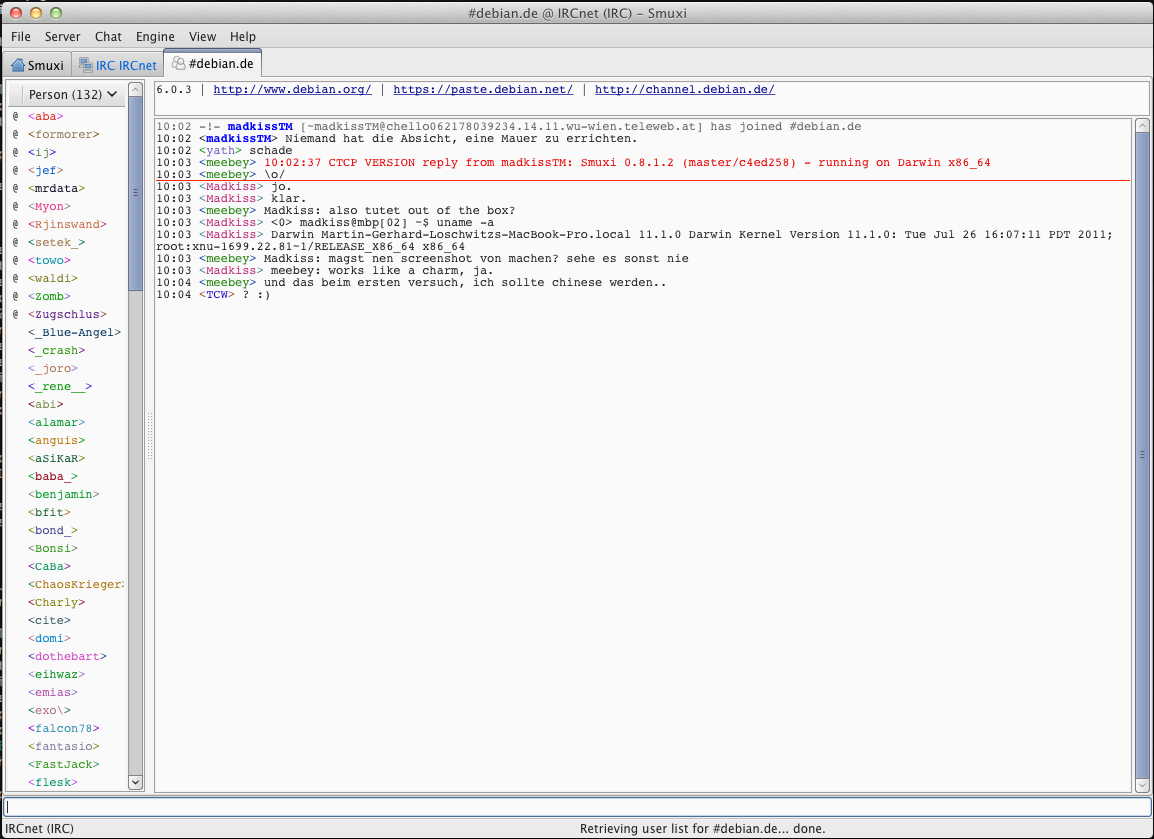
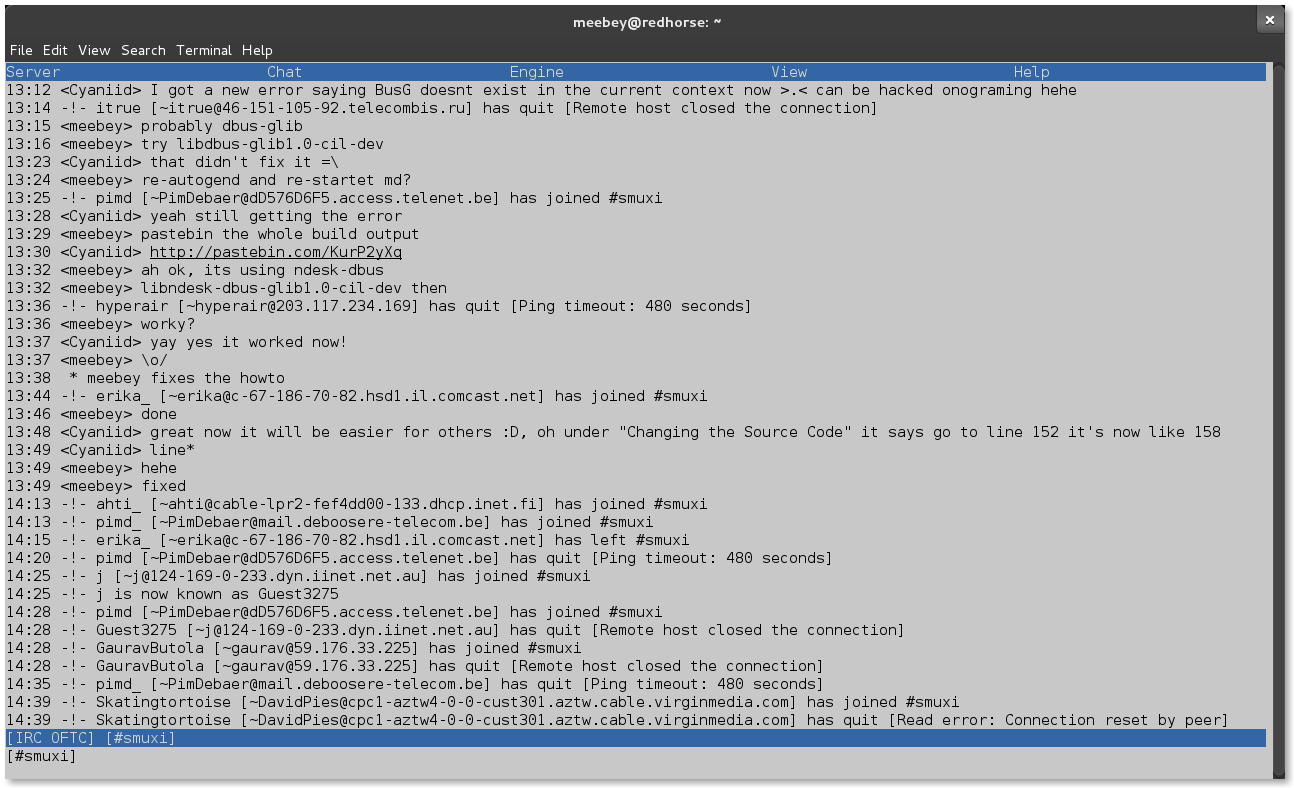
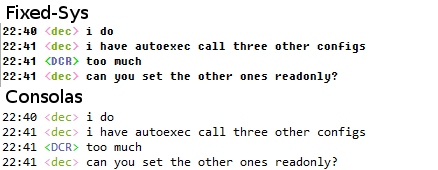
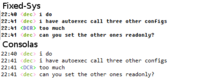
Just in time for 2012 I am very pleased to announce Smuxi 0.8.9 codenamed "One Giant Leap". During the development 56 bug reports and 33 feature requests in 593 commits were worked on making this release a major milestone of the Smuxi project. At the Chaos Communication Congress (28C3) in Berlin I was doing the final development sprint to get 0.8.9 done, which was a very intensive and refreshing experience. Here are the highlights of this release: Development Builds / Rolling Releases After the 0.8 release it became clear that a continious and short development -> test cycle is important to keep the project going quickly. At some point I have received requests if the project is dead while it was more active than ever. The lack of new releases (for about 15 months) lead to this wrong impression. Thus Smuxi can be obtained from development builds now. This includes daily builds for Debian (Squeeze, Wheezy, Sid), Ubuntu (Lucid, Maverick, Natty, Oneiric, Precise) and Windows. Thanks goes to Hannes Tismer for providing the Windows autobuilder and to Canonical for the PPA autobuilder. We invite everyone to use these daily builds to keep track of the latest development of Smuxi. Issues and regressions are fixed in a very short period (usually the same day). Thanks to our users who ran development builds and reported issues which led to many bug fixes prior to this release. On the other hand one of my New Year's resolutions are to "release early, release often" So there should be no nerd left behind... Screenshot of Smuxi 0.8.9 on Mac OS X Mac OS X support With the help of Steven McGrath (Steve[cug]) who created the initial Mac OS X installer for Smuxi we now have official support for Mac OS X. The download page contains the instructions how to obtain and install Smuxi on Mac OS X. This makes the 4th platform where Smuxi can be used on besides Windows, Linux and *BSD. For now Smuxi 0.8.9 doesn't feel as native as it could as it relies on the GTK+ port. We are looking into enhancing the experience though, just stay tuned. Chat History on Disk (Beta) The most exciting feature in this release I think are the "persistent message buffers". With this feature I could solve one of the biggest drawbacks IRC ever had: IRC does not retain any messages you have sent or received. All messages are only relayed to all users. The issue is that if you close your IRC client or even just leave a channel, all your received messages are gone. One workaround in most clients was to create text log files which then contains the chat history, but it is annoying and not user-friendly to open some text file somewhere from your disk to read the history outside of your IRC client. Now with Smuxi 0.8.9 you no longer have this issue, all chat history gets automatically written and read to a message database when you start Smuxi, join channels or open queries! As this feature is not fully stable yet it is not enabled by default. If you want to try it go to: File -> Preferences -> Interface and change "Persistency Type" from "Volatile" to "Persistent", hit OK and restart Smuxi. Now all messages are saved into the database and will automatically be shown. Click here for a screencast of this feature Jabber / XMPP Support (Beta) You probably have friends not on IRC and Twitter, say on Jabber, gTalk or Facebook? This is where the new XMPP engine of Smuxi comes into play. You can send and receive messages to/from them now! The implementation is far from complete, though. It has no buddy list for example and needs only to be treated as a technical preview of what will be coming in future Smuxi releases. Click here for a screencast of this feature Screenshot of Smuxi's Text Interface Text Interface (Alpha) This is the first release that contains a text frontend based on the STFL library. STFL is a library that uses ncurses to draw text based user interface using a markup language (like Glade for GTK+). This frontend is in early alpha state and lacks a lot of interface features and likes to crash. It is still included to attract potential developers who want to enhance this frontend. The frontend can be enabled by passing --enable-frontend-stfl to the configure script and then by executing smuxi-frontend-stfl. NetworkManager Support Everyone with a laptop knows how annoying it can be to suspend and resume when network based applications suddenly go crazy because they have lost the connection and either spew errors or take forever to get back in shape. Smuxi will now detect the network state right away with the help of the new Network Manager support. It automatically reconnects when needed right away for you. Next Generation Internet Support You can now connect to IRC servers using the IPv6 protocol Enhanced Find Group Chat Support Users had real issues to find out how to search for channels, thus Bianca Mix added a neat feature. The /list command will now simply open the Find Group Chat dialog for you. This way everyone used to IRC will find it in no time. Searching for channels on freenode wasn't working correctly, this is now fixed. Smuxi also supports the SAFELIST feature of the IRC protocol now which allows to retrieve a full channel list and do client side search which makes consecutive searches much faster. Enhanced Windows Experience For a long time you could not use Smuxi with the latest GTK# version of 2.12.10 on Windows. The issue was that Smuxi relied on SVG support which 2.12.10 no longer had. Smuxi is no longer using SVG instead it uses pre-scaled PNG images thus it works just fine with GTK# 2.12.10 on Windows now. At the same time the issue that the maximized state of the main window was left when restoring from task bar is fixed with GTK# 2.12.10. Screenshot of Fixed-Sys vs Consolas font Smuxi used by default the FixedSys font on Windows to give it the typical IRC look most people are used to. Since Windows Vista there is a better console-like font available called Consolas. Smuxi will now use the Consolas font instead on Windows Vista or later. Another important enhancement is that Smuxi no longer has issues with multiple GTK+ installs on the same computer, which was getting more common with more popular ported GTK+ applications such as GIMP or Pidgin. SSL for IRC fixed IRC with SSL was only working with the default port of 6697. Thanks to Jo Shields now any port can be used with SSL. Crash Related Issues Desktop notifications could crash Smuxi in case of errors related to the notification system or an absent notification daemon. There was a chance that the crash dialog simply disappeared which made reporting bugs more difficult no longer happens. Rapid use of ctrl+w, /window close (Jimmie Elvenmark) and opening the Find Group Chat dialog on the Smuxi tab do no longer crash. Also number-only network names, /network switch freenode and GTK+ install without SVG support no longer lead into a crash. Enhanced Notice Handling Notices will no longer open query tabs for you instead it will show them on tabs you share with the person who sent it with the server tab as fallback. This also avoids ChanServ, NickServ and spammy IRCop tabs. Twitter fixes Twitter made some changes to their API which broke the Twitter support of Smuxi 0.8. This was taken care of and also a few other issues were solved allowing Smuxi 0.8.9 to work smoothly with Twitter again. Extended Keybindings Smuxi allows now to use the ctrl+tab / ctrl+shift+tab and ctrl+n / ctrl+p keys to switch tabs. The keybindings still work even with a hidden menu bar now. Smuxi Server specific highlights More interactive and much faster synchronization When connecting to a smuxi-server you had to wait till Smuxi finished the synchronization before you could use the interface. Also you could not tell how far the synchronization was and just had to wait till it was completed. With Smuxi 0.8.9 the connect just takes a few seconds and all chats are synchronized in the background with a progress bar so you can use the interface from the first moment on and know how far it is. The speed how much it takes to synchronize all chats also reduced drastictly by 400%! Click here for a screencast of this feature More background communication When using a smuxi-server the interface sometimes had load times like when opening the preferences or when using the nickname completion (Andrew Kannan). These operations are done in the background and no longer blocks the interface. Also when the communication is lost to the smuxi-server the frontend will now automatically reconnect to it in the background. Low Bandwidth Mode When it comes to mobile internet connectivity such as UMTS/HSDPA, Edge and GRPS it can be a real pain to connect to the smuxi-server as it has to transfer all the messages over that. If you just want to ask someone you know then you don't need any old messages to do that. With the "Low Bandwidth Mode" you can now connect to the smuxi-server without loading old messages which makes the connect very quick. You find this option in the engine connect dialog. Stable Protocol Initially I didn't plan to make the protocol of Smuxi stable before the 0.9 release, but as it turned out the 0.8 protocol was good enough to still use it and for that reason Smuxi 0.8.9 is still compatible with 0.8. The 0.8 protocol will see no breakages, instead the next protocol will be on-top or opt-in of the current one. This means future Smuxi versions stay compatible with it. Shutdown Command You can now shutdown the smuxi-server if you like using the /shutdown command. It it safe to use the command, it will do a clean shutdown sequence for you. For example it makes sure all messages are written to disk in the case of enabled persistent message buffers. If you have your smuxi-server daemon monitored (e.g. with runit) it can also automatically be restarted and upgraded this way. Built-in SSH Keyfile Support It is no longer needed to fiddle with the .ssh/config file or pagent to get SSH key authorization working. You can now simply tell Smuxi which SSH keyfile you want to use to connect to your smuxi-server. Updated Translations
  • Catalan (Siegfried-Angel Gevatter Pujals)
  • Danish (Joe Hansen)
  • Finnish (Kalle Kaitala)
  • French (Cl ment Bourgeois)
  • German (Bianca Mix)
  • Italian (Vincenzo Campanella)
  • Portuguese (Americo Monteiro)
  • Spanish (Castilian) (Ricardo A. Hermosilla Carrillo)
New Translations
  • Chinese Simp (Dean Lee)
  • Slovak (Tom Vadina)
  • Swedish (Jimmie Elvenmark)
  • partially Russian (Aleksandr P)
  • partially Turkish (Umut Albayrak)
  • partially Urdu (makki)
Contributors Contributors to this release are the following people:
  • Mirco Bauer (497 commits)
  • Tuukka Hastrup (10 commits)
  • Bianca Mix (10 commits, translations)
  • Cl ment Bourgeois (8 commits, translations)
  • Andrius Bentkus (5 commits)
  • Carlos Mart n Nieto (3 commits)
  • Jimmie Elvenmark (3 commits, translations)
  • Hannes Tismer (1 commit)
  • Jonathan Pryor (1 commit)
  • Jo Shields (1 commit)
  • Siegfried-Angel Gevatter Pujals (translations)
  • Dean Lee (translations)
  • Aleksandr P (translations)
  • Americo Monteiro (translations)
  • Andrew Kannan (translations)
  • Joe Hansen (translations)
  • Kalle Kaitala (translations)
  • makki (translations)
  • Ricardo A. Hermosilla Carrillo (translations)
  • Tom Vadina (translations)
  • Umut Albayrak (translations)
  • Vincenzo Campanella (translations)
Thank you very much for your contributions to Smuxi! After reading this whole pile of text, head over here and grab this smexy stuff!

Posted Sun Jan 1 22:58:29 2012

Craig Small: procps-ng version 3.3.2 released

procps-ng version 3.3.2 was released today. This version fixes some bugs introduced in version 3.3.1 as well as a number of enhancements. Below is the most significant set of changes that 3.3.2 brings. NLS The most visible change is that procps-ng is now international. The NLS changes took a long windy path but we got there in the end. This means all procps-ng programs can now use standard gettext PO files to output in any supported language. While the programs have been enabled for translations, there are no po files as yet but we expect them to follow soon. Library Changes procps always had a closed library, meaning that it wasn t supposed to be used for other non-procps programs. This meant the library was always called libprocps-(version) rather than using a SONAME. Procps 3.3.2 now uses a SONAME of version 0.0.0 The API hasn t changed but it will be in subsequent versions. Patch Backporting Due to the stagnant natute of procps development in the past, there have been a large number of patches each distribution carries for procps. A significant number of patches have been incorportated into procps-ng, giving a more consistent look across the distributions and meaning any subsquent fixes or enhancements are done in one place. A major goal of procps-ng was to reduce the number of distribution specific patches which this change has helped greatly. debian Packages The Debian packages will be worked on soon and will clear up some confusion about the procps binaries and library packages as this will now be split into two. It also means that some programs that depend on libprocps will break, but going on from this point will be able to use the normal shlibs process to manage that, rather than the ugly crunch we will have now.

5 January 2012

Christian Perrier: 2012 update 3 for Debian Installer localization

Please note that the stats page had some breakage for level 3 these days. This is under repairbut newt translations are still missing as of now. Status for D-I level 1 (core D-I files): Status for D-I level 2 (packages that have localized material that may appear during default installs, such as iso-codes, tasksel, etc.): Status for D-I level 3 (packages that have localized material that may appear during non-default installs, such as win32-loader) Full 100% completeness (hall of fame) for: Czech, German, Spanish, French, Italian, Kazakh, Dutch, Portuguese, Russian, Slovak

Jaldhar Vyas: Jeopardy!: The Post-Mortem

By now hopefully you got a chance to see my Jeopardy! episode so it won't be much of a spoiler to mention that I didn't win. It went like this. I flew into LA on the night of October 31st. The taping was to take place on the next two days. Jeopardy! tapes two weeks of shows, two days a week for a total of 10 episodes. Contestants are randomly chosen for one of those 10 episodes but you don't find out which one you will be on until the last minute. Randomness and secrecy have become become a big part of the production process in games since the quiz show scandals of the 1950s. (Interesting fact: it is a Federal felony to tamper with a TV game show.) There were a group of just under 20 0f us altogether waiting to go on. All very nice people. Here in the New York area one tends to equate very intelligent people with "Type A" personalities but we got on well together. Interspersed between the tapings, we had short practice sessions to familiarize ourselves with the studio setup and this is where I first started getting a little apprehensive. Jeopardy! is not just about general knowledge, there is a physical element too in that you have to buzz in by pressing a button on a stick which is wired up to some producers console. You can't buzz in before Alex has finished reading the question and obviously you can't buzz in if someone is already answering the question. If you buzz at the wrong time, your buzzer locks for 0.75 seconds so just jamming your finger on the button. I didn't even get that far as on the entire first day I failed to buzz in at all despite changing hands, changing grip different ways and other strategies. I was pretty despondent by the second day but then miraculously I managed to get the hang of it. So when I was finally selected (for the 3rd game of that day.) I was back to my usual cool self. I was up against Dave Leach and Nicholas Campiz who were returning after having tied in the previous game. And the game did start well enough. Oh one thing you may notice is that Alex mispronounces my name Jaldhal. I knew he did that once or twice and even mentioned it to a producer but it was only viewing the episode right now that I see he does it consistently. I assumed such things would be fixed up in post-editting but I guess not. Oh well, after living in this country for so many years I've learned to be happy whenever two consonants are more or less in the right place. This particular mispronunciation is actually fairly common, even Indian people have been known to make it. The alternative theory is that Alex couldn't read my horrible handwriting which is also plausible. Anyway, I digress. I started off fairly well. My first mistake was in a category about alcoholic drinks. I answered vermouth when the correct response was gin. In my defense I'm a strict teetoler so none of these words mean anything to me. I also earned the disapproval of my superhero fan son by mistaking Dr. Strange for Dr. Doom. I did get the one about Spiderman villain Dr. Octopus so that mollified him somewhat. The highlight of my evening was strangely enough in a category about books of the Bible. I got a Daily Double. It was a risky move but I have always wanted to make a "true" daily double so I threw caution to the winds and wagered everything I had. To my surprise as much as anyones, got the answer right doubling my score. I was in a pretty good position for the Double Jeopardy but thats when Dave started dominating. If you haven't been watching previous games, Dave Leach is arguably the best player this season. Not only is he smart but he is almost supernaturally fast on the buzzer. You can't see because I kept my hands behind the podium but I again and again I would desperately try to ring in on a question I knew the answer to only to be beaten to the punch by Dave. This caused me to start getting a bit reckless and answering questions where I was less than certain which cost me dearly. One particularly dumb mistake was in a category where all the answers were supposed to start with the letter g. I said compass when I should said gyrocompass but actually I should have left that category alone entirely. By the time Final Jeopardy came around winning was no longer an option as Dave was too far in the lead. I was slightly ahead of Nicholas in 2nd place. This is where I again made a strategic error. My original plan to bet nothing in Final Jeopardy but the category was "1930s Novels" and I liked my chances. The clue was read out and it involved an anti-war novel whose author was blacklisted. I was elated. It had to be "All Quiet on the Western Front" right? The blacklist bit gave me pause as the author Erich Maria Remarque was German and this was obviously a reference to the anti-Communist blacklist in the 1950s USA. But somehow I remembered that he had spent the end of his life in Hollywood or maybe I just convinced myself that it was plausible. Evidently my thought process wasn't too crazy because all three of us came up with the same answer. All three of us were wrong. The correct answer was "Johnny Got His Gun" by Daltan Trumbo. In hindsight I knew this but it illustrates the strange ways the mind works. I knew because the video for Metallicas song "One" from "...And Justice for All" is based on the film adaptation of this book. However in a previous orientation session the lady who is the contestant coordinator for Jeopardy! had mentioned AQOTHWF as anexample of something and this got stuck in my brain crowding out the previously known fact. So when all was said and done I ended up in 3rd place. (I bet big whereas Nicholas was more conservative.) Oh well. Despite not winning I had a blast. I fulfilled my dream of appearing on Jeopardy! I met Alex Trebek. (And I should be receiving an autographed picture of us together soon.) My witty banter was sufficiently witty. I made enough money to cover my travel expenses and still have a nice amount left. And I got to meet lots of interesting and wonderful people. So I'm satisfied.

4 January 2012

Jon Dowland: Ready Player One

I recently completed "Ready Player One", Ernest Cline's debut novel. It's a Sci-Fi fan-service novel that explores a dystopian future (yes, another one) where the majority of the populace hide inside a VR environment to escape their "real" lives. The sole-genius who authored the VR software hid a series of easter eggs inside, in the form of challenges relating to pop-culture and video game trivia circa the 80s. He constructs his will such that whoever first completes the challenges inherits the mega-bucks company who control the VR simulation. Mike Hoye has an excellent summary:
Ready Player One is a nerdculture bender of a book, about as hard to hate while you re in the middle of it as it is to love in hindsight; it s young adult literature for people who were born in the late seventies and haven t really grown up yet. Of which I am apparently one, it has become clear, but you re still left with the sense that you re reading a Cory Doctorow book whose discerning virtue is that the lead isn t a thinly-veiled Cory Doctorow. Which is a huge, huge improvement, make no mistake, but it s stills relentless, pandering fanservice.
(Whilst you are over on Mike's website you should really read this excellent piece on libraries and publishers.) Despite the points above, I enjoyed the book. My biggest complaint was that the ending was quite abrupt. Quite often when I read a story which is essentially about a journey, I am disappointed if the story ends when the journey does. I hope I am not spoiling too much here by revealing that someone eventually solves the riddles and inherits essentially the earth. But what do they do with it? What impact do they make on the miserable world, described only briefly in sparse passages dotted around the bulk of the text detailing the VR one? During the book, the characters opine on what to do with the fortune, but we never see that come to fruition. Perhaps in a sequel.

3 January 2012

Rapha&#235;l Hertzog: My Debian Activities in December 2011

This is my monthly summary of my Debian related activities. If you re among the people who made a donation to support my work (364.18 , thanks everybody!), then you can learn how I spent your money. Otherwise it s just an interesting status update on my various projects. Dpkg and Multiarch I had some hope to have a multiarch-enabled dpkg in sid for Christmas as Guillem told me that it was realistic. Alas Guillem got sick. We re in January and we re still not there. While some of Guillem s commits in December were related to multi-arch, the size of his pu/multiarch/master branch did not really shrink. We still have 36 commits to merge most of the work he did was refactoring some parts of the code that were already merged. And he initiated some discussion on interface changes. I participated to those discussions hoping to bring them to a quick resolution. I m still maintaining my own pu/multiarch/full branch, it is based on Guillem s branch but with further fixes that I developed and that he has not yet merged and with a change reverted (Guillem s branch allows crossgrading packages between different architectures while dpkg does not manage this correctly yet). I can only hope that January will be the last month of this never-ending saga. It s been one year since I started working on this project. :- Misc dpkg work I reviewed (and later merged) a patch of Kees Cook to enhance dpkg-buildflags so that it can report which hardening features are enabled. This feature might then be used by tools like lintian to detect missing hardening features. I mentored Gianluca Ciccarelli who is trying to enhance dpkg-maintscript-helper to take care of replacing a directory by a symlink and vice-versa. I took care of #651993 so that dpkg-mergechangelogs doesn t fail when it encounters an invalid version in the changelog, and of #652414 so that dpkg-source --commit accepts a relative filename when a patch file is explicitly given. Guillem also merged a fix I developed for LP#369898. Packaging work WordPress 3.3 came out so I immediately packaged it. Despite my upstream bug report, they did not update their GPL compliance page which offers the corresponding sources for what s bundled in the tarball. So I hunted for the required sources myself, and bundled them in the debian.tar.xz of the Debian source package. It s a rather crude solution but this allowed me to close the release critical bug #646729 and to reintroduce the Flash files that were dropped in the past which is great since the Flash-based file uploader is nicer than the one using the browser s file field. Quilt 0.50 came out after 2 years of (slow) development. The Debian package has many patches and several of them had to be updated to cope with the new upstream release. Fortunately some of them were also merged upstream. It still took an entire morning to complete this update. I also converted the packaging from CDBS to dh with a short rules file. Zim 0.54 came out and I immediately updated the package since it fixed a bug that was annoying me. Review of the ledgersmb packaging As the sql-ledger maintainer (and a user of this software for my accounting), I have been hoping to get ledgersmb packaged as a possible replacement for it. I have been following the various efforts initiated over time but none of them resulted in a real package in Debian. This is a real pity so I tried to fix this by offering to sponsor package uploads. That s why I did a first review of the packaging. It took several hours because you have to explain everything that s not good enough. I also filed a wishlist bug against lintian (#652963) to suggest that lintian should detect improper usage of dpkg-statoverride (this is a mistake that was present in the package that I reviewed). nautilus-dropbox work I wanted to polish the package in time for the Ubuntu LTS release and since Debian Import Freeze is in January, I implemented some of the important fixes that I wanted. The Debian package diverges from upstream in that the non-free binaries are installed in /var/lib/dropbox/ instead of $HOME.

Due to a bug, the files were not properly root-owned so I first fixed this (unpacking the tarball as root lead to reuse of the embedded user & group information, and those information changed recently on the Dropbox side apparently). Then we recently identified other problems related to proxy handling (see #651065). I fixed this too because it s relatively frequent that the initial download triggered during the package configuration fails and in that case it s the user that will re-trigger a package download after having given the appropriate credentials through PackageKit. Without my fix, usage of pkexec would imply the loss of the http_proxy environment variable and thus it would not be possible for a user to download through a proxy. Last but not least I reorganized the Debian specific patches to better separate what can and should be merged upstream, from the changes that upstream doesn t want. Unfortunately Dropbox insists on being able to auto-update their non-free binaries, they are, thus, against the installation under /var/lib/dropbox and the corresponding changes. Book update We re making decent progress in the translation of the Debian Administrator s Handbook, about 6 chapters are already translated (not yet reviewed though). The liberation campaign is also (slowly) going forward. We re at 67% now (thanks to 90 new supporters!) while we were only at 60% at the start of December. Thanks See you next month for a new summary of my activities.

No comment Liked this article? Click here. My blog is Flattr-enabled.

Jaldhar Vyas: Watch Me on Jeopardy! This Wednesday

<video controls="controls" poster="http://www.braincells.com/debian/images/jaldhar_jeopardy_howdy.jpg">
<source src="http://www.braincells.com/debian/images/jaldhar_jeopardy_howdy.mpg" type="video/mpeg">
<source src="http://www.braincells.com/debian/images/jaldhar_jeopardy_howdy.ogv" type="video/ogg">
HTML 5 Video does not seem to be supported by your browser. Download the video of my Jeopardy! "Hometown Howdy" here (MPG format) or here (OGG format). </video> Some time ago, I mentioned auditioning for Jeopardy!, Americas top TV quiz show. I didn't hear back from the producers for quite a while so I assumed I hadn't been selected but then suddenly one day in October I got a call inviting me to come out to Sony Studios in Culver City California for a taping in November. I went and it is finally airing now. So if you are in the US or Canada (the show is possibly syndicated elsewhere but I'm not sure) please be sure to watch me on Wednesday, January the 4th. I won't say how well I did until afterwards but I was quite pleased with my performance.

1 January 2012

Tanguy Ortolo: Debian Developper

Debian red swirl For this new year I got a quite specific present : a Debian Developer account. Of course this is not an end by itself but rather a beginning, or perhaps a continuation of my modest effort to contribute to the greater good of our users and free software. As an introduction, I would like to quickly explain how I came to this point, and I also have some people to thank.

Debianist journey
1997-2003
First family computer, a PC running Microsoft Windows 98. I became a power-user, and I progressively replaced all the pieces of that computer, except it operating system (though I reinstalled it several times).
2003
First contact with GNU/Linux: at my preparatory school, we use XEmacs and Kile under Mandrake Linux 9.2 to do some works in Caml Light and LaTeX. I start enjoying free software at home, with Mozilla Firefox, Thunderbird and Libre^WOpenOffice.org.
2005, preparatory school
I try Knoppix at home and eventually install Mandriva Linux 10.2 for my own use. Since then I have never used Microsoft Windows for personal work any more.
2005, engineer school
I integrate Centrale Paris and I join the team of VIA Centrale R seaux, which I believe is a known den of debianists. So I start using Debian on my personal laptop.
2006
Debian power-user. I start reporting bugs.
2007
First small contributions: some of my bug reports now include patches. I also start maintaining a French training document about Debian: formation Debian GNU/Linux.
2008
First packaging work with the help of adn, a modification and split of frozen-bubble to have a server-only package (contribution finally refused, actually).
2010
First package: I adopt dokuwiki with the help of adn. I become a Debian Maintainer, with the intent of applying as a Debian Member later.
2012
I am now a Debian Developer, responsible for a handful of packages and able to do NMUs and to sponsor new contributors.
As you may guess, I have always been a tinkerer, about computers but also about bikes (the ones that work with manpower, not the ones that make noise and smoke ;-)). And I also always wanted to publish my works somehow, because I hate to think that someone could have to do again some reusable work I had to do before instead of taking advantage of it. Well, it happened that free software was a way to achieve both goals: to hack and to make my work available for anyone. Thanks I would like to thank all those who helped me to discover and contribute to free software, especially: adn, who helped me with my first steps to directly contribute to Debian, dererk and all the Debian Developers that patiently reread and sponsored my packages, and my Application Manager gwolf, who gave quite a lot of time asking me questions, reading my replies, and replying to some questions that arose during the process. Outside of the Debian Project I have to thank Alexis de Lattre, who wrote the original Formation Linux that I am now maintaining under the name of Formation Debian GNU/Linux , a document which helped me to discover GNU/Linux and Debian specifically. More generally, I would like to thank all the Free Software community that made that possible: Debian Developers, hackers and users from everywhere. We have built and we are still building quite an impressive pile of very useful work, and we can be proud of it. Notes
  1. Here in the northern hemisphere our school years begin in the middle of the civil year, which makes it tricky to tell them apart
  2. This is almost a synonym for tinkering, in the context of free software, is it not?

31 December 2011

Russell Coker: Sociological Images

I ve recently been reading the Sociological Images blog [1]. That site has lots of pictures and videos that are relevant to the study of Sociology (most of which have a major WTF factor) and it s run by people who have Ph.Ds in Sociology so the commentary is insightful. Since reading that I ve started photographing relevant things. woman in straight-jacket advertising energy prices I can t work out the logic behind the above advert for Energy Watch which was on a billboard near Ringwood Station in Melbourne, Australia. The only thing that it clear is that it spreads bad ideas about mental illness and psychiatric treatment. It doesn t make me want to do business with them. Antons full display The above picture is a shop-front for the Antons clothing store (I m not sure if they are a tailor or if they sell ready to wear). It was taken on Lonsdale St, Melbourne where the store apparently used to be, now they are in Melbourne Central. Antons left display, African and Southern EuropeanAntons right display, Northern European and Japanese The above pictures show more detail. Unfortunately the combination of lighting and my camera (Xperia X10 phone camera) wasn t adequate to show the apparent ethnic differences between the two men. It seems that the most likely Australian interpretation of the ethnic groups that are represented are African (maybe Afro-American), Southern-European or maybe American Hispanic, North-Western European, and Japanese. It s good to have mannequins representing the fact that not everyone in Australia is white, but different facial expressions for different races seems a strange choice (admittedly it might be a choice made by mannequin manufacturers). Also the Japanese woman with fan idea is rather outdated. I ve just started reading You May Ask Yourself: An Introduction to Thinking Like a Sociologist (Second Edition) by Dalton Conley. I ve only read the first chapter, but that was good enough that the entire book has to be good enough to recommend.

29 December 2011

Jon Dowland: backup

Backups are something I don't do well. I hope to write a more thorough article about them at some point. For now, here are some tips. Like most home users, I don't have access to a tape drive or jukebox for backups. I'm therefore looking for a solution that backs up to a local block device. I haven't ruled out a solution that backs up to DVD-Rs, but I haven't found a suitable one. I first tried rsnapshot, which uses hard link trees to represent increments. I found that this resulted in enormous filesystem metadata, sufficient to cause the machine I was running it on (an embedded ARM system) to slow to a crawl. I'd recommend to avoid anything using this technique. I more recently have been using rdiff-backup. This has appeared to work quite well for a number of years. However, it does not gracefully handle the backup volume being full, spewing python backtraces. This is compounded with some confusing use of temporary directies and not honouring $TMPDIR. This has been known about for years (1, 2). I've just independently discovered these problems for the second time. Aside from that, because it does not de-duplicate files, it is sensitive to large files being moved around in the source being backed up. It also cannot do a dry-run estimate of the disk space required for the next increment. So: time to move on. Back in 2010 I discovered bup, an intriguing backup tool that used a git-style backing store. It's interesting enough that I packaged it and use it in a few situations, but I wouldn't rely on it for my main backups, for two reasons: one, it's not tried-and-tested enough yet (but that is rapidly being resolved), two: you can't get rid of old increments, so your backup volume will always increase in size over time, and never throw away old data. So, for now: move on. Next on my list to try is Lars Wirzenius' obnam.

Next.

Previous.