Search Results: "nic"

21 October 2012

Christian Perrier: [life] Running update: nearly qualified for Boston marathon...

That was not my target in today's marathon (my second one in the year). The target was breaking my 3h38'45" record, set on June 10th in Caen. And, well, I did it. By more than 5 minutes \o/. Of course, the Seine-Eure marathon is the perfect place for this: My target was running 5'06"/km, so 3h35'11" (but the target was running this as long as possible and see what happens after km 35). I did this nearly perfectly in the first half, reaching the half-marathon in 1h47'30". Double this and you get 3h35'..:-) "However", I slightly accelerated in the second half, first without noticing, then because....I just could do it..:-). So I managed to run the second half at an average 5'/km, with even the last 2 kilometers around 4'50" and an amazing sprint at the end. Usain bubulle. The outcome is 3h33'35". Doh. Never thought I could do this. It seems that my unusual preparation (remember the "let's run a marathon when coming back from work, at night", in September? or the 5 half-marathons in a row....culminating in a 3/4 marathon in the 6th week-end?)...was not so bad. I'm now very close to qualifying times for Boston, my dream marathon (much more than NYC) as they are 3h30' for my age category. Well, another option is to wait turning 55, where the qualifying time is then 3h40..:-)...but it woudl be quite good to complete one under 3h30. Now, it doesn't look like a dream. We'll see at the end of next year as I will only run one marathon, in autumn, more focusing Spring on ultra running (and, technically, a marathon, but that will be the Mont-Blanc marathon, just before Debconf13....and these 42.195km are quite different from those in Normandy!

20 October 2012

Vincent Bernat: Network lab with KVM

To experiment with network stuff, I was using UML-based network labs. Many alternatives exist, like GNS3, Netkit, Marionnet or Cloonix. All of them are great viable solutions but I still prefer to stick to my minimal home-made solution with UML virtual machines. Here is why: The use of UML had some drawbacks: However, UML features HostFS, a filesystem providing access to any part of the host filesystem. This is the killer feature which allows me to not use any virtual disk image and to get access to my home directory right from the guest. I discovered recently that KVM provided 9P, a similar filesystem on top of VirtIO, the paravirtualized IO framework.

Setting up the lab The setup of the lab is done with a single self-contained shell file. The layout is similar to what I have done with UML. I will only highlight here the most interesting steps.

Booting KVM with a minimal kernel My initial goal was to experiment with Nicolas Dichtel s IPv6 ECMP patch. Therefore, I needed to configure a custom kernel. I have started from make defconfig, removed everything that was not necessary, added what I needed for my lab (mostly network stuff) and added the appropriate options for VirtIO drivers:
CONFIG_NET_9P_VIRTIO=y
CONFIG_VIRTIO_BLK=y
CONFIG_VIRTIO_NET=y
CONFIG_VIRTIO_CONSOLE=y
CONFIG_HW_RANDOM_VIRTIO=y
CONFIG_VIRTIO=y
CONFIG_VIRTIO_RING=y
CONFIG_VIRTIO_PCI=y
CONFIG_VIRTIO_BALLOON=y
CONFIG_VIRTIO_MMIO=y
No modules. Grab the complete configuration if you want to have a look. From here, you can start your kernel with the following command ($LINUX is the appropriate bzImage):
kvm \
  -m 256m \
  -display none \
  -nodefconfig -no-user-config -nodefaults \
  \
  -chardev stdio,id=charserial0,signal=off \
  -device isa-serial,chardev=charserial0,id=serial0 \
  \
  -chardev socket,id=con0,path=$TMP/vm-$name-console.pipe,server,nowait \
  -mon chardev=con0,mode=readline,default \
  \
  -kernel $LINUX \
  -append "init=/bin/sh console=ttyS0"
Of course, since there is no disk to boot from, the kernel will panic when trying to mount the root filesystem. KVM is configured to not display video output (-display none). A serial port is defined and uses stdio as a backend1. The kernel is configured to use this serial port as a console (console=ttyS0). A VirtIO console could have been used instead but it seems this is not possible to make it work early in the boot process. The KVM monitor is setup to listen on an Unix socket. It is possible to connect to it with socat UNIX:$TMP/vm-$name-console.pipe -.

Initial ramdisk UPDATED: I was initially unable to mount the host filesystem as the root filesystem for the guest directly by the kernel. In a comment, Josh Triplett told me to use /dev/root as the mount tag to solve this problem. I keep using an initrd in this post but the lab on Github has been updated to not use one. Here is how to build a small initial ramdisk:
# Setup initrd
setup_initrd()  
    info "Build initrd"
    DESTDIR=$TMP/initrd
    mkdir -p $DESTDIR
    # Setup busybox
    copy_exec $($WHICH busybox) /bin/busybox
    for applet in $($ DESTDIR /bin/busybox --list); do
        ln -s busybox $ DESTDIR /bin/$ applet 
    done
    # Setup init
    cp $PROGNAME $ DESTDIR /init
    cd "$ DESTDIR " && find .   \
       cpio --quiet -R 0:0 -o -H newc   \
       gzip > $TMP/initrd.gz
 
The copy_exec function is stolen from the initramfs-tools package in Debian. It will ensure that the appropriate libraries are also copied. Another solution would have been to use a static busybox. The setup script is copied as /init in the initial ramdisk. It will detect it has been invoked as such. If it was omitted, a shell would be spawned instead. Remove the cp call if you want to experiment manually. The flag -initrd allows KVM to use this initial ramdisk.

Root filesystem Let s mount our root filesystem using 9P. This is quite easy. First KVM needs to be configured to export the host filesystem to the guest:
kvm \
  $ PREVIOUS_ARGS  \
  -fsdev local,security_model=passthrough,id=fsdev-root,path=$ ROOT ,readonly \
  -device virtio-9p-pci,id=fs-root,fsdev=fsdev-root,mount_tag=rootshare
$ ROOT can either be / or any directory containing a complete filesystem. Mounting it from the guest is quite easy:
mkdir -p /target/ro
mount -t 9p rootshare /target/ro -o trans=virtio,version=9p2000.u
You should find a complete root filesystem inside /target/ro. I have used version=9p2000.u instead of version=9p2000.L because the later does not allow a program to mount() a host mount point2. Now, you have a read-only root filesystem (because you don t want to mess with your existing root filesystem and moreover, you did not run this lab as root, did you?). Let s use an union filesystem. Debian comes with AUFS while Ubuntu and OpenWRT have migrated to overlayfs. I was previously using AUFS but got errors on some specific cases. It is still not clear which one will end up in the kernel. So, let s try overlayfs. I didn t find any patchset ready to be applied on top of my kernel tree. I was working with David Miller s net-next tree. Here is how I have applied the overlayfs patch on top of it:
$ git remote add torvalds git://git.kernel.org/pub/scm/linux/kernel/git/torvalds/linux-2.6.git
$ git fetch torvalds
$ git remote add overlayfs git://git.kernel.org/pub/scm/linux/kernel/git/mszeredi/vfs.git
$ git fetch overlayfs
$ git merge-base overlayfs.v15 v3.6
4cbe5a555fa58a79b6ecbb6c531b8bab0650778d
$ git checkout -b net-next+overlayfs
$ git cherry-pick 4cbe5a555fa58a79b6ecbb6c531b8bab0650778d..overlayfs.v15
Don t forget to enable CONFIG_OVERLAYFS_FS in .config. Here is how I configured the whole root filesystem:
info "Setup overlayfs"
mkdir /target
mkdir /target/ro
mkdir /target/rw
mkdir /target/overlay
# Version 9p2000.u allows to access /dev, /sys and mount new
# partitions over them. This is not the case for 9p2000.L.
mount -t 9p        rootshare /target/ro      -o trans=virtio,version=9p2000.u
mount -t tmpfs     tmpfs     /target/rw      -o rw
mount -t overlayfs overlayfs /target/overlay -o lowerdir=/target/ro,upperdir=/target/rw
mount -n -t proc  proc /target/overlay/proc
mount -n -t sysfs sys  /target/overlay/sys
info "Mount home directory on /root"
mount -t 9p homeshare /target/overlay/root -o trans=virtio,version=9p2000.L,access=0,rw
info "Mount lab directory on /lab"
mkdir /target/overlay/lab
mount -t 9p labshare /target/overlay/lab -o trans=virtio,version=9p2000.L,access=0,rw
info "Chroot"
export STATE=1
cp "$PROGNAME" /target/overlay
exec chroot /target/overlay "$PROGNAME"
You have to export your $ HOME and the lab directory from host:
kvm \
  $ PREVIOUS_ARGS  \
  -fsdev local,security_model=passthrough,id=fsdev-root,path=$ ROOT ,readonly \
  -device virtio-9p-pci,id=fs-root,fsdev=fsdev-root,mount_tag=rootshare \
  -fsdev local,security_model=none,id=fsdev-home,path=$ HOME  \
  -device virtio-9p-pci,id=fs-home,fsdev=fsdev-home,mount_tag=homeshare \
  -fsdev local,security_model=none,id=fsdev-lab,path=$(dirname "$PROGNAME") \
  -device virtio-9p-pci,id=fs-lab,fsdev=fsdev-lab,mount_tag=labshare

Network You know what is missing from our network lab? Network setup. For each LAN that I will need, I spawn a VDE switch:
# Setup a VDE switch
setup_switch()  
    info "Setup switch $1"
    screen -t "sw-$1" \
        start-stop-daemon --make-pidfile --pidfile "$TMP/switch-$1.pid" \
        --start --startas $($WHICH vde_switch) -- \
        --sock "$TMP/switch-$1.sock"
    screen -X select 0
 
To attach an interface to the newly created LAN, I use:
mac=$(echo $name-$net   sha1sum   \
            awk ' print "52:54:" substr($1,0,2) ":" substr($1, 2, 2) ":" substr($1, 4, 2) ":" substr($1, 6, 2) ')
kvm \
  $ PREVIOUS_ARGS  \
  -net nic,model=virtio,macaddr=$mac,vlan=$net \
  -net vde,sock=$TMP/switch-$net.sock,vlan=$net
The use of a VDE switch allows me to run the lab as a non-root user. It is possible to give Internet access to each VM, either by using -net user flag or using slirpvde on a special switch. I prefer the latest solution since it will allow the VM to speak to each others.

Debugging This lab was mostly done to debug both the kernel and Quagga. Each of them can be debugged remotely.

Kernel debugging While the kernel features KGDB, its own debugger, compatible with GDB, it is easier to use the remote GDB server built inside KVM.
kvm \
  $ PREVIOUS_ARGS  \
  -gdb unix:$TMP/vm-$name-gdb.pipe,server,nowait
To connect to the remote GDB server from the host, first locate the vmlinux file at the root of the source tree and run GDB on it. The kernel has to be compiled with CONFIG_DEBUG_INFO=y to get the appropriate debugging symbols. Then, use socat with the Unix socket to attach to the remote debugger:
$ gdb vmlinux
GNU gdb (GDB) 7.4.1-debian
Reading symbols from /home/bernat/src/linux/vmlinux...done.
(gdb) target remote   socat UNIX:$TMP/vm-$name-gdb.pipe -
Remote debugging using   socat UNIX:/tmp/tmp.W36qWnrCEj/vm-r1-gdb.pipe -
native_safe_halt () at /home/bernat/src/linux/arch/x86/include/asm/irqflags.h:50
50   
(gdb)
You can now set breakpoints and resume the execution of the kernel. It is easier to debug the kernel if optimizations are not enabled. However, it is not possible to disable them globally. You can however disable them for some files. For example, to debug net/ipv6/route.c, just add CFLAGS_route.o = -O0 to net/ipv6/Makefile, remove net/ipv6/route.o and type make.

Userland debugging To debug a program inside KVM, you can just use gdb as usual. Your $HOME directory is available and it should be therefore straightforward. However, if you want to perform some remote debugging, that s quite easy. Add a new serial port to KVM:
kvm \
  $ PREVIOUS_ARGS  \
  -chardev socket,id=charserial1,path=$TMP/vm-$name-serial.pipe,server,nowait \
  -device isa-serial,chardev=charserial1,id=serial1
Starts gdbserver in the guest:
$ libtool execute gdbserver /dev/ttyS1 zebra/zebra
Process /root/code/orange/quagga/build/zebra/.libs/lt-zebra created; pid = 800
Remote debugging using /dev/ttyS1
And from the host, you can attach to the remote process:
$ libtool execute gdb zebra/zebra
GNU gdb (GDB) 7.4.1-debian
Reading symbols from /home/bernat/code/orange/quagga/build/zebra/.libs/lt-zebra...done.
(gdb) target remote   socat UNIX:/tmp/tmp.W36qWnrCEj/vm-r1-serial.pipe
Remote debugging using   socat UNIX:/tmp/tmp.W36qWnrCEj/vm-r1-serial.pipe
Reading symbols from /lib64/ld-linux-x86-64.so.2...(no debugging symbols found)...done.
Loaded symbols for /lib64/ld-linux-x86-64.so.2
0x00007ffff7dddaf0 in ?? () from /lib64/ld-linux-x86-64.so.2
(gdb)

Demo For a demo, have a look at the following video (it is also available as an Ogg Theora video).
<iframe frameborder="0" height="270" src="http://www.dailymotion.com/embed/video/xuglsg" width="480"></iframe>

  1. stdio is configured such that signals are not enabled. KVM won t stop when receiving SIGINT. This is important for the usage we want to have.
  2. Therefore, it is not possible to mound a fresh /proc on top of the existing one. I have searched a bit but didn t find why. Any comments on this is welcome.

19 October 2012

Bernhard R. Link: Time flies like an arrow

It's now 10 years I am Debian Developer. In retrospect it feels like a very short time. I guess because not so much in Debian's big picture has changed. Except I sometimes have the feeling that less people care about users and more people instead prefer solutions incapacitating users. But perhaps I'm only getting old and grumpy and thriving for systems enabling the user to do what they want was only a stop-gap until there where also open source solutions for second-guessing what the user should have wanted. Anyway, thanks to all of you in and around Debian that made the last ten years such a nice and rewarding experience and I'm looking forward to the next ten years.

Sylvain Le Gall: Book review: Puppet 2.7 Cookbook

I recently read this book and it was enlightening -- that is the least I can say. It is organized into a set of recipes addressing the most common problems you have with puppet. I think the whole point is about being practical and it gives you various ways to achieve the same goal, depending if you want to do a quick and dirty hack or pick a long term solution. The whole book aims at being practical and it achieves this goal pretty well. However, it is not for beginners. Puppet itself is not for beginner and you should already have written and run into problem to really take advantage of this book. I read the book in 5 days (only while commuting), and at each page I thought : "OMG, they do that like this" or "of course, you should use git + that" and wait impatiently coming back home to test all this stuff. The book is really about technical details and how to organize yourself to write nice Puppet classes. I have been an "irregular" user of Puppet since 4 years. I was mainly running it to distribute files on all my computers. Since 3 weeks, I am applying the recipes found in this book and it is just like discovering that you own something worth a million euros. Let look at some example: Before: Replace the whole file. Now: Use Augeas to just change the value and don't touch to the rest of the file. The book makes me discover Augeas and it rocks !!! Before:_ Loosy darcs repository inside /etc/ and edit directly the master. Now: Shiny git repository in my home directory, using a Makefile to validate Puppet syntax, simulate applying it and effectively apply it to the current node before deploying it through git push. Before: Nothing because I didn't think it was possible. Now: Generate a configuration file using a template, install it, run the exim4 update script and restart the service. Before: Copy a file and restart it. Now: Use Augeas and a template with a loop to change what is needed for each node depending on which user I want to allow to connect on this node. Use different SSH port for every vserver that share the same IP and distribute an /etc/ssh_config to propagate the default ports set for all the vservers... (just being able to do that is worth the price of the book). Before: Complain, whine and give up. Now: Go to Puppet Forge, take inspiration for similar module, re-read part of the book, find an idea and apply it. And so forth and so on. This book made me love puppets again. I warmly recommend it to you.

Martin F. Krafft: Digital picture frames and random image order

I am moving into an office. And as any proud husband and father, I want to have photos of my wife and daughter on my desk. The year being 2012, I did not hike to the photo shop to get a print framed, but instead thought to myself that I should put a digital photo frame onto my table. This idea exposed me to the ridiculous world of consumer electronics. It led me to conclude that digital picture frame designers need to be whacked with cluebats. Step by step Once accepted, the thought of a digital photo frame developed into a product definition along the following lines: my idea photo frame would connect to my Wifi-network, and obtain the photos on-the-go from a folder exposed via HTTP or CIFS, and then go on to display them in random order, incorporating new photos as it encounters them. With this in mind, I went to the shops, and since I believe in specialised retailers and want to support them, my first stop was Foto Sauter at Sendlinger Tor. Unfortunately, none of the frames they had came with Wifi, so I decided to look further. I vehemently oppose to the business practices of the Metro group, thus skipped Saturn and MediaMarkt, and eventually ended up at Conrad. They had a frame with Wifi! I jumped for joy, until I read the manual: pictures can be obtained from Flickr and Picasa. Period. All other models on the Internet seem to be similarly limited, including the new Sony S-frame. The night before, Penny had researched the field a bit and came to the conclusion that the S-frame would be the best product available. This led me to scratch Wifi off my requirements list and get a model that would read photos off a USB stick. I went back to the photo store and bought a "Sony S-frame", only to discover that it cannot show photos in random order. It has three viewing modes (single photo, collage, single photo with clock), and a random mode, but guess what: the random mode randomly switches the viewing modes, which then display the photos in lexicographical order. How stupid is that??? I returned the product and left the store after discovering that none of their products could do random playback. I went back to Conrad and found an "Intenso MediaCreator" (what media does it create???), which displayed the photos seemingly randomly. But at home I found out that the "random" order is always the same, probably because the bright engineer that programmed this thought it was better to sort filenames by last letter and call it random, than to figure out a way to roll a dice on the device. I wrote to the support team and asked them. The response was that the desired functionality (random selection) is not possible and won't be made available. So I am returning the product. Gah! Would someone please tell me about a digital picture frame (8 inch or so) that can display images in random order, ideally loading them off a CIFS share via Wifi? Or is it really the case that consumer electronics are completely useless these days, by which I mean that "consumers" have dumbed down so far to buy this crap? Update: a lot of people wrote in suggesting to invest in a cheap Android tablet. Some suggested Raspberry Pis in USB host mode (emulating the USB stick and hence the source of the images, provided that the frame doesn't cache). Other suggestions included the Samsung SPF-85V which can display images according to an RSS feed but needs Microsoft for that (or maybe not), and the community-developed, Linux-based Joggler. Regarding the non-random order on the Intenso frame, Paul Hedderly postulated that the order comes from the filesystems (FAT order) and can be changed by writing the files differently.

Martin F. Krafft: Configuration management

Puppet I've really had it with Puppet. I used to be able to put up with all its downsides
  • Non-Unix approach to everything (own transport, self-made PKI, non-intuitive configuration language, a faint attempt at versioning (bitbucket), and much much more )
  • Ruby
  • Abysmal slowness
  • Lack of basic functionality (e.g. replace a line of text)
  • Host management and configuration programming intertwined, lack of a high-level approach to defining functionality
  • Horrific error messages
  • Catastrophic upgrade paths
  • Did I mention Ruby and its speed?
  • Lack of IPv6 support
  • [I could keep going ]
but now that my fourth attempt to upgrade my complex configuration from version 0.25.5 to version 2.7 failed due to a myriad of completely incomprehensible errors ("err: Could not run Puppet configuration client: interning empty string") and many hours were lost in trying to hunt these down using binary searches, I am giving up. Bye bye Puppet.

An alternative But I need an alternative. I want a system that is capable of handling a large number of hosts, but not so complex that one wouldn't put it to use for half a dozen machines. The configuration management system I want looks about as follows: It
  • makes use of existing infrastructure (e.g. SSH transport and public keys, Unix toolchain, Debian package management and debconf)
  • interacts with the package management system (Debian only in my case)
  • can provision files whose contents might depend on context, particular machine data and conditionals. There should be a unified templating approach for static and dynamic files, with the ability to override the source of data (e.g. a default template used unless a template exists for a class of machine, or a specific hostname)
  • can edit files on the target machine in a flexible and robust manner
  • can remove files
  • can run commands when files change
  • can reference data from other machines (e.g. obtain the certificate fingerprint of each hosts that define me as their SMTP smarthost)
  • can control running services (i.e. enable init.d scripts, check that a process is running
  • is written in a sensible language
  • is modular and easily extensible, ideally using a well-known language (e.g. Python!)
  • allows to specify infrastructure with tags ("all webservers", "all machines in Zurich", "machines that are in Munich and receive mail"), but with the ability to override every parameter for a specific host
  • should just do configuration management, and not try to take away jobs from monitoring software
  • logs changes per-machine and collects data about applied configurations in a central location
  • is configured using flat files that are human-readable so that the configuration may be stored in Git (e.g. YAML, not XML)
  • can be configured using scripts in a flexible way
Since for me, Ruby is a downside of Puppet, I won't look at Chef, but from this page, I gleaned a couple of links: Ansible, Quattor, Salt, and bcfg2 (which uses XML though). And of course, there remains the ephemeral cfengine.

cfengine I haven't used cfengine since 2002, but I am not convinced it's worth a new look because it seems to be an academic project with gigantic complexity and a whole vernacular to its own. There is no doubt that it is a powerful solution, and the most mature of all of them, but it's far away from the Unix-like simplicity that I've come to love in almost 20 years of Debian. Do correct me if I am wrong.

Ansible Ansible looks interesting. It seems rather bottom-up, first introducing a way to remotely execute commands on hosts, which you can then later extend/automate to manage the host configurations. It uses SSH for transport, and its reason-to-be made me want to look at it. My ventures into the Ansible domain are not over yet, but I've put them on hold. First of all, it's not yet packaged for Debian (Ubuntu-PPA packages work on Debian squeeze and wheezy). Second, I was put off a bit by its gratuitous use of the shell to run commands, as well as other design decisions. Check this out: there are modules for the remote execution of commands, namely "shell", "command", and "raw". The shell modules should be self-explanatory; the command module provides some idempotency, such as not running the command if a file exists (or not). To do this, it creates a Python script in /tmp on the target and then executes that like so:
$SHELL -c /tmp/ansible/ansible-1350291485.22-74945524909437/command

Correct me if I am wrong, but there is zero need for this shell indirection. My attempts at finding an answer on IRC were met by user "daniel_hozac" with a reason along the lines of "it's needed, believe me", and on the mailing list, I am told that only the shell can execute a script by parsing the interpreter line at the top of the module. Finally, the raw execution module also executes using the shell And there a few other design decisions that I can't quite explain, around the command-line switch --sudo see the aforementioned message In short: running a command like
ansible -v arnold.madduck.net -a "/usr/bin/apt-get update" --sudo

does not invoke apt-get with sudo, as one might like; it invokes the shell that runs the Python script that runs the command. Effectively therefore, you need to allow sudo shell execution, and for proper automation, this has to be possible without a password. And then you might just as well allow root logins again. The author seems to think that "core behaviour" is that sudo allows all execution and that limiting the commands to run is not a use-case that Ansible will support. Apparently, I was the first to ever suggest this. There are always ways around (e.g. skip --sudo and just use sudo as the command, simply ignore the useless shell invocation and trust that your machine can handle it, but when such design decisions remain incomprehensible and get defended by the project people, then I am hesitant to invest more time on principle.

Salt Finally, I've looked at Salt, which is what I've spent most time on so far. From the discussions I started on host targeting and data collection, it soon became apparent that Salt is very thin and flexible, and that the user community is accomodating. Unfortunately, Salt does not use SSH, but at least it reuses existing functionality (ZeroMQ). As opposed to the push/pull model, Salt "minions" interestingly maintain a persistent connection to the server (which is not yet very stable), and while non-root usage is still not unproblematic, at least there has already been work done in this direction. I think I will investigate Salt more as it does look like it can do what I want. The YAML-based syntax does seem a bit brittle, but it's the best I've found so far. NP: The Pineapple Thief: Someone Here is Missing

18 October 2012

Tanguy Ortolo: An email header field to indicate you would like encrypted replies

A letter with a wax seal As you may know, when Phil Zimmermann published PGP, his goal was to counter the wide spying possibilities the development of electronic communications offered to the authorities, by promoting the general use of encryption so that 1. governments would not be able to restrict it afterwards and 2. it becomes possible to encrypt messages for privacy without drawing suspicion. Now, cryptography has made its way and is widely use, but mostly for commercial website and only sparsely for mail. Indeed, contrary to signing, encrypting a message requires that the recipient has a crypto key and is able and willing to use it to decrypt your message. To alleviate this problem, I thought that it would be useful to have a way, when sending a message, to tell your recipients that you would like that they encrypt their answers, because you are able and willing to get encrypted mail. I think the most relevant way to do that would be by adding a dedicated header field: In that header, one would be able to indicate what protocols he accepts. I suggest a comma-separated list, with the following possible values: PGP (or PGP/MIME and PGP/traditional for people that only accept one of these two PGP formats), S/MIME. For instance: It may be useful to be able to indicate that you either always wish your messages to be encrypted, or that it is only for this message's replies. If this is really relevant, it would take two distinct headers: and . Any thought about that proposal? Next thing to do, determine how to have that standardized at IANA and how to promote it.

Lior Kaplan: LibreOffice conference 2012 (day 1)

Most of the day before the conference, and the conference morning spent working and finalizing my RTL status presentation. My apologies to the lecturers whose lectures I attend only physically (sorry, I can t split my attention too well). To my disappointment I had very few attendees in the talk, but I can understand the competition, as the other parallel talks were quite interesting. In at least one of them I wished to attend my self (if I could only be in two places in the same time ). Maybe next year we should have less parallel talks (4 tacks is a lot). To still push some of the RTL issues, I ve done a private talk over RTL issues for Caolan and Jan (kendy), which was interesting with some feedback. Jan took fdo#44657 on himself, and by the evening he showed me a great improvement in the status of things, so at least there s horizontal scrolling in Calc with RTL interface. With the help of Rene, I got master builds for Debian, and would spend the rest of the conference to check some bugs with it. During the evening dinner and social event I wanted to thank Miklos personally for really improving the RTF support for RTL and Hebrew documents, and he showed me a few of the new stuff he d done in master/3.7. While working I ve noticed a few regressions, and I m glad they were caught early. Cedric told me that after last years talk, he started to check his features also in RTL interface, which for me was the best feedback on my efforts. Having developers keeping RTL in mind (even only nce in a while) saves a lot of trouble along the road. I would prefer to check and double check features while they re being created instead of trying to get bugs fixed later on the release process. Another thing which I enjoyed noticing is the fresh blood the GSoC project brings to LibreOffice. I ve met with Miklos and Eilidh and got impressed with how a successful internship was used as a springboard into a good job. As there almost aren t any Israelis who take part in GSoC, I m not used to notice the effect closely. The event dinner and mingling was very successful for me, I ve got a chance to talk with old friends and meet some of the new attendees (and even get some technical work done by talking with people) Thanks again for the organizational team.
Filed under: LibreOffice

Petter Reinholdtsen: The fight for freedom and privacy

Civil liberties and privacy in the western world are going down the drain, and it is hard to fight against it. I try to do my best, but time is limited. I hope you do your best too. A few years ago I came across a marvellous drawing by Clay Bennett visualising some of what is going on.
They who can give up essential liberty to obtain a little temporary safety, deserve neither liberty nor safety. - Benjamin Franklin
Do you feel safe at the airport? I do not. Do you feel safe when you see a surveillance camera? I do not. Do you feel safe when you leave electronic traces of your behaviour and opinions? I do not. I just remember the Panopticom, and can not help help to think that we are slowly transforming our society to a huge Panopticom on our own.

Jonas Smedegaard: SOME DESCRIPTIVE TITLE

# Copyright (C) YEAR Free Software Foundation, Inc. # This file is distributed under the same license as the PACKAGE package. # FIRST AUTHOR <email>, YEAR. # #, fuzzy msgid "" msgstr "" "Project-Id-Version: PACKAGE VERSION\n" "POT-Creation-Date: 2012-10-12 11:14+0300\n" "PO-Revision-Date: YEAR-MO-DA HO:MI+ZONE\n" "Last-Translator: FULL NAME <email>\n" "Language-Team: LANGUAGE <ll>\n" "Language: \n" "MIME-Version: 1.0\n" "Content-Type: text/plain; charset=UTF-8\n" "Content-Transfer-Encoding: 8bit\n" #. type: Title # #, no-wrap msgid "Retro-style live webcam of our couch" msgstr "" #. type: Plain text #, no-wrap msgid "\n" msgstr "" #. type: Plain text #, no-wrap msgid "\n" msgstr "" #. type: Title ## #, no-wrap msgid "Here's my office - Live!" msgstr "" #. type: Plain text msgid "I generally work from home, sitting in our big red couch." msgstr "" #. type: Plain text msgid "Last fall, when I told this to" msgstr "" #. type: Title ## #, no-wrap msgid "Technical setup" msgstr "" #. type: Plain text #: #, no-wrap msgid "[[!graph src="""\n" msgstr "" #. type: Plain text #, no-wrap msgid "" "rankdir=LR\n" "webcam -> motion -> stream;\n" msgstr "" #. type: Plain text msgid "" "Most of my work is in trying to avoid ways things might go wrong which so " "often happens when computers are involved." msgstr "" #. type: Plain text #, no-wrap msgid "" "What if \n" " * messages are delayed or lost?\n" " * a chain of messages arrive out of order?\n" " * messages are sent faster than they can be delivered?\n" msgstr "" #. type: Plain text #, no-wrap msgid "" "[Copenhagen Carpool]: http://www.kobenhavnsdelebiler.dk/\n" " "K benhavns Delebiler"\n" msgstr "" #. type: Title ## #, no-wrap msgid "Reliable conversation" msgstr "" #. type: Plain text msgid "" "Human conversation is most reliable when using plain speak. Slang, sarcasm " "or jokes raise the risk of misunderstandings. This is quite similar in " "computer conversation." msgstr "" #. type: Plain text msgid "" "When surfing the Web, you normally "GET" a web page or "POST" new data " "like a search query. The words "GET" and "POST" are "plain speak" of " "the World Wide Web defined as a principle called "[REST][]" or " ""RESTful design"." msgstr "" #. type: Plain text #, no-wrap msgid "" "rankdir=LR\n" ""fetch document" -> website [label="GET", dir="back"];\n" ""provide info" -> website [label="POST"];\n" msgstr "" #. type: Plain text msgid "" "I use the [Kannel][] tool to talk directly to the phones. When an sms " "arrives on the phone, Kannel "GET"s it to the calendar. That's weakly " "expressed better if it had "POST"ed the message instead." msgstr "" #. type: Plain text #, no-wrap msgid "" "rankdir=LR\n" ""provide sms info" -> "calendar" [label="GET" style="dotted"];\n" msgstr "" #. type: Plain text msgid "" "Kannel is a quite reliable tool, but not RESTful in conversations. That " "requires extra attention at other parts of the setup to avoid breakage in " "special situations." msgstr "" #. type: Plain text msgid "That worries me." msgstr "" #. type: Plain text #, no-wrap msgid "" "[Kannel]: http://www.kannel.org/\n" " "Kannel: Open Source WAP and SMS Gateway"\n" msgstr "" #. type: Plain text #, no-wrap msgid "" "[REST]: http://en.wikipedia.org/wiki/REST\n" " "Representational State Transfer"\n" msgstr "" #. type: Title ## #, no-wrap msgid "Each car has a blog" msgstr "" #. type: Plain text msgid "" "So I setup a gateway from Kannel to RESTful conversation. And choose " "classic blogging as style of conversation:" msgstr "" #. type: Bullet: ' * ' msgid "The carpool fleet is a blogroll" msgstr "" #. type: Bullet: ' * ' msgid "each car has a blog" msgstr "" #. type: Bullet: ' * ' msgid "each sms emitted from a car is a blog entry" msgstr "" #. type: Plain text msgid "" "Blogging comes in two flavors, [RSS][] and [Atom][]. Both cover " "distribution of messages. I use Atom because it is newest and coolest, and " "because it also covers creating and editing meesages with the [AtomPub][] " "extension." msgstr "" #. type: Plain text msgid "" "AtomPub allows the calendar to create an empty message which then " "triggers an sms from the car which "fills it in."" msgstr "" #. type: Plain text msgid "" "AtomPub also let the calendar "PUT" tags onto existing messages, to mark " "them as processed, read etc., and let an admin or a cleanup script " ""DELETE" outdated entries or blogs. The words "PUT" and "DELETE" are " "RESTful conversation as well." msgstr "" #. type: Plain text #, no-wrap msgid "" "[Atom]: http://en.wikipedia.org/wiki/Atom\n" " "Atom"\n" msgstr "" #. type: Plain text #, no-wrap msgid "" "[RSS]: http://en.wikipedia.org/wiki/RSS\n" " "RSS"\n" msgstr "" #. type: Plain text #, no-wrap msgid "" "[AtomPub]: http://en.wikipedia.org/wiki/AtomPub\n" " "AtomPub"\n" msgstr "" #. type: Title ## #, no-wrap msgid "The system is dancing!" msgstr "" #. type: Plain text msgid "My sms-to-blog gateway is written in [Perl][], using the [Dancer][] toolkit." msgstr "" #. type: Plain text msgid "" "Dancer makes it simple to setup a RESTful web conversation, and when I " "contacted the authors on [IRC][], they swiftly added support for the " "non-RESTful quirk that I needed." msgstr "" #. type: Plain text #, no-wrap msgid "" "rankdir=LR\n" "phone -> "sms gateway" [dir="both"];\n" ""sms gateway" -> "blog gateway" [dir="both", style="dotted"];\n" ""blog gateway" -> calendar [dir="both"];\n" msgstr "" #. type: Plain text msgid "" "My sms-to-blog gateway is not yet ready, but basic routines work. The " "[project is public][], and code is [Free Software][]." msgstr "" #. type: Plain text #, no-wrap msgid "" "[Perl]: http://en.wikipedia.org/wiki/Perl\n" " "Perl"\n" msgstr "" #. type: Plain text #, no-wrap msgid "" "[Dancer]: http://www.perldancer.org/\n" " "Dancer: Perl web development framework"\n" msgstr "" #. type: Plain text #, no-wrap msgid "" "[IRC]: http://www.perldancer.org/irc\n" " "IRC Chat system (Internet Relay Chat)"\n" msgstr "" #. type: Plain text #, no-wrap msgid "" "[project is public]: git://source.delebilfonden.dk/msg/\n" " "Kannel-to-AtomPub Gateway"\n" msgstr "" #. type: Plain text #, no-wrap msgid "" "[Free Software]: http://www.debian.org/social_contract#guidelines\n" " "The Debian Free Software Guidelines (DFSG)"\n" msgstr ""

M nica Ram rez Arceda: Hackafou: C mo empezar a colaborar en Debian

Last Saturday (13/10/2012), I gave a talk about Debian in Hackafou, the Hackmeeting 2012. The talk was titled C mo empezar a colaborar en Debian ( How to start to collaborate in Debian ) and I think all the attendants enjoyed it very much :) Here you have all the produced material (slides and audio), both in Spanish: Talk: C mo empezar a colaborar en Debian You'll find a README inside the slides tar file with a summary of what I talked about during each slide. This is because slides are very visual, with almost no text. I hope you like it!

17 October 2012

Gunnar Wolf: Cycling: Atzcapozalco's cycle path; @p00k4 sends me rail-riding!

Yesterday I went to FES Iztacala, the faculty where I worked between 1999 and 2003. It's nice to go visit some good friends (even if to talk for work issues). It is somewhat far from my usual roaming area (~25Km straight to the North), so I cannot do it as often as I'd like. But anyway - I had to be at work early in the morning, but leaving from here a bit early for lunchtime, and leaving home at ~14:30, I managed to arrive to Iztacala in ~75 minutes. Sustained cycling for 20 Km/h, even counting stops at traffic lights on the way, yay! Anyway, had a productive and fun evening there, but around 18:00 I decided to head back before night got me Specially for the first part of the way, as I'm not familiar with Atzcapozalco. Alejandro suggested me to go by the recently (some months ago) opened cycle path that covers 4Km and almost exactly crosses the delegation (each of the 16 constitutive parts of Distrito Federal, where an important part of Mexico City is located). The cycle path is a good initiative... But I must say, I'm very very glad I took it still with good daylight. As well as the Recreative cyclepath that goes to the South, until the border of Morelos state, this one was built over abandoned rail tracks. Good use for a vacant and useless public space Rail tracks which lay unclaimed in the city are uncomfortable to walk, and useless for anything else, so they basically mean a useless 2m-wide strip of common grounds. So, I welcome any initiatives that make it into a useful space again! And two meters are just enough for a comfortable cycling path - Yes, which will surely be shared with pedestrians, and sometimes becomes uncomfortable. But lets try it! However... When rail tracks are decomissioned and cycle paths built over them... the metal should be dismounted! Not only because of economic concerns (good metal used for rail tracks is much more expensive and useful than asphalt), but because if it stays there, it just becomes a danger. Specially, as is the case, if the asphalt is just deep enough to sometimes cover the tracks And sometimes not. Had I known, I would have taken several photographs of important mistakes in the rail layout. I know I was very close to having an accident at least once (this means, I lost balance and miraclously managed to slow down from ~15Km/h by running with the bike between my legs!), and got in uncomfortable situations several more times. For a good portion of the track, there is a train track running at about of its width, so I had to constantly ring the bell or shout whenever I saw pedestrians As changing from side to side to route around them would put both them and me in danger. Towards the Southern part of the cycle path, as it is a much more active industrial area, there are many places where multiple tracks cross each other under the thin asphalt, sometimes completely unpaved. In one of those points I even decided to step down of the bike and make ~20m walking. This cycle path seems like it was done in a great hurry to present a successful project to the Politicians in Charge, without much thought on what it requires to be really a good project. It provides, yes, a very useful and good mobility solution for cyclists in the North-West. But it is too dangerous... And I am not sure whether I'd take it again. Probably not. So, all in all... Oh, and lastly: Some might be surprised I'm using bits of Twitterspeak here. But well, I now have presence a bot repeating my posts over there, so I'd better get Alejandro to read this using the proper channels ;-)

16 October 2012

David Welton: The Dreaded Google Lockdown

It's one of those things that you read about, but are never really sure about: you think "maybe he was doing something fishy, and isn't tellling it straight in the public account of the incident". So I'll try to stick to "just the facts". A few weeks ago, I dug up some old book reviews I'd done, and posted to Facebook, and opened a site here: http://davids-book-reviews.blogspot.com/ as a way of collecting them. Naturally, I also added Amazon referral links, because, hey, it helps feed my reading habit! Last month I got enough to buy two whole Kindle books, so we're not exactly talking about "get rich quick" territory here. We're not even talking about anything remotely close to my day job, for that matter. But hey, if I can get a little bit extra to spend on books, it's nice. The reviews were basically quick notes on books I read. Nothing that I or the rest of humanity can't get along without, but I felt like writing up a little something for myself and people I know on the internet - maybe it'll help someone else find an interesting book to read. Several days later, I believe on October 8th, I woke up to find my phone was 'not signed in to Google', and, after repeated attempts, wouldn't sign in. Same thing with my Nexus 7. Logging in to my computer, in something of a cold sweat at this point, I find I can't get into Gmail or anything else, either. Luckily, on the computer, Google's system did redirect me to a page where they mentioned suspicious activity, and gave me the chance to reactivate things by sending an SMS to my phone. This did work quickly, and did a little bit to alleviate some of my stress. I understand that locking things down quickly is probably to my benefit as well as theirs in the event of an actual security breach of someone's account: it keeps the attacker from doing any more damage. However, it was sure a bad way to start a Monday morning. However, the actual 'blog' (sorry, I hate the word!) was still blocked. It too has a form to fill out to prove that you're human. Although: as a computer guy, you'd think that with all the clever people at Google, they would be able to tell from my access patterns to the site, browser footprint, IP addresses and so forth, that...well, I am me. In any event though, they promised to review the blog within two days. So, I waited patiently. A week later, still nothing. Then, the next day, I went back to check on the status, and they had reset the review request: it no longer said anything about October 8th, when I had originally made the reinstatement request. So I filled in their form again, asking to have my blog back. That was yesterday, we'll see what happens next. As far as I can tell, I did not violate their actual terms of conditions, which say nothing about referral links: http://www.blogger.com/content.g Since the people at Google are loth to speak with their users directly, it seems as if one of the best ways of getting support is to complain loudly and publicly about this kind of shennanigan. And to forestall the somewhat inevitable comments on anything related to Google: 1) Yes, I know I signed an agreement where they say they can do whatever the hell they want and I can f**k off if I don't like it. Try and do anything on line with a major company and not get a contract like that, or for even more entertainment value, try and negotiate the contract with t he company. Good luck. If you don't say yes, you're pretty much on your own; there doesn't seem to be much of a market for "more humane terms and conditions" out there. 2) I know, I know, relying on the Google beast is a great way to set yourself up for a big fall if anything ever goes wrong, because it's impossible to appeal, or pretty much even to talk with a human. But with a limited amount of time in my life, to date, Google has been a pretty good deal. I suppose it's something of a "black swan" situation: everything seems fine until one day WHACK, and Google pulls the carpet from under your legs. Conclusions? Well, I hope someone out there can help me recover my content. I wrote it myself, and I would like to save my book reviews somewhere. What alternatives are there to the Google colossus? Not too many that I can see that are anywhere at all as convenient. Edit: 2012-10-17: I don't know what did it, but they have reinstated the site. Strange and disconcerting, but I guess things are ok for the time being. Thanks to whoever it was at Google that finally had a look.

Michal &#268;iha&#345;: Bootstrapping awesome in Prague this weekend

This weekend there is going to be a lot happening in Prague - awesome combination of four conferences will happen here. I'm sure this will be really a great event with lot of interesting things on schedule. Even if you are not interested in technical stuff, future media track might be interesting for you. And of course the event includes huge party on Saturday evening (and welcome party with pre-registration on Friday)/ Anyway if you will be around, you can meet me somewhere there, usually within organizers crew. PS: There also nice summary of latest news available now.

Filed under: English Suse 0 comments Flattr this!

15 October 2012

Pietro Abate: Improved dose-builddebcheck

The new release of dose, apart from a few bug fixes, ships a new and improved version of dose-builddebcheck (man page). All the improvements done to dose-builddebcheck are from a set of patches submitted by Johannes Schauer in the context of the Bootstrap GSoC. We are still actively working on this. I invite you to read josh's recent blog post on the topic. For more background and discussion, you can have a look at the archives of this mailing list. Dose-builddebcheck (or buildcheck for short) is similar in intent to dose-debcheck but for source packages. Buildcheck allows you to check, just by looking at the Source and Packages files, if all the dependencies can be satisfied and installed, all this in a matter of seconds (less then 30 secs to test all the source packages in sid on my laptop). A simple example :
deb-buildcheck.native \
--deb-native-arch=amd64 \
tests/DebianPackages/Sid-amd64-Packages-050812.bz2
tests/DebianPackages/Sid-Sources-050812.bz2

native-architecture: amd64
background-packages: 55945
foreground-packages: 18175
broken-packages: 64

real 0m22.223s
user 0m21.937s
sys 0m0.204s
This will check for all source packages in the Source file if their build dependencies can satisfied on amd64 given the Packages binary file. This is nice but nothing new. A script based on the old edos tools has been around for quite a long time. We want more ! The new exciting feature brought by Johannes is the capability of checking source packages for cross-compilation :
dose-builddebcheck -f -e -s --checkonly picolisp \
--deb-native-arch=amd64 \
--deb-foreign-archs=armel \
--deb-host-arch=armel \
tests/DebianPackages/Sid-amd64-Packages-050812.bz2 \
tests/DebianPackages/Sid-armel-Packages-050812.bz2 \
tests/DebianPackages/Sid-Sources-050812.bz2

(I)Sources: Parsing Sources file tests/DebianPackages/Sid-Sources-single-version-050812.bz2...
(I)Format822: total packages 17723
(I)Format822: Merging repositories
(I)Packages: Parsing Packages file tests/DebianPackages/Sid-armel-Packages-050812.bz2...
(I)Packages: Parsing Packages file tests/DebianPackages/Sid-amd64-Packages-050812.bz2...
(I)Format822: total packages 58095

native-architecture: amd64
foreign-architecture: armel
host-architecture: armel
report:
-
package: src:apicolisp
version: 3.1.0.7-1
architecture: kopensolaris-amd64,solaris-amd64,amd64,any-i386,any-armel,any-armeb,any-arm,any-avr32,any-hppa,any-m32r,any-m68k,any-mips,any-mipsel,any-powerpc,any-s390,any-sh3,any-sh3eb,any-sh4,any-sh4eb,any-sparc,any-armhf
source: picolisp (= 3.1.0.7-1)
status: ok

background-packages: 75818
foreground-packages: 17723
broken-packages: 0
This will check, if the source package 'picolisp' in the Sources file can be cross compiled for 'armel' on the native architecture 'amd64' given the list of binary packages in the Packages file. The generated report is, as for dose-debcheck, encoded in yaml and it can be simply parsed using an off-the-shelf library. Apt is the canonical tool that can be used to check if a package can be cross compiled. Josh found a few discrepancies between dose and apt results. This was a very good test for both tools: Bug #683786 is a very interesting read... Dose 3.1.1 (the latest release) should land soon in experimental. Otherwise you can get it from our (new) project homepage.

14 October 2012

Arnaud Quette: Cryptography: SSL support using Mozilla NSS landed in NUT

this week, a new feature was merged into the NUT development tree: beside of the historical OpenSSL support (for more than 10 years), NUT now also provides SSL features using Mozilla NSS. I've already posted a lengthy mail on the NUT developers list. But there are still a few things to be told: For the braves who want to test, here is a small procedure, adapted to Debian. We will use an existing installation, and overwrite upsd, upsmon, libupsclient and few more. Beware that it will obviously breaks the MD5 sums of your nut packages!
# apt-get install nut
$ tar xzvf nut-trunk-r3751.tar.gz
# apt-get install libnss3-dev 
./configure --without-all --with-nss \
        --prefix=/ --sysconfdir=/etc/nut  \
        --with-statepath=/var/run/nut \
        --with-altpidpath=/var/run/nut \
        --with-drvpath=/lib/nut \
        --with-pidpath=/var/run/nut \
        --datadir=/usr/share/nut \
        --with-pkgconfig-dir=/usr/lib/pkgconfig \
        --with-user=nut --with-group=nut
$ make && make install
Before concluding, here is the traditional thank you guys: As a conclusion, cryptography integration and usability is still not on par with other proprietary OS. I would love to see the crypto situation improving in Debian (and friends obviously). So this was just my 2 cents (nuts ;-)) to the cause... cheers,
-- Arno

Pietro Abate: dose has a new git repository and mailing list !

Recently we did a bit of clean up of our git repositories and now thanks to roberto's efforts we have a new shiny git repository on the inria forge and two mailing lists to discuss development and user questions. If you are a user, or interested in dose development, please sign up to these mailing lists: if you already have a copy of the latest git repository, you can change the upstream repository issuing the following command :
git config remote.origin.url git://gforge.inria.fr/dose/dose.git
If you are curious, you can clone dose git clone git://gforge.inria.fr/dose/dose.git and let us know what you think about it. The API documentation is available here. The man pages or various applications developed on top of the dose library are available here. We are still actively working on the documentation and any contribution is very much welcome. I'm working on a nice homepage... You can get the latest tar ball release here : https://gforge.inria.fr/frs/?group_id=4395 Old releases will be left on the old forge.

Update And now we are even social ! follow us on identi.ca : http://identi.ca/group/dose3

11 October 2012

Eddy Petri&#537;or: A shitstorm is comming

It has been brought to my attention that a company selling some so-called colon cleansing product wanted to threat with a law suit a Romanian skeptical blogger because he wrote some articles showing that any such products (the one produced by the said company is the most known/popular in Romania) are pure quackery and there is no scientific basis for the claim they make in order to promote their products.

In his articles he also explained how, in fact, the mucoid plaque, the thing that supposedly proves the efficiency of the product, it is a result of taking the product due to its ingredients, and how no such mucoid plaque was ever observed in any colonoscopy, colon surgery or any other situation where you'd expect it to be seen. He also quoted specialists and lots of other scientific references, showing an honest approach to the issue.

As a response to the initial take-down message from the company doing business with people's crap, the blogger said would like to see scientific proof for the claims made for the product, and when that was to happen, he would take down the articles and publish a correction.

The company decided that the best way to continue this was to try to make a legal threat and ask 100.000 euros (one hundred thousands Euros) as damage in a country where, according to the latest data from the National Statistics Institute, the total average monthly personal income is about 180 Euros.

The blogger, as a reply, decided the threat should be made public and wrote another article which probably made the company very unhappy, because they decided to sue Wordpress so they would take down the blog.

And that's exactly what they did, they sued Wordpress, and sent some documents to Wordpress who sent them to the blogger. Among the documents there were 4 pdf files containing each an original article (in Romanian) from the blog and only 3 pdf containg English translation for only 3 of them. The one missing was the one where the blogger himself showed there wasn't any legal basis for the threats they made initially against him.

Here are the translations (ironically, made on the company's own expense):

Initial article entitled "ColonHelp doesn't help the colon. But it empties your wallet!" (original here)
Initial Article.en<iframe class="scribd_iframe_embed" data-aspect-ratio="0.701030927835051" data-auto-height="true" frameborder="0" height="600" id="doc_83859" scrolling="no" src="http://www.scribd.com/embeds/109756494/content?start_page=1&amp;view_mode=scroll&amp;access_key=key-19l4sbejfk4l4na4feoe" width="100%"></iframe>


The second article entitled "Again about ColonHelp and intestinal cleansers" (original here)
Follow Up.en<iframe class="scribd_iframe_embed" data-aspect-ratio="0.70264064293915" data-auto-height="true" frameborder="0" height="600" id="doc_46722" scrolling="no" src="http://www.scribd.com/embeds/109757646/content?start_page=1&amp;view_mode=scroll&amp;access_key=key-1d0z2779liaialmv90r5" width="100%"></iframe>


** Missing translation of the first reply to threats (original Romanian text here)


The second article about the threats entitled "People who clean the colon have filled the fan with shit" (original here)
Threats 2<iframe class="scribd_iframe_embed" data-aspect-ratio="0.705069124423963" data-auto-height="true" frameborder="0" height="600" id="doc_72956" scrolling="no" src="http://www.scribd.com/embeds/109758037/content?start_page=1&amp;view_mode=scroll&amp;access_key=key-2d3c3eq1d6lo313fogho" width="100%"></iframe>


The Romanian blogger explains himself more of the details on this issue in his latest article on his blog.

The company is called Zenyth Pharmaceuticals and Wordpress will probably lose the lawsuit by not presenting themselves in any way in the Romanian courts, but I think some Streisand effect would really help the asses of this company to get them kicked in their rightful place, at the top of the hall of shame.

The product name is called ColonHelp.

Please spread this information as wide as possible.
Do NOT link to the company's site (it would raise its search engine rank), but link to the blogger' article or the translations.


If any Romanian speaker cares to translate the untranslated article and publish it somewhere on the web, I would be more than glad to update this article and add a link to that translation.

Paul Tagliamonte: Stuff that's bothering me about Ubuntu right now

As many of you know, I love Ubuntu. I ve given years of my life for Ubuntu. I ve served as much as anyone s expected to, and long upheld the ideology and technical motivations behind Ubuntu as second to none. Until recently. Now, with advertisements in the default DE (and don t tell me they re not, when I search for term and get The Terminator on DVD, it s a ad if you care so much about whatever binding to search applications, why not disable ads by default, and let super-s do your shopping ), and now, begging for a handout when people Download Ubuntu without an option to donate to Debian, which composes over 70% of the Desktop, I get upset. I feel cheated, and I m not even involved on a day-to-day anymore. I m ashamed of what s going on now, and I hope we find a better way to serve our users.

10 October 2012

Jonathan Carter: LTSP By The Sea 2012


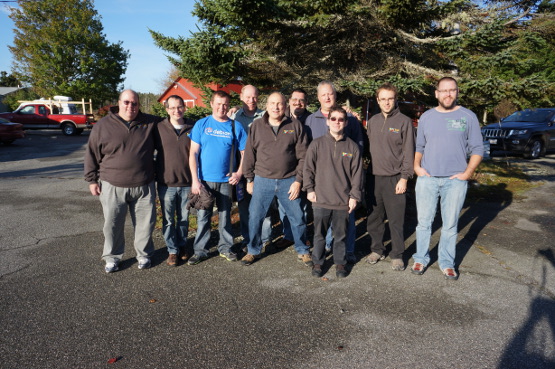
Last weekend I was in Southwest Harbour, Maine again for the annual LTSP hackfest (called By The Sea). It s a fun and productive event and as always it s been good catching up with LTSP folk, even though we were missing Oliver, Alkis and Vagrant. Here is a summary of what I can recall from the discussions of the weekend Recent Happenings in LTSP Going Forward

  • Libpamssh - This has been ongoing work in the LTSP project that will allow you to authenticate against another machine using SSH with local PAM. This will make it somewhat trivial to adapt LightDM (Light Display Manager) as a remote login manager and we can then do away with LDM (LTSP Display Manager) which currently has several big limitations. Scott Balneaves and St phane Graber made big progress on this over the weekend and it s close to an initial release.
  • New LTSP Cluster Control Center - Simon Poirier has been working on a new LTSP Cluster Control Center, the old one has been rusting away and other attempts at rewriting it didn t quite work out. He did a demonstration of the proof-of-concept code and it s looking quite nice already.
  • Squashed Bugs - Marc Gari py took some time to squash some bugs: LP: #996533, LP: #1048689 and LP: #1062947
  • Documentation - I m taking it upon myself to fix some problems we have with documentation. The lts.conf documentation is incomplete and difficult to maintain, so I will be going through the client/server code and tag all the possible settings that there are so that we can auto-generate documentation from it. David Trask will be helping out there and will be writing some nice descriptions for the config settings.
  • LTSP 6.0 and the Future of LTSP - There was a good opening discussion about the future of LTSP. The combination of all the recent partial rewrites that Alkis has been doing combined with the deprecation of LDM will culminate in what will be called LTSP 6.0. There was also some interest in having an LTSP standalone distribution again (that can be installed on none-integrated distributions) and things like an LTSP live client disc. We were also wondering about the future of pure thin clients, many upstreams are writing software that aren t at all thin client friendly (Clutter-based software like Gnome Shell and Totem, Unity, etc) and at the same time, thin client hardware is becoming increasingly powerful. It s possible that there may be a focus on making diskless fat clients working even better with LTSP and make it easier to use remote-apps for running only certain applications the application servers. We re also quite interested in projects like FreeRDP for users who would still require pure thin clients.
Social It was great seeing everyone again. I first started using LTSP around 9 years ago and never imagined back then that I d get to meet the people behind it. Ron Colcernian sourced us some really cool LTSP tops that you can see us wearing in the group photo. I hope to get to BTS again next year!

Next.

Previous.