Search Results: "tb"

2 September 2007

Russell Coker: Optus Password changeme

I have just given my parents a new computer, and part of the upgrade process lost their email passwords (which were stored in KDE preferences - this seems to happen every time KDE is upgraded). The only password that is not under my control is the password for their Optus account. So I had to get the password changed, I got my mother to phone Optus but they decided that my father had to make the request (not that I would have had any difficulty impersonating him, any of the details that they asked for which I might not have known could have been provided by my mother). So my father requested that my mother be listed as someone who is authorised to make changes to the account. It turned out that changing a password for a mailbox is a difficult operation and I needed to talk to the phone-support guy. He needed to get permission from my father for this (he didn’t seem to realise that he had just granted my mother full access so that she could authorise such things on future calls). After my father had given permission for the second time I got the password changed, the new password was “changeme“. The call-centre guy advised me to change it as “it’s a very common password“! An ISP with any clue in their call centre would get the password changed to a semi-random string. Then there was the process of changing the password. The web site didn’t work at all with Konqueror (the call-centre guy told me that only IE is supported). I used Iceweasel (Firefox) and it allowed me to change the password. The Optus web site is one of the worst I’ve ever seen, and redirecting to the MS site live.com as part of the process was only part of it. Another bad thing that Optus does is punish customers who do things that they don’t like. My original Optus contract specified unlimited uploads, the first time they cut me off for actually uploading a moderate amount of data (running Bittorrent) they disconnected me and claimed that it was a DOS attack. On a later occasion they disconnected me on a Wednesday because I had uploaded some files on the weekend. They alleged that the upload was continuing on the Sunday (although I had a very clear recollection of ending it on the Saturday), but we all agreed that the upload had ceased before the Monday. But apparently I needed to be disconnected on the Wednesday to teach me a lesson. The lesson of course is that Optus sucks really badly. They do have reasonable prices and at the time their cable network offered download speeds significantly higher than any ADSL plans could match, which is why I have continued using them (and subscribed again after buying a new house). Recently ADSL2+ has started to become common and prices have been falling. For my use and for most people who I know ADSL is now either cheaper than cable or close enough that it’s worth paying the extra to escape Optus. My parents are on an Optus plan that gives them 100MB per month of data transfer (which counts both download and upload) before they are limited to modem speed. This is enough for them, but I expect that when their Optus contract runs out there will be an ADSL plan that’s not much more expensive and they can cease using Optus too. I just wish there was a real choice of providers for the base phone service. Currently there is only Telstra and Optus, both of which are expensive and suck. Fortunately Telstra has an insane CEO who is determined to make sure that everyone in Australia learns that Telstra is a nasty monopoly that needs to be broken up or severely constrained.

Joey Hess: apache cgi fork bomb

Like Russell Coker I had to deal with an apache OOM crashing my main Xen instance yesterday. In my case, it is due to the Czech IP 88.102.6.114, which decided it would be a good idea to download the entire output of viewvc, recursively, and apparently also in parallel. After 2 hours and some 40 thousand hits, this eventually started enough instances of viewvc and svn that it used up 512 mb of ram and OOMed the system. I don't have a satesfactory fix yet. Viewvc shouldn't let itself be run dozens of times simulantaneuosly, surely. Apache doesn't seem to provide a way to limit the total number of CGIs it can launch at once, except by limiting the total number of connections. Apache's rlimitnproc option sadly only applies the limits after starting a CGI, rather that applying them to apache itself. Something that could control the number of CGIs started on a per-directory and per-vhost basis would be ideal. For now, I used ulimit -u when starting apache, which prevents many viewvc processes from running at once, but allows anyone who DOSes viewvc to also DOS all other CGIs on the system.

Stefano Zacchiroli: clean distclean

On cleaning and distcleaning ... ... and CDBS and "FTBFS if built twice in a row" Yesterday I closed two bugs of mine (424331 and 424392) of the "FTBFS if built twice in a row" class. Shame on me, they were open since too long. Both packages use autotools and, on the Debian side, CDBS. For both packages the fix was as simple as adding:
DEB_MAKE_CLEAN_TARGET = clean

to debian/rules. The rationale for that is rather obvious (now that I've thought about it of course). CDBS per default uses "distclean" as the upstream target which is invoked when "debian/rules clean" is executed. Unfortunately, "distcheck" (used by upstream to create the distribution tarball) does not check that "distclean" leave the distribution tarball as it was before the build. So nothing grants a priory that stuff removed by "distclean" is rebuildable with just the build-deps. A lot of packages come with generated sources (for example by XSLT or by some template toolkits) included in the source package, if that stuff is removed by mistake during distclean you'll see yet another instance of this kind of bugs. I bet a lot of other "FTBFS if built twice in a row" bugs out there have been fixed this way or can still be fixed with the addition of the line above. Update: changed this post, the first writing was made thinking at "maintainer-clean" instead of "distclean"

Bastian Blank: linux-image-2.6.23-rc4-xen-686

Xen support finally landed in upstream Linux. Okay, it is rather limited yet, but usable. It supports the following: Changes to the old Xen patch: Yet missing things:

Russell Coker: Out Of Memory Errors and Apache

I’ve been having problems with one of my Xen virtual servers crashing with kernel error messages regarding OOM conditions. One thing I had been meaning to do is to determine how to make a core dump of a Xen domain and then get data such as the process list from it. But tonight I ended up catching the machine after the problem occurred but before the kernel gave OOM messages so I could log in to fix things. I discovered the following issues:
  1. 10+ instances of spf-policy.pl (a Postfix program to check the Sender Policy Framework data for a message that is being received), most in D state.

  2. All my Planet news feeds being updated simultaneously (four of them taking 20M each takes a bite out of 256M for a virtual machine).

  3. Over 100 Apache processes running in D state.

I think that there is a bug with having so many instances spf-policy.pl, I’ve also been seeing warning messages from Postfix about timeouts when running it. For the Planet feeds I changed my cron jobs to space them out. Now unless one job takes 40 minutes to run there will be no chance of having them all run at the same time. For Apache I changed the maximum number of processes from 150 to 40 and changed the maximum number of requests that a client may satisfy to 100 (it used to be a lot higher). If more than 40 requests come in at the same time then the excess ones will wait in the TCP connection backlog (of 511 entries) until a worker process is ready to service the request. While keeping the connections waiting is not always ideal, it’s better than killing the entire machine! Finally I installed my memlockd program so that next time I have paging problems the process of logging in and fixing them will be a little faster. Memlockd locks a specified set of files into RAM so that they won’t be paged out when memory runs low. This can make a dramatic difference to the time taken to login to a system that is paging heavily. It also can run ldd on executables to discover the shared objects that they need so it can lock them too.

1 September 2007

Russell Coker: A New Spam Trick

One item on my todo list is to set up a bunch of email addresses on sub-domains of domains that I am responsible for (with the consent of all people involved of course) and perform various actions to get the addresses noticed by spammers and measure how effective the various anti-spam measures are. As part of such tests I would click on every URL in every message sent to some accounts and see what difference it makes. My plan is to run a set of Xen virtual machines with different configurations of some common anti-spam measures used in MTAs and see how they fare with sets of accounts with similar publicity. I am not aware of any work having been done in this area (a quick Google search turned up nothing). There are many honeypots for tracking spam sources, matching email address harvesting to spamming, etc. But I’m not aware of any research into the effectiveness of various methods of combatting spam by setting up multiple honeypots. Please inform me via comments if I have missed something! The most common advice about spam is to NEVER click on the URL that supposedly removes you from a list. By clicking on such a URL the spammer can recognise that you actually read the email and therefore know that it’s a live address and a good target for more spam. I am not aware of any good studies proving this, which is why it’s one of the things I’d like to investigate. A counter theory (for which there is also a lack of evidence AFAIK) is that spammers used to measure delivery etc but now that bot-nets are large and cheap it’s easier to just send mail to all possible addresses. Even though I am not aware of any great evidence to support the idea I avoid clicking on URLs in spam messages. Refraining from hitting the spam web-sites can’t do any harm (it’s not as if the meager contribution to their system load caused by my web browser will cause them a problem). But today I was tricked. A spammer subscribed me to a mailman mailing list, as I am subscribed to many lists (about half of which use mailman) the fact that I didn’t recognise the list name didn’t necessarily mean that I hadn’t signed up to it. After signing in I saw the list archives which had only one post concerning spam. I unsubscribed (there was no other reasonable option open to me) and sent the mailman message to SpamCop. This technique will probably be effective for a while. People will think that they subscribes to a list and forgot about it and that it’s just another list that doesn’t have strong anti-spam measures. That should greatly increase the amount of time taken to black-list the spam server. So from now on if I receive a spam via a mailing list that I am not familiar with then I’ll send it to SpamCop immediately. Also this is yet another good reason for not subscribing people to mailing lists without their consent (a practice that is far too common - it’s really not difficult to send someone an email asking whether they would like to join the list). If you subscribe me to a list without prior discussion and the first post I receive on the list is a spam then it will be sent to SpamCop and this might result in you being black-listed.

MJ Ray: Vuelta a Espa a

Eurosport are broadcasting the Vuelta a Espa a at 19 east from today with commentary in English (analogue only) and German. Scheduled times:-
Sat 01.09.2007
16:30-17:30 CET
Sun 02.09.2007
16:00-17:30 CET
Mon 03.09.2007 to Thu 06.09.2007
16:30-17:30 CET
Fri 07.09.2007 to Mon 10.09.2007
16:00-17:30 CET
Tue 11.09.2007
no show (MTB at 08:45)
Wed 12.09.2007
16:00-17:30 CET
Thu 13.09.2007
01:00-01:30 and 15:45-17:30 CET
Fri 14.09.2007 and Sat 15.09.2007
16:00-17:30 CET
TVEi are broadcasting at 13 and 19 east. Scheduled times:-
Sat 01.09.2007
16:40-18:00 CET
Sun 02.09.2007
16:40-18:30 CET
Mon 03.09.2007
16:35-18:00 CET
Tue 04.09.2007 to Sun 09.09.2007
16:40-18:00 CET
I'll post more times next week. I'd bet on a strong showing from Caisse d'Epargne after a relatively quiet TdF. Who would you tip? If you've not got your satellite set yet, some Lidl specials are still available and most Maplin branches have sets. Finding the broadcasts at 19 east is pretty easy in the UK. See my asteFAQ for hints and links. I've still not fixed my dish up properly, yet it gets most 19 east transmissions.

Russell Coker: Hot-swap Storage

I recently had to decommission an old Linux server and replace it with a new machine. When I was about to turn it off I noticed a power cable of the type used for IDE hard drives leaving the Linux server and entering an NT server that was in the same rack! It turned out that a DAT tape drive used for backup had been shipped without a power cable and they had been forced to take power from another machine. Incidentally is this likely to risk hardware damage? So I had to take the NT machine down to fix it. The new cable had arrived so all I had to do was install it. One thing that wasn’t mentioned on the documentation was that the cable was designed to operate as a double-adapter and replace an existing cable. Once the phone support people had explained this (IBM support is really good - they solved the problem well within the SLA) I was able to correctly wire it. However correct wiring in this case meant having a power cable go through the side of the storage bay and a SCSI cable came from the back of the case underneath the cooling fan assembly (something like 16 separate hot-swap fans in one assembly that can be removed for maintenance). The DAT drive took up space that could otherwise have been used for three hot-swap SCSI hard drives. What I would like to know is, why can’t they make hot-swap DAT drives that use the same power and SCSI connectors as the hard drives? I don’t expect a DAT drive to be any more reliable than a hard drive, and when the system backup is mission-critical then down-time is required for a replacement. Not to mention the effort involved in the installation, my fingers are significantly longer than average, I can’t imagine how anyone with average size hands could complete the job! So IBM, congratulations on the great phone support. But please try and make everything hot-swap when designing servers. Also while on the topic, I think that servers should be designed with external DVD drives connected via USB. I really hate it when I’ve got 10 * 2U servers in a rack, my system performance is limited by the number of disks and every single server has space that could be used for at least one disk sitting idle because there is a DVD drive gathering dust. For the IBM 2U servers in question, they could design them with space for 12 disks or 9 disks and one DAT drive which were all hot-swappable if they were smart about it, the current design supports 6 disks or 3 disks and a DAT.

31 August 2007

Russell Coker: Carbon Geo-Sequestration

My post about Why Hydrogen Powered Cars Will Never Work has received a record number of comments. Some of them suggested that carbon geo-sequestration (storing carbon-dioxide at high pressure under-ground) is the solution to the climate change problem. The idea is that you can mix natural gas or coal gas with steam at high temperature to give carbon-dioxide and hydrogen. Then the carbon dioxide gets stored under-ground while the hydrogen is used for relatively clean fuel. Beyond Zero Emissions has produced a media release about the fallacies expressed in the FutureGen document promoting so-called “clean-coal”, the best content is in their PDF document titled FutureGen Conceptual Design Retort. Note that I did some research to support the preparation of the retort, I am not referencing them to support my arguments but as background information. One overwhealming problem with geo-sequestration for coal based power plants is that it is significantly more expensive than the current coal-fired power plant design. Currently the price difference between coal power and wind power is quite small and there are several technologies that are almost ready for production which will decrease the cost of wind power, it is expected that before so-called “clean coal” becomes viable (they are planning for the first production plants to go live in 2022) the cost of renewable energy will be lower than the current cost of coal power. There is no reasonable possibility of “clean coal” being cheaper than renewable energy. The underground reservoirs that could be used for storing CO2 currently contain brine, which can contain toxic metals and radioactive substances (according to the Bureau of Land and Water Quality in the US). If toxic and radioactive substances need to be pumped out to make room for CO2 then it’s hardly a clean process! The US Geological Survey has an interesting page about volcanic gas. Apparently it’s not uncommon for small animals to be killed when CO2 forms pools in low lying areas. If (when?) CO2 escapes from geo-sequestration the same might happen with humans. They also have a page about CO2 killing trees at Mammoth Mountain! Before I read this I never realised that plants could be killed by excessive CO2. Apparently tree roots need oxygen and CO2 in the ground will kill them. The release of 300 tons of CO2 per day killed 100 acres of trees. The FutureGen trial power plant is designed to support sequestration of over 1,000,000 tons of CO2 per year (that is over 2,700 tons per day). If it leaked at 1/9 that rate then damage comparable to Mammoth Mountain would be the result. Note that the FutureGen trial plant will be a fraction of the size of a real coal power station so an escape of significantly less than 1/9 of the CO2 from a real sequestration plant would have such a bad result. It’s interesting to note that tents and basements are documented as CO2 risks, so I guess we have to avoid camping in areas near power plants! What would happen if a large geo-sequestration project had a sudden failure? IE if the reservoir broke and all the CO2 erupted suddenly? We already have an answer to this question because such things have happened in the past. In 1986 in Cameroon 1.2 cubic kilometers of CO2 gas was released from a volcanic lake, that is 2,400,000 tons (or just over two years of output from the proposed FutureGen plant). It killed over 2000 people. What might happen if 10 years of output from a commercial scale coal power plant was suddenly released into the atmosphere? As far as I know there has been no research on de-sequestration of CO2. If a reservoir is discovered to be unstable after 20,000,000 tons of CO2 have been stored in it, what will we do? Geo-sequestration of CO2 makes nuclear power plants seem safe by comparison.

Simon Richter: Carbon emissions

Russell thinks that trading emission "rights" individually would decrease emissions. The global emission market has shown quite the opposite happening, countries that have no industry and did not contribute to the problem now sell their rights to industrial countries, with the net effect being as if all these countries suddenly became industrialized over night. I don't think anything different would happen at an individual level. The fundamental problem is this: emission rights trading happens only when buying rights is cheaper than actually reducing your emissions. When this is relatively cheap, you remove any incentive to develop better processes in individual companies; if it is more expensive, most industries will remain at the status quo (no emission trading) while those where it still makes sense fiscally now have an alternative, which diminishes the market for technology companies specializing in filtering technology and process optimization (i.e. it becomes even more expensive to behave environmentally conscious). At the same time, the cost of buying these rights from individuals will be passed on to the consumer, the only way to get this money back will be to sell off their emission rights. From a macroeconomic perspective, no money ever changes hands, but you have effectively transferred the individual emission rights over to the industry. Looking at individuals, you are penalizing those that behave environmentally conscious and neither use their "rights" nor sell them. So, emission rights trading is a really bad idea.

Pierre Machard: Install Debian on Dell Vostro200

Recently, at work we changed our desktop computers. I’ve been faced to difficulties with a Dell Vostro200. Vostro had no OS. The hardware is still very recent. After 2 days I finally succeed in it. : The content of my box : (lspci and lspci -v).

migus@dazibao:~$ lspci
00:00.0 Host bridge: Intel Corporation 82G33/G31/P35/P31 Express DRAM Controller (rev 02)
00:01.0 PCI bridge: Intel Corporation 82G33/G31/P35/P31 Express PCI Express Root Port (rev 02)
00:19.0 Ethernet controller: Intel Corporation 82562V-2 10/100 Network Connection (rev 02)
00:1a.0 USB Controller: Intel Corporation 82801I (ICH9 Family) USB UHCI Controller #4 (rev 02)
00:1a.1 USB Controller: Intel Corporation 82801I (ICH9 Family) USB UHCI Controller #5 (rev 02)
00:1a.2 USB Controller: Intel Corporation 82801I (ICH9 Family) USB UHCI Controller #6 (rev 02)
00:1a.7 USB Controller: Intel Corporation 82801I (ICH9 Family) USB2 EHCI Controller #2 (rev 02)
00:1b.0 Audio device: Intel Corporation 82801I (ICH9 Family) HD Audio Controller (rev 02)
00:1d.0 USB Controller: Intel Corporation 82801I (ICH9 Family) USB UHCI Controller #1 (rev 02)
00:1d.1 USB Controller: Intel Corporation 82801I (ICH9 Family) USB UHCI Controller #2 (rev 02)
00:1d.2 USB Controller: Intel Corporation 82801I (ICH9 Family) USB UHCI Controller #3 (rev 02)
00:1d.7 USB Controller: Intel Corporation 82801I (ICH9 Family) USB2 EHCI Controller #1 (rev 02)
00:1e.0 PCI bridge: Intel Corporation 82801 PCI Bridge (rev 92)
00:1f.0 ISA bridge: Intel Corporation 82801IR (ICH9R) LPC Interface Controller (rev 02)
00:1f.2 IDE interface: Intel Corporation 82801IR/IO/IH (ICH9R/DO/DH) 4 port SATA IDE Controller (rev 02)
00:1f.3 SMBus: Intel Corporation 82801I (ICH9 Family) SMBus Controller (rev 02)
00:1f.5 IDE interface: Intel Corporation 82801I (ICH9 Family) 2 port SATA IDE Controller (rev 02)
01:00.0 VGA compatible controller: ATI Technologies Inc RV516 [Radeon X1300/X1550 Series]
01:00.1 Display controller: ATI Technologies Inc RV516 [Radeon X1300 Pro] (Secondary)
02:01.0 FireWire (IEEE 1394): Agere Systems FW323 (rev 61)
So let me explain how I did.
  1. First, I used a netboot. I downloaded a recent netboot.tar.gz (from Debian website). I downloaded a daily image and use a Netboot PXE.. Not all the netboot.tar.gz are working… (That is to say, that I am not sure that all daily snapshot are working). I used this tarball:
    http://migus.nerim.net/vostro200/netboot.tar.gz
    I tried to build my own netboot.tar.gz without success. IRQ conflicts always vanished the debian-installer. I wish I had included the lastest e1000 drivers in my netboot…
  2. I had a problem of network hardware (Intel e1000 included in vostro 200 is too recent). So
  3. I decided to plug the time of my install an old 10OMb/s Ethernet card (e100 with PXE).
  4. Very quickly I had IRQ conflicts that blocked the disk detection. (SATA Controller had timeout).
  5. I passed the following arguments to the install command line acpi=off  irqpoll  vga=791
  6. Everything went well. The installer finished its work. The box rebooted.
  7. I downloaded module assistant, kernel-headers, gcc : aptitude install module-assistant gcc linux-headers-2.6.21-2
    and the e1000 driver from http://sourceforge.net/projects/e1000/. I just run make install
  8. (for lspci I ran a update-pciids (8)).
Everyting work well since :-) Conclusion :
1) Install an old PCI Ethernet card with PXE
2) Install DHCP + PXE
2a) Find a netboot.tar.gz that work without freeze. (the tarball on my website works)
2b)Do not forget to plug your USB keyboard in the usb connector just bellow your ethernet connector. (If you don’t for an unknown reason, when you type on a key, Your box get it twice….)
3) Tune the installer command line : acpi=off  irqpoll
[let’s the installer worked]
4) Download e1000 driver
5) Remove your old PCI Ethernet Card.
6) Be happy
6a)If you want to enable acpi into your desktop, once you installed your system you can try acpi=noirq irqpoll.

Russell Coker: Interesting Ideas from George Monbiot

Here is a transcript of a lecture by George Monbiot about climate change and what we need to do. The latest scientific evidence suggests that we need to cut emissions to zero by 2030 to avoid significant increases in the sea level over the next century, George describes some options that will form part of a solution to this problem. Below are my comments on what I consider the most interesting (the ideas that I hadn’t heard of before), I recommend reading the full article for the rest.
  1. Have a carbon ration for each citizen. Wealthy people who want to use more resources could buy carbon rations from poorer people on an open market. That way people who use less than their ration still have an incentive to save more because the extra savings are worth money! As everyone would then have a financial incentive to reduce emissions there would be a lot of new development of methods and technologies for eliminating or compensating for carbon emissions, capitalism works!

  2. Build battery powered cars with interchangeable batteries. The idea is that you rent a battery from a fuel company, and whenever it runs low you go to a service station and swap it for a fully charged battery (for a small fee). If doing this the service station could use cheap night-time electricity to charge the batteries, and the batteries that are charged could be used to put electricity back into the grid at times of peak demand. A common idea is to have Prius+ type vehicles charge from the grid when not being used and then sell electricity back to the grid at peak times. Implementing such a system for millions of homes is technically challenging and expensive. But having a much smaller number of service stations sell larger quantities of electricity back to the grid is easier to manage.

  3. Reduce air travel by 90%. I wonder how much of this can be achieved by using high-speed trains for all national travel systems and for most travel within the EU. I have often travelled between Amsterdam and London by train, it’s much more civilised than flying.

  4. Classic quote from George on John Howard: “if Howard believes a slight reduction in consumption is a recessionary measure he ought to see what a total reduction of land area would be as a result of the melting of the west Antarctic ice sheet. The two things are just completely out of proportion..”

George Monbiot also has recently released a new book Heat: How to Stop the Planet from Burning.

John Goerzen: The Story of One Barn

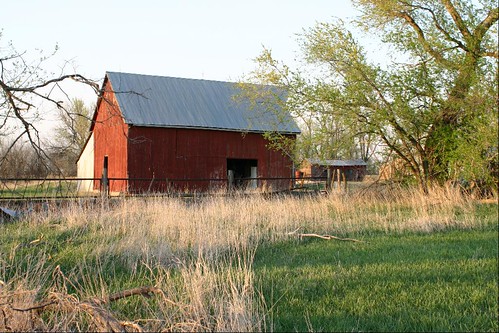
img_2575

About 80 years ago, a Kansas family -- the Janzens -- built this barn.

About 60 years ago, my grandparents moved onto the farm. Their cattle were kept right here. I remember Grandpa's red tractor being parked in the barn.

So many memories have this barn in the background. We had a visit from one of the Janzens that lived here as a child. He had fond memories of this building. My dad and his siblings once played in the deep snow in front of this barn.

Here's one memory from those times:

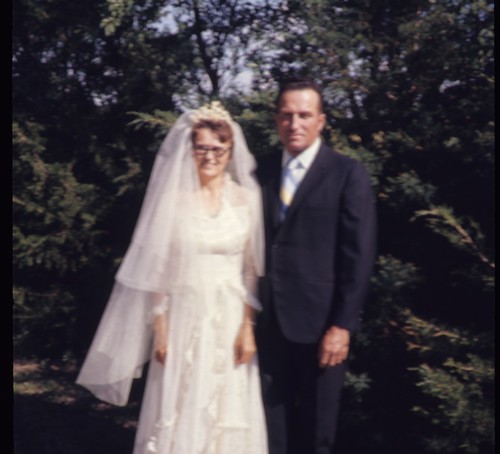
078.jpg

That's my grandma and grandpa on their 25th anniversary in 1970. It was a working barn back then, so they probably weren't standing right next to it for this picture, if you get my drift. But they were on the yard.

About 25 years ago, Grandma lost her battle with cancer. At some point or another, Grandpa had eased out of farming, so the barn had a lot less activity. I remember exploring his outbuildings when I got bored at family gatherings. And I used to mow the lawn next to it every summer when Grandpa went off to be a cook at a camp. I didn't mind mowing next to the barn. But I always tried to go past one corner of the house as fast as I could, because there were wasp and hornet nests right there.

About 7 years ago, it was time for Grandpa to move off the farm. It was getting to be too much to keep up the old house, the barn, the yard, and deal with things like freezing water pipes and water getting in through the windows. He moved to an independent-living duplex in town. He was always worried about what would happen to the farm. Over the next few years, the farm would sometimes be vacant, sometimes have renters. Some renters did some work on the house, but the barn sat. Grandpa would eventually move into the nursing home because of his Parkinson's.

Two and a half years ago, Grandpa passed away. I shared some memories from Grandpa's place at the funeral.

But what of the house, the farm now? Renters went, and it sat empty. Nothing was in great shape, and the house needed a lot of work. Perhaps the whole place would be leveled and turned back into the prairie that it once was, or used as farmland. Perhaps someone would have an interest someday.

A year and a half ago, Jacob was on the way. Terah and I had occasionally thought of buying Grandpa's place, but we never talked about it seriously. We figured that we better finally decide what we're doing, before we have a baby around, or a child in school. So in April 2006, we went out to the farm and checked it out. The picture at the top of this post is from that visit. Terah and I checked out the house, the barns, the granary, the pasture, and the creek. As we walked past one of the barns, a pigeon flew out. Terah jumped with a shout. I grew up around barns and didn't really notice it. In the big red barn, besides Grandpa's tractor, we found some remnants from years ago: some old bales, corn cobs that raccoons had found long ago, several generations of electric fencers, old appliances.

And we decided to go for it and buy the farm. This was right at a year after Grandpa died.

The family always liked to get together for Easter. What would happen for 2006? Well, they decided to have a picnic out at the farm. It was vacant, and a bit eerie. Yet they knew that we were working on buying the place and moving in. All but one took a last look through the house before our renovations began. The one person who didn't was my great aunt, Grandma's sister. She said, "I haven't been in this house for years. I remember how it looked back then. I don't want to remember how it looks now, run down like this. So I'm not going in. But once you have it all fixed up, THEN I'll go in!"

In June of 2006, we bought the farm.

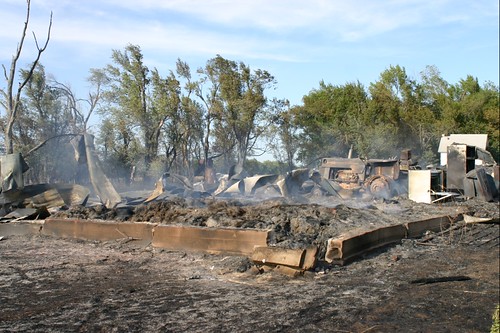
One month later, we lost this barn, and two other buildings, to a fire at our yard. This is what the beautiful red barn looked like that sad afternoon last year:

IMG_3630.JPG

As I wrote back then, nobody got hurt, the barn was insured, but "somehow, despite all these things, it still feels like we lost a little bit of Grandpa today."

2006 was a hot, dry summer. We had a patch of debris, then a patch of dirt, where the barn once stood.

7 months ago, Terah, Jacob, and I moved out to the farm. For the first time in 80 years, someone could stand in the farmhouse in the evening, look to the west, and see the colorful Kansas sunset over the pasture; the trees down by the creek; and even the neighbor's barn off in the distance. It was a beautiful sight, but it was also sad; that's not the view we had expected.

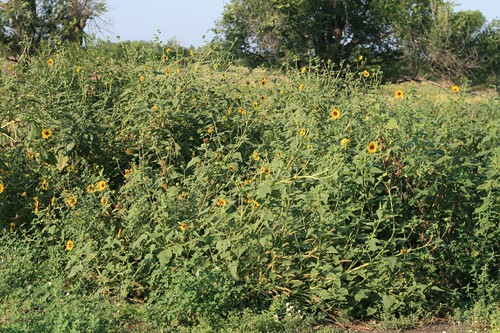
But then a surprise. This spring and summer, plants started coming up where none had grown for 80 years. But only where this barn stood -- not where the other two buildings were.

We watched as they grew tall. I'm sure decades of animals hanging out there were well appreciated by the plants.

As they grew, it looked like we might be seeing Terah's favorite flower: wild Kansas sunflowers.

And sure enough, they were.

Last weekend, Terah, Jacob, and I went out to the old barn. I took some pictures of its new appearance.

img_3429.jpg

This one stands where Grandpa's tractor used to be parked.

img_3401.jpg

And here we see a lifetime of flowers, from the old and withering, to the young just about ready to bloom.

img_3462.jpg

At the edge of the sunflowers, there's an old plow next to them. Though you might think it's barn-colored.

img_3411.jpg

Animals continue to be attracted to the area. Here's one of the smaller visitors.

img_3447.jpg

And here's a picture of almost the whole patch, right where the barn used to stand. I still mow right up to it.

I still miss the old barn. But somehow it still seems to be full of surprises and worth exploring. I wonder what next year will bring.

And I wonder if, a few years from now, Jacob will tell his friends about mowing right up to the sunflower patch, going fast to try to avoid any trouble with the bees.

30 August 2007

Daniel Burrows: Seattle LUG meeting

The Seattle Linux user's group has been defunct for the last two years or so, but an effort is underway to renergize it. This Saturday, the group will be meeting for the first time in years. The meeting will take place at the North Seattle Community College beginning at high noon -- check the official Web page for more details. TBH, the presentations don't look that interesting to me, but it's always fascinating to meet people who actually use Linux...

Yes, I'll be there, but I'm not giving any of the presentations, so please don't let that keep you away. ;-)

Russell Coker: Is SE Linux only for Linux?

I have just been asked for advice on whether SE Linux is Linux specific, and therefore whether code related to SE Linux should always be stored with other Linux specific code instead of being in the main branch of certain free software projects. One example of SE Linux access controls being implemented on a different OS is the work to port SE Linux to Mac OS/X. Here is a paper on the topic presented at the SE Linux Symposium 2007, and the main site is at http://sedarwin.org. One thing I have been doing is trying to get some friends interested in doing similar work for GNU Hurd (there are some similarities between Darwin and HURD so the work done on Mac OS/X “Darwin” will help the HURD effort). I believe that The HURD has the potential to offer significant security benefits due to the micro-kernel design. One significant problem area in computer security is kernel security flaws, if the kernel can be split into a set of independent processes that run with minimal privileges then the scope of such problems is dramatically decreased - and the possibility of upgrading parts of a kernel on a live machine is provided. As people such as Linus point out there is a performance overhead to micro-kernels, but most machines are idle most of the time anyway. I believe that reliability and security are more important than getting the last 10% of system performance for most machines. The success of Xen is evidence that features other than maximum performance are desired. Another example of SE Linux access controls on a non-Linux platform is the MAC framework in the TrustedBSD project. This implements SE Linux access controls on top of FreeBSD. From reading the documentation it seems that the amount of changes required to the SE Linux code base for implementation on TrustedBSD was significantly smaller than the changes required for Darwin. Sun is also apparently considering adding type-enforcement to Solaris. It’s yet to be seen whether this happens and if so whether it is compatible with SE Linux. So it seems that a significant portion of the SE Linux code base is portable, and in particular the user-space code should port well. The interfaces for and methods labelling files etc should port well between platforms. Therefore I recommend not having SE Linux code split into Linux specific trees and instead having a compile option to enable SE Linux support.

Russell Coker: Identifying the Distribution of a Linux System

I just needed to test something so I mounted the filesystem of one of my Xen domains in the Dom0 and chroot’d into it (I didn’t need the overhead of running a DomU for a quick test). Then strangely I found that my chroot environment had no apt-get and no dpkg installed. After a small amount of thought I realised that I had accidentally mounted the filesystem for a Fedora image instead of a Debian image. It seems to me that it might be a good idea for distributions to have shell scripts replacing the package tools for other distributions. For example dpkg on a Fedora box could be a shell script that runs echo “This system is running Fedora, you want to use rpm instead of dpkg”. Such a command would have saved me a couple of minutes of thinking. This may sound trivial, but if you consider the number of people who make such mistakes (and the even larger number of people who don’t realise that there is even more than one package tool in existence) then wasting a few K of disk space on every system to help them seems like a good idea. The minimum size of new hard drives that you can purchase seems to be 36G nowadays. So it’s not as if this would really cost anything. Please leave comments to tell me if I’m being sensible or silly. If the idea is regarded as good I’ll start filing bug reports.

29 August 2007

Russell Coker: The Silly BMW 745h

BMW has released a new prototype hydrogen powered car. The bmwworld.com web page about it claims the cruising range is 190 miles. Added to the 400-mile range of the normal fuel tank, the 745h can go 600 miles between fill-ups. The first issue is that 10 miles are not accounted for (maybe it finishes the 190 miles of hydrogen power at the top of a hill). But more seriously the hydrogen needed to drive for 190 miles would take as much space as petrol needed to drive for 646 miles (hydrogen needs 3.4* the volume to store an equivalent amount of energy). I wonder if that BMW has any space left in the boot/trunk? Now we have some green bloggers praising BMW. An internal combustion engine that burns hydrogen will not give no emissions other than water vapour, it will produce some nitrogen oxides. The processes to produce hydrogen for fuel all consume unreasonable amounts of energy (more than is required to charge a plug-in hybrid). BMW demonstrates their level of interest by giving the cars to some celebrities. This gets some PR but no analysis of the performance. They also introduce the prototype based on one of the most expensive models (the 745) which you almost never see on the roads. If they produced a 318 or 520 that ran on hydrogen it would demonstrate some level of interest in getting this working for the mass market. If BMW wanted to make their cars more environmentally friendly they would start by adopting some of the technology from the Prius. Rumour has it that part of Toyota’s plan to make money from Prius development is in licensing the technology that they patent. A couple of years ago I test drove a BMW 316 and a Prius. The Prius was very quiet and gave a smooth ride (you might call these luxury features), and also gave decent performance (it’s widely regarded that luxury cars should perform well - pity the BMW 316 is a slug). In Australia the concept of “badge engineering” of cars is well established. When government subsidies favoured large manufacturing runs the Ford Laser and Mazda 323 were essentially the same car. Maybe BMW could adopt this concept and sell a re-badged Prius i-tech with a few extra luxury features as a BMW 4 series (it’s a much better car than the 3 series BMW). Finally bmwworld.com has an amusing FAQ about hydrogen power, here are some of the mistakes that they make:
  1. They say “About 45 billion kilograms (50 million tons) [of hydrogen] is produced every year enough hydrogen to fuel 250 million fuel cell cars“, but only if the average fuel-cell car uses 180Kg of fuel per year. According to Wikipedia hydrogen has slightly more than 3* the energy density per mass than petrol, so 180Kg of fuel would be equivalent to 540L of petrol per year. The Australian Bureau of Statistics states that in 1996 the average annual distance travelled by car (it’s not clear whether this is per car or per person) was 14,600Km while among the countries listed the lowest was Japan with 10,130. When efficiently using hydrogen in a Prius (that is quoted as using 5.4L of petrol per 100Km) you might expect that 540/5.4*100=10,000Km could be travelled on the 180Kg of hydrogen. So the FAQ claim that 250M cars could be powered by the current hydrogen production would only apply if the cars are of Prius efficiency and driven the typical distances of Japanese drivers, or the cars were 46% more efficient than the Prius and driven in the Australian manner. Of course in the US things are even worse with 17,862Km being the average distance driven which means that their hypothetical fuel-cell car would need to be 78% more efficient than a Prius.

  2. They state that “the majority of merchant hydrogen is produced by a process called steam methane reforming“. Why not just run cars on methane then? Anything that burns can be used to fuel cars, and methane has a much higher boiling point than hydrogen so it would be easier to store and transport (see the Wikipedia page on methane).

  3. In regard to hydrogen production they say “about 95% of the total global hydrogen production is captive meaning it is used at the site where it is produced“, that is of course because it’s difficult and expensive to transport hydrogen.

  4. The final amusing fact is that it is noted that most hydrogen comes from fossil-fuels. What problem are they trying to solve here? Hydrogen isn’t going to help the environment if it comes from fossil fuels, it will be more expensive than other fuels. Apart from getting government grant money for BMW it doesn’t seem to do any good.

Russell Coker: A Strange Attempt to Trick Google

I just noticed that my post about LED Headlights in an Audi Sports Car was linked from audi.host4blogs.com. Strangely they took some of the words from my post, added some other apparently random words to make it look like a response, and then linked to my post. Having summaries of my blog posts appear on splogs is nothing new. I don’t have any objection to it normally as summaries will in a small way promote my blog as long as they are intelligible. The host4blogs.com site has a couple of other car blogs that link to each other with content of the same quality. I guess I can’t file a DMCA take-down request as the text is not a summary of mine. I hope that Google will start taking action against the sploggers soon.

28 August 2007

Russell Coker: The Silly BMW 745h

BMW has released a new prototype hydrogen powered car. The bmwworld.com web page about it claims the cruising range is 190 miles. Added to the 400-mile range of the normal fuel tank, the 745h can go 600 miles between fill-ups. The first issue is that 10 miles are not accounted for (maybe it finishes the 190 miles of hydrogen power at the top of a hill). But more seriously the hydrogen needed to drive for 190 miles would take as much space as petrol needed to drive for 646 miles (hydrogen needs 3.4* the volume to store an equivalent amount of energy). I wonder if that BMW has any space left in the boot/trunk? Now we have some green bloggers praising BMW. An internal combustion engine that burns hydrogen will not give no emissions other than water vapour, it will produce some nitrogen oxides. The processes to produce hydrogen for fuel all consume unreasonable amounts of energy (more than is required to charge a plug-in hybrid). BMW demonstrates their level of interest by giving the cars to some celebrities. This gets some PR but no analysis of the performance. They also introduce the prototype based on one of the most expensive models (the 745) which you almost never see on the roads. If they produced a 318 or 520 that ran on hydrogen it would demonstrate some level of interest in getting this working for the mass market. If BMW wanted to make their cars more environmentally friendly they would start by adopting some of the technology from the Prius. Rumour has it that part of Toyota’s plan to make money from Prius development is in licensing the technology that they patent. A couple of years ago I test drove a BMW 316 and a Prius. The Prius was very quiet and gave a smooth ride (you might call these luxury features), and also gave decent performance (it’s widely regarded that luxury cars should perform well - pity the BMW 316 is a slug). In Australia the concept of “badge engineering” of cars is well established. When government subsidies favoured large manufacturing runs the Ford Laser and Mazda 323 were essentially the same car. Maybe BMW could adopt this concept and sell a re-badged Prius i-tech with a few extra luxury features as a BMW 4 series (it’s a much better car than the 3 series BMW).

Andrew Pollock: [opinion] On hydrogen powered cars

Russell Coker very effectively debunks hydrogen for fuel. In my opinion, the only reason the oil companies and various shall we say pro-oil governments are getting behind hydrogen is because they know it's completely untenable. They can say "but look over here, we're researching clean energy" knowing full well that it's years away (if at all). It's a diversion, that's all. Meanwhile, we've had perfectly viable electric cars in the mid-1990's, yet fast-forward ten years, and apparently it's only just become commercially viable to have hybrids. Talk about regression. Something's really wrong with the world.

Next.

Previous.