Search Results: "sto"

26 March 2014

Russ Allbery: krb5-strength 3.0

krb5-strength is the password strength checking code that we use at Stanford for our primary Kerberos realm. We've had quite a lot of difficulty deciding exactly what password strength checking we want to do and how we want to handle password history. The good part is that this is to the advantage of everyone else, since now more flexible password strength checking code is available. The major change in this release is the addition of a password history implementation for Heimdal. Implemented as an external password quality check program, it can stack with other password quality check programs, such as the one included in this distribution. Previous passwords are hashed with PBKDF2 with SHA-2. Note that this has somewhat extensive Perl module dependencies, since it was originally written as a separate project. Also in this release is yet another password dictionary type: SQLite. This is probably a bit slower than straight lookups in CDB, and it's definitely less space-efficient since it stores each word both forward and reversed, but it can reject any password that is within edit distance one of a dictionary word. (Edit distance one means that the word can be formed from the password by adding, removing, or changing a single character.) The cdbmake-wordlist utility has been renamed to krb5-strength-wordlist and can now generate the SQLite dictionary as well as the CDB dictionary. Finally, another configuration option has been added: minimum_different. If set, passwords must contain at least this many different characters. This can be used to reject passwords that are long strings of the same character or short repeating patterns, which are otherwise difficult to detect with a straight dictionary-driven approach. You can get the latest release from the krb5-strength distribution page.

Dirk Eddelbuettel: RProtoBuf 0.4.1

A new bug-fix release release 0.4.1 of RProtoBuf, is now on CRAN. RProtoBuf provides GNU R bindings for the Google Protocol Buffers ("Protobuf") data encoding library used and released by Google, and deployed as a language and operating-system agnostic protocol by numerous projects. Murray once more shouldered most of the actual burden and fixed a number of issues detailed below.
Changes in RProtoBuf version 0.4.1 (2014-03-25)
  • Document and add a test for the deprecated group functionality.
  • Add a CITATION file pointing to our arXiv.org preprint.
  • Fix a bug in the show method for EnumDescriptor types.
  • Import all top-level enums from imported .proto files.
  • Removed duplicate enum value type from the unit tests that caused problems with the most recent libprotobuf-2.5. (without option allow_alias).
CRANberries also provides a diff to the previous release. More information is at the RProtoBuf page which has a draft package vignette, a 'quick' overview vignette and a unit test summary vignette. Questions, comments etc should go to the rprotobuf mailing list off the RProtoBuf page at R-Forge.

This post by Dirk Eddelbuettel originated on his Thinking inside the box blog. Please report excessive re-aggregation in third-party for-profit settings.

25 March 2014

Petter Reinholdtsen: Public Trusted Timestamping services for everyone

Did you ever need to store logs or other files in a way that would allow it to be used as evidence in court, and needed a way to demonstrate without reasonable doubt that the file had not been changed since it was created? Or, did you ever need to document that a given document was received at some point in time, like some archived document or the answer to an exam, and not changed after it was received? The problem in these settings is to remove the need to trust yourself and your computers, while still being able to prove that a file is the same as it was at some given time in the past. A solution to these problems is to have a trusted third party "stamp" the document and verify that at some given time the document looked a given way. Such notarius service have been around for thousands of years, and its digital equivalent is called a trusted timestamping service. The Internet Engineering Task Force standardised how such service could work a few years ago as RFC 3161. The mechanism is simple. Create a hash of the file in question, send it to a trusted third party which add a time stamp to the hash and sign the result with its private key, and send back the signed hash + timestamp. Both email, FTP and HTTP can be used to request such signature, depending on what is provided by the service used. Anyone with the document and the signature can then verify that the document matches the signature by creating their own hash and checking the signature using the trusted third party public key. There are several commercial services around providing such timestamping. A quick search for "rfc 3161 service" pointed me to at least DigiStamp, Quo Vadis, Global Sign and Global Trust Finder. The system work as long as the private key of the trusted third party is not compromised. But as far as I can tell, there are very few public trusted timestamp services available for everyone. I've been looking for one for a while now. But yesterday I found one over at Deutches Forschungsnetz mentioned in a blog by David M ller. I then found a good recipe on how to use the service over at the University of Greifswald. The OpenSSL library contain both server and tools to use and set up your own signing service. See the ts(1SSL), tsget(1SSL) manual pages for more details. The following shell script demonstrate how to extract a signed timestamp for any file on the disk in a Debian environment:
#!/bin/sh
set -e
url="http://zeitstempel.dfn.de"
caurl="https://pki.pca.dfn.de/global-services-ca/pub/cacert/chain.txt"
reqfile=$(mktemp -t tmp.XXXXXXXXXX.tsq)
resfile=$(mktemp -t tmp.XXXXXXXXXX.tsr)
cafile=chain.txt
if [ ! -f $cafile ] ; then
    wget -O $cafile "$caurl"
fi
openssl ts -query -data "$1" -cert   tee "$reqfile" \
      /usr/lib/ssl/misc/tsget -h "$url" -o "$resfile"
openssl ts -reply -in "$resfile" -text 1>&2
openssl ts -verify -data "$1" -in "$resfile" -CAfile "$cafile" 1>&2
base64 < "$resfile"
rm "$reqfile" "$resfile"
The argument to the script is the file to timestamp, and the output is a base64 encoded version of the signature to STDOUT and details about the signature to STDERR. Note that due to a bug in the tsget script, you might need to modify the included script and remove the last line. Or just write your own HTTP uploader using curl. :) Now you too can prove and verify that files have not been changed. But the Internet need more public trusted timestamp services. Perhaps something for Uninett or my work place the University of Oslo to set up?

24 March 2014

Michael Prokop: Building Debian+Ubuntu packages on EC2

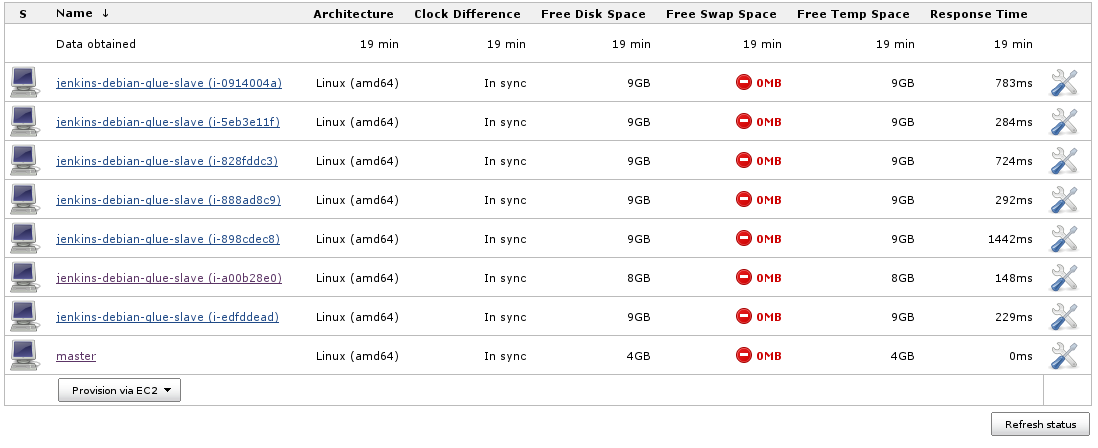
In a project I recently worked on we wanted to provide a jenkins-debian-glue based setup on Amazon s EC2 for building Debian and Ubuntu packages. The idea is to keep a not-so-strong powered Jenkins master up and running 24 7, while stronger machines serving as Jenkins slaves should be launched only as needed. The project setup in question is fully open sourced (more on that in a separate blog post), hereby I am documenting the EC2 setup in usage. Jenkins master vs. slave Debian source packages are generated on Jenkins master where a checkout of the Git repository resides. The Jenkins slaves do the actual workload by building the binary packages and executing piuparts (.deb package installation, upgrading, and removal testing tool) on the resulting binary packages. The Debian packages (source+binaries) are then provided back to Jenkins master and put into a reprepro powered Debian repository for public usage. Preparation The starting point was one of the official Debian AMIs (x86_64, paravirtual on EBS). We automatically deployed jenkins-debian-glue on the system which is used as Jenkins master (we chose a m1.small instance for our needs). We started another instance, slightly adjusted it to already include jenkins-debian-glue related stuff out-of-the-box (more details in section Reduce build time below) and created an AMI out of it. This new AMI ID can be configured for usage inside Jenkins by using the Amazon EC2 Plugin (see screenshot below). IAM policy Before configuring EC2 in Jenkins though start by adding a new user (or group) in AWS s IAM (Identity and Access Management) with a custom policy. This ensures that your EC2 user in Jenkins doesn t have more permissions than really needed. The following policy should give you a starting point (we restrict the account to allow actions only in the EC2 region eu-west-1, YMMV):
 
  "Version": "2012-10-17",
  "Statement": [
     
      "Action": [
        "ec2:CreateTags",
        "ec2:DescribeInstances",
        "ec2:DescribeImages",
        "ec2:DescribeKeyPairs",
        "ec2:GetConsoleOutput",
        "ec2:RunInstances",
        "ec2:StartInstances",
        "ec2:StopInstances",
        "ec2:TerminateInstances"
      ],
      "Effect": "Allow",
      "Resource": "*",
            "Condition":  
                "StringEquals":  
                    "ec2:Region": "eu-west-1"


  ]
 
Jenkins configuration Configure EC2 access with Access Key ID , Secret Access Key , Region and EC2 Key Pair s Private Key (for SSH login) inside Jenkins in the Cloud section on $YOUR_JENKINS_SERVER/configure. Finally add an AMI in the AMIs Amazon EC2 configuration section (adjust security-group as needed, SSH access is enough): As you can see the configuration also includes a launch script. This script ensures that slaves are set up as needed (provide all the packages and scripts that are required for building) and always get the latest configuration and scripts before starting to serve as Jenkins slave. Now your setup should be ready for launching Jenkins slaves as needed: NOTE: you can use the Instance Cap configuration inside the advanced Amazon EC2 Jenkins configuration section to place an upward limit to the number of EC2 instances that Jenkins may launch. This can be useful for avoiding surprises in your AWS invoices. :) Notice though that the cap numbers are calculated for all your running EC2 instances, so be aware if you have further machines running under your account, you might want to e.g. further restrict your IAM policy then. Reduce build time Using a plain Debian AMI and automatically installing jenkins-debian-glue and further jenkins-debian-glue-buildenv* packages on each slave startup would work but it takes time. That s why we created our own AMI which is nothing else than an official Debian AMI with the bootstrap.sh script (which is referred to in the screenshot above) already executed. All the necessary packages are pre-installed and also all the cowbuilder environments are already present then. From time to time we start the instance again to apply (security) updates and execute the bootstrap script with its &dash&dashupdate option to also have all the cowbuilder systems up2date. Creating a new AMI is a no-brainer and we can then use the up2date system for our Jenkins slaves, if something should break for whatever reason we can still fall back to an older known-to-be-good AMI. Final words How to set up your Jenkins jobs for optimal master/slave usage, multi-distribution support (Debian/Ubuntu) and further details about this setup are part of another blog post. Thanks to Andreas Granig, Victor Seva and Bernhard Miklautz for reading drafts of this.

Elena 'valhalla' Grandi: Moving away from google services, step N out of M

For years, I've used a gmail account to subscribe to public mailing lists because it was convenient, it had excellent spam filtering and since the lists were already available on google-indexed public archive I felt that there was no real privacy issue.
I already have a local copy of every message in the account, in case I lose access to it for some random reason, and my real contacts already know and use my other email address(es), so I'm not really worried about continuing to use gmail for this kind of traffic.

When I started contributing to Debian I also used that email address, because I was already subscribed to a few mailing lists under it, and it was going to end up being used on the BTS and other spam-attracting public places like that, but I was less happy with the choice.

Lately, however, gmail's spam filters have started to behave oddly, with lots of false positives including a number of messages from @debian.org addresses, and this basically removes the main reason why I was using gmail in the first place, so I'm seriously considering dropping it also for publicly indicized communications.

My first step, right before leaving for Barcelona was to create a couple other email addresses, one for mailing lists and the other for debian-related work, and add them to my gpg/OpenPGP key, so that any new signature on them from the conf would also include the new UIDs.

If you've received a badly signed message (thanks heirloom mailix for mangling stuff :) ) followed by an hopefully correctly signed one where I was asking you to sign new UIDs, and you were wondering, this is the reason.

Now that the new UIDs have been signed by a few DDs I'm going to start using the new address in Debian: I believe I have changed it everywhere I needed to, except for the maintainer/uploader field for my packages, where it will change on their next uploads.

As for mailing lists, I still don't know how to proceed: I could proceed in a systematic way, but I'm lazy and I will probably just change a few main subscriptions, use the new address for new subscriptions and then migrate the rest a few at a time, unless some other event happens and I'll have to hurriedly migrate everything or risk losing important messages. Even in the latter case, I don't need any information that is only stored on google's servers, so I won't will panic just a bit :)

Now, where did I put that documentation about xmpp servers?

Steve Kemp: So I failed at writing some clustered code in Perl

Until this time next month I'll be posting code-based discussions only. Recently I've been wanting to explore creating clustered services, because clusters are definitely things I use professionally. My initial attempt was to write an auto-clustering version of memcached, because that's a useful tool. Writing the core of the service took an hour or so: At the point I was done the following code worked:
use KeyVal;
# Create an object, and set some values
my $obj = KeyVal->new( logfile => "/tmp/foo.log" );
$obj->incr( "steve" );
print $obj->get( "steve" ) # prints 2.
# Now replay the append-only log
my $replay = KeyVal->new( logfile => "/tmp/foo.log" );
$replay->replay();
print $replay->get( "steve" ) # prints 2.
In the first case we used the primitives to increment a value twice, and then fetch it. In the second case we used the logfile the first object created to replay all prior transactions, then output the value. Neat. The next step was to make it work over a network. Trivial. Finally I wanted to autodetect peers, and deploy replication. Each host would send out regular messages along the lines of "Do you have updates made since $time?". Any that did would replay the logfile from the given unixtime offset. However here I ran into problems. Peer discovery was supposed to be basic, and I figured I'd write something that did leader election by magic. Unfortunately Perls threading code is .. unpleasant: This failed. Majorly. Because you cannot launch the implementation of a class-method as a thread. Equally you cannot make a variable which is "complex" shared across threads. I wrote some demo code which works without packages and a shared singleton: The Ruby version, by contrast, is much more OO and neater. Meh. I've now shelved the project. My next, big, task was to make the network service utterly memcached compatible. That would have been fiddly, but not impossible. Right now I just use a simple line-based network protocol. I suspect I could have got what I wanted using EventMachine, or similar, but that's a path I've not yet explored, and I'm happy enough with that decision.

Andrew Pollock: [life] Day 55, Kindergarten, run, Debian

I got up this morning with the intent of knocking out a 10km run. I managed to last 8km today, so it's an improvement, but I don't know what's up with my running fitness at the moment. After that, I pretty much did Debian stuff all day. I managed an upload of dstat and found a potential security bug in another of my packages when I was trying to update it, so I raised that issue with the package's upstream. I also mostly sorted out opening a bank account for my company. I just have to visit the branch in person tomorrow. Sarah had indicated to me that Zoe had slept poorly last night, on top of a big weekend, and that I should probably pick her up in the car, so I drove to Kindergarten expecting to find her fast asleep and not take too kindly to being woken. Instead, she was wide awake, not having napped at all. The highlight of her day was they had some baby chickens at Kindergarten. They had four day-old hatchlings, with more eggs in an incubator. Megan wanted Zoe to have a coffee with her, so we stopped at the local coffee shop, with her Dad and little sister, for a babyccino on the way home. I had a pretty big weekend away, and didn't feel up to doing the grocery shopping yesterday afternoon when I got home, so we went to the supermarket on the way home to do the weekly grocery shop. After we got home, I got stuck into making dinner while Zoe watched TV. My girlfriend came around after work and joined us for dinner, and the three of us had a nice dinner together. Zoe started showing signs of being particularly tired during dinner, and was a bit uncooperative around bath time, but we got through it all, and I managed to get her down to bed a little bit early, and she fell asleep without too much trouble. It's a fairly warm night. Hopefully she'll sleep well.

Matthew Garrett: What free software means to me

I was awarded the Free Software Foundation Award for the Advancement of Free Software this weekend[1]. I'd been given some forewarning, and I spent a bunch of that time thinking about how free software had influenced my life. It turns out that it's a lot.

I spent most of the 90s growing up in an environment that was rather more interested in cattle than in computers, and had very little internet access during that time. My entire knowledge of the wider free software community came from a couple of CDs that contained a copy of the jargon file, the source code to the entire GNU project and an early copy of the m68k Linux kernel.

But that was enough. Before I'd even got to university, I knew what free software was. I'd had the opportunity to teach myself how an operating system actually worked. I'd seen the benefits of being able to modify software and share those modifications with others. I met other people with the same interests. I ended up with a job writing free software and collaborating with others on integrating it with upstream code. And, from there, I became more and more involved with a wider range of free software communities, finding an increasing number of opportunities to help make changes that benefited both me and others.

Without free software I'd have started years later. I'd have lost the opportunity to collaborate with people spread over the entire world. My first job would have looked very different, as would my entire career since then. Without free software, almost everything I've achieved in my adult life would have been impossible.

To me, free software means I've lived a significantly better life than would otherwise have been the case. But more than that, it means doing what I can to make sure that other people have the same opportunities. I am here because of the work of others. The most rewarding part of my continued involvement is the knowledge that I am part of a countless number of people working to make sure that others can tell the same story in future.

[1] I'd link to the actual press release, but it contains possibly the worst photograph of me in the entire history of the universe

comment count unavailable comments

23 March 2014

Gregor Herrmann: RC bugs 2013/49 - 2014/12

since people keep talking to me about my RC bug fixing activities, I thought it might be time again for a short report. to be honest, I mostly stopped my almost daily work at some point in december, partly because the overall number of RC bugs affecting both testing & unstable is quite low (& therefore the number of easy-to-fix bugs), due to the auto-removal policy of the release team (kudos!). but I still kept track about RC bugs I worked on, & here's the list; as you can see, mostly pkg-perl bugs ps: the how-can-i-help package is a nice tool for finding RC bugs in packages you care about. install it if you haven't so far!

Dominique Dumont: Easier Lcdproc package upgrade with automatic configuration merge

Hello This blog explains how next lcdproc package provide easier upgrader with automatic configuration merge. Here s the current situation: lcdproc is shipped with several configuration files, including /etc/LCDd.conf. This file is modified upstream at every lcdproc release to bring configuration for new lcdproc drivers. On the other hand, this file is always customized to suit the specific hardware of the user s system. So upgrading a package will always lead to a conflict during upgrade. User will always be required to choose whether to use current version or upstream version. Next version of libconfig-model-lcdproc-perl will propose user whether to perform automatic merge of the configuration: upstream change are taken into account while preserving user change. The configuration upgrade shown is based on Config::Model can be applied to other package. Current lcdproc situation To function properly, lcdproc configuration must always be adapted to suit the user s hardware. On the following upgrade, upstream configuration is often updated so user will often be shown this question:
Configuration file '/etc/LCDd.conf'
 ==> Modified (by you or by a script) since installation.
 ==> Package distributor has shipped an updated version.
   What would you like to do about it ?  Your options are:
    Y or I  : install the package maintainer's version
    N or O  : keep your currently-installed version
      D     : show the differences between the versions
      Z     : start a shell to examine the situation
 The default action is to keep your current version.
*** LCDd.conf (Y/I/N/O/D/Z) [default=N] ?
This question is asked in the middle of an upgrade and can be puzzling for an average user. Next package with automatic merge Starting from lcdproc 0.5.6, the configuration merge is handled automatically by the packaging script with the help of Config::Model::Lcdproc. When lcdproc is upgraded to 0.5.6, the following changes are visible:
* lcdproc depends on libconfig-model-lcdproc-perl
* user is asked once by debconf whether to use automatic configuration upgrades or not.
* no further question are asked (no ucf style questions). For instance, here s an upgrade from lcdproc_0.5.5 to lcdproc_0.5.6:
$ sudo dpkg -i lcdproc_0.5.6-1_amd64.deb 
(Reading database ... 322757 files and directories currently installed.)
Preparing to unpack lcdproc_0.5.6-1_amd64.deb ...
Stopping LCDd: LCDd.
Unpacking lcdproc (0.5.6-1) over (0.5.5-3) ...
Setting up lcdproc (0.5.6-1) ...
Changes applied to lcdproc configuration:
- server ReportToSyslog: '' -> '1' # use standard value
update-rc.d: warning: start and stop actions are no longer supported; falling back to defaults
Starting LCDd: LCDd.
Processing triggers for man-db (2.6.6-1) ...
Note: the automatic upgrade currently applies only to LCDd.conf. The other configuration files of lcdproc are handled the usual way. Other benefits User will also be able to:
* check lcdproc configuration with sudo cme check lcdproc
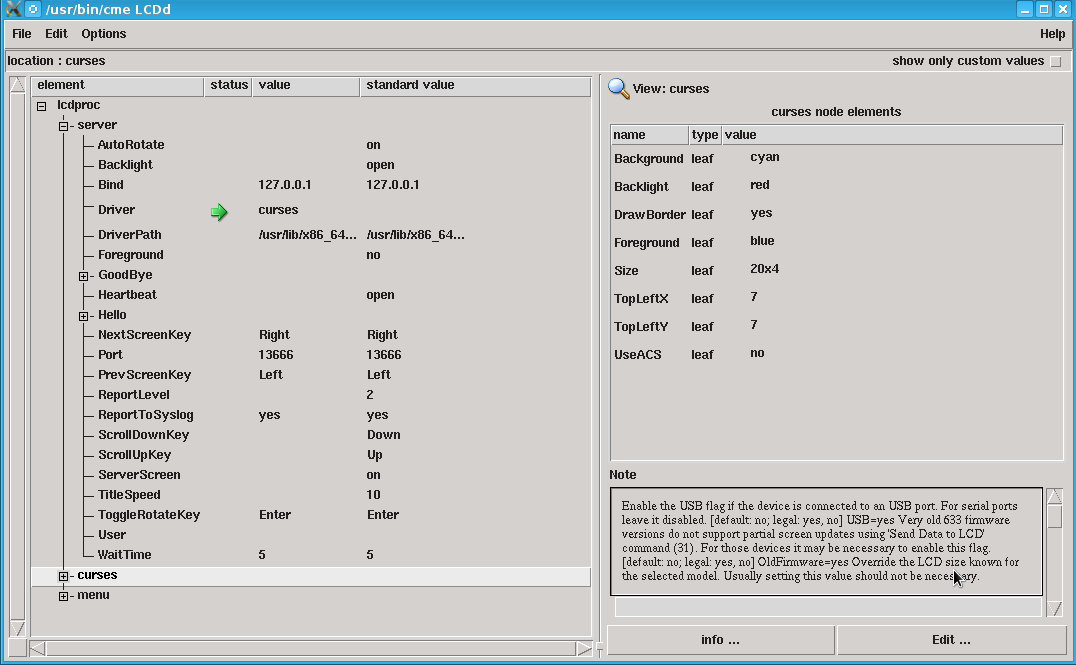
* edit the configuration with a GUI (see Managing Lcdproc configuration with cme for more details) Here s a screenshot of the GUI: GUI to edit lcdproc configuration More information * libconfig-model-lcdproc-perl package page. This package provides a configuration model for lcdproc.
* This blog explains how this model is generated from upstream LCDd.conf.
* How to adapt a package to perform configuration upgrade with Config::Model Next steps Automatic configuration merge can be applied to other packages. But my free time is already taken by the maintenance of Config::Model and the existing models, there s no room for me to take over another package. On the other hand, I will definitely help people who want to provide automatic configuration merge on their packages. Feel free to contact me on:
* config-model-user mailing list
* debian-perl mailing list (where Config::Model is often used to maintain debian package file with cme)
* #debian-perl IRC channel All the best
Tagged: config-model, configuration, debian, Perl, upgrade

Niels Thykier: Upcoming changes to Lintian (in 2.5.22)

The next version of Lintian, 2.5.22, is long overdue mostly because 2.5.21 FTBFS in sid. Besides fixing test failures, 2.5.22 also fixes: Besides bug fixes, we also added a couple of new features/nice changes: We just need to do some final tweaks and get the tag descriptions reviewed before we are ready to release the next version.

Russell Coker: Aldi Deserves an Award for Misleading Email

Aldi Mobile has made a significant change to their offerings. They previously had an offer of $35 for unlimited calls and 2.5G of data in a month for which they had to publicly apologise for misleading customers as 2500 minutes of calls a month (83 minutes per day) is no-where near unlimited [1]. They also had an offer of $15 for 2G of data. In an email about this Aldi said Many of our customers are using a lot less than what is included in our current $35 plan. So we will soon be introducing new Value Packs with more flexible options; meaning you only pay for what you really need and they start from just $10. . That is grossly misleading, if they offered new plans in addition to the old ones and allowed customers to choose the plan that is the best match then it would be useful to some customers. But removing the supposedly unlimited plan and the $15 for 2G of data option is removing affordable options for people who want to use their phones for lots of calls or very few calls but moderate amounts of data use. New Plans The base rate for calls on Aldi pre-paid is $0.12 per minute and $0.12 per SMS, consider every mention of minute in this section to be minute or SMS . The Aldi Newplans page [2] starts with a $10 per month plan which offers 100 minutes of calls which would be $12 at the previous rate of $0.12 per minute. That is OK value when compared to just using the pre-paid calls if you consistently use more than 83 minutes of calls per month. However if you don t use 84 minutes of calls (EG you don t speak much on the phone and use Google Hangouts instead of SMS) then it s not good value. Also the advertised data use is $5 per 100MB, which is way below what is needed for a typical user with an Android phone. My mother in law was barely able to stick within a limit of 300MB/month when that was her limit, but while using the Aldo 2G/month bolt-on she s increased her data usage. The smallest of the new plans costs $20 per month, it provides 300 minutes of calls and includes 300MB of data. For an extra $7 you can get another 300MB of data. For my mother in law it seems that the cheapest option on the new plans would be $27 per month, that would cover the 60 minutes of calls she might make and the 450MB of data she s probably using. That s significantly more expensive than her previous cost of $15 for 2G of data and $7.20 for calls and has the additional difficulty that I would have to be more involved in helping her avoid excessive data use. The 2G data bolt-on was really good for some of my relatives, when they use that and configure their phones not to update software over 3G they never had to ask me about any problems related to excess data use. So my mother in law is facing an extra $5 per month (or maybe more depending on data use) and more time spent calling me for tech support. The data bolt on that Aldi is going to offer in future is $30 for 3G of data to replace the previous offer of $15 for 2G of data. The cost will be unchanged for anyone who uses between 2G and 3G a month, for everyone who uses less than 2G or more than 3G the data bolt-on will cost more. There is simply no possibility for any Aldi data-only customer to save on data use. The only way someone who uses a moderate amount of data could save money is if they use more than 160 minutes of calls and less than 1G of data. Disclaimer My analysis above is based on interpreting the Aldi web site. As with most telcos they aren t trying to make things easy in this regard, it seems that the consensus of opinion among telcos is to use complex pricing to make it difficult to compare and reduce competitive pressure. I blame any inaccuracies in my analysis on the Aldi web site. Why Aldi Shouldn t Mislead Customers Aldi isn t primarily a mobile phone company, their main business is running a supermarket. The trust of customers is important to them, raising prices when competition goes away is one thing, but misleading customers about it is another. If Aldi were to honestly say now that Kogan Mobile no longer exists there is nothing forcing us to have low prices then I d have a lot more respect for their company and be more inclined to shop at their supermarket. It s a sad indictment of our society that I need to include a why lying is wrong section in such a blog post.

22 March 2014

Keith Packard: glamor-core

Core Rendering with Glamor I ve hacked up the intel driver to bypass all of the UXA paths when Glamor is enabled so I m currently running an X server that uses only Glamor for all rendering. There are still too many fall backs, and performance for some operations is not what I d like, but it s entirely usable. It supports DRI3, so I even have GL applications running. Core Rendering Status I ve continued to focus on getting the core X protocol rendering operations complete and correct; those remain a critical part of many X applications and are a poor match for GL. At this point, I ve got accelerated versions of the basic spans functions, filled rectangles, text and copies. GL and Scrolling OpenGL has been on a many-year vendetta against one of the most common 2D accelerated operations copying data within the same object, even when that operation overlaps itself. This used to be the most performance-critical operation in X; it was used for scrolling your terminal windows and when moving windows around on the screen. Reviewing the OpenGL 3.x spec, Eric and I both read the glCopyPixels specification as clearly requiring correct semantics for overlapping copy operations it says that the operation must be equivalent to reading the pixels and then writing the pixels. My CopyArea acceleration thus uses this path for the self-copy case. However, the ARB decided that having a well defined blt operation was too nice to the users, so the current 4.4 specification adds explicit language to assert that this is not well defined anymore (even in the face of the existing language which is pretty darn unambiguous). I suspect we ll end up creating an extension that offers what we need here; applications are unlikely to stop scrolling stuff around, and GPUs (at least Intel) will continue to do what we want. This is the kind of thing that makes GL maddening for 2D graphics the GPU does what we want, and the GL doesn t let us get at it. For implementations not capable of supporting the required semantic, someone will presumably need to write code that creates a temporary copy of the data. PBOs for fall backs For operations which Glamor can t manage, we need to fall back to using a software solution. Direct-to-hardware acceleration architectures do this by simply mapping the underlying GPU object to the CPU. GL doesn t provide this access, and it s probably a good thing as such access needs to be carefully synchronized with GPU access, and attempting to access tiled GPU objects with the CPU require either piles of CPU code to de-tile accesses (ala wfb), or special hardware detilers (like the Intel GTT). However, GL does provide a fairly nice abstraction called pixel buffer objects (PBOs) which work to speed access to GPU data from the CPU. The fallback code allocates a PBO for each relevant X drawable, asks GL to copy pixels in, and then calls fb, with the drawable now referencing the temporary buffer. On the way back out, any potentially modified pixels are copied back through GL and the PBOs are freed. This turns out to be dramatically faster than malloc ing temporary buffers as it allows the GL to allocate memory that it likes, and for it to manage the data upload and buffer destruction asynchronously. Because X pixmaps can contain many X windows (the root pixmap being the most obvious example), they are often significantly larger than the actual rendering target area. As an optimization, the code only copies data from the relevant area of the pixmap, saving considerable time as a result. There s even an interface which further restricts that to a subset of the target drawable which the Composite function uses. Using Scissoring for Clipping The GL scissor operation provides a single clipping rectangle. X provides a list of rectangles to clip to. There are two obvious ways to perform clipping here either perform all clipping in software, or hand each X clipping rectangle in turn to GL and re-execute the entire rendering operation for each rectangle. You d think that the former plan would be the obvious choice; clearly re-executing the entire rendering operation potentially many times is going to take a lot of time in the GPU. However, the reality is that most X drawing occurs under a single clipping rectangle. Accelerating this common case by using the hardware clipper provides enough benefit that we definitely want to use it when it works. We could duplicate all of the rendering paths and perform CPU-based clipping when the number of rectangles was above some threshold, but the additional code complexity isn t obviously worth the effort, given how infrequently it will be used. So I haven t bothered. Most operations look like this:
Allocate VBO space for data
Fill VBO with X primitives
loop over clip rects  
    glScissor()
    glDrawArrays()
 
This obviously out-sources as much of the problem as possible to the GL library, reducing the CPU time spent in glamor to a minimum. A Peek at Some Code With all of these changes in place, drawing something like a list of rectangles becomes a fairly simple piece of code: First, make sure the program we want to use is available and can be used with our GC configuration:
prog = glamor_use_program_fill(pixmap, gc,
                               &glamor_priv->poly_fill_rect_program,
                               &glamor_facet_polyfillrect);
if (!prog)
    goto bail_ctx;
Next, allocate the VBO space and copy all of the X data into it. Note that the data transfer is simply memcpy here that s because we break the X objects apart in the vertex shader using instancing, avoiding the CPU overhead of computing four corner coordinates.
/* Set up the vertex buffers for the points */
v = glamor_get_vbo_space(drawable->pScreen, nrect * (4 * sizeof (GLshort)), &vbo_offset);
glEnableVertexAttribArray(GLAMOR_VERTEX_POS);
glVertexAttribDivisor(GLAMOR_VERTEX_POS, 1);
glVertexAttribPointer(GLAMOR_VERTEX_POS, 4, GL_SHORT, GL_FALSE,
                      4 * sizeof (GLshort), vbo_offset);
memcpy(v, prect, nrect * sizeof (xRectangle));
glamor_put_vbo_space(screen);
Finally, loop over the pixmap tile fragments, and then over the clip list, selecting the drawing target and painting the rectangles:
glEnable(GL_SCISSOR_TEST);
glamor_pixmap_loop(pixmap_priv, box_x, box_y)  
    int nbox = RegionNumRects(gc->pCompositeClip);
    BoxPtr box = RegionRects(gc->pCompositeClip);
    glamor_set_destination_drawable(drawable, box_x, box_y, TRUE, FALSE, prog->matrix_uniform, &off_x, &off_y);
    while (nbox--)  
        glScissor(box->x1 + off_x,
                  box->y1 + off_y,
                  box->x2 - box->x1,
                  box->y2 - box->y1);
        box++;
        glDrawArraysInstanced(GL_TRIANGLE_STRIP, 0, 4, nrect);
     
 
GL texture size limits X pixmaps use 16 bit dimensions for width and height, allowing them to be up to 65536 x 65536 pixels. Because the X coordinate space is signed, only a quarter of this space is actually useful, which makes the useful size of X pixmaps only 32767 x 32767. This is still larger than most GL implementations offer as a maximum texture size though, and while it would be nice to just say we don t allow pixmaps larger than GL textures , the reality is that many applications expect to be able to allocate such pixmaps today, largely to hold the ever increasing size of digital photographs. Glamor has always supported large X pixmaps; it does this by splitting them up into tiles, each of which is no larger than the largest texture supported by the driver. What I ve added to Glamor is some simple macros that walk over the array of tiles, making it easy for the rendering code to support large pixmaps without needing any special case code. Glamor also had some simple testing support you can compile the code to ignore the system-provided maximum texture size and supply your own value. This code had gone stale, and couldn t work as there were parts of the code for which tiling support just doesn t make sense, like the glyph cache, or the X scanout buffer. I fixed things so that you could leave those special cases as solitary large tiles while breaking up all other pixmaps into tiles no larger than 32 pixels square. I hope to remove the single-tile case and leave the code supporting only the multiple-tile case; we have to have the latter code, and so having the single-tile code around simply increases our code size for not obvious benefit. Getting accelerated copies between tiled pixmaps added a new coordinate system to the mix and took a few hours of fussing until it was working. Rebasing Many (many) Times I m sure most of us remember the days before git; changes were often monolithic, and the notion of changing how the changes were made for the sake of clarity never occurred to anyone. It used to be that the final code was the only interesting artifact; how you got there didn t matter to anyone. Things are different today; I probably spend a third of my development time communicating how the code should change with other developers by changing the sequence of patches that are to be applied. In the case of Glamor, I ve now got a set of 28 patches. The first few are fixes outside of the glamor tree that make the rest of the server work better. Then there are a few general glamor infrastructure additions. After that, each core operation is replaced, one a at a time. Finally, a bit of stale code is removed. By sequencing things in a logical fashion, I hope to make review of the code easier, which should mean that people will spend less time trying to figure out what I did and be able to spend more time figuring out if what I did is reasonable and correct. Supporting Older Versions of GL All of the new code uses vertex instancing to move coordinate computation from the CPU to the GPU. I m also pulling textures apart using integer operations. Right now, we should correctly fall back to software for older hardware, but it would probably be nicer to just fall back to simpler GL instead. Unless everyone decides to go buy hardware with new enough GL driver support, someone is going to need to write simplified code paths for glamor. If you ve got such hardware, and are interested in making it work well, please take this as an opportunity to help yourself and others. Near-term Glamor Goals I m pretty sure we ll have the code in good enough shape to merge before the window closes for X server 1.16. Eric is in charge of the glamor tree, so it s up to him when stuff is pulled in. He and Markus Wick have also been generating code and reviewing stuff, but we could always use additional testing and review to make the code as good as possible before the merge window closes. Markus has expressed an interest in working on Glamor as a part of the X.org summer of code this year; there s clearly plenty of work to do here, Eric and I haven t touched the render acceleration stuff at all, and that code could definitely use some updating to use more modern GL features. If that works as well as the core rendering code changes, then we can look forward to a Glamor which offers GPU-limited performance for classic X applications, without requiring GPU-specific drivers for every generation of every chip.

Nicolas Dandrimont: Debian proposals in GSoC 2014

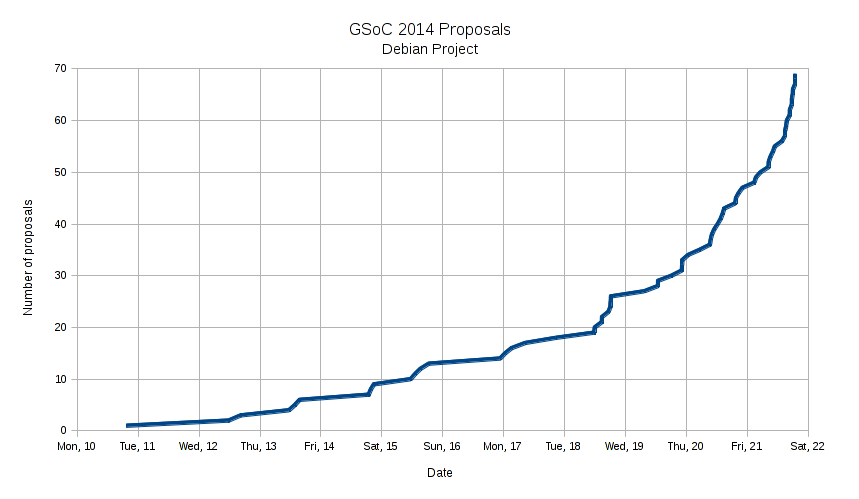
The GSoC student application period is over, and the last two days were pretty interesting. For a few years now, Olly Betts has provided us with a spreadsheet to graph the number of applicants to an organization over time. Here s the graph for Debian this year: Debian GSoC proposals, 2014 edition (Historical graphs: 2013, 2012. Spreadsheet available from Olly s blog) On Wednesday, I was thinking hmm, 30 applicants, this is a slow year . Well, the number of proposals more than doubled in the last two days, to conclude on a whooping 68 applications! The last one was submitted just three seconds before the deadline If you want to take a look at the proposals, head over to the Debian wiki. Time to get on reviewing! The final student acceptances will be published in just less than a month, on April 21st.
21 March 2014

Petter Reinholdtsen: Video DVD reader library / python-dvdvideo - nice free software

Keeping your DVD collection safe from scratches and curious children fingers while still having it available when you want to see a movie is not straight forward. My preferred method at the moment is to store a full copy of the ISO on a hard drive, and use VLC, Popcorn Hour or other useful players to view the resulting file. This way the subtitles and bonus material are still available and using the ISO is just like inserting the original DVD record in the DVD player. Earlier I used dd for taking security copies, but it do not handle DVDs giving read errors (which are quite a few of them). I've also tried using dvdbackup and genisoimage, but these days I use the marvellous python library and program python-dvdvideo written by Bastian Blank. It is in Debian already and the binary package name is python3-dvdvideo. Instead of trying to read every block from the DVD, it parses the file structure and figure out which block on the DVD is actually in used, and only read those blocks from the DVD. This work surprisingly well, and I have been able to almost backup my entire DVD collection using this method. So far, python-dvdvideo have failed on between 10 and 20 DVDs, which is a small fraction of my collection. The most common problem is DVDs using UTF-16 instead of UTF-8 characters, which according to Bastian is against the DVD specification (and seem to cause some players to fail too). A rarer problem is what seem to be inconsistent DVD structures, as the python library claim there is a overlap between objects. An equally rare problem claim some value is out of range. No idea what is going on there. I wish I knew enough about the DVD format to fix these, to ensure my movie collection will stay with me in the future. So, if you need to keep your DVDs safe, back them up using python-dvdvideo. :)

20 March 2014

Steve Kemp: Time to mix things up again

I'm currently a contractor, working for/with Dyn, until April the 11th. I need to decide what I'm doing next, if anything. In the meantime here are some diversions:
Some trivial security issues
I noticed and reported two more temporary-file issues insecure temporary file usage in apt-extracttemplates (apt), and libreadline6: Insecure use of temporary files - in _rl_trace. Neither of those are particularly serious, but looking for them took a little time. I recently started re-auditing code, and decided to do three things:
  • Download the source code to every package installed upon this system.
  • Download the source code to all packages matching the pattern ^libpam-, and ^libruby-*.
I've not yet finished slogging through the code, but my expectation will be a few more issues. I'll guess 5-10, given my cynical nature.
NFS-work
I've been tasked with the job of setting up a small cluster running from a shared and writeable NFS-root. This is a fun project which I've done before, PXE-booting a machine and telling it to mount a root filesystem over NFS is pretty straight-forward. The hard part is making that system writeable, such that you can boot and run "apt-get install XX". I've done it in the past using magic filesystems, or tmpfs. Either will work here, so I'm not going to dwell on it.
Another year
I had another birthday, so that was nice. My wife took me to a water-park where we swam like fisheseses, and that tied in nicely with a recent visit to Deep Sea World, where we got to walk through a glass tunnel, beneath a pool FULL OF SHARKS, and other beasties. Beyond that I received another Global Knife, which has now been bloodied, since I managed to slice my finger open chopping mushrooms on Friday. Oops. Currently I'm in that annoying state where I'm slowly getting used to typing with a plaster around the tip of my finger, but knowing that it'll have to come off again and I'll get confused again.
Linux Distribution
I absolutely did not start working on a "linux distribution", because that would be crazy. Do I look like a crazy-person? All I did was play around with GNU Stow, and ponder the idea of using a minimal LibC and GNU Stow to organize things. It went well, but the devil is always in the details. I like the idea of a master-distribution which installs pam, ssh, etc, but then has derivitives for "This is a webserver", "This is a Ruby server", and "This is a database server". Consider it like task-selection, but with higher ambition.
There's probably more I could say; a new kitchen sink (literally) and a new tap have made our kitchen nicer, I've made it past six months of regular gym-based workouts, and I didn't die when I went to the beach in the dark the other night, so that was nice. Umm? Stuff? Have a nice day. Thanks.

19 March 2014

Tanguy Ortolo: Self-Destructing Cookies for Firefox

Web cookies are meant to store user preferences for a website, but they are often misused for evil purposes, such as tracking him, sometimes across distinct websites.For the user, there is a simple solution to that problem: set up his browser to refuse cookies by default, and use an extension such as Cookie Monster to accept them on trusted websites where they are known to be useful. Unfortunately, that reveals another problem: some shitty websites will just not work at all without cookies. Well, there is a Firefox extension that brings the solution to that: Self-Destructing Cookies. It works in a fairly simple way: cookies for each are accepted for each website, but destroyed when the user leaves it. So, does EvilCorp want to use a cookie, and refuse to work without it? No problem, here it is. Want to retrieve it on next visit? No way.

Andrew Pollock: [life] Day 50, Kindergarten, appointments central, cleaning, meetings and meltdowns

Today was a very busy day for me. First up, I had my chiropractic adjustment. Then I had my half-yearly dental checkup. Then I got stuck into cleaning the house. Fortunately I'd done a bit the afternoon before, otherwise I'd never have gotten it done before my massage. I'm starting to seriously consider getting a cleaner. I can make much better use of the limited time I get than cleaning the house. Zoe's Kindergarten has a Parent Advisory Group or something like that, which meets monthly. I wasn't able to attend the first one, but the second one was today, about an hour before pickup, so I grabbed a quick lunch after my massage and biked over to Kindergarten early. The meeting wasn't particularly interesting. The majority of it revolved around fund raising. At pickup time, Zoe was fast asleep again, and had another massive meltdown when I woke her up. It took forever to get her out. She wanted to give Megan a hug, but Megan had long gone. Then, rather fortuitously, Megan's Dad texted me to tell me they were in the playground on the neighbouring school grounds, so I managed to use that as an incentive to get Zoe moving. I didn't know until today, but at the foothill of the neighbouring primary school, there's some play equipment. A few of the Kindergarten kids seem to have a play over there after Kindergarten. Megan and Zoe played there for a bit before it was time to go. Once we got home, we unpacked and then walked down to the Hawthorne Garage to get some vegetables, and then, after buying some milk from the corner store and another grumpy meltdown, I figured a quiet afternoon was in order, so Zoe watched a DVD for a bit while I prepared dinner. I'd bumped into the mother of Zoe's friends Eva and Layla from her old day care while I was at the dentist in the morning, and arranged for her to drop by to pick up a copy of the photos I'd taken at their 4th birthday party. I'd hoped that she'd bring the girls with her, and had told Zoe they'd be dropping by, but unfortunately she came on the way to picking them up from day care, so Zoe was a bit disappointed. We did arrange to have them over for dinner next Friday, so I'm sure that will be very exciting. After that, we had dinner, and a fairly uneventful bedtime. It's hot again, so I hope that doesn't mess with her sleep.

18 March 2014

Enrico Zini: on-responsibilities

On responsibilities I feel like in my Debian projects I have two roles: the person with the responsibility of making the project happen, and the person who does the work to make it happen. As the person responsible for the project, I need to keep track of vision, goals, milestones, status. To make announcements, find contributors, motivate them, deal with users and bug reports, maintain documentation, digest feedback. As the person who does the work to make it happen, I need quiet time, I need to study technology, design code, write unit tests, merge patches, code, code, code, ask around about deployment information, more code. I have a hard time doing both things at the same time: the first engages my social skills and extroversion, requires low-latency interaction, and acting when outside things happen. The second engages my technical skills and introversion, requires quiet uninterrupted periods of flow, and acting when inspiration strikes. I never managed to make good use of "gift bugs" or "minions": I often found the phrase "it's easier for me to do than to explain it" sadly relevant. Now I understand that it's not because of the objective difficulty of explaining or doing things, nor about the value of doing or of involving people. It's about switching from one kind of workflow to another. If I rephrase that as "it's easier for me to stay in flux and fix it, than to switch my entire attitude to ask for help". Of course this does not scale: we've all been saying it since I can remember. Looking at the situation from the point of view of those two roles, however, I now wonder if those two roles shouldn't really require two people. In other worlds they are: the project managers, taking responsibility for making the project happen, and the software designers, artists, and all other kind of artisans doing the work to make it happen. Of course I don't want the kind of project manager that shifts responsibilities to artisans, does nothing and takes the credit for the project: not in paid work, not in Debian. Project management is something else. I would be interested instead in having the kind of project manager that takes responsibility for the project, checks how the artisans are doing and communicates what is happening to the rest of the world, deals with the community, motivates more people to help, test, try, use, give feedback on things as they happen. A project manager / community manager. So that while I'm flux there is someone who tags bugs as "gift", mentors people to find code and documentation, and remembers to write an announcement if I implemented three cool things in a row and I'm already busy working on the fourth. So that I don't write cool ideas in my todo list where nobody can read them, but I can share them to a mailing list where someone picks up a relevant one and finds someone to make it happen while I'm busy refactoring old code that only I can understand. So that if I say "sorry, paid work calls, I won't be able to work on this project for a month", I'll be able to completely forget about that project for a whole month, without leaving the community out there to die. That's an interesting job for non-uploading DDs: please take over my projects. Let's share a vision, and team up to make it happen. Give me the freedom of being the craftsman I enjoy being, and take away from me those responsibilities that I've never asked for. The worst project managers are those that never asked to be one, but were promoted to it. Let's not repeat that mistake in Debian. A good part of the credits for this post go to Francesca Ciceri, for the discussions we had on our way back from MiniDebConf Barcelona 2014. P.S. I'm seeing how a non-uploading DD could be in the Maintainer field for one or more packages, with uploading DDs being, well, uploaders. Food for thought.

Elena 'valhalla' Grandi: back from the Barcelona minidebconf

I'm back home from the MiniDebConf Barcelona 2014 (and I've had a full night of uninterrupted sleep! :) ), so it's time to thank everybody who were there (both in person and via IRC) and especially the organizers who did a great job at creating a welcoming environment and a smooth experience for all of us.

It was my first @Debian community experience (although I had already met a few of the members in various occasions) and it made me glad of my decision to start contributing to the project. (I realize that I've probably met a sanitized and newbie-friendlier version of the community, but it's also made up of people who are working to improve the not-so-friendly parts.)

It was also my first time speaking to an international audience; I believe it went overall well: I'm happy with what I said and how, not so much with what I forgot to say (e.g. mentioning testing and other non-packaging skills in my answer to Enrico's question "what skills are needed in the 3dprinter team", or actually showing the last slide with reference urls at least this one will be available as soon as I'll send the slides to be uploaded to the site).

Random mentions:

We had free software, and also free beer, from one of the sponsors (I didn't catch which one), but the venue had to remain beer free, which encourages bad puns of the kind I love :)

Contrary to what some people was fearing, the cake was real and not a lie! (also, it tasted like banana bread with chestnut flour).

Video team duty is fun and something I'll do again (and try to use in our local community what I learn in the process), but I don't think I'll let the Galadriel in my mind bully me into subtitling stuff, sorry.

To ease worries of package mistreatment, the cows in the arriero slides looked more like they were moving between pastures in transhumance rather than being led to be slaughtered.

There are curves in B ziers, France (and also bad coffee and great pastries: definitely a better place_with_geek_name to have breakfast than Perl, Germany)!

The stickers with "May I sign your PGP keys" were a nice idea, although they didn't work as well as they could (possibly because there was little time and lots of things to do). I did manage to reduce my dependency on Enrico's key to find trustpaths, however, which is nice :)

I like the idea to draw a pentacle on the floor, and forcing speakers to remain inside, as suggested by a meeting of videoteaming italian cabal members.

Lots of other things I'm forgetting to mention, but now it's time to stop writing this and start work on my todolist where a few things received a priority bump during the conf. :)

Next.

Previous.