Search Results: "reg"

7 February 2011

Alexander Reichle-Schmehl: What a night! What a day!

Wow, that was a night. I'm still quite tired from the weekend. Someone told me, that ~ 1 000 people subscribed to our live denting via identi.ca, and about 12 000 via twitter. And that does not even include those, who followed us via the respective web interfaces! While it was quite exhausting (we tried to watch about 7 irc channels for the important stuff, I partly had ~80 windows in my irssi (which is especially bad, since I only have keyboard shortcuts for the first 40) and there whas also a constant need to watch for mails and due to translations also our spamfilters), it was also very nice to think that somewhere there are release parties going on with people looking at our dents, maybe even having them running on a big monitor or projector ;) One thing that remains to be done, are the left-over dents we prepared as time killers: Since the release process went quite smoothly (and we didn't have the time to check all our dents for the limit of 140 chars ;) we still have some of them left. Since some of them where requested (and I poked other people to get me the numbers) here are the remaining dents: I especially like the one about debian-curiosa ;) Update 1: The 600 USD where collected during DebConf5, not DebConf3. Update 2: Small clarification about the number of subscriptions on identi.ca and twitter: They didn't followed a live-stream channel, but they do follow our general channel. We are not sure, how many people where subribed before we announced the live denting; some saw 700 subscribers on identi.ca, which would mean ~200 seem to have subscribed for the release dents (still not including the ones just following us the old fashioned way via a browser).

6 February 2011

Benjamin Mako Hill: Editor-to-Reader Ratios on Wikipedia

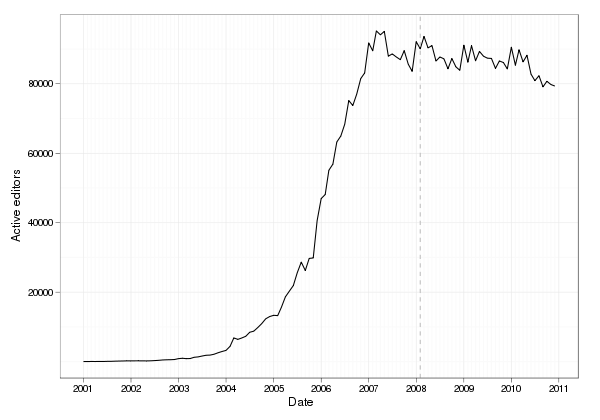
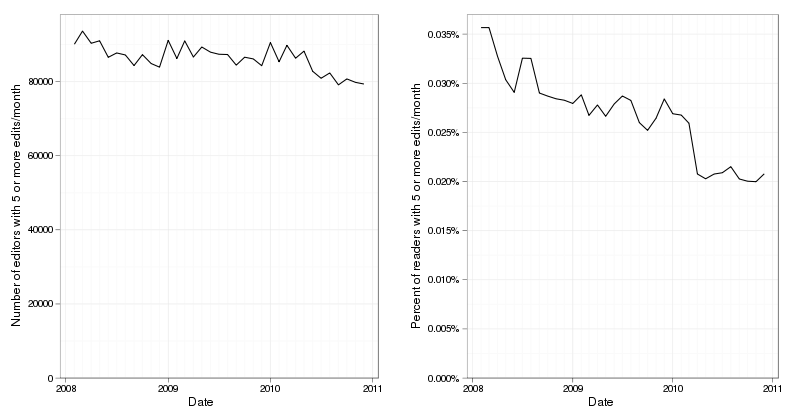
It's been reported for some time now that the number of active editors on Wikipedia (usually defined as people who have edited at least 5 times in a given month) peaked in 2007 and has been mostly stable since then. A graph of the total number of active editors in every month since Wikipedia's founding is shown below. The graph shows the aggregate numbers for all language Wikipedias. English Wikipedia is the largest component of this and is generally more variable. That said, very similar patterns exist for most larger languages. /copyrighteous/images/active_editors_all_wikpiedia.png Felipe Ortega, who has provided many of these statistics, has warned against fatalist claims. Although there seems to be a decrease in the total number of active editors over the last two years, the situation seems to have somewhat stabilized in most languages. New editors in Wikipedia are replacing folks at almost the rate that they are leaving. It is also widely known that the number of readers of Wikipedia has been increasing during this period. According to the report cards released by the foundation using comScore data, the number of unique visitors to Wikipedia each month has increased by 61 million people in the last year -- over 17%. This discrepancy between rising readership and stable or sinking editorship should raise major concern. After all, the Wikimedia Foundation's mission is two part: (1) to empower and engage people around the world to collect and develop educational content and (2) to disseminate it effectively and globally. Although the Foundation report cards include measures of raw levels of editorship, a better metric of engagement and empowerment might be the proportion of readers who engage in editing. I could not find reliable data on the number of unique readers reached each month for more than a few months in the last year. What is available, however, is wonderful data on page views each month going back to 2008. Analysis of the data from available report cards show that, at least during the last year, there is a very stable ratio of 35 page views per unique visitor, as estimated by comScore. Using that measure, we can do a back of the envelope estimation on the proportion of users that are editors for the period where page view data is available, dating back from February 2008 ( marked with the grey dashed lined above). The graphs below show the very different results you get when you consider the change in the number of Wikipedia editors and the change in the editor-to-reader ratio. Once again, these data are combined data for all language Wikipedias although graphs look very similar for most larger languages. The results are striking. Although there has been a 12% decrease between February 2008 and December 2010 in the number of active editors, there is a 42% decrease in the proportion of readers who edit at least five times a month. We can see that fulfilling the first half of the Wikimedia mission remains a struggle. /copyrighteous/images/wikipedia_editors_combined_graph.png Although the graphs above do not say anything directly about the most active core contributors to Wikipedia, the fact that Wikipedia is being maintained by a tiny -- and shrinking -- proportion of its readership does mean that the idea behind Wikipedia is under threat. Although none are as big as Wikipedia, there are lots of good encyclopedias out there. The reason Wikipedia is different, interesting, and important is because -- unlike all those others -- Wikipedia is the encyclopedia that anyone can edit. Wikipedia is powerful because it allow its users to transcend their role as consumers of the information they use to understand the world. Wikipedia allows users to define the reference works that define their understanding of the their environment and each other. But 99.98% of the time, readers do not transcend that role. I think that's a problem. Worse, that the number is growing. The Wikimedia Foundation recently ran a major successful effort to attract donations in its annual fundraiser. Jimmy Wales' smiling mug is apparently enough in the way of motivation to get something like 1% of its readers to donate money to support the project. I think that's very good news. If the Wikimedia community can entice even half of those people to contribute through an increased involvement in the projects themselves, they might do more than ensure Wikipedia's continued growth. They would help take a step toward the empowerment and engagement of those users in sharing their own knowledge, and the continued fulfillment of a critically important mission.

Raphaël Hertzog: Debian 6.0 is out, Wheezy kicks off

As you probably already know, Debian released Squeeze aka Debian 6.0 this week-end. It was a really great week-end. I saw quite a few release already, but none with so much online social activity. Alexander and Meike Schmehl live commented the release on the Debian identi.ca account and Joey Hess held his Debian Party Line. On top of this, the team in charge of the website rolled out a new design on quite a few online services during the week-end including www.debian.org, wiki.debian.org, planet.debian.org and more. Congratulations to all the people who made this happen (and the release team in particular). It s great to see Debian achieve all of this. Do you know that it s the third time in a row that we manage to release in the 18-24 months timeframe? 3.1: June 2005 4.0: April 2007 5.0: February 2009 6.0: February 2011. Yes, despite our size and the fact that we are all volunteers, we have managed to stick to a reasonable schedule for a stable distribution that is deployed on a large scale. Wheezy kicks off The best part of the release for us the developers is that wheezy is now open for development and we can work on new features for the next release. ;-) And it started quickly: according to UDD, wheezy already features 488 new source packages that are not in squeeze, 1713 updated source packages and among those 1246 are new upstream versions. I really look forward to the upcoming projects and related discussions.
Click here to subscribe to my free newsletter and get my monthly analysis on what s going on in Debian and Ubuntu. Or just follow along via the RSS feed, Identi.ca, Twitter or Facebook.

For the curious, here are the UDD queries I used:
# Updated packages in wheezy
select count(source) from sources_uniq as su where (select version from sources_uniq where release='squeeze' and distribution='debian' and source = su.source) < su.version and release='wheezy' and distribution='debian';
# Updated with a new upstream version
select count(source) from sources_uniq as su where debversion(regexp_replace((select version from sources_uniq where release='squeeze' and distribution='debian' and source = su.source), '-.*', '')) < debversion(regexp_replace(su.version, '-.*', '')) and release='wheezy' and distribution='debian';
# New package in wheezy
select count(source) from sources_uniq as su where source not in (select source from sources_uniq where release='squeeze' and distribution='debian' and source = su.source) and release='wheezy' and distribution='debian';

No comment Liked this article? Click here. My blog is Flattr-enabled.

Kees Cook: fun with game memory

So, I was testing a (closed source) single-player offline game recently and thought this exercise might be fun to document. I didn t want to spend any time actually earning in-game money since I d played it before and I wanted to just skip ahead to other aspects of the game. I was curious how straight-forward adjusting my cash might be. So, noting the in-game bank account number of 219393 and account balance of 3000, I dived right in. First up, what s the memory layout of the heap look like? I looked at the brk and the mmap regions without a mapped library or file, marked with w in the permissions column, from /proc/PID/maps:
0827e000-08282000 rw-p 00000000 00:00 0
0a22e000-0b08a000 rw-p 00000000 00:00 0 [heap]
efa59000-efd00000 rw-p 00000000 00:00 0
efd00000-efd21000 rw-p 00000000 00:00 0
Knowing these, I could use gdb s find command, after attaching to the process:
$ gdb /some/cool/game

(gdb) attach PID

(gdb) find /w 0 0827e000, 0 08282000, 219393
(gdb) find /w 0 0a22e000, 0 0b08a000, 219393
0xaf03d08
0xaf06ca8
No hits in the first region, but I see two hits for the account number value in the second region. Let s start there and see what s near them
(gdb) x/8x 0xaf03d08
0xaf03d08: 0 00035901 0 00000000 0 00000000 0 0af06ce0
0xaf03d18: 0 0af06be0 0 00000059 0 0af03d98 0 0af041e8
(gdb) x/8x 0xaf06ca8
0xaf06ca8: 0 00035901 0 00000bb8 0 00000bb8 0 0820b148
0xaf06cb8: 0 00000001 0 00000000 0 00000000 0 00000000
In that second hit, I see the value 0xBB8, which is 3000, and matches our account balance. Let s see what happens if we just change both of those to add a bit a few orders of magnitude above the current value
(gdb) set var *0xaf06cac = 0 00100bb8
(gdb) set var *0xaf06cb0 = 0 00100bb8
(gdb) x/32x 0xaf06cac
0xaf06cac: 0 00100bb8 0 00100bb8 0 0820b148 0 00000001
(gdb) continue
And presto, clicking on the bank account details in-game shows a huge account balance of 1051576 now. No need to reverse-engineer any saved games, whew.

5 February 2011

Joerg Jaspert: Squeeze Release

So after quite a while I again had the opportunity to do the ftpmaster works of a Debian release. Not quite my first and hopefully not my last one, lets see. And, like last time, Mark joined to help with the work. Again, a few moments and not a detailed log (times in UTC): Right now (that is, 21:38 UTC) I am mosty waiting for the rest of the people working on the release (CD builders, press, website, ) to finish their task (building hundreds of images just takes ages). When that is done we can then do a coordinated push to the world. Last plans for that would mean in about an hour . Lets see, Mr. Murphy sure can be around. Thanks go out to everyone involved in preparing this release, be it in the past by fixing bugs, uploading packages, doing whatever was needed, as well as doing the work today. Update: If you miss us setting the new testing AKA wheezy to something inside there - there is no need to. It is simply the continutation of testing with just another name, which did not get changed contents, so nothing done for that. :)

Vincent Fourmond: ctioga superseded by ctioga2

First, some historical details: some 6 years ago, I discovered Ruby together with Tioga, a great library for producing plots. That immediately resulted in my first Ruby program, ctioga. But as years passed and more features were forced into ctioga, I was compelled to see my initial design mistakes, and think about a complete rewrite. This is where ctioga2 was born, some time at the beginning of 2009. I completely stopped using the old ctioga a few month after starting to work on ctioga2, but it took ages before I finally came up with a decent enough documentation to release and announce publicly. But now, it's done, and the first public release of ctioga2 is out, still fresh ! Here are a few highlights of the differences: In any case, you can make yourself an opinion of ctioga2 by looking at the galleries. Enjoy !

Matthew Palmer: I Am Certified!

I figured I may as well give the Hurricane Electric IPv6 certification a go, just for shits and giggles. As it turns out, it was pretty simple -- it took me about an hour to get through it all -- and it prodded me into doing a few things I'd never bothered with before (like finding out that my DNS registrar already supports v6 glue, which is nice). As a result: IPv6 Certification Badge for mpalmer YAY!

Ian Wienand: Comcast self-setup with Netgear routers

I just got a Zoom 5341 modem to replace a very sketchy old Motorola model and so far it seems to work fine. However, the Comcast self-install switch process was not seamless. After you plug your new modem in the process starts fine, capturing your session and prompting you for your account. However at the next step it prompts you to download the Windows or Mac only client, directing you to an address http://cdn/.... It is at this point you can get stuck if you're behind a Netgear router (I have a WNDR3700) and probably others. The simple problem is that, for whatever reason, the factory firmware in this router does not pass on the domain search suffix through its inbuilt DHCP client. Without that, cdn doesn't resolve to anything, so you can't download the self-help tool and you're effectively stuck at a "can not find this page" screen. If you google at this point you can find many people who have hit this problem, and various information from erroneous suggestions that you've been hacked (?) to most people just giving up and moving into Comcast phone support hell. Assuming you now don't have internet access, you can complete the process with a quick swizzle. Somebody might be able to correct me on this, but I don't think you want to run the self-install tool from an actual computer plugged directly into the modem if you have a router in the picture, because the wrong MAC address will get registered. So, your best solution is to turn everything off, plug your computer directly into the modem, turn it on, get an address, download the tool, turn everything off, plug the router back-in to the modem and then run the self install tool. At this point, everything just worked fine for me. Netgear should probably fix this by correctly passing through the domain search suffixes in their routers. Comcast should probably fix this by doing some sort of geo-ip lookup to give clients a fully-qualified address in that webpage to download the tool even if their router is broken (or really, does downloading that file really require a content-delivery network?). You can probably fix this by running Openwrt on your router before you start. Otherwise, the Zoom modem and the Netgear WNDR3700 seem to make a very nice combination which I would reccommend.

3 February 2011

Pietro Abate: Package Managers Comparison

The Mancoosi Team has recently published the details of a study we conducted analyzing different packages managers available in debian. The goal of this study was to compare MPM (the mancoosi package manager) to other legacy solvers and try to get a big picture regarding of the state of the art. A similar study was conduct during EDOS and the results are still available here. As I wrote few months ago, MPM is a proof of concept that we wrote to test the behavior of a number of solvers that have been developed for the MISC competition in a real world scenario. These results do not show anything new w.r.t. the experience of a lot of poeple dueling daily with their machines in order to install a new piece of software. In a nutshell, we have shown that apt-get, aptitude, smart and cupt perform pretty well when used only with one baseline (for example a stable release) : this conforms with the experience of the majority of users of debian based systems. However problems start to arise when a user start mixing more then one baseline putting a lot of stress on the solver in order to find a satisfying solution. This solution of course exists, but it is cleverly hidden in the dependency structure of more then 40K packages... MPM is not as fast as other package solvers (say 10 seconds for mpm, while apt-get is able to find a solution in 3 second), but is remarkably stable. It is always able to find a satisfying solution, even in the harder cases where all the other failed. In these experiments MPM uses the postdam solver aspcud. This solver uses only GPL components and it would be a good candidate for inclusion in debian (there are actually a couple of ITP already filled for clasp and gringo). The results (with a lot of details) are published on the mancoosi website (a more detailed report is in the works). Enjoy ! During fosdem the Mancoosi team that authored this work (Roberto, Ralf, Zack and Me) will be around, so, please stop us for a chat ! And don't miss Ralf's talk !!

2 February 2011

Enrico Zini: Gzip streaming in Python (or lack thereof)

Gzip streaming in Python (or lack thereof) Consider this simple Python snippet:
#!/usr/bin/python
import gzip
from urllib import urlopen
zfd = urlopen("http://ftp.debian.org/debian/dists/sid/Contents-udeb.gz")
fd = gzip.GzipFile(fileobj=zfd, mode="r")
for line in fd:
    foobar(line)
It does not work: it turns out GzipFile wants to seek() and tell() on its file object:
$ /tmp/z.py 
Traceback (most recent call last):
  File "/tmp/z.py", line 8, in <module>
    for line in fd:
  File "/usr/lib/python2.6/gzip.py", line 438, in next
    line = self.readline()
  File "/usr/lib/python2.6/gzip.py", line 393, in readline
    c = self.read(readsize)
  File "/usr/lib/python2.6/gzip.py", line 219, in read
    self._read(readsize)
  File "/usr/lib/python2.6/gzip.py", line 247, in _read
    pos = self.fileobj.tell()   # Save current position
AttributeError: addinfourl instance has no attribute 'tell'
Oh dear... this really shouldn't be. Let's look around the internet for details:
Since opener.open returns a file-like object, and you know from the headers that when you read it, you're going to get gzip-compressed data, why not simply pass that file-like object directly to GzipFile? As you read from the GzipFile instance, it will read compressed data from the remote HTTP server and decompress it on the fly. It's a good idea, but unfortunately it doesn't work. Because of the way gzip compression works, GzipFile needs to save its position and move forwards and backwards through the compressed file. This doesn't work when the file is a stream of bytes coming from a remote server; all you can do with it is retrieve bytes one at a time, not move back and forth through the data stream. So the inelegant hack of using StringIO is the best solution: download the compressed data, create a file-like object out of it with StringIO, and then decompress the data from that.
Oh really, so it's a limitation of "the way gzip compression works", and the only way to work around this fundamental design flaw of gzip is to buffer the lot in memory or to a temporary file? [facepalm]
# Apparently, this is not how gzip compression works:
curl http://ftp.debian.org/debian/dists/sid/Contents-udeb.gz   zcat
This is not the first time that, after finding a frustrating spot in core Python things, looking around the internet for extra information has the effect of amplifying my frustration by destroying my expectations of common sense. What is the gzip module doing anyway?
    if self._new_member:
        # If the _new_member flag is set, we have to
        # jump to the next member, if there is one.
        #
        # First, check if we're at the end of the file;
        # if so, it's time to stop; no more members to read.
        pos = self.fileobj.tell()   # Save current position
        self.fileobj.seek(0, 2)     # Seek to end of file
        if pos == self.fileobj.tell():
            raise EOFError, "Reached EOF"
        else:
            self.fileobj.seek( pos ) # Return to original position
        self._init_read()
        self._read_gzip_header()
        self.decompress = zlib.decompressobj(-zlib.MAX_WBITS)
        self._new_member = False
Right, tell() and seek() in order to check if it's reached end of file. Oh dear... So, there's a flaw in the Python standard library, and: I wish core Python documentation started properly documenting Python flaws so that one can code with language limitations in mind, insted of having to rediscover them and their work arounds every time.

1 February 2011

Cyril Brulebois: Debian XSF News #3

Time for a third Debian XSF News issue! Debian XSF News #3 It s been a year On a personal note, it s been a year to the day since I first looked into X. After having hacked on the Debian Installer to make it use X.Org instead of DirectFB, I did some heavy bug triaging, resulting in a drop in the xorg-server bug count in March. The same happened past week as written above, resulting in a second drop. In the meanwhile, the bug count remained more or less stable, since we try to reply quickly to new bugs, and since Julien Viard de Galbert does bug triaging on a weekly basis: BTS graph for xorg-server One might ask: what does maintaining X mean?

31 January 2011

David Welton: Parallelized web site creating and selling - underperformingstocks.com

I often have ideas for little web sites, stuff I just get the urge to create for the fun of it. Some of them have done rather well, like langpop.com but even that doesn't make any money, and, sadly, as I age, that is becoming a more important factor in life. So I decided to try a little experiment. I was thinking some about "value" stocks, and fiddling around with Google's stock screener, and thought of the idea of a site that highlights underperforming stocks: http://underperformingstocks.com - so far so good - I went ahead and registered the domain, and put together the beginnings of a Rails application. At the same time though, I decided I have enough things to do in my evenings and weekends, so I decided that it might be interesting to start selling the site at the same time I'm building it. I'm not really sure how it will work out: perhaps people will see that there's not much there and not bid for it. Perhaps someone likes the idea behind it and is willing to buy on that. My idea, in any case, is to keep working on it as the auction progresses. As an additional twist, there are obviously a lot of features that could be added to the site, so I'll prioritize work on features suggested by users who have bid on the site. Here's the auction listing on Flippa.com: www.underperformingstocks.com is For Sale on Flippa! Edit: I'll also be posting updates to the twitter account I created for the project: http://twitter.com/#!/underpstocks

Tiago Bortoletto Vaz: new website

I m switching from WordPress to a virtual private server. I m playing with a Gandi.net VPS. So far, I m happy with their domain registration service. Also, they offer some discounts for Debian people. Btw, I still have a promo code for a one month free VPS share which I m allowed to give away. For my new website (same old URL) I m using PyBlosxom over Lighttpd in a Debian GNU/Linux system. I want to keep things simple by git-pushing plain text files for all html content. For the blog system I ve just written a plugin which gives PyBlosxom the (very nice!) txt2tags formatter (source: t2t.py). There re still issues to fix but it s working quite well. So, thanks WordPress for all the fish. This is probably my last post here. (although I m keeping the current account active for comments)

29 January 2011

Russell Coker: Egypt

Gunnar Wolf has written an interesting post about the current situation in Egypt, which includes references to Israel (where he lived for a few years) and Mexico (where he has spent most of his life) [1].Gunnar included a copy of Mohammed Sameer s blog post on the topic [2], which is a good idea as we can t rely on Mohammed s post remaining online.The Reid Report has an interesting summary of various news sources [3].I hope that the end result of this is a democratically elected government that respects human rights and offers fair trials to people accused of crimes and humane punishments those found guilty. It would be ideal if the transition could happen in a way that involves little violence and no interruptions to the food supply etc.Update: Chris Samuel provided some information on free PPP access in other countries for people in Egypt [4]. This will probably be of short-term use as the Egypten regime will probably cut International phone access too.Update2: Lars has written some interesting comments including links to articles about the US government wanting the power to cut off Internet access in the same way as the Egyptian government [5].

28 January 2011

Amaya Rodrigo: Indignez Vous!

If There is any sort of food for thought worth reading, this is it.
INDIGNEZ-VOUS! GET ANGRY! CRY OUT by St phane Hessel


St phane Hessel, author of Indignez-vous!
After 93 years, it is almost the final act. The end for me is not very far off any more. But it still leaves me a chance to be able to remind others of what acted as the basis of my political engagement. It was the years of resistance to the Nazi occupation -- and the program of social rights worked out 66 years ago by the National Council of the Resistance!

It is to Jean Moulin [murdered founder of the Council] that we owe, as part of this Council, the uniting of all elements of occupied France -- the movements, the parties, the labor unions -- to proclaim their membership in Fighting France, and we owe this to the only leader that it acknowledged, General de Gaulle. From London, where I had joined de Gaulle in March 1941, I learned that this Council had completed a program and adopted it on March 15th, 1944, that offered for liberated France a group of principles and values on which would rest the modern democracy of our country.

These principles and these values, we need today more than ever. It is up to us to see to it, all together, that our society becomes a society of which we are proud, not this society of immigrants without papers -- expulsions, suspicion regarding the immigrants. Not this society where they call into question social security and national retirement and health plans. Not this society where mass media are in the hands of the rich. These are things that we would have refused to give in to if we had been the true heirs of the National Council of the Resistance.


From 1945, after a dreadful drama [WWII], it was an ambitious
resurrection of society to which the remaining contingent of the Council
of the Resistance devoted itself. Let us remember them while creating
national health and pensions plans such as the Resistance wished, as its
program stipulated, "a full plan of French national health and social
security, aimed at assuring all citizens the means of existence whenever
they are unable to obtain them by a job; a retirement allowing the old
workers to finish their days with dignity."

The sources of energy, electricity, and gas, mines, the big banks, were
nationalized. Now this was as the program recommended: "... the return
to the nation of big monopolized means of production, fruits of common
labor, sources of energy, wealth from the mines, from insurance
companies and from big banks; the institution of a true economic and
social democracy involving the ousting of the big economic and financial
fiefdoms from the direction of the economy."

General interest must dominate over special interest. The just man
believes that wealth created in the realm of labor should dominate over
the power of money.

The Resistance proposed, "a rational organization of the economy
assuring the subordination of special interests to general interest, and
the emancipation of 'slaves' of the professional dictatorship that was
instituted just as in the fascist states," which had used the interim
[for two years after the war] government of the Republic as an agent.

A true democracy needs an independent press, and the Resistance
acknowledged it, demanded it, by defending "the freedom of the press,
its honor, and its independence from the State, the power of money and
foreign influence." This is what relieved restrictions on the press from
1944 on. And press freedom is definitely what is in danger today.

The Resistance called for a "real possibility for all French children to
benefit from the most advanced education," without discrimination.
Reforms offered in 2008 go contrary to this plan. Young teachers, whose
actions I support, went so far as refusing to apply them, and they saw
their salaries cut by way of punishment. They were indignant,
"disobeyed," judging these reforms too far from the ideal of the
democratic school, too much in the service of a society of commerce and
not developing the inventive and critical mind enough. 2

All the foundations of the social conquests of the Resistance are
threatened today.

The motive of the Resistance: indignation (Indignez-vous!)

Some dare to say to us that the State cannot afford the expenses of
these measures for citizens any more. But how can there be today a lack
of money to support and extend these conquests while the production of
wealth has been considerably augmented since the Liberation period when
Europe was in ruins? On the contrary, the problem is the power of money,
so much opposed by the Resistance, and of the big, boldfaced, selfish
man, with his own servants in the highest spheres of the State.

Banks, since privatized again, have proved to be concerned foremost for
their dividends and for the very high salaries of their leaders, not the
general interest. The disparity between the poorest and the richest has
never been so great, and amassing money, competition, so encouraged.

The basic motive of the Resistance was indignation!

We, the veterans of the resistance movements and combat forces of Free
France, we call on the young generation to live by, to transmit, the
legacy of the Resistance and its ideals. We say to them: Take our place,
"Indignez-vous!" [Get angry! or Cry out!].

The political, economic, intellectual leaders, and the whole society do
not have to give in, nor allow oppression by an actual international
dictatorship of the financial markets, which threatens peace and
democracy.

I wish for you all, each of you, to have your own motive for
indignation. It is precious. When something outrages you as I was
outraged by Nazism, then people become militant, strong, and engaged.
They join this current of history, and the great current of history must
continue thanks to each individual. And this current goes towards more
justice, more freedom, but not this unbridled freedom of the fox in the
henhouse. The rights contained in the UN Universal Declaration of Human
Rights of 1948 are just that, universal.

If you meet somebody who does not benefit from it, feel sorry for them
but help them to win their rights.

Two visions of history

When I try to understand what caused fascism, what made it so we were
overcome by Hitler and the Vichy [French government that collaborated
with Hitler], I tell myself that the propertied, with their selfishness,
were terrifically afraid of Bolshevik revolution. They were allowed to
lead with their fear.

But if, today as then, an active minority stands up, it will be enough;
we shall be the leavening that makes the bread rise. Certainly, the
experience of a very old person like me, born in 1917, is different from
the experience of the today's young persons. I often ask professors for
the opportunity to interact with their students, and I say to them: You
don't have the same obvious reasons to engage you. For us, to resist was
not to accept German occupation, defeat. It was comparatively simple.
Simple as what followed, decolonization. Then the war in Algeria.

It was necessary that Algeria become independent, it was obvious. As for
Stalin, we all applauded the victory of the Red Army against the Nazis
in 1943. But already we had known about the big Stalinist trials of
1935, and even if it was necessary to keep an ear open towards communism
to compensate against American capitalism, the necessity to oppose this
unbearable form of totalitarianism had established itself as an
obviousness. My long life presented a succession of reasons to outrage
me.

These reasons were born less from an emotion than a deliberate
commitment. As a young student at normal school [teachers college] I was
very influenced by Sartre, a fellow student. His "Nausea" [a novel],
"The Wall," [play], and "The Being and Nothingness" [essay] were very
important in the training of my thought. Sartre taught us, "You are
responsible as individuals." It was a libertarian message. The
responsibility of a person can not be assigned by a power or an
authority. On the contrary, it is necessary to get involved in the name
of one's responsibility as a human being.

When I entered the French Ecole Normale Superieure, Ulm Street, in Paris
in 1939, I entered it as a fervent adherent of the philosopher Hegel,
and I adhered to the thought of Maurice Merleau-Ponty. His teaching
explored concrete experience, that of the body and of its relations with
the senses, one big singular sense faced with a plurality of senses. But
my natural optimism, which wants all that is desirable to be possible,
carried me rather towards Hegel. Hegelism interprets the long history of
humanity as having a meaning: It is the freedom of man progressing step
by step. History is made of successive shocks, and the taking into
account of challenges. The history of societies thus advances; and in
the end, man having attained his full freedom, we have the democratic
state in its ideal form.

There is certainly another understanding of history. It says progress is
made by "freedom" of competition, striving for "always more"; it can be
as if living in a devastating hurricane. That's what it represented to a
friend of my father, the man who shared with him an effort to translate
into German "The Search for Time Lost" [novel] by Marcel Proust.

That was the German philosopher Walter Benjamin. He had drawn a
pessimistic view from a painting by the Swiss painter Paul Klee,
"Angelus Novus," where the face of the angel opens arms as if to contain
and push back a tempest, which he identifies with progress. For
Benjamin, who would commit suicide in September 1940 to escape Nazism,
the sense of history is the overpowering progression of disaster upon
disaster.

Indifference: the worst of attitudes

It is true the reasons to be indignant can seem today less clearly
related or the world too complex. Who's doing the ordering, who decides?
It is not always easy to differentiate between all the currents that
govern us. We are not any more dealing with a small elite whose joint
activities can be clearly seen. It is a vast world, of which we have a
feeling of interdependence.

We live in an interconnectivity as never before. But in this world there
still are intolerable things. To see them, it is well and necessary to
look, to search. I say to the young people, Search little, and that is
what you are going to find. The worst of attitudes is indifference, to
say "I can do nothing there, I'll just manage to get by." By including
yourself in that, you lose one of the essential elements that makes the
human being: the faculty of indignation and the commitment that is a
consequence of it.

They [young people] can already identify two big new challenges:

1. The huge gap which exists between the very poor and the very rich and
that does not cease increasing. It is an innovation of the 20th and 21st
centuries. The very poor in the today's world earn barely two dollars a
day. The new generation cannot let this gap become even greater. The
official reports alone should provoke a commitment.

2. Human rights and state of the planet: I had the chance after the
Liberation to join in the writing of the Universal Declaration of Human
Rights, adopted by the United Nations organization, on December 10th,
1948, in Paris at the palace of Chaillot. It was as principal private
secretary of Henry Laugier, the adjunct general-secretary of the UN, and
as and secretary of the Commission on Human Rights that I with others
was led to participate in the writing of this statement. I wouldn't know
how to forget the role in its elaboration of Ren Cassin, who was
national commissioner of justice and education in the government of Free
France in London in 1941 and won the Nobel peace prize in 1968, nor that
of Pierre Mend s-France in the Economic and Social Council, to whom the
text drafts we worked out were submitted before being considered by the
Third Committee (Social, Humanitarian and Cultural) of the General
Assembly. It was ratified by the 54 member states in session of the
United Nations, and I certified it as secretary.

It is to Ren Cassin that we owe the term "universal rights" instead of
"international rights" as offered by our American and British friends.
This [universal versus international] was key because, at the end of the
Second World War, what was at stake was to becomeereignty," which a
nation can emphasize while it devotes itself to crimes against humanity
on its own soil. Such was the case of Hitler, who felt himself supreme
and authorized to carry out a genocide. This universal statement owed
much to universal revulsion towards Nazism, fascism, and totalitarianism
-- and owes a lot, in our minds, to the spirit of the Resistance.

I had a feeling that it was necessary to move quickly so as not to be
dupes of the hypocrisy that there was in the UN membership, some whom
claimed these values already won but had no intention at all to promote
them faithfully -- claimed that we were trying to impose values on them.

I can not resist the desire to quote Article 15 of the Universal
Declaration of Human Rights (1948): "Everyone has the right to a
nationality." Article 22 says, "Everyone, as a member of society, has
the right to social security and is entitled to realization, through
national effort and international cooperation and in accordance with the
organization and resources of each State, of the economic, social and
cultural rights indispensable for his dignity and the free development
of his personality." And if this statement has a declarative scope, and
not statutory, the Declaration nevertheless has played a powerful role
since 1948. It saw colonized people take it up in their fight for
independence; it sowed minds in a battle for freedom.

I note with pleasure that in the course of last decades there has been
an increase in nongovernmental organizations (NGOs) and social movements
such as ATTAC (Association for the Taxation of Financial Transactions);

also FIDH (International Federation for Human Rights) and Amnesty
International, which are active and competitive. It is obvious that to
be effective today it is necessary to act in a network, to use all
modern means of communication.

To the young people, I say: Look around you, you will find topics that
justify your indignation facts about treatment of immigrants, of
"illegal" immigrants, of the Roma [aka Gypsies]. You will find concrete
situations that lead you to strong citizen action. Search and you shall
find!

My indignation regarding Palestine outrages by Israel [Indignez-vous!]

Today, my main indignation concerns Palestine, the Gaza Strip, and the
West Bank of Jordan. This conflict is outrageous. It is absolutely
essential to read the report by Richard Goldstone, of September 2009, on
Gaza, in which this South African, Jewish judge, who claims even to be a
Zionist, accuses the Israeli army of having committed "acts comparable
to war crimes and perhaps, in certain circumstances, crimes against
humanity" during its "Operation Cast Lead," which lasted three weeks.

I went back to Gaza in 2009 myself, when I was able to enter with my
wife thanks to our diplomatic passports, to study first-hand what this
report said. People who accompanied us were not authorized to enter the
Gaza Strip. There and in the West Bank of Jordan. We also visited the
Palestinian refugee camps set up from 1948 by the United Nations agency
UNRWA, where more than three million Palestinians expelled off their
lands by Israel wait even yet for a more and more problematical return.

As for Gaza, it is a roofless prison for one and a half million
Palestinians. A prison where people get organized just to survive.
Despite material destruction such as that of the Red Crescent hospital
by Operation Cast Lead, it is the behavior of the Gazans, their
patriotism, their love of the sea and beaches, their constant
preoccupation for the welfare of their children, who are innumerable and
cheerful, that haunt our memory. We were impressed by how ingeniously
they face up to all the scarcities that are imposed on them. We saw them
making bricks, for lack of cement, to rebuild the thousands of houses
destroyed by tanks. They confirmed to us that there had been 1400 deaths
including women, children, and oldsters in the Palestinian camp
during this Operation Cast Lead led by the Israeli army, compared to
only 50 injured men on the Israeli side. I share conclusions of the
South African judge. That Jews can, themselves, perpetrate war crimes is
unbearable. Alas, history does not give enough examples of people who
draw lessons from their own history. [The author, St phane Hessel, had
a Jewish father.]

Terrorism, or exasperation?

I know that Hamas [party of Palestine freedom fighters], which had won
the last legislative elections, could not help it that rockets were
launched on Israeli cities in response to the situation of isolation and
blockade in which Gazans exist. I think, naturally, that terrorism is
unacceptable; but it is necessary to acknowledge (from experience in
France) that when people are occupied by forces immensely superior to
their own, popular reaction cannot be altogether bloodless.

Does it serve Hamas to send rockets onto the town of Sd rot [Israeli
town across the border from Gaza]?

The answer is no. This does not serve their purpose, but they can
explain this gesture by the exasperation of Gazans. In the notion of
exasperation, it is necessary to understand violence as the regrettable
conclusion of situations not acceptable to those who are subjected them.

Thus, they can tell themselves, terrorism is a form of exasperation. And
that this "terrorism" is a misnomer. One should not have to resort to
this exasperation, but it is necessary to have hope. Exasperation is a
denial of hope. It is comprehensible, I would say almost natural, but it
still is not acceptable. Because it does not allow one to acquire
results that hope can possibly, eventually produce.

Nonviolence: the way we must learn to follow

I am persuaded that the future belongs to nonviolence, to reconciliation
of different cultures. It is by this way that humanity will have to
enter its next stage. But on this I agree with Sartre: We cannot excuse
the terrorists who throw bombs, but we can understand them. Sartre wrote
in 1947: "I recognize that violence in whatever form it may manifest
itself is a setback. But it is an inevitable setback because we are in a
world of violence. And if it is true that recourse to violence risks
perpetuating it, it is also true it is the sure means to make it stop."

To that I would add that nonviolence is a surer means of making violence
stop. One can not condone the terrorism, using Sartre or in the name of
this principle, during the war of Algeria, nor during the Munich Games
of 1972 the murder attempt made against Israeli athletes. Terrorism is
not productive, and Sartre himself would end up wondering at the end of
his life about the sense of violence and doubt its reason for being.

However, to proclaim "violence is not effective" is more important than
to know whether one must condemn or not those who devote themselves to
it. Terrorism is not effective. In the notion of effectiveness, a
bloodless hope is needed. If there is a violent hope, it is in the poem
of William Apollinaire "that hope is violent," and not in policy.

Sartre, in March 1980, within three weeks of his death, declared: "It is
necessary to try to explain why the world of today, which is horrible,
is only an instant in a long historical development, that hope always
has been one of the dominant forces in revolutions and insurrections,
and how I still feel hope as my conception of the future." [Note 5]

It is necessary to understand that violence turns its back on hope. It
is necessary to prefer to it hope, hope over violence. Nonviolence is
the way that we must learn to follow. So must the oppressors.
10

It is necessary to arrive at negotiations to remove oppression; it is
what will allow you to have no more terrorist violence. That's why you
should not let too much hate pile up.

The message of Mandela and Martin Luther King finds all its pertinence
in the world that overcame the confrontation of ideologies [e.g.,
Nazism] and conquered totalitarianism [e.g.,Hitler]. It is also a
message of hope in the capacity of modern societies to overcome
conflicts by a mutual understanding and a vigilant patience. To reach
that point is necessarily based on rights, against es, such as the
military intervention in Iraq.

We had this economic crisis, but we still did not initiate a new policy
of development. Also, the summit of Copenhagen against climatic warming
did not bring about a true policy for the preservation of the planet.

We are on a threshold between the terror of the first decade and the
possibilities of following decades. But it is necessary to hope, it is
always necessary to hope. The previous decade, that of 1990s, had been a
time of great progress. The United Nations had enough wisdom to call
conferences such as those of Rio on environment, in 1992, and that of
Beijing on women, in 1995. In September 2000, on the initiative of the
general secretary of United Nations, Kofi Annan, the 191 member
countries adopted a statement on the "eight objectives of the millennium
for development," by which they notably promised to reduce poverty in
the world by half before 2015.

My big regret is that neither Obama nor the European Union has yet
committed themselves to what should be the provision for a useful forum
bearing on the fundamental values.

Conclusion

How to conclude this call to be indignant? By saying still what, on the
occasion of the sixtieth anniversary of the program of the National
Council of the Resistance, we said on March 8th, 2004 -- we veterans of
the resistance movements and combat forces of Free France (1940-1945) --
that certainly "Nazism was conquered, thanks to the sacrifice of our
brothers and sisters of the Resistance and United Nations against
fascist barbarism. But this threat did not completely disappear, and our
anger against injustice is ever intact." [Note 6] Also, let us always be
called in "a truly peaceful insurrection against means of mass
communication that offer as a vista for our youth only the consumption
of mass trivia, contempt of the weakest and the culture, a generalized
amnesia, and the hard competition of all against all."

To those who will make the 21st century, we say with our affection:

TO CREATE IS TO RESIST; TO RESIST IS TO CREATE.

Erich Schubert: Google Research Awards

Any Googlers reading this maybe? Anyone from MapReduce or Image Labeler would be best.
I'm looking for someone to sponsor a "research award" application for me. They're written and ready to hand in; but I've read that applications have much better chances when they have a "sponsor" at Google, so someone that is familiar with the topic that considers them to be interesting.
One is about the behaviour of large high-dimensional sets, and we just don't have access to appropriate data. A data excerpt from Google Image Labeler would help us a lot. (No budget, just some data.)
The second is about adapting some outlier detection methods to scale in linear time using a MapReduce cluster that would usually run in quadratic time and thus not be usable for many situations. The first results in this (I already have some students work on this for me) look very promising; but I'd like to have a PhD student like me to continue this work, where some aspects go beyond what is doable in the regular 6-month theses.
If you are interested, please contact me at erich AT debian org with your google address to discuss the ideas. From earlier experience I have the impression that without an interested Google contact my chances are rather low in getting accepted.

Rapha&#235;l Hertzog: 3 ways to not clutter your Debian source package with autogenerated files

It s quite common that the upstream build system generates/updates some files but does not clean them up properly when you call make clean. In that case, when you rebuild the package a second time in the same tree, the generated Debian source package will contain those changes. You usually don t want those changes. They make your package harder to review because they contain unneeded modifications (either directly in the .diff.gz with the old source format, or in a new patch in debian/patches/debian-changes-<ver> with the 3.0 (quilt) source format). I ll show you 3 ways to avoid this problem. They are all workarounds, the proper fix would be to improve the upstream build system to really clean up the generated files. This is usually possible for files that are created , but it s much more cumbersome for files that are updated (you would have to keep a backup of the original file so that you can restore it). The traditional fix Instead of relying on the upstream build system to do the work, we modify the clean target in debian/rules to remove the files that are left-over. Since debian/rules clean is always called before a source package is built, those generated files are not included as changes compared to what upstream provided. A common work-around: always build from a clean state As you have noted, the problem only happens when you build (source and binaries) twice in a row in the same tree. Some VCS-helper tools always build the Debian package in a temporary tree which is exported from the VCS. This is the case of svn-buildpackage by default and of git-buildpackage if you use its --git-export-dir option. I don t like this solution because it solves the problem only for the maintainer. Anyone else who is working on top of the package without using the same VCS-helper tool would be affected by the problem. A new way to avoid the problem Since it s now possible to store dpkg-source options in the source package itself, we can conveniently have everybody use the --extend-diff-ignore option. It tells dpkg-source to ignore some files when checking whether we have made changes to upstream files. For example if you want to ignore changes made on the files config.sub , config.guess and Makefile you could put this in debian/source/options:
# Don't store changes on autogenerated files
extend-diff-ignore = "(^ /)(config\.sub config\.guess Makefile)$"
You need to know a bit about Perl regular expressions since that s what is used by dpkg-source to match the filenames to exclude. Note that this approach always works, even when you can t remove the file. So it saves you having to make a backup of the unmodified file just to be able to restore it before the next build.
Found it useful? Be sure to not miss other packaging tips (or lessons), click here to subscribe to my free newsletter and get new articles by email.

No comment Liked this article? Click here. My blog is Flattr-enabled.

Gunnar Wolf: Echoing Mohammed

For those of you who follow me through anything other than Planet Debian (who will surely tolerate this repetition): Interesting but frightful things are happening in North African countries. We saw what happened in Tunisia some days ago. Now, Egypt is a way larger, way more populous... And, dare I say, way more important country. Also, it is a country which borders Israel, where I lived in for ~18 months, and to which although I am today unaffiliated is very important for me. And what happens in Egypt will surely shape the whole mid-East. So, here goes a copy of Mohammed Sameer's post Not just a link to it, as he might have to take it down. Of course, Mohammed, if you in any way think I should delete this, please please tell me, and I will comply immediately.
Egypt has been fighting for freedom already for 3 days now. The whole country has experienced a large number of street demonstrations and protests within the last 3 days to be continued also on Friday, the 28th of January and afterwards. The protests' main goal is to oust dictator Hosni Mubarak's regime, which has been in power for almost 30 years. We want him out. A massacre has happened in Suez. Police used live ammunition and tear gas. There are unconfirmed rumors that the army might interfere. Even a bigger protest is supposed to take place a few hours from now. After the Prayer on Friday. The internet has been shutdown completely. Egypt is no longer online since Friday, the 28th of January 00:45 AM. Text messages to cell phones have been cut off too and all cell phones services will be following. No one knows exactly the intentions of the regime but it doesn't sound good. Please help us.
Please blog about it in English and in all languages.
Please spread the news everywhere.
Please talk to media.
Please petition your government if that will help. If there's anything that you can do, please do it and help us save the country and the people. More news from twitter #jan25.
...From what I read from Israeli sources, what worries them and many people around the world is that, although Egypt is formally a democratic country, the ruling party has seen towards having basically no oposition Besides the stubborn Islamic Brotherhood (very akin to Hamas). Now, the Islamic Brotherhood (as well as Hamas, and as well as most other Islamic regimes I know off, although I might be way mistaken) have got huge popular support because... They are true to their beliefs. In short, they are not corrupt Something that cannot be said about many political organizations around the globe. They are true to their word. And although many of us shiver at thinking of their word getting more power... It is only the Egyptians who should have a say on who rules Egypt. I honestly hope the Egyptian people get their long-owed self-determination. Of course, I hope Tunisians also get it, and not just a mirage of it. And every people, including us poor Mexicans who have neither had a chance to rule our destiny. And I hope it is a change for good, for tolerance, for peaceful coexistance with the neighbours, even if they are in many ways the rivals. [Update] I just found out that, as expected, the news have reached Slashdot: Egypt shuts off all Internet access. I'm sure you will find lots of more information there.

27 January 2011

Mohammed Sameer: Egypt, Internet cut off. A massacre will follow. Please help.

Egypt has been fighting for freedom already for 3 days now.

The whole country has experienced a large number of street demonstrations and protests within the last 3 days to be continued also on Friday, the 28th of January and afterwards.

The protests' main goal is to oust dictator Hosni Mubarak's regime, which has been in power for almost 30 years.

We want him out.

A massacre has happened in Suez. Police used live ammunition and tear gas. There are unconfirmed rumors that the army might interfere.

Even a bigger protest is supposed to take place a few hours from now. After the Prayer on Friday.

The internet has been shutdown completely. Egypt is no longer online since Friday, the 28th of January 00:45 AM.

Text messages to cell phones have been cut off too and all cell phones services will be following. No one knows exactly the intentions of the regime but it doesn't sound good.

Please help us.
Please blog about it in English and in all languages.
Please spread the news everywhere.
Please talk to media.
Please petition your government if that will help.

If there's anything that you can do, please do it and help us save the country and the people.

More news from twitter #jan25. read more

26 January 2011

Rapha&#235;l Hertzog: My Debian related goals for 2011

Like last year, here s a list of Debian related projects that I d like to tackle this year. I might not do them all, but I like to write them down, I am more productive when I have concrete objectives.
  1. Translate my Debian book into English.
    I will run a fundraising campaign with Ulule.com and if enough people are interested, I will spend a few months with Roland Mas to translate the book. Hopefully this project can be completed until the summer.
  2. Finish multiarch support in dpkg.
    I m working on this with Guillem Jover right now, thanks to Linaro who is sponsoring my work.
  3. Make deb files use XZ compression by default.
    It s a simple change in dpkg-deb and it would literally save gigabytes of space on mirrors. It s particularly important so that single CD/DVD can have a more complete set of software. #556407 (on DAK) needs to be fixed first though and a project-wide discussion is in order. Some archs might want to have a different default.
  4. Be more reactive to review/merge dpkg patches.
    While we welcome help, we have a backlog of patches sitting in the BTS and it happened several times that we failed to review/merge submitted branches in a decent time. It s very frustrating for the contributor. I already tried to improve the situation by creating the Review/Merge Queue but nobody stepped up to help review and update the patches.
    As I am getting more familiar with the C part of dpkg, I hope to be able to jump in when Guillem doesn t have the time or the interest.
  5. Implement the rolling distribution proposed as part of the CUT project and try to improve the release process.
    I really want the new rolling distribution but it will inevitably have an impact on the release process. It can t be done as a standalone project. I would also like to see progress in the way we deal with transitions (see discussion here).
  6. Work more regularly on the developers-reference.
    Hopefully I will be able to combine this with my blog writing activities, i.e. write blog articles on the topics that the developers-reference shall cover and then adapt my articles with some docbook markup.
To the above list, I shall add a few supplementary goals related to funding my Debian work:
  1. Write a 10-lesson course called Smart Package Management .
    It will delivered by email to my newsletter subscribers.
  2. Create an information product (most likely an ebook or an online training) and sell it on my blog.
    The precise topic has not yet been defined although I have a few ideas. Is there something that you would like me to teach you? Leave your suggestions in a comment.
  3. By the end of the year, have at least 1/3 of my time funded by donations and/or earnings of my information products.
    More concretely it means 700 each month or a 9-fold increase compared to the current income level (around 80 /month mostly via Flattr).
That makes up lots of challenges for this year. You can help me reach those goals, join my Debian Supporters Guild and you ll be informed every time that I start something new or when you can help in specific ways.

6 comments Liked this article? Click here. My blog is Flattr-enabled.

Next.

Previous.