Search Results: "ean"

15 April 2012

Richard Hartmann: Choo choo two

Now that our departure is looming ahead of us, it's time to give a short update. (Turns out it's not so short, after all...) Preparation Visa Mongolian and Russian visas are done; we will apply for the Chinese ones next Monday. Travel All train tickets, hotels, hostels, and tents have been booked and both a horse-back tour through Mongolia and scuba diving in Lake Baikal have been pre-arranged. The Russian railway seems to do maintenance and development on the live website all the time which meant we were forced to book through a local travel agent. We paid a hefty extra charge for that privilege but still, that was less than half of what we would have paid if we had booked through a German agent. With the help of #china-lug on irc.freenode.net, we found accommodation in a traditional Siheyuan in an old Hutong. Hopefully, this will be a interesting as it sounds. Locals By the power of attending conferences and this blog, I now have local contacts in Moscow, Beijing, and Shanghai. Everyone who contacted me was extremely nice and helpful. I have been getting hints and tips galore; I doubt our preparations would be as neat as they are without this invaluable help. Thanks; you know who you are :) Packing list Apparently there's an interest in what we will be bringing; also, this will be a nice reminder for the future. Information and note-keeping Luggage Clothing Personal and computer security Fastening, storage, and tools Health Photography Minimal scuba gear Food Convenience Leisure That's it. Re-reading this list, I wonder how we managed to fit all of this into an 80-liter travel bag and a 15-liter backpack, but we did and with room to spare.

Richard Hartmann: All aboard the Choo Choo train!

All aboard the Choo Choo train! As some of you know, we are planning our trip on the Trans-Siberian (well, Trans-Mongolian to be exact) railway, at the moment. Given the wall of text my post about Svalbard turned out to be, I am trying to split early and often. The plan Our three-week itinerary is pretty much fixed, by now: Visa issues Not wanting to just book any random package with any random travel agent, we are picking and mixing our own, as usual. Given visa requirements, language barriers and things that are plain weird, it's been an interesting ride before we even pack our bags a month or two from now. Being European, visas are something that do not concern us a lot, normally. I am starting to realize how incredibly lucky we are... barring India, we never needed to do much to be allowed to enter any foreign country. Not so on this trip... While Mongolia has rather lax, or let's just say reasonable, terms, China and Russia are different. To get a visa for Russia, you need: For China, you need to provide a night-to-night itinerary of hotel stays. This may be a remnant of Mao's philosophy of restricting free movement of the population within China, I don't know. On the plus side, they don't require an invitation, health insurance or means of industrial espionage. With processing times ranging from one to four weeks per visa, you will wait one to two months until your passports are back with you and properly visa'ed by everyone. Tickets, please Purchasing tickets in advance, but not through a travel agent, is turning out to be rather complicated. As you can not book train tickets with RZD, the Russian rail company, more than 45 days in advance, you end up with nice circular dependencies. We could pay a premium for faster processing of our visas and buy via travel agencies which sell train tickets from their special contingents, but that's kinda boring, innit? Also, rzd.ru offers Russian order forms, only. With the help of Google translate, ##russian on irc.freenode.net, and a lot of guess-work, we were able to hammer out the connections from Moscow to Novosibirsk and from there on to Irkutsk. Yet, it's quite a different experience not to not be able to fall back to English. No matter where we went in the past, English was the lingua franca, at least to some extent. That's not the case in any of our three intended destinations so those phrase books will get used a lot, I suspect... We are still not sure if the 4-people cabins in second class have a door, let alone one that can be locked, but we decided that this is not too much of an issue. Generally speaking, people are nice and there are train attendants so crime should not be an issue. And even if things do disappear, as long as we stay healthy and I still have one of my several copies of all photos I will take, I will be reasonably happy. As to getting from Irkutsk to Ulan Bator... even a Russian travel agent we contacted claimed you can only purchase tickets on site, not online. From Ulan Bator to Beijing, it's a different booking system. And from Beijing to Shanghai, it's yet another one. This is the most fragmented booking process we ever went through. Other than a few moments of stress and frustration, the hunting for information, cross-referencing and having the occasional eureka moment is tons of fun, though; no complaints here. When in Rome... According to Lonely Planet, the Trans-Siberian is more or less one large picnic where everyone shares whatever they have with them with everyone else. I poked a few Russians about what typically German food they like and they came up with Frankfurters, mustard, and beer. Guess that's what we will be stuffing our backpack with once everything else is packed. And snuff; apparently it's common courtesy to offer your snuff to other men you meet in Mongolia and then snuff from their bottle. When in Rome... German snuff tends to be mixed with menthol, I suspect that will raise some eyebrows ;) No idea if there is any non-obvious social grease to bring to China; still working on that. Initially, we wanted to tour Mongolia's main attractions, but we would either have to sit in a car for days on end or go by plane. Driving for days in between a solid week(!) spent on trains is not very appealing and neither is breaking our personal ground travel record by cheating flying. Thus, we decided to take the eco-tourism route: After a two-hour orientation course in Mongolian behaviour and manners, we will travel a few hundred kilometers by public bus, be picked up by a local, driven out into the outback and ride from ger to ger by camel and horse before returning to Ulan Bator by bus. The stays at the gers are immersive, if short; we will live with the families, help them do their daily chores, and visit local places of interest in between. Oddly enough, I am looking to forward to the bus ride even more than to the gers. At the gers, at least one person is able to speak basic English. Not so with the local bus. People on the various trains will be used to strangers, as are the families at the gers. People on the bus are, most likely, not. Communicating with hand, foot, phrasebook, and a smile will, hopefully, be a lasting experience. If time permits, we will try to visit kiva.org borrowers while in Ulan Bator; this is something we never had a chance to do before and it's been on the bucket list for some time, now. As an aside, the local agent in Mongolia asked us if our sleeping bags are rated down to -26 degrees Celsius. I do hope he was joking... On the privileges of living in a first-world country... Travelling by horse means travelling light. Not a problem for us as we pack light by default and still manage to bring everything from Swiss Tool to water bottles, zip ties, medkit, and everything in between. Still, there's one major thing I have been taking for granted all my life: electricity. Being without any source of power for four to five days is... challenging. Even more so as every single gadget I rely on uses a different type of battery. Flashlight: CR123A and AA; GPS: Ni-MH AA rechargeables and Lithium AAA primaries respectively; Laptop, cameras, cell phone, ebook reader, Nintendo DS and MP3 player: proprietary. I am starting to truly understand why NATO has a hard rule of allowing AA-powered devices, only; planning spares is a pain. Obviously, I am focusing on flashlights, GPS, and, above all, cameras. Battery grips with AA adapters to the rescue! Another even more unsettling realization came when I asked if it would be possible to have boodog (vegetarians/vegans: don't click). Mongolians do not usually prepare boodog in spring as the animals which survived the harsh winter need to fatten and breed before being killed for food. All my life, I have never even once considered the remote possibility of not being able to slaughter domesticated animals due to outside constraints. Mongolian nomads need their animals. This is not about wanting to do things one way or another; this is about survival. Quite fascinating, and humbling, to think about. I am incredibly privileged and, as you are reading this, so are you. An exercise for the reader If you have any information regarding: please let me know. As usual, but just a little bit more than usual, comments are appreciated.

14 April 2012

Axel Beckert: Automatically hardlinking duplicate files under /usr/share/doc with APT

On my everyday netbook (a very reliable first generation ASUS EeePC 701 4G) the disk (4 GB as the product name suggests :-) is nearly always close to full. TL;DWTR? Jump directly to the HowTo. :-) So I came up with a few techniques to save some more disk space. Installing localepurge was one of the earliest. Another one was to implement aptitude filters to do interactively what deborphan does non-interactively. Yet another one is to use du and friends a lot ncdu is definitely my favourite du-like tool in the meanwhile. Using du and friends I often noticed how much disk space /usr/share/doc takes up. But since I value the contents of /usr/share/doc a lot, I condemn how Nokia solved that on the N900: They let APT delete all files and directories under /usr/share/doc (including the copyright files!) via some package named docpurge. I also dislike Ubuntu s solution to truncate the shipped changelog files (you can still get the remainder of the files on the web somewhere) as they re an important source of information for me. So when aptitude showed me that some package suddenly wanted to use up quite some more disk space, I noticed that the new package version included the upstream changelog twice. So I started searching for duplicate files under /usr/share/doc. There are quite some tools to find duplicate files in Debian. hardlink seemed most appropriate for this case. First I just looked for duplicate files per package, which even on that less than four gigabytes installation on my EeePC found nine packages which shipped at least one file twice. As recommended I rather opted for an according Lintian check (see bugs. Niels Thykier kindly implemented such a check in Lintian and its findings are as reported as tags duplicate-changelog-files (Severity: normal, from Lintian 2.5.2 on) and duplicate-files (Severity: minor, experimental, from Lintian 2.5.0 on). Nevertheless, some source packages generate several binary packages and all of them (of course) ship the same, in some cases quite large (Debian) changelog file. So I found myself running hardlink /usr/share/doc now and then to gain some more free disk space. But as I run Sid and package upgrades happen more than daily, I came to the conclusion that I should run this command more or less after each aptitude run, i.e. automatically. Having taken localepurge s APT hook as example, I added the following content as /etc/apt/apt.conf.d/98-hardlink-doc to my system:
// Hardlink identical docs, changelogs, copyrights, examples, etc
DPkg
 
Post-Invoke  "if [ -x /usr/bin/hardlink ]; then /usr/bin/hardlink -t /usr/share/doc; else exit 0; fi"; ;
 ;
So now installing a package which contains duplicate files looks like this:
~ # aptitude install perl-tk
The following NEW packages will be installed:
  perl-tk 
0 packages upgraded, 1 newly installed, 0 to remove and 0 not upgraded.
Need to get 2,522 kB of archives. After unpacking 6,783 kB will be used.
Get: 1 http://ftp.ch.debian.org/debian/ sid/main perl-tk i386 1:804.029-1.2 [2,522 kB]
Fetched 2,522 kB in 1s (1,287 kB/s)  
Selecting previously unselected package perl-tk.
(Reading database ... 121849 files and directories currently installed.)
Unpacking perl-tk (from .../perl-tk_1%3a804.029-1.2_i386.deb) ...
Processing triggers for man-db ...
Setting up perl-tk (1:804.029-1.2) ...
Mode:     real
Files:    15423
Linked:   3 files
Compared: 14724 files
Saved:    7.29 KiB
Duration: 4.03 seconds
localepurge: Disk space freed in /usr/share/locale: 0 KiB
localepurge: Disk space freed in /usr/share/man: 0 KiB
localepurge: Disk space freed in /usr/share/gnome/help: 0 KiB
localepurge: Disk space freed in /usr/share/omf: 0 KiB
Total disk space freed by localepurge: 0 KiB
Sure, that wasn t the most space saving example, but on some installations I saved around 100 MB of disk space that way and I still haven t found a case where this caused unwanted damage. (Use of this advice on your own risk, though. Pointers to potential problems welcome. :-)

Dominique Dumont: My setup for vdr automatic wake up and shutdown

Hello Like all kids, my kids really enjoy watching cartoons. Unfortunately, most of them are broadcast during the morning, sometimes very early in the morning. Since I don t want my kids to wake up (or wake me up ) too early in the morning to watch cartoon, I record the most interesting programs with vdr (I also edit out commercials before my kids watch them) To limit my carbon (or equivalent radio-active waste) footprint, I do not want to leave the computer on 24/24, so the machine has to power up by itself before a recording time. So I ve setup vdr to automatically setup the wake up time of the computer and shutdown the machine once the recording is finished. Note that this machine is also my main home machine, so it must not shutdown while I m working on it (typing this blog, for instance). This should have been easy and fairly documented. Well, it was not that easy. A lot of doc mentions nvram-wakeup which is more or less obsolete. Other docs were in German. So, here s a summary of the setup so other can benefit from my experience. First, this was done on a Debian/sid machine, this post should be usable on other distros, provided some adaptations. These adaptations are left as an exercise to the reader (which is marketing lingo for I don t have a clue ) First add this line in /etc/default/vdr:
 ENABLE_SHUTDOWN=1
When vdr has nothing to do, it will run some shutdown scripts, including /usr/share/vdr/shutdown-hooks/S90.custom, which is a link to /etc/vdr/shutdown-hooks/S90.custom. The output of this script will be eval ed by vdr, so vdr knows what to do next (e.g. abort shutdown, display a message to user, retry later ). Here are the possible output of a vdr shutdown script (list taken from vdr-wiki): This script will mess with /sys/class/rtc/rtc0/wakealarm so it must be run as root. But vdr will launch this script and does not run as root. Instead of setting a suid bit, let s setup sudo to enable this script to gain root privilege from vdr. Add this line in /etc/sudoers (with visudo):
vdr ALL= NOPASSWD: /etc/vdr/shutdown-hooks/S90.custom *
And here s a commented Perl script that handle the shutdown test:
#!/usr/bin/perl
use IO::File ;
use 5.10.0 ;
use English;
use Path::Class; 
use Sys::Syslog qw(:standard :macros);  # standard functions & macros
openlog('vdr-shutdown', "", "user");
Here s the call to sudo to gain root privilege (if not already run as root):
if ($EUID)  
    system('sudo','/etc/vdr/shutdown-hooks/S90.custom', @ARGV) ;
    syslog(info => "vdr-shutdown: sudo myself returned $@") ;
 
Get the next timer info from the command arguments provided by vdr:
my ($next_timer,$interval) = @ARGV ;
Setup the next alarm in the mother board:
if ( $next_timer)  
  my $dev_fh = IO::File->new("> /sys/class/rtc/rtc0/wakealarm");
  die "cannot open $dev_fh: $!" unless $dev_fh ;
  my $newtime = $next_timer - 300  ;  # Start 5 minutes earlier
  $dev_fh->print( "$newtime\n" ) ;
  $dev_fh->close ;
  syslog(info => "vdr-shutdown: set wakeup to $newtime") ;
 
Now, let s check if someone is logged on the system. Weirdly enough, forking a command from this Perl script does not work when it s run by vdr. Calling the who command always return empty. The trick to find if anyone is logged is to check the content of /dev/pts directory. No files in there means that nobody is logged:
my @pts  = dir('/dev/pts')->children;
syslog(info => "vdr-shutdown:  found pts @pts") ;
if (@pts > 1)  
    syslog(info => "vdr-shutdown: retry later: someone is logged") ;
    say 'ABORT_MESSAGE="someone is logged, shutting down deferred"';
    say 'TRY_AGAIN=30'
 
else  
    syslog(info => "vdr-shutdown: nobody is logged, halting") ;
 
Now some cleanup then exit:
closelog() ;
exit 0;
This script has been working for one month, and not a single programs was missed. My kids are happy. I m not so happy because I now have a lot of commercials to edit out ;-) All the best
Tagged: debian, Perl, vdr

Craig Small: PHP floats and locales

I recently had a bug report in jffnms that the SLA checks were failing with bizarre calculations. Things like 300% disk drive utilization and the like. Briefly, JFFNMS is written in PHP and checks values that come out of rrdtool and makes various comparisons like have you used more than 80% of your disk or have there been too many errors. The logs showed strange input variables coming in, all were integers below 10. I don t know of many 1 or 3 kB sized disk drives. What was going on? I ran a rrdtool fetch command on the relevant file and got output of something like 1,780000e+07 which for an 18GB drive seemed ok. Notice the comma, in this locale that s a decimal point hmm. In lib/api.rrdtool.inc.php there is this line around the rrdtool_fetch area:
$value[] = ($line1[$i]=="nan")?0:(float)$line1[$i];
A quick check and I was finding that my 1,7 e+07 was coming back as 1. We had a float conversion problem. Or more specifically, php has a float conversion problem. I built a small check script like the following:
setlocale(LC_NUMERIC,'pl_PL.UTF-8');
$linfo = localeconv();
$pi='3,14';
print "Decimal is \"$linfo[decimal_point]\". Pi is $pi and ".(float)($pi)."\n";
print "Half is ".(1/2)."\n";
Which gave the output of:
Decimal is , . Pi is 3,14 and 3 Half is 0,5
So PHP is saying that decimal point is a comma and it uses it BUT if a string comes in with a comma, its not a decimal point. Really?? Are they serious here? I tried various combinations and could not make it parse correctly. The fix was made easier for me because I know rrdtool fetch only outputs values in scientific notation. That means if there is a string with a comma, then it must be a decimal point as it could never be used for a thousands mark. By using str_replace to replace any comma with a period the code worked again and didn t even need the locale to be set correctly, or that the locale for the shell where rrdtool is run is the same as the locale in php.

Wouter Verhelst: LOAD: tutorial on Debian Packaging

Two weeks ago, I was at LOAD, where I did a tutorial on Debian Packaging. Unfortunately, I wasn't doing very well physically, and as a result my preparation wasn't what I had hoped for. It ended up being not so much a tutorial as a walking the audience through packaging a piece of software in casu NBD with debhelper in dh mode. Not very difficult, but since there's nothing for people to fall back on afterwards, it may help if they have a writedown of what I said during the session; and I promised to put it on my blog. So, here goes. However, note that the canonical written tutorial on Debian Packaging is here. With apologies to readers of Planet Debian, most of whom for which all this is probably old hat. Unlike RPM packaging, in Debian, the data that tells the debian packaging system how to package a piece of software is functionally split among a number of files. All these files go in a toplevel directory in the source package, (unsurprisingly) called 'debian'. There are four files that are required for every Debian package: the control, changelog, copyright, and rules files. Without these files, dpkg-dev will fail to produce a package any package. The first, the control file, contains metadata on packages: the name of the package, its description, the dependencies, etc. Basically, almost all the information you see when you run 'apt-cache show <package>' (with one exception) is in the control file. If you have a source package that builds multiple binary packages, then you should have multiple 'Package' stanzas in the control file. In my opinion, creating a control file is easiest done by copying a control file from another (similar?) package, and modifying it to suit the software you're dealing with. The one exception, the one bit of metadata that is not found in the control file is the version number: this data is contained in the changelog file. This file looks like a free-form file for the most part, but it really is a machine-parsable format; as such, it's best to edit it with specialized tools, such as the debian-changelog-mode in the emacs editor, or the debchange script, also available as dch, from the devscripts package. In the changelog, you should document any changes you make to the package, making sure the version number (top line), distribution (unstable, experimental, stable, ...; top line), urgency (top line; used mainly when testing needs to be updated urgently for things like security updates), author (bottom line) and date and time (also bottom line) are correct. The copyright file, unsurprisingly, should contain the copyrights statements of the original software, and the license (or a reference to a copy of the same license text under /usr/share/common-licenses). This file is still free-format in most packages today, although a machine-readable format for this file has recently been defined. Of the four required files, this is probably the most boring one, but hey, we can't like everything we do. The last file, the rules file, is where all the action happens. This file is defined as a Makefile, of which the targets are called for various parts of the build system. The rules file has a number of required targets (such as build, clean, and others), but if you're using debhelper in dh mode, you don't need to worry about those; instead, you can use the following simple rules file:
#!/usr/bin/make -f
%:
	dh $@
With the first line, the shebang, we make clear that this is a makefile, and that it should be called by make. The next is a generic target (the % is a wildcard for make), with just one command: 'call dh with the name of the target being called'. Since dh implements all required rules targets, that immediately gets you a working package. Go ahead, try! Run 'dpkg-buildpackage -rfakeroot', and see what happens. Did that work? Maybe, maybe not. First, you'll have seen loads of warnings about something involving a "compatibility level". This is from debhelper; this compatibility level, or 'API level' if you wish, allows debhelper to move forward and make incompatible changes without breaking all the existing packages out there; whenever the compat level is bumped, some new functionality will only be made available if you also raise the compat level in your source package (and then you'll know you may have some changes to do in your package). Since the original debhelper, over a decade ago, did not have a compat level, the absense of a compat level signals compat level 1, which is far outdated now, and about to be unsupported. Hence the warning. The fix is simple: create a file debian/compat containing a single number: the compatibility level you're working with. It's best to use the most recent level which debhelper supports when you create your package, which as of this writing is level 9. Ignoring the compatibility level, if you're building a software package which uses a well-established build system, and you only build one binary package out of that, chances are pretty high that everything worked as expected. If not, you'll have more work. Building multiple packages requires that you tell debhelper somehow which file goes in which package. You can do this with a file debian/package.install, where package is the name of the binary package you're building. The install file is read by dh_install, one of many tools in the debhelper suite. You see, in the old days (before debhelper 7), debhelper was just a suite of tools, which required that you wrote a debian/rules file containing all the individual tools to be called in the correct order. This mode is still supported; in fact, even if you do use dh, you do, since all that tool really does is call the right tools in the right order; the real work is done by the invidual tools. They all have their own man page; to understand how dh_install chooses which file to put in which package, go read man dh_install. Go ahead, do it now; I'll wait. Back? Good. You've now learned that dh_install can install files either from the source directory (useful for packages containing only scripts or so), or from a directory debian/tmp. If you use an autotools-based software package, this is what dh will do for you. When you called dpkg-builpackage above, you may also have noticed that the output contained many lines starting with dh_, one of which said dh_install. As you may have guessed, dh echoes every debhelper command just before it will execute them. This allows you to look at the output, and see what's happening. For more detail, set the environment variable DH_VERBOSE to a non-zero value. I'm sure you'll have seen one or two debhelper tools that could make your package better. Go ahead, go and read their man pages to see what they do, and how they do it. Most of these will require you to create a file debian/package.toolname to specify details. In some cases, you may need to specify command-line arguments to the tool to get it to do what you want. In yet other cases, the tool won't support what you need it to do, and you'll have to do something manual. What to do now? The dh command line doesn't support adding extra commands easily. Does this mean you'd have to revert to old-style long, non-dh debian/rules files? Luckily, no. You can create an override target. If dh detects that you have such a target for a particular tool, it will call that target instead of the tool. This target's rules can then call the tool in question (or not), and add any command line arguments, or extra commands, as needed. An override target is a normal Makefile target with a name of the form override_dh_something, where dh_something is the name of the tool you wish to override. At this point, I'd reached almost the end of my two allotted hours, and a member of the audience asked how to make dpkg deal with configuration files. The answer is, you don't need to do anything! Not if you use debhelper, anyway; all you need to do is install the file in /etc. Since debian policy specifies that all files in /etc need to be configuration files and that no conffiles may be placed anywhere but in /etc, debhelper will automatically mark any file installed in /etc as a conffile, which will cause dpkg to ask the user what to do with changes to such files. Note that in Debian parlance, a conffile is not the same thing as a configuration file: a conffile is a configuration file that is part of the binary package (i.e., if you call 'dpkg --contents' on the .deb file, you'll see it in the output), whereas a configuration file is a file (any file, including files generated during or after installation of the .deb file on a system). Occasionally, this is also why some differences to configuration files are managed through debconf, while others aren't: the ones managed through debconf are non-conffile configuration files managed through ucf, whereas the others are conffiles. So in the simplest of cases, if you want to install a configuration file and you want to make sure it's protected against accidental overwrites by package upgrades, all you need to do is make sure it's installed to /etc; debhelper will do the rest. And that concludes this introduction. Please note it's only an introduction, not a full-blown tutorial; while this will allow you to get started, you may have to learn a bit more if you wish to eventually upload a package to Debian.

13 April 2012

David Welton: Mr. Blank, we're outside the building, and we want eBooks!

Steve Blank is known for his teachings on the Silicon Valley type of entrepreneurship, with his ideas forming the basis for the "lean startup movement" amongst other things. He writes frequently on entrepreneurship, and with a great deal of credibility, having been involved in various startups in a number of roles. He has, without a doubt, walked the walk in terms of startups, and now seems to be spending his time helping other people learn how to walk the same path. That's a noble thing to be doing when, with the money he's made, he could probably be off doing pretty much whatever he wants. If you've heard of Steve Blank, you've probably also heard his famous phrase: "get out of the building", an admonition to startup founders to get out and talk with their customers to validate their ideas, rather than huddling in their offices building something that may or may not have a market. With that in mind, when I saw he had a new book out, The Startup Owner's Manual, I thought "great, that's one I'll get without hesitating!". Unfortunately, though, an eBook wont' be out until "2nd half of 2012"! Ouch. To me, his ignoring eBooks is indicative of a need to get a bit further outside the building, though. "I want an eBook" was probably the biggest request on his blog post announcing the new book, along side messages of thanks for writing the book. After reading, on Blank's blog about the availability of the book from BookDepository Ltd, who offer free worldwide shipping, I went ahead and ordered it even if I would have prefered the eBook. Since they're in the UK, and I'm in Italy, I figure it can't take that long, right? Wrong. I ordered on March 15th, and as of April 13th, it still isn't here. Compare and contrast with the other books I'm currently reading which I was able to order and start looking at in just a few minutes on my Kindle. Granted, Steve Blank surely isn't doing this for the money, and from that point of view has little real need to listen to his customers - it's not wrong to say he's doing the world a favor by writing the book in the first place. If he thinks a paper version is far superior, that's his perogative. However, I think he's doing a lot of his readers a disservice by not making the eBook available sooner. I know I would have liked to start reading what he had to say last month, rather than waiting for a paper book to make its way (by mule train?) down here to Italy. The crux of the matter is that while he may well be right in thinking a paper book is "better", for some people, an eBook is the only option, and for them, an "inferior" eBook is a heck of a lot better than no book at all. Also, on a more constructive note, with eBooks, you can get pretty creative. For instance, if you have a tabular worksheet, you can simply hyperlink to it in, say, Google Docs, so that those with more advanced devices like iPads can open up the link and start working with a real, live spreadsheet immediately, rather than a chart in a printed book. Granted, that means 'giving away' the worksheet, but presumably it's not that valuable on its own, and makes for great advertising if it gets a lot of attention. Finally, since I actually run a business that does eBook conversions , on the blog post announcing the book, I offered to donate our services, so he'd get his book done for free, so you can't accuse me of just complaining! Mr. Blank, get out of that building and make an eBook available, please!

Peter Eisentraut: Enabling core files for PostgreSQL on Debian

The other day, I was a bit puzzled over a seemingly simple task: Enable core files to be generated from a PostgreSQL instance running on Debian. That instance has unfortunately been segfaulting on occasion, but never left a core file.

Now in principle it is clear that
ulimit -c unlimited
is the incantation to get this done. But where do you put this? You could hack it into the init script, but that seemed a bit ugly, and I wanted a sustainable solution.

A useful thing in the meantime is to check the current settings. That information is available in /proc/$PID/limits with the PID of the postmaster process (or any child process, really), and it looked like this to begin with:
Limit                     Soft Limit           Hard Limit           Units     
Max cpu time unlimited unlimited ms
Max file size unlimited unlimited bytes
Max data size unlimited unlimited bytes
Max stack size 8388608 unlimited bytes
Max core file size 0 unlimited bytes
...
Use sudo grep core /proc/$(sudo cat /var/run/postgresql/8.4-main.pid)/limits if you want it automated.

So it's good to know that we only need to set the soft limit.

One way to configure this properly would appear to be in /etc/security/limits.conf. There you can add a line like
*               soft    core            unlimited
to enable core dumps globally. I'm not actually sure whether that would work if the service is started during the boot without PAM. In any case, I didn't want to enable core files globally; who knows what that would lead to.

One could replace the * by a user name, such as postgres, and then enable pam_limits.so in /etc/pam.d/su. But the postgresql init script in Debian is nested about four levels deep, so it wasn't clear whether it called su at all.

Now as it turns out, the init script ends up changing the user using this Perl code:
$) = $groups;
$( = $gid;
$> = $< = $uid;
(see change_ugid in /usr/share/postgresql-common/PgCommon.pm), so the whole PAM line of thought wasn't going to work anyway. (Other packages such as pgbouncer and slony1 do got through su, so that would be a solution for those.)

The way to solve this is the pg_ctl -c option, which sets the soft limit for core files to unlimited. And the way to pass this option through the init script maze is the file /etc/postgresql/8.4/main/pg_ctl.conf, which should contain a line like this:
pg_ctl_options = '-c'
Then restart postgresql, and check /proc/$PID/limits again:
Limit                     Soft Limit           Hard Limit           Units     
Max cpu time unlimited unlimited ms
Max file size unlimited unlimited bytes
Max data size unlimited unlimited bytes
Max stack size 8388608 unlimited bytes
Max core file size unlimited unlimited bytes
OK.

Another thing that's recommendable in this context is to change the core file names to have a unique element, so that if multiple backends crash before you can take a look, they don't overwrite each other's core files. The core(7) man page explains the configuration options; I went with this sysctl setting:
kernel.core_pattern = core.%e.%p
which includes process name and PID. The PID file still ends up in the data directory of the PostgreSQL instance, which could also be changed, but I didn't find it necessary.

Stick the above line in /etc/sysctl.d/local.conf and reload with
service procps force-reload
I actually use a setting like that on all machines now; it's just nicer.

OK, and now I'll wait for the next core file. Or not.

12 April 2012

DebConf team: Registration open for DebConf12 (Posted by Leandro Gomez)

The Debian Project is pleased to announce that registration is now open for DebConf12, which will take place in Managua, Nicaragua, from Sunday 8 July to Saturday 14 July 2012. The conference will be preceded as usual by one week of DebCamp, from Sunday 1 July to Saturday 7 July. As previous years, three different registration options will be available: Sponsored, Professional and Corporate. Through the Sponsored category, the Debian Project intend to help some people attend who would not be able to pay for their own travel to DebConf. The Corporate category, with a USD 1300 (EUR 1000) registration fee is intended for those attending DebConf as representatives of companies. The Professional category, with a USD 650 (EUR 500) registration fee, is intended for any individual or company who wants to help the conference by paying the direct costs of their attendence. It will only be possible to apply for food and accommodation grants and/or travel grants until 15 May. For more detailed information about how to register, please see the separate announcement from the DebConf team. Call for papers Debian invites submissions of proposals for papers, presentations, discussion sessions and tutorials for its DebConf12 conference. Submissions are not limited to raditional talks: you could propose a performance, art installation, debate, or anything else. Official submissions will be accepted until 1 June 2012, 23:59 UTC. This year, we will continue to organize some talks into thematic tracks. If you have a proposal for a DebConf track, please contact <debconf-team@lists.debconf.org>. Previous examples included Debian Science, Debian Infrastructure, and Community Outreach tracks. If you would like to be a track coordinator, please volunteer on that list. Detailed information on how to submit an event are available on the mail from the DebConf team.

Paul Tagliamonte: GeoParse update

I ve thrown a bit of work at the wall, and some of it stuck. I ve been working (slowly) on GeoParse, which is a (hopefully pythonic) library to clean, pamper, separate and really dig into fairly low-quality GPS data (like, say, from Google Latitude) Just the basics are in place now, but work s slowly progressing. Hopefully, I should have something workable in the short-term future.

11 April 2012

Dirk Eddelbuettel: RcppArmadillo 0.3.0 is now on CRAN

Conrad Sanderson has released a new major version 3.0.0 of his excellent Armadillo C++ template library for linear algebra. A corresponding new release 0.3.0 of RcppArmadillo is now on CRAN. This follows four pre-releases of Armadillo which we packaged as before, but for reasons detailed in another post did not send to CRAN. All that said, here are the NEWS entries for all release since the last non-test release:
0.3.0   2012-04-10
    o   Upgraded to Armadillo release 3.0.0 "Antarctic Chilli Ranch"
          * added non-contiguous submatrix views
          * added shorthand for inverse: .i()
          * added hist() and histc()
          * faster repmat()
          * faster handling of submatrix views with one row or column 
          * faster generation of random numbers
          * faster element access in fixed size matrices
          * better detection of vector expressions by sum(), cumsum(),
            prod(), min(), max(), mean(), median(), stddev(), var() 
          * expressions X=A.i()*B and X=inv(A)*B are automatically converted
            to X=solve(A,B) 
0.2.40  2012-04-04
    o   Upgraded to Armadillo release 2.99.4 "Antarctic Chilli Ranch (Beta 4)"
          * fixes for handling expressions with fixed size matrices
0.2.39  2012-04-02
    o   Upgraded to Armadillo release 2.99.3 "Antarctic Chilli Ranch (Beta 3)"
          * faster repmat()
          * workarounds for braindead compilers (eg. Visual Studio)
0.2.38  2012-03-28
    o   Upgraded to Armadillo release 2.99.2 "Antarctic Chilli Ranch (Beta 2)"
          * added .i()
          * much faster handling of .col() and .row()
          * expressions X=A.i()*B and X=inv(A)*B are automatically converted
            to X=solve(A,B) 
0.2.37  2012-03-19
    o   Upgraded to Armadillo release 2.99.1 "Antarctic Chilli Ranch (Beta 1)"
          * added non-contiguous submatrix views
          * added hist() and histc()
          * faster handling of submatrix views
          * faster generation of random numbers
          * faster element access in fixed size matrices
          * better detection of vector expressions by sum(), cumsum(),
            prod(), min(), max(), mean(), median(), stddev(), var() 
Courtesy of CRANberries, there is also a diffstat report for 0.3.0 relative to 0.2.36 As always, more detailed information is on the RcppArmadillo page. Questions, comments etc should go to the rcpp-devel mailing list off the R-Forge page.

10 April 2012

Michal &#268;iha&#345;: phpMyAdmin in GSoC 2012

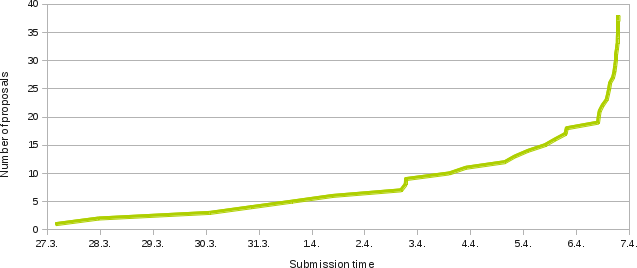
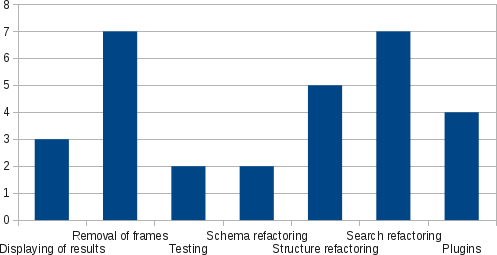
As student application period of Google Summer of Code 2012 is over, it's time to look at proposals we got for phpMyAdmin. First of all we got slightly less proposals than in past years (38 this year, 52 in 2011 and 68 in 2010). This is probably related to the fact that we heavily focus on code cleanup this year and this is definitely not that interesting topic as adding new features. I think quality has also slightly improved, but still there were few completely bogus applications for totally unrelated projects. Also as usual, people tend to leave submission for very last date: Number of applications over time (and then complain, that they don't have enough time to submit patch as described in our applicant guide). Quite unsurprisingly the most interesting topic seemed to be frames removal, where we got few really good proposals. You can see how other topics were frequent in following chart: Number of applications for various types Please note that the numbers are not 100% accurate as some proposals really did not fit into above categories. Anyway we're just waiting for last people submitting patches today and evaluation will finalize in upcoming days. Of course you will know the results from Google on April 23rd.
Filed under: English Phpmyadmin 0 comments Flattr this!

MJ Ray: DLT is better than CAPTCHA

Stop using CAPTCHAs. It s time to switch to DLT: Design, Limit and Trapdoor.

[a certain website] has the evil bad wrong Google reCaptcha on the edit page to stop disabled users, so screw it. Google s reCaptcha seems to be spreading again, obstructing more people when accessing more websites. Is there a reason for that? The re in reCaptcha stands for replace with real anti-spam, please!
I wrote the above about two years ago and it s not getting any better. I ve written similar things over the last ten years, as have many others, and I ve always sought to avoid using physical ability tests as a way to cut down spammers. Why do people keep reaching for the reCaptcha non-captcha or things that use similar bad eyetests like Mollom? So most online messages may be spam, but those physical ability tests do nothing to test for spam. They re trying to detect computer submissions (the TCHA in CAPTCHA is meant to be Telling Computers and Humans Apart), but that s really bad when the computer is helping someone with a disability to access the internet. People from the home of the CAPTCHA describe access for sight and hearing-impaired users as an important open problem for the project (Luis von Ahn, Manuel Blum and John Langford. Telling Humans and Computers Apart Automatically. In Communications of the ACM). Until that problem is closed, CAPTCHAs should be considered defective and removed whenever possible. What webmasters should do instead is DLT:
  1. Design it well: Set up sites so the spammers cannot get a quick win in the first place. Configure permissions and things like that so people have to do some work before they are trusted to post links. This is similar to the basic theory behind my Open Activism paper Fighting in the Shadows. This is much easier to do if the system is Free and Open Source Software (FOSS), too.
  2. Limit the damage: include rate limits to stop one person causing you lots of work: even with computer-assistance, few people need to post 10 forum messages every minute. Join up in co-operative anti-spam networks like blogspam.net so if they hurt you, others can see them coming. Again, it s easier to hook into a network if you re using FOSS.
  3. Trapdoor: keep a way for people to contact you if they are really blocked by your design decisions and limitation and keep a way to exempt them from the limits if needed. Make it welcoming because disabled users are tired of reporting barriers to webmasters who don t care and will never fix the web. A good multi-step eyetest-free contact form is a basic way to do this.
Have you tried this? Have your experiences been as good as our co-op s? Are there sites you don t think it would work for? A comments form is on the original of this article, as ever.

9 April 2012

Christian Perrier: Languages to be deactivated in Debian Installer (take 2)

My last call, a bit alarming about some languages becoming candidates for being deactivated in D-I had some results. A few teams updated at least sublevels 1 and 2 so that their language is "safe". Still, If I follow the policy we chose in D-I, I should deactivate languages that are not complete for what we call "sublevel 1" and "sublevel 2" in code Debian Installer. At this very moment, it means that I would deactivate (stats in parenthesis are those in these sublevels, respectively): That's way too many. So, before I blog everywhere that "Debian is dying" because I have to deactivate 20 languages in the installer...or before I blog that "Ubuntu steals our translators" (which is somehow true now, as half, if not more, of active translators are indeed interested in the Ubuntu installer to be translated, not the Debian one)....do something...or the Ubuntu installer will have 20 less languages..:-)

Gunnar Wolf: Xilitla

On this Semana Santa (holy/major week), Regina and I took a little vacation: We went ~400Km North, to the magical Xilitla, in the Eastern part of San Luis Potos state. To get there, we went by the Sierra Gorda de Quer taro route: A beautiful but quite hard to drive road, crossing desert, forest and jungle through a very steep mountain ridge. What does hard to drive mean? It means that for ~200Km we had a speed average of 40-50Km/h. The road is in very good conditions, and traffic was quite light. And although our plans were to come back via the other ridge road (crossing Hidalgo state instead of Quer taro), we were persuaded to go the long way instead: We came back via San Luis Potos city, making ~700Km instead of ~400, but I'll concede it was a much easier drive. But although I take the road as an important part of the vacation, and although it was a very quick vacation, what is it we went to see there? Xilitla is a town at the beginning of the huasteca potosina region, with really exuberant vegetation, that captured Sir Edward James' heart back in the 1940s. Sir Edward, a noble Englishman, was good friends with several surrealist artists, and became one himself. After moving to Xilitla and buying an impressive chunk of jungle, in the 1960s he started building a surrealist garden in the middle of the jungle, which he continued to work on until his death, in 1984. We took some pictures, but of course, they pay very little tribute to the magic and beauty of the place. And going to the huasteca means going to places of nature, of many crystaline rivers. Yes, only three days (two of them spent getting there and back) are far too little to enjoy it. But even so, we went to the birth of river Huichihuay n (~45 minutes North of Xilitla) and to the Los Micos waterfalls (~20 minutes West of Ciudad Valles). Very nice places to visit, among so many others. We should go back to the huasteca soon! I uploaded many of the pictures here. They will not be syndicated on the planets that follow my blog on RSS (or for individuals following RSS, FWIW), but you will find them following the relevant links. And of course: I pay for a very cheap package on my hosting provider. Drupal often answers with an error page when the server is (even mildly) overloaded. So, feel free to hit reload if something appears unavailable.

8 April 2012

Richard Hartmann: Richuck

Q: How much wood would a Richuck chuck if a Richuck could chuck wood? A: Quite a bit. The few times in the past when I was able to get my hands onto a tree or three, I thoroughly enjoyed turning them into firewood. It's good workout, you get fresh air, and you can actually see what you accomplished with your hands. Back then, I had access to a hatchet, a felling axe and a single wedge. Splitting anything larger than 20 or 30 cm in diameter was tedious work, though still enjoyable. Two weeks ago, I was presented with several cubic meters of spruce; log diameters ranging in between 10 and 50 cm, pre-cut to two meters in length. Plus, access to a chainsaw. Yay. After some research, I ordered two helicoidal splitting wedges (they turn themselves when driven into wood), a splitting axe and a splitting maul. The rest of the equipment handed to me is probably older than I am, but still working perfectly fine. You have to admire the simple yet efficient design of the cant hook. Something I could not find an English name for is the German Sapie, in itself loosely defined as "any tool you can use to pick up, turn, drag or otherwise move logs". There's a surprising variety of these tools, but then, moving wood around has been a necessity of life for millennia so people are bound to come up with good designs. Last weekend, the chainsaw wasn't running very smoothly or much at all, resulting in hours spent coaxing it to cut at least enough for some hacking (the wood, not the computer kind). Other than our chainsaw troubles, that weekend was very pleasant and I ended up splitting tons of logs. We had the chainsaw overhauled and resharpened during the week and picked it up again on Friday, planning to resume cutting early Saturday, a plan that was spoiled by torrential downpour and hail. In the afternoon, I started splitting some left-overs around the house and used a short break from the rain to head out into the woods to where the logs are piled. The place I chose for splitting is somewhat exposed and even though the mix of rain, sleet, snow, hail, and everything in between resumed soon enough turns out you simply stop caring at some point. While temperatures were around freezing, I ended up being drenched in sweat in no time at all. There is something primordial and deeply satisfying about simply working away at these logs, ending with piles and piles of firewood. Of course, using my favourite new toy, 4.6 kg of forged stainless steel fuck you, increased said satisfaction immensely. Between the two wedges and that maul, splitting any middle-European conifers is a breeze. Add in the splitting axe for slim trunks and splitting will take less than 60 seconds per cut, no matter how many branch knots or pockets of shock-absorbing partially decayed wood you encounter. If only I've had those tools a decade and a half ago... While I am feeling muscles I forgot I had, I am planning to pursue this new-found old hobby for at least the foreseeable future. Especially since I sourced more logs and a few trees, already.

7 April 2012

Wouter Verhelst: New toy

A while back, I was thinking. Playing the flute or whistling on a bottle is the exact same technique; but, in my opinion, the sound that comes from a bottle has some interesting overtones, making for a nice sound. Since the material of which an instrument is made is in large part responsible for the overtones that it produces (apart from the technique used by the musician), I wondered if nobody had ever come up with the idea of making a flute in glass. Turns out that, of course, this has already happened. In fact, the modern concert flute wouldn't have been possible without one Claude Laurent, a Parisian instrument maker who received a patent for "a new [method of] making flutes from crystal"; part of his patent described a method of attaching the valves to the instrument. It was this method which was used by Theobald Boehm when he invented the fingering system that defines the modern concert flute. The price of an intact Laurent flute today is, of course, beyond my budget; and it doesn't look like there are any glass flutes being made that use the Boehm system. But that doesn't mean there aren't any glass flutes being made anymore; indeed, a short look around the Internet quickly turned up Hall Crystal Flutes, a family-owned business from Rochester in the US state of Washington. As the price was not too insane (49 USD for the instrument, plus almost the same amount for shipping it to Belgium), I ordered one of their piccolos in C. Last wednesday, a woman from the post office rang my doorbell, with a pakage containing the new instrument. Unfortunately, however, it had a customs tax of slightly more than what was in my wallet at the time, which meant I could only fetch it from the post office the next day. At least I could pay in plastic there. After having had it for a few days, I can make a few observations: I've been playing a few diddlies on it for the past few days, and it's been fun so far. We'll see where this leads us.

6 April 2012

Rapha&#235;l Hertzog: People Behind Debian: Francesca Ciceri, Member of the Debian Press & Publicity Teams

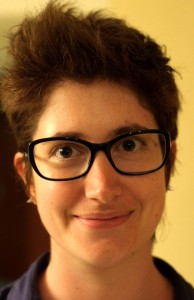
Francesca Ciceri, photo by Andrew McMillan, CC-BY-SA 2.0

I met Francesca in Debconf 11 in Banja Luka. If I recall correctly, it s Enrico Zini who introduced me to her, because she was the madamezou (her IRC nickname) who started to get involved in the publicity team. Since then and despite having a bachelor thesis to complete she got way more involved and even gained official responsibilities in the project. Before starting with the interview, I wanted to mention that Francesca is drafting a diversity statement for Debian I was expecting the discussions to go nowhere but she listened to all objections and managed to improve the text and build a consensus around it. Thank you for this and keep up the good work, Francesca! Rapha l: Who are you? Francesca: My name is Francesca, I m 30 and I studied Social Sciences. Currently I live in Italy but I m planning to go abroad (not a lot of jobs here for geeky social scientists). Apart for Debian and FLOSS world in general, I have unrestrained passions for chocolate; zombie movies; sci-fi; zombie books; knitting sewing crafting and DIY in general; zombie videogames; bicycles; pulling apart objects to look inside them; splatter B movies, David Foster Wallace s books, playing trumpet, and did I already mentioned zombies? Days are too short for all this stuff, but I try to do my best. Raphael: How did you start contributing to Debian? Francesca: Some years ago I was stuck in bed for literally some months, due to a grave series of migraine attacks. I wasn t able to do anything: no social life, no books or television. So, I decided to turn on the laptop and do something constructive with it: I was already a Debian user and it seemed quite logical to me to try to give back to the community. I am not a coder and I ve not studied Computer Science, so my first step was to join an Italian Debian on-line community (Debianizzati) and help with tutorials, users support, wiki management. In a couple of months I learnt many things: helping other users with their problems forces you to do lots of research! My first contributions to the Debian project were mostly translations of the main website. Translators are the perfect typos spotters: they work so precisely on the text to be translated that they finish to do a great QA job. This is how I ve started to contribute to the Debian website: with very simple things, fixing typos or wrong links or misplaced wml tags. I still remember my first commit to the website: the idea was to undercase some tags, but it ended up that I misplaced some of them and in addition I fixed them only in the English page and not on the translations as well. When after a couple of minutes, K re Thor Olsen a long time contributor of the team and now webmaster reverted my commit, I felt so stupid and full of shame. But, to my great surprise, no one treated me like an idiot for that error: Gerfried Fuchs, one of the guru of the team, replies me in a really helpful and polite way explaining what I did wrong and how to do things correctly. I think this episode was a turning point in my Debian life: there s this idea that Debian Developers are just a bunch of arrogant assholes and maybe it was true in the past, but for my experience they are not. Well, at least the ones I met and work with ;) .
To my great surprise, no one treated me like an idiot for that error.
Since then, I joined the WWW team and helped them apply the shiny new design provided by Kalle S derman. A lot of work was done during the week immediately before the release of the new website. Oh that was a week! We worked night and day to have the new design ready for February 6th, and it was fantastic when we finally published it, simultaneously with the release of Squeeze. At the same time, I started to contribute more actively to the Debian Publicity team, not only translating news but also writing them. It can sound scary for a non native English speaker to write something from scratch in English, but you have to keep in mind that your text will be reviewed by native speakers before being published. And we have some fantastic reviewers in the English localisation team: particularly Justin B Rye, who is tireless in his effort and more recently Moray Allan. I think I m particularly lucky to work with all these people: there s a special mood in both Publicity and WWW team, which makes you feel happy to do things and at the same time pushes you to do more just because it s fun to work with them sharing jokes, ideas, rants, patches and hugs. Rapha l: I believe that you have been trough the new member process very quickly. You re now a Non-Uploading Debian Developer. How was the experience and what does this mean to you? Francesca: Becoming a Debian Developer was not so obvious for me, because I didn t need to be a DD for the work I do in Debian. For instance, I don t maintain packages, so I had no reasons to want to become a DD in order to have uploading rights. For a while I didn t really feel the necessity of being a DD. Luckily, some people started to pester me about it, asking me to apply for the NM process. I remember Martin Zobel-Helas doing this for an entire week every single day, and Gerfried Fuchs doing it as well. Suddenly, I realized that people I worked with felt that I deserved the DD status and that I simply had thought I didn t. As a non coder and a woman, there probably was a bit of impostor syndrome involved. Having people encouraging me, gave me more confidence and the desire to finally become a DD. And so I did. The process for non uploading DD is identical to the one to become an uploading DD, with one exception: in the second part of the process (named Tasks and Skills) instead of questions about how to create and maintain packages, there are questions about the non packaging work you usually do in Debian. The general resolution which created the possibility to become a non uploading DD gave us a chance to recognize the great effort of Debian contributors who work in various area (translations, documentation, artworks, etc.) that were not always considered as important as packaging efforts. And this is great because if you are a regular contributor, if you love Debian and you are committed to the project, there are no reasons to not be an official member of it. With regards to this, I like the metaphor used by Meike Reichle in her recent talk about the Debian Women Project (video recording here):
a Debian Developer status is a lot like a citizenship in a country that you re living in. If you live in a country and you don t have citizenship, you can find a job, buy a house, have a family [...] but if this country at any point in time decides to go into a direction that you don t like, there s nothing you can do about it. You are not in the position to make any change or to make any effect on that country: you just live there, but there s no way that you can excercise influence on the people who run this country.
Rapha l: You recently joined the Debian Press Team. What does it involve and how are you managing this new responsibility? Francesca: The Press Team is basically the armed wing of the Publicity Team: it handles announcements that need to be kept private until the release, moderate the debian-announce and debian-news mailing list and maintain contacts with press people from outside the project. The real job, so, is done within the Publicity Team. The most important part of our work is to write announcements and the newsletter: while the newsletter is published bi-weekly, the announcements need to be write in a shorter timeframe. Localization is really important in spreading Debian word, so we work closely with translators: both announcements and DPN are usually translated in four or five different languages. The publicity work could be stressful, as we have strict deadlines, we need to take quick decisions and often do last-minute changes. Personally, I like it: I work better under pressure. But I know that is sometimes difficult for contributors to accept that we can t debate endlessly on details, we have just to go on and do our best in a given timeframe.
The publicity work could be stressful, as we have strict deadlines, [ ]. Personally, I like it.
Raphael: You re one of the main editor behind the Debian Project News. What s the role and scope of this newsletter? Francesca: Debian Project News is our beloved newsletter, direct successor of the Debian Weekly News founded by Joey Hess in 1999 and later kept alive by Martin Schulze. In 2007, Debian Weekly News was discontinued but in 2008 the project was revived by Alexander Reichle Schmehl. The idea behind DPN is to provide our users an overview of what is happening inside and outside the project. As the core team of editors is formed by three people, the main problem is to be able to collect enough news from various sources: in this sense we are always glad when someone points us to interesting blogposts, mails and articles. DPN is also a good chance for non coders to contribute to Debian: propose news, write paragraphs and review the draft before the publication are quite easy tasks but very useful. English native speakers can do a proofread (as no one of the main editors is a native speaker) while others can always translate DPN in their native language. People who want to help us can take a look at our wiki page.
DPN is also a good chance for non coders to contribute to Debian.
Just yesterday I realized that since January we don t miss or delay an issue: so I d like to thank the fantastic team of editors, reviewers and translators who made it possible. The team is now working on another way of spreading Debian s message: a long-time project is finally becoming real. Stay tuned, surprise arriving! Raphael: You re trying to organize IRC training sessions but that doesn t seem to take off in Debian, while it s quite common in the Ubuntu community. How do you explain that? Francesca: I m not sure about it: both Debian users and contributors seemed to appreciate this initiative in the past. I was quite surprised by the amount of Debian members present during the various sessions and by the amount of interesting questions asked by the users. So the only reason I can think about is that I need to put more enthusiasm in convincing the teams to do it: they need more encouragement (or to be pestered more!). I, for myself, think that IRC training sessions are a great way to promote our work, to share our best practice, to talk about our project to a wider audience. And I ll sure try to organize more of them. Help, suggestions, ideas are really welcome! Raphael: If you could spend all your time on Debian, what would you work on? Francesca: There is a project I d like to give more love, but I always end up without the time to do it: the debian-community.org project. Back in 2007, Holger Levsen founded it with the aim of reducing the gap between Debian contributors and Debian users, giving all an opportunity to contribute, share ideas and more. The project was discontinued and I d really like to revive it: in these years various things have changed, but I think that the core idea of having a node to connect existing local communities is still good and doable. In Debian we don t have the wide and well articulated local infrastructure present in other distributions (Ubuntu, particularly, but also Fedora): even if I don t like too centralized structures, I think that a better connection between the project and local groups of users and on-line communities would be a step forward for the project. Being part of the Events Team, I m aware of how much we need to improve our communication with local groups. An example is the events organization: sometimes, Publicity and Events teams even don t know about regional Debian related events (like booth at conferences, workshops, talks, install parties, etc) and this is a shame because we could offer a lot of help in organizing and promoting local events. What we lack is better communication. And debian-community.org project could give us exactly this. Could be a cluster of local groups, a platform for events organization and even a useful resource for newbies who want to find a local group near them. I started some effort in this sense, sending a proposal about it, working on a census of Debian local groups. Any help is appreciated! I m really curious to see how many Debian communities (from all around the world and the web) are out there, and I d love to have members from these communities better connected with the Debian Project. Raphael: What s the biggest problem of Debian? Probably the bikeshedding feticism of almost all of us. It s the other side of the coin of Debian s commitment to technical excellence and our perfectionism, but sometimes it leads just to endless discussions about details, and it is a blocker for various initiatives. In Debian, you have to be really patient and in a way stubborn to push some changes. This is frustrating sometimes. On the other hand, I really appreciate how people take some times to think to each proposals, give some feedback and discuss about it: the process could be annoying, indeed, but the result is often an improvement of the initial proposal. Raphael: Is there someone in Debian that you admire for their contributions? Most of my teammates are simply brilliant and adorable and hard-working. But I have to admit that I particularly admire David Pr vot: beside being a webmaster he does a lot of things, from French translations to DPN editing. All his contributions have a great quality and he s able to push you always further in doing things and doing them better. He is a good example of how I d like to be as contributor: smart, tireless, friendly.
Thank you to Francesca for the time spent answering my questions. I hope you enjoyed reading her answers as I did. Note that older interviews are indexed on wiki.debian.org/PeopleBehindDebian.

Subscribe to my newsletter to get my monthly summary of the Debian/Ubuntu news and to not miss further interviews. You can also follow along on Identi.ca, Google+, Twitter and Facebook.

3 comments Liked this article? Click here. My blog is Flattr-enabled.

Vasudev Kamath: Packaging Falcon Programming Language for Debian

Falcon is a programming language which is not yet packaged for Debian. I saw that the ITP#460591 is owned by my Debian mentor and good friend Kartik Mistry. So I jumped in to help him finish this package. Ok enough of introduction now directly to point. We thought its better to base the Debian package on upstream Git repository itself so we can do snapshot release like Go Language package is doing. So in this post I'm going to give steps we used to do this and also guidelines on future packaging of Falcon.
    1. First step we need to clone the upstream Falcon's git repo. Then duplicate *master* branch into *upstream* branch.
      git clone http://git.falconpl.org/falcon.git
      git checkout -b upstream
      
    
    2. Now by staying on *upstream* branch we made it track the upstream's git repo using following commands
       git remote add upstream-falcon http://git.falconpl.org/falcon.git
       git branch --set-upstream upstream-falcon
       
    
    3. We made the master branch point to origin which is our collab-maint git repository.
       git checkout master
       git remote set-url origin git.debian.org:/git/collab-maint/falconpl.git
       
    
    4. Next is creating the pristine-tar branch so that it will be easy for us to build using *git-buildpackage* tools. We just took snapshot of upstream's head and created a tarball and then used *pristine-tar* utility to commit it. Then we tagged upstream version
       git checkout upstream
       git archive --format=tar HEAD   gzip -9 > ../falconpl_0.9.6.8-git20120403.orig.tar.gz
       git tag upstream/0.9.6.8-git20120403
       pristine-tar commit ../falconpl_0.9.6.8-git20120403.orig.tar.gz
       
    
    5. And finally we copied **debian** directory from Ubuntu's falconpl package into our master branch and modified the debian changelog to match our new snapshot version. To release a new version all we need to do is follow step 4 and then additionally merge the upstream with master
So our repo is now in proper shape to be built using git-buildpackage. But we are left with many things to clean and fix. So things which are currently pending are
  1. Make copyright file in Debian copyright format 1.0
  2. Separate out each module falcon builds into separate package. Looks like Ubuntu doesn't install any of modules
  3. Last but not the least upload it to Debian ( Kartik's task :-) )
Even though I'm packaging Falcon for Debian I'm not a Falcon programmer so if there are any Falcon programmer reading this post and want to help you are always welcome :-).

5 April 2012

Benjamin Mako Hill: OH Man!

Since installing a whiteboard in our kitchen, conversations at the Acetarium have been moving in new and interesting directions. For example, Mika and I recently noticed that, when rotated correctly, the skeletal formula for 2,3-dimethyl-2-butanol looks pretty friendly! /copyrighteous/images/2,3-dimethyl-2-butanol-clean.png

Next.

Previous.