Search Results: "agi"

27 October 2007

Lior Kaplan: Status of the Firefox bug triage (and what I learned from triaging bugs)

The Firefox bug triage started a month ago, with the goal of verifying the relevance of bugs reported against the firefox package, which isn’t present any more in unstable. From the 324 bugs I started with, 37 have been closed and 85 were verified. The latter were reassigned to the Iceweasel package and got the necessary version info. 165 bugs are still pending for verification. Additional 37 bugs are forwarded to the Mozilla bugzilla, most of them are open for a long time. Help with forwarding more upstream bug to the bugzilla is always welcome. The status of the triage is available at the firefox bugs’ page. During my recent bug triages (openoffice.org, cvs, firefox), I think we need to add a “be kind to QA people” section along with the “be kind to porters” one. I encountered a few people thought the goal of the triage was to bother them than to get bugs solved (or at least ease the maintainer to attend to them). One even got an angry reply back after complaining too much about getting an extra mail:
I must say that I don’t understand your lake of patience. So you got another mail… we all get dozens of them everyday. I invest time in doing the ugly QA work, and I don’t I deserve this attitude.
But on the other hand, I had a few people thanking for the fact that someone invested time in their reports, and others that were patient regarding a few mistakes I made. One conclusion I have from the triage process - our DDs don’t use versioning info enough. This makes going over reports harder and more time consuming. It also harder for the maintainer to figure out if the bug is still relevant for a new version.

Romain Francoise: Shared links for 2007-10-27

25 October 2007

Enrico Zini: axi-query-similar

apt-xapian-index: searching for similar packages I've recently posted: Today I'll show how to abuse Xapian to show a list of packages similar to a given one. This time I'll try just linking to the code in wsvn and showing in the blog only show the most important bits. So, we have a package name, and we want to show what are the packages similar to that one. To do it, we simply build a big OR query with all the terms indexed for that package: Xapian will show us the packages whose terms are most similar, and that does the trick. This works because Xapian gives us the best results first, therefore even if no package except the given one will give an exact match, we still get the nearest matches first. In order to get the list of indexed terms given a package name we need to do two things:
  1. Get the Xapian document for the package.
  2. Get the termlist of the document.
To get the Xapian document we search for a term that only that document can have. In the index, the package name is indexed with the special prefix "XP", so we can search for that:
def docForPackage(pkgname):
    "Get the document corresponding to the package with the given name"
    # Query the term with the package name
    query = xapian.Query("XP"+pkgname)
    enquire = xapian.Enquire(db)
    enquire.set_query(query)
    # Get the top result only
    matches = enquire.get_mset(0, 1)
    if matches.size() == 0:
        return None
    else:
        m = matches[0]
        return m[xapian.MSET_DOCUMENT]
Then we build the big term list, by iterating the termlist of the document:
# Build a term list with all the terms in the given packages
terms = []
# Get the document corresponding to the package name
doc = docForPackage(pkgname)
if not doc: continue
# Retrieve all the terms in the document
for t in doc.termlist():
    if len(t.term) < 2 or t.term[:2] != 'XP':
        terms.append(t.term)
Note that it's trivial to fetch terms from more than one document, if you want to query "all packages a bit like this one and a bit like that one", although that's less of a useful feature. Lastly, we build the final query:
# Build the big OR query
query = xapian.Query(xapian.Query.OP_AND_NOT,
            # Terms we want
            xapian.Query(xapian.Query.OP_OR, terms),
            # AND NOT the input packages
            xapian.Query("XP"+pkgname))
I add an AND_NOT part with the input package name so that we don't get in the output the package that we asked for. This is it:
$ ./axi-query-similar.py debtags
20309 results found.
Results 1-20:
33% debtags-edit - GUI browser and editor for Debian Package Tags
27% tagcolledit - GUI editor for tagged collections
25% libtagcoll2-dev - Functions used to manipulate tagged collections (development version)
24% tagcoll - Commandline tool to perform operations on tagged collections
19% packagesearch - GUI for searching packages and viewing package information
18% doodle - Desktop Search Engine (client)
18% doodled - Desktop Search Engine (daemon)
18% libept0 - High-level library for managing Debian package information
18% upgrade-system - system upgrader from Konflux
18% libept-dev - High-level library for managing Debian package information
17% ept-cache - Commandline tool to search the package archive
16% tracker-utils - metadata database, indexer and search tool - commandline tools
[...]
You can use the wsvn interface to get to the full source code and the module it uses. Next in the series: adaptive quality cutoff.

24 October 2007

Enrico Zini: axi-query-expand

apt-xapian-index: suggesting new terms for improving the query I've recently posted an introduction of apt-xapian-index, an example of how to query it and a way to add simple result filters to the query. Today I'll show how to use a very interesting feature of Xapian: computing a list of the best terms to use to improve the query. I'll expand apt-query-pkgtype.py to write, after the results, the suggested terms. If you feel like reimplementing my examples in another language, let me know and I'll include it to the post. Let's start with a few definitions taken from the Xapian glossary:
RSet (Relevance Set) The Relevance Set (RSet) is the set of documents which have been marked by the user as relevant. They can be used to suggest terms that the user may want to add to the query (these terms form an ESet), and also to adjust term weights to reorder query results. ESet (Expand Set) The Expand Set (ESet) is a ranked list of terms that could be used to expand the original query. These terms are those which are statistically good differentiators between relevant and non-relevant documents.
What I'm doing now is: after printing the normal result, I build an rset with all the results. For better results one can ask the user to pick the results they like (make a GUI with that: it should rock!), but starting with the top results in the RSet is a good enough default:
# Now, we ask Xapian what are the terms in the index that are most relevant to
# this search.  This can be used to suggest to the user the most useful ways of
# refining the search.
# Select the first 10 documents as the key ones to use to compute relevant
# terms (matches is the mset returned by a normal query)
rset = xapian.RSet()
for m in matches:
    rset.add_document(m[xapian.MSET_DID])
Then I use the RSet to compute the ESet, and display the results to the user:
# This is the "Expansion set" for the search: the 10 most relevant terms
eset = enquire.get_eset(10, rset)
# Print it out.  Note that some terms have a prefix from the database: can we
# filter them out?  Indeed: Xapian allow to give a filter to get_eset.
# Read on...
print
print "Terms that could improve the search:",
print ", ".join(["%s (%.2f%%)" % (res.term, res.weight) for res in eset])
You can also abuse this feature to show what are the tags that are most related to the search results. This allows you to turn a search based on keywords to a search based on semantic attributes, which would be an absolutely stunning feature in a GUI. We can do it thanks to Xapian allowing to specify a filter for the output of get_eset. This filter filters out all the keywords that are not tags, or that were in the list of query terms:
class Filter(xapian.ExpandDecider):
    def __call__(self, term):
        "Return true if we want the term, else false"
        return term[:2] == "XT"
I just rerun get_eset like above, but adding the filter, to show only a suggestion of tags:
# This is the "Expansion set" for the search: the 10 most relevant terms that
# match the filter
eset = enquire.get_eset(10, rset, Filter())
# Print out the resulting tags
print
print "Tags that could improve the search:",
print ", ".join(["%s (%.2f%%)" % (res.term[2:], res.weight) for res in eset])
sys.exit(0)
This is it. You can use the wsvn interface to get to the full source code and the module it uses. Try running it as:
axi-query-expand.py --type=gui image editor
axi-query-expand.py --type=cmdline image editor
axi-query-expand.py --type=game image editor
you will see that as the results change, the suggestions change as well. I'm happy to see that Xapian often suggests tags: this means that tags are useful discriminators in search results, and that all the work done on Debtags has been a good work. Notice that the suggestions change as you change any of the terms, the custom filter, and the tags you put in the search. Try to imagine how such a thing could improve Synaptic. What if I told you that Xapian is fast enough that all of this can happen live while you type? Next in the series: searching for similar packages.

23 October 2007

Adeodato Sim : Coming out (the bipolar version)

I’d like to make somewhat more visible what some of you already know, that I have bipolar disorder. I was diagnosed a bit more than a year ago. I’m doing this mainly because I think visibility matters. First and most important, because in my experience it can be helpful and comforting to hear about other people whose names you recognize that can relate to your situation. And second, in case it helps a tiny bit in detabooizing mental ilnesses and their drugs. (But fortunately geek circles seem to need less of that than other, more prejudiced environments.) On a more personal note, I can’t but be grateful after six months of straight euthymia, during which I’ve regained control of my life, written code, attended events, and retaken long term projects. I also feel, after many years, less fearful of the future. And finally, let me add I can’t imagine having made through it without one particular friend, who doesn’t even read this blog. Should everybody be so lucky.

21 October 2007

Alastair McKinstry: Whither Darwin/ Terrestrial Planet Finder ?

I see from the BBC and /. that ESA has made its choices in Cosmic Vision 2015-2025. It appears that Darwin did not make the cut. Istead, PLATO and SPICA seem to be holding the banner for exoplanetary exploration. Can someone closer to the decision-making process comment? What does this mean for NASA's Terrestrial Planet Finder? There were considerations of merging Darwin and TPF; does the project live as TPF, or was the task of imaging an exoplanet left to JWST ? Tags , ,

Eric Dorland: Slick

My UPS died today, so I went to the store to get a new one. It came with a USB cable and when I plugged it into my desktop an icon popped into the Gnome panel to show me my new UPS, how much charge it had, etc (and I assume shut it down when . Very cool, and honestly completely unexpected. I think a couple of years ago I would be much less impressed by this, but as I find my free time dwindling I really appreciate when things just work. It's also a small, but encouraging sign that "Desktop Linux" is making good progress.

20 October 2007

Jan Wagner: wordpress plugin and widget packages

Yesterday I was going through the plugins and widgets, if there are any updates or such. I realized again, that updating of plugins (and maybe searching for the relocated download source) makes me mad. Also testing and switching back is annoying much.
So I decided to package plugins and widgets I use. Since some plugins and widgets are not maintained long enought for any debian release cycle or getting obsolet with new wordpress releases, I decided to maintain the packages outside of the debian project. Anyways … some people are also scared about the security situation of wordpress. I guess this isn’t much better for wordpress extensions. Next pity, some extensions or any equivalents aren’t available for wordpress 2.3 (yet). If you run multiple blogs via the stock debian package and wan’t to make use of the new wordpress version in any of your sites, you have update all at once … which maybe not a way you want to go. I decided to repackage wordpress 2.3.0 as wordpress23, which allows you to install wordpress (<<2.3.0) and wordpress23 at same time. If you want to use debian plugin, widget or theme packages or use these from your normal wordpress installation (/usr/share/wordpress) with wordpress23, you need to symlink the dirs. For example:

# mv /usr/share/wordpress23/wp-content/plugins/ /usr/share/wordpress23/wp-content/plugins.orig
# mv /usr/share/wordpress23/wp-content/themes/ /usr/share/wordpress23/wp-content/themes.orig
# ln -s /usr/share/wordpress23/wp-content/plugins /usr/share/wordpress/wp-content/plugins
# ln -s /usr/share/wordpress23/wp-content/themes /usr/share/wordpress/wp-content/themes Remember that package updates of wordpress or wordpress23 may overwrite parts of /usr/share/wordpress/wp-content/[plugins themes] in such situation. BE CAREFULL! You can get the stuff via apt-line:

deb ftp://ftp.cyconet.org/debian wordpress main non-free contrib Or directly from: http://ftp.cyconet.org/debian/archive/wordpress/ The actual package list is: wordpress-plugin-af-extended-live-archive
wordpress-plugin-ald-spa
wordpress-plugin-all-in-one-seo-pack
wordpress-plugin-exec-php
wordpress-plugin-google-sitemap-generator
wordpress-plugin-landingsites
wordpress-plugin-lightbox-2
wordpress-plugin-now-reading
wordpress-plugin-page-links-to
wordpress-plugin-photopress
wordpress-plugin-related-posts
wordpress-plugin-rolemanager
wordpress-plugin-sideblog
wordpress-plugin-spam-karma
wordpress-plugin-stats
wordpress-plugin-ubernyms
wordpress-plugin-utw
wordpress-plugin-utwgooglesitemaps
wordpress-plugins
wordpress-widget-category-cloud
wordpress-widget-samsarin-php
wordpress-widget-utw-cloud
wordpress-widgets
wordpress23 If you want a plugin or widget included and it makes sence to do so, drop me a mail, where to grab. Be aware that UTW isn’t supported since wordpress 2.3 anymore. A tag system was included into wordpress and you need to search replacements for all the nice UTW extension! Stay tuned! , , , , ,

John Goerzen: Short-Term Thinking

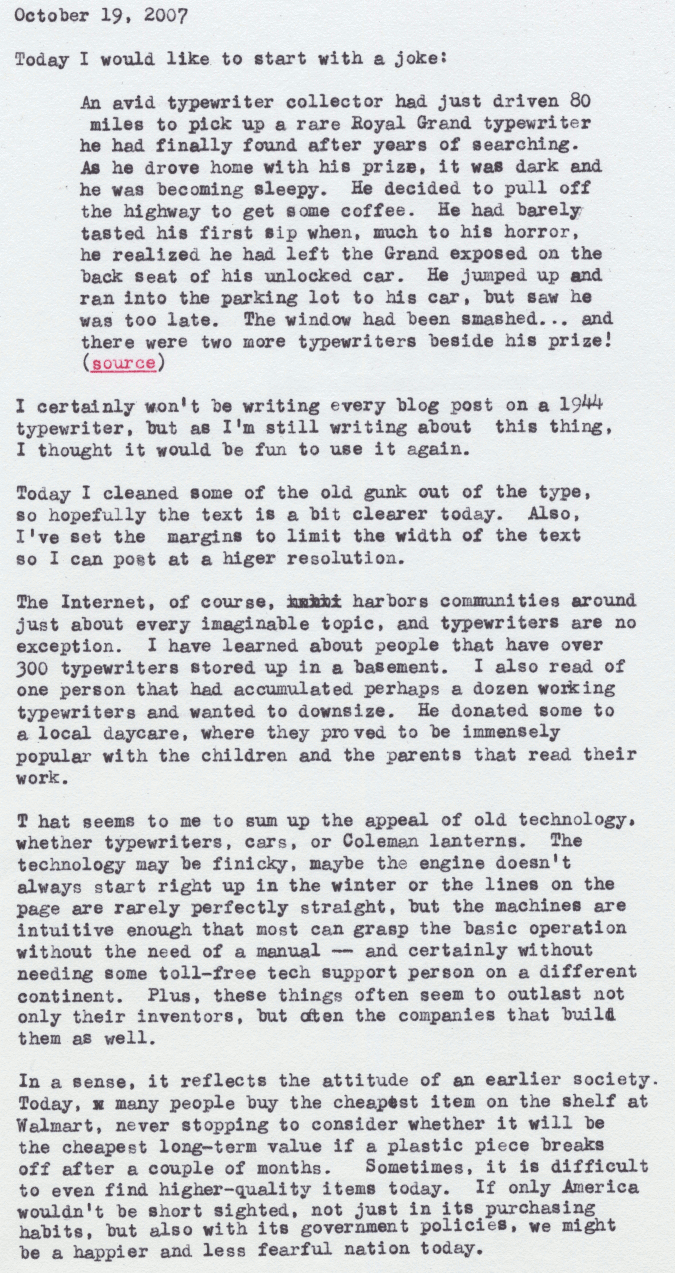
Today I would like to start with a joke:
An avid typewriter collector had just driven 80 miles to pick up a rare Royal
Grand typewriter he had finally found after years of searching.  As he drove
home with his prize, it was dark and he was becoming sleepy.  He decided
to pull off the highway to get some coffee.  He had barely tasted his first
sip when, much to his horror, he realized he had left the Grand exposed on
the back seat of his unlocked car.  He jumped up and ran into the parking
lot to his car, but saw he was too late.  The window had been smashed...
and there were two more typewriters beside his prize!
I certainly won't be writing every blog post on a 1944 typewriter, but I'm
still writing about this thing, I thought it would be fun to use it again.
Today I cleaned some of the old gunk out of the type, so hopefully the
text is a bit clearer today.  Also, I've set the margins to limit the width
of the text so I can post at a higher resolution.
The Internet, of course, harbors communities around just about every
imaginable topic, and typewriters are no exception.  I have learned about people that have over 300 typewriters stored up in a basement.  I also read of one person that had accumulated perhaps a dozen working typewriters and wanted to downsize.  He donated some to a local daycare, where they proved to be immensely popular with the children and the parents that read their work.
That seems to sum up the appeal of old technology, whether typewriters, care, or Coleman lanterns.  The technology may be finicky, maybe the engine doesn't always start right up in the winter or the lines on the page are rarely perfectly straight, but the machines are intuitive enough that most can grasp the basic operation without the need of a manual -- and certainly without needing some toll-free tech support person on a different continent.  Plus, these things often seem to outlast not only their inventors, but often the companies that build them as well.
In a sense, it reflects the attitude of an earlier society.  Today, many people buy the cheapest item on the shelf at Walmart, never stopping to consider whether it will be the cheapest long-term value if a plastic piece breaks off after a couple of months.  Sometimes, it is difficult to even find higher-quality items today.  If only America wouldn't be short sighted, not just in its purchasing habits, but also with its government policies, we might be a happier and less fearful nation today. flickr page

Andrea Veri: BehindMOTU: My interview

Original post can be found here. Interview: Today we are interviewing Andrea Veri, fresh MOTU and eager Ubuntu volunteer. Age: 18
Location: Udine, Italy
IRC Nick: bluekuja How long have you used Linux and what was your first distro?
I started using Linux at the end of 2005 using Red Hat and Fedora distros, contributing on writing several pages for Fedora documentation (mostly server docs) but mainly working on some packaging-related activities (introducing ctorrent, gtorrent-viewer and v2strip packages inside Fedora) for more than 3 months until the beginning of March 2006 when I decided to move definitely to Ubuntu after discovering it at a friend s party. Was love at first sight that made me leaving every Fedora plan and project creating my first personal wiki page on wiki.ubuntu.com some days later. How long have you been using Ubuntu?
In fact, I started using Ubuntu at the beginning of 2006, firstly getting involved inside the Edubuntu family making real the possibility to have an Edubuntu Italian support and website area inside the current Italian LoCo Team. When did you get involved with the MOTU team and how?
Right after joining the Ubuntu brigade I started checking out MOTU documentation, mainly packaging guide plus debian new maintainer s guide, trying to understand every single new word and applying directly to a source package every lesson learned during developer s world travel . After getting introduced and fascinated from an active community, I had to left the project for a while for some small problems, restarting everything on May 2007 with my first sponsored upload inside the archive. My packaging passion increased right after meeting Alexander Sack inside #ubuntu-mozillateam irc channel some days later, deciding to work directly with him as my mentor for both Debian and Ubuntu distributions. What helped you learning packaging and learning how the Ubuntu teams work?
I started with Debian New Maintainer s guide and Ubuntu s packaging guide moving then to package my first applications learning from already-packaged software and asking if needed to Alexander improving and learning every time from him or from other developers a new Ubuntu Team lesson. Favorite part of working with MOTU?
Introducing a fix making tons of users happy is one of the best things I appreciate of being a MOTU. Mentoring, sponsoring, helping out new contributors or students is something special as well. Any advice for people wanting to help with MOTU?
I always suggest to start with a package a new contributor cares about personally, that s useful to improve/fix the package itself during its maintenance.
Reading MOTU and Debian documentation is a great starting point as well to avoid any strange question on our MOTU irc channel. What packages/areas of Universe are you most interested in?
I m currently working on a vast area of packages, but I ll try to focus on p2p (Peer-2-Peer) applications both for Universe and Main. I planned to create a MOTU-p2p team really soon including it inside the existing motu-torrent team, but it will take some months to organize everything up; contributors (testers/packagers) are currently missing. Any Plans for Hardy Heron?
I ll keep working on a large number of packages but as I said before I would like to focus on having an updated situation of p2p applications, introducing libtorrent-rasterbar and its related clients like btg or linkage. Creating a working team with interested contributors and developers will be the first step to work on. Favorite quote?
As for me, all I know is that I know nothing. Socrates
What do you do in your other spare time?
I love going around with my motorbike, listening good music, playing basketball and meeting up with friends around the city centre. Pic of you, your work area, and/or your screen?

19 October 2007

Ian Haken: Long Time, No Update

So I've clearly neglected giving frequent updates, so I'll try to summarize everything that's been going on and maybe try to post more frequently in the future (I feel like I've said that many times before).

The summer ended very well, I think. My GSoC project vlosuts concluded with a fully working version, and so hopefully some guys over at Quality Assurance can be goaded into giving it a try. Once Lars and I find some time (it seems like both our lives have been quite hectic) we'll be submitting it to the unstable branch. I intend to continue supporting and developing it; in fact last night I just checked in the first update for VirtualBox support, as recommended by Jon in my comments. It does seem to work faster than QEMU and Innotek did a quality job (in my opinion at least) of packaging it. The biggest kink is that it does not support raw disk images, and so vlosuts gets slowed down by having to convert to VMDK and back, for which I am using qemu-img (and does anyone know why VBoxManage unregisterimage doesn't seem to be working for VMDKs?). If it's possible to do a loopback mount of VMDK (without VMware's utility) it would probably make more sense to use VMDK instead of a raw image to begin with, but I'm not familiar with any way to do this. At any rate, first version of VirtualBox is there for anyone who'd like to give it a shot.

Anyone not concerned with the personal going-ons of my life should stop reading right about now. Since my semester started up again at the end of August, I've pretty much hit the ground running. I'm taking 20 units (I think the average is around 15), one of which is a mathematics graduate course. I'm also doing a research project in computer science, working a part time job (which I try to do for about 10 hours a week), and getting my graduate school applications taken care of. For anyone who is curious, the GRE is a terrible thing. Graduate school and fellowship applications have been a particular headache, but fortunately I'm just about finished up with the essays. For the curious I'll be applying to mathematics departments with an emphasis in logic and foundations at the following universities (list subject to change frequently): MIT, Berkeley, Stanford, Carnegie Mellon, Urbana-Champaign, UMich.

Raphael Geissert: DeBaBaReTools: The de-what?

It's been a while since I wanted to post about a project I started.
But today when I read Russell Coker's post about his SE Linux repository I decided it was time to blog about DeBaBaReTools.


So, what is/are DeBaBaReTools?
is: a project which tries to unify different packages-building systems (pbuilder, buildd, etc) and different repository tools (debarchiver, reprepro, etc) in a single system by providing an incoming/ system.

are: Debian Bash-Based Repository Tools.

Or in other words:
DeBaBaReTools handles new packages by:


DeBaBaReTools is NOT a rewrite of a repository tool (like reprepro, debpool or debarchiver), neither yet an other building tool (like buildd or pbuilder). It is rather a glue between those two kind of tools.

So, how does DeBaBaReTools work?
As already said, they are a set of scripts which do all the work.
These are some of the scripts (more might be written later, they are under development):


Note that at the moment these are the only supported backends: gpgv, du, md5sums (all built in checkSums), pbuilder and reprepro.

Sounds interesting, doesn't it? :)

So, here's the magic:

The backends system
DeBaBaReTools doesn't try to re-invent the wheel, but it makes use of all the available tools so it works as less as possible.

This is where the backends take action. They are even more shell (even tough DeBaBaReTools clearly specifies they are Bash scripts they should work on any other POSIX-compatible shell) scripts which are loaded on demand and according to the user settings.

This opens a wide range of possible combinations of backends; making DeBaBaReTools work with almost anything.

The probe.sh script searches different directories for the specified backend (and will soon support user-hinted backends).

I think an example says more than a thousand words:
When needsBuild finds a package that needs to be built in a given architecture, the toBuild shell function is called. In order to provide the already said flexibility, needsBuild will at startup time call probeFile "buildQueue" which will then check several directories for the required backend (buildQueue in this case). Once it finds the given backend (backends/buildQueue/) it will check for any user hint (which will specify the real backend to be used) and then for a default one (default.sh which is a symlink to a real backend, plaintext.sh by default).

So, if somebody at some point wants to use a sqlite database to store all that information, that person would have to write a file called backends/buildQueue/sqlite.sh (or make it available in any of the include paths which can be extended via the EXTRA_PROBE_DIRS env variable) and either set a user hint or make default.sh point to it.
The sqlite.sh script can then call any external tools (or even more scripts) to insert the information in the database, read it and more.

I know this is a lot of blahblahblah but no single line of code is shown.
I've already requested an alioth project but it was denied because the package isn't already in the Debian archive.
If you are a DD and you think this sounds like a good project please contact the Alioth admins and convince them to create a project account for DeBaBaReTools.
Once created, many other people will be able to work on it and make it work with virtually any tool.

Any kind of feedback is very welcomed but I hope they are constructive ideas.

Why did I start this crazy project?
Because AFAIR only dak is able to do such job but I think dak is just too complex for a simple system to manage an a repository with an incoming system. And AFAIK there's no script which is able to do this job besides dak.

I hope this post makes sense because I don't want to review it again (I'm tired) :)

:bye: all

17 October 2007

Russell Coker: Lazyweb Posts

A common practice in the blog space is to write posts that ask a question in the hope that someone else will answer it via a comment or a post. This is known as a “Lazyweb Post”. It seems to me that the way of managing such posts could be improved with a little informal cooperation. From now on I plan to tag each Lazyweb post with a Lazyweb Tag, now any reader of my blog can with a single click see all the unanswered lazyweb posts that I have written (I will remove the tag once an adequate answer has been provided or I have discovered and documented the solution myself). Almost all bloggers want to get more traffic to their blogs, the question is how to get traffic of the nature that you desire. Links from blogs that you like are a preferred source of traffic. If a blogger that you would like to receive a link from has a lazyweb tag or category then it provides a good list of ideas for post topics that will get you the links you desire. Such lists would also be good for determining what information is not generally available and which therefore can be used for the topics of original posts. Such tags or categories should also be good for getting answers to lazyweb posts. I’ll start doing this and see how well it takes off.

John Goerzen: Unexpected Interest

A few days ago, I wrote about my recent purchase of an old Smith-Corona manual typewriter built in 1944. Terah and I were at an antique store, and it was $25 and sorta an impulse buy.

Since then, something unexpected has happened: I'm getting interested in using manual typewriters.

I've been busily tracking down ribbons (Nukote BW277 doesn't work on it, even though their website says it does), typing paper (business-supplies.com has it at a decent price with free overnight shipping on most orders over $50), and various tidbits of knowledge (such as: what does the lever numbered 0 to 6 beneath the right ribbon spool do?)

Today I went to a local office supply store. Not OfficeMax or OfficeDepot -- they do carry ribbons for typewriters of this era, but not the right ones for my particular machine. But the store that has been owned by the same family since it opened in 1899 on Main Street, where it remains.

And, surprise, they had the ribbon I need!

It seems that typewriters are experiencing a certain resurgence in popularity. People that have computers -- and perhaps never knew a world without them -- are buying typewriters. Because of interest, novelty, or even usefulness. There are quite a few typewriter repair shops that still exist, most of them happy to work on typewriters up to a century old.

So why am I excited about it?

Part of it is the fun of making a really old piece of technology work.

Perhaps part of it is knowing that I'll be typing at a machine that was built the same year as D-Day, the year when the first German city fell in World War II. Part of it is knowing that this 40-pound machine was built to last, in an era before planned obsolescence. And, to a certain extent, it has outlasted its manufacturer.

Part of it is curiosity: will I write differently on a typewriter than a computer? It seems that most people that have tried both say that their writing is different on a typewriter, and often better. Perhaps it is the difficulty of editing that forces more rigorous thought up front.

Christopher Watkins wrote:

[Manual typewriters] just plain shame me into working. As with any fine instrument, they're made to be used, their very design bespeaks this, and there's been many a night I've caught one of my typewriters glaring sternly at me from the shadows, implicating me in a grand failure to honor their structural destinies. Chagrined and challenged, I dutifully sit down to see what I can do to contribute to the machine-age legacy I've been called on to uphold. . .

When you sit down to write a song at the piano, you're going to write differently than if you have a banjo in your lap. And if one instrument isn't bringing the magic and the muse, maybe another will. Typewriters are the same; they make me write in a different fashion, and also provide an alternate trigger for inspiration. And as an electric guitar is different from an acoustic steel-string guitar is different from a nylon-string classical guitar is different from a national steel resonator guitar; so does each individual typewriter differ. My Underwood is different from my Royal is different from my Remington is different from my Corona is different from my Hermes. And if one isn't giving me the juice, another might.


Brian Drake added (emphasis mine):

Or you print out the document again because someone misplaced it. Misplaced it! When we were on typewriters, let me tell you, no one misplaced a hundred-page contract! That meant another two days of typing, and tying up at least two secretaries to get it done then. . .

Gore Vidal said he could tell when a book had been written on a word processor. I can, too. Sometimes I can see the cut-and-paste.

I've worked as a professional proofreader and copyeditor, and I can attest that the computer has not led to better writing. What it has led to is more writing, acres and acres of it. Books have grown fatter and fatter while their content grows slimmer and slimmer.


These seem to resonate well. More typewriter essays here.

And perhaps a typewritten blog post or two, once I try out my new ribbon.

15 October 2007

Martin F. Krafft: CO and the environment

Today is environment blog action day. I don't like memes or mass actions of this sort, but given a recent discussion on the effects of Al Gore's movie An Inconvenient Truth and everyday/everyone environmental protection on a UL-internal discussion list called "opinions", I feel like sharing my views. The original poster suggested everyone to see the movie and was promptly smashed down by two people who responded along the lines of "the movie has no scientific basis," quoting fancy research on how global warming is not as bad as it's hyped to be, and that CO is not as guilty as everyone claims. None of this research is relevant to what I had to say to this, so I won't quote it, but if you're interested, the Intergovernmental Panel on Climate Change (IPCC) is the place to start. One person went further and compared the CO -reduction hype to communism and criticised how we're expecting everyone to take action on the basis of false claims. I was partly disgusted by (all) those replies, not because they weren't accurate, but because they simply miss the point. And because the entire discussion was just another iteration of talk versus action. It may well be true that CO is not that bad, after all. But it's also true that any reasonable attempt to reduce its emission is not going to harm the environment (not to say that it might actually have a net-positive effect). Or as I put it in the thread:
I don't care for politics, I don't even care for research on this matter. I care for my environment, and I don't need to be a scientist to assume that plastic bags and car exhaust and lights left on when out to the pub are not making it any better. And yet, I am not a militant green. I prefer halogen light bulbs to the energy-saving ones and occasionally I'll be at the supermarket without a reusable bag; I don't condemn people using cars instead of a 15 minute walk to the office, and I still haven't managed to talk to a housemate of mine (no, not my Swiss flatmate), who notoriously leaves lights and appliances running when away. But at least I can say that I think of these issues, without scientific basis, but common sense. And I'll say that a thousand people aware of that will make more of a difference than any politician out there.
Not only do I think about these issues, I also act accordingly. But to be able to do that, I had to become aware of them. In as such, I'll stand by the claim in the discussion: awareness is what we ought to strive for, rather than talking about possible ways to start considering how we could potentially one day make leaps towards the solution of the world's problems, of which the environment is one. Awareness and little steps, which everyone can take: turn off lights and appliances, turn down the heater, use reusable shopping bags, prefer local produce to imported products, avoid fancy packaging, and so on In the thread, I asked "What have you done today to help lessen the burden we place on our environment?" I got no replies. I hope that's because people couldn't be bothered to show off their little contributions to the environment. If that were the case, then we are on the right path. NP: Gazpacho: Night

14 October 2007

Martin F. Krafft: Converting a package to Git

Previously, I demonstrated a Debian packaging workflow using Git and I mentioned the possibility of a follow-up post; well, here it is: you want to use my workflow (or one that's related) for a package that is currently maintained with Subversion on svn.debian.org and you'd like to keep the history during the conversion. Make sure to read the previous post before this one. I am again using the example of mdadm since its Git packaging repository is in a state of shambles and I want to restart to get it right and import the history from the previous Subversion repository. What better way than to write a blog post as I do so? Well, plenty actually. This kind of post isn't really made for a blog, and I have started work on setting up ikiwiki on madduck.net, but it's not yet ready, so I'll stick with the blog for now. I will make sure that links don't break as I move content over, so feel free to bookmark this
Importing the package into Git Thanks to git-svn, the initial step of getting your package imported into Git is a breeze:
$ git-svn clone --stdlayout --no-metadata \
    svn+ssh://svn.debian.org/svn/pkg-mdadm/mdadm mdadm
Sit back and enjoy. If that command exits prematurely with an error such as the following:
Malformed network data: Malformed network data at /usr/local/bin/git-svn line 1029
then you should upgrade to a newer Git version, or have a look here. If your Git does not know --stdlayout then upgrade as well (or use -T trunk -t tags -b branches instead). Sam Vilain notes that it is important to "get the attribution right with the final SVN import - getting the authors map right. I didn't do that. If you look at the repository resulting from the above command, you'll notice strange commit authors, such as madduck@some-unique-uuid-from-svn . git-svn allows you to map these to real names with real email addresses, which ensures that the attributions are good for the whole world to see. When done, switch to the repository and run git-branch -r. As you'll see, git-svn imported all SVN branches and tags as remote branches. You need those if you want to bidirectionally track the Subversion repository, but we are converting, as you may have guessed by the --no-metadata switch above. Therefore, we resort to the Dinosaur method of converting branches to tags, which I'll simplify for mdadm. We also just delete all remote branches after tagging, since mdadm never used branches in the SVN repository. Your mileage may vary.
git branch -r   sed -rne 's, *tags/([^@]+)$,\1,p'   while read tag; do
  echo "git tag debian/$tag tags/$ tag ^; git branch -r -d tags/$tag"
done
git branch -r   while read tag; do
  echo "git branch -r -d $tag"
done
If that seems to work alright, then you can execute the commands. Sam Vilain (again) hints me at git-pack-refs and then to edit .git/packed-refs with an editor. This certainly leaves more room for errors but might be significantly faster.
Cleaning up the SVN references Even though we passed --no-metadata to git-svn, it did leave some traces in .git/, which we can now safely remove:
$ git config --remove-section svn-remote.svn
$ rm -r .git/svn
Setting things straight You can skip this section unless you want to know a bit about how to fix up stuff with Git. There was actually some nasty tagging errors leading up to the 2.5.6-9 release for etch and I could never be bothered to fix those in SVN, but now I can (I love Git!):
$ git tag -d debian/2.5.6-10            # never existed
$ git tag -f debian/2.5.6-8 2.5.6-8~2   # mistagged
$ git checkout -b maint/etch 2.5.6-8    # this is when we diverged
$ git apply < /tmp/mdadm-2.5.6-8..2.5.6-9.diff
$ git add debian/po/gl.po debian/po/pt.po debian/changelog
$ git commit -s
$ git tag debian/2.5.6-9
Now that that's fixed, there is one other thing to worry about, namely the very last commit to SVN, which obsoletes the repository and points to the Git repository. But that's not all of it. I was also silly enough to include a fix in the same commit. Let's see what Git can do. Since the process of obsoletion involves all but adding a file, we can simply --amend the last commit and provide a new log message:
$ git checkout master
$ git rm OBSOLETE debian/OBSOLETE
$ git commit --amend
Now the repository is in an acceptable state.
Making ends meet The pkg-mdadm effort on svn.debian.org only maintained the ./debian/ directory, separate from the upstream code, and boy was that a bad idea. Just to give one example: think about what's involved in preparing a Debian-specific patch against the upstream code this has to end, and we can make it end right here; let's import upstream's code (again not using his ADSL line, but the upstream branch of the pkg-mdadm Git repository; see the previous post for details):
$ git remote add upstream-repo git://git.debian.org/git/pkg-mdadm/mdadm
$ git config remote.upstream-repo.fetch \
    +refs/heads/upstream:refs/remotes/upstream-repo/upstream
$ git fetch upstream-repo
$ git checkout -b upstream upstream-repo/master
Now we have two unconnected ancestries in our repository, and it's time to join them together. The most logical way seems to be to use the last upstream tag for which we have a Debian tag: 2.6.2. For this, we branch off the corresponding Debian tag (2.6.2-1) and merge upstream's 2.6.2 tag into the new branch. This will be a temporary branch Then, we rebase (remember, nothing has been published yet) the master branch on top of this temporary branch, before we end that branch's short life. The Debian tag stays where it is since it describes the state of the repository at time of the release of 2.6.2-1.
$ git checkout -b tmp/join debian/2.6.2-1
$ git merge mdadm-2.6.2
$ git rebase tmp/join master
$ git branch -d tmp/join
It just so happens that the head of the SVN repository, which is identical to the tip of our master branch, corresponds to Debian release 2.6.2-2, so we tag it:
$ git tag debian/2.6.2-2
We are now also "born" in the sense that maintenance in Git has started. Let's mark that point in history. There is no real reason I can foresee for this yet, but nonetheless:
$ git tag -s git-birth
Turning dpatch files into feature branches We want to turn dpatch files into feature branches and we somehow make it "proper". We could branch, apply the patch, delete the patch file, checkout master and delete the patch file there as well, but that appears "improper" to me at least; so instead, we'll cherry-pick:
$ git checkout -b deb/conffile-location
$ debian/patches/01-mdadm.conf-location.dpatch -apply
$ git rm debian/patches/01-mdadm.conf-location.dpatch
$ git commit -s
$ git commit -s $(git ls-files --others --modified)
I should quickly intervene to make sure you are following. I am making use of Git's index here. Applying the patch makes the changes in the working tree, but we did not tell Git that we want those to be part of the commit just yet. Instead, we delete the dpatch with git-rm, which automatically registers the deletion with the index. Thus, the first git-commit creates a commit which deletes the dpatch, while the second git-commit creates a commit with all the changes from the dpatch, using git-ls-files to identify new and modified files. But for now, let's move on. We have two commits in the deb/conffile-location branch, and one of those is relevant to the master branch, we cherry-pick it:
$ git cherry-pick deb/conffile-location^
If you're confused, let me explain: our goal is to have a number of feature branches, of which master is the one in which most of ./debian/ is maintained. All the branches later come together in the long-living build branch, so deb/conffile-location will never be merged back into master. However, once we applied the dpatch to the feature branch, we can delete it from there and the master branch. By cherry-picking, we "import" the deletion to the master branch. I repeat the same procedure for deb/docs, merging all the documentation-related dpatches, but I'll spare you the details.
and then Git let me down In the next step, I found I had misunderstood Git merging: I thought Git was smart, but Linus had his reasons for calling Git the "stupid content tracker" (more on that later). Read on as I am obsoleting dpatch files that upstream had merged: 99-*-FIX.dpatch. For consistency, I wanted to cherry-pick each of the appropriate upstream commits into the master branch along with deleting the corresponding dpatch file. Here is one example: 99-monitor-6+10-FIX.dpatch was obsoleted by upstream's commit 66f8bbb; the -x records the original commit ID in the log:
$ git cherry-pick -x 66f8bbb
$ git rm debian/patches/99-monitor-6+10-FIX.dpatch
$ git commit -s -m"remove dpatch obsoleted by $(git rev-parse --short HEAD)"
I repeated the procedure for the other dpatch files, removed the dpatch infrastructure, and then went on to merge it all into build to build the package. The build branch is a long-living branch off upstream, but which upstream? I'll fast-forward you past a segfault problem with mdadm, which upstream (thought to have) resolved with commit 23dc1ae after 2.6.3, but he had not yet released 2.6.4. Looking at the commits between 23dc1ae and upstream's HEAD at the time, I decided to include them all and snapshot 4450e59:
$ git fetch upstream-repo
$ git checkout upstream
$ git merge upstream-repo
$ git tag mdadm-2.6.3+200709292116+4450e59 4450e59
$ git checkout master
$ git merge --no-commit mdadm-2.6.3+200709292116+4450e59
$ dch -v mdadm-2.6.3+200709292116+4450e59-1
$ git add debian/changelog
$ git commit -s
And then I called poor-mans-gitbuild, which merges master and then deb/* into build. Here is when stuff blew up. I'll make a long story short (read my description of the problem and Linus' answer if you want to know more): I thought Git was smart to identify merges common to both branches and do the right thing, but it turn out that Git does not care at all about commits, it only worries about content and the end result. In our case, unfortunately (or fortunately), the outcome meant a conflict because the upstream branch introduced a simple change (last hunk) in the lines surrounding the patch we cherry-picked, and Git can't handle it. The solution is not to cherry-pick, to cherry-pick all commits touching the context of the dpatch, or to simply merge upstream into all out feature branches. In our case, the first is the easiest solution and since importing dpatch files is a one-time thing (thank $DEITY), I'll leave it at that. Almost. I have spent two days thinking about this more than I should have. And it was this point Linus made which made me appreciate Git even more:
Conflicts aren't bad - they're good. Trying to aggressively resolve them automatically when two branches have done slightly different things in the same area is stupid and just results in more problems. Instead, git tries to do what I don't think anybody else has done: make the conflicts easy to resolve, by allowing you to work with them in your normal working tree, and still giving you a lot of tools to help you see what's going on.
The end This concludes today's report. Importing the changes from the old Git repo, tagging and merging the branches is all covered in my previous post, or at least you'll find enough information there to complete the exercise. I would like to specifically thank Sam Vilain and Linus Torvalds for their help in preparing this post, as well as the #git/freenode inhabitants, as always. If you are interested in the topic of using version control for distro packaging, I invite you to join the vcs-pkg mailing list and/or the #vcs-pkg/irc.oftc.net IRC channel. Also, if you are interested in Git in general, you can find a list of blog posts on the Git wiki. NP: The Police: Zenyatta Mondatta

John Goerzen: My New Printer

Yesterday, Terah and I were in a store selling used items. I spotted a good deal: a used printer for $25. Here are some of its features: Here are some photos:
img_3705.jpg
img_3707.jpg
img_3706.jpg

13 October 2007

Clint Adams: One of us does not get it

Rapha l, I'm not sure you understood. The solution is to get rid of all of DSA (and maybe anyone that supports them). Removing one side of a power struggle may win you some short term gains, but may be a no-op or even more harmful in the long run. Such a solution is indicative of what I would call an overly-practical mindset, the kind I'd expect from Project Scud. You can say that DSA's inadequacies and ineptitude are due to specific individuals, but it is a team: each member is free to quit at any time (unless there is some kind of sinister blackmail or other means of coercion in progress, in which case I'm sure we would all appreciate if you exposed it), and each member is responsible for the performance of the team. If you accept that each team member is responsible, and you acknowledge that DSA's behavior is unacceptable, then how can you imagine that adding or subtracting members piecemeal will effect anything substantial?

12 October 2007

Kartik Mistry: Getting gitty with it..

* Martin (madduck) posted really nice (and long..) tutorial of ‘Packaging with Git‘. Highly recommended.

11 October 2007

Russell Coker: Getting People into IT

Pia writes about the difficulty in getting young women and young people in general into the computer industry [1]. While I agree that having more women in the computer industry would be a good thing, I have difficulty believing some of the claims that Pia makes. For example the claim that “[girls] are more career focused earlier in their school life“. I chose my career when I was about 11 years old [2] and several of my friends made similar decisions at similar ages. I would be interested to read anecdotal evidence from women in the computer industry about how old they were when they decided on their career and if their friends did the same, a reference to any research on this topic would also be useful. I tend to believe that boys are more career focussed at all stages of their life but have little evidence to support this idea. One fact that seems obvious is that the idea that “if you don’t succeed in your career then you can always marry someone who does” is almost non-existent among boys. It seems likely that such ideas have a statistically relevant affect on the focus on career of boys vs girls. Also the Australian Bureau of Statistics reports that the MEDIAN income for women is significantly lower than for men [4], I find it difficult to imagine that girls could be more career focussed from a younger age and yet get significantly lower pay (note the fact that it’s median not mean income is very significant as it removes the “glass ceiling” effect). Phillip Greenspun writes about why there are so few women doing scientific research [6] and makes some good points about why scientific research is generally not well paid and therefore a university student would choose a career in some other area and suggests that it’s a macho thing that guys enter such competitive fields for relatively low wages. Maybe some women correctly assess the costs and benefits of a career in scientific research and then make the mistake of equating Computer Science to other branches of science. But the median income suggests that although there may be some valid reasons for avoiding science that would only cover a small portion of the problem (the difference in median income can not be explained by misplaced attempts to maximise income). One problem that is significant is the quality of school education for girls. Not only is there the issue that boys may crowd-out girls for some subjects that are supposedly traditionally for boys (such as all science) but even girls schools aren’t as good as they should be. Some time ago I was talking to a teacher at an all-girls school, the school was moderately expensive and parents were paying the extra money presumably to give their daughters educational opportunities that they might miss in a co-ed school. However the school did not teach hard maths (”Maths B” was the official name at the time) and only taught the easy maths (official name “Maths A” and unofficial name “Vegie Maths“) because they didn’t have many girls demanding it (which is probably difficult to measure if you don’t offer it as a reasonable option) and the girls who wanted to study it could always move to a different school. So the choice facing girls at the exclusive school in question was “skip the subject that is most useful for further studies in most science subjects” or “go to a different school and miss most of your friends“, this sort of decision would surely discourage some potential female computer programemers. Also I think that the difference between boys and girls in regard to studying computer science has a lot to do with the fact that given a choice between missing most of their friends and missing out on something related to computers would be a no-brainer for most boys. Paul Graham’s article about Nerds has some interesting points to make in this regard - maybe the problem is that girls aren’t Nerdish enough [5]. Pia also writes about parents and teachers advising children not do study IT because of a perceived lack of jobs. I think that the problem here is not just bad advice, but also a bad tendency to take advice. Someone who wants to study in an established field which changes little over time (law and accounting spring to mind) probably should take careful note of the advice that they are given - things haven’t changed much in the last few decades. But someone who wants to study in a field that changes rapidly and where every year has new and significant developments (of which the best example is the computer industry) should probably be quite skeptical of all advice - most advice about the computer industry concerns how things used to be not how things are. Finally when considering whether to accept advice you should consider who is offering it. For example advice from a hiring manager should be carefully noted (as the manager will tell you precisely what factors influence their own decisions on hiring). Advice from people who are successful in the industry should also be noted. Advice from a school career advisor who gets paid about 1/3 what any 25yo can earn in the computer industry should be entirely ignored. I wonder whether being hesitant to ignore advice is a problem for girls in this regard. When I was in year 11 I had to take a subject related to career planning. It covered some things that were of minor use (such as writing CVs) and had an assignment of writing a fictional CV for yourself a few years after leaving university. I received bad marks for preparing a CV that involved changing jobs as companies went bankrupt or projects failed due to bad management, I was told that if your employer fails in the market it makes you look bad! However my fictional CV did bear some resemblance to what really happened… In terms of what industries have jobs available, the best advice I can give students is to actively do some research of their own. It’s not difficult to get the jobs sections of some newspapers and do a quick scan to see how many positions are open in a field, and it’s even easier to do some searches on online jobs sites (which usually tell you how many positions posted in the last X days match your criteria). For example I just visited jobserve.com.au and found 1724 Engineering jobs and 5622 IT jobs advertised. If you compare this to the university intake (I visited the Swinburne university courses list [3] and found 25 IT courses vs 29 Engineering course) it seems that the ratio of Engineering graduates to jobs is not likely to be as good as that for CS graduates. Of course it may be that all the other universities have hardly any Engineering courses and balance the ratio out (but I doubt it). In any case this would be a good way of injecting some facts into a discussion of the relative merits of different career choices and avoiding it being an issue of parents/teachers not liking computers vs children liking them. Determining the relative pay rates of different industries is a lot more difficult (and requires a significant amount of work), some recruiting agencies publish statistics - but those stats only apply to the positions that they fill (which is a sub-set of the actual positions). Finally as a piece of advice for children, try and find a job that you enjoy. If you earn $30K doing something you enjoy then you’ll probably be happier than if you earn $100K doing something you hate. Also if you enjoy your work then you will probably be able to take the extra steps needed to become successful - often it’s not a choice between having fun or making good money but a choice between fun and good money or the absence of both. If someone tells you to avoid doing what you love and instead do something boring for some unsubstantiated belief that there would be more money in it then be a nerd and tell them that their opinion is not relevant (it does tend to make teachers angry though).

Next.

Previous.