Search Results: "tats"

31 October 2011

Christian Perrier: New update about Debian Installer localization

One forgotten "full 100%" in last publication: German. Full stats are here Status for D-I level 1 (core D-I files): Status for D-I level 2 (packages that have localized material that may appear during default installs, such as iso-codes, tasksel, etc.): Status for D-I level 3 (packages that have localized material that may appear during non-default installs, such as win32-loader) So, full 100% completeness (hall of fame) for: German (de), Persian (fa), French (fr), Portuguese (pt, Russian (ru)

Christian Perrier: New update about Debian Installer localization

(live from Mangalore, India, where I had a great time at the MiniDebconf India, Mangalore edition. Full report to come out soon) One more "full 100%" since last publication: Russian. Kudos to Yuri Kozlov for his very longstanding commitment to Debian localization efforts in his language. Today, I sent yet another nagging mail for level 1. If your language is not in the 100% list below, then you should start worrying about what the translator in charge is doing. Wheezy release is planned for "sometime in 2012" and it's never too early to start being the jerk who shakes the tree (Doh, I have 79 translation efforts to handle, remember!). So, I know that some oldtimer translators who always update at the last minute will be grumpy about me sending these nagging mails in advance. Sorry in advance for this, guys (you know who you are...:-)). I'm very fine with last minute updates....but this is not what will stop mefrom nagging the Debian l10n crowd anyway. Full stats are here Status for D-I level 1 (core D-I files): Status for D-I level 2 (packages that have localized material that may appear during default installs, such as iso-codes, tasksel, etc.): Status for D-I level 3 (packages that have localized material that may appear during non-default installs, such as win32-loader) So, full 100% completeness (hall of fame) for: Persian (fa), French (fr), Portuguese (pt), Russian

30 October 2011

Dominique Dumont: Config::Model: How to test configuration models

Hello With Config::Model, configuration models are created to validate configuration data. But, before that, how can we validate a model ? This has long been a sore spot of Config::Model. During its development, I ve progressively enhanced a test script to tests the various models (and their corner cases) shipped with Config::Model. This script is able to test several models with several subtests. Currently, more that 400 unit tests are done on 5 models and about 50 configuration files. Which is great, but usable only inside Config::Model distribution. Which is not so great So I ve bitten the bullet and created a new Config::Model::Tester class from this test script. This new class is shipped with Config::Model 1.260 (also available on Debian/sid). For instance, let s see how this tester is used to test Xorg model (shipped in Config::Model::Xorg). Xorg features a small test file (t/model_test.t):
use warnings;
use strict;
use Config::Model::Tester ;
use ExtUtils::testlib;
my $arg = shift   '';
my $test_only_model = shift   '';
my $do = shift ;
run_tests($arg, $test_only_model, $do) ;
The xorg files to test are specified by t/model_tests.d/xorg-test-conf.pl:
$conf_file_name = "xorg.conf" ;
$conf_dir = "etc/X11" ;
$model_to_test = "Xorg" ;
@tests = (
      name => 'fglrx',  ,
      name => 'modern',  ,
      name => 'vesa',  ,
      name => 'xorg',  ,
      name => 'xorg-ati',  ,
);
1;
And the xorg.conf files are there:
$ ls t/model_tests.d/xorg-examples/
fglrx  modern  vesa  xorg  xorg-ati
Here s the output of the xorg-ati subtest:
$ perl -Ilib t/model_tests.t x xorg xorg-ati
ok 1 - compiled
# Beginning xorg test (t/model_tests.d/xorg-test-conf.pl)
# xorg uses Xorg model on file xorg.conf
# Beginning subtest xorg xorg-ati
ok 2 - Copied xorg example xorg-ati
ok 3 - Read wr_root/test-xorg-ati/etc/X11/xorg.conf and created instance with init() method with warning check
ok 4 - Ran dump_tree
ok 5 - Dumped xorg config tree in full mode
ok 6 - Dumped xorg config tree in custom mode
ok 7 - xorg write back done
ok 8 - Created instance xorg-test-xorg-ati-w
ok 9 - Dumped xorg 2nd config tree in custom mode
ok 10 - compare original xorg custom data with 2nd instance custom data
ok 11 - check that original xorg file was not clobbered
# End of subtest xorg xorg-ati
# End of xorg test
1..11
Now, it s quite easy to create non regression tests for bug triggered by err, unexpected, configuration files: Just drop the file in the example directory and edit the *-test-conf.pl file. This saves a lot of typing. All the best

29 October 2011

Kartik Mistry: New GPG Key

* What a lazy DD I m. My new GPG key transition document is available at: http://people.debian.org/~kartik/gpg-transition-kartik.txt.asc Many thanks to Christian Perrier for this. Please consider signing my new shiny key: 0x783AA4DE And, yes. It is fun to be at MiniDebconf here in Nitte.

23 October 2011

Niels Thykier: Testing testing migration

If you have been following Lintian s development closely, you will probably have noticed that I have not really done anything there for the past week. Instead I have turned my focus on our testing migration script, britney2. First, I have created a minimal test suite[1]. It started as 4 simple tests and by now it contains about 30 tests. The size of each test is rather small; the largest tests are about 1600 binary packages in total[2], but most are 2-20 binary packages in total. Thus the test suite is rather fast compared to a live data sample , which easily takes more than 10 minutes for a single run. Unfortunately, hand-crafting the test data is somewhat annoying and easy to get wrong. The test suite has a somewhat unfair focus on auto-hint [3] cases, so the current britney2 fails up to 14 tests. Some of these appears to fail because the auto-hinter (for some reason) receives incomplete information about the situation. To my knowledge we not been able to debug the situation, but Adam has a refactor branch that does not seem to have this issue. Personally I am hoping it will soon be merged into the master branch, especially because it seems to simplify a lot of common operations. Joachim Breitner (who has been working on a SAT-solver based britney) also contributed a couple of test cases[4]. Allegedly, SAT-britney does rather well on the test suite, failing only 2 tests as far as I can tell[5]. On the other hand, it does solve a some of the more interesting cases britney2 does not solve. On a more mathematical note, the britney2 implementation behaves like a function[6] with an attractive fixed point[7]. This is interesting, because for some cases it may take britney2 a couple of iterations to reach the right solution. This fixed point is somewhat simple to find by using the following steps (pseudo-code):
// Runtime complexity O(n * br * diff), where "n" is the number of iterations until
// a fixed point is reached, "br" is the complexity of "run_britney" and "diff" is
// the runtime of the "last != current" comparison.
function find_fixed_point(initial);
    last = run_britney(initial)
    current = run_britney(last)
    while last != current ; do
        last = current
        current = run_britney(last)
    od
    return current
end
This gives us a simple way to test if britney will eventually solve the issue herself (and when she will do it). Currently britney2 is automatically run twice a day, so for every 2 iterations (beyond the first) roughly translates to a 24-hours delay. So far the test suite does not have a lot of problems that requires more than one iteration. Personally I would be pleased if it turned out to stay that way as the test suite coverage grows. If you are interested in playing around with this, you can get sources from: Footnotes: [1] http://lists.debian.org/debian-release/2011/10/msg00178.html [2] These tests are auto-generated, so it is merely an up-scaled pattern . [3] Basically if two (or more) packages needs to migrate into testing at the exact same time, they need to be hinted in. [4] Not to mention all the copy-waste errors he pointed out in mine. Apparently, SAT-britney has stricter requirements to the data than britney2. :P [5] I assume the test called sat-britney-death (created by Joachim) was named that way for a reason. The second failure is caused by SAT britney not reading hints (yet?), so the approve tpu package test case should fail. [6] A function that maps an archive into another archive erh, I mean, it maps a set of packages into another set of packages :P [7] http://en.wikipedia.org/wiki/Fixed_point_%28mathematics%29 Assuming my claim to be true, the function will have more than one fixed point. The obtained fixed point depends on the initial state of testing. As an example:
y depends on x
x in testing has RC bugs If x is not in testing, it cannot migrate to testing (due to its RC bugs). If x is not in testing, then y cannot migrate into testing. But if x starts in testing, then y may be able to migrate. This can happen if x migrated to testing before an RC bug was filed against it. (Dis-)Proving my claim is an exercise left for the reader.

Luca Falavigna: Stats, more stats and, guess what? Even more stats!

We all love stats, don t we? So, here we go! Let s start with a graph: NEW graph It shows the number of packages in the NEW queue since last year. You can see a big drop during April 2011, and a reasonably low rate during the last six months. You could think fellow Debian Developers stopped to upload NEW packages. Sorry, you re wrong! :) Since Squeeze release, 3.832 .changes files with NEW components were processed by dak, with an average of 14,85 NEW packages per day. On the FTP Team side, we had 3.732 accepts (14,47 per day), 339 rejects (1,31 per day) and 178 comments to maintainers (0,69 per day).
Who were the most prolific maintainers who got a NEW processing? Here is our special top ten:
  1. Debian Haskell Group (362 packages)
  2. Debian Perl Group (343 packages)
  3. Debian Java Maintainers (161 packages)
  4. Debian Ruby Extras Maintainers (124 packages)
  5. Debian Multimedia Maintainers (100 packages)
  6. Debian Fonts Task Force (96 packages)
  7. Debian Med Packaging Team (79 packages)
  8. Debian Install System Team (61 packages)
  9. Debian Javascript Maintainers (54 packages)
  10. Debian Python Modules Team (50 packages)
That s bad packaging teams cannot bake cookies!
Let s do the same with Changed By, this time:
  1. Ben Hutchings (159 packages)
  2. Joachim Breitner (138 packages)
  3. Clint Adams (134 packages)
  4. Jonas Smedegaard (124 packages)
  5. TANIGUCHI Takaki (97 packages)
  6. Nicholas Bamber (61 packages)
  7. Alessio Treglia (60 packages)
  8. maximilian attems (54 packages)
  9. David Paleino (51 packages)
  10. Torsten Werner (45 packages)
Much better now go and heat up your ovens, we know who you are ;)
Another nice aspect to look at is the speed of NEW processing. Some maintainers were very happy for a fast NEW processing, someone even complained for having been too quick! :) So, let s find out which upload was the quickest ever. Try to gamble a bit before reading the answer, to see whether you are near to the real value ;) Alessio Treglia, you probably already know, because your gwc_0.21.16~dfsg-1 upload has been processed in 41 seconds (yes, forty-one seconds!). Here s an excerpt from ftp-master log to certify it:
20110516120252 process-upload dak Processing changes file gwc_0.21.16~dfsg-1_amd64.changes
20110516120258 process-upload dak Moving to new gwc_0.21.16~dfsg-1_amd64.changes
20110516120339 process-new tolimar NEW ACCEPT: gwc_0.21.16~dfsg-1_amd64.changes
Alex was the super-fast FTP Team member behind the quickest accept, do you want to beat him? Join FTP Team ;)

19 October 2011

Lior Kaplan: LibreOffice Conference 2011

I ve recently been to the LibreOffice Conference 2011 in Paris. It s very nice to finally meet in person all those names from the malinglist and the bug reports. Although meeting most people for the first time, I left the conference with a strong feeling of a community (which I m proud to be a member of), this is a very motivating feeling. During the conference I had the chance to work on LibreOffice related issues: The 3 patches began when I noticed a few weird strings to translate in the context of installation media good luck to those who will try to install LibreOffice from 5.25 disk, 3.5 disk or a tape drive. These 3 strings are now removed from the code with other 36 unused strings. So translators please take the strings to translate with a grain of salt. Post conference tasks (always ending up with more stuff to do after a conference):
Filed under: LibreOffice, Openoffice.org

Steve Langasek: Debian: not stale, just hardened

Rapha l Hertzog recently announced a new dpkg-buildflags interface in dpkg that at long last gives the distribution, the package maintainers, and users the control they want over the build flags used when building packages. The announcement mail gives all the gory details about how to invoke dpkg-buildflags in your build to be compliant; but the nice thing is, if you're using dh(1) with debian/compat=9, debhelper does it for you automatically so long as you're using a build system that it knows how to pass compiler flags to. So for the first time, /usr/share/doc/debhelper/examples/rules.tiny can now be used as-is to provide a policy-compliant package by default (setting -g -O2 or -g -O0 for your build regardless of how debian/rules is invoked). Of course, none of my packages actually work that way; among other things I have a habit of liberally sprinkling DEB_MAINT_CFLAGS_APPEND := -Wall in my rules, and sometimes DEB_LDFLAGS_MAINT_APPEND := -Wl,-z,defs and DEB_CFLAGS_MAINT_APPEND := $(shell getconf LFS_CFLAGS) as well. And my upstreams' build systems rarely work 100% out of the box with dhauto* without one override or another somewhere. So in practice, the shortest debian/rules file in any of my packages seems to be 13 lines currently. But that's 13 lines of almost 100% signal, unlike the bad old days of cut'n'pasted dh_* command lists. The biggest benefit, though, isn't in making it shorter to write a rules file with the old, standard build options. The biggest benefit is that dpkg-buildflags now also outputs build-hardening compiler and linker flags by default on Debian. Specifically, using the new interface lets you pick up all of these hardening flags for free:
-fstack-protector --param=ssp-buffer-size=4 -Wformat -Wformat-security -Werror=format-security -Wl,-z,relro
It also lets you get -fPIE and -Wl,-z,now by adding this one line to your debian/rules (assuming you're using dh(1) and compat 9):
export DEB_BUILD_MAINT_OPTIONS := hardening=+pie,+bindnow
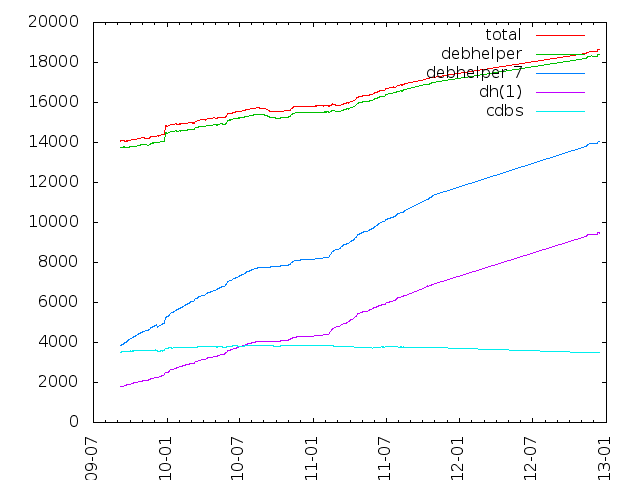
Converting all my packages to use dh(1) has always been a long-term goal, but some packages are easier to convert than others. This was the tipping point for me, though. Even though debhelper compat level 9 isn't yet frozen, meaning there might still be other behavior changes to it that will make more work for me between now and release, over the past couple of weekends I've been systematically converting all my packages to use it with dh. In particular, pam and samba have been rebuilt to use the default hardening flags, and openldap uses these flags plus PIE support. (Samba already builds with PIE by default courtesy of upstream.) You can't really make samba and openldap out on the graph, but they're there (with their rules files reduced by 50% or more). I cannot overstate the significance of proactive hardening. There have been a number of vulnerabilities over the past few years that have been thwarted on Ubuntu because Ubuntu is using -fstack-protector by default. Debian has a great security team that responds quickly to these issues as soon as they're revealed, but we don't always get to find out about them before they're already being exploited in the wild. In this respect, Debian has lagged behind other distros. With dpkg-buildflags, we now have the tools to correct this. It's just a matter of getting packages to use the new interfaces. If you're a maintainer of a security sensitive package (such as a network-facing daemon or a setuid application), please enable dpkg-buildflags in your package for wheezy! (Preferably with PIE as well.) And if you don't maintain security sensitive packages, you can still help out with the hardening release goal.

Christian Perrier: New update about Debian Installer localization

Full stats are here Status for D-I level 1 (core D-I files): Status for D-I level 2 (packages that have localized material that may appear during default installs, such as iso-codes, tasksel, etc.): Status for D-I level 3 (packages that have localized material that may appear during non-default installs, such as win32-loader) So, full 100% completeness (hall of fame) for: Persian (fa), French (fr), Portuguese (pt).

12 October 2011

Lior Kaplan: Visit to the Mozilla Europe office in Paris

I m in Paris for the LibreOffice conference, but today after a random talk with a guy that had a Mozilla badge/pin, I found myself in a tour to the Mozilla Europe office (which is also in Paris). Thank you random guy David for the tour (: The office itself looks very nice, and reminds me of the work space of many software companies. But the unique part of the tour was David pointing to people and telling us what they are working on. It s interesting to see the people behind the sciences, although we didn t talk with them in order not to disturb the work. I remember most when we David pointed to a guy and said he s the one doing composer. Maybe because it s very clear what he doesn t, while some people work on more internal parts or more conceptual concepts like performance . After seeing some cool posters on the wall, I got a chance for a short chat with Tristan Nitot and ask him some questions about Mozilla Europe and the office. I m still trying to understand how Mozilla works (as an organization), and this was a good chance to get familiar with the European branch. For me, the highlight of the tour was the chance to say to the people at the office thanks for the software just before leaving and saying goodbye. Not in everyday you get a chance to see the faces behind the software you use daily.
Filed under: Mozilla

9 October 2011

Joachim Breitner: stm-stats published for factis research

Factis research has hired me to make sure their code gets contributed back to the Haskell community. As a first step, I have followed a request of someone in the audience of Stefan Wehr s talk at HaL 6 and prepared stm-stats seem my post at the factis research blog about that.
Flattr this post

7 October 2011

Matt Zimmerman: Ada Lovelace Day 2011: Dr. Marian C. Diamond

For Ada Lovelace Day this year, I want to share my appreciation for Dr. Marian C. Diamond. In years past, I ve saluted women in the field of computing, which is my field as well. Dr. Diamond, however, is a biologist. Her research includes neuroanatomy, environment, immune functions, and hormones. In particular, she is interested in studying the effects of the external environment, aging, and immune responses on the cerebral neocortex. She has, in her words, had a love affair with the brain for about 70 years. I know very little about biology. The content and methods of her research are, frankly, beyond me, though some of her results have garnered popular attention. She has inspired me by demonstrating that rare combination of gifts: a deep understanding of a technical subject, and the ability to explain it to other people in an accessible way. In her interviews, articles and lectures, many of which are available online, Dr. Diamond displays these gifts in abundance. Her skill and enthusiasm for both learning and teaching is unmistakable. After applying her gifts in the classroom for many years, digital distribution has now enabled many more people to see and hear her, through millions of YouTube views. In 1960, she became the first female graduate student in UC Berkeley s anatomy department, and was apparently given the job of sewing a cover for a magnifying machine. I can only imagine the persistence required to continue from there to become a recognized leader in her field. She has gone on to help many other students along their way, and was named an unsung, everyday hero for the support she provided to students outside of the classroom or lab. As if that weren t enough, she has also traveled to Cambodia to apply her expertise in helping children injured by land mines. She still teaches today, just across the bay from where I write this, and will turn 85 next month.

Christian Perrier: New update about Debian Installer localization

Full stats are here Status for D-I level 1 (core D-I files): Status for D-I level 2 (packages that have localized material that may appear during default installs, such as iso-codes, tasksel, etc.): Status for D-I level 3 (packages that have localized material that may appear during non-default installs, such as win32-loader) So, full 100% completeness (hall of fame) for: Persian (fa), French (fr), Portuguese (pt).

6 October 2011

Scott Kitterman: python2.7 default python in wheezy

python 2.7.2-7 wheezy all
python 2.7.2-7 sid all This took a lot of work from a lot of people. Thank you everyone. Fortunately there won t be a python2.8, so we don t have to do this again.

5 October 2011

Niels Thykier: Numbers and lintian

Lintian uses some small scripts to collect data from packages. In daily talk, they are usually referred to as collection scripts. Lintian uses files to track the status of collection scripts between runs. Consider the following directory listing on lintian.d.o:
$ ls -al laboratory/binary/eclipse/.*-*
-rw-r--r-- 1 user group  45 Jul 18 01:21 laboratory/binary/eclipse/.ar-info-1
-rw-r--r-- 1 user group  45 Jul 18 01:21 laboratory/binary/eclipse/.bin-pkg-control-1
-rw-r--r-- 1 user group  45 Jul 18 01:21 laboratory/binary/eclipse/.changelog-file-1
-rw-r--r-- 1 user group  45 Jul 18 01:21 laboratory/binary/eclipse/.copyright-file-1
-rw-r--r-- 1 user group  45 Jul 18 01:21 laboratory/binary/eclipse/.debian-readme-1
-rw-r--r-- 1 user group  45 Jul 18 01:21 laboratory/binary/eclipse/.doc-base-files-1
-rw-r--r-- 1 user group  45 Jul 18 01:21 laboratory/binary/eclipse/.fields-1
[...]
This example shows that a bunch of collections scripts have been run for the eclipse binary package. Each of these files contain the version of Lintian that created them (or last wrote them) and a timestamp. Why the interest in these files? Let us go a bit back in time to the 15th of June 2011. That was the day where Lintian 2.5.1 was uploaded to unstable. That version of Lintian had 17 collection scripts[1] for binary packages. So every binary package would have 17 files and there are over 35 000 binary packages in the Debian archive. Ouch, so that makes about 595 000 files if we use this on all binary packages on the archive. The size of each of those files are about 45 bytes, so that is a total of 25.5 MB for all of these files[2]. So other than the inode abuse , this is not too bad. A little du -h should confirm this
$ du -h laboratory/binary/eclipse/.*-*
4.0K    laboratory/binary/eclipse/.ar-info-1
4.0K    laboratory/binary/eclipse/.bin-pkg-control-1
4.0K    laboratory/binary/eclipse/.changelog-file-1
4.0K    laboratory/binary/eclipse/.copyright-file-1
4.0K    laboratory/binary/eclipse/.debian-readme-1
4.0K    laboratory/binary/eclipse/.doc-base-files-1
4.0K    laboratory/binary/eclipse/.fields-1
[...]
Whaaa oh the file system uses a block-size of 4K bytes, so I guess we have to pay a full block for these files. Let s see what that gives, 595 000 times 4 kB is 2.27 GB Oops! That was in the (not too distant) past. About a month later (12th of July), the code creating these files are refactored into:
sub _mark_coll_finished  
    my ($self, $collname, $collver) = @_;
    # In the "old days" we would also write the Lintian version and the time
    # stamp in these files, but since we never read them it seems like overkill.
    #  - for the timestamp we could use the mtime of the file anyway
    return touch_file "$self-> base_dir /.$collname-$collver";
 
This turns out to be a very space-saving change if we ask du -h:
$ du -h laboratory/binary/lintian/.*-*
0       laboratory/binary/lintian/.ar-info-1
0       laboratory/binary/lintian/.bin-pkg-control-1
0       laboratory/binary/lintian/.changelog-file-1
0       laboratory/binary/lintian/.copyright-file-1
0       laboratory/binary/lintian/.debian-readme-1
0       laboratory/binary/lintian/.doc-base-files-1
[...]
Existing files are not emptied, so we still have some old non-empty files left on lintian.d.o. Nevertheless that was the "nice story" about "the side effect of being lazy sometimes reduces space waste"[3]. But we have another "number" problem. If you grep for "Too many links" in the lintian.log from lintian.d.o you should see:
$ grep -i "too many links" logs/lintian.log
mkdir: cannot create directory  /srv/lintian.debian.org/laboratory/binary/aces3': Too many links
mkdir: cannot create directory  /srv/lintian.debian.org/laboratory/binary/boinc-cgi-stripchart': Too many links
mkdir: cannot create directory  /srv/lintian.debian.org/laboratory/binary/libbrailleutils-java': Too many links
mkdir: cannot create directory  /srv/lintian.debian.org/laboratory/binary/libbrailleutils-java-doc': Too many links
mkdir: cannot create directory  /srv/lintian.debian.org/laboratory/binary/libclippoly0': Too many links
mkdir: cannot create directory  /srv/lintian.debian.org/laboratory/binary/libclippoly-dev': Too many links
mkdir: cannot create directory  /srv/lintian.debian.org/laboratory/binary/xul-ext-cookie-monster': Too many links
mkdir: cannot create directory  /srv/lintian.debian.org/laboratory/binary/cucumber': Too many links
[...]
$ grep -i "too many links" logs/lintian.log   wc -l
3274
In the Lintian Laboratory every package is unpacked in a directory based on its type and name (as hinted in the output above). The problem is that ext3 has a limit of the amount sub-directories a directory can have[4]. This limit is just shy of 32 000 and (as a reminder) Debian has over 35 000 binary packages. So a lot of packages are currently not checked on lintian.d.o (#641468). The current feature branch for #641468 already solves the directory limit issue (by using a "mirror-like" pool layout). It also removes the need for "1 file per completed collection" by writing this information in the existing "per entry" status file.
I hope we can get the branch merged into master within 2-3 weeks, though there are still a few issues that needs to be worked out before then. Footnotes: [1] Actually it had 18 collections, but one of them are "auto-removed" so it is better not to include it in this case. [2] Content alone - metadata like permissions and such is ignored. [3] I admit it was more luck than intention! [4] The limit comes from the "32 000 hardlink per inode" limitation.

2 October 2011

Christian Perrier: New update about Debian Installer localization

D-I localization first moved backwards when some changes were introduced to partman-nbd templates....then moves forward again. Full stats are here Status for D-I level 1 (core D-I files): Status for D-I level 2 (packages that have localized material that may appear during default installs, such as iso-codes, tasksel, etc.): Status for D-I level 3 (packages that have localized material that may appear during non-default installs, such as win32-loader) So, full 100% completeness (hall of fame) for: Persian (fa), French (fr), Portuguese (pt).

27 September 2011

Kartik Mistry: Updates

* Life: As usual. * Debian: Lots of stuffs going on. We ve yet another MiniDebConf edition, this time at Mangalore. (Not really, it is at: NMAM Institute of Technology, Nitte) And, yes, we ve some nice international guests this time. (Ah, hello, bubulle!). I ve booked ticket etc. even I m heading there during Diwali time, I hope that it will be more fun than usual crackers + sweets etc this time! gwibber still sucks. * There is nothing apart from Life, Debian that needs update. Aye. Aye.

22 September 2011

Christian Perrier: 3rd update about Debian Installer localization

Yet another progress report about D-I l10n. Full stats are here Status for D-I level 1 (core D-I files): New complete languages since last update: Esperanto, Spanish, Tamil, Simplified Chinese. Status for D-I level 2 (packages that have localized material that may appear during default installs, such as iso-codes, tasksel, etc.): Status for D-I level 3 (packages that have localized material that may appear during non-default installs, such as win32-loader)

20 September 2011

MJ Ray: Six of the Best Podcasts?

I m listening to quite a few podcasts recently. Here are my current favourites: And now for number six, what are you listening to? Anything you d recommend?

18 September 2011

Philipp Kern: python-gnucash, historic build stats

Two tiny bits:

Next.

Previous.