Search Results: "rul"

5 February 2022

Dirk Eddelbuettel: corels 0.0.4 on CRAN: M1 Update

An updated version of the corels package is now on CRAN! The Certifiably Optimal RulE ListS (Corels) learner provides interpretable decision rules with an optimality guarantee. The change is (just like the previous one) chiefly an update to configure.ac in order to ensure R on M1 macOS finds the locally-added GNU GMP. Our thanks to the infatiguable Brian Ripley for the heads-up even containing the two needed assignments to LD and CPPFLAGS.. If you like this or other open-source work I do, you can now sponsor me at GitHub.

This post by Dirk Eddelbuettel originated on his Thinking inside the box blog. Please report excessive re-aggregation in third-party for-profit settings.

4 February 2022

Ian Jackson: EUDCC QR codes vs NHS Travel barcodes vs TAC Verify

The EU Digital Covid Certificate scheme is a format for (digitally signed) vaccination status certificates. Not only EU countries participate - the UK is now a participant in this scheme. I am currently on my way to go skiing in the French Alps. So I needed a certificate that would be accepted in France. AFAICT the official way to do this is to get the international certificate from the NHS, and take it to a French pharmacy who will convert it into something suitably French. (AIUI the NHS international barcode is the same regardless of whether you get it via the NHS website, the NHS app, or a paper letter. NB that there is one barcode per vaccine dose so you have to get the right one - probably that means your booster since there s a 9 month rule!) I read on an forum somewhere that you could use the French TousAntiCovid app to convert the barcode. So I thought I would try that. The TousAntiCovid is Free Softare and on F-Droid, so I was happy to install and use it for this. I also used the French TAC Verify app to check to see what barcodes were accepted. (I found an official document addressed to French professionals recommending this as an option for verifying the status of visitors to one s establishment.) Unfortunately this involves a googlified phone, but one could use a burner phone or ask a friend who s bitten that bullet already. I discovered that, indeed: This made me curious. I used a QR code reader to decode both barcodes. The decodings were identical! A long string of guff starting HC1:. AIUI it is an encoded JWT. But there was a difference in the framing: Binary Eye reported that the NHS barcode used error correction level M (medium, aka 15%). The TousAntiCovid barcode used level L (low, 7%). I had my QR code software regenerate a QR code at level M for the data from the TousAntiCovid code. The result was a QR code which is identical (pixel-wise) to the one from the NHS. So the only difference is the error correction level. Curiously, both L (low, generated by TousAntiCovid, accepted by TAC Verify) and M (medium, generated by NHS, rejected by TAC Verify) are lower than the Q (25") recommended by what I think is the specification. This is all very odd. But the upshot is that I think you can convert the NHS international barcode into something that should work in France simply by passing it through any QR code software to re-encode it at error correction level L (7%). But if you re happy to use the TousAntiCovid app it s probably a good way to store them. I guess I ll find out when I get to France if the converted NHS barcodes work in real establishments. Thanks to the folks behind sanipasse.fr for publishing some helpful backround info and operating a Free Software backed public verification service. Footnote To compare the QR codes pixelwise, I roughly cropped the NHS PDF image using a GUI tool, and then on each of the two images used pnmcrop (to trim the border), pnmscale (to rescale the one-pixel-per-pixel output from Binary Eye) and pnmarith -difference to compare them (producing a pretty squirgly image showing just the pixel edges due to antialiasing).

comment count unavailable comments

2 February 2022

Norbert Preining: Mechanical keyboards: Pulsar PCMK

Mechanical keyboards the big fat rabbit hole you can disappear I started using mechanical keyboards about a year ago, with a Drevo Blademaster Pro (review coming up), but recently got a Pulsar PCML TKL keyboard in a build-it-yourself order.
The Drevo Blademaster Pro I am using is great, but doesn t allow changing switches at all. So I was contemplating getting a mechanical keyboard that allows for arbitrary switches. My biggest problem here is that I am used to the Japanese JIS layout which gives you a lot more keys which come in extremely handy in Emacs or when typing various languages. Fortunately, APlusX a Korean company manufactures a lot of gear under the Pulsar name, and supports also JIS layout. In addition, they have a great web site to customize your keyboard (layout, color, switch, keycaps) and send you a build-yourself kit for a very reasonable prize at least in Japan. So I got my first keyboard to put together myself . how was I nervous getting all the stuff out! Despite being a DIY keyboard, it is very easy (and they offer also pre-assembly options, too!). You don t need to solder the PCB or similar, the steps are more or less: (i) put in the switches, and (ii) add the key caps. I started with the first, putting the switches (I went with Kailh Box Brown tactile ones) into the PCB board
Well, that was easy at least I thought until I started testing the keys and realized that about 20 of them didn t work!! Pulling out the switches again I saw that I twisted a pin on each of them. One by one I straightened the pins and reinserted them very carefully. Lesson learned! At the end all the switches were on the board and reacted to key presses. Next step was adding the key caps. Again, those are not really special key caps, but simply style and sufficient for me. Of course I messed up 0 and O (which have different heights) and at first were confused about different arrow options etc, but since plugging in and pulling out key caps is very easy, at the end all the caps were in place.
With the final keyboard assembled (see top photo), I connected it to my Linux system and started typing around. And first of all, the typing experience was nice. The Kailh Box Brown switches have a bit stronger actuation point then the switches I have in the Blademaster Pro (which are Cherry MX Brown ones), but above all the sound is a bit deeper and thumbier , which really gives a nice feeling. The keyboard also allows changing the RGB lightening via the keyboard (color, pattern, speed, brightness etc). There is a configuration software for macros etc, unfortunately it only works on Windows (and I couldn t get it to work with Wine, either), a sour point One more negative point is that the LED backlight doesn t have a timeout, that is, it stays on all the time. The Drevo I have turns off after a configured number of seconds, and turns completely black something I really like and miss on the Pulsar. Another difference to the Blademaster is connectivity: While the Blademaster offers cable, bluetooth, and wireless (with dongle), the Pulsar only offers cable (USB-C). Not a real deal-breaker for me, since I use it at my desktop and really don t need wireless/bluetooth capabilities, but still. I have been using the Pulsar now for a few days without even touching the Drevo (besides comparing typing sounds and actuation points), and really like the Pulsar. I think it is hard to get a fully configurable and changeable mechanical keyboard for a similar prize. There is one last thing that I really really miss an ergonomic mechanical keyboard. Of course there are some, like the ErgoDox EZ or the Kinesis Advantage 2, but they don t offer JIS layout (and are very expensive). Then there is the Truly Ergonomic CLEAVE keyboard, which is really great, but quite expensive. I guess I have to dive down the rabbit hole even more and make my own PCB and ergonomic keyboard!

1 February 2022

Jonathan Dowland: Amateur archiving activities, January 2022

I have a backlog of digital stuff to upload to archive.org that I'm finally starting to flush. I'd had some difficulties in getting uploads to work until I tried using the excellent ia CLI tool, which is packaged in Debian. In January 2022 I uploaded: two sets of multitracks from the 1981 album My Life in the Bush of Ghosts by Brian Eno and David Byrne, "A Secret Life" and "Help Me Somebody"; 28 cover disks from late 80s/early 90s issues of PC Plus, Pc Today, PC Zone and Personal Computing; and a LEGO Land Billund brochure from 1993. I try to keep a record of my amateur archiving work (and related TODO items) at archiving. In January I also discovered that, late last year, the nine inch nails live archive project have had their download links forcibly removed by their ISP. I've been watching this project for a while because I thought it was "at risk". Years ago the project's creator, Ryan, created a series of torrents covering all the material at the time, although there had been a number of changes since the last one. However, this issue with his ISP spurred him on to create up-to-date torrents. It seems to me that archive.org would be a good place for this material, but there are two problems: the most natural collection would be the Live Music Archive, but it has a rule that musicians must have given explicit permission for live recordings to be deposited there (inherited from the earlier etree.org days) and in this case no such permission exists. The second problem is that ninlive's owner/creator, Ryan, has always resisted the idea. For now the best I can think to do is simply to continue to seed the torrent.

Dirk Eddelbuettel: #35: apt install rstudio quarto

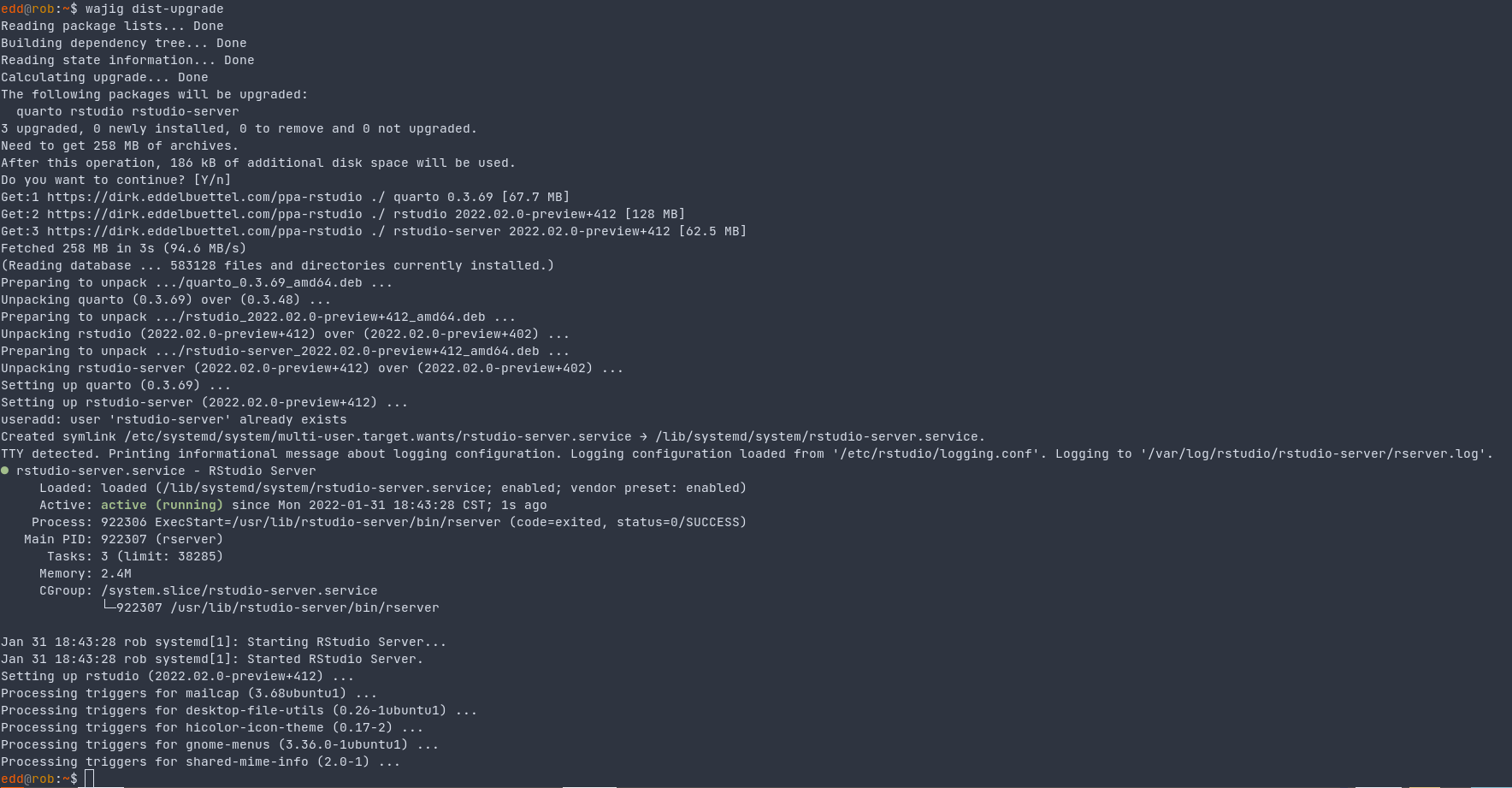
Welcome to the 35th post in the ravishingly rabiant R recommendations, or R4. Today s post is about apt and R tools. Many of us have been running RStudio off our local machines for as long as binaries have been provided. Which is by now probably a bit over a decade. Time flies. And as nice it is to have matching binaries, in my case in the .deb format used on Debian or Ubuntu, it is wee bit a painful to manually download a file and then install it. Twice the pain if you are lucky enough to be on a system where you can also run RStudio Server. And now three times as painful as you may need a matching quarto-cli binary for the nice quarto service. So wouldn t it be nice to have an apt-getable repo? And to autoMAGICall get updated versions when they are available? Oh yes. And I had been bugging JJ from day one. And JJ would almost listen intendly, nod briefly and firmly, and issue an assured we will look into it. Well, they are still looking Luckily, years ago, Carl wrote a helper script for our use in Rocker. I promptly adopted these and kept them in the littler examples directory as a pair of script getRStudioDesktop.r and getRStudioServer.r, later complemented by getQuartoCli.r. And I used these for years, somewhere between weekly and monthly. But it is still very manual: three script calls, one sudo dpkg -i call. And as our good friends at RStudio don t seem to be coming forward with a repo, I created one at GitHub thinking I could serve the files via GitHub Pages. Which of course I cannot as the .deb file for rstudio is well above the 100mb limit. So that seemed to be a bit of a setback. But after a bit of pondering, and recognizing that I am now in the fortunate position to have symmetric broadband access at home, I reckoned that until the bandwidth use gets excessive I will serve this as truly personal package archive (or tPPA) from here. Note that this is calibrated for my use so Ubuntu amd64 it is. Nothing else. And that it installs dailies . Which may cause issues for some people. You have warned. Reading tis paragraphs signifies agreement with the terms and limitations. Just kidding. A quick screenshot from an update earlier is here. Note that I use the fabulous wajig wrapper by Graham Williams here as my frontend to apt, dpkg and more as I have for even longer than I have use RStudio. Its use is tangential here; sudo apt upgrade would have done the same (and is essentially being called). And it demonstrates the main benefit: we are now automated as the cron scheduler launches an update of the PPA at which ever frequency you chose (currently twice a week for me) and after that it becomes part of the normal apt updates we do anyway (and which I do about daily). So that s main gist: automated apt upgrades of rstudio, rstudio-server, and quarto-cli. And you can find the underlying code in the GitHub repo ppa-rstudio which I put together a good week ago. I am currently updating the tPPA twice a week from crontab and have had two full upgrades already. And who knows, maybe with a bid of prodding RStudio may come around. One can always hope. If you like this or other open-source work I do, you can sponsor me at GitHub.

This post by Dirk Eddelbuettel originated on his Thinking inside the box blog. Please report excessive re-aggregation in third-party for-profit settings.

31 January 2022

Russ Allbery: Review: The Story of the Treasure Seekers

Review: The Story of the Treasure Seekers, by E. Nesbit
Publisher: Amazon
Copyright: 1899
Printing: May 2012
ASIN: B0082ZBXSI
Format: Kindle
Pages: 136
The Story of the Treasure Seekers was originally published in 1899 and is no longer covered by copyright. I read the free Amazon Kindle version because it was convenient. My guess is that Amazon is republishing the Project Gutenberg version, but they only credit "a community of volunteers." There are six Bastable children: Dora, Oswald, Dicky, the twins Alice and Noel, and Horace Octavius (H.O.), the youngest. Their mother is dead and the family's finances have suffered in the wake of her death (or, as the first-person narrator puts it, "the fortunes of the ancient House of Bastable were really fallen"), which means that their father works long hours and is very absorbed with his business. That leaves the six kids largely to fend for themselves, since they can't afford school. Clearly the solution is to find treasure. This is a fix-up novel constructed from short stories that were originally published in various periodicals, reordered and occasionally rewritten for the collected publication. To be honest, calling it a fix-up novel is generous; there are some references to previous events, but the first fourteen chapters can mostly stand alone. The last two chapters are closely related and provide an ending. More on that in a moment. What grabs the reader's attention from the first paragraph is the writing style:
This is the story of the different ways we looked for treasure, and I think when you have read it you will see that we were not lazy about the looking. There are some things I must tell before I begin to tell about the treasure-seeking, because I have read books myself, and I know how beastly it is when a story begins, "Alas!" said Hildegarde with a deep sigh, "we must look our last on this ancestral home" and then some one else says something and you don't know for pages and pages where the home is, or who Hildegarde is, or anything about it.
The first-person narrator of The Story of the Treasure Seekers is one of the six kids.
It is one of us that tells this story but I shall not tell you which: only at the very end perhaps I will.
The narrator then goes on to elaborately praise one of the kids, occasionally accidentally uses "I" instead of their name, and then remembers and tries to hide who is telling the story again. It's beautifully done and had me snickering throughout the book. It's not much of a mystery (you will figure out who is telling the story very quickly), but Nesbit captures the writing style of a kid astonishingly well without making the story poorly written. Descriptions of events have a headlong style that captures a child's sense of adventure and heedless immortality mixed with quiet observations that remind the reader that kids don't miss as much as people think they do. I think the most skillful part of this book is the way Nesbit captures a kid's disregard of literary convention. The narrator in a book written by an adult tends to fit into a standard choice of story-telling style and follow it consistently. Even first-person narrators who break some of those rules feel like intentionally constructed characters. The Story of the Treasure Seekers is instead half "kid telling a story" and half "kid trying to emulate the way stories are told in books" and tends to veer wildly between the two when the narrator gets excited, as if they're vaguely aware of the conventions they're supposed to be following but are murky on the specifics. It feels exactly like the sort of book a smart and well-read kid would write (with extensive help from an editor). The other thing that Nesbit handles exceptionally well is the dynamic between the six kids. This is a collection of fairly short stories, so there isn't a lot of room for characterization. The kids are mostly sketched out with one or two memorable quirks. But Nesbit puts a lot of effort into the dynamics that arise between the children in a tight-knit family, properly making the group of kids as a whole and in various combinations a sort of character in their own right. Never for a moment does either the reader or the kids forget that they have siblings. Most adventures involve some process of sorting out who is going to come along and who is going to do other things, and there's a constant but unobtrusive background rhythm of bickering, making up, supporting each other, being frustrated by each other, and getting exasperated at each other's quirks. It's one of the better-written sibling dynamics that I've read. I somehow managed to miss Nesbit entirely as a kid, probably because she didn't write long series and child me was strongly biased towards books that were part of long series. (One book was at most a pleasant few hours; there needed to be a whole series attached to get any reasonable amount of reading out of the world.) This was nonetheless a fun bit of nostalgia because it was so much like the books I did read: kids finding adventures and making things up, getting into various trouble but getting out of it by being honest and kind, and only occasional and spotty adult supervision. Reading as an adult, I can see the touches of melancholy of loss that Nesbit embeds into this quest for riches, but part of the appeal of the stories is that the kids determinedly refuse to talk about it except as a problem to be solved. Nesbit was a rather famous progressive, but this is still a book of its time, which means there's one instance of the n-word and the kids have grown up playing the very racist version of cowboys and indians. The narrator also does a lot of stereotyping of boys and girls, although Nesbit undermines that a bit by making Alice a tomboy. I found all of this easier to ignore because the story is narrated by one of the kids who doesn't know any better, but your mileage may vary. I am always entertained by how anyone worth writing about in a British children's novel of this era has servants. You know the Bastables have fallen upon hard times because they only have one servant. The kids don't have much respect for Eliza, which I found a bit off-putting, and I wondered what this world looks like from her perspective. She clearly did a lot of the work of raising these motherless kids, but the kids view her as the hired help or an obstacle to be avoided, and there's not a lot of gratitude present. As the stories unfold, it becomes more and more clear that there's a quiet conspiracy of surrounding adults to watch out for these kids, which the kids never notice. This says good things about society, but it does undermine the adventures a little, and by the end of the book the sameness of the stories was wearing a bit thin. The high point of the book is probably chapter eight, in which the kids make their own newspaper, the entirety of which is reproduced in the book and is a note-perfect recreation of what an enterprising group of kids would come up with. In the last two stories, Nesbit tacks on an ending that was probably obligatory, but which I thought undermined some of the emotional subtext of the rest of the book. I'm not sure how else one could have put an ending on this book, but the ending she chose emphasized the degree to which the adventures really were just play, and the kids are rewarded in these stories for their ethics and their circumstances rather than for anything they concretely do. It's a bit unsatisfying. This is mostly a nostalgia read, but I'm glad I read it. If this book was not part of your childhood, it's worth reading if only for how well Nesbit captures a child's narrative voice. Rating: 7 out of 10

27 January 2022

Russ Allbery: Review: I Didn't Do the Thing Today

Review: I Didn't Do the Thing Today, by Madeleine Dore
Publisher: Avery
Copyright: 2022
ISBN: 0-593-41914-6
Format: Kindle
Pages: 291
At least from my narrow view of it, the world of productivity self-help literature is a fascinating place right now. The pandemic overturned normal work patterns and exacerbated schedule inequality, creating vastly different experiences for the people whose work continued to be in-person and the people whose work could become mostly or entirely remote. Self-help literature, which is primarily aimed at the more affluent white-collar class, primarily tracked the latter disruption: newly-remote work, endless Zoom meetings, the impossibility of child care, the breakdown of boundaries between work and home, and the dawning realization that much of the mechanics of day-to-day office work are neither productive nor defensible. My primary exposure these days to the more traditional self-help productivity literature is via Cal Newport. The stereotype of the productivity self-help book is a collection of life hacks and list-making techniques that will help you become a more efficient capitalist cog, but Newport has been moving away from that dead end for as long as I've been reading him, and his recent work focuses more on structural issues with the organization of knowledge work. He also shares with the newer productivity writers a willingness to tell people to use the free time they recover via improved efficiency on some life goal other than improved job productivity. But he's still prickly and defensive about the importance of personal productivity and accomplishing things. He gives lip service on his podcast to the value of the critique of productivity, but then usually reverts to characterizing anti-productivity arguments as saying that productivity is a capitalist invention to control workers. (Someone has doubtless said this on Twitter, but I've never seen a serious critique of productivity make this simplistic of an argument.) On the anti-productivity side, as it's commonly called, I've seen a lot of new writing in the past couple of years that tries to break the connection between productivity and human worth so endemic to US society. This is not a new analysis; disabled writers have been making this point for decades, it's present in both Keynes and in Galbraith's The Affluent Society, and Kathi Weeks's The Problem with Work traces some of its history in Marxist thought. But what does feel new to me is its widespread mainstream appearance in newspaper articles, viral blog posts, and books such as Jenny Odell's How to Do Nothing and Devon Price's Laziness Does Not Exist. The pushback against defining life around productivity is having a moment. Entering this discussion is Madeleine Dore's I Didn't Do the Thing Today. Dore is the author of the Extraordinary Routines blog and host of the Routines and Ruts podcast. Extraordinary Routines began as a survey of how various people organize their daily lives. I Didn't Do the Thing Today is, according to the preface, a summary of the thoughts Dore has had about her own life and routines as a result of those interviews. As you might guess from the subtitle (Letting Go of Productivity Guilt), Dore's book is superficially on the anti-productivity side. Its chapters are organized around gentle critiques of productivity concepts, with titles like "The Hopeless Search for the Ideal Routine," "The Myth of Balance," or "The Harsh Rules of Discipline." But I think anti-productivity is a poor name for this critique; its writers are not opposed to being productive, only to its position as an all-consuming focus and guilt-generating measure of personal worth. Dore structures most chapters by naming an aspect, goal, or concern of a life defined by productivity, such as wasted time, ambition, busyness, distraction, comparison, or indecision. Each chapter sketches the impact of that idea and then attempts to gently dismantle the grip that it may have on the reader's life. All of these discussions are nuanced; it's rare for Dore to say that one of these aspects has no value, and she anticipates numerous objections. But her overarching goal is to help the reader be more comfortable with imperfection, more willing to live in the moment, and less frustrated with the limitations of life and the human brain. If striving for productivity is like lifting weights, Dore's diagnosis is that we've tried too hard for too long, and have overworked that muscle until it is cramping. This book is a gentle massage to induce the muscle to relax and let go. Whether this will work is, as with all self-help books, individual. I found it was best read in small quantities, perhaps a chapter per day, since it otherwise began feeling too much the same. I'm also not the ideal audience; Dore is a creative freelancer and primarily interviewed other creative people, which I think has a different sort of productivity rhythm than the work that I do. She's also not a planner to the degree that I am; more on that below. And yet, I found this book worked on me anyway. I can't say that I was captivated all the way through, but I found myself mentally relaxing while I was reading it, and I may re-read some chapters from time to time. How does this relate to the genre of productivity self-help? With less conflict than I think productivity writers believe, although there seems to be one foundational difference of perspective. Dore is not opposed to accomplishing things, or even to systems that help people accomplish things. She is more attuned than the typical productivity writer to the guilt and frustration that can accumulate when one has a day in which one does not do the thing, but her goal is not to talk you out of attempting things. It is, instead, to convince you to hold those attempts and goals more lightly, to allow them to move and shift and change, and to not treat a failure to do the thing today as a reason for guilt. This is wholly compatible with standard productivity advice. It's adding nuance at one level of abstraction higher: how tightly to cling to productivity goals, and what to do when they don't work out. Cramping muscles are not strong muscles capable of lifting heavy things. If one can massage out the cramp, one's productivity by even the strict economic definition may improve. Where I do see a conflict is that most productivity writers are planners, and Dore is not. This is, I think, a significant blind spot in productivity self-help writing. Cal Newport, for example, advocates time-block planning, where every hour of the working day has a job. David Allen advocates a complex set of comprehensive lists and well-defined next actions. Mark Forster builds a flurry of small systems for working through lists. The standard in productivity writing is to to add structure to your day and cultivate the self-discipline required to stick to that structure. For many people, including me, this largely works. I'm mostly a planner, and when my life gets chaotic, adding more structure and focusing on that structure helps me. But the productivity writers I've read are quite insistent that their style of structure will work for everyone, and on that point I am dubious. Newport, for example, advocates time-block planning for everyone without exception, insisting that it is the best way to structure a day. Dore, in contrast, describes spending years trying to perfect a routine before realizing that elastic possibilities work better for her than routines. For those who are more like Dore than Newport, I Didn't Do the Thing Today is more likely to be helpful than Newport's instructions. This doesn't make Newport's ideas wrong; it simply makes them not universal, something that the productivity self-help genre seems to have trouble acknowledging. Even for readers like myself who prefer structure, I Didn't Do the Thing Today is a valuable corrective to the emphasis on every-better systems. For those who never got along with too much structure, I think it may strike a chord. The standard self-help caveat still applies: Dore has the most to say to people who are in a similar social class and line of work as her. I'm not sure this book will be of much help to someone who has to juggle two jobs with shift work and child care, where the problem is more sharp external constraints than internalized productivity guilt. But for its target audience, I think it's a valuable, calming message. Dore doesn't have a recipe to sort out your life, but may help you feel better about the merits of life unsorted. Rating: 7 out of 10

22 January 2022

Steve Kemp: Visiting the UK was difficult, but worth it

So in my previous post I mentioned that we were going to spend the Christmas period in the UK, which we did. We spent a couple of days there, meeting my parents, and family. We also persuaded my sister to drive us to Scarborough so that we could hang out on the beach for an afternoon. Finland has lots of lakes, but it doesn't have proper waves. So it was surprisingly good just to wade in the sea and see waves! Unfortunately our child was a wee bit too scared to ride on a donkey! Unfortunately upon our return to Finland we all tested positive for COVID-19, me first, then the child, and about three days later my wife. We had negative tests in advance of our flights home, so we figure that either the tests were broken, or we were infected in the airplane/airport. Thankfully things weren't too bad, we stayed indoors for the appropriate length of time, and a combination of a couple of neighbours and online shopping meant we didn't run out of food. Since I've been back home I've been automating AWS activities with aws-utils, and updating my simple host-automation system, marionette. Marionette is something that was inspired by puppet, the configuration management utility, but it runs upon localhost only. Despite the small number of integrated primitives it actually works surprisingly well, and although I don't expect it will ever become popular it was an interesting research project. The aws-utilities? They were specifically put together because I've worked in a few places where infrastructure is setup with terraform, or cloudformation, but there are always the odd thing that is configured manually. Typically we'll have an openvpn gateway which uses a manually maintained IP allow-list, or some admin-server which has a security-group maintained somewhat manually. Having the ability to update a bunch of rules with your external IP, as a single command, across a number of AWS accounts/roles, and a number of security-groups is an enormous time-saver when your home IP changes. I'd quite like to add more things to that collection, but there's no particular rush.

21 January 2022

Louis-Philippe V ronneau: Montreal Subway Foot Traffic Data, 2021 edition

For the third time now, I've asked Soci t de Transport de Montr al, Montreal's transit agency, for the foot traffic data of Montreal's subway. I think this has become an annual thing now :) The original blog post and the 2019-2020 edition can be read here: By clicking on a subway station, you'll be redirected to a graph of the station's foot traffic. Licences

20 January 2022

Caleb Adepitan: I'm Thinking About You Right Now!

Just in case you stumbled on this incidentally and you wonder Who in the seven fat worlds is this mysterious...? Ha! That was what I was thinking about you you were thinking about me. You gerrit!? I heard you listening to my thoughts; I listened to yours too. I wonder if you heard me too. I will like to talk, today, about what it is I do at Debian as an Outreachy Intern under the JavaScript team. I woke up this morning and decided to bore you with so much details. I must have woken up glorified!

A Broader View My sole role at Debian alongside my teammate, aided by our mentors, is to facilitate the Node.js 16 and Webpack 5 Transitioning. What exactly does that mean? Node.js 16, as of the time of this writing, is the active LTS release from the Node.js developers while Webpack 5 is also the current release from the Webpack developers. At Debian we have to work towards supporting these packages. Debian as an OS comes with a package manager coined Advanced Package Tool or simply APT on which command-line programs specific to Debian and it's many-flavored distributions, apt, apt-get, apt-cache are based. This means before the conception of yarn and npm, the typical JavaScript developer's package managers, apt has been. Debian unlike yarn and npm, ideally, only supports one version of a software at any point in time and on edge cases may have to support an extra one as noted in this chat between my mentor and a member. To provide support for Webpack 5 and Node.js 16 which as regards to Debian are currently in experimental and only can be migrated to unstable after our transitioning, we have to test, reverse build, report and fix bugs till a certain level of compatibility has been attained with dependent packages currently in unstable. Webpack and Node.js have their respective dependencies, but there are certain software and packages also dependent on Webpack and/or Node.js, these are termed as reverse-dependencies. We have to test and build these reverse-dependencies, report and fix bugs and incompatibilities with the new versions of Webpack and Node.js. For reverse-dependent packages not yet supporting Webpack 5 and/or Node.js 16, we'll open an issue in form of a feature-request in upstream repository asking for Webpack 5 and/or Node.js 16 support. Ideally, Debian manages a repository of all supported packages on a GitLab managed Git based VCS. For JavaScript packages maintained by the JS Team, the home of those packages sits at https://salsa.debian.org/js-team/. Supported packages are pulled from upstream repository, mostly GitHub, using some certian packaging tools provided by Debian. The pulled source cannot be directly modified else it will break build. So there exists a dedicated folder named debian where certain cofiguration files, scripts and rules to convey to the debian package builder live at. In some cases, source code needs to be modified; these are done via patching which means the modifications won't live in the source but in a dedicated patch file inside the debian/patches/ folder. The modifications are diffed line by line with the original source (just as with git) and the result is output in a file managed by debian utility tool, Quilt. The contents of the debian folder are instructions on how to build the source into binaries or an installable archive .deb (like Java's .jar or Android's .apk).

Understanding Debian Software Release Cycle There are quite some interesting things about the software release cycle at Debian to get familiar with. Listed here are some release repositories alongside their codenames as of Debian 11:
  1. Unstable (Sid)
  2. Testing (Bookworm)
  3. Stable (Bullseye)
  4. Old stable (Buster)
  5. Old old stable (Stretch)
Ha! Isn't it ironic that unstable is the only one with a stable codename? Some of these, if not all, have codenames subject to change after every new release and/or migration. Only unstable which is referred to as Sid never changes. The current stable release which is Debian 11 is codenamed Bullseye. The next stable release which will be Debian 12 will be codenamed Bookworm because the current testing repository will be migrated to stable and released as Debian 12. The previous stable release which was Debian 10, now old stable, was codenamed Buster. To better understand Debian releases you may take a look at this wiki that completely defines them. Basically, as explained by one of my mentors remixed in my own words, experimental software are migrated to unstable after (as I said earlier) they have attained a certain level of compatibility with dependent software. They remain in unstable for a long period of time undergoing testing, autopkgtest tests, regression tests, etc. At this point bugs are reported and fixed to a satisfactory level. The unstable repository is then migrated to testing where release-critical bugs are reported and fixed to a satisfactory level where one can comfortably say testing is almost stable , and voila (!), testing is released as a Debian stable version. This happens roughly every two years. Some months before a new stable release, a soft freeze is turned on such that no new versions or transitions should be uploaded to unstable. Only fixes will be uploaded at this point. In like 4-6 weeks before the release, a hard freeze is turned on that completely disallows uploading to unstable, not even fixes. In due time, testing becomes the new stable release and freeze is lifted.

References
  1. Packaging pre-requisites
  2. Working with chroots
  3. Sbuild (clean builds)
  4. Updating a Debian Package by Abraham Raji

Russ Allbery: DocKnot 7.01

Continuing to flush out bugs in the recent changes to my static web site generator. I had missed some Unicode implications for how output from external programs was handled, and also missed Unicode decoding of the output from Pod::Thread, since Pod::Simple always encodes its output even if that output is to a scalar. I also missed an implication for how symlinks were handled in Path::Iterator::Rule, causing docknot spin to fail to copy files into the output tree that were symlinks in the input tree. Both of those bugs are fixed in this release. I also fixed a minor output issue from the \size command, which was using SI units when it meant IEC units. You can get the latest release from CPAN or from the DocKnot distribution page.

16 January 2022

Chris Lamb: Favourite films of 2021

In my four most recent posts, I went over the memoirs and biographies, the non-fiction, the fiction and the 'classic' novels that I enjoyed reading the most in 2021. But in the very last of my 2021 roundup posts, I'll be going over some of my favourite movies. (Saying that, these are perhaps less of my 'favourite films' than the ones worth remarking on after all, nobody needs to hear that The Godfather is a good movie.) It's probably helpful to remark you that I took a self-directed course in film history in 2021, based around the first volume of Roger Ebert's The Great Movies. This collection of 100-odd movie essays aims to make a tour of the landmarks of the first century of cinema, and I watched all but a handul before the year was out. I am slowly making my way through volume two in 2022. This tome was tremendously useful, and not simply due to the background context that Ebert added to each film: it also brought me into contact with films I would have hardly come through some other means. Would I have ever discovered the sly comedy of Trouble in Paradise (1932) or the touching proto-realism of L'Atalante (1934) any other way? It also helped me to 'get around' to watching films I may have put off watching forever the influential Battleship Potemkin (1925), for instance, and the ur-epic Lawrence of Arabia (1962) spring to mind here. Choosing a 'worst' film is perhaps more difficult than choosing the best. There are first those that left me completely dry (Ready or Not, Written on the Wind, etc.), and those that were simply poorly executed. And there are those that failed to meet their own high opinions of themselves, such as the 'made for Reddit' Tenet (2020) or the inscrutable Vanilla Sky (2001) the latter being an almost perfect example of late-20th century cultural exhaustion. But I must save my most severe judgement for those films where I took a visceral dislike how their subjects were portrayed. The sexually problematic Sixteen Candles (1984) and the pseudo-Catholic vigilantism of The Boondock Saints (1999) both spring to mind here, the latter of which combines so many things I dislike into such a short running time I'd need an entire essay to adequately express how much I disliked it.

Dogtooth (2009) A father, a mother, a brother and two sisters live in a large and affluent house behind a very high wall and an always-locked gate. Only the father ever leaves the property, driving to the factory that he happens to own. Dogtooth goes far beyond any allusion to Josef Fritzl's cellar, though, as the children's education is a grotesque parody of home-schooling. Here, the parents deliberately teach their children the wrong meaning of words (e.g. a yellow flower is called a 'zombie'), all of which renders the outside world utterly meaningless and unreadable, and completely mystifying its very existence. It is this creepy strangeness within a 'regular' family unit in Dogtooth that is both socially and epistemically horrific, and I'll say nothing here of its sexual elements as well. Despite its cold, inscrutable and deadpan surreality, Dogtooth invites all manner of potential interpretations. Is this film about the artificiality of the nuclear family that the West insists is the benchmark of normality? Or is it, as I prefer to believe, something more visceral altogether: an allegory for the various forms of ontological violence wrought by fascism, as well a sobering nod towards some of fascism's inherent appeals? (Perhaps it is both. In 1972, French poststructuralists Gilles and F lix Guattari wrote Anti-Oedipus, which plays with the idea of the family unit as a metaphor for the authoritarian state.) The Greek-language Dogtooth, elegantly shot, thankfully provides no easy answers.

Holy Motors (2012) There is an infamous scene in Un Chien Andalou, the 1929 film collaboration between Luis Bu uel and famed artist Salvador Dal . A young woman is cornered in her own apartment by a threatening man, and she reaches for a tennis racquet in self-defence. But the man suddenly picks up two nearby ropes and drags into the frame two large grand pianos... each leaden with a dead donkey, a stone tablet, a pumpkin and a bewildered priest. This bizarre sketch serves as a better introduction to Leos Carax's Holy Motors than any elementary outline of its plot, which ostensibly follows 24 hours in the life of a man who must play a number of extremely diverse roles around Paris... all for no apparent reason. (And is he even a man?) Surrealism as an art movement gets a pretty bad wrap these days, and perhaps justifiably so. But Holy Motors and Un Chien Andalou serve as a good reminder that surrealism can be, well, 'good, actually'. And if not quite high art, Holy Motors at least demonstrates that surrealism can still unnerving and hilariously funny. Indeed, recalling the whimsy of the plot to a close friend, the tears of laughter came unbidden to my eyes once again. ("And then the limousines...!") Still, it is unclear how Holy Motors truly refreshes surrealism for the twenty-first century. Surrealism was, in part, a reaction to the mechanical and unfeeling brutality of World War I and ultimately sought to release the creative potential of the unconscious mind. Holy Motors cannot be responding to another continental conflagration, and so it appears to me to be some kind of commentary on the roles we exhibit in an era of 'post-postmodernity': a sketch on our age of performative authenticity, perhaps, or an idle doodle on the function and psychosocial function of work. Or perhaps not. After all, this film was produced in a time that offers the near-universal availability of mind-altering substances, and this certainly changes the context in which this film was both created. And, how can I put it, was intended to be watched.

Manchester by the Sea (2016) An absolutely devastating portrayal of a character who is unable to forgive himself and is hesitant to engage with anyone ever again. It features a near-ideal balance between portraying unrecoverable anguish and tender warmth, and is paradoxically grandiose in its subtle intimacy. The mechanics of life led me to watch this lying on a bed in a chain hotel by Heathrow Airport, and if this colourless circumstance blunted the film's emotional impact on me, I am probably thankful for it. Indeed, I find myself reduced in this review to fatuously recalling my favourite interactions instead of providing any real commentary. You could write a whole essay about one particular incident: its surfaces, subtexts and angles... all despite nothing of any substance ever being communicated. Truly stunning.

McCabe & Mrs. Miller (1971) Roger Ebert called this movie one of the saddest films I have ever seen, filled with a yearning for love and home that will not ever come. But whilst it is difficult to disagree with his sentiment, Ebert's choice of sad is somehow not quite the right word. Indeed, I've long regretted that our dictionaries don't have more nuanced blends of tragedy and sadness; perhaps the Ancient Greeks can loan us some. Nevertheless, the plot of this film is of a gambler and a prostitute who become business partners in a new and remote mining town called Presbyterian Church. However, as their town and enterprise booms, it comes to the attention of a large mining corporation who want to bully or buy their way into the action. What makes this film stand out is not the plot itself, however, but its mood and tone the town and its inhabitants seem to be thrown together out of raw lumber, covered alternatively in mud or frozen ice, and their days (and their personalities) are both short and dark in equal measure. As a brief aside, if you haven't seen a Roger Altman film before, this has all the trappings of being a good introduction. As Ebert went on to observe: This is not the kind of movie where the characters are introduced. They are all already here. Furthermore, we can see some of Altman's trademark conversations that overlap, a superb handling of ensemble casts, and a quietly subversive view of the tyranny of 'genre'... and the latter in a time when the appetite for revisionist portrays of the West was not very strong. All of these 'Altmanian' trademarks can be ordered in much stronger measures in his later films: in particular, his comedy-drama Nashville (1975) has 24 main characters, and my jejune interpretation of Gosford Park (2001) is that it is purposefully designed to poke fun those who take a reductionist view of 'genre', or at least on the audience's expectations. (In this case, an Edwardian-era English murder mystery in the style of Agatha Christie, but where no real murder or detection really takes place.) On the other hand, McCabe & Mrs. Miller is actually a poor introduction to Altman. The story is told in a suitable deliberate and slow tempo, and the two stars of the film are shown thoroughly defrocked of any 'star status', in both the visual and moral dimensions. All of these traits are, however, this film's strength, adding up to a credible, fascinating and riveting portrayal of the old West.

Detour (1945) Detour was filmed in less than a week, and it's difficult to decide out of the actors and the screenplay which is its weakest point.... Yet it still somehow seemed to drag me in. The plot revolves around luckless Al who is hitchhiking to California. Al gets a lift from a man called Haskell who quickly falls down dead from a heart attack. Al quickly buries the body and takes Haskell's money, car and identification, believing that the police will believe Al murdered him. An unstable element is soon introduced in the guise of Vera, who, through a set of coincidences that stretches credulity, knows that this 'new' Haskell (ie. Al pretending to be him) is not who he seems. Vera then attaches herself to Al in order to blackmail him, and the world starts to spin out of his control. It must be understood that none of this is executed very well. Rather, what makes Detour so interesting to watch is that its 'errors' lend a distinctively creepy and unnatural hue to the film. Indeed, in the early twentieth century, Sigmund Freud used the word unheimlich to describe the experience of something that is not simply mysterious, but something creepy in a strangely familiar way. This is almost the perfect description of watching Detour its eerie nature means that we are not only frequently second-guessed about where the film is going, but are often uncertain whether we are watching the usual objective perspective offered by cinema. In particular, are all the ham-fisted segues, stilted dialogue and inscrutable character motivations actually a product of Al inventing a story for the viewer? Did he murder Haskell after all, despite the film 'showing' us that Haskell died of natural causes? In other words, are we watching what Al wants us to believe? Regardless of the answers to these questions, the film succeeds precisely because of its accidental or inadvertent choices, so it is an implicit reminder that seeking the director's original intention in any piece of art is a complete mirage. Detour is certainly not a good film, but it just might be a great one. (It is a short film too, and, out of copyright, it is available online for free.)

Safe (1995) Safe is a subtly disturbing film about an upper-middle-class housewife who begins to complain about vague symptoms of illness. Initially claiming that she doesn't feel right, Carol starts to have unexplained headaches, a dry cough and nosebleeds, and eventually begins to have trouble breathing. Carol's family doctor treats her concerns with little care, and suggests to her husband that she sees a psychiatrist. Yet Carol's episodes soon escalate. For example, as a 'homemaker' and with nothing else to occupy her, Carol's orders a new couch for a party. But when the store delivers the wrong one (although it is not altogether clear that they did), Carol has a near breakdown. Unsure where to turn, an 'allergist' tells Carol she has "Environmental Illness," and so Carol eventually checks herself into a new-age commune filled with alternative therapies. On the surface, Safe is thus a film about the increasing about of pesticides and chemicals in our lives, something that was clearly felt far more viscerally in the 1990s. But it is also a film about how lack of genuine healthcare for women must be seen as a critical factor in the rise of crank medicine. (Indeed, it made for something of an uncomfortable watch during the coronavirus lockdown.) More interestingly, however, Safe gently-yet-critically examines the psychosocial causes that may be aggravating Carol's illnesses, including her vacant marriage, her hollow friends and the 'empty calorie' stimulus of suburbia. None of this should be especially new to anyone: the gendered Victorian term 'hysterical' is often all but spoken throughout this film, and perhaps from the very invention of modern medicine, women's symptoms have often regularly minimised or outright dismissed. (Hilary Mantel's 2003 memoir, Giving Up the Ghost is especially harrowing on this.) As I opened this review, the film is subtle in its messaging. Just to take one example from many, the sound of the cars is always just a fraction too loud: there's a scene where a group is eating dinner with a road in the background, and the total effect can be seen as representing the toxic fumes of modernity invading our social lives and health. I won't spoiler the conclusion of this quietly devasting film, but don't expect a happy ending.

The Driver (1978) Critics grossly misunderstood The Driver when it was first released. They interpreted the cold and unemotional affect of the characters with the lack of developmental depth, instead of representing their dissociation from the society around them. This reading was encouraged by the fact that the principal actors aren't given real names and are instead known simply by their archetypes instead: 'The Driver', 'The Detective', 'The Player' and so on. This sort of quasi-Jungian erudition is common in many crime films today (Reservoir Dogs, Kill Bill, Layer Cake, Fight Club), so the critics' misconceptions were entirely reasonable in 1978. The plot of The Driver involves the eponymous Driver, a noted getaway driver for robberies in Los Angeles. His exceptional talent has far prevented him from being captured thus far, so the Detective attempts to catch the Driver by pardoning another gang if they help convict the Driver via a set-up robbery. To give himself an edge, however, The Driver seeks help from the femme fatale 'Player' in order to mislead the Detective. If this all sounds eerily familiar, you would not be far wrong. The film was essentially remade by Nicolas Winding Refn as Drive (2011) and in Edgar Wright's 2017 Baby Driver. Yet The Driver offers something that these neon-noir variants do not. In particular, the car chases around Los Angeles are some of the most captivating I've seen: they aren't thrilling in the sense of tyre squeals, explosions and flying boxes, but rather the vehicles come across like wild animals hunting one another. This feels especially so when the police are hunting The Driver, which feels less like a low-stakes game of cat and mouse than a pack of feral animals working together a gang who will tear apart their prey if they find him. In contrast to the undercar neon glow of the Fast & Furious franchise, the urban realism backdrop of the The Driver's LA metropolis contributes to a sincere feeling of artistic fidelity as well. To be sure, most of this is present in the truly-excellent Drive, where the chase scenes do really communicate a credible sense of stakes. But the substitution of The Driver's grit with Drive's soft neon tilts it slightly towards that common affliction of crime movies: style over substance. Nevertheless, I can highly recommend watching The Driver and Drive together, as it can tell you a lot about the disconnected socioeconomic practices of the 1980s compared to the 2010s. More than that, however, the pseudo-1980s synthwave soundtrack of Drive captures something crucial to analysing the world of today. In particular, these 'sounds from the past filtered through the present' bring to mind the increasing role of nostalgia for lost futures in the culture of today, where temporality and pop culture references are almost-exclusively citational and commemorational.

The Souvenir (2019) The ostensible outline of this quietly understated film follows a shy but ambitious film student who falls into an emotionally fraught relationship with a charismatic but untrustworthy older man. But that doesn't quite cover the plot at all, for not only is The Souvenir a film about a young artist who is inspired, derailed and ultimately strengthened by a toxic relationship, it is also partly a coming-of-age drama, a subtle portrait of class and, finally, a film about the making of a film. Still, one of the geniuses of this truly heartbreaking movie is that none of these many elements crowds out the other. It never, ever feels rushed. Indeed, there are many scenes where the camera simply 'sits there' and quietly observes what is going on. Other films might smother themselves through references to 18th-century oil paintings, but The Souvenir somehow evades this too. And there's a certain ring of credibility to the story as well, no doubt in part due to the fact it is based on director Joanna Hogg's own experiences at film school. A beautifully observed and multi-layered film; I'll be happy if the sequel is one-half as good.

The Wrestler (2008) Randy 'The Ram' Robinson is long past his prime, but he is still rarin' to go in the local pro-wrestling circuit. Yet after a brutal beating that seriously threatens his health, Randy hangs up his tights and pursues a serious relationship... and even tries to reconnect with his estranged daughter. But Randy can't resist the lure of the ring, and readies himself for a comeback. The stage is thus set for Darren Aronofsky's The Wrestler, which is essentially about what drives Randy back to the ring. To be sure, Randy derives much of his money from wrestling as well as his 'fitness', self-image, self-esteem and self-worth. Oh, it's no use insisting that wrestling is fake, for the sport is, needless to say, Randy's identity; it's not for nothing that this film is called The Wrestler. In a number of ways, The Sound of Metal (2019) is both a reaction to (and a quiet remake of) The Wrestler, if only because both movies utilise 'cool' professions to explore such questions of identity. But perhaps simply when The Wrestler was produced makes it the superior film. Indeed, the role of time feels very important for the Wrestler. In the first instance, time is clearly taking its toll on Randy's body, but I felt it more strongly in the sense this was very much a pre-2008 film, released on the cliff-edge of the global financial crisis, and the concomitant precarity of the 2010s. Indeed, it is curious to consider that you couldn't make The Wrestler today, although not because the relationship to work has changed in any fundamentalway. (Indeed, isn't it somewhat depressing the realise that, since the start of the pandemic and the 'work from home' trend to one side, we now require even more people to wreck their bodies and mental health to cover their bills?) No, what I mean to say here is that, post-2016, you cannot portray wrestling on-screen without, how can I put it, unwelcome connotations. All of which then reminds me of Minari's notorious red hat... But I digress. The Wrestler is a grittily stark darkly humorous look into the life of a desperate man and a sorrowful world, all through one tragic profession.

Thief (1981) Frank is an expert professional safecracker and specialises in high-profile diamond heists. He plans to use his ill-gotten gains to retire from crime and build a life for himself with a wife and kids, so he signs on with a top gangster for one last big score. This, of course, could be the plot to any number of heist movies, but Thief does something different. Similar to The Wrestler and The Driver (see above) and a number of other films that I watched this year, Thief seems to be saying about our relationship to work and family in modernity and postmodernity. Indeed, the 'heist film', we are told, is an understudied genre, but part of the pleasure of watching these films is said to arise from how they portray our desired relationship to work. In particular, Frank's desire to pull off that last big job feels less about the money it would bring him, but a displacement from (or proxy for) fulfilling some deep-down desire to have a family or indeed any relationship at all. Because in theory, of course, Frank could enter into a fulfilling long-term relationship right away, without stealing millions of dollars in diamonds... but that's kinda the entire point: Frank needing just one more theft is an excuse to not pursue a relationship and put it off indefinitely in favour of 'work'. (And being Federal crimes, it also means Frank cannot put down meaningful roots in a community.) All this is communicated extremely subtly in the justly-lauded lowkey diner scene, by far the best scene in the movie. The visual aesthetic of Thief is as if you set The Warriors (1979) in a similarly-filthy Chicago, with the Xenophon-inspired plot of The Warriors replaced with an almost deliberate lack of plot development... and the allure of The Warriors' fantastical criminal gangs (with their alluringly well-defined social identities) substituted by a bunch of amoral individuals with no solidarity beyond the immediate moment. A tale of our time, perhaps. I should warn you that the ending of Thief is famously weak, but this is a gritty, intelligent and strangely credible heist movie before you get there.

Uncut Gems (2019) The most exhausting film I've seen in years; the cinematic equivalent of four cups of double espresso, I didn't even bother even trying to sleep after downing Uncut Gems late one night. Directed by the two Safdie Brothers, it often felt like I was watching two films that had been made at the same time. (Or do I mean two films at 2X speed?) No, whatever clumsy metaphor you choose to adopt, the unavoidable effect of this film's finely-tuned chaos is an uncompromising and anxiety-inducing piece of cinema. The plot follows Howard as a man lost to his countless vices mostly gambling with a significant side hustle in adultery, but you get the distinct impression he would be happy with anything that will give him another high. A true junkie's junkie, you might say. You know right from the beginning it's going to end in some kind of disaster, the only question remaining is precisely how and what. Portrayed by an (almost unrecognisable) Adam Sandler, there's an uncanny sense of distance in the emotional chasm between 'Sandler-as-junkie' and 'Sandler-as-regular-star-of-goofy-comedies'. Yet instead of being distracting and reducing the film's affect, this possibly-deliberate intertextuality somehow adds to the masterfully-controlled mayhem. My heart races just at the memory. Oof.

Woman in the Dunes (1964) I ended up watching three films that feature sand this year: Denis Villeneuve's Dune (2021), Lawrence of Arabia (1962) and Woman in the Dunes. But it is this last 1964 film by Hiroshi Teshigahara that will stick in my mind in the years to come. Sure, there is none of the Medician intrigue of Dune or the Super Panavision-70 of Lawrence of Arabia (or its quasi-orientalist score, itself likely stolen from Anton Bruckner's 6th Symphony), but Woman in the Dunes doesn't have to assert its confidence so boldly, and it reveals the enormity of its plot slowly and deliberately instead. Woman in the Dunes never rushes to get to the film's central dilemma, and it uncovers its terror in little hints and insights, all whilst establishing the daily rhythm of life. Woman in the Dunes has something of the uncanny horror as Dogtooth (see above), as well as its broad range of potential interpretations. Both films permit a wide array of readings, without resorting to being deliberately obscurantist or being just plain random it is perhaps this reason why I enjoyed them so much. It is true that asking 'So what does the sand mean?' sounds tediously sophomoric shorn of any context, but it somehow applies to this thoughtfully self-contained piece of cinema.

A Quiet Place (2018) Although A Quiet Place was not actually one of the best films I saw this year, I'm including it here as it is certainly one of the better 'mainstream' Hollywood franchises I came across. Not only is the film very ably constructed and engages on a visceral level, I should point out that it is rare that I can empathise with the peril of conventional horror movies (and perhaps prefer to focus on its cultural and political aesthetics), but I did here. The conceit of this particular post-apocalyptic world is that a family is forced to live in almost complete silence while hiding from creatures that hunt by sound alone. Still, A Quiet Place engages on an intellectual level too, and this probably works in tandem with the pure 'horrorific' elements and make it stick into your mind. In particular, and to my mind at least, A Quiet Place a deeply American conservative film below the surface: it exalts the family structure and a certain kind of sacrifice for your family. (The music often had a passacaglia-like strain too, forming a tombeau for America.) Moreover, you survive in this dystopia by staying quiet that is to say, by staying stoic suggesting that in the wake of any conflict that might beset the world, the best thing to do is to keep quiet. Even communicating with your loved ones can be deadly to both of you, so not emote, acquiesce quietly to your fate, and don't, whatever you do, speak up. (Or join a union.) I could go on, but The Quiet Place is more than this. It's taut and brief, and despite cinema being an increasingly visual medium, it encourages its audience to develop a new relationship with sound.

11 January 2022

Russ Allbery: Review: Hench

Review: Hench, by Natalie Zina Walschots
Publisher: William Morrow
Copyright: September 2020
ISBN: 0-06-297859-4
Format: Kindle
Pages: 403
Anna Tromedlov is a hench, which means she does boring things for terrible people for money. Supervillains need a lot of labor to keep their bases and criminal organizations running, and they get that labor the same way everyone else does: through temporary agencies. Anna does spreadsheets, preferably from home on her couch. On-site work was terrifying and she tried to avoid it, but the lure of a long-term contract was too strong. The Electric Eel, despite being a creepy sleazeball, seemed to be a manageable problem. He needed some support at a press conference, which turns out to be code for being a diversity token in front of the camera, but all she should have to do is stand there. That's how Anna ends up holding the mind control device to the head of the mayor's kid when the superheroes attack, followed shortly by being thrown across the room by Supercollider. Left with a complex fracture of her leg that will take months to heal, a layoff notice and a fruit basket from Electric Eel's company, and a vaguely menacing hospital conversation with the police (including Supercollider in a transparent disguise) in which it's made clear to her that she is mistaken about Supercollider's hand-print on her thigh, Anna starts wondering just how much damage superheroes have done. The answer, when analyzed using the framework for natural disasters, is astonishingly high. Anna's resulting obsession with adding up the numbers leads to her starting a blog, the Injury Report, with a growing cult following. That, in turn, leads to a new job and a sponsor: the mysterious supervillain Leviathan. To review this book properly, I need to talk about Watchmen. One of the things that makes superheroes interesting culturally is the straightforwardness of their foundational appeal. The archetypal superhero story is an id story: an almost pure power fantasy aimed at teenage boys. Like other pulp mass media, they reflect the prevailing cultural myths of the era in which they're told. World War II superheroes are mostly all-American boy scouts who punch Nazis. 1960s superheroes are a more complex mix of outsider misfits with a moral code and sarcastic but earnestly ethical do-gooders. The superhero genre is vast, with numerous reinterpretations, deconstructions, and alternate perspectives, but its ur-story is a good versus evil struggle of individual action, in which exceptional people use their powers for good to defeat nefarious villains. Watchmen was not the first internal critique of the genre, but it was the one that everyone read in the 1980s and 1990s. It takes direct aim at that moral binary. The superheroes in Watchmen are not paragons of virtue (some of them are truly horrible people), and they have just as much messy entanglement with the world as the rest of us. It was superheroes re-imagined for the post-Vietnam, post-Watergate era, for the end of the Cold War when we were realizing how many lies about morality we had been told. But it still put superheroes and their struggles with morality at the center of the story. Hench is a superhero story for the modern neoliberal world of reality TV and power inequality in the way that Watchmen was a superhero story for the Iran-Contra era and the end of the Cold War. Whether our heroes have feet of clay is no longer a question. Today, a better question is whether the official heroes, the ones that are celebrated as triumphs of individual achievement, are anything but clay. Hench doesn't bother asking whether superheroes have fallen short of their ideal; that answer is obvious. What Hench asks instead is a question familiar to those living in a world full of televangelists, climate denialism, manipulative advertising, and Facebook: are superheroes anything more than a self-perpetuating scam? Has the good superheroes supposedly do ever outweighed the collateral damage? Do they care in the slightest about the people they're supposedly protecting? Or is the whole system of superheroes and supervillains a performance for an audience, one that chews up bystanders and spits them out mangled while delivering simplistic and unquestioned official morality? This sounds like a deeply cynical premise, but Hench is not a cynical book. It is cynical about superheroes, which is not the same thing. The brilliance of Walschots's approach is that Anna has a foot in both worlds. She works for a supervillain and, over the course of the book, gains access to real power within the world of superheroic battles. But she's also an ordinary person with ordinary problems: not enough money, rocky friendships, deep anger at the injustices of the world and the way people like her are discarded, and now a disability and PTSD. Walschots perfectly balances the tension between those worlds and maintains that tension straight to the end of the book. From the supervillain world, Anna draws support, resources, and a mission, but all of the hope, true morality, and heart of this book comes from the ordinary side. If you had the infrastructure of a supervillain at your disposal, what would you do with it? Anna's answer is to treat superheroes as a destructive force like climate change, and to do whatever she can to drive them out of the business and thus reduce their impact on the world. The tool she uses for that is psychological warfare: make them so miserable that they'll snap and do something too catastrophic to be covered up. And the raw material for that psychological warfare is data. That's the foot in the supervillain world. In descriptions of this book, her skills with data are often called her superpower. That's not exactly wrong, but the reason why she gains power and respect is only partly because of her data skills. Anna lives by the morality of the ordinary people world: you look out for your friends, you treat your co-workers with respect as long as they're not assholes, and you try to make life a bit better for the people around you. When Leviathan gives her the opportunity to put together a team, she finds people with skills she admires, funnels work to people who are good at it, and worries about the team dynamics. She treats the other ordinary employees of a supervillain as people, with lives and personalities and emotions and worth. She wins their respect. Then she uses their combined skills to destroy superhero lives. I was fascinated by the moral complexity in this book. Anna and her team do villainous things by the morality of the superheroic world (and, honestly, by the morality of most readers), including some things that result in people's deaths. By the end of the book, one could argue that Anna has been driven by revenge into becoming an unusual sort of supervillain. And yet, she treats the people around her so much better than either the heroes or the villains do. Anna is fiercely moral in all the ordinary person ways, and that leads directly to her becoming a villain in the superhero frame. Hench doesn't resolve that conflict; it just leaves it on the page for the reader to ponder. The best part about this book is that it's absurdly grabby, unpredictable, and full of narrative momentum. Walschots's pacing kept me up past midnight a couple of times and derailed other weekend plans so that I could keep reading. I had no idea where the plot was going even at the 80% mark. The ending is ambiguous and a bit uncomfortable, just like the morality throughout the book, but I liked it the more I thought about it. One caveat, unfortunately: Hench has some very graphic descriptions of violence and medical procedures, and there's an extended torture sequence with some incredibly gruesome body horror that I thought went on far too long and was unnecessary to the plot. If you're a bit squeamish like I am, there are some places where you'll want to skim, including one sequence that's annoyingly intermixed with important story developments. Otherwise, though, this is a truly excellent book. It has a memorable protagonist with a great first-person voice, an epic character arc of empowerment and revenge, a timely take on the superhero genre that uses it for sharp critique of neoliberal governance and reality TV morality, a fascinatingly ambiguous and unsettled moral stance, a gripping and unpredictable plot, and some thoroughly enjoyable competence porn. I had put off reading it because I was worried that it would be too cynical or dark, but apart from the unnecessary torture scene, it's not at all. Highly recommended. Rating: 9 out of 10

9 January 2022

Russ Allbery: Review: Redemptor

Review: Redemptor, by Jordan Ifueko
Series: Raybearer #2
Publisher: Amulet Books
Copyright: 2021
ISBN: 1-68335-720-5
Format: Kindle
Pages: 328
Redemptor is the second half of a duology that started with Raybearer. You could read the first book without the second, but reading the second without the first will not make much sense. I'm going to be a bit elliptical in my plot description since there's a lot of potential for spoilers for the first book. Tarisai has reached a point of stability and power, but she's also committed herself to a goal, one that will right a great historical and ongoing injustice. She's also now in a position to both notice and potentially correct numerous other injustices in the structure of her society, and plans to start by defending those closest to her. But in the midst of her opening gambit to save someone she believes is unjustly imprisoned, the first murderous undead child appears, attacking both Tarisai's fragile sense of security and her self-esteem and self-worth. Before long, she's drowning in feelings of inadequacy and isolation, and her grand plans for reordering the world have turned into an anxiety loop of self-flagellating burnout. I so much wanted to like this book. Argh. I think I see what Ifueko was aiming for, and it's a worthy topic for a novel. In Raybearer, Tarisai got the sort of life that she previously could only imagine, but she's also the sort of person who shoulders massive obligations. Imposter syndrome, anxiety, overwork, and burnout are realistic risks, and are also important topics to write about. There are some nicely subtle touches buried in this story, such as the desire of her chosen family to have her present and happy without entirely understanding why she isn't, and without seeing the urgency that she sees in the world's injustice. The balancing act of being effective without overwhelming oneself is nearly impossible, and Tarisai has very little preparation or knowledgeable support. But this story is told with the subtlety of a sledgehammer, and in a way that felt forced rather than arising naturally from the characters. If the point of emphasis had been a disagreement with her closest circle over when and how much the world should be changed, I think this would be a better book. In the places where this drives the plot, it is a better book. But Ifueko instead externalizes anxiety and depression in the form of obviously manipulative demonic undead children who (mostly) only Tarisai can see, and it's just way too much. Her reactions are manipulated and sometimes externally imposed in a way that turns what should have been a character vs. self plot into a character vs. character plot in which the protagonist is very obviously making bad decisions and the antagonist is an uninteresting cliche. The largest problem I had with this book is that I found it thuddingly obvious, in part because the plot felt like it was on narrowly constrained rails to ensure it hit all of the required stops. When the characters didn't want the plot to go somewhere, they're sidelined, written out of the story, or otherwise forcibly overridden. Tarisai has to feel isolated, so all the people who, according to the events of the previous book and the established world-building rules, would not let her be isolated are pushed out of her life. When this breaks the rules of magic in this world, those rules are off-handedly altered. Characters that could have had their own growth arcs after Raybearer become static and less interesting, since there's no room for them in the plot. Instead, we get all new characters, which gives Redemptor a bit of a cast size problem. Underneath this, there is an occasional flash of great writing. Ifueko chooses to introduce a dozen mostly-new characters to an already large cast and I was still able to mostly keep them straight, which shows real authorial skill. She is very good with short bursts of characterization to make new characters feel fresh and interesting. Even the most irritating of the new characters (Crocodile, whose surprise twist I thought was obvious and predictable) is an interesting archetype to explore in a book about activism and activist burnout. I can see some pieces of a better book here. But I desperately wanted something to surprise me, for Tarisai or one of the other characters to take the plot in some totally unexpected direction the way that Raybearer did. It never happened. That leads directly to another complaint: I liked Raybearer in part because of the freshness of a different mythological system and a different storytelling tradition than what we typically get in fantasy novels. I was hoping for more of the same in Redemptor, which meant I was disappointed when I got a mix of Christianity and Greek mythology. As advertised by Raybearer, the central mythological crisis of Redemptor concerns the Underworld. This doesn't happen until about 80% into the book (which is also a bit of a problem; the ending felt rushed given how central it was to the plot), so I can't talk about it in detail without spoiling it. But what I think I can say is that unfortunately the religious connotations of the title are not an accident. Rather than something novel that builds on the excellent idea of the emi-ehran spirit animal, there is a lot of Christ symbolism mixed with an underworld that could have come from an Orpheus retelling. There's nothing inherently wrong with this (although the Christian bits landed poorly for me), but it wasn't what I was hoping for from the mythology of this world. I rarely talk much about the authors in fiction reviews. I prefer to let books stand on their own without trying too hard to divine the author's original intentions. But here, I think it's worth acknowledging Ifueko's afterword in which she says that writing Redemptor in the middle of a pandemic, major depression, and the George Floyd protests was the most difficult thing she'd ever done. I've seen authors write similar things in afterwords when the effect on the book was minimal or invisible, but I don't think that was the case here. Redemptor is furious, anxious, depressed, and at points despairing, and while it's okay for novels to be all of those things when it's under the author's control, here they felt like emotions that were imposed on the story from outside. Raybearer was an adventure story about found family and ethics that happened to involve a lot of politics. Redemptor is a story about political activism and governance, but written in a universe whose bones are set up for an adventure story. The mismatch bothered me throughout; not only did these not feel like the right characters to tell this story with, but the politics were too simple, too morally clear-cut, and too amenable to easy solutions for a good political fantasy. Raybearer focused its political attention on colonialism. That's a deep enough topic by itself to support a duology (or more), but Redemptor adds in property rights, land reform, economic and social disparity, unfair magical systems, and a grab bag of other issues, and it overwhelms the plot. There isn't space and time to support solutions with sufficient complexity to satisfyingly address the problems. Ifueko falls back on benevolent dictator solutions, and I understand why, but that's not the path to a satisfying resolution in an overtly political fantasy. This is the sort of sequel that leaves me wondering if I can recommend reading the first book and not the second, and that makes me sad. Redemptor is not without its occasional flashes of brilliance, but I did not have fun reading this book and I can't recommend the experience. That said, I think this is a book problem, not an author problem; I will happily read Ifueko's next novel, and I suspect it will be much better. Rating: 5 out of 10

8 January 2022

John Goerzen: Make the Internet Yours Again With an Instant Mesh Network

I m going to lead with the technical punch line, and then explain it: Yggdrasil Network is an opportunistic mesh that can be deployed privately or as part of a global-scale network. Each node gets a stable IPv6 address (or even an entire /64) that is derived from its public key and is bound to that node as long as the node wants it (of course, it can generate a new keypair anytime) and is valid wherever the node joins the mesh. All traffic is end-to-end encrypted. Yggdrasil will automatically discover peers on a LAN via broadcast beacons, and requires zero configuration to peer in such a way. It can also run as an overlay network atop the public Internet. Public peers serve as places to join the global network, and since it s a mesh, if one device on your LAN joins the global network, the others will automatically have visibility on it also, thanks to the mesh routing. It neatly solves a lot of problems of portability (my ssh sessions stay live as I move networks, for instance), VPN (incoming ports aren t required since local nodes can connect to a public peer via an outbound connection), security, and so forth. Now on to the explanation: The Tyranny of IP rigidity Every device on the Internet, at one time, had its own globally-unique IP address. This number was its identifier to the world; with an IP address, you can connect to any machine anywhere. Even now, when you connect to a computer to download a webpage or send a message, under the hood, your computer is talking to the other one by IP address. Only, now it s hard to get one. The Internet protocol we all grew up with, version 4 (IPv4), didn t have enough addresses for the explosive growth we ve seen. Internet providers and IT departments had to use a trick called NAT (Network Address Translation) to give you a sort of fake IP address, so they could put hundreds or thousands of devices behind a single public one. That, plus the mobility of devices changing IPs whenever they change locations has meant that a fundamental rule of the old Internet is now broken: Every participant is an equal peer. (Well, not any more.) Nowadays, you can t you host your own website from your phone. Or share files from your house. (Without, that is, the use of some third-party service that locks you down and acts as an intermediary.) Back in the 90s, I worked at a university, and I, like every other employee, had a PC on my desk with an unfirewalled public IP. I installed a webserver, and poof instant website. Nowadays, running a website from home is just about impossible. You may not have a public IP, and if you do, it likely changes from time to time. And even then, your ISP probably blocks you from running servers on it. In short, you have to buy your way into the resources to participate on the Internet. I wrote about these problems in more detail in my article Recovering Our Lost Free Will Online. Enter Yggdrasil I already gave away the punch line at the top. But what does all that mean?
  • Every device that participates gets an IP address that is fully live on the Yggdrasil network.
  • You can host a website, or a mail server, or whatever you like with your Yggdrasil IP.
  • Encryption and authentication are smaller (though not nonexistent) worries thanks to the built-in end-to-end encryption.
  • You can travel the globe, and your IP will follow you: onto a plane, from continent to continent, wherever. Yggdrasil will find you.
  • I ve set up /etc/hosts on my laptop to use the Yggdrasil IPs for other machines on my LAN. Now I can just ssh foo and it will work from home, from a coffee shop, from a 4G tether, wherever. Now, other tools like tinc can do this, obviously. And I could stop there; I could have a completely closed, private Yggdrasil network. Or, I can join the global Yggdrasil network. Each device, in addition to accepting peers it finds on the LAN, can also be configured to establish outbound peering connections or accept inbound ones over the Internet. Put a public peer or two in your configuration and you ve joined the global network. Most people will probably want to do that on every device (because why not?), but you could also do that from just one device on your LAN. Again, there s no need to explicitly build routes via it; your other machines on the LAN will discover the route s existence and use it. This is one of many projects that are working to democratize and decentralize the Internet. So far, it has been quite successful, growing to over 2000 nodes. It is the direct successor to the earlier cjdns/Hyperboria and BATMAN networks, and aims to be a proof of concept and a viable tool for global expansion. Finally, think about how much easier development is when you don t have to necessarily worry about TLS complexity in every single application. When you don t have to worry about port forwarding and firewall penetration. It s what the Internet should be.

    5 January 2022

    Reproducible Builds: Reproducible Builds in December 2021

    Welcome to the December 2021 report from the Reproducible Builds project! In these reports, we try and summarise what we have been up to over the past month, as well as what else has been occurring in the world of software supply-chain security. As a quick recap of what reproducible builds is trying to address, whilst anyone may inspect the source code of free software for malicious flaws, almost all software is distributed to end users as pre-compiled binaries. The motivation behind the reproducible builds effort is to ensure no flaws have been introduced during this compilation process by promising identical results are always generated from a given source, thus allowing multiple third-parties to come to a consensus on whether a build was compromised. As always, if you would like to contribute to the project, please get in touch with us directly or visit the Contribute page on our website.
    Early in December, Julien Voisin blogged about setting up a rebuilderd instance in order to reproduce Tails images. Working on previous work from 2018, Julien has now set up a public-facing instance which is providing build attestations. As Julien dryly notes in his post, Currently, this isn t really super-useful to anyone, except maybe some Tails developers who want to check that the release manager didn t backdoor the released image. Naturally, we would contend sincerely that this is indeed useful.
    The secure/anonymous Tor browser now supports reproducible source releases. According to the project s changelog, version 0.4.7.3-alpha of Tor can now build reproducible tarballs via the make dist-reprod command. This issue was tracked via Tor issue #26299.
    Fabian Keil posted a question to our mailing list this month asking how they might analyse differences in images produced with the FreeBSD and ElectroBSD s mkimg and makefs commands:
    After rebasing ElectroBSD from FreeBSD stable/11 to stable/12
    I recently noticed that the "memstick" images are unfortunately
    still not 100% reproducible.
    Fabian s original post generated a short back-and-forth with Chris Lamb regarding how diffoscope might be able to support the particular format of images generated by this command set.

    diffoscope diffoscope is our in-depth and content-aware diff utility. Not only can it locate and diagnose reproducibility issues, it can provide human-readable diffs from many kinds of binary formats. This month, Chris Lamb prepared and uploading versions 195, 196, 197 and 198 to Debian, as well as made the following changes:
    • Support showing Ordering differences only within .dsc field values. [ ]
    • Add support for XMLb files. [ ]
    • Also add, for example, /usr/lib/x86_64-linux-gnu to our local binary search path. [ ]
    • Support OCaml versions 4.11, 4.12 and 4.13. [ ]
    • Drop some unnecessary has_same_content_as logging calls. [ ]
    • Replace token variable with an anonymously-named variable instead to remove extra lines. [ ]
    • Don t use the runtime platform s native endianness when unpacking .pyc files. This fixes test failures on big-endian machines. [ ]
    Mattia Rizzolo also made a number of changes to diffoscope this month as well, such as:
    • Also recognize GnuCash files as XML. [ ]
    • Support the pgpdump PGP packet visualiser version 0.34. [ ]
    • Ignore the new Lintian tag binary-with-bad-dynamic-table. [ ]
    • Fix the Enhances field in debian/control. [ ]
    Finally, Brent Spillner fixed the version detection for Black uncompromising code formatter [ ], Jelle van der Waa added an external tool reference for Arch Linux [ ] and Roland Clobus added support for reporting when the GNU_BUILD_ID field has been modified [ ]. Thank you for your contributions!

    Distribution work In Debian this month, 70 reviews of packages were added, 27 were updated and 41 were removed, adding to our database of knowledge about specific issues. A number of issue types were created as well, including: strip-nondeterminism version 1.13.0-1 was uploaded to Debian unstable by Holger Levsen. It included contributions already covered in previous months as well as new ones from Mattia Rizzolo, particularly that the dh_strip_nondeterminism Debian integration interface uses the new get_non_binnmu_date_epoch() utility when available: this is important to ensure that strip-nondeterminism does not break some kinds of binNMUs.
    In the world of openSUSE, however, Bernhard M. Wiedemann posted his monthly reproducible builds status report.
    In NixOS, work towards the longer-term goal of making the graphical installation image reproducible is ongoing. For example, Artturin made the gnome-desktop package reproducible.

    Upstream patches The Reproducible Builds project attempts to fix as many currently-unreproducible packages as possible. In December, we wrote a large number of such patches, including:

    Testing framework The Reproducible Builds project runs a significant testing framework at tests.reproducible-builds.org, to check packages and other artifacts for reproducibility. This month, the following changes were made:
    • Holger Levsen:
      • Run the Debian scheduler less often. [ ]
      • Fix the name of the Debian testing suite name. [ ]
      • Detect builds that are rescheduling due to problems with the diffoscope container. [ ]
      • No longer special-case particular machines having a different /boot partition size. [ ]
      • Automatically fix failed apt-daily and apt-daily-upgrade services [ ], failed e2scrub_all.service & user@ systemd units [ ][ ] as well as generic build failures [ ].
      • Simplify a script to powercycle arm64 architecture nodes hosted at/by codethink.co.uk. [ ]
      • Detect if the udd-mirror.debian.net service is down. [ ]
      • Various miscellaneous node maintenance. [ ][ ]
    • Roland Clobus (Debian live image generation):
      • If the latest snapshot is not complete yet, try to use the previous snapshot instead. [ ]
      • Minor: whitespace correction + comment correction. [ ]
      • Use unique folders and reports for each Debian version. [ ]
      • Turn off debugging. [ ]
      • Add a better error description for incorrect/missing arguments. [ ]
      • Report non-reproducible issues in Debian sid images. [ ]
    Lastly, Mattia Rizzolo updated the automatic logfile parsing rules in a number of ways (eg. to ignore a warning about the Python setuptools deprecation) [ ][ ] and Vagrant Cascadian adjusted the config for the Squid caching proxy on a node. [ ]

    If you are interested in contributing to the Reproducible Builds project, please visit our Contribute page on our website. However, you can get in touch with us via:

    4 January 2022

    Jelmer Vernooij: Personal Streaming Audio Server

    For a while now, I ve been looking for a good way to stream music from my home music collection on my phone. There are quite a few options for music servers that support streaming. However, Android apps that can stream music from one of those servers tend to be unmaintained, clunky or slow (or more than one of those). It is possible to use something that runs in a web server, but that means no offline caching - which can be quite convenient in spots without connectivity, such as the Underground or other random bits of London with poor cell coverage.
    Server Most music servers today support some form of the subsonic API. I ve tried a couple, with mixed results:
    • supysonic; Python. Slow. Ran into some issues with subsonic clients. No real web UI.
    • gonic; Go. Works well & fast enough. Minimal web UI, i.e. no ability to play music from a browser.
    • airsonic; Java. Last in a chain of (abandoned) forks. More effort to get to work, and resource intensive.
    Eventually, I ve settled on Navidrome. It s got a couple of things going for it:
    • Good subsonic implementation that worked with all the Android apps I used it with.
    • Great Web UI for use in a browser
    I run Navidrome in Kubernetes. It s surprisingly easy to get going. Here s the deployment I m using:
     1
     2
     3
     4
     5
     6
     7
     8
     9
    10
    11
    12
    13
    14
    15
    16
    17
    18
    19
    20
    21
    22
    23
    24
    25
    26
    27
    28
    29
    30
    31
    32
    33
    34
    35
    36
    37
    38
    39
    40
    41
    42
    43
    44
    45
    46
    47
    48
    49
    50
    51
    52
    53
    54
    55
    56
    57
    58
    59
    60
    61
    62
    63
    64
    65
    66
    67
    68
    69
    apiVersion: apps/v1
    kind: Deployment
    metadata:
     name: navidrome
    spec:
     replicas: 1
     selector:
       matchLabels:
         app: navidrome
     template:
       metadata:
         labels:
           app: navidrome
       spec:
         containers:
           - name: navidrome
             image: deluan/navidrome:latest
             imagePullPolicy: Always
             resources:
               limits:
                 cpu: ".5"
                 memory: "2Gi"
               requests:
                 cpu: "0.1"
                 memory: "10M"
             ports:
               - containerPort: 4533
             volumeMounts:
               - name: navidrome-data-volume
                 mountPath: /data
               - name: navidrome-music-volume
                 mountPath: /music
             env:
               - name: ND_SCANSCHEDULE
                 value: 1h
               - name: ND_LOGLEVEL
                 value: info
               - name: ND_SESSIONTIMEOUT
                 value: 24h
               - name: ND_BASEURL
                 value: /navidrome
             livenessProbe:
                httpGet:
                  path: /navidrome/app
                  port: 4533
                initialDelaySeconds: 30
                periodSeconds: 3
                timeoutSeconds: 90
         volumes:
            - name: navidrome-data-volume
              hostPath:
               path: /srv/navidrome
               type: Directory
            - name: navidrome-music-volume
              hostPath:
                path: /srv/media/music
                type: Directory
    ---
    apiVersion: v1
    kind: Service
    metadata:
      name: navidrome
    spec:
      ports:
        - port: 4533
          name: web
      selector:
        app: navidrome
      type: ClusterIP
    
    At the moment, this deployment is still tied to the machine with my music on it since it relies on hostPath volumes, but I m planning to move that to ceph in the future. I then expose this service on /navidrome on my private domain (here replaced with example.com) using an Ingress:
     1
     2
     3
     4
     5
     6
     7
     8
     9
    10
    11
    12
    13
    14
    15
    16
    17
    apiVersion: networking.k8s.io/v1
    kind: Ingress
    metadata:
      name: navidrome
    spec:
      ingressClassName: nginx
      rules:
      - host: example.com
        http:
          paths:
          - backend:
              service:
                name: navidrome
                port:
                  name: web
            path: /navidrome(/ $)(.*)
            pathType: Prefix
    
    Client On the desktop, I usually just use navidrome s web interface. Clementine s support for subsonic is also okay. sublime-music is meant to be a music player specifically for Subsonic, but I ve not really found it stable enough for day-to-day usage. There are various Android clients for Subsonic, but I ve only really considered the Open Source ones that are hosted on F-Droid. Most of those are abandoned, but D-Sub works pretty well - as does my preferred option, Subtracks.

    Jonathan McDowell: Upgrading from a CC2531 to a CC2538 Zigbee coordinator

    Previously I setup a CC2531 as a Zigbee coordinator for my home automation. This has turned out to be a good move, with the 4 gang wireless switch being particularly useful. However the range of the CC2531 is fairly poor; it has a simple PCB antenna. It s also a very basic device. I set about trying to improve the range and scalability and settled upon a CC2538 + CC2592 device, which feature an MMCX antenna connector. This device also has the advantage that it s ARM based, which I m hopeful means I might be able to build some firmware myself using a standard GCC toolchain. For now I fetched the JetHome firmware from https://github.com/jethome-ru/zigbee-firmware/tree/master/ti/coordinator/cc2538_cc2592 (JH_2538_2592_ZNP_UART_20211222.hex) - while it s possible to do USB directly with the CC2538 my board doesn t have those bits so going the external USB UART route is easier. The device had some existing firmware on it, so I needed to erase this to force a drop into the boot loader. That means soldering up the JTAG pins and hooking it up to my Bus Pirate for OpenOCD goodness.
    OpenOCD config
    source [find interface/buspirate.cfg]
    buspirate_port /dev/ttyUSB1
    buspirate_mode normal
    buspirate_vreg 1
    buspirate_pullup 0
    transport select jtag
    source [find target/cc2538.cfg]
    
    Steps to erase
    $ telnet localhost 4444
    Trying ::1...
    Trying 127.0.0.1...
    Connected to localhost.
    Escape character is '^]'.
    Open On-Chip Debugger
    > mww 0x400D300C 0x7F800
    > mww 0x400D3008 0x0205
    > shutdown
    shutdown command invoked
    Connection closed by foreign host.
    
    At that point I can switch to the UART connection (on PA0 + PA1) and flash using cc2538-bsl:
    $ git clone https://github.com/JelmerT/cc2538-bsl.git
    $ cc2538-bsl/cc2538-bsl.py -p /dev/ttyUSB1 -e -w -v ~/JH_2538_2592_ZNP_UART_20211222.hex
    Opening port /dev/ttyUSB1, baud 500000
    Reading data from /home/noodles/JH_2538_2592_ZNP_UART_20211222.hex
    Firmware file: Intel Hex
    Connecting to target...
    CC2538 PG2.0: 512KB Flash, 32KB SRAM, CCFG at 0x0027FFD4
    Primary IEEE Address: 00:12:4B:00:22:22:22:22
        Performing mass erase
    Erasing 524288 bytes starting at address 0x00200000
        Erase done
    Writing 524256 bytes starting at address 0x00200000
    Write 232 bytes at 0x0027FEF88
        Write done
    Verifying by comparing CRC32 calculations.
        Verified (match: 0x74f2b0a1)
    
    I then wanted to migrate from the old device to the new without having to repair everything. So I shut down Home Assistant and backed up the CC2531 network information using zigpy-znp (which is already installed for Home Assistant):
    python3 -m zigpy_znp.tools.network_backup /dev/zigbee > cc2531-network.json
    
    I copied the backup to cc2538-network.json and modified the coordinator_ieee to be the new device s MAC address (rather than end up with 2 devices claiming the same MAC if/when I reuse the CC2531) and did:
    python3 -m zigpy_znp.tools.network_restore --input cc2538-network.json /dev/ttyUSB1
    
    The old CC2531 needed unplugged first, otherwise I got an RuntimeError: Network formation refused, RF environment is likely too noisy. Temporarily unscrew the antenna or shield the coordinator with metal until a network is formed. error. After that I updated my udev rules to map the CC2538 to /dev/zigbee and restarted Home Assistant. To my surprise it came up and detected the existing devices without any extra effort on my part. However that resulted in 2 coordinators being shown in the visualisation, with the old one turning up as unk_manufacturer. Fixing that involved editing /etc/homeassistant/.storage/core.device_registry and removing the entry which had the old MAC address, removing the device entry in /etc/homeassistant/.storage/zha.storage for the old MAC and then finally firing up sqlite to modify the Zigbee database:
    $ sqlite3 /etc/homeassistant/zigbee.db
    SQLite version 3.34.1 2021-01-20 14:10:07
    Enter ".help" for usage hints.
    sqlite> DELETE FROM devices_v6 WHERE ieee = '00:12:4b:00:11:11:11:11';
    sqlite> DELETE FROM endpoints_v6 WHERE ieee = '00:12:4b:00:11:11:11:11';
    sqlite> DELETE FROM in_clusters_v6 WHERE ieee = '00:12:4b:00:11:11:11:11';
    sqlite> DELETE FROM neighbors_v6 WHERE ieee = '00:12:4b:00:11:11:11:11' OR device_ieee = '00:12:4b:00:11:11:11:11';
    sqlite> DELETE FROM node_descriptors_v6 WHERE ieee = '00:12:4b:00:11:11:11:11';
    sqlite> DELETE FROM out_clusters_v6 WHERE ieee = '00:12:4b:00:11:11:11:11';
    sqlite> .quit
    
    So far it all seems a bit happier than with the CC2531; I ve been able to pair a light bulb that was previously detected but would not integrate, which suggests the range is improved. (This post another in the set of things I should write down so I can just grep my own website when I forget what I did to do foo .)

    3 January 2022

    Ian Jackson: Debian s approach to Rust - Dependency handling

    tl;dr: Faithfully following upstream semver, in Debian package dependencies, is a bad idea. Introduction I have been involved in Debian for a very long time. And I ve been working with Rust for a few years now. Late last year I had cause to try to work on Rust things within Debian. When I did, I found it very difficult. The Debian Rust Team were very helpful. However, the workflow and tooling require very large amounts of manual clerical work - work which it is almost impossible to do correctly since the information required does not exist. I had wanted to package a fairly straightforward program I had written in Rust, partly as a learning exercise. But, unfortunately, after I got stuck in, it looked to me like the effort would be wildly greater than I was prepared for, so I gave up. Since then I ve been thinking about what I learned about how Rust is packaged in Debian. I think I can see how to fix some of the problems. Although I don t want to go charging in and try to tell everyone how to do things, I felt I ought at least to write up my ideas. Hence this blog post, which may become the first of a series. This post is going to be about semver handling. I see problems with other aspects of dependency handling and source code management and traceability as well, and of course if my ideas find favour in principle, there are a lot of details that need to be worked out, including some kind of transition plan. How Debian packages Rust, and build vs runtime dependencies Today I will be discussing almost entirely build-dependencies; Rust doesn t (yet?) support dynamic linking, so built Rust binaries don t have Rusty dependencies. However, things are a bit confusing because even the Debian binary packages for Rust libraries contain pure source code. So for a Rust library package, building the Debian binary package from the Debian source package does not involve running the Rust compiler; it s just file-copying and format conversion. The library s Rust dependencies do not need to be installed on the build machine for this. So I m mostly going to be talking about Depends fields, which are Debian s way of talking about runtime dependencies, even though they are used only at build-time. The way this works is that some ultimate leaf package (which is supposed to produce actual executable code) Build-Depends on the libraries it needs, and those Depends on their under-libraries, so that everything needed is installed. What do dependencies mean and what are they for anyway? In systems where packages declare dependencies on other packages, it generally becomes necessary to support versioned dependencies. In all but the most simple systems, this involves an ordering (or similar) on version numbers and a way for a package A to specify that it depends on certain versions of B. Both Debian and Rust have this. Rust upstream crates have version numbers and can specify their dependencies according to semver. Debian s dependency system can represent that. So it was natural for the designers of the scheme for packaging Rust code in Debian to simply translate the Rust version dependencies to Debian ones. However, while the two dependency schemes seem equivalent in the abstract, their concrete real-world semantics are totally different. These different package management systems have different practices and different meanings for dependencies. (Interestingly, the Python world also has debates about the meaning and proper use of dependency versions.) The epistemological problem Consider some package A which is known to depend on B. In general, it is not trivial to know which versions of B will be satisfactory. I.e., whether a new B, with potentially-breaking changes, will actually break A. Sometimes tooling can be used which calculates this (eg, the Debian shlibdeps system for runtime dependencies) but this is unusual - especially for build-time dependencies. Which versions of B are OK can normally only be discovered by a human consideration of changelogs etc., or by having a computer try particular combinations. Few ecosystems with dependencies, in the Free Software community at least, make an attempt to precisely calculate the versions of B that are actually required to build some A. So it turns out that there are three cases for a particular combination of A and B: it is believed to work; it is known not to work; and: it is not known whether it will work. And, I am not aware of any dependency system that has an explicit machine-readable representation for the unknown state, so that they can say something like A is known to depend on B; versions of B before v1 are known to break; version v2 is known to work . (Sometimes statements like that can be found in human-readable docs.) That leaves two possibilities for the semantics of a dependency A depends B, version(s) V..W: Precise: A will definitely work if B matches V..W, and Optimistic: We have no reason to think B breaks with any of V..W. At first sight the latter does not seem useful, since how would the package manager find a working combination? Taking Debian as an example, which uses optimistic version dependencies, the answer is as follows: The primary information about what package versions to use is not only the dependencies, but mostly in which Debian release is being targeted. (Other systems using optimistic version dependencies could use the date of the build, i.e. use only packages that are current .)
    Precise Optimistic
    People involved in version management Package developers,
    downstream developers/users.
    Package developers,
    downstream developer/users,
    distribution QA and release managers.
    Package developers declare versions V and dependency ranges V..W so that It definitely works. A wide range of B can satisfy the declared requirement.
    The principal version data used by the package manager Only dependency versions. Contextual, eg, Releases - set(s) of packages available.
    Version dependencies are for Selecting working combinations (out of all that ever existed). Sequencing (ordering) of updates; QA.
    Expected use pattern by a downstream Downstream can combine any
    declared-good combination.
    Use a particular release of the whole system. Mixing-and-matching requires additional QA and remedial work.
    Downstreams are protected from breakage by Pessimistically updating versions and dependencies whenever anything might go wrong. Whole-release QA.
    A substantial deployment will typically contain Multiple versions of many packages. A single version of each package, except where there are actual incompatibilities which are too hard to fix.
    Package updates are driven by Top-down:
    Depending package updates the declared metadata.
    Bottom-up:
    Depended-on package is updated in the repository for the work-in-progress release.
    So, while Rust and Debian have systems that look superficially similar, they contain fundamentally different kinds of information. Simply representing the Rust versions directly into Debian doesn t work. What is currently done by the Debian Rust Team is to manually patch the dependency specifications, to relax them. This is very labour-intensive, and there is little automation supporting either decisionmaking or actually applying the resulting changes. What to do Desired end goal To update a Rust package in Debian, that many things depend on, one need simply update that package. Debian s sophisticated build and CI infrastructure will try building all the reverse-dependencies against the new version. Packages that actually fail against the new dependency are flagged as suffering from release-critical problems. Debian Rust developers then update those other packages too. If the problems turn out to be too difficult, it is possible to roll back. If a problem with a depending packages is not resolved in a timely fashion, priority is given to updating core packages, and the depending package falls by the wayside (since it is empirically unmaintainable, given available effort). There is no routine manual patching of dependency metadata (or of anything else). Radical proposal Debian should not precisely follow upstream Rust semver dependency information. Instead, Debian should optimistically try the combinations of packages that we want to have. The resulting breakages will be discovered by automated QA; they will have to be fixed by manual intervention of some kind, but usually, simply updating the depending package will be sufficient. This no longer ensures (unlike the upstream Rust scheme) that the result is expected to build and work if the dependencies are satisfied. But as discussed, we don t really need that property in Debian. More important is the new property we gain: that we are able to mix and match versions that we find work in practice, without a great deal of manual effort. Or to put it another way, in Debian we should do as a Rust upstream maintainer does when they do the regular update dependencies for new semvers task: we should update everything, see what breaks, and fix those. (In theory a Rust upstream package maintainer is supposed to do some additional checks or something. But the practices are not standardised and any checks one does almost never reveal anything untoward, so in practice I think many Rust upstreams just update and see what happens. The Rust upstream community has other mechanisms - often, reactive ones - to deal with any problems. Debian should subscribe to those same information sources, eg RustSec.) Nobbling cargo Somehow, when cargo is run to build Rust things against these Debian packages, cargo s dependency system will have to be overridden so that the version of the package that is actually selected by Debian s package manager is used by cargo without complaint. We probably don t want to change the Rust version numbers of Debian Rust library packages, so this should be done by either presenting cargo with an automatically-massaged Cargo.toml where the dependency version restrictions are relaxed, or by using a modified version of cargo which has special option(s) to relax certain dependencies. Handling breakage Rust packages in Debian should already be provided with autopkgtests so that ci.debian.net will detect build breakages. Build breakages will stop the updated dependency from migrating to the work-in-progress release, Debian testing. To resolve this, and allow forward progress, we will usually upload a new version of the dependency containing an appropriate Breaks, and either file an RC bug against the depending package, or update it. This can be done after the upload of the base package. Thus, resolution of breakage due to incompatibilities will be done collaboratively within the Debian archive, rather than ad-hoc locally. And it can be done without blocking. My proposal prioritises the ability to make progress in the core, over stability and in particular over retaining leaf packages. This is not Debian s usual approach but given the Rust ecosystem s practical attitudes to API design, versioning, etc., I think the instability will be manageable. In practice fixing leaf packages is not usually really that hard, but it s still work and the question is what happens if the work doesn t get done. After all we are always a shortage of effort - and we probably still will be, even if we get rid of the makework clerical work of patching dependency versions everywhere (so that usually no work is needed on depending packages). Exceptions to the one-version rule There will have to be some packages that we need to keep multiple versions of. We won t want to update every depending package manually when this happens. Instead, we ll probably want to set a version number split: rdepends which want version <X will get the old one. Details - a sketch I m going to sketch out some of the details of a scheme I think would work. But I haven t thought this through fully. This is still mostly at the handwaving stage. If my ideas find favour, we ll have to do some detailed review and consider a whole bunch of edge cases I m glossing over. The dependency specification consists of two halves: the depending .deb s Depends (or, for a leaf package, Build-Depends) and the base .deb Version and perhaps Breaks and Provides. Even though libraries vastly outnumber leaf packages, we still want to avoid updating leaf Debian source packages simply to bump dependencies. Dependency encoding proposal Compared to the existing scheme, I suggest we implement the dependency relaxation by changing the depended-on package, rather than the depending one. So we retain roughly the existing semver translation for Depends fields. But we drop all local patching of dependency versions. Into every library source package we insert a new Debian-specific metadata file declaring the earliest version that we uploaded. When we translate a library source package to a .deb, the binary package build adds Provides for every previous version. The effect is that when one updates a base package, the usual behaviour is to simply try to use it to satisfy everything that depends on that base package. The Debian CI will report the build or test failures of all the depending packages which the API changes broke. We will have a choice, then: Breakage handling - update broken depending packages individually If there are only a few packages that are broken, for each broken dependency, we add an appropriate Breaks to the base binary package. (The version field in the Breaks should be chosen narrowly, so that it is possible to resolve it without changing the major version of the dependency, eg by making a minor source change.) When can then do one of the following: Breakage handling - declare new incompatible API in Debian If the API changes are widespread and many dependencies are affected, we should represent this by changing the in-Debian-source-package metadata to arrange for fewer Provides lines to be generated - withdrawing the Provides lines for earlier APIs. Hopefully examination of the upstream changelog will show what the main compat break is, and therefore tell us which Provides we still want to retain. This is like declaring Breaks for all the rdepends. We should do it if many rdepends are affected. Then, for each rdependency, we must choose one of the responses in the bullet points above. In practice this will often be a mass bug filing campaign, or large update campaign. Breakage handling - multiple versions Sometimes there will be a big API rewrite in some package, and we can t easily update all of the rdependencies because the upstream ecosystem is fragmented and the work involved in reconciling it all is too substantial. When this happens we will bite the bullet and include multiple versions of the base package in Debian. The old version will become a new source package with a version number in its name. This is analogous to how key C/C++ libraries are handled. Downsides of this scheme The first obvious downside is that assembling some arbitrary set of Debian Rust library packages, that satisfy the dependencies declared by Debian, is no longer necessarily going to work. The combinations that Debian has tested - Debian releases - will work, though. And at least, any breakage will affect only people building Rust code using Debian-supplied libraries. Another less obvious problem is that because there is no such thing as Build-Breaks (in a Debian binary package), the per-package update scheme may result in no way to declare that a particular library update breaks the build of a particular leaf package. In other words, old source packages might no longer build when exposed to newer versions of their build-dependencies, taken from a newer Debian release. This is a thing that already happens in Debian, with source packages in other languages, though. Semver violation I am proposing that Debian should routinely compile Rust packages against dependencies in violation of the declared semver, and ship the results to Debian s millions of users. This sounds quite alarming! But I think it will not in fact lead to shipping bad binaries, for the following reasons: The Rust community strongly values safety (in a broad sense) in its APIs. An API which is merely capable of insecure (or other seriously bad) use is generally considered to be wrong. For example, such situations are regarded as vulnerabilities by the RustSec project, even if there is no suggestion that any actually-broken caller source code exists, let alone that actually-broken compiled code is likely. The Rust community also values alerting programmers to problems. Nontrivial semantic changes to APIs are typically accompanied not merely by a semver bump, but also by changes to names or types, precisely to ensure that broken combinations of code do not compile. Or to look at it another way, in Debian we would simply be doing what many Rust upstream developers routinely do: bump the versions of their dependencies, and throw it at the wall and hope it sticks. We can mitigate the risks the same way a Rust upstream maintainer would: when updating a package we should of course review the upstream changelog for any gotchas. We should look at RustSec and other upstream ecosystem tracking and authorship information. Difficulties for another day As I said, I see some other issues with Rust in Debian. Thanks all for your attention!

    comment count unavailable comments

    Russ Allbery: Review: Crashed

    Review: Crashed, by Adam Tooze
    Publisher: Penguin Books
    Copyright: 2018
    Printing: 2019
    ISBN: 0-525-55880-2
    Format: Kindle
    Pages: 615
    The histories of the 2008 financial crisis that I have read focus almost exclusively on the United States. They also stop after the bank rescue and TARP or, if they press on into the aftermath, focus on the resulting damage to the US economy and the widespread pain of falling housing prices and foreclosure. Crashed does neither, instead arguing that 2008 was a crisis of European banks as much as American banks. It extends its history to cover the sovereign debt crisis in the eurozone, treating it as a continuation of the same crisis in a different guise. In the process, Tooze makes a compelling argument that one can draw a clear, if wandering, line from the moral revulsion at the propping up of the international banking system to Brexit and Trump. Qualifications first, since they are important for this type of comprehensive and, in places, surprising and counterintuitive history. Adam Tooze is Kathryn and Shelby Cullom Davis Professor of History at Columbia University and the director of its European Institute. His previous books have won multiple awards, and Crashed won the Lionel Gelber Prize for non-fiction on foreign policy. That it won a prize in that topic, rather than history or economics, is a hint at Tooze's chosen lens. The first half of the book is the lead-up and response to the crisis provoked by the collapse in value of securitized US mortgages and leading to the failure of Lehman Brothers, the failure in all but name of AIG, and a massive bank rescue. The financial instruments at the center of the crisis are complex and difficult to understand, and Tooze provides only brief explanation. This therefore may not be the best first book on the crisis; for that, I would still recommend Bethany McClean and Joe Nocera's All the Devils Are Here, although it's hard to beat Michael Lewis's storytelling in The Big Short. Tooze is not interested in dwelling on a blow-by-blow account of the crisis and initial response, and some of his account feels perfunctory. He is instead interested in describing its entangled global sweep. The new detail I took from the first half of Crashed is the depth of involvement of the European banks in what is often portrayed as a US crisis. Tooze goes into more specifics than other accounts on the eurodollar market, run primarily through the City of London, and the vast dollar-denominated liabilities of European banks. When the crisis struck, the breakdown of liquidity markets left those banks with no source of dollar funding to repay dollar-denominated short-term loans. The scale of dollar borrowing by European banks was vast, dwarfing the currency reserves or trade surpluses of their home countries. An estimate from the Bank of International Settlements put the total dollar funding needs for European banks at more than $2 trillion. The institution that saved the European banks was the United States Federal Reserve. This was an act of economic self-protection, not largesse; in the absence of dollar liquidity, the fire sale of dollar assets by European banks in a desperate attempt to cover their loans would have exacerbated the market crash. But it's remarkable in its extent, and in how deeply this contradicts the later public political position that 2008 was an American recession caused by American banks. 52% of the mortgage-backed securities purchased by the Federal Reserve in its quantitative easing policies (popularly known as QE1, QE2, and QE3) were sold by foreign banks. Deutsche Bank and Credit Suisse unloaded more securities on the Fed than any American bank by a significant margin. And when that wasn't enough, the Fed went farther and extended swap lines to major national banks, providing them dollar liquidity that they could then pass along to their local institutions. In essence, in Tooze's telling, the US Federal Reserve became the reserve bank for the entire world, preventing a currency crisis by providing dollars to financial systems both foreign and domestic, and it did so with a remarkable lack of scrutiny. Its swap lines avoided public review until 2010, when Bloomberg won a court fight to extract the records. That allowed the European banks that benefited to hide the extent of their exposure.
    In Europe, the bullish CEOs of Deutsche Bank and Barclays claimed exceptional status because they avoided taking aid from their national governments. What the Fed data reveal is the hollowness of those boasts. The banks might have avoided state-sponsored recapitalization, but every major bank in the entire world was taking liquidity assistance on a grand scale from its local central bank, and either directly or indirectly by way of the swap lines from the Fed.
    The emergency steps taken by Timothy Geithner in the Treasury Department were nearly as dramatic as those of the Federal Reserve. Without regard for borders, and pushing the boundary of their legal authority, they intervened massively in the world (not just the US) economy to save the banking and international finance system. And it worked. One of the benefits of a good history is to turn stories about heroes and villains into more nuanced information about motives and philosophies. I came away from Sheila Bair's account of the crisis furious at Geithner's protection of banks from any meaningful consequences for their greed. Tooze's account, and analysis, agrees with Bair in many respects, but Bair was continuing a personal fight and Tooze has more space to put Geithner into context. That context tells an interesting story about the shape of political economics in the 21st century. Tooze identifies Geithner as an institutionalist. His goal was to keep the system running, and he was acutely aware of what would happen if it failed. He therefore focused on the pragmatic and the practical: the financial system was about to collapse, he did whatever was necessary to keep it working, and that effort was successful. Fairness, fault, and morals were treated as irrelevant. This becomes more obvious when contrasted with the eurozone crisis, which started with a Greek debt crisis in the wake of the recession triggered by the 2008 crisis. Greece is tiny by the standards of the European economy, so at first glance there is no obvious reason why its debt crisis should have perturbed the financial system. Under normal circumstances, its lenders should have been able to absorb such relatively modest losses. But the immediate aftermath of the 2008 crisis was not normal circumstances, particularly in Europe. The United States had moved aggressively to recapitalize its banks using the threat of compensation caps and government review of their decisions. The European Union had not; European countries had done very little, and their banks were still in a fragile state. Worse, the European Central Bank had sent signals that the market interpreted as guaranteeing the safety of all European sovereign debt equally, even though this was explicitly ruled out by the Lisbon Treaty. If Greece defaulted on its debt, not only would that be another shock to already-precarious banks, it would indicate to the market that all European debt was not equal and other countries may also be allowed to default. As the shape of the Greek crisis became clearer, the cost of borrowing for all of the economically weaker European countries began rising towards unsustainable levels. In contrast to the approach taken by the United States government, though, Europe took a moralistic approach to the crisis. Jean-Claude Trichet, then president of the European Central Bank, held the absolute position that defaulting on or renegotiating the Greek debt was unthinkable and would not be permitted, even though there was no realistic possibility that Greece would be able to repay. He also took a conservative hard line on the role of the ECB, arguing that it could not assist in this crisis. (Tooze is absolutely scathing towards Trichet, who comes off in this account as rigidly inflexible, volatile, and completely irrational.) Germany's position, represented by Angela Merkel, was far more realistic: Greece's debt should be renegotiated and the creditors would have to accept losses. This is, in Tooze's account, clearly correct, and indeed is what eventually happened. But the problem with Merkel's position was the potential fallout. The German government was still in denial about the health of its own banks, and political opinion, particularly in Merkel's coalition, was strongly opposed to making German taxpayers responsible for other people's debts. Stopping the progression of a Greek default to a loss of confidence in other European countries would require backstopping European sovereign debt, and Merkel was not willing to support this. Tooze is similarly scathing towards Merkel, but I'm not sure it's warranted by his own account. She seemed, even in his account, boxed in by domestic politics and the tight constraints of the European political structure. Regardless, even after Trichet's term ended and he was replaced by the far more pragmatic Mario Draghi, Germany and Merkel continued to block effective action to relieve Greece's debt burden. As a result, the crisis lurched from inadequate stopgap to inadequate stopgap, forcing crippling austerity, deep depressions, and continued market instability while pretending unsustainable debt would magically become payable through sufficient tax increases and spending cuts. US officials such as Geithner, who put morals and arguably legality aside to do whatever was needed to save the system, were aghast. One takeaway from this is that expansionary austerity is the single worst macroeconomic idea that anyone has ever had.
    In the summer of 2012 [the IMF's] staff revisited the forecasts they had made in the spring of 2010 as the eurozone crisis began and discovered that they had systematically underestimated the negative impact of budget cuts. Whereas they had started the crisis believing that the multiplier was on average around 0.5, they now concluded that from 2010 forward it had been in excess of 1. This meant that cutting government spending by 1 euro, as the austerity programs demanded, would reduce economic activity by more than 1 euro. So the share of the state in economic activity actually increased rather than decreased, as the programs presupposed. It was a staggering admission. Bad economics and faulty empirical assumptions had led the IMF to advocate a policy that destroyed the economic prospects for a generation of young people in Southern Europe.
    Another takeaway, though, is central to Tooze's point in the final section of the book: the institutionalists in the United States won the war on financial collapse via massive state interventions to support banks and the financial system, a model that Europe grudgingly had to follow when attempting to reject it caused vast suffering while still failing to stabilize the financial system. But both did so via actions that were profoundly and obviously unfair, and only questionably legal. Bankers suffered few consequences for their greed and systematic mismanagement, taking home their normal round of bonuses while millions of people lost their homes and unemployment rates for young men in some European countries exceeded 50%. In Europe, the troika's political pressure against Greece and Italy was profoundly anti-democratic. The financial elite achieved their goal of saving the financial system. It could have failed, that failure would have been catastrophic, and their actions are defensible on pragmatic grounds. But they completely abandoned the moral high ground in the process. The political forces opposed to centrist neoliberalism attempted to step into that moral gap. On the Left, that came in the form of mass protest movements, Occupy Wall Street, Bernie Sanders, and parties such as Syriza in Greece. The Left, broadly, took the moral side of debtors, holding that the primary pain of the crisis should instead be born by the wealthy creditors who were more able to absorb it. The Right by contrast, in the form of the Tea Party movement inside the Republican Party in the United States and the nationalist parties in Europe, broadly blamed debtors for taking on excessive debt and focused their opposition on use of taxpayer dollars to bail out investment banks and other institutions of the rich. Tooze correctly points out that the Right's embrace of racist nationalism and incoherent demagoguery obscures the fact that their criticism of the elite center has real merit and is partly shared by the Left. As Tooze sketches out, the elite centrist consensus held in most of Europe, beating back challenges from both the Left and the Right, although it faltered in the UK, Poland, and Hungary. In the United States, the Democratic Party similarly solidified around neoliberalism and saw off its challenges from the Left. The Republican Party, however, essentially abandoned the centrist position, embracing the Right. That left the Democratic Party as the sole remaining neoliberal institutionalist party, supplemented by a handful of embattled Republican centrists. Wall Street and its money swung to the Democratic Party, but it was deeply unpopular on both the Left and the Right and this shift may have hurt them more than helped. The Democrats, by not abandoning the center, bore the brunt of the residual anger over the bank bailout and subsequent deep recession. Tooze sees in that part of the explanation for Trump's electoral victory over Hilary Clinton. This review is already much too long, and I haven't even mentioned Tooze's clear explanation of the centrality of treasury bonds to world finances, or his discussions of Russian and Ukraine, China, or Brexit, all of which I thought were excellent. This is not only an comprehensive history of both of the crises and international politics of the time period. It is also a thought-provoking look at how drastic of interventions are required to keep the supposed free market working, who is left to suffer after those interventions, and the political consequences of the choice to prioritize the stability of a deeply inequitable and unsafe financial system. At least in the United States, there is now a major political party that is likely to oppose even mundane international financial institutions, let alone another major intervention. The neoliberal center is profoundly weakened. But nothing has been done to untangle the international financial system, and little has been done to reduce its risk. The world will go into the next financial challenge still suffering from a legitimacy crisis. Given the miserly, condescending, and dismissive treatment of the suffering general populace after moving heaven and earth to save the banking system, that legitimacy crisis is arguably justified, but an uncontrolled crash of the financial system is not likely to be any kinder to the average citizen than it is to the investment bankers. Crashed is not the best-written book at a sentence-by-sentence level. Tooze's prose is choppy and a bit awkward, and his paragraphs occasionally wander away from a clear point. But the content is excellent and thought-provoking, filling in large sections of the crisis picture that I had not previously been aware of and making a persuasive argument for its continuing effects on current politics. Recommended if you're not tired of reading about financial crises. Rating: 8 out of 10

    Next.

    Previous.