
Search Results: "rui"

24 September 2009

Biella Coleman: I Pity the Fool


I Pity the Fool, originally uploaded by the biella.
When I fly, I often do so with Continental Airlines because 1) I tend to like their international flights 2) they have many flights at convenient times to San Juan, PR where I head to around 4-6 times a year. Like most airlines, their food is nothing to be desired but their gluten free option is about some of the worst food I have ever tasted. The chicken is cooked to death but otherwise entirely buck naked. Like there is nothing on it, they throw some rice in the container, and sometimes (and only sometimes) a packet of Mrs. Dash. The best part of the meal, is a coconut macaroon. After about five years of this meal (usually putting it to the side but sometimes forgetting my food and suffering from hunger) I decided it was high time to take action; I could no longer confront the bleak reality of nude rubbery chicken. So I wrote them letter. I kept it brief and knew boring would not advance My Cause, so I just decided to add some rhetorical flourish and, naturally who else came to mind than the grand master of rhetorical flourish, Mr. T. After providing the basics, like describing the truly offensive nature of nude and rubbery chicken, I drove the nail deep into wood by stating : I pity the fool that has has to survive through their gluten free meal and that naked chicken sucked more than the word suck could ever really convey (though I did duly note my appreciation for the gluten free option and that I generally liked their service). After sending off the letter I forgot about it almost immediately nor did I fly with them again for many months (not because I boycotting, I just found cheaper flights). I recently flew to Puerto Rico and lo and behold have found the gluten free option has taken a drastic turn for the better. In fact, not only was the chicken no longer naked it was in fact, fully clothed, blackened chicken, spiced to no end. And the cherry on top was a gluten free blueberry muffin and some nice fruit. Go Continental. I will never know if my letter touched the soul of some Continental office employee, working in some nameless faceless, practically windowless office park, one whose life of labor is a bit like that gluten free chicken that I so despised, rubbery and naked, in other words with no flavour or spice. But I will forever think that a dash of spice, that with the aid of the badassery that is Mr. T, one can lightly kick corporate ass to take action.

15 September 2009

David Welton: Tcl and the Tk Toolkit, 2nd edition

<iframe frameborder="0" marginheight="0" marginwidth="0" scrolling="no" src="http://rcm.amazon.com/e/cm?lt1=_blank&amp;bc1=000000&amp;IS2=1&amp;bg1=FFFFFF&amp;fc1=000000&amp;lc1=0000FF&amp;t=dedasys-20&amp;o=1&amp;p=8&amp;l=as1&amp;m=amazon&amp;f=ifr&amp;md=10FE9736YVPPT7A0FBG2&amp;asins=032133633X" style="width:120px;height:240px; float: left; padding-bottom: 10px; padding-right: 10px;"></iframe> I'm not sure what I was expecting, but the news that "my" book is finally out is cause for excitement, anxiety, and relief. It's not actually "my" book at all; it was originally written by Dr. John Ousterhout, who created the Tcl programming language, and the Tk toolkit. And Ken Jones is listed as the co author of the 2nd edition, because he's the guy that pulled everything together and managed to actually bring the project to fruition. However, I did play a part a part in the project. About 5 years ago, I was doing a lot with Tcl, and then, as now, I thought it was a shame that the language was not promoted as well as it could be. It's not a perfect language, but at nearly 20 years old, it has stood the test of time, and it has a lot going for it. In any case, at the time, I had noticed that there was no good, publicly available tutorial. Tcl has always had an excellent set of man pages describing all of its various commands and subsystems, but did not ship with a tutorial that would help new users get started. I thought that that would be a good problem to solve in order to make the language more attractive to newcomers. However, writing a tutorial from scratch is no simple task, so I started looking around for material that might be adapted. One thing that sprung to mind was the first edition of "Tcl and the Tk Toolkit". At that point the book was nearly 10 years old, which in tech years is practically forever, and indeed, the material in the book, while good, was quite dated for some portions of Tcl. Figuring it couldn't hurt, I emailed Dr. Ousterhout to see what he thought of open sourcing the book, or at least the first part of it, with the idea of updating and utilizing that as a tutorial. He was actually ok with that idea, but the copyright belonged to the publisher rather than him, so he gave me a contact with the publisher, who I then sent my idea to. They weren't necessarily against the idea of releasing the material under an open license, but came back with another idea: why not update the book? That sounded like an interesting project in its own right. I don't recall all the details (this was in 2004), but the publisher ended up with Ken Jones as the guy to run the project, as he'd participated successfully in updating another popular Tcl book. In the end, there were several of us (Eric Foster-Johnson, Donal Fellows and Brian Griffin, in addition to Ken and myself), that worked on the project, divying things up by sections, with Ken coordinating. I am honored to have my name listed amongst such august company. Which brings me back to being nervous: the idea of having something I wrote "set in stone" is a source of some anxiety for someone like me used to working with such a malleable world as that of software. Also; I wrote most of my contribution (I focused on the C API) several years ago, and I hope it's still valid, and of course that there aren't any huge and glaring errors. For a while, the book seemed like it was in limbo - just when I thought it was dead, Ken would come back with an update. This was also a cause for concern, as I wanted the thing to either die a dignified death, and get on with my life, or appear in print. As for the tutorial, I did manage to make that happen as well. Clif Flynt, who authored a Tcl/Tk book of his own, was kind enough to donate some material from a tutorial of his own, which several of us hacked at to get it into shape. It's available here: http://www.tcl.tk/man/tcl/tutorial/tcltutorial.html In any case, I sincerely hope that the material I wrote manages to do justice to the years and years of work that have gone into the language and its implementation, and hope you find the book valuable if you pick up a copy.

10 September 2009

Steve McIntyre: Cool DebConf

Yeah, OK, I suck and I should have posted about DebConf 9 while I was there or shortly afterwards. Well, I've been busy with various things (or, to be more specific, one person \o/). I'm slowly catching up on stuff now, so I thought I'd write something and link to some photos! I drove down from the UK with Neil, Chris and Chris and we had a good trip. We left Cambridge really early on Wednesday the 22nd, stopped at Le Mans for lunch, then headed to San Sebastian overnight. The French autoroutes were mostly empty and we made very good time, swapping drivers every two hours. Le Mans The venue was superb, with just about all the facilities we needed on site. And there was a handy outdoor bar in the park just up the street. Yay! MT residence As always, it was excellent to meet up with Debian friends old and new from all over the world. The DebConf team did a great job of making the conference happen and I had a wonderful time, as did everybody else I spoke to. Tincho! There was an official day trip involved, but as we had 2 cars from the UK a group of us rebelled and made our own trip out to do touristy things. We visited the Roman ruins in Merida (photos here), then as we were so close to Portugal we decided to head over the border and found the lovely old town of Elvas. Elvas After the conference, we headed slowly back up to the north coast of Spain, stopping over in Madrid and then Bilbao before catching the overnight ferry back to England. Along the way on that trip we saw a few sights such as the historic city of Pamplona and the "Valley of the Fallen", the monument to people killed in the Spanish Civil War. Valley of the Fallen I got back to Cambridge late on Monday the 3rd, tired but happy. We'd done 2,400 or so miles in the car and several hundred more on the ferry, and we'd all had a great journey. We saw some silly stuff along the way too, and I'll post more about those soon.

3 September 2009

Miriam Ruiz: New cutie in Debian: Zaz

Zaz ( Zaz ain t Z*** ) is nice action puzzle game, similar to Zuma, in which you have to get rid of all the balls that roll around the screen through some given paths by rearranging their order in the chain. The balls explode and dissapear when three or more of the same color get in contact. The whole game is controlled through the mouse device.
Through the game some special balls appear, with a tiny symbol over them, that makes your life easier by doing thinks like make all the balls step back a bit, making them move more slowly, stopping them for a while or giving you a ray to help you point your device and get and drop the balls where you want. You lose a life when the balls reach their destination hole, so be quick! The game currently has 10 different levels, but will probably have more in the future, and needs a 3D accelerator for decent gameplay. Zaz has just entered Debian repositories. If you like arcade puzzles, you should definitely give it a try. If you use Ubuntu Jaunty, you can also find it in my PPA. The original game included CC-by-sa-nc 3.0 music from Nine Inch Nails, which had to be removed for the game to go into Debian Main. The game has already been translated to Polish and Spanish, probably other translations will follow in the future, but it is not really text-based at all, so that shouldn t really be a problem for anyone.

Andrew McMillan: Storing Secrets

Something that has been annoying me recently with my bank has been that their website tells me that they will never ask for my password over the phone. And then their call centre asks me for my password. Over the phone. Of course the call centre doesn't mean my website password - they mean the special 'ultra-secure 5ekr1t code phrase', but they don't have a good, universally understood word to use for that. Hopefully they'll work one out, but they appear to have got the message anyway. This got me to thinking about how these phrases are used, and how insecure they are in reality. After all when I store a website password I go to significant lengths to ensure that the same password is not represented by the same string of characters in my database. How vulnerable are our secrets in the databases of organisations we do business with?
<!--break--> Simple Password Storage Surprisingly often people do store passwords in databases in plain text, so that should their website get hacked someone would quite possibly be able to download the whole password database. Please feel free to name and shame these organisations in the comments below. My own pet hate in this regard is the 'Mailman' mailing list software: by default on 'mailman day' - the first day of each month - it sends me my password. In plain text. Of course many developers recognise this flaw, and work around it by using a one-way hash to obscure the password. Usually they choose md5 for their hashing algorithm though, and they often fail to use a 'salt' to randomise the plaintext prior to hashing. This means that even though a password might seem obscure like 'Supercalifragilisticexpialidocious!', and no doubt it will hash to something that seems obscure like 'a7290d426b6a1764af6fd7fba5db214e', but you can often find it straighforwardly by looking it up through one of the friendly reverse hash lookup websites. There's even a Digest::MD5::Reverse perl module on CPAN to interface to a bunch of these in a more automated way! Oh dear. One way to go beyond this is using a 1-way hashing algorithm, with a random salt included into the plaintext before the hashing, so that if (god forbid) two users had 'password' for their password I might see two rows in my database like:
davical=# select username, password from usr;
  username                       password                          
-------------+------------------------------------------------
 user1          SSHA qCctCH5dirYCf29uxJiE68LvmLRDdnBkbldiWlE=
 user2          SSHA y8yOzjoh9fSkVwLaXGoVtWdiIYxmU2FCb2dOZXc=
(2 rows)
When the user wants to log in I apply the same transformation to their incoming password (appending the same salt) and compare against my stored hash. If they match then it must be the same password they used previously. Storing passwords in this way secures them from casual, or even reasonably determined access, although naturally they can still be logged at the beginning and end of the communication - or even in the middle, if we didn't encrypt that bit! The PHP function I use to salt and hash the password is as follows:
/**
* Make a salted SHA1 string, given a string and (possibly) a salt.  PHP5 only (although it
* could be made to work on PHP4 (@see http://www.openldap.org/faq/data/cache/347.html). The
* algorithm used here is compatible with OpenLDAP so passwords generated through this
* function should be able to be migrated to OpenLDAP.
*
* If no salt is supplied we will generate a random one.
*
* @param string $instr The string to be salted and SHA1'd
* @param string $salt Some salt to sprinkle into the string to be SHA1'd so we don't
*                     get the same PW always hashing to the same value.
* @return string  SSHA  followed by a base64 encoded SHA1 of the salted string.
*/
function session_salted_sha1( $instr, $salt = "" )  
  if ( $salt == "" )  
    $salt = substr( base64_encode(sha1(rand(100000,9999999),true))), 2, 9);
   
  return ( sprintf(" SSHA %s", base64_encode(sha1($instr.$salt, true) . $salt)));
 
What about Secret Code Phrases? The problem with these secret code phrases, apart from all of the forgetability and guessability problems that have repeatedly been identified elsewhere, is that they are much less likely to be stored in a one-way hash. Are you going to ask your call-centre staff to type in the customer's secret code phrase? Didn't think so. And if you did it's going to add pronouncability issues to the whole mix. So this means that those organisations who have our secret code phrases in their database will, in all likelihood, have them stored directly as plain text, displaying them to the random call-centre staffer along with all of our other account details, and especially making them vulnerable to accidental disclosure. Disclosure of a sort that doesn't necessarily involve knowing they have been disclosed. Proliferation of Use These things provide the appearance of security - 'Security Theatre' as Bruce Schneier terms it - and because of that they're taken up in a kind of a cargo cult of security: "if the banks do it that way it must be a really good form of security". This makes the problem much worse, because now I have to remember a secret code phrases not only for banks, but for ISPs, phone companies, online auction websites, and so on. How many mother's maiden names, favourite teachers and friend's phone numbers do I have? I'm sure I'm at well up whatever curve it is that measures the number of passwords a person has, because five years ago I had so many I started to store them all in an encrypted database - protected by a yet another password, of course. Now in order to get my story straight I have to store my 'secret code phrases' in there too. If I didn't store my secret code phrases in that database, I'd obviously be re-using them everywhere, from a very small set - perhaps the same one that everyone around me overhears, every time I have to ring my bank to authorise another payment from my account. Because the proliferation of use is not just the breadth of wannabe thespians hoping to climb on the stage of this latest play, but the way they want to use it all the time, too. In fact the only conversation I've had recently with my bank where they didn't want it was when they rang me. Obviously I was the only person who could answer a phone in my house, right? It isn't just security theatre: I think we can see that this analogy belongs much deeper into the sub-genre of 'Security Farce'. Is there a solution? I don't have any easy answers - other than the ones to my security questions, of course - but some improvements are possible. Other banks have quizzed me about stuff like recent expenditure or credit card limits from time to time, but I've usually passed those tests by reading my last bank statement - or failed them by not having it to hand! I don't really think that the answers can lie in that direction because the information is only quite loosely tied to my identity. For some parts of the call-centre handling of secret code phrases there are changes that could make them more secure, but in the fairly short term these organisations need to find a different way to perform these out of band identity checks. For the actual storage of the code phrases it would be a marginal improvement if the database did not contain the actual phrase. Perhaps it could be encrypted with some application-known key, so that it can be unencrypted when it needs to be displayed, but never stored in the clear. Of course there's still the problem with that key... Verification of the secret code phrase could be done by someone not involved in the transaction, so that the call could be temporarily passed into a 'verification stream' where a different person performed the verification step without the context of the account details or enquiry. Though this sort of complexity seems unlikely with call centres seemingly being outsourced to the cheapest supplier. One thing does seem likely to become increasingly true: there is less and less private data in our lives, and every time we share one of these little nuggets with our bank, or our electricity company, or our on-line associates-we-call-friends, is one more chance that it escapes into the hands of the foaming-at-the-mouth-terrorist-cracker-communist-nazi-right-wing-religious-fruitcake hordes. The highest bar for personal verification which any of my banks currently sets for me is a random choice from a set of personally entered questions, with a set of personally entered answers, for which I have to enter two randomly selected characters using my mouse. That's not bad for safe verification, and I'd have to be really impressed with their security if that was stored in the database by a passphrase-protected encryption key. With that bank I don't know what they do over the phone - I assume they've concluded they can trust my logged on persona enough that I can do what I want online, consequently I haven't had to call them and share those secrets with everyone in earshot. Maybe paranoid freaks like me will go back to a chequebook and close down on-line access to their bank accounts entirely when they find themselves having to supply a skin scraping in order to authorise their next $500 payment. "Please insert your finger in the AccuYou(tm) BloodSucker(tm) to proceed with this payment" - well, I guess it might cut down my spending! In any case, biometrics need to be understood before they can be used effectively and appropriately - and remotely over the phone is probably not one of the ways that they can be trusted to work.

1 September 2009

Biella Coleman: Hello Ladies (aka learning from the lady geeks)

3692689082_dc8494bf13 Whenever I attend Debconf, the first day is always a bit disorienting due to the confluence of jet lag with the sea of male programmers swarming at the venue. I am not sure I should be admitting this but one of the first things that pops to mind is the very cheesy one hit wonder whose video is filled with many bikini clad men, Its raining men. So for a few hours, maybe a day, I sometimes feel out of place but this this first wave of discomfort usually gives way to comfort. This is not only because I connect with friends but because Debconf as well as many other hacker events and this sits in marked contrast to professional academic conferences are remarkably accepting of diversity and difference, at least that has been my personal experience. Most notably, people could care less about how you look, disabilities are consistently accommodated, and some things, like gender changing, which would raise serious eyebrows for instance in most academic conferences, is accepted with next to no gossip. I raise this because this is how I personally have experienced the world of Free Software: overwhelming male but overwhelming accepting of difference as well. So even while I think it is key to confront the problems of discrimination in this world, it is not a simple story, for again, it is an environment that is also accommodates difference and quirkiness to some notable degree. The question of gender in F/OSS is complicated one and here I am not going to ruminate on sources of gender bias except to say that I am sure there are some in operation (as there are in most domains) some of which are internal to Free Software and other s external to Free Software. But what I have been struck by, especially over the course of the summer, is the explosion of sites, blogs, and debates that have confronted gender in Free Software. It has been nothing short of astounding and a really positive turn. The most notable example is this AWEEEEEEEEEEESOME pair: a wiki and a blog that confront gender head on. These are notable because the wiki, for example, catalogs all sorts of controversial events, comments on them, leaving a very visible trace of debate, one that is necessary to change the gender make-up and dynamic within Free Software project. Along with these, the FSF is finally hosting a min-summit, which is great (less great is that participation seems invite only but perhaps they have some good reasons for doing so). And today I just learned of this diversity page coming out the Python project. These are perfect examples of the recursive public in action raised in Chris Kelty s work. And I have long been impressed with the dialogue that has followed from some controversial events in the world of Free Software, including those related to gender and this summer seems to be a watershed of sorts and I look forward to their developments over time. Indeed and this may be controversial as well, but I think my academic field of media, law, and culture has something to learn from these gender politics for there are some very real, though probably unintentional forms of discrimination that are not under that much active discussion. The most glaring problem is the underwhelming presence of female scholars during conferences (and as we know, conferences are exceedingly important for one s professional development and career). What I find most striking about this trend is the number of female scholars is significant. That is, when it comes to scholars and this seems different from the world of tech, there is a sizable community of women scholars and activists so when there is a 5% female participation , as for example, with this event, one has to wonder why is it raining men at these conferences? It also seems that while the debate exists, it is not as vibrant as with what is going on right now in F/OSS. Take for example, this recent mailing list post which unapologetically highlighted the lack of female presence in the up and coming Free Culture event at the Berkman Center. While the post generated a handful of thoughtful responses, including this supremely classic, biting, and quite clever response from Georgetown professor Julie Cohen, the debate did not linger on (however short, the posts and discussion were quite fruitful). What to do? Frankly, blame and finger pointing are pretty counterproductive, mostly because the discrimination is quite unintentional and I believe change can be brought about via more constructive paths. More important is we need to make the issue visible, identify some possible sources, and then create projects that can remedy the problem. Along with Elizabeth Stark, who has also been keen to note and change the gender problems, I am currently whipping together a wiki with a list of female scholars, leaders, and technologists as a resource for folks organizing conferences. We already have a base list (with a remarkably long list of folks) and will hopefully in the course of the next month throwing it up on the wiki. I don t think it will ever be as cool as the Geek Feminism Wiki but it will hopefully do some good!

Gunnar Wolf: Method for locating yourself in space and in time

Today I had a nice and productive day, code-wise. Maybe that's a side effect from being unable to lose my time following E-mail?

Anyway, checking my code with git citool previous to today's git commit, I came accross this method. I didn't even pay attention to it while writing. But it did make me laugh in semi-awe thinking about the great implications it might have. The method signature: def days_for(who, what, how) The code itself? Naah, too pedestrian, to simplistic. It will ruin the sight. It just looks so beautifully universal! Ok, I am compelled to share, even if it spoils it and renders it into a completely regular, even stupid method.
  1. def days_for(who, what, how)
  2. return ' No dates set ' unless who.has_validity_period?
  3. days_to = who.send(how)
  4. return 'Past' if days_to <= 0
  5. '%d days (%s)' % [days_to, who.send(what)]
  6. end

30 August 2009

Aigars Mahinovs: Debconf9 photos and banter

A bit more than a week after Debconf9 ended here is a post summarising what I remember about it for myself to look back to later, for others that were there for a good memory, for those that were not there for insight and for organisers of future Debconfs to improve. Let s start with something most people know I took photos, a lot of photos. The main photo naturally was the Debconf9 group photo (also http://tr.im/dc9group and an annotated version). Please look for people that are missing their IRC nicknames. I have uploaded the best of my photos on Flickr and all good photos in full resolution on the Gallery site. All of these photos are licensed CC-BY 2.0 or 3.0 or GPL v2 or v3 (your choice). Now about the organisation. The place reasonably easy to get to but not particularly fast or cheap from airport to the venue it took 1 hour in metro, 3 hours in a bus or train and a half an hour walk (or 5 minutes in a taxi) for the sum of 22 and 4.5 hours or 27 and 4 hours one way. While we all accept the time waisted in airports, getting from the airport to the venue should be easier and cheaper than this. While it was crazy hot outside (38-40 C) there was great air conditioning everywhere, so we did not feel the heat most of the time (except if you walked from bus/train to the venue or did the climb during the day trip). Having air conditioning in the room was a godsend I do not think I would be able to sleep otherwise. Also free water from a drinking fountain where you could also refill your water bottle was a great touch. The rooms were great two beds, air conditioning, bathroom, shower, desks and closets where one could unpack their things. And we did not have to move to other rooms in the middle, it allowed us to unpack and feel comfortable instead of living out of the suitcase the whole time. I m not sure if it will be possible for future Debconfs to get rooms with only two beds, but I think that even with 4 people per room would have been fine, provided that there are enough bathrooms/showers, enough space to unpack everyone s clothes, enough sockets to charge some stuff overnight and enough WiFi coverage in rooms to get some late emails without going to the hacklab. Which brings me to Internet and hacklabs. I must say that Internet was great this year it was fast enough not be a major problem, it was almost everywhere (a bit more signal in the sleeping rooms would be better), it was up and running from day one of the Debcamp and it was stable through (I think there was one or two interruptions). It would be nice to see people write a blog entry about how exactly it was done. As far as I know it was very helpful to have several kilometres of CAT5 cable, several large switches and a huge amount of identical WiFi routers all flashed with OpenWRT (and then some more smaller routers also flashed with OpenWRT to plug some holes). I heard there were two Internet connections joined together and a complex firewall/transparent proxy/traffic shaper and also a local Debian mirror that was DNS-redirecting people to it from all the regular Debian mirrors people use at home. The hacklabs were also nice when the Debcamp started the second hacklab was lacking most tables and chairs, but when those arrived there was plenty of space. Other common issues such as access to a free switch port for people without wireless and access to power sockets were also handled well and fast. It was very nice that organisers always had a few spare power strips or a spare patch cable at hand. This year there was a siesta break in the proceedings. While it was in line with local traditions (take a several hour break during the hottest hours), it did not do much for the secondary stated reason to get out and see the surrounding, because half of the attraction of getting out (shops and bars) were all closed during the same siesta time. IMHO we should have used the great aircon of the venue and continued the talks from mid day to 18:00 (when the siesta ends) and then make a break until dinner so that we could go out and enjoy shops and bars and historic places during a cooler time of day. If there is a break in proceedings, then it should be at the time when people are most likely to enjoy the surroundings. I doun t know the schedules in NY, but if the museums close at 18:00, then there should be a break during the day to allow people to get to those museums. Food was there and it was there every day, but it was not particularly great. Aside from typical problems with vegetarians and vegans (even salads had pieces of meat in them), I did not find the food to be compelling most of the time. I do not like fish and there was a lot of fish. Mostly it was good fish and sometimes it was so well done that even I enjoyed eating it, but other times it was full of fish bones and/or tasteless. Too often the dinner consisted of a salad, a deep-fried piece of meat and spoonful of dry fries. It would not kill them to put more fries on the plate and have some kind of sauce for them. One thing that was great in food were the fruit deserts apples, oranges, peaches and nectarines were fresh and juicy and then there were melons! I typically hate melons because the ones I can get in shops in Latvia are dry and bitter, but the melons here were bursting with sweet juice heavenly stuff. In the future it would be nice if the food selection and amounts per portion could be checked and agreed upon with the caterer in advance. Also the timing should be adjusted it is too early to end breakfast at 10:00, especially with dinner starting at 21:30 there is way too little time to socialize with other people after dinner and then to get a decent sleep. Talks can start at 10:00, but breakfast should go up to 11! I did like the water bottles and wine jugs on the tables and the beer being served as part of the food that was a nice touch that many people enjoyed. The daytrip was a nice distraction in the middle of the conference a trip to a swimming pool made from a river bed blocked by a damn with an optional hike up a mountain to a spectacular cascade of natural water pools and slides that a river has carved in the solid rock or the mountain valley. Most people did the hike it was steep and hot and rocky, but the payout (the water fun) was there at the end, and it was great! Wonderful warm water and unexpectedly deep pools that both locals and us jumped into from rocks of differing heights. I am more of a climber than a jumper so instead of jumping off a cliff, I spidermanned up the cliff up from the water. I did not have any safety, but if I did fall I would have fallen into the water, so felt almost safe :) After the hike, the jumps and a hike back downhill we went into the buses and joined up with the people relaxing in the pool or in the bar right next to it. And after an hour or two later the day trip was over. While this was fun I would have preferred if after the hike we would have gone to some castle or other tourist attraction for more of a trip experience than sitting by a pool chatting. Formal dinner was another traditional thing that we did this year. We walked over to a restaurant overlooking the city, sat down at many different tables occupying most of the place and then the waiters brought us plates with bits of food. Each plate was basically a set of 4 snacks for 4 people a plate of cheese, a plate of ham cuts, a plate of steamed vegetables and a plate of grilled meat. After that was coffee and desert. In my opinion the grilled meat was overcooked, the vegetables were passable, 1 of 5 cheeses was great (the local soft speciality) while other were ok and the ham cuts were ok. Desert was average. In all I was neither impressed by the food nor filled by it. There was also entertainment a singer with two dancers. They ware way too loud, so loud in fact that police came and shut the performance down, I did get a few interesting photos but otherwise I did not like them. They came to our venue the next night to continue the performance, luckily it was in an isolated patio and did not disturb people sleeping. Wine and cheese party on the other hand was simply great this year there was a huge selection of wine and cheese as we were in the right part of the world for that. There were 7 tables full of cheese, wine and bread and also some extra stuff such as a barrel of peanuts and some great tea from Taiwan. People were walking around for hours eating cheese, cleaning the taste off with bread and wine, chatting and doing it all over again at another table. I left the patio at around 2am and there were still several dozen people around chatting, eating, drinking wine and tea. I m not sure how to get an event of similar size in NY as it is not allowed for travellers to bring cheese into US, only commercial import with an appropriate licence is allowed. I also have my praise for the video team, but I ll hold on to that and the feedback about the talks until I see the recordings of talks that I missed, so I can also recommend the must see recordings. All in all it was a great event meeting all the great Debian people again, coding some stuff, having fun and talking about the future of Debian in a more relaxed atmosphere than an IRC chat room. Debconf 9 was great, see you all next year at Debconf 10 in New York!

7 June 2009

Sam Hartman: Debconf and Debcamp

I will be attending Debconf 9 in Spain from July 23-30. I will also be attending debcamp the previous week. I m hoping to build contacts and increase my involvement in the Debian community, and the previous debconf I attended was an interesting window into what was going on in Debian and Linux. I m still lining up things to do at Debcamp. Jelmer Vernooij will be there; he s interested in working with me on Samba 4 support for MIT Kerberos in Debian. I m interested in working with him on making the user experience good for people who use both Samba 4 and other Kerberos applications. As I wrote at the bottom of this post, I believe it is critical that the open source community not just follow what Microsoft is doing in the Enterprise space. I also think it is important that we maintain avenues for our own innovation. To that end, I want to look at what we can do to use enterprise infrastructure independent of AD-look-alike projects like Samba as well. So, I ll be looking at making what I can do to help this in Debian. Areas of interest include:
  1. Easy set up of Kerberos to use an LDAP database
  2. Easy configuration of libpam-krb5 and libpam-ldap together using Kerberos for authentication and LDAP for authorization but not authentication.
  3. Support for FAST integrated into Debian systems so we can gain better protection against weak passwords. As I promised, more about this in its own post.
  4. Better support for PKI/smart cards for network authentication.
These are all projects I think I could make headway on myself. However the value of debcamp is the other people there. I ve never been to a debcamp before and so I don t know what it will be like. I do know that I will give higher priority to projects that will benefit from close cooperation over a week. So, if you re there and want to try to recruit me to your project, feel free. I m interested in enterprise infrastructure, VOIP, IPv6, network security and making complex infrastructure easy to use.

24 May 2009

Christian Perrier: [life] [running] Some news

From my friends around who read my "running" posts, here are some news. Since my first marathon, I had a full week rest, then gradually began running again, first starting with 10 to 15 kilometers runs and then slowly reclimbing up distances to reach 23km 3 weeks after the marathon and 26km on May 3rd. Both these were done at a 5:35 to 5:40 mins/km pace, which seems to be the pace I can keep for a long time at this moment. On later weeks, I diminished efforts slightly, cutting off on distances, to concentrate on speed, so running distances between 7 and 12km, with a faster pace (between 5:15 and 5:30). That culminate in a very sharp 6km at 5:06 on a week day, after work (and that loop includes a very steep slope). The target for this "preparation" was indeed May 19th. I was on holidays all week long and that seemed to be a great occasion to try out something I wanted to do for quite a long time: run a marathon....alone. I completed it, moreover with a very great loop in Rambouillet forest, running the 42.2 kilometers in 4h22. Not that a great time (6:12/km), compared to the 4h10 of the Paris Marathon, but fairly interesting as that was done by running lonely...and also by running in woods, partly on very muddy paths. What's even more interesting is that I ended up nearly without cramps and had only to walk on the steepest slope....at km41 (about 20% slope for 200 meters). Note that I made a stop around km25 in order to eat dry fruits as, contrary to official marathons, in lonely marathons, you need to have your own food and beverage with you. So, well, the full time is around 4h30. Even more interesting: I was not tired at all the day after and, accordinng to my wife, much more "alive" than after Paris marathon..:). That probably explains why I could run again only 4 days after (a small but fast 6km) as well as today, 5 days after, for a 14km loop at 5:25/km despite the heat (my very best time on such a distance). So, Debconf runners, bring on your shoes in C ceres. I'll be there and ready..:-)

7 May 2009

Pablo Lorenzzoni: Another small victory - don't relax just yet

Months (even years) of activism, over 140 thousand signatures, and finally another small victory: Brazilian Minister of Justice Mr. Tarso Genro sent a letter [pt-BR] stating that Sen. Azeredo s bill is dangerous, and that the Ministry is working in an alternative (among other things). We had already incited a public hearing that were very fruitful [pt-BR] and might have brought the Ministry to the issue. But don t relax just yet, folks! Right now, working in this alternative , are people with every kind of agenda It s safe to assume that some of them are from the same lobby that pushed Sen. Azeredo first version of the thing. So, yes, this was another victory, but nothing really changed The bill is still approved by the Senate and still has to be reviewed by the Chamber-of-Deputies, and the alternative that will be presented by the Ministry is still under construction. What we accomplished is nothing more than making the Minister aware of the issue So, keep the pressure over your representatives, send messages to the Ministry, stating how you feel about the issue! Let s show them what we want them to do After all, that s why we elected them, in the first place, isn t it? [Published also at Trezentos, in portuguese]

23 April 2009

Petr Rockai: darcs sprint 2009-04

As you might know, as part of the Haskell Hackathon 5 in Utrecht, the second darcs hacking sprint took place. Thanks to generous donations to the Darcs project, I have been able to attend. I took the overnight train from Prague on Thursday evening interestingly, we managed to accumulate about 90 minute delay in Germany, but by skipping some detours (throwing passangers out at more convenient ones) we managed to get to Utrecht on time. (Wow.) After a while of confusion, we managed to get our strippencards and find the right bus and get to the UU campus (at that time, we have already met with Thorkil, whose train was combined with mine in the middle of the night somewhere in Germany). The first thing there was to get our name tags and a round of introductions followed I was fairly surprising by (large) number of darcs hackers among the general Haskell population present at the Hackathon. Overall during the sprint, various topics have been discussed ranging from theory issues to actual implementation bits in current darcs. Some roadmapping has taken place. It was great to see all those darcs people together. More interestingly, it sort of convinced me that actually something is going on with darcs. Although most people seem to be pretty short on time, at least I got the impression that people have actual intent to keep advancing darcs, in one form or other. Also, there s been some preliminary plotting on what is the life expectancy of darcs 2, roughly. My current plan is to use darcs 2 as an implementation vehicle, because people use it in real life, for carrying out the actual work on hashed-storage. That way, we should be able to de-couple low-level repository and file access code from darcs itself, also meaning it should be reasonably easy to plug it into camp later (or maybe it turns out we instead want to remodel darcs so that we can plug camp-core in time should tell). We have done some bits of work on darcsit (gitit) migration of wiki.darcs.net, although it hasn t been so much of a smooth sailing. I have even tried to set up gitit on one of my machines, but cabal-installed happstack went eventually crashing and burning instead of doing anything useful. I m stuck on that front, hoping that Eric and Gwern can get test.darcs.net running within reasonable resource usage. I have thrown a chat with various people about hashed storage and I have explained various problems of the current darcs hashed repositories and how hashed storage addresses those. Also, I have talked with Benedikt about his filecache and we entertained some initial thoughts on how those two play together. We have also spent a while at a whiteboard with Eric discussing what needs to be fixed in sources handling: the file that lives under _darcs/prefs/sources and that keeps track of related branches of a given repository. The catch is, that when inappropriate entries get into that file, bad things can happen: darcs repeatedly waiting for a nonexistent remote machine to answer, or triggering automount a few thousand times by probing just the wrong directory. These need to be remedied and we came up with a reasonable action plan. Hope to have this in 2.3, as it should be moderately hard to fix and it has potential to sweep a fair amount of silly and obscure performance bugs. All in all, it seems to me that the important part of the sprint this time was talking to people and thinking about things. Still, I did manage to get some hashed-storage coding done (but mostly cleaning up and documenting work) during the sprint. I expect the fruit of the sprint discussions to take shape in form of code improvements in following months.

Manoj Srivastava: Manoj: Ontologies: Towards a generic, distribution agnostic tool for building packages from a VCS

This is a continuation from before. I am digressing a little in this post. One of the things I want to get out of this exercise is to learn more about Ontologies and Ontology editors, and on the principle that you can never learn something unless you build something with it (aka bone knowledge), so this is gathering my thoughts to get started on creating an Ontology for package building. Perhaps this has been done before, and better, but I ll probably learn more trying to create my own. Also, I am playing around with code, an odd melange of my package building porcelain, and gitpkg, and other ideas bruited on IRC, and I don t want to blog about something that would be embarrassing in the long run if some of the concepts I have milling around turn out to not meet the challenge of first contact with reality. I want to create a ontology related to packaging software. It should be general enough to cater to the needs any packaging effort in a distribution agnostic and version control agnostic manner. It should enable us to talk about packaging schemes and mechanisms, compare different methods, and perhaps to work towards a common interchange mechanism good enough for people to share the efforts spent in packaging software. The ontology should be able to describe common practices in packaging, concepts of upstream sources, versioning, commits, package versions, and other meta-data related to packages. vcs-pkg concept diagram I am doing this ontology primarily for myself, but I hope this might be useful for other folks involved in packaging software. So, here follow a set of concepts related to packaging software, people who like pretty pictures can click on the thumbnail on the right:

22 April 2009

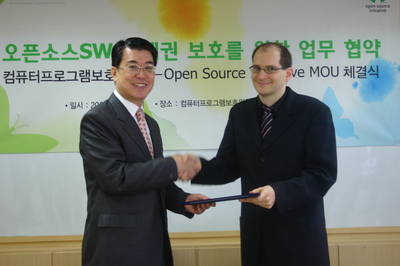
Martin Michlmayr: OSI signs an MOU with the Korea Software Copyright Committee

I visited Seoul last week to represent the Open Source Initiative (OSI) at an open source conference and to sign a Memorandum of Understanding (MOU) with the Korea Software Copyright Committee (SOCOP). SOCOP organized a conference with the title "Free Open Source Software License Insight Conference", and the international speakers included Brett Smith of the FSF, Brendan Scott of Open Source Law, Michael Cot of RedMonk and myself. From the questions we received, it seems that there is a lot of interest in legal questions related to open source. There were a number of folks from hardware companies that asked specific questions what they could do and couldn't do (e.g. related to including sources for GPL code and properly giving credit for BSD code). I think the conference was a great success. The talks were of high value and we got good questions. The audience was quite mixed, ranging from managers to developers. Even though they had simultaneous translation of the talks, the majority of the people listened in English... this gives me hope that some of these folks will end up becoming involved in the international open source community. Mr Koo and Dr Michlmayr signing MOU SOCOP is working on a number of activities related to open source, including: The day after the conference, I went to the SOCOP office to sign the MOU between SOCOP and OSI with Mr Yung Bo Koo, the chairman of SOCOP. The MOU says that we'll share knowledge and expertise, help with promotional activities and support each other's activities in other ways. I was delighted to sign the MOU between SOCOP and OSI, and I look forward to a fruitful cooperation between our organizations in the future. It's great to see so much interest and so many activities around open source in the Republic of Korea.

21 April 2009

Clint Adams: bug democracy

I don't know what votes are in a bug tracking system, but it's almost enough to distract me from sharing my opinion about Seb Ruiz, whoever he is.

19 April 2009

Miriam Ruiz: Debian packages for Structure Synth

Structure Synth is an application for creating 3D structures from a set of user specified rules. It is an attempt to make a 3D version of Context Free (a free -GPL ed- program that generates images from written instructions called a grammar). The cool thing about Structure Synth is that it has a simple language for writing recursive scripts that can generate complex structures (kinda Processing, but in 3D), and you can feed the result into Sunflow (a rendering system for photo-realistic image synthesis, already available in Debian) to generate Escher-like cool images. The program is waiting in the NEW queue, but you can temporarily download my packages (for Debian SID amd64) if you want. Even though I ve tried hard to be the one to blog about this, my friend Javier Candeira has won the competition and has been able to write about this earlier than me :P Spanish readers might want to have a look at JoSeKBlog, where he describes how to combine Structure Synth and Sunflow, and where I first read about the existence of the program.

16 April 2009

Stefano Zacchiroli: happy term Steve

DPL candidacy woes Well, time to face it publicly: I lost and Steve/Luk won, it is as simple as that :-) This post is to: All in all, standing for DPL has been worth and interesting no matter the result. Time to get back to my usual Debian duties now ...

8 April 2009

Obey Arthur Liu: Google Summer of Code at Debian: Update, need mentors!

A quick update before the big one about the 2009 Google Summer of Code. I believe we had a great recruitment drive this year and we have a very good set of proposals to work with. We d like to thank everyone involved for their help. We re now ranking out student applications. I promised elsewhere that I ll send out our shortlist of projects once Google sends us our preliminary slot allocation today but I misread the thread on the -mentors list and that count will only happen on Thursday, so we ll have to wait a bit more. That shortlist would only include projects, but not individual students. The idea is to give a heads up to everyone before committing to a group of projects and students. It is very important to inform the community as it increases visibility of the students work, giving them more help and support (and also avoids duplicating existing not yet publicized work!). As far as mentors go, we should have all of our approximately 14 planned projects covered, except for 2. I m posting them here in case you could mentor or help find mentors for those projects. (The wiki pages are not really up to date, so please come on IRC and ask clarifications, see below) Finish Petr Rockai s Adept 3.0 and bring a Qt4 Package Manager to Debian, with a different interface paradigm than Aptitude-gtk.
Petr said he would provide help with the existing codebase but can t mentor. Sune Vuorela from Debian KDE is ready to help with Qt4 related issues. Build Debian tools to create Debian images for Amazon EC2 and the free Eucalyptus implementation. Packaging of the Eucalyptus hosting framework is also possible.
For this project, we already have on board to help: Charles Plessy from Debian Med, Eric Hammond, developer of the existing vmbuilder Ubuntu tool for EC2 and Chris Grzegorczyk and Rich Wolski, from the Eucalyptus team. Plenty of people to get help from. Mentoring is a great experience! See this for what it entails. If we still can t find a mentor by the end of the week, I ll blast an announcement over at debian-devel@l.d.o along with the project shortlist. In the meantime, don t forget to idle on #debian-soc on irc.debian.org.

31 March 2009

Russell Coker: Censorship, Piracy, and Movie Ideas

Flame has written a satirical post about the different methods used to try and prevent unauthorised use of copyright movies and the distribution of illegal porn [1]. He has also written an amusing rant about how offended he was by the false advertising of an erotic movie [2]. I think that both these issues need to be addressed at the same time. We need to have an erotic movie about a senator and some movie executives who go on a cruise. It could start with the senator wearing fishnet stockings under his suit while giving a speech about the need to prevent the distribution of pornography and protect the children . Then when on the the cruise he meets a young looking woman who likes wearing school uniforms and spends some of his spare time photographing her in artistic poses. Most of the film would have gratuitous shots of people wearing less clothing than usual and spanking each other (including the senator giving a good impression of Dr Frank n Furter [3]). An element of mystery would also be good - who did the senator sleep with while blindfolded? The finale would have the senator in bed with the movie executives in an analogy of what senators do in real life (except that real life has a lot less spanking). This plot wouldn t necessarily imply a movie of Ed Wood [4] caliber. Let s face it, most Hollywood movies don t have a plot (the exceptions being those that are copied from successful movies from other times or places). Disclaimer: This plot idea is strictly a work of fiction and bears no resemblance to any real people (I wouldn t want my blog to end up in a secretive government blacklist). That said, if you want to imagine that any male politician who gives a speech about protecting the children is wearing lingerie while doing so, then go for it (you might even be right).

Next.

Previous.