Search Results: "robert"

11 January 2007

Martin F. Krafft: To Kill a Mockingbird

To Kill a Mockingbird is in the ImDB Top 50 charts, and even though I've never been much of a charts person, I found them to be strangely accurate and have more than merely enjoyed each of the movies ranked 8 or above by the visitors of the site, with the exception of the fantasy and some of the science fiction movies those are just not my thing. I've owned the Mockinbird movie for quite a while but it's been until tonight that I haven't watched it. Whenever I took it out, I dismissed it as being too serious, as yet another movie that dealt with the topic of the inhuman treating of negroes in America, and similar to movies depicting Third Reich Germany, I've reached the point of saturation fairly soon, having seen The Shawshank Redemption, Mississippi Burning, and Malcolm X and many others. To Kill a Mockingbird was somewhat different in that its main focus is the relationship between the defendant's lawyer Atticus and his children, Jem and Scout. Especially Scout, the daughter, played by Mary Badham (who was to become to youngest nominee for the Best Supporting Actress award) displays a character that got right to my heart, but this is not to discredit Gregory Peck, who plays Atticus, and Robert Mulligan's directing, or most any of the other actors involved. I feel unable to write about the film, unable to find the right words. This is not to say that I am too moved by it, but simply because I wouldn't be able to describe the sheer beauty I found during the two hours it lasted. Definitely recommended. NP: Yue / ZKM Improv, 2006-04-29

16 December 2006

Robert McQueen: Telepathy and OLPC (part 2)

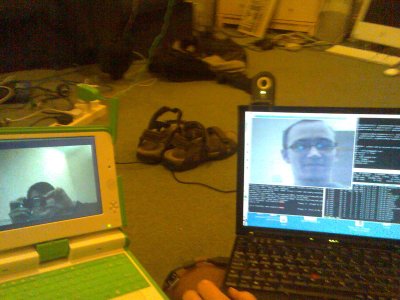
I’ve been away from the office for a couple of days, but when I got back to Cambridge, Daf and Sjoerd had some pretty cool stuff to show me: These screenshots are taken by using an environment variable to tell stream-engine just to create an xvimagesink for any call, but Daf’s writing a simple pygtk UI which handles embedding the output window into the UI properly and should make placing/receiving calls slightly less mystical. Even so, a graphical video call APP in ~150 lines of python… not too bad if you ask me. :)

15 December 2006

Robert Collins: 14 Dec 2006

So, phone call today went something like this Yeah, I was seriously cranky - after the amount of email spam I cleaned out this morning, it was -not- a good day to be spamming my mobile phone number. I feel somewhat guilty about the abusive (its not my normal persona!) language to the poor shmuck (who sounded like they come from an Indian call centre by accent) whose job it is to spam people, but not very: they are willing to do so - so I dont feel guilty. I do feel quite a sense of satisfaction though : imagine having one of the pharma spammers on the phone - what would you choose to say to them ?

12 December 2006

Robert McQueen: Telepathy and OLPC

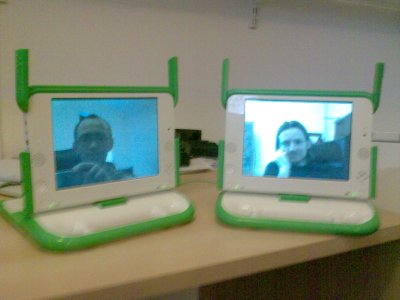
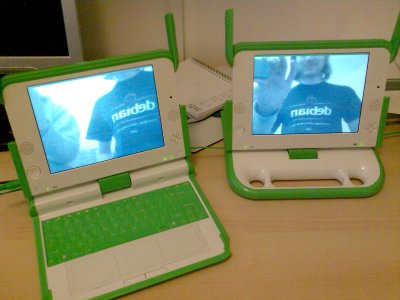
We got an OLPC prototype at Collabora last week, and have been playing with the Telepathy VOIP/IM framework on the devices. Using telepathy-gabble’s (our XMPP backend) Jingle implementation, and telepathy-stream-engine with the Farsight GStreamer RTP library, we got a bidirectional voice/video call going pretty quickly using a few lines of python and a bit of hackery (patches to follow :D). We’re going to polish this up into an activity you can install, and also Sjoerd Simons has been working with us on telepathy-salut, an XMPP Link-Local (also known as Rendezvous, Bonjour, iChat, whatever) backend which we’re hoping to also get working as part of the OLPC platform.

3 December 2006

Andree Leidenfrost: Upgrade Testing with QEMU

I have been really busy until two weeks ago [Shameless plug: If you need a (technical) project manager and/or hands-on Basis person to get your SAP R/3 system upgraded to ECC6, get in touch.]. Which means I've been a bit slack - so slack in fact that Andreas Barth had to resolve an RC bug in one of my packages - mea culpa.

Ridden by guilt I decided to finally do what I've been wanting to for some time: Putting the steps together to do a Debian test upgrade using QEMU. I chose QEMU because it is free and readily comes with Debian. It is slower than VMware, at least without the non-free kernel module, but still usable on somewhat reasonable hardware. The actual upgrade steps given below are independent of the virtualisation technology used, so they will apply to VMware as well.

Without further ado, here goes:
All in all, things seem to work ok. However, this is far from hitting the friendly green upgrade button and it just happens. So, I thought I try the next best thing to the friendly green upgrade button which is synaptic. Doing an upgrade with synaptic does actually work quite smoothly. It needs to be restarted a few times, leaves some cruft in terms of obsolete and orphan packages and the reboot doesn't really work from within Gnome, but other than that it is ok. Most notably, it didn't leave me with an unusable system in the middle of it all.

Robert Collins made some interesting remarks about the challenges of upgrades last week when we had dinner with Martin Krafft and a number of other great people. It looks like the Ubuntu folks are working on improving update-manager but also the underlying infrastructure to smooth out the upgrade process. Maybe there could be an opportunity to work together on this and achieve a situation where upgrades become as smooth as installs are now due to the fantastic work of the d-i people.

22 November 2006

Adam Rosi-Kessel: Netflix Should Have Standing Orders

One feature I’d like to see at Netflix: a “standing order” for films that match particular criteria. For example, I would be happy to have Netflix automatically add any Pedro Almodóvar film to my queue as soon as it enters the Netflix universe (Volver looks interesting). I also wouldn’t mind any film rated four stars by Roger Ebert to be dropped into the queue. You could even ask Netflix to add anything that its collaborative filters give a top rating based on your past preferences. Then you would just sit back and be surprised at what arrives for you. Rather than “opt-in,” the system would become “opt-out” — similar to those discount CD clubs that were popular in the 1980’s, where you had to tell them if you didn’t want the pick of the month. (I built the bulk of my CD collection in that era by taking advantage of the occasional “3 for the price 1” deals.) The difference here is that you are actually likely to want the pick of the month. A related feature would be “add all” matching a certain criteria with a single action — for example, all Hitchcock films. This is pretty much how I select films anyway. Knowing that a film is directed by Robert Bresson or Akira Kurosawa (two of my favorite directors) tells me a lot more than a plot synopsis. I’d actually rather know nothing about the film itself in advance.

21 November 2006

Ben Hutchings: Interface checking

Robert Collins writes: "Added to my list of 'things we need'... a version of icheck that requires less configuration to hook into package builds. Ideally one that we can get running automatically on any package build." There's only so much you can do without having debug information from both versions, which of course we don't keep at present. However, Steve Langasek implemented some basic checks on exported symbols in the unixodbc package which you can find in its debian directory. I'm slowly starting to work on a more comprehensive ABI checker that would use debug information. This would require someone to keep or rebuild debug information from the previous version (and to delay stripping it from the new version) so I don't think it could be automatic.

Robert Collins: 20 Nov 2006

Added to my list of 'things we need'... a version of icheck that requires less configuration to hook into package builds. Ideally one that we can get running automatically on any package build. Yes, its sci-fi, but avoiding ABI breaks across all libraries would be fantastic.

19 November 2006

Robert Collins: 18 Nov 2006

Well, UDS mountain view is over, and all-hands. I found the USA fun in a number of ways. However, for some reason I recieved the 'SSSS' ("Selected for Secondary Security Screening") marker on my boarding pass in both directions, which is known to not be a coincidence. So someone out there with my name is a security risk, or its because I flew from .au to .us on a .nz passport or perhaps they think I'm this guy. I think its time we did something about this. I urge every American to start writing to your senator or representative about this.. Bruce Schneier and others have already commented on how ineffective the SSSS mechanism is. For my part, I'm now boycotting as much as possible every company based in the USA. And I shall never visit the USA except when work compels me to. Which is of course a shame, as many of the people in the USA are nice: but unless they collectively *do something* and fix their out of control government, the USA is heading into being a surveillance state.

27 October 2006

Scott James Remnant: Parallel Peer Programming

Here at Canonical Towers we have several staff who worship at the altar of Extreme Programming, and as such many of the methodologies and rituals prescribed by that religion find their way into our day-to-day working practices. A few of these came together in an interesting way a few weeks ago, and it was suggested by a cow-orker that I blog about it so he could give the URL to people. The first ritual is that of the sprint, I don’t think this is orthodox XP but rather something inspired from it that we picked up from the Python community. With all of the Canonical developers scattered across the globe mostly working from their own homes, it’s become a useful tool; particularly for the Launchpad team. The basic idea for those that haven’t heard of it is simple, and perhaps obvious; you get a selection of the team together in one place, sit them around the same table with particular goals to complete. In effect it’s highly compressed facetime and high bandwidth interaction to nail those tasks that need it, before you head off again and work at a more sedate pace. The second is directly from XP doctrine and is that peculiar observance known as pair programming, something that is often coupled with sprints. For anybody who hasn’t encountered this before, it’s something I’ve always found rather odd. You get two programmers together, both itching to code, and you take one of them’s laptop away; and you don’t just force them to fight over the keyboard either, the laptop-less soul isn’t allowed to touch it. The theory here is that it frees the deprived individual of the hassle of coding and allows them to direct the programmer in ways that may not be immediately obbious, or alternately think about the next bit of work that needs doing. Another interesting side-effect is it can be an interesting way to learn code you’ve not worked with before, if you’re the one doing the coding and you’re being guided what to do by a sage who already knows it. I have a funny story here, so I’m going to digress from the main stream for a moment to tell it. A few months ago I was working in the London office, Mark had been up all night coding and had then given me responsibility to get his changes landed onto the Launchpad mainline. I’m not that hot on quite a bit of Launchpad, and fade to utterly clueless the nearer the code gets to the web application itself; and when trying to merge the two there were conflicts which I needed Mark’s help to resolve. Now as anybody who’s met Mark knows, he’s a pretty good example of a Type-A personality, yet he suggested that we do a spot of pair programming to get the code in and I’d be the one with the laptop as it’d help me get to grips with the affected parts. This hilighted something I’ve always seen as a problem with pair programming, dealing with it when the a person with the keyboard has a totally different way of working to you. In particular, I’m an emacs user, whereas Mark is a die-hard vim user; but also right down to the working directory I would work from, how I test results, etc. When you’re the one without the laptop, this can be quite infuriating, as you know exactly how to solve a problem and the idiot with the keyboard is dithering about doing things you don’t understand just to get there. If you’re a Type-A personality, you generally snatch the laptop away at this point and do it yourself; or at least you would, if you could drive the strange editor the other person uses. I swear Mark was sulking as he gave the laptop back and let me do it. Anyway, there is some relevance to that and we’ll come to it in a moment. The third and final methodology is the concept of unit tests and more specifically test driven development. For anyone who hasn’t come across this before, I highly recommend it; I was suspicious too when Robert Collins took it upon himself to teach me the true way, but now I’m sold. Simply the idea is that if you have any code that doesn’t have another piece of code in a test suite that checks that it’s working correctly, that code is broken. More particularly unit testing involves checking just one feature or requirement at a time, and stacking them together to test all of the code paths. I’ve actually found that this improves the APIs I design, as I write the code in small blocks and functions to make them easier to test. Test driven development takes it even further, you write the unit tests first, before you write the code they’re supposed to test; usually one or two at a time. Obviously these tests will fail at first, it’s then your job to write as little code as possible to make them pass. If your code isn’t right, you add a unit test that will fail, and modify the code to make it pass. This really comes into its own when you’re fixing bugs later, once you’ve identified the bug you write a test case or two that cause the problem; these will of course fail. You can then modify the code to make them pass, and at the same time be sure you’ve not broken other functionality because of the existing test suite. I’ve also found it really useful for particularly complicated or tricky pieces of code, especially those intricate algorithms that do particularly heavy lifting. So onto the event itself, this was a sprint in our London office to indoctrinate Gustavo Niemeyer with the various projects he’d be working on. The goal for this sprint was decided to start the conversion of HCT to Bazaar-NG, and to do this Gustavo and I would pair program. Now my last experience of pair programming had been that story with Mark (see, it had some relevance) and I knew I’d be just as bad if I wasn’t allowed to have the keyboard. I was also acutely aware that if Gustavo was just sitting by and watching, he wouldn’t get much benefit from it either, so he needed to be actively involved in the coding so he could learn the things he’d be working on. I came to what I thought was a pretty neat, and obvious, solution to these problems. We set up my laptop with the code we’d be working on, and on my display were two side-by-side terminals both running screen sessions. Gustavo then set up two same-sized terminals on his, ssh’d into my laptop from both of them and joined the screen sessions. In the left-hand one he ran vi, and in the right-hand one I ran emacs. Thus we both had keyboards, and both had editors, yet could see each other working and even steal the keyboard without danger of violence. We didn’t just sit side-by-side and code on different things though, that’s not pair programming and is just ordinary programming with a bit of a voyeuristic twist. What we did was: in my terminal I started writing the test cases for the code we needed, it was Gustavo’s job to write the code that would make them pass. We actually added a third terminal in which we could run the test cases themselves; so I could run them when I’d added something that would fail, and Gustavo could run them when he thought he’d made them pass again. This turned out to be a rather fun way to work, and at one point I was almost able to try and convince myself that the code was writing itself to pass the test cases I was writing. It also got me thinking that it’d be really neat to use genetic algorithms to breed code to pass test cases.

Dirk Eddelbuettel: Too good to be true?

Robert Cringely opens his new-look digs (now in blog format which is funny given how his columns predate the term by a good while, even though they always were web logs') with a stunning column about a new disk technology coming to market next year:
[...] disk drives that held up to three times as much data in the same space, were more reliable, actually cheaper to build, and used 70-95 percent less energy to run.
[...]
Our metal foil drive costs less, not more, and spins up so quickly that data can be read from disk as fast or faster than it can be read from flash. Who needs a hybrid disk drive?
[...]
The market potential is one billion computer disk drives and one billion mobile phone drives per year. And it all starts around this time next year when metal foil drives will begin to appear under well-known brand names.
Bring'em on.

23 October 2006

John Goerzen: We need to follow the Amish example

Just a few weeks ago, the world heard the news of the tragic school shooting at an Amish school in rural Pennsylvania. A deranged man entered the schoolhouse, bound and gagged female hostages, brought along torture equipment, and shot 10 of them. 5 died, and the remaining 5 are believed to still be hospitalized.

Back in 1990, a deranged man committed a series of murders near the University of Florida campus in Gainesville. The story mentions 5 people that were killed.

Both were tragic situations. Both men killed people that had their whole lives in front of them. Both shook an entire community.

But look at how the communities responded. The Amish responded like this:

CNN reported a grandfather of one of the murdered Amish girls said of the killer on the day of the murder: "We must not think evil of this man."

Jack Meyer, a member of the Brethren community living near the Amish in Lancaster County, explained: "I don't think there's anybody here that wants to do anything but forgive and not only reach out to those who have suffered a loss in that way but to reach out to the family of the man who committed these acts," he told CNN.

The Amish have reached out to Roberts' family. Dwight Lefever, a Roberts family spokesman said an Amish neighbor comforted the Roberts family hours after the shooting and extended forgiveness to them.

An article in a Canadian newspaper the National Post stated that the Amish have set up a charitable fund for the family of the shooter. (Wikipedia)


In addition, the Amish invited the Roberts family to attend the funerals for the Amish girls he killed.

Gainesville reacted this way:

Dianna Hoyt, Christa Hoyt's stepmother, said Rolling's execution has been eagerly awaited by the victims' families. Some will be inside the prison to witness it. . .

Sadie Darnell, who was the police department's media spokeswoman at the time and developed enduring friendships with the victims' families, said Rolling's execution still matters, even if it also provides him more of the notoriety he sought.

"Retribution . . . is important because it represents that our society is holding that person accountable," said Darnell, now a candidate for Alachua County sheriff. (CNN)


We've all heard of murders that have taken place lately. Usually they are accompanied by calls by politicians, victim's family, and sometimes even clergy to kill the perpetrator. In the days after 9/11, there were reports of anybody that looked Middle Eastern being attacked in several different places around the country.

I have never understood this great desire for revenge. How does that help anyone?

What the Amish did was right religiously and morally. They truly followed the New Testament call to love your enemies and forgive. It is not easy to follow all of Jesus' teachings, and nobody said it would be. But they are doing it, and they have already begun healing. Reports are that the Roberts family has become friends with several of the Amish in the area, and they are working to help each other out after this horrible tragedy.

Even putting religion aside for a moment, the Amish actions are quite simply the right thing to do. By spreading love instead of hate, and friendship instead of revenge, they have succeeded in making sure that no cycle of violence starts there.

In contrast, 16 years later, the families of the victims in Florida still aren't healing. They are still angry and bitter. They are still seeking revenge. They hope that their lives will get back to normal after the murderer is killed. But after 16 years of stewing about it, will they really? And what about the family of the murderer, whose lives certainly must have been a mess for the past 16 years? They will now lose a family member. Does anyone care about them, or will they now turn angry at society and possibly spread the pain more?

Imagine what would happen if so many more people around the world took the Amish perspective -- to forgive those that wronged us. How long must it be before we can forgive? How far back do we spread our hate? Do we still hate those that were involved in 9/11, or can we forgive them? Do we still hate the Germans for what their ancestors did in World War II, or can we forgive them? Do we hate politicians with whom we strongly disagree, or think are liars? Do we still hate all those that have wronged us personally -- someone that stole something from us or the sadistic boss?

Knives, electric chairs, and bombs do not buy reconciliation. They can not "win over" the hearts of others. They do not make our lives easier. Hate brings more hate, and more resentment.

Forgiveness is not easy. We all hope that we will never be involved in such a tragedies as these. But let us follow the example the Amish have shown -- forgive for all things, big or small, important or not, painful or not.

Only then will we be at peace with ourselves, and only then will we have the chance to be at peace with our neighbors.
16 October 2006

Robert Collins: 16 Oct 2006

Just landed a sweet feature for bzr: dotted decimal revision numbers. There is a sample log (warning its 2Mb) where you can see this in all its glory. A sneak preview is here:
------------------------------------------------------------
revno: 1986
committer: Canonical.com Patch Queue
Manager<pqm@pqm.ubuntu.com>
branch nick: +trunk
timestamp: Wed 2006-09-06 00:33:01 +0100
message:
  (robertc) Add TestCase.applyDeprecated, a common-case
helper for testing deprecated functions.
    ------------------------------------------------------------
    revno: 1982.3.3
    merged:
robertc@robertcollins.net-20060905231840-bd95f673d0205a81
    committer: Robert Collins <robertc@robertcollins.net>
    branch nick: applyDeprecated
    timestamp: Wed 2006-09-06 09:18:40 +1000
    message:
      Change raise AssertionError to self.fail in the new
applyDeprecated test support method.
    ------------------------------------------------------------
    revno: 1982.3.2
    merged:
robertc@robertcollins.net-20060905230133-2c68611e38fd7922
    committer: Robert Collins <robertc@robertcollins.net>
    branch nick: applyDeprecated
    timestamp: Wed 2006-09-06 09:01:33 +1000
    message:
      New TestCase helper applyDeprecated. This allows you
to call a callable
      which is deprecated without it spewing to the screen,
just by supplying
      the deprecation format string issued for it. (Robert
Collins)
------------------------------------------------------------
revno: 1985
committer: Canonical.com Patch Queue
Manager<pqm@pqm.ubuntu.com>
branch nick: +trunk
timestamp: Tue 2006-09-05 23:13:00 +0100
message:
  (robertc) Add symbol_versioning.deprecation_string, a
helper for establishing what a deprecation warning for a
symbol, version-format pair will look like.
This is really nice for users, because it lets them address revisions in a somewhat more predictable manner than the UUID each revision has. This feature is in the mainline now, look for bzr 0.12 to be able to use it - or grab bzr.dev now!

8 October 2006

Robert Collins: 8 Oct 2006

It make be a small thing, but barriers to entry are .. barriers to entry. Erlang has a make-life file built into the system. If you see something like 'Emakefile', you might be tempted to google 'emake'. Dont. Instead, run 'erl -make'. And this is my point : that should be made much more obvious. Simply saying in the README for an app that uses this, 'build with erl -make' would remove all the mystery.

7 October 2006

Robert Collins: 7 Oct 2006

Man, paper selection is awesomely hard... but we've done it!

2 October 2006

Robert Collins: 1 Oct 2006

My second release as bzr release manager is over - 0.11 is released. John A Meinel will be doing the 0.12 release - and it looks to be a cracker!

30 September 2006

Otavio Salvador: GRUB legacy is frozen

During this week, Robert (one of maintainers of grub), proposed on the mailing list to freeze it. We won’t do a hard freeze but we’ll only accept patches that: Besides, he did a lot of good work on GRUB2. All new developments, improvements and refactorings are focused on GRUB2 now. We intend to move to it as soon as Etch goes out and ’cause of that we engourage everyone to make a test and report his/her results to us. I also want to ask to everyone who did previous work on grub and that wasn’t merged until now, try to convert it to grub2 and coordenate with us how we can integrate it better with grub2.

27 September 2006

Robert Collins: 26 Sep 2006

I've just released bzr 0.11rc2 which unbreaks the test suite for windows and fixes our commit performance regression! The 0.12 release will be managed by John Arbash Meinel, giving me some more cycles to focus on local performance. Yay!

22 September 2006

Scott James Remnant: Parallel Peer Programming

Here at Canonical Towers we have several staff who worship at the altar of Extreme Programming, and as such many of the methodologies and rituals prescribed by that religion find their way into our day-to-day working practices. A few of these came together in an interesting way a few weeks ago, and it was suggested by a cow-orker that I blog about it so he could give the URL to people. The first ritual is that of the sprint, I don’t think this is orthodox XP but rather something inspired from it that we picked up from the Python community. With all of the Canonical developers scattered across the globe mostly working from their own homes, it’s become a useful tool; particularly for the Launchpad team. The basic idea for those that haven’t heard of it is simple, and perhaps obvious; you get a selection of the team together in one place, sit them around the same table with particular goals to complete. In effect it’s highly compressed facetime and high bandwidth interaction to nail those tasks that need it, before you head off again and work at a more sedate pace. The second is directly from XP doctrine and is that peculiar observance known as pair programming, something that is often coupled with sprints. For anybody who hasn’t encountered this before, it’s something I’ve always found rather odd. You get two programmers together, both itching to code, and you take one of them’s laptop away; and you don’t just force them to fight over the keyboard either, the laptop-less soul isn’t allowed to touch it. The theory here is that it frees the deprived individual of the hassle of coding and allows them to direct the programmer in ways that may not be immediately obbious, or alternately think about the next bit of work that needs doing. Another interesting side-effect is it can be an interesting way to learn code you’ve not worked with before, if you’re the one doing the coding and you’re being guided what to do by a sage who already knows it. I have a funny story here, so I’m going to digress from the main stream for a moment to tell it. A few months ago I was working in the London office, Mark had been up all night coding and had then given me responsibility to get his changes landed onto the Launchpad mainline. I’m not that hot on quite a bit of Launchpad, and fade to utterly clueless the nearer the code gets to the web application itself; and when trying to merge the two there were conflicts which I needed Mark’s help to resolve. Now as anybody who’s met Mark knows, he’s a pretty good example of a Type-A personality, yet he suggested that we do a spot of pair programming to get the code in and I’d be the one with the laptop as it’d help me get to grips with the affected parts. This hilighted something I’ve always seen as a problem with pair programming, dealing with it when the a person with the keyboard has a totally different way of working to you. In particular, I’m an emacs user, whereas Mark is a die-hard vim user; but also right down to the working directory I would work from, how I test results, etc. When you’re the one without the laptop, this can be quite infuriating, as you know exactly how to solve a problem and the idiot with the keyboard is dithering about doing things you don’t understand just to get there. If you’re a Type-A personality, you generally snatch the laptop away at this point and do it yourself; or at least you would, if you could drive the strange editor the other person uses. I swear Mark was sulking as he gave the laptop back and let me do it. Anyway, there is some relevance to that and we’ll come to it in a moment. The third and final methodology is the concept of unit tests and more specifically test driven development. For anyone who hasn’t come across this before, I highly recommend it; I was suspicious too when Robert Collins took it upon himself to teach me the true way, but now I’m sold. Simply the idea is that if you have any code that doesn’t have another piece of code in a test suite that checks that it’s working correctly, that code is broken. More particularly unit testing involves checking just one feature or requirement at a time, and stacking them together to test all of the code paths. I’ve actually found that this improves the APIs I design, as I write the code in small blocks and functions to make them easier to test. Test driven development takes it even further, you write the unit tests first, before you write the code they’re supposed to test; usually one or two at a time. Obviously these tests will fail at first, it’s then your job to write as little code as possible to make them pass. If your code isn’t right, you add a unit test that will fail, and modify the code to make it pass. This really comes into its own when you’re fixing bugs later, once you’ve identified the bug you write a test case or two that cause the problem; these will of course fail. You can then modify the code to make them pass, and at the same time be sure you’ve not broken other functionality because of the existing test suite. I’ve also found it really useful for particularly complicated or tricky pieces of code, especially those intricate algorithms that do particularly heavy lifting. So onto the event itself, this was a sprint in our London office to indoctrinate Gustavo Niemeyer with the various projects he’d be working on. The goal for this sprint was decided to start the conversion of HCT to Bazaar-NG, and to do this Gustavo and I would pair program. Now my last experience of pair programming had been that story with Mark (see, it had some relevance) and I knew I’d be just as bad if I wasn’t allowed to have the keyboard. I was also acutely aware that if Gustavo was just sitting by and watching, he wouldn’t get much benefit from it either, so he needed to be actively involved in the coding so he could learn the things he’d be working on. I came to what I thought was a pretty neat, and obvious, solution to these problems. We set up my laptop with the code we’d be working on, and on my display were two side-by-side terminals both running screen sessions. Gustavo then set up two same-sized terminals on his, ssh’d into my laptop from both of them and joined the screen sessions. In the left-hand one he ran vi, and in the right-hand one I ran emacs. Thus we both had keyboards, and both had editors, yet could see each other working and even steal the keyboard without danger of violence. We didn’t just sit side-by-side and code on different things though, that’s not pair programming and is just ordinary programming with a bit of a voyeuristic twist. What we did was: in my terminal I started writing the test cases for the code we needed, it was Gustavo’s job to write the code that would make them pass. We actually added a third terminal in which we could run the test cases themselves; so I could run them when I’d added something that would fail, and Gustavo could run them when he thought he’d made them pass again. This turned out to be a rather fun way to work, and at one point I was almost able to try and convince myself that the code was writing itself to pass the test cases I was writing. It also got me thinking that it’d be really neat to use genetic algorithms to breed code to pass test cases.

15 September 2006

Joey Hess: bookmarks and stuff

This is kinda a mix between my list of bookmarks and some things I've been thinking about and following lately. astronomy I've been reading a lot of astronomy stuff lately, a lot more than my usual low-level interest in it. I'm kind of feeling the need for a refresher course, so I can get a better handle on stuff that's happened since I studied this stuff in school. It's hard to get my head around things like dark matter and really grok the evidence. While black holes and relativity and such seem so obviously a natural part of this universe. Does this mean I'm getting old? The chance to bounce questions and ideas off someone would probably help in getting a real grip on this stuff. So would a lot more physics than I know.. (Hurrah for Eris BTW. The name almost makes all that sillyness over a mere definition worthwhile.) Favorite sites: Universe Today and Wikipedia.
weather I've been following this hurricane season, to make up for having paid so little attention to last year's disastrous one. I knew about the "New Orleans bowl" scenario well before Katrina, and the night before it hit I actually spent several hours tuning in far-away AM stations from down there and listening to the city not react in time. But despite all that I feel that I missed out on really seeing it happen, so I've been learning about tropical waves, and wind shear and ULL's, and dropsondes, and the satelite data that can be used to follow hurricanes. The nice thing is that instead of the old stereotype of someone watching the weather channel 24/7 with a map and thumbtacks, these days there's a nice mix of pre-processed info and analysis and raw data, easily followed in small amounts of time on Wunderground's blogs.
spaceflight Half love and half hate. The recent shuttle mission has been a riot for a shuttle-hater and SF lover. It has all the elements of one of those SF novels where they go down to the cape, dig up an Apollo stack, and use it to save the world / travel to Mars / fight the alien invaders. Except here they're pulling an unused orbitor out of mothbolls. And putting it up on the launchpad with a hurricane bearing down, getting it struck by lightning, pulling it off the pad, changing their mind with the giant crawler half-way through that milti-day maneuver when the hurricane fizzles, putting it back, filling and refilling the tank as sensors fail and they rewrite their safty regs on the fly, barely making the launch window, and proceeding to triumphantly lose nuts and break wrenches .. In Space! Space opera, indeed. Then there's the genuinely interesting stuff. Intentional crashing of a French probe into the moon, probes firing projectiles at asteroids and trying (with great difficulty and many glitches) to return a sample. A mission on its way to Pluto. The rovers still going strong on Mars after all this time. Bigelow launching an inflatable prototype of his planned space hotel. A whole load of microsats tragically blowing up on launch. All the private aereospace stuff, which seems to close to turning into something real. Happily followed at Spaceflight Now.
TV Over the past while and a half I've been very happy to discover The Wire and Deadwood, have been working my way through the Sopranos and Lost, been creepily fascinated by Big Love, got a kick out of the Canadian antics of Corner Gas, vegged out to Greys Anatomy, and have been very sad to reach the end of Six Feet Under. BSG, Doctor Who, House, and some other shows haven't held up as well past the first seasons for me. Happily, there's NetFlix, which makes it plausable that I did this legally despite not having HBO or even owning a TV.
literature I've been reading Charles Stross, David Drake, John Twelve Hawks, Kelly Armstrong, Naomi Novik, Robert Charles Wilson, VC Andrews, and, loath though I am to admit it, John Ringo. I'm in the middle of books by Steph Swainston, Geoff Ryman, and Dave Duncan. I finally found a defintion of Science Fiction I like, but I lost the link. (It's the subjective "her world exploded" one.) Anyway, I'm afraid that I may have reached the point where to get much more out of reading SF, I'd have to start going to cons. Which I don't want to do. But I seem to be at a low ebb for it being interesting to me, or just need to finally tackle some other branch of literature. Actually, the most engaging reading I've been doing lately is in the achives (all of them!) of the Idle Words blog. It makes obscure details about Poland and China, and even interpretation of Russian classics seem pretty darn interesting, and has much better rants about the space shuttle. And it proves that blog entries should properly be good and long.

Next.

Previous.