Search Results: "pa"

5 March 2026

Dirk Eddelbuettel: RcppGSL 0.3.14 on CRAN: Maintenance

A new release 0.3.14 of RcppGSL is now on CRAN. The RcppGSL package provides an interface from R to the GNU GSL by relying on the Rcpp package. It has already been uploaded to Debian, and is also already available as a binary via r2u. This release, the first in over three years, contains mostly maintenance changes. We polished the fastLm example implementation a little more, updated continunous integration as one does over such a long period, adopted the Authors@R convention, switched the (pre-made) pdf vignette to a new driver now provided by Rcpp, updated vignette references and URLs, and updated one call to Rf_error to aid in a Rcpp transition towards using only Rcpp::stop which unwinds error conditions better. (Technically this was a false positive on Rf_error but on the margin worth tickling this release after all this time.) The NEWS entry follows:

Changes in version 0.3.14 (2026-03-05)
  • Updated some internals of fastLm example, and regenerated RcppExports.* files
  • Several updates for continuous integration
  • Switched to using Authors@R
  • Replace ::Rf_error with (Rf_error) in old example to aid Rcpp transition to Rcpp::stop (or this pass-through)
  • Vignette now uses the Rcpp::asis builder for pre-made pdfs
  • Vignette references have been updated, URLs prefer https and DOIs

Thanks to my CRANberries, there is also a diffstat report for this release. More information is on the RcppGSL page. Questions, comments etc should go to the issue tickets at the GitHub repo.

This post by Dirk Eddelbuettel originated on his Thinking inside the box blog. If you like this or other open-source work I do, you can now sponsor me at GitHub.

Vincent Bernat: Automatic Prometheus metrics discovery with Docker labels

Akvorado, a network flow collector, relies on Traefik, a reverse HTTP proxy, to expose HTTP endpoints for its Docker Compose services. Docker labels attached to each service define the routing rules. Traefik picks them up automatically when a container starts. Instead of maintaining a static configuration file to collect Prometheus metrics, we apply the same approach with Grafana Alloy.

Traefik & Docker Traefik listens for events on the Docker socket. Each service advertises its configuration through labels. For example, here is the Loki service in Akvorado:
services:
  loki:
    #  
    expose:
      - 3100/tcp
    labels:
      - traefik.enable=true
      - traefik.http.routers.loki.rule=PathPrefix( /loki )
Once the container is healthy, Traefik creates a router forwarding requests matching /loki to its first exposed port. Colocating Traefik configuration with the service definition is attractive. How do we achieve the same for Prometheus metrics?

Metrics discovery with Alloy Grafana Alloy, a metrics collector that scrapes Prometheus endpoints, includes a discovery.docker component. Just like Traefik, it connects to the Docker socket.1 With a few relabeling rules, we teach it to use Docker labels to locate and scrape metrics. We define three labels on each service:
  • metrics.enable set to true enables metrics collection,
  • metrics.port specifies the port exposing the Prometheus endpoint, and
  • metrics.path specifies the path to the metrics endpoint.
If a service exposes more than one port, metrics.port is mandatory. Otherwise, it defaults to the only exposed port. The default value for metrics.path is /metrics. The Loki service from earlier becomes:
services:
  loki:
    #  
    expose:
      - 3100/tcp
    labels:
      - traefik.enable=true
      - traefik.http.routers.loki.rule=PathPrefix( /loki )
      - metrics.enable=true
      - metrics.path=/loki/metrics
Alloy s configuration is split into four parts:
  1. discover containers through the Docker socket,
  2. filter and relabel targets using Docker labels,
  3. scrape the matching endpoints, and
  4. forward the metrics to Prometheus.

Discovering Docker containers The first building block discovers running containers:
discovery.docker "docker"  
  host             = "unix:///var/run/docker.sock"
  refresh_interval = "30s"
  filter  
    name   = "label"
    values = ["com.docker.compose.project=akvorado"]
   
 
This connects to the Docker socket and lists containers every 30 seconds.2 The filter block restricts discovery to containers belonging to the akvorado project, avoiding interference with unrelated containers on the same host. For each discovered container, Alloy produces a target with labels such as __meta_docker_container_label_metrics_port for the metrics.port Docker label.

Relabeling targets The relabeling step filters and transforms raw targets from Docker discovery into scrape targets. The first stage keeps only targets with metrics.enable set to true:
discovery.relabel "prometheus"  
  targets = discovery.docker.docker.targets
  // Keep only targets with metrics.enable=true
  rule  
    source_labels = ["__meta_docker_container_label_metrics_enable"]
    regex         =  true 
    action        = "keep"
   
  //  
 
The second stage overrides the discovered port when the service defines metrics.port:
// When metrics.port is set, override __address__.
rule  
  source_labels = ["__address__", "__meta_docker_container_label_metrics_port"]
  regex         =  (.+):\d+;(.+) 
  target_label  = "__address__"
  replacement   = "$1:$2"
 
Next, we handle containers in host network mode. When __meta_docker_network_name equals host, Alloy rewrites the address to host.docker.internal instead of localhost:3
// When host networking, override __address__ to host.docker.internal.
rule  
  source_labels = ["__meta_docker_container_label_metrics_port", "__meta_docker_network_name"]
  regex         =  (.+);host 
  target_label  = "__address__"
  replacement   = "host.docker.internal:$1"
 
The next stage derives the job name from the service name, stripping any numbered suffix. The instance label is the address without the port:
rule  
  source_labels = ["__meta_docker_container_label_com_docker_compose_service"]
  regex         =  (.+)(?:-\d+)? 
  target_label  = "job"
 
rule  
  source_labels = ["__address__"]
  regex         =  (.+):\d+ 
  target_label  = "instance"
 
If a container defines metrics.path, Alloy uses it. Otherwise, it defaults to /metrics:
rule  
  source_labels = ["__meta_docker_container_label_metrics_path"]
  regex         =  (.+) 
  target_label  = "__metrics_path__"
 
rule  
  source_labels = ["__metrics_path__"]
  regex         = ""
  target_label  = "__metrics_path__"
  replacement   = "/metrics"
 

Scraping and forwarding With the targets properly relabeled, scraping and forwarding are straightforward:
prometheus.scrape "docker"  
  targets         = discovery.relabel.prometheus.output
  forward_to      = [prometheus.remote_write.default.receiver]
  scrape_interval = "30s"
 
prometheus.remote_write "default"  
  endpoint  
    url = "http://prometheus:9090/api/v1/write"
   
 
prometheus.scrape periodically fetches metrics from the discovered targets. prometheus.remote_write sends them to Prometheus.

Built-in exporters Some services do not expose a Prometheus endpoint. Redis and Kafka are common examples. Alloy ships built-in Prometheus exporters that query these services and expose metrics on their behalf.
prometheus.exporter.redis "docker"  
  redis_addr = "redis:6379"
 
discovery.relabel "redis"  
  targets = prometheus.exporter.redis.docker.targets
  rule  
    target_label = "job"
    replacement  = "redis"
   
 
prometheus.scrape "redis"  
  targets         = discovery.relabel.redis.output
  forward_to      = [prometheus.remote_write.default.receiver]
  scrape_interval = "30s"
 
The same pattern applies to Kafka:
prometheus.exporter.kafka "docker"  
  kafka_uris = ["kafka:9092"]
 
discovery.relabel "kafka"  
  targets = prometheus.exporter.kafka.docker.targets
  rule  
    target_label = "job"
    replacement  = "kafka"
   
 
prometheus.scrape "kafka"  
  targets         = discovery.relabel.kafka.output
  forward_to      = [prometheus.remote_write.default.receiver]
  scrape_interval = "30s"
 
Each exporter is a separate component with its own relabeling and scrape configuration. We set the job label explicitly since no Docker metadata can provide it.
With this setup, adding metrics to a new service with a Prometheus endpoint requires only a few labels in docker-compose.yml, just like adding a Traefik route. Alloy picks it up automatically. You can apply the same pattern with another discovery method, like discovery.kubernetes, discovery.scaleway, or discovery.http.

  1. Both Traefik and Alloy require access to the Docker socket, which grants root-level access to the host. A Docker socket proxy mitigates this by exposing only the read-only API endpoints needed for discovery.
  2. Unlike Traefik, which watches for events, Grafana Alloy polls the container list at regular intervals a behavior inherited from Prometheus.
  3. The Alloy service needs extra_hosts: ["host.docker.internal:host-gateway"] in its definition.

4 March 2026

Sean Whitton: Southern Biscuits with British ingredients

I miss the US more and more, and have recently been trying to perfect Southern Biscuits using British ingredients. It took me eight or nine tries before I was consistently getting good results. Here is my recipe. Ingredients Method
  1. Slice and then chill the butter in the freezer for at least fifteen minutes.
  2. Preheat oven to 220 C with the fan turned off.
  3. Twice sieve together the flours, leaveners and salt. Some salt may not go through the sieve; just tip it back into the bowl.
  4. Cut cold butter slices into the flour with a pastry blender until the mixture resembles coarse crumbs: some small lumps of fat remaining is desirable. In particular, the fine crumbs you are looking for when making British scones are not wanted here. Rubbing in with fingertips just won t do; biscuits demand keeping things cold even more than shortcrust pastry does.
  5. Make a well in the centre, pour in the buttermilk, and stir with a metal spoon until the dough comes together and pulls away from the sides of the bowl. Avoid overmixing, but I ve found that so long as the ingredients are cold, you don t have to be too gentle at this stage and can make sure all the crumbs are mixed in.
  6. Flour your hands, turn dough onto a floured work surface, and pat together into a rectangle. Some suggest dusting the top of the dough with flour, too, here.
  7. Fold the dough in half, then gather any crumbs and pat it back into the same shape. Turn ninety degrees and do the same again, until you have completed a total of eight folds, two in each cardinal direction. The dough should now be a little springy.
  8. Roll to about inch thick.
  9. Cut out biscuits. If using a round cutter, do not twist it, as that seals the edges of the biscuits and so spoils the layering.
  10. Transfer to a baking sheet, placed close together (helps them rise). Flour your thumb and use it to press an indent into the top of each biscuit (helps them rise straight), brush with buttermilk.
  11. Bake until flaky and golden brown: about fifteen minutes.
Gravy It turns out that the pepper gravy that one commonly has with biscuits is just a white/b chamel sauce made with lots of black pepper. I haven t got a recipe I really like for this yet. Better is a sausage gravy ; again this has a white sauce as its base, I believe. I have a vegetarian recipe for this to try at some point. Variations Notes

Sean Whitton: dgit-as-a-service retrospective

We recently launched tag2upload, aka cloud dgit or dgit-as-a-service. This was something of a culmination of work I ve been doing since 2016 towards modernising Debian workflows, so I thought I d write a short personal retrospective. When I started contributing to Debian in 2015, I was not impressed with how packages were represented in Git by most package maintainers, and wanted a pure Git workflow. I read a couple of Joey Hess s blog posts on the matter, a rope ladder to the dgit treehouse and upstream git repositories and made a bug report against dgit hoping to tie some things together. The results of that early work were the git-deborig(1) program and the dgit-maint-merge(7) tutorial manpage. Starting with Joey s workflow pointers, I developed a complete, pure Git workflow that I thought would be suitable for all package maintainers in Debian. It was certainly well-suited for my own packages. It took me a while to learn that there are packages for which this workflow is too simple. We now also have the dgit-maint-debrebase(7) workflow which uses git-debrebase, something which wasn t invented until several years later. Where dgit-maint-merge(7) won t do, you can use dgit-maint-debrebase(7), and still be doing pretty much pure Git. Here s a full, recent guide to modernisation. The next most significant contribution of my own was the push-source subcommand for dgit. dgit push required a preexisting .changes file produced from the working tree. I wanted to make dgit push-source prepare that .changes file for you, but also not use the working tree, instead consulting HEAD. The idea was that you were doing a git push which doesn t care about the working tree direct to the Debian archive, or as close as we could get. I implemented that at DebConf18 in Taiwan, I think, with Ian, and we also did a talk on git-debrebase. We ended up having to change it to look at the working tree in addition to HEAD to make it work as well as possible, but I think that the idea of a command which was like doing a Git push direct to the archive was perhaps foundational for us later wanting to develop tag2upload. Indeed, while tag2upload s client-side tool git-debpush does look at the working tree, it doesn t do so in a way that is essential to its operation. tag2upload is dgit push-source-as-a-service. And finally we come to tag2upload, a system Ian and I designed in 2019 during a two-person sprint at his place in Cambridge, while I was visiting the UK from Arizona. With tag2upload, appropriately authorised Debian package maintainers can upload to Debian with only pure Git operations namely, making and pushing a signed Git tag to Debian s GitLab instance. Although we had a solid prototype in 2019, we only finally launched it last month, February 2026. This was mostly due to political delays, but also because we have put in a lot of hours making it better in various ways. Looking back, one thing that seems notable to me is that the core elements of the pure Git workflows haven t changed much at all. Working out all the details of dgit-maint-merge(7), designing and writing git-debrebase (Ian s work), and then working out all the details of dgit-maint-debrebase(7), are the important parts, to me. The rest is mostly just large amounts of compatibility code. git-debrebase and dgit-maint-debrebase(7) are very novel but dgit-maint-merge(7) is mostly just an extrapolation of Joey s thoughts from 13 years ago. And yet, adoption of these workflows remains low. People prefer to use what they are used to using, even if the workflows have significant inconveniences. That s completely understandable; I m really interested in good workflows, but most other contributors care less about it. But you would expect enough newcomers to have arrived in 13 years that the new workflows would have a higher uptake. That is, packages maintained by contributors that got involved after these workflows became available would be maintained using newer workflows, at least. But the inertia seems to be too strong even for that. Instead, new contributors used to working purely out of Git are told they need to learn Debian s strange ways of representing things, tarballs and all. It doesn t have to be that way. We hope that tag2upload will make the pure Git workflows seem more appealing to people.

Jonathan Dowland: More lava lamps

photograph of a Mathmos Telstar rocket lava lamp with orange wax and purple water
Mathmos had a sale on spare Lava lamp bottles around Christmas, so I bought a couple of new-to-me colour combinations.
photograph of a Mathmos Telstar rocket lava lamp with blue wax in purple water
photograph of a Mathmos Telstar rocket lava lamp with pink wax in clear water
The lamp I have came with orange wax in purple liquid, which gives a strong red glow in a dark room. I bought blue wax in purple liquid, which I think looks fantastic and works really nicely with my Rob Sheridan print. The other one I bought was pink in clear, which is nice, but I think the coloured liquids add a lot to the tone of lighting in a room. Recently, UK vid-blogger Techmoan did some really nice videos about Mathmos lava lamps: Best Lava Lamp? and LAVA LAMPS Giant, Mini & Neo.

Dirk Eddelbuettel: tidyCpp 0.0.9 on CRAN: More (forced) Maintenance

Another maintenance release of the tidyCpp package arrived on CRAN this morning. The packages offers a clean C++ layer (as well as one small C++ helper class) on top of the C API for R which aims to make use of this robust (if awkward) C API a little easier and more consistent. See the vignette for motivating examples. This release follows a similar release in November and had its hand forced by rather abrupt and forced overnight changes in R-devel, this time the removal of VECTOR_PTR in [this commit]. The release also contains changes accumulated since the last release (including some kindly contritbuted by Ivan) and those are signs that the R Core team can do more coordinated release management when they try a little harder. Changes are summarize in the NEWS entry that follows.

Changes in tidyCpp version 0.0.9 (2026-03-03)
  • Several vignette typos have been corrected (#4 addressing #3)
  • A badge for r-universe has been added to the README.md
  • The vignette is now served via GitHub Pages and that version is referenced in the README.
  • Two entry points reintroduced and redefined using permitted R API function (Ivan Krylov in #5).
  • Another entry has been removed to match R-devel API changes.
  • Six new attributes helpers have been added for R 4.6.0 or later.
  • VECTOR_PTR_RO(x) replaces the removed VECTOR_PTR, a warning or deprecation period would have been nice here.

Thanks to my CRANberries, there is also a diffstat report for this release. For questions, suggestions, or issues please use the issue tracker at the GitHub repo.

This post by Dirk Eddelbuettel originated on his Thinking inside the box blog. If you like this or other open-source work I do, you can now sponsor me at GitHub.

3 March 2026

Matthew Garrett: To update blobs or not to update blobs

A lot of hardware runs non-free software. Sometimes that non-free software is in ROM. Sometimes it s in flash. Sometimes it s not stored on the device at all, it s pushed into it at runtime by another piece of hardware or by the operating system. We typically refer to this software as firmware to differentiate it from the software run on the CPU after the OS has started1, but a lot of it (and, these days, probably most of it) is software written in C or some other systems programming language and targeting Arm or RISC-V or maybe MIPS and even sometimes x862. There s no real distinction between it and any other bit of software you run, except it s generally not run within the context of the OS3. Anyway. It s code. I m going to simplify things here and stop using the words software or firmware and just say code instead, because that way we don t need to worry about semantics. A fundamental problem for free software enthusiasts is that almost all of the code we re talking about here is non-free. In some cases, it s cryptographically signed in a way that makes it difficult or impossible to replace it with free code. In some cases it s even encrypted, such that even examining the code is impossible. But because it s code, sometimes the vendor responsible for it will provide updates, and now you get to choose whether or not to apply those updates. I m now going to present some things to consider. These are not in any particular order and are not intended to form any sort of argument in themselves, but are representative of the opinions you will get from various people and I would like you to read these, think about them, and come to your own set of opinions before I tell you what my opinion is. THINGS TO CONSIDER Ok we re done with the things to consider. Please spend a few seconds thinking about what the tradeoffs are here and what your feelings are. Proceed when ready. I trust my CPU vendor. I don t trust my CPU vendor because I want to, I trust my CPU vendor because I have no choice. I don t think it s likely that my CPU vendor has designed a CPU that identifies when I m generating cryptographic keys and biases the RNG output so my keys are significantly weaker than they look, but it s not literally impossible. I generate keys on it anyway, because what choice do I have? At some point I will buy a new laptop because Electron will no longer fit in 32GB of RAM and I will have to make the same affirmation of trust, because the alternative is that I just don t have a computer. And in any case, I will be communicating with other people who generated their keys on CPUs I have no control over, and I will also be relying on them to be trustworthy. If I refuse to trust my CPU then I don t get to computer, and if I don t get to computer then I will be sad. I suspect I m not alone here. Why would I install a code update on my CPU when my CPU s job is to run my code in the first place? Because it turns out that CPUs are complicated and messy and they have their own bugs, and those bugs may be functional (for example, some performance counter functionality was broken on Sandybridge at release, and was then fixed with a microcode blob update) and if you update it your hardware works better. Or it might be that you re running a CPU with speculative execution bugs and there s a microcode update that provides a mitigation for that even if your CPU is slower when you enable it, but at least now you can run virtual machines without code in those virtual machines being able to reach outside the hypervisor boundary and extract secrets from other contexts. When it s put that way, why would I not install the update? And the straightforward answer is that theoretically it could include new code that doesn t act in my interests, either deliberately or not. And, yes, this is theoretically possible. Of course, if you don t trust your CPU vendor, why are you buying CPUs from them, but well maybe they ve been corrupted (in which case don t buy any new CPUs from them either) or maybe they ve just introduced a new vulnerability by accident, and also you re in a position to determine whether the alleged security improvements matter to you at all. Do you care about speculative execution attacks if all software running on your system is trustworthy? Probably not! Do you need to update a blob that fixes something you don t care about and which might introduce some sort of vulnerability? Seems like no! But there s a difference between a recommendation for a fully informed device owner who has a full understanding of threats, and a recommendation for an average user who just wants their computer to work and to not be ransomwared. A code update on a wifi card may introduce a backdoor, or it may fix the ability for someone to compromise your machine with a hostile access point. Most people are just not going to be in a position to figure out which is more likely, and there s no single answer that s correct for everyone. What we do know is that where vulnerabilities in this sort of code have been discovered, updates have tended to fix them - but nobody has flagged such an update as a real-world vector for system compromise. My personal opinion? You should make your own mind up, but also you shouldn t impose that choice on others, because your threat model is not necessarily their threat model. Code updates are a reasonable default, but they shouldn t be unilaterally imposed, and nor should they be blocked outright. And the best way to shift the balance of power away from vendors who insist on distributing non-free blobs is to demonstrate the benefits gained from them being free - a vendor who ships free code on their system enables their customers to improve their code and enable new functionality and make their hardware more attractive. It s impossible to say with absolute certainty that your security will be improved by installing code blobs. It s also impossible to say with absolute certainty that it won t. So far evidence tends to support the idea that most updates that claim to fix security issues do, and there s not a lot of evidence to support the idea that updates add new backdoors. Overall I d say that providing the updates is likely the right default for most users - and that that should never be strongly enforced, because people should be allowed to define their own security model, and whatever set of threats I m worried about, someone else may have a good reason to focus on different ones.

  1. Code that runs on the CPU before the OS is still usually described as firmware - UEFI is firmware even though it s executing on the CPU, which should give a strong indication that the difference between firmware and software is largely arbitrary
  2. And, obviously 8051
  3. Because UEFI makes everything more complicated, UEFI makes this more complicated. Triggering a UEFI runtime service involves your OS jumping into firmware code at runtime, in the same context as the OS kernel. Sometimes this will trigger a jump into System Management Mode, but other times it won t, and it s just your kernel executing code that got dumped into RAM when your system booted.
  4. I don t understand most of the diff between one kernel version and the next, and I don t have time to read all of it either.
  5. There s a bunch of reasons to do this, the most reasonable of which is probably not wanting customers to replace the code and break their hardware and deal with the support overhead of that, but not being able to replace code running on hardware I own is always going to be an affront to me.

Michael Ablassmeier: pbsindex - file backup index

If you take backups using the proxmox-backup-client and you wondered what backup may include a specific file, the only way to find out is to mount the backup and search for the files. For regular file backups, the Proxmox Backup Server frontend provides a pcat1 file for download, whose binary format is somewhat undocumented but actually includes a listing of the files backed up. A Proxmox backup server datastore includes the same pcat1 file as blob index (.pcat1.didx). So to actually beeing able to tell which backup contains which files, one needs to: 1) Open the .pcat1.didx file and find out required blobs, see format documentation 2) Reconstruct the .pcat1 file from the blobs 3) Parse the pcat1 file and output the directory listing. I ve implemented this in pbsindex which lets you create a central file index for your backups by scanning a complete PBS datastore. Lets say you want to have a file listing for a specific backup, use:
 pbsindex --chunk-dir /backup/.chunks/ /backup/host/vm178/2026-03-02T10:47:57Z/catalog.pcat1.didx
 didx uuid=7e4086a9-4432-4184-a21f-0aeec2b2de93 ctime=2026-03-02T10:47:57Z chunks=2 total_size=1037386
 chunk[0] start=0 end=344652 size=344652 digest=af3851419f5e74fbb4d7ca6ac3bc7c5cbbdb7c03d3cb489d57742ea717972224
 chunk[1] start=344652 end=1037386 size=692734 digest=e400b13522df02641c2d9934c3880ae78ebb397c66f9b4cf3b931d309da1a7cc
 d ./usr.pxar.didx
 d ./usr.pxar.didx/bin
 l ./usr.pxar.didx/bin/Mail
 f ./usr.pxar.didx/bin/[ size=55720 mtime=2025-06-04T15:14:05Z
 f ./usr.pxar.didx/bin/aa-enabled size=18672 mtime=2025-04-10T15:06:25Z
 f ./usr.pxar.didx/bin/aa-exec size=18672 mtime=2025-04-10T15:06:25Z
 f ./usr.pxar.didx/bin/aa-features-abi size=18664 mtime=2025-04-10T15:06:25Z
 l ./usr.pxar.didx/bin/apropos
It also lets you scan a complete datastore for all existing .pcat1.didx files and store the directory listings in a SQLite database for easier searching.

2 March 2026

Isoken Ibizugbe: Wrapping Up My Outreachy Internship at Debian

Twelve weeks ago, I stepped into the Debian ecosystem as an Outreachy intern with a curiosity for Quality Assurance. It feels like just yesterday, and time has flown by so fast! Now, I am wrapping up that journey, not just with a completed project, but with improved technical reasoning.

I have learned how to use documentation to understand a complex project, how to be a good collaborator, and that learning is a continuous process. These experiences have helped me grow much more confident in my skills as an engineer.

My Achievements

As I close this chapter, I am leaving a permanent Proof-of-Work in the Debian repositories:

  • Full Test Coverage: I automated apps_startstop tests for Cinnamon, LXQt, and XFCE, covering both Live images and Netinst installations.
  • Synergy: I used symbolic links and a single Perl script to handle common application tests across different desktops, which reduces code redundancy.
  • The Contributor Style Guide: I created a guide for future contributors to make documentation clearer and reviews faster, helping to reduce the burden on reviewers.

Final Month: Wrap Up

In this final month, things became easier as my understanding of the project grew. I focused on stability and finishing my remaining tasks:

  • I spent time exploring different QEMU video options like VGA, qxl, and virtio on KDE desktop environment . This was important to ensure screen rendering remained stable so that our needles (visual test markers) wouldn t fail because of minor glitches.
  • I successfully moved from familiarizing to test automation for the XFCE desktop. This included writing prepare steps and creating the visual needles needed to make the tests reliable.
  • One of my final challenges was the app launcher function. Originally, my code used else if blocks for each desktop. I proposed a unified solution, but hit a blocker: XFCE has two ways to launch apps (App Finder and the Application Menu). Because using different methods sometimes caused failures, I chose to use the application menu button across the board.

What s Next?

I don t want my journey with Debian to end here. I plan to stay involved in the community and extend these same tests to the LXDE desktop to complete the coverage for all major Debian desktop environments. I am excited to keep exploring and learning more about the Debian ecosystem.

Thank You

This journey wouldn t have been possible without the steady guidance of my mentors: Tassia Camoes Araujo, Roland Clobus, and Philip Hands. Thank you for teaching me that in the world of Free and Open Source Software (FOSS), your voice and your code are equally important.

To my fellow intern Hellen and the entire Outreachy community, thank you for the shared learning and support. It has been an incredible 12 weeks.

Hellen Chemtai: The Last Week of My Journey as an Outreachy Intern at Debian OpenQA

Hello world  . I m Hellen Chemtai, an intern at Outreachy working with the Debian OpenQA team on Images Testing. This is the final week of the internship. This is just a start for me as I will continue contributing to the community .I am grateful for the opportunity to work with the Debian OpenQA team as an Outreachy intern. I have had the best welcoming team to Open Source.


My tasks and contributions

I have been working on network install and live images tasks :

  1. Install live Installers ( Ventoy , Rufus and Balenaetcher) and test the live USBs made by these live installers. These tasks were completed and is running on the server.
  2. Use different file systems (btrfs , jfs , xfs) for installation and then test. This task was completed and running on the server. It still needs some changes to ensure automation for each file system
  3. Use speech synthesis to capture all audio. This task is complete. We are refining it to run well in server.
  4. Publish temporary assets. This task is being worked on.

I have enjoyed working on testing both live images and net install images. This was one of the goals that I had highlighted in my application. I have also been working with fellow contributors in this project.

My team

As I had stated , I have had the best welcoming team to Open Source . They have been working with me and ensuring I have the proper resources for contributions. I am grateful to my three mentors and the work they have done.

  1. Roland Clobus is a project maintainer. He is in charge of code review , pointing out what we need to learn and works on technical issues. He considers every solution we contributors think of and will go into detailed explanations for any issue we have.
  2. Tassia Camoes is a community coordinator. She is in charge of communication, co-ordination between contributors and networking within the community. She on-boarded us and introduced us to the community.
  3. Philip Hands is also a project maintainer. He is in charge of technical code , ensuring sources work and also working on server and its issues. He also gives detailed explanations for any issue we have.

I wish to learn more with the team. On my to do list, I would like to gain more skills on ports and packages so to contribute more technically. I have enjoyed working on the tasks and learning

The impact of this project

The automated tests done by the team help the community in some of the following examples:

  1. Check the installation and system behavior of the Operating System images versions
  2. Help developers and users of Operating Systems know which versions of applications e.g live installers run well on system
  3. Check for any issues during installation and running of Operating Systems and their flavors

I have also networked with the greater community and other contributors. During the contribution phase, I found many friends who were learning together with me . I hope to continue networking with the community and continue learning.

Ben Hutchings: FOSS activity in February 2026

Valhalla's Things: A Pen Case (or a Few)

Posted on March 2, 2026
Tags: madeof:atoms, FreeSoftWear, craft:sewing
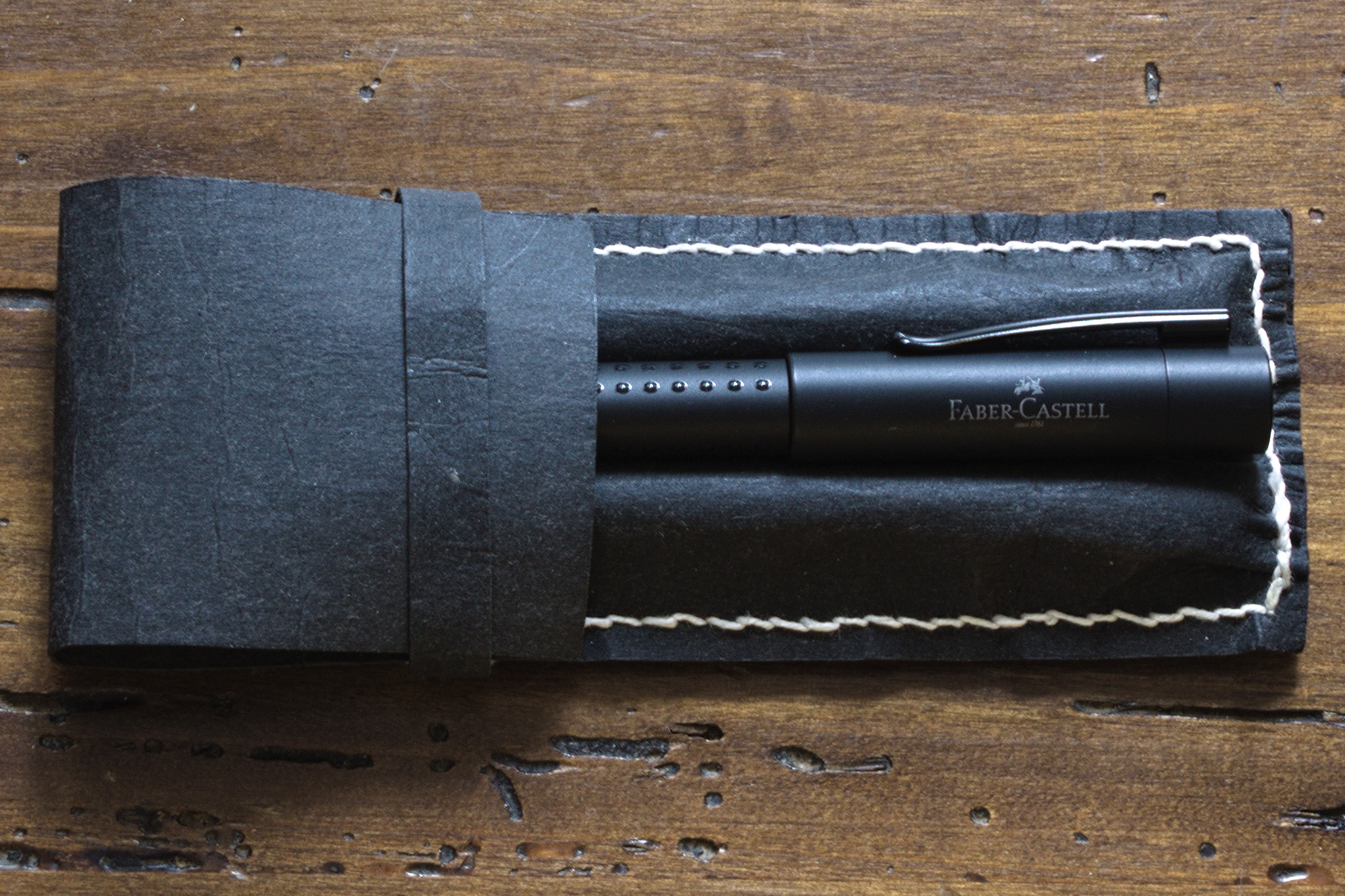
A pen case made of two pieces of a relatively stiff black material with a flat base and three separate channels on top, plus a flap covering everything and a band to keep the flap closed; there is visible light blue stitching all around the channels. For my birthday, I ve bought myself a fancy new expensive1 fountain pen. A two slot pen case in the same material as above, but brown: the flap is too short to cover the pens, and there isn't a band to keep it closed. Such a fancy pen, of course requires a suitable case: I couldn t use the failed prototype of a case I ve been keeping my Preppys in, so I had to get out the nice vegetable tanned leather Yeah, nope, I don t have that (yet). I got out the latex and cardboard material that is sold as a (cheaper) leather substitute, doesn t look like leather at all, but is quite nice (and easy) to work with. The project is not vegan anyway, because I used waxed linen thread, waxing it myself with a lot of very nicely smelling beeswax. a case similar to the one above, but this one only has two slots, and there is a a Faber Castell pen nested on top of the case between the two slots. Here the stitches are white, and in a coarser thread. I got the measurements2 from the less failed prototype where I keep my desktop pens, and this time I made a proper pattern I could share online, under the usual Free Culture license. A case like the one above, except that the stitches are in black, and not as regular. This one has also been scrunched up a bit for a different look, and now the band is a bit too wide. From the width of the material I could conveniently cut two cases, so that s what I did, started sewing the first one, realized that I got the order of stitching wrong, and also that if I used light blue thread instead of the black one it would look nice, and be easier to see in the pictures for the published pattern, started sewing the second one, and kept alternating between the two, depending on the availability of light for taking pictures. The open pen case, showing two pens, a blue Preppy and a gunmetal Plaisir cosily nested in the two outer slots, while the middle slot is ominously empty. One of the two took the place of my desktop one, where I had one more pen than slots, and one of the old prototypes was moved to keep my bedside pen, and the other new case was used for the new pen in my handbag, together with a Preppy, and now I have a free slot and you can see how this is going to go wrong, right? :D

  1. 16 . plus a 9 converter, and another 6 pen to get the EF nib from, since it wasn t available for the expensive pen.
  2. I have them written down somewhere. I couldn t find them. So I measured the real thing, with some approximation.

1 March 2026

Junichi Uekawa: The next Debconf happens in Japan.

The next Debconf happens in Japan. Great news. Feels like we came a long way, but I didn't personally do much, I just made the first moves.

28 February 2026

Mike Gabriel: Debian Lomiri Tablets 2025-2027 - Project Report (Q3/2025)

Debian Lomiri for Debian 13 (previous project) In our previous project around Debian and Lomiri (lasting until July 2025), we achieved to get Lomiri 0.5.0 (and with it another 130 packages) into Debian (with two minor exceptions [1]) just in time for the Debian 13 release in August 2025. Debian Lomiri for Debian 14 At DebConf in Brest, a follow-up project has been designed between the project sponsor and Fre(i)e Software GmbH [2]. The new project (on paper) started on 1st August 2025 and project duration was agreed on to be 2 years, allowing our company to work with an equivalent of ~5 FTE on Lomiri targetting the Debian 14 release some time in the second half of 2027 (an assumed date, let's see what happens). Ongoing work would be covered from day one of the new project and once all contract details had been properly put on paper end of September, Fre(i)e Software GmbH started hiring a new team of software developers and (future) Debian maintainers. (More of that new team in our next Q4/2025 report). The ongoing work of Q3/2025 was basically Guido Berh rster and myself working on Morph Browser Qt6 (mostly Guido together with Bhushan from MiraLab [3]) and package maintenance in Debian (mostly me). Morph Browser Qt6 The first milestone we could reach with the Qt6 porting of Morph Browser [4] and related components (LUITK aka lomiri-ui-toolkit (big chunk! [5]), lomiri-content-hub, lomiri-download-manager and a few other components) was reached on 21st Sep 2025 with an upload of Morph Browser 1.2.0~git20250813.1ca2aa7+dfsg-1~exp1 to Debian experimental and the Lomiri PPA [6]). Preparation of Debian 13 Updates (still pending) In background, various Lomiri updates for Debian 13 have been prepared during Q3/2025 (with a huge patchset), but publishing those to Debian 13 are still pending as tests are still not satisfying. [1] lomiri-push-service and nuntium
[2] https://freiesoftware.gmbh
[3] https://miralab.one/
[4] https://gitlab.com/ubports/development/core/morph-browser/-/merge_reques... et al.
[5] https://gitlab.com/ubports/development/core/lomiri-ui-toolkit/-/merge_re... et al.
[6] https://launchpad.net/~lomiri

Utkarsh Gupta: FOSS Activites in February 2026

Here s my monthly but brief update about the activities I ve done in the FOSS world.

Debian
Whilst I didn t get a chance to do much, here are still a few things that I worked on:
  • Uploaded node-lodash/4.17.21+dfsg+~cs8.31.198.20210220-10 to fix CVE-2025-13465 in unstable. Pinged Xavier and Praveen to see how they feel about the backport for the stable releases.
  • Assited a few folks in getting their patches submitted via Salsa.
    • Reviewing pyenv MR for Ujjwal.
    • Reviewing and assisting Anshul with his Golang stuff.
  • Mentoring for newcomers.
  • Started to be a bit involved with DC 26 bits.
  • Moderation of -project mailing list.

Ubuntu
I joined Canonical to work on Ubuntu full-time back in February 2021. Whilst I can t give a full, detailed list of things I did, here s a quick TL;DR of what I did:
  • Successfully released Resolute Snapshot 4!
    • This one was also done without the ISO tracker and cdimage access.
    • We also worked very hard to build and promote all the image in due time.
    • This was one done with the Test Observer. The first one.
  • Worked further on the whole artifact signing story for cdimage.
  • Assisted a bunch of folks with my Archive Admin and Release team hats to:
    • Review and grant FFes.
    • Coordinating weekly syncs.
    • Promoting binaries to main.
    • Taking care of package removals and so on.
  • Was pretty occupied with the new release processs architecture.

Debian (E)LTS
This month I have worked 42 hours on Debian Long Term Support (LTS) and on its sister Extended LTS project and did the following things:

Released Security Updates

Work in Progress
  • knot-resolver: Affected by CVE-2023-26249, CVE-2023-46317, and CVE-2022-40188, leading to Denial of Service.
  • ruby-rack: There were multiple vulnerabilities reported in Rack, leading to DoS (memory exhaustion) and proxy bypass.
    • [ELTS]: I ve partially reviewed patches by Bastien but whilst doing so, new ones came up for all the releases.
    • [sid]: Uploaded ruby-rack/3.2.5-1 to unstable to fix the new CVEs, CVE-2026-25500 and CVE-2026-22860.
    • [stable]: Prepared the upload for stable releases, as requested by the Security Team. Will upload them in March.
    • [bullseye]: Backport for CVE-2026-22860 hasn t been as trivial as it appears to be. There are test failures, which aren t really ignore-able:
      The tests requests /cgi/../test, which File.expand_path resolves to <root>/test - firmly inside @root. With the old code, it hit the return unless path_info.include? ".." guard and fell through to 403. But it would also have returned early via start_with?(@root) being true
    • anyway, this needs more investigation - I ll continue to do so in March as P1.
  • node-lodash: Affected by CVE-2025-13465, lrototype pollution in baseUnset function.
    • [stable]: The patch for trixie and bookworm are ready and have been awaiting the maintainer review.
    • [LTS]: The bullseye upload will follow once the stable uploads are in and ACK d by the SRMs.
  • vlc: Affected by CVE-2025-51602, an out-of-bounds read and denial of service via a crafted 0x01 response from an MMS server.
    • [LTS]: 3.0.23 backport is ready but not tested. I ll get this over the line in March.
    • [ELTS]: 3.0.23 backport is ready but not very clean. Would like to complete LTS and get back to this.

Other Activities
  • [LTS] Coordinated the libvirt sitaution with Ben Hutchings. The upload has already been prepped, will upload in March.
  • [ELTS] Continued to help Bastien and Markus with the tomcat9 regression for buster.
  • [ELTS] Partially reviewed ruby-rack CVEs to help Bastien. This took more time than expected with some more develpments hapening at the end of the month - new CVEs that aren t as easy to backport as I expected them to be. Will continue with these in March.
  • [E/LTS] Front Desk duties: Performed a large batch of CVE triage, marking numerous packages for bullseye, buster, and stretch as either postponed, end-of-life, not-affected, or added them to the Xla-needed.txt files.
    • Also replied to certain mails and IRC texts around FD related tasks.
  • [E/LTS] Monitored discussions on mailing lists, IRC, and all the documentation updates.
  • [E/LTS] Attended the monthly LTS meeting on Jitsi. Summary here.

Until next time.
:wq for today.

Daniel Baumann: Debian Fast Forward: An alternative backports repository

The Debian project releases a new stable version of its Linux distribution approximately every two years. During its life time, a stable release usually gets security updates only, but in general no feature updates. For some packages it is desirable to get feature updates earlier than with the next stable release. Some new packages included in Debian after the initial release of a stable distribution are desirable for stable too. Both use-cases can be solved by recompiling the newer version of a package from testing/unstable on stable (aka backporting). Packages are backported together with only the minimal amount of required build-depends or depends not already fulfilled in stable (if any), and without any changes unless required to fix building on stable (if needed). There are official Debian Backports available, as well as several well-known unofficial backports repositories. I have been involved in one of these unofficial repositories since 2005 which subsequently turned 2010 into its own Debian derivative, mixing both backports and modified packages in one repository for simplicity. Starting with the Debian 13 (trixie) release, the (otherwise unmodified) backports of this derivative have been split out from the derivative distribution into a separate repository. This way the backports are more accessible and useful for all interested Debian users too.
TL;DR: Debian Fast Forward - https://fastforward.debian.net
  • is an alternative Debian repository containing complementary backports from testing/unstable to stable
  • with packages organized in a curated, self-contained selection of coherent sets
  • supporting amd64, i386, and arm64 architectures
  • containing around 400 packages in trixie-fastforward-backports
  • with 1 800 uploads since July 2025
End user documentation about how to enable Debian Fast Forwards is available. Have fun!

27 February 2026

Petter Reinholdtsen: Free software toolchain for the simplest RISC-V CPU in a small FPGA?

On Wednesday I had the pleasure of attending a presentation organized by the Norwegian Unix Users Group on implementing RISC-V using a small FPGA. This project is the result of a university teacher wanting to teach students assembly programming using a real instruction set, while still providing a simple and transparent CPU environment. The CPU in question implements the smallest set of opcodes needed to still call the CPU a RISC-V CPU, the RV32I base set. The author and presenter, Kristoffer Robin Stokke, demonstrated how to build both the FPGA setup and a small startup code providing a "Hello World" message over both serial port and a small LCD display. The FPGA is programmed using VHDL, the entire source code is available from github, but unfortunately the target FPGA setup is compiled using the proprietary tool Quartus. It is such a pity that such a cool little piece of free software should be chained down by non-free software, so my friend Jon Nordby set out to see if we can liberate this small RISC-V CPU. After all, it would be unforgivable sin to force students to use non-free software to study at the University of Oslo. The VHDL code for the CPU instructions itself is only 1138 lines, if I am to believe wc -l lib/riscv_common/* lib/rv32i/*. On the small FPGA used during the talk, the entire CPU, ROM, display and serial port driver only used up half the capacity. These days, there exists a free software toolchain for FPGA programming not only in Verilog but also in VHDL, and we hope the support in yosys, ghdl, and yosys-plugin-ghdl (sadly and strangely enough, removed from Debian unstable) is complete enough to at least build this small and simple project with some minor portability fixes. Or perhaps there are other approaches that work better? The first patches are already floating on github, to make the VHDL code more portable and to test out the build. If you are interested in running your own little RISC-V CPU on a FPGA chip, please get in touch. At the moment we sadly have hit a GHDL bug, which we do not quite know how to work around or fix:
******************** GHDL Bug occurred ***************************
Please report this bug on https://github.com/ghdl/ghdl/issues
GHDL release: 5.0.1 (Debian 5.0.1+dfsg-1+b1) [Dunoon edition]
Compiled with unknown compiler version
Target: x86_64-linux-gnu
/scratch/pere/src/fpga/memstick-fpga-riscv-upstream/
Command line:
Exception CONSTRAINT_ERROR raised
Exception information:
raised CONSTRAINT_ERROR : synth-vhdl_expr.adb:1763 discriminant check failed
******************************************************************
Thus more work is needed. For me, this simple project is the first stepping stone for a larger dream I have of converting the MESA machine controller system to build its firmware using a free software toolchain. I just need to learn more FPGA programming first. :) As usual, if you use Bitcoin and want to show your support of my activities, please send Bitcoin donations to my address 15oWEoG9dUPovwmUL9KWAnYRtNJEkP1u1b.

Dirk Eddelbuettel: x13binary 1.1.61.2 on CRAN: Micro Maintenance

The x13binary team is happy to share the availability of Release 1.1.61.2 of the x13binary package providing the X-13ARIMA-SEATS program by the US Census Bureau which arrived on CRAN earlier today, and has already been built for r2u. This release responds to a CRAN request to display the compiler version when building. x13binary, just like three other packages there, creates and ships a local binary it interfaces with. So our build was a little outside of R CMD INSTALL ... but now signals build versions like R does. We also modernized and simplified our continuous intgegration script based on r-ci. Courtesy of my CRANberries, there is also a diffstat report for this release showing changes to the previous release.

This post by Dirk Eddelbuettel originated on his Thinking inside the box blog. If you like this or other open-source work I do, you can sponsor me at GitHub.

25 February 2026

Sahil Dhiman: Publicly Available NKN Data Traffic Graphs

National Knowledge Network (NKN) is one of India s main National Research and Educational Network (NREN). The other being the less prevalent Education and Research Network (ERNET). This post grew out of this Mastodon thread where I kept on adding various public graphs (from various global research and educational entities) that peer or connect with NKN. This was to get some purview about traffic data between them and NKN.

CERN CERN, birthplace of the World Wide Web (WWW) and home of the Large Hadron Collider (LHC). India participates in the LHCONE project, which carries LHC data over these links for scientific research purposes. This presentation from Vikas Singhal from Variable Energy Cyclotron Centre (VECC), Kolkata, at the 8th Asian Tier Center Forum in 2024 gives some details.

G ANT G ANT is pan European Union s collaboration of NRENs.

LEARN Lanka Education and Research Network (LEARN) is Sri Lanka s NREN.

NORDUnet NREN for Nordic countries. I couldn t find any public live data transfer graphs from NKN side. If you know any other graphs, do let me know.

Joachim Breitner: Vibe-coding a debugger for a DSL

Earlier this week a colleague of mine, Emilio Jes s Gallego Arias, shared a demo of something he built as an experiment, and I felt the desire to share this and add a bit of reflection. (Not keen on watching a 5 min video? Read on below.)
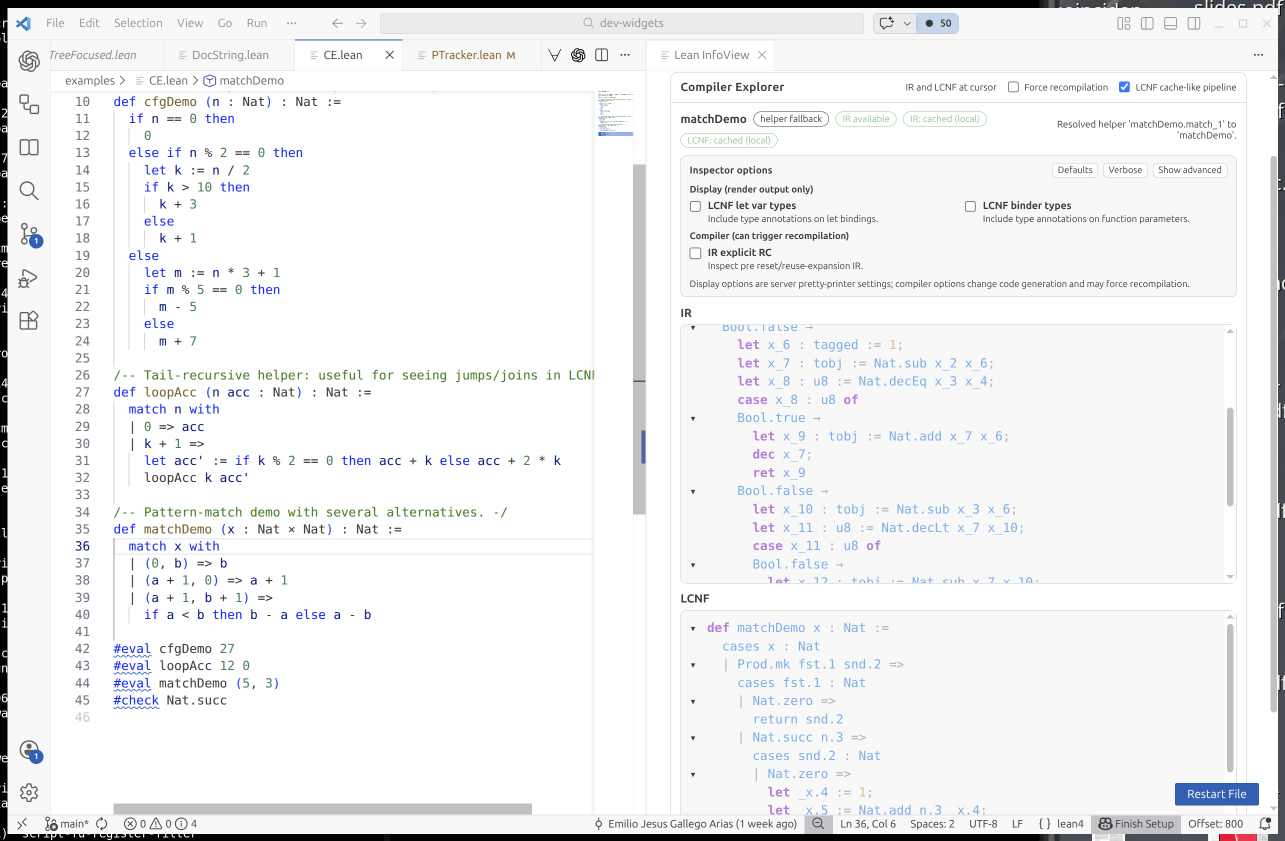
What was that? So what did you just see (or skipped watching)? You could see Emilio s screen, running VSCode and editing a Lean file. He designed a small programming language that he embedded into Lean, including an evaluator. So far, so standard, but a few things stick out already:
  • Using Lean s very extensible syntax this embedding is rather elegant and pretty.
  • Furthermore, he can run this DSL code right there, in the source code, using commands like #eval. This is a bit like the interpreter found in Haskell or Python, but without needing a separate process, or like using a Jupyter notebook, but without the stateful cell management.
This is already a nice demonstration of Lean s abilities and strength, as we know them. But what blew my mind the first time was what happened next: He had a visual debugger that allowed him to debug his DSL program. It appeared on the right, in Lean s Info View , where various Lean tools can hook into, show information and allow the user to interact. But it did not stop there, and my mind was blown a second time: Emilio opened VSCode s Debugger pane on the left, and was able to properly use VSCode s full-fledged debugger frontend for his own little embedded programming language! Complete with highlighting the executed line, with the ability to set breakpoints there, and showing the state of local variables in the debugger. Having a good debugger is not to be taken for granted even for serious, practical programming languages. Having it for a small embedded language that you just built yourself? I wouldn t have even considered that.

Did it take long? If I were Emilio s manager I would applaud the demo and then would have to ask how many weeks he spent on that. Coming up with the language, getting the syntax extension right, writing the evaluator and especially learning how the debugger integration into VSCode (using the DAP protocol) works, and then instrumenting his evaluator to speak that protocol that is a sizeable project! It turns out the answer isn t measured in weeks: it took just one day of coding together with GPT-Codex 5.3. My mind was blown a third time.

Why does Lean make a difference? I am sure this post is just one of many stories you have read in recent weeks about how new models like Claude Opus 4.6 and GPT-Codex 5.3 built impressive things in hours that would have taken days or more before. But have you seen something like this? Agentic coding is powerful, but limited by what the underlying platform exposes. I claim that Lean is a particularly well-suited platform to unleash the agents versatility. Here we are using Lean as a programming language, not as a theorem prover (which brings other immediate benefits when using agents, e.g. the produced code can be verified rather than merely plausible, but that s a story to be told elsewhere.) But arguably because Lean is also a theorem prover, and because of the requirements that stem from that, its architecture is different from that of a conventional programming language implementation:
  • As a theorem prover, it needs extensible syntax to allow formalizing mathematics in an ergonomic way, but it can also be used for embedding syntax.
  • As a theorem prover, it needs the ability to run tactics written by the user, hence the ability to evaluate the code right there in the editor.
  • As a theorem prover, it needs to give access to information such as tactic state, and such introspection abilities unlock many other features such as a debugger for an embedded language.
  • As a theorem prover, it has to allow tools to present information like the tactic state, so it has the concept of interactive Widgets .
So Lean s design has always made such a feat possible. But it was no easy feat. The Lean API is large, and documentation never ceases to be improvable. In the past, it would take an expert (or someone willing to become one) to pull off that stunt. These days, coding assistants have no issue digesting, understanding and using the API, as Emilio s demo shows. The combination of Lean s extensibility and the ability of coding agents to make use of that is a game changer to how we can develop software, with rich, deep, flexible and bespoke ways to interact with our code, created on demand.

Where does that lead us? Emilio actually shared more such demos (Github repository). A visual explorer for the compiler output (have a look at the screenshot. A browser-devtool-like inspection tool for Lean s InfoTree . Any of these provide a significant productivity boost. Any of these would have been a sizeable project half a year ago. Now it s just a few hours of chatting with the agent. So allow me to try and extrapolate into a future where coding agents have continued to advance at the current pace, and are used ubiquitously. Is there then even a point in polishing these tools, shipping them to our users, documenting them? Why build a compiler explorer for our users, if our users can just ask their agent to build one for them, right then when they need it, tailored to precisely the use case they have, with no unnecessary or confusing feature. The code would be single use, as the next time the user needs something like that the agent can just re-create it, maybe slightly different because every use case is different. If that comes to pass then Lean may no longer get praise for its nice out-of-the-box user experience, but instead because it is such a powerful framework for ad-hoc UX improvements. And Emilio wouldn t post demos about his debugger. He d just use it.

Next.

Previous.