Search Results: "oku"

20 September 2007

Michael Prokop: grml-live - mach dir deine eigene Live-CD

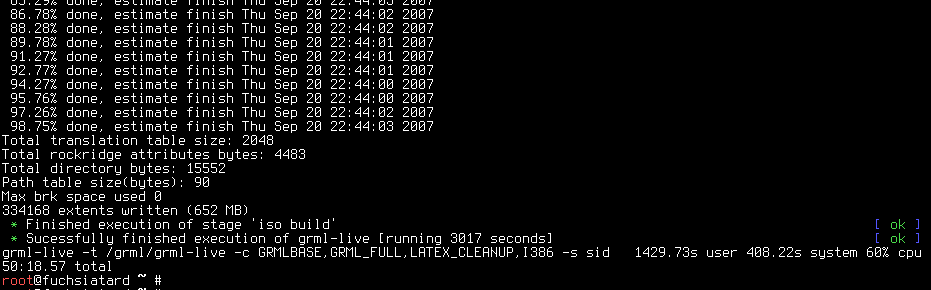
grml-live ist ein Framework, mit dessen Hilfe man mit nur 1 Kommando eine auf grml/Debian basierende Linux Live-CD bauen kann. grml-live baut auf FAI (Fully Automatic Installation) auf und nutzt dessen klassenbasiertes Konzept: Screenshot: grml-live In diesem Beispiel habe ich gerade ein gro es grml-ISO gebaut. Dabei habe ich einfach nur den Debian-Mirror in /etc/grml/grml-live.conf auf meinen lokalen Mirror gedreht (um Traffic und Zeit zu sparen) und dann folgendes Kommando aufgerufen:
# grml-live -t /grml/grml-live -c GRMLBASE,GRML_FULL,LATEX_CLEANUP,I386 -s sid
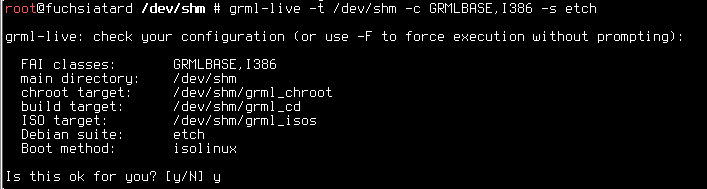
Ca. 50 Minuten sp ter habe ich im Ordner grml_isos unter /grml/grml-live/ (-t …) ein fertiges grml-ISO. Dieses wurde auf Basis der Klassen (-c …) GRMLBASE (da steckt alles essenzielle drin), GRML_FULL (Software-Auswahl wie auf der offiziellen gro en grml), LATEX_CLEANUP (ein paar sehr gro e LaTeX-Verzeichnisse aufr umen) und I386 (x86-spezifische Pakete wie z.B. der Kernel) gebaut. Als Debian-Suite (-s) wurde sid (unstable) ausgew hlt. Und das war es auch schon. Ein kleinere grml-Version auf Basis von Debian/stable gef llig? Kein Problem, machen wir es doch einfach mal im Shared-Memory (superschnell und mit genug RAM und den Mountoptionen rw,suid,dev auch kein Problem): Screenshot grml-live: der Start Ein ‘grml-live -t /dev/shm -c GRMLBASE,I386 -s etch’ und keine 5(!) Minuten sp ter hab ich dann mein 135MB kleines grml: Screenshot grml-live: done Mit grml-live kann man sich somit seine pers nlich angepasste Linux Live-CD erstellen, ohne sich erst mit Remastering im Detail besch ftigen zu m ssen. Auch muss man dabei nicht zwingend Debian/unstable nehmen, sondern kann auch Debian/stable als Basis ausw hlen. Durch das Erstellen einer neuen Klasse oder das Anpassen einer existierenden kann man auch spezielle Software-W nsche ganz einfach erf llen. Wird damit das offizielle grml-ISO etwa obsolet? Nein, auf keinen Fall. grml-live soll dem grml-Team als Buildsystem dienen (automatisierte Snapshots auf regelm iger Basis z.B. sind schon in Planung) und die langweilige Arbeit abnehmen, damit wir uns auf die wirklich wichtigen Sachen konzentrieren k nnen: Testen, Bugfixing, Implementieren von neuen Features, Arbeit am Kernel, Qualit tssicherung, Dokumentation,… grml-live hat den Anspruch, auf jedem Debian-basierten System zu funktionieren und wer Interesse daran gefunden hat, kann sich das Debian-Pakete aus dem grml-Repository holen. Den Quellcode gibt es nat rlich auf unserer Mercurial-Webseite. Wer jetzt noch Fragen hat oder mehr Details zu grml-live erfahren m chte, der m ge einfach auf die grml-live-Homepage schauen. Falls dort eine Frage noch nicht beantwortet sein sollte, jemand Feature-Requests, Bugreports oder Patches hat: meine Inbox freut sich ber Post! :-)

13 September 2007

Neil Williams: apt-cross moves to Cache::Apt:: and GPL-3 or later

Just completed the migration of the next version of apt-cross that is due to be uploaded once dpkg-cross pre2 can be uploaded to experimental. (This in turn is waiting for dpkg to support removal of the dpkg-cross diversions: #439979.)
AptCross:: has gone, replaced by Cache::Apt:: and the Cache.pm from NorthernCross is now called Lookup.pm for clarity.
This update solves a lot of niggles with the old apt-cross behaviour when dealing with non-standard repositories, CDROM archives, proxied mirrors and various other stuff that apt can cope with but which wget found difficult. (#440929, #442012)
Also, the entire package has migrated to GPL v3 or later - all the code was GPL v2 or later.
This means that emdebian-tools will also be migrating to GPL v3 or later when that is updated to use the new apt-cross and dpkg-cross code.
Sometime after Lenny, Cache::Apt:: will migrate into a source package of its own (on CPAN), allowing the apt-cross functionality to be merged into apt and the module to support other tasks in Emdebian.
In other news, gpe-cash is coming along and highlighting a few issues in libqof1, libqof-backend-sqlite and libqofexpensesobjects so there are improvements due there too. gpe-cash and gpe-expenses are also GPL v3 or later, as are deb-gview, quicklist (experimental) and pilot-qof now too.
Most have some machine-operable fields in debian/copyright and most have the new dpkg fields in debian/control.
Got a fix for gpe-bluetooth to upload tonight as well as (hopefully) the last go at getting homebank through NEW.

5 September 2007

Jan Wagner: eGroupware 1.4.001.dfsg-2.1~bpo40+1 backported to etch

I did upload a updated version of eGroupware to my pool. You can grab it from http://ftp.cyconet.org/debian/archive/bpo/egroupware/1.4.001.dfsg-2.1~bpo40+1/ or via:

deb ftp://ftp.cyconet.org/debian etch-backports main non-free contrib For installing the rules analog backports.org applies. Have fun! , , , ,

Ian Wienand: Short review of guarded page-tables

Anyone who has done an operating systems 101 course is familiar with the standard hierarchical page-table structure. This is essentially a radix-tree where bits of the virtual address are taken as indexes into an array of pointers, each pointing to the next level down or, at the leaves, to a physical entry. Hierarchical page-table One potential issue with this style of page-table is with a very large, very sparse address space (such as in a single address-space operating system) there will be many intermediate steps with possibly only a single translation at the end (i.e. lots of single pages scattered all around your address-space). Thus we can add a bit-field guard to each of the entries in the page table (Liedtke, 1994) to help indicate only those paths through the tree which are valid (similar to a Patricia tree). Translation first proceeds as usual; the top bits are used as an index into the top level table. However, each entry now contains extra information about further valid addresses. The guard is masked against the next bits in the virtual address; if it matches (e.g. in our example is 0x2) the next step can proceed directly to the leaf node, bypassing the middle look-up. The entry can be marked as either final (i.e. pointing to a leaf node) or intermediate, in which case the process continues with the next level (which also has its own guard, and so forth). Any entry that does not match the guard is known to be false, and therefore a fault can be raised. Hierarchical page-table with guard To examine this further, consider that we know that each page in our 24-bit address space above is 4KiB, thanks to the 212 = 4KiB offset. Therefore each of the 16 possible values of the top four bits selects 1MiB of the 224 = 16MiB address space; e.g. 0x0 selects the first megabyte, 0x1 the second and so forth. The second 4 bits selects a 64KiB region of this 1MiB, and the last 4 bits selects a 4KiB region of this 64KiB region. This scheme could work quite well if we were using only 16 pages each separated by 1MiB. Each of these pages would only require an entry in the top level with an appropriate guard which could then be marked as final and point directly to a physical frame. Once things become less sparse however, we need to start filling in middle levels. If you have 2 pages within a 16MiB region, you need at least one extra bit of address to tell them apart. If you have 3 or 4 pages, you need at least 2 bits to tell them apart, and so forth. It would therefore be beneficial to have variable level sizes to dynamically adapt and create the most efficient lookup possible given the address space layout of a process. For example, if you knew your process was only going map pages 0x123 (100100011) and 0x124 (100100100) a good option would be to make your top-level only two entries (i.e. check the top bit) with a guard on the entry at index 0x1 of 00100. You then need a second level with 8 pointers to differentiate the remaining 3 bits (each of these would be final and hence point directly to a physical page). The more pages you start mapping, the less bits you can discard with the guard. If you follow this through to a guard of 0 bits you end up with a linear page-table. It has been shown (Elphinstone, 1999) that fixed level sizes with 16 entries tends to work well. For a 32-bit address-space with 4KiB pages (e.g. 12 bits offset) this leaves 20 bits to be mapped by the page-tables; with each level mapping 24 bits this means a 5 level tree. The guard values provide enough path-compression that the table is not constantly walked. The disadvantage is that it may "over-allocate" meaning more space is dedicated to page-tables than strictly required. Deciding where and when to split levels, what size indexes to put at each level and updating all the guard values dynamically to make the smallest, most efficient page-table would create a variable-radix page-table (Szmajda and Heiser, 2003). In summary, a guarded page-table is more useful the more sparse your address space is. A variable-radix guarded page-table is complex, but could offer advantages for implementing variable page-size support and thus having positive effects on TLB coverage.

1 September 2007

Junichi Uekawa: Has info-lookup-symbol keybinding changed?

Has info-lookup-symbol keybinding changed? Apparently, it has. Personally, 'C-h S' is much harder to type for me than 'C-h C-i'. I've added this configuration to .emacs to work around the problem. (define-key help-map "\C-i" 'info-lookup-symbol)

29 August 2007

Pierre Habouzit: postfix and SRS

Peter, it's fun you ask right now, because I happen to just be writing a SRS daemon for postfix, to be used as a tcp_table(5) canonical lookup table. It's part of my soon to be pfixtools (Postfix Tools), that you can grab on my git repositories. I should package them as soon as the srs daemon is ready (and it's almost ready, it just needs the pidfile and fork-in-the-baground thingies). And as a matter of a fact, yes, if you're a forwarder you have (because of things like SPF, but not only) to use a Sender Rewriting thing, and SRS is somehow elegant in the sense that if many people use it in the forwarding chain, the sending address won't bloat. But even if nobody else uses it, then well, it works, and serves its purpose really well. As of performance: on my laptop, it's able to deal with 100k SRS rewrites in less than 0.72seconds, so it's as fast as it can be, only postfix supporting SRS natively can beat that I'd say.

11 August 2007

Steve Kemp: Are you talking to me?

My GNOME desktop is broken upon my primary machine, and it has taken me too long to get it sorted out. Short version: metacity will not run:
skx@vain:~$ metacity
metacity: symbol lookup error: /usr/lib/libgthread-2.0.so.0: undefined symbol: g_thread_gettime
The .so file referenced is a symlink to libgthread-2.0.so.0.1200.13, and using nm I can see there are no symbols listed:
skx@vain:~$ nm /usr/lib/libgthread-2.0.so.0.1200.13
nm: /usr/lib/libgthread-2.0.so.0.1200.13: no symbols
That seems weird to me, but libraries are mysterious beasts, so I might be expecting this behaviour? Anyway dpkg claims this file is installed by libglib2.0-0, and the package hasn't had an upload since July 17th, so I can't believe this is the reason for the recent breakage (Even given that I don't logout often..) Reinstalling both packages (metacity + libglib2.0-0) has failed to fix the problem so I'm lost. Right now I'm running GNOME with a different window manager, icewm, via a ~/.gnome2/session file:
gnome-wm --default-wm /usr/bin/icewm-gnome --sm-client-id default0
This works almost perfectly - it is better than metacity in the sense that new windows don't overlap existing ones if there is spare screen space, but worse in that alt-TAB shows two windows "Top extended Edge Panel" and "Bottom Extended Edge Panel" - which I don't need/want to see. I'd be happy to stay with IceWM if I could fix those two problems, but I'd love to know why metacity is broken, and how I can fix it. I can't see any obvious bug reports - and I'm not 100% certain that the gthread package is the source of the error... Any suggestions welcome.
ii  metacity       1:2.18.5-1     A lightweight GTK2 based Window Manager
ii  libglib2.0-0   2.12.13-1      The GLib library of C routines

3 August 2007

Andrew McMillan: IPv6 Burninating all the Peasants

A recent thread which started on the Debian Release mailing list caught my eye this week. I attempted to aid the migration of this thread to the debian-ipv6 mailing list, which is really a better place for this and sorely in need of controversial topics for discussion. It is interesting how people can so blindly decide that broken things should be destroyed. Repair often appears not to be an option, even for a long-term, wide-reaching effort like this, though we are all working on open-source software! In this case there are an unknown number of less fortunate people in the world who are located behind some kinds of broken DNS infrastructure which discards 'AAAA' lookups. Of course 'AAAA' lookups are attempts to resolve a name to an IPv6 address, and the resolver in a 'modern' libc (i.e. one from the last five years or so :-) will try to retrieve an IPv6 address before it attempts to resolve a name as IPv4 with an 'A' lookup. That is how the standard is written, so if you want to comply with the standard you have to do it that way. Other things also interfere, but this element of the specified behaviour seems to cause the most annoying and pointless whingeing I have heard. I suppose that the people who want working IPv6 make it so, and do not have problems with this behaviour. But it seems that people who are behind this kind of broken DNS either disable IPv6, or they have to whine about IPv6 being turned on by default, and can't we please all go back to the good old days. What's wrong with IPv4 anyway? Doesn't NAT solve all of it's problems? Are we sure this new (heh!) technology is safe? Fortunately some people are so good at making their pain felt by other people that they can get other people to do their work for them. So Mithrandir has written a nice elegant patch for libc6 so that it won't do the IPv6 lookups unless you have a usable IPv6 configuration. I've filed bug #435646 against Debian to get this included, but Aurelian Jarno justifiably wants a few people to test it a bit harder... So I've taken the original patch and tweaked it to apply against current libc6 sources (2.6-5) and tested it for myself. It works as desired, as far as I can see, when comparing behaviour with an unpatched system. The patch is attached to the bug report, of course. Perhaps some other people out there can put a wee bit of CPU into testing this for other environments so that we can make life easier for those people with no time / inclination to use IPv6, to ensure that they don't just disable it because it is making life too painful for them in it's current form? How to build libc6 for fun and proft If you have appropriate deb-src URLs configured, and are running Sid, then the following will let you build a local copy of libc6 with the patch. This is probably better testing than if I just make my packages available (which are only i386 in any case).
apt-get build-dep glibc
apt-get source glibc
cd glibc-2.6
debian/rules unpack
cd build-tree/glibc-2.6
wget http://tinyurl.com/3xzm3o
patch -p0 <glibc-only-lookup-ipv6-if-it-makes-sense-debian.patch
cd -
dch --newversion 2.6-5+v6 "Apply IPv6 Resolver Sanity"
fakeroot debian/rules binary
Wait a few hours for it to build... Install... And then confirm that this only does 'AAAA' lookups if (when) you actually have a global or site scoped IPv6 address. When you only have a loopback or link local IPv6 address then you should only see 'A' record lookups. Step 3: profit! Whoops! I forgot the fun bit: please update the bug report :-) What the patch does In my opinion this is quite an elegant solution from Tolleff. He has picked a single characteristic of the IPv6 interfaces to further refine whether the IPv6 configuration of some interface is actually usable. With IPv6 it is much more common to have multiple addresses assigned to a single interface. Interfaces are automatically configured with a link-local address which is not globally routable, and the loopback interface is also configured with the IPv6 equivalent of 127.0.0.1 (which is "::1"). To get a usable IPv6 setup you will also end up with a more widely usable address. In most cases this will be a global address, meaning that it is (in theory) globally routable from other people who also have global addresses, or you could have a "site" address, which is the IPv6 equivalent of RFC1918 addressing. The patch considers that for the purposes of name resolution, it will be pointless to do AAAA lookups unless you have an address of the second kind. This means that people behind broken DNS won't be impacted unless the try and set up IPv6, and people who don't try and set up IPv6 won't get the 'hesitation' while their system attempts to resolve each address in IPv6 space first. It will also mean that when people start to enable IPv6 around them, their setup will continue to work correctly.

27 July 2007

Michael Prokop: Linux on the Lenovo Thinkpad X61s

Lenovo X61s - picture Since about two days I’m proud owner of a Lenovo X61s notebook. It will become my main and new developer box for grml, featuring all that nifty stuff like 64bit support, hardware virtualization and so on… I managed to use all the important features with a very current version of grml. I’m using kernel 2.6.22-grml on a setup with LVM, cryptsetup-luks,… everything works fine so far (including Suspend-To-RAM - even in grml live-mode when booting from USB pen :-) - thanks for the excellent hibernate package, madduck!). As you won’t find useful and approriate information about Linux on the X61s yet (either pretty incomplete or wrong) I decided to put all relevant information on a webpage in the grml-wiki: Short version: the X61s rocks. I’ll provide information to thinkwiki as soon I checked out all the details…

24 July 2007

Martin F. Krafft: Iceweasel/Firefox brings you the Windows experience!

For a while now, Iceweasel/Firefox comes with built-in phishing protection, which is undoubtedly a good thing given the number of idiots using the Web these days.
Screenshot of iceweasel's phishing protection warning
But the implementation is crap. If you surf to a phishing site, such as this test site, the page loads as you would expect and then the first strange things happen: I get similar performance problems on the StaTravel website, and on map.search.ch, it almost always crashes. Thank you, Firefox developers, for bringing the joys of the Windows world to Linux! NP: Dream Theater: Metropolis Pt 2: Scenes from a Memory Update: several people have responded that they cannot reproduce the problem. I thus created a new profile, uninstalled all system-wide extensions, removed all plugins such that about:plugins was empty and tried again. The problems persist, although I think the lags are not quite as long as before and the memory consumption is obviously down. Maybe this is amd64-related? Update: It's not amd64-related, as several users have pointed out. Update: still no luck, but James Andrewart pointed me to this bug report, which might improve things a bit:
"The new protocol specifies a single lookup algorithm for all tables, rather than having per-table logic. This lookup logic was moved in to the db service from the javascript. URL canonicalization was moved completely into C++ too. The DB service can now handle a query from a raw URI, which will be needed for malware blocking."

23 July 2007

Simon Richter: Package management and components (aka "our users and free software")

Ian, I am not sure that “good package management” is a real selling point for anyone but system administrators. Home users do not care, as there is not that much difference between double-clicking an executable (that pops up a window, asks a few questions and then installs the software) and selecting a check-box in a list and clicking “apply” (followed by window, questions, etc.). In a business setting the users usually do not have permission to install software anyway, so they could not care less how it was installed, the only thing important is that it is there. In my opinion, the single technology that has had the most impact would be COM, the “Component Object Model”, because this is what the ISVs want: an easy way to define a (binary) interface that will allow components from different vendors to work together, ideally in the same virtual address space for maximum efficiency. The registry provides the necessary lookup functionality, so that you can construct an object of a given type by giving its class name or GUID to CoCreateInstance, and you get something back that provides the interfaces that this class implements, which is either the object directly or an RPC proxy. The latter happens, for example, when a multithreaded application wants to call methods in an object that is not threadsafe (COM will then serialize the calls) or when the object is provided by a system service (where we have dbus). The fact that the only thing you can rely on is the defined interface (a set of methods and data objects that map to getter/setter methods) makes it necessary to define the interface first and invest lots of Interfaces become immutable as soon as they are published, incompatible changes need a new interface name (that's where all the interface names ending in …2 or …3 come from). Under Linux, the closest thing is GNOME and their use of CORBA. If you were to write an application that runs within the GNOME framework, and if you wanted third party vendors to be able to plug into it, then you would probably publish an IDL file for it. Lots of “if”s there. Licensing is also an issue here. One thing the GPL fails to address, even in version 3, is the integration of components without linking into the same address space (which ORBit never does IIRC). Technically, the component provider and the component user communicate via sockets using a well-known protocol, so the component user is not bound by the GPL; the only thing that could be argued is that the IDL file defining the interface would be GPLd (although most jurisdictions consider interfaces as not copyrightable and/or permit “reengineering” for interoperability purposes). Some people might consider this “cheating” around the GPL, as any GPL'd program or library providing components could be used freely by any closed source application as long as the source code to the GPL'd portions was made available. Last (but not least) it is a matter of developer motivation. Third party vendors are, for most of us, not our target audience, and properly supporting them is going to be quite a bit of work. I've written about mixing different C libraries in the same executable image before, as a “nice to have” item. For components that should share the same image, like COM does, it is an absolute must, and COM goes to great lengths to make sure this actually works. For example, allocating memory that is to be passed to a COM method must be allocated using midl_user_alloc() from the RTC DLL and freed using midl_user_free() from the same; as this is a system library and compiler vendors are forbidden from bringing their own, everyone uses the same allocator pair (that internally just calls malloc() and free() from the Microsoft C library, but that is an implementation detail you are not supposed to know). On the Linux side, people do not care much about matching allocator functions, because in essence it all ends up in glibc's malloc()/free() anyway. When glib introduced their own allocators and started using them for their own structures, a number of applications started crashing unless you set a certain environment variable that told glib to pass everything through to glibc. Personally, I've spent the last days compiling toolchains in order to provide compiler packages that work “out of the box” on at least Debian etch, lenny and sid, and Ubuntu dapper, edgy, feisty and gutsy. Right now, I feel a lot like shipping statically linked binaries. Where Windows has mostly gotten out of the “DLL hell”, Linux has built its own variant of it:
The Windows DLL hell
is a hot place. Everyone is bringing their own grill lighter they believe does not cause cancer, starts a small fire and begins to roast marshmallows. The problem there is that the floor is covered with a sticky mixture of lighter fluid and everything is burning.
The Linux DLL hell
on the contrary is freezing cold. It has small isolated fires where a few friends are sitting, and they suddenly decide to move on and pour water over the fire and your marshmallows without asking first. Getting into a group is difficult, and if you manage it, all it means is that you are told to pick up your marshmallows before they extinguish the fire.
At this point, I'm going to be comment- and trackback-whoring; instead of answering the obvious question, I'm going to leave it open: Would a COM-style componentization model work in the Linux world, and attract software vendors, provided we can put out stable APIs and support them properly, or is that a red herring?

22 July 2007

Wouter Verhelst: Damn spammers

Since I spent quite some time thinking about my SMTP setup earlier today, I finally took the time to hack up a little perl script to parse my mainlog, pick out the IP addresses of hosts that appear to have been spamming me, put them in a database, and modified my exim4.conf to look them up and deny them access if I want to. Those lookups are pretty easy, really. In the first section of your exim4.conf, I have this:
hide pgsql_servers = (/var/run/postgresql/.s.PGSQL.5432)/*/spam/Debian-exim/
with '*' being the password. Except that this is ident authentication, so I don't need a password, but apparently exim still expects something (if I'm not on crack). Oh well. Then, in an acl, I have this:
  deny
    message = "Your IP was used for spamming over the last few days. Please stop the spamming, wait a few days, and try again."
    log_message = "denied access for $sender_host_address: in blacklist database"
    condition = $ lookup pgsql SELECT id FROM spammer WHERE       \
       adres='$sender_host_address' AND lastseen > now() - '10 \
       days'::interval true false 
(with the backslashed lines being one line, really, but I didn't want to fuck up scrolling) You can put this in any ACL you want, really. In my case, since I'm very sure by the nature of the way I gather these IP addresses that they're spammers, it's in acl_smtp_helo. Depending on how you populate your database, you may want to put this in a different place. If you want, you can teergrube them a bit by adding delay=30s. An alternative would be to set up a DNS blacklist; but that would just take too much effort to set up properly, and I just didn't feel like it. This works.

18 July 2007

Russell Coker: IEA predicts global oil crisis

The ABC reports that an oil shortage is predicted soon. The International Energy Agency predicts that oil supply problems will start within the next five years. Oil production has been dropping over the last two years (we have passed the “peak oil” point) and demand is steadily increasing. Regardless of wars oil prices will increase significantly in the near future. According to the Australian Bureau of Statistics the average age of Australian cars was 10.7 years at the end of 1998. So the vast majority of the current fuel-hungry cars on Australian roads will still be in use in five years time - if the owners can afford them. The government needs to start providing tax incentives for fuel efficient cars and to end tax incentives for inefficient cars. Currently 4WD vehicles have reduced taxes and the tax deduction for a business car is based on the engine size (get a less efficient car and get a bigger tax deduction). The government claims to be protecting the economy (at the expense of the environment). But with the way things currently work the economy will be destroyed in less than five years. Even though the government cares little for the environment (in spite of the effect that climate change is having on farmers) they need to do something if they want to fulfill their claims of protecting the economy! Thanks to Chris Samuel for informing me of this.

3 July 2007

Kai Hendry: Slug

NAS installing with Debian 4.0 Bought a NSLU2 from Ebuyer. Was about ~50GBP hence qualifying for free delivery with 5 working days. I don’t know why, but according to the packaging it was sent “next day” on the 4th day(!?). The device came direct from the usual suspects Computer2000, one of the oldest and biggest computer part distributors in the UK. Sidenote: I wonder if Ebuyer can claim to have stock, when it’s actually their distributors stock? tbm’s slug install page aided my Debian etch install. This slug has a 80G external USB hard drive attached with 10G ext3 for Debian and the rest for my legacy pr0n collection on fat32. I’ve already configured nfs and it seems to work well. 539M Debian install for that… bloat. I am worried I might have not have given it enough swap, so now I am thinking of how to ramp up the memory. I’ve reassuringly discovered my slug is already operating at full 266 speeds. It would be good if this device can handle btdownloadcurses. Other ideas is to setup a logging server on it. Also I’d like to familiarise myself better with the architecture. I think I’ve seen these Xscale’s in at least one mobile phone. :) Other hardware purchases I am thinking of: I wish this slug had a USB-style power supply. As for backups, I want to switch everything I have over to LVM2 eventually and use its snapshot features. Any tips or suggestions, let me know. I am not a fan of RAID solutions btw.

1 July 2007

Steve Kemp: I'm starving now, feeling dead on my feet

Three, count them, three local root exploits discovered so far via the source scan of the Debian archive. More to follow. Right now my biggest irritation is the amount of time it takes to report bugs in packages which don't have security issues - just bad coding. It takes me a fair while to do it, since I either have to install the package and use "reportbug", or lookup version numbers and submit manually. I should think of a better way of doing it.

27 June 2007

Jacobo Tarr&#237;o Barreiro: All Mexico All

For several days now, I have been seeing messages like this in my logcheck output:
Jun 27 19:24:07 maestro postfix/smtpd[14339]: warning: malformed domain name in resource data of MX record for neolookups.com: *.mx.*
Obviously, the MX entry for the domain neolookups.com (and all its subdomains, apparently) is 0 *.mx.* . It turns out that you cannot search for *.mx.* on Google, so I ask you, dear Lazyweb, is this one of the latest tricks spammers use to try and thwart antispam countermeasures?

20 June 2007

Joachim Breitner: Finding revoked signatures on a gpg key

The Gnu Pricacy Guard seems to have the default option of setting an expiry date when the signed key has such a date. My gpg key used to have such an expiry day when I went to the first keysigning parties (LinuxTag, DebConf 3). I have removed the expiry date later, but still a lot of signatures are now no longer valid: While I have signed 310 keys, my key is currently (pre-DebConf 7) only has 170 valid signatures.Tonight I wanted to find out what keys are these exactly, and after quite some trial and error I found a way to get that data, using only real old unix tools such as awk, sort, join:
gpg  --list-options show-sig-expire --fixed-list-mode --with-colons --list-sigs nomeata > my-sigs-col
cat my-sigs-col  awk -F: '$1 == "sig" && $7 != ""   print  '   sort -k 5,5 -t : -u > expired
cat my-sigs-col  awk -F: '$1 == "sig" && $7 == ""   print  '   sort -k 5,5 -t : -u > non-expired
join -v 1 -t : -j 5  expired non-expired > only-expired
Maybe I will use that list some time after DebConf7 to mail all these people, asking them to remove or update the expiry date from their signature.

11 June 2007

Adam Rosi-Kessel: Sodoku SQL Solution

In case this blog hasn’t been meeting its geekiness quota, I present the following. Ken (who deserves to be better known in the blogosphere and elsewhere) wrote a Haskell program to solve Sodoku with a single SQL query:
SELECT * FROM values AS aaaa, values AS aaab, values AS aaba, values AS aabb, values AS aabc, values AS aaca, values AS abab, values AS abba, values AS abbb, values AS abbc, values AS abcb, values AS abcc, values AS acba, values AS acbc, values AS acca, values AS accc, values AS baaa, values AS baac, values AS babb, values AS babc, values AS bacb, values AS bacc, values AS bbba, values AS bbbc, values AS bcaa, values AS bcab, values AS bcba, values AS bcbb, values AS bcca, values AS bccc, values AS caaa, values AS caac, values AS caba, values AS cabc, values AS cbaa, values AS cbab, values AS cbba, values AS cbbb, values AS cbbc, values AS cbcb, values AS ccac, values AS ccba, values AS ccbb, values AS ccbc, values AS cccb, values AS cccc WHERE aaaa.v <> 3 AND aaaa.v <> 9 AND aaaa.v <> baaa.v AND aaaa.v <> 4 AND aaaa.v <> bcaa.v AND aaaa.v <> caaa.v AND aaaa.v <> cbaa.v AND aaaa.v <> 8 AND 3 <> 9 AND 3 <> baaa.v AND 3 <> 4 AND 3 <> bcaa.v AND 3 …
(edited for brevity)

10 June 2007

Chris Lamb: Sudoku solver in PostScript

There seems to have been a bit of fuss over this Sudoku solver implemented in SQL. In Easter 2005, when Sudoku fever kicked off in a big way in England, my Dad started writing a solver implemented in PostScript which I then modified so that it could perform backtracking. I also wrote a C# solver for my phone around the same time and later sneakily won a competition with it - I am now barred from entering competitions in that paper. Anyway, here is an example PostScript board (PDF version). It was labelled “Fiendish” in The Times. The board can be easily changed at the top of the PostScript file. NB. Best results are achieved if you view the PostScript directly in a viewer such as gv or GSview as you actually see the process of backtracking in solving the puzzle, the recursion depth and the set of possible symbols for each square — most PDF viewers are terrible at displaying the process as they seem to render inside the wrong thread. (In terms of solving the puzzle, we both found that by enforcing the simplest constraints and then ‘guessing’ was far easier and more efficient than performing any of the complicated constraints typically employed by human solvers. I’m certain I am not the first to notice that attempting to emulate the brain’s method of solving a problem is usually a short-sighted approach for a computer.) There are few other goodies in the file: replacing the final autotest with autotestR will recurse using the right-most possible symbol - if you get the same board with both of these then the initial board has a unique solution. Also, if you can get your hands on a true PostScript printer, printing the file will mean the puzzle is solved in hardware. Enjoy :) . I’m looking forward to DebConf7! UPDATE: Added PDF version.

Next.

Previous.