Search Results: "nion"

5 February 2016

Daniel Pocock: Giving up democracy to get it back

Do services like Facebook and Twitter really help worthwhile participation in democracy, or are they the most sinister and efficient mechanism ever invented to control people while giving the illusion that they empower us? Over the last few years, groups on the left and right of the political spectrum have spoken more and more loudly about the problems in the European Union. Some advocate breaking up the EU, while behind the scenes milking it for every handout they can get. Others seek to reform it from within. Yanis Varoufakis on motorbike Most recently, former Greek finance minister Yanis Varoufakis has announced plans to found a movement (not a political party) that claims to "democratise" the EU by 2025. Ironically, one of his first steps has been to create a web site directing supporters to Facebook and Twitter. A groundbreaking effort to put citizens back in charge? Or further entangling activism in the false hope of platforms that are run for profit by their Silicon Valley overlords? A Greek tragedy indeed, in the classical sense. Varoufakis rails against authoritarian establishment figures who don't put the citizens' interests first. Ironically, big data and the cloud are a far bigger threat than Brussels. The privacy and independence of each citizen is fundamental to a healthy democracy. Companies like Facebook are obliged - by law and by contract - to service the needs of their shareholders and advertisers paying to study and influence the poor user. If "Facebook privacy" settings were actually credible, who would want to buy their shares any more? Facebook is more akin to an activism placebo: people sitting in their armchair clicking to "Like" whales or trees are having hardly any impact at all. Maintaining democracy requires a sufficient number of people to be actively involved, whether it is raising funds for worthwhile causes, scrutinizing the work of our public institutions or even writing blogs like this. Keeping them busy on Facebook and Twitter renders them impotent in the real world (but please feel free to alert your friends with a tweet) Big data is one of the areas that requires the greatest scrutiny. Many of the professionals working in the field are actually selling out their own friends and neighbours, their own families and even themselves. The general public and the policy makers who claim to represent us are oblivious or reckless about the consequences of this all-you-can-eat feeding frenzy on humanity. Pretending to be democratic is all part of the illusion. Facebook's recent announcement to deviate from their real-name policy is about as effective as using sunscreen to treat HIV. By subjecting themselves to the laws of Facebook, activists have simply given Facebook more status and power. Data means power. Those who are accumulating it from us, collecting billions of tiny details about our behavior, every hour of every day, are fortifying a position of great strength with which they can personalize messages to condition anybody, anywhere, to think the way they want us to. Does that sound like the route to democracy? I would encourage Mr Varoufakis to get up to speed with Free Software and come down to Zurich next week to hear Richard Stallman explain it the day before launching his DiEM25 project in Berlin. Will the DiEM25 movement invite participation from experts on big data and digital freedom and make these issues a core element of their promised manifesto? Is there any credible way they can achieve their goal of democracy by 2025 without addressing such issues head-on? Or put that the other way around: what will be left of democracy in 2025 if big data continues to run rampant? Will it be as distant as the gods of Greek mythology? Still not convinced? Read about Amazon secretly removing George Orwell's 1984 and Animal Farm from Kindles while people were reading them, Apple filtering the availability of apps with a pro-Life bias and Facebook using algorithms to identify homosexual users.

2 February 2016

Norbert Preining: Gaming: The Talos Principle Road to Gehenna

After finishing the Talos Principle I immediately started to play the extension Road to Gehenna, but was derailed near completion by the incredible Portal Stories: Mel. Now that I finally managed to escape from the test chambers my attention returned to the Road to Gehenna. As with the pair Portal 2 and Portal Stories: Mel, the challenges are going up considerably from the original Talos Principle to the Road to Gehenna. Checking the hours of game play it took me about 24h through all the riddles in Road to Gehenna, but I have to admit, I had some riddles where I needed to cheat. road-to-gehenna.jpg The Road to Gehenna does not bring much new game play elements, but loads of new riddles. And the best of all, playable on Linux! And as with the original game, the graphics are really well done, while still be playable on my Vaio Pro laptop with Intel integrated graphic card a plus that is rare in the world of computer games where everyone is expected to have a high-end nVidia or Radeon card. Ok, there is not much action going on where quick graphic computations are necessary, still the impression of the game is great.
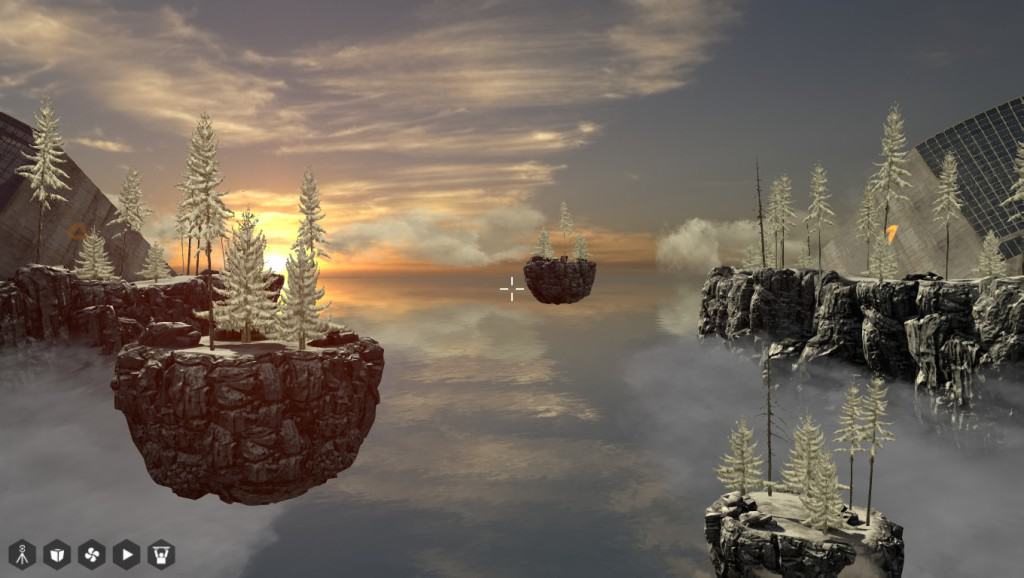
gehenna1 The riddles contain the well known elements (connectors, boxes, jammer, etc), but the settings are often spectacular, sometimes very small and narrow, just a few moves if done in the right order, sometimes like wide open fields with lots of space to explore. Transportation between various islands suspended in the air is with vents, giving you a lot of nice flight time!
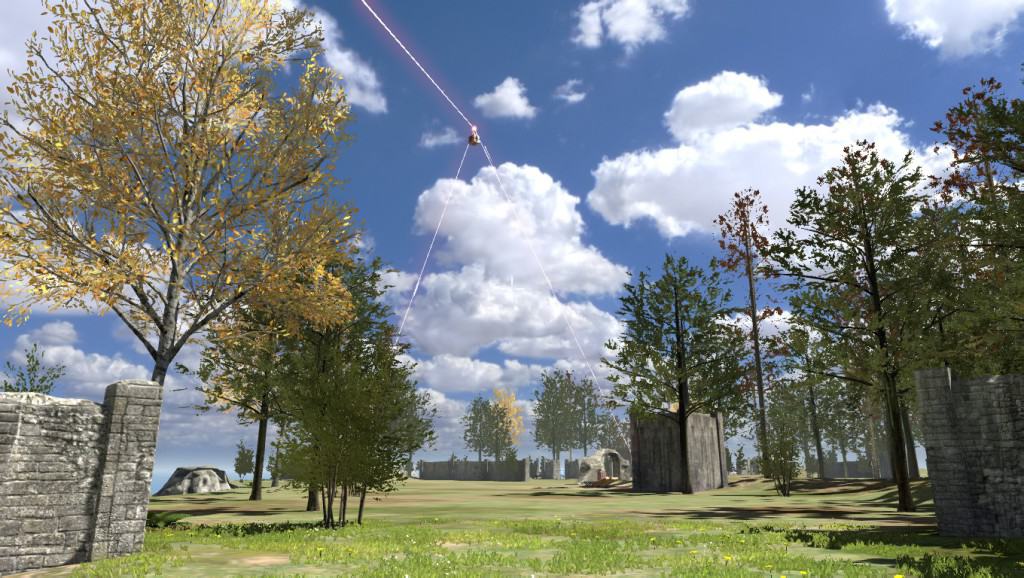
gehenna2 If one searches a lot, or uses a bit of cheating, one can find good old friends from the Portal series, burried in the sand in one of the world. This is not the only easter egg hidden in the game, there are actually a lot, some of which I have not seen but only read about afterwards. Guess I need to replay the whole game.
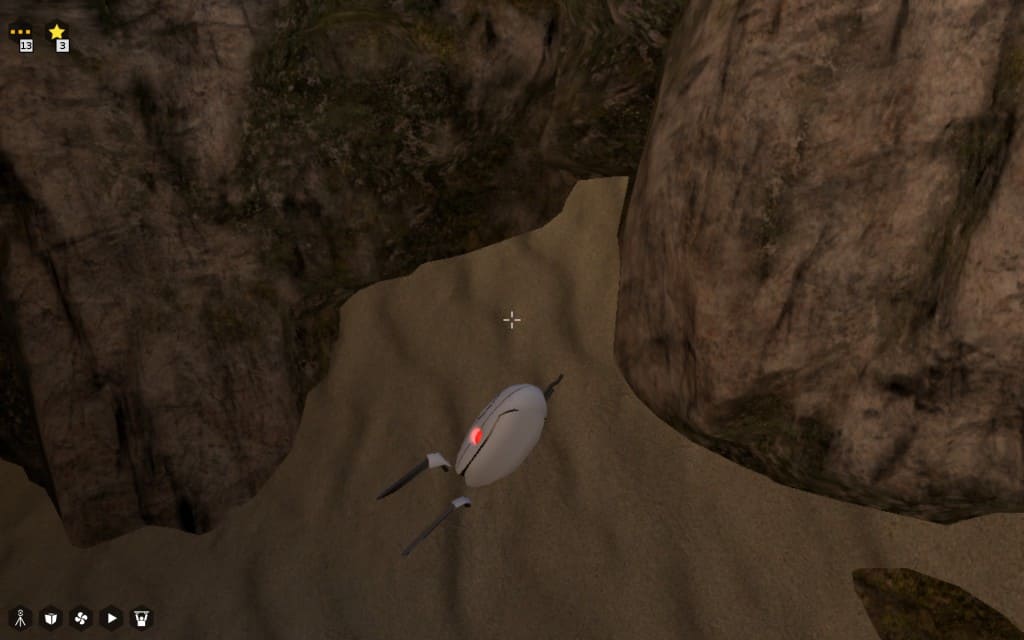
gehenna3 Coming back to the riddles, I really believe that the makers have been ingenious in using the few items at hand to create challenging and surprising riddles. As it is so often, many of the riddles look completely impossible at first glance, and often even after staring at them for tens and tens of minutes. Until (and if) one has the the a-ha effect and understands the trick. This often still needs a lot of handwork and trial-error rounds, but all in all the game is well balanced. What is a bit a pain similar to the original game are collecting the stars to reach the hidden world and free the admin. There the developers overdid it in my opinion, with some rather absurd and complicated stars.

gehenna4 The end of the game, ascension of the messengers, is rather unspectacular. A short discussion on who remains and then a big closing scene with the messenger being beamed up a la Starship Enterprise, and a closing black screen. But well, the fun was with the riddles.
gehenna5 All in all an extension that is well worth the investment if one enjoyed the original Talos, and is looking for rather challenging riddles. Now that I have finished all the Portal and Talos titles, I am hard thinking of what is next looking into Braid Enjoy!

1 February 2016

Ritesh Raj Sarraf: State of Email Clients on Linux Based Platforms

I've been trying to catch up on my reading list (Thanks to rss2email, now I can hold the list longer, than just marking all as read). And one item from last year's end worth spending time was Thunderbird. Thunderbird has been the email client of choice for many users. The main reason for it being popular has been, in my opinion, it being cross platform. Because that allows users an easy migration path across platforms. It also bring persistence, in terms of features and workflows, to the end users. Perhaps that must have been an important reason for many distributions (Ubuntu) and service providers to promote it as the default email client. A Windows/Mac user migrating to Ubuntu will have a lot better experience if they see familiar tools, and their data and workflows being intact. Mozilla must have executed its plan pretty well, to have been able to get it rolling so far. Because other attempts elsewhere (KDE4 Windows) weren't so easy. Part of the reason maybe that any time a new disruptive update is rolled on (KDE4, GNOME3), a lot many frustrated users are born. It is not that people don't want change. Its just that no one likes to see things break. But unfortunately, in Free Software / Open Source world, that is taken lightly. That's one reason why it takes Mozilla so so so long to implement Maildir in TB, when others (Evolution) have had it for so long. So, recently, Mozilla announced its plans to drop Thunderbird development. It is not something new. Anyone using TB knows how long it has been in Maintenance/ESR mode. What was interesting on LWN was the comments. People talked a lot about DE Native Email clients - Kmail, Sylpheed. TUI Clients and these days Browser based clients. Surprisingly, not much was talked about Evolution. My recent move to GNOME has made me look into letting go of old tools/workflows, and try to embrace newer ones. Of them has been GNOME itself. Changing workflows for email was difficult and frustrating. But knowing that TB doesn't have a bright future, it was important to look for alternatives. Just having waited for Maildir and GTK3 port of TB for so long, was enough. On GNOME, Evolution, may give an initial impression of being in Maintenance mode. Especially given that most GNOME apps are now moving to the new UI, which is more touch friendly. And also, because there were other efforts to have another email client on GNOME, I think it is Yorba. But even in its current form, Evolution is a pretty impressive email client Personal Information Management tool. It already is ported to GTK3. Which implies it is capable of responding to Touch events. It sure could have a revised Touch UI, like what is happening with other GNOME Apps. But I'm happy that it has been defered for now. Revising Evolution won't be an easy task, and knowing that GNOME too is understaffed, breaking a perfectly working tool won't be a good idea. My intent with this blog post is to give credit to my favorite GNOME application, i.e. Evolution. So next time you are looking for an email client alternative, give Evolution a try. Today, it already does:
  • Touch UI
  • Maildir
  • Microsoft Exchange
  • GTK3
  • Addressbook, Notes, Tasks, Calendar - Most Standards Based and Google Services compatible
  • RSS Feed Manager
  • And many more that I may not have been using
The only missing piece is being cross-platform. But given the trend, and available resources, I think that path is not worthy of trying. Keep It Simple. Support one platform and support it well.

Categories:

Keywords:

Like:

30 January 2016

Lunar: Only allow outgoing connections through Tor

Using Tor helps take back control of what data one decides to share online. It also helps in avoiding surveillance from the local network (think of someone listening to the public Wi-Fi) or the Internet access provider. But it is easy to make mistakes: Tor Browser, the easiest and most common way to use Tor, is just a web browser. Extra special care is required to make other applications use Tor, and it is easy to forget to change settings, let alone actual attackers. That's why using Tails is often recommended as everything is preconfigured and it requires traffic to go through Tor by various means. Qubes or Whonix also have interesting properties, but require reinstalling systems and changing habits. Meanwhile, securing the network on an already installed system can help you feel better. A potential solution to prevent connections from leaking out without going through Tor is simply to prevent all connections from leaving the computer, except the ones going to the Tor network. This can quite easily be implemented by setting up an outgoing firewall. Using the default settings, a Tor client can potentially connect to any of the 2,000 Guard relays. While there are ways to get such a list and turn it into firewall rules, we are going to use an easier solution. Because the list of Tor relays is public, censors have often used it to prevent people from connecting to the Tor network. The Tor project came up with bridges as a work-around. Bridges are entry nodes in the Tor network. For public bridges, users can only get a few bridge addresses at a time, preventing an adversary from easily blocking them at all once. When configured to use a set of bridges, Tor will only connect to their addresses. This will make our firewall much shorter. The instructions that follow should work on Debian Jessie and later versions. Adapting them to other systems should not be too hard either. We assume that Tor Browser is already installed. As we will want other applications to use Tor than just the browser, we also want to install a system-wide instance:
# apt install tor
Next, visit bridges.torproject.org to request a set of bridges: BridgeDB landing page You then need to select the type of bridges. Tor standard protocol is easy to identify as such. The Tor project has developed pluggable transports to easily disguise the traffic, but using them is outside the scope for this documentation. So lets stay with the default type of bridges: BridgeDB bridge type selection After solving a CAPTCHA, you'll get a list of addresses and fingerprints for a couple of bridges like the following one: Example bridge list from BridgeDB (blurred to protect the actual bridges To tell Tor to use these bridges, edit /etc/tor/torrc, and at the end, add something like:
UseBridges 1
Bridge 109.XXX.XXX.XXX:4XXX 2244XXXXXXXXXXXXXXXXXXXXXXXXXXXXXXXXXXXX
Bridge 37.XXX.XXX.XXX:1XXXX 9CF0XXXXXXXXXXXXXXXXXXXXXXXXXXXXXXXXXXXX
Bridge 171.XXX.XXX.XXX:4XXX 7705XXXXXXXXXXXXXXXXXXXXXXXXXXXXXXXXXXXX
Replace the actual addresses and fingerprints by those you got earlier. Now reload the daemon and make sure that it still connects to the network:
# service tor reload
# tail -f /var/log/tor/log
Tor Browser also needs to be told to use these bridges. Open the onion menu close to the location bar, and select Tor Network Settings . Tor Browser  onion menu In there, tick My Internet Service Provider (ISP) blocks connections to the Tor network and paste the list of bridges below Enter custom bridges: Tor Browser Network Settings Before we restrict outgoing connections to only use the Tor network, lets configure APT to use Tor as well so we can continue installing and upgrading packages in the future:

# apt install apt-transport-tor
The following command will reconfigure APT to use Tor to access the currently configured package repositories. It basically takes care of replacing every http:// by tor+http://:
# sed -e 's/^[^#]*\(deb\(-src\)\?\W\+\)http/\1tor+http/' -i /etc/apt/sources.list /etc/apt/sources.list.d/*.list
Lets see if it still works:
# apt update
One last thing: sometimes, we still need to bypass our restrictions and access the network directly. Some websites sadly deny access to Tor users, or we might need to login through a captive portal before being able to use a random network. To make it practical, we are going to create a new user account. This will enable us to use the desktop user switching capabilities to start a new browser or sudo for command line applications. In this example, the user is going to be named passthrough:
# adduser passthrough
Make sure to set a proper password! Now lets configure the firewall. Here we are going to use ferm which makes it fairly easy to do low-level firewall rule in a readable manner:
# apt install ferm
We want the firewall to be started at boot time. Now edit its configuration in /etc/ferm/ferm.conf. At the end, add:
# Let's block everything for both IPv4 and IPv6, except to localhost,
# already established connections and the special 'passthrough' user.
domain (ip ip6) chain OUTPUT  
    policy DROP;
    outerface lo ACCEPT;
    proto icmp ACCEPT;
    mod state state (ESTABLISHED RELATED) ACCEPT;
    mod owner uid-owner "passthrough" ACCEPT;
 
# Now for IPv4, we want to restrict output to configured Tor bridges
domain ip chain OUTPUT  
    # Don't break network autoconfiguration
    mod owner uid-owner 0 proto udp dport bootps ACCEPT;
    # Allow bridges defined in torrc by getting them directly
    # from the configuration file.
    @include "sed -n -e 's/^Bridge \([^ ]* \)\?\([0-9.]*\):\([0-9]*\).*/daddr \2 proto tcp dport \3 ACCEPT;/p' /etc/tor/torrc  ";
 
# Let's REJECT everything else so we get notice instead of timeouts
domain (ip ip6) chain OUTPUT REJECT;
Reload the firewall through:
# service ferm reload
Lets do some tests:
# ping check.torproject.org
  ping: unknown host check.torproject.org
# tor-resolve check.torproject.org
  38.229.72.22
# ping 38.229.72.22
  From 192.168.7.234 icmp_seq=1 Destination Port Unreachable
# curl https://check.torproject.org/
  curl: (6) Could not resolve host: check.torproject.org
# curl -I https://38.229.72.22/
  curl: (7) Failed to connect to 38.229.72.22 port 443: Connection refused
# curl --socks5 127.0.0.1:9050 https://check.torproject.org/
  curl: (6) Could not resolve host: check.torproject.org
# curl --silent --socks5-hostname 127.0.0.1:9050 https://check.torproject.org/   grep Congratulations
  Congratulations. This browser is configured to use Tor.
# sudo -u passthrough ping -c 1 check.torproject.org
  64 bytes from sergii.torproject.org (38.229.72.22): icmp_seq=1 ttl=54 time=148 ms
# sudo -u passthrough curl --silent https://check.torproject.org/   grep Sorry
  Sorry. You are not using Tor.
One last thing to complete the setup: for command line applications like SSH, torsocks does wonders. Just prefix your usual commands by torsocks and they should work:
# apt install torsocks
# torsocks curl --silent https://check.torproject.org/   grep Congratulations
  Congratulations. This browser is configured to use Tor.
All set! In case you ever need to turn it all off, just ask ferm to reconfigure the firewall:
# service ferm stop
But don't forget to turn it back on later!
# service ferm start
Ideally, we would have a way to automatically configure a different set of bridges for each network we connect to make it more difficult to trace the computer from network to network. But there's quite some more work to be done on various levels before that can be done in an integrated manner (torshiftchange and tordyguards are promising options). Meanwhile, be aware that you might want to keep a fresh set of bridges handy to configure them after leaving for a trip. Another downside of the setup currently is that it doesn't allow for network time synchronization. That might make the system fingerprintable by using its clock drift. To use obfs4 bridges which helps defeating censored networks, you will need two extra steps. First, install the required software:
# apt install obfs4proxy
Then add the following extra line to /etc/tor/torrc:
ClientTransportPlugin obfs2,obfs3,obfs4,scramblesuit exec /usr/bin/obfs4proxy
You can then request obfs4 bridges from BridgeDB. These changes are only required for the system-wide Tor daemon, as Tor Browser comes with obs4proxy preconfigured. Kudos to Micah for proofreading this article.

28 January 2016

Holger Levsen: 20160127-torbrowser-daily-tests

Daily tests of torbrowser-launcher, and on every git commit too Tor Browser for reasons beyond this blog post is not part of Debian. To easily and securely use it, one can run
sudo apt-get install torbrowser-launcher
and then run torbrowser-launcher which will download Tor Browser and well, launch it. And this sometimes breaks, when things change, which is rather frequently the case So yesterday I finally woke up to see what I wished to see every morning since November 15th last year, when I started testing torbrowser-launcher systematically on jenkins.debian.net: This is the graphical status overview of torbrowser tests on Debian which are tests installing torbrowser-launcher on and from sid, stretch, jessie-backports, jessie and wheezy-backports, which first download torbrowser via https and via tor, then launches it to finally connect to a debian mirror via an onion-address and then to www.debian.org. In addition to these there are also tests installing the package from stretch on jessie as well as the package from sid on stretch and jessie. Finally there are also tests for building the package from our git branches for various suites and finally we also build a package based on the upstream git master branch merged with our sid packaging. There are 17 different tests currently and they are configured in just two files, a 220 line yaml file defining the jenkins jobs and 528 lines of bash script containing the actual test code. The tests are using schroot, xvfb, kvkbd and gocr and are executed either daily or weekly (those testing the package from ftp.d.o) or on every commit and at least once every month (those testing the package build from git). At least briefly I have been looking at the this page every day since setting up these tests two months ago. Back then, torbrowser-launcher was broken in many suites and then it broke some more and instead of fixing it, I first made these tests so that at least in future there will be automatic notifications when things break. This has worked out rather nicely and torbrowser-launcher got fixed over time too. Doing so in jessie proper took longest as we missed 8.2. Once jessie was fixed the fix for wheezy-backports was also finally accepted very quickly. Which was this Monday, so yesterday on Tuesday I could enjoy for the first time an all "green page"! :-) And then on Wednesday, which is now also yesterday, the nice green page became less green due two new issues: #805173 really needs ca-certificates as depends and not recommends and then also the rendering of the new 5.5 version of torbrowser changed slightly Both issues have been addressed by now. I'm curious how this page will look tomorrow morning. And when I'll consider it the number of false negatives to be low enough so as I'll happily enable notifications to be send to the pkg privacy maintainers mailing list. I think it's almost the case and will keep an eye on the results the coming weeks and months. Last not least: if you want to run similar tests for your Debian project, I'd be glad to help! See you at FOSDEM?

27 January 2016

Jonas Smedegaard: BOSS - Barath Operating System Solutions

Siri and I are on a journey through India and Nepal, with the aim of learning about needs of Debian derivatives, to improve Debian and encourage closer integration.

C-DAC and BOSS Centre for Development of Advanced Computing (C-DAC) is a large organization serving country- and state-level institutions in India, with offices and training facilities several major cities. In Chennai, C-DAC has a staff of 25 developers working full time on Barath Operating System Solutions (BOSS). BOSS is a Debian derivative with several flavors - a desktop for use at primary schools (EduBOSS), a desktop for governmental offices (BOSS), and a range of server-oriented use cases using same core as the desktops with various (non-packaged) code and configuration on top. The core common to all BOSS flavors is a derivative of Debian. Major work has been in strengthening localization and related code - including the development of a font covering all officially supported indic scripts, tuning input methods configuration, and bugfixing LibreOffice handling of complex scripts. All that work is all passed directly to upstream code projects (some still show as derived work until sifting down again into Debian). Besides locale derivations, BOSS currently includes 11 packages not yet in Debian - a mixture of package dependencies, branding data and configuration tweaks. Seems most if not all can fit into Debian with a bit of restructuring work.

small computers As some of you know, I always had a special interest in low-resource (yet general purpose) computers (partly driven by my lack of money to spend on shinier hardware), and since ~2009 particularly in ARM-based computers. After 4 days of meetings and discussion with C-DAC, - literally few minutes before departure - I casually mentioned my interest in small computers, and much to my surprise it turned out that C-DAC also works on that, just didn't get around to mention it yet at the Debian wiki page. C-DAC have worked for a year on tuning BOSS to work on the Vidyut laptop (successor to the Aakash tablet). All except builtin camera is allegedly working. C-DAC is also looking into Olimex boards - my favorites - possibly for use with small server setups but our time was up, we had to leave for our train to Pune, so details on that we will have to figure out through mail.

collaboration In the past, C-DAC have kept in touch with their users through BOSS-specific places like a dedicated IRC channel. Recent changes in management style at the development office have caused less attention available to that communication, however. C-DAC have politely offered their code changes upstram for years, but maybe "too polite": Maybe they have offered only polished fixes, being less loud about "interesting problems". I suggested, as way to improve while limiting (ideally avoiding) extra work, is to mentally take a step up the stream: Treat BOSS not as a derivative but a subset of Debian itself, hang out and discuss issues and ideas at debian irc channels, and maintain your packages directly in Debian. Only parts unfit for Debian - secret stuff done for India military, and dirty configuration hacks not yet possible within Debian Policy - really need to be kept away from Debian. C-DAC agreed, and Debian now has a BOSS team! Anyone interested to follow BOSS as a Debian blend, and perhaps even contribute with opinions and/or code, is quite welcome to join the newly created mailinglist on Debian Alioth: https://lists.alioth.debian.org/mailman/listinfo/boss-devel. Our meetings with BOSS developers have been very pleasant. Even those working at the top of cloud or big data stacks - furthest away from our mindset of tightly "locking down" all parts as packages - were patient with us. Thanks in particular to Prema S and Prathibha B, working on packaging of BOSS for the past 5+ years, and both likely to enter the Debian New Maintainer Queue before long :-)

25 January 2016

Antoine Beaupr : Internet in Cuba

A lot has been written about the Internet in Cuba over the years. I have read a few articles, from New York Times' happy support for Google's invasion of Cuba to RSF's dramatic and fairly outdated report about censorship in Cuba. Having written before about Internet censorship in Tunisia, I was curious to see if I could get a feel of what it is like over there, now that a new Castro is in power and the Obama administration has started restoring diplomatic ties with Cuba. With those political changes coming signifying the end of an embargo that has been called genocidal by the Cuban government, it is surprisingly difficult to get fresh information about the current state of affairs. This article aims to fill that gap in clarifying how the internet works in Cuba, what kind of censorship mechanisms are in place and how to work around them. It also digs more technically into the network architecture and performance. It is published in the hope of providing both Cubans and the rest of the world with a better understanding of their network and, if possible, Cubans ways to access the internet more cheaply or without censorship.

"Censorship" and workarounds Unfortunately, I have been connected to the internet only through the the Varadero airport and the WiFi of a "full included" resort near Jibacoa. I have to come to assume that this network is likely to be on a segregated, uncensored internet while the rest of the country suffers the wrath of the Internet censorship in Cuba I have seen documented elsewhere. Through my research, I couldn't find any sort of direct censorship. The Netalyzr tool couldn't find anything significantly wrong with the connection, other than the obvious performance problems related both to the overloaded uplinks of the Cuban internet. I ran an incomplete OONI probe as well, and it seems there was no obvious censorship detected there as well, at least according to folks in the helpful #ooni IRC channel. Tor also works fine, and could be a great way to avoid the global surveillance system described later in this article. Nevertheless, it still remains to be seen how the internet is censored in the "real" Cuban internet, outside of the tourist designated areas - hopefully future visitors or locals can expand on this using the tools mentioned above, using the regular internet. Usual care should be taken when using any workaround tools, mentioned in this post or not, as different regimes over the world have accused, detained, tortured and killed sometimes for the mere fact of using or distributing circumvention tools. For example, a Russian developer was arrested and detained in 2001 by United States' FBI for exposing vulnerabilities in the Adobe e-books copy protection mechanisms. Similarly, people distributing Tor and other tools have been arrested during the period prior to the revolution in Tunisia.

The Cuban captive portal There is, however, a more pernicious and yet very obvious censorship mechanism at work in Cuba: to get access to the internet, you have to go through what seems to be a state-wide captive portal, which I have seen both at the hotel and the airport. It is presumably deployed at all levels of the internet access points. To get credentials through that portal, you need a username and password which you get by buying a Nauta card. Those cards cost 2$CUC and get you an hour of basically unlimited internet access. That may not seem like a lot for a rich northern hotel party-goer, but for Cubans, it's a lot of money, given that the average monthly salary is around 20$CUC. The system is also pretty annoying to use, because it means you do not get continuous network access: every hour, you need to input a new card, which will obviously make streaming movies and other online activities annoying. It also makes hosting servers basically impossible. So while Cuba does not have, like China or Iran, a "great firewall", there is definitely a big restriction to going online in Cuba. Indeed, it seems to be how the government ensures that Cubans do not foment too much dissent online: keep the internet slow and inaccessible, and you won't get too many Arab spring / blogger revolutions.

Bypassing the Cuban captive portal The good news is that it is perfectly possible for Cubans (or at least for a tourist like me with resources outside of the country) to bypass the captive portal. Like many poorly implemented portals, the portal allows DNS traffic to go through, which makes it possible to access the global network for free by using a tool like iodine which tunnels IP traffic over DNS requests. Of course, the bandwidth and reliability of the connection you get through such a portal is pretty bad. I have regularly seen 80% packet loss and over two minutes of latency:
--- 10.0.0.1 ping statistics ---
163 packets transmitted, 31 received, 80% packet loss, time 162391ms
rtt min/avg/max/mdev = 133.700/2669.535/64188.027/11257.336 ms, pipe 65
Still, it allowed me to login to my home server through SSH using Mosh to workaround the reliability issues. Every once in a while, mosh would get stuck and keep on trying to send packets to probe the server, which would clog the connection even more. So I regularly had to restart the whole stack using these commands:
killall iodine # stop DNS tunnel
nmcli n off # turn off wifi to change MAC address
macchanger -A wlan0 # change MAC address
nmcli n on # turn wifi back on
sleep 3 # wait for wifi to settle
iodine-client-start # restart DNS tunnel
The Koumbit Wiki has good instructions on how to setup a DNS tunnel. I am wondering if such a public service could be of use for Cubans, although I am not sure how it could be deployed only for Cubans, and what kind of traffic it could support... The fact is that iodine does require a server to operate, and that server must be run on the outside of the censored perimeter, something that Cubans may not be able to afford in the first place. Another possible way to save money with the captive portal would be to write something that automates connecting and disconnecting from the portal. You would feed that program a list of credentials and it would connect to the portal only on demand, and disconnect as soon as no traffic goes through. There are details on the implementation of the captive portal below that may help future endeavours in that field.

Private information revealed to the captive portal It should be mentioned, however, that the captive portal has a significant amount of information on clients, which is a direct threat to the online privacy of Cuban internet users. Of course the unique identifiers issued with the Nauta cards can be correlated with your identity, right from the start. For example, I had to give my room number to get a Nauta card issued. Then the central portal also knows which access point you are connected to. For example, the central portal I was connected to Wifi_Memories_Jibacoa which, for anyone that cares to research, will give them a location of about 20 square meters where I was located when connected (there is only one access point in the whole hotel). Finally, the central portal also knows my MAC address, a unique identifier for the computer I am using which also reveals which brand of computer I am using (Mac, Lenovo, etc). While this address can be changed, very few people know that, let alone how. This led me to question whether I would be allowed back in Cuba (or even allowed out!) after publishing this blog post, as it is obvious that I can be easily identified based on the time this article was published, my name and other details. Hopefully the Cuban government will either not notice or not care, but this can be a tricky situation, obviously. I have heard that Cuban prisons are not the best hangout place in Cuba, to say the least...

Network configuration assessment This section is more technical and delves more deeply in the Cuban internet to analyze the quality and topology of the network, along with hints as to which hardware and providers are being used to support the Cuban government.

Line quality The internet is actually not so bad in the hotel. Again, this may be because of the very fact that I am in that hotel, and I get a privileged access to the new fiber line to Venezuela, the ALBA-1 link. The line speed I get is around 1mbps, according to speedtest, which selected a server from LIME in George Town, Cayman Islands:
[1034]anarcat@angela:cuba$ speedtest
Retrieving speedtest.net configuration...
Retrieving speedtest.net server list...
Testing from Empresa de Telecomunicaciones de Cuba (152.206.92.146)...
Selecting best server based on latency...
Hosted by LIME (George Town) [391.78 km]: 317.546 ms
Testing download speed........................................
Download: 1.01 Mbits/s
Testing upload speed..................................................
Upload: 1.00 Mbits/s
Latency to the rest of the world is of couse slow:
--- koumbit.org ping statistics ---
122 packets transmitted, 120 received, 1,64% packet loss, time 18731,6ms
rtt min/avg/max/sdev = 127,457/156,097/725,211/94,688 ms
--- google.com ping statistics ---
122 packets transmitted, 121 received, 0,82% packet loss, time 19371,4ms
rtt min/avg/max/sdev = 132,517/160,095/724,971/93,273 ms
--- redcta.org.ar ping statistics ---
122 packets transmitted, 120 received, 1,64% packet loss, time 40748,6ms
rtt min/avg/max/sdev = 303,035/339,572/965,092/97,503 ms
--- ccc.de ping statistics ---
122 packets transmitted, 72 received, 40,98% packet loss, time 19560,2ms
rtt min/avg/max/sdev = 244,266/271,670/594,104/61,933 ms
Interestingly, Koumbit is actually the closest host in the above test. It could be that Canadian hosts are less affected by bandwidth problems compared to US hosts because of the embargo.

Network topology The various traceroutes show a fairly odd network topology, but that is typical of what I would described as "colonized internet users", which have layers and layers of NAT and obscure routing that keep them from the real internet. Just like large corporations are implementing NAT in a large scale, Cuba seems to have layers and layers of private RFC 1918 IPv4 space. A typical traceroute starts with:
traceroute to koumbit.net (199.58.80.33), 30 hops max, 60 byte packets
 1  10.156.41.1 (10.156.41.1)  9.724 ms  9.472 ms  9.405 ms
 2  192.168.134.137 (192.168.134.137)  16.089 ms  15.612 ms  15.509 ms
 3  172.31.252.113 (172.31.252.113)  15.350 ms  15.805 ms  15.358 ms
 4  pos6-0-0-agu-cr-1.mpls.enet.cu (172.31.253.197)  15.286 ms  14.832 ms  14.405 ms
 5  172.31.252.29 (172.31.252.29)  13.734 ms  13.685 ms  14.485 ms
 6  200.0.16.130 (200.0.16.130)  14.428 ms  11.393 ms  10.977 ms
 7  200.0.16.74 (200.0.16.74)  10.738 ms  10.019 ms  10.326 ms
 8  ix-11-3-1-0.tcore1.TNK-Toronto.as6453.net (64.86.33.45)  108.577 ms  108.449 ms
Let's take this apart line by line:
 1  10.156.41.1 (10.156.41.1)  9.724 ms  9.472 ms  9.405 ms
This is my local gateway, probably the hotel's wifi router.
 2  192.168.134.137 (192.168.134.137)  16.089 ms  15.612 ms  15.509 ms
This is likely not very far from the local gateway, probably still in Cuba. It in one bit away from the captive portal IP address (see below) so it is very likely related to the captive portal implementation.
 3  172.31.252.113 (172.31.252.113)  15.350 ms  15.805 ms  15.358 ms
 4  pos6-0-0-agu-cr-1.mpls.enet.cu (172.31.253.197)  15.286 ms  14.832 ms  14.405 ms
 5  172.31.252.29 (172.31.252.29)  13.734 ms  13.685 ms  14.485 ms
All those are withing RFC 1918 space. Interestingly, the Cuban DNS servers resolve one of those private IPs as within Cuban space, on line #4. That line is interesting because it reveals the potential use of MPLS.
 6  200.0.16.130 (200.0.16.130)  14.428 ms  11.393 ms  10.977 ms
 7  200.0.16.74 (200.0.16.74)  10.738 ms  10.019 ms  10.326 ms
Those two lines are the only ones that actually reveal that the route belongs in Cuba at all. Both IPs are in a tiny (/24, or 256 IP addresses) network allocated to ETECSA, the state telco in Cuba:
inetnum:     200.0.16/24
status:      allocated
aut-num:     N/A
owner:       EMPRESA DE TELECOMUNICACIONES DE CUBA S.A. (IXP CUBA)
ownerid:     CU-CUBA-LACNIC
responsible: Rafael L pez Guerra
address:     Ave. Independencia y 19 Mayo, s/n,
address:     10600 - La Habana - CH
country:     CU
phone:       +53 7 574242 []
owner-c:     JOQ
tech-c:      JOQ
abuse-c:     JEM52
inetrev:     200.0.16/24
nserver:     NS1.NAP.ETECSA.NET
nsstat:      20160123 AA
nslastaa:    20160123
nserver:     NS2.NAP.ETECSA.NET
nsstat:      20160123 AA
nslastaa:    20160123
created:     20030512
changed:     20140610
Then the last hop:
 8  ix-11-3-1-0.tcore1.TNK-Toronto.as6453.net (64.86.33.45)  108.577 ms  108.449 ms  108.257 ms
...interestingly, lands directly in Toronto, in this case going later to Koumbit but that is the first hop that varies according to the destination, hops 1-7 being a common trunk to all external communications. It's also interesting that this shoves a good 90 milliseconds extra in latency, showing that a significant distance and number of equipment crossed. Yet a single hop is crossed, not showing the intermediate step of the Venezuelan link or any other links for that matter. Something obscure is going on there... Also interesting to note is the traceroute to the redirection host, which is only one hop away:
traceroute to 192.168.134.138 (192.168.134.138), 30 hops max, 60 byte packets
 1  192.168.134.138 (192.168.134.138)  6.027 ms  5.698 ms  5.596 ms
Even though it is not the gateway:
$ ip route
default via 10.156.41.1 dev wlan0  proto static  metric 1024
10.156.41.0/24 dev wlan0  proto kernel  scope link  src 10.156.41.4
169.254.0.0/16 dev wlan0  scope link  metric 1000
This means a very close coordination between the different access points and the captive portal system. Finally, note that there seems to be only three peers to the Cuban internet: Teleglobe, formerly Canadian, now owned by the Indian [[!wiki Tata group]], and Telef nica, the Spanish Telco that colonized most of Latin America's internet, all the way down to Argentina. This is confirmed by my traceroutes, which show traffic to Koumbit going through Tata and Google's going through Telef nica.

Captive portal implementation The captive portal is https://www.portal-wifi-temas.nauta.cu/ (not accessible outside of Cuba) and uses a self-signed certificate. The domain name resolves to 190.6.81.230 in the hotel. Accessing http://1.1.1.1/ gives you a status page which allows you to disconnect from the portal. It actually redirects you to https://192.168.134.138/logout.user. That is also a self-signed, but different certificate. That certificate actually reveals the implication of Gemtek which is a "world-leading provider of Wireless Broadband solutions, offering a wide range of solutions from residential to business". It is somewhat unclear if the implication of Gemtek here is deliberate or a misconfiguration on the part of Cuban officials, especially since the certificate is self-signed and was issued in 2002. It could be, however, a trace of the supposed involvement of China in the development of Cuba's networking systems, although Gemtek is based in Taiwan, and not in the China mainland. That IP, in turn, redirects you to the same portal but in a page that shows you the statistics:
https://www.portal-wifi-temas.nauta.cu/?mac=0024D1717D18&script=logout.user&remain_time=00%3A55%3A52&session_time=00%3A04%3A08&username=151003576287&clientip=10.156.41.21&nasid=Wifi_Memories_Jibacoa&r=ac%2Fpopup
Notice how you see the MAC address of the machine in the URL (randomized, this is not my MAC address), along with the remaining time, session time, client IP and the Wifi access point ESSID. There may be some potential in defrauding the session time there, I haven't tested it directly. Hitting Actualizar redirects you back to the IP address, which redirects you to the right URL on the portal. The "real" logout is at:
http://192.168.134.138/logout.user?cmd=logout
The login is performed against https://www.portal-wifi-temas.nauta.cu/index.php?r=ac/login with a referer of:
https://www.portal-wifi-temas.nauta.cu/?&nasid=Wifi_Memories_Jibacoa&nasip=192.168.134.138&clientip=10.156.41.21&mac=EC:55:F9:C5:F2:55&ourl=http%3a%2f%2fgoogle.ca%2f&sslport=443&lang=en-US%2cen%3bq%3d0.8&lanip=10.156.41.1
Again, notice the information revealed to the central portal.

Equipment and providers I ran Nmap probes against both the captive portal and the redirection host, in the hope of finding out how they were built and if they could reveal the source of the equipment used. The complete nmap probes are available in nmap, but it seems that the captive portal is running some embedded device. It is confusing because the probe for the captive portal responds as if it was the gateway, which blurs even more the distinction between the hotel's gateway and the captive portal. This raises the distinct possibility that all access points are actually captive portal that authenticate to another central server. The nmap traces do show three distinct hosts however:
  • the captive portal (www.portal-wifi-temas.nauta.cu, 190.6.81.230)
  • some redirection host (192.168.134.138)
  • the hotel's gateway (10.156.41.1)
They do have distinct signatures so the above may be just me misinterpreting traceroute and nmap results. Your comments may help in clarifying the above. Still, the three devices show up as running Linux, in the two last cases versions between 2.4.21 and 2.4.31. Now, to find out which version of Linux it is running is way more challenging, and it is possible it is just some custom Linux distribution. Indeed, the webserver shows up as G4200.GSI.2.22.0155 and the SSH server is running OpenSSH 3.0.2p1, which is basically prehistoric (2002!) which corroborates the idea that this is some Gemtek embedded device. The fact that those devices are running 14 years old software should be a concern to the people responsible for those networks. There is, for example, a remote root vulnerability that affects that specific version of OpenSSH, among many other vulnerabilities.

A note on Nauta card's security Finally, one can note that it is probably trivial to guess card UIDs. All cards i have here start with the prefix 15100, the following digits being 3576 or 4595, presumably depending on the "batch" that was sent to different hotels, which seems to be batches of 1000 cards. You can also correlate the UID with the date at which the card was issued. For example, 15100357XXX cards are all valid until 19/03/2017, and 151004595XXX cards are all valid until 23/03/2017. Here's the list of UIDs I have seen:
151004595313
151004595974
151003576287
151003576105
151003576097
The passwords, on the other hand, do seem fairly random (although my sample size is small). Interestingly, those passwords are also 12 digits long, which is about as strong as a seven-letter password (mixed uppercase and lowercase). If there are no rate-limiting provisions on that captive portal, it could be possible to guess those passwords, since you have free rein on accessing those routers. Depending on the performance of the routers, you could be lucky and find a working password for free...

Conclusion Clearly, Internet access in Cuba needs to be modernized. We can clearly see that Cuba years behind the rest of the Americas, if only through the percentage of the population with internet access, or download speeds. The existence of a centralized captive portal also enables a huge surveillance potential that should be a concern for any Cuban, or for that matter, anyone wishing to live in a free society. The answer, however, lies not in the liberalization of commerce and opening the doors to the US companies and their own systems of surveillance. It should be possible, and even desirable for Cubans to establish their own neutral network, a proposal I have made in the past even for here in Qu bec. This network could be used and improved by Cubans themselves, prioritizing local communities that would establish their own infrastructure according to their own needs. I have been impressed by this article about the El Paquete system - it shows great innovation and initiative from Cubans which are known for engaging in technology in a creative way. This should be leveraged by letting Cubans do what they want with their networks, not telling them what to do. The best the Googles of this world can do to help Cuba is not to colonize Cuba's technological landscape but to cleanup their own and make their own tools more easily accessible and shareable offline. It is something companies can do right now, something I detailed in a previous article.

14 January 2016

Petter Reinholdtsen: Always download Debian packages using Tor - the simple recipe

During his DebConf15 keynote, Jacob Appelbaum observed that those listening on the Internet lines would have good reason to believe a computer have a given security hole if it download a security fix from a Debian mirror. This is a good reason to always use encrypted connections to the Debian mirror, to make sure those listening do not know which IP address to attack. In August, Richard Hartmann observed that encryption was not enough, when it was possible to interfere download size to security patches or the fact that download took place shortly after a security fix was released, and proposed to always use Tor to download packages from the Debian mirror. He was not the first to propose this, as the apt-transport-tor package by Tim Retout already existed to make it easy to convince apt to use Tor, but I was not aware of that package when I read the blog post from Richard. Richard discussed the idea with Peter Palfrader, one of the Debian sysadmins, and he set up a Tor hidden service on one of the central Debian mirrors using the address vwakviie2ienjx6t.onion, thus making it possible to download packages directly between two tor nodes, making sure the network traffic always were encrypted. Here is a short recipe for enabling this on your machine, by installing apt-transport-tor and replacing http and https urls with tor+http and tor+https, and using the hidden service instead of the official Debian mirror site. I recommend installing etckeeper before you start to have a history of the changes done in /etc/.
apt install apt-transport-tor
sed -i 's% http://ftp.debian.org/%tor+http://vwakviie2ienjx6t.onion/%' /etc/apt/sources.list
sed -i 's% http% tor+http%' /etc/apt/sources.list
If you have more sources listed in /etc/apt/sources.list.d/, run the sed commands for these too. The sed command is assuming your are using the ftp.debian.org Debian mirror. Adjust the command (or just edit the file manually) to match your mirror. This work in Debian Jessie and later. Note that tools like apt-file only recently started using the apt transport system, and do not work with these tor+http URLs. For apt-file you need the version currently in experimental, which need a recent apt version currently only in unstable. So if you need a working apt-file, this is not for you. Another advantage from this change is that your machine will start using Tor regularly and at fairly random intervals (every time you update the package lists or upgrade or install a new package), thus masking other Tor traffic done from the same machine. Using Tor will become normal for the machine in question. On Freedombox, APT is set up by default to use apt-transport-tor when Tor is enabled. It would be great if it was the default on any Debian system.

13 January 2016

Norbert Preining: Ian Buruma: Wages of Guilt

Since moving to Japan, I got more and more interested in history, especially the recent history of the 20th century. The book I just finished, Ian Buruma (Wiki, home page) Wages of Guilt Memories of War in Germany and Japan (Independent, NYRB), has been a revelation for me. As an Austrian living in Japan, I am experiencing the discrepancy between these two countries with respect to their treatment of war legacy practically daily, and many of my blog entries revolve around the topic of Japanese non-reconciliation.
Willy Brandt went down on his knees in the Warsaw ghetto, after a functioning democracy had been established in the Federal Republic of Germany, not before. But Japan, shielded from the evil world, has grown into an Oskar Matzerath: opportunistic, stunted, and haunted by demons, which it tries to ignore by burying them in the sand, like Oskar s drum.
Ian Buruma, Wages of Guilt, Clearing Up the Ruins
Buruma-Wages_of_Guilt The comparison of Germany and Japan with respect to their recent history as laid out in Buruma s book throws a spotlight on various aspects of the psychology of German and Japanese population, while at the same time not falling into the easy trap of explaining everything with difference in the guilt culture. A book of great depth and broad insights everyone having even the slightest interest in these topics should read.
This difference between (West) German and Japanese textbooks is not just a matter of detail; it shows a gap in perception.
Ian Buruma, Wages of Guilt, Romance of the Ruins
Only thinking about giving a halfway full account of this book is something impossible for me. The sheer amount of information, both on the German and Japanese side, is impressive. His incredible background (studies of Chinese literature and Japanese movie!) and long years as journalist, editor, etc, enriches the book with facets normally not available: In particular his knowledge of both the German and Japanese movie history, and the reflection of history in movies, were complete new aspects for me (see my recent post (in Japanese)). The book is comprised of four parts: The first with the chapters War Against the West and Romance of the Ruins; the second with the chapters Auschwitz, Hiroshima, and Nanking; the third with History on Trial, Textbook Resistance, and Memorials, Museums, and Monuments; and the last part with A Normal Country, Two Normal Towns, and Clearing Up the Ruins. Let us look at the chapters in turn: The boook somehow left me with a bleak impression of Japanese post-war times as well as Japanese future. Having read other books about the political ignorance in Japan (Norma Field s In the realm of a dying emperor, or the Chibana history), Buruma s characterization of Japanese politics is striking. He couldn t foresee the recent changes in legislation pushed through by the Abe government actually breaking the constitution, or the rewriting of history currently going on with respect to comfort women and Nanking. But reading his statement about Article Nine of the constitution and looking at the changes in political attitude, I am scared about where Japan is heading to:
The Nanking Massacre, for leftists and many liberals too, is the main symbol of Japanese militarism, supported by the imperial (and imperialist) cult. Which is why it is a keystone of postwar pacifism. Article Nine of the constitution is necessary to avoid another Nanking Massacre. The nationalist right takes the opposite view. To restore the true identity of Japan, the emperor must be reinstated as a religious head of state, and Article Nine must be revised to make Japan a legitimate military power again. For this reason, the Nanking Massacre, or any other example of extreme Japanese aggression, has to be ignored, softened, or denied.
Ian Buruma, Wages of Guilt, Nanking
While there are signs of resistance in the streets of Japan (Okinawa and the Hanako bay, the demonstrations against secrecy law and reversion of the constitution), we are still to see a change influenced by the people in a country ruled and distributed by oligarchs. I don t think there will be another Nanking Massacre in the near future, but Buruma s books shows that we are heading back to a nationalistic regime similar to pre-war times, just covered with a democratic veil to distract critics.
I close with several other quotes from the book that caught my attention: In the preface and introduction:
[ ] mainstream conservatives made a deliberate attempt to distract people s attention from war and politics by concentrating on economic growth.
The curious thing was that much of what attracted Japanese to Germany before the war Prussian authoritarianism, romantic nationalism, pseudo-scientific racialism had lingered in Japan while becoming distinctly unfashionable in Germany.
In Romance of the Ruins:
The point of all this is that Ikeda s promise of riches was the final stage of what came to be known as the reverse course, the turn away from a leftist, pacifist, neutral Japan a Japan that would never again be involved in any wars, that would resist any form of imperialism, that had, in short, turned its back for good on its bloody past. The Double Your Incomes policy was a deliberate ploy to draw public attention away from constitutional issues.
In Hiroshima:
The citizens of Hiroshima were indeed victims, primarily of their own military rulers. But when a local group of peace activists petitioned the city of Hiroshima in 1987 to incorporate the history of Japanese aggression into the Peace Memorial Museum, the request was turned down. The petition for an Aggressors Corner was prompted by junior high school students from Osaka, who had embarrassed Peace Museum officials by asking for an explanation about Japanese responsibility for the war.
The history of the war, or indeed any history, is indeed not what the Hiroshima spirit is about. This is why Auschwitz is the only comparison that is officially condoned. Anything else is too controversial, too much part of the flow of history .
In Nanking, by the governmental pseudo-historian Tanaka:
Unlike in Europe or China, writes Tanaka, you won t find one instance of planned, systematic murder in the entire history of Japan. This is because the Japanese have a different sense of values from the Chinese or the Westerners.
In History on Trial:
In 1950, Becker wrote that few things have done more to hinder true historical self-knowledge in Germany than the war crimes trials. He stuck to this belief. Becker must be taken seriously, for he is not a right-wing apologist for the Nazi past, but an eminent liberal.
There never were any Japanese war crimes trials, nor is there a Japanese Ludwigsburg. This is partly because there was no exact equivalent of the Holocaust. Even though the behavior of Japanese troops was often barbarous, and the psychological consequences of State Shinto and emperor worship were frequently as hysterical as Nazism, Japanese atrocities were part of a military campaign, not a planned genocide of a people that included the country s own citizens. And besides, those aspects of the war that were most revolting and furthest removed from actual combat, such as the medical experiments on human guinea pigs (known as logs ) carried out by Unit 731 in Manchuria, were passed over during the Tokyo trial. The knowledge compiled by the doctors of Unit 731 of freezing experiments, injection of deadly diseases, vivisections, among other things was considered so valuable by the Americans in 1945 that the doctors responsible were allowed to go free in exchange for their data.
Some Japanese have suggested that they should have conducted their own war crimes trials. The historian Hata Ikuhiko thought the Japanese leaders should have been tried according to existing Japanese laws, either in military or in civil courts. The Japanese judges, he believed, might well have been more severe than the Allied tribunal in Tokyo. And the consequences would have been healthier. If found guilty, the spirits of the defendants would not have ended up being enshrined at Yasukuni. The Tokyo trial, he said, purified the crimes of the accused and turned them into martyrs. If they had been tried in domestic courts, there is a good chance the real criminals would have been flushed out.
After it was over, the Nippon Times pointed out the flaws of the trial, but added that the Japanese people must ponder over why it is that there has been such a discrepancy between what they thought and what the rest of the world accepted almost as common knowledge. This is at the root of the tragedy which Japan brought upon herself.
Emperor Hirohito was not Hitler; Hitler was no mere Shrine. But the lethal consequences of the emperor-worshipping system of irresponsibilities did emerge during the Tokyo trial. The savagery of Japanese troops was legitimized, if not driven, by an ideology that did not include a Final Solution but was as racialist as Hider s National Socialism. The Japanese were the Asian Herrenvolk, descended from the gods.
Emperor Hirohito, the shadowy figure who changed after the war from navy uniforms to gray suits, was not personally comparable to Hitler, but his psychological role was remarkably similar.
In fact, MacArthur behaved like a traditional Japanese strongman (and was admired for doing so by many Japanese), using the imperial symbol to enhance his own power. As a result, he hurt the chances of a working Japanese democracy and seriously distorted history. For to keep the emperor in place (he could at least have been made to resign), Hirohito s past had to be freed from any blemish; the symbol had to be, so to speak, cleansed from what had been done in its name.
In Memorials, Museums, and Monuments:
If one disregards, for a moment, the differences in style between Shinto and Christianity, the Yasukuni Shrine, with its relics, its sacred ground, its bronze paeans to noble sacrifice, is not so very different from many European memorials after World War I. By and large, World War II memorials in Europe and the United States (though not the Soviet Union) no longer glorify the sacrifice of the fallen soldier. The sacrificial cult and the romantic elevation of war to a higher spiritual plane no longer seemed appropriate after Auschwitz. The Christian knight, bearing the cross of king and country, was not resurrected. But in Japan, where the war was still truly a war (not a Holocaust), and the symbolism still redolent of religious exultation, such shrines as Yasukuni still carry the torch of nineteenth-century nationalism. Hence the image of the nation owing its restoration to the sacrifice of fallen soldiers.
In A Normal Country:
The mayor received a letter from a Shinto priest in which the priest pointed out that it was un-Japanese to demand any more moral responsibility from the emperor than he had already taken. Had the emperor not demonstrated his deep sorrow every year, on the anniversary of Japan s surrender? Besides, he wrote, it was wrong to have spoken about the emperor in such a manner, even as the entire nation was deeply worried about his health. Then he came to the main point: It is a common error among Christians and people with Western inclinations, including so-called intellectuals, to fail to grasp that Western societies and Japanese society are based on fundamentally different religious concepts . . . Forgetting this premise, they attempt to place a Western structure on a Japanese foundation. I think this kind of mistake explains the demand for the emperor to bear full responsibility.
In Two Normal Towns:
The bust of the man caught my attention, but not because it was in any way unusual; such busts of prominent local figures can be seen everywhere in Japan. This one, however, was particularly grandiose. Smiling across the yard, with a look of deep satisfaction over his many achievements, was Hatazawa Kyoichi. His various functions and titles were inscribed below his bust. He had been an important provincial bureaucrat, a pillar of the sumo wrestling establishment, a member of various Olympic committees, and the recipient of some of the highest honors in Japan. The song engraved on the smooth stone was composed in praise of his rich life. There was just one small gap in Hatazawa s life story as related on his monument: the years from 1941 to 1945 were missing. Yet he had not been idle then, for he was the man in charge of labor at the Hanaoka mines.
In Clearing Up the Ruins:
But the question in American minds was understandable: could one trust a nation whose official spokesmen still refused to admit that their country had been responsible for starting a war? In these Japanese evasions there was something of the petulant child, stamping its foot, shouting that it had done nothing wrong, because everybody did it.
Japan seems at times not so much a nation of twelve-year-olds, to repeat General MacArthur s phrase, as a nation of people longing to be twelve-year-olds, or even younger, to be at that golden age when everything was secure and responsibility and conformity were not yet required.
For General MacArthur was right: in 1945, the Japanese people were political children. Until then, they had been forced into a position of complete submission to a state run by authoritarian bureaucrats and military men, and to a religious cult whose high priest was also formally chief of the armed forces and supreme monarch of the empire.
I saw Jew S ss that same year, at a screening for students of the film academy in Berlin. This showing, too, was followed by a discussion. The students, mostly from western Germany, but some from the east, were in their early twenties. They were dressed in the international uniform of jeans, anoraks, and work shirts. The professor was a man in his forties, a 68er named Karsten Witte. He began the discussion by saying that he wanted the students to concentrate on the aesthetics of the film more than the story. To describe the propaganda, he said, would simply be banal: We all know the what, so let s talk about the how. I thought of my fellow students at the film school in Tokyo more than fifteen years before. How many of them knew the what of the Japanese war in Asia.

11 January 2016

Keith Packard: Altos1.6.2

AltOS 1.6.2 TeleMega v2.0 support, bug fixes and documentation updates Bdale and I are pleased to announce the release of AltOS version 1.6.2. AltOS is the core of the software for all of the Altus Metrum products. It consists of firmware for our cc1111, STM32L151, STMF042, LPC11U14 and ATtiny85 based electronics and Java-based ground station software. This is a minor release of AltOS, including support for our new TeleMega v2.0 board, a small selection of bug fixes and a major update of the documentation AltOS Firmware TeleMega v2.0 added The updated six-channel flight computer, TeleMega v2.0, has a few changes from the v1.0 design: None of these change the basic functionality of the device, but they do change the firmware a bit so there's a new package. AltOS Bug Fixes We also worked around a ground station limitation in the firmware: AltosUI and TeleGPS applications A few minor new features are in this release Documentation I spent a good number of hours completely reformatting and restructuring the Altus Metrum documentation.

9 January 2016

Daniel Pocock: Comments about people with mental illness

A quote:
As the Buddha said 2500 years ago... we're all out of our fucking minds. (Albert Ellis)
There have been a few occasions over the last year where people suffering mental illnesses have been the subject of much discussion. In March 2015 there was the tragic loss of Germanwings flight 9525. It was discovered that the co-pilot, Andreas Lubitz, had been receiving treatment for mental illness. Under strict privacy laws, nobody at his employer, the airline, had received any information about the diagnosis or treatment. During the summer, the private mailing list for a large online community discussed the mental illness of a contributor to a project. Various people expressed opinions that appeared to be generalizations about all those with mental illness. Some people hinted the illness was a lie to avoid work while others speculated about options for treatment. Nobody involved mentioned having any medical expertise. It is ironic that on the one hand, we have the dramatic example of an aircraft crashing at the hands of somebody who is declared unfit to work but working anyway and on the other hand when somebody else couldn't do something, the diagnosis is being disputed by people who find it inconvenient or don't understand it. More recently, there has been openly public discussion about whether another developer may have had mental illness. Once again, there doesn't appear to be any evidence from people with any medical expertise or documentation whatsoever. Some of the comments appear to be in the context of a grudge or justifying some other opinion. What's worse, some comments appear to suggest that mental illness can be blamed for anything else that goes wrong in somebody's life. If somebody is shot and bleeds to death, do you say low blood pressure killed him or do you just say he was shot? Likewise, if somebody is subject to some kind of bullying and abused, does this have no interaction with mental illness? In fact, Google reveals an enormous number of papers from experts in this field suggesting that mental illness can arise or be exacerbated by bad experiences. Although it may not have been clear at that point in time, when we look back at Alan Turing's death today, suicide was not a valid verdict and persecution was a factor. Statistics tell us that 1 in 4 people experience a mental health problem in the UK each year. In the USA it is 26% of the adult population, each year. These may be long term conditions or they may be short term conditions. They may arise spontaneously or they may be arising from some kind of trauma, abuse or harassment in the home, workplace or some other context. For large online communities, these statistics imply it is inevitable that some participants will be suffering from mental illness and others will have spouses, parents or children suffering from such conditions. These people will be acutely aware of the comments being made publicly about other people in the community. Social interaction also relates to the experience of mental illness, people who are supported by their community and society are more likely to recover while those who feel they are not understood or discriminated against may feel more isolated, compounding their condition. As a developer, I wouldn't really like the idea of doctors meddling with my code, so why is it that some people in the IT and business community are so happy to meddle around in the domain of doctors, giving such strong opinions about something they have no expertise in? Despite the tragic loss of life in Germanwings 9525, observing some of these other discussions that have taken place reminds me why Germany and some other countries do have such strict privacy laws for people who seek medical treatment. (You can Follow or Tweet about this blog on Twitter)

Iain R. Learmonth: Trust

This is not a new world, this is simply an extension of the old one. I'm not going to write here about sweeping changes that are happening now, but changes that have been taking place in plain sight for many decades. No one has flipped a switch, only tweaked and tuned variables here and there to lead us down this path. I'd like to reflect on where we are now but there is no way I could describe how it is we got here, the journey was far too complex and filled with ommissions, half-truths and outright lies. It's likely we will never know what has brought us here. I live in Scotland, a country that is a part of the United Kingdom and a member of the European Union. We have a Scottish Government, although certain matters are still handled by the UK Government. The European Government also handles some matters and these can take effect across the entire European Union. I do not feel that I can hold trust in any of these bodies anymore. The European Convention on Human Rights was, for me at least, a beacon of hope. A series of fundamental rights guaranteed to be upheld for every person within the European Union. A series of fundamental rights that has been ignored by governments repeatedly: This is not an exhaustive list, just select cross-sections of our recent history. It is important to remember that in each of these cases, it took a citizen to take the case to the European Court of Human Rights. These rights were violated by the UK government until the actions were challenged, the legislation that allowed them was currently enacted into UK law without regard for the ECHR. It should also be noted that the ban on prisoners voting is still in effect in the UK. We've learnt that the ECHR is not an effective safeguard against the abuse of powers by government. The UK government also sees the Human Rights Act as a problem, although at least scrapping it has been delayed for now. Much of these breaches of human rights are justified by the government as in the interest of the runaway train known as "national security". I have recently had direct contact with one aspect of this during my journey home from 32c3. You can read about my experiences with airport security here and here. My experiences at these airports angered me for a number of reasons. The first of which was that I was asked to expose my genitals as part of the routine screening, which I do not believe to be proportionate at all. At Luton, I was at the point where I was intending to leave the airport and take the train instead before I was allowed to excercise my right to opt-out of the nude body scanner. Since these incidents, I have conducted some research into these scanners and started an article on the Open Rights Group wiki. While the security officer at Luton had tried to tell me that the radio waves used could not penetrate clothing, they in fact can and this is the entire purpose of them. While the security officer at Luton told me that the machines did not generate an image, they are in fact doing exactly that, even if that image is processed by computer vision algorithms as opposed to being viewed by a human reviewer. A leaflet by the Department for Transport, made available on the Aberdeen Airport website, also states that no image is created, and yet this is exactly how the scanners work. I have never seen this leaflet printed and available in the airport itself, although I admit I do not fly regularly and may have missed it. That said, it does not provide a true representation of the scan process and I would go as far to say it contains an outright lie. In a document published by the UK Government titled "Response to the consultation on the use of security scanners in an aviation security environment", they state:

"nearly all passengers, if they fully understand the procedures, would be unlikely to opt for [the alternative of a private search]"
Even with this display of confidence that they believe the public are happy with the invasion of privacy brought by the security scanners, they have still chosen to not fully inform the public in the way in which the scanner operates. It is the lies that anger me the most. We claim to live in a democracy and you cannot have a democracy without transparency. It is not too late for the Government to earn back my trust, but for now, they haven't given me good reason to believe anything they produce. If you have read this article and you would like to support efforts for change in the United Kingdom, please consider joining the Open Rights Group and perhaps getting involved in their work.

8 January 2016

Alessio Treglia: OpenStack: a .deb guy on (the) board

The elections for the new OpenStack board are coming closer
and this time the Open Source community has a great
opportunity of representation: Giuseppe Patern is standing as a candidate for the board.

Although Giuseppe is considered by HP and Forrester Research
among the top talented consultants in the world,
Gippa (as he s largely known in the industry) is still one of us ,
a nerd that grew up with a keyboard on his hands.
As he s one of the candidates of the OpenStack board,
Fabio Marzocca wishing to know more has interviewed him.

[FM] The hard question. You re a techie. Why the hell are you running for the board?

[GP] This is indeed a good question It all started as a challenge from some clients and friends that are working in the OpenStack project. The truth is that the board and most of the management of the foundation are from vendors. I m not questioning here if they do a good job or not, it is very likely that they tend to protect their own interests. In my opinion it lacks some community spirit that have fostered Linux development such as Debian and Ubuntu. That s why I m running for it, to bring the community where it should be.

[FM] Back to Debian and Ubuntu, could you tell us your story with Linux?

[GP] I discovered Linux in 1994, but only in 1996 things were serious. By the time I just finished high school and I applied for a job in a local Internet Service Provider. At 15 years I was well known in the local community as I was installing and maintaining several BBSes, so it wasn t hard to get the job. I can say it was love at first sight. I started with Slackware (was the first distro), but I moved into redhat first and then debian. When I was working for the IBM Linux Technology Center, I was in charge of helping porting Linux to PowerPC and backporting LVM to make it similar to AIX. Sun was also a good playground as they acquired Cobalt, a hardware appliance based on debian. Then I shifted more towards Enterprise Linux adoption with 6 years in RedHat and then I went to Canonical. I was happy to go back to Debian and Ubuntu community, because I still believe that Ubuntu Developer Summits (UDS) were the real spirit of a Linux community.

[FM] Another hard question. We know you re somehow involved in the rebellion of Devuan.org. What is your opinion about systemd?

[GP] Let me tell you that it s not totally black/white and let s see the two sides here. Something like systemd was indeed needed. Each distro has its own way of init ing the system and for a package maintainer or commercial software maker, maintaining different init behaviour is insane. And as an init replacement it totally makes sense. However, IMHO systemd went too far away, incorporating into its code something that should not happen. A DHCP client into an init system, seriously? I doubt it was in the spirit of the Unix and Linux system
However, in the real world of pets vs cattle , where application matters more than systems, having a systemd as it is, doesn t change that much.

[FM] OpenStack was incubated in Ubuntu and the roots are quite clear. Is there something else that you would like to see from Debian and Ubuntu in OpenStack?

[GP] Stability, if I can name just one. Currently OpenStack is released every 6 months, which was probably the best choice to speed up the development. However, this is now becoming a weakness, as enterprise customers can t upgrade their critical infrastructures every 6 months. Traditionally Debian is maniacally focused on given a bullet-proof distribution, this is something that in my opinion is missing from OpenStack.

[FM] Gippa, tell us just 2 or 3 topics you will bring to action in case of election

[GP] I d like to introduce an OpenStack LTS process, following the Ubuntu approach: while releasing every 6 months is fair enough for development and testing environments, having a stable release every 2-3 years can give enterprise customers the peace of mind they need while running production environments.
I d also love to see a consolidation of the core (Nova/Neutron/Cinder/Swift): vendors and developers are introducing new features and projects while I d love to see for example- a more stable and scalable Neutron and a more stable connection to Oslo (in particular rabbitmq).
In general, I would encourage more attention to who is actually deploying, integrating and using OpenStack every day. I would also try to foster the ecosystem of ISVs in order to release and certify their software for OpenStack. And last but not least- to see interoperation between regional datacenters: I dream of a world where companies in a given territory can work together , and this is only possible through standards. I hope that OpenStack can represent this standard.

[FM] When are the elections and how can we vote?

[GP] Individual Member Director elections for the 2016 Board will be held online from Monday January 11, 2016 to Friday January 15, 2016. More informations on the website.

7 January 2016

Elena 'valhalla' Grandi: Smartphones, ownership and hope for the fate of humanity

Smartphones, ownership and hope for the fate of humanity
Do you own your phone or does it own you? DanielPocock.com


I have conflicting opinions about this article.

Usually I carry a dumb phone, so I'm not completely disconnected, but I'm mostly self-limited to "useful" communications by the fact that I have to pay for calls and SMSs. It also has a few useful features like showing the time , an alarm clock and a led torch, but that's it.

I also carry a smartphone, but I've never been able to trust it with my personal data, so there is no email on it and no communication software. It's also always offline to preserve battery, unless I'm actually using it for something (usually maps). It does have an offline wikipedia reader, which is the second thing I use it more often for. About half of the time I try to use it, however, it is off because I forgot to charge it, unless I've planned in advance to use it (which usually means I'm also carrying a laptop and will need to tether it).

So I guess that I should be agreeing with the article that offline life is better, and that we shouldn't depend on phones in our daily life, and mostly I do.

On the other hand, I'm not so sure that all of the people who seem to be interacting with a phone are actually disconnected from the local reality.

More than once I've experienced the use of smartphones as part of a local interaction: one typical case involves people having a conversation IRL and checking some fact on the internet and then sharing the results with the rest of the local group.

Actually, most of the time I've seen a smartphone being used at our table while eating with friends or collegues it was being passed around to show something to the people at the table, or at the very least being read aloud from, so it was part of the local experience, not a way to disconnect from it.

I'm sure that there are cases of abuse, but I still have hope that most of the connected humanity is managing to find a good balance between online and offline.

I don't want to go back carrying a wrist watch. I remember them as something unconfortable that ended up hitting stuff as I moved my hands, and I'd rather have my wrists free while I type, thanks. Pocket watches, OTOH...

the main exception involved one young adult in the middle of significantly older relatives, which is a somewhat different issue, and one that I believe predated smartphones (IIRC in my case similar situations involved trying to be somewhere else by reading a book).

Daniel Pocock: Do you own your phone or does it own you?

Have you started thinking about new year's resolutions for 2016? Back to the gym or giving up sugary drinks? Many new year's resolutions have a health theme. Unless you have a heroin addiction, there may not be anything else in your life that is more addictive and has potentially more impact on your health and quality of life than your mobile phone. Almost every week there is some new report about the negative impact of phone use on rest or leisure time. Children are particularly at risk and evidence strongly suggests their grades at school are tanking as a consequence. Can you imagine your life changing for the better if you switched off your mobile phone or left it at home for one day per week in 2016? If you have children, can you think of anything more powerful than the example you set yourself to help them stay in control of their phones? Children have a remarkable ability to emulate the bad habits they observe in their parents. Are you in control? Turning it off is a powerful act of showing who is in charge. If you feel you can't live without it, then you are putting your life in the hands of the people who expect an immediate answer of their calls, your phone company and the Silicon Valley executives who make all those apps you can't stop using. As security expert Jacob Appelbaum puts it, cell phones are tracking devices that also happen to make phone calls. Isn't that a chilling thought to reflect on the next time you give one as Christmas gift? For your health, your children and your bank balance Not so long ago we were having lunch in a pizza restaurant in Luzern, a picturesque lakeside town at the base of the Swiss Alps. Luzern is a popular first stop for tourists from all around the world. A Korean family came along and sat at the table next to us. After ordering their food, they all immediately took out their mobile devices and sat there in complete silence, the mother and father, a girl of eight and a boy of five, oblivious to the world around them and even each other, tapping and swiping for the next ten minutes until their food arrived. We wanted to say hello to them, I joked that I should beep first, initiating communication with the sound of a text message notification. Is this how all holidays will be in future? Is it how all families will spend time together? Can you imagine your grandchildren and their children sharing a meal like this in the year 2050 or beyond? Which gadgets does Bond bring to Switzerland? On Her Majesty's Secret Service is one of the more memorable Bond movies for its spectacular setting in the Swiss Alps, the location now transformed into a mountain-top revolving restaurant visited by thousands of tourists every day with a comfortable cable car service and hiking trails with breathtaking views that never become boring. Can you imagine Bond leaving behind his gun and his skis and visiting Switzerland with a smartphone instead? Eating a pizza with one hand while using the fingertips of the other to operate an app for making drone strikes on villains, swiping through Tinder for a new girl to replace the one who died (from boredom) in his previous "adventure" and letting his gelati melt while engrossed in a downhill ski or motorcycle game in all the glory of a 5.7" 24-bit colour display? Of course its absurd. Would you want to live like that yourself? We see more and more of it in people who are supposedly in Switzerland on the trip of a lifetime. Would you tolerate it in a movie? The mobile phone industry has paid big money to have their technology appear on the silver screen but audience feedback shows people are frustrated with movies that plaster the contents of text messages across the screen every few minutes; hopefully Bond movies will continue to plaster bullets and blood across the screen instead. Time for freedom How would you live for a day or a weekend or an entire holiday without your mobile phone? There are many small frustrations you may experience but the biggest one and the indirect cause of many other problems you will experience may be the inability to tell the time. Many people today have stopped wearing a watch, relying instead upon their mobile phone to tell the time. Without either a phone or a watch, frustration is not far away. If you feel apprehension just at the thought of leaving your phone at home, the lack of a watch may be a subconcious factor behind your hesitation. Trying is better than reading Many articles and blogs give opinions about how to buy a watch, how much to spend and what you can wear it with. Don't spend a lot of time reading any of it, if you don't know where to start, simply go down to the local high street or mall and try them. Start with the most glamorous and expensive models from Swiss manufacturers, as these are what everything else is compared to and then perhaps proceed to look more widely. While Swiss brands tend to sell through the stores, vendors on Amazon and eBay now distribute a range of watches from manufacturers in Japan, China and other locations, such as Orient and Invicta, at a fraction of the price of those in the stores. You still need to try a few first to identify your preferred style and case size though. Google can also turn up many options for different budgets.
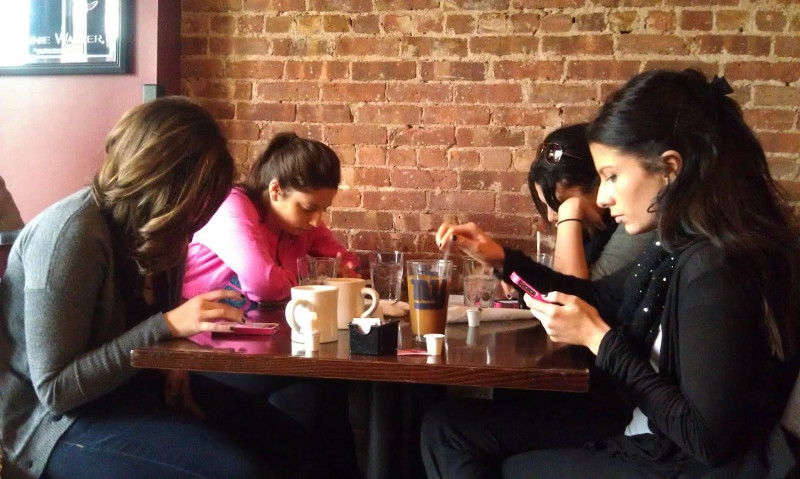

Copying or competition? Similarity of Invicta (from Amazon) and Rolex Submariner You may not know whether you want a watch that is manually wound, automatically wound or battery operated. Buying a low-cost automatic model online could be a good way to familiarize yourself before buying anything serious. Mechanical watches have a smoother and more elegant second-hand movement and will survive the next Carrington event but may come to grief around magnets - a brief encounter with a low-cost de-gausser fixes that. Is it smart to buy a smart watch? If you genuinely want to have the feeling of complete freedom and control over technology, you may want to think twice about buying a smart watch. While it may be interesting to own and experiment with it some of the time, being free from your phone means being free from other electronic technology too. If you do go for a smart watch (and there are many valid reasons for trying one some of the time), maybe make it a second (or third) watch. Smart watches are likely to be controversial for some time to come due to their impact in schools (where mobile phones are usually banned) and various privacy factors. Help those around you achieve phone freedom in 2016 There will be further blogs on this theme during 2016, each looking at the pressures people face when with or without the mobile phone. As a developer of communications technology myself, you may be surprised to see me encouraging people not to use it every waking minute. Working on this technology makes me more conscious of its impact on those around me and society in general. A powerful factor to consider when talking about any communications technology is the presence of peer pressure and the behavior of those around you. Going phone-free may involve helping them to consider taking control too. Helping them out with a new watch as a gift (be careful to seek advice on the style that they are likely to prefer or ensure the purchase can be exchanged) may be an interesting way to help them engage with the idea and every time they look at the time, they may also be reminded of your concern for their freedom.

3 January 2016

Lunar: Reproducible builds: week 35 in Stretch cycle

What happened in the reproducible builds effort between December 20th to December 26th: Toolchain fixes Mattia Rizzolo rebased our experimental versions of debhelper (twice!) and dpkg on top of the latest releases. Reiner Herrmann submited a patch for mozilla-devscripts to sort the file list in generated preferences.js files. To be able to lift the restriction that packages must be built in the same path, translation support for the __FILE__ C pre-processor macro would also be required. Joerg Sonnenberger submitted a patch back in 2010 that would still be useful today. Chris Lamb started work on providing a deterministic mode for debootstrap. Packages fixed The following packages have become reproducible due to changes in their build dependencies: bouncycastle, cairo-dock-plug-ins, darktable, gshare, libgpod, pafy, ruby-redis-namespace, ruby-rouge, sparkleshare. The following packages became reproducible after getting fixed: Some uploads fixed some reproducibility issues, but not all of them: Patches submitted which have not made their way to the archive yet: reproducible.debian.net Statistics for package sets are now visible for the armhf architecture. (h01ger) The second build now has a longer timeout (18 hours) than the first build (12 hours). This should prevent wasting resources when a machine is loaded. (h01ger) Builds of Arch Linux packages are now done using a tmpfs. (h01ger) 200 GiB have been added to jenkins.debian.net (thanks to ProfitBricks!) to make room for new jobs. The current count is at 962 and growing! diffoscope development Aside from some minor bugs that have been fixed, a one-line change made huge memory (and time) savings as the output of transformation tool is now streamed line by line instead of loaded entirely in memory at once. disorderfs development Andrew Ayer released disorderfs version 0.4.2-1 on December 22th. It fixes a memory corruption error when processing command line arguments that could cause command line options to be ignored. Documentation update Many small improvements for the documentation on reproducible-builds.org sent by Georg Koppen were merged. Package reviews 666 (!) reviews have been removed, 189 added and 162 updated in the previous week. 151 new fail to build from source reports have been made by Chris West, Chris Lamb, Mattia Rizzolo, and Niko Tyni. New issues identified: unsorted_filelist_in_xul_ext_preferences, nondeterminstic_output_generated_by_moarvm. Misc. Steven Chamberlain drew our attention to one analysis of the Juniper ScreenOS Authentication Backdoor: Whilst this may have been added in source code, it was well-disguised in the disassembly and just 7 instructions long. I thought this was a good example of the current state-of-the-art, and why we'd like our binaries and eventually, installer and VM images reproducible IMHO. Joanna Rutkowska has mentioned possible ways for Qubes to become reproducible on their development mailing-list.

2 January 2016

Iain R. Learmonth: Fun in Hamburg Airport

Today I'm travelling home from 32c3, back to Aberdeen via London from Hamburg Airport. My experience passing through security to get to the gates this morning has angered me to the point that I had to vent. They have full-body scanners installed, which in my opinion are a massive invasion of my personal privacy. As I approached the security checkpoint, I noticed a sign where it stated that use of the scanner was not mandatory and that a manual screening process was available. Once I'd loaded my bags into the trays, I asked the security officer how to opt for the manual screening at which point I was told it was not available due to a lack of staff. I was forced to allow for an intimate scan to take place or miss my flight. I'm not really in a position to be making alternative arrangements for travel and so I had to submit but it has left me outraged. Privacy is about the ability to choose what I share and who I share it with. This was meant to be a right protected by the ECHR, but I guess human rights are outdated now we're entering 2016. Bring on the dystopian future!

1 January 2016

Russ Allbery: Review: One Salt Sea

Review: One Salt Sea, by Seanan McGuire
Series: October Daye #5
Publisher: DAW
Copyright: September 2011
ISBN: 1-101-54760-X
Format: Kindle
Pages: 368
This is the fifth book of the October Daye series. It's the best book of the series to date, at least in my opinion, but this is a series with a substantial cast and political complications. You could probably start here and work out things on the fly, since each story is largely self-contained, but much of the emotional resonance would be lost. As expected for this series, Toby's life doesn't have much time to stabilize after the events of Late Eclipses. This time, though, the initial threat is less personal and more political. The children of the rulers of the Duchy of Saltmist have been kidnapped, and war between Saltmist and the Kingdom of the Mists (Toby's home) is very near. All that stands in the way of horrible casualties, of fae that can scarce afford more death, is Toby's desperate detective work. Toby's confidence and belief in her own abilities has been growing steadily throughout this series. One of my favorite themes in fiction is someone who doesn't really believe in themselves but tries anyway, because they couldn't live with themselves if they didn't, and discovers they're more capable than they thought. In this series, I think that works best when Toby is less scared and more angry, which is very true in One Salt Sea. That's one reason why I liked this book better than either An Artificial Night or Late Eclipses. Another is that I love the politics and the depth of world-building and lore that McGuire brings to this series, and One Salt Sea is a showcase of both. We get the Undersea Duchy of Saltmist, which comes from both different traditions and different fae than the series so far. We get a plot that combines political maneuvering with a more traditional detective story than the last few books. We get more hidden traditions, past alliances and enmity that Toby didn't know about, and further development of Toby's own abilities. She has to tug hard on some threads, move between levels of the fae world, and draw on her network for uniquely fae forms of forensic analysis. I thoroughly enjoyed it, particularly the rocks. (You'll know what I mean when you get to that part.) But the best thing about this book, by far, is the Luidaeg. I've mentioned in reviews of previous books that the Luidaeg is my favorite character of the series. One Salt Sea just cements that. This is the deepest that the Luidaeg has been involved in a story: she gives Toby her mission at the start, substantial help along the way, and is deeply involved in the ending. We even learn some of her own background, and some of her own worries and pain. (And foreshadowing that there's more of this to come, which I'm eagerly looking forward to.) She's moved from a strange ally through a cautious friend to some combination of aunt and mother to Toby, while always staying her irascible and occasionally painful self. The bits with her in this book are the best so far, and there are a lot of them. It's a delightful reading experience. McGuire also uses this story to clear up a plot element that's been lingering since the first book of the series, but that never worked emotionally for me. (I'm talking about this indirectly since it's a significant spoiler.) It's a great resolution, one with heft and emotion and hard choices and pain, and largely makes up for the showing rather than telling that we've gotten in the previous books, while also (at least I suspect) graciously shuffling that plot out of the way in future books. It's a good bit of series work and personal growth for Toby, and I think frees the series to focus on the bits I enjoy the most. The ending of One Salt Sea hurts, but it's a good hurt, full of hard choices made well, bravery, and sacrifice. The best moments of this series have always had that, but I think this book is the most successful delivery of the whole package to date. This has always been a solid urban fantasy series, but I think it's getting better as it goes along. One major reason is that McGuire doesn't seem to be running out of world-building oomph. In a lot of urban fantasy, particularly the werewolf and vampire sort, I feel like the lore gets thinner, more rehashed, and more mundane as the series ages. But McGuire is still introducing new elements, showing existing elements from new directions and in new light, and has been slowly building major puzzles around Toby's life and abilities that intrigue me. And, even more rare, the eventual revelations usually live up to the preceding tension. It's certainly a recipe to keep me reading. Followed by Ashes of Honor. Rating: 9 out of 10

31 December 2015

Laura Arjona Reina: Thanks Ian, thanks Debian

I didn t know Ian Murdock but the news about his passing left me with a very strange and sad feeling, because he started the project that creates the tool that I use every day in my work, and everyday in my communication with my family and friends, and everyday for anything computer related It s like if somebody puts a treasure in your hands and you got distracted looking at it and when you head up to look at the person and say Thank you , he s gone And, in the last years, Debian for me is not just my favorite tool , I ve been slowly getting involved in the community, known some people here and there, been able to put some work to try to improve some small parts, been able to work with other people as a team, and I ve been touched many times admiring how the Debianers work, how they talk and write, how they behave to each other and to the ones that reach the community for first time, and to the world, since most of the communication and work is public I ve felt myself helped, welcomed, encouraged, empowered. Not only in my computer related skills or the improved capabilities of my humble hardware. I ve felt myself helped, welcomed, encouraged and empowered in important areas of my life (understanding other points of view, caring about the ones that don t speak aloud, enjoying diversity and becoming flexible to make it flourish, making friends ). And I like to think that I try to emulate that and help, welcome, encourage, empower others too I m learning. Thanks Ian, for this alive and growing treasure that is Debian (the OS, the community), and thanks Debian, for the past, present and future miracles.
Filed under: My experiences and opinion Tagged: Communities, Contributing to libre software, Debian, English, Moving into free software

27 December 2015

Lars Wirzenius: Coming back to Finland after five years

It was a shock to be back in Finland after five years. The country had gone bad. I was born in Finland, and lived here all my life, until January, 2010. I then moved abroad for five years, with my then-girlfriend, now wife. We lived in New Zealand, Scotland, and England. In October 2014 we came back, because my next job happened to be in Finland. When we came back, I found that the country had changed, or I had lost my rose-coloured glasses. The Finland I left was a place where equality and solidarity were assumed, though not universal. The country I came back to turned out to be racist, scared, and quickly abandoning everything that used to be examples of why the country is a good place to live. Some of the change has, possibly, only happened during 2015 and the refugee crisis in Europe, but the change started earlier. Examples: Now, it is clear that Finland was never the kind of idyllic utopia that I thought it was, back when I was young. The older I get, the clearer it is that I was naive. The change over five years is still quite remarkable. I can't ever go back home. Now, I am sometimes ashamed of being Finnish.
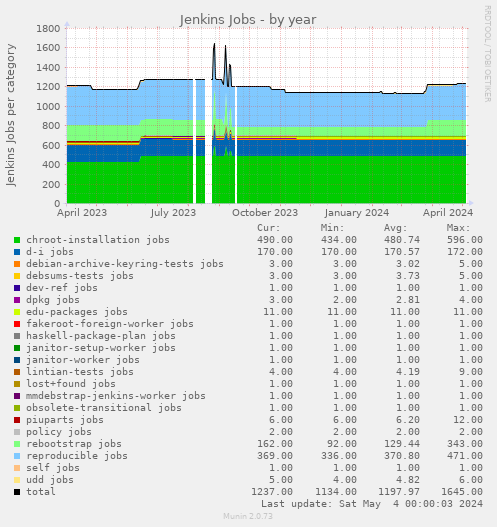
Next.

Previous.