Search Results: "mt"

7 February 2021

Chris Lamb: Favourite books of 2020

I won't reveal precisely how many books I read in 2020, but it was definitely an improvement on 74 in 2019, 53 in 2018 and 50 in 2017. But not only did I read more in a quantitative sense, the quality seemed higher as well. There were certainly fewer disappointments: given its cultural resonance, I was nonplussed by Nick Hornby's Fever Pitch and whilst Ian Fleming's The Man with the Golden Gun was a little thin (again, given the obvious influence of the Bond franchise) the booked lacked 'thinness' in a way that made it interesting to critique. The weakest novel I read this year was probably J. M. Berger's Optimal, but even this hybrid of Ready Player One late-period Black Mirror wasn't that cringeworthy, all things considered. Alas, graphic novels continue to not quite be my thing, I'm afraid. I perhaps experienced more disappointments in the non-fiction section. Paul Bloom's Against Empathy was frustrating, particularly in that it expended unnecessary energy battling its misleading title and accepted terminology, and it could so easily have been an 20-minute video essay instead). (Elsewhere in the social sciences, David and Goliath will likely be the last Malcolm Gladwell book I voluntarily read.) After so many positive citations, I was also more than a little underwhelmed by Shoshana Zuboff's The Age of Surveillance Capitalism, and after Ryan Holiday's many engaging reboots of Stoic philosophy, his Conspiracy (on Peter Thiel and Hulk Hogan taking on Gawker) was slightly wide of the mark for me. Anyway, here follows a selection of my favourites from 2020, in no particular order:

Fiction Wolf Hall & Bring Up the Bodies & The Mirror and the Light Hilary Mantel During the early weeks of 2020, I re-read the first two parts of Hilary Mantel's Thomas Cromwell trilogy in time for the March release of The Mirror and the Light. I had actually spent the last few years eagerly following any news of the final instalment, feigning outrage whenever Mantel appeared to be spending time on other projects. Wolf Hall turned out to be an even better book than I remembered, and when The Mirror and the Light finally landed at midnight on 5th March, I began in earnest the next morning. Note that date carefully; this was early 2020, and the book swiftly became something of a heavy-handed allegory about the world at the time. That is to say and without claiming that I am Monsieur Cromuel in any meaningful sense it was an uneasy experience to be reading about a man whose confident grasp on his world, friends and life was slipping beyond his control, and at least in Cromwell's case, was heading inexorably towards its denouement. The final instalment in Mantel's trilogy is not perfect, and despite my love of her writing I would concur with the judges who decided against awarding her a third Booker Prize. For instance, there is something of the longueur that readers dislike in the second novel, although this might not be entirely Mantel's fault after all, the rise of the "ugly" Anne of Cleves and laborious trade negotiations for an uninspiring mineral (this is no Herbertian 'spice') will never match the court intrigues of Anne Boleyn, Jane Seymour and that man for all seasons, Thomas More. Still, I am already looking forward to returning to the verbal sparring between King Henry and Cromwell when I read the entire trilogy once again, tentatively planned for 2022.

The Fault in Our Stars John Green I came across John Green's The Fault in Our Stars via a fantastic video by Lindsay Ellis discussing Roland Barthes famous 1967 essay on authorial intent. However, I might have eventually come across The Fault in Our Stars regardless, not because of Green's status as an internet celebrity of sorts but because I'm a complete sucker for this kind of emotionally-manipulative bildungsroman, likely due to reading Philip Pullman's His Dark Materials a few too many times in my teens. Although its title is taken from Shakespeare's Julius Caesar, The Fault in Our Stars is actually more Romeo & Juliet. Hazel, a 16-year-old cancer patient falls in love with Gus, an equally ill teen from her cancer support group. Hazel and Gus share the same acerbic (and distinctly unteenage) wit and a love of books, centred around Hazel's obsession of An Imperial Affliction, a novel by the meta-fictional author Peter Van Houten. Through a kind of American version of Jim'll Fix It, Gus and Hazel go and visit Van Houten in Amsterdam. I'm afraid it's even cheesier than I'm describing it. Yet just as there is a time and a place for Michelin stars and Haribo Starmix, there's surely a place for this kind of well-constructed but altogether maudlin literature. One test for emotionally manipulative works like this is how well it can mask its internal contradictions while Green's story focuses on the universalities of love, fate and the shortness of life (as do almost all of his works, it seems), The Fault in Our Stars manages to hide, for example, that this is an exceedingly favourable treatment of terminal illness that is only possible for the better off. The 2014 film adaptation does somewhat worse in peddling this fantasy (and has a much weaker treatment of the relationship between the teens' parents too, an underappreciated subtlety of the book). The novel, however, is pretty slick stuff, and it is difficult to fault it for what it is. For some comparison, I later read Green's Looking for Alaska and Paper Towns which, as I mention, tug at many of the same strings, but they don't come together nearly as well as The Fault in Our Stars. James Joyce claimed that "sentimentality is unearned emotion", and in this respect, The Fault in Our Stars really does earn it.

The Plague Albert Camus P. D. James' The Children of Men, George Orwell's Nineteen Eighty-Four, Arthur Koestler's Darkness at Noon ... dystopian fiction was already a theme of my reading in 2020, so given world events it was an inevitability that I would end up with Camus's novel about a plague that swept through the Algerian city of Oran. Is The Plague an allegory about the Nazi occupation of France during World War Two? Where are all the female characters? Where are the Arab ones? Since its original publication in 1947, there's been so much written about The Plague that it's hard to say anything new today. Nevertheless, I was taken aback by how well it captured so much of the nuance of 2020. Whilst we were saying just how 'unprecedented' these times were, it was eerie how a novel written in the 1940s could accurately how many of us were feeling well over seventy years on later: the attitudes of the people; the confident declarations from the institutions; the misaligned conversations that led to accidental misunderstandings. The disconnected lovers. The only thing that perhaps did not work for me in The Plague was the 'character' of the church. Although I could appreciate most of the allusion and metaphor, it was difficult for me to relate to the significance of Father Paneloux, particularly regarding his change of view on the doctrinal implications of the virus, and spoiler alert that he finally died of a "doubtful case" of the disease, beyond the idea that Paneloux's beliefs are in themselves "doubtful". Answers on a postcard, perhaps. The Plague even seemed to predict how we, at least speaking of the UK, would react when the waves of the virus waxed and waned as well:
The disease stiffened and carried off three or four patients who were expected to recover. These were the unfortunates of the plague, those whom it killed when hope was high
It somehow captured the nostalgic yearning for high-definition videos of cities and public transport; one character even visits the completely deserted railway station in Oman simply to read the timetables on the wall.

Tinker, Tailor, Soldier, Spy John le Carr There's absolutely none of the Mad Men glamour of James Bond in John le Carr 's icy world of Cold War spies:
Small, podgy, and at best middle-aged, Smiley was by appearance one of London's meek who do not inherit the earth. His legs were short, his gait anything but agile, his dress costly, ill-fitting, and extremely wet.
Almost a direct rebuttal to Ian Fleming's 007, Tinker, Tailor has broken-down cars, bad clothes, women with their own internal and external lives (!), pathetically primitive gadgets, and (contra Mad Men) hangovers that significantly longer than ten minutes. In fact, the main aspect that the mostly excellent 2011 film adaption doesn't really capture is the smoggy and run-down nature of 1970s London this is not your proto-Cool Britannia of Austin Powers or GTA:1969, the city is truly 'gritty' in the sense there is a thin film of dirt and grime on every surface imaginable. Another angle that the film cannot capture well is just how purposefully the novel does not mention the United States. Despite the US obviously being the dominant power, the British vacillate between pretending it doesn't exist or implying its irrelevance to the matter at hand. This is no mistake on Le Carr 's part, as careful readers are rewarded by finding this denial of US hegemony in metaphor throughout --pace Ian Fleming, there is no obvious Felix Leiter to loudly throw money at the problem or a Sheriff Pepper to serve as cartoon racist for the Brits to feel superior about. By contrast, I recall that a clever allusion to "dusty teabags" is subtly mirrored a few paragraphs later with a reference to the installation of a coffee machine in the office, likely symbolic of the omnipresent and unavoidable influence of America. (The officer class convince themselves that coffee is a European import.) Indeed, Le Carr communicates a feeling of being surrounded on all sides by the peeling wallpaper of Empire. Oftentimes, the writing style matches the graceless and inelegance of the world it depicts. The sentences are dense and you find your brain performing a fair amount of mid-flight sentence reconstruction, reparsing clauses, commas and conjunctions to interpret Le Carr 's intended meaning. In fact, in his eulogy-cum-analysis of Le Carr 's writing style, William Boyd, himself a ventrioquilist of Ian Fleming, named this intentional technique 'staccato'. Like the musical term, I suspect the effect of this literary staccato is as much about the impact it makes on a sentence as the imperceptible space it generates after it. Lastly, the large cast in this sprawling novel is completely believable, all the way from the Russian spymaster Karla to minor schoolboy Roach the latter possibly a stand-in for Le Carr himself. I got through the 500-odd pages in just a few days, somehow managing to hold the almost-absurdly complicated plot in my head. This is one of those classic books of the genre that made me wonder why I had not got around to it before.

The Nickel Boys Colson Whitehead According to the judges who awarded it the Pulitzer Prize for Fiction, The Nickel Boys is "a devastating exploration of abuse at a reform school in Jim Crow-era Florida" that serves as a "powerful tale of human perseverance, dignity and redemption". But whilst there is plenty of this perseverance and dignity on display, I found little redemption in this deeply cynical novel. It could almost be read as a follow-up book to Whitehead's popular The Underground Railroad, which itself won the Pulitzer Prize in 2017. Indeed, each book focuses on a young protagonist who might be euphemistically referred to as 'downtrodden'. But The Nickel Boys is not only far darker in tone, it feels much closer and more connected to us today. Perhaps this is unsurprising, given that it is based on the story of the Dozier School in northern Florida which operated for over a century before its long history of institutional abuse and racism was exposed a 2012 investigation. Nevertheless, if you liked the social commentary in The Underground Railroad, then there is much more of that in The Nickel Boys:
Perhaps his life might have veered elsewhere if the US government had opened the country to colored advancement like they opened the army. But it was one thing to allow someone to kill for you and another to let him live next door.
Sardonic aper us of this kind are pretty relentless throughout the book, but it never tips its hand too far into on nihilism, especially when some of the visual metaphors are often first-rate: "An American flag sighed on a pole" is one I can easily recall from memory. In general though, The Nickel Boys is not only more world-weary in tenor than his previous novel, the United States it describes seems almost too beaten down to have the energy conjure up the Swiftian magical realism that prevented The Underground Railroad from being overly lachrymose. Indeed, even we Whitehead transports us a present-day New York City, we can't indulge in another kind of fantasy, the one where America has solved its problems:
The Daily News review described the [Manhattan restaurant] as nouveau Southern, "down-home plates with a twist." What was the twist that it was soul food made by white people?
It might be overly reductionist to connect Whitehead's tonal downshift with the racial justice movements of the past few years, but whatever the reason, we've ended up with a hard-hitting, crushing and frankly excellent book.

True Grit & No Country for Old Men Charles Portis & Cormac McCarthy It's one of the most tedious cliches to claim the book is better than the film, but these two books are of such high quality that even the Coen Brothers at their best cannot transcend them. I'm grouping these books together here though, not because their respective adaptations will exemplify some of the best cinema of the 21st century, but because of their superb treatment of language. Take the use of dialogue. Cormac McCarthy famously does not use any punctuation "I believe in periods, in capitals, in the occasional comma, and that's it" but the conversations in No Country for Old Men together feel familiar and commonplace, despite being relayed through this unconventional technique. In lesser hands, McCarthy's written-out Texan drawl would be the novelistic equivalent of white rap or Jar Jar Binks, but not only is the effect entirely gripping, it helps you to believe you are physically present in the many intimate and domestic conversations that hold this book together. Perhaps the cinematic familiarity helps, as you can almost hear Tommy Lee Jones' voice as Sheriff Bell from the opening page to the last. Charles Portis' True Grit excels in its dialogue too, but in this book it is not so much in how it flows (although that is delightful in its own way) but in how forthright and sardonic Maddie Ross is:
"Earlier tonight I gave some thought to stealing a kiss from you, though you are very young, and sick and unattractive to boot, but now I am of a mind to give you five or six good licks with my belt." "One would be as unpleasant as the other."
Perhaps this should be unsurprising. Maddie, a fourteen-year-old girl from Yell County, Arkansas, can barely fire her father's heavy pistol, so she can only has words to wield as her weapon. Anyway, it's not just me who treasures this book. In her encomium that presages most modern editions, Donna Tartt of The Secret History fame traces the novels origins through Huckleberry Finn, praising its elegance and economy: "The plot of True Grit is uncomplicated and as pure in its way as one of the Canterbury Tales". I've read any Chaucer, but I am inclined to agree. Tartt also recalls that True Grit vanished almost entirely from the public eye after the release of John Wayne's flimsy cinematic vehicle in 1969 this earlier film was, Tartt believes, "good enough, but doesn't do the book justice". As it happens, reading a book with its big screen adaptation as a chaser has been a minor theme of my 2020, including P. D. James' The Children of Men, Kazuo Ishiguro's Never Let Me Go, Patricia Highsmith's Strangers on a Train, James Ellroy's The Black Dahlia, John Green's The Fault in Our Stars, John le Carr 's Tinker, Tailor Soldier, Spy and even a staged production of Charles Dicken's A Christmas Carol streamed from The Old Vic. For an autodidact with no academic background in literature or cinema, I've been finding this an effective and enjoyable means of getting closer to these fine books and films it is precisely where they deviate (or perhaps where they are deficient) that offers a means by which one can see how they were constructed. I've also found that adaptations can also tell you a lot about the culture in which they were made: take the 'straightwashing' in the film version of Strangers on a Train (1951) compared to the original novel, for example. It is certainly true that adaptions rarely (as Tartt put it) "do the book justice", but she might be also right to alight on a legal metaphor, for as the saying goes, to judge a movie in comparison to the book is to do both a disservice.

The Glass Hotel Emily St. John Mandel In The Glass Hotel, Mandel somehow pulls off the impossible; writing a loose roman- -clef on Bernie Madoff, a Ponzi scheme and the ephemeral nature of finance capital that is tranquil and shimmeringly beautiful. Indeed, don't get the wrong idea about the subject matter; this is no over over-caffeinated The Big Short, as The Glass Hotel is less about a Madoff or coked-up financebros but the fragile unreality of the late 2010s, a time which was, as we indeed discovered in 2020, one event away from almost shattering completely. Mandel's prose has that translucent, phantom quality to it where the chapters slip through your fingers when you try to grasp at them, and the plot is like a ghost ship that that slips silently, like the Mary Celeste, onto the Canadian water next to which the eponymous 'Glass Hotel' resides. Indeed, not unlike The Overlook Hotel, the novel so overflows with symbolism so that even the title needs to evoke the idea of impermanence permanently living in a hotel might serve as a house, but it won't provide a home. It's risky to generalise about such things post-2016, but the whole story sits in that the infinitesimally small distance between perception and reality, a self-constructed culture that is not so much 'post truth' but between them. There's something to consider in almost every character too. Take the stand-in for Bernie Madoff: no caricature of Wall Street out of a 1920s political cartoon or Brechtian satire, Jonathan Alkaitis has none of the oleaginous sleaze of a Dominic Strauss-Kahn, the cold sociopathy of a Marcus Halberstam nor the well-exercised sinuses of, say, Jordan Belford. Alkaitis is dare I say it? eminently likeable, and the book is all the better for it. Even the C-level characters have something to say: Enrico, trivially escaping from the regulators (who are pathetically late to the fraud without Mandel ever telling us explicitly), is daydreaming about the girlfriend he abandoned in New York: "He wished he'd realised he loved her before he left". What was in his previous life that prevented him from doing so? Perhaps he was never in love at all, or is love itself just as transient as the imaginary money in all those bank accounts? Maybe he fell in love just as he crossed safely into Mexico? When, precisely, do we fall in love anyway? I went on to read Mandel's Last Night in Montreal, an early work where you can feel her reaching for that other-worldly quality that she so masterfully achieves in The Glass Hotel. Her f ted Station Eleven is on my must-read list for 2021. "What is truth?" asked Pontius Pilate. Not even Mandel cannot give us the answer, but this will certainly do for now.

Running the Light Sam Tallent Although it trades in all of the clich s and stereotypes of the stand-up comedian (the triumvirate of drink, drugs and divorce), Sam Tallent's debut novel depicts an extremely convincing fictional account of a touring road comic. The comedian Doug Stanhope (who himself released a fairly decent No Encore for the Donkey memoir in 2020) hyped Sam's book relentlessly on his podcast during lockdown... and justifiably so. I ripped through Running the Light in a few short hours, the only disappointment being that I can't seem to find videos online of Sam that come anywhere close to match up to his writing style. If you liked the rollercoaster energy of Paul Beatty's The Sellout, the cynicism of George Carlin and the car-crash invertibility of final season Breaking Bad, check this great book out.

Non-fiction Inside Story Martin Amis This was my first introduction to Martin Amis's work after hearing that his "novelised autobiography" contained a fair amount about Christopher Hitchens, an author with whom I had a one of those rather clich d parasocial relationship with in the early days of YouTube. (Hey, it could have been much worse.) Amis calls his book a "novelised autobiography", and just as much has been made of its quasi-fictional nature as the many diversions into didactic writing advice that betwixt each chapter: "Not content with being a novel, this book also wants to tell you how to write novels", complained Tim Adams in The Guardian. I suspect that reviewers who grew up with Martin since his debut book in 1973 rolled their eyes at yet another demonstration of his manifest cleverness, but as my first exposure to Amis's gift of observation, I confess that I was thought it was actually kinda clever. Try, for example, "it remains a maddening truth that both sexual success and sexual failure are steeply self-perpetuating" or "a hospital gym is a contradiction like a young Conservative", etc. Then again, perhaps I was experiencing a form of nostalgia for a pre-Gamergate YouTube, when everything in the world was a lot simpler... or at least things could be solved by articulate gentlemen who honed their art of rhetoric at the Oxford Union. I went on to read Martin's first novel, The Rachel Papers (is it 'arrogance' if you are, indeed, that confident?), as well as his 1997 Night Train. I plan to read more of him in the future.

The Collected Essays, Journalism and Letters: Volume 1 & Volume 2 & Volume 3 & Volume 4 George Orwell These deceptively bulky four volumes contain all of George Orwell's essays, reviews and correspondence, from his teenage letters sent to local newspapers to notes to his literary executor on his deathbed in 1950. Reading this was part of a larger, multi-year project of mine to cover the entirety of his output. By including this here, however, I'm not recommending that you read everything that came out of Orwell's typewriter. The letters to friends and publishers will only be interesting to biographers or hardcore fans (although I would recommend Dorian Lynskey's The Ministry of Truth: A Biography of George Orwell's 1984 first). Furthermore, many of his book reviews will be of little interest today. Still, some insights can be gleaned; if there is any inconsistency in this huge corpus is that his best work is almost 'too' good and too impactful, making his merely-average writing appear like hackwork. There are some gems that don't make the usual essay collections too, and some of Orwell's most astute social commentary came out of series of articles he wrote for the left-leaning newspaper Tribune, related in many ways to the US Jacobin. You can also see some of his most famous ideas start to take shape years if not decades before they appear in his novels in these prototype blog posts. I also read Dennis Glover's novelised account of the writing of Nineteen-Eighty Four called The Last Man in Europe, and I plan to re-read some of Orwell's earlier novels during 2021 too, including A Clergyman's Daughter and his 'antebellum' Coming Up for Air that he wrote just before the Second World War; his most under-rated novel in my estimation. As it happens, and with the exception of the US and Spain, copyright in the works published in his lifetime ends on 1st January 2021. Make of that what you will.

Capitalist Realism & Chavs: The Demonisation of the Working Class Mark Fisher & Owen Jones These two books are not natural companions to one another and there is likely much that Jones and Fisher would vehemently disagree on, but I am pairing these books together here because they represent the best of the 'political' books I read in 2020. Mark Fisher was a dedicated leftist whose first book, Capitalist Realism, marked an important contribution to political philosophy in the UK. However, since his suicide in early 2017, the currency of his writing has markedly risen, and Fisher is now frequently referenced due to his belief that the prevalence of mental health conditions in modern life is a side-effect of various material conditions, rather than a natural or unalterable fact "like weather". (Of course, our 'weather' is being increasingly determined by a combination of politics, economics and petrochemistry than pure randomness.) Still, Fisher wrote on all manner of topics, from the 2012 London Olympics and "weird and eerie" electronic music that yearns for a lost future that will never arrive, possibly prefiguring or influencing the Fallout video game series. Saying that, I suspect Fisher will resonate better with a UK audience more than one across the Atlantic, not necessarily because he was minded to write about the parochial politics and culture of Britain, but because his writing often carries some exasperation at the suppression of class in favour of identity-oriented politics, a viewpoint not entirely prevalent in the United States outside of, say, Tour F. Reed or the late Michael Brooks. (Indeed, Fisher is likely best known in the US as the author of his controversial 2013 essay, Exiting the Vampire Castle, but that does not figure greatly in this book). Regardless, Capitalist Realism is an insightful, damning and deeply unoptimistic book, best enjoyed in the warm sunshine I found it an ironic compliment that I had quoted so many paragraphs that my Kindle's copy protection routines prevented me from clipping any further. Owen Jones needs no introduction to anyone who regularly reads a British newspaper, especially since 2015 where he unofficially served as a proxy and punching bag for expressing frustrations with the then-Labour leader, Jeremy Corbyn. However, as the subtitle of Jones' 2012 book suggests, Chavs attempts to reveal the "demonisation of the working class" in post-financial crisis Britain. Indeed, the timing of the book is central to Jones' analysis, specifically that the stereotype of the "chav" is used by government and the media as a convenient figleaf to avoid meaningful engagement with economic and social problems on an austerity ridden island. (I'm not quite sure what the US equivalent to 'chav' might be. Perhaps Florida Man without the implications of mental health.) Anyway, Jones certainly has a point. From Vicky Pollard to the attacks on Jade Goody, there is an ignorance and prejudice at the heart of the 'chav' backlash, and that would be bad enough even if it was not being co-opted or criminalised for ideological ends. Elsewhere in political science, I also caught Michael Brooks' Against the Web and David Graeber's Bullshit Jobs, although they are not quite methodical enough to recommend here. However, Graeber's award-winning Debt: The First 5000 Years will be read in 2021. Matt Taibbi's Hate Inc: Why Today's Media Makes Us Despise One Another is worth a brief mention here though, but its sprawling nature felt very much like I was reading a set of Substack articles loosely edited together. And, indeed, I was.

The Golden Thread: The Story of Writing Ewan Clayton A recommendation from a dear friend, Ewan Clayton's The Golden Thread is a journey through the long history of the writing from the Dawn of Man to present day. Whether you are a linguist, a graphic designer, a visual artist, a typographer, an archaeologist or 'just' a reader, there is probably something in here for you. I was already dipping my quill into calligraphy this year so I suspect I would have liked this book in any case, but highlights would definitely include the changing role of writing due to the influence of textual forms in the workplace as well as digression on ergonomic desks employed by monks and scribes in the Middle Ages. A lot of books by otherwise-sensible authors overstretch themselves when they write about computers or other technology from the Information Age, at best resulting in bizarre non-sequiturs and dangerously Panglossian viewpoints at worst. But Clayton surprised me by writing extremely cogently and accurate on the role of text in this new and unpredictable era. After finishing it I realised why for a number of years, Clayton was a consultant for the legendary Xerox PARC where he worked in a group focusing on documents and contemporary communications whilst his colleagues were busy inventing the graphical user interface, laser printing, text editors and the computer mouse.

New Dark Age & Radical Technologies: The Design of Everyday Life James Bridle & Adam Greenfield I struggled to describe these two books to friends, so I doubt I will suddenly do a better job here. Allow me to quote from Will Self's review of James Bridle's New Dark Age in the Guardian:
We're accustomed to worrying about AI systems being built that will either "go rogue" and attack us, or succeed us in a bizarre evolution of, um, evolution what we didn't reckon on is the sheer inscrutability of these manufactured minds. And minds is not a misnomer. How else should we think about the neural network Google has built so its translator can model the interrelation of all words in all languages, in a kind of three-dimensional "semantic space"?
New Dark Age also turns its attention to the weird, algorithmically-derived products offered for sale on Amazon as well as the disturbing and abusive videos that are automatically uploaded by bots to YouTube. It should, by rights, be a mess of disparate ideas and concerns, but Bridle has a flair for introducing topics which reveals he comes to computer science from another discipline altogether; indeed, on a four-part series he made for Radio 4, he's primarily referred to as "an artist". Whilst New Dark Age has rather abstract section topics, Adam Greenfield's Radical Technologies is a rather different book altogether. Each chapter dissects one of the so-called 'radical' technologies that condition the choices available to us, asking how do they work, what challenges do they present to us and who ultimately benefits from their adoption. Greenfield takes his scalpel to smartphones, machine learning, cryptocurrencies, artificial intelligence, etc., and I don't think it would be unfair to say that starts and ends with a cynical point of view. He is no reactionary Luddite, though, and this is both informed and extremely well-explained, and it also lacks the lazy, affected and Private Eye-like cynicism of, say, Attack of the 50 Foot Blockchain. The books aren't a natural pair, for Bridle's writing contains quite a bit of air in places, ironically mimics the very 'clouds' he inveighs against. Greenfield's book, by contrast, as little air and much lower pH value. Still, it was more than refreshing to read two technology books that do not limit themselves to platitudinal booleans, be those dangerously naive (e.g. Kevin Kelly's The Inevitable) or relentlessly nihilistic (Shoshana Zuboff's The Age of Surveillance Capitalism). Sure, they are both anti-technology screeds, but they tend to make arguments about systems of power rather than specific companies and avoid being too anti-'Big Tech' through a narrower, Silicon Valley obsessed lens for that (dipping into some other 2020 reading of mine) I might suggest Wendy Liu's Abolish Silicon Valley or Scott Galloway's The Four. Still, both books are superlatively written. In fact, Adam Greenfield has some of the best non-fiction writing around, both in terms of how he can explain complicated concepts (particularly the smart contract mechanism of the Ethereum cryptocurrency) as well as in the extremely finely-crafted sentences I often felt that the writing style almost had no need to be that poetic, and I particularly enjoyed his fictional scenarios at the end of the book.

The Algebra of Happiness & Indistractable: How to Control Your Attention and Choose Your Life Scott Galloway & Nir Eyal A cocktail of insight, informality and abrasiveness makes NYU Professor Scott Galloway uncannily appealing to guys around my age. Although Galloway definitely has his own wisdom and experience, similar to Joe Rogan I suspect that a crucial part of Galloway's appeal is that you feel you are learning right alongside him. Thankfully, 'Prof G' is far less err problematic than Rogan (Galloway is more of a well-meaning, spirited centrist), although he, too, has some pretty awful takes at time. This is a shame, because removed from the whirlwind of social media he can be really quite considered, such as in this long-form interview with Stephanie Ruhle. In fact, it is this kind of sentiment that he captured in his 2019 Algebra of Happiness. When I look over my highlighted sections, it's clear that it's rather schmaltzy out of context ("Things you hate become just inconveniences in the presence of people you love..."), but his one-two punch of cynicism and saccharine ("Ask somebody who purchased a home in 2007 if their 'American Dream' came true...") is weirdly effective, especially when he uses his own family experiences as part of his story:
A better proxy for your life isn't your first home, but your last. Where you draw your last breath is more meaningful, as it's a reflection of your success and, more important, the number of people who care about your well-being. Your first house signals the meaningful your future and possibility. Your last home signals the profound the people who love you. Where you die, and who is around you at the end, is a strong signal of your success or failure in life.
Nir Eyal's Indistractable, however, is a totally different kind of 'self-help' book. The important background story is that Eyal was the author of the widely-read Hooked which turned into a secular Bible of so-called 'addictive design'. (If you've ever been cornered by a techbro wielding a Wikipedia-thin knowledge of B. F. Skinner's behaviourist psychology and how it can get you to click 'Like' more often, it ultimately came from Hooked.) However, Eyal's latest effort is actually an extended mea culpa for his previous sin and he offers both high and low-level palliative advice on how to avoid falling for the tricks he so studiously espoused before. I suppose we should be thankful to capitalism for selling both cause and cure. Speaking of markets, there appears to be a growing appetite for books in this 'anti-distraction' category, and whilst I cannot claim to have done an exhausting study of this nascent field, Indistractable argues its points well without relying on accurate-but-dry "studies show..." or, worse, Gladwellian gotchas. My main criticism, however, would be that Eyal doesn't acknowledge the limits of a self-help approach to this problem; it seems that many of the issues he outlines are an inescapable part of the alienation in modern Western society, and the only way one can really avoid distraction is to move up the income ladder or move out to a 500-acre ranch.

6 February 2021

Andrew Cater: Debian 10.8 release process - Yay, it's a lot faster

Thanks to the changes behind the scenes, images are now being produced significantly faster than they were: the embarrassingly parallel speed up has worked, though at slight cost to the predictability of when we get each architecture produced for us to test.Thanks, as ever, to Sledge, RattusRattus and Isy over in Cambridge and to schweer who painstakingly tests all the debian-edu releases.83 out of 94 steps done and it's only 13:50 GMT - less popular architectures are coming on apace. There's still a lot of testing to do: we will never be able to test s390x for example. Other architectures - including mips* - we have no machines, we're building as best efforts and we can't guarantee how well they will work for anyone.Anybody installing the less popular architectures please let us know that you've installed them and how you get on. We'd like to see a positive report as well as bugs: we don't see much feedback at all to know how useful they are: evidence of installs on any architecture is always helpful to us.

31 January 2021

Paul Wise: FLOSS Activities January 2021

Focus This month I didn't have any particular focus. I just worked on issues in my info bubble.

Changes

Issues

Review

Administration
  • Debian ports: fix header on incoming.ports.d.o/buildd
  • Debian wiki: unblock IP addresses, approve accounts

Communication
  • Initiate discussions about aptly, Linux USB gadgets maintenance
  • Respond to queries from Debian users and contributors on the mailing lists and IRC
  • Invite organisations to post on FOSSjobs

Sponsors The samba work, apt-listchanges work, pytest-rerunfailures upload, python-testfixtures/python-scrapy bugs and python-scrapy related backports were sponsored by my employer. All other work was done on a volunteer basis.

Chris Lamb: Free software activities in January 2021

Here is my monthly update covering what I have been doing in the free software world during January 2021 (previous month):

Reproducible Builds One of the original promises of open source software is that distributed peer review and transparency of process results in enhanced end-user security. However, whilst anyone may inspect the source code of free and open source software for malicious flaws, almost all software today is distributed as pre-compiled binaries. This allows nefarious third-parties to compromise systems by injecting malicious code into ostensibly secure software during the various compilation and distribution processes. The motivation behind the Reproducible Builds effort is to ensure no flaws have been introduced during this compilation process by promising identical results are always generated from a given source, thus allowing multiple third-parties to come to a consensus on whether a build was compromised. This month, I:
I also made the following changes to diffoscope, our in-depth and content-aware diff utility that can locate and diagnose reproducibility issues, releasing version 164, version 165 and version 166 as well as triaging and merging many contributions from others:

Debian Uploads Debian LTS This month I worked 18 hours on Debian Long Term Support (LTS) and 12 hours on its sister Extended LTS project. You can find out more about the project via the following video:

27 January 2021

Jonathan Dowland: 2020 in Fiction

Cover for Susanna Clarke's Piranesi
Cover for Emily St. John Mandel's Station 11
I managed to read 31 "books" in 2020. I'm happy with that. I thought the Pandemic would prevent me reaching my goal (30), since I did most of my reading on the commute to the Newcastle office, pre-pandemic. Somehow I've managed to compensate. I started setting a goal for books read per year in 2012 when I started to use goodreads. Doing so started to influence the type of reading I do (which is the reason I stopped my Interzone subscription in 2014, although I resumed it again sometime afterwards). Once I realised that I've been a bit more careful to ensure setting a goal was a worthwhile thing to do and not just another source of stress in my life. Two books I read were published in 2020. The first was Robert Galbraith's (a.k.a. J K Rowling's) Troubled Blood, the fifth (and largest) in the series of crime novels featuring Cormoran Strike (and the equally important Robin Ellacott). Nowadays Rowling is a controversial figure, but I'm not writing about that today, or the book itself, in much detail: briefly, it exceeded expectations, and my wife and I really enjoyed it. The other was Susanna Clarke's Piranesi: an utterly fantastic modern-fantasy story, quite short, completely different to her successful debut novel Jonathan Strange & Mr Norrell. I really loved this book, partly because it appeals to my love of fantasy geography, but also because it is very well put together, with a strong sense of the value of people's lives. A couple of the other books I read were quite Pandemic-appropriate. I tore through Josh Malerman's Bird Box, a fast-paced post-apocalyptic style horror/suspense story. The appeal was mostly in the construction and delivery: the story itself was strong enough to support the book at the length that it is, but I don't really feel it could have lasted much longer, and so I've no idea how the new sequel (Malorie) will work. The other was Station Eleven by Emily St. John Mandel. This was a story about a group of travelling musicians in a post-apocalyptic (post-pandemic) North America. A cast of characters all revolve around their relationship (or six degrees of separation) to an actor who died just prior to the Pandemic. The world-building in this book was really strong, and I felt sufficiently invested in the characters that I would love to read more about them in another book. However, I think that (although I'm largely just guessing here), in common with Bird Box, the setting was there to support the novel and the ideas that the author wanted to get across, and so I (sadly) doubt she will return to it. Finally I read a lot of short fiction. I'll write more about that in a separate blog post.

21 January 2021

Russell Coker: Links January 2021

Krebs on Security has an informative article about web notifications and how they are being used for spamming and promoting malware [1]. He also includes links for how to permanently disable them. If nothing else clicking no on each new site that wants to send notifications is annoying. Michael Stapelberg wrote an insightful posts about inefficiencies in the Debian development processes [2]. While I agree with most of his assessment of Debian issues I am not going to decrease my involvement in Debian. Of the issues he mentions the 2 that seem to have the best effort to reward ratio are improvements to mailing list archives (to ideally make it practical to post to lists without subscribing and read responses in the archives) and the issues of forgetting all the complexities of the development process which can be alleviated by better Wiki pages. In my Debian work I ve contributed more to the Wiki in recent times but not nearly as much as I should. Jacobin has an insightful article Ending Poverty in the United States Would Actually Be Pretty Easy [3]. Mark Brown wrote an interesting blog post about the Rust programming language [4]. He links to a couple of longer blog posts about it. Rust has some great features and I ve been meaning to learn it. Scientific America has an informative article about research on the spread of fake news and memes [5]. Something to consider when using social media. Bruce Schneier wrote an insightful blog post on whether there should be limits on persuasive technology [6]. Jonathan Dowland wrote an interesting blog post about git rebasing and lab books [7]. I think it s an interesting thought experiment to compare the process of developing code worthy of being committed to a master branch of a VCS to the process of developing a Ph.D thesis. CBS has a disturbing article about the effect of Covid19 on people s lungs [8]. Apparently it usually does more lung damage than long-term smoking and even 70%+ of people who don t have symptoms of the disease get significant lung damage. People who live in heavily affected countries like the US now have to worry that they might have had the disease and got lung damage without knowing it. Russ Allbery wrote an interesting review of the book Because Internet about modern linguistics [9]. The topic is interesting and I might read that book at some future time (I have many good books I want to read). Jonathan Carter wrote an interesting blog post about CentOS Streams and why using a totally free OS like Debian is going to be a better option for most users [10]. Linus has slammed Intel for using ECC support as a way of segmenting the market between server and desktop to maximise profits [11]. It would be nice if a company made a line of Ryzen systems with ECC RAM support, but most manufacturers seem to be in on the market segmentation scam. Russ Allbery wrote an interesting review of the book Can t Even about millenials as the burnout generation and the blame that the corporate culture deserves for this [12].

17 January 2021

Wouter Verhelst: Dear Google

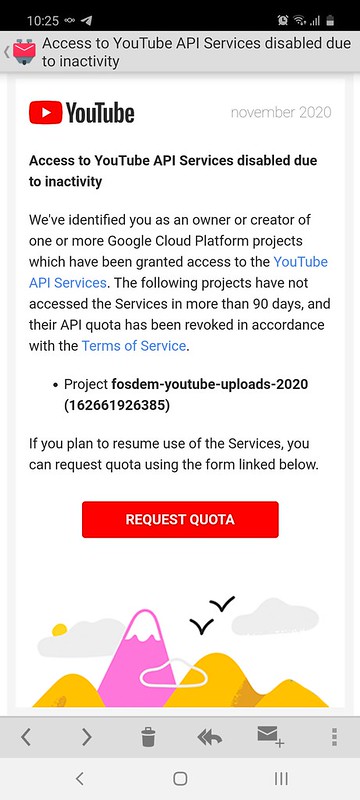
... Why do you have to be so effing difficult about a YouTube API project that is used for a single event per year? FOSDEM creates 600+ videos on a yearly basis. There is no way I am going to manually upload 600+ videos through your webinterface, so we use the API you provide, using a script written by Stefano Rivera. This script grabs video filenames and metadata from a YAML file, and then uses your APIs to upload said videos with said metadata. It works quite well. I run it from cron, and it uploads files until the quota is exhausted, then waits until the next time the cron job runs. It runs so well, that the first time we used it, we could upload 50+ videos on a daily basis, and so the uploads were done as soon as all the videos were created, which was a few months after the event. Cool! The second time we used the script, it did not work at all. We asked one of our key note speakers who happened to be some hotshot at your company, to help us out. He contacted the YouTube people, and whatever had been broken was quickly fixed, so yay, uploads worked again. I found out later that this is actually a normal thing if you don't use your API quota for 90 days or more. Because it's happened to us every bloody year. For the 2020 event, rather than going through back channels (which happened to be unavailable this edition), I tried to use your normal ways of unblocking the API project. This involves creating a screencast of a bloody command line script and describing various things that don't apply to FOSDEM and ghaah shoot me now so meh, I created a new API project instead, and had the uploads go through that. Doing so gives me a limited quota that only allows about 5 or 6 videos per day, but that's fine, it gives people subscribed to our channel the time to actually watch all the videos while they're being uploaded, rather than being presented with a boatload of videos that they can never watch in a day. Also it doesn't overload subscribers, so yay. About three months ago, I started uploading videos. Since then, every day, the "fosdemtalks" channel on YouTube has published five or six videos. Given that, imagine my surprise when I found this in my mailbox this morning... Google lies, claiming that my YouTube API project isn't being used for 90 days and informing me that it will be disabled This is an outright lie, Google. The project has been created 90 days ago, yes, that's correct. It has been used every day since then to upload videos. I guess that means I'll have to deal with your broken automatic content filters to try and get stuff unblocked... ... or I could just give up and not do this anymore. After all, all the FOSDEM content is available on our public video host, too.
16 January 2021

Abhijith PA: Transition from Thunderbird to Mutt

I was going OK with Thunderbird and enigmail(though it have many problems). Normally I go through changelogs before updating packages and rarely do a complete upgrage of my machine. Couple of days ago I did a complete upgrade of system which updated my Thunderbird to latest version and throwing of enigmail plugin for using their native openPGP support. There is a blog from Mozilla which I should ve read earlier. Thunderbird s builtin openPGP functionality is still in experimental, atleast not ready for my workflow. I could ve downgrade to version 68. But I chose to move to my secondary MUA, mutt. I was using mutt for emails and newsletters that I check twice in a year a so. So I started configuring mutt to handle my big mailboxes. It took three evenings to configure mutt to my workflow. Though the basic setup can be done in less than an hour it is the small nitpicks consumed much of my time. Currently I have isync to pull and keep mails offline. Mutt to read, msmtp to send, abook as the email address book and urlview to see the links in mail. I am still learning notmuch and virtual mailbox ways to filter. Mutt There are ton of articles out there to configure mutt and all related things to it. But I find certain configs very hard to get. So I will write down those. So far, everything going okay.

Cons
  • some times mbsync throws EOF and secret key not found error.
  • searching is still a pain in mutt
  • nano s spell checker also check things which I am replying to.

More to come Well for now I moved mail from part of the Thunderbird. But Thunderbird was more than a MUA to me. It was my RSS reader, calendar and to-do list manager. I will write more about those once I make a complete transition.

12 January 2021

John Goerzen: Remote Directory Tree Comparison, Optionally Asynchronous and Airgapped

Note: this is another article in my series on asynchronous communication in Linux with UUCP and NNCP. In the previous installment on store-and-forward backups, I mentioned how easy it is to do with ZFS, and some of the tools that can be used to do it without ZFS. A lot of those tools are a bit less robust, so we need some sort of store-and-forward mechanism to verify backups. To be sure, verifying backups is good with ANY scheme, and this could be used with ZFS backups also. So let s say you have a shiny new backup scheme in place, and you d like to verify that it s working correctly. To do that, you need to compare the source directory tree on machine A with the backed-up directory tree on machine B. Assuming a conventional setup, here are some ways you might consider to do that: The first two options are not particularly practical for large datasets, though I note that the second is compatible with airgapping. Using rsync requires both systems to be online at the same time to perform the comparison. What would be really nice here is a tool that would write out lots of information about the files on a system: their names, sizes, last modified dates, maybe even sha256sum and other data. This file would be far smaller than the directory tree itself, would compress nicely, and could be easily shipped to an airgapped system via NNCP, UUCP, a USB drive, or something similar. Tool choices It turns out there are already quite a few tools in Debian (and other Free operating systems) to do this, and half of them are named mtree (though, of course, not all mtrees are compatible with each other.) We ll look at some of the options here. I ve made a simple test directory for illustration purposes with these commands:
mkdir test
cd test
echo hi > hi
ln -s hi there
ln hi foo
touch empty
mkdir emptydir
mkdir somethingdir
cd somethingdir
ln -s ../there
I then also used touch to set all files to a consistent timestamp for illustration purposes. Tool option: getfacl (Debian package: acl) This comes with the acl package, but can be used with other than ACL purposes. Unfortunately, it doesn t come with a tool to directly compare its output with a filesystem (setfacl, for instance, can apply the permissions listed but won t compare.) It ignores symlinks and doesn t show sizes or dates, so is ineffective for our purposes. Example output:
$ getfacl --numeric -R test
...
# file: test/hi
# owner: 1000
# group: 1000
user::rw-
group::r--
other::r--
...
Tool option: fmtree, the FreeBSD mtree (Debian package: freebsd-buildutils) fmtree can prepare a specification based on a directory tree, and compare a directory tree to that specification. The comparison also is aware of files that exist in a directory tree but not in the specification. The specification format is a bit on the odd side, but works well enough with fmtree. Here s a sample output with defaults:
$ fmtree -c -p test
...
# .
/set type=file uid=1000 gid=1000 mode=0644 nlink=1
.               type=dir mode=0755 nlink=4 time=1610421833.000000000
    empty       size=0 time=1610421833.000000000
    foo         nlink=2 size=3 time=1610421833.000000000
    hi          nlink=2 size=3 time=1610421833.000000000
    there       type=link mode=0777 time=1610421833.000000000 link=hi
... skipping ...
# ./somethingdir
/set type=file uid=1000 gid=1000 mode=0777 nlink=1
somethingdir    type=dir mode=0755 nlink=2 time=1610421833.000000000
    there       type=link time=1610421833.000000000 link=../there
# ./somethingdir
..
..
You might be wondering here what it does about special characters, and the answer is that it has octal escapes, so it is 8-bit clean. To compare, you can save the output of fmtree to a file, then run like this:
cd test
fmtree < ../test.fmtree
If there is no output, then the trees are identical. Change something and you get a line of of output explaining each difference. You can also use fmtree -U to change things like modification dates to match the specification. fmtree also supports quite a few optional keywords you can add with -K. They include things like file flags, user/group names, various tipes of hashes, and so forth. I'll note that none of the options can let you determine which files are hardlinked together. Here's an excerpt with -K sha256digest added:
    empty       size=0 time=1610421833.000000000 \
                sha256digest=e3b0c44298fc1c149afbf4c8996fb92427ae41e4649b934ca495991b7852b855
    foo         nlink=2 size=3 time=1610421833.000000000 \
                sha256digest=98ea6e4f216f2fb4b69fff9b3a44842c38686ca685f3f55dc48c5d3fb1107be4
If you include a sha256digest in the spec, then when you verify it with fmtree, the verification will also include the sha256digest. Obviously fmtree -U can't correct a mismatch there, but of course it will detect and report it. Tool option: mtree, the NetBSD mtree (Debian package: mtree-netbsd) mtree produces (by default) output very similar to fmtree. With minor differences (such as the name of the sha256digest in the output), the discussion above about fmtree also applies to mtree. There are some differences, and the most notable is that mtree adds a -C option which reads a spec and converts it to a "format that's easier to parse with various tools." Here's an example:
$ mtree -c -K sha256digest -p test   mtree -C
. type=dir uid=1000 gid=1000 mode=0755 nlink=4 time=1610421833.0 flags=none 
./empty type=file uid=1000 gid=1000 mode=0644 nlink=1 size=0 time=1610421833.0 flags=none 
./foo type=file uid=1000 gid=1000 mode=0644 nlink=2 size=3 time=1610421833.0 flags=none 
./hi type=file uid=1000 gid=1000 mode=0644 nlink=2 size=3 time=1610421833.0 flags=none 
./there type=link uid=1000 gid=1000 mode=0777 nlink=1 link=hi time=1610421833.0 flags=none 
./emptydir type=dir uid=1000 gid=1000 mode=0755 nlink=2 time=1610421833.0 flags=none 
./somethingdir type=dir uid=1000 gid=1000 mode=0755 nlink=2 time=1610421833.0 flags=none 
./somethingdir/there type=link uid=1000 gid=1000 mode=0777 nlink=1 link=../there time=1610421833.0 flags=none 
Most definitely an improvement in both space and convenience, while still retaining the relevant information. Note that if you want the sha256digest in the formatted output, you need to pass the -K to both mtree invocations. I could have done that here, but it is easier to read without it. mtree can verify a specification in either format. Given what I'm about to show you about bsdtar, this should illustrate why I bothered to package mtree-netbsd for Debian. Unlike fmtree, the mtree -U command will not adjust modification times based on the spec, but it will report on differences. Tool option: bsdtar (Debian package: libarchive-tools) bsdtar is a fascinating program that can work with many formats other than just tar files. Among the formats it supports is is the NetBSD mtree "pleasant" format (mtree -C compatible). bsdtar can also convert between the formats it supports. So, put this together: bsdtar can convert a tar file to an mtree specification without extracting the tar file. bsdtar can also use an mtree specification to override the permissions on files going into tar -c, so it is a way to prepare a tar file with things owned by root without resorting to tools like fakeroot. Let's look at how this can work:
$ cd test
$ bsdtar --numeric -cf - --format=mtree .

. time=1610472086.318593729 mode=755 gid=1000 uid=1000 type=dir
./empty time=1610421833.0 mode=644 gid=1000 uid=1000 type=file size=0
./foo nlink=2 time=1610421833.0 mode=644 gid=1000 uid=1000 type=file size=3
./hi nlink=2 time=1610421833.0 mode=644 gid=1000 uid=1000 type=file size=3
./ormat\075mtree time=1610472086.318593729 mode=644 gid=1000 uid=1000 type=file size=5632
./there time=1610421833.0 mode=777 gid=1000 uid=1000 type=link link=hi
./emptydir time=1610421833.0 mode=755 gid=1000 uid=1000 type=dir
./somethingdir time=1610421833.0 mode=755 gid=1000 uid=1000 type=dir
./somethingdir/there time=1610421833.0 mode=777 gid=1000 uid=1000 type=link link=../there
You can use mtree -U to verify that as before. With the --options mtree: set, you can also add hashes and similar to the bsdtar output. Since bsdtar can use input from tar, pax, cpio, zip, iso9660, 7z, etc., this capability can be used to create verification of the files inside quite a few different formats. You can convert with bsdtar -cf output.mtree --format=mtree @input.tar. There are some foibles with directly using these converted files with mtree -U, but usually minor changes will get it there. Side mention: stat(1) (Debian package: coreutils) This tool isn't included because it won't operate recursively, but is a tool in the similar toolbox. Putting It Together I will still be developing a complete non-ZFS backup system for NNCP (or UUCP) in a future post. But in the meantime, here are some ideas you can reflect on: I will further develop at least one of these ideas in a future post. Bonus: cross-tool comparisons In my mtree-netbsd packaging, I added tests like this to compare between tools:
fmtree -c -K $(MTREE_KEYWORDS)   mtree
mtree -c -K $(MTREE_KEYWORDS)   sed -e 's/\(md5\ sha1\ sha256\ sha384\ sha512\)=/\1digest=/' -e 's/rmd160=/ripemd160digest=/'   fmtree
bsdtar -cf - --options 'mtree:uname,gname,md5,sha1,sha256,sha384,sha512,device,flags,gid,link,mode,nlink,size,time,uid,type,uname' --format mtree .   mtree

Russell Coker: RISC-V and Qemu

RISC-V is the latest RISC architecture that s become popular. It is the 5th RISC architecture from the University of California Berkeley. It seems to be a competitor to ARM due to not having license fees or restrictions on alterations to the architecture (something you have to pay extra for when using ARM). RISC-V seems the most popular architecture to implement in FPGA. When I first tried to run RISC-V under QEMU it didn t work, which was probably due to running Debian/Unstable on my QEMU/KVM system and there being QEMU bugs in Unstable at the time. I have just tried it again and got it working. The Debian Wiki page about RISC-V is pretty good [1]. The instructions there got it going for me. One thing I wasted some time on before reading that page was trying to get a netinst CD image, which is what I usually do for setting up a VM. Apparently there isn t RISC-V hardware that boots from a CD/DVD so there isn t a Debian netinst CD image. But debootstrap can install directly from the Debian web server (something I ve never wanted to do in the past) and that gave me a successful installation. Here are the commands I used to setup the base image:
apt-get install debootstrap qemu-user-static binfmt-support debian-ports-archive-keyring
debootstrap --arch=riscv64 --keyring /usr/share/keyrings/debian-ports-archive-keyring.gpg --include=debian-ports-archive-keyring unstable /mnt/tmp http://deb.debian.org/debian-ports
I first tried running RISC-V Qemu on Buster, but even ls didn t work properly and the installation failed.
chroot /mnt/tmp bin/bash
# ls -ld .
/usr/bin/ls: cannot access '.': Function not implemented
When I ran it on Unstable ls works but strace doesn t work in a chroot, this gave enough functionality to complete the installation.
chroot /mnt/tmp bin/bash
# strace ls -l
/usr/bin/strace: test_ptrace_get_syscall_info: PTRACE_TRACEME: Function not implemented
/usr/bin/strace: ptrace(PTRACE_TRACEME, ...): Function not implemented
/usr/bin/strace: PTRACE_SETOPTIONS: Function not implemented
/usr/bin/strace: detach: waitpid(1602629): No child processes
/usr/bin/strace: Process 1602629 detached
When running the VM the operation was noticably slower than the emulation of PPC64 and S/390x which both ran at an apparently normal speed. When running on a server with equivalent speed CPU a ssh login was obviously slower due to the CPU time taken for encryption, a ssh connection from a system on the same LAN took 6 seconds to connect. I presume that because RISC-V is a newer architecture there hasn t been as much effort made on optimising the Qemu emulation and that a future version of Qemu will be faster. But I don t think that Debian/Bullseye will give good Qemu performance for RISC-V, probably more changes are needed than can happen before the freeze. Maybe a version of Qemu with better RISC-V performance can be uploaded to backports some time after Bullseye is released. Here s the Qemu command I use to run RISC-V emulation:
qemu-system-riscv64 -machine virt -device virtio-blk-device,drive=hd0 -drive file=/vmstore/riscv,format=raw,id=hd0 -device virtio-blk-device,drive=hd1 -drive file=/vmswap/riscv,format=raw,id=hd1 -m 1024 -kernel /boot/riscv/vmlinux-5.10.0-1-riscv64 -initrd /boot/riscv/initrd.img-5.10.0-1-riscv64 -nographic -append net.ifnames=0 noresume security=selinux root=/dev/vda ro -object rng-random,filename=/dev/urandom,id=rng0 -device virtio-rng-device,rng=rng0 -device virtio-net-device,netdev=net0,mac=02:02:00:00:01:03 -netdev tap,id=net0,helper=/usr/lib/qemu/qemu-bridge-helper
Currently the program /usr/sbin/sefcontext_compile from the selinux-utils package needs execmem access on RISC-V while it doesn t on any other architecture I have tested. I don t know why and support for debugging such things seems to be in early stages of development, for example the execstack program doesn t work on RISC-V now. RISC-V emulation in Unstable seems adequate for people who are serious about RISC-V development. But if you want to just try a different architecture then PPC64 and S/390 will work better.

6 January 2021

Jonathan Dowland: PaperWM

My PaperWM desktop, as I write this post. My PaperWM desktop, as I write this post.
Just before Christmas I decided to try out a GNOME extension I'd read about, PaperWM. It looked promising, but I was a little nervous about breaking my existing workflow, which was heavily reliant on the Put Windows extension. It's great! I have had to carefully un-train some of my muscle memory but it seems to be worth it. It seems to strike a great balance between the rigidity of a tile-based window manager and a more traditional floating-windows one. I'm always wary of coming to rely upon large extensions or plugins. The parent software is often quite hands-off about caring about supporting users of them, or breaking them by making API changes. Certainly those Firefox users who were heavily dependent on plugins prior to the Quantum fire-break are still very, very angry. (I actually returned to Firefox at that point, so I avoided the pain, and enjoy the advantages of the re-architecture). PaperWM hopefully is large enough and popular enough to avoid that fate.

4 January 2021

John Goerzen: More Topics on Store-And-Forward (Possibly Airgapped) ZFS and Non-ZFS Backups with NNCP

Note: this is another article in my series on asynchronous communication in Linux with UUCP and NNCP. In my previous post, I introduced a way to use ZFS backups over NNCP. In this post, I ll expand on that and also explore non-ZFS backups. Use of nncp-file instead of nncp-exec The previous example used nncp-exec (like UUCP s uux), which lets you pipe stdin in, then queues up a request to run a given command with that input on a remote. I discussed that NNCP doesn t guarantee order of execution, but that for the ZFS use case, that was fine since zfs receive would just fail (causing NNCP to try again later). At present, nncp-exec stores the data piped to it in RAM before generating the outbound packet (the author plans to fix this shortly). That made it unusable for some of my backups, so I set it up another way: with nncp-file, the tool to transfer files to a remote machine. A cron job then picks them up and processes them. On the machine being backed up, we have to find a way to encode the dataset to be received. I chose to do that as part of the filename, so the updated simplesnap-queue could look like this:
#!/bin/bash
set -e
set -o pipefail
DEST=" echo $1   sed 's,^tank/simplesnap/,,' "
FILE="bakfsfmt2- date "+%s.%N".$$ _ echo "$DEST"   sed 's,/,@,g' "
echo "Processing $DEST to $FILE" >&2
# stdin piped to this
zstd -8 - \
    gpg --compress-algo none --cipher-algo AES256 -e -r 012345...  \
    su nncp -c "/usr/local/nncp/bin/nncp-file -nice B -noprogress - 'backupsvr:$FILE'" >&2
echo "Queued $DEST to $FILE" >&2
I ve added compression and encryption here as well; more on that below. On the backup server, we would define a different incoming directory for each node in nncp.hjson. For instance:
host1:  
...
   incoming: "/var/local/nncp-bakcups-incoming/host1"
 
host2:  
...
   incoming: "/var/local/nncp-backups-incoming/host2"
 
I ll present the scanning script in a bit. Offsite Backup Rotation Most of the time, you don t want just a single drive to store the backups. You d like to have a set. At minimum, one wouldn t be plugged in so lightning wouldn t ruin all your backups. But maybe you d store a second drive at some other location you have access to (friend s house, bank box, etc.) There are several ways you could solve this: The third option can be helped with NNCP, too. One way is to create separate NNCP installations for each of the drives that you store data on. Then, whenever one is plugged in, the appropriate NNCP config will be loaded and appropriate packets received and processed. The neighbor machine the spooler would just store up packets for the offsite drive until it comes back onsite (or, perhaps, your airgapped USB transport would do this). Then when it s back onsite, all the queued up ZFS sends get replayed and the backups replicated. Now, how might you handle this with NNCP? The simple way would be to have each system generating backups send them to two destinations. For instance:
zstd -8 -   gpg --compress-algo none --cipher-algo AES256 -e -r 07D5794CD900FAF1D30B03AC3D13151E5039C9D5 \
    tee >(su nncp -c "/usr/local/nncp/bin/nncp-file -nice B+5 -noprogress - 'backupdisk1:$FILE'") \
        >(su nncp -c "/usr/local/nncp/bin/nncp-file -nice B+5 -noprogress - 'backupdisk2:$FILE'") \
   > /dev/null
You could probably also more safely use pee(1) (from moreutils) to do this. This has an unfortunate result of doubling the network traffic from every machine being backed up. So an alternative option would be to queue the packets to the spooling machine, and run a distribution script from it; something like this, in part:
INCOMINGDIR="/var/local/nncp-bakfs-incoming"
LOCKFILE="$INCOMINGDIR/.lock"
printf -v EVAL_SAFE_LOCKFILE '%q' "$LOCKFILE"
if dotlockfile -r 0 -l -p "$ LOCKFILE "; then
  logit "Lock obtained at $ LOCKFILE  with dotlockfile"
  trap 'ECODE=$?; dotlockfile -u '"$ EVAL_SAFE_LOCKFILE "'; exit $ECODE' EXIT INT TERM
else
  logit "Could not obtain lock at $LOCKFILE; $0 likely already running."
  exit 0
fi
logit "Scanning queue directory..."
cd "$INCOMINGDIR"
for HOST in *; do
   cd "$INCOMINGDIR/$HOST"
   for FILE in bakfsfmt2-*; do
           if [ -f "$FILE" ]; then
                   for BAKFS in backupdisk1 backupdisk2; do
                           runcommand nncp-file -nice B+5 -noprogress "$FILE" "$BAKFS:$HOST/$FILE"
                   done
                   runcommand rm "$FILE"
           else
                   logit "$HOST: Skipping $FILE since it doesn't exist"
           fi
   done
done
logit "Scan complete."
Security Considerations You ll notice that in my example above, the encryption happens as the root user, but nncp is called under su. This means that even if there is a vulnerability in NNCP, the data would still be protected by GPG. I ll also note here that many sites run ssh as root unnecessarily; the same principles should apply there. (ssh has had vulnerabilities in the past as well). I could have used gpg s built-in compression, but zstd is faster and better, so we can get good performance by using fast compression and piping that to an algorithm that can use hardware acceleration for encryption. I strongly encourage considering transport, whether ssh or NNCP or UUCP, to be untrusted. Don t run it as root if you can avoid it. In my example, the nncp user, which all NNCP commands are run as, has no access to the backup data at all. So even if NNCP were compromised, my backup data wouldn t be. For even more security, I could also sign the backup stream with gpg and validate that on the receiving end. I should note, however, that this conversation assumes that a network- or USB-facing ssh or NNCP is more likely to have an exploitable vulnerability than is gpg (which here is just processing a stream). This is probably a safe assumption in general. If you believe gpg is more likely to have an exploitable vulnerability than ssh or NNCP, then obviously you wouldn t take this particular approach. On the zfs side, the use of -F with zfs receive is avoided; this could lead to a compromised backed-up machine generating a malicious rollback on the destination. Backup zpools should be imported with -R or -N to ensure that a malicious mountpoint property couldn t be used to cause an attack. I choose to use zfs receive -u -o readonly=on which is compatible with both unmounted backup datasets and zpools imported with -R (or both). To access the data in a backup dataset, you would normally clone it and access it there. The processing script So, put this all together and look at an example of a processing script that would run from cron as root and process the incoming ZFS data.
#!/bin/bash
set -e
set -o pipefail
# Log a message
logit ()  
   logger -p info -t " basename "$0" [$$]" "$1"
 
# Log an error message
logerror ()  
   logger -p err -t " basename "$0" [$$]" "$1"
 
# Log stdin with the given code.  Used normally to log stderr.
logstdin ()  
   logger -p info -t " basename "$0" [$$/$1]"
 
# Run command, logging stderr and exit code
runcommand ()  
   logit "Running $*"
   if "$@" 2> >(logstdin "$1") ; then
      logit "$1 exited successfully"
      return 0
   else
       RETVAL="$?"
       logerror "$1 exited with error $RETVAL"
       return "$RETVAL"
   fi
 
STORE=backups/simplesnap
INCOMINGDIR=/backups/nncp/incoming
if ! [ -d "$INCOMINGDIR" ]; then
        logerror "$INCOMINGDIR doesn't exist"
        exit 0
fi
LOCKFILE="/backups/nncp/.nncp-backups-zfs-scan.lock"
printf -v EVAL_SAFE_LOCKFILE '%q' "$LOCKFILE"
if dotlockfile -r 0 -l -p "$ LOCKFILE "; then
  logit "Lock obtained at $ LOCKFILE  with dotlockfile"
  trap 'ECODE=$?; dotlockfile -u '"$ EVAL_SAFE_LOCKFILE "'; exit $ECODE' EXIT INT TERM
else
  logit "Could not obtain lock at $LOCKFILE; $0 likely already running."
  exit 0
fi
EXITCODE=0
cd "$INCOMINGDIR"
logit "Scanning queue directory..."
for HOST in *; do
    HOSTPATH="$INCOMINGDIR/$HOST"
    # files like backupsfmt2-134.13134_dest
    for FILE in "$HOSTPATH"/backupsfmt2-[0-9]*_?*; do
        if [ ! -f "$FILE" ]; then
            logit "Skipping non-existent $FILE"
            continue
        fi
        # Now, $DEST will be HOST/DEST.  Strip off the @ also.
        DEST=" echo "$FILE"   sed -e 's/^.*backupsfmt2[^_]*_//' -e 's,@,/,g' "
        if [ -z "$DEST" ]; then
            logerror "Malformed dest in $FILE"
            continue
        fi
        HOST2=" echo "$DEST"   sed 's,/.*,,g' "
        if [ -z "$HOST2" ]; then
            logerror "Malformed DEST $DEST in $FILE"
            continue
        fi
        if [ ! "$HOST" = "$HOST2" ]; then
            logerror "$DIR: $HOST doesn't match $HOST2"
            continue
        fi
        logit "Processing $FILE to $STORE/$DEST"
            if runcommand gpg -q -d < "$FILE"   runcommand zstdcat   runcommand zfs receive -u -o readonly=on "$STORE/$DEST"; then
                logit "Successfully processed $FILE to $STORE/$DEST"
                runcommand rm "$FILE"
        else
                logerror "FAILED to process $FILE to $STORE/$DEST"
                EXITCODE=15
        fi
Applying These Ideas to Non-ZFS Backups ZFS backups made our job easier in a lot of ways: Some of these benefits you just won't get without ZFS (or something similar like btrfs), but let's see how we could apply these ideas to non-ZFS backups. I will explore the implementation of them in a future post. When I say "non ZFS", I am being a bit vague as to whether the source, the destination, or both systems are running a non-ZFS filesystem. In general I'll assume that neither are ZFS. The first and most obvious answer is to just tar up the whole system and send that every day. This is, of course, only suitable for small datasets on a fast network. These tarballs could be unpacked on the destination and stored more efficiently via any number of methods (hardlink trees, a block-level deduplicator like borg or rdedup, or even just simply compressed tarballs). To make the network trip more efficient, something like rdiff or xdelta could be used. A signature file could be stored on the machine being backed up (generated via tee/pee at stream time), and the next run could simply send an rdiff delta over NNCP. This would be quite network-efficient, but still would require reading every byte of every file on every backup, and would also require quite a bit of temporary space on the receiving end (to apply the delta to the previous tarball and generate a new one). Alternatively, a program that generates incremental backup files such as rdup could be used. These could be transmitted over NNCP to the backup server, and unpacked there. While perhaps less efficient on the network -- every file with at least one modified byte would be retransmitted in its entirety -- it avoids the need to read every byte of unmodified files or to have enormous temporary space. I should note here that GNU tar claims to have an incremental mode, but it has a potential data loss bug. There are also some tools with algorithms that may apply well in this use care: syrep and fssync being the two most prominent examples, though rdedup (mentioned above) and the nascent asuran project may also be combinable with other tools to achieve this effect. I should, of course, conclude this section by mentioning btrfs. Every time I've tried it, I've run into serious bugs, and its status page indicates that only some of them have been resolved. I would not consider using it for something as important as backups. However, if you are comfortable with it, it is likely to be able to run in more constrained environments than ZFS and could probably be processed in much the same way as zfs streams.

3 January 2021

Enrico Zini: COVID-19 vaccines

COVID-19 vaccination has started, and this site tracks progress in Italy. This site, world-wide. Reverse Engineering the source code of the BioNTech/Pfizer SARS-CoV-2 Vaccine has a pretty good description of the BioNTech/Pfizer SARS-CoV-2 Vaccine, codon by codon, broken down in a way that I managed to follow. From the same author, DNA seen through the eyes of a coder

1 January 2021

Utkarsh Gupta: FOSS Activites in December 2020

Here s my (fifteenth) monthly update about the activities I ve done in the F/L/OSS world.

Debian
This was my 24th month of contributing to Debian. I became a DM in late March last year and a DD last Christmas! \o/ Amongs a lot of things, this was month was crazy, hectic, adventerous, and the last of 2020 more on some parts later this month.
I finally finished my 7th semester (FTW!) and moved onto my last one! That said, I had been busy with other things but still did a bunch of Debian stuff Here are the following things I did this month:

Uploads and bug fixes:

Other $things:
  • Attended the Debian Ruby team meeting.
  • Mentoring for newcomers.
  • FTP Trainee reviewing.
  • Moderation of -project mailing list.
  • Sponsored golang-github-gorilla-css for Fedrico.

Debian (E)LTS
Debian Long Term Support (LTS) is a project to extend the lifetime of all Debian stable releases to (at least) 5 years. Debian LTS is not handled by the Debian security team, but by a separate group of volunteers and companies interested in making it a success. And Debian Extended LTS (ELTS) is its sister project, extending support to the Jessie release (+2 years after LTS support). This was my fifteenth month as a Debian LTS and sixth month as a Debian ELTS paid contributor.
I was assigned 26.00 hours for LTS and 38.25 hours for ELTS and worked on the following things:

LTS CVE Fixes and Announcements:
  • Issued DLA 2474-1, fixing CVE-2020-28928, for musl.
    For Debian 9 Stretch, these problems have been fixed in version 1.1.16-3+deb9u1.
  • Issued DLA 2481-1, fixing CVE-2020-25709 and CVE-2020-25710, for openldap.
    For Debian 9 Stretch, these problems have been fixed in version 2.4.44+dfsg-5+deb9u6.
  • Issued DLA 2484-1, fixing #969126, for python-certbot.
    For Debian 9 Stretch, these problems have been fixed in version 0.28.0-1~deb9u3.
  • Issued DLA 2487-1, fixing CVE-2020-27350, for apt.
    For Debian 9 Stretch, these problems have been fixed in version 1.4.11. The update was prepared by the maintainer, Julian.
  • Issued DLA 2488-1, fixing CVE-2020-27351, for python-apt.
    For Debian 9 Stretch, these problems have been fixed in version 1.4.2. The update was prepared by the maintainer, Julian.
  • Issued DLA 2495-1, fixing CVE-2020-17527, for tomcat8.
    For Debian 9 Stretch, these problems have been fixed in version 8.5.54-0+deb9u5.
  • Issued DLA 2488-2, for python-apt.
    For Debian 9 Stretch, these problems have been fixed in version 1.4.3. The update was prepared by the maintainer, Julian.
  • Issued DLA 2508-1, fixing CVE-2020-35730, for roundcube.
    For Debian 9 Stretch, these problems have been fixed in version 1.2.3+dfsg.1-4+deb9u8. The update was prepared by the maintainer, Guilhem.

ELTS CVE Fixes and Announcements:

Other (E)LTS Work:
  • Front-desk duty from 21-12 until 27-12 and from 28-12 until 03-01 for both LTS and ELTS.
  • Triaged openldap, python-certbot, lemonldap-ng, qemu, gdm3, open-iscsi, gobby, jackson-databind, wavpack, cairo, nsd, tomcat8, and bountycastle.
  • Marked CVE-2020-17527/tomcat8 as not-affected for jessie.
  • Marked CVE-2020-28052/bountycastle as not-affected for jessie.
  • Marked CVE-2020-14394/qemu as postponed for jessie.
  • Marked CVE-2020-35738/wavpack as not-affected for jessie.
  • Marked CVE-2020-3550 3-6 /qemu as postponed for jessie.
  • Marked CVE-2020-3550 3-6 /qemu as postponed for stretch.
  • Marked CVE-2020-16093/lemonldap-ng as no-dsa for stretch.
  • Marked CVE-2020-27837/gdm3 as no-dsa for stretch.
  • Marked CVE-2020- 13987, 13988, 17437 /open-iscsi as no-dsa for stretch.
  • Marked CVE-2020-35450/gobby as no-dsa for stretch.
  • Marked CVE-2020-35728/jackson-databind as no-dsa for stretch.
  • Marked CVE-2020-28935/nsd as no-dsa for stretch.
  • Auto EOL ed libpam-tacplus, open-iscsi, wireshark, gdm3, golang-go.crypto, jackson-databind, spotweb, python-autobahn, asterisk, nsd, ruby-nokogiri, linux, and motion for jessie.
  • General discussion on LTS private and public mailing list.

Other $things! \o/

Bugs and Patches Well, I did report some bugs and issues and also sent some patches:
  • Issue #44 for github-activity-readme, asking for a feature request to set custom committer s email address.
  • Issue #711 for git2go, reporting build failure for the library.
  • PR #89 for rubocop-rails_config, bumping RuboCop::Packaging to v0.5.
  • Issue #36 for rubocop-packaging, asking to try out mutant :)
  • PR #212 for cucumber-ruby-core, bumping RuboCop::Packaging to v0.5.
  • PR #213 for cucumber-ruby-core, enabling RuboCop::Packaging.
  • Issue #19 for behance, asking to relax constraints on faraday and faraday_middleware.
  • PR #37 for rubocop-packaging, enabling tests against ruby3.0! \o/
  • PR #489 for cucumber-rails, bumping RuboCop::Packaging to v0.5.
  • Issue #362 for nheko, reporting a crash when opening the application.
  • PR #1282 for paper_trail, adding RuboCop::Packaging amongst other used extensions.
  • Bug #978640 for nheko Debian package, reporting a crash, as a result of libfmt7 regression.

Misc and Fun Besides squashing bugs and submitting patches, I did some other things as well!
  • Participated in my first Advent of Code event! :)
    Whilst it was indeed fun, I didn t really complete it. No reason, really. But I ll definitely come back stronger next year, heh! :)
    All the solutions thus far could be found here.
  • Did a couple of reviews for some PRs and triaged some bugs here and there, meh.
  • Also did some cloud debugging, not so fun if you ask me, but cool enough to make me want to do it again! ^_^
  • Worked along with pollo, zigo, ehashman, rlb, et al for puppet and puppetserver in Debian. OMG, they re so lovely! <3
  • Ordered some interesting books to read January onward. New year resolution? Meh, not really. Or maybe. But nah.
  • Also did some interesting stuff this month but can t really talk about it now. Hopefully sooooon.

Until next time.
:wq for today.

31 December 2020

Chris Lamb: Free software activities in December 2020

Here is my monthly update covering what I have been doing in the free software world during December 2020 (previous month):

Reproducible Builds One of the original promises of open source software is that distributed peer review and transparency of process results in enhanced end-user security. However, whilst anyone may inspect the source code of free and open source software for malicious flaws, almost all software today is distributed as pre-compiled binaries. This allows nefarious third-parties to compromise systems by injecting malicious code into ostensibly secure software during the various compilation and distribution processes. The motivation behind the Reproducible Builds effort is to ensure no flaws have been introduced during this compilation process by promising identical results are always generated from a given source, thus allowing multiple third-parties to come to a consensus on whether a build was compromised. This month, I: I also made the following changes to diffoscope, our in-depth and content-aware diff utility that can locate and diagnose reproducibility issues, including releasing version 163:

Debian Uploads I also sponsored an upload of adminer (4.7.8-2) on behalf of Alexandre Rossi and performed two QA uploads of sendfile (2.1b.20080616-7 and 2.1b.20080616-8) to make the build the build reproducible (#776938) and to fix a number of other unrelated issues. Debian LTS This month I have worked 18 hours on Debian Long Term Support (LTS) and 12 hours on its sister Extended LTS project. You can find out more about the Debian LTS project via the following video:

27 December 2020

John Goerzen: Asynchronous Email: Exim over NNCP (or UUCP)

Following up to yesterday s article about how NNCP rehabilitates asynchronous communication with modern encryption and onion routing, here is the first of my posts showing how to put it into action. Email is a natural fit for async; in fact, much of early email was carried by UUCP. It is useful for an airgapped machine to be able to send back messages; errors from cron, results of handling incoming data, disk space alerts, etc. (Of course, this would apply to a non-airgapped machine also). The NNCP documentation already describes how to do this for Postfix. Here I will show how to do it for Exim. A quick detour to UUCP land When you encounter a system such as email that has instructions for doing something via UUCP, that should be an alert to you that here is some very relevant information for doing this same thing via NNCP. The syntax is different, but broadly, here s a table of similar NNCP commands:
Purpose UUCP NNCP
Connect to remote system uucico -s, uupoll nncp-call, nncp-caller
Receive connection (pipe, daemon, etc) uucico (-l or similar) nncp-daemon
Request remote execution, stdin piped in uux nncp-exec
Copy file to remote machine uucp nncp-file
Copy file from remote machine uucp nncp-freq
Process received requests uuxqt nncp-toss
Move outbound requests to dir (for USB stick, airgap, etc) N/A nncp-xfer
Create streaming package of outbound requests N/A nncp-bundle
If you used UUCP back in the day, you surely remember bang paths. I will not be using those here. NNCP handles routing itself, rather than making the MTA be aware of the network topology, so this simplifies things considerably. Sending from Exim to a smarthost One common use for async email is from a satellite system: one that doesn t receive mail, or have local mailboxes, but just needs to get email out to the Internet. This is a common situation even for conventionally-connected systems; in Exim speak, this is a satellite system that routes mail via a smarthost. That is, every outbound message goes to a specific target, which then is responsible for eventual delivery (over the Internet, LAN, whatever). This is fairly simple in Exim. We actually have two choices for how to do this: bsmtp or rmail mode. bsmtp (batch SMTP) is the more modern way, and is essentially a derivative of SMTP that explicitly can be queued asynchronously. Basically it s a set of SMTP commands that can be saved in a file. The alternative is rmail (which is just an alias for sendmail these days), where the data is piped to rmail/sendmail with the recipients given on the command line. Both can work with Exim and NNCP, but because we re doing shiny new things, we ll use bsmtp. These instructions are loosely based on the Using outgoing BSMTP with Exim HOWTO. Some of these may assume Debianness in the configuration, but should be easily enough extrapolated to other configs as well. First, configure Exim to use satellite mode with minimal DNS lookups (assuming that you may not have working DNS anyhow). Then, in the Exim primary router section for smarthost (router/200_exim4-config_primary in Debian split configurations), just change transport = remote_smtp_smarthost to transport = nncp. Now, define the NNCP transport. If you are on Debian, you might name this transports/40_exim4-config_local_nncp:
nncp:
  debug_print = "T: nncp transport for $local_part@$domain"
  driver = pipe
  user = nncp
  batch_max = 100
  use_bsmtp
  command = /usr/local/nncp/bin/nncp-exec -noprogress -quiet hostname_goes_here rsmtp
.ifdef REMOTE_SMTP_HEADERS_REWRITE
  headers_rewrite = REMOTE_SMTP_HEADERS_REWRITE
.endif
.ifdef REMOTE_SMTP_RETURN_PATH
  return_path = REMOTE_SMTP_RETURN_PATH
.endif
This is pretty straightforward. We pipe to nncp-exec, run it as the nncp user. nncp-exec sends it to a target node and runs whatever that node has called rsmtp (the command to receive bsmtp data). When the target node processes the request, it will run the configured command and pipe the data in to it. More complicated: Routing to various NNCP nodes Perhaps you would like to be able to send mail directly to various NNCP nodes. There are a lot of ways to do that. Fundamentally, you will need a setup similar to the UUCP example in Exim s manualroute manual, which lets you define how to reach various hosts via UUCP/NNCP. Perhaps you have a star topology (every NNCP node exchanges email with a central hub). In the NNCP world, you have two choices of how you do this. You could, at the Exim level, make the central hub the smarthost for all the side nodes, and let it redistribute mail. That would work, but requires decrypting messages at the hub to let Exim process. The other alternative is to configure NNCP to just send to the destinations via the central hub; that takes advantage of onion routing and doesn t require any Exim processing at the central hub at all. Receiving mail from NNCP On the receiving side, first you need to configure NNCP to authorize the execution of a mail program. In the section of your receiving host where you set the permissions for the client, include something like this:
      exec:  
        rsmtp: ["/usr/sbin/sendmail", "-bS"]
       
The -bS option is what tells Exim to receive BSMTP on stdin. Now, you need to tell Exim that nncp is a trusted user (able to set From headers arbitrarily). Assuming you are running NNCP as the nncp user, then add MAIN_TRUSTED_USERS = nncp to a file such as /etc/exim4/conf.d/main/01_exim4-config_local-nncp. That s it! Some hosts, of course, both send and receive mail via NNCP and will need configurations for both.

26 December 2020

Sandro Tosi: QNAP firmware 4.5.1.1465: disable ssh management menu

as a good boy i just upgraded my QNAP NAS to the latest available firmware, 4.5.1.1465, but after the reboot there's an ugly surprise awaiting for meonce i ssh'd into the box to do my stuff, instead of a familiar bash prompt i'm greeted by a management menu that allows me to perform some basic management tasks or quit it and go back to the shell. i dont really need this menu (in particular because i have automations that regularly ssh into the box and they are not meant to be interactive).to disable it: edit /etc/profile and comment the line "[[ "admin" = "$USER" ]] && /sbin/qts-console-mgmt -f" (you can judge me later for sshing as root)UPDATE (2020-12-26): as pointed out in the comments, and discovered now after an upgrade, the menu comes back up after because /etc/profile is a system file for QNAP so gets replaced/updated by them often

25 December 2020

Jonathan Dowland: My favourite Christmas song

picture of a vinyl record

Jonathan Dowland: Season's Greetings!

picture of a vinyl record

23 December 2020

Sven Hoexter: Jenkins dynamically parameterized pipelins for terraform execution

Jenkins in the Ops space is in general already painful. Lately the deprecation of the multiple-scms plugin caused some headache, becaue we relied heavily on it to generate pipelines in a Seedjob based on structure inside secondary repositories. We kind of started from scratch now and ship parameterized pipelines defined in Jenkinsfiles in those secondary repositories. Basically that is the way it should be, you store the pipeline definition along with code you'd like to execute. In our case that is mostly terraform and ansible. Problem Directory structure is roughly "stage" -> "project" -> "service". We'd like to have one job pipeline per project, which dynamically reads all service folder names and offers those as available parameters. A service folder is the smallest entity we manage with terraform in a separate state file. Now Jenkins pipelines are by intention limited, but you can add some groovy at will if you whitelist the usage in Jenkins. You have to click through some security though to make it work. Jenkinsfile This is basically a commented version of the Jenkinsfile we copy now around as a template, to be manually adjusted per project.
// Syntax: https://jenkins.io/doc/book/pipeline/syntax/
// project name as we use it in the folder structure and job name
def TfProject = "myproject-I-dev"
// directory relative to the repo checkout inside the jenkins workspace
def jobDirectory = "terraform/dev/$ TfProject "
// informational string to describe the stage or project
def stageEnvDescription = "DEV"
/* Attention please if you rebuild the Jenkins instance consider the following:
- You've to run this job at least *thrice*. It first has to checkout the
repository, then you've to add permisions for the groovy part, and on
the third run you can gather the list of available terraform folder.
- As a safeguard the first first folder name is always the invalid string
"choose-one". That prevents accidential execution of a random project.
- If you add new terraform folder you've to run the "choose-one" dummy rollout so
the dynamic parameters pick up the new folder. */
/* Here we hardcode the path to the correct job workspace on the jenkins host, and
   discover the service folder list. We have to filter it slightly to avoid temporary folders created by Jenkins (like @tmp folders). */
List tffolder = new File("/var/lib/jenkins/jobs/terraform $ TfProject /workspace/$ jobDirectory ").listFiles().findAll   it.isDirectory() && it.name ==~ /(?i)[a-z0-9_-]+/  .sort()
/* ensure the "choose-one" dummy entry is always the first in the list, otherwise
   initial executions might execute something. By default the first parameter is
   used if none is selected */
tffolder.add(0,"choose-one")
pipeline  
    agent any
    /* Show a choice parameter with the service directory list we stored
       above in the variable tffolder */
    parameters  
        choice(name: "TFFOLDER", choices: tffolder)
     
    // Configure logrotation and coloring.
    options  
        buildDiscarder(logRotator(daysToKeepStr: "30", numToKeepStr: "100"))
        ansiColor("xterm")
     
    // Set some variables for terraform to pick up the right service account.
    environment  
        GOOGLE_CLOUD_KEYFILE_JSON = '/var/lib/jenkins/cicd.json'
        GOOGLE_APPLICATION_CREDENTIALS = '/var/lib/jenkins/cicd.json'
     
stages  
    stage('TF Plan')  
    /* Make sure on every stage that we only execute if the
       choice parameter is not the dummy one. Ensures we
       can run the pipeline smoothly for re-reading the
       service directories. */
    when   expression   params.TFFOLDER != "choose-one"    
    steps  
        /* Initialize terraform and generate a plan in the selected
           service folder. */
        dir("$ params.TFFOLDER ")  
        sh 'terraform init -no-color -upgrade=true'
        sh 'terraform plan -no-color -out myplan'
         
        // Read in the repo name we act on for informational output.
        script  
            remoteRepo = sh(returnStdout: true, script: 'git remote get-url origin').trim()
         
        echo "INFO: job *$ JOB_NAME * in *$ params.TFFOLDER * on branch *$ GIT_BRANCH * of repo *$ remoteRepo *"
     
     
    stage('TF Apply')  
    /* Run terraform apply only after manual acknowledgement, we have to
       make sure that the when     condition is actually evaluated before
       the input. Default is input before when. */
    when  
        beforeInput true
        expression   params.TFFOLDER != "choose-one"  
     
    input  
        message "Cowboy would you really like to run **$ JOB_NAME ** in **$ params.TFFOLDER **"
        ok "Apply $ JOB_NAME  to $ stageEnvDescription "
     
    steps  
        dir("$ params.TFFOLDER ")  
        sh 'terraform apply -no-color -input=false myplan'


    post  
            failure  
                // You can also alert to noisy chat platforms on failures if you like.
                echo "job failed"
             
         
job-dsl side of the story Having all those when conditions in the pipeline stages above allows us to create a dependency between successful Seedjob executions and just let that trigger the execution of the pipeline jobs. This is important because the Seedjob execution itself will reset all pipeline jobs, so your dynamic parameters are gone. By making sure we can re-execute the job, and doing that automatically, we still have up to date parameterized pipelines, whenever the Seedjob ran successfully. The job-dsl script looks like this:
import javaposse.jobdsl.dsl.DslScriptLoader;
import javaposse.jobdsl.plugin.JenkinsJobManagement;
import javaposse.jobdsl.plugin.ExecuteDslScripts;
def params = [
    // Defaults are repo: mycorp/admin, branch: master, jenkinsFilename: Jenkinsfile
    pipelineJobs: [
        [name: 'terraform myproject-I-dev', jenkinsFilename: 'terraform/dev/myproject-I-dev/Jenkinsfile', upstream: 'Seedjob'],
        [name: 'terraform myproject-I-prod', jenkinsFilename: 'terraform/prod/myproject-I-prod/Jenkinsfile', upstream: 'Seedjob'],
    ],
]
params.pipelineJobs.each   job ->
    pipelineJob(job.name)  
        definition  
            cpsScm  
                // assume admin and branch master as a default, look for Jenkinsfile
                def repo = job.repo ?: 'mycorp/admin'
                def branch = job.branch ?: 'master'
                def jenkinsFilename = job.jenkinsFilename ?: 'Jenkinsfile'
                scm  
                    git("ssh://git@github.com/$ repo .git", branch)
                 
                scriptPath(jenkinsFilename)
             
         
        properties  
            pipelineTriggers  
                triggers  
                    if(job.upstream)  
                        upstream  
                            upstreamProjects("$ job.upstream ")
                            threshold('SUCCESS')


Disadvantages There are still a bunch of disadvantages you've to consider Jenkins Rebuilds are Painful In general we rebuild our Jenkins instances quite frequently. With the approach outlined here in place, you've to allow the groovy script execution after the first Seedjob execution, and then go through at least another round of run the job, allow permissions, run the job, until it's finally all up and running. Copy around Jenkinsfile Whenever you create a new project you've to copy around Jenkinsfiles for each and every stage and modify the variables at the top accordingly. Keep the Seedjob definitions and Jenkinsfile in Sync You not only have to copy the Jenkinsfile around, but you also have to keep the variables and names in sync with what you define for the Seedjob. Sadly the pipeline env-vars are not available outside of the pipeline when we execute the groovy parts. Kudos This setup was crafted with a lot of help by Michael and Eric.

Next.

Previous.