Search Results: "ghe"

26 July 2015

Dirk Eddelbuettel: RcppZiggurat 0.1.3: Faster Random Normal Draws

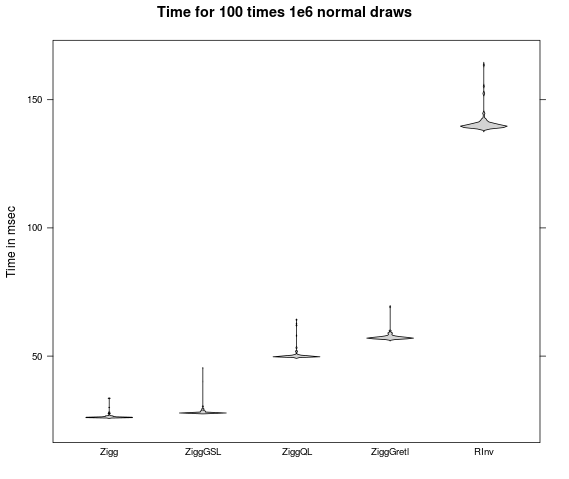
ziggurats After a slight hiatus since the last release in early 2014, we are delighted to announce a new release of RcppZiggurat which is now on the CRAN network for R. The RcppZiggurat package updates the code for the Ziggurat generator which provides very fast draws from a Normal distribution. The package provides a simple C++ wrapper class for the generator improving on the very basic macros, and permits comparison among several existing Ziggurat implementations. This can be seen in the figure where Ziggurat from this package dominates accessing the implementations from the GSL, QuantLib and Gretl---all of which are still way faster than the default Normal generator in R (which is of course of higher code complexity). This release contains a few internal cleanups relative to the last release. It was triggered by a very helpful email from Brian Ripley who notices compiler warnings on the Solaris platform due to my incorrect use of on integer variables. The NEWS file entry below lists all changes.
Changes in version 0.1.3 (2015-07-25)
  • Use the SHR3 generator for the default implementation just like Leong et al do, making our default implementation identical to theirs (but 32- and 64-bit compatible)
  • Switched generators from float to double ensuring that results are identical on 32- and 64-bit platforms
  • Simplified builds with respect to GSL use via the RcppGSL package; added a seed setter for the GSL variant
  • Corrected use of fabs() to abs() on integer variables, with a grateful nod to Brian Ripley for the hint (based on CRAN checks on the beloved Slowlaris machines)
  • Accelerated Travis CI tests by relying exclusively on r-cran-* packages from the PPAs by Michael Rutter and myself
  • Updated DESCRIPTION and NAMESPACE according to current best practices, and R-devel CMD check --as-cran checks
Courtesy of CRANberries, there is also a diffstat report for the most recent release. More information is on the RcppZiggurat page.

This post by Dirk Eddelbuettel originated on his Thinking inside the box blog. Please report excessive re-aggregation in third-party for-profit settings.

24 July 2015

Elena 'valhalla' Grandi: Old and new: furoshiki and electronics.

Old and new: furoshiki and electronics.

Yesterday at the local LUG (@Gruppo Linux Como ) somebody commented on the mix of old and new in my cloth-wrapped emergency electronics kit (you know, the kind of things you carry around with a microcontroller board http://espruino.com and a few components in case you suddenly have an idea for a project :-) ).

Immagine/fotohttp://social.gl-como.it/photos/valhalla/image/401bdd78db4a7eb8265a8119cb28c385

This is the kind of things it has right now: components tend to change in time.

Immagine/fotohttp://social.gl-como.it/photos/valhalla/image/7ba4c1372772b4d0374b655613f70c99

And yes, I admit I can only count up to 2, for higher numbers I carry a reference card :-)

Immagine/fotohttp://social.gl-como.it/photos/valhalla/image/2f544e5bef5c08c4ce9490865d22208a

Anyway, there was a bit of conversation on how this looked like a grandmother-ish thing, especially since it was in the same bag with a knitted WIP sock, and I mentioned the Japanese #furoshiki revival and how I believe that good old things are good, and good new things are good, and why not use them both?

Somebody else, who may or not be @Davide De Prisco asked me to let him have the links I mentioned, which include:

* Wikipedia page: Furoshiki https://en.wikipedia.org/wiki/Furoshiki
* Guide from the Japanese Ministry of the Environment on how to use a furoshiki http://www.env.go.jp/en/focus/attach/060403-5.html (and the article http://www.env.go.jp/en/focus/060403.html)
* A website with many other wrapping tecniques http://furoshiki.com/techniques/.

23 July 2015

Antoine Beaupr : Is it safe to use open wireless access points?

I sometimes get questions when people use my wireless access point, which, for as long as I can remember, has been open to everyone; that is without any form of password protection or encryption. I arguably don't use the access point much myself, as I prefer the wired connection for the higher bandwidth, security and reliability it provides. Apart from convenience for myself and visitors, the main reason why I leave my wireless access open is that I believe in a free (both as in beer and freedom) internet, built with principles of solidarity rather than exploitation and profitability. In these days of ubiquitous surveillance, freedom often goes hand in hand with anonymity, which implies providing free internet access to everyone. I also believe that, as more and more services get perniciously transferred to the global internet, access to the network is becoming a basic human right. This is therefore my small contribution to the struggle, now also part of the R seau Libre project. So here were my friends question, in essence:
My credit card info was stolen when I used a wifi hotspot in an airport... Should I use open wifi networks? Is it safe to use my credit card for shopping online?
Here is a modified version of an answer I sent to a friend recently which I thought could be useful to the larger internet community. The short answer is "sorry about that", "it depends, you generally can, but be careful" and "your credit card company is supposed to protect you".

Sorry! First off, sorry to hear that our credit card was stolen in an airport! That has to be annoying... Did the credit card company reimburse you? Normally, the whole point of credit cards is that they protect you in case of theft like this and they are supposed to reimburse you if you credit card gets stolen or abused...

The complexity and unreliability of passwords Now of course, securing every bit of your internet infrastructure helps in protecting against such attacks. However: there is a trade-off! First off, it does makes it more complicated for people to join the network. You need to make up some silly password (which has its own security problems: passwords can be surprisingly easy to guess!) that you will post on the fridge or worst, forget all the time! And if it's on the fridge, anyone with a view to that darn fridge, be it one-time visitor or sneaky neighbor, can find the password and steal your internet access (although, granted, that won't allow them to directly spy on your internet connection). In any case, if you choose to use a password, you should use the tricks I wrote in the koumbit wiki to generate the password and avoid writing it on the fridge.

The false sense of security of wireless encryption Second, it can also give a false sense of security: just because a wifi access point appears "secure" (ie. that the communication between your computer and the wifi access point is encrypted) doesn't mean the whole connection is secure. In fact, one attack that can be done against access points is exactly to masquerade as an existing access point, with no security security at all. That way, instead of connecting to the real secure and trusted access point, you connect to an evil one which spies on our connection. Most computers will happily connect to such a hotspot even with degraded security without warning. It may be what happened at the airport, in fact. Of course this particular attack would be less likely to happen if you live in the middle of the woods than an airport, but it's some important distinction to keep in mind, because the same attack can be performed after the wireless access point, for example by your countryside internet access provider or someone attacking it. Your best protection for your banking details is to rely on good passwords (for your back account) but also, and more importantly, what we call end-to-end encryption. That is usually implemented using the "HTTPS" with a pad lock icon in your address bar. This ensures that the communication between your computer and the bank or credit card company is secure, that is: that no wifi access point or attacker between your computer and them can intercept your credit card number.

The flaws of internet security Now unfortunately, even the HTTPS protocol doesn't bring complete security. For example, one attack that can be done is similar to the previous one and that is to masquerade as a legitimate bank site, but either strip out the encryption or even fake the encryption. So you also need to look at the address of the website you are visiting. Attackers are often pretty clever and will use many tricks to hide the real address of the website in the address bar. To work around this, I always explicitly type my bank website address (https://accesd.desjardins.com/ in my case) directly myself instead of clicking on links, bookmarks or using a search engine to find my bank site. In the case of credit cards, it is much trickier because when you buy stuff online, you end up putting that credit card number on different sites which you do not necessarily trust. There's no good solution but complaining to your credit card company if you believe a website you used has stolen your credit card details. You can also use services like Paypal, Dwolla or Bitcoin that hide your credit card details from the seller, if they support the service. I usually try to avoid putting my credit card details on sites I do not trust, and limit myself to known parties (e.g. Via Rail, Air Canada, etc). Also, in general, I try to assume the network connection between me and the website I visit is compromised. This forced me to get familiar with online security and use of encryption. It is more accessible to me than trying to secure the infrastructure i am using, because i often do not control it at all (e.g. internet cafes...). Internet security is unfortunately a hard problem, and things are not getting easier as more things move online. The burden is on us programmers and system administrators to create systems that are more secure and intuitive for our users so, as I said earlier, sorry the internet sucks so much, we didn't think so many people would join the acid trip of the 70s. ;)

Daniel Pocock: Unpaid work training Google's spam filters

This week, there has been increased discussion about the pain of spam filtering by large companies, especially Google. It started with Google's announcement that they are offering a service for email senders to know if their messages are wrongly classified as spam. Two particular things caught my attention: the statement that less than 0.05% of genuine email goes to the spam folder by mistake and the statement that this new tool to understand misclassification is only available to "help qualified high-volume senders". From there, discussion has proceeded with Linus Torvalds blogging about his own experience of Google misclassifying patches from Linux contributors as spam and that has been widely reported in places like Slashdot and The Register. Personally, I've observed much the same thing from the other perspective. While Torvalds complains that he isn't receiving email, I've observed that my own emails are not always received when the recipient is a Gmail address. It seems that Google expects their users work a little bit every day going through every message in the spam folder and explicitly clicking the "Not Spam" button: so that Google can improve their proprietary algorithms for classifying mail. If you just read or reply to a message in the folder without clicking the button, or if you don't do this for every message, including mailing list posts and other trivial notifications that are not actually spam, more important messages from the same senders will also continue to be misclassified. If you are not willing to volunteer your time to do this, or if you are simply one of those people who has better things to do, Google's Gmail service is going to have a corrosive effect on your relationships. A few months ago, we visited Australia and I sent emails to many people who I wanted to catch up with, including invitations to a family event. Some people received the emails in their inboxes yet other people didn't see them because the systems at Google (and other companies, notably Hotmail) put them in a spam folder. The rate at which this appeared to happen was definitely higher than the 0.05% quoted in the Google article above. Maybe the Google spam filters noticed that I haven't sent email to some members of the extended family for a long time and this triggered the spam algorithm? Yet it was at that very moment that we were visiting Australia that email needs to work reliably with that type of contact as we don't fly out there every year. A little bit earlier in the year, I was corresponding with a few students who were applying for Google Summer of Code. Some of them also observed the same thing, they sent me an email and didn't receive my response until they were looking in their spam folder a few days later. Last year I know a GSoC mentor who lost track of a student for over a week because of Google silently discarding chat messages, so it appears Google has not just shot themselves in the foot, they managed to shoot their foot twice. What is remarkable is that in both cases, the email problems and the XMPP problems, Google doesn't send any error back to the sender so that they know their message didn't get through. Instead, it is silently discarded or left in a spam folder. This is the most corrosive form of communication problem as more time can pass before anybody realizes that something went wrong. After it happens a few times, people lose a lot of confidence in the technology itself and try other means of communication which may be more expensive, more synchronous and time intensive or less private. When I discussed these issues with friends, some people replied by telling me I should send them things through Facebook or WhatsApp, but each of those services has a higher privacy cost and there are also many other people who don't use either of those services. This tends to fragment communications even more as people who use Facebook end up communicating with other people who use Facebook and excluding all the people who don't have time for Facebook. On top of that, it creates more tedious effort going to three or four different places to check for messages. Despite all of this, the suggestion that Google's only response is to build a service to "help qualified high-volume senders" get their messages through leaves me feeling that things will get worse before they start to get better. There is no mention in the Google announcement about what they will offer to help the average person eliminate these problems, other than to stop using Gmail or spend unpaid time meticulously training the Google spam filter and hoping everybody else does the same thing. Some more observations on the issue Many spam filtering programs used in corporate networks, such as SpamAssassin, add headers to each email to suggest why it was classified as spam. Google's systems don't appear to give any such feedback to their users or message senders though, just a very basic set of recommendations for running a mail server. Many chat protocols work with an explicit opt-in. Before you can exchange messages with somebody, you must add each other to your buddy lists. Once you do this, virtually all messages get through without filtering. Could this concept be adapted to email, maybe giving users a summary of messages from people they don't have in their contact list and asking them to explicitly accept or reject each contact? If a message spends more than a week in the spam folder and Google detects that the user isn't ever looking in the spam folder, should Google send a bounce message back to the sender to indicate that Google refused to deliver it to the inbox? I've personally heard that misclassification occurs with mailing list posts as well as private messages.

13 July 2015

Dirk Eddelbuettel: RcppGSL 0.2.5

A new version of RcppGSL arrived on CRAN a couple of days ago. This package provides an interface from R to the GNU GSL using our Rcpp package. In the course of preparation for the higher-performance R via C++ course I gave in Zuerich last month, I overhauled this package, its embedded package (!!) showing how to build a package which uses R, C++ and the GSL (and which can serve as a fine example of how to build and R and C++ package using an external library), and also overhauled the vignette which discusses all these aspect. All examples now consistently use Rcpp Attributes. The NEWS file entries follows below:
Changes in version 0.2.5 (2015-07-05)
  • The colnorm function in the included example package was rewritten to use Rcpp Attributes, the example package was updated and its version number increased to 0.0.3.
  • The unit tests also use the updated version of the example package.
  • The package, and the included example package, were updated throughout to conform to the current R CMD check standards.
  • The RcppGSL-intro vignette was updated throughout.
  • The Travis CI integration now uses r-cran-* packages which leads to faster tests.
Courtesy of CRANberries, a summary of changes to the most recent release is available. More information is on the RcppGSL page. Questions, comments etc should go to the rcpp-devel mailing list off the R-Forge page.

This post by Dirk Eddelbuettel originated on his Thinking inside the box blog. Please report excessive re-aggregation in third-party for-profit settings.

23 June 2015

Sandro Tosi: CFEngine: upgrade Debian packages

say you use CFEngine to install Debian packages on your server, so it's likely you'll have a bundle looking like this:

bundle agent agentname

vars:

"packages" slist =>
"pkg1",
"pkg2",
"pkg3"
;

packages:

"$(packages)"
package_policy => "addupdate",
package_method => apt_get;


this works great to guarantee those packages are installed, but if a newer version is available in the repositories, that wont be installed. If you want CFEngine to do that too, then the web suggests this trick:

packages:

"$(packages)"
package_policy => "addupdate",
package_version => "999999999",
package_method => apt_get;

which tweak the install system declaring that you want to install version 999999999 of each package, so if you have available a higher version than the one installed, CFEngine will happily upgrade it for you. It works great.. but sometimes it doesn't. why oh why?

That's because Debian versions can have a epoch: every plain version (like 1.0-1) has an implicit epoch of 0, and same goes for the 999999999 above, that means if any of the installed packages has an epoch, that version will sort higher than 999999999 and the package wont be upgraded. If you want to be sure to upgrade every package, then the right solution is:

packages:

"$(packages)"
package_policy => "addupdate",
package_version => "9:999999999",
package_method => apt_get;

20 June 2015

Lunar: Reproducible builds: week 5 in Stretch cycle

What happened about the reproducible builds effort for this week: Toolchain fixes Uploads that should help other packages: Patch submitted for toolchain issues: Some discussions have been started in Debian and with upstream: Packages fixed The following 8 packages became reproducible due to changes in their build dependencies: access-modifier-checker, apache-log4j2, jenkins-xstream, libsdl-perl, maven-shared-incremental, ruby-pygments.rb, ruby-wikicloth, uimaj. The following packages became reproducible after getting fixed: Some uploads fixed some reproducibility issues but not all of them: Patches submitted which did not make their way to the archive yet: Discussions that have been started: reproducible.debian.net Holger Levsen added two new package sets: pkg-javascript-devel and pkg-php-pear. The list of packages with and without notes are now sorted by age of the latest build. Mattia Rizzolo added support for email notifications so that maintainers can be warned when a package becomes unreproducible. Please ask Mattia or Holger or in the #debian-reproducible IRC channel if you want to be notified for your packages! strip-nondeterminism development Andrew Ayer fixed the gzip handler so that it skip adding a predetermined timestamp when there was none. Documentation update Lunar added documentation about mtimes of file extracted using unzip being timezone dependent. He also wrote a short example on how to test reproducibility. Stephen Kitt updated the documentation about timestamps in PE binaries. Documentation and scripts to perform weekly reports were published by Lunar. Package reviews 50 obsolete reviews have been removed, 51 added and 29 updated this week. Thanks Chris West and Mathieu Bridon amongst others. New identified issues: Misc. Lunar will be talking (in French) about reproducible builds at Pas Sage en Seine on June 19th, at 15:00 in Paris. Meeting will happen this Wednesday, 19:00 UTC.

8 June 2015

Timo Jyrinki: Quick Look: Dell XPS 13 Developer Edition (2015) with Ubuntu 14.04 LTS

I recently obtained the newest Dell's Ubuntu developer offering, XPS 13 (2015, model 9343). I opted in for FullHD non-touch display, mostly because of better battery life, the actual no need for higher resolution, and matte screen which is great outside. Touch would have been "nice-to-have", but in my work I don't really need it.

The other specifications include i7-5600U CPU, 8GB RAM, 256GB SSD [edit: lshw], and of course Ubuntu 14.04 LTS pre-installed as OEM specific installation. It was not possible to directly order it from Dell site, as Finland is reportedly not online market for Dell... The wholesale company however managed to get two models on their lists and so it's now possible to order via retailers. [edit: here are some country specific direct web order links however US, DE, FR, SE, NL]

In this blog post I give a quick look on how I started up using it, and do a few observations on the pre-installed Ubuntu included. I personally was interested in using the pre-installed Ubuntu like a non-Debian/Ubuntu developer would use it, but Dell has also provided instructions for Ubuntu 15.04, Debian 7.0 and Debian 8.0 advanced users among else. Even if not using the pre-installed Ubuntu, the benefit from buying an Ubuntu laptop is obviously smaller cost and on the other hand contributing to free software (by paying for the hardware enablement engineering done by or purchased by Dell).
Unboxing
The Black Box. (and white cat)

Opened box.


First time lid opened, no dust here yet!
First time boot up, transitioning from the boot logo to a first time Ubuntu video.
A small clip from the end of the welcoming video.
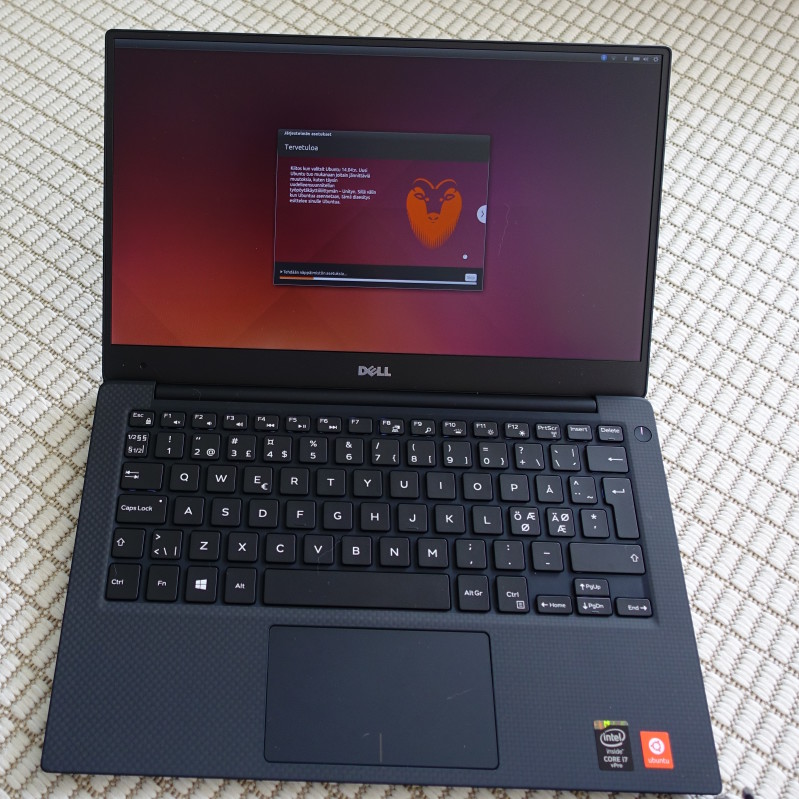
First time setup. Language, Dell EULA, connecting to WiFi, location, keyboard, user+password.
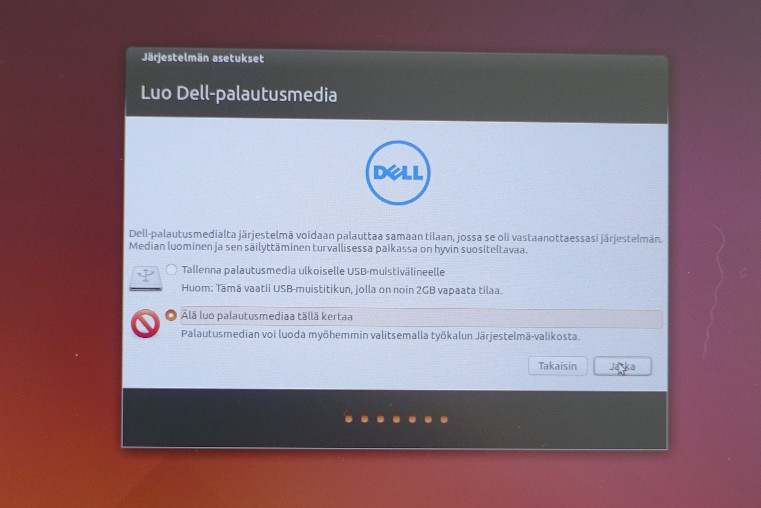
Creating recovery media. I opted not to do this as I had happened to read that it's highly recommended to install upgrades first, including to this tool.
Finalizing setup.
Ready to log in!
It's alive!
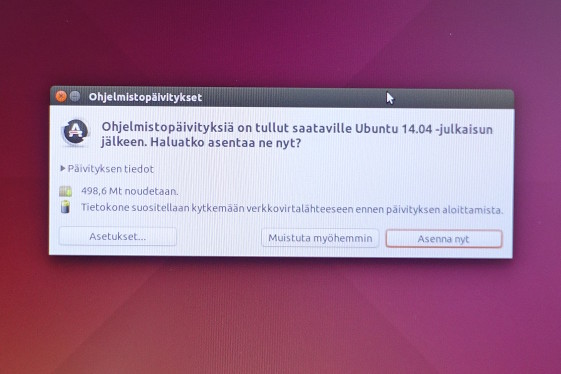
Not so recent 14.04 LTS image... lots of updates.
Problems in the First BatchUnfortunately the first batch of XPS 13:s with Ubuntu are going to ship with some problems. They're easy to fix if you know how to, but it's sad that they're there to begin with in the factory image. There is no knowledge when a fixed batch will start shipping - July maybe?

First of all, installing software upgrades stops. You need to run the following command via Dash Terminal once: sudo apt-get install -f (it suggests upgrading libc-dev-bin, libc6-dbg, libc6-dev and udev). After that you can continue running Software Updater as usual, maybe rebooting in between.

Secondly, the fixed touchpad driver is included but not enabled by default. You need to enable the only non-enabled Additional Driver as seen in the picture below or instructed in Youtube.

Dialog enabling the touchpad driver.

Clarification: you can safely ignore the two paragraphs below, they're just for advanced users like me who want to play with upgraded driver stacks.

Optionally, since I'm interested in the latest graphics drivers especially in case of a brand new hardware like Intel Broadwell, I upgraded my Ubuntu to use the 14.04.2 Hardware Enablement stack (matches 14.10 hardware support): sudo apt install --install-recommends libgles2-mesa-lts-utopic libglapi-mesa-lts-utopic linux-generic-lts-utopic xserver-xorg-lts-utopic libgl1-mesa-dri-lts-utopic libegl1-mesa-drivers-lts-utopic libgl1-mesa-glx-lts-utopic:i386

Even though it's much better than a normal Ubuntu 14.10 would be since many of the Dell fixes continue to be in use, some functionality might become worse compared to the pre-installed stack. The only thing I have noticed though is the internal microphone not working anymore out-of-the-box, requiring a kernel patch as mentioned in Dell's notes. This is not a surprise since the real eventual upstream support involves switching from HDA to I2S and during 14.10 kernel work that was not nearly done. If you're excited about new drivers, I'd recommend waiting until August when the 15.04 based 14.04.3 stack is available (same package names, but 'vivid' instead of 'utopic'). [edit: I couldn't resist myself when I saw linux-generic-lts-vivid (3.19 kernel) is already in the archives. 14.04.2 + that gives me working microphone again!]
ConclusionDell XPS 13 Developer Edition with Ubuntu 14.04 LTS is an extremely capable laptop + OS combination nearing perfection, but not quite there because of the software problems in the launch pre-install image. The laptop looks great, feels like a quality product should and is very compact for the screen size.

I've moved over all my work onto it and everything so far is working smoothly in my day-to-day tasks. I'm staying at Ubuntu 14.04 LTS and using my previous LXC configuration to run the latest Ubuntu and Debian development versions. I've also done some interesting changes already like LUKS In-Place Conversion, converting the pre-installed Ubuntu into whole disk encrypted one (not recommended for the faint hearted, GRUB reconfiguration is a bit of a pain).

I look happily forward to working a few productive years with this one!

5 June 2015

Simon McVittie: Why polkit (or, how to mount a disk on modern Linux)

I've recently found myself explaining polkit (formerly PolicyKit) to one of Collabora's clients, and thought that blogging about the same topic might be useful for other people who are confused by it; so, here is why udisks2 and polkit are the way they are. As always, opinions in this blog are my own, not Collabora's. Privileged actions Broadly, there are two ways a process can do something: it can do it directly (i.e. ask the kernel directly), or it can use inter-process communication to ask a service to do that operation on its behalf. If it does it directly, the components that say whether it can succeed are the Linux kernel's normal permissions checks (DAC), and if configured, AppArmor, SELinux or a similar MAC layer. All very simple so far. Unfortunately, the kernel's relatively coarse-grained checks are not sufficient to express the sorts of policies that exist on a desktop/laptop/mobile system. My favourite example for this sort of thing is mounting filesystems. If I plug in a USB stick with a FAT filesystem, it's reasonable to expect my chosen user interface to either mount it automatically, or let me press a button to mount it. Similarly, to avoid data loss, I should be able to unmount it when I'm finished with it. However, mounting and unmounting a USB stick is fundamentally the same system call as mounting and unmounting any other filesystem - and if ordinary users can do arbitrary mount system calls, they can cause all sorts of chaos, for instance by mounting a filesystem that contains setuid executables (privilege escalation), or umounting a critical OS filesystem like /usr (denial of service). Something needs to arbitrate: you can mount filesystems, but only under certain conditions . The kernel developer motto for this sort of thing is mechanism, not policy : they are very keen to avoid encoding particular environments' policies (the sort of thing you could think of as business rules ) in the kernel, because that makes it non-generic and hard to maintain. As a result, direct mount/unmount actions are only allowed by privileged processes, and it's up to user-space processes to arrange for a privileged process to make the desired mount syscall. Here are some other privileged actions which laptop/desktop users can reasonably expect to just work , with or without requiring a sysadmin-like (root-equivalent) user: In environments that use a MAC framework like AppArmor, actions that would normally be allowed can become privileged: for instance, in a framework for sandboxed applications, most apps shouldn't be allowed to record audio. This prevents carrying out these actions directly, again resulting in the only way to achieve them being to ask a service to carry out the action. Ask a system service to do it On to the next design, then: I can submit a request to a privileged process, which does some checks to make sure I'm not trying to break the system (or alternatively, that I have enough sysadmin rights that I'm allowed to break the system if I want to), and then does the privileged action for me. You might think I'm about to start discussing D-Bus and daemons, but actually, a prominent earlier implementation of this was mount(8), which is normally setuid root:
% ls -l /bin/mount
-rwsr-xr-x 1 root root 40000 May 22 11:37 /bin/mount
If you look at it from an odd angle, this is inter-process communication across a privilege boundary: I run the setuid executable, creating a process. Because the executable has the setuid bit set, the kernel makes the process highly privileged: its effective uid is root, and it has all the necessary capabilities to mount filesystems. I submit the request by passing it in the command-line arguments. mount does some checks - specifically, it looks in /etc/fstab to see whether the filesystem I'm trying to mount has the user or users flag - then carries out the mount system call. There are a few obvious problems with this: Ask a system service to do it, via D-Bus or other IPC To avoid the issues of setuid, we could use inter-process communication in the traditional sense: run a privileged daemon (on boot or on-demand), make it listen for requests, and use the IPC channel as our privilege boundary. udisks2 is one such privileged daemon, which uses D-Bus as its IPC channel. D-Bus is a commonly-used inter-process system; one of its intended/designed uses is to let user processes and system services communicate, especially this sort of communication between a privileged daemon and its less-privileged clients. People sometimes criticize D-Bus as not doing anything you couldn't do yourself with some AF_UNIX sockets. Well, no, of course it doesn't - the important bit of the reference implementation and the various interoperable reimplementations consists of a daemon and some AF_UNIX sockets, and the rest is a simple matter of programming. However, it's sufficient for most uses in its problem space, and is usually better than inventing your own. The advantage of D-Bus over doing your own thing is precisely that you are not doing your own thing: good IPC design is hard, and D-Bus makes some structural decisions so that fewer application authors have to think about them. For instance, it has a central hub daemon (the dbus-daemon, or message bus ) so that n communicating applications don't need O(n ) sockets; it uses the dbus-daemon to provide a total message ordering so you don't have to think about message reordering; it has a distributed naming model (which can also be used as a distributed mutex) so you don't have to design that; it has a serialization format and a type system so you don't have to design one of those; it has a framework for activating" run-on-demand daemons so they don't have to use resources initially, implemented using a setuid helper and/or systemd; and so on. If you have religious objections to D-Bus, you can mentally replace D-Bus with AF_UNIX or something and most of this article will still be true. Is this OK? In either case - exec'ing a privileged helper, or submitting a request to a privileged daemon via IPC - the privileged process has two questions that it needs to answer before it does its work: It needs to make some sort of decision on the latter based on the information available to it. However, before we even get there, there is another layer: In the setuid model, there is a simple security check that you can apply: you can make /bin/mount only executable by a particular group, or only executable by certain AppArmor profiles, or similar. That works up to a point, but cannot distinguish between physically-present and not-physically-present users, or other facts that might be interesting to your local security policy. Similarly, in the IPC model, you can make certain communication channels impossible, for instance by using dbus-daemon's ability to decide which messages to deliver, or AF_UNIX sockets' filesystem permissions, or a MAC framework like AppArmor. Both of these are quite coarse-grained checks which don't really understand the finer details of what is going on. If the answer to "is this safe? is something of the form maybe, it depends on... , then they can't do the right thing: they must either let it through and let the domain-specific privileged process do the check, or deny it and lose potentially useful functionality. For instance, in an AppArmor environment, some applications have absolutely no legitimate reason to talk to udisks2, so the AppArmor policy can just block it altogether. However, once again, this is a coarse-grained check: the kernel has mechanism, not policy, and it doesn't know what the service does or why. If the application does need to be able to talk to the service at all, then finer-grained access control (obeying some, but not all, requests) has to be the service's job. dbus-daemon does have the ability to match messages in a relatively fine-grained way, based on the object path, interface and member in the message, as well as the routing information that it uses itself (i.e. the source and destination). However, it is not clear that this makes a great deal of sense conceptually: these are facts about the mechanics of the IPC, not facts about the domain-specific request (because the mechanics of the IPC are all that dbus-daemon understands). For instance, taking the udisks2 example again, dbus-daemon can't distinguish between an attempt to adjust mount options for a USB stick (probably fine) and an attempt to adjust mount options for /usr (not good). To have a domain-specific security policy, we need a domain-specific component, for instance udisks2, to get involved. Unlike dbus-daemon, udisks2 knows that not all disks are equal, knows which categories make sense to distinguish, and can identify which categories a particular disk is in. So udisks2 can make a more informed decision. So, a naive approach might be to write a function in udisks2 that looks something like this pseudocode:
may_i_mount_this_disk (user, disk, mount options)   boolean
 
    if (user is root   user is root-equivalent)
        return true;
    if (disk is not removable)
       return false;
    if (mount options are scary)
       return false;
    if (user is in  manipulate non-local disks  group)
        return true;
    if (user is not logged-in locally)
       return false;
    # https://en.wikipedia.org/wiki/Multiseat_configuration
    if (user is not logged-in on the same seat where the disk is
            plugged in)
       return false;
    return true;
 
Delegating the security policy to something central The pseudocode security policy outlined above is reasonably complicated already, and doesn't necessarily cover everything that you might want to consider. Meanwhile, not every system is the same. A general-purpose Linux distribution like Debian might run on server/mainframe systems with only remote users, personal laptops/desktops with one root-equivalent user, locked-down corporate laptops/desktops, mobile devices and so on; these systems should not necessarily all have the same security policy. Another interesting factor is that for some privileged operations, you might want to carry out interactive authorization: ask the requesting user to confirm that the action (which might have come from a background process) should take place (like Windows' UAC), or to prove that the person currently at the keyboard is the same as the person who logged in by giving their password (like sudo). We could in principle write code for all of this in udisks2, and in NetworkManager, and in systemd, ... - but that clearly doesn't scale, particularly if you want the security policy to be configurable. Enter polkit (formerly PolicyKit), a system service for applying security policies to actions. The way polkit works is that the application does its domain-specific analysis of the request - in the case of udisks2, whether the device to be mounted is removable, whether the mount options are reasonable, etc. - and converts it into an action. The action gives polkit a way to distinguish between things that are conceptually different, without needing to know the specifics. For instance, udisks2 currently divides up filesystem-mounting into org.freedesktop.udisks2.filesystem-mount, org.freedesktop.udisks2.filesystem-mount-fstab, org.freedesktop.udisks2.filesystem-mount-system and org.freedesktop.udisks2.filesystem-mount-other-seat. The application also finds the identity of the user making the request. Next, the application sends the action, the identity of the requesting user, and any other interesting facts to polkit. As currently implemented, polkit is a D-Bus service, so this is an IPC request via D-Bus. polkit consults its database of policies in order to choose one of several results: So how does polkit decide this? The first thing is that it reads the machine-readable description of the actions, in /usr/share/polkit-1/actions, which specifies a default policy. Next, it evaluates a local security policy to see what that says. In the current version of polkit, the local security policy is configured by writing JavaScript in /etc/polkit-1/rules.d (local policy) and /usr/share/polkit-1/rules.d (OS-vendor defaults). In older versions such as the one currently shipped in Debian unstable, there was a plugin architecture; but in practice nobody wrote plugins for it, and instead everyone used the example local authority shipped with polkit, which was configured via files in /etc/polkit-1/localauthority and /etc/polkit-1/localauthority.d. These policies can take into account useful facts like: For instance, gnome-control-center on Debian installs this snippet:
polkit.addRule(function(action, subject)  
        if ((action.id == "org.freedesktop.locale1.set-locale"  
             action.id == "org.freedesktop.locale1.set-keyboard"  
             action.id == "org.freedesktop.hostname1.set-static-hostname"  
             action.id == "org.freedesktop.hostname1.set-hostname"  
             action.id == "org.gnome.controlcenter.datetime.configure") &&
            subject.local &&
            subject.active &&
            subject.isInGroup ("sudo"))  
                    return polkit.Result.YES;
             
 );
which is reasonably close to being pseudocode for active local users in the sudo group may set the system locale, keyboard layout, hostname and time, without needing to authenticate . A system administrator could of course override that by dropping a higher-priority policy for some or all of these actions into /etc/polkit-1/rules.d. Summary

19 May 2015

Gunnar Wolf: Feeling somewhat special

Today I feel more special than I have ever felt. Or... Well, or something like that. Thing is, there is no clear adjective for this But I successfully finished my Specialization degree! Yes, believe it or not, today I can formally say I am Specialist in Informatic Security and Information Technologies (Especialista en Seguridad Inform tica y Tecnolog as de la Informaci n), as awarded by the Higher School of Electric and Mechanic Engineering (Escuela Superior de Ingenier a Mec nica y El ctrica) of the National Polytechnical Institute (Instituto Polit cnico Nacional). In Mexico and most Latin American countries, degrees are usually incorporated to your name as if they were a nobiliary title. Thus, when graduating from Engineering studies (pre-graduate universitary level), I became "Ingeniero Gunnar Wolf". People graduating from further postgraduate programs get to introduce themselves as "Maestro Foobar Baz" or "Doctor Quux Noox". And yes, a Specialization is a small posgraduate program (I often say, the smallest possible posgraduate). And as a Specialist... What can I brag about? Can say I am Specially Gunnar Wolf? Or Special Gunnar Wolf? Nope. The honorific title for a Specialization is a pointer to null, and when casted into a char* it might corrupt your honor-recognizing function. So I'm still Ingeniero Gunnar Wolf, for information security reasons. So that's the reason I am now enrolled in the Masters program. I hope to write an addenda to this message soonish (where soonish 18 months) saying I'm finally a Maestro. As a sidenote, many people asked me: Why did I take on the specialization, which is a degree too small for most kinds of real work recognition? Because it's been around twenty years since I last attended a long-term scholar program as a student. And my dish is quite full with activities and responsabilities. I decided to take a short program, designed for 12 months (I graduated in 16, minus two months that the university was on strike... Quite good, I'd say ;-) ) to see how I fared on it, and only later jumping on the full version. Because, yes, to advance my career at the university, I finally recognized and understood that I do need postgraduate studies. Oh, and what kind of work did I do for this? Besides the classes I took, I wrote a thesis on a model for evaluating covert channels for establishing secure communications.

16 May 2015

Ian Campbell: A vhosting git setup with gitolite and gitweb

Since gitorious' shutdown I decided it was time to start hosting my own git repositories for my own little projects (although the company which took over gitorious has a Free software offering it seems that their hosted offering is based on the proprietary version, and in any case once bitten, twice shy and all that). After a bit of investigation I settled on using gitolite and gitweb. I did consider (and even had a vague preference for) cgit but it wasn't available in Wheezy (even backports, and the backport looked tricky) and I haven't upgraded my VPS yet. I may reconsider cgit this once I switch to Jessie. The only wrinkle was that my VPS is shared with a friend and I didn't want to completely take over the gitolite and gitweb namespaces in case he ever wanted to setup git.hisdomain.com, so I needed something which was at least somewhat compatible with vhosting. gitolite doesn't appear to support such things out of the box but I found an interesting/useful post from Julius Plenz which included sufficient inspiration that I thought I knew what to do. After a bit of trial and error here is what I ended up with: Install gitolite The gitolite website has plenty of documentation on configuring gitolite. But since gitolite is in Debian its even more trivial than even the quick install makes out. I decided to use the newer gitolite3 package from wheezy-backports instead of the gitolite (v2) package from Wheezy. I already had backports enabled so this was just:
# apt-get install gitolite3/wheezy-backports
I accepted the defaults and gave it the public half of the ssh key which I had created to be used as the gitolite admin key. By default this added a user gitolite3 with a home directory of /var/lib/gitolite3. Since they username forms part of the URL used to access the repositories I want it to include the 3, so I edited /etc/passwd, /etc/groups, /etc/shadow and /etc/gshadow to say just gitolite but leaving the home directory as gitolite3. Now I could clone the gitolite-admin repo and begin to configure things. Add my user This was simple as dropping the public half into the gitolite-admin repo as keydir/ijc.pub, then git add, commit and push. Setup vhosting Between the gitolite docs and Julius' blog post I had a pretty good idea what I wanted to do here. I wasn't too worried about making the vhost transparent from the developer's (ssh:// URL) point of view, just from the gitweb and git clone side. So I decided to adapt things to use a simple $VHOST/$REPO.git schema. I created /var/lib/gitolite3/local/lib/Gitolite/Triggers/VHost.pm containing:
package Gitolite::Triggers::VHost;
use strict;
use warnings;
use File::Slurp qw(read_file write_file);
sub post_compile  
    my %vhost = ();
    my @projlist = read_file("$ENV HOME /projects.list");
    for my $proj (sort @projlist)  
        $proj =~ m,^([^/\.]*\.[^/]*)/(.*)$, or next;
        my ($host, $repo) = ($1,$2);
        $vhost $host  //= [];
        push @ $vhost $host  => $repo;
     
    for my $v (keys %vhost)  
        write_file("$ENV HOME /projects.$v.list",
                     atomic => 1  , join("\n",@ $vhost $v ));
     
 
1;
I then edited /var/lib/gitolite3/.gitolite.rc and ensured it contained:
LOCAL_CODE                =>  "$ENV HOME /local",
POST_COMPILE => [ 'VHost::post_compile', ],
(The first I had to uncomment, the second to add). All this trigger does is take the global projects.list, in which gitolite will list any repo which is configured to be accessible via gitweb, and split it into several vhost specific lists. Create first repository Now that the basics were in place I could create my first repository (for hosting qcontrol). In the gitolite-admin repository I edited conf/gitolite.conf and added:
repo hellion.org.uk/qcontrol
    RW+     =   ijc
After adding, committing and pushing I now have "/var/lib/gitolite3/projects.list" containing:
hellion.org.uk/qcontrol.git
testing.git
(the testing.git repository is configured by default) and /var/lib/gitolite3/projects.hellion.org.uk.list containing just:
qcontrol.git
For cloning the URL is:
gitolite@$ VPSNAME :hellion.org.uk/qcontrol.git
which is rather verbose ($ VPSNAME is quote long in my case too), so to simplify things I added to my .ssh/config:
Host gitolite
Hostname $ VPSNAME 
User gitolite
IdentityFile ~/.ssh/id_rsa_gitolite
so I can instead use:
gitolite:hellion.org.uk/qcontrol.git
which is a bit less of a mouthful and almost readable. Configure gitweb (http:// URL browsing) Following the documentation's advice I edited /var/lib/gitolite3/.gitolite.rc to set:
UMASK                           =>  0027,
and then:
$ chmod -R g+rX /var/lib/gitolite3/repositories/*
Which arranges that members of the gitolite group can read anything under /var/lib/gitolite3/repositories/*. Then:
# adduser www-data gitolite
This adds the user www-data to the gitolite group so it can take advantage of those relaxed permissions. I'm not super happy about this but since gitweb runs as www-data:www-data this seems to be the recommended way of doing things. I'm consoling myself with the fact that I don't plan on hosting anything sensitive... I also arranged things such that members of the groups can only list the contents of directories from the vhost directory down by setting g=x not g=rx on higher level directories. Potentially sensitive files do not have group permissions at all either. Next I created /etc/apache2/gitolite-gitweb.conf:
die unless $ENV GIT_PROJECT_ROOT ;
$ENV GIT_PROJECT_ROOT  =~ m,^.*/([^/]+)$,;
our $gitolite_vhost = $1;
our $projectroot = $ENV GIT_PROJECT_ROOT ;
our $projects_list = "/var/lib/gitolite3/projects.$ gitolite_vhost .list";
our @git_base_url_list = ("http://git.$ gitolite_vhost ");
This extracts the vhost name from $ GIT_PROJECT_ROOT (it must be the last element) and uses it to select the appropriate vhost specific projects.list. Then I added a new vhost to my apache2 configuration:
<VirtualHost 212.110.190.137:80 [2001:41c8:1:628a::89]:80>
        ServerName git.hellion.org.uk
        SetEnv GIT_PROJECT_ROOT /var/lib/gitolite3/repositories/hellion.org.uk
        SetEnv GITWEB_CONFIG /etc/apache2/gitolite-gitweb.conf
        Alias /static /usr/share/gitweb/static
        ScriptAlias / /usr/share/gitweb/gitweb.cgi/
</VirtualHost>
This configures git.hellion.org.uk (don't forget to update DNS too) and sets the appropriate environment variables to find the custom gitolite-gitweb.conf and the project root. Next I edited /var/lib/gitolite3/.gitolite.rc again to set:
GIT_CONFIG_KEYS                 => 'gitweb\.(owner description category)',
Now I can edit the repo configuration to be:
repo hellion.org.uk/qcontrol
    owner   =   Ian Campbell
    desc    =   qcontrol
    RW+     =   ijc
    R       =   gitweb
That R permission for the gitweb pseudo-user causes the repo to be listed in the global projects.list and the trigger which we've added causes it to be listed in projects.hellion.org.uk.list, which is where our custom gitolite-gitweb.conf will look. Setting GIT_CONFIG_KEYS allows those options (owner and desc are syntactic sugar for two of them) to be set here and propagated to the actual repo. Configure git-http-backend (http:// URL cloning) After all that this was pretty simple. I just added this to my vhost before the ScriptAlias / /usr/share/gitweb/gitweb.cgi/ line:
        ScriptAliasMatch \
                "(?x)^/(.*/(HEAD   \
                                info/refs   \
                                objects/(info/[^/]+   \
                                         [0-9a-f] 2 /[0-9a-f] 38    \
                                         pack/pack-[0-9a-f] 40 \.(pack idx))   \
                                git-(upload receive)-pack))$" \
                /usr/lib/git-core/git-http-backend/$1
This (which I stole straight from the git-http-backend(1) manpage causes anything which git-http-backend should deal with to be sent there and everything else to be sent to gitweb. Having done that access is enabled by editing the repo configuration one last time to be:
repo hellion.org.uk/qcontrol
    owner   =   Ian Campbell
    desc    =   qcontrol
    RW+     =   ijc
    R       =   gitweb daemon
Adding R permissions for daemon causes gitolite to drop a stamp file in the repository which tells git-http-backend that it should export it. Configure git daemon (git:// URL cloning) I actually didn't bother with this, git http-backend supports the smart HTTP mode which should be as efficient as the git protocol. Given that I couldn't see any reason to run another network facing daemon on my VPS. FWIW it looks like vhosting could have been achieved by using the --interpolated-path option. Conclusion There's quite a few moving parts, but they all seems to fit together quite nicely. In the end apart from adding www-data to the gitolite group I'm pretty happy with how things ended up.

7 May 2015

Benjamin Mako Hill: DRM on Streaming Services

For the 2015 International Day Against DRM, I wrote a short essay on DRM for streaming services posted on the Defective by Design website. I m republishing it here. Between 2003 and 2009, most music purchased through Apple s iTunes store was locked using Apple s FairPlay digital restrictions management (DRM) software, which is designed to prevent users from copying music they purchased. Apple did not seem particularly concerned by the fact that FairPlay was never effective at stopping unauthorized distribution and was easily removed with publicly available tools. After all, FairPlay was effective at preventing most users from playing their purchased music on devices that were not made by Apple. No user ever requested FairPlay. Apple did not build the system because music buyers complained that CDs purchased from Sony would play on Panasonic players or that discs could be played on an unlimited number of devices (FairPlay allowed five). Like all DRM systems, FairPlay was forced on users by a recording industry paranoid about file sharing and, perhaps more importantly, by technology companies like Apple, who were eager to control the digital infrastructure of music distribution and consumption. In 2007, Apple began charging users 30 percent extra for music files not processed with FairPlay. In 2009, after lawsuits were filed in Europe and the US, and after several years of protests, Apple capitulated to their customers complaints and removed DRM from the vast majority of the iTunes music catalog. Fundamentally, DRM for downloaded music failed because it is what I ve called an antifeature. Like features, antifeatures are functionality created at enormous cost to technology developers. That said, unlike features which users clamor to pay extra for, users pay to have antifeatures removed. You can think of antifeatures as a technological mob protection racket. Apple charges more for music without DRM and independent music distributors often use DRM-free as a primary selling point for their products. Unfortunately, after being defeated a half-decade ago, DRM for digital music is becoming the norm again through the growth of music streaming services like Pandora and Spotify, which nearly all use DRM. Impressed by the convenience of these services, many people have forgotten the lessons we learned in the fight against FairPlay. Once again, the justification for DRM is both familiar and similarly disingenuous. Although the stated goal is still to prevent unauthorized copying, tools for stripping DRM from services continue to be widely available. Of course, the very need for DRM on these services is reduced because users don t normally store copies of music and because the same music is now available for download without DRM on services like iTunes. We should remember that, like ten years ago, the real effect of DRM is to allow technology companies to capture value by creating dependence in their customers and by blocking innovation and competition. For example, DRM in streaming services blocks third-party apps from playing music from services, just as FairPlay ensured that iTunes music would only play on Apple devices. DRM in streaming services means that listening to music requires one to use special proprietary clients. For example, even with a premium account, a subscriber cannot listen to music from their catalog using an alternative or modified music player. It means that their television, car, or mobile device manufacturer must cut deals with their service to allow each paying customer to play the catalog they have subscribed to. Although streaming services are able to capture and control value more effectively, this comes at the cost of reduced freedom, choice, and flexibility for users and at higher prices paid by subscribers. A decade ago, arguments against DRM for downloaded music focused on the claim that users should have control over the music they purchase. Although these arguments may not seem to apply to subscription services, it is worth remembering that DRM is fundamentally a problem because it means that we do not have control of the technology we use to play our music, and because the firms aiming to control us are using DRM to push antifeatures, raise prices, and block innovation. In all of these senses, DRM in streaming services is exactly as bad as FairPlay, and we should continue to demand better.

1 May 2015

Petter Reinholdtsen: What would it cost to store all phone calls in Norway?

Many years ago, a friend of mine calculated how much it would cost to store the sound of all phone calls in Norway, and came up with the cost of around 20 million NOK (2.4 mill EUR) for all the calls in a year. I got curious and wondered what the same calculation would look like today. To do so one need an idea of how much data storage is needed for each minute of sound, how many minutes all the calls in Norway sums up to, and the cost of data storage. The 2005 numbers are from digi.no, the 2012 numbers are from a NKOM report, and I got the 2013 numbers after asking NKOM via email. I was told the numbers for 2014 will be presented May 20th, and decided not to wait for those, as I doubt they will be very different from the numbers from 2013. The amount of data storage per minute sound depend on the wanted quality, and for phone calls it is generally believed that 8 Kbit/s is enough. See for example a summary on voice quality from Cisco for some alternatives. 8 Kbit/s is 60 Kbytes/min, and this can be multiplied with the number of call minutes to get the storage requirements. Storage prices varies a lot, depending on speed, backup strategies, availability requirements etc. But a simple way to calculate can be to use the price of a TiB-disk (around 1000 NOK / 120 EUR) and double it to take space, power and redundancy into account. It could be much higher with high speed and good redundancy requirements. But back to the question, What would it cost to store all phone calls in Norway? Not much. Here is a small table showing the estimated cost, which is within the budget constraint of most medium and large organisations:
YearCall minutesSizePrice in NOK / EUR
200524 000 000 0001.3 PiB3 mill / 358 000
201218 000 000 0001.0 PiB2.2 mill / 262 000
201317 000 000 000950 TiB2.1 mill / 250 000
This is the cost of buying the storage. Maintenance need to be taken into account too, but calculating that is left as an exercise for the reader. But it is obvious to me from those numbers that recording the sound of all phone calls in Norway is not going to be stopped because it is too expensive. I wonder if someone already is collecting the data?

27 April 2015

Matthew Garrett: Reducing power consumption on Haswell and Broadwell systems

Edit to add: These patches on their own won't enable this functionality, they just give us a better set of options. Once they're merged we can look at changing the defaults so people get the benefit of this out of the box.

Haswell and Broadwell (Intel's previous and current generations of x86) both introduced a range of new power saving states that promised significant improvements in battery life. Unfortunately, the typical experience on Linux was an increase in power consumption. The reasons why are kind of complicated and distinctly unfortunate, and I'm at something of a loss as to why none of the companies who get paid to care about this kind of thing seemed to actually be caring until I got a Broadwell and looked unhappy, but here we are so let's make things better.

Recent Intel mobile parts have the Platform Controller Hub (Intel's term for the Southbridge, the chipset component responsible for most system i/o like SATA and USB) integrated onto the same package as the CPU. This makes it easier to implement aggressive power saving - the CPU package already has a bunch of hardware for turning various clock and power domains on and off, and these can be shared between the CPU, the GPU and the PCH. But that also introduces additional constraints, since if any component within a power management domain is active then the entire domain has to be enabled. We've pretty much been ignoring that.

The tldr is that Haswell and Broadwell are only able to get into deeper package power saving states if several different components are in their own power saving states. If the CPU is active, you'll stay in a higher-power state. If the GPU is active, you'll stay in a higher-power state. And if the PCH is active, you'll stay in a higher-power state. The last one is the killer here. Having a SATA link in a full-power state is sufficient to keep the PCH active, and that constrains the deepest package power savings state you can enter.

SATA power management on Linux is in a kind of odd state. We support it, but we don't enable it by default. In fact, right now we even remove any existing SATA power management configuration that the firmware has initialised. Distributions don't enable it by default because there are horror stories about some combinations of disk and controller and power management configuration resulting in corruption and data loss and apparently nobody had time to investigate the problem.

I did some digging and it turns out that our approach isn't entirely inconsistent with the industry. The default behaviour on Windows is pretty much the same as ours. But vendors don't tend to ship with the Windows AHCI driver, they replace it with the Intel Rapid Storage Technology driver - and it turns out that that has a default-on policy. But to make things even more awkwad, the policy implemented by Intel doesn't match any of the policies that Linux provides.

In an attempt to address this, I've written some patches. The aim here is to provide two new policies. The first simply inherits whichever configuration the firmware has provided, on the assumption that the system vendor probably didn't configure their system to corrupt data out of the box[1]. The second implements the policy that Intel use in IRST. With luck we'll be able to use the firmware settings by default and switch to the IRST settings on Intel mobile devices.

This change alone drops my idle power consumption from around 8.5W to about 5W. One reason we'd pretty much ignored this in the past was that SATA power management simply wasn't that big a win. Even at its most aggressive, we'd struggle to see 0.5W of saving. But on these new parts, the SATA link state is the difference between going to PC2 and going to PC7, and the difference between those states is a large part of the CPU package being powered up.

But this isn't the full story. There's still work to be done on other components, especially the GPU. Keeping the link between the GPU and an internal display panel active is both a power suck and requires additional chipset components to be powered up. Embedded Displayport 1.3 introduced a new feature called Panel Self-Refresh that permits the GPU and the screen to negotiate dropping the link, leaving it up to the screen to maintain its contents. There's patches to enable this on Intel systems, but it's still not turned on by default. Doing so increases the amount of time spent in PC7 and brings corresponding improvements to battery life.

This trend is likely to continue. As systems become more integrated we're going to have to pay more attention to the interdependencies in order to obtain the best possible power consumption, and that means that distribution vendors are going to have to spend some time figuring out what these dependencies are and what the appropriate default policy is for their users. Intel's done the work to add kernel support for most of these features, but they're not the ones shipping it to end-users. Let's figure out how to make this right out of the box.

[1] This is not necessarily a good assumption, but hey, let's see

comment count unavailable comments

26 April 2015

Joachim Breitner: Fifth place in Godingame World Cup

Last evening, Codingame held a Programming World Cup titled There is no Spoon . The format is that within four hours, you get to write a program that solves a given task. Submissions are first rated by completeness (there are 13 test inputs that you can check your code again, and further hidden tests that will only be checked after submission) and then by time of submission. You can only submit your code once. What I like about Codingame is that they support a great number of programming languages in their Web- IDE , including Haskell. I had nothing better to do yesterday, so I joined. I was aiming for a good position in the Haskell-specific ranking. After nearly two hours my code completed all the visible test cases and I submitted. I figured that this was a reasonable time to do so, as it was half-time and there are supposed to be two challenges. I turned out that the first, quite small task, which felt like a warm-up or qualification puzzle, was the first of those two, and that therefore I was done, and indeed the 5th fastest to complete a 100% solution! With only less than 5 minutes difference to the 3rd, money-winning place if I had known I had such a chance, I had started on time... Having submitted the highest ranked Haskell code, I will get a T-Shirt. I also defended Haskell s reputation as an efficient programming language, ranked third in the contest, after C++ (rank 1) and Java (rank 2), but before PHP (9), C# (10) and Python (11), listing only those that had a 100% solution. The task, solving a Bridges puzzle, did not feel like a great fit for Haskell at first. I was juggling Data.Maps around where otherwise I d simple attach attributes to object, and a recursive function simulated nothing but a plain loop. But it played off the moment I had to implement guessing parts of the solution, trying what happens and backtracking when it did not work: With all state in parameters and pure code it was very simple to get a complete solution. My code is of course not very polished, and having the main loop live in the IO monad just to be able to print diagnostic commands is a bit ugly. The next, Lord of the Ring-themed world cup will be on June 27th. Maybe we will see more than 18 Haskell entries then?

18 April 2015

Russ Allbery: Review: The Long Way to a Small, Angry Planet

Review: The Long Way to a Small, Angry Planet, by Becky Chambers
Publisher: CreateSpace
Copyright: 2014
ISBN: 1-5004-5330-7
Format: Kindle
Pages: 503
The Wayfarer is a tunneling ship: one of the small, unremarked construction ships that help build the wormhole network used for interstellar transport. It's a working ship with a crew of eight (although most people would count seven and not count the AI). They don't all like each other particularly not the algaeist, who is remarkably unlikeable but they're used to each other. It's not a bad life, although a more professional attention to paperwork and procedure might help them land higher-paying jobs. That's where Rosemary Harper comes in. At the start of the book, she's joining the ship as their clerk: nervous, hopeful, uncertain, and not very experienced. But this is a way to get entirely away from her old life and, unbeknownst to the ship she's joining, her real name, identity, and anyone who would know her. Given that introduction, I was expecting this book to be primarily about Rosemary. What is she fleeing? Why did she change her identity? How will that past come to haunt her and the crew that she joined? But that's just the first place that Chambers surprised me. This isn't that book at all. It's something much quieter, more human, more expansive, and more joyful. For one, Chambers doesn't stick with Rosemary as a viewpoint character, either narratively or with the focus of the plot. The book may open with Rosemary and the captain, Ashby, as focal points, but that focus expands to include every member of the crew of the Wayfarer. We see each through others' eyes first, and then usually through their own, either in dialogue or directly. This is a true ensemble cast. Normally, for me, that's a drawback: large viewpoint casts tend to be either jarring or too sprawling, mixing people I want to read about with people I don't particularly care about. But Chambers avoids that almost entirely. I was occasionally a touch disappointed when the narrative focus shifted, but then I found myself engrossed in the backstory, hopes, and dreams of the next crew member, and the complex ways they interweave. Rosemary isn't the center of this story, but only because there's no single center. It's very hard to capture in a review what makes this book so special. The closest that I can come is that I like these people. They're individual, quirky, human (even the aliens; this is from more the Star Trek tradition of alien worldbuilding), complicated, and interesting, and it's very easy to care about them. Even characters I never expected to like. The Long Way to a Small, Angry Planet does have a plot, but it's not a fast-moving or completely coherent one. The ship tends to wander, even when the mission that gives rise to the title turns up. And there are a lot of coincidences here, which may bother you if you're reading for plot. At multiple points, the ship ends up in exactly the right place to trigger some revelation about the backstory of one of the crew members, even if the coincidence strains credulity. Similar to the algae-driven fuel system, some things one just has to shrug about and move past. On other fronts, though, I found The Long Way to be refreshingly willing to take a hard look at SF assumptions. This is not the typical space opera: humans are a relatively minor species in this galaxy, one that made rather a mess of their planet and are now refugees. They are treated with sympathy or pity; they're not somehow more flexible, adaptable, or interesting than the rest of the galaxy. More fascinatingly to me, humans are mostly pacifists, a cultural reaction to the dire path through history that brought them to their current exile. This is set against a backdrop of a vibrant variety of alien species, several of whom are present onboard the Wayfinder. The history and background of the other species are not, sadly, as well fleshed out as the humans, but each with at least a few twists that add interest to the story. But the true magic of this book, the thing that it has in overwhelming abundance, is heart. Not everyone in this book is a good person, but most of them are trying. I've rarely read a book full of so much empathy and willingness to reach out to others with open hands. And, even better, they're all nice in different ways. They bring their own unique personalities and approaches to their relationships, particularly the complex web of relationships that connects the crew. When bad things happen, and, despite the overall light tone, a few very bad things happen, the crew rallies like friends, or like chosen family. I have to say it again: I like these people. Usually, that's not a good sign for a book, since wholly likeable people don't generate enough drama. But this is one of the better-executed "protagonist versus nature" plots I've read. It successfully casts the difficulties of making a living at a hard and lonely and political job as the "nature" that provides the conflict. This is a rather unusual book. It's probably best classified as space opera, but it doesn't fit the normal pattern of space opera and it doesn't have enough drama. It's not a book about changing the universe; at the end of the book, the universe is in pretty much the same shape as we found it. It's not even about the character introduced in the first pages, or really that much about her dilemma. And it's certainly not a book about winning a cunning victory against your enemies. What it is, rather, is a book about friendships, about chosen families and how they form, about being on someone else's side, about banding together while still being yourself. It's about people making a living in a hard universe, together. It's full of heart, and I loved it. I'm unsurprised that The Long Way to a Small, Angry Planet had to be self-published via a Kickstarter campaign to find its audience. I'm also unsurprised that, once it got out there, it proved very popular and has now been picked up by a regular publisher. It's that sort of book. I believe it's currently out of print, at least in the US, as its new publisher spins up that process, but it should be back in print by late 2015. When that happens, I recommend it to your attention. It was the most emotionally satisfying book I've read so far this year. Rating: 9 out of 10

6 April 2015

Daniel Leidert: Motion picture capturing: Debian + motion + Logitech C910

Woodpecker near the windowWinter time is a good time for some nature observation. Yesterday I had a woodpecker (picture) in front of my kitchen window. During the recent weeks there were long-tailed tits, a wren and other rarely seen birds. So I thought, it might be a good idea to capture some of these events :) I still own a Logitech C910 USB camera which allows HD video capturing up to 1080p. So I checked the web for some software that would begin video capturing in the case of motion detection and found motion, already available for Debian users. So I gave it a try. I tested all available resolutions of the camera together with the capturing results. I found that the resulting framerate of both the live stream and the captured video is highly depending on the resolution and some few configuration options. Below is a summary of my tests and the results I've achieved so far.

Logitech C910 HD cameraJust a bit of data regarding the camera. AFAIK it allows for fluent video streams up to 720p.
$ dmesg
[..]
usb 7-3: new high-speed USB device number 5 using ehci-pci
usb 7-3: New USB device found, idVendor=046d, idProduct=0821
usb 7-3: New USB device strings: Mfr=0, Product=0, SerialNumber=1
usb 7-3: SerialNumber: 91CF80A0
usb 7-3: current rate 0 is different from the runtime rate 16000
usb 7-3: current rate 0 is different from the runtime rate 32000
uvcvideo: Found UVC 1.00 device (046d:0821)
input: UVC Camera (046d:0821) as /devices/pci0000:00/0000:00:1a.7/usb7/7-3/7-3:1.2/input/input17

$ lsusb
[..]
Bus 007 Device 005: ID 046d:0821 Logitech, Inc. HD Webcam C910
[..]

$ v4l2-ctl -V -d /dev/video1
Format Video Capture:
Width/Height : 1280/720
Pixel Format : 'YUYV'
Field : None
Bytes per Line: 2560
Size Image : 1843200
Colorspace : SRGB
Also the uvcvideo kernel module is loaded and the user in question is part of the video group. Installation and startInstallation of the software is as easy as always:
apt-get install motion
It is possible to run the software as a service. But for testing, I copied /etc/motion/motion.conf to ~/.motion/motion.conf, fixed its permissions (you cannot copy the file as user - it's not world readable) and disabled the daemon mode.
daemon off
Note that in my case the correct device is /dev/video1 because the laptop has a built-in camera, that is /dev/video0. Also the target directory should be writeable by my user:
videodevice /dev/video1
target_dir ~/Videos
Then running motion from the command line ...
$ motion
[..]
[0] [NTC] [ALL] motion_startup: Motion 3.2.12+git20140228 Started
[..]
[1] [NTC] [ALL] motion_init: Thread 1 started , motion detection Enabled
[0] [NTC] [ALL] main: Thread 1 is device: /dev/video1 input -1
[1] [NTC] [VID] v4l2_get_capability:
------------------------
cap.driver: "uvcvideo"
cap.card: "UVC Camera (046d:0821)"
cap.bus_info: "usb-0000:00:1a.7-1"
cap.capabilities=0x84000001
------------------------
[1] [NTC] [VID] v4l2_get_capability: - VIDEO_CAPTURE
[1] [NTC] [VID] v4l2_get_capability: - STREAMING
[1] [NTC] [VID] v4l2_select_input: name = "Camera 1", type 0x00000002, status 00000000
[1] [NTC] [VID] v4l2_select_input: - CAMERA
[..]
[1] [NTC] [ALL] image_ring_resize: Resizing pre_capture buffer to 1 items
... will begin to capture motion detection events and also output a live stream. CTRL+C will stop it again. Live streamThe live stream is available by pointing the browser to localhost:8081. However, the stream seems to run at 1 fps (frames per second) and indeed does. The stream gets more quality by this configuration:
stream_motion on
stream_maxrate 100
The first option is responsible, that the stream only runs at one fps if there is no motion detection event. Otherwise the framerate increases to its maximum value, which is either the one given by stream_maxrate or the camera limit. The quality of the stream picture can be increased a bit further too by increasing the stream_quality value. Because I neither need the stream nor the control feed I disabled both:
stream_port 0
webcontrol_port 0
Picture capturingBy default there is video and picture capturing if a motion event is detected. I'm not interested in these pictures, so I turned them off:
output_pictures off
FYI: If you want a good picture quality, then the value of quality should very probably be increased. Video capturingThis is the really interesting part :) Of course if I will "shoot" some birds (with the camera), then a small image of say 320x240 pixels is not enough. The camera allows for a capture resolution up to 1920x1080 pixels (1080p). It is advertised for fluent video streams up to 720p (1280x720 pixels). So I tried the following resolutions: 320x240, 640x480, 800x600, 640x360 (360p), 1280x720 (720p) and 1920x1080 (1080p). These are easily configured by the width and height variables. For example the following configures motion for 1280x720 pixels (720p):
width 1280
height 720
The result was really disappointing. No event is captured with more then 20 fps. At higher resolutions the framerate drops even further and at the highest resolution of 1920x1080 pixels, the framerate is only two(!) fps. Also every created video runs much too fast and even faster by increasing the framerate variable. Of course its default value of 2 (fps) is not enough for fluent videos. AFAIK the C910 can run with 30 fps at 1280x720 pixels. So increasing the value of framerate, the maximum framerate recorded, is a must-do. (If you wanna test yourself, check the log output for the value following event_new_video FPS.)The solution to the issue, that videos are running too fast, however is to increase the pre_capture value, the number of pre-captured (buffered) pictures from before motion was detected. Even small values like 3..5 result in a distinctive improvement of the situation. Though increasing the value further didn't have any effect. So the values below should almost get the most out of the camera and result in videos in normal speed.
framerate 100
pre_capture 5
Videos in 1280x720 pixels are still captured with 10 fps and I don't know why. Running guvcview, the same camera allows for 30 fps in this resolution (even 60 fps in lower resolutions). However, even if the framerate could be higher, the resulting video runs fluently. Still the quality is just moderate (or to be honest, still disappointing). It looks "pixelated". Only static pictures are sharp. It took me a while to fix this too, because I first thought, the reason is the camera or missing hardware support. It is not :) The reason is, that ffmpeg is configured to produce a moderate(?)-quality video. The relevant variables are ffmpeg_bps and ffmpeg_variable_bitrate. I got the best results just changing the latter:
ffmpeg_variable_bitrate 2
Finally the resulting video quality is promising. I'll start with this configuration setting up an observation camera for the bird feeding ground.There is one more tweak for me. I got even better results by enabling the auto_brightness feature.
auto_brightness on
Complete configurationSo the complete configuration looks like this (only those options changed to the original config file)
daemon off
videodevice /dev/video1
width 1280
height 720
framerate 100
auto_brightness on
ffmpeg_variable_bitrate 2
target_dir /home/user/Videos
stream_port 0 #8081
stream_motion on
stream_maxrate 100
webcontrol_port 0 #8080
Links Continue with part II ...

1 April 2015

Holger Levsen: 20150401-reproducible-jessie

Testing jessie for reproducibility or "here, have some 8 cores and 25 GB RAM extra..." So three weeks ago it occurred to me that it would be useful to test the reproducibility of Jessie too (until then we only tested unstable and experimental), as this will give us a nice data point to compare future developments against and also because we wanted to test "testing" in future anyway, so we could as well start while "testing" is still jessie... (because then we will have to test less once stretch development has started, as in the beginning stretch will be jessie anyway.) Quite quickly I then realized that building all packages twice on the current, quite heavily loaded jenkins.debian.net machine, would take 4-6 weeks and that it might well happen that we'll release Jessie before this has finished. (And I do want a Jessie release rather sooner than later!) So I've asked Profitbricks, who have been sponsoring the jenkins.debian.net setup since October 2012, for some more resources temporarily, and once again they quickly helped out and the next day I could add eight cores and 25 GB of RAM to the existing VM, for a total of 23 Cores and 75 GB RAM. So currently jenkins.d.n runs eight reproducible build jobs simultaneously, each of them is pbuilding packages in tmpfs in RAM. Thus these builds are really fast: for small packages without additional build depends build times as low as 40 seconds can be seen, which doesn't sound impressive at first, but this includes the source download and building twice and it includes untar'ing the base.tgz twice as well as running debbindiff on the resulting binary packages. (And all this is while quite many other jobs continue to hammer the machine as well.) (BTW: I doubt using LVM snapshots is faster then running this in tmpfs, but if you think LVM is faster I'd be curious to see some numbers.) Interestingly this rebuild also discovered a rather unexpected result as we found an RC bug in jessie, which caused build failures for >20 packages: "#781076 cdbs: perlmodule-vars.mk LDDLFLAGS quoting problem". And then there were some unexpected but really expectable results: testing turned out to "only" give reproducible results for 79.4% of all packages in main, while unstable has 82.6% reproducible packages. This was unexpected, as our (few) fixed packages in our repo are also used for testing testing and as testing is smaller than sid, I at first believed the reproducible percentage should be higher, as testing has 1000 packages less. So why was the lower percentage to be expected? This is due to two factors: since FOSDEM we have introduced a number of new variations for the second build, that is we now build with a.) a different domainname, b.) with a different umask, c.) a different timezone and d.) a different kernel version (using 'linux64 --uname-2.6'). And secondly, most packages in sid haven't been rebuild since FOSDEM. Thus we'll now reschedule all packages in testing which are unreproducible in unstable, which should decrease the current reproducibility of sid a bit... For those wondering about the 622 packages failing to build in testing: at least 453 are due to our test setup, categorized in (currently) three issues: timestamps_from_cpp_macros, ftbfs_werror_equals and ocaml_configure_not_as_root. The ones in this third issue category are rather trivial to fix, so this leaves 622-453=169 minus those fixed by #781076, so roughly 150 packeges which fail to build in our setup which need to be investigated... And for those wondering about other missing variations, there is at least one big one missing: changing the build date. Current guestimate is that this will make 1-2000 packages unreprdoucible again but we'll only know for sure once we tested them. So I would like to once again thank Profitbricks for supporting jenkins.d.n in the last 2.5 years and making reproducible.d.n possible so smoothly. Being able to painlessly add more resources when we needed them was incredible useful and I hope we can count on their support in the future. (I have some more ideas how to burn resources usefully in future. Stay tuned and btw, if you know how to put more hours in the day, please do tell me. ;) And, of course: thanks for your work on Debian, no matter whether you've been working on Jessie, reproducibility or something totally different! To finish this post I'd like to remind everyone that currently all this is just about the prospects of reproducible builds for Debian. Debian is not 80% reproducible yet - but it easily could be! And I certainly hope it will be "soon", and hopefully "soon" will only mean a few months. We will rebuild and see.

Benjamin Mako Hill: RomancR: The Future of the Sharing-Your-Bed Economy

romancer_logo Today, Aaron Shaw and I are pleased to announce a new startup. The startup is based around an app we are building called RomancR that will bring the sharing economy directly into your bedrooms and romantic lives. When launched, RomancR will bring the kind of market-driven convenience and efficiency that Uber has brought to ride sharing, and that AirBnB has brought to room sharing, directly into the most frustrating and inefficient domain of our personal lives. RomancR is Uber for romance and sex. Here s how it will work: Of course, there are many existing applications like Tinder and Grindr that help facilitate romance, dating, and hookups. Unfortunately, each of these still relies on old-fashion intrinsic ways of motivating people to participate in romantic endeavors. The sharing economy has shown us that systems that rely on these non-monetary motivations are ineffective and limiting! For example, many altruistic and socially-driven ride-sharing systems existed on platforms like Craigslist or Ridejoy before Uber. Similarly, volunteer-based communities like Couchsurfing and Hospitality Club existed for many years before AirBnB. None of those older systems took off in the way that their sharing economy counterparts were able to! The reason that Uber and AirBnB exploded where previous efforts stalled is that this new generation of sharing economy startups brings the power of markets to bear on the problems they are trying to solve. Money both encourages more people to participate in providing a service and also makes it socially easier for people to take that service up without feeling like they are socially in debt to the person providing the service for free. The result has been more reliable and effective systems for proving rides and rooms! The reason that the sharing economy works, fundamentally, is that it has nothing to do with sharing at all! Systems that rely on people s social desire to share without money projects like Couchsurfing are relics of the previous century. RomancR, which we plan to launch later this year, will bring the power and efficiency of markets to our romantic lives. You will leave your pitiful dating life where it belongs in the dustbin of history! Go beyond antiquated non-market systems for finding lovers. Why should we rely on people s fickle sense of taste and attractiveness, their complicated ideas of interpersonal compatibility, or their sense of altruism, when we can rely on the power of prices? With RomancR, we won t have to! Note: Thanks to Yochai Benkler whose example of how leaving a $100 bill on the bedside table of a person with whom you spent the night can change the nature of the a romantic interaction inspired the idea for this startup.

Next.

Previous.