Search Results: "evo"

2 October 2017

Antoine Beaupr : Strategies for offline PGP key storage

While the adoption of OpenPGP by the general population is marginal at best, it is a critical component for the security community and particularly for Linux distributions. For example, every package uploaded into Debian is verified by the central repository using the maintainer's OpenPGP keys and the repository itself is, in turn, signed using a separate key. If upstream packages also use such signatures, this creates a complete trust path from the original upstream developer to users. Beyond that, pull requests for the Linux kernel are verified using signatures as well. Therefore, the stakes are high: a compromise of the release key, or even of a single maintainer's key, could enable devastating attacks against many machines. That has led the Debian community to develop a good grasp of best practices for cryptographic signatures (which are typically handled using GNU Privacy Guard, also known as GnuPG or GPG). For example, weak (less than 2048 bits) and vulnerable PGPv3 keys were removed from the keyring in 2015, and there is a strong culture of cross-signing keys between Debian members at in-person meetings. Yet even Debian developers (DDs) do not seem to have established practices on how to actually store critical private key material, as we can see in this discussion on the debian-project mailing list. That email boiled down to a simple request: can I have a "key dongles for dummies" tutorial? Key dongles, or keycards as we'll call them here, are small devices that allow users to store keys on an offline device and provide one possible solution for protecting private key material. In this article, I hope to use my experience in this domain to clarify the issue of how to store those precious private keys that, if compromised, could enable arbitrary code execution on millions of machines all over the world.

Why store keys offline? Before we go into details about storing keys offline, it may be useful to do a small reminder of how the OpenPGP standard works. OpenPGP keys are made of a main public/private key pair, the certification key, used to sign user identifiers and subkeys. My public key, shown below, has the usual main certification/signature key (marked SC) but also an encryption subkey (marked E), a separate signature key (S), and two authentication keys (marked A) which I use as RSA keys to log into servers using SSH, thanks to the Monkeysphere project.
    pub   rsa4096/792152527B75921E 2009-05-29 [SC] [expires: 2018-04-19]
      8DC901CE64146C048AD50FBB792152527B75921E
    uid                 [ultimate] Antoine Beaupr  <anarcat@anarc.at>
    uid                 [ultimate] Antoine Beaupr  <anarcat@koumbit.org>
    uid                 [ultimate] Antoine Beaupr  <anarcat@orangeseeds.org>
    uid                 [ultimate] Antoine Beaupr  <anarcat@debian.org>
    sub   rsa2048/B7F648FED2DF2587 2012-07-18 [A]
    sub   rsa2048/604E4B3EEE02855A 2012-07-20 [A]
    sub   rsa4096/A51D5B109C5A5581 2009-05-29 [E]
    sub   rsa2048/3EA1DDDDB261D97B 2017-08-23 [S]
All the subkeys (sub) and identities (uid) are bound by the main certification key using cryptographic self-signatures. So while an attacker stealing a private subkey can spoof signatures in my name or authenticate to other servers, that key can always be revoked by the main certification key. But if the certification key gets stolen, all bets are off: the attacker can create or revoke identities or subkeys as they wish. In a catastrophic scenario, an attacker could even steal the key and remove your copies, taking complete control of the key, without any possibility of recovery. Incidentally, this is why it is so important to generate a revocation certificate and store it offline. So by moving the certification key offline, we reduce the attack surface on the OpenPGP trust chain: day-to-day keys (e.g. email encryption or signature) can stay online but if they get stolen, the certification key can revoke those keys without having to revoke the main certification key as well. Note that a stolen encryption key is a different problem: even if we revoke the encryption subkey, this will only affect future encrypted messages. Previous messages will be readable by the attacker with the stolen subkey even if that subkey gets revoked, so the benefits of revoking encryption certificates are more limited.

Common strategies for offline key storage Considering the security tradeoffs, some propose storing those critical keys offline to reduce those threats. But where exactly? In an attempt to answer that question, Jonathan McDowell, a member of the Debian keyring maintenance team, said that there are three options: use an external LUKS-encrypted volume, an air-gapped system, or a keycard. Full-disk encryption like LUKS adds an extra layer of security by hiding the content of the key from an attacker. Even though private keyrings are usually protected by a passphrase, they are easily identifiable as a keyring. But when a volume is fully encrypted, it's not immediately obvious to an attacker there is private key material on the device. According to Sean Whitton, another advantage of LUKS over plain GnuPG keyring encryption is that you can pass the --iter-time argument when creating a LUKS partition to increase key-derivation delay, which makes brute-forcing much harder. Indeed, GnuPG 2.x doesn't have a run-time option to configure the key-derivation algorithm, although a patch was introduced recently to make the delay configurable at compile time in gpg-agent, which is now responsible for all secret key operations. The downside of external volumes is complexity: GnuPG makes it difficult to extract secrets out of its keyring, which makes the first setup tricky and error-prone. This is easier in the 2.x series thanks to the new storage system and the associated keygrip files, but it still requires arcane knowledge of GPG internals. It is also inconvenient to use secret keys stored outside your main keyring when you actually do need to use them, as GPG doesn't know where to find those keys anymore. Another option is to set up a separate air-gapped system to perform certification operations. An example is the PGP clean room project, which is a live system based on Debian and designed by DD Daniel Pocock to operate an OpenPGP and X.509 certificate authority using commodity hardware. The basic principle is to store the secrets on a different machine that is never connected to the network and, therefore, not exposed to attacks, at least in theory. I have personally discarded that approach because I feel air-gapped systems provide a false sense of security: data eventually does need to come in and out of the system, somehow, even if only to propagate signatures out of the system, which exposes the system to attacks. System updates are similarly problematic: to keep the system secure, timely security updates need to be deployed to the air-gapped system. A common use pattern is to share data through USB keys, which introduce a vulnerability where attacks like BadUSB can infect the air-gapped system. From there, there is a multitude of exotic ways of exfiltrating the data using LEDs, infrared cameras, or the good old TEMPEST attack. I therefore concluded the complexity tradeoffs of an air-gapped system are not worth it. Furthermore, the workflow for air-gapped systems is complex: even though PGP clean room went a long way, it's still lacking even simple scripts that allow signing or transferring keys, which is a problem shared by the external LUKS storage approach.

Keycard advantages The approach I have chosen is to use a cryptographic keycard: an external device, usually connected through the USB port, that stores the private key material and performs critical cryptographic operations on the behalf of the host. For example, the FST-01 keycard can perform RSA and ECC public-key decryption without ever exposing the private key material to the host. In effect, a keycard is a miniature computer that performs restricted computations for another host. Keycards usually support multiple "slots" to store subkeys. The OpenPGP standard specifies there are three subkeys available by default: for signature, authentication, and encryption. Finally, keycards can have an actual physical keypad to enter passwords so a potential keylogger cannot capture them, although the keycards I have access to do not feature such a keypad. We could easily draw a parallel between keycards and an air-gapped system; in effect, a keycard is a miniaturized air-gapped computer and suffers from similar problems. An attacker can intercept data on the host system and attack the device in the same way, if not more easily, because a keycard is actually "online" (i.e. clearly not air-gapped) when connected. The advantage over a fully-fledged air-gapped computer, however, is that the keycard implements only a restricted set of operations. So it is easier to create an open hardware and software design that is audited and verified, which is much harder to accomplish for a general-purpose computer. Like air-gapped systems, keycards address the scenario where an attacker wants to get the private key material. While an attacker could fool the keycard into signing or decrypting some data, this is possible only while the key is physically connected, and the keycard software will prompt the user for a password before doing the operation, though the keycard can cache the password for some time. In effect, it thwarts offline attacks: to brute-force the key's password, the attacker needs to be on the target system and try to guess the keycard's password, which will lock itself after a limited number of tries. It also provides for a clean and standard interface to store keys offline: a single GnuPG command moves private key material to a keycard (the keytocard command in the --edit-key interface), whereas moving private key material to a LUKS-encrypted device or air-gapped computer is more complex. Keycards are also useful if you operate on multiple computers. A common problem when using GnuPG on multiple machines is how to safely copy and synchronize private key material among different devices, which introduces new security problems. Indeed, a "good rule of thumb in a forensics lab", according to Robert J. Hansen on the GnuPG mailing list, is to "store the minimum personal data possible on your systems". Keycards provide the best of both worlds here: you can use your private key on multiple computers without actually storing it in multiple places. In fact, Mike Gerwitz went as far as saying:
For users that need their GPG key on multiple boxes, I consider a smartcard to be essential. Otherwise, the user is just furthering her risk of compromise.

Keycard tradeoffs As Gerwitz hinted, there are multiple downsides to using a keycard, however. Another DD, Wouter Verhelst clearly expressed the tradeoffs:
Smartcards are useful. They ensure that the private half of your key is never on any hard disk or other general storage device, and therefore that it cannot possibly be stolen (because there's only one possible copy of it). Smartcards are a pain in the ass. They ensure that the private half of your key is never on any hard disk or other general storage device but instead sits in your wallet, so whenever you need to access it, you need to grab your wallet to be able to do so, which takes more effort than just firing up GnuPG. If your laptop doesn't have a builtin cardreader, you also need to fish the reader from your backpack or wherever, etc.
"Smartcards" here refer to older OpenPGP cards that relied on the IEC 7816 smartcard connectors and therefore needed a specially-built smartcard reader. Newer keycards simply use a standard USB connector. In any case, it's true that having an external device introduces new issues: attackers can steal your keycard, you can simply lose it, or wash it with your dirty laundry. A laptop or a computer can also be lost, of course, but it is much easier to lose a small USB keycard than a full laptop and I have yet to hear of someone shoving a full laptop into a washing machine. When you lose your keycard, unless a separate revocation certificate is available somewhere, you lose complete control of the key, which is catastrophic. But, even if you revoke the lost key, you need to create a new one, which involves rebuilding the web of trust for the key a rather expensive operation as it usually requires meeting other OpenPGP users in person to exchange fingerprints. You should therefore think about how to back up the certification key, which is a problem that already exists for online keys; of course, everyone has a revocation certificates and backups of their OpenPGP keys... right? In the keycard scenario, backups may be multiple keycards distributed geographically. Note that, contrary to an air-gapped system, a key generated on a keycard cannot be backed up, by design. For subkeys, this is not a problem as they do not need to be backed up (except encryption keys). But, for a certification key, this means users need to generate the key on the host and transfer it to the keycard, which means the host is expected to have enough entropy to generate cryptographic-strength random numbers, for example. Also consider the possibility of combining different approaches: you could, for example, use a keycard for day-to-day operation, but keep a backup of the certification key on a LUKS-encrypted offline volume. Keycards introduce a new element into the trust chain: you need to trust the keycard manufacturer to not have any hostile code in the key's firmware or hardware. In addition, you need to trust that the implementation is correct. Keycards are harder to update: the firmware may be deliberately inaccessible to the host for security reasons or may require special software to manipulate. Keycards may be slower than the CPU in performing certain operations because they are small embedded microcontrollers with limited computing power. Finally, keycards may encourage users to trust multiple machines with their secrets, which works against the "minimum personal data" principle. A completely different approach called the trusted physical console (TPC) does the opposite: instead of trying to get private key material onto all of those machines, just have them on a single machine that is used for everything. Unlike a keycard, the TPC is an actual computer, say a laptop, which has the advantage of needing no special procedure to manage keys. The downside is, of course, that you actually need to carry that laptop everywhere you go, which may be problematic, especially in some corporate environments that restrict bringing your own devices.

Quick keycard "howto" Getting keys onto a keycard is easy enough:
  1. Start with a temporary key to test the procedure:
        export GNUPGHOME=$(mktemp -d)
        gpg --generate-key
    
  2. Edit the key using its user ID (UID):
        gpg --edit-key UID
    
  3. Use the key command to select the first subkey, then copy it to the keycard (you can also use the addcardkey command to just generate a new subkey directly on the keycard):
        gpg> key 1
        gpg> keytocard
    
  4. If you want to move the subkey, use the save command, which will remove the local copy of the private key, so the keycard will be the only copy of the secret key. Otherwise use the quit command to save the key on the keycard, but keep the secret key in your normal keyring; answer "n" to "save changes?" and "y" to "quit without saving?" . This way the keycard is a backup of your secret key.
  5. Once you are satisfied with the results, repeat steps 1 through 4 with your normal keyring (unset $GNUPGHOME)
When a key is moved to a keycard, --list-secret-keys will show it as sec> (or ssb> for subkeys) instead of the usual sec keyword. If the key is completely missing (for example, if you moved it to a LUKS container), the # sign is used instead. If you need to use a key from a keycard backup, you simply do gpg --card-edit with the key plugged in, then type the fetch command at the prompt to fetch the public key that corresponds to the private key on the keycard (which stays on the keycard). This is the same procedure as the one to use the secret key on another computer.

Conclusion There are already informal OpenPGP best-practices guides out there and some recommend storing keys offline, but they rarely explain what exactly that means. Storing your primary secret key offline is important in dealing with possible compromises and we examined the main ways of doing so: either with an air-gapped system, LUKS-encrypted keyring, or by using keycards. Each approach has its own tradeoffs, but I recommend getting familiar with keycards if you use multiple computers and want a standardized interface with minimal configuration trouble. And of course, those approaches can be combined. This tutorial, for example, uses a keycard on an air-gapped computer, which neatly resolves the question of how to transmit signatures between the air-gapped system and the world. It is definitely not for the faint of heart, however. Once one has decided to use a keycard, the next order of business is to choose a specific device. That choice will be addressed in a followup article, where I will look at performance, physical design, and other considerations.
This article first appeared in the Linux Weekly News.

18 September 2017

Russ Allbery: Consolidation haul

My parents are less fond than I am of filling every available wall in their house with bookshelves and did a pruning of their books. A lot of them duplicated other things that I had, or didn't sound interesting, but I still ended up with two boxes of books (and now have to decide which of my books to prune, since I'm out of shelf space). Also included is the regular accumulation of new ebook purchases. Mitch Albom Tuesdays with Morrie (nonfiction)
Ilona Andrews Clean Sweep (sff)
Catherine Asaro Charmed Sphere (sff)
Isaac Asimov The Caves of Steel (sff)
Isaac Asimov The Naked Sun (sff)
Marie Brennan Dice Tales (nonfiction)
Captain Eric "Winkle" Brown Wings on My Sleeve (nonfiction)
Brian Christian & Tom Griffiths Algorithms to Live By (nonfiction)
Tom Clancy The Cardinal of the Kremlin (thriller)
Tom Clancy The Hunt for the Red October (thriller)
Tom Clancy Red Storm Rising (thriller)
April Daniels Sovereign (sff)
Tom Flynn Galactic Rapture (sff)
Neil Gaiman American Gods (sff)
Gary J. Hudson They Had to Go Out (nonfiction)
Catherine Ryan Hyde Pay It Forward (mainstream)
John Irving A Prayer for Owen Meany (mainstream)
John Irving The Cider House Rules (mainstream)
John Irving The Hotel New Hampshire (mainstream)
Lawrence M. Krauss Beyond Star Trek (nonfiction)
Lawrence M. Krauss The Physics of Star Trek (nonfiction)
Ursula K. Le Guin Four Ways to Forgiveness (sff collection)
Ursula K. Le Guin Words Are My Matter (nonfiction)
Richard Matheson Somewhere in Time (sff)
Larry Niven Limits (sff collection)
Larry Niven The Long ARM of Gil Hamilton (sff collection)
Larry Niven The Magic Goes Away (sff)
Larry Niven Protector (sff)
Larry Niven World of Ptavvs (sff)
Larry Niven & Jerry Pournelle The Gripping Hand (sff)
Larry Niven & Jerry Pournelle Inferno (sff)
Larry Niven & Jerry Pournelle The Mote in God's Eye (sff)
Flann O'Brien The Best of Myles (nonfiction)
Jerry Pournelle Exiles to Glory (sff)
Jerry Pournelle The Mercenary (sff)
Jerry Pournelle Prince of Mercenaries (sff)
Jerry Pournelle West of Honor (sff)
Jerry Pournelle (ed.) Codominium: Revolt on War World (sff anthology)
Jerry Pournelle & S.M. Stirling Go Tell the Spartans (sff)
J.D. Salinger The Catcher in the Rye (mainstream)
Jessica Amanda Salmonson The Swordswoman (sff)
Stanley Schmidt Aliens and Alien Societies (nonfiction)
Cecilia Tan (ed.) Sextopia (sff anthology)
Lavie Tidhar Central Station (sff)
Catherynne Valente Chicks Dig Gaming (nonfiction)
J.E. Zimmerman Dictionary of Classical Mythology (nonfiction) This is an interesting tour of a lot of stuff I read as a teenager (Asimov, Niven, Clancy, and Pournelle, mostly in combination with Niven but sometimes his solo work). I suspect I will no longer consider many of these books to be very good, and some of them will probably go back into used bookstores after I've re-read them for memory's sake, or when I run low on space again. But all those mass market SF novels were a big part of my teenage years, and a few (like Mote In God's Eye) I definitely want to read again. Also included is a random collection of stuff my parents picked up over the years. I don't know what to expect from a lot of it, which makes it fun to anticipate. Fall vacation is coming up, and with it a large amount of uninterrupted reading time.

17 September 2017

Rapha&#235;l Hertzog: Freexian s report about Debian Long Term Support, August 2017

A Debian LTS logoLike each month, here comes a report about the work of paid contributors to Debian LTS. Individual reports In August, about 189 work hours have been dispatched among 12 paid contributors. Their reports are available: Evolution of the situation The number of sponsored hours is the same as last month. The security tracker currently lists 59 packages with a known CVE and the dla-needed.txt file 60. The number of packages with open issues decreased slightly compared to last month but we re not yet back to the usual situation. The number of CVE to fix per package tends to increase due to the increased usage of fuzzers. Thanks to our sponsors New sponsors are in bold.

No comment Liked this article? Click here. My blog is Flattr-enabled.

4 September 2017

Dominique Dumont: cme: some read-write backend features are being deprecated

Hello Config::Model and cme read and write configuration data with a set of backend classes, like Config::Model::Backend::IniFile. These classes are managed by Config::Model::BackendMgr. Well, that s the simplified view. Actually, the backend manager can handle several different backends to read and write data: read backends are tried until one of them succeeds to read configuration data. And write backend cen be different from the read backend, thus offering the possibility to migrare from one format to another. This feature came at the beginning of the project, back in 2005. This felt like a good idea to let user migrate from one data format to another. More than 10 years later, this feature has never been used and is handled by a bunch of messy code that hampers further evolution of the backend classes. So, without further ado, I m going to deprecate the following features in order to simplify the backend manager: Unless someone objects, actual removal of these feature will be done in the next few months, after a quite short deprecation period. All the best
Tagged: cme, config-model, Config::Model, configuration

28 August 2017

Norbert Preining: Gaming: The Long Dark Wintermute Episode 1

One month ago the Story Mode for The Long Dark has been released. Finally I managed to finish the first of the two chapters, and it was worth the wait. I have played many ours in the Sandbox mode, but while the first days in story mode are like hand-holding kids, on the fifth day you are kicked into a brutal void with lots, and I mean *lots* of wolves being more than eager to devour you. Targeting new players the four days one just practice basic techniques, fire making, water, food, first aid, collecting materials. Finally one is allowed to leave the crash site of the plane and climbs out into a mountainous area searching for shelter and at the end for Milton, a deserted village. But the moment one reaches a street, wolves are appearing again and again, and the only way is often to run from car to car and hide there, hoping not to freeze to death. Took me several tries to make it to the church and then into town to meet the Grey Mother. The rest of epsiode one is dedicated to various tasks set by the Grey Mother, and some additional (optional) side quests. And while the first encounter with the wolves was pretty grim, in the later parts I had the feeling that they became a bit more easy to take. This might be related to one of the many patches (8 till now) that were shipped out in this month. After having finished all the quests, including the side quests (and found the very useful distress pistol), I made my way out of Milton, probably not to be seen again?! And while all the quests were finished, I had the feeling I could spend a bit more time and explore the surroundings, maybe something is still hiding out there. But shouldering the climbing rope and climbing out of Milton leads to a very beautiful last stretch, a canyon lined with waterfalls leading to a cave and to the next episode. Now I only need more time to play Episode 2.

John Goerzen: The Joy of Exploring: Old Phone Systems, Pizza, and Discovery

This story involves boys pretending to be pizza deliverymen using a working automated Strowger telephone exchange demonstrator on display in a museum, which is very old and is, to my knowledge, the only such working exhibit in the world. (Yes, I have video.) But first, a thought on exploration. There are those that would say that there is nothing left to explore anymore that the whole earth is mapped, photographed by satellites, and, well, known. I prefer to look at it a different way: the earth is full of places that billions of people will never see, and probably don t even know about. Those places may be quiet country creeks, peaceful neighborhoods one block away from major tourist attractions, an MTA museum in Brooklyn, a state park in Arkansas, or a beautiful church in Germany. Martha is not yet two months old, and last week she and I spent a surprisingly long amount of time just gazing at tree branches she was mesmerized, and why not, because to her, everything is new. As I was exploring in Portland two weeks ago, I happened to pick up a nearly-forgotten book by a nearly-forgotten person, Beryl Markham, a woman who was a pilot in Africa about 80 years ago. The passage that I happened to randomly flip to in the bookstore, which really grabbed my attention, was this:
The available aviation maps of Africa in use at that time all bore the cartographer s scale mark, 1/2,000,000 one over two million. An inch on the map was about thitry-two miles in the air, as compared to the flying maps of Europe on which one inch represented no more than four air miles. Moreover, it seemed that the printers of the African maps had a slightly malicious habit of including, in large letters, the names of towns, junctions, and villages which, while most of them did exist in fact, as a group of thatched huts may exist or a water hold, they were usually so inconsequential as completely to escape discovery from the cockpit. Beyond this, it was even more disconcerting to examine your charts before a proposed flight only to find that in many cases the bulk of the terrain over which you had to fly was bluntly marked: UNSURVEYED . It was as if the mapmakers had said, We are aware that between this spot and that one, there are several hundred thousands of acres, but until you make a forced landing there, we won t know whether it is mud, desert, or jungle and the chances are we won t know then! Beryl Markham, West With the Night
My aviation maps today have no such markings. The continent is covered with radio beacons, the world with GPS, the maps with precise elevations of the ground and everything from skyscrapers to antenna towers. And yet, despite all we know, the world is still a breathtaking adventure. Yesterday, the boys and I were going to fly to Abilene, KS, to see a museum (Seelye Mansion). Circumstances were such that we neither flew, nor saw that museum. But we still went to Abilene, and wound up at the Museum of Independent Telephony, a wondrous place for anyone interested in the history of technology. As it is one of those off-the-beaten-path sorts of places, the boys got 2.5 hours to use the hands-on exhibits of real old phones, switchboards, and also the schoolhouse out back. They decided why not? to use this historic equipment to pretend to order pizzas. Jacob and Oliver proceeded to invent all sorts of things to use the phones for: ordering pizza, calling the cops to chase the pizza delivery guys, etc. They were so interested that by 2PM we still hadn t had lunch and they claimed we re not hungry despite the fact that we were going to get pizza for lunch. And I certainly enjoyed the exhibits on the evolution of telephones, switching (from manual plugboards to automated switchboards), and such. This place was known it even has a website, I had been there before, and in fact so had the boys (my parents took them there a couple of years ago). But yesterday, we discovered the Strowger switch had been repaired since the last visit, and that it, in fact, is great for conversations about pizza. Whether it s seeing an eclipse, discovering a fascination with tree branches, or historic telephones, a spirit of curiosity and exploration lets a person find fun adventures almost anywhere.

27 August 2017

Andrew Cater: BBQ Cambridge 2017 - post 5 - and a bit of a retrospective

Thanks to all the sponsors of this BBQ who have made this so awesome.

This is also post 100 in this blog - looking back, 90 or so of the 100 have been from Cambridge which just goes to show how much of the world revolves around a radius of about five miles from here

Likewise, there are folk in the room whom I've known for 20 years even if I'm dreadful with remembering stuff. There's also scope for remembering absent friends who have got us this far and are no longer with us, for whatever reason.

I've just handed over some CDs and DVDs which, if readable, have a collective memory back to Debian 0.93 in about 1994 - even if not readable, they're a document of how far we've come from boot floppies to VMs, Bu-Ray size images and architectures undreamt of all those years ago.

23 August 2017

Sylvestre Ledru: Rebuild of Debian using Clang 3.9, 4.0 and 5.0

tldr: The percentage of failure is decreasing, Clang support is improving but there is a long way to go. The goal of this initiative is to rebuild Debian using Clang as a compiler instead of gcc. I have been doing this analysis for the last 6 years. Recently, we rebuilt the archive of the Debian archive with Clang 3.9.1 (July 6th), 4.0.1 (July 6th) and 5.0 rc2 (August 20th). For various reasons, we didn't perform a rebuild since June 2016 with version 3.8. Therefor, we took the opportunity to do three over the last month. Now, the 3.9 & 4.0 results are impacted by a build failure when building all haskell packages (the -no-pie option in Clang doesn't exist - I introduced it in clang 5.0). Fixing this issue with 5.0 removed more than 860 failures. Also, for the same versions, a Qt compiler detection is considering that Clang is not a C++11 compiler because clang++, by default, defines __cplusplus as 199711L (-std=c++11 has to be added to define a correct __cplusplus). See https://bugreports.qt.io/browse/QTBUG-62535 for more information. Some discussions happened on the upstream mailing list about changing the default C++ dialect.
For example, with 4.0, this is causing 132 errors. With 5.0, probably thanks to a new Qt version, roughly the same number of packages are failing but because gcc just triggers a warning with the "nodiscard" attribute being incorrectly used when clang triggers an error. In parallel, ignoring the haskell build failures, the numbers sightly increased since last year even if the overall percentage decreased (new packages being uploaded in the archive).
VersionBuild failuresIgnoring haskell pkgs
3.81367 / 5.6%
3.92274 / 8.1%1618 / 5.8%
4.02311 / 8.3%1655 / 5.9%
5.01445 / 5.1%
In parallel, new warnings and errors showed up in Clang.
This is causing a new set of build failures (especially with the usage of -Werror). As few examples:
* Starting with 4.0, clang triggers an error ordered comparison between pointer and zero ('char *' and 'int').
* Similarly, with this version, -Wmain introduces a new warning which will trigger a warning when a bool literal is returned from main.
* clang also introduced a new warning called -Waddress-of-packed-member causing 5 new errors.
* With the same version, clang can trigger a new error when auto is used in function return type. Now, as a conclusion, having Debian being built with clang by default is still a long shot.
First, when Clang became usable for a general audience, gcc was lagging in term of warning and error detections. Now, gcc is in a much better position than it was, decreasing the interest to have clang replacing gcc. In parallel, most of the efforts in term of warnings
and mistake detections are currently done under the clang tidy umbrella, making them less intrusive as part of this initiative (but harder to use and to deploy).
As an example, the gcc warning -Wmisleading-indentation has been implemented under a clang-tidy checker.
Second, the very permissive license of clang has been a key factor for some operating systems to switch like the PS4, Mac OS X or FreeBSD. With Debian, the community is generally happy with the GPL.
Third, the performances are similar enough that it is not worth the work, except for some projects with very special needs. Last, despite that it is much easier to contribute to llvm/clang than gcc (not copyright assignment or actual review system for example), this isn't a big differentiator for most of the projects. Of course, I will continue to run and analysis these rebuilds as this is a great source of information for clang upstream developers to improve the compatibility with gcc and understand some impacts. However, until there is a big game changer, I will stop pursuing the goal of having Debian switching to clang instead of gcc. I will stop effort on the debile project (which was aiming to rebuild in the background packages).

Antoine Beaupr : The supposed decline of copyleft

At DebConf17, John Sullivan, the executive director of the FSF, gave a talk on the supposed decline of the use of copyleft licenses use free-software projects. In his presentation, Sullivan questioned the notion that permissive licenses, like the BSD or MIT licenses, are gaining ground at the expense of the traditionally dominant copyleft licenses from the FSF. While there does seem to be a rise in the use of permissive licenses, in general, there are several possible explanations for the phenomenon.

When the rumor mill starts Sullivan gave a recent example of the claim of the decline of copyleft in an article on Opensource.com by Jono Bacon from February 2017 that showed a histogram of license usage between 2010 and 2017 (seen below).
[Black Duck   histogram]
From that, Bacon elaborates possible reasons for the apparent decline of the GPL. The graphic used in the article was actually generated by Stephen O'Grady in a January article, The State Of Open Source Licensing, which said:
In Black Duck's sample, the most popular variant of the GPL version 2 is less than half as popular as it was (46% to 19%). Over the same span, the permissive MIT has gone from 8% share to 29%, while its permissive cousin the Apache License 2.0 jumped from 5% to 15%.
Sullivan, however, argued that the methodology used to create both articles was problematic. Neither contains original research: the graphs actually come from the Black Duck Software "KnowledgeBase" data, which was partly created from the old Ohloh web site now known as Open Hub. To show one problem with the data, Sullivan mentioned two free-software projects, GNU Bash and GNU Emacs, that had been showcased on the front page of Ohloh.net in 2012. On the site, Bash was (and still is) listed as GPLv2+, whereas it changed to GPLv3 in 2011. He also claimed that "Emacs was listed as licensed under GPLv3-only, which is a license Emacs has never had in its history", although I wasn't able to verify that information from the Internet archive. Basically, according to Sullivan, "the two projects featured on the front page of a site that was using [the Black Duck] data set were wrong". This, in turn, seriously brings into question the quality of the data:
I reported this problem and we'll continue to do that but when someone is not sharing the data set that they're using for other people to evaluate it and we see glimpses of it which are incorrect, that should give us a lot of hesitation about accepting any conclusion that comes out of it.
Reproducible observations are necessary to the establishment of solid theories in science. Sullivan didn't try to contact Black Duck to get access to the database, because he assumed (rightly, as it turned out) that he would need to "pay for the data under terms that forbid you to share that information with anybody else". So I wrote Black Duck myself to confirm this information. In an email interview, Patrick Carey from Black Duck confirmed its data set is proprietary. He believes, however, that through a "combination of human and automated techniques", Black Duck is "highly confident at the accuracy and completeness of the data in the KnowledgeBase". He did point out, however, that "the way we track the data may not necessarily be optimal for answering the question on license use trend" as "that would entail examination of new open source projects coming into existence each year and the licenses used by them". In other words, even according to Black Duck, its database may not be useful to establish the conclusions drawn by those articles. Carey did agree with those conclusions intuitively, however, saying that "there seems to be a shift toward Apache and MIT licenses in new projects, though I don't have data to back that up". He suggested that "an effective way to answer the trend question would be to analyze the new projects on GitHub over the last 5-10 years." Carey also suggested that "GitHub has become so dominant over the recent years that just looking at projects on GitHub would give you a reasonable sampling from which to draw conclusions".
[GitHub   graph]
Indeed, GitHub published a report in 2015 that also seems to confirm MIT's popularity (45%), surpassing copyleft licenses (24%). The data is, however, not without its own limitations. For example, in the above graph going back to the inception of GitHub in 2008, we see a rather abnormal spike in 2013, which seems to correlate with the launch of the choosealicense.com site, described by GitHub as "our first pass at making open source licensing on GitHub easier". In his talk, Sullivan was critical of the initial version of the site which he described as biased toward permissive licenses. Because the GitHub project creation page links to the site, Sullivan explained that the site's bias could have actually influenced GitHub users' license choices. Following a talk from Sullivan at FOSDEM 2016, GitHub addressed the problem later that year by rewording parts of the front page to be more accurate, but that any change in license choice obviously doesn't show in the report produced in 2015 and won't affect choices users have already made. Therefore, there can be reasonable doubts that GitHub's subset of software projects may not actually be that representative of the larger free-software community.

In search of solid evidence So it seems we are missing good, reproducible results to confirm or dispel these claims. Sullivan explained that it is a difficult problem, if only in the way you select which projects to analyze: the impact of a MIT-licensed personal wiki will obviously be vastly different from, say, a GPL-licensed C compiler or kernel. We may want to distinguish between active and inactive projects. Then there is the problem of code duplication, both across publication platforms (a project may be published on GitHub and SourceForge for example) but also across projects (code may be copy-pasted between projects). We should think about how to evaluate the license of a given project: different files in the same code base regularly have different licenses often none at all. This is why having a clear, documented and publicly available data set and methodology is critical. Without this, the assumptions made are not clear and it is unreasonable to draw certain conclusions from the results. It turns out that some researchers did that kind of open research in 2016 in a paper called "The Debsources Dataset: Two Decades of Free and Open Source Software" [PDF] by Matthieu Caneill, Daniel M. Germ n, and Stefano Zacchiroli. The Debsources data set is the complete Debian source code that covers a large history of the Debian project and therefore includes thousands of free-software projects of different origins. According to the paper:
The long history of Debian creates a perfect subject to evaluate how FOSS licenses use has evolved over time, and the popularity of licenses currently in use.
Sullivan argued that the Debsources data set is interesting because of its quality: every package in Debian has been reviewed by multiple humans, including the original packager, but also by the FTP masters to ensure that the distribution can legally redistribute the software. The existence of a package in Debian provides a minimal "proof of use": unmaintained packages get removed from Debian on a regular basis and the mere fact that a piece of software gets packaged in Debian means at least some users found it important enough to work on packaging it. Debian packagers make specific efforts to avoid code duplication between packages in order to ease security maintenance. The data set covers a period longer than Black Duck's or GitHub's, as it goes all the way back to the Hamm 2.0 release in 1998. The data and how to reproduce it are freely available under a CC BY-SA 4.0 license.
[Debsource   graph]
Sullivan presented the above graph from the research paper that showed the evolution of software license use in the Debian archive. Whereas previous graphs showed statistics in percentages, this one showed actual absolute numbers, where we can't actually distinguish a decline in copyleft licenses. To quote the paper again:
The top license is, once again, GPL-2.0+, followed by: Artistic-1.0/GPL dual-licensing (the licensing choice of Perl and most Perl libraries), GPL-3.0+, and Apache-2.0.
Indeed, looking at the graph, at most do we see a rise of the Apache and MIT licenses and no decline of the GPL per se, although its adoption does seem to slow down in recent years. We should also mention the possibility that Debian's data set has the opposite bias: toward GPL software. The Debian project is culturally quite different from the GitHub community and even the larger free-software ecosystem, naturally, which could explain the disparity in the results. We can only hope a similar analysis can be performed on the much larger Software Heritage data set eventually, which may give more representative results. The paper acknowledges this problem:
Debian is likely representative of enterprise use of FOSS as a base operating system, where stable, long-term and seldomly updated software products are desirable. Conversely Debian is unlikely representative of more dynamic FOSS environments (e.g., modern Web-development with micro libraries) where users, who are usually developers themselves, expect to receive library updates on a daily basis.
The Debsources research also shares methodology limitations with Black Duck: while Debian packages are reviewed before uploading and we can rely on the copyright information provided by Debian maintainers, the research also relies on automated tools (specifically FOSSology) to retrieve license information. Sullivan also warned against "ascribing reason to numbers": people may have different reasons for choosing a particular license. Developers may choose the MIT license because it has fewer words, for compatibility reasons, or simply because "their lawyers told them to". It may not imply an actual deliberate philosophical or ideological choice. Finally, he brought up the theory that the rise of non-copyleft licenses isn't necessarily at the detriment of the GPL. He explained that, even if there is an actual decline, it may not be much of a problem if there is an overall growth of free software to the detriment of proprietary software. He reminded the audience that non-copyleft licenses are still free software, according to the FSF and the Debian Free Software Guidelines, so their rise is still a positive outcome. Even if the GPL is a better tool to accomplish the goal of a free-software world, we can all acknowledge that the conversion of proprietary software to more permissive and certainly simpler licenses is definitely heading in the right direction.
[I would like to thank the DebConf organizers for providing meals for me during the conference.] Note: this article first appeared in the Linux Weekly News.

18 August 2017

Rapha&#235;l Hertzog: Freexian s report about Debian Long Term Support, July 2017

A Debian LTS logoLike each month, here comes a report about the work of paid contributors to Debian LTS. Individual reports In July, about 181 work hours have been dispatched among 11 paid contributors. Their reports are available: Evolution of the situation The number of sponsored hours increased slightly with two new sponsors: Leibniz Rechenzentrum (silver sponsor) and Catalyst IT Ltd (bronze sponsor). The security tracker currently lists 74 packages with a known CVE and the dla-needed.txt file 64. The number of packages with open issues increased of almost 50% compared to last month. Hopefully this backlog will get cleared up when the unused hours will actually be done. In any case, this evolution is worth watching. Thanks to our sponsors New sponsors are in bold.

No comment Liked this article? Click here. My blog is Flattr-enabled.

17 August 2017

Julian Andres Klode: Why TUF does not shine (for APT repositories)

In DebConf17 there was a talk about The Update Framework, short TUF. TUF claims to be a plug-in solution to software updates, but while it has the same practical level of security as apt, it also has the same shortcomings, including no way to effectively revoke keys. TUF divides signing responsibilities into roles: A root role, a targets rule (signing stuff to download), a snapshots rule (signing meta data), and a time stamp rule (signing a time stamp file). There also is a mirror role for signing a list of mirrors, but we can ignore that for now. It strongly recommends that all keys except for timestamp and mirrors are kept offline, which is not applicable for APT repositories Ubuntu updates the repository every 30 minutes, imagine doing that with offline keys. An insane proposal. In APT repositories, we effectively only have a snapshots rule the only thing we sign are Release files, and trust is then chained down by hashes (Release files hashes Packages index files, and they have hashes of individual packages). The keys used to sign repositories are online keys, after all, all the metadata files change every 30 minutes (Ubuntu) or 6 hours (Debian) it s impossible to sign them by hand. The timestamp role is replaced by a field in the Release file specifying until when the Release file is considered valid. Let s check the attacks TUF protects again: As we can see, APT addresses all attacks TUF addresses. But both do not handle key revocation. So, if a key & mirror gets compromised (or just key and the mirror is MITMed), we cannot inform the user that the key has been compromised and block updates from the compromised repository. I just wrote up a proposal to allow APT to query for revoked keys from a different host with a key revocation list (KRL) file that is signed by different keys than the repository. This would solve the problem of key revocation easily even if the repository host is MITMed or compromised, we can still revoke the keys signing the repository from a different location.
Filed under: Debian, Ubuntu

14 August 2017

Jamie McClelland: Diversity doesn't help the bottom line

A Google software engineer's sexist screed against diversity has been making the rounds lately. Most notable are the offensive and mis-guided statements about gender essentialism, which honestly make the thing hard to read at all. What seems lost in the hype, however, is that his primary point seems quite accurate. In short: If Google successfully diversified it's workforce, racial and gender tensions would increase not decrease, divisiveness would spread and, with all liklihood, Google could be damaged. Imagine what would happen if the thousands of existing, mostly male, white and Asian engineers, the majority of whom are convinced that they play no part in racism and sexism, were confronted with thousands of smart and ambitious women, African Americans and Latinos who were becoming their bosses, telling them to work in different ways, and taking "their" promotions. It would be a revolution! I'd love to see it. Google's bosses definitely do not. That's why none of the diversity programs at Google or any other major tech company are having any impact - because they are not designed to have an impact. They are designed to boost morale and make their existing engineers feel good about what they do. Google has one goal: to make money. And one strategy: to design software that that people want to use. One of their tactics that is highly effective is building tight knit groups of programmers who work well together. If the creation of hostile, racist and sexist environments is a by-product - well, it's not one that affects their bottom line. Would Google make better software with a more diverse group of engineers? Definitely! For one, if African American engineers were working on their facial recognition software, it's doubtful it would have mistaken people with black faces for gorillas. However, if the perceived improvement in software outweighed the risks of diversification, then Google would not waste any time on feel-good programs and trainings - they would simply build a jobs pipeline and change their job outreach programs to recruit substantially more female, African Americans and Latino candidates. In the end, this risk avoidance and failure to perceive the limitations of homogeneity is the achiles heel of corporate software design. Our challenge is to see what we can build outside the confines of corporate culture that prioritizes profits, production efficiency, and stability. What can we do with teams that are willing to embrace racial and gender tension, risk diviseveness and be willing to see benefits beyond releasing version 1.0?

13 August 2017

Enrico Zini: Consensually doing things together?

On 2017-08-06 I have a talk at DebConf17 in Montreal titled "Consensually doing things together?" (video). Here are the talk notes. Abstract At DebConf Heidelberg I talked about how Free Software has a lot to do about consensually doing things together. Is that always true, at least in Debian? I d like to explore what motivates one to start a project and what motivates one to keep maintaining it. What are the energy levels required to manage bits of Debian as the project keeps growing. How easy it is to say no. Whether we have roles in Debian that require irreplaceable heroes to keep them going. What could be done to make life easier for heroes, easy enough that mere mortals can help, or take their place. Unhappy is the community that needs heroes, and unhappy is the community that needs martyrs. I d like to try and make sure that now, or in the very near future, Debian is not such an unhappy community. Consensually doing things together I gave a talk in Heidelberg. Valhalla made stickers Debian France distributed many of them. There's one on my laptop. Which reminds me of what we ought to be doing. Of what we have a chance to do, if we play our cards right. I'm going to talk about relationships. Consensual relationships. Relationships in short. Nonconsensual relationships are usually called abuse. I like to see Debian as a relationship between multiple people. And I'd like it to be a consensual one. I'd like it not to be abuse. Consent From wikpedia:
In Canada "consent means the voluntary agreement of the complainant to engage in sexual activity" without abuse or exploitation of "trust, power or authority", coercion or threats.[7] Consent can also be revoked at any moment.[8] There are 3 pillars often included in the description of sexual consent, or "the way we let others know what we're up for, be it a good-night kiss or the moments leading up to sex." They are:
  • Knowing exactly what and how much I'm agreeing to
  • Expressing my intent to participate
  • Deciding freely and voluntarily to participate[20]
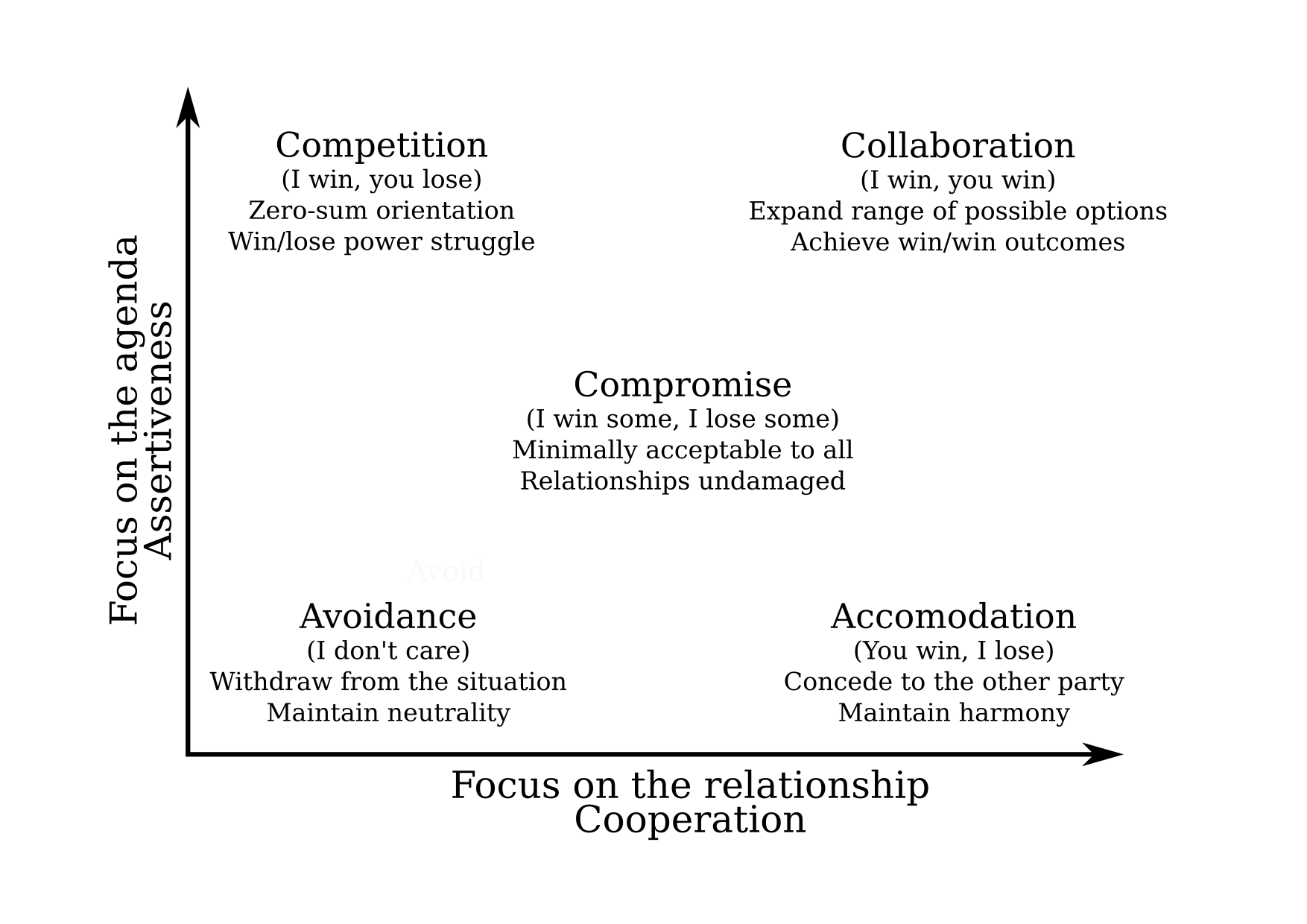
Saying "I've decided I won't do laundry anymore" when the other partner is tired, or busy doing things. Is different than saying "I've decided I won't do laundry anymore" when the other partner has a chance to say "why? tell me more" and take part in negotiation. Resources: Relationships Debian is the Universal Operating System. Debian is made and maintained by people. The long term health of debian is a consequence of the long term health of the relationship between Debian contributors. Debian doesn't need to be technically perfect, it needs to be socially healthy. Technical problems can be fixed by a healty community. graph showing relationship between avoidance, accomodation, compromise, competition, collaboration The Thomas-Kilmann Conflict Mode Instrument: source png. Motivations Quick poll: What are your motivations to be in a relationship? Which of those motivations are healthy/unhealthy? "Galadriel" (noun, by Francesca Ciceri): a task you have to do otherwise Sauron takes over Middle Earth See: http://blog.zouish.org/nonupdd/#/22/1 What motivates me to start a project or pick one up? What motivates me to keep maintaning a project? What motivates you? What's an example of a sustainable motivation? Is it really all consensual in Debian? Energy Energy that thing which is measured in spoons. The metaphore comes from people suffering with chronic health issues:
"Spoons" are a visual representation used as a unit of measure used to quantify how much energy a person has throughout a given day. Each activity requires a given number of spoons, which will only be replaced as the person "recharges" through rest. A person who runs out of spoons has no choice but to rest until their spoons are replenished.
For example, in Debian, I could spend: What is one person capable of doing? Have reasonable expectations, on others: Have reasonable expectations, on yourself: Debian is a shared responsibility When spoons are limited, what takes more energy tends not to get done As the project grows, project-wide tasks become harder Are they still humanly achievable? I don't want Debian to have positions that require hero-types to fill them Dictatorship of who has more spoons: Perfectionism You are in a relationship that is just perfect. All your friends look up to you. You give people relationship advice. You are safe in knowing that You Are Doing It Right. Then one day you have an argument in public. You don't just have to deal with the argument, but also with your reputation and self-perception shattering. One things I hate about Debian: consistent technical excellence. I don't want to be required to always be right. One of my favourite moments in the history of Debian is the openssl bug Debian doesn't need to be technically perfect, it needs to be socially healthy, technical problems can be fixed. I want to remove perfectionism from Debian: if we discover we've been wrong all the time in something important, it's not the end of Debian, it's the beginning of an improved Debian. Too good to be true There comes a point in most people's dating experience where one learns that when some things feel too good to be true, they might indeed be. There are people who cannot say no: There are people who cannot take a no: Note the diversity statement: it's not a problem to have one of those (and many other) tendencies, as long as one manages to keep interacting constructively with the rest of the community Also, it is important to be aware of these patterns, to be able to compensate for one's own tendencies. What happens when an avoidant person meets a narcissistic person, and they are both unaware of the risks? Resources: Note: there are problems with the way these resources are framed: Red flag / green flag http://pervocracy.blogspot.ca/2012/07/green-flags.html Ask for examples of red/green flags in Debian. Green flags: Red flags: Apologies / Dealing with issues I don't see the usefulness of apologies that are about accepting blame, or making a person stop complaining. I see apologies as opportunities to understand the problem I caused, help fix it, and possibly find ways of avoiding causing that problem again in the future. A Better Way to Say Sorry lists a 4 step process, which is basically what we do when in bug reports already: 1, Try to understand and reproduce the exact problem the person had. 2. Try to find the cause of the issue. 3. Try to find a solution for the issue. 4. Verify with the reporter that the solution does indeed fix the issue. This is just to say
My software ate
the files
that where in
your home directory and which
you were probably
needing
for work Forgive me
it was so quick to write
without tests
and it worked so well for me
(inspired by a 1934 poem by William Carlos Williams) Don't be afraid to fail Don't be afraid to fail or drop the ball. I think that anything that has a label attached of "if you don't do it, nobody will", shouldn't fall on anybody's shoulders and should be shared no matter what. Shared or dropped. Share the responsibility for a healthy relationship Don't expect that the more experienced mates will take care of everything. In a project with active people counted by the thousand, it's unlikely that harassment isn't happening. Is anyone writing anti-harassment? Do we have stats? Is having an email address and a CoC giving us a false sense of security?
When you get involved in a new community, such as Debian, find out early where, if that happens, you can find support, understanding, and help to make it stop. If you cannot find any, or if the only thing you can find is people who say "it never happens here", consider whether you really want to be in that community.
(from http://www.enricozini.org/blog/2016/debian/you-ll-thank-me-later/)
There are some nice people in the world. I mean nice people, the sort I couldn t describe myself as. People who are friends with everyone, who are somehow never involved in any argument, who seem content to spend their time drawing pictures of bumblebees on flowers that make everyone happy. Those people are great to have around. You want to hold onto them as much as you can. But people only have so much tolerance for jerkiness, and really nice people often have less tolerance than the rest of us. The trouble with not ejecting a jerk whether their shenanigans are deliberate or incidental is that you allow the average jerkiness of the community to rise slightly. The higher it goes, the more likely it is that those really nice people will come around less often, or stop coming around at all. That, in turn, makes the average jerkiness rise even more, which teaches the original jerk that their behavior is acceptable and makes your community more appealing to other jerks. Meanwhile, more people at the nice end of the scale are drifting away.
(from https://eev.ee/blog/2016/07/22/on-a-technicality/) Give people freedom If someone tries something in Debian, try to acknowledge and accept their work. You can give feedback on what they are doing, and try not to stand in their way, unless what they are doing is actually hurting you. In that case, try to collaborate, so that you all can get what you need. It's ok if you don't like everything that they are doing. I personally don't care if people tell me I'm good when I do something, I perceive it a bit like "good boy" or "good dog". I rather prefer if people show an interest, say "that looks useful" or "how does it work?" or "what do you need to deploy this?" Acknowledge that I've done something. I don't care if it's especially liked, give me the freedom to keep doing it. Don't give me rewards, give me space and dignity. Rather than feeding my ego, feed by freedom, and feed my possibility to create.

12 August 2017

Sam Hartman: Debian: a Commons of Innovation

I recently returned from Debconf. This year at Debconf, Matthew Garrett gave a talk about the next twenty years in free software. In his talk he raised concerns that Debian might not be relevant in that ecosystem and talked about some of the trends that contribute to his concerns.
I was talking to Marga after the talk and she said that Debian used to be a lot more innovative than it is today.
My initial reaction was doubt; what she said didn't feel right to me. At the time I didn't have a good answer. Since then I've been pondering the issue, and I think I have a partial answer to both Marga and Matthew and so I'll share it here.
In the beginning Debian focused on a lot of technical innovations related to bringing an operating system together. We didn't understand how to approach builds and build dependencies in a uniform manner. Producing packages in a clean environment was hard. We didn't understand what we wanted out of packages in terms of a uniform approach to configuration handling and upgrades. To a large extent we've solved those problems.
However, as the community has grown, our interests are more diverse. Our users and free software (and the operating system we build together) are what bring us together: we still have a central focus. However, no one technical project captures us all. There's still significant technical innovation in the Debian ecosystem. That innovation happens in Debian teams, companies and organizations that interact with the Debian community. We saw several talks about such innovation this year. I found the talk about ostree and flatpak interesting, especially because it focused on people in the broader Debian ecosystem valuing Debian along with some of the same technologies that Matthew is worried will undermine our relevance.
Matthew talked about how Debian ends up being a man-in-the-middle. We're between users and developers. we're between distributions and upstreams. Users are frustrated because we hold back the latest version of software they want from getting to them. Developers are frustrated because we present our users with old versions of their software configured not as they would like, combined with different dependencies than they expect.
All these weaknesses are real.
However, I think Debian-in-the-middle is our greatest strength both on the technical and social front.
I value Debian because I get a relatively uniform interface to the software I use. I can take one approach to reporting bugs whether they are upstream or Debian specific. I expect the software to behave in uniform ways with regard to things covered by policy. I know that I'm not going to have to configure multiple different versions of core dependencies; for the most part system services are shared. When Debian has value it's because our users want those things we provide. Debian has also reviewed every source file in the software we ship to understand the license and license compatibility. As a free software supporter and as someone who consumes software in commercial context, that value alone is enormous.
The world has evolved and we're facing technologies that provide different models. They've been coming for years: Python, Ruby, Java, Perl and others have been putting together their own commons of software. They have all been working to provide virtualization to isolate one program (and its dependencies) from another. Containerization takes that to the next level. Sometimes that's what our users want.
We haven't figured out what the balances are, how we fit into this new world. However, I disagree with the claim that we aren't even discussing the problem. I think we're trying a lot of things off in our own little technical groups. We're just getting to the level of critical mass of understanding where we can take advantage of Debian's modern form of innovation.
Because here's the thing. Debian's innovation now is social, not technical. Just as we're in the middle technically, we're in the middle socially. Upstreams, developers, users, derivatives, and all the other members of our community work together. we're a place where we can share technology, explore solutions, and pull apart common elements. This is the first Debconf where it felt like we'd explored some of these trends enough to start understanding how they might fit together in a whole. Seven years ago, it felt like we were busy being convinced the Java folks were wrong-headed. A couple of years later, it felt like we were starting to understand our users' desires that let to models different than packaging, but we didn't have any thoughts. At least in my part of the hallway it sounded like people were starting to think about how they might fit parts together and what the tradeoffs would be.
Yes, Matthew's talk doubtless sparked some of that. I think he gave us a well deserved and important wake-up call. However, I was excited by the discussion prior to Thursday.
What I'm taking a way is that Debian is valuable when there's a role in the middle. Both socially and technically we should capitalize on situations where something between makes things better and get out of the way where it does not.

1 August 2017

Russell Coker: QEMU for ARM Processes

I m currently doing some embedded work on ARM systems. Having a virtual ARM environment is of course helpful. For the i586 class embedded systems that I run it s very easy to setup a virtual environment, I just have a chroot run from systemd-nspawn with the --personality=x86 option. I run it on my laptop for my own development and on a server my client owns so that they can deal with the hit by a bus scenario. I also occasionally run KVM virtual machines to test the boot image of i586 embedded systems (they use GRUB etc and are just like any other 32bit Intel system). ARM systems have a different boot setup, there is a uBoot loader that is fairly tightly coupled with the kernel. ARM systems also tend to have more unusual hardware choices. While the i586 embedded systems I support turned out to work well with standard Debian kernels (even though the reference OS for the hardware has a custom kernel) the ARM systems need a special kernel. I spent a reasonable amount of time playing with QEMU and was unable to make it boot from a uBoot ARM image. The Google searches I performed didn t turn up anything that helped me. If anyone has good references for getting QEMU to work for an ARM system image on an AMD64 platform then please let me know in the comments. While I am currently surviving without that facility it would be a handy thing to have if it was relatively easy to do (my client isn t going to pay me to spend a week working on this and I m not inclined to devote that much of my hobby time to it). QEMU for Process Emulation I ve given up on emulating an entire system and now I m using a chroot environment with systemd-nspawn. The package qemu-user-static has staticly linked programs for emulating various CPUs on a per-process basis. You can run this as /usr/bin/qemu-arm-static ./staticly-linked-arm-program . The Debian package qemu-user-static uses the binfmt_misc support in the kernel to automatically run /usr/bin/qemu-arm-static when an ARM binary is executed. So if you have copied the image of an ARM system to /chroot/arm you can run the following commands like the following to enter the chroot: cp /usr/bin/qemu-arm-static /chroot/arm/usr/bin/qemu-arm-static
chroot /chroot/arm bin/bash Then you can create a full virtual environment with /usr/bin/systemd-nspawn -D /chroot/arm if you have systemd-container installed. Selecting the CPU Type There is a huge range of ARM CPUs with different capabilities. How this compares to the range of x86 and AMD64 CPUs depends on how you are counting (the i5 system I m using now has 76 CPU capability flags). The default CPU type for qemu-arm-static is armv7l and I need to emulate a system with a armv5tejl. Setting the environment variable QEMU_CPU=pxa250 gives me armv5tel emulation. The ARM Architecture Wikipedia page [2] says that in armv5tejl the T stands for Thumb instructions (which I don t think Debian uses), the E stands for DSP enhancements (which probably isn t relevant for me as I m only doing integer maths), the J stands for supporting special Java instructions (which I definitely don t need) and I m still trying to work out what L means (comments appreciated). So it seems clear that the armv5tel emulation provided by QEMU_CPU=pxa250 will do everything I need for building and testing ARM embedded software. The issue is how to enable it. For a user shell I can just put export QEMU_CPU=pxa250 in .login or something, but I want to emulate an entire system (cron jobs, ssh logins, etc). I ve filed Debian bug #870329 requesting a configuration file for this [1]. If I put such a configuration file in the chroot everything would work as desired. To get things working in the meantime I wrote the below wrapper for /usr/bin/qemu-arm-static that calls /usr/bin/qemu-arm-static.orig (the renamed version of the original program). It s ugly (I would use a config file if I needed to support more than one type of CPU) but it works. #include <stdio.h>
#include <unistd.h>
#include <stdlib.h> int main(int argc, char **argv)

if(setenv("QEMU_CPU", "pxa250", 1))

printf("Can't set $QEMU_CPU\n");
return 1;

execv("/usr/bin/qemu-arm-static.orig", argv);
printf("Can't execute \"%s\" because of qemu failure\n", argv[0]);
return 1;

29 July 2017

Russell Coker: Apache Mesos on Debian

I decided to try packaging Mesos for Debian/Stretch. I had a spare system with a i7-930 CPU, 48G of RAM, and SSDs to use for building. The i7-930 isn t really fast by today s standards, but 48G of RAM and SSD storage mean that overall it s a decent build system faster than most systems I run (for myself and for clients) and probably faster than most systems used by Debian Developers for build purposes. There s a github issue about the lack of an upstream package for Debian/Stretch [1]. That upstream issue could probably be worked around by adding Jessie sources to the APT sources.list file, but a package for Stretch is what is needed anyway. Here is the documentation on building for Debian [2]. The list of packages it gives as build dependencies is incomplete, it also needs zlib1g-dev libapr1-dev libcurl4-nss-dev openjdk-8-jdk maven libsasl2-dev libsvn-dev. So BUILDING this software requires Java + Maven, Ruby, and Python along with autoconf, libtool, and all the usual Unix build tools. It also requires the FPM (Fucking Package Management) tool, I take the choice of name as an indication of the professionalism of the author. Building the software on my i7 system took 79 minutes which includes 76 minutes of CPU time (I didn t use the -j option to make). At the end of the build it turned out that I had mistakenly failed to install the Fucking Package Management gem and it aborted. At this stage I gave up on Mesos, the pain involved exceeds my interest in trying it out. How to do it Better One of the aims of Free Software is that bugs are more likely to get solved if many people look at them. There aren t many people who will devote 76 minutes of CPU time on a moderately fast system to investigate a single bug. To deal with this software should be prepared as components. An example of this is the SE Linux project which has 13 source modules in the latest release [3]. Of those 13 only 5 are really required. So anyone who wants to start on SE Linux from source (without considering a distribution like Debian or Fedora that has it packaged) can build the 5 most important ones. Also anyone who has an issue with SE Linux on their system can find the one source package that is relevant and study it with a short compile time. As an aside I ve been working on SE Linux since long before it was split into so many separate source packages and know the code well, but I still find the separation convenient I rarely need to work on more than a small subset of the code at one time. The requirement of Java, Ruby, and Python to build Mesos could be partly due to language interfaces to call Mesos interfaces from Ruby and Python. Ohe solution to that is to have the C libraries and header files to call Mesos and have separate packages that depend on those libraries and headers to provide the bindings for other languages. Another solution is to have autoconf detect that some languages aren t installed and just not try to compile bindings for them (this is one of the purposes of autoconf). The use of a tool like Fucking Package Management means that you don t get help from experts in the various distributions in making better packages. When there is a FOSS project with a debian subdirectory that makes barely functional packages then you will be likely to have an experienced Debian Developer offer a patch to improve it (I ve offered patches for such things on many occasions). When there is a FOSS project that uses a tool that is never used by Debian developers (or developers of Fedora and other distributions) then the only patches you will get will be from inexperienced people. A software build process should not download anything from the Internet. The source archive should contain everything that is needed and there should be dependencies for external software. Any downloads from the Internet need to be protected from MITM attacks which means that a responsible software developer has to read through the build system and make sure that appropriate PGP signature checks etc are performed. It could be that the files that the Mesos build downloaded from the Apache site had appropriate PGP checks performed but it would take me extra time and effort to verify this and I can t distribute software without being sure of this. Also reproducible builds are one of the latest things we aim for in the Debian project, this means we can t just download files from web sites because the next build might get a different version. Finally the fpm (Fucking Package Management) tool is a Ruby Gem that has to be installed with the gem install command. Any time you specify a gem install command you should include the -v option to ensure that everyone is using the same version of that gem, otherwise there is no guarantee that people who follow your documentation will get the same results. Also a quick Google search didn t indicate whether gem install checks PGP keys or verifies data integrity in other ways. If I m going to compile software for other people to use I m concerned about getting unexpected results with such things. A Google search indicates that Ruby people were worried about such things in 2013 but doesn t indicate whether they solved the problem properly.

27 July 2017

Joachim Breitner: Coinduction in Coq and Isabelle

The DeepSpec Summer School is almost over, and I have had a few good discussions. One revolved around coinduction: What is it, how does it differ from induction, and how do you actually prove something. In the course of the discussion, I came up with a very simple coinductive exercise, and solved it both in Coq and Isabelle

The task Define the extended natural numbers coinductively. Define the min function and the relation. Show that min(n, m) n holds.

Coq The definitions are straight forward. Note that in Coq, we use the same command to define a coinductive data type and a coinductively defined relation:
CoInductive ENat :=
    N : ENat
    S : ENat -> ENat.
CoFixpoint min (n : ENat) (m : ENat)
  :=match n, m with   S n', S m' => S (min n' m')
                      _, _       => N end.
CoInductive le : ENat -> ENat -> Prop :=
    leN : forall m, le N m
    leS : forall n m, le n m -> le (S n) (S m).
The lemma is specified as
Lemma min_le: forall n m, le (min n m) n.
and the proof method of choice to show that some coinductive relation holds, is cofix. One would wish that the following proof would work:
Lemma min_le: forall n m, le (min n m) n.
Proof.
  cofix.
  destruct n, m.
  * apply leN.
  * apply leN.
  * apply leN.
  * apply leS.
    apply min_le.
Qed.
but we get the error message
Error:
In environment
min_le : forall n m : ENat, le (min n m) n
Unable to unify "le N ?M170" with "le (min N N) N
Effectively, as Coq is trying to figure out whether our proof is correct, i.e. type-checks, it stumbled on the equation min N N = N, and like a kid scared of coinduction, it did not dare to run the min function. The reason it does not just run a CoFixpoint is that doing so too daringly might simply not terminate. So, as Adam explains in a chapter of his book, Coq reduces a cofixpoint only when it is the scrutinee of a match statement. So we need to get a match statement in place. We can do so with a helper function:
Definition evalN (n : ENat) :=
  match n with   N => N
                 S n => S n end.
Lemma evalN_eq : forall n, evalN n = n.
Proof. intros. destruct n; reflexivity. Qed.
This function does not really do anything besides nudging Coq to actually evaluate its argument to a constructor (N or S _). We can use it in the proof to guide Coq, and the following goes through:
Lemma min_le: forall n m, le (min n m) n.
Proof.
  cofix.
  destruct n, m; rewrite <- evalN_eq with (n := min _ _).
  * apply leN.
  * apply leN.
  * apply leN.
  * apply leS.
    apply min_le.
Qed.

Isabelle In Isabelle, definitions and types are very different things, so we use different commands to define ENat and le:
theory ENat imports  Main begin
codatatype ENat =  N   S  ENat
primcorec min where
   "min n m = (case n of
       N   N
       S n'   (case m of
        N   N
        S m'   S (min n' m')))"
coinductive le where
  leN: "le N m"
  leS: "le n m   le (S n) (S m)"
There are actually many ways of defining min; I chose the one most similar to the one above. For more details, see the corec tutorial. Now to the proof:
lemma min_le: "le (min n m) n"
proof (coinduction arbitrary: n m)
  case le
  show ?case
  proof(cases n)
    case N then show ?thesis by simp
  next
    case (S n') then show ?thesis
    proof(cases m)
      case N then show ?thesis by simp
    next
      case (S m')  with  n = _  show ?thesis
        unfolding min.code[where n = n and m = m]
        by auto
    qed
  qed
qed
The coinduction proof methods produces this goal:
proof (state)
goal (1 subgoal):
 1.  n m. ( m'. min n m = N   n = m')  
          ( n' m'.
               min n m = S n'  
               n = S m'  
	       (( n m. n' = min n m   m' = n)   le n' m'))
I chose to spell the proof out in the Isar proof language, where the outermost proof structure is done relatively explicity, and I proceed by case analysis mimiking the min function definition. In the cases where one argument of min is N, Isabelle s simplifier (a term rewriting tactic, so to say), can solve the goal automatically. This is because the primcorec command produces a bunch of lemmas, one of which states n = N m = N min n m = N. In the other case, we need to help Isabelle a bit to reduce the call to min (S n) (S m) using the unfolding methods, where min.code contains exactly the equation that we used to specify min. Using just unfolding min.code would send this method into a loop, so we restrict it to the concrete arguments n and m. Then auto can solve the remaining goal (despite all the existential quantifiers).

Summary Both theorem provers are able to prove the desired result. To me it seems that it is slightly more convenient in Isabelle because a lot of Coq infrastructure relies on the type checker being able to effectively evaluate expressions, which is tricky with cofixpoints, wheras evaluation plays a much less central role in Isabelle, where rewriting is the crucial technique, and while one still cannot simply throw min.code into the simpset, so working with objects that do not evaluate easily or completely is less strange.

Agda I was challenged to do it in Agda. Here it is:
module ENat where
open import Coinduction
data ENat : Set where
  N : ENat
  S :   ENat   ENat
min : ENat   ENat   ENat
min (S n') (S m') = S (  (min (  n') (  m')))
min _ _ = N
data le : ENat   ENat   Set where
  leN :    m    le N m
  leS :    n m      (le (  n) (  m))   le (S n) (S m)
min_le :    n m    le (min n m) n
min_le  S n'   S m'  = leS (  min_le)
min_le  N      S m'  = leN
min_le  S n'   N  = leN
min_le  N      N  = leN
I will refrain from commenting it, because I do not really know what I have been doing here, but it typechecks, and refer you to the official documentation on coinduction in Agda. But let me note that I wrote this using plain inductive types and recursion, and added , and until it worked.

18 July 2017

Matthew Garrett: Avoiding TPM PCR fragility using Secure Boot

In measured boot, each component of the boot process is "measured" (ie, hashed and that hash recorded) in a register in the Trusted Platform Module (TPM) build into the system. The TPM has several different registers (Platform Configuration Registers, or PCRs) which are typically used for different purposes - for instance, PCR0 contains measurements of various system firmware components, PCR2 contains any option ROMs, PCR4 contains information about the partition table and the bootloader. The allocation of these is defined by the PC Client working group of the Trusted Computing Group. However, once the boot loader takes over, we're outside the spec[1].

One important thing to note here is that the TPM doesn't actually have any ability to directly interfere with the boot process. If you try to boot modified code on a system, the TPM will contain different measurements but boot will still succeed. What the TPM can do is refuse to hand over secrets unless the measurements are correct. This allows for configurations where your disk encryption key can be stored in the TPM and then handed over automatically if the measurements are unaltered. If anybody interferes with your boot process then the measurements will be different, the TPM will refuse to hand over the key, your disk will remain encrypted and whoever's trying to compromise your machine will be sad.

The problem here is that a lot of things can affect the measurements. Upgrading your bootloader or kernel will do so. At that point if you reboot your disk fails to unlock and you become unhappy. To get around this your update system needs to notice that a new component is about to be installed, generate the new expected hashes and re-seal the secret to the TPM using the new hashes. If there are several different points in the update where this can happen, this can quite easily go wrong. And if it goes wrong, you're back to being unhappy.

Is there a way to improve this? Surprisingly, the answer is "yes" and the people to thank are Microsoft. Appendix A of a basically entirely unrelated spec defines a mechanism for storing the UEFI Secure Boot policy and used keys in PCR 7 of the TPM. The idea here is that you trust your OS vendor (since otherwise they could just backdoor your system anyway), so anything signed by your OS vendor is acceptable. If someone tries to boot something signed by a different vendor then PCR 7 will be different. If someone disables secure boot, PCR 7 will be different. If you upgrade your bootloader or kernel, PCR 7 will be the same. This simplifies things significantly.

I've put together a (not well-tested) patchset for Shim that adds support for including Shim's measurements in PCR 7. In conjunction with appropriate firmware, it should then be straightforward to seal secrets to PCR 7 and not worry about things breaking over system updates. This makes tying things like disk encryption keys to the TPM much more reasonable.

However, there's still one pretty major problem, which is that the initramfs (ie, the component responsible for setting up the disk encryption in the first place) isn't signed and isn't included in PCR 7[2]. An attacker can simply modify it to stash any TPM-backed secrets or mount the encrypted filesystem and then drop to a root prompt. This, uh, reduces the utility of the entire exercise.

The simplest solution to this that I've come up with depends on how Linux implements initramfs files. In its simplest form, an initramfs is just a cpio archive. In its slightly more complicated form, it's a compressed cpio archive. And in its peak form of evolution, it's a series of compressed cpio archives concatenated together. As the kernel reads each one in turn, it extracts it over the previous ones. That means that any files in the final archive will overwrite files of the same name in previous archives.

My proposal is to generate a small initramfs whose sole job is to get secrets from the TPM and stash them in the kernel keyring, and then measure an additional value into PCR 7 in order to ensure that the secrets can't be obtained again. Later disk encryption setup will then be able to set up dm-crypt using the secret already stored within the kernel. This small initramfs will be built into the signed kernel image, and the bootloader will be responsible for appending it to the end of any user-provided initramfs. This means that the TPM will only grant access to the secrets while trustworthy code is running - once the secret is in the kernel it will only be available for in-kernel use, and once PCR 7 has been modified the TPM won't give it to anyone else. A similar approach for some kernel command-line arguments (the kernel, module-init-tools and systemd all interpret the kernel command line left-to-right, with later arguments overriding earlier ones) would make it possible to ensure that certain kernel configuration options (such as the iommu) weren't overridable by an attacker.

There's obviously a few things that have to be done here (standardise how to embed such an initramfs in the kernel image, ensure that luks knows how to use the kernel keyring, teach all relevant bootloaders how to handle these images), but overall this should make it practical to use PCR 7 as a mechanism for supporting TPM-backed disk encryption secrets on Linux without introducing a hug support burden in the process.

[1] The patchset I've posted to add measured boot support to Grub use PCRs 8 and 9 to measure various components during the boot process, but other bootloaders may have different policies.

[2] This is because most Linux systems generate the initramfs locally rather than shipping it pre-built. It may also get rebuilt on various userspace updates, even if the kernel hasn't changed. Including it in PCR 7 would entirely break the fragility guarantees and defeat the point of all of this.

comment count unavailable comments

15 July 2017

Joey Hess: Functional Reactive Propellor

I wrote this code, and it made me super happy!
data Variety = Installer   Target
    deriving (Eq)
seed :: UserInput -> Versioned Variety Host
seed userinput ver = host "foo"
    & ver (   (== Installer) --> hostname "installer"
          < > (== Target)    --> hostname (inputHostname userinput)
          )
    & osDebian Unstable X86_64
    & Apt.stdSourcesList
    & Apt.installed ["linux-image-amd64"]
    & Grub.installed PC
    & XFCE.installed
    & ver (   (== Installer) --> desktopUser defaultUser
          < > (== Target)    --> desktopUser (inputUsername userinput)
          )
    & ver (   (== Installer) --> autostartInstaller )
This is doing so much in so little space and with so little fuss! It's completely defining two different versions of a Host. One version is the Installer, which in turn installs the Target. The code above provides all the information that propellor needs to convert a copy of the Installer into the Target, which it can do very efficiently. For example, it knows that the default user account should be deleted, and a new user account created based on the user's input of their name. The germ of this idea comes from a short presentation I made about propellor in Portland several years ago. I was describing RevertableProperty, and Joachim Breitner pointed out that to use it, the user essentially has to keep track of the evolution of their Host in their head. It would be better for propellor to know what past versions looked like, so it can know when a RevertableProperty needs to be reverted. I didn't see a way to address the objection for years. I was hung up on the problem that propellor's properties can't be compared for equality, because functions can't be compared for equality (generally). And on the problem that it would be hard for propellor to pull old versions of a Host out of git. But then I ran into the situation where I needed these two closely related hosts to be defined in a single file, and it all fell into place. The basic idea is that propellor first reverts all the revertible properties for other versions. Then it ensures the property for the current version. Another use for it would be if you wanted to be able to roll back changes to a Host. For example:
foos :: Versioned Int Host
foos ver = host "foo"
    & hostname "foo.example.com"
    & ver (   (== 1) --> Apache.modEnabled "mpm_worker"
          < > (>= 2) --> Apache.modEnabled "mpm_event"
          )
    & ver ( (>= 3)   --> Apt.unattendedUpgrades )
foo :: Host
foo = foos  version  (4 :: Int)
Versioned properties can also be defined:
foobar :: Versioned Int -> RevertableProperty DebianLike DebianLike
foobar ver =
    ver (   (== 1) --> (Apt.installed "foo" <!> Apt.removed "foo")
        < > (== 2) --> (Apt.installed "bar" <!> Apt.removed "bar")
        )
Notice that I've embedded a small DSL for versioning into the propellor config file syntax. While implementing versioning took all day, that part was super easy; Haskell config files win again! API documentation for this feature PS: Not really FRP, probably. But time-varying in a FRP-like way.
Development of this was sponsored by Jake Vosloo on Patreon.

Next.

Previous.