Emanuele Rocca: Murder Mystery: GCC Builds Failing After sbuild Refactoring
This is the story of an investigation conducted by Jochen Sprickerhof, Helmut
Grohne, and myself. It was true teamwork, and we would have not reached the
bottom of the issue working individually. We think you will find it as
interesting and fun as we did, so here is a brief writeup. A few of the steps
mentioned here took several days, others just a few minutes. What is described
as a natural progression of events did not always look very obvious at the
moment at all.
Let us go through the Six Stages of Debugging together.
Stage 1: That cannot happen
Official Debian GCC builds start failing on multiple architectures in late
November.
The build error happens on the build servers when running the testuite, but we
know this cannot happen. GCC builds are not meant to fail in case of testsuite
failures! Return codes are not making the build fail, make is being called
with -k, it just cannot happen.
A lot of the GCC tests are always failing in fact, and an extensive log of
the results is posted to the debian-gcc
mailing list, but the packages always build fine regardless.
On the build daemons,
build
failures take several hours.
Official Debian GCC builds start failing on multiple architectures in late
November.
The build error happens on the build servers when running the testuite, but we
know this cannot happen. GCC builds are not meant to fail in case of testsuite
failures! Return codes are not making the build fail,
make is being called
with -k, it just cannot happen.
A lot of the GCC tests are always failing in fact, and an extensive log of
the results is posted to the debian-gcc
mailing list, but the packages always build fine regardless.
On the build daemons,
build
failures take several hours.
Stage 2: That does not happen on my machine
Building on my machine running Bookworm is just fine. The Build Daemons run
Bookworm and use a Sid chroot for the build environment, just like I am. Same
kernel.
Debian packages are built by a network of
autobuilding machines using a program called
sbuild. In my last blog post
I
mentioned the transition from the schroot backend to a new one based on
unshare.
The only obvious difference between my setup and the Debian buildds is that I
am using sbuild 0.85.0 from bookworm, and the buildds have 0.86.3~bpo12+1
from bookworm-backports. Trying again with 0.86.3~bpo12+1, the build fails on
my system too. The build daemons were updated to the bookworm-backports version
of sbuild at some point in late November. Ha.
Stage 3: That should not happen
There are quite a few sbuild versions in between 0.85.0 and 0.86.3~bpo12+1,
but looking at recent sbuild bugs shows that
sbuild 0.86.0 was
breaking "quite a number of packages". Indeed, with 0.86.0 the build still
fails. Trying the version immediately before, 0.85.11, the build finishes
correctly. This took more time than it sounds, one run including the tests
takes several hours. We need a way to shorten this somehow.
The Debian packaging of GCC allows to specify which languages you may want to
skip, and by default it builds Ada, Go, C, C++, D, Fortran, Objective
C, Objective C++, M2, and Rust. When running the tests sequentially,
the build logs stop roughly around the tests of a runtime library for D,
libphobos. So can we still reproduce the failure by skipping everything except
for D? With
DEB_BUILD_OPTIONS=nolang=ada,go,c,c++,fortran,objc,obj-c++,m2,rust
the build still fails, and it fails faster than before. Several minutes, not
hours. This is progress, and time to file a bug. The report contains massive
spoilers, so no link. :-)
Stage 4: Why does that happen?
Something is causing the build to end prematurely. It s not the OOM killer, and
the kernel does not have anything useful to say in the logs. Can it be that the
D language tests are sending signals to some process, and that is what s
killing make ? We start tracing signals sent with bpftrace by writing the
following script, signals.bt:
tracepoint:signal:signal_generate
    printf("%s PID %d (%s) sent signal %d to PID %d\n", comm, pid, args->sig, args->pid);
And executing it with sudo bpftrace signals.bt.
The build takes its sweet time, and it fails. Looking at the trace output
there s a suspicious process.exe terminating stuff.
process.exe (PID: 2868133) sent signal 15 to PID 711826
That looks interesting, but we have no clue what PID 711826 may be. Let s change
the script a bit, and trace signals received as well.
tracepoint:signal:signal_generate
    printf("PID %d (%s) sent signal %d to %d\n", pid, comm, args->sig, args->pid);

tracepoint:signal:signal_deliver
    printf("PID %d (%s) received signal %d\n", pid, comm, args->sig);
The working version of sbuild was using dumb-init, whereas the new one
features
a
little init in perl. We patch the current version of sbuild by making it use
dumb-init instead, and trace two builds: one with the perl init, one with
dumb-init.
Here are the signals observed when building with dumb-init.
PID 3590011 (process.exe) sent signal 2 to 3590014
PID 3590014 (sleep) received signal 9
PID 3590011 (process.exe) sent signal 15 to 3590063
PID 3590063 (std.process tem) received signal 9
PID 3590011 (process.exe) sent signal 9 to 3590065
PID 3590065 (std.process tem) received signal 9
And this is what happens with the new init in perl:
PID 3589274 (process.exe) sent signal 2 to 3589291
PID 3589291 (sleep) received signal 9
PID 3589274 (process.exe) sent signal 15 to 3589338
PID 3589338 (std.process tem) received signal 9
PID 3589274 (process.exe) sent signal 9 to 3589340
PID 3589340 (std.process tem) received signal 9
PID 3589274 (process.exe) sent signal 15 to 3589341
PID 3589274 (process.exe) sent signal 15 to 3589323
PID 3589274 (process.exe) sent signal 15 to 3589320
PID 3589274 (process.exe) sent signal 15 to 3589274
PID 3589274 (process.exe) received signal 9
PID 3589341 (sleep) received signal 9
PID 3589273 (sbuild-usernsex) sent signal 9 to 3589320
PID 3589273 (sbuild-usernsex) sent signal 9 to 3589323
There are a few additional SIGTERM being sent when using the perl init, that s
helpful. At this point we are fairly convinced that process.exe is worth
additional inspection. The
source
code of process.d shows something interesting:
1221 @system unittest
1222
[...]
1247     auto pid = spawnProcess(["sleep", "10000"],
[...]
1260     // kill the spawned process with SIGINT
1261     // and send its return code
1262     spawn((shared Pid pid)
1263         auto p = cast() pid;
1264         kill(p, SIGINT);
So yes, there s our sleep and the SIGINT (signal 2) right in the unit tests
of process.d, just like we have observed in the bpftrace output.
Can we study the behavior of process.exe in isolation, separatedly from the
build? Indeed we can. Let s take the executable from a failed build, and try
running it under /usr/libexec/sbuild-usernsexec.
First, we prepare a chroot inside a suitable user namespace:
unshare --map-auto --setuid 0 --setgid 0 mkdir /tmp/rootfs
cd /tmp/rootfs
cat /home/ema/.cache/sbuild/unstable-arm64.tar   unshare --map-auto --setuid 0 --setgid 0 tar xf  -
unshare --map-auto --setuid 0 --setgid 0 mkdir /tmp/rootfs/whatever
unshare --map-auto --setuid 0 --setgid 0 cp process.exe /tmp/rootfs/
Now we can run process.exe on its own using the perl init, and trace signals at will:
/usr/libexec/sbuild-usernsexec --pivotroot --nonet u:0:100000:65536 g:0:100000:65536 /tmp/rootfs ema /whatever -- /process.exe
We can compare the behavior of the perl init vis-a-vis the one using
dumb-init in milliseconds instead of minutes.
Something is causing the build to end prematurely. It s not the OOM killer, and
the kernel does not have anything useful to say in the logs. Can it be that the
D language tests are sending signals to some process, and that is what s
killing
make ? We start tracing signals sent with bpftrace by writing the
following script, signals.bt:
tracepoint:signal:signal_generate
printf("%s PID %d (%s) sent signal %d to PID %d\n", comm, pid, args->sig, args->pid);
And executing it with
sudo bpftrace signals.bt.
The build takes its sweet time, and it fails. Looking at the trace output
there s a suspicious
process.exe terminating stuff.
process.exe (PID: 2868133) sent signal 15 to PID 711826
That looks interesting, but we have no clue what PID 711826 may be. Let s change
the script a bit, and trace signals received as well.
tracepoint:signal:signal_generate
printf("PID %d (%s) sent signal %d to %d\n", pid, comm, args->sig, args->pid);
tracepoint:signal:signal_deliver
printf("PID %d (%s) received signal %d\n", pid, comm, args->sig);
The working version of sbuild was using
dumb-init, whereas the new one
features
a
little init in perl. We patch the current version of sbuild by making it use
dumb-init instead, and trace two builds: one with the perl init, one with
dumb-init.
Here are the signals observed when building with
dumb-init.
PID 3590011 (process.exe) sent signal 2 to 3590014 PID 3590014 (sleep) received signal 9 PID 3590011 (process.exe) sent signal 15 to 3590063 PID 3590063 (std.process tem) received signal 9 PID 3590011 (process.exe) sent signal 9 to 3590065 PID 3590065 (std.process tem) received signal 9
And this is what happens with the new init in perl:
PID 3589274 (process.exe) sent signal 2 to 3589291 PID 3589291 (sleep) received signal 9 PID 3589274 (process.exe) sent signal 15 to 3589338 PID 3589338 (std.process tem) received signal 9 PID 3589274 (process.exe) sent signal 9 to 3589340 PID 3589340 (std.process tem) received signal 9 PID 3589274 (process.exe) sent signal 15 to 3589341 PID 3589274 (process.exe) sent signal 15 to 3589323 PID 3589274 (process.exe) sent signal 15 to 3589320 PID 3589274 (process.exe) sent signal 15 to 3589274 PID 3589274 (process.exe) received signal 9 PID 3589341 (sleep) received signal 9 PID 3589273 (sbuild-usernsex) sent signal 9 to 3589320 PID 3589273 (sbuild-usernsex) sent signal 9 to 3589323
There are a few additional SIGTERM being sent when using the perl init, that s
helpful. At this point we are fairly convinced that
process.exe is worth
additional inspection. The
source
code of process.d shows something interesting:
1221 @system unittest 1222 [...] 1247 auto pid = spawnProcess(["sleep", "10000"], [...] 1260 // kill the spawned process with SIGINT 1261 // and send its return code 1262 spawn((shared Pid pid) 1263 auto p = cast() pid; 1264 kill(p, SIGINT);
So yes, there s our
sleep and the SIGINT (signal 2) right in the unit tests
of process.d, just like we have observed in the bpftrace output.
Can we study the behavior of
process.exe in isolation, separatedly from the
build? Indeed we can. Let s take the executable from a failed build, and try
running it under /usr/libexec/sbuild-usernsexec.
First, we prepare a chroot inside a suitable user namespace:
unshare --map-auto --setuid 0 --setgid 0 mkdir /tmp/rootfs cd /tmp/rootfs cat /home/ema/.cache/sbuild/unstable-arm64.tar unshare --map-auto --setuid 0 --setgid 0 tar xf - unshare --map-auto --setuid 0 --setgid 0 mkdir /tmp/rootfs/whatever unshare --map-auto --setuid 0 --setgid 0 cp process.exe /tmp/rootfs/
Now we can run
process.exe on its own using the perl init, and trace signals at will:
/usr/libexec/sbuild-usernsexec --pivotroot --nonet u:0:100000:65536 g:0:100000:65536 /tmp/rootfs ema /whatever -- /process.exe
We can compare the behavior of the perl init vis-a-vis the one using
dumb-init in milliseconds instead of minutes.
Stage 5: Oh, I see.
Why does process.exe send more SIGTERMs when using the perl init is now the
big question. We have a simple reproducer, so this is where using strace
becomes possible.
sudo strace --user ema --follow-forks -o sbuild-dumb-init.strace ./sbuild-usernsexec-dumb-init --pivotroot --nonet u:0:100000:65536 g:0:100000:65536 /tmp/dumbroot ema /whatever -- /process.exe
We start comparing the
strace output of dumb-init with
that of perl-init,
looking in particular for different calls to kill.
Here is what process.exe does under dumb-init:
3593883 kill(-2, SIGTERM) = -1 ESRCH (No such process)
No such process. Under perl-init instead:
3593777 kill(-2, SIGTERM <unfinished ...>
The process is there under perl-init!
That is a kill with negative pid. From the kill(2) man page:
If pid is less than -1, then sig is sent to every process in the process group whose ID is -pid.
It would have been very useful to see this kill with negative pid in the
output of bpftrace, why didn t we? The tracepoint used,
tracepoint:signal:signal_generate, shows when signals are actually being
sent, and not the syscall being called. To confirm, one can trace
tracepoint:syscalls:sys_enter_kill and see the negative PIDs, for example:
PID 312719 (bash) sent signal 2 to -312728
The obvious question at this point is: why is there no process group 2 when
using dumb-init?
Why does
process.exe send more SIGTERMs when using the perl init is now the
big question. We have a simple reproducer, so this is where using strace
becomes possible.
sudo strace --user ema --follow-forks -o sbuild-dumb-init.strace ./sbuild-usernsexec-dumb-init --pivotroot --nonet u:0:100000:65536 g:0:100000:65536 /tmp/dumbroot ema /whatever -- /process.exe
We start comparing the
strace output of dumb-init with
that of perl-init,
looking in particular for different calls to
kill.
Here is what
process.exe does under dumb-init:
3593883 kill(-2, SIGTERM) = -1 ESRCH (No such process)
No such process. Under
perl-init instead:
3593777 kill(-2, SIGTERM <unfinished ...>
The process is there under
perl-init!
That is a kill with negative pid. From the
kill(2) man page:
If pid is less than -1, then sig is sent to every process in the process group whose ID is -pid.
It would have been very useful to see this kill with negative pid in the
output of bpftrace, why didn t we? The tracepoint used,
tracepoint:signal:signal_generate, shows when signals are actually being
sent, and not the syscall being called. To confirm, one can trace
tracepoint:syscalls:sys_enter_kill and see the negative PIDs, for example:
PID 312719 (bash) sent signal 2 to -312728
The obvious question at this point is: why is there no process group 2 when
using
dumb-init?
Stage 6: How did that ever work?
We know that process.exe sends a SIGTERM to every process in the process
group with ID 2. To find out what this process group may be, we spawn a shell
with dumb-init and observe under /proc PIDs 1, 16, and 17. With perl-init
we have 1, 2, and 17. When running dumb-init, there are a few forks before
launching the program, explaining the difference. Looking at /proc/2/cmdline
we see that it s bash, ie. the program we are running under perl-init. When
building a package, that is dpkg-buildpackage itself.
The test is accidentally killing its own process group.
Now where does this -2 come from in the test?
2363     // Special values for _processID.
2364     enum invalid = -1, terminated = -2;
Oh. -2 is used as a special value for PID, meaning "terminated". And there s a
call to kill() later on:
2694     do   s = tryWait(pid);   while (!s.terminated);
[...]
2697     assertThrown!ProcessException(kill(pid));
What sets pid to terminated you ask?
Here is tryWait:
2568 auto tryWait(Pid pid) @safe
2569
2570     import std.typecons : Tuple;
2571     assert(pid !is null, "Called tryWait on a null Pid.");
2572     auto code = pid.performWait(false);
And performWait:
2306 _processID = terminated;
The solution, dear reader, is not to kill.
PS: the bug report with spoilers for those interested is
#1089007.
We know that
process.exe sends a SIGTERM to every process in the process
group with ID 2. To find out what this process group may be, we spawn a shell
with dumb-init and observe under /proc PIDs 1, 16, and 17. With perl-init
we have 1, 2, and 17. When running dumb-init, there are a few forks before
launching the program, explaining the difference. Looking at /proc/2/cmdline
we see that it s bash, ie. the program we are running under perl-init. When
building a package, that is dpkg-buildpackage itself.
The test is accidentally killing its own process group.
Now where does this
-2 come from in the test?
2363 // Special values for _processID. 2364 enum invalid = -1, terminated = -2;
Oh. -2 is used as a special value for PID, meaning "terminated". And there s a
call to kill() later on:
2694 do s = tryWait(pid); while (!s.terminated); [...] 2697 assertThrown!ProcessException(kill(pid));
What sets
pid to terminated you ask?
Here is
tryWait:
2568 auto tryWait(Pid pid) @safe 2569 2570 import std.typecons : Tuple; 2571 assert(pid !is null, "Called tryWait on a null Pid."); 2572 auto code = pid.performWait(false);
And
performWait:
2306 _processID = terminated;
The solution, dear reader, is not to kill.
PS: the bug report with spoilers for those interested is
#1089007.

 Like each month, have a look at the work funded by
 The distinction between hardware and software has historically been relatively easy to understand - hardware is the physical object that software runs on. This is made more complicated by the existence of programmable logic like FPGAs, but by and large things tend to fall into fairly neat categories if we're drawing that distinction.

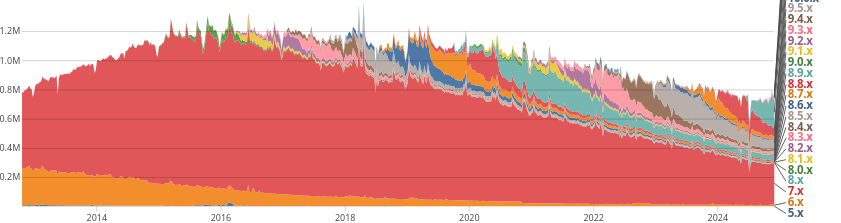 This graph is disgregated into minor versions, and I don t want to come up with
yet another graph for it but it supports (most of) the narrative I presented
above although I do miss the recent drop builtwith reported in D7 s
numbers!


 Most of my Debian contributions this month were
 For the past decade-plus, every piece of software I write has had one of two release processes.
Software that gets deployed directly onto servers (websites, mostly, but also the infrastructure that runs