Search Results: "daniel"

13 February 2015

Neil Williams: OpenTAC mailing list

After the OpenTAC session at Linaro Connect, we do now have a mailing list to support any and all discussions related to OpenTAC. Thanks to Daniel Silverstone for the list. List archive: http://listmaster.pepperfish.net/pipermail/opentac-vero-apparatus.com More information on OpenTAC: http://wiki.vero-apparatus.com/OpenTAC

12 February 2015

Daniel Leidert: Setting up a network buildd with pbuilder ... continued

Last year I'd described my setup of a local network-buildd using pbuilder, ccache, inoticoming and NFS. One then-still-open goal was to support different Debian releases. This is especially necessary for backports of e.g. bluefish. The rules to contribute backports require to include all changelog entries since the last version on debian-backports or since stable if it's the first version in an uploaded package. Therefor one needs to know the last version in e.g. wheezy-backports. Because I'm not typing the command (the source package only gets uploaded and inoticoming starts the build process) I was looking for a way to automatically retrieve that version and add the relevant -vX.Y-Z switch to dpkg-buildpackage.The solution I found requires aptitude and a sources.list entry for the relevant release. If you are only interested in the solution, just jump to the end :)I'm going to add the version switch to the DEBBUILDOPTS variable of pbuilder. In my setup I have a common (shared) snippet called /etc/pbuilderrc.inc and one configuration file per release and architecture, say /etc/pbuilderrc.amd64.stable. Now the first already contains ...
DEBBUILDOPTS="-us -uc -j2"
... and DEBBUILDOPTS can be extended in the latter:
DEBBUILDOPTS+="..."
Because the config file is parsed pretty early in the process the package name has not yet been assigned to any variable. The last argument to pbuilder is the .dsc file. So I use the last argument and parse the file to retrieve the source package name.
cat $ @: -1    grep -e ^Source   awk -F\  '  print $2  '
The solution above works, because pbuilder is a BASH script. Otherwise it maybe needs some tweaking. I use the source package name, because it is unique and there is just one :) Now with this name I check for all versions in wheezy* and stable* and sort them. The sort order of aptitude is from low to high, so the last line shopuld contain the highest version. This covers the possibility that there has not yet been a backport or that there is one:
aptitude versions -F '%p' --show-package-names=never --group-by=none --sort=version \
"?narrow(?source-package(^PACKAGE\$), ?or(?archive(^wheezy.*), ?archive(^stable.*)))" \
tail -n 1 sed -e 's#~bpo.*$##g'
The sed-part is necessary because otherwise dh_genchanges will add a superfluous changelog entry (the last one of the last upload). To make things easier, I assign the name and version to variables. So this is the complete solution:

[..]
MYPACKAGE=" cat $ @: -1 grep -e ^Source awk -F\ ' print $2 ' "
MYBPOVERS=" aptitude versions -F '%p' --show-package-names=never --group-by=none --sort=version "?narrow(?source-package(^$MYPACKAGE\$), ?or(?archive(^wheezy.*), ?archive(^stable.*)))" tail -n 1 sed -e 's#~bpo.*$##g' "

log "I: Package is $MYPACKAGE and last stable/bpo version is $MYBPOVERS"

DEBBUILDOPTS+=" -v$MYBPOVERS"
[..]
ExamplesI've recently built a new bluefish backport. The last backport version is 2.2.6-1~bpo70+1. There is also the stable version 2.2.3-4. So the version I need is 2.2.6-1 (2.2.6-1~bpo70+1 < 2.2.6-1!!). Checking the log it works:
I: Package is bluefish and last stable/bpo version is 2.2.6-1
A different example is rsync. I've recently locally rebuilt it for a stable system (wanted to make use of the --chown switch). There is not yet a backport. So the version I (would) need is 3.0.9-4. Checking the logs again and works too:
I: Package is rsync and last stable/bpo version is 3.0.9-4
Feedback appreciated ... Links

11 February 2015

Daniel Leidert: Blogger RSS feed and category URLs with combined labels/tags

Run a blog on blogger.com? Maybe made it bilingual? Maybe blog on different topics? Wondering how the URL for an RSS feed for e.g. two labels looks like? Asking how to see all articles matching two tags (labels)? Finding a keyword under one or more labels? Many things are possible. I'll show a few examples below. Maybe that is even interesting for the planet Debian folks. I happen to blog mostly in English about Debian topics. But sometimes I also want to post something in German only (e.g. about German tax software). It is discouraged to put the latter on planet-debian. Instead it can be published in the language specific planet feed. So instead of adding new tags, one could easily combine two labels: the one for language of the feed and the one for Debian related posts (e.g. debian+english or debian+german). Therefor this post goes to the Debian planet. Search for combbined labels/tagsSay I want to view all postings related to the topics FOO and BAR. Then it is:

http://domain.tld/search/label/FOO+BAR OR
http://domain.tld/search/?q=label:FOO+label:BAR
Be aware that labels are case sensitive and that more labels can be added. The examples below will show all postings related to the topics debian and n54l and xbmc:

http://www.wgdd.de/search/label/debian+n54l+xbmc
http://www.wgdd.de/search/?q=label:debian+label:n54l+label:xbmc
It is also possible to search for all posts related to the topics FOO or BAR:

http://domain.tld/search/?q=label:FOO label:BAR
Say for example, you want to see all postings related to the topics logitech or toshiba, then it is:

http://www.wgdd.de/search/?q=label:logitech label:toshiba
Feed URLsTo get back to the first example lets say, the feed shall contain all posts related to the topics FOO and BAR. Then it is:

http://domain.tld/feeds/posts/default/-/FOO/BAR/ OR
http://domain.tld/feeds/posts/default?q=label:FOO+label:BAR
Respecitvely to show all feeds related to either of those topics use:

http://domain.tld/feeds/posts/default/?q=label:FOO label:BAR
To get a feed of the example topics as shown above then would be:

http://www.wgdd.de/feeds/posts/default/-/debian/n54l/xbmc/
http://www.wgdd.de/feeds/posts/default?q=label:debian+label:n54l+label:xbmc
http://www.wgdd.de/feeds/posts/default?q=label:logitech label:toshiba
Coming back to planet Debian, below is a solution for a multi-lingual planet contribution (if both planets would exist):

http://www.wgdd.de/feeds/posts/default?q=label:planet-debian+label:english
http://www.wgdd.de/feeds/posts/default?q=label:planet-debian+label:german
Advanced ...There is much more possible. I'll just show two more examples. AND and OR can be combined ...
http://www.wgdd.de/feeds/posts/default?q=label:debian+(label:logitech label:toshiba)
... and a keyword search can be added too:
http://www.wgdd.de/feeds/posts/default?q=stick+(label:debian+(label:logitech label:toshiba))
Links

Daniel Leidert: Issues with Server4You vServer running Debian Stable (Wheezy)

I recently acquired a vServer hosted by Server4You and decided to install a Debian Wheezy image. Usually I boot any device in backup mode and first install a fresh Debian copy using debootstrap over the provided image, to have a clean system. In this case I did not and I came across a few glitches I want to talk about. So hopefully, if you are running the same system image, it saves you some time to figure out, why the h*ll some things don't work as expected :) Cron jobs not runningI installed unattended-upgrades and adjusted all configuration files to enable unattended upgrades. But I never received any mail about an update although looking at the system, I saw updates waiting. I checked with
# run-parts --list /etc/cron.daily
and apt was not listed although /etc/cron.daily/apt was there. After spending some time to figure out, what was going on, I found the rather simple cause: Several scripts were missing the executable bit, thus did not run. So it seems, for whatever reason, the image authors have tempered with file permissions and of course, not by using dpkg-statoverride :( It was easy to fix the file permissions for everything beyond /etc/cron*, but that still leaves a very bad feeling, that there are more files that have been tempered with! I'm not speaking about customizations. That are easy to find using debsums. I'm speaking about file permissions and ownership.Now there seems no easy way to either check for changed permissions or ownership. The only solution I found is to get a list of all installed packages on the system, install them into a chroot environment and get all permission and ownership information from this very fresh system. Then compare file permissions/ownership of the installed system with this list. Not fun. init from testing / upstart on holdToday I've discovered, that apt-get wanted to update the init package. Of course I was curious, why unattended-upgrades didn't yet already do so. Turns out, init is only in testing/unstable and essential there. I purged it, but apt-get keeps bugging me to update/install this package. I really began to wonder, what is going on here, because this is a plain stable system:
  • no sources listed for backports, volatile, multimedia etc.
  • sources listed for testing and unstable
  • only packages from stable/stable-updates installed
  • sets APT::Default-Release "stable";
First I checked with aptitude:
# aptitude why init
Unable to find a reason to install init.
Ok, so why:
# apt-get dist-upgrade -u
Reading package lists... Done
Building dependency tree
Reading state information... Done
Calculating upgrade... Done
The following NEW packages will be installed:
init
0 upgraded, 1 newly installed, 0 to remove and 0 not upgraded.
Need to get 0 B/4674 B of archives.
After this operation, 29.7 kB of additional disk space will be used.
Do you want to continue [Y/n]?
JFTR: I see a stable system bugging me to install systemd for no obvious reason. The issue might be similar! I'm still investigating. (not reproducible anymore)Now I tried to debug this:
# apt-get -o  Debug::pkgProblemResolver="true" dist-upgrade -u
Reading package lists... Done
Building dependency tree
Reading state information... Done
Calculating upgrade... Starting
Starting 2
Investigating (0) upstart [ amd64 ] < 1.6.1-1 1.11-5 > ( admin )
Broken upstart:amd64 Conflicts on sysvinit [ amd64 ] < none -> 2.88dsf-41+deb7u1 2.88dsf-58 > ( admin )
Conflicts//Breaks against version 2.88dsf-58 for sysvinit but that is not InstVer, ignoring
Considering sysvinit:amd64 5102 as a solution to upstart:amd64 10102
Added sysvinit:amd64 to the remove list
Fixing upstart:amd64 via keep of sysvinit:amd64
Done
Done
The following NEW packages will be installed:
init
0 upgraded, 1 newly installed, 0 to remove and 0 not upgraded.
Need to get 0 B/4674 B of archives.
After this operation, 29.7 kB of additional disk space will be used.
Do you want to continue [Y/n]?
Eh, upstart?
# apt-cache policy upstart
upstart:
Installed: 1.6.1-1
Candidate: 1.6.1-1
Version table:
1.11-5 0
500 http://ftp.de.debian.org/debian/ testing/main amd64 Packages
500 http://ftp.de.debian.org/debian/ sid/main amd64 Packages
*** 1.6.1-1 0
990 http://ftp.de.debian.org/debian/ stable/main amd64 Packages
100 /var/lib/dpkg/status
# dpkg -l upstart
Desired=Unknown/Install/Remove/Purge/Hold
Status=Not/Inst/Conf-files/Unpacked/halF-conf/Half-inst/trig-aWait/Trig-pend
/ Err?=(none)/Reinst-required (Status,Err: uppercase=bad)
/ Name Version Architecture Description
+++-=============================-===================-===================-===============================================================
hi upstart 1.6.1-1 amd64 event-based init daemon
Ok, at least one package is at hold. This is another questionable customization, but in case easy to fix. But I still don't understand apt-get and the difference to aptitude behaviour? Can someone please enlighten me? Customized filesThis isn't really an issue, but just for completion: several files have been customized. debsums easily shows which ones:
# debsums -ac
I don't have the original list anymore - please check yourself

6 February 2015

Daniel Pocock: Lumicall's 3rd Birthday

Today, 6 February, is the third birthday of the Lumicall app for secure SIP on Android. Happy birthday Lumicall's 1.0 tag was created in the Git repository on this day in 2012. It was released to the Google Play store, known as the Android Market back then, while I was in Brussels, the day after FOSDEM. Since then, Lumicall has also become available through the F-Droid free software marketplace for Android and this is the recommended way to download it. An international effort Most of the work on Lumicall itself has taken place in Switzerland. Many of the building blocks come from Switzerland's neighbours:
  • The ice4j ICE/STUN/TURN implementation comes from the amazing Jitsi softphone, which is developed in France.
  • The ZORG open source ZRTP stack comes from PrivateWave in Italy
  • Lumicall itself is based on the Sipdroid project that has a German influence, while Sipdroid is based on MjSIP which comes out of Italy.
  • The ENUM dialing logic uses code from ENUMdroid, published by Nominet in the UK. The UK is not exactly a neighbour of Switzerland but there is a tremendous connection between the two countries.
  • Google's libPhoneNumber has been developed by the Google team in Zurich and helps Lumicall format phone numbers for dialing through international VoIP gateways and ENUM.
Lumicall also uses the reSIProcate project for server-side infrastructure. The repro SIP proxy and TURN server run on secure and reliable Debian servers in a leading Swiss data center. An interesting three years for free communications Free communications is not just about avoiding excessive charges for phone calls. Free communications is about freedom. In the three years Lumicall has been promoting freedom, the issue of communications privacy has grabbed more headlines than I could have ever imagined. On 5 June 2013 I published a blog about the Gold Standard in Free Communications Technology. Just hours later a leading British newspaper, The Guardian, published damning revelations about the US Government spying on its own citizens. Within a week, Edward Snowden was a household name. Google's Eric Schmidt had previously told us that "If you have something that you don't want anyone to know, maybe you shouldn't be doing it in the first place.". This statement is easily debunked: as CEO of a corporation listed on a public stock exchange, Schmidt and his senior executives are under an obligation to protect commercially sensitive information that could be used for crimes such as insider trading. There is no guarantee that Lumicall will keep the most determined NSA agent out of your phone but nonetheless using a free and open source application for communications does help to avoid the defacto leakage of your conversations to a plethora of marketing and profiling companies that occurs when using a regular phone service or messaging app. How you can help free communications technology evolve As I mentioned in my previous blog on Lumicall, the best way you can help Lumicall is by helping the F-Droid team. F-Droid provides a wonderful platform for distributing free software for Android and my own life really wouldn't be the same without it. It is a privilege for Lumicall to be featured in the F-Droid eco-system. That said, if you try Lumicall and it doesn't work for you, please feel free to send details from the Android logs through the Lumicall issue tracker on Github and they will be looked at. It is impossible for Lumicall developers to test every possible phone but where errors are obvious in the logs some attempt can be made to fix them. Beyond regular SIP Another thing that has emerged in the three years since Lumicall was launched is WebRTC, browser based real-time communications and VoIP. In its present form, WebRTC provides tremendous opportunities on the desktop but it does not displace the need for dedicated VoIP apps on mobile handsets. WebRTC applications using JavaScript are a demanding solution that don't integrate as seamlessly with the Android UI as a native app and they currently tend to be more intensive users of the battery. Lumicall users can receive calls from desktop users with a WebRTC browser using the free calling from browser to mobile feature on the Lumicall web site. This service is powered by JSCommunicator and DruCall for Drupal.

5 February 2015

Daniel Pocock: Debian Maintainer Dashboard now provides iCalendar feeds

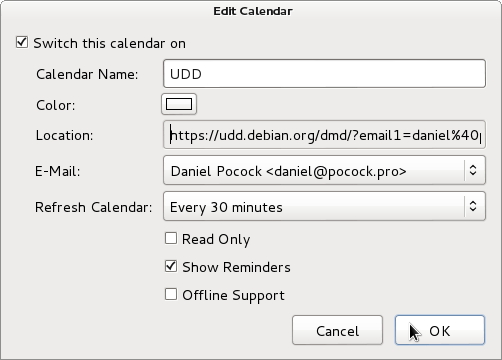
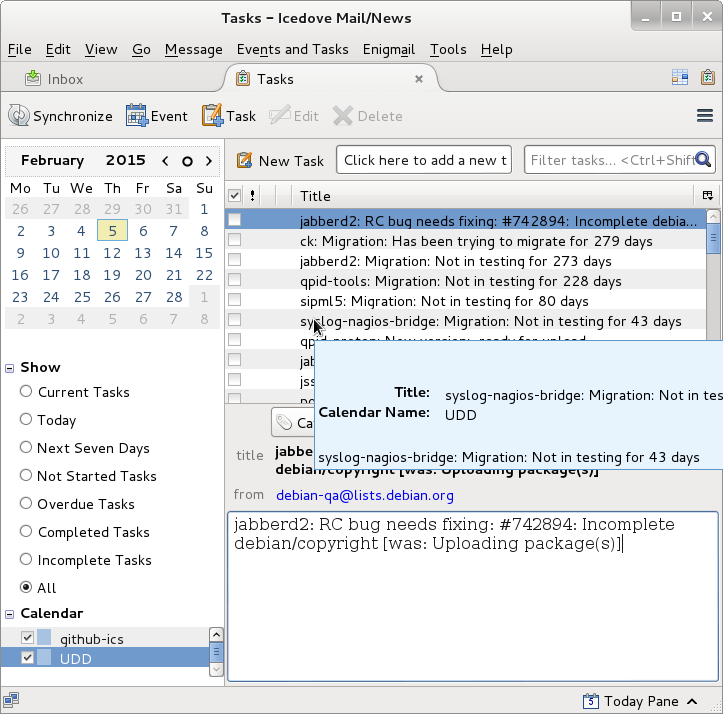
Contributors to Debian can now monitor their list of pending activities using iCalendar clients on their desktop or mobile device. Thanks to the tremendous work of the Debian QA team, the Ultimate Debian Database has been scooping up data from all around the Debian universe and storing it in a PostgreSQL back-end. The Debian Maintainer Dashboard allows developers to see a summary of outstanding issues across all their packages in a range of different formats. With today's update, an aggregated list of Debian tasks and to-dos can now be rendered in iCalendar format and loaded into a range of productivity tools. Using the iCalendar URL Many productivity tools like Mozilla Lightning (Iceowl extension on Debian) allow you to poll any calendar or task list just using a URL. For UDD iCalendar feeds, the URLs look like this:
https://udd.debian.org/dmd/?format=ics&email1=daniel%40pocock.pro
You can also get the data by visiting the Debian Maintainer Dashboard, filling out the form and selecting the iCalendar output format. Next steps Currently, the priority and deadline attributes are not set on any of the tasks in the feed. The strategy of prioritizing issues has been raised in bug #777112. iCalendar also supports other possibilities such as categories and reminders/alarms. It is likely that each developer has their own personal preferences about using these features. Giving feedback through the Debian QA mailing list or the bug tracker is welcome. Screenshots

Daniel Pocock: Github iCalendar issue feed now scans all repositories

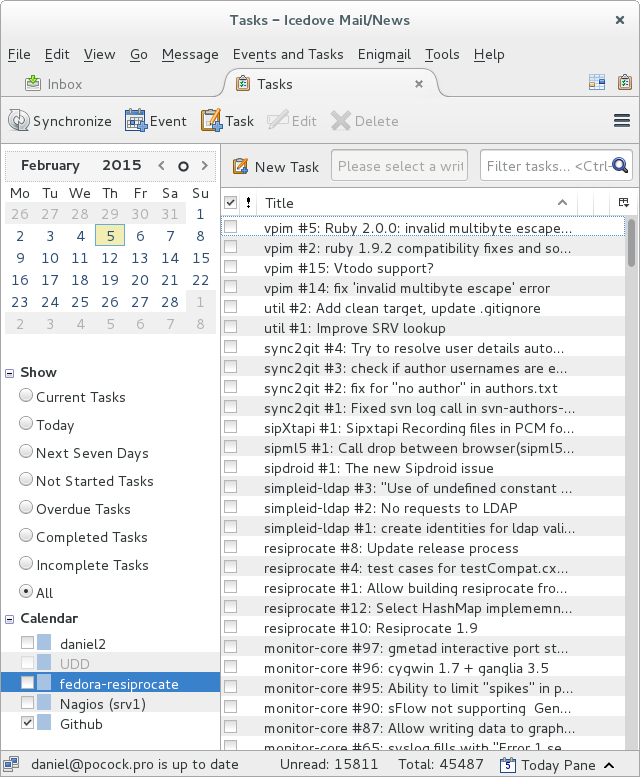
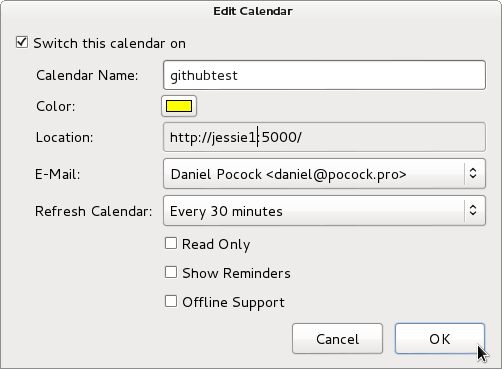
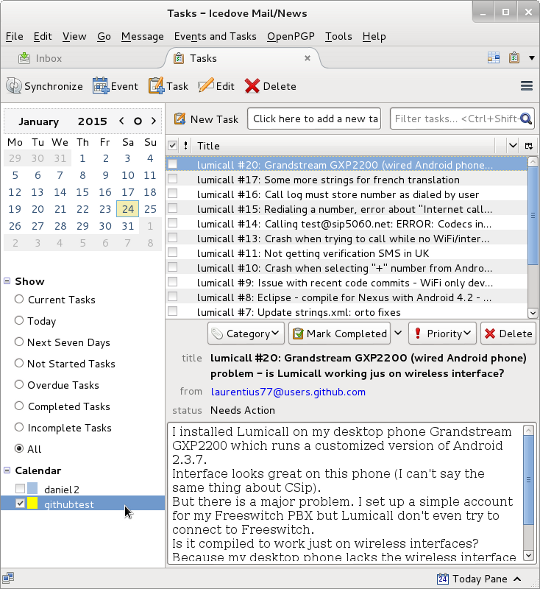
The Github iCalendar feed has now been updated to scan issues in all of your repositories. It is no longer necessary to list your repositories in the configuration file or remember to add new repositories to the configuration from time to time. Screenshot Below is a screenshot from Mozilla Lightning (known as Iceowl extension on Debian) showing the issues from a range of my projects on Github. Notice in the bottom left corner that I can switch each of my feeds on and off just by (un)ticking a box.

26 January 2015

Daniel Pocock: Get your Nagios issues as an iCalendar feed

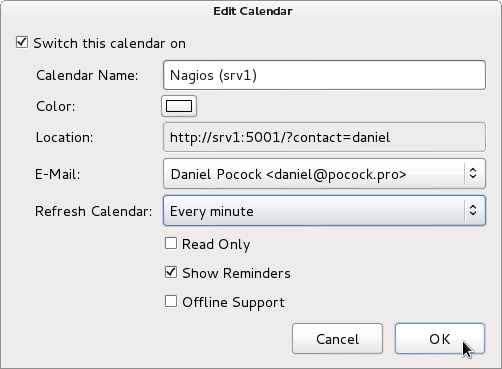
The other day I demonstrated how to get your Github issues/bugs as an iCalendar feed. I'm planning to take this concept further and I just whipped up another Python script, exposing Nagios issues as an iCalendar feed. The script is nagios-icalendar. Usage is explained concisely in the README file, it takes just minutes to get up and running. One interesting feature is that you can append a contact name to the URL and just get the issues for that contact, e.g.:
http://nagios-server.example.org:5001?contact=daniel
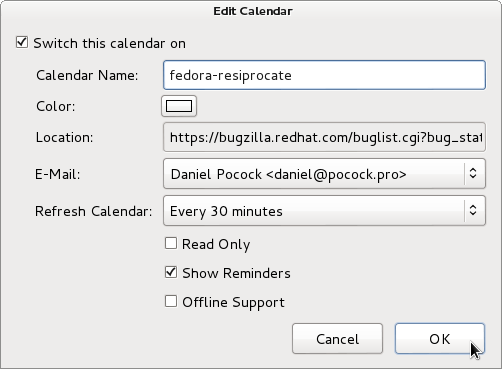
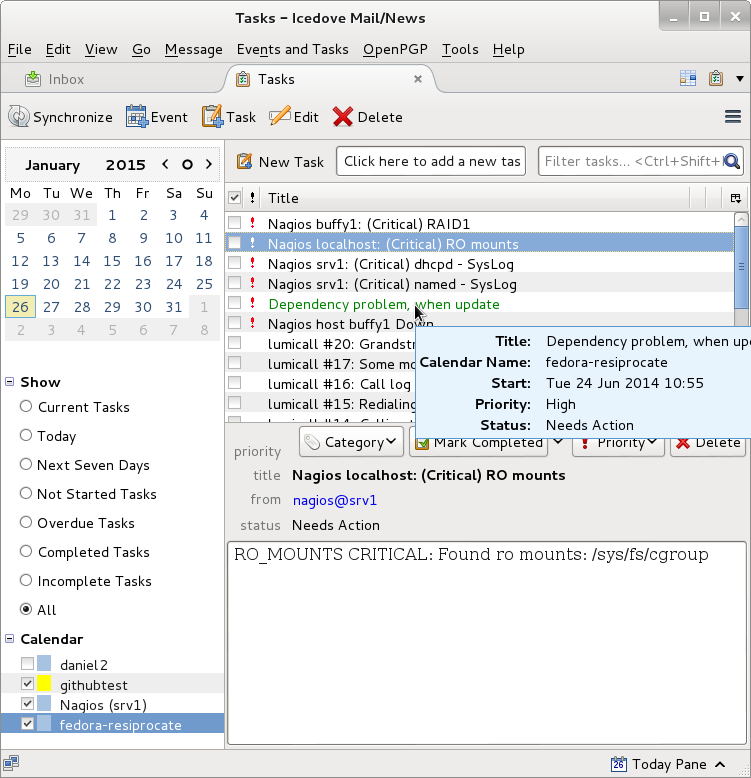
Screenshots Here I demonstrate using Mozilla Lightning / Iceowl-extension to aggregate issues from Nagios, the Fedora instance of Bugzilla and Lumicall's Github issues into a single to-do list.

24 January 2015

Daniel Pocock: Get your Github issues as an iCalendar feed

I've just whipped up a Python script that renders Github issue lists from your favourite projects as an iCalendar feed. The project is called github-icalendar. It uses Python Flask to expose the iCalendar feed over HTTP. It is really easy to get up and running. All the dependencies are available on a modern Linux distribution, for example:
$ sudo apt-get install python-yaml python-icalendar python-flask python-pygithub
Just create an API token in Github and put it into a configuration file like this:
api_token: 6b36b3d7579d06c9f8e88bc6fb33864e4765e5fac4a3c2fd1bc33aad
bind_address: ::0
bind_port: 5000
filter: all
Run it from the shell:
$ ./github_icalendar/main.py github-ics.cfg
and connect to it with your favourite iCalendar client. Consolidating issue lists from Bugzilla, Github, Debian BTS and other sources A single iCalendar client can usually support multiple sources and thereby consolidate lists of issues from multiple bug trackers. This can be much more powerful than combining RSS bug feeds because iCalendar has built-in support for concepts such as priority and deadline. The client can use these to help you identify the most critical issues across all your projects, no matter which bug tracker they use. Bugzilla bugtrackers already expose iCalendar feeds directly, just look for the iCalendar link at the bottom of any search results page. Here is an example URL from the Mozilla instance of Bugzilla. The Ultimate Debian Database consolidates information from the Debian and Ubuntu universe and can already export it as an RSS feed, there is discussion about extrapolating that to an iCalendar feed too. Further possibilities
  • Prioritizing the issues in Github and mapping these priorities to iCalendar priorities
  • Creating tags in Github that allow issues to be ignored/excluded from the feed (e.g. excluding wishlist items)
  • Creating summary entries instead of listing all the issues, e.g. a single task entry with the title Fix 2 critical bugs for project foo
Screenshots The screenshots below are based on the issue list of the Lumicall secure SIP phone for Android. Screenshot - Mozilla Thunderbird/Lightning (Icedove/Iceowl-extension on Debian)

Diego Escalante Urrelo: Link Pack #05

Lever Rukhin Photographs Los Angeles From His Car
Lever Rukhin shoots the sketchiest parts of Los Angeles from his car, taking a really unique perspective that helps you perceive what LA looks like, if you were in a car An experience that is apparently common to all LA people. People drive too much in the US :-). It s a very interesting interview that goes well with his full site: Lev Rukhin. What I love about this, besides the whole premise, is that Lev went the extra mile and actually hacked his car to make the images he wanted:
Phoblographer: It looks like many of these images have artificial lighting in them. What s your gear setup, and how do you introduce so much light into the scene from your car? Lever: About 9 months ago, I affixed a Mola beauty dish onto the roof rack of my 75 Volvo and juice it with a profoto bi-tube. This takes a bit of practice, as making a turn changes the light completely, which I always try to keep balanced. The Canon 5D3 with a 24mm f1.4 is set up on a tripod. The strobe has allowed me to capture more detail as well as creating a somewhat surreal feel to the sets.
Lev Rukhin Lev Rukhin http://www.levrukhin.com/
The Invisible Woman: A conversation with Bj rk
Bj rk is that Icelandic singer we all hear about but never really pay much attention to because her music is too smart for our simple ears. In this interview she goes over how her latest album is a very personal work, and unexpectedly (?) ends talking about how problematic it s been to be a female auteur in her generation. I have seen the same problem she denounces about people assuming that the male members of a team did all the work while the women just sticked to making coffee and sandwiches. I ve worked with exceptional women that don t get enough credit, but I ve also worked with potentially exceptional women who don t give themselves enough credit. It s a very interesting read, specially since it comes from someone who couldn t be higher in the art food chain. Bj rk is god-damn Bj rk. Only thing that bugs me is that Pitchfork decided to hold back most of the interview for publishing next month. I ll try to go back and read it in full, but I wonder if the technique works for them or if perhaps they are missing the opportunity for a bigger impact. But I digress.
Pitchfork: The world has a difficult time with the female auteur. B: I have nothing against Kanye West. Help me with this I m not dissing him this is about how people talk about him. With the last album he did, he got all the best beatmakers on the planet at the time to make beats for him. A lot of the time, he wasn t even there. Yet no one would question his authorship for a second. If whatever I m saying to you now helps women, I m up for saying it. For example, I did 80% of the beats on Vespertine and it took me three years to work on that album, because it was all microbeats it was like doing a huge embroidery piece. Matmos came in the last two weeks and added percussion on top of the songs, but they didn t do any of the main parts, and they are credited everywhere as having done the whole album. [Matmos ] Drew [Daniel] is a close friend of mine, and in every single interview he did, he corrected it. And they don t even listen to him. It really is strange.
In Defense of the Selfie Stick
Miguel proposes a different take on the consequences of the selfies stick:
When you ask someone to take a picture of you, technically, they are the photographer, and they own the copyright of your picture. ( ) All of a sudden, your backpacking adventure in Europe requires you to pack a stack of legal contracts. Now your exchange goes from Can you take a picture of us? to Can you take a picture of us, making sure that the church is on the top right corner, and also, I am going to need you to sign this paper .
I don t know what s with the selfie stick hate. Let people have fun, it doesn t hurt. If anything, it prevents them from asking you to take their photo, and if we already established you are the kind of people not a big fan of strangers, all the better, right? Why Top Tech CEOs Want Employees With Liberal Arts Degrees
Here s a small extra. When I decided to pursue a humanities/art formal training, I got many naysayers telling me that I was screwing up not specializing even more as a formal (titled) engineer. I argued then, and now, that if I was gonna pay for training, I might as well pay for training outside my comfort zone. The result resonates perfectly with this article. Of course, it s not like the thing is settled, but I can back the various quotes in there. Working with purely technical/engineering types can be an echo chamber, and having trained myself in the humanities and arts I have become incredibly much more sensitive to the human factor of things. I used to think I was already good at this (because we hacker types have lots of confidence), but studying humanities like human communication, social conflict and development, film language, etc; it all has made me a much more capable hacker of things. There s also a nice argument to be made about joining the arts when you are already highly skilled on technical matters. Like Robert Rodr guez s teacher (mentioned in his diary/book Rebel Without a Cause, which I also have to review soon) used to say (generous paraphrasing here): the world is of those who can be their own creative and their own technician.
Both Yi and Sheer recognize that the scientific method is valuable, with its emphasis on logic and reason, especially when dealing with data or engineering problems. But they believe this approach can sometimes be limiting. When I collaborate with people who have a strictly technical background, says Yi, the perspective I find most lacking is an understanding of what motivates people and how to balance multiple factors that are at work outside the realm of technology.
Interesting food for thought, specially if you know an engineer that ditches the arts as of little value for personal growth in their careers/life.
Read more Link Pack, you ll love it

22 January 2015

Diego Escalante Urrelo: Link Pack #04

Writing Your Way to Happiness (nytimes.com)
Researches believe that the way we think about, and remember, our story can be so powerful that it can actually influence our happiness and success. It s a nice little article summarizing actual research. The main study referred put fresh university students to test: a group received tools to rewrite their memory and story of their academic performance, another group didn t. The first group improved their grades and had only 1 student drop school within a year, the other group had 4 drop outs and no specific improvement. I ve been thinking about this as I recently rewrote my About page and also started writing down some past Travel journals. Looking back and rewriting your own story is incredibly empowering, it s a fantastic rush of confidence and self-assertion. Memory is always betraying us, and remembering our success is not particularly high on the list of things to keep.
The concept is based on the idea that we all have a personal narrative that shapes our view of the world and ourselves. But sometimes our inner voice doesn t get it completely right. Some researchers believe that by writing and then editing our own stories, we can change our perceptions of ourselves and identify obstacles that stand in the way of better health. It may sound like self-help nonsense, but research suggests the effects are real. Students who had been prompted to change their personal stories improved their grade-point averages and were less likely to drop out over the next year than the students who received no information. In the control group, which had received no advice about grades, 20 percent of the students had dropped out within a year. But in the intervention group, only 1 student or just 5 percent dropped out.
Old Masters at the Top of Their Game (nytimes.com)
Fantastic read on how these artists defy the conventions of old meaning useless. Masters at their art, they haven t quit nor have laid to rest and cash their reputation. They keep making, they stay alive (physically and metaphorically) through art. No rush to get to their age, but still a really interesting letter from the future . Full of cheat codes, read this now.
Now I am 79. I ve written many hundreds of essays, 10 times that number of misbegotten drafts both early and late, and I begin to understand that failure is its own reward. It is in the effort to close the distance between the work imagined and the work achieved wherein it is to be found that the ceaseless labor is the freedom of play, that what s at stake isn t a reflection in the mirror of fame but the escape from the prison of the self. T. H. White, the British naturalist turned novelist to write The Once and Future King, calls upon the druid Merlyn to teach the lesson to the young prince Arthur: You may grow old and trembling in your anatomies, you may lie awake at night listening to the disorder of your veins, you may miss your only love, you may see the world about you devastated by evil lunatics, or know your honour trampled in the sewers of baser minds. There is only one thing for it then to learn. Learn why the world wags and what wags it. That is the only thing which the mind can never exhaust, never alienate, never be tortured by, never fear or distrust, and never dream of regretting.
A Life with a View (ribbonfarm.com)
A somewhat tricky read, but with a nice payback. Take your time, and savor it slowly. It s a very interesting look into how we keep wanting new stuff, and how we shield from ourselves by looking for the place with no yearns , the place where we won t want anything anymore doesn t exist. Chains very well into the reads I shared a few days ago on practical contentment.
The arrival fallacy is about seeking a life from which one can look with a complacent equanimity upon the rest of reality, without yearning. It is an ideal of a life that is defined primarily by blindness to itself. You yearn while you see your life as others see it, until you arrive at a situation where you can disappear into the broader background, and see comfortably without being seen discomfittingly, especially by yourself. Once you re there, the yearning stops, so the theory goes. Of course it is a laughably bad theory.
How To Escape From A Moving Car (mrporter.com)
By Adam Kirley, stunt double for Daniel Craig in the crazy crane scene of Casino Royale (where 007 jumps from monkey nuts high to donkey bonkers high, a badger bum crazy distance). Really funny, and one of those things I always find myself thinking Almost as much as what to do in case of a Post Office Showdown (xkcd.com)
Everyone s first instinct is to put their hands or legs down first. That s the worst thing you can do: you will break something. The pointy parts of your body hurt elbows, knees, hips, ankles. Put your fists under your chin, and bring your elbows together. Keep your chin tucked in to your chest to protect your head. The best point of impact is the back of the shoulder and your back. If you dive out directly onto your shoulder you ll break it.
What the World Looks Like with Social Anxiety (collegehumor.com)
Funny vignettes about how the world looks like when you are socially anxious. I can only really identify with the last one:
cfd04d22a6dfa4fb858dee8d3d5592afShea Strauss.
Helsinki Bus Station Theory (fotocommunity.com)
Don t get off the bus. Art comes to those who wait and persevere. At first, you replicate the same route others have done, but only if you stay long enough in such path you begin to find your own path. Although perhaps a little more classic in conception, this is an interesting text advising artists to don t give up just because they don t compare well to the masters of their current art or genre. Only those who persevere will catch up and diverge from the masters. You could say that diverging early is also a way to find your path, but there s still a case to be made for learning from those who came before. Whether you want to imitate them, or rebel against them, you still need to know them. My take: it doesn t hurt to pick up some biographies or works from past masters and see what made them masters. Create your master genealogy, kinda like in Steal Like an Artist (which I recently read but haven t got around to write about yet).
Georges Braque has said that out of limited means, new forms emerge. I say, we find out what we will do by knowing what we will not do. And so, if your heart is set on 8 10 platinum landscapes in misty southern terrains, work your way through those who inspire you, ride their bus route and damn those who would say you are merely repeating what has been done before. Wait for the months and years to pass and soon your differences will begin to appear with clarity and intelligence, when your originality will become visible, even the works from those very first years of trepidation when everything you did seemed so done before.
At 90, She s Designing Tech For Aging Boomers (npr.org)
The inspiring tale of a 90 year old woman who joined IDEO to contribute a unique point of view to the design process. You can never stop learning, life never ceases to be interesting. It s short, and not incredibly shocking, but that this has happened somewhere as referenced and revered as IDEO says a lot.
And for the bulging demographic of baby boomers growing old, Beskind has this advice: Embrace change and design for it.

Previously on Link Pack

20 January 2015

Daniel Pocock: Quantifying the performance of the Microserver

In my earlier blog about choosing a storage controller, I mentioned that the Microserver's on-board AMD SB820M SATA controller doesn't quite let the SSDs perform at their best. Just how bad is it? I did run some tests with the fio benchmarking utility. Lets have a look at those random writes, they simulate the workload of synchronous NFS write operations:
rand-write: (groupid=3, jobs=1): err= 0: pid=1979
  write: io=1024.0MB, bw=22621KB/s, iops=5655 , runt= 46355msec
Now compare it to the HP Z800 on my desk, it has the Crucial CT512MX100SSD1 on a built-in LSI SAS 1068E controller:
rand-write: (groupid=3, jobs=1): err= 0: pid=21103
  write: io=1024.0MB, bw=81002KB/s, iops=20250 , runt= 12945msec
and then there is the Thinkpad with OCZ-NOCTI mSATA SSD:
rand-write: (groupid=3, jobs=1): err= 0: pid=30185
  write: io=1024.0MB, bw=106088KB/s, iops=26522 , runt=  9884msec
That's right, the HP workstation is four times faster than the Microserver, but the Thinkpad whips both of them. I don't know how much I can expect of the PCI bus in the Microserver but I suspect that any storage controller will help me get some gain here.

19 January 2015

Daniel Pocock: jSMPP project update, 2.1.1 and 2.2.1 releases

The jSMPP project on Github stopped processing pull requests over a year ago and appeared to be needing some help. I've recently started hosting it under https://github.com/opentelecoms-org/jsmpp and tried to merge some of the backlog of pull requests myself. There have been new releases:
  • 2.1.1 works in any project already using 2.1.0. It introduces bug fixes only.
  • 2.2.1 introduces some new features and API changes and bigger bug fixes
The new versions are easily accessible for Maven users through the central repository service. Apache Camel has already updated to use 2.1.1. Thanks to all those people who have contributed to this project throughout its history.

Daniel Pocock: Storage controllers for small Linux NFS networks

While contemplating the disk capacity upgrade for my Microserver at home, I've also been thinking about adding a proper storage controller. Currently I just use the built-in controller in the Microserver. It is an AMD SB820M SATA controller. It is a bottleneck for the SSD IOPS. On the disks, I prefer to use software RAID (such as md or BtrFs) and not become dependent on the metadata format of any specific RAID controller. The RAID controllers don't offer the checksumming feature that is available in BtrFs and ZFS. The use case is NFS for a small number of workstations. NFS synchronous writes block the client while the server ensures data really goes onto the disk. This creates a performance bottleneck. It is actually slower than if clients are writing directly to their local disks through the local OS caches. SSDs on an NFS server offer some benefit because they can complete write operations more quickly and the NFS server can then tell the client the operation is complete. The more performant solution (albeit with a slight risk of data corruption) is to use a storage controller with a non-volatile (battery-backed or flash-protected) write cache. Many RAID controllers have non-volatile write caches. Some online discussions of BtrFs and ZFS have suggested staying away from full RAID controllers though, amongst other things, to avoid the complexities of RAID controllers adding their metadata to the drives. This brings me to the first challenge though: are there suitable storage controllers that have a non-volatile write cache but without having other RAID features? Or a second possibility: out of the various RAID controllers that are available, do any provide first-class JBOD support? Observations I looked at specs and documentation for various RAID controllers and identified some of the following challenges: Next steps Are there other options to look at, for example, alternatives to NFS? If I just add in a non-RAID HBA to enable faster IO to the SSDs will this be enough to make a noticeable difference on the small number of NFS clients I'm using? Or is it inevitable that I will have to go with one of the solutions that involves putting a vendor's volume metadata onto JBOD volumes? If I do go that way, which of the vendors' metadata formats are most likely to be recognized by free software utilities in the future if I ever connect the disk to a generic non-RAID HBA? Thanks to all those people who provided comments about choosing drives for this type of NAS usage. Related reading

17 January 2015

Diego Escalante Urrelo: Link Pack #03

What s that? The third edition of Link Pack of course!
Playing with Power (7 minutes, Vimeo)
A super awesome story about a stop motion animator that turned a Nintendo Power Glove into the perfect animation tool. It s a fun, inspiring video :-). I love the Power Glove, it s so bad. The Power Glove Angry Video Game Nerd Episode 14 (12 minutes, YouTube)
On the topic of the Power Glove, here s the now classic Angry Video Game Nerd video about it. James Rolfe is funny. Ship Your Enemies Glitter
A rising star in the internet business landscape. You pay them $9.99 and they send an envelope full of glitter to your worst enemy. They promise it will jump into everything, as usual. Damn you glitter. A Guide to Practical Contentment
Be happy with what you have, but understand why:
( ) if you start in this place of fixing what s wrong with you, you keep looking for what else is wrong with you, what else you need to improve. So maybe now feel like you don t have enough muscles, or six pack abs, or you think your calves don t look good, or if it s not about your body, you ll find something else. So it s this never-ending cycle for your entire life. You never reach it. If you start with a place of wanting to improve yourself and feeling stuck, even if you re constantly successful and improving, you re always looking for happiness from external sources. You don t find the happiness from within, so you look to other things.
The Comments Section For Every Video Where Someone Does A Pushup
Comments. From YouTube. Enough said.
These are dips. Not pushups. In the entire history of the world, no one has ever successfully performed a pushup. They re all just dips. STOP DRIVING WITH YOUR HIPS. IF YOU RE DOING A PUSHUP CORRECTLY, YOUR HIPS SHOULD CEASE TO EXIST. You could do 100 pushups like this and it wouldn t improve your strength at all. You re just bending your arms.
Self-Taught Chinese Street Photographer Tao Liu Has an Eye for Peculiar Moments
This Chinese photog uses his lunch break to snap interesting street photography. Funny selection by PetaPixel, his Flickr page has even more stuff. Even more in his photoblog.
From https://www.flickr.com/photos/58083590@N05/14613273495/By Liu Tao. https://www.flickr.com/photos/58083590@N05/14613273495/
Enrique Castro-Mendivil s Agua Dulce photo set
Another interesting photo link. This time it s the most popular beach in Lima, with most people coming from low income neighborhoods, it shows how fragmented the city is.
By Enrique Castro-Mendivil. http://www.castromendivilphoto.com/index.php/component/content/article/11-work/69-agua-dulceBy Enrique Castro-Mendivil. http://www.castromendivilphoto.com/index.php/component/content/article/11-work/69-agua-dulce

Also on Link Pack

15 January 2015

Daniel Pocock: Disk expansion

A persistent problem that I encounter with hard disks is the capacity limit. If only hard disks could expand like the Tardis. My current setup at home involves a HP Microserver. It has four drive bays carrying two SSDs (for home directories) and two Western Digital RE4 2TB drives for bulk data storage (photos, source tarballs and other things that don't change often). Each pair of drives is mirrored. I chose the RE4 because I use RAID1 and they offer good performance and error recovery control which is useful in any RAID scenario. When I put in the 2TB drives, I created a 1TB partition on each for Linux md RAID1 and another 1TB partition on each for BtrFs. Later I added the SSDs and I chose BtrFs again as it had been working well for me. Where to from here? Since getting a 36 megapixel DSLR that produces 100MB raw images and 20MB JPEGs I've been filling up that 2TB faster than I could have ever imagined. I've also noticed that vendors are offering much bigger NAS and archive disks so I'm tempted to upgrade. First I looked at the Seagate Archive 8TB drives. 2TB bigger than the nearest competition. Discussion on Reddit suggests they don't have Error Recovery Control / TLER however and that leaves me feeling they are not the right solution for me. Then I had a look at WD Red. Slightly less performant than the RE4 drives I run now, but with the possibility of 6TB per drive and a little cheaper. Apparently they have TLER though, just like the RE4 and other enterprise drives. Will 6 or 8TB create new problems? This all leaves me scratching my head and wondering about a couple of things though:
  • Will I run into trouble with the firmware in my HP Microserver if I try to use such a big disk?
  • Should I run the whole thing with BtrFs and how well will it work at this scale?
  • Should I avoid the WD Red and stick with RE4 or similar drives from Seagate or elsehwere?
If anybody can share any feedback it would be really welcome.

13 January 2015

Daniel Pocock: Silent data loss exposed

I was moving a large number of image files around and decided to compare checksums after putting them in their new home. Ouf of several thousand files, about 80GB of data, I found that seventeen of them had a checksum mismatch. Running md5sum manually on each of those was showing a correct checksum, well, up until the sixth file and then I found this:
$ md5sum DSC_2624.NEF
94fc8d3cdea3b0f3479fa255f7634b5b  DSC_2624.NEF
$ md5sum DSC_2624.NEF
25cf4469f44ae5e5d6a13c8e2fb220bf  DSC_2624.NEF
$ md5sum DSC_2624.NEF
03a68230b2c6d29a9888d2358ed8e225  DSC_2624.NEF
Yes, each time I run md5sum on the same file it gives a different result. Out of the seventeen files, I found one other displaying the same problem and the others gave correct checksums when I ran md5sum manually. Definitely not a healthy disk, or is it? This is the reason why checksumming filesystems like Btrfs are so important. There are no errors or warnings in the logs on the system with this disk. Silent data loss at its best. Is the disk to blame though? It may be tempting to think this is a disk fault, most people have seen faulty disks at some time or another. In the old days you could often hear them too. There is another possible explanation though: memory corruption. The data read from disk is normally cached in RAM and if the RAM is corrupt, the cache would return bad data. I dropped the read cache:
# echo 3 > /proc/sys/vm/drop_caches 
and tried md5sum again and observed the file checksum is now correct. It would appear the md5sum command had been operating on data in the page cache and the root cause of the problem is memory corruption. Time to run a memory test and then replace the RAM in the machine.

12 January 2015

Daniel Pocock: Lumicall: big steps forward, help needed

I've recently made more updates to Lumicall, the free, open source and secure alternative to Viber and Skype. Here are some of the highlights:
  • The dialing popup is now optional, so if you want to call your friends with Lumicall / SIP but they don't want to see the popup when making calls themselves, you can disable the popup on their phone.
  • The dialer popup now shows results asynchronously so you can dial more quickly
  • SIP SIMPLE messaging is now supported, Lumicall is now taking on WhatsApp
  • Various bugs in the preferences/settings have been fixed and adding SIP accounts is now easier
  • Dialing with a TURN relay is now much more reliable
  • It is now possible to redial SIP calls in the call history without seeing the nasty Android bug / popup telling you that you don't have Internet calling configured
F-Droid not updated yet F-Droid is not yet carrying the latest version. The F-Droid team may need assistance as they appear to be reviewing a lot of the third-party dependencies used by apps they distribute to make sure the full stack is 100% free software. If people want to continue having the option to get Lumicall and other free software through F-Droid instead of Google Play then helping the F-Droid community is the number one way you can help Lumicall. Other ways you can help, even without coding You don't have to be a developer to help with Lumicall. Taking on Viber, Skype and now WhatsApp as well may not sound easy. It isn't. Your help could make the difference though. Here are some of the things that need assistance:
  • Helping to get it on Wikipedia, they keep deleting the page while happily hosting pages about similar products like Sipdroid and CSipSimple
  • Helping get the latest dependencies and Lumicall version into F-Droid
  • UI design ideas
  • Web site assistance
  • Documentation and screenshots, e.g. for use with Asterisk and FreeSWITCH and various SIP proxies
  • Translation
  • Messaging: to be the default SMS app on an Android device, Lumicall would need a full messaging UI and the ability to replace all functions of the default SMS app. Can anybody identify any other free software that does this and is modular enough to share the relevant code with Lumicall?
  • ZRTP: can you help improve the ZRTP stack used by Lumicall?
Try SIP SIMPLE messaging When composing a message to a Lumicall user, the SIP address is written sip:number @sip5060.net. E.g. if the number is +442071234567 then the SIP address to use when calling or composing a message is sip:+442071234567 @sip5060.net Debian Developers should be able to interact with Lumicall users from rtc.debian.org using the SIP over WebSocket messaging. Getting the latest Lumicall It is available from:

22 December 2014

Erich Schubert: Java sum-of-array comparisons

This is a follow-up to the post by Daniel Lemire on a close topic.
Daniel Lemire hat experimented with boxing a primitive array in an interface, and has been trying to measure the cost.
I must admit I was a bit sceptical about his results, because I have seen Java successfully inlining code in various situations.
For an experimental library I occasionally work on, I had been spending quite a bit of time on benchmarking. Previously, I had used Google Caliper for it (I even wrote an evaluation tool for it to produce better statistics). However, Caliper hasn't seen much updates recently, and there is a very attractive similar tool at openJDK now, too: Java Microbenchmarking Harness (actually it can be used for benchmarking at other scale, too).
Now that I have experience in both, I must say I consider JMH superior, and I have switched over my microbenchmarks to it. One of the nice things is that it doesn't make this distinction of micro vs. macrobenchmarks, and the runtime of your benchmarks is easier to control.
I largely recreated his task using JMH. The benchmark task is easy: compute the sum of an array; the question is how much the cost is when allowing different data structures than double[].
My results, however, are quite different. And the statistics of JMH indicate the differences may be not significant, and thus indicating that Java manages to inline the code properly.
adapterFor       1000000  thrpt  50  836,898   13,223  ops/s
adapterForL      1000000  thrpt  50  842,464   11,008  ops/s
adapterForR      1000000  thrpt  50  810,343    9,961  ops/s
adapterWhile     1000000  thrpt  50  839,369   11,705  ops/s
adapterWhileL    1000000  thrpt  50  842,531    9,276  ops/s
boxedFor         1000000  thrpt  50  848,081    7,562  ops/s
boxedForL        1000000  thrpt  50  840,156   12,985  ops/s
boxedForR        1000000  thrpt  50  817,666    9,706  ops/s
boxedWhile       1000000  thrpt  50  845,379   12,761  ops/s
boxedWhileL      1000000  thrpt  50  851,212    7,645  ops/s
forSum           1000000  thrpt  50  845,140   12,500  ops/s
forSumL          1000000  thrpt  50  847,134    9,479  ops/s
forSumL2         1000000  thrpt  50  846,306   13,654  ops/s
forSumR          1000000  thrpt  50  831,139   13,519  ops/s
foreachSum       1000000  thrpt  50  843,023   13,397  ops/s
whileSum         1000000  thrpt  50  848,666   10,723  ops/s
whileSumL        1000000  thrpt  50  847,756   11,191  ops/s
The postfix is the iteration type: sum using for loops, with local variable for the length (L), or in reverse order (R); while loops (again with local variable for the length). The prefix is the data layout: the primitive array, the array using a static adapter (which is the approach I have been using in many implementations in cervidae) and using a "boxed" wrapper class around the array (roughly the approach that Daniel Lemire has been investigating. On the primitive array, I also included the foreach loop approach (for(double v:array) ).
If you look at the standard deviations, the results are pretty much identical, except for reverse loops. This is not surprising, given the strong inlining capabilities of Java - all of these codes will lead to next to the same CPU code after warmup and hotspot optimization.
I do not have a full explanation of the differences the others have been seeing. There is no "polymorphism" occurring here (at runtime) - there is only a single Array implementation in use; but this was the same with his benchmark.
Here is a visualization of the results (sorted by average):
Result boxplots
As you can see, most results are indiscernible. The measurement standard deviation is higher than the individual differences. If you run the same benchmark again, you will likely get a different ranking.
Note that performance may - drastically - drop once you use multiple adapters or boxing classes in the same hot codepath. Java Hotspot keeps statistics on the classes it sees, and as long as it only sees 1-2 different types, it performs quite aggressive optimizations instead of doing "virtual" method calls.

Michael Prokop: Ten years of Grml

* On 22nd of October 2004 an event called OS04 took place in Seifenfabrik Graz/Austria and it marked the first official release of the Grml project. Grml was initially started by myself in 2003 I registered the domain on September 16, 2003 (so technically it would be 11 years already :)). It started with a boot-disk, first created by hand and then based on yard. On 4th of October 2004 we had a first presentation of grml 0.09 Codename Bughunter at Kunstlabor in Graz. I managed to talk a good friend and fellow student Martin Hecher into joining me. Soon after Michael Gebetsroither and Andreas Gredler joined and throughout the upcoming years further team members (Nico Golde, Daniel K. Gebhart, Mario Lang, Gerfried Fuchs, Matthias Kopfermann, Wolfgang Scheicher, Julius Plenz, Tobias Klauser, Marcel Wichern, Alexander Wirt, Timo Boettcher, Ulrich Dangel, Frank Terbeck, Alexander Steinb ck, Christian Hofstaedtler) and contributors (Hermann Thomas, Andreas Krennmair, Sven Guckes, Jogi Hofm ller, Moritz Augsburger, ) joined our efforts. Back in those days most efforts went into hardware detection, loading and setting up the according drivers and configurations, packaging software and fighting bugs with lots of reboots (working on our custom /linuxrc for the initrd wasn t always fun). Throughout the years virtualization became more broadly available, which is especially great for most of the testing you need to do when working on your own (meta) distribution. Once upon a time udev became available and solved most of the hardware detection issues for us. Nowadays X.org doesn t even need a xorg.conf file anymore (at least by default). We have to acknowledge that Linux grew up over the years quite a bit (and I m wondering how we ll look back at the systemd discussions in a few years). By having Debian Developers within the team we managed to push quite some work of us back to Debian (the distribution Grml was and still is based on), years before the Debian Derivatives initiative appeared. We never stopped contributing to Debian though and we also still benefit from the Debian Derivatives initiative, like sharing issues and ideas on DebConf meetings. On 28th of May 2009 I myself became an official Debian Developer. Over the years we moved from private self-hosted infrastructure to company-sponsored systems, migrated from Subversion (brr) to Mercurial (2006) to Git (2008). Our Zsh-related work became widely known as grml-zshrc. jenkins.grml.org managed to become a continuous integration/deployment/delivery home e.g. for the dpkg, fai, initramfs-tools, screen and zsh Debian packages. The underlying software for creating Debian packages in a CI/CD way became its own project known as jenkins-debian-glue in August 2011. In 2006 I started grml-debootstrap, which grew into a reliable method for installing plain Debian (nowadays even supporting installation as VM, and one of my customers does tens of deployments per day with grml-debootstrap in a fully automated fashion). So one of the biggest achievements of Grml is from my point of view that it managed to grow several active and successful sub-projects under its umbrella. Nowadays the Grml team consists of 3 Debian Developers Alexander Wirt (formorer), Evgeni Golov (Zhenech) and myself. We couldn t talk Frank Terbeck (ft) into becoming a DM/DD (yet?), but he s an active part of our Grml team nonetheless and does a terrific job with maintaining grml-zshrc as well as helping out in Debian s Zsh packaging (and being a Zsh upstream committer at the same time makes all of that even better :)). My personal conclusion for 10 years of Grml? Back in the days when I was a student Grml was my main personal pet and hobby. Grml grew into an open source project which wasn t known just in Graz/Austria, but especially throughout the German system administration scene. Since 2008 I m working self-employed and mainly working on open source stuff, so I m kind of living a dream, which I didn t even have when I started with Grml in 2003. Nowadays with running my own business and having my own family it s getting harder for me to consider it still a hobby though, instead it s more integrated and part of my business which I personally consider both good and bad at the same time (for various reasons). Thanks so much to anyone of you, who was (and possibly still is) part of the Grml journey! Let s hope for another 10 successful years! Thanks to Max Amanshauser and Christian Hofstaedtler for reading drafts of this.

Next.

Previous.