Search Results: "cts"

12 January 2025

Dirk Eddelbuettel: Rcpp 1.0.14 on CRAN: Regular Semi-Annual Update

rcpp logo The Rcpp Core Team is once again thrilled, pleased, and chuffed (am I doing this right for LinkedIn?) to announce a new release (now at 1.0.14) of the Rcpp package. It arrived on CRAN earlier today, and has since been uploaded to Debian. Windows and macOS builds should appear at CRAN in the next few days, as will builds in different Linux distribution and of course r2u should catch up tomorrow too. The release was only uploaded yesterday, and as always get flagged because of the grandfathered .Call(symbol) as well as for the url to the Rcpp book (which has remained unchanged for years) failing . My email reply was promptly dealt with under European morning hours and by the time I got up the submission was in state waiting over a single reverse-dependency failure which is also spurious, appears on some systems and not others, and also not new. Imagine that: nearly 3000 reverse dependencies and only one (spurious) change to worse. Solid testing seems to help. My thanks as always to the CRAN for responding promptly. This release continues with the six-months January-July cycle started with release 1.0.5 in July 2020. This time we also need a one-off hotfix release 1.0.13-1: we had (accidentally) conditioned an upcoming R change on 4.5.0, but it already came with 4.4.2 so we needed to adjust our code. As a reminder, we do of course make interim snapshot dev or rc releases available via the Rcpp drat repo as well as the r-universe page and repo and strongly encourage their use and testing I run my systems with these versions which tend to work just as well, and are also fully tested against all reverse-dependencies. Rcpp has long established itself as the most popular way of enhancing R with C or C++ code. Right now, 2977 packages on CRAN depend on Rcpp for making analytical code go faster and further. On CRAN, 13.6% of all packages depend (directly) on Rcpp, and 60.8% of all compiled packages do. From the cloud mirror of CRAN (which is but a subset of all CRAN downloads), Rcpp has been downloaded 93.7 million times. The two published papers (also included in the package as preprint vignettes) have, respectively, 1947 (JSS, 2011) and 354 (TAS, 2018) citations, while the the book (Springer useR!, 2013) has another 676. This release is primarily incremental as usual, generally preserving existing capabilities faithfully while smoothing our corners and / or extending slightly, sometimes in response to changing and tightened demands from CRAN or R standards. The move towards a more standardized approach for the C API of R once again to a few changes; Kevin did once again did most of these PRs. Other contributed PRs include G bor permitting builds on yet another BSD variant, Simon Guest correcting sourceCpp() to work on read-only files, Marco Colombo correcting a (surprisingly large) number of vignette typos, I aki rebuilding some documentation files that tickled (false) alerts, and I took care of a number of other maintenance items along the way. The full list below details all changes, their respective PRs and, if applicable, issue tickets. Big thanks from all of us to all contributors!

Changes in Rcpp release version 1.0.14 (2025-01-11)
  • Changes in Rcpp API:
    • Support for user-defined databases has been removed (Kevin in #1314 fixing #1313)
    • The SET_TYPEOF function and macro is no longer used (Kevin in #1315 fixing #1312)
    • An errorneous cast to int affecting large return object has been removed (Dirk in #1335 fixing #1334)
    • Compilation on DragonFlyBSD is now supported (G bor Cs rdi in #1338)
    • Use read-only VECTOR_PTR and STRING_PTR only with with R 4.5.0 or later (Kevin in #1342 fixing #1341)
  • Changes in Rcpp Attributes:
    • The sourceCpp() function can now handle input files with read-only modes (Simon Guest in #1346 fixing #1345)
  • Changes in Rcpp Deployment:
    • One unit tests for arm64 macOS has been adjusted; a macOS continuous integration runner was added (Dirk in #1324)
    • Authors@R is now used in DESCRIPTION as mandated by CRAN, the Rcpp.package.skeleton() function also creates it (Dirk in #1325 and #1327)
    • A single datetime format test has been adjusted to match a change in R-devel (Dirk in #1348 fixing #1347)
  • Changes in Rcpp Documentation:
    • The Rcpp Modules vignette was extended slightly following #1322 (Dirk)
    • Pdf vignettes have been regenerated under Ghostscript 10.03.1 to avoid a false positive by a Windows virus scanner (I aki in #1331)
    • A (large) number of (old) typos have been corrected in the vignettes (Marco Colombo in #1344)

Thanks to my CRANberries, you can also look at a diff to the previous release Questions, comments etc should go to the rcpp-devel mailing list off the R-Forge page. Bugs reports are welcome at the GitHub issue tracker as well (where one can also search among open or closed issues).

This post by Dirk Eddelbuettel originated on his Thinking inside the box blog. If you like this or other open-source work I do, you can sponsor me at GitHub.

10 January 2025

Sergio Talens-Oliag: Testing New User Tools

On recent weeks I ve had some time to scratch my own itch on matters related to tools I use daily on my computer, namely the desktop / window manager and my text editor of choice. This post is a summary of what I tried, how it worked out and my short and medium-term plans related to them.

Desktop / WMOn the desktop / window manager front I ve been using Cinnamon on Debian and Ubuntu systems since Gnome 3 was published (I never liked version 3, so I decided to move to something similar to Gnome 2, including the keyboard shortcuts). In fact I ve never been a fan of Desktop environments, before Gnome I used OpenBox and IceWM because they where a lot faster than desktop systems on my hardware at the time and I was using them only to place one or two windows on multiple workspaces using mainly the keyboard for my interactions (well, except for the web browsers and the image manipulation programs). Although I was comfortable using Cinnamon, some years ago I tried to move to i3, a tilling window manager for X11 that looked like a good choice for me, but I didn t have much time to play with it and never used it enough to make me productive with it (I didn t prepare a complete configuration nor had enough time to learn the new shortcuts, so I went back to Cinnamon and never tried again). Anyway, some weeks ago I updated my work machine OS (it was using Ubuntu 22.04 LTS and I updated it to the 24.04 LTS version) and the Cinnamon systray applet stopped working as it used to do (in fact I still have to restart Cinnamon after starting a session to make it work) and, as I had some time, I decided to try a tilling window manager again, but now I decided to go for SwayWM, as it uses Wayland instead of X11.

Sway configurationOn my ~/.config/sway/config I tuned some things:
  • Set fuzzel as the application launcher.
  • Installed manually the shikane application and created a configuration to be executed always when sway is started / reloaded (I adjusted my configuration with wdisplays and used shikanectl to save it).
  • Added support for running the xdg-desktop-portal-wlr service.
  • Enabled the swayidle command to lock the screen after some time of inactivity.
  • Adjusted the keyboard to use the es key map
  • Added some keybindings to make my life easier, including the use of grimm and swappy to take screenshots
  • Configured waybar as the environment bar.
  • Added a shell script to start applications when sway is started (it uses swaymsg to execute background commands and the i3toolwait script to wait for the
    #!/bin/sh
    # VARIABLES
    CHROMIUM_LOCAL_STATE="$HOME/.config/google-chrome/Local State"
    I3_TOOLWAIT="$HOME/.config/sway/scripts/i3-toolwait"
    # Functions
    chromium_profile_dir()  
      jq -r ".profile.info_cache to_entries map( (.value.name): .key ) add .\"$1\" // \"\"" "$CHROMIUM_LOCAL_STATE"
     
    # MAIN
    IGZ_PROFILE_DIR="$(chromium_profile_dir "sergio.talens@intelygenz.com")"
    OURO_PROFILE_DIR="$(chromium_profile_dir "sergio.talens@nxr.global")"
    PERSONAL_PROFILE_DIR="$(chromium_profile_dir "stalens@gmail.com")"
    # Common programs
    swaymsg "exec nextcloud --background"
    swaymsg "exec nm-applet"
    # Run spotify on the first workspace (it is mapped to the laptop screen)
    swaymsg -q "workspace 1"
    $ I3_TOOLWAIT  "spotify"
    # Run tmux on the
    swaymsg -q "workspace 2"
    $ I3_TOOLWAIT  -- foot tmux a -dt sto
    wp_num="3"
    if [ "$OURO_PROFILE_DIR" ]; then
      swaymsg -q "workspace $wp_num"
      $ I3_TOOLWAIT  -m ouro-browser -- google-chrome --profile-directory="$OURO_PROFILE_DIR"
      wp_num="$((wp_num+1))"
    fi
    if [ "$IGZ_PROFILE_DIR" ]; then
      swaymsg -q "workspace $wp_num"
      $ I3_TOOLWAIT  -m igz-browser -- google-chrome --profile-directory="$IGZ_PROFILE_DIR"
      wp_num="$((wp_num+1))"
    fi
    if [ "$PERSONAL_PROFILE_DIR" ]; then
      swaymsg -q "workspace $wp_num"
      $ I3_TOOLWAIT  -m personal-browser -- google-chrome --profile-directory="$PERSONAL_PROFILE_DIR"
      wp_num="$((wp_num+1))"
    fi
    # Open the browser without setting the profile directory if none was found
    if [ "$wp_num" = "3" ]; then
      swaymsg -q "workspace $wp_num"
      $ I3_TOOLWAIT  google-chrome
      wp_num="$((wp_num+1))"
    fi
    swaymsg -q "workspace $wp_num"
    $ I3_TOOLWAIT  evolution
    wp_num="$((wp_num+1))"
    swaymsg -q "workspace $wp_num"
    $ I3_TOOLWAIT  slack
    wp_num="$((wp_num+1))"
    # Open a private browser and a console in the last workspace
    swaymsg -q "workspace $wp_num"
    $ I3_TOOLWAIT  -- google-chrome --incognito
    $ I3_TOOLWAIT  foot
    # Go back to the second workspace for keepassxc
    swaymsg "workspace 2"
    $ I3_TOOLWAIT  keepassxc

ConclusionAfter using Sway for some days I can confirm that it is a good choice for me, but some of the components needed to make it work as I want are too new and not available on the Ubuntu 24.04 LTS repositories, so I decided to go back to Cinnamon and try Sway again in the future, although I added more workspaces to my setup (now they are only available on the main monitor, the laptop screen is fixed while there is a big monitor connected), added some additional keyboard shortcuts and installed or updated some applets.

Text editorWhen I started using Linux many years ago I used vi/vim and emacs as my text editors (vi for plain text and emacs for programming and editing HTML/XML), but eventually I moved to vim as my main text editor and I ve been using it since (well, I moved to neovim some time ago, although I kept my old vim configuration). To be fair I m not as expert as I could be with vim, but I m productive with it and it has many plugins that make my life easier on my machines, while keeping my ability to edit text and configurations on any system that has a vi compatible editor installed. For work reasons I tried to use Visual Studio Code last year, but I ve never really liked it and almost everything I do with it I can do with neovim (i. e. I even use copilot with it). Besides, I m a heavy terminal user (I use tmux locally and via ssh) and I like to be able to use my text editor on my shell sessions, and code does not work like that. The only annoying thing about vim/neovim is its configuration (well, the problem is that I have a very old one and probably should spend some time fixing and updating it), but, as I said, it s been working well for me for a long time, so I never really had the motivation to do it. Anyway, after finishing my desktop tests I saw that I had the Helix editor installed for some time but I never tried it, so I decided to give it a try and see if it could be a good replacement for neovim on my environments (the only drawback is that as it is not vi compatible, I would need to switch back to vi mode when working on remote systems, but I guess I could live with that). I ran the helix tutorial and I liked it, so I decided to configure and install the Language Servers I can probably take advantage of on my daily work on my personal and work machines and see how it works.

Language server installationsA lot of manual installations are needed to get the language servers working what I did on my machines is more or less the following:
# AWK
sudo npm i -g 'awk-language-server@>=0.5.2'
# BASH
sudo apt-get install shellcheck shfmt
sudo npm i -g bash-language-server
# C/C++
sudo apt-get install clangd
# CSS, HTML, ESLint, JSON, SCS
sudo npm i -g vscode-langservers-extracted
# Docker
sudo npm install -g dockerfile-language-server-nodejs
# Docker compose
sudo npm install -g @microsoft/compose-language-service
# Helm
app="helm_ls_linux_amd64"
url="$(
  curl -s https://api.github.com/repos/mrjosh/helm-ls/releases/latest  
    jq -r ".assets[]   select(.name == \"$app\")   .browser_download_url"
)"
curl -L "$url" --output /tmp/helm_ls
sudo install /tmp/helm_ls /usr/local/bin
rm /tmp/helm_ls
# Markdown
app="marksman-linux-x64"
url="$(
  curl -s https://api.github.com/repos/artempyanykh/marksman/releases/latest  
    jq -r ".assets[]   select(.name == \"$app\")   .browser_download_url"
)"
curl -L "$url" --output /tmp/marksman
sudo install /tmp/marksman /usr/local/bin
rm /tmp/marksman
# Python
sudo npm i -g pyright
# Rust
rustup component add rust-analyzer
# SQL
sudo npm i -g sql-language-server
# Terraform
sudo apt-get install terraform-ls
# TOML
cargo install taplo-cli --locked --features lsp
# YAML
sudo npm install --global yaml-language-server
# JavaScript, TypeScript
sudo npm install -g typescript-language-server typescript
sudo npm install -g --save-dev --save-exact @biomejs/biome

Helix configurationThe helix configuration is done on a couple of toml files that are placed on the ~/.config/helix directory, the config.toml file I used is this one:
theme = "solarized_light"
[editor]
line-number = "relative"
mouse = false
[editor.statusline]
left = ["mode", "spinner"]
center = ["file-name"]
right = ["diagnostics", "selections", "position", "file-encoding", "file-line-ending", "file-type"]
separator = " "
mode.normal = "NORMAL"
mode.insert = "INSERT"
mode.select = "SELECT"
[editor.cursor-shape]
insert = "bar"
normal = "block"
select = "underline"
[editor.file-picker]
hidden = false
[editor.whitespace]
render = "all"
[editor.indent-guides]
render = true
character = " " # Some characters that work well: " ", " ", " ", " "
skip-levels = 1
And to configure the language servers I used the following language-servers.toml file:
[[language]]
name = "go"
auto-format = true
formatter =   command = "goimports"  
[[language]]
name = "javascript"
language-servers = [
  "typescript-language-server", # optional
  "vscode-eslint-language-server",
]
[language-server.rust-analyzer.config.check]
command = "clippy"
[language-server.sql-language-server]
command = "sql-language-server"
args = ["up", "--method", "stdio"]
[[language]]
name = "sql"
language-servers = [ "sql-language-server" ]
[[language]]
name = "hcl"
language-servers = [ "terraform-ls" ]
language-id = "terraform"
[[language]]
name = "tfvars"
language-servers = [ "terraform-ls" ]
language-id = "terraform-vars"
[language-server.terraform-ls]
command = "terraform-ls"
args = ["serve"]
[[language]]
name = "toml"
formatter =   command = "taplo", args = ["fmt", "-"]  
[[language]]
name = "typescript"
language-servers = [
  "typescript-language-server",
  "vscode-eslint-language-server",
]

Neovim configurationAfter a little while I noticed that I was going to need some time to get used to helix and the most interesting thing for me was the easy configuration and the language server integrations, but as I am already comfortable with neovim and just had installed the language server support tools on my machines I just need to configure them for neovim and I can keep using it for a while. As I said my configuration is old, to configure neovim I have the following init.vim file on my ~/.config/nvim folder:
set runtimepath^=~/.vim runtimepath+=~/.vim/after
let &packpath=&runtimepath
source ~/.vim/vimrc
" load lua configuration
lua require('config')
With that configuration I keep my old vimrc (it is a little bit messy, but it works) and I use a lua configuration file for the language servers and some additional neovim plugins on the ~/.config/nvim/lua/config.lua file:
-- -----------------------
-- BEG: LSP Configurations
-- -----------------------
-- AWS (awk_ls)
require'lspconfig'.awk_ls.setup 
-- Bash (bashls)
require'lspconfig'.bashls.setup 
-- C/C++ (clangd)
require'lspconfig'.clangd.setup 
-- CSS (cssls)
require'lspconfig'.cssls.setup 
-- Docker (dockerls)
require'lspconfig'.dockerls.setup 
-- Docker Compose
require'lspconfig'.docker_compose_language_service.setup 
-- Golang (gopls)
require'lspconfig'.gopls.setup 
-- Helm (helm_ls)
require'lspconfig'.helm_ls.setup 
-- Markdown
require'lspconfig'.marksman.setup 
-- Python (pyright)
require'lspconfig'.pyright.setup 
-- Rust (rust-analyzer)
require'lspconfig'.rust_analyzer.setup 
-- SQL (sqlls)
require'lspconfig'.sqlls.setup 
-- Terraform (terraformls)
require'lspconfig'.terraformls.setup 
-- TOML (taplo)
require'lspconfig'.taplo.setup 
-- Typescript (ts_ls)
require'lspconfig'.ts_ls.setup 
-- YAML (yamlls)
require'lspconfig'.yamlls.setup 
  settings =  
    yaml =  
      customTags =   "!reference sequence"  


-- -----------------------
-- END: LSP Configurations
-- -----------------------
-- ---------------------------------
-- BEG: Autocompletion configuration
-- ---------------------------------
-- Ref: https://github.com/neovim/nvim-lspconfig/wiki/Autocompletion
--
-- Pre requisites:
--
--   # Packer
--   git clone --depth 1 https://github.com/wbthomason/packer.nvim \
--      ~/.local/share/nvim/site/pack/packer/start/packer.nvim
--
--   # Start nvim and run :PackerSync or :PackerUpdate
-- ---------------------------------
local use = require('packer').use
require('packer').startup(function()
  use 'wbthomason/packer.nvim' -- Packer, useful to avoid removing it with PackerSync / PackerUpdate
  use 'neovim/nvim-lspconfig' -- Collection of configurations for built-in LSP client
  use 'hrsh7th/nvim-cmp' -- Autocompletion plugin
  use 'hrsh7th/cmp-nvim-lsp' -- LSP source for nvim-cmp
  use 'saadparwaiz1/cmp_luasnip' -- Snippets source for nvim-cmp
  use 'L3MON4D3/LuaSnip' -- Snippets plugin
end)
-- Add additional capabilities supported by nvim-cmp
local capabilities = require("cmp_nvim_lsp").default_capabilities()
local lspconfig = require('lspconfig')
-- Enable some language servers with the additional completion capabilities offered by nvim-cmp
local servers =   'clangd', 'rust_analyzer', 'pyright', 'ts_ls'  
for _, lsp in ipairs(servers) do
  lspconfig[lsp].setup  
    -- on_attach = my_custom_on_attach,
    capabilities = capabilities,
   
end
-- luasnip setup
local luasnip = require 'luasnip'
-- nvim-cmp setup
local cmp = require 'cmp'
cmp.setup  
  snippet =  
    expand = function(args)
      luasnip.lsp_expand(args.body)
    end,
   ,
  mapping = cmp.mapping.preset.insert( 
    ['<C-u>'] = cmp.mapping.scroll_docs(-4), -- Up
    ['<C-d>'] = cmp.mapping.scroll_docs(4), -- Down
    -- C-b (back) C-f (forward) for snippet placeholder navigation.
    ['<C-Space>'] = cmp.mapping.complete(),
    ['<CR>'] = cmp.mapping.confirm  
      behavior = cmp.ConfirmBehavior.Replace,
      select = true,
     ,
    ['<Tab>'] = cmp.mapping(function(fallback)
      if cmp.visible() then
        cmp.select_next_item()
      elseif luasnip.expand_or_jumpable() then
        luasnip.expand_or_jump()
      else
        fallback()
      end
    end,   'i', 's'  ),
    ['<S-Tab>'] = cmp.mapping(function(fallback)
      if cmp.visible() then
        cmp.select_prev_item()
      elseif luasnip.jumpable(-1) then
        luasnip.jump(-1)
      else
        fallback()
      end
    end,   'i', 's'  ),
   ),
  sources =  
      name = 'nvim_lsp'  ,
      name = 'luasnip'  ,
   ,
 
-- ---------------------------------
-- END: Autocompletion configuration
-- ---------------------------------

ConclusionI guess I ll keep helix installed and try it again on some of my personal projects to see if I can get used to it, but for now I ll stay with neovim as my main text editor and learn the shortcuts to use it with the language servers.

9 January 2025

Dirk Eddelbuettel: inline 0.3.21: Minor Polish

A fresh minor release of the inline package got to CRAN today, following on the November release which had marked the first release in three and half years. inline facilitates writing code in-line in simple string expressions or short files. The package was used quite extensively by Rcpp in the very early days before Rcpp Attributes arrived on the scene providing an even better alternative for its use cases. inline is still used by rstan and a number of other packages. In the November release we accommodated upcoming R-devel changes on setting R_NO_REMAP by conditioning on the release version. It turns that this does not get when the #define independently so this needed a small refinement which this version brings. No other changes were made. The NEWS extract follows and details the changes some more.

Changes in inline version 0.3.21 (2025-01-08)
  • Refine use of Rf_warning in cfunction setting -DR_NO_REMAP ourselves to get R version independent state

Thanks to my CRANberries, you can also look at a diff to the previous release. Questions, comments etc should go to the rcpp-devel mailing list off the R-Forge page. Bugs reports are welcome at the GitHub issue tracker as well (where one can also search among open or closed issues).

This post by Dirk Eddelbuettel originated on his Thinking inside the box blog. If you like this or other open-source work I do, you can now sponsor me at GitHub.

Reproducible Builds: Reproducible Builds in December 2024

Welcome to the December 2024 report from the Reproducible Builds project! Our monthly reports outline what we ve been up to over the past month and highlight items of news from elsewhere in the world of software supply-chain security when relevant. As ever, however, if you are interested in contributing to the Reproducible Builds project, please visit our Contribute page on our website. Table of contents:
  1. reproduce.debian.net
  2. debian-repro-status
  3. On our mailing list
  4. Enhancing the Security of Software Supply Chains
  5. diffoscope
  6. Supply-chain attack in the Solana ecosystem
  7. Website updates
  8. Debian changes
  9. Other development news
  10. Upstream patches
  11. Reproducibility testing framework

reproduce.debian.net Last month saw the introduction of reproduce.debian.net. Announced at the recent Debian MiniDebConf in Toulouse, reproduce.debian.net is an instance of rebuilderd operated by the Reproducible Builds project. rebuilderd is our server designed monitor the official package repositories of Linux distributions and attempts to reproduce the observed results there. This month, however, we are pleased to announce that not only does the service now produce graphs, the reproduce.debian.net homepage itself has become a start page of sorts, and the amd64.reproduce.debian.net and i386.reproduce.debian.net pages have emerged. The first of these rebuilds the amd64 architecture, naturally, but it also is building Debian packages that are marked with the no architecture label, all. The second builder is, however, only rebuilding the i386 architecture. Both of these services were also switched to reproduce the Debian trixie distribution instead of unstable, which started with 43% of the archive rebuild with 79.3% reproduced successfully. This is very much a work in progress, and we ll start reproducing Debian unstable soon. Our i386 hosts are very kindly sponsored by Infomaniak whilst the amd64 node is sponsored by OSUOSL thank you! Indeed, we are looking for more workers for more Debian architectures; please contact us if you are able to help.

debian-repro-status Reproducible builds developer kpcyrd has published a client program for reproduce.debian.net (see above) that queries the status of the locally installed packages and rates the system with a percentage score. This tool works analogously to arch-repro-status for the Arch Linux Reproducible Builds setup. The tool was packaged for Debian and is currently available in Debian trixie: it can be installed with apt install debian-repro-status.

On our mailing list On our mailing list this month:
  • Bernhard M. Wiedemann wrote a detailed post on his long journey towards a bit-reproducible Emacs package. In his interesting message, Bernhard goes into depth about the tools that they used and the lower-level technical details of, for instance, compatibility with the version for glibc within openSUSE.
  • Shivanand Kunijadar posed a question pertaining to the reproducibility issues with encrypted images. Shivanand explains that they must use a random IV for encryption with AES CBC. The resulting artifact is not reproducible due to the random IV used. The message resulted in a handful of replies, hopefully helpful!
  • User Danilo posted an in interesting question related to their attempts in trying to achieve reproducible builds for Threema Desktop 2.0. The question resulted in a number of replies attempting to find the right combination of compiler and linker flags (for example).
  • Longstanding contributor David A. Wheeler wrote to our list announcing the release of the Census III of Free and Open Source Software: Application Libraries report written by Frank Nagle, Kate Powell, Richie Zitomer and David himself. As David writes in his message, the report attempts to answer the question what is the most popular Free and Open Source Software (FOSS)? .
  • Lastly, kpcyrd followed-up to a post from September 2024 which mentioned their desire for someone to implement a hashset of allowed module hashes that is generated during the kernel build and then embedded in the kernel image , thus enabling a deterministic and reproducible build. However, they are now reporting that somebody implemented the hash-based allow list feature and submitted it to the Linux kernel mailing list . Like kpcyrd, we hope it gets merged.

Enhancing the Security of Software Supply Chains: Methods and Practices Mehdi Keshani of the Delft University of Technology in the Netherlands has published their thesis on Enhancing the Security of Software Supply Chains: Methods and Practices . Their introductory summary first begins with an outline of software supply chains and the importance of the Maven ecosystem before outlining the issues that it faces that threaten its security and effectiveness . To address these:
First, we propose an automated approach for library reproducibility to enhance library security during the deployment phase. We then develop a scalable call graph generation technique to support various use cases, such as method-level vulnerability analysis and change impact analysis, which help mitigate security challenges within the ecosystem. Utilizing the generated call graphs, we explore the impact of libraries on their users. Finally, through empirical research and mining techniques, we investigate the current state of the Maven ecosystem, identify harmful practices, and propose recommendations to address them.
A PDF of Mehdi s entire thesis is available to download.

diffoscope diffoscope is our in-depth and content-aware diff utility that can locate and diagnose reproducibility issues. This month, Chris Lamb made the following changes, including preparing and uploading versions 283 and 284 to Debian:
  • Update copyright years. [ ]
  • Update tests to support file 5.46. [ ][ ]
  • Simplify tests_quines.py::test_ differences,differences_deb to simply use assert_diff and not mangle the test fixture. [ ]

Supply-chain attack in the Solana ecosystem A significant supply-chain attack impacted Solana, an ecosystem for decentralised applications running on a blockchain. Hackers targeted the @solana/web3.js JavaScript library and embedded malicious code that extracted private keys and drained funds from cryptocurrency wallets. According to some reports, about $160,000 worth of assets were stolen, not including SOL tokens and other crypto assets.

Website updates Similar to last month, there was a large number of changes made to our website this month, including:
  • Chris Lamb:
    • Make the landing page hero look nicer when the vertical height component of the viewport is restricted, not just the horizontal width.
    • Rename the Buy-in page to Why Reproducible Builds? [ ]
    • Removing the top black border. [ ][ ]
  • Holger Levsen:
  • hulkoba:
    • Remove the sidebar-type layout and move to a static navigation element. [ ][ ][ ][ ]
    • Create and merge a new Success stories page, which highlights the success stories of Reproducible Builds, showcasing real-world examples of projects shipping with verifiable, reproducible builds. These stories aim to enhance the technical resilience of the initiative by encouraging community involvement and inspiring new contributions. . [ ]
    • Further changes to the homepage. [ ]
    • Remove the translation icon from the navigation bar. [ ]
    • Remove unused CSS styles pertaining to the sidebar. [ ]
    • Add sponsors to the global footer. [ ]
    • Add extra space on large screens on the Who page. [ ]
    • Hide the side navigation on small screens on the Documentation pages. [ ]

Debian changes There were a significant number of reproducibility-related changes within Debian this month, including:
  • Santiago Vila uploaded version 0.11+nmu4 of the dh-buildinfo package. In this release, the dh_buildinfo becomes a no-op ie. it no longer does anything beyond warning the developer that the dh-buildinfo package is now obsolete. In his upload, Santiago wrote that We still want packages to drop their [dependency] on dh-buildinfo, but now they will immediately benefit from this change after a simple rebuild.
  • Holger Levsen filed Debian bug #1091550 requesting a rebuild of a number of packages that were built with a very old version of dpkg.
  • Fay Stegerman contributed to an extensive thread on the debian-devel development mailing list on the topic of Supporting alternative zlib implementations . In particular, Fay wrote about her results experimenting whether zlib-ng produces identical results or not.
  • kpcyrd uploaded a new rust-rebuilderd-worker, rust-derp, rust-in-toto and debian-repro-status to Debian, which passed successfully through the so-called NEW queue.
  • Gioele Barabucci filed a number of bugs against the debrebuild component/script of the devscripts package, including:
    • #1089087: Address a spurious extra subdirectory in the build path.
    • #1089201: Extra zero bytes added to .dynstr when rebuilding CMake projects.
    • #1089088: Some binNMUs have a 1-second offset in some timestamps.
  • Gioele Barabucci also filed a bug against the dh-r package to report that the Recommends and Suggests fields are missing from rebuilt R packages. At the time of writing, this bug has no patch and needs some help to make over 350 binary packages reproducible.
  • Lastly, 8 reviews of Debian packages were added, 11 were updated and 11 were removed this month adding to our knowledge about identified issues.

Other development news In other ecosystem and distribution news:
  • Lastly, in openSUSE, Bernhard M. Wiedemann published another report for the distribution. There, Bernhard reports about the success of building R-B-OS , a partial fork of openSUSE with only 100% bit-reproducible packages. This effort was sponsored by the NLNet NGI0 initiative.

Upstream patches The Reproducible Builds project detects, dissects and attempts to fix as many currently-unreproducible packages as possible. We endeavour to send all of our patches upstream where appropriate. This month, we wrote a large number of such patches, including:

Reproducibility testing framework The Reproducible Builds project operates a comprehensive testing framework running primarily at tests.reproducible-builds.org in order to check packages and other artifacts for reproducibility. In November, a number of changes were made by Holger Levsen, including:
  • reproduce.debian.net-related:
    • Add a new i386.reproduce.debian.net rebuilder. [ ][ ][ ][ ][ ][ ]
    • Make a number of updates to the documentation. [ ][ ][ ][ ][ ]
    • Run i386.reproduce.debian.net run on a public port to allow external workers. [ ]
    • Add a link to the /api/v0/pkgs/list endpoint. [ ]
    • Add support for a statistics page. [ ][ ][ ][ ][ ][ ]
    • Limit build logs to 20 MiB and diffoscope output to 10 MiB. [ ]
    • Improve the frontpage. [ ][ ]
    • Explain that we re testing arch:any and arch:all on the amd64 architecture, but only arch:any on i386. [ ]
  • Misc:
    • Remove code for testing Arch Linux, which has moved to reproduce.archlinux.org. [ ][ ]
    • Don t install dstat on Jenkins nodes anymore as its been removed from Debian trixie. [ ]
    • Prepare the infom08-i386 node to become another rebuilder. [ ]
    • Add debug date output for benchmarking the reproducible_pool_buildinfos.sh script. [ ]
    • Install installation-birthday everywhere. [ ]
    • Temporarily disable automatic updates of pool links on buildinfos.debian.net. [ ]
    • Install Recommends by default on Jenkins nodes. [ ]
    • Rename rebuilder_stats.py to rebuilderd_stats.py. [ ]
    • r.d.n/stats: minor formatting changes. [ ]
    • Install files under /etc/cron.d/ with the correct permissions. [ ]
and Jochen Sprickerhof made the following changes: Lastly, Gioele Barabucci also classified packages affected by 1-second offset issue filed as Debian bug #1089088 [ ][ ][ ][ ], Chris Hofstaedtler updated the URL for Grml s dpkg.selections file [ ], Roland Clobus updated the Jenkins log parser to parse warnings from diffoscope [ ] and Mattia Rizzolo banned a number of bots and crawlers from the service [ ][ ].
If you are interested in contributing to the Reproducible Builds project, please visit our Contribute page on our website. However, you can get in touch with us via:

Freexian Collaborators: Debian Contributions: Tracker.debian.org updates, Salsa CI improvements, Coinstallable build-essential, Python 3.13 transition, Ruby 3.3 transition and more! (by Anupa Ann Joseph, Stefano Rivera)

Debian Contributions: 2024-12 Contributing to Debian is part of Freexian s mission. This article covers the latest achievements of Freexian and their collaborators. All of this is made possible by organizations subscribing to our Long Term Support contracts and consulting services.

Tracker.debian.org updates, by Rapha l Hertzog Profiting from end-of-year vacations, Rapha l prepared for tracker.debian.org to be upgraded to Debian 12 bookworm by getting rid of the remnants of python3-django-jsonfield in the code (it was superseded by a Django-native field). Thanks to Philipp Kern from the Debian System Administrators team, the upgrade happened on December 23rd. Rapha l also improved distro-tracker to better deal with invalid Maintainer fields which recently caused multiples issues in the regular data updates (#1089985, MR 105). While working on this, he filed #1089648 asking dpkg tools to error out early when maintainers make such mistakes. Finally he provided feedback to multiple issues and merge requests (MR 106, issues #21, #76, #77), there seems to be a surge of interest in distro-tracker lately. It would be nice if those new contributors could stick around and help out with the significant backlog of issues (in the Debian BTS, in Salsa).

Salsa CI improvements, by Santiago Ruano Rinc n Given that the Debian buildd network now relies on sbuild using the unshare backend, and that Salsa CI s reproducibility testing needs to be reworked (#399), Santiago resumed the work for moving the build job to use sbuild. There was some related work a few months ago that was focused on sbuild with the schroot and the sudo backends, but those attempts were stalled for different reasons, including discussions around the convenience of the move (#296). However, using sbuild and unshare avoids all of the drawbacks that have been identified so far. Santiago is preparing two merge requests: !568 to introduce a new build image, and !569 that moves all the extract-source related tasks to the build job. As mentioned in the previous reports, this change will make it possible for more projects to use the pipeline to build the packages (See #195). Additional advantages of this change include a more optimal way to test if a package builds twice in a row: instead of actually building it twice, the Salsa CI pipeline will configure sbuild to check if the clean target of debian/rules correctly restores the source tree, saving some CPU cycles by avoiding one build. Also, the images related to Ubuntu won t be needed anymore, since the build job will create chroots for different distributions and vendors from a single common build image. This will save space in the container registry. More changes are to come, especially those related to handling projects that customize the pipeline and make use of the extract-source job.

Coinstallable build-essential, by Helmut Grohne Building on the gcc-for-host work of last December, a notable patch turning build-essential Multi-Arch: same became feasible. Whilst the change is small, its implications and foundations are not. We still install crossbuild-essential-$ARCH for cross building and due to a britney2 limitation, we cannot have it depend on the host s C library. As a result, there are workarounds in place for sbuild and pbuilder. In turning build-essential Multi-Arch: same, we may actually express these dependencies directly as we install build-essential:$ARCH instead. The crossbuild-essential-$ARCH packages will continue to be available as transitional dummy packages.

Python 3.13 transition, by Colin Watson and Stefano Rivera Building on last month s work, Colin, Stefano, and other members of the Debian Python team fixed 3.13 compatibility bugs in many more packages, allowing 3.13 to now be a supported but non-default version in testing. The next stage will be to switch to it as the default version, which will start soon. Stefano did some test-rebuilds of packages that only build for the default Python 3 version, to find issues that will block the transition. The default version transition typically shakes out some more issues in applications that (unlike libraries) only test with the default Python version. Colin also fixed Sphinx 8.0 compatibility issues in many packages, which otherwise threatened to get in the way of this transition.

Ruby 3.3 transition, by Lucas Kanashiro The Debian Ruby team decided to ship Ruby 3.3 in the next Debian release, and Lucas took the lead of the interpreter transition with the assistance of the rest of the team. In order to understand the impact of the new interpreter in the ruby ecosystem, ruby-defaults was uploaded to experimental adding ruby3.3 as an alternative interpreter, and a mass rebuild of reverse dependencies was done here. Initially, a couple of hundred packages were failing to build, after many rounds of rebuilds, adjustments, and many uploads we are down to 30 package build failures, of those, 21 packages were asked to be removed from testing and for the other 9, bugs were filled. All the information to track this transition can be found here. Now, we are waiting for PHP 8.4 to finish to avoid any collision. Once it is done the Ruby 3.3 transition will start in unstable.

Miscellaneous contributions
  • Enrico Zini redesigned the way nm.debian.org stores historical audit logs and personal data backups.
  • Carles Pina submitted a new package (python-firebase-messaging) and prepared updates for python3-ring-doorbell.
  • Carles Pina developed further po-debconf-manager: better state transition, fixed bugs, automated assigning translators and reviewers on edit, updating po header files automatically, fixed bugs, etc.
  • Carles Pina reviewed, submitted and followed up the debconf templates translation (more than 20 packages) and translated some packages (about 5).
  • Santiago continued to work on DebConf 25 organization related tasks, including handling the logo survey and results. Stefano spent time on DebConf 25 too.
  • Santiago continued the exploratory work about linux livepatching with Emmanuel Arias. Santiago and Emmanuel found a challenge since kpatch won t fully support linux in trixie and newer, so they are exploring alternatives such as klp-build.
  • Helmut maintained the /usr-move transition filing bugs in e.g. bubblewrap, e2fsprogs, libvpd-2.2-3, and pam-tmpdir and corresponding on related issues such as kexec-tools and live-build. The removal of the usrmerge package unfortunately broke debootstrap and was quickly reverted. Continued fallout is expected and will continue until trixie is released.
  • Helmut sent patches for 10 cross build failures and worked with Sandro Knau on stuck Qt/KDE patches related to cross building.
  • Helmut continued to maintain rebootstrap removing the need to build gnu-efi in the process.
  • Helmut collaborated with Emanuele Rocca and Jochen Sprickerhof on an interesting adventure in diagnosing why gcc would FTBFS in recent sbuild.
  • Helmut proposed supporting build concurrency limits in coreutils s nproc. As it turns out nproc is not a good place for this functionality.
  • Colin worked with Sandro Tosi and Andrej Shadura to finish resolving the multipart vs. python-multipart name conflict, as mentioned last month.
  • Colin upgraded 48 Python packages to new upstream versions, fixing four CVEs and a number of compatibility bugs with recent Python versions.
  • Colin issued an openssh bookworm update with a number of fixes that had accumulated over the last year, especially fixing GSS-API key exchange which had been quite broken in bookworm.
  • Stefano fixed a minor bug in debian-reimbursements that was disallowing combination PDFs containing JAL tickets, encoded in UTF-16.
  • Stefano uploaded a stable update to PyPy3 in bookworm, catching up with security issues resolved in cPython.
  • Stefano fixed a regression in the eventlet from his Python 3.13 porting patch.
  • Stefano continued discussing a forwarded patch (renaming the sysconfigdata module) with cPython upstream, ending in a decision to drop the patch from Debian. This will need some continued work.
  • Anupa participated in the Debian Publicity team meeting in December, which discussed the team activities done in 2024 and projects for 2025.

5 January 2025

Jonathan McDowell: Free Software Activities for 2024

I tailed off on blog posts towards the end of the year; I blame a bunch of travel (personal + business), catching the flu, then December being its usual busy self. Anyway, to try and start off the year a bit better I thought I d do my annual recap of my Free Software activities. For previous years see 2019, 2020, 2021, 2022 + 2023.

Conferences In 2024 I managed to make it to FOSDEM again. It s a hectic conference, and I know there are legitimate concerns about it being a super spreader event, but it has the advantage of being relatively close and having a lot of different groups of people I want to talk to / see talk at it. I m already booked to go this year as well. I spoke at All Systems Go in Berlin about Using TPMs at scale for protecting keys. It was nice to actually be able to talk publicly about some of the work stuff my team and I have been working on. I d a talk submission in for FOSDEM about our use of attestation and why it s not necessarily the evil some folk claim, but there were a lot of good talks submitted and I wasn t selected. Maybe I ll find somewhere else suitable to do it. BSides Belfast may or may not count - it s a security conference, but there s a lot of overlap with various bits of Free software, so I feel it deserves a mention. I skipped DebConf for 2024 for a variety of reasons, but I m expecting to make DebConf25 in Brest, France in July.

Debian Most of my contributions to Free software continue to happen within Debian. In 2023 I d done a bunch of work on retrogaming with Kodi on Debian, so I made an effort to try and keep those bits more up to date, even if I m not actually regularly using them at present. RetroArch got 1.18.0+dfsg-1 and 1.19.1+dfsg-1 uploads. libretro-core-info got associated 1.18.0-1 and 1.19.0-1 uploads too. I note 1.20.0 has been released recently, so I ll have to find some time to build the appropriate DFSG tarball and update it. rcheevos saw 11.2.0-1, 11.5.0-1 + 11.6.0-1 uploaded. kodi-game-libretro itself had 20.2.7-1 uploaded, then 21.0.7-1. Latest upstream is 22.1.0, but that s tracking Kodi 22 and we re still on Kodi 21 so I plan to follow the Omega branch for now. Which I ve just noticed had a 21.0.8 release this week. Finally in the games space I uploaded mgba 0.10.3+dfsg-1 and 0.10.3+dfsg-2 for Ryan Tandy, before realising he was already a Debian Maintainer and granting him the appropriate ACL access so he can upload it himself; I ve had zero concerns about any of his packaging. The Debian Electronics Packaging Team continues to be home for a bunch of packages I care about. There was nothing big there, for me, in 2024, but a few bits of cleanup here and there. I seem to have become one of the main uploaders for sdcc - I have some interest in the space, and the sigrok firmware requires it to build, so I at least like to ensure it s in half decent state. I uploaded 4.4.0+dfsg-1, 4.4.0+dfsg-2, and, just in time to count for 2024, 4.4.0+dfsg-3. The sdcc 4.4 upload lead to some compilation issues for sigrok-firmware-fx2laf so I uploaded 0.1.7-2 fixing that, then 0.1.7-3 doing some further cleanups. OpenOCD had 0.12.0-2 uploaded to disable the libgpiod backend thanks to incompatible changes upstream. There were some in-discussion patches with OpenOCD upstream at the time, but they didn t seem to be ready yet so I held off on pulling them in. 0.12.0-3 fixed builds with more recent versions of jimtcl. It looks like the next upstream release is about a year away, so Trixie will in all probability ship with 0.12.0 as well. libjaylink had a new upstream release, so 0.4.0-1 was uploaded. libserialsport also had a new upstream release, leading to 0.1.2-1. I finally cracked and uploaded sg3-utils 1.48-1 into experimental. I m not the primary maintainer, but 1.46 is nearly 4 years old now and I wanted to get it updated in enough time to shake out any problems before we get to a Trixie freeze. Outside of team owned packages, libcli had compilation issues with GCC 14, leading to 1.10.7-2. I also added a new package, sedutil 1.20.0-2 back in April; it looks fairly unmaintained upstream (there s been some recent activity, but it doesn t seem to be release quality), but there was an outstanding ITP and I ve some familiarity with the space as we ve been using it at work as part of investigating TCG OPAL encryption. I continue to keep an eye on Debian New Members, even though I m mostly inactive as an application manager - we generally seem to have enough available recently. Mostly my involvement is via Front Desk activities, helping out with queries to the team alias, and contributing to internal discussions. Finally the 3 month rotation for Debian Keyring continues to operate smoothly. I dealt with 2023.03.24, 2023.06.24, 2023.09.22 + 2023.11.24.

Linux I d a single kernel contribution this year, to Clean up TPM space after command failure. That was based on some issues we saw at work. I ve another fix in progress that I hope to submit in 2025, but it s for an intermittent failure so confirming the fix is necessary + sufficient is taking a little while.

Personal projects I didn t end up doing much in the way of externally published personal project work in 2024. Despite the release of OpenPGP v6 in RFC 9580 I did not manage to really work on onak. I started on the v6 support, but have not had sufficient time to complete anything worth pushing external yet. listadmin3 got some minor updates based on external feedback / MRs. It s nice to know it s useful to other folk even in its basic state. That wraps up 2024. I ve got no particular goals for this year at present. Ideally I d get v6 support into onak, and it would be nice to implement some of the wishlist items people have provided for listadmin3, but I ll settle for making sure all my Debian packages are in reasonable state for Trixie.

1 January 2025

Louis-Philippe V ronneau: 2024 A Musical Retrospective

Another musical retrospective. If you enjoy this, I also did a 2022 and a 2023 one. Albums In 2024, I added 88 new albums to my collection that's a lot! This year again, I bought the vast majority of my music on Bandcamp. To be honest, I'm quite distraught by what's become of that website. Although it stays a wonderful place to buy underground music, Songtradr, the new owner of the platform, has been shown to be viciously anti-union. Money continues to ruin the world, I guess. Concerts I continued to go to a lot of concerts in 2024 (25!). Over the past 3 years, I have been going to more and more concerts, and I think I've reached my "peak". A mean of a concert every two weeks is quite a lot :) If you also like music and concerts, but find yourself not going to as many as you would like, the real secret is not to be afraid to go to concerts alone. Going with friends is always fun, but if I restricted myself to only going to concerts in a group, I'd barely see a few each year. Another good advice is to bring a book or something else1 to pass the time between sets. It can often take 30-45 minutes between sets for the artists to get their instruments ready, which can get quite boring if you just stand there and wait. Anyway, here are the concerts I went to in 2024: Shout out to the Gancio project and to the folks running the Montreal instance. It continues to be a smash hit and most of the interesting concerts end up being advertised there. See you all in 2025!



  1. I bought a Miyoo Mini Plus, a handheld Linux console running OnionOS, for that express reason. So far it's been great and I've been very happy to revisit some childhood classics.

31 December 2024

Russ Allbery: Review: Metal from Heaven

Review: Metal from Heaven, by August Clarke
Publisher: Erewhon
Copyright: November 2024
ISBN: 1-64566-099-0
Format: Kindle
Pages: 443
Metal from Heaven is industrial-era secondary-world fantasy with a literary bent. It is a complete story in one book, and I would be very surprised by a sequel. Clarke previously wrote the Scapegracers young-adult trilogy, which got excellent reviews and a few award nominations, as H.A. Clarke. This is his first adult novel.
Know I adore you. Look out over the glow. The cities sundered, their machines inverted, mountains split and prairies blazing, that long foreseen Hereafter crowning fast. This calamity is a promise made to you. A prayer to you, and to your shadow which has become my second self, tucked behind my eye and growing in tandem with me, pressing outwards through the pupil, the smarter, truer, almost bursting reason for our wrath. Do not doubt me. Just look. Watch us rise as the sun comes up over the beauty. The future stains the bleakness so pink. When my violence subsides, we will have nothing, and be champions.
Marney Honeycutt is twelve years old, a factory worker, and lustertouched. She works in the Yann I. Chauncey Ichorite Foundry in Ignavia City, alongside her family and her best friend, shaping the magical metal ichorite into the valuable industrial products of a new age of commerce and industry. She is the oldest of the lustertouched, the children born to factory workers and poisoned by the metal. It has made her allergic, prone to fits at any contact with ichorite, but also able to exert a strange control over the metal if she's willing to pay the price of spasms and hallucinations for hours afterwards. As Metal from Heaven opens, the workers have declared a strike. Her older sister is the spokesperson, demanding shorter hours, safer working conditions, and an investigation into the health of the lustertouched children. Chauncey's response is to send enforcer snipers to kill the workers, including the entirety of her family.
The girl sang, "Unalone toward dawn we go, toward the glory of the new morning." An enforcer shot her in the belly, and when she did not fall, her head.
Marney survives, fleeing into the city, swearing an impossible personal revenge against Yann Chauncey. An act of charity gets her a ticket on a train into the countryside. The woman who bought her ticket is a bandit who is on the train to rob it. Marney's ability to control ichorite allows her to help the bandits in return, winning her a place with the Highwayman's Choir who have been preying on the shipments of the rich and powerful and then disappearing into the hills. The Choir's secret is that the agoraphobic and paranoid Baron of the Fingerbluffs is dead and has been for years. He was killed by his staff, Hereafterist idealists, who have turned his remote territory into an anarchist commune and haven for pirates and bandits. This becomes Marney's home and the Choir becomes her family, but she never forgets her oath of revenge or the childhood friend she left behind in the piles of bodies and to whom this story is narrated. First, Clarke's writing is absolutely gorgeous.
We scaled the viny mountain jags at Montrose Barony's legal edge, the place where land was and wasn't Ignavia, Royston, and Drustland alike. There was a border but it was diffuse and hallucinatory, even more so than most. On legal papers and state maps there were harsh lines that squashed topography and sanded down the mountains into even hills in planter's rows, but here among the jutting rocks and craggy heather, the ground was lineless.
The rhythm of it, the grasp of contrast and metaphor, the word choice! That climactic word "lineless," with its echo of limitless. So good. Second, this is the rarest of books: a political fantasy that takes class and religion seriously and uses them for more than plot drivers. This is not at all our world, and the technology level is somewhat ambiguous, but the parallels to the Gilded Age and Progressive Era are unmistakable. The Hereafterists that Marney joins are political anarchists, not in the sense of alternative governance structures and political theory sanitized for middle-class liberals, but in the sense of Emma Goldman and Peter Kropotkin. The society they have built in the Fingerbluffs is temporary, threatened, and contingent, but it is sincere and wildly popular among the people who already lived there. Even beyond politics, class is a tangible force in this book. Marney is a factory worker and the child of factory workers. She barely knows how to read and doesn't magically learn over the course of the book. She has friends who are clever in the sense rewarded by politics and nobility, who navigate bureaucracies and political nuance, but that is not Marney's world. When, towards the end of the book, she has to deal with a gathering of high-class women, the contrast is stark, and she navigates that gathering only by being entirely unexpected. Perhaps the best illustration of the subtlety of this is the terminology in the book for lesbian. Marney is a crawly, which is a slur thrown at people like her (and one of the rare fictional slurs that work exactly as the author intended) but is also simply what she calls herself. Whether or not it functions as a slur depends on context, and the context is never hard to understand. The high-class lesbians she meets later are Lunarists, and react to crawly as a vile and insulting word. They use language to separate themselves from both the insult and from the social class that uses it. Language is an indication of culture and manners and therefore of morality, unlike deeds, which admit endless justifications.
Conversation was fleeting. Perdita managed with whomever stood near her, chipper about every prettiness she saw, the flitting butterflies, the dappled light between the leaves, the lushness and the fragrance of untamed land, and her walking companions took turns sharing in her delight. It was infectious, how happy she was. She was going to slaughter millions. She was going to skip like this all the while.
The handling of religion is perhaps even better. Marney was raised a Tullian, which sits alongside two other fleshed-out fictional religions and sketches of several more. Tullians tend to be conservative and patriarchal, and Marney has a realistically complicated relationship with faith: sticking with some Tullian worship practices and gestures because they're part of who she is, feeling a kinship to other Tullians, discarding beliefs that don't fit her, and revising others. Every major religion has a Hereafterist spin or reinterpretation that upends or reverses the parts of the religion that were used to prop up the existing social order and brings it more in line with Hereafterist ideals. We see the Tullian Hereafterist variation in detail, and as someone who has studied a lot of methods of reinterpreting Christianity, I was impressed by how well Clarke invents both a belief system and its revisionist rewrite. This is exactly how religions work in human history, but one almost never sees this subtlety in fantasy novels. Marney's allergy to ichorite causes her internal dialogue to dissolve into hallucinatory synesthesia when she's manipulating or exposed to it. Since that's most of the book, substantial portions read like drug trips with growing body horror. I normally hate this type of narration, so it's a sign of just how good Clarke's writing is that I tolerated it and even enjoyed parts. It helps that the descriptions are irreverent and often surprising, full of unexpected metaphors and sudden turns. It's very hard not to quote paragraph after paragraph of this book. Clarke is also doing a lot with gender that I don't feel qualified to comment in detail on, but it would not surprise me to see this book in the Otherwise Award recommendation list. I can think of three significant male characters, all of whom are well-done, but every other major character is female by at least some gender definition. Within that group, though, is huge gender diversity of the complicated and personal type that doesn't force people into defined boxes. Marney's sexuality is similarly unclassified and sometimes surprising. My one complaint is that I thought the sex scenes (which, to warn, are often graphic) fell into the literary fiction trap of being described so closely and physically that it didn't feel like anyone involved was actually enjoying themselves. (This is almost certainly a matter of personal taste.) I had absolutely no idea how Clarke was going to end this book, and the last couple of chapters caught me by surprise. I'm still not sure what I think about the climax. It's not the ending that I wanted, but one of the merits of this book is that it never did what I thought I wanted and yet made me enjoy the journey anyway. It is, at least, a genre ending, not a literary ending: The reader gets a full explanation of what is going on, and the setting is not static the way that it so often is in literary fiction. The characters can change the world, for good or for ill. The story felt frustrating and incomplete when I first finished it, but I haven't stopped thinking about this book and I think I like the shape of it a bit more now. It was certainly unexpected, at least by me. Clarke names Dhalgren as one of their influences in the acknowledgments, and yes, Metal from Heaven is that kind of book. This is the first 2024 novel I've read that felt like the kind of book that should be on award shortlists. I'm not sure it was entirely successful, and there are parts of it that I didn't like or that weren't for me, but it's trying to do something different and challenging and uncomfortable, and I think it mostly worked. And the writing is so good.
She looked like a mythic princess from the old woodcuts, who ruled nature by force of goodness and faith and had no legal power.
Metal from Heaven is not going to be everyone's taste. If you do not like literary fantasy, there is a real chance that you will hate this. I am very glad that I read it, and also am going to take a significant break from difficult books before I tackle another one. But then I'm probably going to try the Scapegracers series, because Clarke is an author I want to follow. Content notes: Explicit sex, including sadomasochistic sex. Political violence, mostly by authorities. Murdered children, some body horror, and a lot of serious injuries and death. Rating: 8 out of 10

27 December 2024

Wouter Verhelst: Writing an extensible JSON-based DSL with Moose

At work, I've been maintaining a perl script that needs to run a number of steps as part of a release workflow. Initially, that script was very simple, but over time it has grown to do a number of things. And then some of those things did not need to be run all the time. And then we wanted to do this one exceptional thing for this one case. And so on; eventually the script became a big mess of configuration options and unreadable flow, and so I decided that I wanted it to be more configurable. I sat down and spent some time on this, and eventually came up with what I now realize is a domain-specific language (DSL) in JSON, implemented by creating objects in Moose, extensible by writing more object classes. Let me explain how it works. In order to explain, however, I need to explain some perl and Moose basics first. If you already know all that, you can safely skip ahead past the "Preliminaries" section that's next.

Preliminaries

Moose object creation, references. In Moose, creating a class is done something like this:
package Foo;
use v5.40;
use Moose;
has 'attribute' => (
    is  => 'ro',
    isa => 'Str',
    required => 1
);
sub say_something  
    my $self = shift;
    say "Hello there, our attribute is " . $self->attribute;
 
The above is a class that has a single attribute called attribute. To create an object, you use the Moose constructor on the class, and pass it the attributes you want:
use v5.40;
use Foo;
my $foo = Foo->new(attribute => "foo");
$foo->say_something;
(output: Hello there, our attribute is foo) This creates a new object with the attribute attribute set to bar. The attribute accessor is a method generated by Moose, which functions both as a getter and a setter (though in this particular case we made the attribute "ro", meaning read-only, so while it can be set at object creation time it cannot be changed by the setter anymore). So yay, an object. And it has methods, things that we set ourselves. Basic OO, all that. One of the peculiarities of perl is its concept of "lists". Not to be confused with the lists of python -- a concept that is called "arrays" in perl and is somewhat different -- in perl, lists are enumerations of values. They can be used as initializers for arrays or hashes, and they are used as arguments to subroutines. Lists cannot be nested; whenever a hash or array is passed in a list, the list is "flattened", that is, it becomes one big list. This means that the below script is functionally equivalent to the above script that uses our "Foo" object:
use v5.40;
use Foo;
my %args;
$args attribute  = "foo";
my $foo = Foo->new(%args);
$foo->say_something;
(output: Hello there, our attribute is foo) This creates a hash %args wherein we set the attributes that we want to pass to our constructor. We set one attribute in %args, the one called attribute, and then use %args and rely on list flattening to create the object with the same attribute set (list flattening turns a hash into a list of key-value pairs). Perl also has a concept of "references". These are scalar values that point to other values; the other value can be a hash, a list, or another scalar. There is syntax to create a non-scalar value at assignment time, called anonymous references, which is useful when one wants to remember non-scoped values. By default, references are not flattened, and this is what allows you to create multidimensional values in perl; however, it is possible to request list flattening by dereferencing the reference. The below example, again functionally equivalent to the previous two examples, demonstrates this:
use v5.40;
use Foo;
my $args =  ;
$args-> attribute  = "foo";
my $foo = Foo->new(%$args);
$foo->say_something;
(output: Hello there, our attribute is foo) This creates a scalar $args, which is a reference to an anonymous hash. Then, we set the key attribute of that anonymous hash to bar (note the use arrow operator here, which is used to indicate that we want to dereference a reference to a hash), and create the object using that reference, requesting hash dereferencing and flattening by using a double sigil, %$. As a side note, objects in perl are references too, hence the fact that we have to use the dereferencing arrow to access the attributes and methods of Moose objects. Moose attributes don't have to be strings or even simple scalars. They can also be references to hashes or arrays, or even other objects:
package Bar;
use v5.40;
use Moose;
extends 'Foo';
has 'hash_attribute' => (
    is => 'ro',
    isa => 'HashRef[Str]',
    predicate => 'has_hash_attribute',
);
has 'object_attribute' => (
    is => 'ro',
    isa => 'Foo',
    predicate => 'has_object_attribute',
);
sub say_something  
    my $self = shift;
    if($self->has_object_attribute)  
        $self->object_attribute->say_something;
     
    $self->SUPER::say_something unless $self->has_hash_attribute;
    say "We have a hash attribute!"
 
This creates a subclass of Foo called Bar that has a hash attribute called hash_attribute, and an object attribute called object_attribute. Both of them are references; one to a hash, the other to an object. The hash ref is further limited in that it requires that each value in the hash must be a string (this is optional but can occasionally be useful), and the object ref in that it must refer to an object of the class Foo, or any of its subclasses. The predicates used here are extra subroutines that Moose provides if you ask for them, and which allow you to see if an object's attribute has a value or not. The example script would use an object like this:
use v5.40;
use Bar;
my $foo = Foo->new(attribute => "foo");
my $bar = Bar->new(object_attribute => $foo, attribute => "bar");
$bar->say_something;
(output: Hello there, our attribute is foo) This example also shows object inheritance, and methods implemented in child classes. Okay, that's it for perl and Moose basics. On to...

Moose Coercion Moose has a concept of "value coercion". Value coercion allows you to tell Moose that if it sees one thing but expects another, it should convert is using a passed subroutine before assigning the value. That sounds a bit dense without example, so let me show you how it works. Reimaginging the Bar package, we could use coercion to eliminate one object creation step from the creation of a Bar object:
package "Bar";
use v5.40;
use Moose;
use Moose::Util::TypeConstraints;
extends "Foo";
coerce "Foo",
    from "HashRef",
    via   Foo->new(%$_)  ;
has 'hash_attribute' => (
    is => 'ro',
    isa => 'HashRef',
    predicate => 'has_hash_attribute',
);
has 'object_attribute' => (
    is => 'ro',
    isa => 'Foo',
    coerce => 1,
    predicate => 'has_object_attribute',
);
sub say_something  
    my $self = shift;
    if($self->has_object_attribute)  
        $self->object_attribute->say_something;
     
    $self->SUPER::say_something unless $self->has_hash_attribute;
    say "We have a hash attribute!"
 
Okay, let's unpack that a bit. First, we add the Moose::Util::TypeConstraints module to our package. This is required to declare coercions. Then, we declare a coercion to tell Moose how to convert a HashRef to a Foo object: by using the Foo constructor on a flattened list created from the hashref that it is given. Then, we update the definition of the object_attribute to say that it should use coercions. This is not the default, because going through the list of coercions to find the right one has a performance penalty, so if the coercion is not requested then we do not do it. This allows us to simplify declarations. With the updated Bar class, we can simplify our example script to this:
use v5.40;
use Bar;
my $bar = Bar->new(attribute => "bar", object_attribute =>   attribute => "foo"  );
$bar->say_something
(output: Hello there, our attribute is foo) Here, the coercion kicks in because the value object_attribute, which is supposed to be an object of class Foo, is instead a hash ref. Without the coercion, this would produce an error message saying that the type of the object_attribute attribute is not a Foo object. With the coercion, however, the value that we pass to object_attribute is passed to a Foo constructor using list flattening, and then the resulting Foo object is assigned to the object_attribute attribute. Coercion works for more complicated things, too; for instance, you can use coercion to coerce an array of hashes into an array of objects, by creating a subtype first:
package MyCoercions;
use v5.40;
use Moose;
use Moose::Util::TypeConstraints;
use Foo;
subtype "ArrayOfFoo", as "ArrayRef[Foo]";
subtype "ArrayOfHashes", as "ArrayRef[HashRef]";
coerce "ArrayOfFoo", from "ArrayOfHashes", via   [ map   Foo->create(%$_)   @ $_  ]  ;
Ick. That's a bit more complex. What happens here is that we use the map function to iterate over a list of values. The given list of values is @ $_ , which is perl for "dereference the default value as an array reference, and flatten the list of values in that array reference". So the ArrayRef of HashRefs is dereferenced and flattened, and each HashRef in the ArrayRef is passed to the map function. The map function then takes each hash ref in turn and passes it to the block of code that it is also given. In this case, that block is Foo->create(%$_) . In other words, we invoke the create factory method with the flattened hashref as an argument. This returns an object of the correct implementation (assuming our hash ref has a type attribute set), and with all attributes of their object set to the correct value. That value is then returned from the block (this could be made more explicit with a return call, but that is optional, perl defaults a return value to the rvalue of the last expression in a block). The map function then returns a list of all the created objects, which we capture in an anonymous array ref (the [] square brackets), i.e., an ArrayRef of Foo object, passing the Moose requirement of ArrayRef[Foo]. Usually, I tend to put my coercions in a special-purpose package. Although it is not strictly required by Moose, I find that it is useful to do this, because Moose does not allow a coercion to be defined if a coercion for the same type had already been done in a different package. And while it is theoretically possible to make sure you only ever declare a coercion once in your entire codebase, I find that doing so is easier to remember if you put all your coercions in a specific package. Okay, now you understand Moose object coercion! On to...

Dynamic module loading Perl allows loading modules at runtime. In the most simple case, you just use require inside a stringy eval:
my $module = "Foo";
eval "require $module";
This loads "Foo" at runtime. Obviously, the $module string could be a computed value, it does not have to be hardcoded. There are some obvious downsides to doing things this way, mostly in the fact that a computed value can basically be anything and so without proper checks this can quickly become an arbitrary code vulnerability. As such, there are a number of distributions on CPAN to help you with the low-level stuff of figuring out what the possible modules are, and how to load them. For the purposes of my script, I used Module::Pluggable. Its API is fairly simple and straightforward:
package Foo;
use v5.40;
use Moose;
use Module::Pluggable require => 1;
has 'attribute' => (
    is => 'ro',
    isa => 'Str',
);
has 'type' => (
    is => 'ro',
    isa => 'Str',
    required => 1,
);
sub handles_type  
    return 0;
 
sub create  
    my $class = shift;
    my %data = @_;
    foreach my $impl($class->plugins)  
        if($impl->can("handles_type") && $impl->handles_type($data type ))  
            return $impl->new(%data);
         
     
    die "could not find a plugin for type " . $data type ;
 
sub say_something  
    my $self = shift;
    say "Hello there, I am a " . $self->type;
 
The new concept here is the plugins class method, which is added by Module::Pluggable, and which searches perl's library paths for all modules that are in our namespace. The namespace is configurable, but by default it is the name of our module; so in the above example, if there were a package "Foo::Bar" which
  • has a subroutine handles_type
  • that returns a truthy value when passed the value of the type key in a hash that is passed to the create subroutine,
  • then the create subroutine creates a new object with the passed key/value pairs used as attribute initializers.
Let's implement a Foo::Bar package:
package Foo::Bar;
use v5.40;
use Moose;
extends 'Foo';
has 'type' => (
    is => 'ro',
    isa => 'Str',
    required => 1,
);
has 'serves_drinks' => (
    is => 'ro',
    isa => 'Bool',
    default => 0,
);
sub handles_type  
    my $class = shift;
    my $type = shift;
    return $type eq "bar";
 
sub say_something  
    my $self = shift;
    $self->SUPER::say_something;
    say "I serve drinks!" if $self->serves_drinks;
 
We can now indirectly use the Foo::Bar package in our script:
use v5.40;
use Foo;
my $obj = Foo->create(type => bar, serves_drinks => 1);
$obj->say_something;
output:
Hello there, I am a bar.
I serve drinks!
Okay, now you understand all the bits and pieces that are needed to understand how I created the DSL engine. On to...

Putting it all together We're actually quite close already. The create factory method in the last version of our Foo package allows us to decide at run time which module to instantiate an object of, and to load that module at run time. We can use coercion and list flattening to turn a reference to a hash into an object of the correct type. We haven't looked yet at how to turn a JSON data structure into a hash, but that bit is actually ridiculously trivial:
use JSON::MaybeXS;
my $data = decode_json($json_string);
Tada, now $data is a reference to a deserialized version of the JSON string: if the JSON string contained an object, $data is a hashref; if the JSON string contained an array, $data is an arrayref, etc. So, in other words, to create an extensible JSON-based DSL that is implemented by Moose objects, all we need to do is create a system that
  • takes hash refs to set arguments
  • has factory methods to create objects, which
    • uses Module::Pluggable to find the available object classes, and
    • uses the type attribute to figure out which object class to use to create the object
  • uses coercion to convert hash refs into objects using these factory methods
In practice, we could have a JSON file with the following structure:
 
    "description": "do stuff",
    "actions": [
         
            "type": "bar",
            "serves_drinks": true,
         ,
         
            "type": "bar",
            "serves_drinks": false,
         
    ]
 
... and then we could have a Moose object definition like this:
package MyDSL;
use v5.40;
use Moose;
use MyCoercions;
has "description" => (
    is => 'ro',
    isa => 'Str',
);
has 'actions' => (
    is => 'ro',
    isa => 'ArrayOfFoo'
    coerce => 1,
    required => 1,
);
sub say_something  
    say "Hello there, I am described as " . $self->description . " and I am performing my actions: ";
    foreach my $action(@ $self->actions )  
        $action->say_something;
     
 
Now, we can write a script that loads this JSON file and create a new object using the flattened arguments:
use v5.40;
use MyDSL;
use JSON::MaybeXS;
my $input_file_name = shift;
my $args = do  
    local $/ = undef;
    open my $input_fh, "<", $input_file_name or die "could not open file";
    <$input_fh>;
 ;
$args = decode_json($args);
my $dsl = MyDSL->new(%$args);
$dsl->say_something
Output:
Hello there, I am described as do stuff and I am performing my actions:
Hello there, I am a bar
I am serving drinks!
Hello there, I am a bar
In some more detail, this will:
  • Read the JSON file and deserialize it;
  • Pass the object keys in the JSON file as arguments to a constructor of the MyDSL class;
  • The MyDSL class then uses those arguments to set its attributes, using Moose coercion to convert the "actions" array of hashes into an array of Foo::Bar objects.
  • Perform the say_something method on the MyDSL object
Once this is written, extending the scheme to also support a "quux" type simply requires writing a Foo::Quux class, making sure it has a method handles_type that returns a truthy value when called with quux as the argument, and installing it into the perl library path. This is rather easy to do. It can even be extended deeper, too; if the quux type requires a list of arguments rather than just a single argument, it could itself also have an array attribute with relevant coercions. These coercions could then be used to convert the list of arguments into an array of objects of the correct type, using the same schema as above. The actual DSL is of course somewhat more complex, and also actually does something useful, in contrast to the DSL that we define here which just says things. Creating an object that actually performs some action when required is left as an exercise to the reader.

24 December 2024

Divine Attah-Ohiemi: Seamless Transitions: Mastering Apache Redirects for a Smooth Hugo Migration

This week, I dove into setting up redirects with Apache to make the transition to Hugo's multilingual system smoother. The challenge? Ensuring that all those old links still worked while I migrated to the new URL format. For instance, I needed to redirect: /es/distrib to /distrib/index.es.html
/es/social_contract to /social_contract.es.html
/es/intro/about to /intro/about.es.html
/da to /index.da.html

To tackle this, I turned to Apache's mod_rewrite. Here s the magic I came up with in my .htaccess file: RewriteCond % REQUEST_URI ^/([a-z] 2 (?:-[a-z] 2 )?)/(.*)$
RewriteCond % DOCUMENT_ROOT /$2/index.%1.html -f
RewriteCond % DOCUMENT_ROOT /$1/$2 !-d
RewriteRule ^/([a-z] 2 (?:-[a-z] 2 )?)/(.*)$ /$2/index.%1.html [last,redirect]

RewriteCond % REQUEST_URI ^/([a-z] 2 (?:-[a-z] 2 )?)/(.*)$
RewriteCond % DOCUMENT_ROOT /$2.%1.html -f
RewriteCond % DOCUMENT_ROOT /$1/$2 !-d
RewriteRule ^/([a-z] 2 (?:-[a-z] 2 )?)/(.*)$ /$2.%1.html [last,redirect]

What s happening here? The rules check if the URL starts with a language code (like /es or /da). Then, they verify whether the corresponding HTML file exists. If it does, and the path isn t a directory, voil ! The user gets redirected to the new format. It s a bit of a dance with conditions and rules, but it s satisfying to see everything working seamlessly. Now, as I continue migrating content, users clicking on old links won t end up in a digital dead end. It s all about keeping the flow smooth and maintaining that user experience. So, if you re also juggling multilingual pages and thinking about making the switch to Hugo, don t underestimate the power of mod_rewrite. It s your best friend in the world of redirects! Happy coding!

23 December 2024

Sahil Dhiman: Debian Mirrors Hierarchy

After finding AlmaLinux mirror sync capacity at Tier 0 (or Tier 1, however you look at it) is around 140 Gbps, I wanted to find source and hierarchy in Debian mirroring systems. There are two main types of mirrors in Debian - Debian package mirrors (for package installs and updates) and Debian CD mirrors (for ISO and others medias). Let s talk about package mirrors (and it s hierarchy) first.

Package mirror hierarchy Trace file was a good starting point for checking upstream for a package mirror in Debian. It resides at <URL>/debian/project/trace/_traces and shows flow of data. Sample trace file from jing.rocks s mirror. It showed, canonical source for packages is ftp-master.debian.org. Checking via https://db.debian.org/machines.cgi, showed it s fasolo.d.o hosted at Brown University, US. This serves as Master Archive Server , making it a Tier 0 mirror. It s entry mentions that it has 1 Gbps shared LAN connectivity (dated information?) but it only has to push to 3 other machines/sites. Side note - .d.o is .debian.org As shown on https://mirror-master.debian.org/status/mirror-hierarchy.html, the three sites are:
  • syncproxy2.eu.debian.org ie smit.d.o hosted by University of Twente, Netherlands with 2x10 Gbps connectivity.
  • syncproxy4.eu.debian.org ie schmelzer.d.o hosted by Conova in Austria with 2x10 Gbps connectivity.
  • syncproxy2.wna.debian.org - https://db.debian.org/machines.cgi entry mentions it being hosted at UBC here, but IP seems to be pointing to OSUOSL IP range as of now. IIRC few months ago, syncproxy2.wna.d.o was made to point to other host due to some issue (?). mirror-osuosl.d.o seems to be serving as syncproxy2.wna.d.o now. Bandwidth isn t explicitly mentioned but from my experience seeing bandwidths which other free software projects hosted at OSUOSL have, it would be atleast 10 Gbps and maybe more for Debian.

                     syncproxy2.eu.d.o (NL) ---> to the world
                    /
ftp-master.d.o (US) -- syncproxy4.eu.d.o (AT)  --> to the world 
                    \
                     syncproxy2.wna.d.o (US) --> to the world
A visualation of flow of package from ftp-master.d.o
These form the Debian Tier 1 mirror network, as all the mirrors sync from them. So Debian has atleast 50 Gbps+ capacity at Tier 1. A normal Debian user might never directly interact with any of these 3 machines, but every Debian package they run/download/install flows through these machines. Though, I m unsure what wna stands for in syncproxy2.wna.d.o. NA probably is North America and W is west (coast)? If you know, do let me know. After Tier 1, there are a few more syncproxies (detailed below). There are atleast 45 mirrors at Tier 2, updates for which are directly pushed from the three Tier 1 sync proxies. Most country mirrors i.e. ftp..debian.org are at Tier 2 too (barring a few like ftp.au.d.o, ftp.nz.do etc). Coming back to Sync proxies at Tier 2:
  • syncproxy3.wna.debian.org - gretchaninov.d.o which is marked as syncproxy2 on db.d.o (information dated). It s hosted in University of British Columbia, Canada, where a lot of Debian infrastructure including Salsa is hosted.
  • syncproxy.eu.debian.org - Croatian Academic and Research Network managed machine. CNAME directs to debian.carnet.hr.
  • syncproxy.au.debian.org - mirror-anu.d.o hosted by Australian National University with 100Mbps connectivity. Closest sync proxy for all Australian mirrors.
  • syncproxy4.wna.debian.org - syncproxy-aws-wna-01.d.o hosted in AWS, in US (according to GeoIP). IPv6 only (CNAME to syncproxy-aws-wna-01.debian.org. which only has an AAAA record, no A record). A m6g.2xlarge instance which has speeds upto 10 Gbps.
Coming back to https://mirror-master.debian.org/status/mirror-hierarchy.html, one can see chain extend till Tier 6 like in case of this mirror in AU which should add some latency for the updates from being pushed at ftp-master.d.o to them. Ideally, which shouldn t be a problem as https://www.debian.org/mirror/ftpmirror#when mentions The main archive gets updated four times a day . In my case, I get my updates from NITC mirror, so my updates flows from US > US > TW > IN > me in IN. CDNs have to internally manage cache purging too unlike normal mirrors which directly serve static file. Both deb.debian.org (sponsored by Fastly) and cdn-aws.deb.debian.org (sponsored by Amazon Cloudfront) sync from following CDN backends: See deb.d.o trace file and cdn-aws.deb.d.o trace file. (Thanks to Philipp Kern for the heads up here.)

CD image mirrors Hierarchy Till now, I have only talked about Debian package mirrors. When you see /debian directory on various mirrors, they re usually for package install and updates. If you want to grab the latest (and greatest) Debian ISO, you go to Debian CD (as they re still called) mirror site. casulana.d.o is mentioned as CD builder site hosted by Bytemark while pettersson-ng.d.o is mentioned as CD publishing server hosted at Academic Computer Club in Ume , Sweden. Primary download site for Debian CD when you click download on debian.org homepage is https://cdimage.debian.org/debian-cd/ is hosted here as well. This essentially becomes Tier 0 mirror for Debian CD. All Debian CD mirrors are downstream to it.
pettersson-ng.d.o / cdimage.d.o (SE) ---> to the world
A visualation of flow of Debian CD from cdimage.d.o
Academic Computer Club s mirror setup uses a combination of multiple machines (called frontends and offloading servers) to load balance requests. Their document setup is a highly recommended read. Also, in that document, they mention , All machines are reachable via both IPv4 and IPv6 and connected with 10 or 25 gigabit Ethernet, external bandwidth available is 200 gigabit/s. For completeness sake, following mirror (or mirror systems) exists too for Debian: Debian heavily rely on various organizations to donate resources (hosting and hardware) to distribute and update Debian. Compiling above information made me thankful to all these organizations. Many thanks to DSA and mirror team as well for managing these stuffs. I relied heavily on https://db.debian.org/machines.cgi which seems to be manually updated, so things might have changed along the way. If anything looks amiss, feel free to ping.

Joey Hess: the twenty-fifth year of my free software career

I've been lucky to be able to spend twenty! five! years! developing free software and making a living on it, and this was a banner year for that career. To start with, there was the Distribits conference. There's a big ecosystem of tools and projects that are based on git-annex, especially in scientific data management, and this was the first conference focused on that. Basically every talk involved git-annex in some way. It's been a while since I was at a conference where my software was in the center like that -- reminded me of Debconf days. I gave a talk on how git-annex was probably basically feature complete. I have been very busy ever since adding new features to it, because in mapping out git-annex's feature set, I discovered new possibilities. Meeting people and getting a better feel for the shape of that ecosytem, both technically and funding wise, led to several big developments in funding later in the year. Going into the year, I had an ongoing source of funding from several projects at Dartmouth that use git-annex, but after 10 years, some of that was winding up. That all came together in my essentially writing a grant proposal to the OpenNeuro project at Stanford, to spend 6 months building out a whole constellation of features. The summer became a sprint to get it all done. Signficant amounts of very productive design work were done while swimming in the river. That was great. (Somehow in there, I ended up onstage at FOSSY in Portland, in a keynote panel on Open Source and AI. This required developing a nuanced understanding of the mess of the OSI's Open Source AI definition, but I was mostly on the panel as the unqualified guy.) Capping off the year, I have a new maintenance contract with Forschungszentrum J lich. This covers the typical daily grind kind of tasks, like bug triage, keeping on top of security, release preparation, and updating dependencies, which is the kind of thing I've never been able to find dedicated funding for before. A career in free software is a succession of hurdles. How to do something new and worthwhile? How to make any income while developing it at all? How to maintain your independant vision when working on it for hire? How to deal with burn-out? How to grow a project to be more than a one developer affair? And on and on. How does a free software project keep paying the bills once it's feature complete? Maybe I am starting to get a glimpse of an answer.

Thomas Lange: Happy Birthday FAI!

A Brief History of FAI, Which Began 25 Years Ago On Dec 21st, 1999 version 1.0 of FAI (Fully Automatic Installation) was announced. That was 25 years ago. Some months before, the computer science department of the University of Cologne bought a small HPC cluster with 16 nodes (each with dual CPU Pentium II 400Mhz, 256 MB RAM) and I was too lazy to install those nodes manually. That's why I started the FAI project. With FAI you can install computers in a few minutes from scratch to a machine with a custom configuration that is ready to go for their users. At that time Debian 2.1 aka slink was using kernel 2.0.36 and it was the first release using apt. Many things have happened since then. In the beginning we wrote the first technical report about FAI and a lot of documentation were added afterwards. I gave more than 45 talks about FAI all over the world. Over the past 25 years, there has been an average of more than one commit per day to the FAI software repository. Several top500.org HPC clusters were built using FAI and many companies are using FAI for their IT infrastructure or deploying Linux on their products using FAI. An overview of users can be found here. Some major milestones of FAI are listed in the blog post of the 20th anniversary. What Happended in the Last 5 Years? Currently, I'm preparing for the next FAI release and I still have ideas for new features. Thanks for all the feedback from you, which helped a lot in making FAI a successful project. About FAI FAI is a tool for unattended mass deployment of Linux. It's a system to install and configure Linux systems and software packages on computers as well as virtual machines, from small labs to large-scale infrastructures like clusters and cloud environments. You can take one or more virgin PC's, turn on the power, and after a few minutes, the systems are installed, and completely configured to your exact needs, without any interaction necessary.

21 December 2024

Dirk Eddelbuettel: anytime 0.3.11 on CRAN: Maintenance

A follow-up release 0.3.11 to the recent 0.3.10 release release of the anytime package arrived on CRAN two days ago. The package is fairly feature-complete, and code and functionality remain mature and stable, of course. anytime is a very focused package aiming to do just one thing really well: to convert anything in integer, numeric, character, factor, ordered, input format to either POSIXct (when called as anytime) or Date objects (when called as anydate) and to do so without requiring a format string as well as accomodating different formats in one input vector. See the anytime page, or the GitHub repo for a few examples, and the beautiful documentation site for all documentation. This release simply skips one test file. CRAN labeled an error M1mac yet it did not reproduce on any of the other M1 macOS I can access (macbuilder, GitHub Actions) as this appeared related to a local setting of timezone values I could not reproduce anywwhere. So the only way to get rid of the fail is to not to run the test. Needless to say the upload process was a little tedious as I got the passive-aggressive not responding treatment on a first upload and the required email answer it lead to. Anyway, after a few days, and even more deep breaths, it is taken care of and now the package result standing is (at least currently) pristinely clean. The short list of changes follows.

Changes in anytime version 0.3.11 (2024-12-18)
  • Skip a test file

Courtesy of my CRANberries, there is also a diffstat report of changes relative to the previous release. The issue tracker tracker off the GitHub repo can be use for questions and comments. More information about the package is at the package page, the GitHub repo and the documentation site.

This post by Dirk Eddelbuettel originated on his Thinking inside the box blog. If you like this or other open-source work I do, you can now sponsor me at GitHub.

18 December 2024

Simon Josefsson: Guix Container Images for GitLab CI/CD

I am using GitLab CI/CD pipelines for several upstream projects (libidn, libidn2, gsasl, inetutils, libtasn1, libntlm, ) and a long-time concern for these have been that there is too little testing on GNU Guix. Several attempts have been made, and earlier this year Ludo came really close to finish this. My earlier effort to idempotently rebuild Debian recently led me to think about re-bootstrapping Debian. Since Debian is a binary distribution, it re-use earlier binary packages when building new packages. The prospect of re-bootstrapping Debian in a reproducible way by rebuilding all of those packages going back to the beginning of time does not appeal to me. Instead, wouldn t it be easier to build Debian trixie (or some future release of Debian) from Guix, by creating a small bootstrap sandbox that can start to build Debian packages, and then make sure that the particular Debian release can idempotently rebuild itself in a reproducible way? Then you will eventually end up with a reproducible and re-bootstrapped Debian, which pave the way for a trustworthy release of Trisquel. Fortunately, such an endeavour appears to offer many rabbit holes. Preparing Guix container images for use in GitLab pipelines is one that I jumped into in the last few days, and just came out of. Let s go directly to the point of this article: here is a GitLab pipeline job that runs in a native Guix container image that builds libksba after installing the libgpg-error dependency from Guix using the pre-built substitutes.
test-amd64-latest-wget-configure-make-libksba:
  image: registry.gitlab.com/debdistutils/guix/container:latest
  before_script:
  - lndir /gnu/store/*profile/etc/ /etc
  - rm -f /etc/group
  - groupadd --system guixbuild
  - for i in $(seq -w 1 10); do useradd -g guixbuild -G guixbuild -d /var/empty -s $(command -v nologin) -c "Guix build user $i" --system guixbuilder$i; done
  - export HOME=/
  - export LANG=C.UTF-8
  - guix-daemon --disable-chroot --build-users-group=guixbuild &
  - guix archive --authorize < /share/guix/ci.guix.gnu.org.pub
  - guix archive --authorize < /share/guix/bordeaux.guix.gnu.org.pub
  - guix describe
  - guix package -i libgpg-error
  - GUIX_PROFILE="//.guix-profile"
  - . "$GUIX_PROFILE/etc/profile"
  script:
  - wget https://www.gnupg.org/ftp/gcrypt/libksba/libksba-1.6.7.tar.bz2
  - tar xfa libksba-1.6.7.tar.bz2
  - cd libksba-1.6.7
  - ./configure
  - make V=1
  - make check VERBOSE=t V=1
You can put that in a .gitlab-ci.yml and push it to GitLab and you will end up with a nice pipeline job output. As you may imagine, there are several things that are sub-optimal in the before_script above that ought to be taken care of by the Guix container image, and I hope to be able to remove as much of the ugliness as possible. However that doesn t change that these images are useful now, and I wanted to announce this work to allow others to start testing them and possibly offer help. I have started to make use of these images in some projects, see for example the libntlm commit for that. You are welcome to join me in the Guix container images for GitLab CI/CD project! Issues and merge requests are welcome happy hacking folks!

17 December 2024

Russ Allbery: Review: Iris Kelly Doesn't Date

Review: Iris Kelly Doesn't Date, by Ashley Herring Blake
Series: Bright Falls #3
Publisher: Berkley Romance
Copyright: October 2023
ISBN: 0-593-55058-7
Format: Kindle
Pages: 381
Iris Kelly Doesn't Date is a sapphic romance novel (probably a romantic comedy, although I'm bad at romance subgenres). It is the third book in the Bright Falls series. In the romance style, it has a new set of protagonists, but the protagonists of the previous books appear as supporting characters and reading this will spoil the previous books. Among the friend group we were introduced to in Delilah Green Doesn't Care, Iris was the irrepressible loudmouth. She's bad at secrets, good at saying whatever is on her mind, and has zero desire to either get married or have children. After one of the side plots of Astrid Parker Doesn't Fail, she has sworn off dating entirely. Iris is also now a romance novelist. Her paper store didn't get enough foot traffic to justify staying open, so she switched her planner business to online only and wrote a romance novel that was good enough to get a two-book deal. Now she needs to write a second book and she has absolutely nothing. Her own avoidance of romantic situations is not helping, but neither is her meddling family who are convinced her choices about marriage and family can be overturned with sufficient pestering. She desperately needs to shake up her life, get out of her creative rut, and do something new. Failing that, she'll settle for meeting someone in a bar and having some fun. Stevie is a barista and actress living in Portland. Six months ago, she broke up with Adri, her creative partner, girlfriend of six years, and the first person with whom she had a serious relationship. More precisely, Adri broke up with her. They're still friends, truly, even though that friendship is being seriously strained by Adri dating Vanessa, another member of their small and close-knit friend group. Stevie has occasionally-crippling anxiety, not much luck in finding real acting roles in Portland, and a desperate desire to not make waves. Ren, the fourth member of their friend group, thinks Stevie needs a new relationship, or at least a fling. That's how Stevie, with Ren as backup and encouragement, ends up at the same bar with Iris. The resulting dance and conversation was rather fun for both Stevie and Iris. The attempted one-night stand afterwards was a disaster due to Stevie's anxiety, and neither of them expected to see the other again. Stevie therefore felt safe pretending they'd hit it off to get her friends off her back. When Iris's continued restlessness lands her in an audition for Adri's fundraiser play that she also talked Stevie into performing in, this turns into a full-blown fake dating trope. These books continue to be impossible to put down. I'm not sure what Blake is doing to make the pacing so perfect, but as with the previous books of the series I found this utterly compulsive reading. I started it in the afternoon, took a break in the evening for a few hours, and then finished it at 2am. I wasn't sure if a book focused on Iris would work as well, but I need not have worried. Iris Kelly Doesn't Date is both more dramatic and more trope-centered than the earlier books, but Blake handles that in a way that fits Iris's personality and wasn't annoying even to a reader like me, who has an aversion to many types of relationship drama. The secret is Stevie, and specifically having the other protagonist be someone with severe anxiety.
No was never a very easy word for Stevie when it came to Adri, when it came to anyone, really. She could handle the little stuff do you want a soda, have you seen this movie, do you like onions on your pizza but the big stuff, the stuff that caused disappointed expressions and down-turned mouths... yeah, she sucked at that part. Her anxiety would flare, and she'd spend the next week convinced her friends hated her, she'd die alone and miserable, and wasn't worth a damn to anyone. Then, when said friend or family member eventually got ahold of her to tell her that, no, of course they didn't hate her, why in the world would she think that, her anxiety would crest once again, convincing her that she was terrible at understanding people and could never trust her own brain to make heads or tails of any social situation.
This is a spot-on description of a particular type of anxiety, but also this is the perfect protagonist to pair with Iris. Throughout the series, Iris has always been the ride-or-die friend, the person who may have no idea how to help but who will show up anyway and at least try to distract you. Stevie's anxiety makes Iris feel protective, which reveals one of the best sides of Iris's personality, and then the protectiveness plays off against Iris's own relationship issues and tendency to avoid taking anything too seriously. It's one of those relationships that starts a bit one-sided and then becomes mutually supporting once Stevie gets her feet under her. That's a relationship pattern I really enjoy reading about. As with the rest of the series, the friendship dynamics are great. Here we get to see two friend groups at work: Iris's, which we've seen in the previous two volumes and which expanded interestingly in Astrid Parker Doesn't Fail, and Stevie's, which is new. I liked all of these people, even Adri in her own way (although she's the hardest to like). The previous happily-ever-afters do get a bit awkward here, but Blake tries to make that part of the plot and also avoids most of the problem of somewhat-boring romantic bliss by spreading the friendship connections a bit wider. Stevie's friend group formed at orientation at Reed College, and that let me put my finger on another property of this series: essentially all of the characters are from a very specific social class. They're nearly all arts people (bookstore owner, photographer, interior decorator, actress, writer, director), they've mostly gone to college, and while most of them don't have lots of money, there's always at least one person in each friend group with significant wealth. Jordan, from the previous book, is a bit of an exception since she works in a trade (a carpenter), but she still acts like someone from that same social class. It's a bit like reading Jane Austen novels and realizing that the protagonists are drawn from a very specific and very narrow portion of society. This is not a complaint, to be clear; I have no objections to reading about a very specific social class. But if one has already read lots of books about this class of people, I could see that diminishing the appeal of this series a bit. There are a lot of assumptions baked into the story that aren't really questioned, such as the ubiquity of therapists. (I don't know how Stevie affords one on a barista salary.) There are also some small things in the terminology (therapy speak, for example) and in the specific type of earnestness with which the books attempt to be diverse on most axes other than social class that I suspect may grate a bit for some readers. If that's you, this is your warning. There is a third-act breakup here, just like the previous volumes. There is also a defense of the emotional punch of third-act breakups in romance novels in the book itself, put into Iris's internal monologue, so I suspect that's the author's answer to critics like myself who don't like the trope. I was less frustrated by this one because it fit the drama level of the protagonists, but I'll also know to expect a third-act breakup in any Blake novel I read in the future. But, all that said, the summary once again is that I loved this book and could not put it down. Iris is dramatic and occasionally self-destructive but has a core of earnest empathy that makes her easy to like. She's exactly the sort of extrovert who is soothing to introverts rather than draining because she carries the extrovert load of social situations. Stevie is adorably earnest and thoughtful beneath her anxiety. They two of them are wildly different and yet remarkably good together, and I loved reading their story. Highly recommended, along with the whole series. Start with Delilah Green Doesn't Care; if you like that, you're in for a treat. Content note: This book is also rather sex-forward and pretty explicit in the sex scenes, maybe a touch more than Astrid Parker Doesn't Fail. If that is or is not your thing in romance novels, be aware going in. Rating: 9 out of 10

16 December 2024

Russ Allbery: Review: Finders

Review: Finders, by Melissa Scott
Series: Firstborn, Lastborn #1
Publisher: Candlemark & Gleam
Copyright: 2018
ISBN: 1-936460-87-4
Format: Kindle
Pages: 409
Finders is a far future science fiction novel with cyberpunk vibes. It is the first of a series, but the second (and, so far, only other) book of the series is a prequel. It stands alone reasonably well (more on that later). Cassilde Sam is a salvor. That means she specializes in exploring ancient wrecks and ruins left behind by the Ancients and salvaging materials that can be reused. The most important of those are what are called Ancestral elements: BLUE, which can hold programming; GOLD, which which reacts to BLUE instructions; RED, which produces actions or output; and GREEN, the rarest and most valuable, which powers everything else. Cassilde and her partner Dai Winter file claims on newly-discovered or incompletely salvaged Ancestor sites and then extract elemental material and anything else of value in their small salvage ship. Cassilde is also dying. She has Lightman's, an incurable degenerative disease that can only be treated with ever-increasing quantities of GREEN. It's hard to sleep, hard to get warm, hard to breathe, and eventually she'll run out of money to pay for the GREEN and she'll die. To push that day off into the future, she and Dai need work. The good news is that the wreckage of a new Ancestor sky palace was discovered in a long orbit and will create enough salvage work for every experienced salvor in the system. The bad news is that they're not qualified to bid on it. They need a scholar with a class-one license to bid on the best sections, and they haven't had a reliable scholar since their former partner and lover Summerland Ashe picked the opposite side in the Troubles and left the Fringe for the Entente, the more densely settled and connected portion of human space. But, unexpectedly and suspiciously, Ashe may be back and offering to work with them again. So, first, I love this setting. This is far from the first SF novel that is set in the aftermath of a general collapse of human civilization and revolving around discovering lost mysteries. Most examples of that genre are post-apocalyptic novels limited to Earth or the local solar system, but Kate Elliott's Unconquerable Sun comes immediately to mind. It's also not the first space archaeology series I've read; Kristine Kathyrn Rusch's story series starting with "Diving into the Wreck" also came to mind. But I don't recall the last time I've seen the author sell the setting so effectively. This is a world with starships and spaceports and clearly advanced technology, but it feels like a post-collapse society that's built on ruins. It's not just that technology runs on half-understood Ancestral elements and states fight over control of debris fields. It's also that the society repurposes Ancestral remnants in ways that both they and the reader know weren't originally intended, and that sometimes are more ingenious or efficient than how the Ancestors probably used them. There's a creative grittiness here that reminds me of good cyberpunk. It's not just good atmospheric writing, though. Scott makes a world-building decision that is going to sound trivial when I say it, but that has brilliant implications for the rest of the setting. There was not just one collapse; there were two. The Ancestor civilization, presumed to be the first human civilization, has passed into myth, quite literally when it comes to the stories around its downfall in the aftermath of a war against AIs. After the Ancestors came the Successors, who followed a similar salvage and rebuild approach and got as far as inventing their own warp drive technology that was based on but different than the Ancestor technology. Then they also collapsed, leaving their adapted technology and salvage operations layered over Ancestor sites. Cassilde's civilization is the third human starfaring civilization, and it is very specifically the third, neither the second nor one of dozens. This has so many small but effective implications that improve this story. A fall happened twice, so it feels like a pattern that makes Cassilde's civilization paranoid, but it happened for two very different reasons, so there is room to argue against it being a pattern. Salvage is harder because of the layering of Ancestor and Successor activity. Successors had their own way of controlling technology that is not accessible to Cassilde and her crew but is also not how the technology was intended to be used, which sends small ripples of interesting complexity through the background. And salvors are competing not only against each other but also against Successor salvage operations for which they have fragmentary records. It's a beautifully effective touch. Melissa Scott has been publishing science fiction for forty years, and it shows in this book. The protagonists are older characters: established professionals with resource problems but also social connections and an earned reputation, people who are trying to do a job and live their lives, not change the world. The writing is competent, deft, and atmospheric, with the confidence of long practice, but it also has the feel of an earlier era of science fiction. I mentioned the cyberpunk influence, which shows in the grittiness of the descriptions, the marginality of the characters in society, and the background theme of repurposing and reusing technology in unintended ways. This is the sort of book that feels solidly in the center of science fiction, without the genre mixing into either fantasy or romance that has become somewhat more common, and also without the dramatics of space opera (although the reader discovers that the stakes of this novel may be higher than anyone realized). And yet, so much of this book is about navigating a complicated romantic relationship, and that's where the story structure felt a bit odd. Cassilde, Dai, and Ashe were a polyamorous triad (polyamory also shows up in Scott's excellent Roads of Heaven series), and much of the first third of the book deals with the fracturing of trust with Ashe and their renegotiation of that relationship given his return. This is refreshingly written as the thoughtful interaction of three adults who take issues of trust seriously, but that also means it's much less dramatic than it sounds, and that means this book starts exceptionally slow. Scott is going somewhere, and the slow build became engrossing around the midpoint of the book, but I had to fight to stick with it at the start. About 80% of the way through this book, I had no idea how Scott was going to wrap things up in the pages remaining and was bracing myself for some sort of series cliffhanger. This is not what happens; the plot is not fully resolved in every detail, but it reaches a conclusion of sorts that does not mandate a sequel. I did think the end was a little bit unsatisfying, though, and I want another book that explores the implications of the ending. I think it would have to be a much different book, and the tonal shift might be stark. I've had this book on my to-read list for a while and kept putting it off because I wasn't sure I was in the mood for something precarious and gritty. This turned out to be an accurate worry: this is literally a book about salvaging the pieces of something full of wonders inextricably connected to dangers. You have to be in a cyberpunk sort of mood. But I've never read a bad Melissa Scott book, and this is no exception. The simplicity and ALL-CAPSNESS of the Ancestral elements grated a bit, but apart from that, the world-building is exceptional and well worth the trip. Recommended, although be warned that, if you're like me, it may not grab you from the first page. Followed by Fallen, but that book is a prequel that does not share any protagonists. Content notes: disability and degenerative illness in a universe where magical cures are possible, so be warned if that specific thematic combination is not what you're looking for. Rating: 7 out of 10

15 December 2024

Russell Coker: Hisense 65U80G 65 Inch 8K ULED Android TV (2021)

The Aim I just bought a Hisense 65U80G 65 Inch 8K ULED Android TV (2021 model) for $1,568 including delivery. I got that deal by googling refurbished 8K TVs and finding the cheapest one I could buy. Amazon and eBay didn t have any good prices on second hand 8K TVs and new ones start at $3,000 on special. I didn t assess how Hisense compares to other TVs, as far as I could determine there was only one model of 8K TV on sale in Australia in the price range I was prepared to pay. So I won t review how this TV compares to other models but how refurbished TVs compare to other display options. I bought this because the highest resolution monitor in my price range is 5120*2160 [1]. While I could get a 5128*2880 monitor for around $1,500 paying 3* the money for 33% more pixels is bad value for money. Getting 4* the pixels for under 3* the price is good value even when it s a TV with the lower display quality that involves. Before buying this TV I read this blog post by Daniel Lawrence about using an 8K TV as a primary monitor [2]. While he has an interesting setup with a 65 TV on a large desk it s not what I plan to do at this time. My Plans for Use I don t plan to make it a main monitor. While 5120*2160 isn t as good as I like on my desk it s bearable and the quality of the display is high. High resolution isn t needed for all tasks, for example I m writing this blog post on my laptop while watching a movie on the 8K TV. One thing I d like to do with the 8K TV when I get it working as a monitor is to share the screen for team programming projects. I don t have any specific plans other than team coding projects at the moment. But it will be interesting to experiment with it when I get it working. Technical Issues with High Resolution Monitors Hardware Needed A lot of the graphic hardware out there don t support resolutions higher than 5120*2880. It seems that most laptops don t support resolutions higher than that and higher resolutions than 4K are difficult. Only quite recent and high end video cards will do 8K. Apparently the RTX 2080 is one of the oldest ones that does and that s $400 on ebay. Strangely the GPU chipset spec pages don t list the maximum resolution and there s the additional complication that the other chips might not support the resolutions that the GPU itself can support. As an aside I don t use NVidia cards for regular workstations due to reliability problems. But they are good for ML work and for special purpose systems. Interface Versions To do 8K video it seems that you need HDMI 2.1 (or maybe 2.0 with 4:2:0 chroma subsampling) or DisplayPort 1.3 for 30Hz with 24bit color and 2.0 for higher refresh rates. But using a particular version of the interface doesn t require supporting all the resolutions that it might support. This TV has HDMI 2.1 inputs, I ve bought an adaptor cable that does DisplayPort 1.4 to HDMI 2.1 at 8K resolution. So I need a video card that does DisplayPort 1.4 or HDMI 2.1 output. That doesn t mean that the card will work, but it could work. It s a pity that no-one has made a USB-C video controller that has a basic frame-buffer supporting 8K and the minimal GPU capabilities. The consensus of opinion is that no games will run well at 8K at this time so anyone using 8K resolution doesn t need GPU power unless it s for ML stuff. I m thinking of making a system that can be used as a ML server and X/Wayland server so a GPU with a decent amount of RAM and compute power would be good. I m not particularly interested in spending $1,500+ to get a GPU that can drive a $1,568 TV. I m looking into getting a RTX A2000 with 12G of RAM which should be adequate for ML experiments and can handle 8K@60Hz output. I ve ordered a DisplayPort to HDMI converter cable so if I get a DisplayPort card it will work. Software Support When I first got started with 4K monitors I had significant problems in adjusting the UI to be usable. The support for scaling software is much better now than it was then and 8K 65 has a lower DPI than 4K 32 . So I hope this won t be an issue. Progress So Far My first Hisense 8K TV stopped working properly. It would change to a mostly white screen after being used for some time. The screen would change in ways that correlate to changes in what should appear, but not in a way that was usable. It was just a different pattern of white blobs when I changed to a menu view not anything that allowed using it. I presume that this was the problem that drove a need for refurbishment as when I first got the TV it was still signed in to Google accounts for YouTube and to NetFlix. Best Buy Electrical was good about providing a quick replacement, they took away the old TV and delivered a new one on the same visit and it s now working well. I ve obtained a NVidia card that can allegedly do 8K output and a combination of cables that might be able to carry an 8K signal. Now I just need to get the NVidia drivers to not cause a kernel panic to get things to work.

12 December 2024

Matthew Garrett: When should we require that firmware be free?

The distinction between hardware and software has historically been relatively easy to understand - hardware is the physical object that software runs on. This is made more complicated by the existence of programmable logic like FPGAs, but by and large things tend to fall into fairly neat categories if we're drawing that distinction.

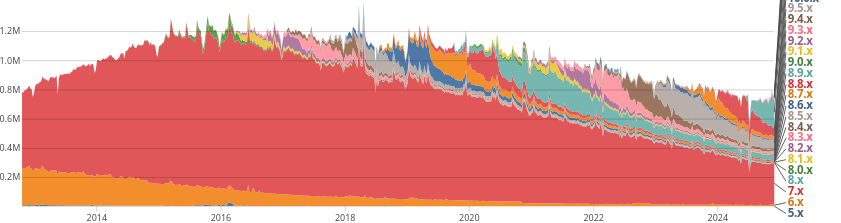
Conversations usually become more complicated when we introduce firmware, but should they? According to Wikipedia, Firmware is software that provides low-level control of computing device hardware, and basically anything that's generally described as firmware certainly fits into the "software" side of the above hardware/software binary. From a software freedom perspective, this seems like something where the obvious answer to "Should this be free" is "yes", but it's worth thinking about why the answer is yes - the goal of free software isn't freedom for freedom's sake, but because the freedoms embodied in the Free Software Definition (and by proxy the DFSG) are grounded in real world practicalities.

How do these line up for firmware? Firmware can fit into two main classes - it can be something that's responsible for initialisation of the hardware (such as, historically, BIOS, which is involved in initialisation and boot and then largely irrelevant for runtime[1]) or it can be something that makes the hardware work at runtime (wifi card firmware being an obvious example). The role of free software in the latter case feels fairly intuitive, since the interface and functionality the hardware offers to the operating system is frequently largely defined by the firmware running on it. Your wifi chipset is, these days, largely a software defined radio, and what you can do with it is determined by what the firmware it's running allows you to do. Sometimes those restrictions may be required by law, but other times they're simply because the people writing the firmware aren't interested in supporting a feature - they may see no reason to allow raw radio packets to be provided to the OS, for instance. We also shouldn't ignore the fact that sufficiently complicated firmware exposed to untrusted input (as is the case in most wifi scenarios) may contain exploitable vulnerabilities allowing attackers to gain arbitrary code execution on the wifi chipset - and potentially use that as a way to gain control of the host OS (see this writeup for an example). Vendors being in a unique position to update that firmware means users may never receive security updates, leaving them with a choice between discarding hardware that otherwise works perfectly or leaving themselves vulnerable to known security issues.

But even the cases where firmware does nothing other than initialise the hardware cause problems. A lot of hardware has functionality controlled by registers that can be locked during the boot process. Vendor firmware may choose to disable (or, rather, never to enable) functionality that may be beneficial to a user, and then lock out the ability to reconfigure the hardware later. Without any ability to modify that firmware, the user lacks the freedom to choose what functionality their hardware makes available to them. Again, the ability to inspect this firmware and modify it has a distinct benefit to the user.

So, from a practical perspective, I think there's a strong argument that users would benefit from most (if not all) firmware being free software, and I don't think that's an especially controversial argument. So I think this is less of a philosophical discussion, and more of a strategic one - is spending time focused on ensuring firmware is free worthwhile, and if so what's an appropriate way of achieving this?

I think there's two consistent ways to view this. One is to view free firmware as desirable but not necessary. This approach basically argues that code that's running on hardware that isn't the main CPU would benefit from being free, in the same way that code running on a remote network service would benefit from being free, but that this is much less important than ensuring that all the code running in the context of the OS on the primary CPU is free. The maximalist position is not to compromise at all - all software on a system, whether it's running at boot or during runtime, and whether it's running on the primary CPU or any other component on the board, should be free.

Personally, I lean towards the former and think there's a reasonably coherent argument here. I think users would benefit from the ability to modify the code running on hardware that their OS talks to, in the same way that I think users would benefit from the ability to modify the code running on hardware the other side of a network link that their browser talks to. I also think that there's enough that remains to be done in terms of what's running on the host CPU that it's not worth having that fight yet. But I think the latter is absolutely intellectually consistent, and while I don't agree with it from a pragmatic perspective I think things would undeniably be better if we lived in that world.

This feels like a thing you'd expect the Free Software Foundation to have opinions on, and it does! There are two primarily relevant things - the Respects your Freedoms campaign focused on ensuring that certified hardware meets certain requirements (including around firmware), and the Free System Distribution Guidelines, which define a baseline for an OS to be considered free by the FSF (including requirements around firmware).

RYF requires that all software on a piece of hardware be free other than under one specific set of circumstances. If software runs on (a) a secondary processor and (b) within which software installation is not intended after the user obtains the product, then the software does not need to be free. (b) effectively means that the firmware has to be in ROM, since any runtime interface that allows the firmware to be loaded or updated is intended to allow software installation after the user obtains the product.

The Free System Distribution Guidelines require that all non-free firmware be removed from the OS before it can be considered free. The recommended mechanism to achieve this is via linux-libre, a project that produces tooling to remove anything that looks plausibly like a non-free firmware blob from the Linux source code, along with any incitement to the user to load firmware - including even removing suggestions to update CPU microcode in order to mitigate CPU vulnerabilities.

For hardware that requires non-free firmware to be loaded at runtime in order to work, linux-libre doesn't do anything to work around this - the hardware will simply not work. In this respect, linux-libre reduces the amount of non-free firmware running on a system in the same way that removing the hardware would. This presumably encourages users to purchase RYF compliant hardware.

But does that actually improve things? RYF doesn't require that a piece of hardware have no non-free firmware, it simply requires that any non-free firmware be hidden from the user. CPU microcode is an instructive example here. At the time of writing, every laptop listed here has an Intel CPU. Every Intel CPU has microcode in ROM, typically an early revision that is known to have many bugs. The expectation is that this microcode is updated in the field by either the firmware or the OS at boot time - the updated version is loaded into RAM on the CPU, and vanishes if power is cut. The combination of RYF and linux-libre doesn't reduce the amount of non-free code running inside the CPU, it just means that the user (a) is more likely to hit since-fixed bugs (including security ones!), and (b) has less guidance on how to avoid them.

As long as RYF permits hardware that makes use of non-free firmware I think it hurts more than it helps. In many cases users aren't guided away from non-free firmware - instead it's hidden away from them, leaving them less aware that their freedom is constrained. Linux-libre goes further, refusing to even inform the user that the non-free firmware that their hardware depends on can be upgraded to improve their security.

Out of sight shouldn't mean out of mind. If non-free firmware is a threat to user freedom then allowing it to exist in ROM doesn't do anything to solve that problem. And if it isn't a threat to user freedom, then what's the point of requiring linux-libre for a Linux distribution to be considered free by the FSF? We seem to have ended up in the worst case scenario, where nothing is being done to actually replace any of the non-free firmware running on people's systems and where users may even end up with a reduced awareness that the non-free firmware even exists.

[1] Yes yes SMM

comment count unavailable comments

9 December 2024

Gunnar Wolf: Some tips for those who still administer Drupal7-based sites

A bit of history: Drupal at my workplace (and in Debian) My main day-to-day responsibility in my workplace is, and has been for 20 years, to take care of the network infrastructure for UNAM s Economics Research Institute. One of the most visible parts of this responsibility is to ensure we have a working Web presence, and that it caters for the needs of our academic community. I joined the Institute in January 2005. Back then, our designer pushed static versions of our webpage, completely built in her computer. This was standard practice at the time, and lasted through some redesigns, but I soon started advocating for the adoption of a Content Management System. After evaluating some alternatives, I recommended adopting Drupal. It took us quite a bit to do the change: even though I clearly recall starting work toward adopting it as early as 2006, according to the Internet Archive, we switched to a Drupal-backed site around June 2010. We started using it somewhere in the version 6 s lifecycle. As for my Debian work, by late 2012 I started getting involved in the maintenance of the drupal7 package, and by April 2013 I became its primary maintainer. I kept the drupal7 package up to date in Debian until 2018; the supported build methods for Drupal 8 are not compatible with Debian (mainly, bundling third-party libraries and updating them without coordination with the rest of the ecosystem), so towards the end of 2016, I announced I would not package Drupal 8 for Debian. By March 2016, we migrated our main page to Drupal 7. By then, we already had several other sites for our academics projects, but my narrative follows our main Web site. I did manage to migrate several Drupal 6 (D6) sites to Drupal 7 (D7); it was quite involved process, never transparent to the user, and we did have the backlash of long downtimes (or partial downtimes, with sites half-available only) with many of our users. For our main site, we took the opportunity to do a complete redesign and deployed a fully new site. You might note that March 2016 is after the release of D8 (November 2015). I don t recall many of the specifics for this decision, but if I m not mistaken, building the new site was a several months long process not only for the technical work of setting it up, but for the legwork of getting all of the needed information from the different areas that need to be represented in the Institute. Not only that: Drupal sites often include tens of contributed themes and modules; the technological shift the project underwent between its 7 and 8 releases was too deep, and modules took a long time (if at all many themes and modules were outright dumped) to become available for the new release. Naturally, the Drupal Foundation wanted to evolve and deprecate the old codebase. But the pain to migrate from D7 to D8 is too big, and many sites have remained under version 7 Eight years after D8 s release, almost 40% of Drupal installs are for version 7, and a similar proportion runs a currently-supported release (10 or 11). And while the Drupal Foundation made a great job at providing very-long-term support for D7, I understand the burden is becoming too much, so close to a year ago (and after pushing several times the D7, they finally announced support will finish this upcoming January 5.

Drupal 7 must go! I found the following usage graphs quite interesting: the usage statistics for all Drupal versions follows a very positive slope, peaking around 2014 during the best years of D7, and somewhat stagnating afterwards, staying since 2015 at the 25000 28000 sites mark (I m very tempted to copy the graphs, but builtwith s terms of use are very clear in not allowing it). There is a sharp drop in the last year I attribute it to the people that are leaving D7 for other technologies after its end-of-life announcement. This becomes clearer looking only at D7 s usage statistics: D7 peaks at 15000 installs in 2016 stays there for close to 5 years, and has a sharp drop to under 7500 sites in the span of one year. D8 has a more regular rise, peak and fall peaking at ~8500 between 2020 and 2021, and down to close to 2500 for some months already; D9 has a very brief peak of almost 9000 sites in 2023 and is now close to half of it. Currently, the Drupal king appears to be D10, still on a positive slope and with over 9000 sites. Drupal 11 is still just a blip in builtwith s radar, with 3 registered sites as of September 2024 :- After writing this last paragraph, I came across the statistics found in the Drupal webpage; the methodology for acquiring its data is completely different: while builtwith s methodology is their trade secret, you can read more about how Drupal s data is gathered (and agree or disagree with it , but at least you have a page detailing 12 years so far of reported data, producing the following graph (which can be shared under the CC BY-SA license ): Drupal usage statistics by version 2013 2024 This graph is disgregated into minor versions, and I don t want to come up with yet another graph for it but it supports (most of) the narrative I presented above although I do miss the recent drop builtwith reported in D7 s numbers!
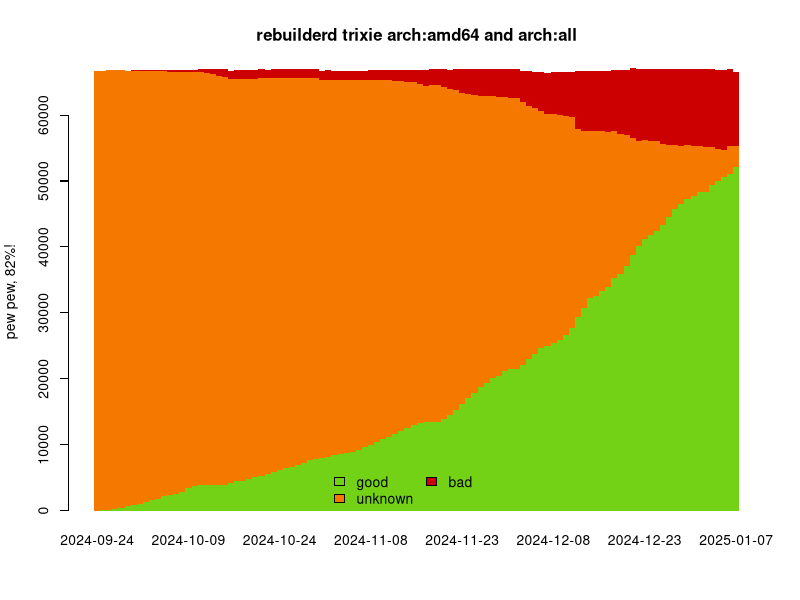
And what about Backdrop? During the D8 release cycle, a group of Drupal developers were not happy with the depth of the architectural changes that were being adopted, particularly the transition to the Symfony PHP component framework, and forked the D7 codebase to create the Backdrop CMS, a modern version of Drupal, without dropping the known and tested architecture it had. The Backdrop developers keep working closely together with the Drupal community, and although its usage numbers are way smaller than Drupal s, seems to be sustainable and lively. Of course, as I presented their numbers in the previous section, you can see Backdrop s numbers in builtwith are way, way lower. I have found it to be a very warm and welcoming community, eager to receive new members. And, thanks to its contributed D2B Migrate module, I found it is quite easy to migrate a live site from Drupal 7 to Backdrop.

Migration by playbook! So Well, I m an academic. And (if it s not obvious to you after reading so far ), one of the things I must do in my job is to write. So I decided to write an article to invite my colleagues to consider Backdrop for their D7 sites in Cuadernos T cnicos Universitarios de la DGTIC, a young journal in our university for showcasing technical academical work. And now that my article got accepted and published, I m happy to share it with you of course, if you can read Spanish But anyway Given I have several sites to migrate, and that I m trying to get my colleagues to follow suite, I decided to automatize the migration by writing an Ansible playbook to do the heavy lifting. Of course, the playbook s users will probably need to tweak it a bit to their personal needs. I m also far from an Ansible expert, so I m sure there is ample room fo improvement in my style. But it works. Quite well, I must add.

But with this size of database I did stumble across a big pebble, though. I am working on the migration of one of my users sites, and found that its database is huge. I checked the mysqldump output, and it got me close to 3GB of data. And given the D2B_migrate is meant to work via a Web interface (my playbook works around it by using a client I wrote with Perl s WWW::Mechanize), I repeatedly stumbled with PHP s maximum POST size, maximum upload size, maximum memory size I asked for help in Backdrop s Zulip chat site, and my attention was taken off fixing PHP to something more obvious: Why is the database so large? So I took a quick look at the database (or rather: my first look was at the database server s filesystem usage). MariaDB stores each table as a separate file on disk, so I looked for the nine largest tables:
# ls -lhS head
total 3.8G
-rw-rw---- 1 mysql mysql 2.4G Dec 10 12:09 accesslog.ibd
-rw-rw---- 1 mysql mysql 224M Dec  2 16:43 search_index.ibd
-rw-rw---- 1 mysql mysql 220M Dec 10 12:09 watchdog.ibd
-rw-rw---- 1 mysql mysql 148M Dec  6 14:45 cache_field.ibd
-rw-rw---- 1 mysql mysql  92M Dec  9 05:08 aggregator_item.ibd
-rw-rw---- 1 mysql mysql  80M Dec 10 12:15 cache_path.ibd
-rw-rw---- 1 mysql mysql  72M Dec  2 16:39 search_dataset.ibd
-rw-rw---- 1 mysql mysql  68M Dec  2 13:16 field_revision_field_idea_principal_articulo.ibd
-rw-rw---- 1 mysql mysql  60M Dec  9 13:19 cache_menu.ibd
A single table, the access log, is over 2.4GB long. The three following tables are, cache tables. I can perfectly live without their data in our new site! But I don t want to touch the slightest bit of this site until I m satisfied with the migration process, so I found a way to exclude those tables in a non-destructive way: given D2B_migrate works with a mysqldump output, and given that mysqldump locks each table before starting to modify it and unlocks it after its job is done, I can just do the following:
$ perl -e '$output = 1; while (<>)   $output=0 if /^LOCK TABLES  (accesslog search_index watchdog cache_field cache_path) /; $output=1 if /^UNLOCK TABLES/; print if $output ' < /tmp/d7_backup.sql  > /tmp/d7_backup.eviscerated.sql; ls -hl /tmp/d7_backup.sql /tmp/d7_backup.eviscerated.sql
-rw-rw-r-- 1 gwolf gwolf 216M Dec 10 12:22 /tmp/d7_backup.eviscerated.sql
-rw------- 1 gwolf gwolf 2.1G Dec  6 18:14 /tmp/d7_backup.sql
Five seconds later, I m done! The database is now a tenth of its size, and D2B_migrate is happy to take it. And I m a big step closer to finishing my reliance on (this bit of) legacy code for my highly-visible sites

Next.

Previous.