Search Results: "anbe"

11 August 2017

Dirk Eddelbuettel: #8: Customizing Spell Checks for R CMD check

Welcome to the eight post in the ramblingly random R rants series, or R4 for short. We took a short break over the last few weeks due to some conferencing followed by some vacationing and general chill. But we're back now, and this post gets us back to initial spirit of (hopefully) quick and useful posts. Perusing yesterday's batch of CRANberries posts, I noticed a peculiar new directory shown the in the diffstat output we use to compare two subsequent source tarballs. It was entitled .aspell/, in the top-level directory, and in two new packages by R Core member Kurt Hornik himself. The context is, of course, the not infrequently-expressed desire to customize the spell checking done on CRAN incoming packages, see e.g. this r-package-devel thread. And now we can as I verified with (the upcoming next release of) RcppArmadillo, along with a recent-enough (i.e. last few days) version of r-devel. Just copying what Kurt did, i.e. adding a file .aspell/defaults.R, and in it pointing to rds file (named as the package) containing a character vector with words added to the spell checker's universe is all it takes. For my package, see here for the peculiars. Or see here:
edd@bud:~/git/rcpparmadillo/.aspell(master)$ cat defaults.R 
Rd_files <- vignettes <- R_files <- description <-
    list(encoding = "UTF-8",
         language = "en",
         dictionaries = c("en_stats", "RcppArmadillo"))
edd@bud:~/git/rcpparmadillo/.aspell(master)$ r -p -e 'readRDS("RcppArmadillo.rds")'
[1] "MPL"            "Sanderson"      "Templated"
[4] "decompositions" "onwards"        "templated"
edd@bud:~/git/rcpparmadillo/.aspell(master)$     
And now R(-devel) CMD check --as-cran ... is silent about spelling. Yay! But take this with a grain of salt as this does not yet seem to be "announced" as e.g. yesterday's change in the CRAN Policy did not mention it. So things may well change -- but hey, it worked for me. And this all is about aspell, here is something topical about a spell to close the post:

This post by Dirk Eddelbuettel originated on his Thinking inside the box blog. Please report excessive re-aggregation in third-party for-profit settings.

4 August 2017

Dirk Eddelbuettel: R for System Adminstration

Just getting back from the most fun meetup I have been to in quite some time: episode 23 (by their count) of Open Source Open Mic hosted by Matt Godbolt and Joe Walnes here in Chicago. Nothing but a sequence of lightning talks. Plus beer and pizza. Sounds awesome? It was! We had fantastic talks across at least half a dozen languages, covering both new-ish (Pony) and interesting ones such (Rust, Go, ...) plus of course some Javascript and some Python, no Java (yay!) and a few batshit crazy things like a self-hosting database in its own (shell) code, a terminal gif viewer (!!), and more. And it gave me an opportunity to quickly (one evening and morning commute) jam out a presentation about what is in the title: R for system administration. And I am only half-joking. I had used R a couple of years ago when I needed to select, subset, modify, ... a large number of image files given some timestamp and filename patterns. And given how well R works in a vectorised manner with both regular expressions and timestamps, as well as on top of essentially all standard POSIX-style operating system / file-system functions, I picked up that thread again on the problem of ... cleaning up the file storage underlying CRANberries which by now has well over fifty-seven thousand (!!) tarballs of CRAN packages based on now ten years of CRANberries. So I showed how to prune this in essentially half a dozen lines of R (and data.table code), plus some motivation---all just right for a lightning talk. Seemingly the talk went well enough as quite a few folks gave a thumbs up and compliments over beers afterwards. But see for yourself as the slides are now uploaded to my standard talks page. My thanks to Matt and Joe for organizing the meetup. I think I will be back.

15 July 2017

Dirk Eddelbuettel: Rcpp 0.12.12: Rounding some corners

The twelveth update in the 0.12.* series of Rcpp landed on CRAN this morning, following two days of testing at CRAN preceded by five full reverse-depends checks we did (and which are always logged in this GitHub repo). The Debian package has been built and uploaded; Windows and macOS binaries should follow at CRAN as usual. This 0.12.12 release follows the 0.12.0 release from late July, the 0.12.1 release in September, the 0.12.2 release in November, the 0.12.3 release in January, the 0.12.4 release in March, the 0.12.5 release in May, the 0.12.6 release in July, the 0.12.7 release in September, the 0.12.8 release in November, the 0.12.9 release in January, the 0.12.10.release in March, and the 0.12.11.release in May making it the sixteenth release at the steady and predictable bi-montly release frequency. Rcpp has become the most popular way of enhancing GNU R with C or C++ code. As of today, 1097 packages (and hence 71 more since the last release in May) on CRAN depend on Rcpp for making analytical code go faster and further, along with another 91 in BioConductor. This releases contain a fairly large number of fairly small and focused pull requests most of which either correct some corner cases or improve other aspects. JJ tirelessly improved the package registration added in the previous release and following R 3.4.0. Kirill tidied up a number of small issues allowing us to run compilation in even more verbose modes---usually a good thing. Jeroen, Elias Pipping and Yo Gong all contributed as well, and we thank everybody for their contributions. All changes are listed below in some detail.

Changes in Rcpp version 0.12.12 (2017-07-13)
  • Changes in Rcpp API:
    • The tinyformat.h header now ends in a newline (#701).
    • Fixed rare protection error that occurred when fetching stack traces during the construction of an Rcpp exception (Kirill M ller in #706).
    • Compilation is now also possibly on Haiku-OS (Yo Gong in #708 addressing #707).
    • Dimension attributes are explicitly cast to int (Kirill M ller in #715).
    • Unused arguments are no longer declared (Kirill M ller in #716).
    • Visibility of exported functions is now supported via the R macro atttribute_visible (Jeroen Ooms in #720).
    • The no_init() constructor accepts R_xlen_t (Kirill M ller in #730).
    • Loop unrolling used R_xlen_t (Kirill M ller in #731).
    • Two unused-variables warnings are now avoided (Jeff Pollock in #732).
  • Changes in Rcpp Attributes:
    • Execute tools::package_native_routine_registration_skeleton within package rather than current working directory (JJ in #697).
    • The R portion no longer uses dir.exists to no require R 3.2.0 or newer (Elias Pipping in #698).
    • Fix native registration for exports with name attribute (JJ in #703 addressing #702).
    • Automatically register init functions for Rcpp Modules (JJ in #705 addressing #704).
    • Add Shield around parameters in Rcpp::interfaces (JJ in #713 addressing #712).
    • Replace dot (".") with underscore ("_") in package names when generating native routine registrations (JJ in #722 addressing #721).
    • Generate C++ native routines with underscore ("_") prefix to avoid exporting when standard exportPattern is used in NAMESPACE (JJ in #725 addressing #723).

Thanks to CRANberries, you can also look at a diff to the previous release. As always, even fuller details are on the Rcpp Changelog page and the Rcpp page which also leads to the downloads page, the browseable doxygen docs and zip files of doxygen output for the standard formats. A local directory has source and documentation too. Questions, comments etc should go to the rcpp-devel mailing list off the R-Forge page.

This post by Dirk Eddelbuettel originated on his Thinking inside the box blog. Please report excessive re-aggregation in third-party for-profit settings.

22 June 2017

Dirk Eddelbuettel: nanotime 0.2.0

A new version of the nanotime package for working with nanosecond timestamps just arrived on CRAN. nanotime uses the RcppCCTZ package for (efficient) high(er) resolution time parsing and formatting up to nanosecond resolution, and the bit64 package for the actual integer64 arithmetic. Thanks to a metric ton of work by Leonardo Silvestri, the package now uses S4 classes internally allowing for greater consistency of operations on nanotime objects.

Changes in version 0.2.0 (2017-06-22)
  • Rewritten in S4 to provide more robust operations (#17 by Leonardo)
  • Ensure tz="" is treated as unset (Leonardo in #20)
  • Added format and tz arguments to nanotime, format, print (#22 by Leonardo and Dirk)
  • Ensure printing respect options()$max.print, ensure names are kept with vector (#23 by Leonardo)
  • Correct summary() by defining names<- (Leonardo in #25 fixing #24)
  • Report error on operations that are meaningful for type; handled NA, NaN, Inf, -Inf correctly (Leonardo in #27 fixing #26)

We also have a diff to the previous version thanks to CRANberries. More details and examples are at the nanotime page; code, issue tickets etc at the GitHub repository.

This post by Dirk Eddelbuettel originated on his Thinking inside the box blog. Please report excessive re-aggregation in third-party for-profit settings.

Dirk Eddelbuettel: RcppCCTZ 0.2.3 (and 0.2.2)

A new minor version 0.2.3 of RcppCCTZ is now on CRAN. RcppCCTZ uses Rcpp to bring CCTZ to R. CCTZ is a C++ library for translating between absolute and civil times using the rules of a time zone. In fact, it is two libraries. One for dealing with civil time: human-readable dates and times, and one for converting between between absolute and civil times via time zones. The RcppCCTZ page has a few usage examples and details. This version ensures that we set the TZDIR environment variable correctly on the old dreaded OS that does not come with proper timezone information---an issue which had come up while preparing the next (and awesome, trust me) release of nanotime. It also appears that I failed to blog about 0.2.2, another maintenance release, so changes for both are summarised next.

Changes in version 0.2.3 (2017-06-19)
  • On Windows, the TZDIR environment variable is now set in .onLoad()
  • Replaced init.c with registration code inside of RcppExports.cpp thanks to Rcpp 0.12.11.

Changes in version 0.2.2 (2017-04-20)
  • Synchronized with upstream CCTZ
  • The time_point object is instantiated explicitly for nanosecond use which appears to be required on macOS

We also have a diff to the previous version thanks to CRANberries. More details are at the RcppCCTZ page; code, issue tickets etc at the GitHub repository.

This post by Dirk Eddelbuettel originated on his Thinking inside the box blog. Please report excessive re-aggregation in third-party for-profit settings.

6 June 2017

Dirk Eddelbuettel: anytime 0.3.0

A new version of the anytime package is now on CRAN. It marks the eleventh release since the inaugural version late last summer. anytime is a very focused package aiming to do just one thing really well: to convert anything in integer, numeric, character, factor, ordered, ... format to either POSIXct or Date objects -- and to do so without requiring a format string. See the anytime page, or the GitHub README.md for a few examples. This release brings a little more consistency to how numeric or integer arguments are handled. Previously, we were overly eager in accepting something such as 20150605 (i.e. today) as a (numerical or integer) input to both anytime() and anydate(). That is well-intentioned, but ultimately foolish. We relied on heuristic cutoffs to determine whether input was "meant to be" a date or time offset. There lies madness. We now differentiate whether we were called via anytime() (in which case numerical data is second offset to the epoch, just as.POSICct()) or anytime() (in which case it is days offset to the (date) epoch, just like as.Date()). The previous behaviour can be restored via a options, both function-local as well as global are supported. And of course, there is no change for all other (and more common) input formats, notably character or factor. A full list of changes follows.

Changes in anytime version 0.3.0 (2017-06-05)
  • Numeric input is now always an offset to epoch, with anytime() using seconds, and anydate() using dates. (#65 fixing #63).
  • Old behaviour can be re-enabled with an option also supporting a global setting getOption("anytimeOldHeuristic")
  • RStudio versions 1.1.129 or later can run all functions without fear of crashing due to a change in their use of Boost.
  • Replaced init.c with registration code inside of RcppExports.cpp thanks to Rcpp 0.12.11.

Courtesy of CRANberries, there is a comparison to the previous release. More information is on the anytime page. For questions or comments use the issue tracker off the GitHub repo.

This post by Dirk Eddelbuettel originated on his Thinking inside the box blog. Please report excessive re-aggregation in third-party for-profit settings.

4 June 2017

Dirk Eddelbuettel: RcppArmadillo 0.7.900.2.0

armadillo image The new RcppArmadillo release 0.7.900.2.0 is now on CRAN, and the Debian package was just updated as well. Armadillo is a powerful and expressive C++ template library for linear algebra aiming towards a good balance between speed and ease of use with a syntax deliberately close to a Matlab. RcppArmadillo integrates this library with the R environment and language--and is widely used by (currently) 350 other packages on CRAN---an increase of 32 since the last CRAN release of 0.7.800.2.0 in April! With the 7.900.* series of Armadillo, Conrad has started to more fully utilize OpenMP (also see Wikipedia on OpenMP) for operations that can be parallelized. To use this in your package you need to update its src/Makevars ,.win file similarly to what the skeleton default now uses
PKG_CXXFLAGS = $(SHLIB_OPENMP_CXXFLAGS) 
PKG_LIBS = $(SHLIB_OPENMP_CFLAGS) $(LAPACK_LIBS) $(BLAS_LIBS) $(FLIBS)
and you may want to enable C++11 while you are at it---though this may pose issues with older-than-ancient RHEL installations which are still (way too) pervasive so we do not do it by default (yet). Here, we once again rely on the build infrastructure automagically provided by R itself: if and when OpenMP is available, R will use it via $(SHLIB_OPENMP_CXXFLAGS) etc; see the fine WRE manual for details. That said, some operating systems make this harder than other, and macOS usually takes the crown. See for example this blog post by James for surviving in that environment. I am a little short of details because on Linux these things just work, and have for well over a decade. The rcpp-devel mailing list will be the best place for questions. Changes in this release relative to the previous CRAN release are as follows:

Changes in RcppArmadillo version 0.7.900.2.0 (2017-06-02)
  • Upgraded to Armadillo release 7.900.2 (Evil Banana Republic)
    • Expanded clamp() to handle cubes
    • Computationally expensive element-wise functions (such as exp(), log(), cos(), etc) can now be automatically sped up via OpenMP; this requires a C++11/C++14 compiler with OpenMP 3.0+ support for GCC and clang compilers
    • One caveat: when using GCC, use of -march=native in conjunction with -fopenmp may lead to speed regressions on recent processors
  • Added gcc 7 to support compiler check (James Balamuta in #128 addressing #126).
  • A unit test helper function for rmultinom was corrected (#133).
  • OpenMP support was added to the skeleton helper in inline.R

Courtesy of CRANberries, there is a diffstat report. More detailed information is on the RcppArmadillo page. Questions, comments etc should go to the rcpp-devel mailing list off the R-Forge page.

This post by Dirk Eddelbuettel originated on his Thinking inside the box blog. Please report excessive re-aggregation in third-party for-profit settings.

23 May 2017

Dirk Eddelbuettel: Rcpp 0.12.11: Loads of goodies

The elevent update in the 0.12.* series of Rcpp landed on CRAN yesterday following the initial upload on the weekend, and the Debian package and Windows binaries should follow as usual. The 0.12.11 release follows the 0.12.0 release from late July, the 0.12.1 release in September, the 0.12.2 release in November, the 0.12.3 release in January, the 0.12.4 release in March, the 0.12.5 release in May, the 0.12.6 release in July, the 0.12.7 release in September, the 0.12.8 release in November, the 0.12.9 release in January, and the 0.12.10.release in March --- making it the fifteenth release at the steady and predictable bi-montly release frequency. Rcpp has become the most popular way of enhancing GNU R with C or C++ code. As of today, 1026 packages on CRAN depend on Rcpp for making analytical code go faster and further, along with another 91 in BioConductor. This releases follows on the heels of R's 3.4.0 release and addresses on or two issues from the transition, along with a literal boatload of other fixes and enhancements. James "coatless" Balamuta was once restless in making the documentation better, Kirill Mueller addressed a number of more obscure compiler warnings (triggered under under -Wextra and the like), Jim Hester improved excecption handling, and much more mostly by the Rcpp Core team. All changes are listed below in some detail. One big change that JJ made is that Rcpp Attributes also generate the now-almost-required package registration. (For background, I blogged about this one, two, three times.) We tested this, and do not expect it to throw curveballs. If you have an existing src/init.c, or if you do not have registration set in your NAMESPACE. It should cover most cases. But one never knows, and one first post-release buglet related to how devtools tests things has already been fixed in this PR by JJ.

Changes in Rcpp version 0.12.11 (2017-05-20)
  • Changes in Rcpp API:
    • Rcpp::exceptions can now be constructed without a call stack (Jim Hester in #663 addressing #664).
    • Somewhat spurious compiler messages under very verbose settings are now suppressed (Kirill Mueller in #670, #671, #672, #687, #688, #691).
    • Refreshed the included tinyformat template library (James Balamuta in #674 addressing #673).
    • Added printf-like syntax support for exception classes and variadic templating for Rcpp::stop and Rcpp::warning (James Balamuta in #676).
    • Exception messages have been rewritten to provide additional information. (James Balamuta in #676 and #677 addressing #184).
    • One more instance of Rf_mkString is protected from garbage collection (Dirk in #686 addressing #685).
    • Two exception specification that are no longer tolerated by g++-7.1 or later were removed (Dirk in #690 addressing #689)
  • Changes in Rcpp Documentation:
  • Changes in Rcpp Sugar:
    • Added sugar function trimws (Nathan Russell in #680 addressing #679).
  • Changes in Rcpp Attributes:
    • Automatically generate native routine registrations (JJ in #694)
    • The plugins for C++11, C++14, C++17 now set the values R 3.4.0 or later expects; a plugin for C++98 was added (Dirk in #684 addressing #683).
  • Changes in Rcpp support functions:
    • The Rcpp.package.skeleton() function now creates a package registration file provided R 3.4.0 or later is used (Dirk in #692)

Thanks to CRANberries, you can also look at a diff to the previous release. As always, even fuller details are on the Rcpp Changelog page and the Rcpp page which also leads to the downloads page, the browseable doxygen docs and zip files of doxygen output for the standard formats. A local directory has source and documentation too. Questions, comments etc should go to the rcpp-devel mailing list off the R-Forge page.

This post by Dirk Eddelbuettel originated on his Thinking inside the box blog. Please report excessive re-aggregation in third-party for-profit settings.

7 May 2017

Dirk Eddelbuettel: RInside 0.2.14

A new release 0.2.14 of RInside is now on CRAN and in Debian. RInside provides a set of convenience classes which facilitate embedding of R inside of C++ applications and programs, using the classes and functions provided by Rcpp. It has been nearly two years since the last release, and a number of nice extensions, build robustifications and fixes had been submitted over this period---see below for more. The only larger and visible extension is both a new example and some corresponding internal changes to allow a readline prompt in an RInside application, should you desire it. RInside is stressing the CRAN system a little in that it triggers a number of NOTE and WARNING messages. Some of these are par for the course as we get close to R internals not all of which are "officially" in the API. This lead to the submission sitting a little longer than usual in incoming queue. Going forward we may need to find a way to either sanction these access point, whitelist them or, as a last resort, take the package off CRAN. Time will tell. Changes since the last release were:

Changes in RInside version 0.2.14 (2017-04-28)
  • Interactive mode can use readline REPL ( ukasz aniewski-Wo k in #25, and Dirk in #26)
  • Windows macros checks now uses _WIN32 (Kevin Ushey in #22)
  • The wt example now links with libboost_system
  • The Makevars file is now more robist (Mattias Ellert in #21)
  • A problem with empty environment variable definitions on Windows was addressed (Jeroen Ooms in #17 addressing #16)
  • HAVE_UINTPTR_T is defined only if not already defined
  • Travis CI is now driven via run.sh from our forked r-travis

CRANberries also provides a short report with changes from the previous release. More information is on the RInside page. Questions, comments etc should go to the rcpp-devel mailing list off the Rcpp R-Forge page, or to issues tickets at the GitHub repo.

This post by Dirk Eddelbuettel originated on his Thinking inside the box blog. Please report excessive re-aggregation in third-party for-profit settings.

6 May 2017

Dirk Eddelbuettel: x13binary 1.1.39-1

The US Census Bureau released a new build 1.1.39 of their X-13ARIMA-SEATS program, released as binary and source. So Christoph and went to work and updated our x13binary package on CRAN. The x13binary package takes the pain out of installing X-13ARIMA-SEATS by making it a fully resolved CRAN dependency. For example, if you install the excellent seasonal package by Christoph, then X-13ARIMA-SEATS will get pulled in via the x13binary package and things just work: Depend on x13binary and on all relevant OSs supported by R, you should have an X-13ARIMA-SEATS binary installed which will be called seamlessly by the higher-level packages such as seasonal or gunsales. So now the full power of the what is likely the world's most sophisticated deseasonalization and forecasting package is now at your fingertips and the R prompt, just like any other of the 10,500+ CRAN packages. Not many packaging changes in this release besides updating the underlying builds, but we switched our versioning scheme to reflect that our releases are driven by the US Census Bureau releases. But thanks to an initial contribution by David Schaub we now support the 'armhf' architecture common on Chromebooks running Linux. Courtesy of CRANberries, there is also a diffstat report for this release.

This post by Dirk Eddelbuettel originated on his Thinking inside the box blog. Please report excessive re-aggregation in third-party for-profit settings.

Dirk Eddelbuettel: RcppEigen 0.3.3.3.0

A new RcppEigen release 0.3.3.3.0 was put into CRAN (and Debian) a few days ago. It brings Eigen 3.3.* to R. Once again, Yixuan Qiu did most of the heavy lifting over a multi-month period as some adjustments needed to be made in the package itself, along with coordination downstream. The complete NEWS file entry follows.

Changes in RcppEigen version 0.3.3.3.0 (2017-04-29)
  • Updated to version 3.3.3 of Eigen
  • Fixed incorrect function names in the examples, thanks to Ching-Chuan Chen
  • The class MappedSparseMatrix<T> has been deprecated since Eigen 3.3.0. The new structure Map<SparseMatrix<T> > should be used instead
  • Exporters for the new type Map<SparseMatrix<T> > were added
  • Travis CI is now driven via run.sh from our forked r-travis
Courtesy of CRANberries, there is also a diffstat report for the most recent release.

This post by Dirk Eddelbuettel originated on his Thinking inside the box blog. Please report excessive re-aggregation in third-party for-profit settings.

26 April 2017

Dirk Eddelbuettel: RcppTOML 0.1.3

A bug fix release of RcppTOML arrived on CRAN today. Table arrays were (wrongly) not allowing for nesting; a simply recursion fix addresses this. RcppTOML brings TOML to R. TOML is a file format that is most suitable for configurations, as it is meant to be edited by humans but read by computers. It emphasizes strong readability for humans while at the same time supporting strong typing as well as immediate and clear error reports. On small typos you get parse errors, rather than silently corrupted garbage. Much preferable to any and all of XML, JSON or YAML -- though sadly these may be too ubiquitous now. TOML is making good inroads with newer and more flexible projects such as the Hugo static blog compiler, or the Cargo system of Crates (aka "packages") for the Rust language.

Changes in version 0.1.3 (2017-04-25)
  • Nested TableArray types are now correctly handled (#16)

Courtesy of CRANberries, there is a diffstat report for this release. More information is on the RcppTOML page page. Issues and bugreports should go to the GitHub issue tracker.

This post by Dirk Eddelbuettel originated on his Thinking inside the box blog. Please report excessive re-aggregation in third-party for-profit settings.

21 April 2017

Dirk Eddelbuettel: Rblpapi 0.3.6

Time for a new release of Rblpapi -- version 0.3.6 is now on CRAN. Rblpapi provides a direct interface between R and the Bloomberg Terminal via the C++ API provided by Bloomberg Labs (but note that a valid Bloomberg license and installation is required). This is the seventh release since the package first appeared on CRAN last year. This release brings a very nice new function lookupSecurity() contributed by Kevin Jin as well as a number of small fixes and enhancements. Details below:

Changes in Rblpapi version 0.3.6 (2017-04-20)
  • bdh can now store in double preventing overflow (Whit and John in #205 closing #163)
  • bdp documentation has another ovveride example
  • A new function lookupSecurity can search for securities, optionally filtered by yellow key (Kevin Jin and Dirk in #216 and #217 closing #215)
  • Added file init.c with calls to R_registerRoutines() and R_useDynamicSymbols(); also use .registration=TRUE in useDynLib in NAMESPACE (Dirk in #220)
  • getBars and getTicks can now return data.table objects (Dirk in #221)
  • bds has improved internal protect logic via Rcpp::Shield (Dirk in #222)

Courtesy of CRANberries, there is also a diffstat report for the this release. As always, more detailed information is on the Rblpapi page. Questions, comments etc should go to the issue tickets system at the GitHub repo.

This post by Dirk Eddelbuettel originated on his Thinking inside the box blog. Please report excessive re-aggregation in third-party for-profit settings.

15 April 2017

Dirk Eddelbuettel: Rcpp now used by 1000 CRAN packages

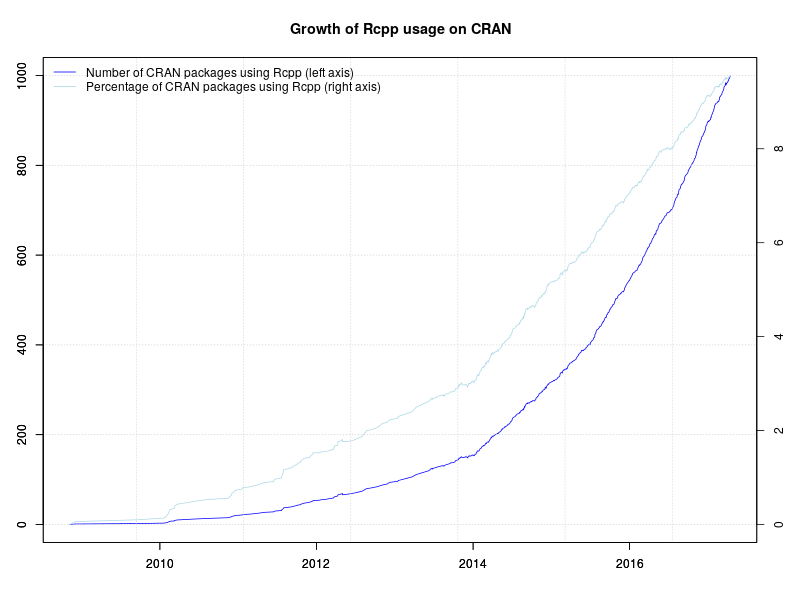
800 Rcpp packages Moments ago Rcpp passed a big milestone as there are now 1000 packages on CRAN depending on it (as measured by Depends, Imports and LinkingTo, but excluding Suggests). The graph is on the left depicts the growth of Rcpp usage over time. One easy way to compute such reverse dependency counts is the tools::dependsOnPkgs() function that was just mentioned in yesterday's R^4 blog post. Another way is to use the reverse_dependencies_with_maintainers() function from this helper scripts file on CRAN. Lastly, devtools has a function revdep() but it has the wrong default parameters as it includes Suggests: which you'd have to override to get the count I use here (it currently gets 1012 in this wider measure). Rcpp cleared 300 packages in November 2014. It passed 400 packages in June 2015 (when I only tweeted about it), 500 packages in late October 2015, 600 packages last March, 700 packages last July, 800 packages last October and 900 packages early January. The chart extends to the very beginning via manually compiled data from CRANberries and checked with crandb. The next part uses manually saved entries. The core (and by far largest) part of the data set was generated semi-automatically via a short script appending updates to a small file-based backend. A list of packages using Rcpp is kept on this page. Also displayed in the graph is the relative proportion of CRAN packages using Rcpp. The four per-cent hurdle was cleared just before useR! 2014 where I showed a similar graph (as two distinct graphs) in my invited talk. We passed five percent in December of 2014, six percent July of 2015, seven percent just before Christmas 2015, eight percent last summer, and nine percent mid-December 2016. Ten percent is next; we may get there during the summer. 1000 user packages is a really large number. This puts a whole lot of responsibility on us in the Rcpp team as we continue to keep Rcpp as performant and reliable as it has been. And with that a very big Thank You! to all users and contributors of Rcpp for help, suggestions, bug reports, documentation or, of course, code.

This post by Dirk Eddelbuettel originated on his Thinking inside the box blog. Please report excessive re-aggregation in third-party for-profit settings.

14 April 2017

Dirk Eddelbuettel: RcppArmadillo 0.7.800.2.0

armadillo image A new RcppArmadillo version 0.7.800.2.0 is now on CRAN. Armadillo is a powerful and expressive C++ template library for linear algebra aiming towards a good balance between speed and ease of use with a syntax deliberately close to a Matlab. RcppArmadillo integrates this library with the R environment and language--and is widely used by (currently) 318 other packages on CRAN -- an increase of 20 just since the last CRAN release of 0.7.600.1.0 in December! Changes in this release relative to the previous CRAN release are as follows:

Changes in RcppArmadillo version 0.7.800.2.0 (2017-04-12)
  • Upgraded to Armadillo release 7.800.2 (Rogue State Redux)
    • The Armadillo license changed to Apache License 2.0
  • The DESCRIPTION file now mentions the Apache License 2.0, as well as the former MPL2 license used for earlier releases.
  • A new file init.c was added with calls to R_registerRoutines() and R_useDynamicSymbols()
  • Symbol registration is enabled in useDynLib
  • The fastLm example was updated

Courtesy of CRANberries, there is a diffstat report. More detailed information is on the RcppArmadillo page. Questions, comments etc should go to the rcpp-devel mailing list off the R-Forge page.

This post by Dirk Eddelbuettel originated on his Thinking inside the box blog. Please report excessive re-aggregation in third-party for-profit settings.

7 April 2017

Dirk Eddelbuettel: #3: Follow R-devel

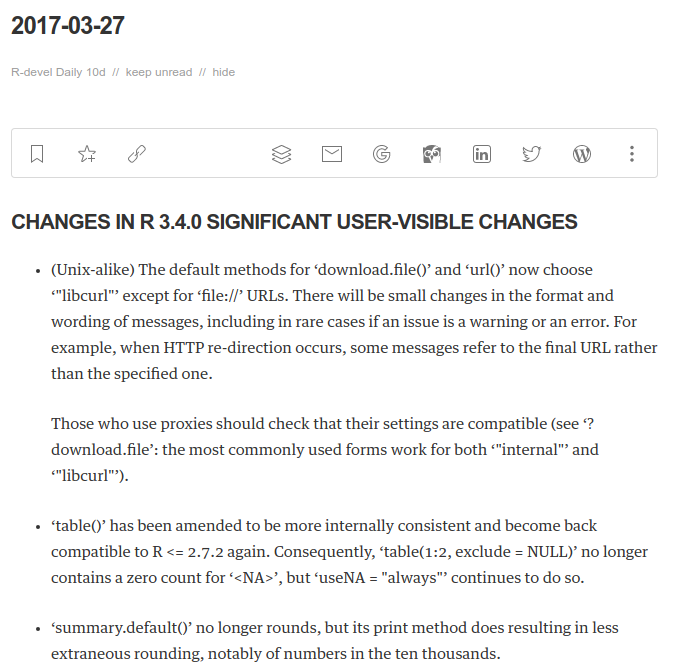
Welcome to the third post in the rarely relevant R recommendation series, or R4 for short. Today will be brief, but of some importance. In order to know where R is going next, few places provide a better vantage point than the actual ongoing development. A few years ago, I mentioned to Duncan Murdoch how straightforward the setup of my CRANberries feed (and site) was. After all, static blog compilers converting textual input to html, rss feed and whatnot have been around for fifteen years (though they keep getting reinvented). He took this to heart and built the (not too pretty) R-devel daily site (which also uses a fancy diff tool as it shows changes in NEWS) as well as a more general description of all available sub-feeds. I follow this mostly through blog aggregations -- Google Reader in its day, now Feedly. A screenshot is below just to show that it doesn't have to be ugly just because it is on them intertubes:
This shows a particularly useful day when R-devel folded into the new branch for what will be the R 3.4.0 release come April 21. The list of upcoming changes is truly impressive and quite comprehensive -- and the package registration helper, focus of posts #1 and #2 here, is but one of these many changes. One function I learned about that day is tools::CRAN_package_db(), a helper to get a single (large) data.frame with all package DESCRIPTION information. Very handy. Others may have noticed that CRAN repos now have a new top-level file PACKAGES.rds and this function does indeed just fetch it--which you could do with a similar one-liner in R-release as well. Still very handy. But do read about changes in R-devel and hence upcoming changes in R 3.4.0. Lots of good things coming our way.

This post by Dirk Eddelbuettel originated on his Thinking inside the box blog. Please report excessive re-aggregation in third-party for-profit settings.

3 April 2017

Dirk Eddelbuettel: RApiDatetime 0.0.3

A brown bag bug fix release 0.0.3 of RApiDatetime is now on CRAN. RApiDatetime provides six entry points for C-level functions of the R API for Date and Datetime calculations. The functions asPOSIXlt and asPOSIXct convert between long and compact datetime representation, formatPOSIXlt and Rstrptime convert to and from character strings, and POSIXlt2D and D2POSIXlt convert between Date and POSIXlt datetime. These six functions are all fairly essential and useful, but not one of them was previously exported by R. I left two undefined variables in calls in the exported header file; this only become an issue once I actually tried accessing the API from another package as I am now doing in anytime.

Changes in RApiDatetime version 0.0.3 (2017-04-02)
  • Correct two simple copy-and-paste errors in RApiDatetime.h
  • Also enable registration in useDynLib, and explicitly export known and documented R access functions provided for testing

Courtesy of CRANberries, there is a comparison to the previous release. More information is on the rapidatetime page. For questions or comments please use the issue tracker off the GitHub repo.

This post by Dirk Eddelbuettel originated on his Thinking inside the box blog. Please report excessive re-aggregation in third-party for-profit settings.

31 March 2017

Chris Lamb: Free software activities in March 2017

Here is my monthly update covering what I have been doing in the free software world (previous month):
Reproducible builds

Whilst anyone can inspect the source code of free software for malicious flaws, most software is distributed pre-compiled to end users. The motivation behind the Reproducible Builds effort is to permit verification that no flaws have been introduced either maliciously or accidentally during this compilation process by promising identical results are always generated from a given source, thus allowing multiple third-parties to come to a consensus on whether a build was compromised. I have generously been awarded a grant from the Core Infrastructure Initiative to fund my work in this area. This month I:
I also made the following changes to our tooling:
diffoscope

diffoscope is our in-depth and content-aware diff utility that can locate and diagnose reproducibility issues.

  • New features/optimisations:
    • Extract squashfs archive in one go rather than per-file, speeding up ISO comparison by ~10x.
    • Add support for .docx and .odt files via docx2txt & odt2txt. (#859056).
    • Add support for PGP files via pgpdump. (#859034).
    • Add support for comparing Pcap files. (#858867).
    • Compare GIF images using gifbuild. (#857610).
  • Bug fixes:
    • Ensure that we really are using ImageMagick and not the GraphicsMagick compatibility layer. (#857940).
    • Fix and add test for meaningless 1234-content metadata when introspecting archives. (#858223).
    • Fix detection of ISO9660 images processed with isohybrid.
    • Skip icc tests if the Debian-specific patch is not present. (#856447).
    • Support newer versions of cbfstool to avoid test failures. (#856446).
    • Update the progress bar prior to working to ensure filename is in sync.
  • Cleanups:
    • Use /usr/share/dpkg/pkg-info.mk over manual calls to dpkg-parsechangelog in debian/rules.
    • Ensure tests and the runtime environment can locate binaries in /usr/sbin (eg. tcpdump).

strip-nondeterminism

strip-nondeterminism is our tool to remove specific non-deterministic results from a completed build.

  • Fix a possible endless loop while stripping .ar files due to trusting the file's own file size data. (#857975).
  • Add support for testing files we should reject and include the filename when evaluating fixtures.

buildinfo.debian.net

buildinfo.debian.net is my experiment into how to process, store and distribute .buildinfo files after the Debian archive software has processed them.

  • Add support for Format: 1.0. (#20).
  • Don't parse Format: header as the source package version. (#21).
  • Show the reproducible status of packages.


Debian


I submitted my platform for the 2017 Debian Project Leader Elections. This was subsequently covered on LWN and I have been participating in the discussions on the debian-vote mailing list since then.


Debian LTS

This month I have been paid to work 14.75 hours on Debian Long Term Support (LTS). In that time I did the following:
  • "Frontdesk" duties, triaging CVEs, etc.
  • Issued DLA 848-1 for the freetype font library fixing a denial of service vulnerability.
  • Issued DLA 851-1 for wget preventing a header injection attack.
  • Issued DLA 863-1 for the deluge BitTorrent client correcting a cross-site request forgery vulnerability.
  • Issued DLA 864-1 for jhead (an EXIF metadata tool) patching an arbitrary code execution vulnerability.
  • Issued DLA 865-1 for the suricata intrusion detection system, fixing an IP protocol matching error.
  • Issued DLA 871-1 for python3.2 fixing a TLS stripping vulnerability in the smptlib library.
  • Issued DLA 873-1 for apt-cacher preventing a HTTP response splitting vulnerability.
  • Issued DLA 876-1 for eject to prevent an issue regarding the checking of setuid(2) and setgid(2) return values.

Uploads
  • python-django:
    • 1:1.10.6-1 New upstream bugfix release.
    • 1:1.11~rc1-1 New upstream release candidate.
  • redis:
    • 3:3.2.8-2 Avoid conflict between RuntimeDirectory and tmpfiles.d(5) both attempting to create /run/redis with differing permissions. (#856116)
    • 3:3.2.8-3 Revert the creation of a /usr/bin/redis-check-rdb to /usr/bin/redis-server symlink to avoid a dangling symlink if only the redis-tools package is installed. (#858519)
  • gunicorn 19.7.0-1 & 19.7.1-1 New upstream releases.
  • adminer 4.3.0-1 New upstream release.

Finally, I also made the following non-maintainer uploads (NMUs):


FTP Team

As a Debian FTP assistant I ACCEPTed 121 packages: 4pane, adql, android-platform-system-core, android-sdk-helper, braillegraph, deepnano, dh-runit, django-auth-ldap, django-dirtyfields, drf-extensions, gammaray, gcc-7, gnome-keysign, golang-code.gitea-sdk, golang-github-bluebreezecf-opentsdb-goclient, golang-github-bsm-redeo, golang-github-cupcake-rdb, golang-github-denisenkom-go-mssqldb, golang-github-exponent-io-jsonpath, golang-github-facebookgo-ensure, golang-github-facebookgo-freeport, golang-github-facebookgo-grace, golang-github-facebookgo-httpdown, golang-github-facebookgo-stack, golang-github-facebookgo-subset, golang-github-go-openapi-loads, golang-github-go-openapi-runtime, golang-github-go-openapi-strfmt, golang-github-go-openapi-validate, golang-github-golang-geo, golang-github-gorilla-pat, golang-github-gorilla-securecookie, golang-github-issue9-assert, golang-github-issue9-identicon, golang-github-jaytaylor-html2text, golang-github-joho-godotenv, golang-github-juju-errors, golang-github-kisielk-gotool, golang-github-kubernetes-gengo, golang-github-lpabon-godbc, golang-github-lunny-log, golang-github-makenowjust-heredoc, golang-github-mrjones-oauth, golang-github-nbutton23-zxcvbn-go, golang-github-neelance-sourcemap, golang-github-ngaut-deadline, golang-github-ngaut-go-zookeeper, golang-github-ngaut-log, golang-github-ngaut-pools, golang-github-ngaut-sync2, golang-github-optiopay-kafka, golang-github-quobyte-api, golang-github-renstrom-dedent, golang-github-sergi-go-diff, golang-github-siddontang-go, golang-github-smartystreets-go-aws-auth, golang-github-xanzy-go-cloudstack, golang-github-xtaci-kcp, golang-github-yohcop-openid-go, graywolf, haskell-raaz, hfst-ospell, hikaricp, iptraf-ng, kanboard-cli, kcptun, kreport, libbluray, libcatmandu-store-elasticsearch-perl, libcsfml, libnet-prometheus-perl, libosmocore, libpandoc-wrapper-perl, libseqlib, matrix-synapse, mockldap, nfs-ganesha, node-buffer, node-pako, nose-el, nvptx-tools, nx-libs, open-ath9k-htc-firmware, pagein, paleomix, pgsql-ogr-fdw, profanity, pyosmium, python-biotools, python-django-extra-views, python-django-otp, python-django-push-notifications, python-dnslib, python-gmpy, python-gmpy2, python-holidays, python-kanboard, python-line-profiler, python-pgpy, python-pweave, python-raven, python-xapian-haystack, python-xopen, r-cran-v8, repetier-host, ruby-jar-dependencies, ruby-maven-libs, ruby-psych, ruby-retriable, seafile-client, spyder-unittest, stressant, systray-mdstat, telegram-desktop, thawab, tigris, tnseq-transit, typesafe-config, vibe.d, x2goserver & xmlrpc-c. I additionally filed 14 RC bugs against packages that had incomplete debian/copyright files against: golang-github-cupcake-rdb, golang-github-sergi-go-diff, graywolf, hfst-ospell, libbluray, pgsql-ogr-fdw, python-gmpy, python-gmpy2, python-pgpy, python-xapian-haystack, repetier-host, telegram-desktop, tigris & xmlrpc-c.

28 March 2017

Dirk Eddelbuettel: nanotime 0.1.2

A new minor version of the nanotime package for working with nanosecond timestamps arrived yesterday on CRAN. nanotime uses the RcppCCTZ package for (efficient) high(er) resolution time parsing and formatting up to nanosecond resolution, and the bit64 package for the actual integer64 arithmetic. This release just arranges things neatly before Leonardo Silvestri and I may shake things up with a possible shift to doing it all in S4 as we may need the added rigour for nanotime object operations for use in his ztsdb project.

Changes in version 0.1.2 (2017-03-27)
  • The as.integer64 function is now exported as well.

We also have a diff to the previous version thanks to CRANberries. More details and examples are at the nanotime page; code, issue tickets etc at the GitHub repository.

This post by Dirk Eddelbuettel originated on his Thinking inside the box blog. Please report excessive re-aggregation in third-party for-profit settings.

26 March 2017

Dirk Eddelbuettel: RcppTOML 0.1.2

A new release of RcppTOML is now on CRAN. This release fixes a few parsing issues for less frequently-used inputs: vectors of boolean or date(time) types, as well as table array input. RcppTOML brings TOML to R. TOML is a file format that is most suitable for configurations, as it is meant to be edited by humans but read by computers. It emphasizes strong readability for humans while at the same time supporting strong typing as well as immediate and clear error reports. On small typos you get parse errors, rather than silently corrupted garbage. Much preferable to any and all of XML, JSON or YAML -- though sadly these may be too ubiquitous now. TOML is making good inroads with newer and more flexible projects such as the Hugo static blog compiler, or the Cargo system of Crates (aka "packages") for the Rust language.

Changes in version 0.1.2 (2017-03-26)
  • Dates and Datetimes in arrays in the input now preserve their types instead of converting to numeric vectors (#13)
  • Boolean vectors are also correctly handled (#14)
  • TableArray types are now stored as lists in a single named list (#15)
  • The README.md file was expanded with an example and screenshot.
  • Added file init.c with calls to R_registerRoutines() and R_useDynamicSymbols(); also use .registration=TRUE in useDynLib in NAMESPACE
  • Two example files were updated.

Courtesy of CRANberries, there is a diffstat report for this release. More information is on the RcppTOML page page. Issues and bugreports should go to the GitHub issue tracker.

This post by Dirk Eddelbuettel originated on his Thinking inside the box blog. Please report excessive re-aggregation in third-party for-profit settings.

Next.

Previous.