Search Results: "spa"

27 January 2012

Craig Small: Unlucky sometimes

Sometimes life throws little curves at you to see if you are still awake, today has been one of those days. fglrx is (apparently) fixed I ve had a long-running problem with fglrx on my laptop. The problem stems from ATI closed-source drivers with one of those laptops that has an ATI and Intel driver. It means I am basically using the slow Intel chip only. This morning I had enough and backed up my home and started to rebuild the laptop with debian 6.0.3. So I kicked off the very very slow process of reformatting the crypto drive (it has taken 5 hours and still going) let it gurgle on its merry way and started to read my email. One of the emails was that my bug about fglrx not working is closed, apparently it is fixed. If I had read that 10 minutes earlier, a simple apt-get install fglrx-driver would of perhaps fixed it; oh well. My problem is now is do I move to the latest driver and hope their fix is my fix or leave it with some ancient version? My preference is the former; I only hope it works! psmisc 22.15 and buffer overflows psmisc has a program called pstree which prints the set of processes in a tree fashion. It hasn t changed much for quite a while. I released version 22.15 and the Debian package 22.15-1. 22.15-1 I also adopted the harden CFLAGS as suggested for procps. I was a little surprised that I received an important bug. The report was saying I had a buffer overflow introduced in 22.15-1, but no relevant code had changed. The compiler options had done their job and stopped a buffer being overflowed. But where exactly was the overflow? Running gdb on pstree quickly showed that it was line 267 of pstree.c which uses strcpy(). That function set off warning bells. The relevant code is:
    PROC *new;
 
    if (!(new = malloc(sizeof(PROC))))  
        perror("malloc");
        exit(1);
     
    strcpy(new->comm, comm);
Now comm is the short command name you find in /proc//stat. It is fixed in the kernel at 16 characters. The PROC structure has this field as 17 characters long, one extra for the NUL. I went and checked the Linux source and yes, it is still 16 characters long. The clue was in the name of the program that it died on.
#6  new_proc (comm=0x6111b0 " console-kit-dae ", pid=1571, uid=0)
  at pstree.c:267
That string is 17 characters long. The problem is that 16 characters is for the name only. If the name is in brackets or braces, then that 16 character limit doesn t apply. The buffer overflow bug has been there for a long time, but only with the compiler flags did it become visible. Given you need to read names out of the /proc filesystem and if someone can fiddle with that you have bigger problems it doesn t seem to be too much of an issue. It should be (and is in Debian 22.15-2) fixed but is a nice example of the compiler catching bad things.

26 January 2012

MJ Ray: Phones, Privacy and Co-ops

And now a slightly longer than usual rant: The problem with the o2 network disclosing mobile browsers phone numbers that I repeated 2 days ago (and it appeared on our co-op website) snowballed yesterday to the point that it was on the short bulletins from ITN, BBC, IRN and probably many more. And then o2 fixed it. Good! The reply claims that it s only since 10th January which is rather at odds with other claims that it has been happening since at least March 2010 in some situations. I started buying from o2 in December. I was using Three, but their network where I stay in Norfolk isn t reliable and you can t just buy a device in a shop for The Phone Co-op. The dongle from o2 is a recent Huawei USB device that just worked in debian and was fairly easy for me to get working in Ubuntu. There s space in it for a memory card, so maybe I could boot from it but that s an idea for later. The o2 deal is OK but not great, and the included wifi is nowhere near as good as it looked: when it says it includes BT Openzone that doesn t include any of the BT Openzone-H hotspots that are much more common. You re only allowed to register one device for wifi, so no using your phone, tablet and laptop at different times! I can t believe it s legal to advertise that as unlimited wifi , but o2 is still a better offer than access to BT Openzone-H hotspots at 39/month (yes, that s the price for wifi-only ). Ultimately, I think the problem is that there s a rubbish choice of mobile (wifi or 3G) internet access providers in the UK. It s a completely and utterly failed market, so you need to use Virtual Private Networks and similar tricks to protect yourself from the dysfunctional networks. My VPN meant my mobile number was safe: how about yours? As luck would have it, I had already proposed a resolution about protecting customer privacy to The Phone Co-op (affiliate link) for our AGM on Saturday 4 February (if you re a member, let me know). We were trying to find a compromise wording and I don t think this little o2 scandal has hurt my proposal at all! At least the phone co-op s mobile service is based on Orange s network, which wasn t affected. How does your network perform? There s an Internet Service Provider evilness test which might tell you.

Russell Coker: Links January 2012

Cops in Tennessee routinely steal cash from citizens [1]. They are ordered to do so and in some cases their salary is paid from the cash that they take. So they have a good reason to imagine that any large sum of money is drug money and take it. David Frum wrote an insightful article for NY Mag about the problems with the US Republican Party [2]. TreeHugger.com has an interesting article about eco-friendly features on some modern cruise ships [3]. Dan Walsh describes how to get the RSA SecureID PAM module working on a SE Linux system [4]. It s interesting that RSA was telling everyone to turn off SE Linux and shipping a program that was falsely marked as needing an executable stack and which uses netstat instead of /dev/urandom for entropy. Really the only way RSA could do worse could be to fall victim to an Advanced Persistent Attack :-# The Long Now has an interesting summary of a presentation about archive.org [5]. I never realised the range of things that archive.org stores, I will have to explore that if I find some spare time! Jonah Lehrer wrote a detailed and informative article about the way that American high school students receive head injuries playing football[6]. He suggests that it might eventually be the end of the game as we know it. Fran ois Marier wrote an informative article about optimising PNG files [7], optipng is apparently the best option at the moment but it doesn t do everything you might want. Helen Keeble wrote an interesting review of Twilight [8]. The most noteworthy thing about it IMHO is that she tries to understand teenage girls who like the books and movies. Trying to understand young people is quite rare. Jon Masters wrote a critique of the concept of citizen journalism and described how he has two subscriptions to the NYT as a way of donating to support quality journalism [9]. The only comment on his post indicates a desire for biased news (such as Fox) which shows the reason why most US media is failing at journalism. Luis von Ahn gave an interesting TED talk about crowd-sourced translation [10]. He starts by describing CAPTCHAs and the way that his company ReCAPTCHA provides the CAPTCHA service while also using people s time to digitise books. Then he describes his online translation service and language education system DuoLingo which allows people to learn a second language for free while translating text between languages [11]. One of the benefits of this is that people don t have to pay to learn a new language and thus poor people can learn other languages great for people in developing countries that want to learn first-world languages! DuoLingo is in a beta phase at the moment but they are taking some volunteers. Cory Doctorow wrote an insightful article for the Publishers Weekly titles Copyrights vs Human Rights [12] which is primarily about SOPA. Naomi Wolf wrote an insightful article for The Guardian about the Occupy movement, among other things the highest levels of the US government are using the DHS as part of the crackdown [13]. Naomi s claim is that the right-wing and government attacks on the Occupy movement are due to the fact that they want to reform the political process and prevent corruption. John Bohannon gave an interesting and entertaining TED talk about using dance as part of a presentation [14]. He gave an example of using dancerts to illustrate some concepts related to physics and then spoke about the waste of PowerPoint. Joe Sabia gave an amusing and inspiring TED talk about the technology of storytelling [15]. He gave the presentation with live actions on his iPad to match his words, a difficult task to perform successfully. Thomas Koch wrote an informative post about some of the issues related to binary distribution of software [16]. I think the problem is evenm worse than Thomas describes. Related posts:
  1. Links January 2011 Halla Tomasdottir gave an interesting TED talk about her financial...
  2. Links January 2010 Magnus Larsson gave an interesting TED talk about using bacteria...
  3. Links January 2009 Jennifer 8 Lee gave an interesting TED talk about the...

25 January 2012

Pietro Abate: new thinkpad x220

This summer my beloved thinkpad x301 died in a cloud of smoke. It was exactly 3 years and 20 days old while my warranty was valid only for 3 years. Now, don't tell me this is a coincidence. Anyway. After about 5 months, I finally managed to convince my employer to get me a new thinkpad, the x220. My specs includes a 128G SSD , 4G of RAM, 2.4Gz processor, camera and fingerprint reader. It's a pity that the x300 series is not in production anymore. They were light, with a solid battery and a large screen. The X1 just don't cut it. Even though it can be consider the successor of the x300, its battery life is just not enough for my needs. On the other hand, the x220 is a very nice machine : the screen is a bit smaller then the X300, but it is light, with a very powerful processor, good battery and it feels very solid. In my opinion lenovo should have packed the new hw of the x220 in the chassis of the x300, maybe with small compromise on the battery life (I got the big battery and I can squeeze almost 7 hs with a single charge) but clearly this was not a good business choice... Installing debian on this laptop is not immediate because none of the official debian installers are shipped with a recent kernel (as in 3.x series). Since with the official debian installer I cannot have neither the driver for the Ethernet card or the driver for the wirelles card, I opted to use a custom installer built by kmuto (http://kmuto.jp/debian/d-i/ ) . Using this installer the ethernet card is recognized immediately and it's easy to proceed with the installation as usual. Another option would have been to add the binary blog for the wireless chip, but apparently the deb installer supports only WEP auth, while all my access point are WPA. I didn't spend too much time on the wireless setup, so it might well be that is indeed possible to install using a WPA access point. Last time I installed a laptop, I used the automatic partition option to have lvm on top of a lucks encrypted partition, only to discover later that the default dimensions of the partitions were a bit too small for me. For example, by default the boot partition is only 256Mb. This is plenty if you want to have only one kernel image installed at each given time, but if you want more then one kernel, memtest and for example a grml rescue iso, it's easy to run out of space. So I proceed to manually partition the disc creating a boot partition of 512M, and using the rest as a luks encrypted device with lvm on top and 3 logical volumes : sys (15G), swap (4G) and home (the rest). For my daily use having 15G on my laptop for /usr, /var, etc should more the enough... Next step was to install the system. Since in recent times I got extremely pissed off with gnome 3, I've decided to dump it completely and go back to awesome. But since awesome all by itself is a bit sad, I paired it up with xfce. Everything works, except the automount, and I'm still trying to figure out how to make it work. Apparently is a consolkit problem... I'll write another post about the xfce4 + awsome setup soon... Today I've also started playing with the finger print reader. It seems working, but I haven't managed yet to use it in conjunction with pam for authentication ... more to come. And... On last closing remark : during the last 5 months I've used a dell latitude e6410 ... Gosh. I feel I'm on anther planet. The keyboard of a thinkpad give you pleasure, not pain, from 2 to 4G of RAM is a big jump and from a conventional HD to a SSD ... well... it seems I'm flyinggggg :) I've the impression my productivity just went up 50% !!! If you work with your laptop everyday get a good laptop. It is well worth the investment ...

Russell Coker: SE Linux Status in Debian 2012-01

Since my last SE Linux in Debian status report [1] there have been some significant changes. Policy Last year I reported that the policy wasn t very usable, on the 18th of January I uploaded version 2:2.20110726-2 of the policy packages that fixes many bugs. The policy should now be usable by most people for desktop operations and as a server. Part of the delay was that I wanted to include support for systemd, but as my work on systemd proceeded slowly and others didn t contribute policy I could use I gave up and just released it. Systemd is still a priority for me and I plan to use it on all my systems when Wheezy is released. Kernel Some time between Debian kernel 3.0.0-2 and 3.1.0-1 support for an upstream change to the security module configuration was incorporated. Instead of using selinux=1 on the kernel command line to enable SE Linux support the kernel option is security=selinux. This change allows people to boot with security=tomoyo or security=apparmor if they wish. No support for Smack though. As the kernel silently ignores command line parameters that it doesn t understand so there is no harm in having both selinux=1 and security=selinux on both older and newer kernels. So version 0.5.0 of selinux-basics now adds both kernel command-line options to GRUB configuration when selinux-activate is run. Also when the package is upgraded it will search for selinux=1 in the GRUB configuration and if it s there it will add security=selinux. This will give users the functionality that they expect, systems which have SE Linux activated will keep running SE Linux after a kernel upgrade or downgrade! Prior to updating selinux-basics systems running Debian/Unstable won t work with SE Linux. As an aside the postinst file for selinux-basics was last changed in 2006 (thanks Erich Schubert). This package is part of the new design of SE Linux in Debian and some bits of it haven t needed to be changed for 6 years! SE Linux isn t a new thing, it s been in production for a long time. Audit While the audit daemon isn t strictly a part of SE Linux (each can be used without the other) it seems that most of the time they are used together (in Debian at least). I have prepared a NMU of the new upstream version of audit and uploaded it to delayed/7. I want to get everything related to SE Linux up to date or at least with comparable versions to Fedora. Also I sent some of the Debian patches for the auditd upstream which should reduce the maintenance effort in future. Libraries There have been some NMUs of libraries that are part of SE Linux. Due to a combination of having confidence in the people doing the NMUs and not having much spare time I have let them go through without review. I m sure that I will notice soon enough if they don t work, my test systems exercise enough SE Linux functionality that it would be difficult to break things without me noticing. Play Machine I am now preparing a new SE Linux Play Machine running Debian/Unstable. I wore my Play Machine shirt at LCA so I ve got to get one going again soon. This is a good exercise of the strict features of SE Linux policy, I ve found some bugs which need to be fixed. Running Play Machines really helps improve the overall quality of SE Linux. Related posts:
  1. Status of SE Linux in Debian LCA 2009 This morning I gave a talk at the Security mini-conf...
  2. SE Linux in Debian I have now got a Debian Xen domU running the...
  3. Debian SE Linux Status At the moment I ve got more time to work on...

24 January 2012

James Morrison: Appengine

I've been working with appengine for a few months now. I've managed to find out the hard way that appcfg.py rollback is useless. I've learned to create a git branch for each refactoring I start on. The git branch also includes a new app version for the branch. When push all my changes to my live site, I upload one last time to the new app. Merge my branch into the master then change the live version from the old one to the new one.

I haven't learned how this work flow translates to having multiple developers. Hopefully, it is simple enough that other people can follow.

I also use make since it's an easy way to automate tasks. I hear redo is good, but for python, I'm not really compiling anything, I'm simply writing shell scripts and make is a great shell script dispatcher.

James Morrison: CMYK images in PDFs

For the few of you out there that are parsing PDFs manually in python, JPEG images (including CMYK images) can be extracted with the following code fragment.
  # reader is a PDFReader object from pyPdf, value is the operand to a Do operator. 
from PIL import Image, ImageChops

xobject = reader.getObject(value)
if xobject['/Filter'] == '/DCTDecode':
raw_data = xobject.getRawData()
if xobject['/ColorSpace'] == '/DeviceRGB':
_CreateFile('image/jpeg', filename, raw_data))
else:
f = cStringIO.StringIO(raw_data)
of = cStringIO.StringIO()
i = Image.open(f)
if xobject['/ColorSpace'] == '/DeviceCMYK':
i = ImageChops.invert(i)
i.convert('RGB').save(of, 'JPEG')
_CreateFile('image/jpeg', filename, of.getvalue())

The CMYK images I found in the PDFs needed to inverted. PIL versions before 1.1.7 would do that for you, but version 1.1.7 removed in the ImageChops.invert() call.

Sylvain Beucler: OpenGL ES 2.0 using Android NDK

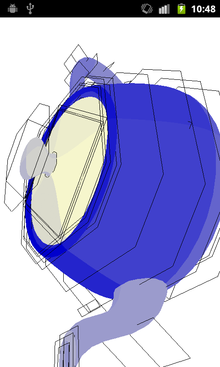
Teapot on Android I got myself a second-hand Samsung Galaxy S at last, and started hacking on it! The very first thing I wanted to try was porting the OpenGL wikibook C++ samples, that we wrote with OpenGL ES 2 in mind. I started writing a minimal GLUT-compatible wrapper to run the samples as-is, using the Android NDK, and I'm making progress :) The Android NDK is getting nicer with Android 2.3, though it still feels less supported than Java apps (e.g. the resize events seem buggy and the keycodes header is incomplete...). Nonetheless, it's nice to be able to write C++ portable apps. You can see how to use the wrapper, and how it works internally, at: http://en.wikibooks.org/wiki/OpenGL_Programming/Installation/Android One of the limitations is that GLES2 is not a true subset of OpenGL 2.1, in particular: I needed to pre-process these differences away, checking on GL_ES_VERSION_2_0 in the C++ source code to define a GLES2 macro in the shaders:
#ifdef GLES2
varying lowp vec4 f_color;
# else
varying vec4 f_color;
#endif
Is there a better way?

Stefano Zacchiroli: hardware sponsorship for Debian Developers

A few days ago Yves-Alexis Perez asked me how many hardware sponsorship request I usually get from Debian Developers, that is how many people ask me to use Debian money to buy material that can improve their work on Debian and indirectly Debian itself. The answer is "too few".
Making it easier for our developers to improve Debian is a worthwhile investment of money donated to Debian. Of course such a use of money should be motivated (i.e. you should be able to justify how the material you're asking for would improve Debian and why it should be Debian paying for it) and transparent (i.e. you should periodically report about what you're doing with material that Debian has bought for you to use). The above two principles are what I've tried to convey in a new section of the sponsoring guidelines wiki page I've been maintaining for a while. Comments and improvements highly welcome! Equally welcome are advocacy messages for hardware sponsoring to other fellow Developers, as suggested by Corsac.

Gunnar Wolf: BugCon friends, are you trying to scare away 50%+ of the target audience?

You are scaring away much more than that. I just came across an invitation for BugCon 2012. BugCon is a Mexican conference devoted to computer security I cannot comment on its level or value because, although it's a topic that has long interested me, I must recognize each day I feel less of an expert, nowadays finding myself at the level of a "sysadmin who tries not to be too dumb for his own job security". Oh, and also because it would be completely off-topic for this post. If you look at Vendetta's (the main organizer) blog post, it will probably give you the impression that the conference is just an excuse for the afterparty: Lets go see some b00bs! Do you think your fellow female hackers will have any interest in joining a bunch of sex-starved, hormone-infested teenagers who only want to pwn a website and grab more pr0n? Do you think females will feel welcome (or even mildly safe) between you? I would not think so. And I also think you are alienating any professional who might have any interest in joining your community, be it as a member, as a mentor, or whatnot. I cannot right now do a coherent post on this topic, but I can reference you to what I have seen (and read) over the last almost 10 years, when the issue was first brought up to our attention. I am very glad to see that, at least in the Free Software area, there has been a real change of mindset. I hope you are in time to think about it and rectify. Oh, and not the description of an incident, but a very interesting and thoughtful take on this: [pdf] Interesting analysis by Hannah Wallach on the numbers and motivations of women in Free Software groups. I don't know if Hannah has published this in article form, but many interesting points can be understood by looking at the presentation. My good friend Vendetta: I don't mean this post (longer than what I originally intended) as a way to say you and the conference you are organizing for the third year (IIRC) already is unprofessional or targetted to pimply teenagers. I know the work you have put in it. I hope you see the points I'm trying to drive You are of course free to have whatever afterparty you have. But, if as the main organizer, you are giving the images of nice chicks at Hooters more weight and relevance than to the conference itself... you are doing yourself a disservice. I hope you can rectify it, and make BugCon attractive to hacker women as well.

Lior Kaplan: RTL status for Libre Office 3.5.0

As LibreOffice is approaching its final 3.5.0 release, I d like to sum up the RTL status for RC1. So far, 6 RTL related bugs were resolved in the 3.5 cycle (#32530, #34222, #40950, #43790, #43793, #44078), and a few minor issues reported directly to the developer s mailing list got quick responses. Most importantly, the new features of page break and header/footer not only support RTL but actually looks good. During the LibreOffice conference I was suggested to help with these features, providing feedback, and I m glade the needed attention was given to it. Besides that, a few l10n and translation issues were solved in the process of doing the Hebrew translation (which also reflects on other RTL languages). At a few cases, these issue because a general l10n issues which affects all the languages. In general, I found the core developers responsive to mails about RTL support. I m sure the talk about RTL problems during the conference helped, as well as being more active in the project and having more personal acquaintance with the developers. That s being said, RTL support for LibreOffice still has problems, which I hope will be pushed during the 3.5.x cycles (full list at Bug 43808, the rtl meta bug). As to get some focus regarding was is to be done, I m listing the top problems:
  1. #44657 RTL UI: Horizontal scrollbar in calc main window is broken
  2. #33302 brackets inverted in rtl text (mac only)
  3. #37692 RTL list numbering reverses its direction
  4. #42070 - RTL support in broken in presenter Console extension
  5. #32531 - Incorrect cursor key movement between table cells of different directionality
  6. #104515 - RTL UI: moving active embedded object to the left moves it to the right (reported for OO.org, but verified in LibO)
  7. #37128 - Writer saves text alignment of RTL paragraph not according to the ODF specification
I hoped to have the first two done for 3.5.0, but didn t succeed in getting them fixed. Will keep trying
Filed under: i18n & l10n, Israeli Community, LibreOffice

23 January 2012

Christian Perrier: 2012 update 6 for Debian Installer localization

When you shake the tree, things happen..:-). I sent targeted update requests for level 2 (mostly espeakup and grub2). Status for D-I level 1 (core D-I files): Status for D-I level 2 (packages that have localized material that may appear during default installs, such as iso-codes, tasksel, etc.): Status for D-I level 3 (packages that have localized material that may appear during non-default installs, such as win32-loader) Full 100% completeness (hall of fame) for 14 languages: Bulgarian, Czech, German, Esperanto, Spanish, French, Italian, Japanese, Kazakh, Dutch, Portuguese, Russian, Slovak, Simplified Chinese

22 January 2012

Jon Dowland: bugs

[pic]
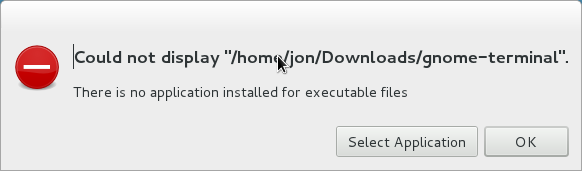
Bugs I've hit in GNOME 3, in the last 5 minutes: I didn't set out to bug-hunt this morning, I'm actually trying to get some work done. Whilst this is a particularly bad case of stacked-bugs, it's unfortunately, pretty representative of what it's like to try and use a Linux desktop at the moment. Every day I go through a similar experience. I've just had to give up and log out and back in again. The shell path bug above has re-surfaced in a new session. Great. I'm waiting on a delayed laptop at work. I'm very tempted to cancel the order and just use a Mac Air instead (we have one spare). It seems I'm walking the inevitable path of F/OSS desktop frustration and the end for many people seems to be the Mac perhaps I should spare myself the pain of the journey. In the mean time, It's bye-bye to GNOME and off to Xfce for me.

21 January 2012

David Welton: Thinking at the Margin

Something I've picked up from reading about economics is the concept of "the margin". It's a way of thinking about problems that more people ought to take into consideration. What is "the margin"? It's that space on a line, in the middle, between two extremes, where the transition from "yes" to "no" occurs. If I offered you a million dollars for the computer you're reading this on (for broad definitions of 'computing device'), you'd probably take me up on the offer. For 0 dollars, you would not. Somewhere, in the middle, is a number where you'd change your mind from "nope, won't sell" to "well... sure, what the heck". That is, loosly defined, a margin. As an example, when people debate about "intellectual property", they often use terrible examples: companies like Microsoft, or performers such as Lady Gaga. Those are bad examples because they are complete outliers, way off on one end of the curve. It's hard to disagree with "so what if Lady Gaga earns a bit less revenue from her music, she's got plenty to live on" when you talk about copyright being a means for artists to support themselves with. Thinking "at the margin" is about those bands that currently barely sell enough music to work professionally as musicians. In scenario A, they are able to work creating music, thus creating more, and likely better music than if they merely pursued it as a hobby. In scenario B, they fall on the other side of the margin and therefore have to get 'real jobs'. This means that their music takes a back seat, and they produce less of it. Now, copyright and company are a complex conundrum with many facets; my point is simply that when thinking about big changes, we should think what will happen at the margin, not what will happen to the outliers.

Joey Hess: olduse.net 1982

Hard to believe I've consumed all of 1981's Usenet posts now on olduse.net, and it's been running for 7 months already.
Last night, there was a "very long" post, describing nearly every node on usenet in 1982. There had been a warning about this post the day before, since it would take many sites half an hour to download at 300 baud. It was handily formatted as a shell script, which created per-node files. So, I ran this code nobody has run since 1982. It worked. I got files. I tossed them on the olduse.net wiki, and used some ikiwiki code TOVA contracted me to write just a few months ago, to make clickable links on my usenet map. usenet map The map data was contributed in another post a while back. By 1982, usenet is getting nearly impossible to map with 1982 technology of ascii art. I enjoyed throwing graphviz, git, wikis, and the web at it. So, we have a collaboration across time, me and "Mark" and a lot of people who described their usenet nodes and piles of technology that make creating a mashup easy. Awesome!
I blog about stuff I find on the olduse.net blog. It's an open blog; Koldfront also blogs there, and we welcome other bloggers. Some of the highlights for me have included: As the space shuttle program is winding down, reading the excitement about the first shuttle flights, and the play-by-play coverage of a launch, posted to net.columbia by a high school student borrowing his dad's account. (A usegroup name that's hard to read without remembering its fate). The announcements of the Motorola M68k, the IBM PC, and the CD-ROM. world ipv6 launch Reading the TCP-IP digest, and Postel's plans for launching IPv4 soon, while the world IPv6 launch is being planned now. (The nay-sayers are especially fun to read. Including the guy who was concerned about the address space size, in 1981!) Learning that nethack ascention tales have a history streching back 30 years, to rogue, and that the stories back then had much the same flavor as they do today. Various celebrity sightings. Dennis Ritchie teaching C and Unix. Bill Joy talking vi. RMS talking .. nuclear politics? The general development of usenet. B-news being rolled out, groups proliferating, many first inklings of what will be major problems and developments in 5 or 10 years. A shift in tone is already apparent, by now usenet is not only about announcements, there are already some flames. oldusenet in a period terminal Still 9 years to go!

20 January 2012

Enrico Zini: Debtags for derivative distributions

Debtags for derivative distributions Sometimes I do cool stuff and I forget to announce it. Ok, so I recently announced a new Debtags website. I forgot to say in the announcement that the new website does not only know of Debian packages: see for example this page, at the very bottom it says: "Distributions: oneiric, precise, sid, testing". This means that already, here and now, debtags.debian.net can be used to tag packages from both Debian and Ubuntu, and can easily be extended to cover the entire Debian ecosystem. If you are a package maintainer, you will notice that your maintainer page shows your packages from everywhere. If you want to filter things a bit, for example hide obsolete packages from an old Debian Stable or Ubuntu LTS, just click on the "Settings" link on the top right to configure the page. How it works The magic is in this mergepackages script, which is run daily, and exports merged Packages files at dde.debian.net. The debtags.debian.net concept of Packages and Sources files are just those all-merged.gz and all-merged-sources.gz. The merging is simple: that rebuild script processes files in order, and the first version of a package that is found is chosen as the base for the one that will go in the merged Packages file. Some fields like "Description" are just taken from this pivot package, others like Architecture or dependencies are merged into it. It's arbitrary, but works for me: the result has all the packages with all their possible architectures and dependencies, and is ready to be indexed with apt-xapian-index. At the moment I pull data from Debian and Ubuntu, but you can see that the script can easily be extended to pull data from any Debian-style ftp archive, so any Debian derivative can go in. I've already started negotiations with the Derivatives Census on how to add any Debian derivative and keep the list up to date. How to export tags for your own distribution I'll use Ubuntu as an example since the data is already available. The way you add Debtags to the Ubuntu packages file is just this one:
  1. Get the full reviewed tag database
  2. Optionally filter out those packages that you are not interested in
  3. Tweak this script to build an overrides file.
  4. Give the overrides file to your favourite ftp archive building tool.
The make-overrides is a bit rusty: if you improve it, please send me your changes. That is it, nothing else required, no excuses, it's ready, here, now! Hitches and gotchas This merged Packages file is a bit of a hack, and suffers from name conflicts across distributions, where two different softwares are packaged in two different distributions with the same name. Ideally, name conflicts should not happen: if a derivative decided to package kate and call it gedit, they deserve to have it tagged uitoolkit::gtk. I think it's rather important that the whole Debian ecosystem works as much as possible with a single package namespace. However, that reasoning fails if you take time into account: packages get renamed, like git and chromium, and may mean completely different things, for example, if you compare Debian Stable with Debian Sid. This last is a problem caused by debtags only working with package names but not package versions. I have a strategy in mind based on being able to override the stable tag database using headers in debian/control; it still needs some details sorted out, but I'm confident we will be able to address these issues properly soon enough. Why stop at the Debian ecosystem? Why indeed. I'm clearly trying to use FOSDEM, and the CrossDistribution devroom as the venue to discuss just that.

19 January 2012

Obey Arthur Liu: Google Summer of Code 2009 at Debian needs you


In case you've been living under a rock these past years, I shouldn't have to tell you what this is about :). Well, just in case.
The Google Summer of Code (GSoC) is an international program that offers student developers stipends to write code for various open source software projects. Debian has participated since 2006, mentoring dozens of students on Debian projects.

The important part of the 2009 edition of the Google Summer of Code is going to start next week with the Organizations application period (March 9th). By that time, we should have listed a reasonable number of ideas on the dedicated wiki page.

We will try this year to improve on the performance of the previous years, starting first with more and more dedicated manpower. If you have some time to spare to help manage our Summer of Code bid this year, we can make it a much better experience for the students and for Debian.

Help is immediately needed in many areas. Some examples:

By mid-March, we will need:

Further in the spring:

In the summer:

As you can see, there is much work ahead. It's time to pitch out your favorite pet project :)
Remember! The Summer of Code has become a prominent outreach forum for open source organizations. It puts a spotlight on each of them to provide a well-rounded and deep experience of open source development.

Right now, you can help with the Wiki, join us on IRC on #debian-soc on OFTC or join the mailing-list at soc-coordination on alioth.

The short "flyers-friendly" URL for the Summer of Code at Debian is : <http://wiki.debian.org/gsoc>. Publicize it!

See you this summer!

Christian Perrier: 2012 update 5 for Debian Installer localization

Status for D-I level 1 (core D-I files): Status for D-I level 2 (packages that have localized material that may appear during default installs, such as iso-codes, tasksel, etc.): Status for D-I level 3 (packages that have localized material that may appear during non-default installs, such as win32-loader) Full 100% completeness (hall of fame) for: Czech, German, Spanish, French, Italian, Kazakh, Dutch, Portuguese, Russian, Slovak

18 January 2012

Tanguy Ortolo: Debian buttons for Firefox/Iceweasel

As a Debian administrator, power user or contributor, one often goes to look for information about a package, a bug, a developer or a message from the mailing lists. If you are in this case, you may be interested in the Firefox/Iceweasel extension Debian buttons , written by Damyan Ivanov and packaged by myself.

An Iceweasel toolbar with five Debian-related buttons
Description When installed, this extension provides five buttons, that you can place in your Firefox or Iceweasel toolbar. These buttons take the text from the X11 PRIMARY selection and act as shortcuts to the web pages corresponding to: Typical use case Let us imagine you see the following sentence on IRC:
12:42 < Tanguy> I am packaging a cool Firefox/Iceweasel extension (ITP #654896)!
If you want to check out the corresponding ITP report, just double-click on the bug number to select it (do not worry about the leading hash or even the possible trailing bracket, it will be handled), and click on the BTS button on your browser toolbar: here you are! Depending on your needs and habits, this extension may considerably speed up and simplify your quests for information. At least, it does for me, so I hope you will enjoy it too!

Sylvestre Ledru: Major changes in the Debian HDF5 packages

Yesterday, I uploaded hdf5 1.8.8 in unstable. This new version, which has been available in experimental for a while, is a major step in the HDF5 packaging. For those who are using this package, besides the switch from version 1.8.6 to 1.8.8, the changes are the following: More information about the transition:
http://release.debian.org/transitions/html/hdf5.html TODO: Fix the FTBFS (Fail To Build From Sources) under sparc & ia64.

Next.

Previous.